
Reconstructed breed
Dutch Smoushond: The Breed That Died Out and Was Rebuilt From Strays
The Hollandse Smoushond is the clearest documented case in dog breeding of a breed being rebuilt after it stopped existing. The FCI's own standard says the last litter was registered in 1949 and that the woman who restarted it in 1973 began with crossbreeds that looked right. Here is what that actually means for the dog you see today.
Quick answer
The Dutch Smoushond cannot be bought in India at any price. Its entire world population lives in the Netherlands, the Hollandse Smoushonden Club fixes the price at 600 euro, the waiting list runs about 250 people and three to four years, and the club tells foreign enquirers plainly that it cannot yet afford to export dogs. The breed itself died out after 1949 and was rebuilt from 1973 out of look-alike strays and five Border Terriers.
This guide summarises breed-standard documents, kennel-club register data, peer-reviewed veterinary research, Indian import and breeding law and satellite climate data as general information for Indian pet owners. It is not a diagnosis and it is not treatment advice. Consult a registered veterinarian near you before acting on anything you read here, and treat collapse, laboured panting that does not settle, a swollen or painful abdomen, sudden blindness or a whelping that stalls as an emergency and go straight to a clinic.
Dutch Smoushond at a glance
What the Dutch Smoushond is, and why its history has a hole in it
The Dutch Smoushond is a small yellow rough-coated Dutch companion dog, FCI standard 308, and the only breed on this site whose own governing standard records the moment its population stopped existing and the year somebody started it again.
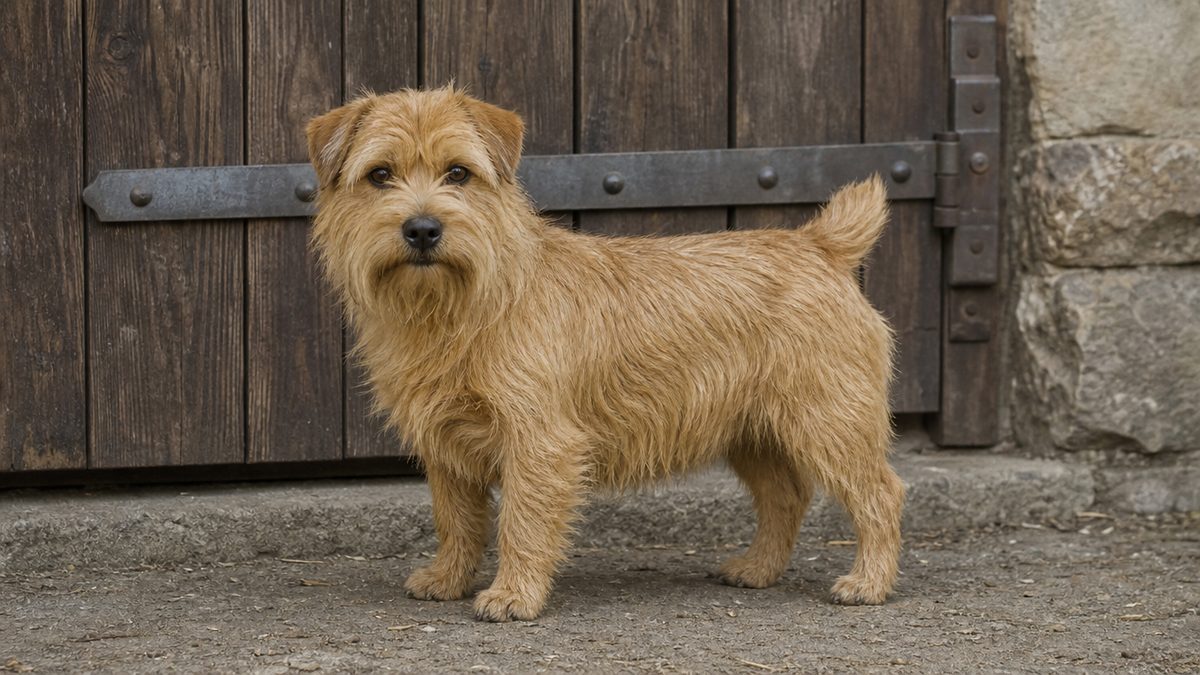
Start with the plain description, because the breed standard is short and unambiguous. The dog is rough coated, lively, active, strong and squarely built, compact and sturdy, with a broad shortish head, a distinct stop, small drop ears set rather high, and a short tail carried gaily but never curled over the back. The colour is self-coloured yellow in any shade with a preference for dark straw, and any other colour is undesirable.
The size and appearance are those of a small dog rather than a medium one, whatever three ranking pages say. Males stand approximately 37 to 42 cm at the withers and females approximately 35 to 40 cm. That is a dog you can pick up.
Where the name and the job came from
The breed began as commercial stock rather than as a breeding project. Around 1830 an Amsterdam dog dealer named Jan Abraas sold straw-yellow puppies as Heeren Stalhond, the gentleman's stable dog, and he did not breed them himself: he bought them in Rotterdam, probably in the harbour. Merchants who moved their goods by horse and cart kept the feed in the same stables the horses stood in, rats and mice followed the feed, and Abraas's yellow dogs turned out to be excellent at killing them.
The FCI standard tells the same story from the buyer's end. In the middle of the nineteenth century it was popular among the Dutch upper middle classes to follow horse and carriage and catch rats in the stables, and a dog dealer in Amsterdam sold these dogs as gentleman's stable dogs to visitors of the Amsterdam commodity exchange. The name Smous, meaning rough bearded, came into use to distinguish the dog from the Brussels Griffon.
The breed club is franker about the etymology than the FCI is. It records that the dog was called a Smous because its rough coat and hairy face resembled the equally bearded Jewish traders of Amsterdam, who at the time were themselves called Smouzen. The word has a history in Dutch that a modern reader should know about rather than have smoothed over.
The claimed German origin, and how firm it is
The Schnauzer theory is a suggestion by a named person, not a finding. The Dutch cynologist L. Seegers proposed that the little dogs came from Germany and might descend from the German Wirehaired Pinscher, today's Schnauzer, reasoning that yellow is an undesirable Schnauzer colour and that mis-coloured puppies could leave Germany cheaply by ship to Rotterdam harbour. The FCI records the same idea in the weaker form that the origin is uncertain but it is generally believed the yellow Schnauzer was one of the original dogs.
Seegers is also the man who wrote the first breed standard, in 1905, together with H. A. Earl of Bylandt and A. Woltman Elpers. In the same year the Hollandse Smoushonden Club was founded, and the name Hollandse Smoushond was chosen deliberately to avoid confusion with the Belgian Smoushondjes, the Griffon. That is worth holding on to: the man who proposed the origin also wrote the specification, so the German theory and the breed standard come from the same pen.
The hole
Then the history stops. The horse went out of use as transport, demand for Abraas's stable dog fell with it, wealthier buyers preferred expensive foreign breeds, and the club died a quiet death. In the second half of the 1940s only four litters were born, and after 1949 no litter was bred at all. The Raad van Beheer puts it without qualification: just after the Second World War the Hollandse Smoushond was completely extinct.
The reconstruction: what actually happened after 1973
In 1973 two Dutch women who remembered the yellow dogs of their childhood decided to rebuild the breed from scratch, and the FCI's own standard records it: Mrs H. M. Barkman van der Weel took the initiative to reconstruct the breed and started with crossbreeds that looked like the Dutch Smousdog.
That sentence is the most important one on this page, and almost nobody quotes it. It is not a claim by a breed club, a hobbyist or an aggregator. It is the historical summary printed inside FCI-Standard N 308, the document every kennel club in the FCI system judges the breed against. A governing body stating in its own specification that the breed was reconstructed from crossbreds selected on appearance is about as good as documentary evidence gets.
Twenty-four years of nothing
The gap is exact and both Dutch sources agree on it. After 1949 no litter was bred, and it stayed silent for twenty-five years before the two women got together in 1973. The FCI dates the last Nederlands Honden Stamboek litter to 1949 and the reconstruction initiative to 1973, which is the same twenty-four-year hole counted from the other end.
The method: an advertisement in the newspapers
The recruitment mechanism was a small ad. Riek Barkman placed appeals in newspapers and other magazines carrying a photograph of Jopie, the Smousje belonging to one of her childhood friends, and asked anybody with a similar dog to come forward. The rare breeds foundation describes the same step as an appeal in the national daily papers that put them in touch with people who had a smousachtig, a Smous-like, little dog.
There were a great many replies, and the programme is candid about why. It attributes the flood of look-alikes to the extraordinary popularity of the poodle at that moment: poodles were running loose all over the Netherlands, loose and in season, so a good number of small dogs happened to look a lot like a Smousje. That is the reconstruction programme itself telling you that a substantial part of what answered the advertisement was poodle-cross street stock.
Who did it, and with what qualifications
Barkman had no dog-world background at all beyond her own Border Terrier, and the programme says so. What she had instead was institutional cover: Martin van de Weijer, a judge and at the time secretary of the Raad van Beheer, supported the project wholeheartedly in its early years. A national kennel club's own secretary backing a phenotype-led rebuild is why this became a recognised breed rather than a private strain.
The second woman drops out of the story quickly. The rare breeds foundation names the pair as Riek Barkman and Mia van Woerden, while the programme's history says Mia van Woerden withdrew fairly soon and the work fell to Barkman's persistence. The same programme page spells her name two ways, van Woerden and van Woerkom, within a few paragraphs, which is worth flagging rather than tidying away.
How the dogs were assessed
The assessment regime was unusually thorough for a hobby project. Every dog was visited two or three times in its life: in the nest at seven weeks, again at seven months at its new owner's home, and once more as an adult. From 1979 Barkman did this with Fredie van der Giessen, every Wednesday, across the whole country. All the data was recorded, catalogued and photographed into a long series of photograph albums.
The selection priority is the detail that decides how you read the modern dog. Barkman's breeding policy put health and character first and treated appearance as subordinate, and dogs that were unhealthy or had a deviant character were excluded from breeding. In 1985 she and van der Giessen founded the Stichting Terugfokprogramma Hollandse Smoushond, after Barkman persuaded a tax inspector that the work was cultural heritage and therefore deductible.
Thirty foundlings and five Border Terriers: the founding stock, counted
The present Dutch Smoushond population descends from thirty foundling look-alikes plus five Border Terriers, and the reconstruction programme publishes both numbers on its own website.
No English-language page carries either figure. The programme's history states flatly that the current breeding originates in thirty of these foundlings. That is the founder count for an entire breed, and it is small enough that an Indian reader can hold the whole gene pool in their head.
The Border Terrier crosses, dated
The Border Terrier went in twice, and the dates are specific. The first use was Barkman's own bitch, mated to a foundling Smous, and the programme says the very first attempt produced an exemplary typical Smoushond. Then in 1983 and 1984 four more Border Terriers were used, males this time. Five Border Terriers in total, one female and four males.
The programme also lists what the Border Terrier was brought in to fix, and the list is a description of the dog you see today: good size, a short head, a very dark eye, a good tail, a hard coat, and a very free and people-oriented character. Compare that against the FCI standard's requirements for a broad shortish head, large round dark brown eyes, a rather short tail and a coarse wiry harsh coat and the overlap is close to complete.
| Element | Number | When | What it contributed |
|---|---|---|---|
| Foundling look-alikes | 30 | From 1973 | The base population, recruited by newspaper advertisement |
| Border Terrier bitch | 1 | Early, exact year not published | Barkman's own dog; the first cross produced a typical Smoushond |
| Border Terrier males | 4 | 1983 and 1984 | Size, short head, very dark eye, tail, hard coat, free people-oriented character |
| Look-alike outcrosses since | Not published | Continuing | Still used, always on the programme's initiative |
The outcrossing has never stopped
This is the finding that changes how the breed should be described, and it comes from the club's own FAQ. Asked whether a Smoushond may be mated to another breed, the club answers no, and that the Raad van Beheer will issue no pedigrees for such a litter. Then it adds that sometimes a look-alike dog or a Border Terrier is used, always on the initiative of the back-breeding programme.
So the programme that began in 1973 is not a historical event. It is a live procedure, and unregistered look-alikes and Border Terriers are still being fed into the population under its authority. The club describes the breed in the present tense as a ras in opbouw, a breed under construction, and the Dutch information centre says the same: they are still busy building this breed up.
The club's puppy page explains why the waiting list moves unpredictably, and one of the reasons is that buyers state preferences. Some people do not want a puppy from a look-alike, it says, and others specifically do. A buyer can only hold that preference if look-alike-descended litters are being placed now. That single sentence settles the question more firmly than any history page could.
Continuity or re-creation? What the modern dog's relationship to the old one actually is
The modern Dutch Smoushond is a re-creation rather than a continuation, and the distinction is not a technicality: no dog alive today has a documented line of descent to any dog registered before 1949.
Set out the two possible claims plainly. Continuity would mean surviving pre-war dogs, or their unregistered descendants, were gathered up and their line resumed. Re-creation means a target description was written down and dogs were selected against it until the description was met. The FCI standard describes the second: Barkman started with crossbreeds that looked like the Dutch Smousdog.
The Dutch information centre is more specific still, naming what the crossbreeds were: the breed was bred back from, among other things, mongrel dogs that resembled the original Smoushond, and a single Border Terrier, with selection made mainly on health and character. Nothing in any Dutch source claims a surviving registered line.
The target was a photograph and a 1934 bitch
What makes this case unusually clean is that the target is identifiable. Barkman advertised with a photograph of one specific dog, Jopie. And the breed club records that Binkie, a bitch bred in 1934 by the Keeshond breeder Mrs C. van den Hurk, is still considered a very fine specimen and stands as the model for today's Smousje. So the modern dog was bred toward the remembered look of individual dogs from the 1930s and 1940s.
That 1930s episode is itself a first rebuild, and it is almost never mentioned. When the club was reduced to a remnant it asked van den Hurk, a breeder of a different breed entirely, to take the Smous on, and she and another breeder laid the basis for the reconstruction of the breed. The Dutch Smoushond has therefore been rebuilt twice, once in the 1930s from a shrinking registered population and once from 1973 with no registered population at all.
What the honest description is
Three statements are all defensible at once, and a good page makes all three rather than choosing one. First, the Dutch Smoushond is a genuine recognised breed: the FCI accepted it on a definitive basis on 11 March 1981. Second, its type is continuous, because the 1905 standard was revised rather than replaced in 1980. Third, its population is not continuous, because it was rebuilt from dogs of other ancestry.
| Claim | Continuous? | Evidence |
|---|---|---|
| The written standard | Yes | 1905 standard revised in 1980, not replaced |
| The breed name | Yes | Hollandse Smoushond, chosen 1905, unchanged |
| The breed club | No | Founded 1905, ceased to exist by the war, refounded; the club has protected the breed since 1978 |
| The stud book line | No | Last NHSB litter 1949; nothing registered for twenty-four years |
| The living population | No | Rebuilt from thirty foundling look-alikes and five Border Terriers |
| The breeding programme | Open, still running | Look-alikes and Border Terriers still used on the programme's initiative |
Why this matters to a buyer rather than a historian
It matters because it changes what a pedigree means. In a closed studbook a pedigree traces to a founding population; here it traces to a selection decision made about a stray in the 1970s or later. That is not a criticism of the dogs, which are by every Dutch account healthy and pleasant. It is a reason to treat claims of ancient lineage, and any price premium attached to them, as marketing rather than fact.
There is a real argument on the other side and it deserves stating. Barkman selected on health and character for four decades and excluded unsound dogs and unsound temperaments from breeding. The breed that came out the far end has no compulsory health screening because Utrecht University found no hereditary conditions needing special attention, and the one peer-reviewed figure that exists describes its epilepsy incidence as remarkably low compared with most pedigree breeds. A rebuild done that way may produce a sounder dog than a closed studbook would have.
The registration record, year by year, from the Dutch Kennel Club's own database
Three thousand one hundred and forty-seven Dutch Smoushonds were registered in the Nederlands Honden Stamboek with birth years between 1997 and 2025, an average of 108.5 a year, and no page anywhere has published that count before.
The Raad van Beheer runs a public interface to its own stud book called Dutch Dog Data, covering every dog registered in the NHSB and born in or after 1997. It is a search tool rather than a statistics page, so the counts below were pulled year by year through its own endpoint on 27 August 2026, and every returned row printed Hollandse Smoushond in its breed column, which is the check that the database served the breed asked for.
| Years | Registrations | Yearly mean | Lowest year | Highest year |
|---|---|---|---|---|
| 1997-2005 | 785 | 87.2 | 65 (2005) | 112 (2000) |
| 2006-2015 | 1,211 | 121.1 | 71 (2010) | 158 (2009) |
| 2016-2025 | 1,151 | 115.1 | 82 (2023) | 144 (2022) |
| 1997-2025, all | 3,147 | 108.5 | 65 (2005) | 158 (2009) |
| 2026, part year | 53 | n/a | n/a | latest birth 27 June 2026 |
Proving the instrument before trusting the number
A count is only worth as much as the query behind it, so three controls were run in the same session. Labrador Retriever returned 2,709 registrations for 2024 and 2,771 for 2025, with rows printing Labrador Retriever. Border Terrier returned 204 and 166, with rows printing Border Terrier. A nonsense breed code returned zero for both years. So the tool distinguishes breeds correctly and a zero from it would be a real zero.
That Border Terrier figure is worth pausing on. In 2024 the Netherlands registered 204 Border Terriers and 138 Dutch Smoushonds. The breed used to rebuild the Smoushond is now roughly half again as numerous in the Smoushond's own country.
Does the registration record support the claimed population?
The Raad van Beheer says there are now about 1,500 Hollandse Smoushonden in the Netherlands. Test that against the registrations rather than accepting it. In the last ten complete years, 1,151 puppies were registered, and the Dutch sources put average lifespan at about thirteen years. A population turning over at roughly 115 a year with a thirteen-year life expectancy lands close to 1,500 living dogs, so the club's figure is internally consistent rather than a round number picked for a website.
The rare breeds foundation gives a second, narrower figure from a different angle: 700 bitches, risk status Endangered, trend stable over fifteen years. Seven hundred females inside a population of about 1,500 is close to the even sex ratio you would expect, so the two independent Dutch bodies agree with each other and with the register.
Dutch Dog Data starts at birth year 1997, so it cannot show the reconstruction climbing from zero through the 1970s and 1980s, and nothing on this page should be read as covering that period. What it does show is a population that has been flat for a quarter of a century. It has not grown since the reconstruction succeeded, and with the club running a three to four year waiting list, that is a supply decision rather than a demand problem.
Recognition status, register by register, each one checked with a control
Two of the four registers checked list the Dutch Smoushond: the FCI accepted it definitively on 11 March 1981 and the United Kennel Club recognised it in 2006, while the American Kennel Club and the Royal Kennel Club do not list it at all.
Recognition is where aggregator pages invent most confidently, so each register below was read in full and searched with control breeds in the same session. An absence only counts when a breed you know is present comes back.
| Register | Listed? | Detail | Control run in the same session |
|---|---|---|---|
| FCI definitive register | Yes | Standard 308, Group 2 Section 1.3, accepted definitively 11 March 1981 | Entry read directly; breed name printed on the returned page |
| United Kennel Club | Yes | Recognised 2006, placed in the Terrier Group | Standard read on UKC's own site, copyright 2006 |
| American Kennel Club | No | Absent from the complete breed selector, Foundation Stock Service included | Keeshond, Border Terrier, Affenpinscher and Schnauzer all returned |
| Royal Kennel Club | No | Absent from Breeds A to Z | Keeshond, Border Terrier, Schnauzer, Affenpinscher and Griffon all returned |
| Kennel Club of India | By FCI nomenclature | India is an FCI full member represented by the KCI, Chennai | FCI members register read directly |
| OFA disease statistics | No | No breed code, no evaluations published | Labrador, Border Terrier, Keeshond, Otterhound and Harrier all returned |
The two registers that do list it disagree about what it is
The FCI puts the Dutch Smoushond in Group 2, Section 1.3, Pinscher and Schnauzer type, with its own subsection named Smoushond. The United Kennel Club puts the same dog in the Terrier Group. Two governing bodies, one breed, two different families. Neither is wrong exactly, since the FCI has no terrier group that a pinscher-type could sit in and the UKC has no pinscher group, but a reader should know the classification is a filing decision rather than a finding about the dog.
The UKC standard has not been updated since 2006, and it says so accidentally
The UKC document carries a heading called Gait whose entire content is the sentence 'Not mentioned in FCI standard';. The current FCI standard does have a gait clause, requiring an easy, supple and regular gait. So the UKC standard was written from a pre-2012 FCI text, the placeholder was never filled, and the page still carries its original 2006 copyright line. That is a small thing that tells you how little editorial attention this breed gets outside the Netherlands.
What the American absence means, and what it does not
The American Kennel Club's breed index was retrieved in full and carries the complete selector, including Foundation Stock Service entries such as the Alaskan Klee Kai, the American Leopard Hound and the Bouvier des Ardennes. The Dutch Smoushond is not on it, and the only Dutch entry is the Dutch Shepherd. The page's own text states that the American Kennel Club recognizes 200 breeds.
The Royal Kennel Club's Breeds A to Z behaves the same way: the breed is absent, while Keeshond, Border Terrier, Schnauzer, Affenpinscher and Griffon all return in the same retrieval. So does the Orthopedic Foundation for Animals, whose full disease-statistics page carries no Smoushond row against Labrador, Border Terrier, Keeshond, Otterhound and Harrier controls that all return. That last absence is expected rather than telling, since OFA needs 100 hip evaluations or 50 for its other databases before a breed appears at all, and an American register cannot hold data on a breed that has never left the Netherlands. Two ranking pages nonetheless assign the breed to the AKC's Non-Sporting group DogBreedsFinder.com, Dutch Smoushond. One of those cites the FCI as its reference source on the same page, and the FCI has no Non-Sporting group. That is a page contradicting its own citation in its own sidebar.
The Kennel Club of India publishes no breed list for any breed, so querying it returns nothing for the Dutch Smoushond and nothing for a control either. That is a broken instrument, not a finding, and it must not be reported as the breed being unrecognised in India. The route that works is the FCI members register, which lists India as a full member represented by the Kennel Club of India in Anna Nagar, Chennai. Since the KCI issues pedigrees inside FCI nomenclature, FCI standard 308 answers the Indian recognition question in practice.
What the breed standard says, and where the three published versions disagree
Three documents describe this dog and they disagree on weight, on dewclaws and on which group the breed belongs to, so a buyer comparing spec cards is comparing three different specifications.
The FCI standard is the governing one and it is short. Height at the withers: males approximately 37 to 42 cm, females approximately 35 to 40 cm. Weight varies between 7 and 11 kg. Coat coarse, wiry, harsh, straight and unkempt-looking, approximately 4 to 7 cm long with a sufficient undercoat, and a curly or woolly coat or a tendency to mat is undesirable.
| Field | FCI 308 (2012) | United Kennel Club (2006) | LICG (Dutch government-backed) |
|---|---|---|---|
| Group | Group 2, Pinscher and Schnauzer type | Terrier Group | Rasgroep 2 |
| Height, male | approx 37-42 cm | 14-16.5 in (35.6-41.9 cm) both sexes | 37 to 42 cm |
| Height, female | approx 35-40 cm | as above | 35 to 40 cm |
| Weight | 7-11 kg | 20-22 lb (9.07-9.98 kg) | 9 to 10 kg |
| Bite | Scissor preferred; pincer or slightly undershot not faulty | Scissors, level or slightly undershot | Not specified |
| Dewclaws | No dewclaws | Not mentioned | Not specified |
| Tail | Rather short, carried gaily, not curled over back | Undocked, rather short, carried gaily | Carried gaily, not curled over the back |
| Coat length | approx 4-7 cm | 1.5-2.5 in (3.8-6.4 cm) | 4 to 7 cm |
The weight disagreement, and which figure to trust
The FCI's 7 to 11 kg is the widest band and the other two sit inside it. The UKC's 20 to 22 pounds converts to 9.07 to 9.98 kg, which is the LICG's 9 to 10 kg to within a rounding error. So two independent sources describe a real population clustering near 9.5 kg, while the governing standard allows a dog anywhere from 7 to 11.
That matters for one specific reason in India, and it is the only place on this page where the heat evidence gives good news. Hall and colleagues found dogs in every bodyweight category over 10 kg had greater odds of exertional heat-related illness than dogs under 10 kg. A Smoushond at the LICG's 9 to 10 kg sits on the favourable side of that line; one at the FCI's upper limit of 11 kg does not.
The dewclaw clause, which nobody outside the FCI carries
The FCI standard's hindquarters section contains three words that matter more in India than in the Netherlands: 'Metatarsus (Rear pastern): No dewclaws';. The UKC standard does not mention dewclaws at all. The law section of this page sets out why a standard requiring their absence collides with Indian breeding rules.
What the standard disqualifies
The disqualifying faults are worth knowing because they are unusually behavioural. The FCI disqualifies aggressive or overly shy dogs, any dog clearly showing physical or behavioural abnormalities, lack of breed type, and fraudulent modification of the dog. The UKC adds albinism and any colour other than yellow, and disqualifies unilateral or bilateral cryptorchid males.
Lack of breed type as a disqualifying fault is a striking thing to find in a breed reconstructed from look-alikes. It is the standard doing the job Barkman's photograph of Jopie once did: defining the target the dogs are still being selected toward.
Dutch Smoushond price in India, and the fixed 600 euro the club actually charges
No Dutch Smoushond price in india exists, because no Dutch Smoushond has ever been sold in India, and the only price in the world is a fixed 600 euro set by the breed club rather than a market range.
Say the second half first, because it is the more unusual fact. The Hollandse Smoushonden Club answers the question 'Wat is de aanschafprijs van een Smouzenpup?' with two words: 600 euro. The Dutch national pet information centre confirms it and adds the mechanism: a Smous puppy with an FCI pedigree costs a maximum of 600 euro, and this price is set by the breed club.
That is a price ceiling imposed by the governing body of the breed, not an average of what sellers ask. There is no premium tier, no champion-bloodline band and no city-by-city variation, because there is one supply chain and it is a waiting list rather than a market.
| Source | Figure | What kind of number it is |
|---|---|---|
| Hollandse Smoushonden Club FAQ | 600 euro | The club's own fixed price |
| LICG (Dutch information centre) | Maximum 600 euro | Independently confirms the club-set ceiling |
| BreedsPedia | 600 to 2,000 euro | Correct at the bottom, unsourced at the top |
| DogBreedsList | Puppy Prices: Average (Unknown) | An unfilled template field, printed as data |
| Indian listing sites | No rupee figure for this breed | The searches return a different breed entirely |
| Bonbeno's finding | No Indian price exists | There is no lawful route for one to form |
What an Indian search for this breed actually returns
Search 'dutch smoushond price in india' from an Indian location and the results are almost entirely about a different dog. The top organic results include a marketplace page for Dutch Shepherd puppies quoting INR 1,20,000 to INR 5,00,000, a Dutch Shepherd price guide, an Instagram reel selling a Dutch Shepherd, and a government marketplace listing for a police Dutch Shepherd at Rs 1,30,000. The one result that is genuinely about the Smoushond is a book on Amazon.in at Rs 1,281.
That substitution is the finding. An Indian buyer typing the breed name into a search box is shown the Dutch Shepherd, a 30 kg working breed with no relationship to a 9 kg stable ratter beyond the word Dutch. Anybody who does not notice the switch will conclude that a Dutch Smoushond costs somewhere around a lakh, and the number they take away describes a different animal entirely.
The Indian pages that name the breed correctly
Two Indian sites do print the breed name, and neither is selling one. JustDial generates a 'Pet Shops For Dutch Smoushond Dog' page per city; the Guwahati one lists an aquarium shop and a pet clinic, which are the businesses that would be returned for any pet query in that city. The national version of that page would not load for verification, so no conclusion is drawn from its search snippet.
PuppsStud, an Indian KCI-registered puppy marketplace, has DUTCH SMOUSHOND in its breed filter. The phrase appears exactly once in the page source, inside an alphabetical dropdown that also carries DUTCH PARTRIDGE TERRIER and EPAGNEUL PONT-AUDEMER, on a Bangalore listings page whose actual stock contains neither this breed nor a Labrador Retriever. A breed name in a filter menu is a template, not an offer.
Bonbeno's price sections normally cover adoption and availability rather than a purchase market when a breed is not sold through commercial channels. This is that case taken to its limit: not a thin market but no market, in a country with no dogs of the breed, supplied by a club that does not export.
Why you cannot get one: the club's own answer to a foreign enquirer
The Hollandse Smoushonden Club publishes a direct answer to people living abroad who want a Smoushond, and it is no: it says it cannot yet afford to export dogs.
The club's FAQ carries the question in plain Dutch, 'Ik woon in het buitenland. Hoe kom ik aan een Smousje?', which is 'I live abroad. How do I get a Smousje?' The answer opens by saying they must disappoint you, and closes with the sentence that settles this page: we have an unacceptably long waiting list of residents of the Netherlands only, and unfortunately we cannot yet permit ourselves to export dogs.
The reasoning is logistical rather than protectionist, and the club sets it out. A dog living too far away is lost to the back-breeding programme. If it is a male, owners of bitches are often unwilling to drive a long distance on the day she is ready. If it is a female, it is burdensome for the programme to drive that far for a litter, twice. Every dog is needed, so every dog has to be reachable.
The Dutch information centre states it as a flat rule
LICG puts it more bluntly than the club does, twice on the same page. Purebred Smoushonds occur only in the Netherlands, because it is not permitted to export them. And later: it is not possible to buy a puppy from abroad, and one may not export Smous puppies. Note the register: this is a rule of the breeding programme, not a Dutch law, and this page describes it that way.
The waiting list, and the club's two different answers about it
There is a waiting list and the club's own site gives two different lengths for it. The FAQ says the current waiting time is about two and a half to three years and the list is about 250 serious people long. The puppy page says the wait is currently about three years for a male and four years for a female. Both pages are live on smoushond.nl today, and this page prints both rather than picking one.
The list also has a second tier the club is careful to describe. When your turn comes and the timing does not suit, you move to a long-term list without losing your place, and you make contact yourself when you are ready. People who sit on that long-term list for twelve years without making contact are removed. A twelve-year housekeeping rule tells you how long these queues really run.
The Indian end is closed independently
Even if the club changed its mind, the Indian route would still be shut for a purchase. Dogs sit under ITC(HS) 01061900 as a Restricted import, and Policy Condition 7 allows import only for a pet dog with a valid pet book in the importer's name, for research organisations with a CPCSEA recommendation, or for internal security by the Defence and Police Force. Policy Condition 8 states that import of commercial dogs for breeding or any other commercial activity is not permitted.
The notice is blunter still further down: any applications for trading or breeding purposes, or applications made on behalf of some other person or entity, shall be duly rejected. Entry is limited to the airports and seaports of Delhi, Mumbai, Chennai, Hyderabad, Bangalore and Kolkata, and an import authorisation must be applied for at DGFT, with the notice advising pet owners to start at least two months before travel. DAHD added a seventh port, Cochin International Airport at Kochi, for pets arriving under the baggage rules in October 2024. The full route is set out in how to import a dog to India.
A person who already owns a Smoushond in the Netherlands and moves permanently to India after two years of continuous residence abroad could bring it as passenger baggage without a DGFT authorisation, under the pet-import provisions. That is not a way to acquire the breed. It is a way to keep a dog you already own, and it requires the club's agreement to let the dog leave the programme in the first place.
Running the currency tests when there is no rupee figure to test
The usual Bonbeno price forensics cannot be run on this breed, because no Indian site publishes a rupee price for it at all, and that absence is itself the cleanest result this page produces.
This site routinely finds that Indian breed prices are American dollar figures run through one exchange rate. The tests are simple: divide each rupee figure by 84.38, by 74, by 80 and by 66.67, and see which rate produces a number a real seller would print. A set of figures that divides cleanly by a single rate is a converted list rather than an Indian market.
Here there is nothing to divide. Searches from an Indian location for the breed name with price, with puppy, and with for sale returned no Indian page carrying a rupee figure attached to a Dutch Smoushond. The rupee figures that did surface belong to the Dutch Shepherd, and the only rupee number genuinely attached to the words Dutch Smoushond was Rs 1,281 for a paperback book on Amazon.in.
| Test | Result | What it means here |
|---|---|---|
| Divide by 84.38 | No figures to test | No converted US price list exists for this breed |
| Divide by 74.00 | No figures to test | The 155-breed Indian price tables do not carry it |
| Divide by 80.00 | No figures to test | Nothing to produce a false match against |
| Divide by 66.67 | No figures to test | No paired rupee and dollar table found |
| Rs 98,999 house price point | Not found on this breed | The recurring Indian carousel price does not reach it |
| Rupee figures found at all | One, Rs 1,281 | A book about the breed, sold on Amazon.in |
Why the absence is the strong result
A fabricated price needs a reason to exist, and the reason is usually that a page is a template with a price field to fill. The Indian price aggregators that carry 155-breed tables have not bothered to add this one, and the generated Indian pages that do use the breed name are pet-shop directory shells with no price field at all. The breed is too obscure even to be fabricated for, which is a rarer condition than being fabricated about.
There is one partial exception and it is European rather than Indian. BreedsPedia quotes 600 to 2,000 euro. The bottom of that range is the club's actual fixed price and the top is unsupported by any source, so the page has taken a real number and built a plausible-looking band around it. That is the mechanism this site usually catches in rupees, caught here in euro.
The empty field printed as a fact
DogBreedsList's spec card for the breed has a row headed Puppy Prices whose value is 'Average (Unknown)';. The same card carries eight popularity rows, for 2015 through 2022, every one of them blank after the colon. Those are unfilled template fields being rendered as though they were data, and an answer engine reading that page as structured content has no way to tell the difference.
If you find a rupee price for a Dutch Smoushond after this page was published, treat it as a red flag rather than as new information. There is no supply, so a price cannot be a quote. It is either a converted foreign figure, a template default, or a listing for a different dog. Divide it by 84.38, by 74 and by 80, look at whether the quotient is a number a seller would print, and then ask what breed the puppy in the photograph actually is.
The spec cards, field by field, and what they invent
Six of the ten pages ranking for this breed in India print at least one figure that appears in no source, and the errors are systematic rather than random: an invented AKC group, an invented price ceiling, an invented nickname and an invented litter size.
This audit exists because an Indian reader comparing spec cards has no way to see which fields were researched and which were defaults. The ten organic results Bing India returns for the breed name are all genuinely about this dog, so nothing below is a case of the search engine serving the wrong thing. The pages simply carry figures nobody sourced. Wikipedia, which holds position one, is the cleanest of them: four short sections, no invented spec card, and no price. It also omits the two facts that matter most, the 1949 last litter and what the founding stock was. Every claim below was checked against the FCI standard, the UKC standard or the Dutch sources.
| Claim | Who prints it | What the source documents say |
|---|---|---|
| Non-Sporting group | BreedsPedia, DogBreedsFinder | The AKC does not list the breed at all; the FCI has no such group |
| Medium-sized | BreedsPedia | 35 to 42 cm and 7 to 11 kg is a small dog in every published standard |
| Female height 33 to 42 cm | BreedsPedia | FCI gives females approximately 35 to 40 cm |
| Price 600 to 2,000 euro | BreedsPedia | The club fixes the price at 600 euro; LICG calls it a maximum |
| Other name: Dutchie | 101DogBreeds | Dutchie is the Dutch Shepherd's common nickname |
| Litter size 2 to 5 puppies | 101DogBreeds, DogBreedsList | No published litter size figure exists in any Dutch or FCI source |
| Hypoallergenic listing | DogBreedsFinder | The FCI standard says nothing about shedding; the claim is unsupported for every breed |
| Hypoallergenic: No | DogBreedsList | Correct, and it directly contradicts the page above |
| Last litter 1945 | DogZone | The FCI standard and the breed club both give 1949 |
| Height 14-17 in shown as 35-42 cm | DogBreedsList | 14 to 17 inches is 35.6 to 43.2 cm; the conversion is out by 1.2 cm at the top |
The page whose own metadata names a different breed
DogZone's Dutch Smoushond page carries a title tag reading Dutch Smoushond, and Open Graph tags reading 'Romanian Mioritic Shepherd Dog Breed Information, Characteristics & Heath Problems' with an og:url pointing at /breeds/romanian-mioritic-shepherd-dog/. This was verified by fetching the raw HTML directly rather than through an extraction layer. The visible page is about the right dog; the machine-readable metadata is about a different one, misspelling Health along the way.
That is the template seam this site looks for. It tells you the page was cloned from another breed's page and only the visible fields were retyped, and it means any system that reads Open Graph tags rather than body copy will file this page under the wrong breed.
The page that gets it right, and deserves saying so
DogZone is also the best of the ranking set on evidence, which is worth stating plainly. It says outright that the relative scarcity of the breed means there have been no studies looking into which diseases are most prevalent in it, that problems do occur but it is difficult to say whether at a normal rate, and that with a low number of breeding dogs the gene pool is small enough for genetic health issues to be magnified quickly. No other English page on this breed is that careful.
The corporate page with an Indian phone number
Royal Canin publishes a Dutch Smoushond breed page on its Indian domain, carrying an Indian contact number and Monday to Friday IST support hours. Nothing on it is false. It is a global breed library rendered under a national domain, and it is a good example of why the presence of an India-facing page proves nothing about whether a breed exists in India.
Monthly cost in India for a 9 to 10 kg wire-coated dog, if one existed
A Dutch Smoushond in an Indian city would cost roughly Rs 4,500 to Rs 11,000 a month to keep properly, and almost none of that is food, because a 9 to 10 kg dog eats very little and a plucked jacket in Indian humidity needs professional hands.
Treat this section as a benchmark for the small wire-coated dogs an Indian reader can actually get, since the Smoushond itself cannot be acquired. The one Dutch cost figure that exists is food: LICG estimates about 25 euro a month, which is a Netherlands figure for a Netherlands diet and does not transfer directly.
| Item | Lower | Upper | Note |
|---|---|---|---|
| Food | Rs 1,200 | Rs 3,000 | A 9 to 10 kg dog is the cheapest size band to feed |
| Tick and flea prophylaxis | Rs 500 | Rs 1,200 | Year-round in India, not seasonal |
| Deworming | Rs 100 | Rs 250 | Monthly for puppies, quarterly for adults |
| Hand stripping, amortised | Rs 500 | Rs 1,500 | Twice a year at a salon that can strip rather than clip |
| Routine vet, amortised | Rs 400 | Rs 1,200 | Annual vaccination and one check-up spread across the year |
| Ear care and skin monitoring | Rs 150 | Rs 500 | Drop ears plus monsoon humidity |
| Insurance or a savings float | Rs 800 | Rs 2,500 | For the surgeries the anecdotal problem list implies |
| Monthly cost, total | Rs 3,650 | Rs 10,150 | Excluding one-off puppy setup and emergencies |
The line that is different from every other breed page
Hand stripping is the unusual cost, and in India it is unusually hard to buy. The coat is plucked by hand, twice a year, when the hair is ripe and releases with a small tug, and the job takes several hours. Most Indian grooming salons clip, because clipping is faster and every customer's dog can be clipped. A salon that clips a harsh jacket softens it permanently, and a soft coat in an Indian monsoon holds moisture against the skin.
The practical answer the Dutch use is that owners learn to do it themselves. The breed club supplies every buyer with a plukwijzer, a plucking guide, and runs plucking courses. An Indian owner of any harsh-coated small dog should assume the same: learn the technique or find the one groomer in your city who already knows it, and budget for time rather than only for money.
Why the insurance line is not padding
The anecdotal problem list for this breed is surgical rather than medical. Dystocia needing assistance or a caesarean, patellar luxation needing correction in severe cases, cataract surgery, and eyelid surgery for entropion or ectropion are the four things reported. None has a prevalence figure attached, and all four are procedures rather than tablets. A float that covers one soft-tissue surgery is the honest provision for a small dog with that profile.
Small dogs look cheap on the food line and that is where Indian cost estimates usually stop. The lines that actually move on this page are prophylaxis and grooming, both of which are climate costs rather than breed costs. Any northern-origin small dog in an Indian city carries them, so use this table for the dog you can buy rather than the one you cannot.
Can a Dutch Smoushond handle the Indian climate? The wet-bulb numbers say no
Amsterdam averages 10.47 C across the year and Chennai averages 27.95 C, a gap of 17.48 C, and Chennai's coolest month is 6.12 C hotter than the hottest month the breed's home city has ever had as a monthly mean.
The heat rating on this page is one of the few figures that is genuinely Bonbeno's own rather than borrowed, so it was built from satellite climatology queried by explicit latitude and longitude rather than by place name. The origin point is longitude 4.9041, latitude 52.3676, Amsterdam: the city where Jan Abraas sold the dogs and the city the FCI standard names when it describes visitors to the commodity exchange. The API echoed those coordinates back, so no other city can have been served by accident.
| Place | Annual mean C | Coolest month C | Warmest month C | Annual max C |
|---|---|---|---|---|
| Amsterdam | 10.47 | 3.47 (Feb) | 17.97 (Aug) | 32.08 |
| Bengaluru | 23.74 | 20.22 (Dec) | 28.37 (Apr) | 40.38 |
| Pune | 23.86 | 19.62 (Dec) | 28.93 (Apr) | 43.20 |
| Delhi | 25.60 | 13.61 (Jan) | 35.88 (Jun) | 48.79 |
| Kolkata | 25.81 | 17.31 (Jan) | 31.53 (May) | 46.81 |
| Mumbai | 26.77 | 23.19 (Jan) | 31.19 (May) | 44.91 |
| Chennai | 27.95 | 24.09 (Jan) | 31.51 (May) | 42.70 |
Read the coolest-month column against Amsterdam's warmest month and the scale becomes concrete. Chennai's coldest month averages 6.12 C hotter than Amsterdam's hottest. Mumbai's coldest is 5.22 C hotter. Bengaluru, the mildest of the large Indian cities, is still 2.25 C hotter in December than Amsterdam is in August.
Delhi and Kolkata are the interesting exceptions
Two Indian cities have months a Smoushond would recognise, and both are misleading. Delhi's January mean of 13.61 C sits 4.36 C below Amsterdam's August, and Kolkata's January mean of 17.31 C is within 0.66 C of it. For those few weeks the dog would be comfortable. Then Delhi climbs to a June mean of 35.88 C and an annual maximum of 48.79 C, which is 16.71 C above the highest temperature the Amsterdam point reaches in the same dataset.
A heat-sensitive breed's tolerance is not set by its best month. It is set by the eleven others, and eleven of Delhi's twelve are hotter than anything Amsterdam produces.
Where dogs from this climate start reaching clinics
The largest primary-care study of the subject reviewed 905,543 UK dogs under veterinary care in 2016 and identified 1,259 heat-related illness events from 1,222 dogs. Of those events, 380 had no trigger recorded. Of the remaining 879 events with a recorded trigger, 652 were exertional, which is 74.2 percent, followed by environmental at 113 events, 12.9 percent, and vehicular confinement at 46 events, 5.2 percent.
That distribution is the single most useful thing on this page for an Indian reader, and it is routinely misquoted. Exercise, not a parked car, is what puts dogs in clinics. Exertional heat-related illness occurred year-round and carried a 7.6 percent overall fatality rate. An owner who keeps a northern-origin dog indoors all day and then walks it hard at six in the evening in a Chennai May has chosen the commonest trigger in the dataset.
The Dutch Smoushond does not appear anywhere in Hall and colleagues' breed analysis, so none of its breed-specific odds ratios may be applied to it. What does transfer is the bodyweight finding, which is not breed-specific: dogs in every bodyweight category over 10 kg had greater odds of exertional heat-related illness than dogs under 10 kg. At 9 to 10 kg this breed sits on the favourable side of that line, which is the only piece of good news the heat evidence offers it.
The humidity finding that surprised us, and what wet-bulb changes
Amsterdam is more humid than Chennai, and that sounds like good news for this breed until you compute wet-bulb temperature, which separates the two cities by more than fifteen degrees.
The raw relative humidity numbers point the wrong way, and they are worth printing because they are counter-intuitive. Amsterdam's annual mean relative humidity is 84.72 percent. Chennai's is 72.39 percent, Kolkata's 73.93, Mumbai's 67.39, Bengaluru's 67.94, Pune's 66.80 and Delhi's 45.56. On that measure alone the breed's home city is the most humid place in the table by twelve points.
So the common shorthand, that a northern breed will struggle in India because India is humid, is wrong for this breed. Amsterdam is a damp maritime city and the Smoushond's coat evolved in a wet climate. Humidity by itself is not the problem.
Wet-bulb is the measure that actually separates them
Wet-bulb temperature combines heat and moisture into the single number that determines whether a body can shed heat by evaporation. Computed from the monthly mean temperature and relative humidity at each point using the Stull formulation, the picture inverts completely.
| Place | Annual RH % | Annual wet-bulb C | Peak monthly wet-bulb C | Peak month |
|---|---|---|---|---|
| Amsterdam | 84.72 | 8.85 | 15.61 | August |
| Bengaluru | 67.94 | 19.48 | 21.86 | May |
| Pune | 66.80 | 19.43 | 22.97 | June |
| Mumbai | 67.39 | 22.20 | 25.77 | June |
| Chennai | 72.39 | 24.04 | 26.11 | May |
| Delhi | 45.56 | 17.80 | 26.50 | July |
| Kolkata | 73.93 | 22.25 | 27.09 | June |
Amsterdam's peak monthly wet-bulb is 15.61 C in August. Kolkata's is 27.09 C in June, which is 11.48 C higher. Chennai's annual mean wet-bulb of 24.04 C is 8.43 C above Amsterdam's August peak, which means Chennai spends the whole year above the hardest single month this breed's origin climate can produce.
What that means for a dog rather than a spreadsheet
A dog cannot sweat over most of its body, so it dumps heat by panting, which is evaporative cooling from the airway. The higher the wet-bulb temperature, the less each breath achieves. At an Amsterdam August wet-bulb of 15.61 C a panting dog has a large margin; at a Kolkata June wet-bulb of 27.09 C it has very little, and a dense undercoat that traps a layer of still air makes the margin smaller again.
Delhi shows why relative humidity alone misleads in the other direction too. Its annual relative humidity of 45.56 percent is the lowest in the table by twenty points, which makes it look like the dry, tolerable option. Its July wet-bulb of 26.50 C is nonetheless the second highest of the seven, because the monsoon lands on top of extreme heat. A reader choosing an Indian city on humidity figures would pick exactly the wrong one.
The practical rule that falls out of the table is to plan exercise by wet-bulb rather than by temperature. Bengaluru and Pune, at annual wet-bulbs of 19.48 and 19.43 C, are genuinely the mildest large Indian cities for any thick-coated dog, and they are still more than ten degrees above the Smoushond's home climate. Nothing in this table makes India workable for this breed. It makes the difference between the Indian cities visible, which matters for the dog you do own.
Temperament, and why this breed's character is better documented than its body
The Dutch Smoushond is affectionate, gay, friendly and free spirited by nature, with a lively disposition but not nervously over-active nor easily frightened, and that sentence is in the breed standard rather than in a marketing brochure.
Most breed standards give temperament two adjectives. This one gives a full clause, and the FCI wording is precise about what the dog is not: not nervously over-active, and not easily frightened. Both negatives were selected for. The reconstruction excluded dogs with a deviant character from breeding for four decades, so temperament here is not an inherited tradition, it is a deliberate output.
What the Dutch sources agree on
Three independent Dutch bodies describe the same dog. The Raad van Beheer calls the character cheerful and friendly, generally gentle in nature, lively, playful and very affectionate, fond of children and usually fine with cats and other dogs. LICG adds that the dog is stable in nature and adapts easily to different situations, and friendly toward strangers. The breed club says cheerful and free, attached, gentle and keen to learn.
The one caveat every Dutch source raises is prey drive, and it is honest about the reason. The breed is no longer bred for it, but it was historically used to catch rats and mice in stables, so the hunting instinct can surface with smaller pets and sometimes with wildlife, and some Smoushonds will chase moving animals and objects. The drive varies dog to dog and socialisation makes a difference.
Household fit, stated plainly
- Suits a family that wants a small dog in the middle of the household rather than in a crate, and that will be home most of the day.
- Suits a first-time owner, since the Dutch information centre states outright that no previous dog experience is needed to keep one responsibly.
- Suits a household with children, with the usual rule that children learn to respect the dog and the two are never left alone together.
- Struggles with long days alone. The breed is attached and does not enjoy solitude, though it can learn to manage a few hours if built up gradually from puppyhood.
- Struggles in a household with hamsters, rabbits or free-flying birds, because the ratting drive is variable and unpredictable.
- Does not suit anyone wanting a guard dog. Smoushonds are not yappy but they will announce a visitor, and that is the whole of their security contribution.
The Indian reading of this
A dog that wants to be with its family all day is a good match for an Indian household where somebody is usually home, and a poor match for a flat left empty from nine to seven. That is a scheduling question rather than a climate one, and it is the only part of this breed's profile that transfers to India without a caveat.
Descriptions of a rare breed's character usually come from the people who own it, which makes them enthusiastic rather than measured. What makes this case unusual is that the same description sits in the FCI standard, on the Dutch government-backed information centre, and on the national kennel club's page, and the breeding programme's own records show character was the primary selection criterion. That is still not a behavioural study, and no behavioural study of this breed exists.
Training: what works, and the one thing this breed resists
Train a Dutch Smoushond with reward-based methods and a consistent hand, because the breed is intelligent and eager to learn, and it resists exactly one thing, which is being corrected harshly.
Every Dutch source says the same two things in the same order: easy, and sensitive. The Raad van Beheer describes the breed as intelligent and keen to do something for its owner, so raising one is not difficult, but adds that you must be consistent as with any dog. The breed club adds the warning: getting angry usually achieves little and often works in reverse.
LICG gives the practical mechanism. Reward good behaviour so it pays off for the dog, prevent or ignore unwanted behaviour, be consistent and set clear rules, because in the absence of leadership a Smous may decide to organise things itself. Do not handle it roughly, which is unnecessary and counterproductive. Use your voice, because the dog is sensitive to it.
The realistic timeline
| Age | Focus | Why now |
|---|---|---|
| 8 to 12 weeks | Socialisation, name, house training, handling the coat | The socialisation window is open and closing |
| 3 to 5 months | Puppy class, recall on a long line, alone-time built in minutes | Attachment is forming and separation habits set here |
| 5 to 8 months | First real pluck, ignoring moving animals, loose-lead walking | The adult jacket is coming in and the prey drive is waking |
| 8 to 14 months | Adolescence: a follow-on course, consistency over correction | The breed will test rules, not defy them |
| 14 months onward | Scent work, agility, flyball, doggy dance | The Dutch sources name all four as suited to the breed |
Two things worth training that most owners skip
The first is deliberate practice at ignoring moving animals and objects, which LICG names as needing extra attention in this breed. In an Indian street that means cats, cows, scooters and squirrels, all of which move unpredictably at eye level for a 40 cm dog.
The second is tolerance of grooming. A dog that is plucked twice a year for several hours at a stretch has to accept being handled all over for a long time, and the training for that starts at eight weeks with short sessions and food. LICG makes the same point about teeth, recommending brushing be practised from puppyhood.
What training cannot fix
No amount of training makes a double-coated northern dog safe in a Chennai afternoon. The heat sections of this page set out why, and the honest training advice for any thick-coated breed in an Indian city is to move the work rather than to condition the dog: train indoors during the day, work outside only in the coolest hours, and accept that a keen, biddable dog will keep going past the point where it should stop, which is precisely the exertional pattern the heat data describes.
The daily exercise requirement, and what happens without it
A Dutch Smoushond needs two decent long walks a day plus the chance to run off lead, which the Dutch sources describe as an average to generous requirement rather than a working dog's demand.
LICG puts the need at average to ample and describes what the dog enjoys: long walks, preferably off lead, staying near its owner, plus swimming and ball games, with good stamina behind all of it. The Raad van Beheer calls the breed tireless and says it loves long walks and swimming, and rates dog sports such as dog dance, agility and flyball as things it finds wonderful.
One ranking page gives the clearest version of the failure mode, and it matches the Dutch description: a Smoushond expected to lead a couch potato lifestyle gains weight rapidly and becomes bored, which then produces chewing, digging and destructiveness.
The Indian version of that requirement
Two long walks and off-lead running is a straightforward requirement in the Netherlands and a scheduling problem in India, because the window when it is safe to do is narrow for most of the year. The practical shape it takes in an Indian city looks like this.
- Walk before sunrise and after dark, and treat the middle of the day as indoor time from March to October in most of the country.
- Check the surface with the back of your hand before walking. Tar and paving that is too hot to hold for five seconds is too hot for a 40 cm dog whose head is close to it.
- Split the requirement rather than compressing it. Two shorter cool walks beat one long warm one, and the heat data says exertion is the commonest trigger of heat-related illness by a wide margin.
- Substitute mental work when the weather forbids physical work. The breed is intelligent and the Dutch sources recommend scent work, which can be done on a floor indoors.
- Swim where it is safe and clean, since swimming is named by two Dutch sources as something the breed enjoys and it moves the exercise into water rather than heat.
The mistake that produces a fat Smoushond
A small dog gains weight invisibly under a 4 to 7 cm jacket, and the coat hides the waist that would otherwise warn you. Body condition on a wire-coated breed has to be assessed by hand rather than by eye: you should feel the ribs easily under a thin layer, and see a waist from above when the coat is parted. Weight matters more here than on most pages, because Hall and colleagues found dogs at or above their breed and sex mean bodyweight had higher odds of heat-related illness than dogs below it.
The Dutch advice to walk off lead assumes fenced country and a dog that stays near its owner. Most Indian cities do not offer that, and a breed with a variable ratting drive off lead near traffic is a bad combination. Use a long line in an open space instead, and save genuine off-lead freedom for a securely fenced area.
Grooming a plucked jacket in Indian humidity
The Dutch Smoushond's coat is hand-plucked twice a year and needs almost nothing in between, which sounds like the lowest-maintenance coat on this site until you put it in an Indian monsoon.
The ideal coat is rough, coarse and straight, and it is a plucking coat rather than a brushing one. Depending on quality it must be hand-plucked twice a year, and the Raad van Beheer states that combing and brushing are not necessary, but that you should regularly check for mats in the armpits and under the tail. If too much hair grows between the pads, trim it out.
The technique matters and LICG describes it exactly. Plucking is done by hand when the coat is ripe: you pull small tufts of the topcoat loose while holding the skin taut with the other hand, and when the coat is ready the hairs come away easily. The woollier undercoat stays. Allow several hours.
| Age or interval | What happens | Source |
|---|---|---|
| About 3 months | First pluck, to remove the puppy coat | LICG |
| 6 to 8 months | First real pluck of the adult jacket | LICG |
| About 7 months onward | Whenever the hair is ripe and releases with a small tug | Breed club FAQ |
| Twice a year thereafter | Full hand pluck, several hours | Raad van Beheer and LICG |
| Between plucks | No brushing needed; check armpits and under the tail | Raad van Beheer |
| Bathing | Only when genuinely dirty, with dog shampoo | LICG |
Not every Smoushond has the standard coat
This is the detail the English pages miss entirely. LICG says the standard coat has an undercoat and a topcoat, but not every Smous has the same coat, so establish what your dog actually has before you start. Some Smoushonds have a softer coat that mats more; the Dutch advice there is to ask a grooming salon or breeder how to handle it, since part may still be pluckable while the rest has to be combed to prevent matting.
A soft-coated Smoushond is a direct consequence of the reconstruction. The founding stock included dogs that the programme itself attributes partly to loose poodles, and the Border Terrier was brought in specifically to restore a hard coat. Coat texture is one of the traits still being selected for, which is why the FCI standard calls curly or woolly coat and a tendency to mat undesirable.
Why this becomes an Indian problem
In the Netherlands a soft coat is a cosmetic issue. In India it is a skin one. A woolly undercoat that is never stripped out holds moisture against the skin through the monsoon, and warm damp fur under a dense jacket is the substrate that bacterial and fungal skin disease needs. The twice-yearly pluck is what removes that layer, which makes it the one grooming task an Indian owner of any harsh-coated dog cannot skip.
The ears deserve the same attention for the same reason. Drop ears set against the cheeks, in a humid climate, with hair growing inside them, is the standard recipe for otitis externa. Check them regularly, dry them after swimming and after a bath, and do not leave water in them.
Clipping is faster than plucking and most Indian salons clip by default, so you have to ask specifically. A clipped harsh jacket grows back softer each time, permanently, and a softer coat in an Indian climate is worse in every way that matters. If you cannot find a groomer who strips, learn it yourself: the Dutch club hands every buyer a plucking guide and runs courses in it, which tells you the skill is teachable to ordinary owners.
Health and life expectancy: one real figure, and a great deal of silence
Exactly one quantified health figure exists for the Dutch Smoushond in the peer-reviewed literature, and it is a good one: generalised tonic-clonic seizures in 0.7 percent of dogs over twenty years, with idiopathic epilepsy described as remarkably low compared with most pedigree breeds.
The source is the International Veterinary Epilepsy Task Force consensus paper, which reviewed all the case-record logs of the nine Dutch breeders associations representing the nine Dutch breeds. It reports, verbatim, that for the Smoushond the incidence of dogs presented with generalised tonic-clonic seizures was 0.7 percent during the last twenty years, and that another 0.7 percent presented with signs suggestive of focal epilepsy, none of which showed secondary generalisation.
The comparative statement matters as much as the number. The paper groups the Smoushond with the Hollandse Herder, the Markiesje, the Wetterhoun and the Schapendoes as Dutch breeds whose idiopathic epilepsy incidence is remarkably low compared with most pedigree breeds, against four others where it is higher. The underlying data is credited to a 2015 paper by Mandigers in the Tijdschrift voor Diergeneeskunde.
The literature search, and its controls
Beyond that one paper there is nothing, and proving that took controls. A PubMed search for the bare term Smoushond returned zero records, with the query translation showing the term was searched unrewritten. Searching the phrase 'Dutch Smoushond' returned 135,423 records, but PubMed's own translation line shows it had discarded Smoushond and searched 'dutch' alone. 'Hollandse Smoushond' returned 20 records on the same mechanism, having searched 'hollandse'.
Controls run in the same session behaved normally: Labrador Retriever with hip dysplasia returned 126, Border Terrier with dog returned 35. So the tool worked and only the phrase was rewritten. The honest answer is zero PubMed papers about this breed, and the two large numbers are artefacts of the search engine rather than evidence of literature.
Europe PMC, searched in the same session with Border Terrier returning 418 and Keeshond 226 as controls, returned two records for Smoushond. One is the epilepsy consensus paper. The other is a 2026 Thai computed-tomography study of canine hepatic lymph nodes, in which a single Dutch Smoushond appears in a list of breeds making up the patient population. That is the entire footprint of this breed in the world's veterinary literature.
No screening is required, and what that does and does not mean
The club's breeding regulation is current rather than neglected, which makes the omission deliberate: the Verenigingsfokreglement was approved by the club's general meeting on 12 April 2026 and by the board of the Raad van Beheer on 31 July 2026. The Raad van Beheer records that this breeding regulation makes no health examinations compulsory, and that no compulsory screening tests have been established for this breed. LICG explains the reasoning: according to research by Utrecht University, no hereditary conditions can be identified for the Hollandse Smoushond that need special attention, so no tests have been made obligatory for parent animals.
The breed club goes further and states that the Smoushond has no congenital or hereditary disorders and can in one word be called simply healthy, and its FAQ answers the question about known health problems with 'there are no hereditary diseases known in the Smoushond';. Read that carefully: no compulsory screening exists, so unknown and absent are not distinguishable here.
One ranking page reports dystocia, patellar luxation, cataracts and eyelid abnormalities in the breed, and says explicitly that its dystocia report is anecdotal and that no prevalence study exists to size any of them. Bonbeno publishes those four as reported problems without prevalence rather than as breed risks, because there is no denominator anywhere. What is not in dispute is the structural point that page makes: with 700 breeding bitches in the world, the gene pool is small enough that any genetic problem can amplify quickly.
What would actually threaten a small wire-coated dog in India
The diseases that would kill a Dutch Smoushond in India are not the ones on its breed problem list, they are the tick-borne and viral diseases that threaten every dog here, and those have real Indian prevalence figures behind them.
This is the section where an Indian page earns its keep, because the breed-specific literature is empty and the Indian literature is not. The figures below come from Indian veterinary studies with named sample sizes.
Tick-borne disease is the dominant risk
A southern Indian molecular study screened 120 clinically affected dogs between November 2023 and September 2024 and found Babesia species in 66.7 percent of them, that is 80 of 120, with co-infections of Babesia gibsoni and Babesia vogeli making up 76.3 percent of the Babesia-positive cases. Ehrlichia canis was found in 5.0 percent, 6 of 120, Anaplasma platys and Hepatozoon canis in 1.7 percent each, 2 of 120, and no Rickettsia species were detected.
Note what that denominator is. Those are dogs already presenting with fever, anorexia and thrombocytopenia, not a random sample of Indian dogs, so 66.7 percent is the share of sick dogs rather than of all dogs. The study found cases peaked in the pre-monsoon season, March to May, and that tick infestation was frequently observed among them.
A larger Andhra Pradesh study using multiplex PCR on 442 dogs found co-infection incidences of 1.81 percent for the four-pathogen combination, 9.28 percent for Babesia with Ehrlichia, 0.69 percent and 0.90 percent for the two smaller combinations. Its identified risk factors were young age under one year, females, mongrels, rural dogs, kennel dogs and the presence of ticks, and incidence was lower in the rainy season, especially in dogs that had had acaricidal treatment.
Those two studies disagree slightly on seasonality, and publishing the disagreement is more useful than reconciling it. One found a pre-monsoon peak, the other found the rainy season quieter 'Co-infections of major tick-borne…. Both point the same practical way: tick control in India is a year-round job rather than a seasonal one.
Parvovirus, and the Chennai figure every puppy buyer should know
An eight-year study at the Teaching Veterinary Hospital of Madras Veterinary College in Chennai examined 6,105 suspected cases of canine parvoviral enteritis and diagnosed 4,258 of them, a positivity rate of 69.75 percent. The study identified winter and the month of July as periods of higher incidence, and modelled the outbreak pattern against lagged temperature, humidity and rainfall.
That is a hospital population rather than a general one, so the rate describes suspected cases confirmed, not the risk to a vaccinated puppy. What it establishes is that parvovirus is a live, large-volume clinical problem in an Indian metro, which is the context an imported-breed puppy would arrive into.
| Finding | Figure | Sample |
|---|---|---|
| Babesia species in clinically affected dogs, south India | 66.7% (80/120) | 120 dogs with fever, anorexia, thrombocytopenia |
| Babesia gibsoni and vogeli co-infection among those | 76.3% | Of the Babesia-positive cases |
| Ehrlichia canis, same study | 5.0% (6/120) | Same 120 dogs |
| Babesia with Ehrlichia co-infection, Andhra Pradesh | 9.28% | 442 dogs, multiplex PCR |
| Parvoviral enteritis positivity, Chennai | 69.75% (4,258/6,105) | Eight years of suspected cases at one teaching hospital |
The two breed-specific risks that would follow it here
Two items from the anecdotal problem list get worse in India specifically. Eyelid abnormalities, entropion and ectropion, are more troublesome in a dusty climate where the cornea is already under insult, and both are named in Indian breeding law as defects a breeding dog must have been tested for. And drop ears over a plucked coat in monsoon humidity is the standard set-up for otitis externa, which is a management problem rather than a genetic one.
Is the Dutch Smoushond hypoallergenic? One ranking page says yes, and the evidence says no
The Dutch Smoushond is not hypoallergenic, no dog breed is, and the page that files it under hypoallergenic breeds is contradicted by another ranking page's own spec card as well as by the literature.
The claim exists in the ranking set. DogBreedsFinder lists the breed under Hypoallergenic Dog Breeds in its own category footer, on a page that cites the FCI as its reference source. DogBreedsList's spec card for the same breed prints 'Hypoallergenic: No';. Two pages ranking for the same query on the same day give opposite answers.
The FCI standard settles which of them is guessing, by saying nothing at all. It describes coat texture, length, colour and undercoat, and it does not mention shedding, dander or allergy anywhere. A page citing the FCI cannot have got a hypoallergenic classification from the FCI.
The study that closes the question for every breed
Vredegoor and colleagues measured Can f 1, the major dog allergen, in hair and coat samples from 196 dogs of so-called hypoallergenic breeds, being Labradoodle, Poodle, Spanish Waterdog and Airedale Terrier, against 160 non-hypoallergenic dogs, and sampled settled floor dust and airborne dust in the dogs' homes.
The result went the wrong way for the marketing. Hair samples from the hypoallergenic group carried a geometric mean of 2.26 micrograms per gram against 0.77 in the control group, and coat samples 27.04 against 12.98. No differences were found in airborne levels between breeds. The authors conclude that there is no evidence for the classification of certain dog breeds as being hypoallergenic.
Why a wiry coat feels like it should be different
The intuition behind the claim is not stupid. A harsh jacket that is plucked twice a year rather than shed continuously does drop less visible hair around a house, and the Dutch sources describe a coat that is not brushed and does not shower the sofa. But the allergen is Can f 1, a protein in saliva and dander, not the hair itself, and Vredegoor found no difference in airborne allergen between breeds at all.
So a Smoushond may well leave less hair on your clothes than a Labrador. That is a housekeeping benefit and it is not an allergy benefit, and the two get conflated constantly in Indian breed marketing where a premium is charged for the second.
Nobody can sell you a Dutch Smoushond in India, so this section cannot cost you money on this breed. It will cost you money on the next one. Any Indian seller charging extra for a hypoallergenic dog is charging for something the best available evidence says does not exist, and the check is one sentence long: ask which study the claim comes from. Vredegoor and colleagues is the study that exists, and it says the opposite.
Feeding a 9 to 10 kg dog in India, by life stage
Feed a Dutch Smoushond as a small breed rather than a toy one, which in Indian terms means roughly 130 to 200 grams of a good dry food a day at adult weight, split across two meals.
The only published figure for this breed is Dutch and it is a cost rather than a quantity: LICG puts food at about 25 euro a month. Everything else has to be reasoned from the dog's weight, because no feeding study for the breed exists, and this page says that rather than inventing a gramme figure and attributing it.
| Stage | Meals a day | Approach | What to watch |
|---|---|---|---|
| 8 to 16 weeks | 4 | Puppy food for small breeds, weighed not scooped | Loose stools when changing food; change over a week |
| 4 to 6 months | 3 | Same food, portion rising with weight | The first pluck happens around now; coat quality reflects diet |
| 6 to 12 months | 2 | Transition toward adult food late in this window | Adolescent dogs look lean; feel the ribs, do not eyeball the coat |
| 1 year onward | 2 | Adult small-breed food at maintenance | Weight gain is invisible under a 4 to 7 cm jacket |
| 8 years onward | 2 | Senior food if the vet advises; joints and teeth | Dental disease, and the Dutch advice to brush from puppyhood |
The Indian availability question
Small-breed dry food is the easiest category to buy in India and the one with the most genuine competition, so this is a breed whose food would be simple to source if the dog were available. Both imported and Indian-manufactured small-breed formulas are widely sold, and a 9 to 10 kg dog goes through a bag slowly, which makes premium food affordable in a way it is not for a 30 kg breed.
What does not transfer from the Dutch guidance is the storage. Indian humidity turns an opened bag of kibble stale and, in the monsoon, mouldy. Buy the smaller pack, keep it sealed in a rigid container rather than rolled shut, and do not decant into an open bin.
Body condition on a coated dog
Assess this dog by hand, never by eye. Part the coat over the ribs and feel for them under a thin covering of fat, look for a waist from above with the coat parted, and check the tuck-up from the side. The FCI standard says the belly is slightly tucked up, which gives you a reference the dog itself should show you.
There is a specific reason to be strict about it here. Hall and colleagues found that dogs whose bodyweight was equal to or greater than their breed and sex mean had higher odds of heat-related illness than dogs below it, and separately that dogs in every weight band over 10 kg carried higher odds of the exertional form than dogs under 10 kg. A Smoushond that drifts from 9.5 kg to 11 kg crosses that line, and in an Indian climate that is not a cosmetic change.
A dense undercoat slows heat loss, so a thick-coated dog in India needs more water available in more places than a short-coated one, and it needs shade it can choose for itself. Hall and colleagues found that risk was highest where a dog could not escape the heat source. A bowl in the kitchen and a fan in one room is not the same as a cool place the dog can reach on its own.
The first year, and the inspection day no other breed has
A Dutch Smoushond puppy's first year ends with something no other recognised breed does: at about eighteen months the dog is presented at a RITS day and assessed for whether it will be bred from, and if it passes, its owner is obliged to breed it.
Start with the obligation, because it is the structural fact of owning this breed. LICG states that buying a Smoushond carries the duty to use the dog at least once for breeding if it is approved, and that this is something you must take into account. The club's FAQ confirms both halves: yes, you must breed a litter if your bitch is approved at a RITS day, and yes, you must keep an approved male available for stud, because the population is not large and every approved dog is in principle needed.
Neutering is also not the owner's decision alone. LICG says castration of your Smoushond may only follow consultation with the Stichting, in connection with the back-breeding programme.
| Age | What happens | Who does it |
|---|---|---|
| Week 1 | The litter is visited and recorded | Stichting Terugfokprogramma coach |
| Week 7 | The litter is visited again, described and photographed | Stichting Terugfokprogramma |
| 8 weeks | Puppy leaves, vaccinated, wormed, with a passport | Breeder, who is an ordinary owner |
| 8 to 18 weeks | Vaccination course completes; socialisation | Owner and vet |
| About 3 months | First pluck, removing the puppy coat | Owner or groomer |
| 6 to 8 months | First real pluck of the adult jacket | Owner or groomer |
| About 18 months | RITS day: health and character assessed for breeding | Stichting Terugfokprogramma |
| After approval | Bitch must produce a litter; male must be available for stud | Owner, with a coach assigned |
What a RITS day is
The assessment system replaced the original one in 2000 and it is thorough. Before then, Barkman and van der Giessen visited each dog personally two or three times in its life. From 2000, when the dogs were around eighteen months old, the whole litter including the dam and the sire was invited to a RITS day, an inventory day where the results of the breeding are assessed. RITS days are still held about four times a year, along with separate behaviour testing days, staffed by a large number of volunteers.
There is no show requirement attached. The club's FAQ answers the question directly: a bitch or dog does not need to win points at a dog show before breeding, as happens in other breeds, but it must have been seen at a RITS day.
Litter size, and the figure two ranking pages print without a source
Two ranking pages give litter size as 2 to 5 puppies DogBreedsList.info. No Dutch source, no FCI document and no study publishes a litter size for this breed, so where that band comes from is unknown, and this page does not repeat it as fact. It is a plausible number for a 9 kg dog, which is exactly what makes it easy to invent.
The whole timeline above depends on a dog living within driving distance of a volunteer network, which is precisely the reason the club gives for not exporting. It is also, point for point, a system Indian law would not permit: Rule 8(1)(b) of the Dog Breeding and Marketing Rules 2017 requires dogs over six months to be sterilised before sale unless sold to another licensed breeder, where the Dutch programme requires the opposite.
What Indian law says about rebuilding an extinct breed
Reconstructing a breed the way the Dutch Smoushond was reconstructed would be unlawful in India, because Second Schedule Part II paragraph 6(9) of the Dog Breeding and Marketing Rules, 2017 states that breeding to create new breeds of dogs or unusual looks shall be strictly prohibited.
This matters because breed revival is a real and growing activity, and an Indian reader who finishes the reconstruction sections of this page inspired to try it would be walking into a named prohibition rather than a grey area. The clause is one sentence and it is unqualified: '(9) Breeding to create new breeds of dogs or unusual looks shall be strictly prohibited';.
Note where that clause lives, because almost every Indian page that quotes it gets the citation wrong. It is paragraph 6(9) of Part II of the Second Schedule, not 'Rule 6(9)'. The Rules do contain a genuine Rule 6, headed 'Requirements to be met by breeders and establishments used for breeding or housing dogs for breeding', and its function is to make the Second Schedule binding. Citing a Schedule paragraph as a Rule sends anybody who looks it up to the wrong text.
| Provision | Where it sits | What it says |
|---|---|---|
| Eight-week sale minimum | Rule 8(1)(a) | Pups less than eight weeks in age are not sold |
| Sterilisation before sale over six months | Rule 8(1)(b) | Not sold without first being sterilised, unless to another licensed breeder |
| In breeding and incest breeding | Second Schedule Part II para 6(3) | Both prohibited; only out breeding and line breeding are permitted |
| Docking, cropping, de-clawing, mutilation | Second Schedule Part II para 6(8) | Strictly forbidden, including any change of appearance by artificial means |
| Creating new breeds or unusual looks | Second Schedule Part II para 6(9) | Strictly prohibited |
| Genetic-defect testing | Second Schedule Part III para 8(10) | Dogs shall have been tested for the listed genetic defects |
Paragraph 6(3) closes the method as well as the purpose
A reconstruction from a small founding group runs into the in-breeding prohibition immediately. Paragraph 6(3) prohibits two named techniques and defines both. In breeding is defined in the gazette as 'breeding between relatives of the 2nd to 4th grade in straight or side line within the first four generations e.g. uncle to niece, nephew to aunt, cousin to cousin, grandparents to grandchildren'. Incest breeding is 'mating between parents and children or between brother and sister, i.e. 1st grade relatives';. Paragraph 6(2) permits only out breeding and line breeding.
Thirty founders cannot produce four generations without cousin matings. So Indian law closes the route twice over, once on the purpose under 6(9) and once on the method under 6(3), and the Dutch programme's own answer to the same problem was the opposite one: keep bringing in unregistered look-alikes and Border Terriers from outside.
The genetic-defect clause, quoted in full
Second Schedule Part III paragraph 8(10) reads, verbatim, that 'The dogs shall have been tested for genetic defects, including hip dysplasia, progressive retinal atrophy, night blindness, hypothyroidism, entropion, ectropion, overshot, undershot jaw (when incisors do not touch or mesh), wry mouth, two or more missing teeth, unilateral cryptorchid or full cryptorchid males';.
The operative word is including, which makes the list illustrative rather than closed, so no defect is outside the clause merely because it is unlisted. Two items on it land directly on this breed: entropion and ectropion are among the four conditions reported anecdotally in the Smoushond, and the undershot jaw entry collides with the breed standard, which the next section takes up.
Searched across the whole gazette, the strings 'deaf' and 'BAER' appear zero times, and 'patella' appears zero times. The word 'hearing' appears once and refers to an appeal hearing before the Secretary, Animal Husbandry. So there is no Indian patella-testing requirement and no hearing-test requirement for any breed, which matters here because patellar luxation is one of the four conditions reported in the Smoushond and no Indian rule would compel a breeder to screen for it.
Where this breed's own standard collides with Indian law
Two clauses of the FCI standard for the Dutch Smoushond would put an Indian breeder in difficulty, because the standard requires an absence of dewclaws and tolerates a bite that Indian law lists as a genetic defect.
This is the check the playbook asks for on every imported breed: read the standard against the 2017 Rules before repeating any of its instructions to an Indian reader. Two clauses fail.
The dewclaw clause
The FCI standard's hindquarters section says, in three words, 'Metatarsus (Rear pastern): No dewclaws';. In most European countries a breeder meets that by removing rear dewclaws in the first days of life. Second Schedule Part II paragraph 6(8) forbids exactly that, listing de-clawing among the procedures that are strictly forbidden along with tail docking, ear cropping, de-barking, branding, dyeing, injecting substances to enhance visual appeal, and any other kind of mutilation of any body part of the pup, and adding that any change of appearance by artificial means is strictly forbidden.
So an Indian breeder of this breed, in the hypothetical world where one existed, could not produce a dog that met the standard by the usual route. The only lawful path would be to breed away from dewclaws genetically, which is slow, or to show a dog that does not meet the standard. That collision is worth stating plainly rather than leaving for somebody to discover.
The bite clause
The FCI standard says a scissors bite is preferred, and that a pincer bite edge to edge, or just slightly undershot, is not considered as faulty. The UKC standard is the same, allowing scissors, level or slightly undershot. Paragraph 8(10) names 'undershot jaw (when incisors do not touch or mesh)' among the genetic defects a breeding dog must have been tested for.
The two do not contradict each other outright, and the qualifier is what saves it. The Rules name an undershot jaw as a defect when the incisors do not touch or mesh, while the standard tolerates only a slight degree. But a breeder relying on the standard's tolerance would still have to record the test, because the clause requires testing rather than a particular result.
The obligation that Indian law reverses
The sharpest collision is not in the standard at all, it is in the breeding programme. The Dutch system obliges a buyer to breed from an approved dog and requires consultation before neutering. Rule 8(1)(b) of the Indian Rules requires that dogs over six months in age are not sold without first being sterilised, unless they are being sold to another licensed breeder.
An Indian purchaser of an adult Smoushond would therefore arrive home with a sterilised dog, which is the one thing the Dutch programme cannot accept, because a dog that cannot breed is lost to a population of 700 bitches. The two systems are not merely different; they are mutually exclusive, and that is a better explanation of why no Smoushond will ever be sold into India than any sentence about shipping costs.
| What the breed system requires | What Indian law requires | Result |
|---|---|---|
| No dewclaws on the hind legs (FCI 308) | No de-clawing, Second Schedule Part II para 6(8) | Standard unmeetable by the usual route |
| Slightly undershot bite tolerated | Undershot jaw tested for, Part III para 8(10) | Testing required regardless of tolerance |
| Approved dogs must be bred from | Sterilise before sale over six months, Rule 8(1)(b) | Mutually exclusive systems |
| Outcross to look-alikes and Border Terriers | In breeding prohibited, para 6(3); new breeds prohibited, para 6(9) | The Dutch method is the only escape, and 6(9) closes it |
The Dutch Smoushond against the small wire-coated dogs an Indian buyer can actually get
Compare the Dutch Smoushond against the Border Terrier and the Cairn Terrier and the practical answer arrives immediately: two of the three can be bought in India and one cannot, and the one that cannot is the one whose blood the other two partly share.
The comparison worth making is not a beauty contest. It is a supply question. Every dog in the table below is a small, harsh-jacketed, hand-plucked terrier or terrier-type companion in roughly the same size and weight class, and the differences that matter to an Indian reader are which ones have a lawful route into the country and what each one costs to keep once here.
| Breed | Height | Weight | Coat care | Available in India | Indian price |
|---|---|---|---|---|---|
| Dutch Smoushond | 35-42 cm | 7-11 kg (FCI); 9-10 kg (LICG) | Plucked twice a year | No, club does not export | None exists |
| Border Terrier | About 33-40 cm | 5.1-7.1 kg | Stripped twice a year | Yes, imported lines | Published bands exist |
| Cairn Terrier | About 28-31 cm | 6-7.5 kg | Stripped, harsh double coat | Yes, occasionally | Published bands exist |
| Miniature Pinscher | 25-30 cm | 4-6 kg | Smooth, wipe over | Yes, widely | Published bands exist |
| Affenpinscher | 25-30 cm | 4-6 kg | Harsh, rough, plucked | Rare | Published bands exist |
| Indian Pariah Dog | 51-64 cm | 15-30 kg | Short, self-maintaining | Yes, free from any shelter | Adoption fee only |
Why the Border Terrier is the honest substitute
The Border Terrier is the substitute with an actual genetic claim, not merely a visual one. Five Border Terriers went into the reconstruction of the Smoushond: Mrs Barkman's own bitch first, and four more males in 1983 and 1984. The programme lists what the Border contributed, and it reads like a description of the modern Smoushond: good size, a short head, a very dark eye, a good tail, a hard coat, and a very free, people-oriented character.
So an Indian buyer drawn to the Smoushond's look and temperament who buys a Border Terrier is not settling for something similar. They are buying one of the two breeds the modern Smoushond was assembled from, in the only form that can lawfully reach India. The Border Terrier is registered in the Netherlands too, and at a higher rate: 204 Border Terriers against 138 Dutch Smoushonds born there in 2024, on the Raad van Beheer's own register.
The heat comparison, which none of these breeds wins
None of the northern-origin dogs in that table is heat-tolerant, and the Smoushond is not an outlier among them. What the comparison shows instead is that the small ones carry one real advantage. Hall and colleagues found that dogs in every bodyweight category over 10 kg had greater odds of exertional heat-related illness than dogs under 10 kg. A 9 to 10 kg Smoushond sits on that line, and a 6 kg Cairn Terrier sits comfortably below it.
That is a genuine, transferable finding rather than a borrowed one. The same study found purebred dogs had 1.84 times the odds of exertional heat-related illness that crossbred dogs had, with a confidence interval of 1.47 to 2.31. Read alongside the last row of the table, that is the strongest argument on this page for the dog an Indian reader can walk into a shelter and adopt today.
Every height and weight above comes from a governing breed standard, not from a sample of living dogs, so treat them as the specification rather than the population. For the Dutch Smoushond specifically the three published weight figures disagree, and the page's standard section sets out exactly how.
Nine things people get wrong about the Dutch Smoushond
The commonest mistake about the Dutch Smoushond is treating it as an unbroken old breed, when its own governing standard records the population ending in 1949 and restarting in 1973 from dogs that were not Smoushonds.
- Calling it a two-hundred-year-old breed without qualification. The type is old and the population is not. The FCI standard dates the first standard to 1905 and the last registered litter to 1949. Everything alive today descends from a project that began twenty-four years after that.
- Assuming the reconstruction used surviving Smoushonds. It did not, because there were none. The standard says Mrs Barkman started with crossbreeds that looked like the Dutch Smousdog, and the programme's own history calls them foundlings gathered through newspaper appeals.
- Repeating that the breed died out during the Second World War. The club had ceased to exist by the war, but four litters were still born in the second half of the 1940s, and the silence starts after 1949. One ranking page dates the last litter to 1945, which is four years early.
- Quoting a price range. There is no range. The Hollandse Smoushonden Club fixes the price at 600 euro and the Dutch information centre confirms it as a maximum set by the club. A page quoting 600 to 2,000 euro has invented the upper half.
- Believing you can buy one abroad if you try hard enough. The club answers that question directly on its own website and the answer is no, because it cannot yet afford to export dogs.
- Filing it as a hypoallergenic breed. One ranking page does exactly that. The FCI standard says nothing about shedding, and the underlying claim is unsupported for every breed: Vredegoor and colleagues found higher Can f 1 in so-called hypoallergenic dogs than in controls.
- Clipping the coat instead of plucking it. The jacket is meant to look unkempt, and the Dutch guidance is to pluck it by hand twice a year when the hair is ripe and releases with a small tug. Clipping a harsh coat softens it permanently, which in Indian humidity is not a cosmetic problem but a skin one.
- Assuming no required health tests means no health risk. The Raad van Beheer records that the breed club's own breeding regulation makes no health screening compulsory. An absence of testing is not evidence of an absence of disease, and with 700 breeding bitches in the whole world the gene pool is small enough that it matters.
- Treating a Royal Canin India page as evidence of Indian availability. Royal Canin publishes an India-facing breed page for this dog, complete with an Indian phone number. It is a global content template rendered on a national domain, and it says nothing about whether the breed exists here.
The one on this list with a rupee cost attached is the fourth. An Indian buyer who accepts that a price range exists has already accepted that a market exists, and the next step is a deposit paid to somebody who cannot deliver. There is one lawful source in the world, it charges one fixed price, and it will not sell to you.
Adoption, and what an Indian reader should actually do instead
Adopt a dog that already suits the climate you live in, because the Dutch Smoushond cannot be adopted in India and its own governing body says it is almost never available for rehoming even at home.
Rehoming exists inside the Dutch system, but barely. The Dutch information centre states that purebred Smoushonds are virtually never found in a shelter, and that anybody wanting an adult dog must go through the breed club, which keeps a separate waiting list for rehomers. The club confirms the second list and adds that rehoming does not happen often. Both lists are for residents of the Netherlands.
What to adopt instead, and why the argument is not consolation
The Indian Pariah Dog is the honest recommendation here, and the reasoning is the same evidence this page has used against the Smoushond rather than a change of subject. Every climate figure on this page describes a dog whose ancestors worked at an annual mean of 10.47 C being asked to live at 27.95 C NASA POWER 20-year climatology. The pariah dog's ancestors have been at the Indian figure for as long as there have been dogs here.
Hall and colleagues add a second reason that is specific rather than sentimental. Crossbred dogs in their UK primary-care population had significantly lower odds of exertional heat-related illness than Labrador Retrievers, and purebred dogs carried 1.84 times the odds of crossbreds. That is a UK finding and it should not be over-read in an Indian city, but it points the same way as everything else on this page.
If you want the coat, adopt for the coat
Indian shelters take in rough-coated small dogs constantly, usually described as terrier mixes. A dog with a harsh jacket needs the same twice-yearly attention whether or not it has papers, so a reader who genuinely wants the grooming relationship the Smoushond offers can have it without importing anything. Ask the shelter to let you feel the coat: a harsh jacket that releases with a small tug can be plucked, a soft one cannot and should be clipped instead.
- Ask the shelter for the intake date and any medical record, because a dog treated for tick-borne disease before adoption needs follow-up rather than a fresh start.
- Ask for the deworming and vaccination dates in writing, since parvovirus is the single biggest killer of Indian puppies and the Chennai series found a 69.75 percent positivity rate among suspected cases.
- Ask whether the dog has lived with children or cats, which is the only reliable predictor of how it will behave with them.
- Ask what the dog eats now and change it slowly, over a week, rather than switching on day one.
- Ask about tick prophylaxis and start it the day the dog comes home, because Babesia was found in 66.7 percent of clinically affected dogs in a southern Indian series.
The one thing not to do
Do not pay a deposit to anybody in India who claims to have Dutch Smoushond puppies coming. There is no lawful route for such a dog to arrive: the only breeding population in the world sits behind a club that does not export, and Indian import rules state that applications made for trading or breeding purposes shall be duly rejected. A seller offering this breed is offering something else and has not told you what.
This is a lovely small dog with a genuinely interesting history and no path to your house. Read the reconstruction sections for the story, take the grooming and heat findings and apply them to a dog you can actually get, and adopt locally. That is the whole of the practical advice this page has to give an Indian reader.
Dutch Smoushond questions people actually ask
How much does a Dutch Smoushond cost?
A Dutch Smoushond puppy costs 600 euro, and that is not an average, it is a fixed price set by the Hollandse Smoushonden Club and confirmed by the Dutch national pet information centre. There is no cheaper source and no more expensive one, because there is only one source. The ranking page that quotes 600 to 2,000 euro invented the top of its own range.
What is the price of a Dutch Smoushond in India?
No Indian price exists, because no Dutch Smoushond can be bought in India. The breed club does not export, the entire population lives in the Netherlands, and Indian import rules reject applications made for trading or breeding purposes outright. Any rupee figure you find attached to this breed describes a different dog or nothing at all.
What is the average lifespan of a Dutch Smoushond?
No lifespan study exists for this breed, so every published figure is an estimate rather than a measurement. The Dutch national pet information centre says about thirteen years with some dogs reaching sixteen to eighteen, the breed club and the Raad van Beheer say thirteen to fourteen with outliers to seventeen or eighteen, and the English aggregators print twelve to fifteen. Treat the Dutch figures as the better sourced of the three.
How big do Dutch Smoushond dogs usually get?
Males stand about 37 to 42 cm at the withers and females about 35 to 40 cm, under the FCI standard. Weight is where the sources part company: the FCI gives 7 to 11 kg, the United Kennel Club gives 20 to 22 pounds, which is 9.07 to 9.98 kg, and the Dutch information centre gives 9 to 10 kg. The FCI band is the widest and the two narrower ones sit inside it.
Is the Dutch Smoushond really an extinct breed that was brought back?
Yes, and the FCI's own standard says so. It records that the last litter was registered in the Nederlands Honden Stamboek in 1949 and that in 1973 Mrs H. M. Barkman van der Weel took the initiative to reconstruct the breed, starting with crossbreeds that looked like the Dutch Smousdog. The Raad van Beheer says the breed was completely extinct just after the Second World War.
What were the modern Dutch Smoushonds actually bred from?
Thirty look-alike foundlings answering newspaper appeals, plus five Border Terriers. The reconstruction programme's own history states that the present breeding population originates in thirty of these foundlings, that the first outcross was Mrs Barkman's own Border Terrier bitch, and that four more Border Terrier males were used in 1983 and 1984.
Are Dutch Smoushond dogs easy to train?
Yes, and unusually so, because the reconstruction selected on character for four decades before it selected on looks. Dogs that were unhealthy or had a deviant temperament were excluded from breeding. The Dutch information centre states that no previous dog experience is needed to keep one responsibly, and asks only for consistency and a soft hand.
What health issues should I watch for in a Dutch Smoushond?
One figure exists in the peer-reviewed literature and the rest is anecdote. The International Veterinary Epilepsy Task Force reports generalised tonic-clonic seizures in 0.7 percent of Smoushonds over twenty years, and describes idiopathic epilepsy in the breed as remarkably low compared with most pedigree breeds. Beyond that, one ranking page reports dystocia, patellar luxation, cataracts and eyelid abnormalities, and says plainly that no prevalence study exists to size any of them.
Do Dutch Smoushond dogs shed a lot and how should I groom them?
The coat is plucked by hand twice a year rather than brushed or clipped, and between plucks it needs almost nothing beyond checking the armpits and under the tail for mats. The first pluck removes the puppy coat at about three months and the first real pluck follows at six to eight months. Clipping a harsh jacket instead of stripping it softens it permanently.
Is the Dutch Smoushond hypoallergenic?
No, and one ranking page files it under hypoallergenic breeds without any source. The evidence is settled: Vredegoor and colleagues measured the major dog allergen Can f 1 across 196 dogs of so-called hypoallergenic breeds against 160 controls and found higher levels in the hypoallergenic group, concluding there is no evidence for the classification of certain dog breeds as being hypoallergenic.
Is the Dutch Smoushond good with children and other pets?
Yes on all three counts, according to every Dutch source that describes it. The breed is reported as fond of children, sociable with other dogs and generally fine with cats, with the caveat that a dog descended from stable ratters can switch on a prey drive for smaller animals. Supervise children with any dog and never leave them alone together.
How much exercise does a Dutch Smoushond need daily?
Two decent long walks a day and the chance to run free, which the Dutch sources describe as an average to generous requirement rather than a working dog's. The breed has real stamina and enjoys swimming, agility and flyball. Left as a couch dog it gains weight quickly and gets bored, which comes out as chewing and digging.
Can I import a Dutch Smoushond to India?
No, and both ends of the route are closed. The breed club tells foreign enquirers it cannot yet afford to export dogs, so no lawful supply exists to import from. Indian rules add a second block: dogs sit under ITC(HS) 01061900 as a Restricted import, and the trade notice states that any applications for trading or breeding purposes shall be duly rejected.
Could someone recreate the Dutch Smoushond in India?
No, that would be unlawful. Second Schedule Part II paragraph 6(9) of the Prevention of Cruelty to Animals (Dog Breeding and Marketing) Rules, 2017 states that breeding to create new breeds of dogs or unusual looks shall be strictly prohibited. Paragraph 6(3) closes the method as well, prohibiting in breeding within four generations, which no reconstruction from a handful of founders can avoid.
Is the Dutch Smoushond recognised by the Kennel Club of India?
Effectively yes on paper, and it makes no practical difference. The FCI lists India as a full member represented by the Kennel Club of India in Chennai, so the KCI issues pedigrees inside FCI nomenclature, and the Dutch Smoushond is FCI standard 308 accepted on a definitive basis in 1981. A recognised breed with no dogs in the country is still a breed you cannot buy.
How rare is the Dutch Smoushond breed?
About 1,500 dogs exist and all of them live in the Netherlands. The Dutch Kennel Club's register shows 1,151 puppies in the last ten complete years, roughly 115 a year, which at a thirteen-year lifespan reconciles with the Raad van Beheer's figure of about 1,500, and the Dutch rare-breeds foundation counts 700 bitches with a risk status of Endangered, stable over fifteen years. The breed club does not export, and its waiting list runs about 250 people and three to four years.
What is a Dutch Smoushond?
A small yellow rough-coated Dutch companion dog, FCI standard 308, accepted definitively on 11 March 1981, standing 37 to 42 cm in males and 35 to 40 cm in females at 7 to 11 kg. It began around 1830 as the straw-yellow stable ratter an Amsterdam dealer sold as the gentleman's stable dog, died out after its last registered litter in 1949, and was rebuilt from 1973 out of thirty look-alike foundlings and five Border Terriers.
Compare with similar breeds
Dutch Smoushond sits in 2 Bonbeno groups. Each one compares it directly against the breeds it is genuinely an alternative to, on the same figures.