
Indian breed profile
Indie Dog: The Indian Pariah Dog, Full Breed and Adoption Guide
India's native landrace dog, shaped by natural selection rather than breeders. It outlives most imported breeds, carries almost none of their inherited diseases, handles Indian heat by default, and costs nothing to adopt.
Quick answer
The indie dog is the Indian Pariah Dog, India's native landrace shaped by natural selection rather than selective breeding. It lives 12 to 16 years, longer than most imported breeds, and carries far fewer inherited genetic disorders because it was never overbred. It handles Indian heat by default and is usually free to adopt.
This guide is general information for Indian pet owners and is not a diagnosis. Always consult a registered veterinarian near you before acting on anything you read here, and treat any sudden change in your dog's condition as urgent.
Indian Pariah Dog at a glance
What an indie dog actually is
An indie dog is the Indian Pariah Dog, the indigenous landrace dog of the Indian subcontinent. Landrace means it evolved naturally to survive its environment rather than being bred by people to display chosen traits, which is the single most important fact about the breed and explains almost everything else on this page.
The name carries several forms. Indie, desi dog, INDog, pye-dog and pariah dog all refer to the same animal. Indie is short for indigenous, and it came into use deliberately to replace language that framed these dogs as a nuisance rather than a native breed.
What they look like
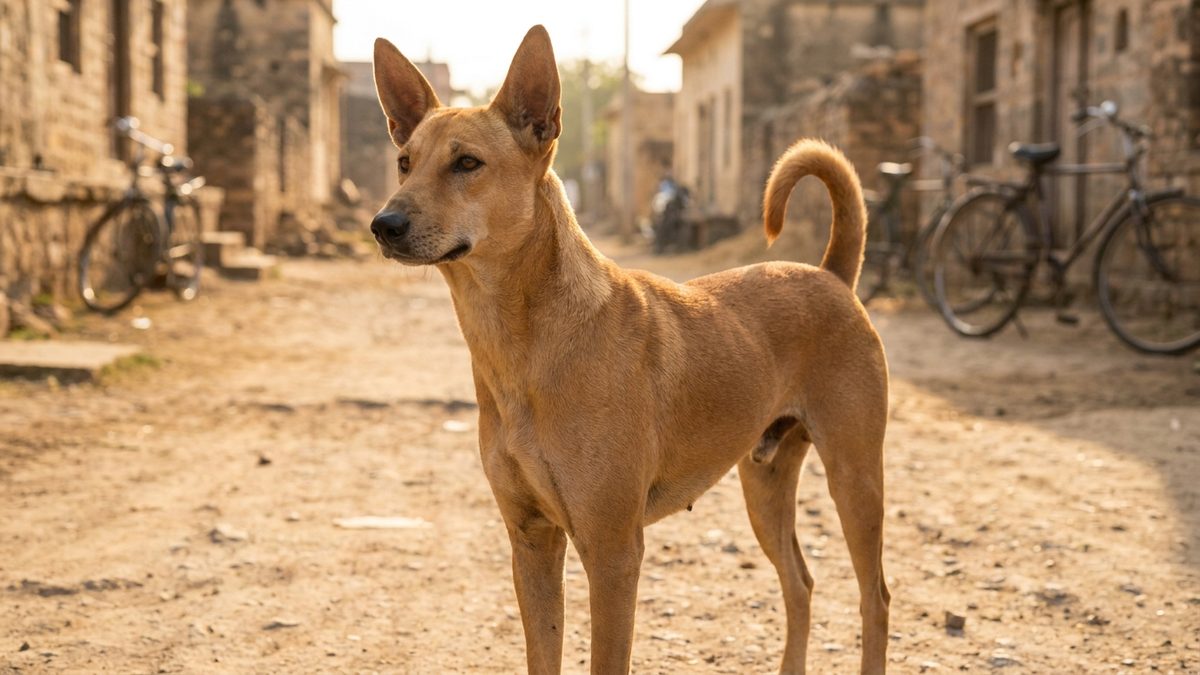
The type is remarkably consistent across the subcontinent, which is what happens when function rather than fashion does the selecting. Indies have erect ears, a wedge-shaped head and a curved tail, and most carry a short, smooth coat that makes grooming close to effortless. The same medium build, upright ear set and curled tail recur in pariah-type dogs across South Asia.
The indie sits alongside India's regional working breeds rather than beneath them. The Rajapalayam of Tamil Nadu, the Mudhol Hound of Karnataka and the Kombai of Theni district were each shaped for a specific job in a specific region, while the indie was shaped by the whole subcontinent for the job of surviving it.
| Attribute | Detail |
|---|---|
| Type | Landrace, naturally evolved |
| Ears | Erect |
| Head | Wedge-shaped |
| Tail | Curved |
| Coat | Short, smooth |
| Lifespan | 12 to 16 years |
| Grooming needs | Minimal |
| Cost | Usually free to adopt |
Selective breeding produces variety by rewarding appearance. Natural selection produces consistency by rewarding survival. The indie looks the way it does across Chennai, Delhi and Kolkata because that build works in Indian conditions, and dogs built differently left fewer descendants.
Indie dog price and what adoption actually costs
An indie dog is usually free. The Indian Pariah Dog price is very low and in most cases these dogs are available at no cost through adoption, which makes the real question not the purchase price but the first-year setup cost.
Because there is no purchase price to compare, this section covers what you will actually spend rather than what a seller will quote. Anyone charging a significant sum for an indie puppy is selling you a free dog.
| Item | Typical position |
|---|---|
| Adoption fee | Free, or a nominal amount at some shelters |
| Core vaccination course | Often already done by the shelter or an ABC programme |
| Sterilisation | Frequently already done, or free at municipal facilities |
| Deworming and tick control | Recurring, and the main ongoing veterinary line |
| Grooming | Effectively nil, short coat |
| Purchase price | Zero |
Compare that against a Golden Retriever at Rs 25,000 to Rs 1,20,000, a Rajapalayam at Rs 9,000 to Rs 30,000, or a Kombai at Rs 10,000 to Rs 25,000. The indie is not merely cheaper at purchase. It also carries a lower expected veterinary burden across its life, for reasons covered in the health section.
There is no legitimate market in indie puppies. Shelters across every Indian metro have more than they can place, and municipal animal birth control programmes handle many more. If someone is charging you Rs 5,000 for a desi puppy, walk away and go to a shelter.
Monthly cost of owning an indie dog
An indie dog is the cheapest dog to keep in India, and the saving is structural rather than marginal. Three of the largest recurring costs for imported breeds barely apply.
No published Indian source states a method behind its monthly cost estimates for this breed, so Bonbeno does not repeat a total. Our verified owner cost survey across eight metros is in progress. What follows is the structure, which is knowable now.
Where indies cost less
- Grooming is effectively free. A short smooth coat needs a weekly brush and nothing professional.
- No climate mitigation spend. Owners of double-coated imports in Indian metros spend real money on cooling. An indie does not need it.
- Lower expected veterinary burden. Not being overbred means fewer of the inherited orthopaedic and cardiac conditions that drive lifetime veterinary spend in pedigree breeds.
- Food scales with a medium build. Most indies sit in a moderate size range rather than the large-breed bracket.
Where the money still goes
- Preventive veterinary care. Vaccination, boosters and year-round tick and flea control remain essential. Natural hardiness is not immunity to parasites.
- Food. Still the largest recurring line, as with any dog.
- Training and socialisation. Worth budgeting for, particularly with a dog adopted as an adult from a street background.
Heat tolerance and the Indian climate
The indie dog is the best heat-adapted dog in India, because it is the only one that was shaped entirely by Indian conditions. Every other breed on this site is either an import or a regional breed developed for one part of the country.
The breeds most at risk of heat stroke in India are the double-coated imports, specifically German Shepherds, Golden Retrievers, Labrador Retrievers, Huskies and Collies, whose dense coats trap heat. Peak summer temperatures cross 45 C in several parts of the country. An indie's short single coat and moderate build are the direct product of surviving those summers without human help.
This does not make an indie invulnerable. Heat stroke remains a veterinary emergency in any dog, and a dog that has moved from street life to an air-conditioned flat loses some acclimatisation.
- Walk early morning and late evening in peak summer, which is the standard veterinary recommendation.
- Keep constant access to fresh water, since hydration and monitoring are the most effective preventive measures available.
- Watch paws on hot surfaces. Street-raised dogs are not immune to burns from midday tarmac and concrete.
- Re-acclimatise gradually. A dog moving indoors permanently will handle heat less well after a few months than it did on the street.
A short coat dries fast. The hot-spot and fungal-skin problems that plague double-coated breeds through the Indian monsoon are far less common in indies, which is a real and underdiscussed benefit of the coat type.
Temperament and household fit
Indies are loyal, alert, intelligent and independent, soft with their own people once trust is built, and cautious with strangers. They make excellent watchdogs when properly socialised and exercised.
The independence is the trait new owners most often misread. A landrace dog that survived by making its own decisions does not default to the eager biddability of a retriever bred for two centuries to take instruction. That is not stubbornness. It is a different relationship with authority, and it responds well to trust and consistency rather than pressure.
Having evolved as pack animals, indies are generally friendly with other dogs and integrate into multi-dog households readily.
Who this breed suits
- Good fit. First-time owners, families, apartments, multi-dog homes, anyone wanting a healthy long-lived dog without a large upfront cost.
- Needs patience. Adults adopted from the street may take weeks to settle and will be wary before they are affectionate. That curve is normal and it ends.
- Watch item. Cautious-with-strangers can present as reactivity in a busy apartment corridor. Socialisation from the first week matters.
An indie that ignores you for a fortnight and then decides you are its person is behaving exactly as expected. Owners who judge the dog in week one frequently conclude it is unfriendly. Judge at week eight.
Indies are among the most adaptable dogs available to an Indian household. They live comfortably in apartments given normal daily walks, they tolerate heat, they cope with the noise and density of Indian cities because they evolved in them, and they are typically good with other dogs. Owners in Mumbai, Bengaluru and Pune report the same pattern of a wary first fortnight followed by a settled, undemanding dog.
Training an indie dog
Indies are among the easiest dogs in India to train. They are quick, food motivated and keen to please the person who earns their trust. The phrase that matters there is *earns*, because an indie decides who it works for.
- Reward what you like rather than correcting what you do not.
- Keep sessions short. Ten minutes is plenty for a puppy.
- Stay consistent with words and house rules, because an intelligent independent dog exploits inconsistency faster than a biddable one.
- Never hit or shout. It destroys the trust the whole relationship runs on.
The territorial trait needs handling early
Indies can be territorial by nature, so letting a puppy meet plenty of friendly people, dogs and new places early is what produces a calm, confident adult. Puppy classes and canine sports such as agility are both worth doing.
Most indies are adopted as adults, and the assumption that an adult street dog cannot be trained is simply wrong. What changes is the timeline, not the ceiling. Expect a settling period of several weeks before training properly begins, and judge the dog at week eight rather than week one.
How much exercise an indie dog needs
An indie needs 45 to 60 minutes a day, including walks, play and mental stimulation. That is genuinely moderate, and it is one of the reasons this breed suits ordinary Indian households better than the working breeds it is often compared with.
Set that against the Mudhol Hound at one to two hours with a weekly free run, or the Kombai at 60 to 90 minutes vigorous. The indie is the only Indian breed on this site whose exercise requirement fits a normal working day.
| Stage | Guidance |
|---|---|
| Puppy | Short frequent sessions plus play |
| Adult | 45 to 60 minutes across walks, play and mental work |
| Senior | Shorter walks, kept daily |
| Peak summer | Early morning and late evening |
- Mental work counts toward the total. Scent games and training sessions tire an intelligent dog efficiently.
- Street-raised adults may need building up. A dog that scavenged on poor nutrition is not automatically fit.
- Watch paws on hot surfaces, since street tolerance is not immunity to burns.
Grooming an indie dog
Grooming an indie takes minutes a week. Most have a short, smooth coat that makes grooming quite effortless, with no undercoat to strip and no professional trimming ever required.
- Brush weekly with a rubber curry or hound glove to lift dead hair.
- Bathe rarely, only when genuinely dirty. Over-bathing strips protective oils and causes more skin trouble than it prevents.
- Check for ticks at every brush, especially through the monsoon. This is the real maintenance task, not the coat itself.
- Clip nails and check ears weekly, since these get skipped when the grooming session is this short.
For comparison, a Golden Retriever in Indian humidity needs frequent professional attention to prevent matting close to the skin. An indie needs none of that, which is a recurring saving across a 12 to 16 year life.
Health and lifespan
The indie dog is the healthiest dog you can keep in India, and the reason is straightforward. Because indies have not been overbred, they are free from many of the common genetic disorders seen in imported breeds, and their lifespan of 12 to 16 years is higher than many foreign breeds.
That comparison is worth making concrete. Pedigree breeds carry inherited disease because closed studbooks concentrate the genes that cause it. Golden Retrievers carry a documented cancer burden and a roughly 10 percent elbow dysplasia rate. The indie's open, naturally selected gene pool never concentrated those risks in the first place.
| Breed | Typical lifespan | Inherited disease burden |
|---|---|---|
| Indian Pariah Dog | 12 to 16 years | Very low |
| Golden Retriever | 11.0 to 12.5 years | High, cancer-dominated |
| Most pedigree imports | Breed dependent | Concentrated by closed studbooks |
What indies do still need
- Full vaccination. Natural hardiness is not protection against rabies, parvovirus or distemper. A street-born dog may have had no vaccination at all.
- Year-round tick and flea control. Tick-borne disease is the realistic health threat across most of India and it does not care how hardy the breed is.
- Deworming on schedule, particularly for a dog adopted from a street background.
- Sterilisation, which many shelter and municipal programmes have already completed before adoption.
- A proper veterinary intake exam at adoption, which establishes a baseline and catches anything the shelter missed.
The genetic advantage is real and well documented. It says nothing about the individual dog in front of you, which may arrive with parasites, malnutrition or an untreated injury. Adopt on the breed's strengths, then treat the individual on its actual condition.
Feeding an indie dog
Feed an indie as a normal medium-build dog on a complete balanced diet, and resist the two opposite myths that surround this breed. Indies neither thrive on scraps nor require premium imported food.
The scraps myth causes real harm. A dog that survived on street scavenging did so despite that diet, not because of it, and street dogs show the nutritional consequences. The opposite myth, that a rescued dog needs an expensive corrective diet, sells food that the dog does not need.
- Feed a complete balanced diet appropriate to age and size, as you would any dog.
- Introduce new food gradually for a dog adopted off the street, since an abrupt switch after irregular feeding causes digestive upset.
- Split intake across two meals and feed to body condition rather than to a fixed chart.
- Expect food-guarding in some rescues. A dog that competed for food will need patient management, which is a behaviour issue rather than a diet one.
Bonbeno reviews Indian pet food brands separately and tests products first-hand before publishing a verdict. See our testing method for what a Bonbeno food review does and does not claim.
One further point specific to adopted street dogs. A dog that scavenged for months may arrive with an iron stomach and terrible eating habits, bolting food and guarding the bowl. Both settle with routine rather than correction. Feed at fixed times in a quiet spot, do not stand over the bowl, and expect normal behaviour within a few weeks.
Indie puppy and adopted adult: the first year
Most indies come home as adults rather than puppies, so this section covers both paths. The socialisation window runs 3 to 14 weeks and closes around 16 weeks, which matters for a breed with a territorial streak.
If you adopt a puppy
- 8 to 16 weeks. Full vaccination course, since a street-born puppy may have had none. Heavy socialisation to people, dogs and places. Ten-minute training sessions.
- 4 to 6 months. Toilet training consolidates. Lead work. First summer routines.
- 6 to 12 months. Territorial behaviour may surface. Keep socialising. Sterilisation timing is a conversation with your vet.
- 12 months onward. Adult routine at 45 to 60 minutes daily.
If you adopt an adult
- Week 1. Veterinary intake exam regardless of what the shelter says. Quiet space, minimal visitors, no expectations.
- Weeks 2 to 4. Routine establishes. The dog may still be wary. This is normal and it is not rejection.
- Weeks 4 to 8. Trust builds and personality emerges. Training begins properly here rather than on day one.
- Month 3 onward. Most adopted indies are fully settled. Judge the match now, not in week one.
Indie dog vs Labrador Retriever
Choose an indie over a Labrador unless you specifically need a biddable retriever temperament. This is the real decision most Indian first-time owners face, and the Labrador wins on trainability while losing on almost everything else that matters in India.
| Factor | Indian Pariah Dog | Labrador Retriever |
|---|---|---|
| Cost | Usually free to adopt | Rs 2,200 term volume, purchase price applies |
| Lifespan | 12 to 16 years | Typically 10 to 12 |
| Inherited disease | Very low, open gene pool | Hip and elbow dysplasia, obesity-prone |
| Heat tolerance | Excellent, evolved here | Poor, double-coated import |
| Grooming | Weekly brush | Year-round shedding, heavier in humidity |
| Exercise | 45 to 60 minutes | High, retriever energy |
| Trainability | Easy, but independent | Among the most biddable breeds |
| With strangers | Cautious, good watchdog | Indiscriminately friendly |
The Labrador's advantage is real and narrow. It is more biddable, more predictable with strangers and children, and easier for an inexperienced owner to train to a standard. Everything else on that table favours the indie.
For most Indian households the indie is the better dog and the cheaper one, and we earn nothing from saying so. If you need predictable off-lead reliability or are nervous about a wary settling period, a retriever is a legitimate choice. Just do it knowing what the climate and health trade actually costs.
Mistakes Indian indie owners actually make
These are the ones that cost the dog most, and almost all are front-loaded into the first two months.
- Judging the dog in week one. An adopted indie is wary before it is affectionate. Owners who conclude the dog is unfriendly at week one return it before week eight, when it would have settled.
- Skipping vaccination because the breed is hardy. Genetic robustness is no protection against rabies, parvovirus or distemper, and a street-born dog may have had none.
- Not socialising a puppy. Indies can be territorial by nature, and the window closes at about 16 weeks.
- Feeding scraps. Street dogs survived that diet despite it, not because of it.
- Buying rather than adopting. Ethical breeders do not sell indies. Anyone charging for one is selling a free dog.
- Shouting or hitting. It destroys trust with a breed whose whole training model runs on earning it.
- Skipping the veterinary intake exam because the shelter said the dog was fine.
- Assuming no exercise is needed. Moderate is not zero, and 45 to 60 minutes daily is the actual figure.
Adopting an indie dog
Adopt an indie through a shelter or a local rescue rather than picking a puppy off the street, because a shelter dog arrives vaccinated, assessed and usually sterilised. This is the section that matters most on this page.
The Indian Pariah Dog Club was launched in May 2002 specifically to promote the adoption of pariah and INDog dogs and their mixes, and the INDog Project has documented the indigenous village dog of the subcontinent as a distinct type worth conserving.
Are all street dogs indies?
Not exactly, and the distinction is worth understanding. The aboriginal landrace type documented by the INDog Project is a specific naturally selected population. India's free-ranging dog population includes that type alongside a great many dogs of mixed ancestry carrying pedigree-breed genes from abandoned or escaped pets. Both deserve homes. Only the first is an INDog in the strict sense.
For a prospective adopter this is mostly academic. A mixed free-ranging dog carries the same practical advantages of heat tolerance, hybrid vigour and low grooming needs. The distinction matters for conservation and for anyone claiming to sell a pure INDog.
Adoption checklist
- Go through a registered shelter or rescue, which handles vaccination, sterilisation and basic temperament assessment before placement.
- Ask what has already been done. Vaccination status, sterilisation and deworming vary between shelters.
- Meet the dog more than once where possible, since a first meeting shows you a stressed animal rather than its real temperament.
- Prepare for a settling period of several weeks, especially with an adult.
- Book a veterinary intake exam in the first week regardless of what the shelter says.
We do not broker sales and we earn nothing from this recommendation. The indie is genuinely the best-value dog available to an Indian household on health, lifespan, climate fit and cost, and the dogs already exist in numbers no breeding programme needs to add to.
Where to actually find one
You do not buy an indie from a breeder, because ethical breeders do not sell them. That single fact removes the entire apparatus of pedigree papers, breeder vetting and price negotiation that dominates every other breed page on this site.
- Registered shelters and rescues, which handle vaccination, sterilisation and basic temperament assessment before placement.
- Verified NGOs, many of which run structured foster and adoption programmes.
- Social media adoption groups, which move a large share of Indian rescues, though these vary in rigour and you should still insist on a veterinary intake exam.
- Municipal animal birth control programmes, which frequently have already vaccinated and sterilised the dogs in their care.
Whichever route you use, the checks stay the same. Ask what vaccination and sterilisation has been done, meet the dog more than once, and book your own veterinary examination in the first week regardless of what you are told.
Indie dog questions Indians actually search
What kind of dog is an indie?
An indie is the Indian Pariah Dog, India's native landrace. Landrace means it evolved naturally to survive its environment rather than being bred by people for chosen traits. Indies typically have erect ears, a wedge-shaped head, a curved tail and a short smooth coat, and the type is consistent across the subcontinent.
What is the price of an indie dog?
An indie dog is usually free. Indian Pariah Dogs are available at no cost through adoption in most cases, and shelters across every Indian metro have more than they can place. Anyone charging a significant sum for an indie puppy is selling you a dog you can get for nothing.
Why are stray dogs called indie?
Indie is short for indigenous, and the term came into use to reframe these dogs as a native breed rather than a nuisance. The distinction is not perfect. The aboriginal INDog is a specific naturally selected landrace, while India's free-ranging population also includes many dogs of mixed ancestry carrying pedigree-breed genes.
Are indie dogs good pets?
Yes, and they are among the best-suited dogs for Indian households. Indies are loyal, alert, intelligent and independent, live 12 to 16 years, carry far fewer inherited genetic disorders than imported breeds, handle Indian heat by default and need almost no grooming. They are cautious with strangers and need a settling period.
Do indie dogs live longer than foreign breeds?
Generally yes. Indian Pariah Dogs typically live 12 to 16 years, which is higher than many foreign breeds. Golden Retrievers, by comparison, show a median age at death of 11.0 to 12.5 years in primary care records. The gap comes from indies never having been overbred into concentrated inherited disease.
Are indie dogs good for apartments?
Yes. Indies adapt well to apartment living given normal daily walks, they cope with the noise and density of Indian cities because they evolved in them, and their short coat means no grooming burden. The one thing to manage is their caution with strangers in shared corridors, which early socialisation handles.
Are indie dogs easy to train?
They are intelligent but independent, which is different from difficult. A landrace dog that survived by making its own decisions does not default to the eager biddability of breeds selected for two centuries to take instruction. Indies respond well to trust, consistency and reward rather than pressure.
Do indie dogs need vaccination if they are naturally hardy?
Yes, absolutely. Genetic hardiness protects against inherited disease, not against rabies, parvovirus, distemper or tick-borne infection. A street-born dog may have had no vaccination at all. Full core vaccination and year-round tick control are essential regardless of the breed's natural robustness.
How much exercise does an indie dog need?
An indie needs 45 to 60 minutes a day across walks, play and mental stimulation. That is genuinely moderate and less than most working breeds, which is one reason indies suit ordinary Indian households better than the Mudhol Hound or Kombai.
Are indie dogs easy to train?
Yes, among the easiest in India. They are quick, food motivated and keen to please the person who earns their trust. Keep sessions to about ten minutes for a puppy, stay consistent with words and house rules, and never hit or shout, because the whole relationship runs on earned trust.
Compare with similar breeds
Indian Pariah Dog sits in 3 Bonbeno groups. Each one compares it directly against the breeds it is genuinely an alternative to, on the same figures.