
Dog breed profile
Artois Hound in India: Price, Registry Numbers and the 1970s Rescue
No Artois Hound market exists in India, and this page proves it with the FCI standard, the French studbook, three Indian price lists and the import law. It also settles whether the breed really did nearly die out.
Quick answer
No verified Artois Hound price in India exists, because there is no Indian market to price. The top India-region result for the term is a Stella Artois beer price page and the next three are print-on-demand training workbooks. DGFT Trade Notice 22/2022-23 makes dogs a Restricted import whose trading and breeding applications shall be duly rejected. Bonbeno rates the Artois Hound 2 of 5 for heat tolerance.
This guide is general information for Indian pet owners and is not a diagnosis. Consult your nearby vet, a registered veterinarian, before acting on anything you read here, and treat heatstroke, a sudden ear problem or any rapid change in your dog's condition as an emergency.
Artois Hound at a glance
What the Artois Hound actually is
The Artois Hound is a medium-sized French pack scent hound of 53 to 58 cm and, on average, 28 to 30 kg, bred in the old province of Artois in northern France to drive hare, roe deer and wild boar towards waiting guns. The Fédération Cynologique Internationale accepted it on a definitive basis on 18 October 1963 and publishes it as FCI-Standard N° 28, Group 6 Scenthounds and related breeds, Section 1.2 Medium sized scent hounds, with working trial.
Bonbeno read FCI-Standard N° 28 in full from the FCI's own PDF, English text dated 25.11.1996, translated by Mrs Peggy Davis from the French original published on 24.07.1996. The document names the breed CHIEN D'ARTOIS (Artois Hound) on its title page, so the figures below come from the correct document and not from a similarly-named one.
The measurements, from the standard rather than from a blog
The breed standard gives both a height and a weight, which matters more than it sounds. Height at the withers is 53 to 58 cm for males and females alike, with a tolerance of 1 cm, and weight is stated as 'On average 28 to 30 kg';. That is unusual. The sibling Ariegeois standard sets a height and no weight at all, which is why every Ariegeois weight in circulation is unsourced. Here the number exists in print, and the ranking pages still disagree with it.
| Source | Height | Weight | Verdict against FCI-Standard N° 28 |
|---|---|---|---|
| FCI-Standard N° 28 | 53 to 58 cm, males and females, tolerance 1 cm | On average 28 to 30 kg | The reference document |
| Brit breed catalogue | 53 to 58 cm with a plus or minus 1 cm tolerance | 28 to 30 kg | Matches the standard exactly |
| Eukanuba Breed Finder | 52 to 59 cm | 28 to 30 kg (62 to 66 lbs) | Height widened by 1 cm at each end |
| French Wikipedia | 52 to 58 cm | 30 to 32 kg | Both figures differ from the standard |
| PetGuide | 21 to 23 inches (53 to 58 cm) | 55 to 65 pounds, roughly 25 to 29 kg | Weight band starts 3 kg below the standard |
| Zoonika | 60 to 70 cm | 25 to 35 kg | Height sits entirely above the standard |
Read the last row again. Zoonika publishes a height band whose floor is 2 cm above the standard's ceiling, on a page that also claims Artois Hounds are used for 'tracking criminals and finding missing persons' and are 'reliable service dogs in police and rescue services';. None of that appears in FCI-Standard N° 28. The same page's own contents list carries a section headed 'How to choose a kitten' on a dog breed page, which tells you what kind of page it is. French Wikipedia's 30 to 32 kg and PetGuide's 55 to 65 pounds sit either side of the real figure.
What the standard says the dog is for
The utilization clause is the most useful paragraph on this breed and almost nobody quotes it. It opens 'The Artois Hound is a Briquet (small type), nowadays especially used in hunting with the gun. He drives the game closer taking advantage of their faults with cleverness, and his speed is average but maintained.'; The French original calls the dog a *rapprocheur*, the hound whose job is to work out the line and close the distance, and gives the same speed clause as 'sa vitesse est moyenne mais soutenue';. This is not a sprinter. It is a dog selected to keep going.
The standard then splits the job by terrain, which is rare in a breed standard and worth reading in the dog's own words.
- In the country, 'Because of his acute sense of smell, he is capable of out manoeuvring the tricks of the hare.'
- In the wood, 'With his incontestable qualities of a hunter, in the sparse and well scattered groups of tall trees, he hunts a deer beautifully in the desired direction.'
- In the thicket, 'his intrepidity and bravery means that he can stir up and even obstinate boar.'
- Moreover, 'He is a hardy animal, endowed with a marvellous tongue in a high pitched voice which can be heard from far away.'
Then comes the line that decides whether this dog belongs in an Indian flat. 'Six to eight tricolour matching Artois hounds constitute a small pack susceptible of giving pleasure to a most demanding huntmaster.'; A breed standard that specifies its own pack size in dogs, and that names the carrying voice as an asset in the same paragraph, has told you what it is. Across the five scenthounds Bonbeno has now built, this is the clearest single statement of the cluster's established finding that voice is the working purpose and not a side effect. On the Ariegeois page that finding rested on the national breed club's separate working standard, which grades the voice as an aptitude. Here it sits inside the FCI standard itself.
Appearance, and the one feature to check in any photograph
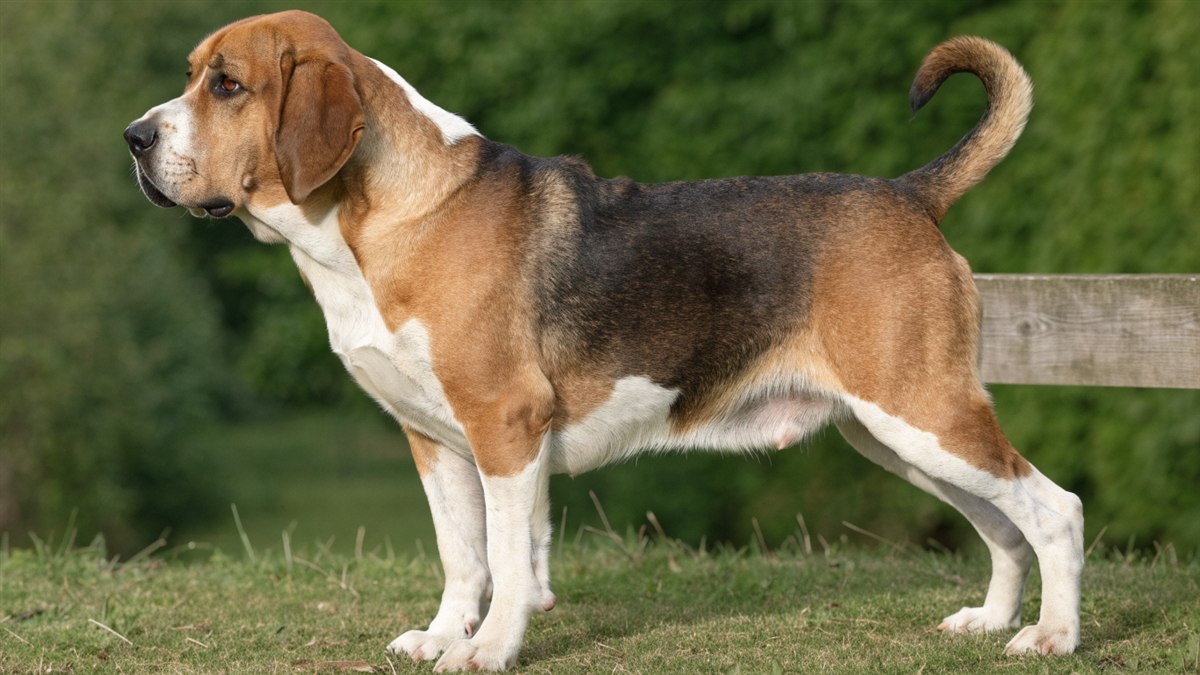
The Artois Hound is a solidly built dog, not a light one. The general appearance clause reads 'Well constructed dog, muscled and not too long, giving the impression of strength and energy', the flanks are described as full, the chest is broad and long and let down to elbow level, and the skin is 'Quite thick'. Anyone arriving from the Ariegeois page, which describes a light and elegant dog with a drawn-up flank, is looking at a different animal in the same FCI section.
The coat is short, thick and quite flat, and the colour is 'Dark fawn tricolour, similar to the coat of the hare or the badger, with mantle or large patches, the head usually fawn, sometimes with black overlay';. Mottling is listed as a fault and distinct mottling as a disqualifying fault, which is the fastest way to tell a genuine Artois Hound photograph from a mislabelled Gascony hound.
The ears are the signature. 'Leathers set at eye level, a little thick, broad, round at the tip, almost flat and quite long, reaching the beginning of the nose.'; Set at eye level, not above it, and long enough to reach the nose. World Dog Finder describes the same ears as 'placed high on the dog's head', which contradicts the standard directly, and the standard lists ears 'set below eye level, short, not flat enough' among its faults. That ear is also the single biggest care burden this dog carries in India, and the grooming section works through why.
A clause the English translation quietly drops
The French original carries two temperament clauses and the English translation carries one. The FCI's English text gives only BEHAVIOUR / TEMPERAMENT, 'Vigorous and hardy dog, with a very fine nose, assembling well in the pack, balanced and affectionate';. The French text reproduced by the Société de Vénerie from the Société Centrale Canine gives COMPORTEMENT, 'Chien vigoureux et rustique, très fin de nez, ralliant bien la meute, équilibré et affectueux', and then a separate CARACTÈRE clause, 'Caractère gai et d'une nature très affectueuse';. Cheerful, and of a very affectionate nature. Every English-language page describing this breed's character is working from a document that is missing half of what the original says about it.
On the Ariegeois page, venerie.org was caught misfiling that breed under Section 1.1 Large-sized Hounds when the FCI's own document says Section 1.2. On the Artois Hound it gets it right, printing 'Groupe 6 Chiens courants, chiens de recherche au sang et races apparentees, Section 1.2 Chiens courants de taille moyenne. Avec epreuves de travail', which is exactly what the FCI publishes. A source that is wrong once is not wrong always, and both findings belong on the record.
Did the Artois Hound really nearly die out, and who rebuilt it
Yes. The near extinction is real, it is documented inside the FCI's own breed standard, and the widely-copied version of who fixed it is wrong. FCI-Standard N° 28 states that 'After the second World War, it was believed that the Artois Hound was one of the breeds lost for ever', and credits the rebuilding to M. Audrechy of Buigny les Gamaches in the Somme, working from the beginning of the 1970s, with Mme Pilat.
This story circulates widely and most versions of it are half right, so Bonbeno checked it against the primary document rather than against the pages repeating it. The FCI's BRIEF HISTORICAL SUMMARY is the load-bearing text, and the French original reproduced by the Société de Vénerie carries the same passage word for word.
The four-stage collapse, in the standard's own words
- Peak. The breed, 'formerly named Picard', was 'much appreciated in ancient hunting at the time of Henri IV and Louis XIII and much sought after', and Sélincourt recorded these dogs working out a hare that had passed an hour earlier in dry weather.
- Dilution. Le Couteulx de Canteleu wrote in Manuel de Vénerie Française (1890) that 'the artesien breed of his time was crossbred and difficult to find pure', though it remained one of the best breeds for hare hunting.
- A failed rescue. 'At the end of the XIXth century and at the beginning of our century, M. Levoir in Picardy has attempted the re-establishment of the old Artois type without really succeeding.' The Picard breeder M. Mallard then dominated the breed until the First World War, winning at shows with dogs that 'were not always in the type conformed with the description given by the old authors'.
- Presumed loss, then rebuilding. 'After the second World War, it was believed that the Artois Hound was one of the breeds lost for ever. But at the beginning of the 1970s M. Audrechy, of Buigny les Gamaches in the Somme, has fixed as a task to reconstitue the kennel. It is thanks to his efforts and those of Mme Pilat that this breed regains its place amongst the scenthounds.'
Fédération Cynologique Internationale
The version most pages print, and why it fails
PetsArmy, the only India-domain page written about this breed, credits the rescue to the wrong people. It states that 'Ernest Levair and his cousin M. Therouanne undertook a task that lasted 20 years to restore the breed's authentic traits';. The FCI standard names a M. Levoir in Picardy, says the attempt happened at the end of the nineteenth century and the very start of the twentieth, and says explicitly that it happened 'without really succeeding';. A failed nineteenth-century attempt has been converted into a successful twenty-year restoration, and a second name has been attached to it that appears nowhere in the standard.
Three independent sources agree on the version that is actually documented. English Wikipedia records that 'After World War II, the Artois was all but extinct' and that in the 1970s aficionados including Audrechy reconstituted the breed from a few remaining specimens. French Wikipedia gives the same two names in the same decade, 'Dans les années 1970, les efforts conjugués de MMe Pilat et de M. Audrechy de Buigny-lès-Gamaches dans la Somme ont permis de sauver la race de l'extinction';. The French enthusiasts' association ANACAF describes the breed's 'quasi disparition' and records that in the 1970s enthusiasts located surviving dogs in the Somme, which 'sauvera le Chien d'Artois de l'extinction';.
| Source | Named people | Decade | Outcome claimed |
|---|---|---|---|
| FCI-Standard N° 28 | M. Levoir; then M. Audrechy and Mme Pilat | Levoir around 1900; Audrechy from the early 1970s | Levoir failed; Audrechy and Pilat succeeded |
| Société de Vénerie, French original | M. Levoir; M. Audréchy of Buigny les Gamaches; Mme Pilat | Same as the FCI text | Same as the FCI text |
| French Wikipedia | Mme Pilat and M. Audrechy of Buigny-lès-Gamaches | 1970s | Saved the breed from extinction |
| English Wikipedia | Audrechy and others, from stock including the Prince de Conde's | 1970s | Reconstituted from a few remaining specimens |
| ANACAF | Unnamed enthusiasts in the Somme | 1970s | Saved the breed from extinction |
| PetsArmy | Ernest Levair and cousin M. Therouanne; separately, M. Audrechy | 20-year restoration, undated | Contradicts the standard on Levoir |
One further claim needs flagging rather than repeating. English Wikipedia says the rebuilding stock included dogs 'of the Prince de Conde';. That detail is absent from the FCI standard, absent from the French original, and absent from ANACAF's own account. It may be true. Bonbeno could not verify it from a primary source, so it is reported here as an unverified attribution rather than as a fact.
What a reconstruction from a handful of dogs means for a buyer
A breed rebuilt from a few survivors starts from a narrow founder base, and that has a legal consequence in India that nobody writing about this breed mentions. The historically standard tools for rebuilding a collapsed population are close matings, and the Prevention of Cruelty to Animals (Dog Breeding and Marketing) Rules, 2017 prohibit exactly those. The Second Schedule permits only out breeding and line breeding. It prohibits 'in breeding', defined as breeding between relatives of the second to fourth grade in straight or side line within the first four generations, giving uncle to niece, cousin to cousin and grandparents to grandchildren as examples, and it prohibits 'incest breeding', mating between parents and children or between brother and sister.
This is not a theoretical point. On the Ariegeois page the same check found a French parent club openly recommending father-to-daughter and half-sibling matings to manage a tiny population. Any Indian reader who imported a pair of this rare breed and tried to rebuild a line here using the methods that saved it in France would be breaking Indian law. The lawful route is out breeding or line breeding only, and with a French studbook registering 57 dogs a year, an unrelated mate is not something you can casually source.
No published pedigree analysis, effective population size, or inbreeding coefficient exists for the Chien d'Artois that Bonbeno could reach. The one breed club whose material Bonbeno could open, the ANACAF enthusiasts' association, lists an Elevage et Genetique section, and that page did not resolve. The Societe Centrale Canine's own breed page returned HTTP 403 to every route tried. So the founder base is documented as small in words and undocumented in numbers, and this page gives no figure rather than estimating one. Where a source would not open, it is not cited here.
Registry recognition and how many Artois Hounds exist
The Artois Hound holds full FCI recognition and almost nothing else. It is FCI-Standard N° 28, accepted on a definitive basis on 18 October 1963, and the only hard population number in existence anywhere is the French studbook, which registered 51 dogs in 2024 and 57 in 2025. Société Centrale Canine Every other registry Bonbeno checked returns a blank, and the blanks are worth naming individually.
Rarity is the one thing every page about this breed agrees on, and not one of them puts a number behind it. This section replaces the adjective with the registry rows.
The French studbook, read from the table
The Société Centrale Canine publishes Statistiques LOF each year, breed by breed. Bonbeno downloaded the 2025 edition and read the Groupe VI table out of the PDF's own text layer rather than from a summary. The Chien d'Artois row reads 51 registrations in 2024, 57 in 2025 and 14 confirmations recorded during 2025.
| Breed | Registered 2024 | Registered 2025 | Confirmations recorded 2025 | Direction |
|---|---|---|---|---|
| Chien d'Artois | 51 | 57 | 14 | Rising |
| Ariegeois | 242 | 227 | 131 | Falling |
| Beagle-Harrier | 478 | 440 | 196 | Falling |
| Anglo-Français de Petite Vénerie | 125 | 147 | 76 | Rising |
| Porcelaine | 326 | 384 | 188 | Rising |
| Beagle | 3,514 | 3,089 | 822 | Falling |
| Poitevin | 110 | 1 | 0 | Collapsed |
| Groupe VI total | 12,894 | 11,720 | 3,989 | Falling 9 percent |
Three things follow. First, the breed is genuinely tiny but it is not shrinking. Fifty-seven registrations in a year, inside a group of 11,720, is roughly one dog in every two hundred registered French scenthounds. It is also six more dogs than the year before, in a group that fell 9 percent. Second, this is a smaller population than the Ariegeois by a factor of four, and the two breeds sit in the same FCI section. Third, the Poitevin row, 110 down to 1, shows what an actual collapse looks like in this table, which is useful context for a breed whose story is a collapse.
A correction to how this site read the confirmation column
The Ariegeois page read that breed's high confirmation rate, 131 of 227 or 58 percent against a Groupe VI average of 34 percent, as the signature of a breed owned by working hunters rather than pet buyers. The Artois Hound row does not fit that reading, and it is worth saying so plainly rather than quietly adopting the house line. Fourteen confirmations against 57 registrations is 24.6 percent, well below the group's 34 percent, on a breed that is at least as hunter-owned as the Ariegeois.
The honest explanation is arithmetic rather than sociology. Confirmation in France is an adult assessment, so the dogs confirmed in 2025 were mostly born in earlier years. Dividing one year's confirmations by the same year's registrations compares two different cohorts, and on a breed registering fewer than sixty dogs a year a handful of missed assessments swings the percentage by ten points. On a breed registering three thousand it barely moves. Treat the confirmation column as a rough signal on large breeds and as noise on very small ones, which is a refinement of the cluster's earlier finding rather than a contradiction of it.
The 500 dogs figure, and where it comes from
PetsArmy opens with 'only about 500 registered dogs worldwide' and later says 'about 500 dogs now in stud books', and cites nothing for either. Bonbeno could not find a source for that figure in any registry, breed club or standard. It may be a reasonable order of magnitude, since 57 French registrations a year across a working life of a decade or so would put a French living population in the high hundreds. It is not a verified number, and this page will not repeat it as one. What is verified is the row in the studbook.
The blanks, named one by one
| Body or dataset | Status | What Bonbeno checked |
|---|---|---|
| Fédération Cynologique Internationale | Fully recognised, FCI-Standard N° 28, Group 6 Section 1.2, with working trial | The FCI breed record and the Group 6 nomenclature page |
| Société Centrale Canine | Registered, 57 dogs in 2025 | The Statistiques LOF 2025 PDF text layer |
| American Kennel Club | No route at all, not even Foundation Stock Service | The AKC's own 88-breed FSS list, revised 10 June 2026, whose 20-breed Hound Group does not include it |
| Orthopedic Foundation for Animals | No statistics table, and no registry code found | The OFA disease-statistics index and the OFA site search, which returned no result for artois |
| Kennel Club of India | No published breed-level figure exists | The FCI's national statistics for the KCI, which give totals only and no breed breakdown |
| Largest UK longevity study, 155 breeds | Absent | The paper's own published breed list, which includes the Beagle, Bloodhound, Foxhound, Basset Hound and Petit Basset Griffon Vendeen |
The AKC blank is total. The AKC's Foundation Stock Service list, revised 10 June 2026, carries 88 breeds, of which 20 sit in the Hound Group, including the Porcelaine and the Slovensky Kopov. Neither the Artois Hound nor the Chien d'Artois appears anywhere on that page. There is therefore no American route into this breed at all, not even the provisional one.
The OFA blank was checked properly rather than guessed. OFA's statistics URLs take a short breed code, and guessing a code returns a real, complete, plausible table for a completely different breed. Bonbeno guessed nothing. The disease-statistics index served no Artois Hound table, and OFA's own site search for 'artois' returned no result. OFA explains the absence in its own FAQ: 'Breeds are not included in the OFA statistics tables until a minimum number of individuals have been evaluated. For hips, each breed must have at least 100 evaluations in the database. For all other databases, there must be at least 50.'; On a breed producing 57 French registrations a year, that threshold is the whole explanation. No OFA figure is published on this page because none exists.
The Kennel Club of India blank is a different kind of blank. The KCI is an FCI member and the FCI publishes its national numbers: 33,880 pure-bred dogs registered with the studbook in 2025, down from 38,592 in 2024 and 89,571 in 2021, with a cumulative 1,425,001 registrations since the studbook began. The FCI publishes no breed-level breakdown for India, so nobody can say from these figures whether a single Artois Hound has ever been registered here. What can be said is that the breed appears in no Indian price list, no Indian breeder listing and no Indian search result, which the next section works through.
FCI recognition is what makes a pedigree portable. A dog registered in the French studbook carries paperwork the Kennel Club of India can in principle read, because both bodies sit under the FCI. That is the difference between this breed and an unregistered landrace. It is also the only part of the ownership chain that works, because as the import law section shows, the paperwork being readable does not make the dog importable for sale.
Artois Hound price in India
There is no Artois Hound price in India, because there is no Indian market for the breed. The top India-region result for the exact query is a Stella Artois beer price page, the next three are print-on-demand training workbooks sold as books rather than dogs, and the only India-domain page that prints a rupee figure states in its own words that the figure came from what other breeds cost. PetsArmy, 'Artois Hound Dog Breed…
That is the answer, and it is worth more to a buyer than any invented range. What follows is the evidence, because a claim this flat has to be evidenced from primary sources rather than from an empty search box.
What an India-region search for the price actually returns
Bonbeno pulled the query 'artois hound price in india' from Yahoo India on 20 August 2026 with an India-region request, after DuckDuckGo and Mojeek served CAPTCHAs and Bing served a bot-detection decoy page whose entire first result set was Kuala Lumpur office listings. The Yahoo India page reported about 21,900 results. This is the whole of page one, in order.
| # | Domain | What it actually is |
|---|---|---|
| 1 | pawspace.in | Dog Price in India 2026, top 40 breeds. Contains zero occurrences of Artois |
| 2 | gyaanvibes.wordpress.com | Stella Artois Beer Price in India 2026. A beer |
| 3 | amazon.in | Print-on-demand book, Artois Hound Tricks & Games Training Tracker & Workbook |
| 4 | amazon.in | Print-on-demand book, Artois Hound Guide |
| 5 | snapdeal.com | Print-on-demand book, Artois Hound Training Guide |
| 6 | olx.in | Generic Puppies, Pets for sale in India category page |
| 7 | flipkart.com | Generic Dogs, Buy Dogs Online at Best Prices In India, which sells dog food |
The only result on page one that pairs the word Artois with a price is a lager. Three of the remaining six are the same auto-generated book template with the breed name swapped in, which is exactly the shell-page pattern this site has documented on other absent breeds. Two are marketplace category pages that would return identically for any breed name. One is a generic price list that does not contain the word.
Three Indian price lists, searched in full, and none of them lists the breed
Bonbeno downloaded the three most visible dog price lists on the Indian web and searched their complete page source for the string 'artois' in every spelling. All three returned zero. All three list the Beagle. Wrapinfur, 'Dog Price List in India 2026 Supertails, 'Dog Price List in India
| List | Breeds covered | Occurrences of Artois | Beagle listed |
|---|---|---|---|
| Pawspace, Dog Price List in India, 2026 | Top 40 | 0 | Yes |
| Wrapinfur, Dog Price List in India 2026 | 50-plus | 0 | Yes |
| Supertails, Dog Price List in India | Top 40 | 0 | Yes |
The Beagle column matters. The Beagle is the FCI Section 1.3 small hound from the same Group 6, it is genuinely sold in India, and it appears on all three lists. The absence of the Artois Hound is therefore not an artefact of these lists ignoring scent hounds. It is an absence of the breed.
The one rupee figure in print, and what it is made of
PetsArmy publishes Rs 80,000 to Rs 2,00,000 for a purebred Artois Hound and then explains, in the same paragraph, that the number is not about this breed. Its exact words are 'Looking at similar rare hound breeds in India, you might need to spend anywhere between Rs 80,000 to Rs 2,00,000 for a purebred Artois Hound. These numbers come from what other imported rare hounds cost, though prices can swing a lot based on availability.';
On the Ariegeois page the equivalent Indian figure turned out to be a currency conversion, both ends dividing exactly by the dollar rate. This one is more honest and more useless at the same time: it is a price for other breeds, printed under this breed's name. A rupee band derived from what a different animal costs records no Artois Hound transaction, and no transaction is what the rest of the page confirms.
The same page goes further than Bonbeno would need to. Under its own heading 'Where to find Artois Hound puppies for sale' it states that 'Right now, India doesn't have any dedicated Artois Hound breeders' and that 'Indian retailers stock books about Artois Hounds, but finding actual dogs remains a tough task.'; The one page selling the idea of buying this breed in India says there is nobody to buy it from.
What a buyer is actually being offered instead
- A beer. Stella Artois price pages outrank every dog result on the query in India.
- Books. Three separate marketplace listings for the same print-on-demand training-workbook template, which exists identically for hundreds of breeds.
- A different breed. On the informational result set, an Indian breeder page ranking for this query is selling Afghan Hound puppies, a long-coated sighthound with nothing in common with a French pack scent hound beyond the word Hound.
- Nothing else. No Indian breeder, no Indian listing, no Indian price, no Indian registration figure.
Yahoo India search results Brave Search results for 'artois hound…
Ask for the FCI or Societe Centrale Canine pedigree number and the DGFT import authorisation in the importer's name, and check both before any money moves. With 57 dogs registered in France in a whole year, an Artois Hound puppy on offer in an Indian city is far more likely to be a tricolour crossbreed, a mislabelled Beagle cross or a photograph of a French dog than the breed named on the advertisement. Bonbeno does not broker sales and recommends no breeder.
Import rules: what Indian law lets you do with this breed
To bring an Artois Hound into India you must import it as your own pet, because Indian import policy allows nothing else. DGFT Trade Notice 22/2022-23 classifies dogs under ITC (HS) 01061900 as a Restricted import, permits entry only for a pet dog with a valid pet book in the importer's own name, for R&D organisations with CPCSEA recommendation, or for the Defence and Police Force, and states that 'any applications for trading/breeding purposes, or applications made on behalf of some another person/ entity shall be duly rejected'.
Bonbeno read Trade Notice 22/2022-23 in full from the DGFT's own PDF, which carries a machine-readable text layer, and quotes only clauses found verbatim in that document. It is dated 19 December 2022 and signed by Md. Moin Afaque, Deputy Director General of Foreign Trade.
The three permitted purposes, and the one that is missing
Policy Condition (7) lists exactly three reasons a dog may enter India.
- A pet dog 'with valid pet book and relevant records/documents in the name of importer'.
- Research, by 'R&D Organisations for conducting research with the recommendation of CPCSEA'.
- Internal security, 'by the Defence and Police Force'.
Policy Condition (8) closes the gap: 'Import of commercial dogs for breeding or any other commercial activities other than the purposes mentioned above is not permitted.'; There is no fourth category for a breeder, an importer or a pet shop. That is the sentence which, combined with a French studbook of 57 dogs a year, means no lawful Indian supply chain for this breed can form. It is also why a rupee price band for an Artois Hound puppy in India describes a transaction that could not legally happen.
What the pet route actually requires
| Requirement | What the notice says |
|---|---|
| Policy status | ITC (HS) 01061900, Mammals: Other. Restricted, subject to Policy Condition 6 |
| Without a DGFT authorisation | Up to two pets, as passenger baggage, only for persons transferring residence to India after two years of continuous stay abroad |
| With a DGFT authorisation | Required if the stay abroad was under two years, if the pet is not travelling as baggage, or for more than two pets, which also go to DAH&D for examination |
| Mandatory documents | Vaccination Book, Pet Passport or Pet Book; a Certificate for Emotional Support; and a Passport of the Pet |
| Application form and lead time | ANF-2M, filed against the importer's IEC or the permanent IEC IIHIE0153E, started at least two months before travel |
| Ports of entry | Only the airports and seaports of Delhi, Mumbai, Chennai, Hyderabad, Bangalore and Kolkata, with quarantine at the government station where required; DAHD added Kochi for pets arriving under the baggage rules in October 2024 |
| Advance NOC | From the AQCS Regional Officer or Quarantine Officer, seven days before travel, relaxable up to three days, with the DGFT licence and the exporting country's veterinary health certificate |
| Applications refused outright | Any application for trading or breeding purposes, and any application made on behalf of another person or entity |
Two of those rows are worth pausing on, because they are the ones that catch people. The two-year rule is a residence test, not a paperwork test. A returning Indian family who lived in France for eighteen months cannot bring the dog in as baggage; they need a DGFT authorisation. And the Certificate for Emotional Support sits in the notice's own mandatory-documents list for both permanent and temporary imports, which surprises owners who have prepared only the vaccination book and the pet passport.
The realistic scenario, and the honest cost answer
The only Indian who lawfully ends up with an Artois Hound is someone who already owned one abroad and moved home. That is a returning hunter, an expatriate or a diplomat, not a buyer. For that person the relevant costs are the airline's live-animal charge, the export health certification in France, the DGFT authorisation where required, quarantine where imposed and domestic transport from one of the seven permitted ports. Bonbeno publishes no rupee total for that chain, because the published Indian figures for pet relocation cover common breeds on common routes and none of them was verified against an actual Artois Hound movement. The full route is set out in how to import a dog to India.
PetsArmy's page tells its readers to 'Reach out to international breed clubs', to 'Look into services that specialize in importing rare breeds' and to consider importing 'directly from France';. Two of those three routes are the commercial import that Policy Condition (8) forbids and paragraph 6 says will be duly rejected.
India's import policy for dogs is written for pets moving with their owners, not for stock moving to a market. For a breed with 57 registrations a year in its home country, that is the whole story: the law and the supply are pointing the same way, and neither points at India.
Monthly cost of keeping an Artois Hound in India
Budget an Artois Hound as a medium to large Indian dog, roughly Rs 4,000 to Rs 12,000 a month, because no Artois-specific Indian cost figure exists anywhere and nobody should invent one. The nearest honest basis is the published Indian monthly maintenance cost tables by size band, applied to a 28 to 30 kg short-coated hound with heavy ear needs and very high exercise needs. Fédération Cynologique Internationale
Every rupee figure below describes a size band, not this breed. Bonbeno says that once here and does not repeat it as a disclaimer at the end of every paragraph.
The size band this dog falls into, and the disagreement about it
The FCI files the Artois Hound as a medium-sized scent hound; Royal Canin India files it as size category Large. Royal Canin India That is not a trivia point, because Indian cost tables, food formulas and boarding rates are all priced by size band, and the two answers differ by several thousand rupees a month.
The standard settles it on the numbers. A dog of 53 to 58 cm and 28 to 30 kg is a medium-to-large dog by any Indian pricing table, sitting at the top of the medium band and the bottom of the large one. Royal Canin's own India page states 'Source: key facts and characteristics sourced from Fédération Cynologique Internationale (FCI)' immediately above a size category the FCI does not use for this breed. Budget at the top of medium and you will not be caught out.
| Line item | Medium band | Large band | What drives it for this breed |
|---|---|---|---|
| Food and treats | Rs 2,000 to Rs 4,000 | Rs 3,000 to Rs 6,000 | A working-bred hound at 28 to 30 kg with high daily activity sits at the top of its band |
| Grooming | Rs 800 to Rs 2,000 | Rs 1,000 to Rs 3,000 | The lowest-cost line on this dog. A short, thick, flat coat needs no salon at all |
| Veterinary care | Rs 500 to Rs 1,500 | Rs 500 to Rs 2,000 | Routine only. Ear problems and tick-borne disease are the two lines that blow this up |
| Toys and enrichment | Rs 500 to Rs 1,500 | Rs 500 to Rs 2,000 | Higher than average, because an under-exercised pack hound destroys things |
| Accessories and miscellaneous | Rs 500 to Rs 1,500 | Rs 500 to Rs 2,000 | A long line, a secure harness and a well-fitted crate are not optional on this breed |
| Estimated monthly total | Rs 4,000 to Rs 8,000 | Rs 6,000 to Rs 12,000 and above | Bonbeno's working range for this breed is Rs 4,000 to Rs 12,000 |
Two other Indian lists give wider ranges for the same question. Pawspace puts average monthly dog maintenance at Rs 5,000 to Rs 25,000 and above, first-year ownership at Rs 80,000 to Rs 5,00,000 and above, training at Rs 8,000 to Rs 60,000 and above, grooming at Rs 800 to Rs 5,000 per session, dog walking at Rs 2,000 to Rs 10,000 a month and boarding at Rs 500 to Rs 3,000 a day. Supertails puts monthly upkeep at Rs 3,000 to Rs 18,000 depending on breed size and grooming needs. The three lists disagree by a factor of five at the top end, and none of them is wrong, because they are describing different cities, different food tiers and different service levels. Publish the spread rather than an average.
The four lines that are specific to this dog
- Ear care is a recurring cost, not an occasional one. Ears set at eye level and long enough to reach the nose, on a dog in Indian heat and humidity, mean a cleaner bottle and vet visits rather than a once-a-year check. Budget for it monthly.
- Tick prevention is a permanent line. A survey of 525 Indian dogs found 261, or 49.7 percent, carrying at least one tick-borne pathogen, and an outdoor-working hound is the worst-exposed body type there is.
- Exercise substitutes cost money in a city. Where there is no safe unfenced space, a long line, a secure yard hire or a daily walker replaces what this dog would do for itself in a field.
- Grooming is the one line that stays cheap. Basepaws records the grooming requirement as Low and the coat as short and thick, and no Indian salon appointment is ever required for this coat.
P.A.M. Abd Rani, P.J. Irwin, G.T. Coleman Basepaws, 'Artois Hound Breed Information &… Fédération Cynologique Internationale
The costs Bonbeno will not put a number on
Three costs are commonly published for rare imported breeds and none of them can be verified for this one. The purchase price does not exist, because no lawful Indian sale channel exists. The import total does not exist, because no verified Artois Hound movement into India is on record and the published relocation quotes describe common breeds on common routes. And breed-specific insurance pricing does not exist, because Indian pet insurers price by size and age band and none of them lists this breed. A page that gives you a confident number for any of those three is guessing, and the guess is usually built from a different breed, exactly as the one Indian price band on this breed openly was.
Heat tolerance and the Indian climate
Bonbeno rates the Artois Hound 2 out of 5 for heat tolerance in Indian conditions. The anatomy is genuinely on its side, because a normal muzzle and a short flat coat are the two body features that most reduce heat risk. The job cancels most of that advantage, because a 28 to 30 kg muscled dog with quite thick skin, bred for speed that is 'average but maintained', earns its heat load through exertion, and exertion caused 74.2 percent of the heat-illness events with a recorded trigger in the largest primary-care study of the question.
Both halves of that rating deserve the full argument, because the anatomical half is real and most Indian breed pages get it backwards in one direction or the other.
The half that is genuinely in this dog's favour
Skull shape is the single strongest anatomical predictor of heat risk in dogs, and this breed is on the safe side of it. The FCI standard describes a straight muzzle, 'moderately elongated' seen in profile, with a strong nose and well opened nostrils. That is a mesocephalic head, the reference category in the veterinary literature. Brachycephalic dogs carried 1.32 times the odds of exertional heat-related illness compared with mesocephalic dogs in a VetCompass study of 905,543 dogs, and in the severity study brachycephalic dogs carried 3.01 times the odds of FATAL heat-related illness (95 percent CI 1.60 to 5.67) while dolichocephalic dogs did not differ significantly from mesocephalic ones. An Artois Hound sits in the group everything else is measured against.
The coat helps too. Short, thick and quite flat, with no undercoat described anywhere in the standard, is a coat that carries no insulating dead layer to trap heat, and it needs no clipping. Basepaws records coat length Short and grooming requirement Low. Compared with a double-coated northern breed in Chennai, this is a fundamentally better-adapted animal.
The half that cancels it
Exertion, not weather, is what actually puts dogs in the clinic, and this breed is built to exert. In a VetCompass study of 905,543 dogs at 886 UK clinics in 2016, 1,259 heat-related illness events were identified. Of the 879 events with a recorded trigger, 652 (74.2 percent) were exertional, 113 (12.9 percent) environmental and 46 (5.2 percent) vehicular confinement. Roughly three in four heat events happened because the dog was doing something.
The next number is the one Indian owners underestimate. Of the 551 exertional events where the exercise type was recorded, 372, or 67.5 percent, followed a walk, not a run and not a hunt. Only 97 (17.6 percent) followed high-intensity activity such as running or cycling. A walk is what a city owner gives a hound that was designed to work a trail for hours, and a walk is what the data says goes wrong.
Then there is mass. The severity study looked at what makes a heat event serious rather than merely recorded, and bodyweight was retained in the model. Taking dogs under 10 kg as the reference, dogs of 10 to under 20 kg carried 2.71 times the odds of severe heat-related illness (95 percent CI 1.17 to 6.28) and dogs of 20 to under 30 kg carried 2.41 times the odds (95 percent CI 0.99 to 5.87). An Artois Hound at 28 to 30 kg sits on the boundary of that band and the one above it. Being honest about the statistics matters here: the 20 to under 30 kg confidence interval runs from 0.99 to 5.87, so it just crosses one and the association is not conclusive at that band. The direction across the whole table is consistent, and the direction is what a buyer needs.
Finally, the standard itself describes the skin as 'Quite thick' and the general appearance as 'muscled', with full flanks and a broad, long chest. More muscle mass generates more heat and a thicker skin sheds it more slowly. This is not the light, drawn-up frame of the Ariegeois, and the difference is worth two or three kilograms of working heat load.
| Factor | Direction | Evidence |
|---|---|---|
| Mesocephalic skull, well opened nostrils | Helps, strongly | Brachycephalic dogs carry 1.32 times the odds of exertional heat illness and 3.01 times the odds of fatal heat illness |
| Short, thick, flat coat with no undercoat described | Helps | FCI-Standard N° 28 coat clause; no clipping ever required |
| Bodyweight of 28 to 30 kg | Hurts | Dogs of 20 to under 30 kg carried 2.41 times the odds of severe heat illness against dogs under 10 kg, on a CI of 0.99 to 5.87 |
| Quite thick skin, heavily muscled build | Hurts | FCI-Standard N° 28 skin and general appearance clauses |
| Bred for speed that is average but maintained | Hurts, decisively | 74.2 percent of triggered heat events were exertional; 67.5 percent of specified exertional events followed a walk |
| Indian ambient conditions | Hurts | Heat waves run March to June, peak in May, and are declared at 40 degrees Celsius in the plains |
What Indian conditions actually add
The World Health Organization's India page records that heat waves typically occur from March to June and in rare cases extend into July, that on average five to six heat wave events occur every year over the northern parts of the country, that a heat wave is declared when a station's maximum temperature reaches at least 40 degrees Celsius in the plains or 30 degrees Celsius in hilly regions, and that 'The peak month of the heat wave over India is May'. For four months of the Indian year, the outdoor conditions in most of the country exceed anything the breed's home range in Picardy produces.
Humidity is the second half. Evaporative cooling through panting is the only cooling mechanism a dog has that matters, and it slows as humidity rises. A coastal city at 33 degrees and 80 percent humidity is harder on this dog than an inland city at 38 degrees and 25 percent, which is why the city guidance below is not a simple temperature ranking.
| City type | Main problem | What has to change |
|---|---|---|
| Hill stations, Shimla, Ooty, Darjeeling, Munnar | Almost none for eight months | The only Indian settings where this dog's exercise need can be met outdoors in daylight |
| Pune, Bengaluru, Hyderabad | Dry heat March to June, tolerable mornings | Work before 06:30, shade and water on every outing, nothing after 09:00 in summer |
| Delhi, Jaipur, Nagpur, Ahmedabad | Extreme dry heat, station maxima past 45 degrees | Two months of the year are indoor months. Plan enrichment, not exercise |
| Mumbai, Chennai, Kolkata, Kochi | Sustained heat plus humidity, which blocks panting | The hardest Indian conditions for this breed. Air-conditioned rest is not a luxury here |
The Indian rule most owners of imported working dogs have never read
Indian law already anticipates this problem. The Second Schedule of the Prevention of Cruelty to Animals (Dog Breeding and Marketing) Rules, 2017 provides at paragraph 21 that dogs 'not accustomed to the temperatures prevalent in the area or region in question' and 'dog breeds that cannot tolerate the temperatures prevalent in the area or region in question' shall not be kept in outdoor facilities unless that practice is specifically approved by the attending veterinary practitioner in writing. Where dogs are kept outdoors, the shelter must have a roof, four sides and a floor, plus separate outside areas of shade large enough to contain all the animals at once and protect them from the direct rays of the sun.
A French pack hound newly arrived in Chennai is the exact animal that paragraph describes. Kennelling it outdoors through an Indian summer without written veterinary approval is not merely unkind, it is outside the Rules.
Heavy unproductive panting that does not settle in shade, bright red gums, unsteadiness, vomiting or collapse mean stop everything and cool the dog with cool running water over the whole body while you get to a vet. Do not use ice water, do not wrap the dog in wet towels and leave them on, and do not wait to see whether it passes. Consult your nearby vet the same hour, because heatstroke is time-dependent and this is one of the few emergencies where the first fifteen minutes decide the outcome.
Temperament and household fit
The Artois Hound is a balanced, affectionate and notably cheerful dog with people, and a hound that was selected to work inside a group of six to eight dogs rather than beside one person. The FCI standard gives 'Vigorous and hardy dog, with a very fine nose, assembling well in the pack, balanced and affectionate', and the French original adds a second clause the English translation drops, 'Caractère gai et d'une nature très affectueuse';. Société de Vénerie
Two things in that description do most of the work. The dog is affectionate, which is why families like it. And it is 'ralliant bien la meute', assembling well in the pack, which is why it is a difficult fit for an Indian flat. Those are not in tension for the dog. They are in tension for the housing.
What the sources agree on
- Affectionate and even-tempered with its own people. The FCI standard, French Wikipedia's 'équilibré et affectueux' and Royal Canin India's character words Loving, Gentle, Calm and Loyal all point the same way.
- Good with children. French Wikipedia records particular gentleness towards children, and Basepaws describes the breed as gentle, friendly and sociable with humans including children.
- Sociable with other dogs. A hound selected to hunt in a small pack is, by construction, a dog that lives with other dogs.
- Independent at work. Brit's catalogue puts it well: 'like everyone Hound also adequately independent, which it cannot be blamed, because during work it must always rely only on itself'.
- Poor guard material. The standard lists 'Timid subject' as a fault and 'Aggressive or overly shy dogs' as a disqualifying fault, so a correct specimen is neither timid nor aggressive. It is friendly to strangers.
Fédération Cynologique Internationale Wikipédia, 'Chien d'Artois' Royal Canin India Basepaws, 'Artois Hound Breed Information &… Brit, breed catalogue, 'Artois Hound'
Prey drive, and the households that cannot absorb it
The prey drive is not adjustable. The standard describes a dog whose acute sense of smell lets him out-manoeuvre the tricks of a hare, who drives a deer in the desired direction in open woodland, and whose intrepidity lets him push an obstinate boar out of a thicket. Basepaws states directly that a strong prey drive 'might make them unsuitable for homes with smaller pets';. An Indian household with a cat, a rabbit or free-ranging chickens should read that as a hard constraint rather than a training project.
This also shapes the street reality in Indian cities, where free-roaming dogs and cats are part of the environment on every walk. A hound with this nose and this drive on a retractable lead in a Bengaluru lane is an incident waiting for a trigger.
Voice, and the Indian noise limit nobody quotes
The carrying voice is a selected feature, not a training failure. The utilization clause praises 'a marvellous tongue in a high pitched voice which can be heard from far away', and French Wikipedia describes 'une belle voix aigüe';. Across five scenthound pages this site has now built, that finding has held every time. On the American English Coonhound and the Ariegeois the voice was documented in club material. Here it sits in the FCI's own statement of what the dog is for.
In an Indian apartment that runs into a specific legal limit. The Noise Pollution (Regulation and Control) Rules, 2000 set the ambient standard for a residential area at 55 dB(A) Leq by day and 45 dB(A) Leq at night, with night defined as 10.00 p.m. to 6.00 a.m. A hound bred so its voice carries across open country, in a building with shared walls, is a neighbour complaint with a rule number attached to it.
Who this breed suits, and who it does not
| Household | Verdict | Why |
|---|---|---|
| Rural or farmhouse home with secure land, cooler district | The only genuinely good fit | Space to work, other dogs for company, and room for the voice to go somewhere |
| Family with older children and a securely fenced garden | Workable with real commitment | Affectionate and patient with children, but the exercise and the ear care are daily jobs |
| Apartment, any Indian metro | Poor fit | Pack hound, carrying voice, 45 dB(A) night limit, and no way to meet the exercise need |
| Home with cats, rabbits or poultry | Poor fit | Strong prey drive is explicitly flagged as unsuitable for homes with smaller pets |
| First-time dog owner | Poor fit | Independent working temperament and a recall problem that needs experience to manage |
| Buyer wanting a guard dog | Wrong breed entirely | Friendly to strangers by design; shyness and aggression are both penalised in the standard |
This is a lovely dog with its family and a badly-placed dog in a city. Nothing in its temperament is difficult. Everything about its housing requirement is.
Training an Artois Hound, and the one thing that will not come easily
To train an Artois Hound, start early, reward heavily and accept that recall on a live scent is the one behaviour this breed is built to refuse. The FCI standard describes a rapprocheur, a hound whose job is to work out the line himself and drive the game while the handler waits with a gun, and Brit's catalogue states the case plainly: 'during work it must always rely only on itself';.
This is the fifth scenthound Bonbeno has built, and the recall finding has now held on every one. It is worth stating why it holds rather than repeating that it does.
Why recall is the defining problem, specifically for this breed
A pack scent hound is not disobedient. It is obedient to something else. The standard's own utilization clause describes a dog working the faults in a trail 'with cleverness' and driving game 'in the desired direction' at a speed that is average but maintained. Nothing in that job description involves checking in with a person. The French text calls the temperament 'ralliant bien la meute', assembling well in the pack, which is a rallying instinct pointed at other dogs rather than at a handler.
That is the mechanism the whole cluster shares. On the American Foxhound page the same conclusion came from a hound bred to run ahead of mounted followers. Here it comes from a hound bred to work ahead of a standing gun. The Artois Hound adds one detail the others do not: the standard specifies its pack size, six to eight matched hounds. A dog selected to coordinate with five to seven other dogs is not selected to coordinate with you.
What trains well
The good news is real. Royal Canin India lists Intelligent and Loyal among the breed's character words and states that 'Training should start early';. Basepaws describes a courageous, tenacious and intelligent dog that tends to be stubborn at times and 'require consistent training from a young age';. Dogster describes the breed as intelligent and even-tempered. Nobody describes a difficult or resistant animal in the house.
- Teach name response, sit, down and place indoors, where competing scent is minimal, in the first eight weeks at home.
- Build loose-lead walking before the dog reaches 20 kg, because a 28 to 30 kg hound that pulls is a physical problem, not a manners problem.
- Reward with food of a value that beats the environment. A dog on a fresh trail is not being tempted by a dry biscuit.
- Train a settle on a mat, which is the single most useful behaviour for a vocal working dog in an Indian flat.
- Socialise to traffic, autorickshaws, cattle, free-roaming dogs and building watchmen inside the first sixteen weeks, in short sessions and early morning heat windows.
What does not train away, and the honest management answer
Off-lead reliability in an unfenced Indian public space is not a realistic goal for this breed. Bonbeno makes that a management statement rather than a training statement, because the failure mode is not a training gap, it is the dog doing exactly the job it was selected for. The workable answer is a 10 to 15 metre long line on a well-fitted harness, a securely fenced space for genuine free running, and a permanent assumption that a scent will beat a whistle.
| Behaviour | Realistic timeline | Reliability to expect |
|---|---|---|
| Name response and sit indoors | 1 to 3 weeks | High |
| Settle on a mat while the household moves around | 4 to 8 weeks | High, and worth more than any trick |
| Loose-lead walking on a quiet street | 3 to 6 months of daily work | Good, if started before adult weight |
| Recall in a fenced garden with no scent | 2 to 4 months | Good |
| Recall in a fenced garden with a fresh trail | 6 to 12 months | Moderate at best |
| Recall in unfenced open ground on a live scent | Not a goal | Do not rely on it. Use a long line |
Two training claims about this breed that need checking
PetsArmy's page tells Indian readers the breed's 'stubborn streak makes training tough' and that it is 'not ideal for first-time dog owners';. Both are fair. The same page also says these dogs 'bark loudly and clearly, which might bother your neighbors', which understates a voice the FCI standard describes as carrying from far away.
Eukanuba's line that the breed 'is very hardy and will make a fine addition to anyone's family, especially if given the opportunity to show its ability as a hunter' is accurate only if you read the second half. The conditional is doing all the work, and in an Indian city the condition is not available.
Punishing a hound for following its nose suppresses the behaviour without changing the motivation, and on a sensitive working dog it produces avoidance rather than recall. Build the recall as the most rewarding option available, manage the rest with equipment, and consult your nearby vet or a qualified force-free trainer before using any aversive tool.
Daily exercise requirement, and what happens without it
No registry, breed club or standard publishes a daily exercise figure in minutes for the Artois Hound, so Bonbeno gives none. What is published is that this is a working hound subject to an FCI working trial, bred for speed that is 'average but maintained' across open country, woodland and thicket, and that Royal Canin India lists 'Needs a lot of exercise' among its three key facts. Royal Canin India
Every '60 to 90 minutes a day' figure circulating for this breed is somebody's estimate, not a measurement, and Bonbeno will not add a sixth version of it. The useful framing is the job rather than a stopwatch.
What the working requirement actually implies
FCI-Standard N° 28 carries the words 'With working trial' in its classification line, which means the breed's international standard is tied to a demonstrated ability to work rather than to conformation alone. The utilization clause describes three distinct terrains and three distinct jobs in each, and the endurance clause describes a hound whose speed is moderate but sustained. Sustained is the operative word. This is not a dog that sprints and sleeps. It is a dog that keeps a moderate pace for as long as the trail lasts.
Basepaws records activity level High and states that 'Being energetic dogs, Artois Hounds require plenty of physical and mental stimulation to keep them happy and prevent destructive behaviors';. Dogster files the breed as suited to active families and experienced dog owners. Nobody who has looked at the breed describes a low-energy animal.
The Indian problem: you cannot give it what it needs in the hours it can safely use
The exercise requirement and the heat constraint collide directly, and that collision is the real reason this breed does not belong in most Indian cities. For four months of the year, from March to June, the safe outdoor window in the plains is roughly 05:30 to 07:30 and again after dark, because heat waves are declared at 40 degrees Celsius and peak in May. That is a narrow slot in which to satisfy a hound built to work for hours.
Pushing into the wrong hours is exactly the behaviour the heat data punishes. Of the exertional heat-illness events where the exercise type was recorded, 372 of 551, or 67.5 percent, followed a walk. The owner who compensates for a missed morning with a long evening walk on hot ground is the owner in that statistic.
A workable Indian routine, if you already have this dog
| Season | Outdoor work | Indoor substitution |
|---|---|---|
| October to February | Two long sessions daily, including free running in a fenced space and long-line trail work | Minimal. This is the season the dog is actually satisfied |
| March to June | One short session before 06:30 and one after 20:00, on shaded surfaces, water carried | Heavy. Scent games, food puzzles, training sessions, chew work, indoor tug |
| Monsoon | Normal duration, but dry the ears every single time | Moderate. Wet ground is fine; wet ears are the problem |
| Any heat wave day | None in daylight. Toilet breaks only | All of it. Treat a 40 degree day as an indoor day |
Scent work is the highest-value indoor substitute for this breed and it is nearly free. Scatter a portion of the daily ration across a room, hide a scented item and let the dog find it, or build a simple track along a corridor. A hound doing nose work is doing the job it was bred for, at a fraction of the heat load of the same time spent walking. It does not replace physical exercise, and it does replace a surprising amount of the frustration.
What an under-exercised Artois Hound does
- Vocalises. The first outlet a frustrated hound uses is the one it was selected for, and a carrying voice in a flat runs into the 45 dB(A) night limit fast.
- Destroys. Basepaws names destructive behaviour as the specific consequence of insufficient physical and mental stimulation.
- Escapes. A bored hound with a working nose treats a gate as a problem to solve, and once it is on a trail the recall will not bring it back.
- Gains weight. An inactive 28 to 30 kg hound on a maintenance ration becomes a 34 kg hound, which moves it into a worse heat-risk band and loads the joints.
Ministry of Environment and Forests Basepaws, 'Artois Hound Breed Information &… Emily J. Hall, Anne J. Carter
Grooming and coat care in Indian humidity
Grooming an Artois Hound is a weekly brush and nothing else, because the coat is short, thick and quite flat with no undercoat described in the standard. The ears are the entire job. Set at eye level, broad, almost flat and long enough to reach the beginning of the nose, they are the most heat-and-humidity-exposed feature this dog has in India.
Basepaws records the grooming requirement as Low and shedding as Moderate, and Royal Canin India's key facts say 'Requires moderate grooming';. Royal Canin India Both are right about the coat. Neither says anything useful about the ear, so this section does.
The coat, in four lines
- Brush once a week with a rubber curry or a bristle brush, twice a week in shedding periods, to lift dead hair off a coat described as thick.
- Bathe only when the dog is genuinely dirty, using a mild dog shampoo, and never more than once a month without veterinary reason.
- Clip never. There is no coat here to clip and no reason to expose the skin, which the standard describes as quite thick.
- Check nails, teeth and pads on the same weekly slot, because a short-coated dog gives you no reason to handle it otherwise.
Fédération Cynologique Internationale Basepaws, 'Artois Hound Breed Information &…
Ear cleaning, which is where the real risk sits
A pendulous ear closes the canal, and a closed canal in Indian heat is a warm, humid, poorly ventilated chamber. The largest UK primary-care study of canine otitis externa sampled 22,333 dogs from a population of 905,554 and found a one-year period prevalence of 7.30 percent (95 percent CI 6.97 to 7.65). Compared with breeds carrying erect ears, breeds with pendulous ear carriage had 1.76 times the odds (95 percent CI 1.48 to 2.10) and breeds with V-shaped drop ears 1.84 times the odds (95 percent CI 1.53 to 2.21).
The breed-level figures in that study make the point sharper for a scenthound buyer. The Basset Hound carried the highest odds of any breed at 5.87 (95 percent CI 3.26 to 10.57), and the Beagle, the pendulous-eared Group 6 hound India actually keeps, carried 2.54 (95 percent CI 1.67 to 3.86). The Artois Hound has no such figure of its own, because no dataset holds enough of them. It has the ear.
An Indian disagreement worth publishing rather than resolving
The house line across Bonbeno's gundog pages has been that Indian otitis peaks in the monsoon. One Indian series says otherwise, and this page reports the disagreement rather than picking the convenient side. A study of dogs presented to the Teaching Veterinary Clinical Complex at Anjora and government hospitals around Durg, Chhattisgarh recorded 51 positive cases and an overall prevalence of 18.14 percent, and found the highest seasonal prevalence in SUMMER, March to June, at 21 of 51 cases or 41.18 percent, ahead of the rainy season at 17 of 51 or 33.33 percent and winter at 13 of 51 or 25.49 percent.
So for this breed, in this climate, both the hot months and the wet months are ear months, and the practical instruction is the same in either case. The Durg series also found prevalence rising steeply with age, from 3 of 55 dogs (5.45 percent) under a year to 23 of 81 (28.40 percent) at five years and above, which means an ageing hound needs more ear attention rather than less.
| Season | Frequency | Specific action |
|---|---|---|
| Summer, March to June | Check daily, clean weekly | The Durg series peak season at 41.18 percent. Lift and air the ear after every outing |
| Monsoon | Check daily, clean weekly and after any soaking | Dry the canal entrance every single time the dog gets wet, before the dog dries itself |
| Winter | Check twice weekly | Lowest-risk season at 25.49 percent, but the routine should not lapse |
| After any swim or bath | Immediately | Plug or protect the ears during the bath, then dry the entrance thoroughly |
The overseas care instruction that does not transfer
Northern-hemisphere breed guidance routinely says to towel a hound off and let it air dry. That is sound advice in Picardy in October. In Mumbai in July, where ambient humidity keeps a closed ear canal wet for hours, it is the instruction that produces the infection. The Durg authors summarise the mechanism in their own discussion, reporting that earlier work found the incidence of otitis externa fluctuates in response to climatic variation, with prevalence higher in late summer when high humidity creates an ideal environment for the growth of bacteria and yeast. Their own cytology found cocci in 16 of the sampled ears, bacilli in 10 and yeast in 4, which is the same picture from the Indian side.
The Indian instruction is therefore the opposite of the imported one. Dry the ear actively, at the entrance, with a soft cloth or a vet-recommended drying solution, every time it gets wet. Do not push cotton buds into the canal, and do not use a household ear drop without a diagnosis, because treating a yeast problem as a bacterial one makes it worse.
Head shaking, scratching at one ear, a bad smell, redness, discharge or pain on touch means stop cleaning and consult your nearby vet. Otitis externa in a pendulous-eared hound can involve bacteria, yeast, mites or a foreign body, and each needs a different treatment. Cleaning an already-inflamed ear can drive material deeper and can rupture a weakened eardrum.
Health problems, screening and lifespan
No breed-specific health data exists for the Artois Hound, and this page will not borrow another breed's. There is no OFA statistics table, no breed-club screening scheme Bonbeno could reach, no peer-reviewed lifespan estimate and no published prevalence figure for any condition in this breed. A canine DNA testing company states the position directly: 'Currently, there are no known genetic conditions tightly associated with the Artois Hound.';
That is an honest blank, not a clean bill of health, and the distinction is the most useful thing this section can teach. A breed with 57 registrations a year in its home country has never been studied at a scale that could find anything.
The three blanks, and why each one is blank
| Evidence type | Status | Reason |
|---|---|---|
| OFA hip, elbow, patella or cardiac statistics | None | OFA requires at least 100 hip evaluations, or 50 for other databases, before a breed appears in its tables |
| Peer-reviewed lifespan estimate | None | The largest UK companion-dog longevity study covers 155 breeds and does not include this one |
| Breed-club screening scheme | None reachable | ANACAF publishes a breeding and genetics section that did not resolve; no screening protocol was found |
| Named genetic condition | None | Basepaws states no genetic conditions are tightly associated with the breed |
| Indian veterinary data on the breed | None | The breed appears in no Indian registry, price list or clinical series Bonbeno could find |
The longevity blank is worth spelling out, because it extends a finding this site has now made five times. The McMillan study used 584,734 unique UK dogs including 284,734 deceased and partitioned longevity across 155 breeds. Bonbeno searched that paper's own published breed list. The Beagle, Bloodhound, Foxhound, Basset Hound and Petit Basset Griffon Vendeen are all in it. The Artois Hound appears nowhere in the paper. Pack hounds enter these cohorts only once a country keeps them as companions, and France keeps this one in kennels.
Every published lifespan figure, and why none of them is a study
Five sources publish a life expectancy for this breed and they disagree by five years, which is what happens when everyone estimates and nobody measures.
| Source | Life expectancy claimed | Basis given |
|---|---|---|
| Royal Canin India | 10 to 13 years | Says key facts are sourced from the FCI, which publishes no lifespan |
| World Dog Finder | 11 to 13 years | None |
| Dogster | 12 to 14 years | None |
| Eukanuba | 13 years, average | None |
| PetGuide | 12 to 15 years | None |
| PetsArmy | 12 to 15 years in one place, 12 to 14 in another | None, and the page contradicts itself |
Royal Canin India World Dog Finder, 'Artois Hound Dogster, 'Artois Hound Dog Breed: Info Eukanuba Europe, Breed Finder Kate Barrington, 'Artois Hound' PetsArmy, 'Artois Hound Dog Breed…
FCI-Standard N° 28 gives no lifespan at all, which is normal, because breed standards describe conformation and not survival. Royal Canin India's page attributes its key facts to the FCI immediately above a figure the FCI does not publish. The honest summary for a buyer is that a medium-to-large working hound of this build would be expected to live somewhere in the low teens, and that nobody has measured it.
What actually threatens this dog in India
The absence of breed-specific inherited disease data does not mean an absence of risk. It shifts the risk onto the things that affect any pendulous-eared, outdoor-working, 28 to 30 kg dog in this climate.
- Heatstroke, and specifically exertional heatstroke. Exertion accounted for 652 of 879 triggered heat-illness events, 74.2 percent, and dogs of 20 to under 30 kg carried 2.41 times the odds of severe disease against dogs under 10 kg.
- Otitis externa. Pendulous ear carriage carried 1.76 times the odds of otitis externa against erect ears, and an Indian series in Durg recorded 18.14 percent overall prevalence peaking at 41.18 percent in summer.
- Tick-borne disease. A survey of 525 Indian dogs found 261, or 49.7 percent, PCR-positive for at least one tick-borne pathogen, led by Hepatozoon canis at 30 percent and Ehrlichia canis at 20.6 percent, with 101 of the 261 positive dogs carrying more than one pathogen at once.
- Weight gain from under-exercise. An Indian city cannot give this dog its working hours, and an overweight hound moves into a worse heat-risk band and loads its joints.
- Trauma and loss from an unreliable recall. For a hound in Indian traffic, the commonest emergency is not a disease at all.
Emily J. Hall, Anne J. Carter and Dan G.… Emily J. Hall, Anne J. Carter Dan G. O'Neill, Andrea V. Volk Roy Manju, Kashyap Roshan and Roy Suhsovan P.A.M. Abd Rani, P.J. Irwin, G.T. Coleman
The tick figure deserves one more line, because microscopy misses it. In the same Indian survey, blood smears found Hepatozoon gamonts in only 12 of 525 dogs, 2.3 percent, against a PCR-detected Hepatozoon canis prevalence of 30 percent. A clear smear does not mean a clear dog. For an outdoor-working hound in India, year-round tick prevention is not optional and a negative slide is not reassurance.
What to screen for anyway, and what Indian law expects
In the absence of breed data, screen against the general schemes rather than against nothing. Indian law already names the list. The Second Schedule of the Prevention of Cruelty to Animals (Dog Breeding and Marketing) Rules, 2017 states that dogs used for breeding 'shall have been tested for genetic defects, including hip dysplasia, progressive retinal atrophy, night blindness, hypothyroidism, entropion, ectropion, overshot, undershot jaw', along with missing teeth and cryptorchidism. The same Schedule requires that pups be vaccinated starting at seven to eight weeks and usually completed by eighteen weeks.
For an individual pet owner the practical version is a hip and elbow assessment at maturity, an annual eye and thyroid check, a monthly ear inspection built into the grooming slot, and year-round tick and heartworm prevention agreed with your vet.
A small population has fewer documented inherited diseases because fewer dogs have been examined, not because fewer dogs are affected. A breed rebuilt in the 1970s from a handful of survivors has a narrow founder base by construction, and narrow founder bases concentrate whatever recessive variants the founders carried. Nobody has published the numbers for this breed, so nobody, including this page, can tell you the real rate of anything. Consult your nearby vet about a screening plan for the individual dog in front of you rather than relying on breed-level reassurance that does not exist.
Feeding an Artois Hound in India
Feed an Artois Hound as an active medium-to-large dog and let body condition, not a bag chart, set the amount. The breed standard puts adult weight at 28 to 30 kg on average, and the practical Indian complication is that the two most-cited breed pages disagree about which size band that is, which changes the food formula, the portion and the monthly bill. Royal Canin India
No breed-specific feeding study, energy requirement or diet trial exists for the Artois Hound. Everything below is standard practice for a dog of this size and activity level, applied to Indian availability, and it is labelled as such.
The size-band problem, and how to resolve it
FCI-Standard N° 28 files this breed as a medium-sized scent hound. Royal Canin India files it as size category Large. Royal Canin India Indian pet-food ranges are built around that split, with medium formulas typically covering 11 to 25 kg and large formulas 26 kg and above. A 28 to 30 kg Artois Hound crosses the line.
Resolve it on the dog rather than on the label. A working-built hound at the top of its standard weight, exercised properly, does better on a large-breed adult formula with a moderate kibble size and controlled calcium during growth. A lightly-exercised city dog at the bottom of the range often does better on a medium formula fed to condition. The formula matters far less than the portion.
Life-stage feeding
| Stage | Meals per day | What matters most |
|---|---|---|
| 8 to 16 weeks | 4 | Large-breed puppy formula with controlled calcium. Never free-feed a growing hound |
| 4 to 6 months | 3 | Steady growth, ribs easily felt. Rapid growth in a 28 to 30 kg breed loads developing joints |
| 6 to 12 months | 2 to 3 | Transition timing agreed with your vet, not fixed by a bag. Adult height arrives before adult weight |
| 1 to 7 years | 2 | Portion set by activity, and Indian activity collapses for four months of the year. Cut the ration in summer |
| 7 years and older | 2 | Lower calories, joint support if advised, and closer ear and dental attention |
The summer ration cut is the single most India-specific feeding instruction on this page. From March to June a plains-city Artois Hound may get a quarter of the outdoor work it gets in December, because heat waves are declared at 40 degrees Celsius and peak in May. Feeding a December ration in May produces a heavier dog going into the hottest month, and heavier dogs sat in a worse severe-heat-illness band in the VetCompass severity study.
Body condition, which beats every chart
- Feel the ribs through a thin layer of muscle without pressing. If you have to press, the dog is carrying too much.
- Look from above for a visible waist behind the ribs. The standard describes full flanks, so this dog will never look tucked up like a sighthound, and it should still have a waist.
- Look from the side for an abdominal tuck rising from the sternum, which sits at elbow level on this breed.
- Weigh the dog monthly on the same scale and write the number down, because a kilogram of drift is invisible and four are not.
Fédération Cynologique Internationale
Feeding around heat and work
Three rules, all of them mechanical rather than nutritional.
- Never feed a full meal immediately before or after hard work. Leave a clear window either side, and let the dog cool and settle before it eats.
- Keep cool fresh water available at all times, including on every walk in summer. This is the cheapest heat intervention there is.
- Do not use food to compensate for a missed walk. A frustrated hound that gets extra chews instead of exercise becomes a heavier frustrated hound.
Indian availability, honestly
Everything this dog needs is available in India and none of it is breed-specific. Large-breed and medium adult and puppy formulas from the major brands are stocked in every metro and shipped nationally. No manufacturer makes an Artois Hound formula, and no Indian retailer stocks one, because there are no Artois Hounds here to sell it to. Royal Canin India publishes a breed page for the Artois Hound while selling no breed-specific diet for it, which is a fair reflection of the market.
Home-cooked Indian diets can work for a hound of this size and are easy to get wrong on calcium, phosphorus and total protein for a growing large-breed dog. If you go that route, do it with a veterinary nutritionist rather than from a recipe, and consult your nearby vet before switching a growing puppy off a complete formula.
Month by month through the first year
An Artois Hound puppy's first year in India runs on three clocks at once: the legal one, which sets eight weeks as the earliest lawful sale age and eighteen weeks as the usual end of the primary vaccination course; the developmental one, which closes the main socialisation window long before either; and the climate one, which decides which hours of which months are usable at all. World Health Organization India
This timeline assumes the realistic case, a puppy that arrived with a family relocating from France under the pet route, because that is the only lawful way an Artois Hound reaches India.
Before the puppy arrives
Rule 8(1)(a) of the Prevention of Cruelty to Animals (Dog Breeding and Marketing) Rules, 2017 requires that 'pups less than eight weeks in age are not sold', and rule 8(1)(e) requires that each pup sold is micro-chipped with a complete record of treatment and vaccination maintained. Rule 8(3) requires the breeder to screen prospective purchasers to ascertain their potential to take proper care of the breed, 'especially if it is a large one';. A seller who will hand over a seven-week puppy, or one without a chip, has told you what kind of seller they are.
| Age | What is happening | What you do |
|---|---|---|
| 8 to 10 weeks | Arrival, and the socialisation window is already open | Settle, crate and toilet routines. Handle ears daily from day one so ear cleaning is never a fight later |
| 10 to 12 weeks | Vaccination course under way; the Rules put the start at seven to eight weeks | Carry the puppy through traffic, markets and lifts before it can walk there. Name response and sit indoors |
| 12 to 16 weeks | The main socialisation window is closing | Meet cattle, autorickshaws, free-roaming dogs, watchmen and children in short calm sessions. Start loose-lead work |
| 16 to 20 weeks | Primary course usually complete by eighteen weeks; free ground access begins | First long-line work on grass. Never off-lead in an unfenced space, not even now |
| 5 to 7 months | Growth is fast and joints are soft | No forced running, no stairs marathons, no jumping. Three meals, controlled calcium, monthly weigh-in |
| 7 to 9 months | Adolescence, and the nose starts overriding the handler | Expect recall to get worse before it gets better. Hold the line on the long line |
| 9 to 12 months | Adult height reached; weight still filling out toward 28 to 30 kg | Move to two meals. Build stamina gradually in cool hours only |
| 12 months and beyond | Adult, and finally able to do real work | Hip and elbow assessment at maturity as advised by your vet, and a settled ear routine for life |
The Indian season the puppy arrives in changes the plan
A puppy that lands in November gets four good months of socialisation before the heat closes in. A puppy that lands in April does not. Heat waves run March to June and peak in May. For an April arrival, the socialisation window that closes around sixteen weeks overlaps exactly with the months when a young dog cannot safely be out in daylight, and the substitute is early-morning outings, evening outings after dark, car rides with the window open in cool hours, and a great deal of indoor exposure work.
Do not solve that by skipping socialisation. An under-socialised working hound in an Indian city becomes a reactive adult, and a reactive 30 kg dog with a carrying voice is a much harder problem than a hot puppy.
Three things not to do in the first year
- Do not crop the ears or dock the tail, in either case for any reason. The Second Schedule of the 2017 Rules states that there shall be no tail docking, ear cropping, de-barking, de-clawing or branding, and calls any change of appearance by artificial means strictly forbidden.
- Do not let a growing hound free-run on concrete or take stairs repeatedly. A dog heading for 28 to 30 kg carries that load on immature joints.
- Do not test the recall off-lead in an open space 'just once to see'. On this breed the first serious scent is the one that teaches the dog that leaving works.
Ministry of Environment Fédération Cynologique Internationale
Handle both ears every single day from the first week, lifting the leather, looking inside and rewarding stillness. On a breed whose ears reach the beginning of the nose and whose biggest documented risk in India is otitis externa, a dog that accepts ear handling calmly at eight weeks is a dog you can treat at eight years.
Artois Hound compared with the breeds Indian buyers actually reach
An Indian buyer who wants an Artois Hound is realistically choosing between the Beagle, which is the same FCI group and genuinely available here, and a native Indian hound, which is heat-adapted and free to adopt. The Artois Hound is not on that shortlist because it cannot be, and the comparison below shows exactly what you gain and lose by swapping. Supertails, 'Dog Price List in India
Two of the comparisons below are within FCI Group 6, which makes them fair on temperament and nose. Two are Indian, which makes them fair on climate and availability. All four are available in India in a way the Artois Hound is not.
| Artois Hound | Beagle | Ariegeois | Indian Pariah Dog | |
|---|---|---|---|---|
| FCI position | N° 28, Group 6, Section 1.2 Medium sized | N° 161, Group 6, Section 1.3 Small-sized | N° 20, Group 6, Section 1.2 Medium sized | Not an FCI breed |
| Height at the withers | 53 to 58 cm, both sexes | Desirable 33 to 40 cm | 52 to 58 cm males, 50 to 56 cm females | No breed standard exists, so no published range |
| Weight in the standard | On average 28 to 30 kg | No weight in the standard | None given at all | No standard |
| French studbook registrations, 2025 | 57 | 3,089 | 227 | Not applicable |
| Available in India | No. No breeder, no listing, no price | Yes, on every Indian price list | No | Yes, free from any shelter or street |
| Indian price, published | None exists | Widely published across Indian lists | None exists | Adoption, roughly zero to Rs 10,000 |
| Heat tolerance, Bonbeno rating | 2 of 5 | Rated on the Beagle page | 2 of 5 | The Indian benchmark |
| Otitis externa odds, measured | None published | 2.54 against erect-eared breeds | None published | None published, erect ears help |
| Voice | High-pitched, carries far, praised in the standard | Famously loud | Graded as an aptitude by the breed club | Ordinary |
| Recall on a scent | Poor by design | Poor by design | Poor by design | Variable, generally better |
Fédération Cynologique Internationale Fédération Cynologique Internationale Fédération Cynologique Internationale Société Centrale Canine Dan G. O'Neill, Andrea V. Volk Pawspace, 'Dog Price List in India
Against the Beagle, the swap most Indian buyers actually make
The Beagle gives you the same nose, the same voice problem and the same recall problem in a 33 to 40 cm body that India already knows how to keep. FCI-Standard N° 161 gives a desirable minimum height at the withers of 33 cm and a desirable maximum of 40 cm, sets no weight, and records that the Beagle was 'said to have been bred down from the larger Foxhound to hunt with men on foot'. It sits in Section 1.3 of the same Group 6, it appears on all three Indian price lists Bonbeno searched, and there is an Indian veterinary and grooming ecosystem that has seen thousands of them. Supertails, 'Dog Price List in India
What you lose is size and stamina. What you gain is a dog whose ear risk has actually been measured, at 2.54 times the odds of otitis externa against erect-eared breeds, so you know what you are managing. For most Indian households drawn to a French pack hound, the Beagle is the honest answer.
Against the Ariegeois, the closest thing to a like-for-like
Same FCI section, same country, same absent Indian market, different dog. FCI-Standard N° 20 gives the Ariegeois 52 to 58 cm for males and 50 to 56 cm for females and sets no weight anywhere in the document; FCI-Standard N° 28 gives the Artois Hound 53 to 58 cm for both sexes and prints 28 to 30 kg. Fédération Cynologique Internationale The Ariegeois registers roughly four times as many dogs a year in France, 227 against 57. For Indian purposes the practical difference is body mass in heat, and the lighter dog has the edge.
Against the Anglo-Français de Petite Vénerie and the American pack hounds
The Anglo-Français de Petite Vénerie sits in the same Section 1.2, stands 48 to 56 cm and is described in its standard as 'Balanced and solidly built dog, but without heaviness'. It registered 147 French dogs in 2025 against this breed's 57, and it has the same absent Indian market. The American Foxhound and American English Coonhound are the American members of the same functional group, and the recall and voice findings on those pages transfer here almost unchanged. If you have read one of those pages, the behavioural conclusions are the same. The new material on this page is the standard's weight clause, the registry numbers and the near extinction.
Against the Indian hounds, which is the comparison that matters most
If what you want is a hound that runs, India has several and they are built for this climate. The Indian Pariah Dog is the heat-adapted default, free to adopt and available in every Indian city. The Mudhol Hound and the Rajapalayam are indigenous running dogs with real working history, published Indian price ranges of roughly Rs 8,000 to Rs 30,000, and breeders you can actually visit.
None of them is a scent hound, and that is the one thing you genuinely cannot substitute. If the nose is the point rather than the pack, the Beagle is the only Group 6 scenthound India supplies at scale.
The Artois Hound loses every one of these comparisons in India on availability alone, before temperament, climate or cost are considered, and the two breeds it loses to most decisively are one you can buy and one you can adopt today.
Mistakes Indian buyers and owners make with this breed
The commonest mistake with the Artois Hound in India is believing a price band that its own publisher says came from other breeds. The remaining seven are the ordinary failures of keeping a pendulous-eared 28 to 30 kg pack hound in a hot country, and every one of them is avoidable if you know it is coming. Fédération Cynologique Internationale
1. Treating the one Indian rupee figure as a market price
PetsArmy's Rs 80,000 to Rs 2,00,000 is a price for 'similar rare hound breeds', by its own admission, and the same page says India has no dedicated Artois Hound breeders. Anyone quoting you that band as an Artois Hound price is quoting a number built from a different animal. Three separate Indian dog price lists covering 40, 40 and 50-plus breeds contain the word Artois exactly zero times. Supertails, 'Dog Price List in India
2. Assuming rarity means the breed is healthy
A breed with no documented inherited diseases is a breed nobody has counted. OFA needs 100 hip evaluations, or 50 for other databases, before a breed appears in its tables at all, and this breed reaches neither. A canine DNA company states there are no genetic conditions tightly associated with the breed, which is a statement about the literature and not about the dogs. A breed rebuilt from a handful of survivors in the 1970s has a narrow founder base by construction.
3. Buying the size category off a brand page instead of the standard
Royal Canin India files the Artois Hound as size category Large under a line saying its key facts come from the FCI, which classifies the breed as a medium-sized scent hound. Fédération Cynologique Internationale Getting that wrong changes the food formula, the portion, the boarding rate and the monthly maintenance cost band. Read the standard: 53 to 58 cm, 28 to 30 kg.
4. Air-drying the ears, because a foreign guide said so
Overseas hound guidance is written for a cool, dry autumn. In an Indian monsoon or a coastal summer, a closed pendulous ear canal does not dry on its own. Pendulous ear carriage already carries 1.76 times the odds of otitis externa against erect ears, and an Indian series in Durg found otitis peaking in summer at 41.18 percent of cases with the rainy season close behind at 33.33 percent. Roy Manju, Kashyap Roshan and Roy Suhsovan Dry the ear entrance actively, every time.
5. Exercising in the wrong hours to make up a missed session
The single most common Indian version of this is a long evening walk on hot ground after a missed morning. Of the exertional heat-illness events where exercise type was recorded, 372 of 551, or 67.5 percent, followed a walk, not a run. A missed morning is a day for scent games indoors, not a longer walk later.
6. Testing the recall off-lead 'just once'
A pack scent hound is selected to work a trail away from its handler, and the standard describes exactly that job across three terrains. The first time an Artois Hound follows a live scent out of an unfenced Indian space, it learns that leaving works, and Indian traffic is what it learns it in. Use a long line.
7. Putting a pack hound in a flat and hoping the voice settles
The FCI standard praises 'a marvellous tongue in a high pitched voice which can be heard from far away' and specifies a working unit of six to eight hounds. The Noise Pollution (Regulation and Control) Rules, 2000 set a residential night limit of 45 dB(A) Leq between 10.00 p.m. and 6.00 a.m. The voice is the product, not the defect, and no amount of training removes a selected trait.
8. Copying French rebuilding practice, which is illegal here
The methods that historically rebuild a collapsed breed are close matings between relatives. The Second Schedule of the Prevention of Cruelty to Animals (Dog Breeding and Marketing) Rules, 2017 permits only out breeding and line breeding, and prohibits in breeding between relatives of the second to fourth grade within four generations as well as incest breeding between parents and children or brother and sister. An Indian owner following overseas rare-breed rebuilding advice would be breaking Indian law.
9. Trusting a breed photograph without checking the ears and the coat
Two checks separate a real Artois Hound picture from a mislabelled hound. Ears set at eye level, broad, almost flat, reaching the beginning of the nose. And a dark fawn tricolour coat with a mantle or large patches, because mottling is a fault and distinct mottling is a disqualifying fault. World Dog Finder's own description of ears 'placed high on the dog's head' fails the first check.
Reading about this breed on pages that never opened the standard. Of the ranking pages Bonbeno checked, one publishes a height entirely above the standard, one describes the ears in a way the standard contradicts, one gives a weight three kilograms below it, one files a medium breed as large, and one credits the rescue to the wrong century. The document is four pages long, free, and on the FCI's own website.
Adoption, and the responsible route if you want this kind of dog
You cannot adopt an Artois Hound in India, because there are none here to surrender. What you can adopt, today, in any Indian city, is a scent-driven, heat-adapted, medium-sized hound-type dog for roughly zero to Rs 10,000, and for almost every household drawn to this breed that is the better animal. PetsArmy, 'Artois Hound Dog Breed…
Adoption is the real section on this page rather than the closing disclaimer, because it is the only route that actually terminates in a dog.
Why no Artois Hound rescue exists in India
A rescue population is downstream of a sale population, and there has never been one here. The French studbook registered 57 Chien d'Artois in 2025. The breed has no AKC route. India's import policy permits dogs only as an owner's own pet, for CPCSEA-recommended research or for the Defence and Police Force, and states that trading and breeding applications 'shall be duly rejected';. The only India-domain page written about the breed says India has no dedicated breeders. Nothing has entered the Indian pet population, so nothing can leave it into a shelter.
If an Indian shelter ever lists an Artois Hound, treat the label with the same scepticism you would give a rupee price. A tricolour, floppy-eared, medium-sized Indian dog is a tricolour, floppy-eared, medium-sized Indian dog, and it is a perfectly good animal without a French breed name attached to it.
What to adopt instead, and what you keep
| Option | What you keep | What you give up | Cost |
|---|---|---|---|
| Indian Pariah Dog or indie from a shelter | Nose, stamina, sociability, and genuine heat adaptation | The pack-hound conformation and the breed name | Roughly zero to Rs 10,000 |
| Hound-type mix from a rescue | Floppy ears, scenting drive, medium size | Predictability of adult size and temperament | Roughly zero to Rs 10,000 |
| Beagle from a breed rescue | The closest available FCI Group 6 scent hound | Size and stamina; you gain a measured 2.54 otitis odds ratio to manage | Rescue fee, well below the purchase price |
| Ex-working Indian hound needing a home | A real working dog with a real job history | The imported pedigree | Usually free |
Dan G. O'Neill, Andrea V. Volk Fédération Cynologique Internationale
How to verify any dog you are offered, whatever it is called
- Verify the microchip. Rule 8(1)(e) of the 2017 Rules requires every pup sold to be micro-chipped with a complete treatment and vaccination record maintained.
- Verify the age. Rule 8(1)(a) states that pups less than eight weeks in age are not sold, and a seller offering a younger pup is already outside the Rules.
- Verify the paperwork against the dog. For any claimed import, ask for the DGFT import authorisation in the importer's own name and the AQCS clearance for one of the seven permitted ports.
- Verify the parents. See the dam with the litter, on the premises, before any money moves.
- Verify the seller's own conduct. Rule 8(3) requires a breeder to screen prospective purchasers; a seller who asks you nothing at all is telling you something.
Ministry of Environment Directorate General of Foreign Trade
If you already have an Artois Hound in India
You are almost certainly a family that relocated with the dog, and there is no Indian breed community to fall back on. Three things help. Register with a vet who has managed working dogs and otitis externa before you need one urgently. Build the ear routine and the summer schedule from day one, because both are habits rather than interventions. And find other dogs, since a breed whose standard describes a working unit of six to eight hounds does badly as an only dog in a flat.
Bonbeno does not broker sales, recommend breeders or link puppy listings. On a breed with 57 registrations a year in its home country and no lawful Indian sale channel, the only honest recommendation this page can make is adoption of a dog that is actually here.
Artois Hound in India: the questions people actually search
What is the Artois Hound price in India?
No verified Artois Hound price in India exists, because no Indian market exists. Three separate Indian dog price lists covering 40, 40 and 50-plus breeds contain zero occurrences of Artois while all three list the Beagle. The single rupee band in print, Rs 80,000 to Rs 2,00,000, is described by its own publisher as derived from what other imported rare hounds cost.
Are Artois Hounds available in India?
No. The only India-domain page written about the breed states in its own words that India has no dedicated Artois Hound breeders and that Indian retailers stock books about Artois Hounds rather than dogs. No Indian registry figure, listing or breeder for the breed could be found anywhere.
Can you import an Artois Hound to India?
Only as your own pet. DGFT Trade Notice 22/2022-23 makes dogs a Restricted import and permits entry only for a pet dog with a valid pet book in the importer's own name, for R&D organisations with CPCSEA recommendation, or for the Defence and Police Force. It states that any application for trading or breeding purposes shall be duly rejected, and limits entry to six ports. DAHD added a seventh port, Cochin International Airport at Kochi, for pets arriving under the baggage rules in October 2024.
Did the Artois Hound almost go extinct?
Yes, and the FCI's own breed standard says so. It records that after the Second World War it was believed the Artois Hound was one of the breeds lost for ever, and credits the rebuilding to M. Audrechy of Buigny les Gamaches in the Somme, from the beginning of the 1970s, with Mme Pilat. An earlier attempt by M. Levoir around 1900 is described as having failed.
How big does an Artois Hound get?
Height at the withers is 53 to 58 cm for males and females alike, with a tolerance of 1 cm, and weight is given in the standard as 28 to 30 kg on average. Ignore the pages publishing 60 to 70 cm or 55 to 65 pounds, both of which sit outside the standard the FCI actually publishes.
What is the typical temperament of an Artois Hound?
Balanced, affectionate and cheerful with its own people, and independent at work. The FCI standard gives vigorous, hardy, very fine of nose, assembling well in the pack, balanced and affectionate, and the French original adds a second clause the English translation drops, describing a cheerful character of a very affectionate nature.
How much exercise does an Artois Hound need?
More than an Indian city can safely give it for four months of the year. No registry publishes a figure in minutes, so Bonbeno publishes none, but the FCI classification carries a working trial and Royal Canin India lists needs a lot of exercise among its three key facts. Plan around a working day, not a walk.
Are Artois Hounds easy to train?
Easy in the house and very hard off-lead. Royal Canin India calls the breed intelligent and says training should start early, and Basepaws notes it can be stubborn and needs consistency from a young age. Recall on a live scent is the one behaviour the breed was selected to refuse, so manage it with a long line rather than training it away.
What is the average lifespan of an Artois Hound?
Nobody has measured it. Published claims run from 10 to 13 years at Royal Canin India through 11 to 13 at World Dog Finder, 12 to 14 at Dogster, 13 average at Eukanuba and 12 to 15 at PetGuide, and not one of them cites a study. The breed is absent from the 155 breeds in the largest UK companion-dog longevity study.
Are Artois Hounds suitable for apartment living?
No. The breed standard specifies a working unit of six to eight matched hounds and praises a high pitched voice that can be heard from far away, and India's Noise Pollution Rules set a residential night limit of 45 dB(A) between 10 p.m. and 6 a.m. An under-exercised pack hound in a flat vocalises, destroys things and tries to leave.
Can an Artois Hound handle Indian heat?
Only with real management, and Bonbeno rates it 2 out of 5. The normal muzzle and short flat coat genuinely help, because brachycephalic dogs carry three times the odds of fatal heat illness. The 28 to 30 kg body, quite thick skin and a job built on sustained work cancel most of that advantage, since 74.2 percent of triggered heat events were exertional.
Is the Artois Hound recognised by the Kennel Club of India?
No breed-level answer is published. The Kennel Club of India is an FCI member and the FCI records 33,880 pure-bred dogs registered with its studbook in 2025, but publishes no breed breakdown for India. Since the breed appears in no Indian price list, listing or breeder directory, there is no evidence any Artois Hound has been registered here.
Is the Artois Hound related to the Beagle?
Possibly, and it is not proven. Dogster and PetsArmy both repeat the claim that the Artois Hound is an ancestor of the Beagle, and neither cites a source. What is documented is that FCI-Standard N° 161 says the Beagle was bred down from the larger Foxhound, and that both breeds sit in FCI Group 6, the Beagle in Section 1.3 and the Artois Hound in Section 1.2.
Is a hound dog a good pet?
This hound is, for a household that can absorb the pack and the nose. The FCI standard describes the Artois Hound as vigorous and hardy, very fine of nose, assembling well in the pack, balanced and affectionate, and the French original adds a cheerful character and a very affectionate nature. French Wikipedia records particular gentleness towards children, and the standard lists timidity as a fault and aggression as a disqualification, so a correct dog is friendly to strangers and poor guard material. The prey drive is not adjustable, which rules out homes with cats, rabbits or free-ranging chickens, and a dog bred to work in a unit of six to eight is a difficult fit for an Indian flat.
Compare with similar breeds
Artois Hound sits in 2 Bonbeno groups. Each one compares it directly against the breeds it is genuinely an alternative to, on the same figures.