
Indian breed profile
Rajapalayam Dog: Price, Care and Full Breed Guide for India
India's white sighthound, bred in Tamil Nadu to hunt wild boar and nearly lost in the 1980s. Cheaper than every imported breed, better suited to Indian heat, and carrying one inherited risk every buyer must test for.
Quick answer
The Rajapalayam dog costs Rs 9,000 to Rs 30,000 in most of India, well below any imported breed. It is a large white sighthound from Tamil Nadu, well adapted to Indian heat, and it is a one-person guarding dog rather than a family pet. Its white coat carries a genetic link to congenital deafness, so a BAER hearing test before purchase is essential.
This guide is general information for Indian pet owners and is not a diagnosis. Always consult a registered veterinarian near you before acting on anything you read here, and treat any sudden change in your dog's condition as urgent.
Rajapalayam at a glance
What the Rajapalayam is
The Rajapalayam is a large Indian sighthound developed in and around the town of Rajapalayam in Virudhunagar district, Tamil Nadu, to hunt wild boar. It is also called the Poligar Hound, the Shikkar Hound and the Indian Ghost Hound, and all four names point at the same dog.
The breed was developed during the reign of the Nayak dynasty and belonged primarily to the Poligars, the feudal chieftains and landowners of the region, who used these dogs for hunting and as war dogs. Rajapalayams were used against British cavalry during the Carnatic Wars and the Polygar War. That war-dog history explains the temperament section below better than any modern description does.
Build and appearance
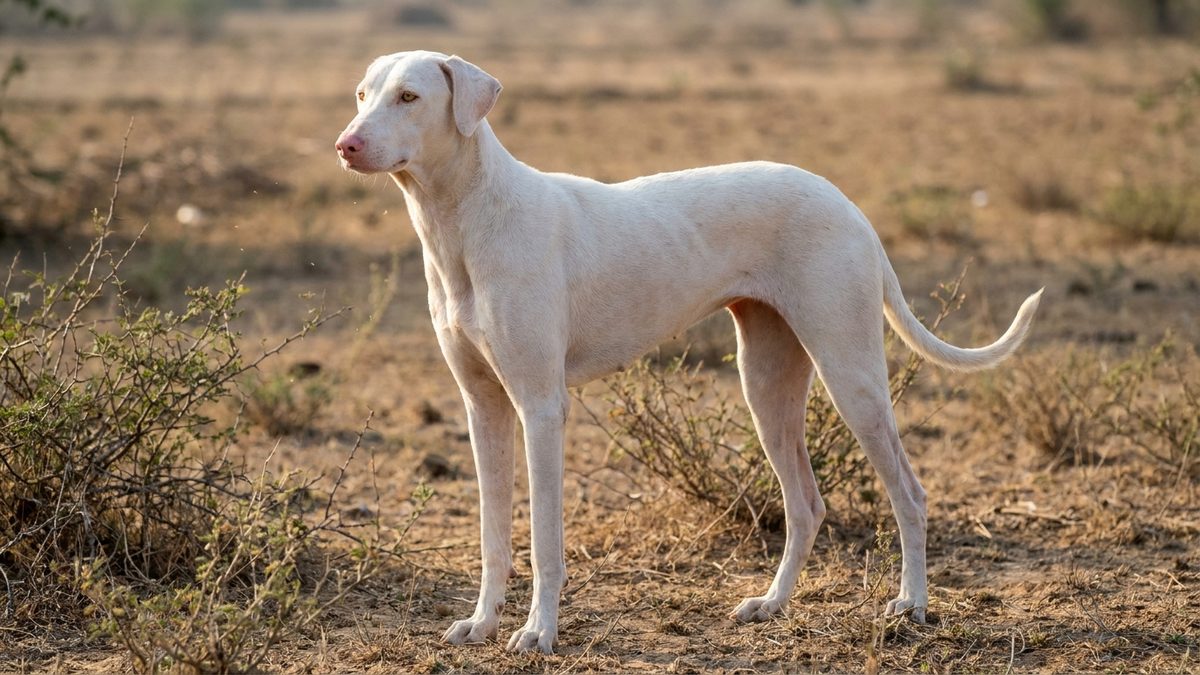
These are large sighthounds standing up to 30 inches at the withers and weighing as much as 77 lb, which is around 35 kg. They have long straight legs, a deep chest and a narrow waist, with a distinctive gait often compared to that of a thoroughbred horse.
One structural detail separates the Rajapalayam from other sighthounds. It is more heavily boned, with a heavier head and a broader muzzle, because it was built to take down wild boar rather than to course hare. A Rajapalayam is not a lightweight dog.
| Attribute | Detail |
|---|---|
| Type | Sighthound, also uses scent |
| Height | Up to 30 in |
| Weight | Up to 77 lb (35 kg) |
| Coat | Short, smooth, predominantly white |
| Nose and skin | Pink, unpigmented |
| Eyes | Golden preferred; blue signals higher risk |
| Origin | Rajapalayam, Virudhunagar district, Tamil Nadu |
| Other names | Poligar Hound, Shikkar Hound, Indian Ghost Hound |
The coat is short, smooth and predominantly white, with a pink nose and pale pinkish skin. The most prized colouring is pure white, sometimes with faint markings, a pink nose and golden eyes. That prized pure white is also the source of the breed's main health problem, covered in the health section.
An unusual sighthound
Unlike most sighthounds, which hunt almost entirely by sight, the Rajapalayam actively uses its sense of smell as well, which links it partly to the scent hounds. For an owner this means a dog that both chases movement and tracks, so recall training matters more than it would with a purely visual courser.
Rajapalayam dog price in India
A Rajapalayam puppy costs Rs 9,000 to Rs 30,000 across most of India, which makes it substantially cheaper than any imported breed. As with every Indian breed price, published figures disagree, so the range matters more than any single number.
Bonbeno compared the price bands published by the sources currently ranking for this breed. The spread is wide and the sources do not agree.
| Source | Stated range | Notes |
|---|---|---|
| Petriever | Rs 7,000 to Rs 30,000+ | Varies by breeder, bloodline and location |
| Wrapinfur | Rs 40,000 to Rs 80,000 | Highest published band found |
| Best Top Pets | Rs 8,000 to Rs 28,000 | Tamil Nadu, reputable breeders |
| Tamil Nadu average | Rs 9,000 to Rs 12,000 | The breed's home region |
The pattern here is the reverse of what buyers expect. The Rajapalayam is cheapest in Tamil Nadu, where it originates and where the breeding population is concentrated, and more expensive elsewhere in India where it is rare and shipped in. Imported breeds behave the opposite way, being most expensive in the metros where demand is highest.
A Rajapalayam at Rs 9,000 to Rs 30,000 sits well below a Golden Retriever at Rs 25,000 to Rs 1,20,000. You are paying less for a dog that handles Indian heat better and carries a shorter list of inherited orthopaedic problems. The trade is temperament, because this is a guarding sighthound and not a family retriever.
Why the Rs 40,000 to Rs 80,000 figure appears
Higher bands generally describe show-quality dogs with documented lineage, or sellers outside Tamil Nadu pricing scarcity. Neither justifies a premium on its own. Ask what specifically is being paid for, because with a rare breed the honest answer is often nothing more than distance from the breeding population.
Monthly cost of owning a Rajapalayam
Running costs for a Rajapalayam are lower than for a comparable imported breed, mainly because the coat needs almost no professional grooming and the dog is adapted to the local climate. The purchase price is a small fraction of the lifetime total regardless.
No published Indian source states a method behind its monthly cost estimates, so Bonbeno does not repeat one. We are running a verified owner cost survey across eight metros and will publish it with the sample size and collection date stated. What follows is the cost structure, which is knowable, rather than a total, which currently is not.
Where the money goes
- Food. A 30 to 35 kg active sighthound eats accordingly. This is the largest recurring line.
- Preventive veterinary care. Core vaccination, boosters, deworming, and tick and flea control. Tick-borne disease pressure is high across South India.
- Sun protection. Unpigmented pink skin burns. Budget for shade management and veterinary-approved sunscreen on exposed areas.
- Space or exercise substitute. A sighthound bred to run needs real daily output, which in a metro often means paid daycare or a secure run.
- Hearing assessment. A one-time BAER test, covered in the health section, is the single highest-value spend of the first month.
When we publish cost figures we state the sample size, the cities covered and the collection date. Where we cannot verify a number we say so rather than repeating an unsourced estimate.
Heat tolerance and the Indian climate
The Rajapalayam is one of the best-adapted dogs available to an Indian owner, because it was developed in the heat of southern Tamil Nadu rather than imported into it. This is its single biggest practical advantage over a Golden Retriever, Husky or German Shepherd.
The breeds most at risk of heat stroke in India are the double-coated imports, specifically German Shepherds, Golden Retrievers, Labrador Retrievers, Huskies and Collies, whose dense coats trap heat. Peak summer temperatures cross 45 C in several parts of the country. The Rajapalayam's short single coat sits on the right side of that divide.
Adapted does not mean immune. Standard veterinary precautions still apply, and heat stroke remains a veterinary emergency in any breed.
- Shift hard exercise to early morning and late evening, which is the standard veterinary recommendation during Indian summers.
- Keep constant access to fresh water, since hydration and monitoring are the most effective preventive measures available.
- Watch the skin, not just the temperature. Pink unpigmented skin and a thin white coat mean sunburn risk that a pigmented breed does not carry.
- Provide shade rather than confinement. This is a running dog, so the answer to midday heat is shade and timing, not a permanently closed room.
The Rajapalayam handles ambient heat better than almost any imported breed but handles direct sun worse than a pigmented dog. Ears, muzzle and belly are the exposed areas. Manage sun exposure specifically, not just temperature.
Temperament and household fit
The Rajapalayam is a one-person guarding dog, not a family companion, and buyers who expect otherwise are the main source of surrendered dogs in this breed. Understand this before anything else.
The character is a mix of loyalty, independence and aggression toward perceived threats. These are known as one-person dogs that, once they trust you, will follow you anywhere, while keeping their distance from the rest of the family. That is a description of a guarding breed, and it comes directly from the war-dog and estate-guarding history.
Who this breed suits
- Good fit. Experienced owners, houses with secure outdoor space, single-dog households, owners who want a guarding presence and will invest in early socialisation.
- Poor fit. First-time owners, homes with frequent visitors or small children, apartments without a real exercise outlet, anyone wanting an affectionate all-family dog.
- Non-negotiable. Early and sustained socialisation. A poorly socialised guarding sighthound of 35 kg is a serious liability, not a quirk.
Because the breed both sights and scents prey, recall in open spaces is unreliable without substantial training. Secure fencing is not optional. A Rajapalayam that decides to chase will outrun the owner calling it.
Apartment reality
A Rajapalayam can live in an apartment only where the owner commits to genuine daily running, not two short walks. This is a coursing hound built to cover ground. Suppressing that entirely produces exactly the frustration behaviours that end in rehoming.
Training a Rajapalayam
Train a Rajapalayam with short, consistent, reward-based sessions and adjust your expectations away from retriever standards. This is an intelligent breed with a genuine independent streak, so it needs firm but gentle handling rather than repetition drills.
Socialisation is the whole game
Socialisation is the single most critical aspect of raising this breed. Between 8 weeks and 4 months, introduce the puppy to everything you can manage safely, because that is what prevents the breed's natural wariness from hardening into fear-aggression.
A Golden Retriever that misses its socialisation window becomes an anxious dog. A 35 kg guarding sighthound that misses it becomes a liability to your visitors and a legal exposure to you. If you cannot commit to structured socialisation through the first four months, this is not the breed to buy.
Why sighthound training feels different
Sighthounds were selectively bred for both the motivation and the ability to spot and chase moving objects, so when something moves at distance the instinct to chase overrides other commands. They are also typically less motivated by food than biddable breeds, and they are sensitive dogs that do not respond well to harsh correction.
A breed bred for independent chase may never achieve the immediate response of a retriever or collie. That does not mean recall training fails. It means adjusting the target and keeping management in place, such as a long line in any area with wildlife.
| Skill | Rajapalayam | Compared with a retriever |
|---|---|---|
| Name response | 3 to 6 weeks | Similar |
| Sit, down, settle | 4 to 8 weeks | Similar |
| Loose-lead walking | 6 to 12 months | Slower |
| Recall with no distraction | 3 to 6 months | Similar |
| Recall with prey in sight | Treat as unreliable, permanently | Achievable in a retriever |
| Calm around strangers | Ongoing management | Usually resolves |
- Keep sessions short and consistent rather than long and repetitive.
- Find the reward that works. If food is weak, use movement, a chase toy or access to a run.
- Never use harsh corrections. They damage a sensitive breed and produce avoidance, not compliance.
- Manage instead of trusting. A long line is not a training failure, it is the correct tool for a coursing breed.
How much exercise a Rajapalayam needs
A Rajapalayam needs at least 60 to 90 minutes of exercise a day, and one to two hours of walking or running is the realistic target. Without it, this breed becomes destructive, which is the most common reason Rajapalayams are surrendered.
Daily walks, runs and play in a secure yard suit the breed, and it responds well to activities that work it mentally as well as physically, such as agility or interactive games.
Rajapalayam owners specifically recommend a walled compound, because the breed can clear even a human-height fence. This is the practical detail that decides whether you can keep one. A standard Indian society boundary wall may be adequate. A garden fence is not.
Apartment living
The Rajapalayam does not adapt well to apartment life and thrives where it has a large yard and room to run. Bonbeno rates apartment suitability 2 out of 5 for this breed for exactly that reason. It is possible only with a genuine daily running outlet, and most metro households cannot provide one.
Exercising in Indian heat
The breed's heat tolerance is excellent, but its unpigmented pink skin burns. That combination changes the schedule rather than the volume.
- Run early morning and late evening, which is the standard veterinary recommendation in Indian summers.
- Prefer shaded routes over open ground at any hour, because sun exposure rather than air temperature is this breed's specific vulnerability.
- Use a secured open space for real running. Lead walks alone do not satisfy a coursing hound.
- Do not exercise a puppy hard. Large-breed growth plates stay open well past the first year, and this breed's adolescence runs 18 to 30 months.
Grooming a short white coat
Grooming a Rajapalayam is the easiest part of owning one. The short, smooth, single coat needs weekly brushing and little else, which is a real cost and time advantage over any double-coated import.
There is no dense undercoat to strip and no seasonal blow-out to manage, so the humidity-driven matting that plagues Golden Retrievers and Spitz-type breeds in India is not a factor here.
- Brush weekly with a rubber curry or hound glove to lift dead hair.
- Bathe rarely. Frequent bathing strips oils from already sensitive unpigmented skin.
- Inspect the skin at every brush. White short-coated dogs show irritation, ticks and sunburn early, which is an advantage if you look.
- Check ears and nails on the same weekly schedule, since neither is coat-related but both get skipped when grooming is quick.
Dogs of this breed are prone to skin sensitivities. Pale unpigmented skin under a thin white coat reacts to sun, humidity and parasites more readily than a pigmented coat does. Budget attention for skin rather than for grooming.
Health risks, deafness and lifespan
The Rajapalayam's defining health issue is congenital deafness linked to its white coat, and it is testable before you buy. This is the most important section on this page and it is the one most Indian breed guides omit entirely.
Congenital deafness
The genetics that produce the breed's prized pure white coat are linked to congenital deafness. The mechanism is absence of pigment in the inner ear, and it is a well-documented pattern across white-coated dog breeds generally, not a quirk of this one. In white dogs, some of the same stem cells that would form the hair cells responsible for hearing instead become pigment cells, and the most common presentation is associated with blue eyes.
A real share of all-white puppies are born deaf in one or both ears, and dogs with blue eyes carry a higher risk of both deafness and vision problems. This is why golden eyes rather than blue are preferred in the breed.
A BAER hearing test on a puppy tells you exactly what you are taking home, before you fall in love with it. Unilateral deafness in particular is invisible to casual observation, because a puppy deaf in one ear behaves almost normally. If a seller will not arrange or permit a BAER test, that is your answer about the seller.
A deaf Rajapalayam is not an unadoptable dog. It is a dog that needs hand-signal training, a permanently secure environment and an owner who understands the risk. What is unacceptable is finding out by accident two years in.
Inbreeding and population size
The breed is generally healthy, but its small population and consequent inbreeding leave it susceptible to genetic disorders. This is a direct legacy of the population collapse described in the adoption section. Other reported concerns include hip dysplasia and skin sensitivities.
| Concern | How it is checked | When |
|---|---|---|
| Congenital deafness | BAER test, both ears | Before purchase |
| Hip dysplasia | Radiographic screening of both parents | Before purchase |
| Skin sensitivity | Veterinary skin examination | At first vet visit |
| Inbreeding depth | Pedigree across at least 3 generations | Before purchase |
Indian breeds have nothing comparable to the large prospective studies that exist for popular Western breeds. There is no Rajapalayam equivalent of the Golden Retriever Lifetime Study. Where this page states a health risk it reflects breed literature and veterinary consensus rather than a large cohort study, and Bonbeno flags that rather than implying a precision the evidence does not support.
Feeding a Rajapalayam
Feed a Rajapalayam as a large, lean, active breed, keeping it at a working body condition rather than a heavy one. A sighthound carrying extra weight loses the thing the breed is built around.
This breed should look lean. Visible waist and a light covering over the ribs is correct for a sighthound and is frequently mistaken by Indian owners for being underfed. Overfeeding a dog with reported hip dysplasia risk adds load to joints for no benefit.
- Use a large-breed formulation through growth, and control the growth rate rather than maximising it.
- Split intake across two meals rather than one, which is standard practice for deep-chested breeds.
- Feed to body condition, not to a chart. Sighthound body condition differs from a retriever's at the same weight.
- Adjust in peak summer, when appetite commonly drops. Persistent inappetence is a veterinary matter, not a preference.
Bonbeno reviews Indian pet food brands separately and tests products first-hand before publishing a verdict. See our testing method for what a Bonbeno food review does and does not claim.
Rajapalayam puppy: the first two years
A Rajapalayam grows into a 25 to 30 inch, 30 to 45 kg adult, and its adolescence runs far longer than most owners expect. Puppyhood covers birth to about 6 months, and the adolescent stage lasts from roughly 18 to 30 months.
| Measure | Reported range | Source |
|---|---|---|
| Height at withers | 25 to 30 in (65 to 75 cm) | Petlur, Rajapalayam Dog Breed Info, Size |
| Weight | 66 to 77 lb | Dog Breeds List, Rajapalayam, Price |
| Weight, alternative | 30 to 45 kg | Petlur, Rajapalayam Dog Breed Info, Size |
| Puppyhood | Birth to about 6 months | Petlur, Rajapalayam Dog Breed Info, Size |
| Adolescence | About 18 to 30 months | Petlur, Rajapalayam Dog Breed Info, Size |
The two windows that decide the adult dog
- 8 weeks to 4 months, socialisation. The most critical care task in the breed. Wariness that is not softened here becomes fear-aggression later.
- Before purchase, hearing. A BAER test is the only way to know whether an all-white puppy hears in both ears. Unilateral deafness is invisible to observation and changes how you must train and contain the dog for life.
Stage by stage
- 8 to 16 weeks. BAER test if not already done. Vaccination course. Structured socialisation with people, surfaces, sounds and other dogs. Name and handling work.
- 4 to 6 months. Growing fast. Keep exercise light and frequent rather than long. Begin loose-lead work. Sun protection habits start now, since pink skin burns from the first summer.
- 6 to 12 months. Guarding behaviour begins to emerge as the dog matures. Continue socialisation rather than stopping, because this is where under-socialised dogs start reacting to visitors.
- 12 to 18 months. Physical maturity approaching. Build exercise toward the adult 60 to 90 minute load.
- 18 to 30 months. Adolescence proper. Expect testing and inconsistency. Hold reward-based methods, because harsh correction on a sensitive sighthound at this stage does lasting damage.
Published figures split between 9 to 10 years and 10 to 12 years, averaging close to 11 Petlur, Rajapalayam Dog Breed Info, Size. No large study of the breed exists, so treat any single number as an estimate rather than a benchmark.
Rajapalayam vs Mudhol Hound
The Rajapalayam and the Mudhol Hound are separate breeds from different states, and confusing them is the most common error Indian buyers make with native sighthounds. The Rajapalayam is the heavier boar hunter from Tamil Nadu; the Mudhol is the leaner courser from Karnataka.
| Factor | Rajapalayam | Mudhol Hound |
|---|---|---|
| Origin | Virudhunagar, Tamil Nadu | Bagalkot, Karnataka and Maharashtra |
| Build | Heavier than most sighthounds, deep chest | Slender, sleek, muscular |
| Head | Broader muzzle, built for boar | Narrow and long, tapering muzzle |
| Coat | White, short, fine | Smooth or silky (Pashmi) |
| Ears | Floppy | Moderately sized, set wide |
| Hunting style | Sight and scent, bay and catch | Sight, long-distance vision, running |
| Service record | None | Army 2017, IAF 2021, SPG |
| Key health flag | Congenital deafness with white coat | Sighthound anaesthesia sensitivity |
The functional difference is the most interesting one. The Rajapalayam is unusual among sighthounds because it fulfils the roles of both a bay dog and a catch dog, and it hunts by sight while also tracking by scent. The Mudhol is a purer courser, valued for running ability, height and the ability to pick out movement at long distance.
Choose the Mudhol Hound if you want a calmer indoor dog with documented bloodlines and a state-backed breeding programme behind it. Choose the Rajapalayam if you specifically want a guarding presence and can provide a walled compound. Neither suits an apartment without a serious running outlet, and if that is your situation the Indian Pariah Dog is the honest answer. For a guarding breed from the same state that is built for close work rather than coursing, compare the Kombai.
Mistakes Indian Rajapalayam owners actually make
The failure modes for this breed are specific and repeat across households. These are ranked by how much damage they do to the dog or to the people around it.
- Skipping the BAER hearing test. The breed's prized white coat is genetically linked to congenital deafness, and a puppy deaf in one ear behaves almost normally. Finding out two years in changes nothing you can fix.
- Under-socialising between 8 weeks and 4 months. This is the window where natural wariness either softens or hardens into fear-aggression. Missing it in a 35 kg guarding breed is the most dangerous mistake on this list.
- Fencing instead of walling. The breed clears human-height fences, and owners specifically recommend a walled compound. A loose coursing hound near traffic is a short story with one ending.
- Buying it as a family pet. This is a one-person guarding dog that keeps distance from the rest of the household. Families expecting a retriever temperament are the main source of surrenders.
- Ignoring sun exposure. Unpigmented pink skin burns. Owners manage air temperature and forget ultraviolet, which is this breed's actual vulnerability.
- Expecting retriever recall. A sighthound in pursuit will not return on command, and treating that as a training failure leads owners to escalate to harsh methods on a sensitive breed.
- Apartment keeping without a running outlet. The breed does not adapt well to apartments and becomes destructive without real exercise.
- Assuming rarity equals quality. A rebuilt population of roughly 200 dogs means inbreeding risk. Pedigree depth matters more here than in a common breed, not less.
Containment. A breed that clears human-height fences, has a hardwired chase response and cannot be recalled mid-pursuit needs a physical boundary, not a trained one. Every other mistake on this list is recoverable.
Conservation, sourcing and adoption
Source a Rajapalayam through Tamil Nadu breeders working with the recognised conservation effort, and verify the pedigree before paying. This breed nearly disappeared, and where you buy from directly affects whether it recovers.
The breed nearly vanished
As hunting declined, the Rajapalayam population fell to around 200 dogs by the 1980s. The Kennel Club of India intervened, launching a campaign to save the breed and establishing a breeding centre to rebuild numbers. The Save the Rajapalayam Project runs with KCI cooperation.
Formal recognition followed. India Post issued a set of indigenous dog breed stamps on 9 January 2005, covering the Himalayan Sheepdog, Rampur Hound and Mudhol Hound at Rs 5 each, and the Rajapalayam at Rs 15 Mintage World, Indian Dog Breeds on Stamps.
Indian breeds are being taken seriously again
The Rajapalayam is part of a broader shift. The Mudhol Hound, another Indian sighthound, entered the Indian Army's inventory in 2017 after training at the Remount and Veterinary Corps Centre in Meerut, was inducted by the Indian Air Force in 2021 to keep birds off runways, and is bred at the Canine Research and Information Centre at Thimmapur near Mudhol, a unit of Karnataka Veterinary, Animal and Fisheries Sciences University. Institutional backing of this kind did not exist for Indian breeds twenty years ago.
Sourcing checklist
- Buy in Tamil Nadu where practical, because the breeding population and the lowest prices are both there.
- Insist on a BAER hearing test on the specific puppy, not a general assurance about the litter.
- Verify KCI registration directly with the Kennel Club of India rather than trusting a photocopy, remembering that KCI certifies pedigree and not health.
- Ask for pedigree depth, since inbreeding is the documented risk in a breed rebuilt from roughly 200 dogs.
- See the dam with the litter in the place the puppies were raised, and decline any seller who refuses.
Adoption
Rajapalayams and Rajapalayam crosses appear in South Indian shelters, frequently surrendered by owners who wanted a family dog and got a guarding sighthound. Adopting an adult removes the two largest unknowns in a puppy purchase, which are temperament and hearing status, because both are already known in an adult dog. If a guarding breed is not what you need, the Indian Pariah Dog is the better-tempered native alternative and costs nothing to adopt.
Rajapalayam questions Indians actually search
What is the price of a Rajapalayam dog?
A Rajapalayam puppy costs Rs 9,000 to Rs 30,000 across most of India, and Rs 8,000 to Rs 28,000 from reputable breeders in Tamil Nadu where the breed originates. Some sellers outside Tamil Nadu quote Rs 40,000 to Rs 80,000, which reflects scarcity and distance rather than a better dog.
Is Rajapalayam a friendly dog?
Not in the way most buyers mean. The Rajapalayam is a one-person guarding dog that bonds intensely with a single owner while keeping distance from the rest of the family, and it shows aggression toward perceived threats. It is loyal rather than friendly, and it needs early sustained socialisation.
Why is Rajapalayam dog famous?
The Rajapalayam is famous as a war dog and a conservation success. Poligar chieftains used it against British cavalry during the Carnatic Wars and the Polygar War, its population then collapsed to about 200 dogs by the 1980s, and India Post honoured it with a Rs 15 stamp on 9 January 2005 as part of a set on indigenous breeds.
Which is the 20 crore dog?
The Rs 20 crore figure refers to an offer a Bengaluru breeder said he refused for a Caucasian Shepherd, and the related Rs 50 crore wolfdog claim has since been debunked. The Enforcement Directorate searched the breeder's residence, found no documentary evidence he owned the animal, and he reportedly said the dog was not his and he had only posed for photographs. No verified Rs 20 crore dog sale exists in India.
Are Rajapalayam dogs deaf?
Some are. The genetics producing the breed's pure white coat are linked to congenital deafness through absent pigment in the inner ear, and a real share of all-white puppies are born deaf in one or both ears. Blue-eyed dogs carry higher risk of both deafness and vision problems. A BAER hearing test before purchase settles it.
Can a Rajapalayam handle Indian summer?
Yes, better than almost any imported breed. It was developed in the heat of southern Tamil Nadu and carries a short single coat rather than the dense double coat that puts Golden Retrievers, Huskies and German Shepherds at heat-stroke risk. Its specific vulnerability is sunburn on unpigmented pink skin, not ambient heat.
Is a Rajapalayam good for an apartment?
Only with a genuine daily running outlet. This is a coursing sighthound built to cover ground, and two short walks will not satisfy it. Floor area matters less than whether the owner can provide real exercise, secure fencing and early socialisation for a guarding breed of about 35 kg.
How big does a Rajapalayam get?
A Rajapalayam stands up to 30 inches at the withers and weighs as much as 77 lb, roughly 35 kg. It is more heavily boned than other sighthounds, with a heavier head and broader muzzle, because it was bred to take down wild boar rather than to course smaller game.
How much exercise does a Rajapalayam need?
A Rajapalayam needs at least 60 to 90 minutes of exercise daily, and one to two hours of walking or running is the realistic target. Without it the breed becomes destructive. It does not adapt well to apartment life and does best with a large secure yard where it can actually run.
Can a Rajapalayam jump a fence?
Yes. Owners specifically recommend a walled compound because the breed can clear even a human-height fence. This is the single most important practical consideration before buying one, because a coursing sighthound that gets out cannot be recalled once it is in pursuit.
Compare with similar breeds
Rajapalayam sits in 3 Bonbeno groups. Each one compares it directly against the breeds it is genuinely an alternative to, on the same figures.