
Breed profile
Bắc Hà Dog (Chó Bắc Hà): Breed Guide for India
A northern Vietnamese highland landrace whose only breed standard is published as seven scans, whose issuing body says in a 2022 decision that the type is not yet fixed and withdrew the standard's own pictures, and which the FCI does not list anywhere. What the document actually says, why the heat rating is a genuinely favourable 3 out of 5, and why no lawful route into India exists.
Quick answer
The bac ha dog is a medium-large highland landrace from Lào Cai in northern Vietnam, standing 52 to 58 cm and weighing 22 to 28 kg, with a thick double coat, drop ears and a plumed tail carried over the back. Its only standard, issued by the Vietnam Kennel Association in 2019, classifies it as a mountain type rather than a spitz. The FCI does not recognise it, and it cannot lawfully be imported into India for breeding or sale.
This guide is general information for Indian pet owners and is not a diagnosis. Consult your nearby vet, a registered veterinarian who has examined your dog, before acting on anything you read here, and treat any sudden collapse, laboured breathing or suspected overheating in hot weather as an emergency requiring immediate cooling and veterinary attention.
Bắc Hà at a glance
What the Bắc Hà dog is, and why almost every English page describes the wrong dog
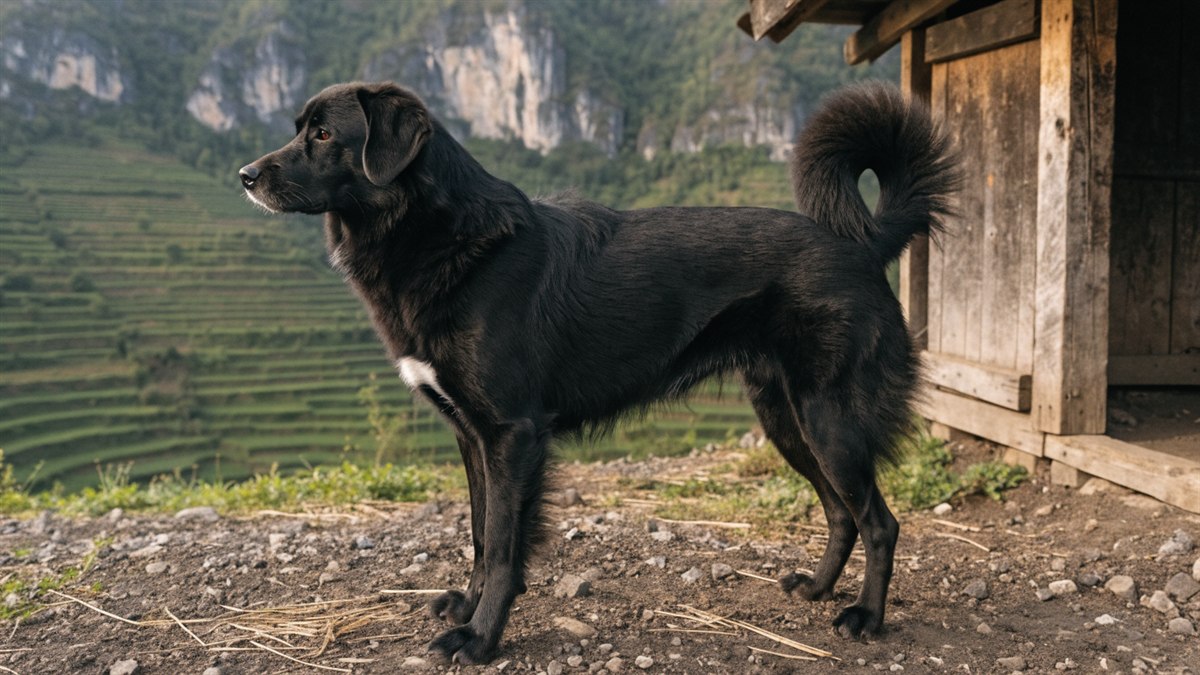
The Bắc Hà dog is a medium-large highland landrace from northern Vietnam, kept for generations by H'Mông households in the Bắc Hà and Si Ma Cai uplands of Lào Cai province as a house guard and hunting companion, and given a written breed standard by the Vietnam Kennel Association in September 2019. It stands 52 to 58 cm at the shoulder as a dog and 50 to 56 cm as a bitch, weighs 22 to 28 kg and 18 to 24 kg respectively, and carries a thick double coat with a mane ringing the neck and shoulders.
Start with the mistake, because it runs through nearly every English page about this breed. The Bắc Hà is repeatedly described as a spitz. English Wikipedia opens by calling it 'a medium-size spitz dog breed' and gives it the alternative name Vietspitz. The two Vietnamese retail pages that rank highest both put it in nhóm chó Spitz Laputa Farm, 'Giống chó Bắc Hà. The only official document that has ever defined the breed says something else entirely.
The Vietnam Kennel Association's standard, number 003/VN/18.09.2019, carries an FCI-format classification line reading Nhóm 2, Phân nhóm 2, Chó núi, which is Group 2, Section 2, Mountain type. That is the section holding the Tibetan Mastiff, the Caucasian Shepherd Dog, the Pyrenean Mountain Dog and the Estrela Mountain Dog. It is not the spitz group. The same association put the H'Mông cộc đuôi in Group 5, Section 5, Asian Spitz and related breeds, in its own separate standard. VKA drew the line itself, in writing, and the English-language internet crossed it.
This matters more than a taxonomy quibble, because the label carries assumptions with it. A reader told 'spitz' pictures prick ears, a wedge head and a tightly curled tail. The standard requires drop ears, describes a trapezoidal elongated skull with a square broad muzzle, and lists tai nhọn và dựng, pointed and erect ears, among the disqualifying faults. A Bắc Hà with the ears most English pages draw would be put out of the ring by the only body that judges the breed.
The standard's own figures, read from the standard
Everything in the table below comes from the six-page breed standard attached to VKA decision 006/2019/QĐ-CT, read page by page from VKA's own scans rather than from any summary of them.
| Point | What standard 003/VN/18.09.2019 says |
|---|---|
| Origin | Việt Nam |
| Effective date | 18 September 2019, Ver. 00 |
| Purpose | Trông nhà và làm bạn, house guarding and companionship. Explicitly not used as a service dog |
| FCI-format group | Nhóm 2, Phân nhóm 2 (Group 2, Section 2, mountain type) |
| Height, dogs | 52 to 58 cm |
| Height, bitches | 50 to 56 cm |
| Weight, dogs | 22 to 28 kg |
| Weight, bitches | 18 to 24 kg |
| Proportions | Height to body length 10:11. Muzzle length to skull length 1:1 |
| Skull | Trapezoidal, elongated. Moderate stop marked by a groove between the brow ridges |
| Ears | Cụp, drop, set slightly high, medium, triangular with rounded tips |
| Eyes | Medium, almond-shaped, set horizontally, deep, wide apart, brown or black |
| Tongue | With or without spots |
| Tail | Set low, carried curved over the back. Densely coated, long and bushy, spreading down over the back |
| Coat | Two layers. Outer coat long and slightly harsh, undercoat thick and soft. Short on the head and lower legs, longer at neck, shoulders and back, forming a mane ring around the neck |
| Colours | White, yellow, brindle, black, brown, grey, spotted and piebald |
| Disqualifying faults | Excessive aggression or timidity, abnormal behaviour or physique, missing dentition, overshot or undershot bite, pointed erect ears, pinched V-shaped muzzle, small slanted close-set triangular eyes, tightly curled tail, weak pigment |
VKA publishes the standard as seven scanned page images, not as text. A scan with no text layer cannot be indexed, summarised or machine-read, so every English description of this breed was written from something other than the document it claims to describe. Bonbeno read the seven scans directly, which is why the ear, group and tail entries above differ from what you will find elsewhere.
Where the breed comes from, and how thin the evidence is
The origin account is folklore plus inference, and it should be labelled as such. The standard's own history paragraph says only that the breed has existed for a very long time alongside the ethnic minority peoples of the northern high mountains, especially the H'Mông living in the highlands of Bắc Hà and Si Ma Cai in Lào Cai, and that it adapted to the harsh environment of the northwestern uplands. It names no date, no founding stock and no study.
Vietnamese Wikipedia goes further and says the breed descends from heavy-coated mountain dogs of southern China that travelled with H'Mông migration into Vietnam, arriving around the late Hậu Lê period. Follow that claim back and it rests on two references. One is a 2015 University of Wisconsin Press book on Hmong political history in French Indochina, which is a real scholarly work about people rather than dogs. The other is nativevietbreedsociety.com, whose domain no longer resolves in DNS at all. The single English-language authority behind the origin story of this breed, in both language editions of Wikipedia, is a website that has ceased to exist.
There is also a legend, and Bonbeno reports it as a legend. H'Mông tradition holds that after the migration reached Lào Cai a dhole came down from the mountains and mated with the migrants' bitches, producing red-coated puppies of especially wild and fierce temperament, and that these were the first Bắc Hà dogs. It is a good story and it is not evidence. No published genetic work on this breed exists to test it, which the health section sets out in detail.
One resemblance keeps being noted and is worth stating carefully. Vietnamese sources observe that the breed shares several features with the Chow Chow of the China and Tibet region, including the coat type and the frequently spotted tongue, and infer a shared Himalayan ancestry Wikipedia tiếng Việt, Chó Bắc Hà. The standard does record that the tongue may or may not carry spots, so the observation is real. The inference is untested. Treat it as a hypothesis, not a pedigree.
Names, and the place the breed is named after
The breed answers to more names than most. Vietnamese sources give chó Bắc Hà, chó Xồm (shaggy dog), chó Mán, chó xù Bắc Hà and the English coinage Vietspitz Wikipedia, Bắc Hà dog. It is counted as one of the tứ đại quốc khuyển, the four great national dogs of Vietnam, alongside the Phú Quốc Ridgeback, the H'Mông cộc đuôi and the Indochinese Dingo.
The place itself has changed since every English page about the breed was written. Bắc Hà was a district of Lào Cai province, sitting at roughly 1,000 to 1,500 m above sea level on limestone terrain with average slopes of 24 to 28 degrees, with a 2019 population of 65,338 of whom more than 47 percent were H'Mông. Under the 2025 administrative reorganisation the district tier was abolished. Bắc Hà is now a commune, and Lào Cai province itself absorbed the former Yên Bái under National Assembly Resolution 202/2025/QH15, giving a merged province of 13,256.92 km2 and 1,778,785 people. If you read that the breed comes from 'Bắc Hà district', the source predates July 2025.
Recognition: one associate-member standard, no FCI listing, and a 2022 decision saying the breed is not yet fixed
The Bắc Hà is recognised by exactly one body, the Vietnam Kennel Association, which issued breed standard 003/VN/18.09.2019 under decision 006/2019/QĐ-CT on 18 September 2019. It is not recognised by the Fédération Cynologique Internationale in any form, definitive or provisional, and it has no FCI standard number Fédération Cynologique Internationale Fédération Cynologique Internationale. It has no Kennel Club of India route either, because the KCI registers on FCI pedigrees and no FCI pedigree for this breed can exist.
Recognition is not a vanity question. It decides whether a pedigree travels, whether a dog can be entered anywhere, and in India whether a lawful import file can even be assembled. So this section reads each register from its own document rather than repeating a claim.
What VKA actually did, in its own words
Decision 006/2019/QĐ-CT was signed in Ho Chi Minh City on 18 September 2019 by the association's president, Phạm Lê Quân. Article 1 recognises the standard for the native Vietnamese breed chó Bắc Hà as standard number 003/VN/18.09.2019, attached in six pages. Article 2 assigns implementation to the Ban phát triển chó bản địa, the native dog development board. Article 3 makes the decision effective from signature. The legal basis cited is Government Decree 45/2010/NĐ-CP on the organisation and management of associations, together with the VKA charter approved by the Minister of Home Affairs under decision 71/QĐ-BNV of 19 January 2009 and amended by decision 337/QĐ-BNV of 22 April 2019.
Note the standard number. It is 003. The H'Mông cộc đuôi holds 002/VN/07.11.2020. VKA's native-breed programme is small enough that the Bắc Hà is only its third standard, and that scale is worth holding in mind when the word 'recognised' appears on a sales page.
The decision nobody quotes, and it is the important one
On 5 May 2022 VKA issued decision 03/2022/QĐ-VKA, headed 'Vv xóa bỏ hình ảnh minh họa chó Bắc Hà trong Bản Tiêu Chuẩn năm 2019', on removing the illustrative images of the Bắc Hà dog from the 2019 standard. It was made on the submission 02/TTr-BKT of the association's Technical and Veterinary Board dated 25 April 2022, and after taking the opinions of Bắc Hà breeders. It was signed for the executive committee by the Secretary General, Cao Minh Kim Qui.
Article 1 opens with a sentence that changes how the whole breed should be read. In VKA's own words, Giống chó Bắc Hà là giống chó đang trong quá trình định hình và phát triển đối với VKA và các nhà nhân giống, the Bắc Hà is a breed still in the process of being fixed and developed, for VKA and for its breeders. It then removes the standard's illustrative images, giving the reason that the images do not match the content they are meant to describe. Article 2 promises replacement images as soon as possible.
On 20 August 2026 the standard served at vka.vn still carried both the pencil sketch on its cover page and the two photographs on page 5 of 6, and the seven scans were uploaded to the site in August 2023, more than a year after the withdrawal decision. Four years on, the replacement promised in Article 2 has not appeared. Anyone matching a dog against the pictures in that document is matching it against images the issuing body formally withdrew as not matching its own text.
Read Articles 1 and 2 together and the honest summary is this. The Bắc Hà has a written standard, that standard's own author says the type is not yet settled, and the pictures meant to show what the words describe were withdrawn for not showing it. That is not a reason to dismiss the breed. It is the reason the sources disagree so widely about its ears, its size and its group, and it is the single most useful fact for anyone trying to verify what they are being shown.
The FCI position, read from three FCI lists
Bonbeno checked three FCI documents rather than one, because a breed can be absent from a group list and still hold provisional status, and because the FCI's own site serves a decoy page under a provisional-sounding path.
- Group 2, Pinscher and Schnauzer, Molossoid and Swiss Mountain and Cattledogs, the group VKA assigns the breed to. Section 2.2 Mountain type lists 15 country entries including the Tibetan Mastiff at 230, the Kangal at 331, the Caucasian Shepherd Dog at 328 and the Karst Shepherd at 278, which is the control confirming the page returned is the real Group 2 list. No Vietnamese breed appears anywhere in the group.
- Group 5, Spitz and primitive types, the group the English pages implicitly claim. Section 5 Asian Spitz and related breeds holds the Chow Chow at 205, the Akita at 255, the Shiba at 257, the Korea Jindo Dog at 334 and the Thai Bangkaew Dog at 358. Section 7 holds the Taiwan Dog at 348 and the Thai Ridgeback at 338. Southeast and East Asia are well represented and no Vietnamese breed is present.
- Breeds recognised on a provisional basis, read from /nomenclature/provisoire.aspx, whose own heading carries the FCI's long-standing 'provisonal' typo, which is the control confirming this is the real list. On 20 August 2026 it held 20 breeds, the highest standard number being 378, with four added on 11 February 2026. It includes the Anjing Kintamani-Bali at 362, an Indonesian landrace, so the FCI does provisionally recognise Southeast Asian native breeds. No Vietnamese breed is on it.
So the breed is unrecognised by the FCI on every list the FCI publishes, and the same is true of the Phú Quốc Ridgeback and the H'Mông cộc đuôi. Vietnam has four national dogs and none of them has an FCI standard number.
What VKA's own FCI status is
VKA is on the FCI's books, but not as a full member. The FCI's members and contract partners record for Vietnam lists the Vietnam Kennel Association at 188C Lê Văn Sỹ, Phường 10, Quận Phú Nhuận, Ho Chi Minh City, with the status Associate member. An associate member's national standards are not FCI standards, and a national standard for a breed the FCI does not list produces no FCI pedigree.
The consequence for an Indian reader is direct. The Kennel Club of India registers dogs on FCI-recognised pedigrees; no FCI pedigree for a Bắc Hà can be issued by anyone, so no Bắc Hà can be registered with the KCI as a pedigreed dog of its breed. Combine that with the import position set out in the price section and the conclusion is not a gap in our research. It is the finding.
The bobtail question: the Bắc Hà is not the bobtailed breed, and the difference is written into two standards
The Bắc Hà does not carry a bobtail. Its standard requires a tail set low and carried curved over the back, densely coated, long and bushy, spreading down over the back, and lists a tightly curled tail among the disqualifying faults. The bobtailed Vietnamese breed is the H'Mông cộc đuôi, whose separate VKA standard requires đuôi cộc bẩm sinh, a congenital bobtail, of no more than 15 cm, and disqualifies any tail longer than 15 cm or not naturally bobbed.
Indian buyers meet these two breeds as one blurred thing, usually as 'the Vietnamese mountain dog', and the confusion is worth dismantling properly because it is the difference between two animals with different jobs, different coats and different legal problems. The cleanest way to separate them is to put the two VKA standards side by side, which no page in any language has done.
| Point | Bắc Hà (003/VN/18.09.2019) | H'Mông cộc đuôi (002/VN/07.11.2020) |
|---|---|---|
| FCI-format group | Group 2, Section 2, mountain type | Group 5, Section 5, Asian Spitz |
| Stated purpose | House guarding and companionship, not a service dog | Guard dog and hunting dog |
| Tail | Set low, carried curved over the back, long and bushy | Congenital bobtail, no more than 15 cm |
| Ears | Drop, medium, triangular, rounded tips | Set high, pricked forward, thick, equilateral triangle |
| Coat length | Outer coat long, mane ring around the neck | Nape hair maximum 5 cm, body maximum 3 cm |
| Height, dogs | 52 to 58 cm | 48 to 54 cm |
| Weight, dogs | 22 to 28 kg | 18 to 26 kg |
| Permitted colours | White, yellow, brindle, black, brown, grey, spotted, piebald | Black, liver, red, brindle only |
| Piebald and white | Permitted | Disqualifying |
| Erect pointed ears | Disqualifying | Required |
| Dewclaws | Not mentioned | Removal required when young |
Read the colour rows again, because they are the fastest field test there is. White and piebald are permitted in the Bắc Hà and disqualifying in the H'Mông cộc đuôi Vietnam Kennel Association. The Bắc Hà that won the Vietnamese Native Breeds Championship Dog Show in October 2020, a dog called Sói, was white. A white dog with a plumed tail over its back and folded ears is a candidate Bắc Hà. A short-coated black or brindle dog with pricked ears and a stump is a candidate H'Mông cộc đuôi. They are not variants of one breed.
If a source does attribute a bobtail to a Bắc Hà
Treat it as a mislabelled dog or a cross, and treat the genetics as untested. That second half is a finding rather than a gap, so it is worth being precise about what is and is not known.
The canine bobtail locus is TBXT, the T-box transcription factor T gene. Haworth and colleagues identified it in 2001, showing that failure of the protein to bind its DNA target produces the short-tail phenotype in dogs. This is canine genetics and it has nothing to do with the unrelated genes behind short tails in cats; the two must never be conflated.
The reach of that mutation is limited, which is exactly why 'bobtailed therefore TBXT' is an unsafe inference. Hytönen and colleagues tested 23 breeds and 360 dogs, of which 156 were naturally short-tailed. The C189G mutation appeared in 17 of the 23 breeds with perfect correlation to the phenotype, and 6 breeds carried neither C189G nor any other coding mutation in the T gene at all. That is 17 of 23, or 73.9 percent, leaving roughly a quarter of short-tailed breeds unexplained by the known variant. The same study found no homozygotes among 360 dogs, which suggests the homozygous state is lethal, and recorded a 29 percent fall in litter size in Swedish Vallhunds when both parents were short-tailed.
The nearest tested analogue to a Vietnamese bobtailed landrace is Korean. Whole-genome sequencing of 22 DongGyeongi, Korea's only short-tailed native dog, against 10 other breeds pointed at ANKRD11 and ACVR2B under selective sweep plus a non-synonymous T-gene variant and an SFRP2 CpG island variant as candidate causes. In other words, in the one East Asian short-tailed landrace anybody has sequenced, the answer was not simply C189G.
No published study has genotyped a H'Mông cộc đuôi or a Bắc Hà for TBXT C189G or for anything else. A PubMed search on 20 August 2026 for the exact phrase 'Bac Ha' with dog returned zero records, and the same search for 'Phu Quoc' with dog returned zero, while a control search for golden retriever and hip dysplasia returned 25 and a broader search for Vietnamese indigenous dog research returned real papers. The database works. The literature does not exist. Untested is the answer, and anyone quoting a carrier rate for either breed is quoting something nobody has measured.
Why the bobtail matters even to a Bắc Hà buyer
A bobtail is not cosmetically free. A 2026 study of 1,679 dogs screened through the Norwegian Kennel Club's hip programme found lumbosacral transitional vertebra in 47.8 percent of 744 Brittany dogs and 14.9 percent of 935 Danish-Swedish Farmdogs, and bobtailed Brittanys had roughly double the odds of being LTV-positive compared with normal-tailed dogs, at an odds ratio of 2.04 with a 95 percent confidence interval of 1.47 to 2.85. Stump-tailed individuals showed the strongest association. In the Danish-Swedish Farmdogs the trend was the same direction but did not reach significance at an odds ratio of 1.66.
Two cautions before anyone carries that number across. Those are European breeds with their own population histories, and the study measured a radiographic finding, not clinical pain. What it does establish is that a short tail is a spinal trait rather than a decoration, which is a good reason to want the tail question settled before buying rather than after.
The H'Mông cộc đuôi standard states that if a dewclaw is present it must be removed while the dog is still young. In India that instruction is unlawful. Second Schedule Part II paragraph 6(8) of the Prevention of Cruelty to Animals (Dog Breeding and Marketing) Rules, 2017 forbids tail docking, ear cropping, de-barking, de-clawing and 'any other kind of mutilation of any body part of the pup and any change of appearance by artificial means';. The Bắc Hà standard contains no such instruction, which is one more reason to know which of the two documents you are reading.
Price in India: there is no Indian price, because there is no lawful route in
No Bắc Hà price exists in India, because the breed is not bred, sold or registered here and cannot lawfully be imported for breeding or sale. Under DGFT Trade Notice 22/2022-23, dogs sit at ITC(HS) 01061900 as a Restricted import, and Policy Condition (8) states plainly that 'import of commercial dogs for breeding or any other commercial activities other than the purposes mentioned above is not permitted';. Any rupee figure you are shown for this breed is a converted foreign number or an invention.
That first line is the most useful thing this page can tell an Indian buyer, so it goes first rather than at the end. What follows is the evidence, then what the published prices actually are in Vietnam, then what an Indian searcher is really being offered.
The import position, read from the trade notice itself
Bonbeno downloaded DGFT Trade Notice No. 22/2022-23 of 19 December 2022 and extracted all five pages rather than relying on any summary. The relevant provisions are these.
- ITC(HS) 01061900, 'Mammals: -- Other', carries the import policy Restricted, subject to Policy Condition 6 of the chapter.
- Policy Condition (7) permits dog import for three purposes only, a pet dog with a valid pet book and records in the importer's name, dogs imported by R&D organisations with a CPCSEA recommendation, and dogs for internal security by the Defence and Police Force.
- Policy Condition (8) states that import of commercial dogs for breeding or any other commercial activity outside those purposes is not permitted.
- Paragraph 6 states that any application for trading or breeding purposes, or made on behalf of another person or entity, 'shall be duly rejected'.
- Paragraph 7 limits entry to the airports and seaports of Delhi, Mumbai, Chennai, Hyderabad, Bangalore and Kolkata, with quarantine at the government station where required. DAHD added a seventh port, Cochin International Airport at Kochi, for pets arriving under the baggage rules in October 2024.
- Paragraph 2 allows up to two pets as passenger baggage without a DGFT import authorisation only for a person transferring residence to India after two years of continuous stay abroad.
Put those together with the recognition position and the supply chain closes at both ends. No breeder in India can lawfully import breeding stock, and no importer can present an FCI pedigree for a breed the FCI does not list Fédération Cynologique Internationale Fédération Cynologique Internationale. The only lawful Bắc Hà in India would be the personal pet of someone moving home from Vietnam with a valid pet book in their own name, and even that requires an advance no-objection certificate from the quarantine officer at one of the seven ports, obtained seven days before travel Department of Animal Husbandry…. The full route is set out in how to import a dog to India.
Ask the seller for the DGFT import authorisation number, the pet book in the importer's own name, and the port of entry from the six named in paragraph 7. DAHD added a seventh port, Cochin International Airport at Kochi, for pets arriving under the baggage rules in October 2024. A genuine lawful import has all three. Nothing else does. If the answer is that the dog was 'bred here from imported parents', that describes an import for breeding, which paragraph 6 says shall be duly rejected.
What the breed actually costs in Vietnam
Vietnamese published prices are wide, low by imported-breed standards, and worth stating in dong first, because converting them into rupees is precisely how the misleading Indian figures get made. Two Vietnamese sources publish bands.
| What is being priced | Published price (VND) | Indicative INR | Source |
|---|---|---|---|
| Reference band, whole breed | 2,000,000 to 25,000,000 | Rs 7,320 to Rs 91,500 | Pet Mart |
| Puppy, 2 to 3 months, mixed colour | 300,000 to 800,000 | Rs 1,098 to Rs 2,928 | Pet Mart |
| Puppy at the Bắc Hà weekend market | 200,000 to 800,000 | Rs 732 to Rs 2,928 | Pet Mart |
| A good adult, typical | about 2,000,000 | about Rs 7,320 | Pet Mart |
| Rare red or brindle, top end | over 20,000,000 | over Rs 73,200 | Pet Mart |
Those figures come from a Vietnamese pet retailer's breed article of 6 June 2024, and the rupee column is Bonbeno's arithmetic at a rate we name and date rather than a price anyone charges. The rupee numbers describe what a dog costs in Vietnam expressed in rupees. They are not an Indian price in India, and nobody in India sells at them.
The USD 2,000 claim, and how to check it in a calculator
The highest-ranking English page states the breed is expensive and puts the red variant at at least USD 2,000, unsourced. Test it against the Vietnamese market. Pet Mart's top-end figure for a rare red or brindle dog is over 20,000,000 VND, which works out to Rs 73,200 and then to about USD 765 at the two rates we retrieved and dated. A claim of at least USD 2,000 is therefore about 2.6 times the top of the published band in the breed's own country, and about 26 times the roughly USD 76 that Pet Mart says buys a good adult dog there.
Now do the check that this site runs on every suspicious rupee figure. At 84.38, the exchange rate that has produced fake Indian prices on three separate Bonbeno breed pages, USD 2,000 becomes Rs 1,68,760. At the real rate on 20 August 2026 of 95.71 rupees to the dollar it becomes Rs 1,91,420. If you are ever quoted either of those numbers for a Bắc Hà in India, you are looking at an unsourced American blog figure run through a currency converter, not at anything an Indian market has ever paid.
Availability in India, and what you are actually being offered
Bonbeno searched for Indian listings, Indian breeders and Indian classified results for this breed and found none. The availability position is not scarce supply, it is no supply. Searches for the breed with 'price in India' return Indian dog-price listicles that do not contain the breed at all, plus the same handful of overseas pages. The most revealing result is a Bắc Hà price article published on the domain of an Australian caravan park visitor centre, with no author, no date and no source, crediting a Vietnamese pet site and reproducing the Vietnamese retail bands almost verbatim. That page exists because content farms fill breed slots, not because anyone in India or Australia is selling these dogs.
If an Indian listing does appear, the realistic possibilities are three. It is an Indian free-ranging dog or a mixed-breed spitz cross with a fluffy coat, sold under a foreign name at a foreign markup. It is a genuinely imported dog with no lawful paperwork. Or it is a shell page that exists identically for two hundred other breeds. In every one of those cases the useful comparison is the Indian Pariah Dog, which costs nothing to adopt, is genuinely adapted to Indian conditions, and is not a legal problem.
Cost of ownership: what drives the bill on a 25 kg double-coated dog in India
Bonbeno publishes no monthly rupee figure for keeping a Bắc Hà in India, because no Indian population of this breed exists to price and a made-up number would be worse than none. What can be stated honestly is the cost structure, which is set by four things this breed's own standard and the Indian disease literature make specific: a 22 to 28 kg body, a thick double coat in a humid climate, year-round tick pressure, and cooling.
Every recurring cost a dog generates scales with one of those four. Work through them in order and you can size your own budget without a fabricated average.
1. Body mass sets the food and drug bill
The standard puts a dog at 22 to 28 kg and a bitch at 18 to 24 kg. That is the same bracket as a Labrador Retriever or a smallish Chow Chow, and it sets food volume, the dose band for every parasiticide, and the price of anaesthesia if surgery is ever needed. A 25 kg dog eats roughly three times what a 8 kg dog eats and is dosed accordingly. Budget from the weight, not from the breed name.
Note that the Vietnamese commercial sources disagree with the standard on this. One farm page gives dogs 19 to 26 kg and bitches 16 to 23 kg, and a retailer gives 16 to 26 kg for the breed generally Pet Mart Việt Nam. Both bottom out below the standard's floor. If you are sizing a budget, use the standard's 22 to 28 kg for a dog and treat anything lighter as a dog that has not been measured against the standard.
2. The double coat sets the grooming bill
The standard describes a two-layer coat, long and slightly harsh on the outside over a thick soft undercoat, short on the head and lower legs, longer at neck, shoulders and back where it forms a mane ring, with a long bushy tail. In Indian humidity that structure needs regular brushing rather than occasional bathing, and it is the single biggest ongoing cost difference between this dog and a short-coated Indian breed. A Vietnamese farm page recommends bathing once or twice a month; the grooming section below explains why brushing frequency, not bathing frequency, is the number that matters here.
3. Tick control is not optional and is not seasonal
This is the line Indian owners most often under-budget. Indian studies of clinically suspected dogs put tick-borne disease pressure high across the country. In Punjab, PCR found Ehrlichia canis in 27 of 82 suspected dogs and Anaplasma platys in 47 of 82, with both present in 19 of 82. In Andhra Pradesh, across 442 suspected dogs from 90 dispensaries, PCR confirmed E. canis in 51 of 442, and a history of tick control was associated with lower odds of infection. Year-round acaricide for a 25 kg dog is a fixed monthly line, and the Andhra finding is the argument for paying it.
4. Cooling is a capital cost and a running cost
A dog built for a highland with a January mean near 12 degrees C needs managed indoor temperature through an Indian summer, which the climate section quantifies. That means fans or air conditioning running in the room the dog uses, for the months your city is above its comfort band. It is a real cost and it belongs in the budget rather than in a footnote.
Core vaccination beginning at seven to eight weeks and usually completed by eighteen weeks, as the Indian rules describe the normal schedule. Year-round tick and flea control dosed for 22 to 28 kg. Deworming. Neutering, which Indian rules require before any sale of a dog over six months other than to a licensed breeder. Brushing tools and a grooming budget. Cooling. And a contingency, because a breed with no Indian veterinary familiarity means longer diagnostic paths when something goes wrong.
One honest caveat on all of the above. These are the cost drivers, not a quotation. Bonbeno does not publish a monthly rupee total for this breed and will not until an Indian population exists that anyone can survey.
Suitability for the Indian climate: a genuinely favourable rating, and the reason it stops at three out of five
The Bắc Hà handles Indian conditions better than almost any European breed on this site, and worse than its Asian origin implies. Its home region is a monsoon highland, not a tropical lowland. Gridded climatology for the breed's home coordinates gives an annual mean of 20.63 degrees C, a January mean of 12.54 degrees C, a hottest month of 26.02 degrees C in June, and an annual mean relative humidity of 81.37 percent. That combination, warm wet summers and cold winters, is why the heat tolerance rating here is 3 out of 5 rather than 1 or 5.
Almost every breed page on the internet reasons about heat from a continent. 'Asian breed, therefore fine in India' is the version this breed suffers from, and one Vietnamese farm page states outright that the Bắc Hà adapts well to almost all different climate conditions. That claim is not tested against any climate data anywhere. So Bonbeno tested it.
First, the number every source repeats is wrong
Vietnamese Wikipedia's district article states an annual mean temperature of 25 degrees C for Bắc Hà, alongside an elevation of 1,000 to 1,500 m and mean humidity of 75 percent. That figure is unsourced in the article and it does not survive a sanity check. Hanoi sits near sea level at a similar latitude with an annual mean around 24 degrees C. A place 1,000 to 1,500 m higher cannot be warmer than the plain below it.
NASA's POWER climatology for the district's own coordinates, 22.5409 N and 104.2908 E, gives an annual mean of 20.63 degrees C. That is 4.37 degrees C below the repeated figure. And the correction runs one way only, because POWER's grid cell has a mean elevation of 679 m while the town sits at 1,000 to 1,500 m. At a normal lapse rate the town is cooler again than the grid figure. Bonbeno uses the grid figure because it is the one we retrieved and can name, and flags that it overstates the town's warmth rather than understating it.
The home climate, month by month
| Place | Grid elevation (m) | Annual mean T (C) | Coldest month mean (C) | Hottest month mean (C) | Annual mean RH (%) |
|---|---|---|---|---|---|
| Bắc Hà, Lào Cai | 679 | 20.63 | 12.54 (Jan) | 26.02 (Jun) | 81.37 |
| Chennai | 49 | 27.95 | 24.09 (Jan) | 31.51 (May) | 72.39 |
| Delhi | 206 | 25.60 | 13.61 (Jan) | 35.88 (Jun) | 45.56 |
| Pune | 636 | 23.86 | 19.62 (Dec) | 28.93 (Apr) | 66.80 |
| Bengaluru | 842 | 23.74 | 20.22 (Dec) | 28.37 (Apr) | 67.94 |
| Shimla grid point | 898 | 21.15 | 10.78 (Jan) | 30.25 (Jun) | 50.32 |
Four readings come out of that table and they are the argument of this page.
- The summer gap is real but modest against southern India. Bắc Hà's hottest month averages 26.02 degrees C. Bengaluru's hottest averages 28.37, a gap of 2.35 degrees C, and Pune's 28.93, a gap of 2.91. Those are manageable differences for a dog with shade, water and a managed indoor space.
- The summer gap against Delhi is not modest. Delhi's June mean is 35.88 degrees C, which is 9.86 degrees C above the hottest month this breed's ancestors ever experienced. Chennai's May mean of 31.51 is 5.49 degrees C above it. Those are different orders of problem.
- Humidity is the one axis where the breed is genuinely pre-adapted. Bắc Hà runs an annual mean relative humidity of 81.37 percent, rising to 83.15 percent in August, which is higher than Chennai's annual 72.39 percent and far above Delhi's 45.56 percent. A humid climate is this dog's normal condition, not a shock. That is the honest core of the favourable rating.
- The winter is the part nobody mentions. A January mean of 12.54 degrees C and a December mean of 13.17 means this is a dog whose coat is doing real work for a third of the year at home. In Chennai, where January averages 24.09, that coat has no season off at all.
The rainfall picture completes it. The Bắc Hà grid point receives 4.12 mm a day averaged over the year, which is about 1,504 mm annually, rising to 8.39 mm a day in July and 10.05 in August. This is a monsoon season breed. It evolved wet. What it did not evolve is wet at 30 degrees C, which is the combination most of coastal India delivers.
The heat-tolerance rating, and the evidence behind it
Bonbeno rates the Bắc Hà 3 out of 5 for heat tolerance, and the reasoning is set out here rather than asserted, because a favourable rating on this site has to be earned.
The case for a rating above the European average is that the home climate is genuinely subtropical and genuinely humid, with a hottest month above 26 degrees C and humidity in the eighties. Compare that with a Samoyed or a Siberian Husky, whose home summers are cooler and drier by a wide margin. On raw home-climate warmth this breed sits well ahead of the northern coat breeds this site rates 1 out of 5.
The case against a rating of 4 or 5 has three parts. First, elevation. The comfort band was formed at 1,000 to 1,500 m, and the same latitude at sea level is a different animal's climate. Second, the coat. The standard specifies a thick soft undercoat under a long outer coat, plus a mane ring at the neck and shoulders and a heavily coated tail, which is insulation built for a 12 degree January, not a 36 degree June. Third, the only large-population evidence on heat risk in a comparable dog is unfavourable. The VetCompass study of 905,543 UK dogs found 395 confirmed heat-related illness events, an incidence of 0.04 percent and an event fatality rate of 14.18 percent, and named the Chow Chow among the highest-risk breeds alongside the Bulldog and French Bulldog. The Chow Chow is the closest heavy-coated Asian analogue with published data, and it is a warning rather than a reassurance.
The same UK dataset found that of the 879 heat-related illness events with a recorded trigger, exertion triggered 74.2 percent, hot environments 12.9 percent and confinement in a vehicle 5.2 percent. The dominant risk to a heat-sensitive double-coated dog in India is not being left in a car. It is a walk taken at the wrong hour. Shift exercise to before sunrise and after dark and you have removed roughly three quarters of the documented trigger set.
City by city, for India
| Setting | Verdict | Why |
|---|---|---|
| Hill stations, Northeast India, Himalayan foothills | Closest match | Elevation and humidity both approach the home profile. This is the only Indian setting where the coat is doing the job it was built for |
| Bengaluru, Pune | Workable with management | Hottest month 2.35 to 2.91 degrees C above the home maximum, with shade, dawn and night walking and a cooled indoor space |
| Mumbai, Kolkata, coastal Kerala | Difficult | Humidity suits the breed, sustained heat does not, and high humidity is exactly what stops evaporative cooling working |
| Chennai, Hyderabad | Poor | Chennai's coldest month averages 24.09 degrees C, warmer than the hottest month the breed's coat is designed against |
| Delhi, Ahmedabad, Jaipur, Nagpur | Not advisable | A June mean 9.86 degrees C above anything in the breed's history, on a dog carrying a full winter undercoat |
If a dog does overheat, cool it before you move it
Indian owners are still widely told that cold water on an overheating dog causes shock. The evidence says otherwise. A 2024 study recorded 115 post-exercise cooling profiles from 52 dogs at UK canicross events and found that cold-water immersion at 0.1 to 15.0 degrees C cooled dogs effectively, that no dog became hypothermic and no adverse effect was seen from any cooling method, and that in 28 of the 115 profiles, 24.4 percent, the dog's temperature carried on rising during the first five minutes after exercise stopped.
The instruction that follows is short. Cool first, transport second. Get cold water onto the dog where it is, keep air moving over it, and only then drive, having cooled the vehicle before the dog goes in. Then get to a veterinarian, because heat-related illness killed 14.18 percent of confirmed cases in the largest study available.
Temperament and household fit: a territorial property guard, described three different ways
The Bắc Hà is described in its own standard as intelligent, independent and strong, friendly outdoors but reserved with strangers, with very high protectiveness of the owner's property, alert within its own territory and showing no sign of timidity or fear. That is a territorial and protective guarding temperament in a 25 kg dog, and the English pages that rank for this breed describe it in two directly contradictory ways.
The contradiction is easy to see once you put the subheadings next to each other. One ranking page tells readers the breed 'Is Ideal for First-Time Dog Owners';. Its sibling page, built on the same H2 skeleton, tells them 'Don't Touch a Bắc Hà Dog if You Are a Stranger';. A Vietnamese farm page says the breed can attack a stranger outright once it feels threatened. Only one of those descriptions can be a guide to buying.
The standard settles it in favour of the guarding reading. It uses the phrase tính bảo vệ tài sản của chủ rất cao, very high protection of the owner's property, and it states the purpose of the breed as house guarding and companionship. A dog whose written purpose is guarding a house is not a beginner's dog in an Indian apartment block with shared corridors, lifts and a stream of delivery riders.
Who this dog suits
- Households with a boundary the dog can understand. A compound, an independent house, a fenced plot. Territory it can patrol is the environment the temperament was shaped in.
- Owners who have kept a guarding breed before. The relevant experience is with a Tibetan Mastiff, a Caucasian Shepherd Dog or a working Kombai, not with a retriever.
- People who will socialise deliberately and early. A primitive landrace with high property drive needs structured exposure to strangers, not hope.
- Cool or elevated locations, for the reasons the climate section sets out.
Who this dog does not suit
- First-time owners, whatever the ranking pages say. The one official description of the breed is of a high-guard dog.
- Flat dwellers in shared buildings, where a territorial dog meets fifty strangers a week at the door.
- Households wanting a low-maintenance coat, because there is no such thing on a double-coated mountain dog in India.
- Anyone in Delhi, Chennai or Ahmedabad, on climate grounds alone.
The loyal side of the description is real and is not in dispute. Both language editions of Wikipedia, both Vietnamese retail sources and the standard all agree the breed bonds hard to its own household and is quick to learn commands from its own person Laputa Farm, 'Giống chó Bắc Hà Hiệp hội Những người nuôi chó giống Việt…. What varies is how that bond reads to everyone outside it.
Vietnamese sources describe the breed as friendly with family members including children and note strong rat-catching drive. No temperament survey, bite-incident dataset or behavioural study of this breed exists in any language, so nothing here can be given as a rate. Treat every claim about this breed's behaviour, including the ones on this page, as description rather than measurement, and judge the individual dog in front of you.
Training: what works with an independent landrace, and what it will resist
Train a Bắc Hà by giving it a job and a clear boundary, not by drilling obedience. Its own standard calls it thông minh, độc lập và mạnh mẽ, intelligent, independent and strong, and independence in a landrace means the dog decides whether a request is worth doing. Reward-based work, short sessions and early stranger exposure work. Repetition and confrontation do not.
Set expectations from the breed's actual working history. This is a dog that accompanied H'Mông households on forest hunting trips and guarded homes, fields and livestock, working at distance and making its own decisions. Independent decision-making is the trait that was selected for. It is not disobedience and it does not respond well to being drilled out.
The four things to train first
- Socialise the doorway. A property-guarding dog forms its strongest opinions about the boundary. Pair the arrival of visitors, delivery riders and building staff with food from week nine onward, before the guarding behaviour consolidates.
- Build a recall you have actually paid for. An independent dog will not come back out of politeness. Recall on this breed is a paid transaction, every time, for the first two years.
- Teach a settle on a mat. A dog that can be sent to a place is a dog you can manage when the gate opens.
- Condition handling early. Ears, feet and the coat around the neck and tail all need routine handling, and a guarding dog that was never taught to accept it becomes a veterinary problem at eighteen months.
What it will resist
It will resist repetition without purpose, harsh corrections, and being asked to accept strangers into its space on someone else's timetable. It will also resist heat, which is a training problem more than owners expect. Sessions in an Indian afternoon fail not because the dog is stubborn but because it is thermally loaded, and exertion is the single largest documented trigger of heat-related illness at 74.2 percent of events. Train at dawn and after dark, in short blocks.
One Vietnamese retail page states the breed is used for herding livestock and as a service dog in defence and security work. The VKA standard says the opposite in a single line, Không sử dụng làm chó nghiệp vụ, not used as a service dog, and gives the purpose as house guarding and companionship. Where a marketplace page and the breed's own standard disagree about what the dog is for, Bonbeno reports both and tells you which one is the official document.
Exercise: 60 to 90 minutes a day, split around the heat, and why 15 minutes is wrong
Give an adult Bắc Hà 60 to 90 minutes of daily activity split across two cool sessions, with sniffing and problem-solving rather than distance running. The figure comes from the dog the standard describes, a 22 to 28 kg trotting hill dog with a wide working range built for terrain, and from the Indian constraint that exertion in heat is the dominant cause of heat-related illness.
The published advice for this breed is far too low. One Vietnamese farm page recommends 15 to 30 minutes a day where the living space is limited. That figure would leave a dog with the standard's described range and drive chronically under-worked, and an under-worked guarding dog in a confined space becomes a barking and boundary problem rather than a calm one.
How to split the day in an Indian city
- Before sunrise, 30 to 45 minutes, the main session. This is the coolest air the day offers.
- After dark, 30 to 45 minutes, the second session. Check the ground with your palm before walking; road surfaces hold heat for hours after sunset.
- Through the day, indoor scent games and food puzzles. Nose work tires a primitive hunting-descended dog faster than walking does and it costs no thermal load.
- In the monsoon, keep the sessions but dry the dog properly afterwards, particularly the mane and tail, for the reasons the grooming section gives.
Never take this dog running in the afternoon, and never take it running as a substitute for the two cool sessions. Of the 879 documented heat-related illness events with a recorded trigger, 74.2 percent were exertional, against 12.9 percent from hot environments and 5.2 percent from vehicles. The activity you choose is a bigger lever on this dog's safety than the city you live in.
If you would not stand outside barefoot in it, do not walk a drop-eared double-coated 25 kg dog in it. Carry water on every walk, keep sessions under 45 minutes, and if the dog slows, lies down or seeks shade, stop immediately and cool it where it is rather than walking it home.
Grooming: brush twice a week, bathe rarely, and never shave the coat
Brush a Bắc Hà at least twice a week year-round and daily through a coat blow, keep bathing infrequent, dry the dog completely afterwards, and never shave the double coat. The standard describes a long slightly harsh outer coat over a thick soft undercoat, short on head and lower legs and forming a mane ring at the neck and shoulders with a long bushy tail. That structure is a heat management system, and removing it makes an Indian summer worse, not better.
Grooming a double coat in India is a different job from grooming one in a Vietnamese highland, and it is one of the places where copying overseas advice goes wrong. The relevant difference is not temperature, it is drying time.
The brushing schedule that actually matters
Frequency of brushing, not frequency of bathing, is the number that controls coat health here. A thick undercoat that is never brushed out packs down, holds moisture against the skin and stops air moving through the coat, which is exactly the mechanism the coat exists to provide. Two sessions a week is the floor, working right down to the skin with an undercoat rake rather than skimming the top coat, and daily during a seasonal shed.
Give the three heavy areas their own attention. The mane ring around the neck and shoulders, the feathering on the tail, and the trousers behind the hind legs are where the standard says the coat is longest, and they are where mats form first in humidity.
Bathing, and the mistake overseas advice imports
One Vietnamese source recommends bathing once or twice a month. In an Indian monsoon that is frequent enough to matter, and what matters more is what happens after. Overseas grooming guides routinely say to towel a dog and let it air dry, which is sound in a dry temperate climate and poor advice in a coastal Indian August, when a thick undercoat can stay damp for many hours. Brush the coat out first, towel hard, then force-dry to the skin.
The Bắc Hà carries drop ears by standard, and pointed erect ears are a disqualifying fault. A folded ear canal holds warmth and moisture in a way a pricked one does not, which makes routine ear checking a real task rather than a formality on this breed specifically. Look into both ears weekly, keep water out during bathing, and dry the ear base thoroughly after any swim, bath or wet walk.
Why shaving is the wrong answer to Indian heat
A double coat insulates in both directions. The undercoat traps a layer of still air that slows heat transfer inward as well as outward, and the guard coat shields skin from direct sun. Shave it and you remove the sun barrier, expose skin that has never been exposed, and get an undercoat that regrows unevenly against a guard coat that may not. The correct response to Indian heat on this breed is a thoroughly brushed-out coat, shade, air movement and a cooled indoor space, which the climate section sets out.
Tick checking belongs in the grooming routine rather than in a separate one, and on this coat it is genuinely difficult. Run your fingers through to the skin over the whole dog during every brushing session, and pay particular attention to the mane, the ear base, between the toes and under the tail. The Indian tick-borne disease figures in the health section are the reason this is worth the ten minutes.
Health and lifespan: no screening data exists, and this page publishes no lifespan figure
The Bắc Hà has no published health data of any kind. No breed health survey, no screening scheme, no prevalence estimate and no genetic study exists in any language, and the breed's own standard gives no life expectancy figure at all. Bonbeno therefore publishes no lifespan for this breed, because the three sources that do publish one disagree by fourteen years and none of them cites anything.
This section is short on numbers about the breed and long on numbers about the environment it would live in, and that is the correct shape for a landrace with no screening programme. Borrowing another breed's figures would be worse than saying so.
The lifespan claims, side by side
| Source | Claimed lifespan | Basis given |
|---|---|---|
| VKA breed standard 003/VN/18.09.2019 | No figure published | The official document does not state one |
| Pet Mart (Vietnam) | 12 to 20 years | None stated |
| Laputa Farm (Vietnam) | 9 to 15 years | None stated |
| Dogster (English) | 9 to 15 years, and separately 'up to 23 years' | None stated, and the two claims contradict each other on the same page |
A twenty-year upper bound would make this one of the longest-lived dogs on earth, and a twenty-three-year claim would make it close to the longest-lived dog ever recorded. Neither is supported by anything. Where the spread across three commercial sources runs from 9 to 23 years and the one official document is silent, the honest output is no figure, and that is what this page carries.
What we searched, and what the searches proved
Absence is a strong claim, so Bonbeno ran controls in the same tool in the same session before making it. On 20 August 2026, in PubMed:
- The exact phrase query for 'Bac Ha' with dog returned zero records.
- A quoted query for 'Bac Ha dog' returned a count of five, and every one of the five was noise. PubMed had silently rewritten the query to 'bac' AND ('hum arenas'[Journal] OR 'ha') AND dog. The five records were a Nature paper on reinforcement learning for quantum error correction, three pharmacology papers on aconitine efflux transporters, and a study of fish-borne trematodes in Ninh Bình. A non-zero count is not coverage, and anyone quoting that five as literature on this breed would be quoting five papers that have nothing to do with it.
- 'Phu Quoc' with dog returned zero, so Vietnam's best-known native breed has no indexed literature either.
- The control query for golden retriever and hip dysplasia returned 25 records, so the database was working.
- A second control for Vietnamese indigenous or native dog research returned real, relevant papers including work on ticks and on Anaplasma in northern Vietnamese dogs, so the topic area is genuinely indexed and the absence is specific to this breed.
Bonbeno attempted to read the Orthopedic Foundation for Animals disease-statistics tables on 20 August 2026. The page returned HTTP 200, but the returned markup contained no breed names at all, including the control breeds Chow Chow, Tibetan Mastiff and Shiba Inu, which are certainly in OFA's database. The tables therefore did not load. Because that control failed, this page reports nothing from OFA in either direction and does not claim the breed is absent from it. An unproven absence is a broken query, not a finding.
What Indian law would require if this breed were ever bred here
Indian rules set a screening floor that applies regardless of whether a breed has its own scheme. Part III paragraph 8(10) of the Second Schedule to the Prevention of Cruelty to Animals (Dog Breeding and Marketing) Rules, 2017 requires that breeding dogs have been tested for genetic defects, naming hip dysplasia, progressive retinal atrophy, night blindness, hypothyroidism, entropion, ectropion, overshot and undershot jaw, wry mouth, two or more missing teeth, and unilateral or full cryptorchidism. Paragraphs 5(2) and 5(7) of the same Schedule set an eighteen-month minimum breeding age for both sexes.
Two of those named defects overlap directly with the VKA standard's own disqualifying list, which rejects missing incisors, canines or premolars, more than two missing premolars, overshot or undershot bites and abnormal bites, and which requires both testicles fully descended. So a Bắc Hà bred to the Indian legal standard and a Bắc Hà bred to the VKA standard would be screened for overlapping things, which is a small piece of good news in an otherwise empty evidence picture.
The real health risk in India is vector-borne, and here are the denominators
In the absence of breed data, the useful evidence is what actually makes dogs ill in the two places this breed would live. All four studies below sampled clinically suspected or shelter dogs rather than the general population, so none of them is a population prevalence rate, and each is quoted with its own denominator.
| Study population | n | Key finding | Design |
|---|---|---|---|
| Shelter dogs, three Hanoi shelters, northern Vietnam, 2026 | 300 | 43.7 percent (131 of 300) infected with at least one pathogen; Rickettsia felis 25.7 percent, Mycoplasma haemocanis 24.0 percent, Babesia vogeli and Hepatozoon canis 1.3 percent each, co-infection 8.7 percent | Apparently healthy shelter dogs, PCR |
| Clinically suspected dogs, Punjab, 2026 | 82 | PCR found Ehrlichia canis in 27 of 82 (32.9 percent) and Anaplasma platys in 47 of 82 (57.3 percent), both in 19 of 82 (23.2 percent). Microscopy found E. canis in only 1 of 82 | Hospital-based, clinically suspected, explicitly not a prevalence estimate |
| Clinically suspected dogs, Andhra Pradesh, 2026 | 442 | Microscopy found E. canis in 37 of 442 (8.37 percent), PCR in 51 of 442 (11.54 percent). Tick control lowered the odds of infection | Cross-sectional across 90 dispensaries |
| Clinically affected dogs, southern India, 2023 to 2024 | 120 | Babesia species in 80 of 120 (66.7 percent), E. canis 6 of 120 (5.0 percent), A. platys and H. canis 2 of 120 each. No Rickettsia found | Clinically affected dogs, microscopy plus PCR |
Two things in that table are worth sitting with. First, the pathogen mix flips between the two countries. Babesia was rare in the northern Vietnamese shelter dogs at 1.3 percent and dominant in the southern Indian clinical cases at 66.7 percent, while Rickettsia felis was the commonest finding in Vietnam at 25.7 percent and was not detected at all in the southern Indian series. A dog moved from one to the other meets a different disease set, not a milder one.
Several Bonbeno guides report Indian canine disease peaking in the monsoon. The southern Indian series above found the opposite for haemoprotozoan infection, with cases peaking in the pre-monsoon months of March to May. We publish that disagreement rather than quietly conforming. For an owner it means tick control should already be running hard before the rains arrive, not started when they do.
The zoonotic note
Anaplasma platys has been characterised from domestic dogs in northern Vietnam, and the authors note that A. platys is able to infect humans and that its presence in cattle and dogs raises concern about zoonotic transmission. The same organism turned up in 47 of 82 clinically suspected dogs in Punjab. Tick control on a heavily coated dog is a household health measure, not only a canine one.
Finally, the generic disease lists. Vietnamese sources name infectious hepatitis, leptospirosis, infectious tracheobronchitis, distemper, rabies and gastrointestinal disease as the breed's common problems Laputa Farm, 'Giống chó Bắc Hà. Those are the core vaccinable and common diseases of any dog anywhere, listed without a single figure attached. They tell you to vaccinate, which is correct, and they tell you nothing about this breed.
Feeding: portion to body condition, not to a chart, on a 22 to 28 kg working frame
Feed a Bắc Hà to a measurable body condition score rather than to a breed chart, because no breed-specific feeding data exists and the published weight ranges disagree with each other. Target a dog you can feel ribs on without pressing, with a visible waist from above and a tucked abdomen from the side, holding to the standard's 22 to 28 kg for dogs and 18 to 24 kg for bitches.
Body condition matters more than usual on this breed for one specific reason. A thick double coat with a mane hides weight gain completely, so an owner who judges by eye will not see the problem until it is substantial. Assess by hand, weekly, during a brushing session.
Weight control is also a heat-safety measure here, not just a joint one. The VetCompass study found that dogs heavier than the mean for their breed and sex carried significantly greater odds of heat-related illness, alongside dogs over 50 kg and brachycephalic dogs. On a double-coated dog in an Indian summer, an extra two kilograms is a thermal liability.
Life-stage feeding, in outline
- Eight weeks to four months. Four meals a day of a complete large-breed puppy food, portioned to the food's own guidance for projected adult weight rather than current weight.
- Four to eight months. Three meals a day. This is the fastest growth window and the one where over-feeding does lasting joint damage on a 25 kg frame.
- Eight to twelve months. Two meals a day, transitioning toward adult food across the second half of the first year.
- Adult. Two meals a day, adjusted seasonally, because appetite and requirement both fall through an Indian summer.
Indian availability and the sensible approach
Complete Indian and imported dry foods sized for a 20 to 30 kg adult are widely available in Indian cities and there is no breed-specific product this dog needs. Feed a complete food appropriate to life stage, keep fresh water available at all times, and increase water access sharply in summer. A working landrace kept on village scraps in Lào Cai is not an argument that a dog in Pune should be fed the same way; it is an observation about what was available there.
Feed the larger meal after the cool evening walk rather than before the morning one, because exertion is the dominant heat-illness trigger and a full stomach adds to the load. And weigh the dog monthly on the same scale, because the coat will not show you what the scale will.
The first year, month by month
Plan a Bắc Hà puppy's first year around three things, the socialisation window, the heat calendar and the coat. The legal and veterinary floor is fixed: no pup may be sold below eight weeks under Indian rules, and core vaccination normally starts at seven to eight weeks and completes by about eighteen weeks.
| Age | What matters most | What to do |
|---|---|---|
| 8 to 10 weeks | Legal floor and settling | The pup may not lawfully have been sold earlier than eight weeks. Begin core vaccination if not started. Introduce handling of ears, feet and coat from day one |
| 10 to 14 weeks | The socialisation window | This is the single highest-value period for a property-guarding breed. Socialise the doorway, the lift, delivery riders, building staff and traffic, in short positive exposures |
| 14 to 18 weeks | Vaccination completion | Core vaccination is usually complete by about eighteen weeks. Widen the social circle once your veterinarian clears it |
| 4 to 6 months | Growth and joints | Fastest growth. Portion to projected adult weight. Keep exercise to free play on soft ground rather than forced distance work |
| 6 months | Legal note on sale | Indian rules prohibit selling a dog over six months without prior sterilisation, unless the sale is to another licensed breeder |
| 6 to 9 months | Adolescent boundary testing | Guarding behaviour begins to consolidate. Recall and settle work need to be maintained daily, not assumed |
| 9 to 12 months | Coat and adult routine | The adult double coat comes in. Move to twice-weekly brushing to the skin and establish the year-round tick routine |
| 12 months onward | Adult exercise load | Move to the full 60 to 90 minutes across two cool sessions. Breeding, if it were ever legal and appropriate here, may not occur before eighteen months under Indian rules |
Two Indian-specific overlays sit on top of that table. The first is the heat calendar. A pup born in October meets its first Indian summer at around six months, in the middle of the growth window, and needs the exercise plan cut hard through April to June. A pup born in March meets summer at eight weeks, during socialisation, which is harder still and needs the socialisation to happen indoors and after dark.
The second is that none of this is breed-specific advice, and Bonbeno says so. There is no published growth curve, no breed puppy survey and no developmental study for the Bắc Hà. The timeline above is what applies to any 25 kg double-coated dog raised in India, anchored to the Indian legal dates that are actually verifiable.
Head to head: Bắc Hà against the breeds Indian buyers actually cross-shop
An Indian buyer looking at a Bắc Hà is realistically choosing between four things, the H'Mông cộc đuôi it is confused with, the Chow Chow it resembles, the Tibetan Mastiff or Akita it sits near in type, and the Indian Pariah Dog that is available and lawful. The comparison that decides it is not temperament. It is whether the dog can lawfully and sensibly exist in India at all.
| Breed | FCI status | Tail and ears | Available in India | Realistic Indian verdict |
|---|---|---|---|---|
| Bắc Hà | Not listed in Group 2, Group 5 or the provisional list Fédération Cynologique Internationale Fédération Cynologique Internationale | Full tail curved over the back, drop ears; erect ears disqualifying | No. No lawful import route for breeding or sale | Not obtainable. Heat tolerance 3 of 5, best in hill settings |
| H'Mông cộc đuôi | Not listed on any FCI list Fédération Cynologique Internationale | Congenital bobtail under 15 cm, high pricked ears | No, same import position | Not obtainable. Its standard also carries a dewclaw-removal instruction that is unlawful here |
| Chow Chow | FCI Group 5, Section 5, standard 205 | Curled tail over the back, small erect ears | Yes, established Indian population | Available and legal, but named among the highest-risk breeds for heat-related illness in the largest study there is |
| Tibetan Mastiff | FCI Group 2, Section 2, standard 230, the same section VKA assigns the Bắc Hà to | Bushy tail over the back, drop ears | Yes, though scarce and expensive | Available and legal. Much larger, and a harder heat problem again |
| Akita | FCI Group 5, Section 5, standard 255 | Tightly curled tail, small erect ears | Yes | Available and legal. A different guarding temperament and the same coat problem |
| Indian Pariah Dog | Not FCI-listed | Sickle tail, erect ears | Yes, free to adopt across India | The only one of the five that is native to Indian heat, freely available and costs nothing to acquire |
If you wanted the Bắc Hà specifically, what were you actually after
It is worth naming the thing that draws people to this breed, because there is almost always a lawful substitute for it in India.
- The mane and the plumed tail. The Chow Chow and the Tibetan Mastiff both deliver it and both are legally obtainable here.
- A rare Asian landrace nobody else has. That impulse is exactly what the import rules exist to restrain, and the Kombai, Chippiparai and Rajapalayam are Indian landraces that are rarer in Indian cities than most imports and are climatically at home here.
- A serious property guard. The Caucasian Shepherd Dog and the Indian working landraces both do the job, without a currency conversion or an import file.
- A dog that copes with monsoon humidity. The Indian Pariah Dog has the best claim to this of any dog on the list and it costs nothing.
The Bắc Hà cannot be compared with the others on health, lifespan, litter size, screening rates or temperament scores, because it has no data on any of those axes and the others do. That asymmetry is itself the comparison. A breed with a written standard whose own issuer calls it unfixed is a different kind of purchase from a breed with fifty years of registry statistics behind it.
Mistakes Indian owners and buyers actually make with this breed
Seven mistakes account for almost every bad outcome around the Bắc Hà in India, and six of them happen before the dog arrives. They run from buying a different breed under this name, through repeating a mistranslated standard, to shaving the coat in May.
1. Buying a H'Mông cộc đuôi, or a village dog, under this name
The two Vietnamese breeds are separate in VKA's own documents and the colour rule separates them instantly. White and piebald are permitted in the Bắc Hà and disqualifying in the H'Mông cộc đuôi, while the H'Mông cộc đuôi must carry a congenital bobtail of 15 cm or less that the Bắc Hà standard never mentions Vietnam Kennel Association. Use the table in the bobtail section as a checklist.
2. Believing the spitz label, and expecting prick ears
The label is wrong at its source. VKA classifies this breed FCI Group 2, Section 2, mountain type, requires drop ears, and lists pointed erect ears as a disqualifying fault. English Wikipedia calls it a spitz while citing that very standard as its authority. Two of the most detailed Vietnamese pages describe the ear as erect, and one of them concedes the point is disputed among Vietnamese fanciers Laputa Farm, 'Giống chó Bắc Hà. The disagreement is real; the official document is not ambiguous.
3. Reasoning from 'Asian breed' to 'good in Indian heat'
This is the costliest mistake on the page. Bắc Hà's home grid point averages 20.63 degrees C annually with a January mean of 12.54, at a town elevation of 1,000 to 1,500 m Wikipedia tiếng Việt, Bắc Hà (huyện). Delhi's June mean is 9.86 degrees C above the hottest month the breed has ever known. Asia is not a climate.
4. Quoting the 25 degrees C figure for the home region
It appears in the Vietnamese Wikipedia district article, unsourced, and it has propagated from there. The gridded value is 20.63 degrees C, and because the grid cell averages 679 m against a town at 1,000 to 1,500 m, the true town figure is lower again. Check any climate number against the elevation it belongs to.
5. Paying a rupee price converted from a dollar guess
The top English page puts the red variant at at least USD 2,000, unsourced, against a Vietnamese published top end of over 20,000,000 VND, about USD 765 Pet Mart Việt Nam ExchangeRate-API open endpoint. Run the arithmetic yourself. At the 84.38 rate that has produced fabricated Indian prices on three other Bonbeno breed pages, USD 2,000 becomes Rs 1,68,760; at the real 20 August 2026 rate of 95.71 it becomes Rs 1,91,420. Either number in an Indian listing is a converted foreign guess.
6. Ignoring the import rules and assuming paperwork can be arranged
It cannot. Dogs are a Restricted import at ITC(HS) 01061900, Policy Condition (8) does not permit commercial import for breeding, and paragraph 6 states that applications for trading or breeding purposes shall be duly rejected. There is no fee, agent or route that changes those rules. The only lawful path is a personal pet with a valid pet book in the importer's own name, entering through one of seven named ports Department of Animal Husbandry….
7. Shaving the coat in summer
The double coat is a two-way insulator and a sun barrier, and removing it makes an Indian summer worse. Brush it out to the skin twice a week, keep the dog in shade with air movement, and use the cooling protocol the climate section gives rather than the clippers.
If a breeding population ever formed here, Indian law would bind it. In breeding within four generations and incest breeding are prohibited under Second Schedule Part II paragraph 6(3), breeding to create new breeds or unusual looks is prohibited under 6(9), and both sexes must be at least eighteen months old under 5(2) and 5(7). A tiny founder population, which is what an unrecognised landrace outside its homeland would be, is very difficult to breed lawfully under those constraints.
Adoption and responsible sourcing: what to do instead
Adopt an Indian dog. That is the practical answer for anyone drawn to the Bắc Hà in India, because the breed has no lawful supply chain here, no registry route and no climate advantage over the dogs already available. If you are outside India and genuinely near a Bắc Hà population, the sourcing checks below are the ones that apply.
This section is not a disclaimer. It is the part of the page that ends with a dog in a home, which is more than any Bắc Hà listing in India will do.
The Indian route, in order
- Contact a local shelter or municipal animal welfare organisation. Every Indian city has adoptable dogs, and the Indian Pariah Dog is the single best-adapted dog for Indian heat and monsoon humidity of any breed on this site.
- Ask specifically for a young adult if you want a known temperament. An adult dog's guarding tendency, tolerance of strangers and energy level are visible on the day, which is more than any puppy purchase offers.
- Verify the dog's vaccination and sterilisation status in writing before taking it home, and register the dog with your municipal authority where that applies locally.
- Budget the same way you would for a purchased dog. Adoption removes the acquisition cost, not the cost of ownership, and the cost drivers set out above apply to an adopted dog identically.
If you are buying anywhere, the checks that matter
These apply to any breed and are worth stating because the Bắc Hà's paperwork situation makes them unusually easy to fail.
- Check the pup's age against the eight-week floor. Indian rules prohibit selling pups under eight weeks under Rule 8(1)(a).
- Check the breeder's registration. Indian breeders must be registered with the State Animal Welfare Board, and registered establishments are inspected at least once a year.
- Check for prohibited procedures. Docked tails, cropped ears and removed dewclaws are all forbidden under Second Schedule Part II paragraph 6(8). On this breed a shortened tail is doubly a red flag, because it also indicates the wrong breed.
- Check the paperwork for a foreign dog. A DGFT import authorisation, a pet book in the importer's own name, and entry through one of the seven named ports. No exceptions exist.
- Verify what the standard actually says before matching a dog to it. For this breed that means reading the seven VKA scans rather than any English summary, and knowing that the illustrations inside them were formally withdrawn in 2022.
The Bắc Hà's future is being decided in Lào Cai, not in an Indian import queue. VKA describes it as a breed still being fixed, its own standard's illustrations were withdrawn as not matching the text, and its recognition sits with a single FCI associate member Fédération Cynologique Internationale. A rare landrace in that position is helped by documentation, genetic study and a settled type in its homeland. It is not helped by a market forming for it four thousand kilometres away in a climate that does not suit it.
One last note on the bobtail gene, because it is the question that brings most readers here. If you meet a short-tailed dog sold as a Bắc Hà, the tail is not a variant of this breed, and no laboratory anywhere has published a TBXT result for either Vietnamese breed. Untested is the answer, and a seller who gives you a different one is telling you something nobody knows.
Bắc Hà dog: the questions Indian readers actually ask
Does the Bac Ha Dog Make a Good Pet?
The Bắc Hà makes a good pet for an experienced owner with a boundary the dog can patrol, in a cool or elevated location. Its own standard describes very high protectiveness of the owner's property and reserve with strangers, which is a guarding temperament rather than a companion one. In an Indian shared apartment block it is a poor fit.
Is the Bac Ha dog a spitz?
No, not according to the only body that has ever defined the breed. The Vietnam Kennel Association standard classifies the Bắc Hà in FCI Group 2, Section 2, mountain type, the section holding the Tibetan Mastiff and the Pyrenean Mountain Dog. VKA placed the H'Mông cộc đuôi in Group 5 spitz instead, in a separate standard.
Is the Bac Ha dog recognized by the FCI?
No. Bonbeno checked three FCI lists on 20 August 2026 and the breed appears on none of them, neither the Group 2 nomenclature it would belong to, nor the Group 5 spitz list, nor the provisional list of 20 breeds. Its only recognition is a national standard issued by an FCI associate member.
Does the Bac Ha dog have a bobtail?
No. The Bắc Hà standard requires a tail set low and carried curved over the back, densely coated and bushy, and lists a tightly curled tail among the disqualifying faults. The bobtailed Vietnamese breed is the H'Mông cộc đuôi, whose standard demands a congenital bobtail of no more than 15 centimetres.
What is the difference between a Bac Ha dog and a H'Mong bobtail?
Six differences are written into the two VKA standards. Group, tail, ears, coat length, size and permitted colours all differ. The fastest field test is colour: white and piebald are permitted in the Bắc Hà and disqualifying in the H'Mông cộc đuôi, which must also carry a natural bobtail under 15 centimetres.
Can I buy a Bac Ha dog in India?
No lawful route exists. Dogs are a Restricted import at ITC(HS) 01061900, import for breeding or any other commercial activity is not permitted, and DGFT states that applications for trading or breeding purposes shall be duly rejected. No FCI pedigree exists for the breed either, so no Kennel Club of India registration is possible.
What is the price of a Bac Ha dog in India?
There is no Indian price, because there is no Indian market. In Vietnam, published figures run from 200,000 to 800,000 dong for a market puppy up to over 20,000,000 dong for a rare red or brindle adult, which is roughly Rs 732 to Rs 73,200 at the rate we retrieved on 20 August 2026.
Can a Bac Ha dog handle Indian heat?
Partly, and better than most European breeds, but not in the plains. Its home grid point averages 20.63 degrees Celsius a year with a hottest month of 26.02, against a Delhi June mean of 35.88 and a Chennai May mean of 31.51. Bengaluru and Pune sit within about three degrees of the home maximum.
How long do Bac Ha dogs live?
Nobody knows, and this page publishes no figure. The official breed standard states no life expectancy at all, while commercial sources claim 9 to 15 years, 12 to 20 years and separately up to 23 years, none of them citing anything. A spread of fourteen years across three unsourced pages is not data.
Is the Bac Ha dog good for first-time dog owners?
No, despite one high-ranking English page saying exactly that in a subheading. Its sibling page on the same template warns strangers not to touch the dog, and the breed standard records very high property protectiveness. An independent guarding landrace with no behavioural literature is not a starter dog.
Are Bac Ha dogs expensive?
Not in Vietnam. A good adult is typically about 2,000,000 dong, roughly Rs 7,320 or USD 76, and market puppies sell for a fraction of that. The widely repeated English claim of at least USD 2,000 for a red dog is about 2.6 times the top of the published Vietnamese band and carries no source.
How much exercise does a Bac Ha dog need?
Plan 60 to 90 minutes a day for an adult, split across a pre-dawn session and a session after dark. The 15 to 30 minutes one Vietnamese farm page recommends is far too little for a 25 kilogram hill-working dog, and afternoon exercise is the single largest documented trigger of canine heat-related illness.
Has the Bac Ha dog been studied genetically?
No. A PubMed search on 20 August 2026 returned zero genuine records for the breed, with a quoted query returning five papers that were all unrelated noise after PubMed silently rewrote it. Controls in the same session returned 25 records for golden retriever hip dysplasia, so the database was working.
What is BAC HA in Vietnamese?
A place, and then a dog named after it. Bắc Hà was a district of Lào Cai province in northern Vietnam, sitting at roughly 1,000 to 1,500 m on limestone terrain with a 2019 population of 65,338, more than 47 percent of them H'Mông; under the 2025 administrative reorganisation the district tier was abolished and Bắc Hà is now a commune. Chó Bắc Hà, the Bắc Hà dog, is the double-coated highland landrace kept there by H'Mông households as a house guard and hunting companion, counted among Vietnam's four great national dogs, the tứ đại quốc khuyển, and sometimes called the Vietspitz.
Compare with similar breeds
Bắc Hà sits in 1 Bonbeno group. Each one compares it directly against the breeds it is genuinely an alternative to, on the same figures.