
Indian breed profile
Chippiparai Dog: Price, Care and Full Breed Guide
Tamil Nadu's royal coursing hound, thought to descend from the Saluki, widely held to be the most trainable of India's native breeds, and close enough to extinction that finding one is now the hard part.
Quick answer
The Chippiparai dog costs Rs 10,000 to Rs 40,000 in India, with rarity rather than pedigree driving the upper end. It is a sighthound from Virudhunagar district in Tamil Nadu, thought to descend from the Saluki, and it is widely regarded as the most intelligent and trainable of India's native breeds. It lives 12 to 15 years and is at serious risk of extinction.
This guide is general information for Indian pet owners and is not a diagnosis. Always consult a registered veterinarian near you before acting on anything you read here, and treat any sudden change in your dog's condition as urgent.
Chippiparai at a glance
What the Chippiparai is
The Chippiparai is a sighthound from the south of Tamil Nadu, named after the village of Sippipparai in Virudhunagar district. It is thought to descend from the Saluki, the ancient Middle Eastern coursing hound, and was kept by South Indian royalty and aristocracy to hunt deer, hare and wild boar across open country.
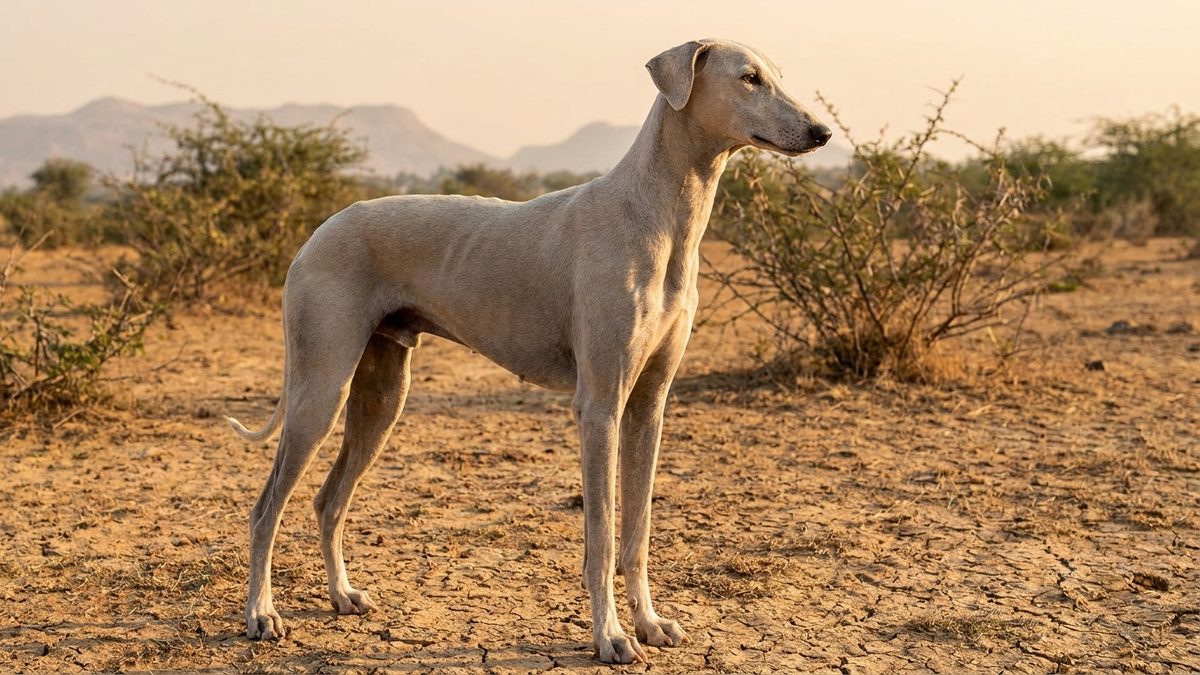
This is a textbook sighthound, streamlined and built only for speed. Long legs, a lithe frame, a deep chest and a narrow, elegant head. It stands around 61 cm at the shoulder, with dogs a little taller than bitches.
| Attribute | Detail |
|---|---|
| Type | Sighthound, coursing |
| Origin | Sippipparai, Virudhunagar district, Tamil Nadu |
| Also spelled | Sippiparai |
| Thought to descend from | The Saluki |
| Height | About 61 cm |
| Coat | Short, minimal shedding |
| Colours | Solid. Pale silver-grey, fawn, reddish-brown, occasionally near-white |
| Historical role | Coursing deer, hare and wild boar for royalty |
Colour is solid, always
Chippiparai colours are solid rather than patterned, most often a pale silver-grey or fawn, sometimes reddish-brown and occasionally near-white. A patched or heavily marked dog sold as a Chippiparai is worth questioning, because the breed does not carry those patterns.
The traits it was actually bred for
The Chippiparai is famous in its homeland for a specific combination: minimal feeding requirements, great physical rigour, a gentle temperament, high speed and deep hunting instincts. That first one matters practically. This is a breed developed by working people to be cheap to keep, and it still is.
Formal characterisation work on the breed's physical and performance traits has been published in the Indian veterinary literature, which puts it among the better-documented Indian breeds despite its rarity.
Bred by working people, not by a kennel club
The Chippiparai's traits read as a specification written by people who could not afford a dog that failed. Minimal feeding requirements meant a hound that earned its keep on scraps. Great physical rigour meant one that worked through a Tamil Nadu summer without breaking down. Speed and hunting instinct meant it actually caught what it chased HappyPet Care, Chippiparai Dog Breed Guide.
None of those are show-ring qualities, and that is exactly why the breed is healthy. Selection pressure on a working hound removes the animals that cannot do the job, which is a far harsher filter than a conformation standard and produces a far sounder dog.
The consequence for a modern owner is a dog that needs a job rather than a routine. A Chippiparai given an hour of structured running is a calm houseguest. The same dog given two lead walks around a colony is a frustrated one.
Chippiparai price in India
A Chippiparai costs Rs 10,000 to Rs 40,000 in India, and the spread is driven by availability rather than by quality. This breed is rare and not commonly found outside southern India, which is the single biggest factor in what you will pay.
| Source | Stated range | Note |
|---|---|---|
| NativFarm | Rs 10,000 to Rs 40,000 | Varies by location and breeder |
| Best Top Pets | Published band | Dedicated price guide |
| Best For Pets | Published band | 2024 guide |
| Hachi | Published band | India-wide |
The pattern here differs from every other Indian breed on this site. The Rajapalayam, Kombai and Indian Spitz are all cheapest at their point of origin because supply is concentrated there. The Chippiparai is expensive everywhere, because supply barely exists anywhere.
You are paying for scarcity, not for a better dog. A Chippiparai at Rs 40,000 is not four times the dog a Rs 10,000 one is. What the higher figure usually reflects is distance from Virudhunagar district and a seller who knows you have no alternative.
Bonbeno does not broker puppy sales and does not publish breeder listings. Given how rare this breed is, verify carefully before paying, because a scarce breed is exactly the situation in which lookalikes are sold as the real thing.
Monthly cost of owning a Chippiparai
The Chippiparai is one of the cheapest dogs to run in India, and that is not incidental. The breed is specifically known for minimal feeding requirements, which is a trait working communities selected for deliberately.
Where the money goes
- Food. Lower than a comparable-sized dog, given the breed's noted minimal feeding requirements. Protein-forward meals suit it, with chicken, eggs, fish, rice and vegetables alongside a balanced commercial food.
- Preventive veterinary care. Core vaccination, boosters, deworming and year-round tick and flea control.
- Exercise provision. The real cost. A coursing hound needs a secure open space, which in a metro usually means paid access rather than a park.
- Grooming. Effectively nil. The short coat sheds minimally.
- Bedding. A lean sighthound on hard Indian floors develops pressure calluses. A thick bed is a health item, not a comfort one.
When we publish cost figures we state the sample size, the cities covered and the collection date. Our verified owner cost survey across eight metros is in progress. Until then we publish the structure rather than a number nobody can check.
Heat tolerance and the Indian climate
The Chippiparai is among the best heat-adapted dogs available in India. It evolved in the dry open country of southern Tamil Nadu, and its short coat and lean frame are exactly what that climate selects for.
The breeds most at risk of heat stroke in India are the double-coated imports, specifically German Shepherds, Golden Retrievers, Labrador Retrievers, Huskies and Collies. Peak summer temperatures cross 45 C in several parts of the country. A short-coated coursing hound from Virudhunagar is on the right side of that line.
Adaptation is not immunity, and heat stroke remains a veterinary emergency in any breed.
- Run early morning and late evening in the hot months, which is the standard veterinary recommendation.
- Watch pale coats for sunburn. Near-white and pale silver dogs carry less pigment protection than fawn or reddish ones.
- Provide shade rather than confinement, because a coursing breed responds badly to being shut in.
- Add a coat in North Indian winters. Minimal body fat and a thin coat cut both ways, and a Chippiparai in Delhi in January genuinely feels it.
Temperament and household fit
The Chippiparai is gentle in temperament and attaches itself to a single person with unusual intensity. Traditional hunters claimed a true Chippiparai would refuse food or affection from anyone but its own person, and while that is folklore rather than fact, it describes the disposition accurately.
The breed is widely regarded as the most intelligent and trainable of India's native breeds. That reputation is real, but it sits alongside genuine independence, and the two are not in conflict. An intelligent independent dog learns quickly and then decides whether to comply.
Who this breed suits
- Good fit. Owners with secure open space, single-person households or families where one person will clearly be the dog's person, anyone wanting a quiet, undemanding indoor companion that runs hard outdoors.
- Poor fit. Apartments without a running outlet, households with free-roaming cats or small pets, owners who want a dog that greets everyone equally.
- Manage carefully. The one-person attachment. In a family, decide early who does the training and feeding, because the dog will decide regardless.
Chippiparais are described as gentle, and they are, but gentle here means low-aggression rather than outgoing. Expect reserve with strangers and a dog that watches from across the room rather than greeting at the door. That is normal for the breed and not a socialisation failure.
What the one-person bond means in an Indian household
Indian homes are rarely single-occupancy. Extended family, domestic help and a steady flow of visitors are the norm, and a breed that selects one person and stays polite but distant from everyone else behaves differently in that setting than it would in a flat shared by two people. The practical consequences are worth planning for rather than discovering. Decide early who feeds and trains the dog. Expect it to seek that person out during anything unfamiliar. Do not read its reserve toward a visiting relative as a fault to be corrected, because it is the temperament working as intended. What does need active management is ensuring at least one other adult can handle, lead and vet-check the dog without difficulty, since a hound that will only cooperate with one person becomes a genuine problem the week that person travels.
Training a Chippiparai
Train a Chippiparai with short, reward-based sessions and start socialisation and obedience work early, because the breed is independent and can be challenging to train despite its intelligence. Early socialisation and obedience training are described as crucial rather than advisable.
Sighthound rules still apply
Sighthounds were bred for both the motivation and the ability to spot and chase moving objects, so a chase instinct overrides commands. They are typically less food-motivated than biddable breeds and are sensitive to harsh correction. A breed bred for independent chase may never match a retriever's immediate response, and the correct response is to adjust the target and keep management in place.
| Skill | Chippiparai | Note |
|---|---|---|
| Name response | 2 to 5 weeks | Fast. This is a bright breed |
| Sit, down, settle | 3 to 6 weeks | Learns quickly, complies selectively |
| Loose-lead walking | 4 to 10 months | Slower than a retriever |
| Recall, no distraction | 3 to 6 months | Achievable |
| Recall with prey in sight | Treat as unreliable, permanently | Manage with a long line |
| Settled with strangers | Ongoing management | Reserve is the breed, not a fault |
The socialisation window runs from about 3 weeks to 14 weeks and is largely closed by 16 weeks. For a naturally reserved breed, what happens there decides whether the adult is aloof or fearful. Those are very different dogs to live with.
- Short sessions, high-value rewards. Movement often beats food with this breed.
- Never use harsh correction. It produces avoidance in a sensitive sighthound.
- One handler leads the training, given the one-person attachment.
- Long line permanently in any area with wildlife, livestock or traffic.
How much exercise a Chippiparai needs
A Chippiparai needs 60 to 90 minutes of active exercise daily and requires open space to run. At minimum this is an hour a day, and lead walks alone do not satisfy a coursing hound however long they are.
The distinction that matters is between walking and running. A sighthound is built to reach speed in a straight line, and a dog that never does is under-exercised regardless of the distance covered on a lead.
| Stage | Guidance |
|---|---|
| Under 12 months | Short frequent play. No forced distance, jumping or stairs work |
| Adult | 60 to 90 minutes active, plus access to open space |
| Adult, weekly | A genuine free run in a secure enclosed area |
| Senior | Shorter, gentler, still daily |
| Peak summer | Early morning and late evening only |
- Secure the space before you unclip. A Chippiparai in pursuit will not stop for a command or for traffic.
- Scent and training games substitute during heatwaves, when running outdoors is unsafe for weeks at a time.
- Check pavement temperature with your palm before summer walks.
- Do not run a puppy. Growth plates in a leggy breed need protecting well past the first year.
Grooming a Chippiparai
Grooming a Chippiparai takes minutes a week. The short coat sheds minimally and no professional grooming is ever required, which over a 12 to 15 year lifespan is a substantial saving against any coated breed.
- Brush weekly with a rubber curry or hound glove.
- Bathe rarely. Frequent bathing strips oils from thin sighthound skin.
- Check for ticks at every brush, which matters far more than the brushing.
- Inspect for cuts after runs. Thin skin over a lean frame tears easily on scrub and fencing.
- Clip nails weekly, which matters more in a running breed than a sedentary one.
A sighthound carries almost no padding over its elbows and hocks, and hard Indian floors produce pressure calluses that thicken and occasionally crack. A thick bed in the spot the dog actually chooses is the entire fix, and it is the care item owners of lean breeds most often miss.
Health and lifespan
The Chippiparai is a very healthy and hardy breed, largely because it evolved under Indian conditions rather than being bred to a show standard. Average lifespan is 12 to 15 years, sometimes longer with proper care and exercise.
The condition to watch
The main documented health challenge in the breed is patellar luxation, where the kneecap dislocates from its normal position and the joint moves abnormally. It is common across many breeds and it is detectable at a routine veterinary examination.
- Watch the hind-leg gait. A skip or hop that resolves on its own is the classic sign and is worth a veterinary opinion.
- Keep the dog lean. Excess weight loads a joint that is already unstable.
- Ask for a patellar check at the annual visit. It takes seconds and is easily skipped.
- Flag sighthound anaesthesia sensitivity to any vet before a procedure, since low body fat changes how some agents are metabolised.
There is no Chippiparai equivalent of the large prospective cohort studies that exist for popular Western breeds, so no reliable prevalence percentages exist for this breed. Formal characterisation work covering physical and performance traits has been published in Indian veterinary literature, which is more than most Indian breeds have, but it is not the same as disease surveillance. Any page giving you a precise percentage is extrapolating.
Feeding a Chippiparai
Feed a Chippiparai a protein-forward diet and keep it visibly lean, which for a sighthound looks underfed to owners used to other breeds and is correct. The breed is specifically noted for minimal feeding requirements.
Suitable meals centre on protein, with chicken, eggs, fish, rice and vegetables alongside a balanced commercial food. What matters more than the exact composition is the quantity, because this is a breed that thrives on less than owners expect.
- Feed to body condition, not to a chart. Ribs lightly covered, a visible waist and a clear tuck is correct for a sighthound.
- Split intake across two meals rather than one, which is standard for deep-chested breeds.
- Resist feeding up. Overfeeding a breed with patellar luxation risk adds load to an unstable joint for no benefit.
- Adjust in peak summer, when appetite commonly drops. Persistent inappetence is a veterinary matter.
Bonbeno reviews Indian pet food brands separately and tests products first-hand before publishing a verdict. See our testing method for what a Bonbeno food review does and does not claim.
Chippiparai puppy: the first two years
A Chippiparai grows into a roughly 61 cm hound with a 12 to 15 year lifespan. The first year is about restraint and socialisation, because the two things that damage this breed early are hard exercise and missed exposure.
- 8 to 16 weeks. Vaccination course. Structured socialisation to people, dogs, surfaces and noise, which for a naturally reserved breed is the highest-value work of its life. Handling and grooming habits start now.
- 4 to 6 months. Lead work in earnest. Keep exercise light and frequent, with no forced distance or stairs. Soft bedding from now on.
- 6 to 12 months. Reserve toward strangers becomes visible. Keep socialising rather than withdrawing the dog from the world. Prey drive emerges, so lead discipline becomes non-negotiable.
- 12 to 18 months. Build toward the adult load of 60 to 90 minutes daily. Introduce free running in secure enclosed space.
- 18 to 24 months. Physically mature. Full adult exercise including regular free runs. Annual veterinary visit should include a patellar check.
Because the breed is rare and expensive relative to other Indian dogs, lookalike sighthound crosses get sold as Chippiparais. Solid colour, roughly 61 cm at the shoulder and a narrow elegant head are the markers. See both parents wherever possible.
Chippiparai vs Rajapalayam
Choose a Chippiparai for trainability and a Rajapalayam for guarding. Both are Tamil Nadu sighthounds from the same district, which is why they are constantly conflated, but they were bred for different work and they live very differently.
| Factor | Chippiparai | Rajapalayam |
|---|---|---|
| Origin | Sippipparai village, Virudhunagar | Rajapalayam town, Virudhunagar |
| Descended from | Thought to be the Saluki | Indigenous sighthound lineage |
| Height | About 61 cm | Up to 76 cm |
| Colour | Solid silver-grey, fawn, reddish | White, pink nose |
| Historical role | Coursing for royalty | Boar hunting and estate guarding |
| Temperament | Gentle, reserved | Guarding, aggression toward threats |
| Trainability | Most trainable Indian breed | Independent, harder |
| Key health flag | Patellar luxation | Congenital deafness with white coat |
| Lifespan | 12 to 15 years | 9 to 12 years |
| Availability | Rare, near extinction | Rebuilt population, findable |
The practical difference is what you are signing up for. A Rajapalayam is a guarding breed that needs a walled compound and heavy socialisation to be safe around visitors. A Chippiparai is a gentle coursing hound that needs space to run and will simply keep its distance from people it does not know.
12 to 15 years against 9 to 12 for the Rajapalayam is a meaningful gap, and it reflects the Chippiparai never having gone through the population bottleneck that the Rajapalayam did. Availability is the trade, because finding a genuine Chippiparai is significantly harder.
Mistakes Indian Chippiparai owners actually make
These recur consistently and are ranked by consequence to the dog.
- Keeping it without open space. The breed requires open space and at least an hour of daily exercise. An apartment with two lead walks is not that.
- Trusting recall near roads or livestock. Chase overrides commands in any sighthound, and a 61 cm coursing hound at speed covers ground faster than a decision.
- Skipping socialisation because the dog seems calm. Reserve left unaddressed becomes fear, and the window closes at about 16 weeks.
- Feeding up because it looks thin. Correct sighthound condition looks underfed, and overfeeding loads a joint already prone to patellar luxation.
- Buying an unverified lookalike. A rare, expensive breed is exactly where crosses get passed off as the real thing.
- Hard floors and thin bedding, which produce pressure calluses on a dog with no padding over its joints.
- Harsh correction on a sensitive breed, which produces avoidance rather than compliance.
- No winter coat in the north, since a lean short-coated hound genuinely suffers in a Delhi January.
Off-lead in an unsecured space. Every other item here is recoverable. A sighthound that follows a chase across a road is not.
Sourcing a Chippiparai, and the conservation question
Source a Chippiparai in southern Tamil Nadu where the remaining population sits, and understand before you start that this breed is on the verge of extinction. Where you buy from directly affects whether it survives.
A breed genuinely at risk
Like several Indian breeds, the Chippiparai is now very rare, and observers have raised concern that it is in imminent danger of extinction. Supporting and adopting native breeds is one of the few practical things an ordinary buyer can do to preserve India's canine genetics.
Wanting to help a rare breed does not justify buying from a seller who will not show you the parents, or paying a scarcity premium for an unverified dog. Poorly bred dogs sold under a rare breed's name damage that breed's reputation and its gene pool at once.
Sourcing checklist
- Buy in southern Tamil Nadu where practical, since that is where the working population remains.
- See both parents, and check height and solid colour against the breed description.
- Ask for a veterinary health certificate dated close to handover, including a patellar examination.
- Verify any registration claim directly with the Kennel Club of India rather than trusting a photocopy, remembering that KCI certifies pedigree and not health.
- Decline any seller who will not let you visit the place the puppies were raised.
Adoption
Chippiparais and Chippiparai crosses occasionally appear in South Indian shelters, usually surrendered when an urban household discovers what an hour of daily running actually requires. An adult has a known temperament and a known energy level, which are the two things you cannot assess in a puppy. If open space is what you lack, the Indian Pariah Dog needs 45 to 60 minutes rather than 90 and is free to adopt.
There is a practical asymmetry worth understanding here. Breeds recover when enough informed owners keep them well, not when scarcity drives prices up. A rare breed with a reputation for being difficult, unhealthy or mis-sold shrinks further, because buyers stop trying. Keeping one properly and telling other people what it actually needs does more for the Chippiparai than paying a premium for a puppy of unverified parentage.
Chippiparai questions Indians actually search
What is the price of Chippiparai puppy dog?
A Chippiparai costs Rs 10,000 to Rs 40,000 in India, depending on location and breeder. The breed is rare and not commonly found outside southern India, so availability drives the price far more than pedigree does. You are paying for scarcity rather than for a better dog.
Is a Chippiparai a Kanni dog?
No, though they are closely related and constantly confused. Both are South Indian sighthounds from the same region of Tamil Nadu, and some authorities treat the Kanni as a variety of the Chippiparai rather than a separate breed. The practical distinction most keepers make is colour, since the Kanni is traditionally black and tan while the Chippiparai is solid silver-grey, fawn or reddish.
Is Chippiparai a good family dog?
For the right family. It is gentle in temperament but attaches to one person with unusual intensity and stays reserved with everyone else. It needs open space and 60 to 90 minutes of daily exercise. Families wanting a dog that greets everyone at the door should choose differently.
Which is the 20 crore dog?
The Rs 20 crore figure refers to an offer a Bengaluru breeder said he refused for a Caucasian Shepherd, and the related Rs 50 crore wolfdog claim was debunked. The Enforcement Directorate searched the breeder's residence, found no documentary evidence he owned the animal, and he reportedly said the dog was not his. No verified Rs 20 crore dog sale exists in India.
How fast is a Chippiparai?
The Chippiparai is a coursing sighthound built only for speed, with long legs, a lithe frame and a deep chest, and it was used to run down deer and hare across open country. Specific top-speed figures circulate online but none trace to a measured study of the breed, so Bonbeno does not publish a number.
How much exercise does a Chippiparai need?
A Chippiparai needs 60 to 90 minutes of active exercise daily and requires open space to run. Lead walks alone do not satisfy a coursing hound however long they are, because the breed is built to reach speed in a straight line rather than to cover distance slowly.
How long do Chippiparai dogs live?
A Chippiparai lives 12 to 15 years on average, and sometimes longer with proper care and exercise. That is notably better than the Rajapalayam's 9 to 12 years, and it reflects a breed that never went through a severe population bottleneck.
Are Chippiparai dogs easy to train?
They are widely regarded as the most intelligent and trainable of India's native breeds, but they are also independent and can be challenging in practice. Early socialisation and obedience training are essential. Recall with prey in sight should be treated as permanently unreliable, as with any sighthound.
Is the Chippiparai going extinct?
It is at serious risk. The breed is now very rare and observers have warned it is in imminent danger of extinction. Supporting native breeds through responsible ownership is one of the few practical things buyers can do, though buying carelessly from a scarcity-driven market does more harm than good.
Can a Chippiparai live in an apartment?
Poorly. The breed requires open space and at least an hour of daily exercise, and a coursing hound that never runs flat out is under-exercised regardless of how far it walks. If open space is your constraint, the Indian Pariah Dog needs 45 to 60 minutes and adapts far better to apartments.
Compare with similar breeds
Chippiparai sits in 3 Bonbeno groups. Each one compares it directly against the breeds it is genuinely an alternative to, on the same figures.