
Indian breed profile
Janwal Pashmi: The Measured Dog of Chakur, Latur
A feathered Marathwada landrace that 207 dogs' worth of MAFSU measurements say is not a Mudhol Hound. Bonbeno reads the paper, checks its arithmetic, and reports what it does and does not establish.
Quick answer
The Janwal Pashmi is a feathered landrace dog from Chakur tehsil in Latur district, Maharashtra, measured in 207 animals by Maharashtra Animal and Fishery Sciences University. Adult males average 26.75 kg and 68.89 cm at the withers, 78.26 percent are black, and 94.69 percent carry medium or long hair. ICAR-NBAGR has not registered it, and no genetic study has ever compared it with the Mudhol Hound.
This guide is general information for Indian pet owners and is not a diagnosis. Consult your nearby vet, a registered veterinarian, before acting on anything you read here, and treat any sudden change in your dog's condition as urgent.
Janwal Pashmi at a glance
What the Janwal Pashmi is
The Janwal Pashmi is a feathered landrace dog of Chakur tehsil in Latur district, Maharashtra, described from 207 measured animals by Maharashtra Animal and Fishery Sciences University and published in the Indian Journal of Animal Sciences in May 2024. Almost everything reliable that is known about this dog comes from that one study and the M.V.Sc. thesis behind it, which makes the population unusually well measured and unusually poorly known at the same time.
Start with what was actually done, because the method is the reason this page can say anything at all. Researchers from the Department of Animal Genetics and Breeding at the College of Veterinary and Animal Sciences, Parbhani, surveyed 29 villages across ten tehsils of Latur, Nanded and Parbhani districts in the Marathwada region and measured 207 unrelated dogs, 105 males and 102 females, using questionnaires and breed descriptor formats prepared in the local language to the National Bureau of Animal Genetic Resources format. Measurements were taken with a tailor's tape on dogs standing upright at ground level, and the data were analysed in SPSS version 24 with Student's t test.
That is a real field study with a stated sample, a stated instrument and a stated statistical test. No other Indian dog population Bonbeno covers at this rarity level has one.
What 207 dogs actually looked like
Six phenotypic traits were scored across the whole sample, and the paper prints both the counts and the percentages. Bonbeno reproduces the counts rather than the percentages alone, because a count of 207 is checkable and a decimal is not.
| Trait | Category | Dogs | Percent |
|---|---|---|---|
| Body colour | Black | 162 | 78.26 |
| Body colour | Fawn | 18 | 8.69 |
| Body colour | Grey | 12 | 5.79 |
| Body colour | Brown | 9 | 4.34 |
| Body colour | White | 6 | 2.89 |
| Hair length | Medium | 106 | 51.20 |
| Hair length | Long | 90 | 43.47 |
| Hair length | Short | 11 | 5.31 |
| Head shape | Straight | 144 | 69.56 |
| Head shape | Wedge | 63 | 30.43 |
| Nostril colour | Black | 197 | 95.16 |
| Nostril colour | Brown | 8 | 3.86 |
| Nostril colour | Pinkish | 2 | 0.96 |
| Eye colour | Dark brown | 109 | 52.65 |
| Eye colour | Light brown | 98 | 47.34 |
| Ear length | Long | 113 | 54.58 |
| Ear length | Medium | 87 | 42.02 |
| Ear length | Small | 7 | 3.38 |
Every one of the six breakdowns divides back out to a whole number of dogs, and every one of the six sums to exactly 207. Black at 78.26 percent is 162 dogs, fawn at 8.69 percent is 18, and 162 plus 18 plus 12 plus 9 plus 6 is 207. That test has caught invented statistics elsewhere on this site, so it is worth stating that this paper passes it six times out of six. One detail is worth flagging for anyone quoting the abstract rather than the paper. The abstract gives only long ears at 54.58 percent and medium at 42.02 percent, which leaves seven dogs unaccounted for. Table 1 of the full paper supplies them as small-eared, 3.38 percent.
The coat is the whole point, and most Indian pages get it backwards
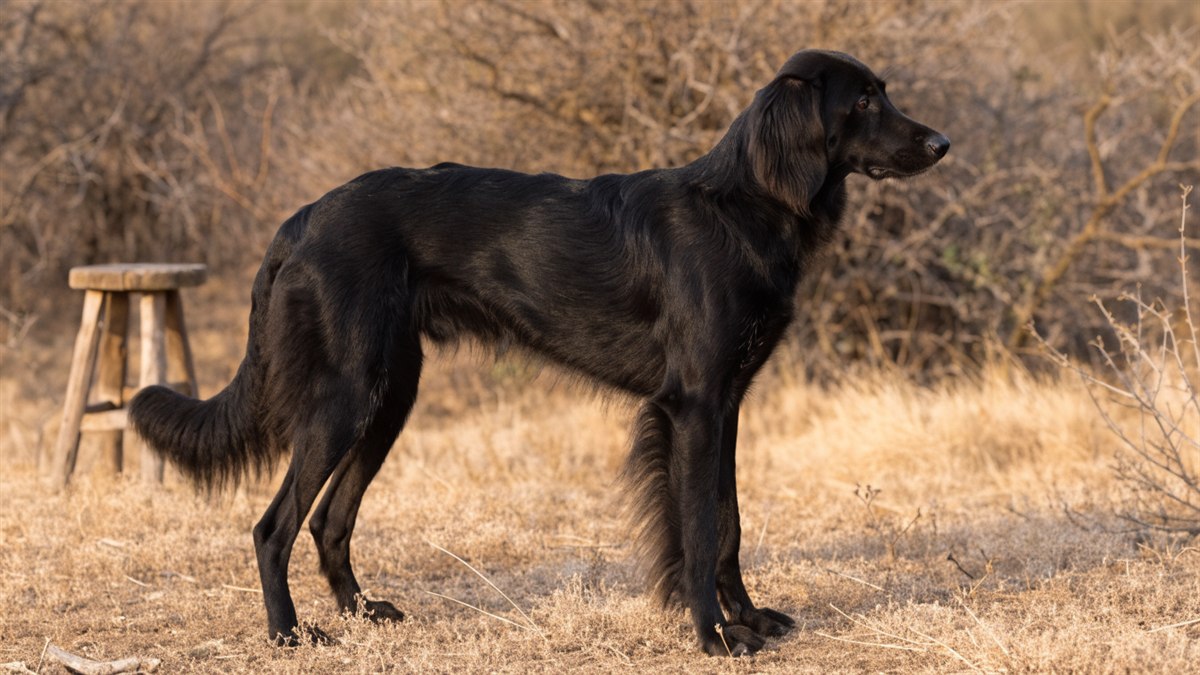
Feathery hair is the defining character of this dog. The paper records feathering predominantly at the ears, tail, head, shoulder, thigh and abdomen, and describes the thick hair on the paws as resembling shoes. Adding the categories together, 196 of 207 dogs, or 94.69 percent, carried medium or long hair. Only 11 dogs in the entire sample were short-coated.
Hold that number against what the Indian web publishes. The one page that carries the Janwal Pashmi name and a care guide states that the dog has a short, dense coat and that its short coat provides adequate protection against heat. That is the opposite of the measured finding, and it is not a small error, because the coat is the single trait the population is named for and the single trait that governs how it handles a Marathwada May.
Size, in the numbers the study published
Adults were classified as dogs above one year and puppies as dogs below one year, and sex differences were significant across most adult traits. Body weight, height at withers, body length, chest girth, tail length, head length, height at base of tail, neck length, neck girth, hind foot length, upper and lower hind leg length, fore foot length and upper fore leg length were all significantly higher in adult males.
| Measurement | Adult male | Adult female | Adult pooled |
|---|---|---|---|
| Body weight | 26.75 ± 0.52 kg | 24.46 ± 0.49 kg | 25.63 ± 0.36 kg |
| Height at withers | 68.89 ± 0.37 cm | 66.02 ± 0.39 cm | 67.50 ± 0.29 cm |
| Body length | 48.89 ± 0.51 cm | 46.84 ± 0.42 cm | 47.90 ± 0.34 cm |
| Chest girth | 68.47 ± 0.55 cm | 65.76 ± 0.64 cm | 67.15 ± 0.43 cm |
| Paunch girth | 47.14 ± 0.65 cm | 46.02 ± 0.76 cm | 46.60 ± 0.50 cm |
| Height at base of tail | 69.16 ± 0.39 cm | 66.60 ± 0.41 cm | 67.91 ± 0.29 cm |
| Tail length | 48.04 ± 0.59 cm | 45.91 ± 0.84 cm | 47.00 ± 0.51 cm |
| Neck girth | 37.30 ± 0.33 cm | 35.58 ± 0.36 cm | 36.46 ± 0.25 cm |
| Ear length | 14.15 ± 0.19 cm | 13.60 ± 0.20 cm | 13.89 ± 0.14 cm |
| Head length | 22.78 ± 0.16 cm | 21.94 ± 0.06 cm | 22.37 ± 0.09 cm |
In plain terms, an adult male stands about 27.1 inches at the shoulder and weighs about 26.75 kg. That is a tall dog and a solid one. The paper places it in the mid-size hound category defined as 51 to 70 cm at the withers and 20 to 40 kg.
The paper states that in this sample the body length of all dogs was greater than the height at withers, which it presents as typical of hound-type dogs. Table 2 of the same paper reports adult body length at 47.90 cm against height at withers of 67.50 cm, so height exceeds length by roughly 20 cm in every cell. Bonbeno reports both and resolves neither, because the likeliest explanation is a landmark definition that differs from the one the comparison assumes, and no reader should take a proportion off this page that the source's own table contradicts. A second, smaller slip sits in the tail-length paragraph, where the male and female figures are printed the wrong way round against Table 2.
Where the dog is said to have come from
The paper reports a local belief rather than evidence, and says so. People believe the dog to be a descendant of the Kyrgyz Taigan and the Afghan Hound, brought to India by Arabs, Persians and Pathans through the Khyber Pass, with a history of more than 100 years. The single reference behind that sentence is a 2015 newspaper article in The Hindu titled Return of the Pashmi. A Marathi extension article by MAFSU veterinarians at Udgir gives a related account, describing the Pashmi as a descendant of the Saluki brought through the Khyber Pass by Persians travelling with nomadic groups, and naming the village of Janwal in Latur district as the dog's home.
Treat all of that as oral history with a newspaper citation attached. It is the honest status of the origin claim, and it is why this guide leads with measurements instead.
Is the Janwal Pashmi the same dog as the Mudhol Hound?
Nobody has established that, and nobody has established the opposite either, because no genetic study has ever included a Janwal Pashmi. What can be settled is why the confusion exists. Pashmi is a coat word, not a breed name, so it attaches independently to any feathered dog and two unrelated populations can carry it honestly.
The word does the damage. Pashm means wool in Persian, and the Marathi extension article written by MAFSU veterinarians states the meaning outright, that Pashmi means hairy, and identifies the extra hair on the ears and tail as the dog's distinguishing mark. An English hound reference gives the same reading, that the name roughly translates to furry or soft and refers to the feathering on the ears, tail and backs of the legs. Three independent sources, one of them in Marathi, agree that the label describes a coat.
Once you know that, the apparent contradiction stops being one. A silky-coated Mudhol Hound is a Pashmi because it is feathered. A feathered Marathwada village dog is a Pashmi because it is feathered. Neither fact tells you they are the same animal.
Who says what, laid out rather than averaged
| Source | Position | What it actually says |
|---|---|---|
| Makne et al., Indian Journal of Animal Sciences | Distinct population | Feathering on ears, tail, head, shoulder, thigh and abdomen "was not commonly observed in other indigenous breeds of this region like Mudhol Hound", and the Janwal Pashmi "is totally different in all phenotypic parameters" |
| Makne M.V.Sc. thesis, MAFSU | Distinct population | "Janwal Pashmi is a unique dog, distinct from other breeds and local indigenous dog population and mainly used for guarding" |
| DogsIndia | Same breed, hairier variety | "The Pashmi Hound is identical in features to the Caravan Hound, except that it has hair growth on the tail, ears, and the underside near the chest and belly" |
| Wikipedia, Mudhol Hound | Same breed, hairier variety | "A variety of the breed with more hair is the Pashmi Hound." The infobox lists only Caravan Hound and Kathewar Dog as other names, and Pashmi is absent from it |
| Top Pet Products | Same breed | Calls the Pashmi "a featherly version of the mudhol hound" and lists Mudhol hound, Caravan hound, Karwani, Lahori and Pisuri hound as its other names |
| K9 Research Lab | Same breed | Publishes Mudhol Hound, Caravan Hound, Pashmi, Karvani and Karwani as one entry |
| The Academic Hound | Contradicts the others | "While some say that this is the feathered version of the Mudhol breed, the Kennel Club of India considers them to be a separate breed" |
| Devale et al., MAFSU authors | Two populations, named separately | Lists "the Caravan Hound, Pashmi, Combai, Rampur Hound, Kanni" among unregistered Indian breeds, and states that "In Maharashtra, Caravan and Pashmi dog population is most commonly found" |
| ICAR-NBAGR register | Silent | Registers Mudhol Hound with accession INDIA_DOG_0800_MUDHOL HOUND_19003 and no synonyms. Neither Pashmi nor Janwal appears anywhere on the register |
Notice what the last two rows do together. A MAFSU-authored paper published in 2023 lists the Caravan Hound among unregistered Indian dog breeds in the same paragraph in which it states that NBAGR had registered the Mudhol Hound. That is one research group treating Caravan Hound and Mudhol Hound as different entries, which is exactly the reason Bonbeno's Mudhol Hound guide describes the Caravan and Pashmi equivalences as conventional rather than settled.
The measurements say these are not the same dog
Two morphometric studies now exist for the same region, published a year apart, and they do not describe the same animal. Devale and colleagues measured 400 Caravan dogs across Latur, Osmanabad, Nanded and Parbhani districts of Marathwada, which is the same landscape and three of the same districts the Janwal Pashmi study worked in. Same region, same decade, comparable protocol, and the two sets of adults are far apart.
| Adult trait | Janwal Pashmi, n=207 | Caravan dog, n=400 | Difference |
|---|---|---|---|
| Body weight, male | 26.75 kg | 18.60 kg | +43.8 percent |
| Body weight, female | 24.46 kg | 17.65 kg | +38.6 percent |
| Height at withers, male | 68.89 cm | 67.64 cm | +1.8 percent |
| Body length, male | 48.89 cm | 54.09 cm | -9.6 percent |
| Neck length, male | 20.72 cm | 23.52 cm | -11.9 percent |
| Ear length, male | 14.15 cm | 12.76 cm | +10.9 percent |
| Ear width, male | 7.50 cm | 7.05 cm | +6.4 percent |
| Coat | 94.69 percent medium or long hair | "short and smooth with fringes" | Different coat type |
Do the division yourself. An adult male Janwal Pashmi carries 26.75 kg on 68.89 cm of height, which is 0.388 kg per centimetre, against the Caravan dog's 18.60 kg on 67.64 cm, or 0.275 kg per centimetre. That is 41 percent more mass per centimetre of height at the same shoulder height, on a shorter back and a shorter neck. Sighthound and feathered sighthound are not descriptions that survive a 41 percent difference in build, whatever they share in coat vocabulary. The ear measurements point the same way, with a length-by-width product 18 percent larger in the Janwal Pashmi Devale S M, Channa G R, Pawankar K N.
The Marathi Agrowon article, written by veterinarians at MAFSU's Udgir college in Latur district, gives Pashmi males as 16 to 20 kg and 22 to 25 inches, and females as 13 to 17 kg and 21 to 23 inches. The measured Janwal Pashmi male is 26.75 kg and 27.1 inches. Those bands do not overlap on weight at all. What the Agrowon band does closely match is the measured Caravan dog at 18.60 kg. Bonbeno reads that as direct evidence that Pashmi is used locally for at least two different dogs, and it is the strongest single reason not to buy on the strength of the name.
The genetic question, answered honestly
No published genetic study has ever included a Janwal Pashmi, so the relationship between this dog and the Mudhol Hound is untested rather than disputed. The one genome-wide characterisation of Indian dog breeds sequenced 46 dogs by ddRAD and identified 75,811 high-quality SNPs and 2,033 tag-SNPs across six breeds, of which the two indigenous ones were the Gaddi and the Mudhol Hound. A companion SNP-haplotype study from the same laboratory drew its dogs from Punjab, Haryana and Karnataka and uses neither Pashmi nor Janwal anywhere in its text. Marathwada was not sampled in either.
Bonbeno tested that absence rather than asserting it. Europe PMC, queried on 20 August 2026, returned zero results for Janwal Pashmi and five for the control term Mudhol Hound in the same session, the top control result being the ddRAD study above. The tool demonstrably worked, so the zero is a finding and not a broken query.
The evidence supports three statements and no more. Pashmi is a coat adjective that legitimately attaches to more than one Indian dog. The Marathwada population measured at Chakur is heavier, shorter-backed and longer-eared than the Caravan dog measured in the same districts, and its own researchers say it differs phenotypically from the Mudhol Hound. And nobody has run the genetics that would settle whether these populations share ancestry. Anyone telling you the Janwal Pashmi simply is a Mudhol Hound, or simply is not, is going beyond the published record.
And it is not the Mahratta Hound either
The Mahratta Hound is a separate naming problem with a separate shape, and conflating the two makes both worse. That name attaches to a smooth-coated sighthound of Maharashtra associated with the Banjara, has no measured population behind it, no agreed size, and published height figures that run from 21 to 28 inches across sources that do not acknowledge each other. Bonbeno's Mahratta Hound guide publishes that disagreement in full. The Janwal Pashmi is the opposite case, a dog with one solid measured description and almost no popular coverage, and the two should not be merged simply because both are rare Maharashtra names.
Janwal Pashmi price and availability in India
No price exists for a Janwal Pashmi in India, because no sale channel uses that name. This is the finding rather than a gap in the research, and it is the most useful thing this section can tell you. The rupee figures circulating online belong to the Pashmi Hound, which the Indian breed press describes as the feathered variety of the Mudhol Hound, and which is a different argument from the dog measured at Chakur.
Bonbeno searched the places a market leaves traces. No listing site, no breeder page and no registry entry Bonbeno opened uses the Janwal Pashmi name. The one Indian page carrying it is an editorial breed profile with no price, no size, no weight and no source. India's largest online pet marketplace does carry Pashmi Hound as a breed, but the page it serves is boilerplate, offering neither a price nor a single Pashmi listing in its rendered content.
Bonbeno downloaded that marketplace's Pashmi Hound puppies-for-sale page on 20 August 2026 and parsed the puppy cards out of the raw HTML. It rendered three of them, and every one was a different breed. Two were French Bulldogs and one was a Cavalier King Charles Spaniel. That is what an empty category looks like when a template has to fill itself, and it is the clearest single piece of evidence that no Pashmi supply chain exists online under any spelling. Read a page like that as an advertisement for the site rather than as a market signal for the breed.
What the published Pashmi Hound bands actually say
Two Indian sources publish rupee ranges under the Pashmi Hound name, and they disagree by a factor of two at the top end. Bonbeno prints both rather than averaging them.
| Source | Figure | Scope | Evidence status |
|---|---|---|---|
| Top Pet Products | Rs 2,000 to Rs 10,000 | Average puppy | No stated method |
| MyLilPaw | Rs 8,000 to Rs 20,000 | Puppy, by quality and show worthiness | No stated method |
| MyLilPaw | Rs 29,400 to Rs 54,600 | Annual upkeep, excluding sterilisation and equipment | No stated method |
| Top Pet Products | Rs 2,000 to Rs 4,000 | Monthly upkeep | Contradicts its own annual figure |
| Top Pet Products | Rs 30,000 to Rs 50,000 | Annual upkeep | Fails its own arithmetic |
| Any source, any figure | None | Janwal Pashmi specifically | No published figure exists |
That fourth and fifth row deserve a sentence, because catching it costs nothing. A monthly band of Rs 2,000 to Rs 4,000 multiplies out to Rs 24,000 to Rs 48,000 a year, and the same page states the annual cost as Rs 30,000 to Rs 50,000. Neither end matches. A cost estimate that fails a twelve times table is an estimate nobody checked, and it should not anchor your budget.
Indian breed pages routinely publish rupee prices that turn out to be US dollar figures run through one exchange rate, and this site has caught it three separate times at exactly 84.38 to the dollar. Bonbeno divided every rupee figure above by 84.38. Rs 2,000 becomes USD 23.70, Rs 10,000 becomes USD 118.51, Rs 8,000 becomes USD 94.81, Rs 20,000 becomes USD 237.02, Rs 29,400 becomes USD 348.42 and Rs 54,600 becomes USD 647.07. Not one lands on a round dollar amount. These bands are weakly sourced, but they are genuinely Indian numbers rather than converted American ones, and that is worth knowing before you discount them entirely.
Where Pashmi puppies are actually offered, and why it matters
The oldest Indian breed reference maintains a Pashmi Hound breeders list, and its entries are the strongest availability signal on the open web. The listings Bonbeno read place Pashmi Hound litters with a breeder in Coimbatore, Tamil Nadu and a breeder in Guntur, Andhra Pradesh, one advertising puppies out of a KCI-registered Indian Champion and the other with KCI registration applied for.
Read that geographically. Both are roughly 800 kilometres from Janwal. A dog whose measured breeding tract is 29 villages around Chakur tehsil is not being bred for sale in Coimbatore under the same name by coincidence, and the far likelier explanation is that these are silky Mudhol or Caravan dogs sold under the coat word. That is a legitimate transaction if it is described honestly. It is not a Janwal Pashmi.
Ask for the registry name and number, and read what is printed on the certificate rather than what the seller says. The Kennel Club of India registers this type as Caravan Hound while the Indian National Kennel Club uses Mudhol Hound, and ICAR-NBAGR's national register lists Mudhol Hound with no synonyms attached. No certificate in India will read Janwal Pashmi, because no body registers that name. If a rarity premium is being charged for the word, you are paying for vocabulary.
In the breeding tract, this is not a purchase market at all
Inside Marathwada the dog moves the way village livestock moves, through farmers rather than through breeders. The published survey found owners feeding both vegetarian and non-vegetarian food and the majority housing dogs in iron mesh cages, which is a description of a working farm animal rather than a commercial line. The Marathi extension article frames ownership the same way, as farmers and livestock keepers raising these dogs for agricultural work and for guarding animals.
So the realistic route to a Janwal Pashmi is not a transaction. It is a relationship with someone in Chakur, Ausa, Udgir or the surrounding tehsils who keeps them, and a long conversation about what the dog is for. Bonbeno does not broker that and does not recommend breeders, and this guide reports prices as published editorial content rather than as offers.
Monthly cost of keeping a Janwal Pashmi in India
No monthly cost figure exists for this dog, so Bonbeno will not print one. What can be stated from the measurements is the shape of the spend, which lines dominate, and the two places where a Janwal Pashmi costs more than the smooth Indian sighthound it is confused with.
Every rupee estimate circulating for a Pashmi describes the Mudhol type, and two of the traits that make the Mudhol cheap to keep do not hold here. That matters more than any number, because it changes which lines you should budget for at all.
| Cost line | Load | Evidence status |
|---|---|---|
| Food | The largest recurring line. An adult averages 25.63 kg, which is 41 percent more mass per centimetre of height than a Caravan dog | Derived from two published means Devale S M, Channa G R, Pawankar K N |
| Grooming | Real, not nil. 94.69 percent of measured dogs carry medium or long hair, with feathering at six sites and thick hair on the paws | Measured |
| Tick and flea control | Heavy and year-round, and harder in a feathered coat than in a smooth one | Backed by Indian prevalence data |
| Secure containment | The largest one-off cost in a city. The surveyed farmers used iron mesh housing | Housing practice recorded in the survey |
| Preventive veterinary care | Core vaccination, boosters and deworming. A puppy course can start at seven to eight weeks and usually completes by eighteen weeks | Second Schedule Part III para 8(9) of the 2017 Rules |
| Running access | Recurring in a metro, negligible on a farm. This dog needs ground, not a corridor | Type-level, stated by MAFSU veterinarians |
| Breed-specific screening | Nothing exists. There is no health scheme, no registry and no test panel for this population | Absence, verified |
The grooming line is the one nobody budgets for
A smooth Indian hound genuinely costs nothing to groom, and that is the received wisdom every Pashmi page repeats. It does not transfer. The measured Janwal Pashmi carries feathering at the ears, tail, head, shoulder, thigh and abdomen, and thick hair on the paws that the paper compares to shoes. Feathering picks up burrs, seed heads and moisture, and paw hair traps grit between the pads. In a working dog that runs through Marathwada scrub, that is a weekly job with a comb rather than a monthly wipe with a glove.
Nobody needs a professional groomer for this dog. What you do need is ten minutes a week and the willingness to actually do it, which over a working lifetime is cheaper than the skin consultations it prevents.
Parasite control is not the line to economise on
Tick control is the recurring cost Indian owners cut first and should cut last. A survey of 525 client-owned dogs across Delhi, Mumbai, Sikkim and Ladakh found 278, or 53 percent, infested with ticks, rising to a prevalence of 80 percent in Mumbai and 75.3 percent in Delhi. Of the full sample, 261 dogs, or 49.7 percent, carried at least one tick-borne pathogen, with Hepatozoon canis at 30 percent, Ehrlichia canis at 20.6 percent, Mycoplasma haemocanis at 12.2 percent, Anaplasma platys at 6.5 percent and Babesia vogeli at 5.5 percent. Concurrent infection with more than one pathogen occurred in 39 percent of cases.
Bonbeno flags one honest caveat. That survey did not sample Marathwada, so it establishes the scale of the Indian problem rather than the Latur figure. What it does establish for this dog specifically is that a feathered coat makes ticks harder to find, which raises the value of a systematic weekly check rather than lowering it.
The survey recorded that the majority of farmers kept these dogs in iron mesh cages. Bonbeno reports that as observed practice rather than as a recommendation. India's Dog Breeding and Marketing Rules 2017 require that a dog be kept in a clean, healthy and safe environment with all socialisation opportunities, vaccinations and deworming necessary for maximum mental and physical wellbeing, and separately require a fenced area for adequate exercise or provision for exercising the dog on a leash. A caged working dog and a well-exercised one are not the same animal, and the difference shows in temperament by eighteen months.
Heat tolerance and the Indian climate
Bonbeno rates the Janwal Pashmi 4 out of 5 for heat tolerance, not 5, and the reason is the coat rather than the map. Marathwada is hot and drought-prone, which tempts every writer to award a locally evolved dog full marks by geography. The measurements do not support that, because 196 of the 207 dogs measured carried medium or long hair.
Work it from the body outward. Four measured features help this dog shed heat and three work against it, and Bonbeno lists both sides with the figure behind each rather than asserting a rating.
| Feature | Measured value | Effect in heat |
|---|---|---|
| Ear size | Adult male 14.15 cm long by 7.50 cm wide, an 18 percent larger length-by-width product than the Caravan dog | Helps. Ear surface is thin, well vascularised skin and a real dissipation site |
| Chest against paunch | Chest girth 67.15 cm against paunch girth 46.60 cm, a ratio of 1.44 | Helps. Deep chest with a tucked-up abdomen, which is hound geometry rather than a barrel body |
| Frame | 67.50 cm at the withers on 25.63 kg | Helps. Tall and comparatively light in absolute terms |
| Legs | Hind leg segments longer than fore leg segments throughout | Helps indirectly. A running gait that clears the ground moves air over the body |
| Coat length | 196 of 207 dogs medium or long haired, 94.69 percent | Hurts. This is not a short smooth coat and must never be treated as one |
| Coat colour | 162 black plus 12 grey, so 174 of 207 dogs are dark, 84.06 percent | Hurts. A dark coat absorbs more solar radiation in direct Deccan sun |
| Mass for size | 25.63 kg against the Caravan dog's 18.13 kg | Hurts. Skin area scales with mass to the two-thirds power, so this dog carries about 10.9 percent less surface area per kilogram |
That last line is arithmetic rather than a citation, and you can check it in a calculator. Surface area grows as roughly the two-thirds power of mass, so area per kilogram falls as mass to the minus one-third. For 25.63 kg that factor is 0.3392 and for 18.13 kg it is 0.3807, which makes the Janwal Pashmi about 10.9 percent worse off per kilo of body it has to cool. Four helping features against three hurting ones, with the biggest single hurt being the coat the dog is named for, is a 4 rather than a 5.
The instinct to clip a feathered dog in an Indian summer is the wrong one. A layered coat over dark skin is also a barrier against direct solar radiation, and removing it exposes skin that has never been exposed. Manage heat with timing, shade and water instead. If your dog is visibly struggling in the heat, that is a conversation for your nearby vet rather than a job for a clipper.
What the home range actually throws at this dog
Latur sits in a semi-arid zone classified BSh under the Köppen system, with average annual rainfall of about 725 mm and a highest recorded temperature of 45.6 C. Bonbeno notes that the underlying climate table credits MSN Weather rather than the India Meteorological Department, so treat the daily means as indicative and the recorded extreme as the useful number.
That extreme matters because it crosses a national threshold. IMD declares a heat wave on actual maximum temperature at 45 C and a severe heat wave at 47 C, and separately on departure from normal at 4.5 to 6.4 C for a heat wave and above 6.4 C for a severe one, with the criteria required at two stations in a meteorological sub-division on two consecutive days. Latur has recorded 45.6 C. A dog selected in that country for a century is genuinely adapted, and it is still a dog.
Adaptation is not immunity, and the numbers are specific
Heat stroke stays a veterinary emergency in every breed. Purina India puts the raised body temperature at 40.5 C or above, with severe panting, difficulty breathing, severe salivating, vomiting, diarrhoea and possible collapse and coma as the signs. Cooling should stop once the temperature returns to 39.4 C, to avoid overshooting into hypothermia.
- Shift exercise to the cooler parts of the day, which is the prevention Purina India names first alongside shade and fresh water.
- Keep shade and fresh water available at all times, and check that the shade still exists at 2 pm rather than only at 8 am.
- Never leave the dog in a parked car. At an outside temperature of 26 C a car interior reaches 32 C in five minutes and 43 C in 25 minutes.
- Check the ground before you walk. Tarmac comfortable at dawn is not comfortable at eleven, and this dog's paws carry thick hair that hides a burn until it is a problem.
- Comb the feathering out in April. A matted feather holds heat against skin, which is the one grooming failure that turns a manageable coat into a liability.
Winter is where this dog differs from every other Indian hound guide
Bonbeno's guides to the Mudhol Hound and the Mahratta Hound both warn that a lean smooth-coated sighthound needs a coat in a North Indian winter, and both are right about those dogs. That warning does not transfer here, and repeating it would be exactly the kind of borrowed advice this site exists to correct.
A Janwal Pashmi carries medium or long hair in 94.69 percent of measured animals, feathering at six body sites and thick hair on the paws, and it carries 41 percent more mass per centimetre of height than the Caravan dog. Both of those are insulation. In practical terms a healthy adult in a Nagpur, Pune or Delhi winter needs dry bedding off a cold floor far more than it needs a jacket. Puppies and thin seniors are the exceptions, as they are in any breed.
The monsoon is a skin season, not a temperature season
Humidity is the harder half of the Indian year for a feathered dog. Water sits in the feathering behind the ears, between the thighs and along the abdomen, and a coat that stays damp under a Maharashtra monsoon is the standing condition for hot spots and fungal skin disease. Dry the dog properly after every wet run, work a comb through the feathered sites rather than only over the top coat, and pay particular attention to the paws, where the thick hair the paper describes as shoes holds moisture and grit together.
| Place | Main risk | What to actually do |
|---|---|---|
| Latur, Nanded, Parbhani | Dry summer heat, recorded to 45.6 C | Dawn and dusk work from March to June. Shade and water all day |
| Mumbai, Pune coastal belt | Humidity in the feathering | Daily drying and combing. Watch the ear feathering and the abdomen |
| Delhi, Chandigarh | Summer extremes, mild winter risk | Summer timing as above. Bedding off cold floors rather than a jacket |
| Nagpur, Vidarbha | Long hot season | Same as Latur, and expect appetite to fall in May |
| Bengaluru, Hyderabad | Milder, but flats are the problem | The climate is fine. The lack of running ground is not |
Temperament and household fit
The Janwal Pashmi is a guarding landrace, and every primary source says so. The M.V.Sc. thesis behind the published paper states that these dogs are mainly used for guarding, the 2022 conference abstract from the same group records guarding and hunting, and the Marathi extension article describes farmers keeping them for agricultural work and to protect livestock. Buy the guarding temperament or do not buy the dog.
That framing matters because the popular English coverage pulls the other way. Pashmi content on the Indian web is written about a sighthound, all coursing drive and hare-chasing, and the sighthound reading is not wrong so much as incomplete. The published paper does argue on anatomy that a dog with a deep chest, narrow abdomen and strong legs can be considered a sighthound. Its own thesis says the population is kept for guarding. Both can be true, and a buyer needs to plan for the second one.
What the Marathi source says, which the English pages do not
The most specific temperament description available is in Marathi, written by veterinarians at MAFSU's Udgir college inside the breeding tract, and it is unusually blunt. Bonbeno searched the regional language deliberately, because a sibling page on this site found its most important source only in Bengali, and the same pattern held here. Four points from it are worth stating plainly.
- Intelligent, sensitive, loyal to the owner and a brave hunting type, in the article's own ordering.
- Dislikes being touched by strangers and accepts touch and handling only from its own people, which the article calls a one-man dog breed.
- Prefers its own company rather than seeking constant contact.
- Requires the owner to be calm and gentle when handling it, and to begin socialisation from a young age.
A one-man dog that dislikes handling by strangers is a specific and useful warning. It tells you that boarding kennels, dog walkers, house guests, grooming parlours and busy urban footpaths are all harder with this dog than with a retriever, and that none of that is a training failure. It is the trait Marathwada farmers selected for.
The single Indian page carrying the Janwal Pashmi name states that the breed is good with children, adapts well to family life and works as a family dog, farm dog or security dog. That page gives no size, no weight, no source and no author, and it describes the coat as short and dense when 94.69 percent of measured dogs are medium or long haired. A page that gets the defining trait backwards has not earned your trust on temperament. Bonbeno rates good-with-children at 3 and marks it unverified for exactly this reason.
Who this dog suits
- Good fit. Farms and semi-rural plots, walled compounds with real ground, experienced owners who want a working guard, households where the same one or two people handle the dog every day.
- Poor fit. Flats, first-time owners, homes with constant visitor traffic, anyone who needs a dog that strangers can handle, households with free-roaming poultry or small pets.
- Think hard. Homes with small children, because a 26 kg guarding dog that dislikes being touched by unfamiliar people is a management problem every time a child brings a friend home.
The Marathi source is unambiguous on housing. It states that this is a hunting type that loves to run, that it needs an open yard or ground in front of the house, and that a flat or an enclosed space is a poor option for keeping it. Bonbeno rates apartment suitability at 1 on that basis and does not soften it.
Training a Janwal Pashmi
Train a Janwal Pashmi by socialising it hard and early, then working with short calm sessions rather than drilling. The MAFSU extension article calls the breed intelligent but somewhat stubborn, and says directly that if you want to keep one as a good family dog you must socialise it at a young age.
Socialisation is the whole game with a guarding landrace, because the trait you are managing is not disobedience. It is suspicion of outsiders, which is the trait the population was selected for and which hardens into a real problem if it is never worked on.
The American Veterinary Society of Animal Behavior holds that the primary and most important time for puppy socialisation is the first three months of life, and that it should be the standard of care for puppies to receive that socialisation before they are fully vaccinated. AVSAB adds that puppies can generally start classes at seven to eight weeks with a minimum of one set of vaccines at least seven days beforehand. India's own Dog Breeding and Marketing Rules 2017 state at Second Schedule Part III para 8(9) that pups shall be vaccinated starting at the age of seven to eight weeks, usually completed at eighteen weeks. The two timelines fit. Discuss the balance with your nearby vet before deciding where to take a part-vaccinated puppy.
What works, in order of return
- Socialise between eight and sixteen weeks, deliberately and to a written list. People of different ages, surfaces, traffic noise, livestock, other dogs, and being handled by someone who is not you.
- Handle the feet, ears and tail daily from week nine. A feathered dog needs combing for life, and a guarding dog that was never taught to accept handling will not permit it at 26 kg.
- Keep sessions short and the handler calm, which the Marathi source names as a requirement rather than a preference.
- Teach a settle and a stay before you teach a recall. In a guarding dog the useful obedience is switching off, not coming when called.
- Build recall indoors, then in a garden, then in a gated field, before any open ground.
- Use a long line far longer than feels necessary, as an extra layer of security while recall is still being built.
Chase drive is real, and food may not beat it
The published paper argues that this dog's deep chest, narrow abdomen and strong legs place it with the sighthounds, and the training consequences of that classification are well documented. Recall is particularly challenging in sighthounds because the instinct to chase overrides other commands, and they are less motivated by food rewards than other breeds. Many respond best to a small moving fluffy toy, because it imitates the thrill of hunting. Watching the ears is the practical tell, since pricked ears mean the dog has seen something and you can interrupt before it goes.
Bonbeno flags the limit of that transfer honestly. The sighthound training literature was written about lighter, smoother, faster dogs, and this dog carries 41 percent more mass per centimetre of height than the Caravan dog measured in the same districts. Test whether food works before you assume it does not, and expect a dog that thinks about guarding as much as it thinks about chasing.
A realistic timeline
| Stage | Realistic target |
|---|---|
| 8 to 16 weeks | Socialisation to a written list. Handling of feet, ears and tail accepted |
| 4 to 6 months | Lead manners, a settle, name response. Grooming tolerated without a fight |
| 6 to 12 months | Reserve toward strangers appears. Keep socialising rather than withdrawing |
| 12 to 18 months | Guarding behaviour consolidates. Boundaries and visitor routines matter now |
| 18 months plus | Adult judgement. Recall reliable in enclosed ground, managed everywhere else |
Nothing in that table produces a dog you can trust off lead beside traffic or livestock. Owners who accept that early keep their dogs alive, and owners who treat off-lead reliability as a milestone to be reached eventually usually find out otherwise on a road.
How much exercise a Janwal Pashmi needs
No study publishes a minutes-per-day figure for this dog, so Bonbeno will not invent one. What the sources agree on is the shape of the requirement. The MAFSU extension article states that daily exercise is necessary for good health, that this hunting type loves to run, and that it needs an open yard or ground rather than a flat.
The measurements back that up in a way no breed blog does. Every hind leg parameter measured in this population exceeded the corresponding fore leg parameter, which the paper reads as an indicator of running ability. Height at withers and height at base of tail are treated in the same literature as criteria for judging speed and endurance, and as the traits that produce long jumps while running. An adult stands 67.50 cm at the withers and 67.91 cm at the base of the tail, which is a level, driving topline built to cover ground.
Translate that into a household requirement. This dog needs to reach full stride somewhere safe, regularly, and long lead walks alone will not do it. On a farm that is trivially satisfied. In a city it is the single hardest thing about owning one.
The growth data says do not run a young one hard
This is the most useful practical finding in the whole paper and no other page has read it. The study reports pooled body weight across four age bands, and the dogs are still growing well past two years.
| Age band | Pooled body weight | Gain on previous band |
|---|---|---|
| Below 12 months | 18.14 ± 1.15 kg | Baseline |
| 13 to 24 months | 23.43 ± 0.48 kg | +5.29 kg, +29.2 percent |
| 25 to 36 months | 25.67 ± 0.63 kg | +2.24 kg, +9.6 percent |
| 37 months and above | 28.24 ± 0.66 kg | +2.57 kg, +10.0 percent |
A dog that adds 10 percent of its body weight between its third and fourth year is not finished at eighteen months. From the first band to the last the population gains 10.10 kg, or 55.7 percent. Bonbeno reads that as a clear argument for building the exercise load slowly through the second year rather than treating an eighteen-month-old as an adult athlete. Growth-plate injury in a large fast-growing dog is permanent, and it removes the working ability the animal exists for. This is type-level reasoning applied to breed-specific data rather than a published protocol, and Bonbeno labels it as such.
- Under 12 months. Short free play on soft ground. No forced distance, no stairs work, no jumping drills.
- 12 to 24 months. Build gradually toward the adult load. This is the band in which the dog gains the most weight.
- Adult. Daily walking plus regular hard running in a secure enclosed area.
- Peak summer. Move the whole schedule to the cooler parts of the day.
- Senior. Shorter and gentler, kept daily.
You cannot lawfully do the thing it was bred for
Every source describes this dog as a hunting type, and the Marathi article calls it an excellent hunting breed. In modern India that history is not a plan. Section 9 of the Wild Life (Protection) Act, 1972 states that no person shall hunt any wild animal specified in Schedules I, II, III and IV except as provided under sections 11 and 12. The Act's definition of hunting covers capturing, killing, poisoning, snaring and trapping any wild animal and every attempt to do so, and separately covers driving any wild animal for those purposes. A dog put onto a wild animal is doing the driving.
For a Schedule I offence the Act prescribes imprisonment of not less than one year, extendable to six years, with a fine of not less than five thousand rupees, rising to a minimum of two years and ten thousand rupees for a repeat offence. Coursing wild game with any Indian hound is not a grey area. Confirm the current position with a lawyer before assuming any exception applies to you.
What to do instead
- Borrow or rent enclosed ground. A walled farm plot or a fenced field out of hours gives a legal full-stride run.
- Use a flirt pole or a lure. A moving target satisfies chase drive that food never will.
- Run long-line sprints on open ground on a 15 to 20 metre line, which delivers much of the benefit with none of the risk.
- Give the guarding brain a job. Patrol routines, scent games and structured boundary work suit this dog better than fetch.
- Walk before you run in the hot months, and check the ground temperature against the paw rather than the forecast.
Grooming a Janwal Pashmi in Indian humidity
Groom a Janwal Pashmi weekly with a comb through the feathering, not a glove over the top coat. This is the section where the borrowed Mudhol Hound advice fails hardest, because 196 of the 207 measured dogs carried medium or long hair and the feathering sits at six specific body sites.
The paper is precise about where the hair is. Feathery hair was observed predominantly at the ears, tail, head, shoulder, thigh and abdomen, and the thick hair on the paws is described as resembling shoes. The 2022 conference abstract from the same team adds that the feet have close-set oval pads turning neither in nor out, and repeats the paw description as winter shoes.
Every one of those sites is a place that mats. A matted feather traps moisture against skin, and in a Maharashtra monsoon that is the standing condition for a skin problem. Ten minutes a week with a comb prevents almost all of it.
| Site | What to do | Why |
|---|---|---|
| Ear feathering | Comb through to the skin, then check inside the ear | Long ears in 113 of 207 dogs, and feathering holds damp against the ear base |
| Tail | Comb along the length, work out burrs the same day | Adult tail length averages 47.00 cm, so there is a lot of it in the scrub |
| Shoulder and thigh | Comb with the lie of the coat, feel for mats underneath | Named feathering sites |
| Abdomen | Check and comb, gently | A named feathering site and the one owners skip |
| Paws | Part the hair, check between every toe, trim only if matted | Thick paw hair traps grit, thorns and moisture |
| Whole dog | Systematic tick check, ears then collar line then armpits then groin then toes | 49.7 percent of surveyed Indian dogs carried a tick-borne pathogen |
| Nails | Clip on a schedule | Uneven wear changes how a running dog loads its toes |
The tick argument on every smooth Indian hound page is that the coat makes ticks easy to find. That advantage does not exist here. Over half of surveyed Indian dogs were carrying ticks and 49.7 percent of 525 carried at least one tick-borne pathogen, with Hepatozoon canis at 30 percent and Ehrlichia canis at 20.6 percent. In a feathered dog you have to part the coat rather than run a hand over it. Work to a fixed order every week so you never skip a site, and speak to your nearby vet about a year-round preventive product suited to your district.
What not to do
- Do not shave the dog for summer. The coat is also a barrier against direct sun on dark skin, and 84.06 percent of measured dogs are black or grey.
- Do not bathe often. The Marathi source recommends a bath at regular intervals rather than frequently, along with regular nail clipping and timely vaccination, and says the dog does not need much care beyond that.
- Do not oil the coat for shine. In Indian humidity a coat dressing collects dust and can make skin problems worse rather than better.
- Do not leave the dog wet. Dry the feathering after every wet run, and pay attention to the ear bases and abdomen.
- Do not book a professional groomer. This coat needs a comb and a person, not a salon, at any point in its life.
One honest limit on all of the above. No grooming protocol has ever been published for this population, so the routine here is derived from the measured coat description plus general Indian coat-care practice. Bonbeno would rather tell you where the guidance comes from than dress a reasonable inference up as a breed standard.
Health, lifespan and what nobody has studied
No health data exists for the Janwal Pashmi. There is no prevalence study, no screening scheme, no registry health survey and no published lifespan for this population, and any source giving you a percentage for this dog is extrapolating from something else. Bonbeno states that plainly rather than filling the gap with a related breed's numbers.
Two hardiness claims do circulate, and both deserve to be read for what they are. The published paper's introduction says the dog is a sturdy animal that can support itself in desert locations and is least likely to contact diseases. The Marathi extension article says the dogs survive well in local conditions on very little and have no hereditary health problems.
Neither statement is a finding. The first sits in an introduction with no reference attached, and the second describes a population nobody has screened. An absence of recorded inherited disease in an undocumented landrace tells you about the documentation, not about the dog. What is fair to say is that a population selected for function in a hard climate for a century carries less cosmetic-breeding burden than a closed pedigree line, which is a reasonable prior and not a health claim.
| Source | Stated lifespan | Evidence |
|---|---|---|
| Agrowon, MAFSU veterinarians | 10 to 15 years | Extension article, no method stated |
| MyLilPaw | 10 to 15 years | Breed blog, no method stated |
| Top Pet Products | 10 to 15 years, average about 15 | Breed blog, internally inconsistent |
| petZcareIndia | 12 to 14 years | The only page naming this breed, and it gets the coat wrong |
| Any peer-reviewed source | None published | No lifespan study exists |
Three of those four describe the Pashmi Hound rather than the Marathwada population, and none states a sample or a method. Treat 10 to 15 years as folk expectation for a medium-to-large Indian landrace and nothing firmer.
The one health item worth telling a vet, with its caveat
The published paper classifies this dog anatomically as a sighthound, on the grounds that it has a deep chest, a narrow abdomen and strong legs. If that classification holds, a well-documented anaesthetic literature applies, and it is the kind of thing a general practice may not think to check.
Court's review sets out four sighthound idiosyncrasies that can adversely affect anaesthetic management. Bonbeno reproduces them with a confidence column, because honest transfer means saying which parts are on firm ground for this particular dog.
| Idiosyncrasy | What the literature recommends | Confidence here |
|---|---|---|
| Nervous demeanour causing stress complications including hyperthermia | Sedative premedication and appropriate analgesia to minimise perioperative stress | High. A one-man guarding dog that dislikes handling by strangers is a stressed patient by definition |
| Lean conformation with high surface-area-to-volume ratio, predisposing to hypothermia | Monitor core temperature closely and warm during anaesthesia and into recovery | Moderate. This dog carries 41 percent more mass per centimetre of height than a Caravan dog, so the lean premise is weaker here |
| Higher packed cell volume and lower serum protein | Interpret pre-anaesthetic bloodwork against sighthound values rather than general canine ranges | Untested. No haematology has ever been published for this population |
| Impaired hepatic biotransformation, prolonged recovery from thiopental | Thiopental and any other thiobarbiturate should not be used. Propofol, ketamine with diazepam, or methohexital are the recommended alternatives | Untested here, but the consequence of being wrong is severe |
Court adds that isoflurane inhalation anaesthesia is the preferred maintenance technique, and that co-administration of agents which inhibit drug biotransformation, such as chloramphenicol, should be avoided.
Tell your veterinarian that this is an unregistered Indian landrace of hound type from Marathwada, that no breed data exists, and that the published characterisation classifies it anatomically as a sighthound. Then let them decide the protocol. That sentence gives a clinician everything Bonbeno can honestly give them and none of the false precision a breed name would imply. Consult your nearby vet before a neuter, a dental, a wound repair or any imaging sedation, and treat any sudden change in your dog's condition as urgent.
What Indian law already requires a breeder to test for
There is no breed screening panel for this dog, but there is a legal one for any registered breeder in India. Second Schedule Part III para 8(10) of the Dog Breeding and Marketing Rules 2017 requires that dogs shall have been tested for genetic defects including hip dysplasia, progressive retinal atrophy, night blindness, hypothyroidism, entropion, ectropion, overshot and undershot jaw, wry mouth, two or more missing teeth, and unilateral or full cryptorchidism.
One item on that list is worth a caution for any hound-type dog. Hypothyroidism testing is mandated, and sighthounds are the one group in which a low thyroid reading is commonly the normal finding rather than a disease. A result read against general canine reference ranges can produce a diagnosis that is an artefact of body type. Ask your nearby vet to interpret any thyroid result in that light rather than acting on the number alone.
The risks that are actually documented in India
- Tick-borne disease. 261 of 525 surveyed Indian dogs, 49.7 percent, carried at least one tick-borne pathogen, and 39 percent of infected dogs carried more than one.
- Heat stroke. A veterinary emergency at a body temperature of 40.5 C or above, with severe panting, difficulty breathing, severe salivating, vomiting, diarrhoea and possible collapse.
- Skin disease under a wet coat. Not measured in this population, but the predictable consequence of feathering at six sites in a monsoon climate.
- Foot injury. Thick paw hair hides thorns, grit and cuts in a dog that works rough ground.
- Anaesthetic risk. Type-level rather than breed-level, and covered above.
Feeding a Janwal Pashmi
Feed a Janwal Pashmi to a visible tuck-up, because the measurements define what correct looks like. Adult chest girth averages 67.15 cm against paunch girth of 46.60 cm, a ratio of 1.44, which the paper reads as a tucked-up abdomen. If your dog's waist has disappeared, it is overweight regardless of what the scale says.
Start from the published adult means and then measure your own dog. Adult males averaged 26.75 kg and females 24.46 kg, with a pooled adult mean of 25.63 kg. Those are field means from 207 animals rather than a target, and a dog 3 kg either side of them can be perfectly conditioned.
What owners in the breeding tract actually feed
The survey recorded that both vegetarian and non-vegetarian food was given to these dogs, and the Marathi article says no special feed is required and that feeding costs little. That is a genuinely useful data point about affordability, and it needs one caution attached.
Bonbeno reports the survey finding as observed practice in the breeding tract and takes no position on whether it is optimal, because no nutritional study of this population exists. A diet that omits animal protein has to be formulated deliberately to meet a dog's requirements, and getting it wrong shows up slowly in coat, muscle and immunity rather than immediately. If you plan to feed vegetarian in a household where that is the norm, plan it with your nearby vet rather than by analogy to what a farmer in Chakur feeds a working dog on a farm's leftovers.
Feeding through a long growth period
The age-band data changes how you should think about a young dog's intake. Pooled body weight runs 18.14 kg below twelve months, 23.43 kg at 13 to 24 months, 25.67 kg at 25 to 36 months and 28.24 kg at 37 months and above. A population still adding weight into its fourth year is one where the growth diet matters longer than the usual twelve-month rule of thumb.
- Feed to body condition rather than to a chart, using the chest-to-paunch tuck as your reference.
- Split intake across two meals rather than one, which is standard practice for any deep-chested dog.
- Match intake to workload. A farm dog patrolling all day and a compound dog walked twice are not the same animal.
- Expect appetite to fall in peak summer, and shift the main meal to the cool end of the day.
- Treat persistent inappetence as a veterinary matter, not a preference. Consult your nearby vet.
Bonbeno reviews Indian pet food brands separately and tests products first-hand before publishing a verdict. See our testing method for what a Bonbeno food review does and does not claim.
Janwal Pashmi puppy: the first year and beyond
Spend the first year on socialisation and restraint, because the two things that damage this dog early are missed handling and too much load on a body that is still growing. The published growth data shows this population adding weight into its fourth year, so the first twelve months are a foundation rather than a finish line.
- 8 to 12 weeks. Vaccination course begins, which under Indian rules can start at seven to eight weeks. Socialisation starts now and matters more than anything else you will do. Handle feet, ears and tail daily so the lifelong combing routine is normal rather than a fight.
- 12 to 16 weeks. The primary socialisation window closes at three months. Work a written list of people, surfaces, sounds, livestock and other dogs. Vaccination usually completes by eighteen weeks.
- 4 to 6 months. Lead manners, a settle and a stay. Short free play on soft ground only, with no forced distance and no stairs drills. Start a fixed weekly grooming order through the six feathered sites.
- 6 to 12 months. Reserve toward strangers appears. Keep socialising rather than withdrawing, because this is where a guarding landrace either becomes steady or becomes suspicious. Pooled weight at this stage averages 18.14 kg.
- 12 to 24 months. The heaviest growth band, gaining 5.29 kg on average to reach a pooled 23.43 kg. Build the exercise load gradually across this whole period rather than switching to adult work at a birthday.
- 24 to 36 months. Pooled weight reaches 25.67 kg. Adult judgement arrives, guarding behaviour consolidates, and visitor routines need to be settled and consistent.
- 37 months and beyond. Pooled weight averages 28.24 kg. The dog is physically finished, which is later than most owners expect.
Rule 8(1)(a) of the Dog Breeding and Marketing Rules 2017 states that every breeder shall ensure that pups less than eight weeks in age are not sold. A village litter is not a registered breeding establishment, so the rule may not bind the person you are talking to, but the developmental reason behind it applies to every puppy. A pup taken at six weeks has missed litter learning it cannot get back, and in a guarding breed that shows up as poor bite inhibition and poor dog-to-dog manners two years later.
One more legal point belongs here, because it surprises people. The same rules state at 8(1)(b) that dogs over six months in age are not sold without first being sterilised, unless they are being sold to another licensed breeder. If someone offers you an intact eight-month-old as breeding stock, ask what licence they hold.
Janwal Pashmi vs the Mudhol Hound type
Choose between them on coat, build and purpose, because those are the three places the measurements actually separate. The Mudhol Hound, registered by ICAR-NBAGR and known to the Kennel Club of India as the Caravan Hound Mudhol Hound, Wikipedia, is the dog most Pashmi searches end up buying, and it is a genuinely different animal from the one measured at Chakur.
| Factor | Janwal Pashmi | Caravan and Mudhol type |
|---|---|---|
| Home tract | Chakur tehsil, Latur, and adjoining Marathwada districts | Mudhol, Bagalkot district, Karnataka |
| Measured adult male weight | 26.75 kg | 18.60 kg in the Marathwada Caravan sample |
| Measured adult male height | 68.89 cm | 67.64 cm |
| Build | Shorter back, shorter neck, 41 percent more mass per cm of height | Longer back, longer neck, lighter frame |
| Coat | Medium or long in 94.69 percent of 207 dogs, feathered at six sites | Short and smooth with fringes, in the breed description |
| Recorded main use | Guarding | Coursing and hunting, with a documented service record |
| Registry status | Not registered anywhere | ICAR-NBAGR accession INDIA_DOG_0800_MUDHOL HOUND_19003 |
| Genetic data | None published | Genome-wide SNP data from a ddRAD study |
| Grooming load | Weekly comb through feathering and paws | Minimal, a weekly brush |
| Heat tolerance | Good, rated 4. The dark medium-to-long coat is the limit | Excellent. A short smooth coat is the whole argument |
| Availability | Effectively none under this name | Real market, published price bands, state backing in Karnataka |
The honest trade is documentation against distinctiveness. A Mudhol Hound gives you a registered breed, a stud book, published prices, a research centre and a genome-wide dataset. A Janwal Pashmi gives you a dog measured once, in 207 animals, that its own researchers argue is phenotypically different from everything else in the region, and no way at all to verify what you have been sold.
The Mudhol type wins on verifiability, grooming load and pure heat tolerance, and it is the right answer for most buyers. The Janwal Pashmi wins if what you want is a heavier guarding dog with a weather coat for farm work in Marathwada, and if you can source it locally from people who keep them. Neither wins on health data, because neither has any that would satisfy a screening programme.
The other two names you will meet
Bonbeno publishes a separate guide to the Mahratta Hound, a rare Maharashtra name whose status as a distinct breed is disputed between published sources, and that page lays out who says what. It is a different problem from this one and the two should not be merged. If the exercise and containment demands on this page look like more than your household can carry, the Indian Pariah Dog is the adaptable, freely adoptable alternative, and the Mudhol Hound guide covers the documented sighthound most people are actually looking for.
Mistakes people make with this dog
These repeat, and they are ranked by consequence rather than by frequency.
- Buying the word instead of the dog. Pashmi means hairy. It is not a registry entry, and a puppy sold under it in Coimbatore or Guntur is almost certainly a silky Caravan or Mudhol.
- Treating it as a wash-and-wear hound. 196 of 207 measured dogs carry medium or long hair with feathering at six sites and thick hair on the paws. A weekly comb is not optional.
- Shaving it for the summer. A dark coat over dark skin is sun protection as well as insulation, and 84.06 percent of measured dogs are black or grey.
- Skipping socialisation because it is a guard dog. Reserve is the selected trait, and reserve that is never worked on becomes a liability. The window closes at three months.
- Putting it in a flat. The MAFSU extension article states plainly that a flat or an enclosed space is a poor option for this dog.
- Working a young one like an adult. The population is still gaining weight at 37 months, adding 55.7 percent between the youngest and oldest bands.
- Copying a Mudhol Hound care guide wholesale. The winter-coat advice, the wash-and-wear grooming and the easy-tick-check argument all rest on a smooth coat this dog does not have.
- Trusting the one page that names the breed. It describes the coat as short and dense, which the measurements contradict outright.
- Reading the abstract instead of the paper. The abstract's ear breakdown leaves seven of 207 dogs unaccounted for, and only Table 1 of the full paper supplies the small-eared category.
- Coursing wild game with it. Section 9 of the Wild Life (Protection) Act, 1972 prohibits hunting scheduled wild animals, and driving an animal falls inside the Act's definition of hunting.
Sourcing, adoption and what registration would take
Source a Janwal Pashmi inside its breeding tract or not at all, because no registry, certificate or marketplace can verify one anywhere else. That sounds discouraging and it is meant to. A dog nobody registers is a dog nobody can confirm you have bought.
The verification problem, stated plainly
ICAR-NBAGR maintains India's national register of animal genetic resources, and the Breed Registration Committee it convenes under the chairmanship of the Deputy Director General for Animal Science is described as the sole recognised process for registering animal genetic resources at national level. That register currently holds 242 indigenous animal breeds, of which exactly five are dogs. Those five are Rajapalayam and Chippiparai from Tamil Nadu, Mudhol Hound from Karnataka, Gaddi from Himachal Pradesh and Changkhi from Ladakh.
The Janwal Pashmi is not among them, and neither Pashmi nor Janwal appears anywhere on the list. The Kennel Club of India registers this type as Caravan Hound and the Indian National Kennel Club as Mudhol Hound, so no Indian certificate will carry the name either.
- Go to the tract. Chakur tehsil in Latur district and the surrounding villages of Latur, Nanded and Parbhani are where the 207 measured dogs came from.
- See the parents, and look at the coat. Medium to long hair with feathering at the ears, tail, head, shoulder, thigh and abdomen, plus thick hair on the paws, is the defining character. A short smooth parent is a different dog.
- Check the colour against the distribution. 162 of 207 dogs were black and only six were white. A white puppy is not impossible, it is a 2.89 percent event.
- Ask what the dogs do. The recorded primary use is guarding. A seller describing a pure coursing hound is describing a different population.
- Refuse a rarity premium. No registry, no stud book, no health scheme and no genetic test exists, so there is nothing above a good village dog's value to pay for.
- Ask for nothing you cannot verify. If someone offers Janwal Pashmi papers, ask which body issued them, then check that body's own list.
The adoption route, which is the realistic one for most readers
Most people reading this page do not need this specific dog. They want a hardy, heat-adapted, low-cost Indian dog that guards, and Indian shelters are full of exactly that. Adopting an adult also solves the single hardest thing about a guarding landrace, because you can see the temperament around strangers before you commit rather than discovering it at eighteen months.
If you specifically want an Indian breed with lower exercise and containment demands, the Indian Pariah Dog is more adaptable and free to adopt. If you want the documented sighthound, the Mudhol Hound guide covers a breed with published prices, a state-funded research centre and a genome-wide dataset behind it.
What it would take to get this dog registered
The characterisation study exists precisely to support registration. Its concluding sentence states that the Janwal Pashmi is phenotypically different from other dogs and may be considered for registration as a distinct dog breed of India, and the thesis behind it recommends registration and conservation as a separate breed. The work was presented as three conference abstracts in 2022 before publication in 2024.
The register has moved in that period. A 2022 abstract from the same MAFSU department recorded that NBAGR had then registered three Indian dog breeds, and the current list holds five. Every one of the five dog registrations happened in the eleven years from 2015-16 to 2025-26, so this is an active register rather than a closed one.
What the Janwal Pashmi file still lacks is the thing the registered breeds have. The Mudhol Hound and the Gaddi both now sit inside a genome-wide SNP dataset, and no equivalent work has been published for any Marathwada population. Bonbeno's reading is that a molecular characterisation is the missing step, not more measuring. Until it exists, the honest status of this dog is a well-measured population with a strong phenotypic case and no genetic evidence, which is exactly what this page has tried to say.
One last legal note for anyone thinking about breeding toward that goal. Second Schedule Part II para 6(9) of the Dog Breeding and Marketing Rules 2017 states that breeding to create new breeds of dogs or unusual looks shall be strictly prohibited. Documenting a population that already exists is not the same activity as creating one, but a breeder should understand the distinction before describing what they do. The same schedule at para 6(8) forbids tail docking, ear cropping, de-barking, de-clawing, branding, dyeing and any other mutilation or change of appearance by artificial means, and para 6(3) prohibits in-breeding within four generations along with parent-to-child and sibling matings. In a small, geographically concentrated population, that last rule is the one a conservation programme has to plan around from the start.
Janwal Pashmi questions people actually search
What is a Janwal Pashmi dog?
The Janwal Pashmi is a feathered landrace dog of Chakur tehsil in Latur district, Maharashtra, and the surrounding Marathwada region. Researchers at Maharashtra Animal and Fishery Sciences University measured 207 of them across 29 villages and published the characterisation in the Indian Journal of Animal Sciences in May 2024. Adult males average 26.75 kg and 68.89 cm at the withers.
Is the Pashmi the same as the Mudhol Hound?
Nobody has established that, because no genetic study has ever included a Janwal Pashmi. Pashmi is a coat word meaning hairy, so it attaches to any feathered dog and legitimately covers both the silky Mudhol variety and this separate Marathwada population. The measurements differ sharply, with the Janwal Pashmi carrying 41 percent more mass per centimetre of height than the Caravan dogs measured in the same districts.
What does Pashmi mean?
Pashmi means hairy or furry. The Marathi extension article written by MAFSU veterinarians states it directly, and the Persian root pashm means wool, the same root behind pashmina. That is why the label attaches to more than one Indian dog and why it is a description of a coat rather than the name of a breed.
What is the Janwal Pashmi price in India?
No price exists under that name, because no seller, breeder or registry in India uses it. Figures you will find belong to the Pashmi Hound, which the Indian breed press treats as the feathered Mudhol variety, and they run from Rs 2,000 to Rs 10,000 in one source and Rs 8,000 to Rs 20,000 in another. Neither states a method.
How big does a Janwal Pashmi get?
Adult males average 26.75 kg and 68.89 cm at the withers, which is about 27.1 inches, and adult females average 24.46 kg and 66.02 cm. Those are means with standard errors from 207 measured dogs rather than a breed standard, because no breed standard exists for this population.
Is the Janwal Pashmi a registered Indian breed?
No. ICAR-NBAGR registers exactly five dog breeds, which are Rajapalayam, Chippiparai, Mudhol Hound, Gaddi and Changkhi, and neither Pashmi nor Janwal appears anywhere on that register. The published characterisation study was written explicitly to support a future registration, and the thesis behind it recommends registration as a separate breed.
Can a Janwal Pashmi handle Indian heat?
Yes, but not as well as the smooth Indian sighthounds it is confused with. Bonbeno rates heat tolerance 4 out of 5. Big ears, a deep chest and a tall frame all help, while a medium to long coat on 94.69 percent of measured dogs and a dark coat on 84.06 percent both work against it. Never shave the dog to cool it down.
Is Janwal Pashmi good for an apartment?
No. The MAFSU extension article says plainly that a flat or an enclosed space is a poor option for this dog, and that it needs an open yard or ground in front of the house because it is a hunting type that loves to run. Bonbeno rates apartment suitability at 1 and does not soften it.
What colour is a Janwal Pashmi?
Predominantly black. Of the 207 dogs measured, 162 were black, which is 78.26 percent, followed by 18 fawn, 12 grey, 9 brown and 6 white. Nostrils were black in 197 of the 207 dogs, and eyes were dark brown in 109 and light brown in 98.
How long does a Janwal Pashmi live?
No lifespan study exists for this population, so no reliable figure can be given. Indian sources publishing on the Pashmi generally state 10 to 15 years, and the one page carrying the Janwal Pashmi name says 12 to 14, but none of them states a sample or a method. Treat those as folk expectation rather than data.
Is the Janwal Pashmi the same as the Mahratta Hound?
No, and merging them makes both harder to understand. The Mahratta Hound is a smooth-coated Maharashtra name with no measured population behind it and published sizes that disagree wildly. The Janwal Pashmi is a feathered Marathwada population with one solid measured description and almost no popular coverage. Bonbeno publishes a separate guide to each.
What is the Janwal Pashmi used for?
Guarding, primarily. The M.V.Sc. thesis behind the published paper states the population is mainly used for guarding, the 2022 conference abstract records guarding and hunting, and the Marathi extension article describes farmers keeping them for agricultural work and to protect livestock. The published paper separately classifies the dog anatomically as a sighthound.
Why is Mudhol dog famous?
Because it is the documented Indian sighthound. The Mudhol Hound is one of only five dogs on ICAR-NBAGR's national register, with accession INDIA_DOG_0800_MUDHOL HOUND_19003, the Kennel Club of India registers the same type as the Caravan Hound, and it has a stud book, published prices, a state-funded research centre and a genome-wide SNP dataset behind it. It is also the dog most Pashmi searches end up buying, because a silky-coated Mudhol is called a Pashmi for its feathering, which is a different animal from the Janwal Pashmi measured at Chakur.
How much does a Desi dog cost?
Nothing, if you adopt. The Indian Pariah Dog, the desi dog, is free to adopt, more adaptable than the Janwal Pashmi and carries lower exercise and containment demands, which is why this page points households that cannot meet a guarding landrace's needs toward it. By contrast no price exists for a Janwal Pashmi in India because no sale channel uses that name, and the figures circulating for a Pashmi Hound, Rs 2,000 to Rs 10,000 in one source and Rs 8,000 to Rs 20,000 in another, describe the feathered Mudhol variety and state no method.
Compare with similar breeds
Janwal Pashmi sits in 2 Bonbeno groups. Each one compares it directly against the breeds it is genuinely an alternative to, on the same figures.