
Breed profile
Denmark Feist: The American Squirrel Dog Mistaken for a Danish Breed
The name says Denmark and the dog is from Virginia. Four registries were searched with working controls, OFA holds zero rows across 13,970, PubMed holds zero genuine records, and the Indian search result for this breed is a coffee mug.
Quick answer
No denmark feist price in india can be verified, because no Indian seller lists the dog at all. The Denmark Feist is an American squirrel-hunting feist from Chatham, Virginia, not a Danish breed. Its name is a portmanteau of two breeders, Dennis Willis and Mark Slade. Wikipedia records it as recognised by no major kennel club, and the UKC registers three feists that do not include it.
This guide is general information for Indian pet owners and is not a diagnosis. Consult a registered veterinarian near you before acting on anything you read here, and treat collapse, disorientation, dark red gums or laboured breathing after exercise in hot weather as an emergency rather than something to watch for an hour.
Denmark Feist at a glance
What a Denmark Feist actually is
A Denmark Feist is a small American squirrel dog from Virginia, descended from a single dog the Slade family acquired in Chatham in 1917. It is not a breed from Denmark, it is not recognised by any major kennel club, and it is best understood as a family bloodline inside the wider feist type rather than as a closed-studbook breed.
The founding story is unusually specific for a dog this obscure. Two published breed dictionaries, Desmond Morris in 2001 and Kristin Mehus-Roe in 2005, both record that the line descends from one dog acquired by the Slade family of Chatham, Virginia in 1917, and both repeat the detail that the dog was supposedly bartered from a travelling salesman for three opossum hides, a large raccoon and a wagon wheel. The family were impressed enough with how he worked to keep him as a foundation sire and to breed on from him for the next sixty-seven years.
Nothing was presented to the public until 1984, when Mark Slade and his friend Dennis Willis unveiled the family's dogs as a breed. Two years later, in 1986, the DenMark Treeing Feist Association was formed. That sequence matters more than it looks. A working line kept inside one family for three generations and then named is a bloodline that has been given a label, which is a different thing from a breed that a registry has agreed to define, and the rest of this page is largely about what follows from that distinction.
What the dog is supposed to look like
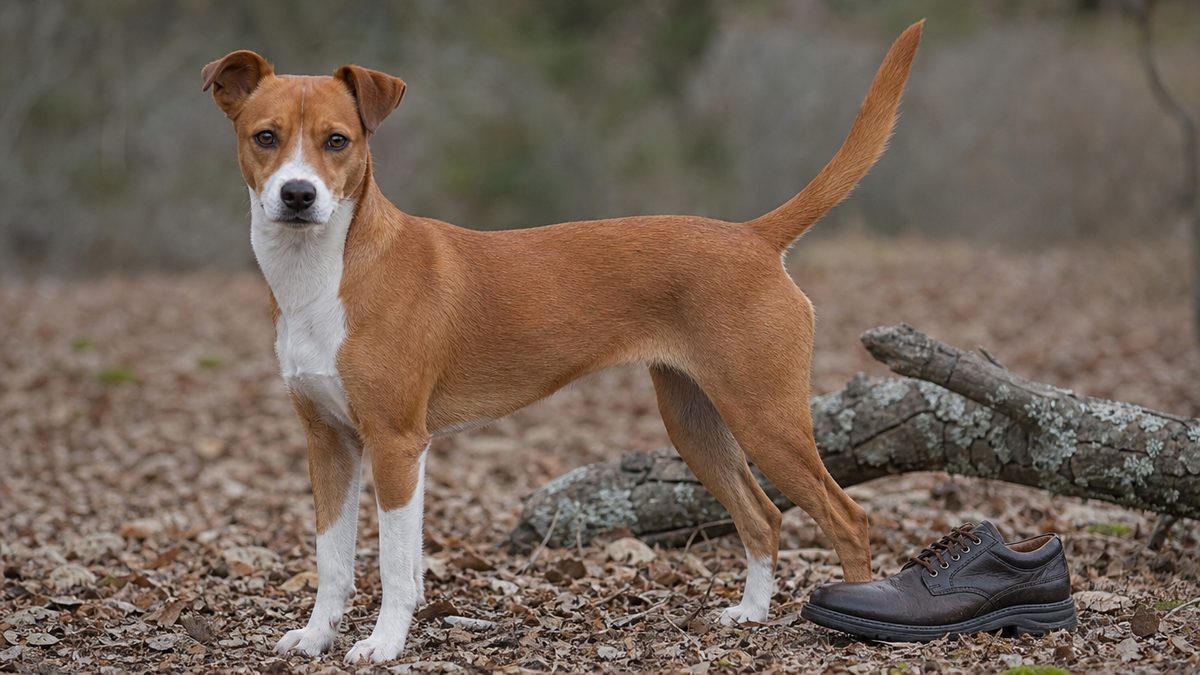
Published descriptions put it at 38 to 46 cm at the withers and 11 to 16 kg, which is 15 to 18 inches and 25 to 35 pounds. The coat is short, usually red or yellow and occasionally red and white spotted. The muzzle is broad, the ears are described as semi-erect, and the tail is short, sometimes a natural bob and otherwise docked. David A. Osborn's 1999 field guide adds that Denmark Feists carry longer legs than the other feist varieties and a noticeably broad muzzle, and gives the same 25 to 35 pound band.
Set that against a Jack Russell Terrier and the differences are real but subtle. A feist carries a softer, smoother coat than a rough-coated Russell, longer legs and a shorter tail, and most feists are quieter dogs than the Russells they get mistaken for in shelters. That confusion is not academic in India, where a Russell is common and a feist is not, so a dog advertised here as a feist is far more likely to be a Russell cross than anything else.
Where the word comes from
The word feist is old and unflattering. Webster's Third New International Dictionary traces it to the obsolete fysting, meaning breaking wind, in expressions such as fysting dog, and defines feist itself as chiefly dialect for a small dog of uncertain ancestry. George Washington used a version of it in his diary in March 1770, describing an animal as a small foist-looking yellow cur, and the modern adjective feisty is derived from the dog rather than the other way round.
The type is genuinely old, then, even where individual strains are not. Feists descend from terriers brought to America by British miners and other immigrants, probably including crosses of Smooth Fox Terrier, Manchester Terrier and the extinct English White Terrier, later crossed with curs, beagles and other scent hounds to add nose and hunting range. What emerged is an American working dog that hunts above ground, is virtually silent on the trail, and barks hard only once it has treed its game.
Denmark here is a family label, not a country. The dog has no Danish ancestry, no Danish registry and no Danish standard, and the two Danish breeds it gets mixed up with are the Danish-Swedish Farmdog and the Broholmer.
One more structural point belongs in the overview, because it shapes everything below. There is no breed standard for the Denmark Feist anywhere. There are standards for the Mountain Feist, the Treeing Feist, the American Feist and a generic Feist, written by two different American registries, and they contradict each other on ears, colour and size. A reader who wants to know what a correct Denmark Feist looks like has to read a 2001 breed dictionary, because no registry has ever written the answer down.
Why the name says Denmark and the dog is American
DenMark is a portmanteau of two men's names, Dennis Willis and Mark Slade, and the capital M in the middle is the clue that survived. The country never had anything to do with it, but the spelling collapsed to Denmark in most retellings and the geography got invented backwards to fit.
The naming is documented by the people who use the dogs. Dogica's feist survey states it flatly, that Denmark references the two creators of the breed, Dennis Willis and Mark Slade. The same two names appear in Wikipedia's account of the 1984 unveiling and in the 1986 association name, which is written DenMark Treeing Feist Association with the internal capital intact. Osborn's 1999 guide, written for squirrel hunters rather than for search engines, also uses the DenMark spelling throughout.
The misconception in print
The wrong version is not a reader's invention. A published breeds glossary states in writing that the Denmark Feist is a small breed that was developed in the United States using dogs that were originally brought over from Denmark. That sentence sits three entries below Danish Broholmer and two below Danish-Swedish Farmdog on the same alphabetical list, which is almost certainly how it happened. Nothing in Morris, in Mehus-Roe or in any American hunting source supports it.
It gets worse on the fourth organic result. A YouTube video ranking on page one in India for this term is titled Denmark Feist Pros and Cons, followed by Danish Feist Advantages and, so the error is now in a ranking title rather than only in body copy. When a reader searches once, sees a Danish label in a video title and a Danish origin in a glossary, the misconception has been confirmed twice before they reach any accurate page.
How the two families of dog actually differ
| Denmark Feist | Danish-Swedish Farmdog | Broholmer | |
|---|---|---|---|
| Country of origin | United States, Virginia | Denmark and Sweden | Denmark |
| FCI status | Never recognised | Standard 356 | Standard 315 |
| UKC status | Not listed | Recognised, Terrier Group | Recognised as Danish Broholmer |
| AKC status | Not in Foundation Stock Service | In Foundation Stock Service | In Foundation Stock Service |
| Adult weight | 11 to 16 kg | Small farm terrier size | Large mastiff type |
| Original job | Treeing and killing squirrels | Farm ratting and general farm work | Estate guarding |
The table is worth reading in one direction only. Two genuinely Danish breeds are carried by every register a buyer would check, and the American dog with the Danish-sounding name is carried by none of them American Kennel Club. If a seller anywhere claims a Danish pedigree for a Denmark Feist, that pedigree does not exist, because no Danish or FCI body has ever issued one.
Why this matters to an Indian buyer specifically
In India the confusion has a price attached. Danish and Scandinavian breeds carry an exotic premium here, and a small imported-sounding dog with a European name is exactly the profile that supports a five-figure rupee ask. A seller who has a Jack Russell cross and a plausible story has every incentive to call it a Danish feist rather than an American one. Knowing that the name is two men's first names removes the entire basis for that premium in one sentence.
The second reason is climatic and it runs the other way. Someone who believes this is a northern European farm dog will assume it is heat-sensitive in the way a Samoyed is, and will look at the short coat and conclude the problem is solved. It is not. The risk here comes from what the dog does rather than what it wears, and that argument only lands once you accept that you are looking at a southern American hunting dog with a hunting drive intact.
Which registries recognise what, checked one by one
Four registries were searched on 27 August 2026 and none of them carries a Denmark Feist. Each search was run with a control that returned results in the same session, so every zero below is a finding rather than a broken query.
Start with the United Kennel Club, because the UKC is the body that actually registers American working dogs. Its breed standards index states that the club recognises over 300 separate breeds, and the Terrier Group alone carries 45 of them. Three are feists. There is no Denmark Feist anywhere in the index, and no breed with Denmark in its name at all, although the index does carry Danish Broholmer, Old Danish Pointing Dog and Danish-Swedish Farmdog.
| Breed | Recognised | Height | Ideal working weight | Ears |
|---|---|---|---|---|
| Treeing Feist | 1 November 1998 | 12 to 18 in | 12 to 30 lb | Erect, button, rose or cocked; drop ears disqualify |
| Mountain Feist | 1 February 2015 | 12 to 18 in | 12 to 30 lb | Must be erect; ears not erect disqualify |
| American Feist | 1 September 2025 | 12 to 18 in | 12 to 30 lb | Only that they be in proportion to the head |
The third row is new enough that most of the internet has not caught up. The UKC recognised the American Feist on 1 September 2025, with a standard that allows a short to medium coat rather than a short one, disqualifies merle colour, and adds a foundation-stock clause letting dogs up to 20 inches register while barring anything over 18 inches from hunting or showing. The club's own Cur and Feist programme page still describes five cur breeds and two feist breeds, so the events side has not been updated to match the standards index.
The other three registers
The National Kennel Club, based in Blaine, Tennessee, takes the opposite approach and registers a single breed called simply Feist, described as tree dogs and scored out of 100 points. Its height range is 10 to 18 inches for males and 10 to 17 for females, with a 30 pound ceiling for both, and it requires that the dog be virtually silent on trail and tree only squirrel or coons. It has no Denmark entry either.
The American Kennel Club recognises no feist of any kind. Its Foundation Stock Service breed selector was read in full and carries no Denmark Feist, no Mountain Feist, no Treeing Feist and no American Feist, while the same list does carry Mountain Cur, Rat Terrier, Teddy Roosevelt Terrier, Treeing Tennessee Brindle, Carolina Dog, Catahoula Leopard Dog and American Leopard Hound. American working breeds are plainly represented there. Feists are simply not among them.
The Federation Cynologique Internationale has never recognised a feist either. Its complete provisional list runs to 21 breeds, the highest standard number in the whole nomenclature being 378, and contains no feist. The alphabetical index for F returns eight breeds, all of them spaniels, retrievers, fox terriers or French hounds, and the index for M returns eleven with no Mountain Feist Federation Cynologique Internationale Federation Cynologique Internationale.
The FCI's own D index is the sharpest control of the four, because it is where a Danish-origin dog of this name would sit. It returns 25 breeds, and the two that matter are Dansk-Svensk Gardshund at standard 356 and, over on the B index, Broholmer at standard 315 Federation Cynologique Internationale. Both real Danish breeds are there with numbers attached. The Denmark Feist is not, because it is not Danish.
The FCI members register lists India as a full member represented by the Kennel Club of India in Chennai, so the KCI issues pedigrees against FCI nomenclature. A breed the FCI has never recognised has no KCI route either, which is why no Indian pedigree for this dog can exist.
That FCI membership fact is checkable and worth stating precisely. The Kennel Club of India appears on the FCI members list as a full member at Nr 28, AA Block, First Street, Anna Nagar, Chennai 600 040. Its own registration volumes are substantial, at 33,880 pure-bred dogs entered in the studbook during 2025 and 1,425,001 since the studbook was created, so this is not a small or inactive register. It simply has no nomenclature slot for a dog the FCI does not list.
The honest summary is that this is an unrecognised strain with a name rather than a breed with a register. Wikipedia's infobox says exactly that, recording the breed status as not recognized as a breed by any major kennel club, and the only recognition the most-linked breed page claims for it is DRA, the Dog Registry of America, which is a commercial registration service rather than a kennel club Dog Breed Info Center.
Strain, breed and regional name are three different things
A strain is a family line of working dogs, a breed is a population a registry has agreed to define and close, and a regional name is neither. The Denmark Feist is a strain, and almost every error on the internet about it comes from filing it in the wrong box.
Wikipedia's feist article files the DenMark Feist among the Mountain Feists, in a list that also holds the Baldwin, Buckley, Galla Creek, Kemmer, Lost Creek, Sport-bred and Thornburg feists. That is a list of family lines, not a list of breeds, and the same article's navigation box of American breeds carries Mountain Feist and Treeing Feist while carrying no Denmark Feist at all. The article contradicts its own infobox categorisation within a single page, and the infobox is the one that says the truth.
Marc Gray, who holds a master's degree in wildlife science and has run a named feist line since 2005, puts the working definition plainly. Feist is an umbrella term for a smooth-coated canine under thirty pounds used for squirrel hunting, and it covers breeds as well as dogs of mixed or unknown origin that do the job. He adds that a treeing feist can be a first-generation cross of two recognised breeds, a mixed-breed dog that fits a physical standard, or a line bred on for generations from other registered treeing feist. All three are called the same thing.
What the strain names actually describe
Osborn's 1999 field guide is the most useful document in this whole area because it treats the strains as what they are, four named families with different working styles and different weights.
| Variety | Weight | Distinctive feature |
|---|---|---|
| DenMark Feist | 25 to 35 lb | Broad muzzle, longer legs than the other varieties |
| Mullins' Feist | 16 to 40 lb | Never erect ears; yellow, yellow with white trim or black, never brindle |
| Thornburg Feist | 12 to 25 lb | Blockier head, mostly erect ears, long legs |
| Treeing Feist | 10 to 35 lb | A catchall name for small dogs with proven treeing ability |
Notice that the four bands overlap almost completely, from 10 pounds at one end to 40 at the other. That is what a strain system looks like. It is organised by who bred the dog and how it hunts, not by a measurable outline, and a judge could not separate a 25 pound DenMark from a 25 pound Treeing Feist on the bench without knowing the pedigree.
How a strain gets registered in practice
The route exists and it does not use the strain name. Texas Parks and Wildlife Magazine describes how hybrid curs are handled, noting that with proper documentation and proof of working ability they can be registered with the National Kennel Club and United Kennel Club as treeing curs. Feists work the same way. A Denmark-bred dog goes onto a register as a Treeing Feist or now as an American Feist, and the strain name lives on in the pedigree and in conversation rather than on the certificate.
The UKC even guards that boundary in writing. Its Treeing Feist standard states that any dog registered in another registry as anything other than a Feist breed is not eligible to be registered as a Treeing Feist. So the club is policing which outside registrations it will accept while never having created a slot called Denmark Feist. The evidence that the strain is real and working is that its dogs go onto the feist registers under other names.
The only dog pictured on the most-linked Denmark Feist page is described by its owner as a purebred Denmark slash Treeing Feist with pedigree papers. The papers say Treeing Feist. The Denmark part is the family label, added by hand.
For an Indian reader this resolves a practical question. If someone offers you papers for a Denmark Feist, the papers cannot say Denmark Feist, because no registry issues that document. At most they can say Treeing Feist or Feist, and those would have to come from an American registry, for a dog that would then have to clear an import route India does not open for purchases.
How big is it, and why the sources refuse to agree
Published weights for this dog run from 10 to 40 pounds depending on which document you open, and the disagreement is not sloppiness. It is what happens when four bodies describe overlapping populations from different starting points, and it has one consequence that actually bites.
Set the figures side by side rather than averaging them, because averaging would produce a number that appears in no document.
| Source | Height | Weight |
|---|---|---|
| Morris 2001 and Mehus-Roe 2005, via Wikipedia, for the Denmark Feist | 15 to 18 in (38 to 46 cm) | 25 to 35 lb (11 to 16 kg) |
| Osborn 1999, for the DenMark Feist | Not stated | 25 to 35 lb |
| A-Z Animals 2025, for the Denmark Feist | 15 to 18 in | 25 to 35 lb |
| UKC, all three feist standards | 12 to 18 in | 12 to 30 lb ideal working weight |
| National Kennel Club, generic Feist | 10 to 18 in males, 10 to 17 in females | Up to 30 lb |
| Wikipedia, feist as a type | 10 to 18 in (25 to 46 cm) | 15 to 30 lb (6.8 to 14 kg) |
| The Land Report 2011, feists generally | Not stated | 20 to 35 lb |
Three of those rows are about this specific strain and four are about the wider type, and the three specific rows all say the same thing, 25 to 35 pounds. That consistency is worth something, because all three trace back to the same small pool of American sources rather than to independent measurement, but at least they do not contradict each other.
The consequence that actually matters
A 35 pound Denmark Feist cannot be shown as any UKC feist. All three UKC standards set the ideal working weight at not under 12 pounds and not over 30, dependent on the dog's height, and all three apply an eliminating fault to dogs under 12 inches or over 18 United Kennel Club United Kennel Club. The top of the published Denmark band sits five pounds above the top of the registry band. The National Kennel Club sets the same 30 pound ceiling.
So the strain as described in the books is, at its upper end, outside the breed as described by the registries. That is not a scandal and it is not unusual in working dogs, but it is a concrete example of why the strain and the breed are different objects. The 2025 American Feist standard is the only one that bends, and only in one direction, allowing foundation-stock dogs up to 20 inches to register while barring anything over 18 inches from hunting or showing.
What the disagreement means for an Indian buyer
Assume nothing about the size of a dog you are shown. Between 11 and 16 kg is a mid-sized Indian flat dog, roughly a large Indian Spitz or a heavy Jack Russell, and a buyer who has been told small will not have budgeted for the exercise. Anything advertised here at 20 kg or above is not a Denmark Feist under any published description, and anything under 5 kg is not one either.
The other thing to distrust is the word purebred. There is no closed studbook, no DNA panel, no breed-specific genetic marker and no Indian registry entry, so purebred applied to this name in India means only that a seller said it. A short-coated red and white terrier-type dog of the right size is consistent with a Denmark Feist, with a Treeing Feist, with a Jack Russell cross and with a great many Indian street dogs, and no test on the market will tell them apart.
What the dog was actually built to do
The Denmark Feist was built to find squirrels by sight, ear and nose, run them into a tree in silence, and then catch and kill them. That last part is unusual and it is the single most decision-relevant fact on this page for an Indian household.
Osborn's account is worth quoting rather than paraphrasing, because it is the only breed-specific temperament description written by someone who used the dogs. On page 53 of the 1999 guide he writes that Denmark Feists hunt to catch and kill, not just to tree, that they are silent or semi-silent while following a scent trail, that at home they protect their human families from unwelcome strangers, and that they fear nothing and, when necessary, will battle farm predators to the death. He closes by saying that above all, they are people dogs.
Read that against the registry standards and a gap opens. The UKC describes its feists as agile, active small tree dogs that hunt using sight, sound and scent and are virtually silent on track. The National Kennel Club goes further and requires that the dog be virtually silent on trail and tree only squirrel or coons. A treeing dog holds the game in place and waits for the gun. A catch-and-kill dog does the job itself.
Why the difference matters in an Indian street
A treeing dog that overshoots into a neighbour's chicken run is a nuisance. A dog selected to close and kill is a liability, and India gives it far more to work with than Virginia does. Free-roaming cats, poultry, monitor lizards, mongooses, palm squirrels on every compound wall and small pet dogs on every landing are all within the target profile of a dog bred to catch small fast animals, and none of that trains out of a working line in one generation.
The published quarry list makes the point. Wikipedia records the Denmark Feist as used to hunt feral pig, bobcat and squirrel, which is a startling range for a 13 kg dog. A-Z Animals repeats squirrels, bobcats and boars for the Slade family's original purpose. Nothing on that list is timid, and a dog that has been selected for eighty years to engage a bobcat is not going to back off a street dog.
How the hunting style works
Feists hunt above ground, unlike terriers and dachshunds that go to earth. They locate a squirrel using eyes, ears and nose, tree it, then bark loudly and circle the trunk in the manner of a coonhound working a raccoon, and they will wade streams, leap logs and cross roads to stay with the animal. Leashing them near squirrels is explicitly advised. In India that translates to a dog that will cross a road after a squirrel, which is how most such dogs die here.
The bark pattern is worth understanding before you buy one. The dog is silent while trailing and then, on treeing, produces a clear rapid chopping bark and keeps producing it. Henry Chappell's account of a young cur treeing describes ten minutes of continuous panting, slobbering barking before the hunter even located the squirrel. In an apartment building, ten minutes of chopping bark aimed at a wall-top squirrel is a complaint from every neighbour on that side.
This is a small, hardy, athletic hunting dog with an intact catch-and-kill prey drive and a purpose-built loud tree bark. Nothing about it was designed for a flat, and nothing about it has been softened by a hundred years of pet breeding, because it has never been bred as a pet.
There is one genuinely warm note in the record and it deserves its place. Every source that describes the temperament of feists agrees they are companionable, easy to train and strongly attached to people, and Osborn's people dogs line is not marketing. The problem is never affection. The problem is that a dog can be devoted to you and still kill your neighbour's cat on the same afternoon.
Denmark Feist price in India
No denmark feist price in india exists, because no Indian seller offers the dog. That is not a gap in this page's research. It is the finding, and the whole first page of Indian search results was read to establish it.
The Google India results page for this exact term was captured on 27 August 2026 with gl=in. Google opened it by offering a spelling correction, asking whether the reader meant denmark first price in india, which is what happens when a query is rare enough that the engine suspects a typo. Ten organic results followed, and not one of them was an Indian dog listing.
| # | Site | What it is actually selling or saying |
|---|---|---|
| 1 | amazon.in | A print-on-demand activity book, not a dog |
| 2 | etsy.com India | A marketplace category page of mugs and prints |
| 3 | en.wikipedia.org | The two-paragraph breed stub |
| 4 | youtube.com | A video titled 'Denmark Feist Pros and Cons | Danish Feist Advantages and ...' |
| 5 | dogbreedinfo.com | A breed page with six empty fields |
| 6 | landreport.com | A 2011 American magazine column about feists |
| 7 | amazon.in | A second print-on-demand book, milestone challenges |
| 8 | animalia.bio | An aggregator restating Wikipedia |
| 9 | etsy.com India | A wall-art poster, sale price Rs 396 |
| 10 | creatures.com | An auto-generated breeder-directory shell |
The only rupee figures anywhere on that page belong to merchandise. Etsy India's feist category shows a digital download at Rs 136 and listings at Rs 498 and Rs 1,395 reduced from Rs 1,993, and the poster at position nine is Rs 396 reduced from Rs 659 Etsy India, Feist Dog marketplace category…. A reader searching for what this dog costs in India is being shown what a picture of it costs.
The control that makes the zero mean something
A zero result is only evidence if the same tool returns results for a query that should work. In the same session, the same search restricted to India for labrador retriever price in india returned ten Indian selling pages carrying real rupee bands, including Rs 30,000 to Rs 1,20,000, Rs 8,000 to Rs 70,000 and Rs 8,000 to Rs 30,000. The instrument works. Indian dog listings are trivially findable when they exist.
Supertails' Indian price table is the second control and it is a stronger one, because it is a deliberate attempt to be comprehensive. It lists forty breeds with rupee bands, from Labrador Retriever at Rs 8,000 to Rs 80,000 down to Rajapalayam at Rs 5,000 to Rs 20,000 and Mudhol Hound at Rs 3,000 to Rs 15,000, and adds a city-wise matrix across six metros. It contains no feist of any kind. A forty-breed Indian price list that omits a breed entirely is telling you the breed is not traded here.
If you are quoted a number, it was not derived from an Indian market, because there is no Indian market. It was either converted from an American price or typed from imagination, and this site has caught both mechanisms on other breeds.
For reference, the American number does exist and is modest. Good Dog's national guidance for the Treeing Feist, the register-recognised breed a Denmark-bred dog would actually be papered as, is USD 375 to 1,050. That is a working dog's price, not an exotic one, and it is worth knowing before anyone quotes you a lakh for something they cannot legally import.
What an Indian search actually returns, page by page
Search this breed from India and you get merchandise, aggregator shells and one video that repeats the error you came to check. Reading what each result actually is turns an empty market into something useful, which is a map of who is monetising a name nobody can supply.
Take the two Amazon.in results first. Both are print-on-demand paperbacks generated from a breed-name template, one offering beginner-to-advanced tricks, fun games and agility for the Denmark Feist, the other offering twenty milestone challenges and memorable moments. Books of that series exist for hundreds of breed names, produced by substituting the name into a fixed manuscript, and buying one gets you generic dog content with this breed's name on the cover.
The Etsy results are the same mechanism in another medium. Etsy India's own category page is titled Buy Feist Dog Online In India and offers a custom Denmark Feist mug, a Denmark Feist cup, and personalised dog-owner gifts. There is nothing dishonest about selling a mug. It is simply worth naming precisely, because a reader scanning a results page sees the words Denmark Feist and India next to a rupee figure and reasonably concludes that a dog is on sale.
The aggregator shells, and the control that exposes them
Creatures.com ranks tenth with a page whose visible headings are Looking for Denmark Feists, Denmark Feists for Sale, Denmark Feist Herdbook, Denmark Feist Profiles, Denmark Feist Breeders, Popular Dog Breeds and Denmark Feist Tools. Every one of those is the breed name pasted into a fixed slot. Nothing on the page is specific to this dog.
Fetching the same site's Labrador Retriever page proves it. The Labrador page carries the identical heading template, plus one heading the Denmark Feist page does not have, which is Quick facts, and a page description reading that you can browse 634 trusted breeders and 10 public profiles. The Denmark Feist page has no quick facts block and no breeder count, because there is nothing to put in either. The template ran anyway.
The page that ranks fifth, and its six missing fields
Dog Breed Info Center's Denmark Feist page is the most-linked breed-specific page in English, and it is a shell of a different kind. Its Description field reads two hyphens. So do Temperament, Height and Weight, Health Problems, Living Conditions and Origin. Six of its twelve fields are literally empty.
The four fields that are filled are worth recording, with the caveat attached. Life expectancy is given as about 12 to 14 years and litter size as about 5 to 8 puppies, with no source and no sample; grooming says an occasional combing and brushing to remove dead hair is all it needs; the group is Hunting; and the recognition line names one body, DRA, the Dog Registry of America, which is a commercial registration service rather than a kennel club. The page also carries a robots noindex directive, so its own publisher does not want it in search.
The single dog pictured on it is the most revealing thing there. Its owner describes it as a purebred Denmark slash Treeing Feist with pedigree papers, good with cats, kids and other dogs, and housebroken. That slash is the whole story of this breed in one punctuation mark. The papers say Treeing Feist. Denmark is the part the family added.
Bing with cc=IN returned HTTP 200, the right page title and About 51 results for this breed, with ten organic results that were all Stack Overflow threads about HTTP cache-control headers. DuckDuckGo returned its select-all-squares-containing-a-duck challenge at HTTP 202. Neither is evidence of anything, in either direction, and no claim on this page rests on either of them.
Why no lawful supply chain can form in India
Two independent facts close the route. India's import policy bars bringing a dog in to breed or sell it, and the FCI nomenclature the Kennel Club of India works from has never contained a feist, so there is nothing to register even if one arrived.
The import instrument is DGFT Trade Notice No. 22/2022-23, dated 19 December 2022 and signed by the Deputy Director General of Foreign Trade. It records dogs under ITC (HS) 01061900, Mammals: Other, with an import policy of Restricted. Restricted means an authorisation is required, not that entry is impossible, and the notice then narrows what the authorisation can be for.
Policy Condition 7 states that import of dogs is allowed only for three specific purposes. The first is a pet dog with a valid pet book and relevant records in the name of the importer. The second is dogs imported by research and development organisations with the recommendation of the CPCSEA. The third is for internal security by the Defence and Police Force. Policy Condition 8 then adds that import of commercial dogs for breeding or any other commercial activities other than the purposes mentioned above is not permitted.
Paragraph 6 of the same notice is blunter still, stating that any applications for trading or breeding purposes, or applications made on behalf of some another person or entity, shall be duly rejected. Paragraph 7 limits entry to the airports and seaports of Delhi, Mumbai, Chennai, Hyderabad, Bangalore and Kolkata, with quarantine at the government station of those ports where required. DAHD added a seventh port, Cochin International Airport at Kochi, for pets arriving under the baggage rules in October 2024. The full route is set out in how to import a dog to India.
What that leaves
The only route that does not need a DGFT authorisation is passenger baggage, and it is narrow. It is open to people transferring their residence to India after two years of continuous stay abroad, for up to two pets, and only cats and dogs may come in under baggage rules. Everything else needs an authorisation, applied for at least two months before travel, examined by the Department of Animal Husbandry and Dairying, and backed by an advance No Objection Certificate from the quarantine officer seven days before travel.
So an American squirrel-dog breeder cannot ship you a puppy, an Indian importer cannot bring a pair in to found a line, and a broker cannot apply on your behalf. The only person who can lawfully bring a Denmark Feist to India is someone who already owns one, already lives abroad, and is moving here. There are, by definition, almost none of those.
The second lock, on the registry side
Even a lawfully arrived dog would have nowhere to register. The FCI members list records India as a full member represented by the Kennel Club of India at Anna Nagar, Chennai, so the KCI issues pedigrees against FCI nomenclature. That nomenclature contains no feist on a definitive basis and none among its 21 provisionally recognised breeds, the newest of which were added on 2 November 2026.
The consequence is worth stating precisely, because it is the sort of thing sellers blur. A Denmark Feist in India could be vaccinated, licensed by a municipality and microchipped like any other dog. It could not be KCI-registered, could not be shown, could not produce a registrable litter, and its puppies would have no pedigree to sell. Whatever price a seller attaches, the paperwork side of that transaction is empty.
Second Schedule Part II paragraph 6(9) of the Dog Breeding and Marketing Rules 2017 states that breeding to create new breeds of dogs or unusual looks shall be strictly prohibited. The Denmark Feist is, by its own history, a family strain that was presented as a new breed in 1984. Attempting the same thing in India today would run straight into that clause.
None of this is unique to this breed and none of it is a criticism of the dog. It is simply the answer to the question the page is titled with. There is no price because there is no market, there is no market because there is no lawful import route for a purchase, and there would be no pedigree even if there were.
What one would actually cost to keep in India
A dog of this size and drive would cost roughly Rs 6,000 to Rs 10,000 a month to keep in an Indian city, and Rs 80,000 to Rs 2,00,000 in the first year. Those are the published Indian figures for the medium-breed band this dog falls into, and they are the only cost numbers on this page that rest on Indian data.
At 11 to 16 kg the Denmark Feist sits squarely in the medium band, alongside a Beagle or a Cocker Spaniel rather than with the small breeds. Supertails' 2026 Indian cost breakdown gives that band the following monthly figures, and they are worth reading line by line rather than as a total, because two of the lines behave differently for a working dog.
| Line item | Medium breed | What changes for a high-drive working dog |
|---|---|---|
| Dry or wet food | Rs 2,500 to Rs 4,000 | Toward the top, because two hours of daily work is not free |
| Routine vet visits | Rs 800 to Rs 1,500 | Higher, because cut pads and thorn injuries are routine |
| Vaccinations | Rs 1,500 a year | Unchanged |
| Grooming | Rs 800 to Rs 1,500 | Far lower, because the short coat needs no professional groom |
| Training over six months | Rs 2,000 to Rs 5,000 | Higher, because recall around prey is the whole job |
| Treats and toys | Rs 500 to Rs 1,000 | Higher, because a bored feist destroys things |
| Flea, tick and deworming | Rs 400 to Rs 700 | Higher, because this dog goes into long grass |
| Monthly total | Rs 6,000 to Rs 10,000 | Realistically the upper half of that band |
The grooming line is the one genuine saving. A short coat that needs occasional combing and brushing to remove dead hair carries no salon cost at all, so the Rs 800 to Rs 1,500 a month a medium-breed owner is told to budget largely disappears. Set against a Shih Tzu, whose professional grooming runs about Rs 2,500 a visit in Indian metros, that is a real structural advantage of a short-coated working dog in this climate.
Where the money goes instead
Two lines move up hard and both are consequences of prey drive rather than of size. Training is the first. A dog selected for eighty years to leave you and pursue an animal is not going to acquire a reliable recall from a six-session package, and Rs 2,000 to Rs 5,000 over six months is the floor rather than the budget. Plan on ongoing work, not a course.
Parasite control is the second. A dog that works in long grass, scrub and leaf litter is exposed to ticks in a way a pavement dog is not, and the Rs 400 to Rs 700 a month line will not cover a proper year-round preventive on a working schedule. That matters more in India than in Virginia and it is a line most breed pages leave at the default.
The first year, honestly bounded
The published Indian first-year range is Rs 80,000 to Rs 2,00,000 including purchase, vaccinations, food, training and supplies, and the annual running cost after that is Rs 30,000 to Rs 1,00,000. For this breed you can strike the purchase component out of the first figure, because there is nothing to buy, which pulls the realistic first year toward the lower end for anyone who adopts a similar dog instead.
One line is worth adding to any Indian budget and it is not breed-specific. An independent pre-purchase or pre-adoption veterinary check costs Rs 800 to Rs 1,500 and is the cheapest protection available in a market with no screening data. On a breed with zero OFA records and zero published literature, that examination is not one data point among several. It is the only one that will ever exist.
Grooming. Every source that describes the coat calls it short and smooth, no source describes any trimming requirement, and no registry standard for any feist asks for scissoring. Weekly brushing and a bath when the dog is dirty is the entire schedule, which in Indian humidity is a real advantage over almost every imported breed.
Suitability for the Indian climate, measured rather than guessed
The Denmark Feist comes from a place that averages 13.94 C across the year and never averages 28 C in any month, which is a colder home than almost any Indian city offers. The surprise in the data is that humidity is not the problem. Its home county is more humid year-round than four of the five Indian cities checked.
The origin was fixed by coordinates rather than by place name, because climate sites have repeatedly served the wrong city to this project. Chatham, Virginia was queried on NASA POWER at latitude 36.8232 and longitude minus 79.3978, and the returned record confirms those coordinates and an elevation of 240.3 metres before giving any figures. The dataset is the 20-year MERRA-2 climatology covering January 2001 to December 2020.
| Place | Annual mean temp | Months averaging 28 C or more | Annual mean humidity | Highest monthly max |
|---|---|---|---|---|
| Chatham, Virginia (origin) | 13.94 C | 0 | 75.58 percent | 40.21 C |
| Bengaluru | 23.74 C | 1 | 67.94 percent | 40.38 C |
| Pune | 23.86 C | 2 | 66.80 percent | 43.20 C |
| Delhi | 25.60 C | 6 | 45.56 percent | 48.79 C |
| Mumbai | 26.77 C | 4 | 67.39 percent | 44.91 C |
| Chennai | 27.95 C | 7 | 72.39 percent | 42.70 C |
Two numbers in that table do the real work. The origin has zero months whose mean temperature reaches 28 C, and its hottest month, July, averages 25.71 C. Chennai's coolest month, January, averages 24.09 C. Chennai's coldest month is therefore within 1.62 C of the warmest month this dog's home county has ever averaged, which is a compact way of saying that Chennai in January is a Virginia summer, all year.
The humidity finding, which runs against expectation
Chatham's annual mean relative humidity is 75.58 percent. Chennai's is 72.39, Bengaluru's 67.94, Mumbai's 67.39 and Pune's 66.80. The origin is more humid across the year than every Indian city checked. Delhi at 45.56 percent is the outlier in the other direction, and it is the driest place in the comparison by a wide margin.
That matters because humidity is the standard explanation people reach for when an imported dog struggles here, and for this breed it is the wrong explanation. This dog's ancestors evolved their thermoregulation in a damp climate. What they never met was seven consecutive months of 28 C and above, or an afternoon maximum of 42.70 C. The problem is heat, and specifically heat during work.
The winter the breed is built for
Chatham's January mean is 1.53 C and its December mean is 3.68 C. Four months of the year sit below 8 C. American squirrel season runs through that cold half of the year, and even the training described in the American literature happens in what an Indian reader would call cool weather. Henry Chappell notes with mild surprise that he and a companion put dogs into the woods in the middle of a 70 degree day, which is 21 C.
Hold that against Bengaluru, the mildest Indian city in the table, whose annual mean is 23.74 C. The temperature an experienced American squirrel hunter treats as notably warm for a working session is nearly two degrees below Bengaluru's ordinary year-round average, and roughly seven degrees below Chennai's. The gap is not marginal and it is not something a short coat closes.
This project has caught climate sites serving Crotone for Bergamo, Pordenone for Glasgow and Porirua for Chennai, all at HTTP 200 with correctly formatted data. A NASA POWER query by explicit latitude and longitude cannot return a different place by accident, and the returned record prints the coordinates back so you can check.
City by city, and the two places this dog is least impossible
Bengaluru and Pune are the only Indian cities in the comparison where a dog of this type could work most of the year, because they are the only two with fewer than three months averaging 28 C or above. Chennai is the hardest, Delhi is hard in a different way, and Mumbai is a monsoon problem rather than a heat problem.
Bengaluru is the least bad, and the elevation is why. At 841.72 metres the city has an annual mean of 23.74 C and exactly one month, April at 28.37 C, that reaches the 28 C line. Its humidity climbs to 81.01 percent in October, so the monsoon half of the year is damp, but the temperature never sits where an working dog cannot recover overnight. A morning walk before seven and an evening one after seven works here for most of the year.
Pune is close behind and for the same reason, sitting at 635.99 metres with an annual mean of 23.86 C and two months over the line, April at 28.93 and May at 28.80. The difference from Bengaluru is a sharper monsoon, with August humidity at 90.80 percent, which shifts the problem from heat to skin and ears for three months. Pune's summer maximum of 43.20 C is also six degrees above Bengaluru's April.
Chennai is the hardest city in the table for this dog and the numbers are not close. Seven months average 28 C or more, the annual mean of 27.95 C is exactly double the origin's 13.94, humidity stays above 64 percent all year and the highest monthly maximum is 42.70 C. There is no season here in which a two-hour working schedule is safe in daylight, and the exercise requirement does not shrink because the weather is difficult.
Delhi is a two-season problem. Six months average 28 C or above, May and June average 35.05 and 35.88 C, and the highest monthly maximum reaches 48.79 C, the most extreme figure in the comparison. Against that, Delhi's annual humidity of 45.56 percent means evaporative cooling by panting works far better than it does on the coast, and January at 13.61 C is genuinely comfortable for this breed. Delhi is survivable in winter and dangerous from April to July.
Mumbai sits at 26.77 C annual mean with four months over the line, but its distinguishing feature is the monsoon rather than the heat, with humidity of 89.56, 90.36 and 88.55 percent in July, August and September. Three months at ninety percent humidity in a coastal city is a skin and ear season, and a short-coated dog that works in wet undergrowth will need its ears checked weekly through it.
The practical schedule, if you have a dog of this type
- Split the day's exercise into a pre-dawn session and one after full dark, from March to October in every city in the table except Bengaluru.
- Move hard work to the winter months and accept that April to June is a maintenance period rather than a training period.
- Carry water on every walk over twenty minutes, because a dog that is hunting will not stop to ask.
- Stop the session at the first sign of a dropped tail, a widened stance or a change in the sound of the panting, rather than at the end of your planned route.
- Check the ears after every wet-season outing, because a working dog in Mumbai or Pune spends three months in ninety percent humidity.
One American care instruction should be dropped outright here. Overseas guidance for short-coated working dogs commonly assumes the dog will air-dry after a wet outing, which is unremarkable in a Virginia autumn. In an Indian monsoon, with three consecutive months near ninety percent humidity in Mumbai and Pune, air-drying a dog with wet ear canals is how otitis starts. Dry the ears deliberately, every time.
The heat tolerance rating, and the study that sets it
Bonbeno rates the Denmark Feist 2 out of 5 for heat tolerance, and the reason is behavioural rather than anatomical. The largest study of canine heat illness ever published found that exertion, not weather and not cars, was the dominant trigger, and this is a breed whose entire purpose is exertion.
The study is Hall, Carter and O'Neill, published in Animals in 2020, using the VetCompass programme to review de-identified records of 905,543 dogs under primary veterinary care in the United Kingdom in 2016. From that population it identified 1,259 heat-related illness events from 1,222 dogs, which is the headline figure most pages quote.
The denominator that matters is smaller than that, and getting it right is the difference between a true sentence and a false one. The Results section reports 380 of the 1,259 events, or 30.2 percent, with no trigger recorded. Of the remaining 879 events with a recorded trigger, exertional heat illness accounted for 652, which is 74.2 percent, followed by environmental at 113, or 12.9 percent, and vehicular confinement at 46, or 5.2 percent.
652 divided by 879 is 74.2 percent, which is what the paper prints. 652 divided by 1,259 would be 51.8 percent, which it does not print. The correct sentence is 652 of the 879 events with a recorded trigger, and a page that writes 74.2 percent of 1,259 events has silently claimed 934 cases that do not exist.
Which exercise did it
The breakdown inside those 652 exertional events is the part that should change behaviour. Exercise type was unspecified for 101 of them. Of the remaining 551, 372 events, or 67.5 percent, occurred after walking. High-intensity activity such as running or cycling accounted for 97, periods of play for 76, and canine competitions for just 6. Two thirds of the exertional cases in the largest study of its kind followed an ordinary walk.
That reframes the whole risk for an Indian owner. The dangerous thing is not a hunt or an agility session. It is the routine forty-minute walk at four in the afternoon that the owner has done a hundred times, taken on a day that is four degrees hotter than usual with a dog that pulls the whole way.
What the study can and cannot say about this breed
It cannot say anything about it directly, and that must be stated rather than glossed. The breed-type variable in Hall 2020 included only breeds with at least five heat-illness cases or at least 5,000 dogs in the study population, so no feist of any kind appears in the model. Importing an odds ratio onto a breed the authors never studied would be fabrication with a citation attached.
Two transferable factors do apply, because they are defined by measurement rather than by breed. The first is bodyweight. Dogs in the 10 to under 20 kg band, which is where an 11 to 16 kg feist sits, had 2.52 times the odds of exertional heat illness compared with dogs under 10 kg, and every band above 10 kg carried raised odds. The second is condition, where dogs at or above their breed and sex mean bodyweight had 1.30 times the odds of those below it.
There is one genuinely reassuring comparison available. The Jack Russell Terrier, the closest modelled analogue to a feist in size, build and drive, had 0.43 times the odds of exertional heat illness compared with a Labrador Retriever, one of the lowest figures in the table. Small, lean, mesocephalic terrier types are not the high-risk group. Brachycephalic dogs, at 1.32 times, and Chow Chows at 7.00 times, are.
That is why the rating is 2 rather than 1. A 13 kg short-coated dog with a normal muzzle sheds heat far better than a Bulldog or a 40 kg cur, and it is small enough to cool in the shade of a compound wall. The rating is held down to 2 by an origin that never averages 28 C, by seven such months in Chennai, and by a working drive that pulls the dog into precisely the activity that triggered 652 of 879 recorded events.
Temperament and household fit
The Denmark Feist is an affectionate, fearless, people-attached dog with an intact killing prey drive, and both halves of that sentence are load-bearing. It is not a difficult dog to live with indoors. It is a difficult dog to live with in a country where small animals are everywhere.
Osborn's 1999 account is the only breed-specific temperament description anywhere, and it is unusually direct. Denmark Feists protect their human families from unwelcome strangers, they fear nothing, they will battle farm predators to the death when necessary, and above all they are people dogs. Every one of those clauses has a household consequence, and the last one is the reason people who own feists rarely give them up.
The wider type reads the same way. Feists are described as fearless and alert but also companionable and easy to train, and most are fairly quiet dogs that lack the tendency toward excessive barking seen in some Jack Russells. The 2025 UKC American Feist standard adds one line worth noting because it is a temperament requirement rather than a description, stating that dogs are bold, not timid.
Who this dog suits
- Households with a fenced compound, ground-floor access and someone home for most of the day.
- Owners who already run, cycle or trek and want the dog with them rather than waiting at home.
- Families with older children who understand that a dog chasing something must not be chased.
- People who want a dog that stays physically close indoors and works independently outdoors.
Who this dog does not suit
- Flat-dwellers with no outdoor access and a working day, because two hours of exercise cannot be improvised.
- Households with cats, rabbits, birds or backyard poultry, unless the dog was raised with them from puppyhood.
- First-time owners who want an easy small dog, because small here means portable rather than manageable.
- Anyone who cannot tolerate sustained loud barking at things they cannot see.
The cat question deserves its own paragraph because it is the one that ends placements. Feists generally do not get along with smaller pets such as cats and guinea pigs unless raised with them from puppyhood, and supervision is recommended for any interaction with a small animal the dog is not used to. In an Indian building with a resident cat population on the stairs, that is not a manageable risk. It is a daily one.
With other dogs the record is better than the prey-drive line suggests. The type is described as getting along with other dogs given a proper introduction on neutral territory, and as noticeably less combative dog to dog than a Jack Russell. A well-socialised young feist introduced carefully to the dogs on its street is a realistic goal in a way that coexisting with a cat is not.
Feist owners consistently describe a dog that is intensely attached, physically close indoors and happiest working beside a person. Nothing about the hunting drive makes this a distant or aloof dog. If anything it makes separation harder, because the dog wants a job and a person, and a flat with neither produces destruction rather than sulking.
Training approach, and the one thing this breed resists
Feists are quick, biddable and genuinely trainable, and every source that describes them says so. The single thing they resist is recall in the presence of moving prey, and no amount of obedience work fully solves it, so the training plan has to be built around management rather than around hope.
Start from the honest baseline. Feists are described as fearless, alert, companionable and easy to train, they are smart dogs that do best with short sessions ending on a positive note, and owners report them learning a changed name, a full basic obedience set and trick behaviours quickly. Nothing about this breed is stubborn in the terrier caricature sense.
The exception is structural. This is a dog selected over eighty years to leave a handler, work independently, locate an animal and commit to it, and to keep barking at the base of a tree until a person arrives. Independence under distraction is the trait the line was built on. Asking for a perfect off-lead recall when a squirrel crosses a wall is asking the dog to switch off the one thing it was bred to switch on.
The plan that works in an Indian setting
- Train recall on a long line from week one, and keep it on the long line in any open space for the whole first year, because a failed recall in Indian traffic is not recoverable.
- Socialise deliberately in the twelve-to-sixteen-week window, with street dogs, autos, cattle, cyclists, temple bells and building watchmen, because a bold dog that has not met India will still be startled by it.
- Build a strong marker-based leave-it before the dog is five months old, using low-value distractions first and never testing it on a live cat.
- Feed a proportion of the daily ration by hand during training, which raises the value of your engagement against the value of the environment.
- Add a settle-on-a-mat cue early, because a working dog that cannot switch off indoors becomes the neighbour complaint, not the dog that pulls.
Keep the sessions short and frequent. Ten minutes three times a day beats forty minutes once, particularly in a climate where the dog is already managing heat load. Two of those sessions can ride on the dawn and after-dark walks the climate forces on you anyway, which makes the schedule less punishing than it sounds.
The bark, and what to do about it
Understand what you are working with before you try to suppress it. A feist is virtually silent while trailing and then produces a clear, rapid, chopping bark on treeing, and it keeps producing it until the handler arrives. That is not nuisance barking, it is the finished product of the breed's entire selection, and it will fire at a palm squirrel on a compound wall exactly as readily as at a grey squirrel in an oak.
You cannot train it out and you should not try to punish it out. What works is interrupting the trigger, which means blocking sight lines to the wall the squirrels use, calling the dog off before the fixation locks in rather than after, and rewarding an alternative behaviour heavily. Owners who succeed manage the environment. Owners who fail keep trying to argue with the dog.
Treat it as a working terrier rather than as a small companion breed. Force-based methods sit badly on a dog described as fearless and bold, and a dog that will engage a bobcat is not going to be intimidated into compliance. Marker training with high-value food and a long line is the whole toolkit.
The daily exercise requirement, and what happens without it
Plan on at least one hour of real physical exercise a day and preferably two, split across dawn and after dark for most of the Indian year. This is not a dog whose needs can be met with three short walks and a stairwell, and the failure mode is destruction and noise rather than obesity.
The figure comes from owners rather than from a study, and it should be presented that way. Feist keepers report one hour as the floor and two as better, with the individual requirement varying by age and body condition. That is consistent with what the breed is, an energetic, athletic dog that in its working life covers rough ground for hours and locates game by ranging rather than by heeling.
Split the hour rather than trying to deliver it in one block. From March to October in every Indian city except Bengaluru, daytime work is not safe for a dog of this drive, and a pre-dawn session plus one after full dark is the only schedule that fits both the requirement and the climate. That is a real household constraint, and it is worth being honest that many Indian working schedules cannot absorb it.
What actually counts as exercise for this dog
- Walk on a long line at the dog's pace over varied ground, which is worth far more than the same distance on a pavement.
- Run or cycle with the dog once it is over eighteen months and its growth plates have closed.
- Hide food or a scent article in a compound or a park and let the dog find it, which uses the nose the breed actually has.
- Play structured chase-and-retrieve games with a rule set, rather than open-ended ball throwing that just raises arousal.
- Load a small dog backpack for walks, which is a genuine intensifier for a dog that has more capacity than your schedule.
Mental work is not a substitute for physical work here, but it is a real multiplier. A feist that has spent twenty minutes searching for a hidden article and ten minutes on obedience will settle after a forty-minute walk in a way it will not after a sixty-minute walk with nothing in it. Nose work is the cheapest and most heat-safe option in an Indian summer, because it can be done indoors on a tiled floor at two in the afternoon.
What under-exercise looks like
It does not look like a fat dog. It looks like a dug-up planter, a chewed doorframe, a dog that barks at sounds through a closed door for forty minutes, and a household that has stopped inviting people over. Owners of under-exercised feists commonly describe a dog that was passed between homes because whoever adopted it was overwhelmed by working-breed behaviour they had not planned for.
The Indian version of that failure has a specific shape. The dog gets its walk in the cool months, the family loses the habit in April when it becomes unpleasant, and by June the dog has spent eight weeks under-worked in a flat. That is when the complaints start, and it is also when a well-meaning owner starts walking at four in the afternoon to compensate, which is exactly the pattern that produced 372 of Hall 2020's exertional cases.
Never increase exercise to fix behaviour in April, May or June. Increase mental work instead, and put the physical load back in October. An under-exercised dog in a hot month is a management problem. An over-exercised one is an emergency.
Grooming and coat care in Indian humidity
This is the easiest coat this site has rated. Weekly brushing, a bath when the dog is genuinely dirty, and no professional grooming appointment in the annual budget. The only real work in India is ears and skin during the monsoon, and that is a drying job rather than a grooming one.
Every source agrees on the coat and none of them asks for anything complicated. The Denmark Feist has a short coat described as short and, in the Morris account, short and rough. The one breed page with a filled grooming field says the dog is easy to groom and that an occasional combing and brushing to remove dead hair is all it needs. The Land Report calls the feist coat short and low-maintenance.
The registry standards are consistent with that and add a limit. The UKC Mountain Feist standard specifies a short, dense, smooth coat of approximately one inch or less and disqualifies semi-wire, wire or long coats over more than half the body; the Treeing Feist standard disqualifies a long or shaggy coat; and the 2025 American Feist standard allows short to medium and disqualifies the same long or shaggy coat United Kennel Club United Kennel Club. None of the three asks for any trimming at all.
The weekly routine
- Brush once a week with a rubber curry or a short-bristle brush, twice a week in a shedding period.
- Bathe only when the dog is actually dirty, using a mild shampoo, because frequent bathing strips a short working coat.
- Dry the ears deliberately after every bath and every wet-season walk, with cotton at the ear opening rather than anything pushed into the canal.
- Check the feet weekly for grass seeds, thorns and cracked pads, because a dog that ranges in scrub collects all three.
- Trim nails every three to four weeks, since a dog exercised on soft ground rather than pavement will not wear them down.
Shedding is moderate rather than heavy. Owners describe a wash-and-go coat that does well on a few brushings a week and sheds noticeably less than a long-coated toy breed and noticeably more than a curly-coated one. No registry standard for any feist mentions shedding at all, which is worth knowing because it means nobody has ever selected this dog for a low-shedding coat, and no source found in this research describes it as hypoallergenic.
What Indian humidity changes
Very little on the coat and a great deal on the ears. Mumbai, Pune and Bengaluru all run above 79 percent mean humidity for three or more months of the monsoon, with Pune reaching 90.80 percent in August and Mumbai 90.36. A working dog that pushes through wet undergrowth in those months arrives home with damp ear canals and damp skin folds, and neither dries on its own at ninety percent humidity.
That is where the imported care advice fails. American guidance for short-coated working dogs routinely says to towel the dog and let it air dry, which is sound in a Virginia autumn at 71.79 percent humidity in September and unsound in a Pune August at 90.80. The instruction that transfers is to towel the dog, then dry the ears and the armpits deliberately, and check both the following morning.
A medium-breed Indian grooming budget of Rs 800 to Rs 1,500 a month largely disappears with this coat, because there is no clipping, no scissoring and no de-matting. Set that against a Shih Tzu at around Rs 2,500 a visit and the short-coated working dog is several thousand rupees a year cheaper to maintain.
Health risks and lifespan, and how little is actually known
Nothing reliable is published about this breed's health. OFA holds zero screening records for any feist, PubMed holds zero genuine papers, no breed club publishes prevalence data, and the most-linked breed page leaves its health problems field empty. Any confident list of this dog's inherited diseases has been invented.
Take the screening register first. The Orthopedic Foundation for Animals publishes its complete statistics inline, and the retrieved page carries 13,970 table rows covering 784 distinct breed labels. A case-insensitive search of the whole 2.2 million character document returns the string feist zero times. So does denmark, so does mountain cur and so does treeing.
That zero is only worth anything with a control, and the controls are clean. The same document returns labrador 109 times, jack russell 51 times and rat terrier 30 times. The tables loaded, the data is there, and the breed is genuinely absent. OFA's own threshold explains why, since a breed needs 100 hip evaluations, or 50 for its other databases, before it appears at all.
The literature search, and the trap inside it
PubMed was queried twice through the E-utilities interface on 27 August 2026. The exact phrase Denmark Feist returned a count of 129, which looks like a literature until you read what PubMed says about its own search. The response carries a quotedphrasesnotfound warning naming the exact phrase, and the query translation shows it searched denmark as a MeSH term combined with feist as an all-fields term. Those 129 records are Danish papers by authors surnamed Feist.
The broader query, feist AND dog, returned five records, and all five were resolved by title and author. One is a 2007 Sarcocystis neurona encephalitis case report with no Feist author. Two are 1975 German anaesthesia papers on sodium and water balance in dogs, co-authored by H. Feist. One is a 1991 digoxin toxicosis case report co-authored by E.H. Feist. The fifth is a 1974 microelectrode array engineering paper by W.M. Feist that is not about dogs at all.
The honest count is therefore zero. The control run in the same session, Labrador Retriever combined with hip dysplasia, returned 52 records with a clean query translation and no warning, so the database and the interface were both working. There is no veterinary literature on the Denmark Feist, and a page that reports 129 hits for it has reported a surname.
Life expectancy
One figure circulates and it has no stated basis. Dog Breed Info Center gives the life expectancy as about 12 to 14 years and the litter size as about 5 to 8 puppies, on a page that leaves description, temperament, height, weight, health problems and origin as literal double-hyphens. A source that cannot state the breed's height is not a source for its lifespan, and Bonbeno publishes no life expectancy for this breed.
What can be said is comparative and weak. A 11 to 16 kg working dog with a normal muzzle, no exaggerated conformation and no closed studbook is in the size and structure class where dogs generally live longest, and the absence of a closed studbook means no founder bottleneck of the kind that drives inherited disease in show breeds. That is a reasonable expectation. It is not a number, and this page will not turn it into one.
Ask where the number came from. If the answer is not a named study, a registry database or a breed club's published screening figures, it came from a template. Three separate registers were searched here and all three came back empty, so there is nothing for a health claim to rest on.
The practical consequence for an Indian owner is simple and slightly liberating. With no breed-specific screening panel to run, the money that would go on breed-typical tests goes instead on a thorough annual examination, a baseline blood panel in middle age, and year-round tick and parasite prevention appropriate to a dog that works in vegetation. Those are the things that will actually find a problem in a dog nobody has studied.
What Indian law requires, against what the registries screen for
Indian law names a specific list of genetic defects a breeding dog must have been tested for, and the American feist standards disqualify a different set of things. The two lists overlap on three items and diverge sharply on two, and knowing which is which tells an Indian owner what to ask for and what nobody will test.
The Indian requirement lives in the Second Schedule Part III paragraph 8(10) of the Prevention of Cruelty to Animals (Dog Breeding and Marketing) Rules, 2017. Extracted directly from the fourteen-page gazette text, it reads that the dogs shall have been tested for genetic defects, including hip dysplasia, progressive retinal atrophy, night blindness, hypothyroidism, entropion, ectropion, overshot, undershot jaw when incisors do not touch or mesh, wry mouth, two or more missing teeth, unilateral cryptorchid or full cryptorchid males.
The word including matters, because it makes the list illustrative rather than closed. A defect is not outside the clause merely because it is unlisted, which is the correct reading for a breed with no published screening data of any kind.
| Condition | Named in Indian paragraph 8(10) | Handled by the UKC feist standards |
|---|---|---|
| Hip dysplasia | Yes | No mention in any of the three |
| Progressive retinal atrophy | Yes | No mention |
| Entropion and ectropion | Yes | No mention |
| Overshot or undershot bite | Yes | Disqualification in all three standards |
| Two or more missing teeth | Yes | All three require a complete set of teeth |
| Cryptorchidism | Yes | Disqualification in all three standards |
| Deafness | Not mentioned anywhere in the Rules | Disqualification in Treeing Feist and American Feist |
| Blindness | Not mentioned in the Rules | Disqualification in Treeing Feist and American Feist |
| Patellar luxation | Not mentioned anywhere in the Rules | No mention |
Three of those rows are worth reading twice. Bite and dentition and cryptorchidism appear on both sides, which means an Indian breeder following the law and an American judge following the standard would reject the same dog for the same reason, from opposite directions. That is unusual and it is genuinely convenient.
The two absences, checked rather than assumed
Deafness is the sharper one. The UKC lists deafness as an outright disqualification in both the Treeing Feist and the 2025 American Feist standards United Kennel Club, while the Indian Rules never mention it at all. Searching the extracted gazette text for BAER returns zero occurrences and for deaf returns zero occurrences. So the American working registry cares about hearing and Indian law does not, and an Indian buyer who wants a hearing test has to ask for it as an extra.
Patellar luxation is the other. The word patella appears zero times in the Rules and luxation zero times, so there is no Indian patellar testing requirement for any breed, and none of the feist standards mentions the joint either. That absence is worth stating because small-breed pages in India routinely imply a legal patella requirement that does not exist.
The clause that would bite a breeder here
Second Schedule Part II paragraph 6(3) prohibits two named mating techniques. In breeding is defined as mating between relatives of the second to fourth grade in straight or side line within the first four generations, giving uncle to niece, nephew to aunt, cousin to cousin and grandparents to grandchildren as examples. Incest breeding is defined as mating between parents and children or between brother and sister, that is first-grade relatives.
A strain descended from a single 1917 foundation sire and kept inside one family until 1984 is, by construction, a closely bred population. Whatever the Slades did in Virginia across those sixty-seven years, an Indian breeder attempting to found a comparable line today would be constrained by paragraph 6(3) in a way the original was not, and by paragraph 6(9)'s prohibition on breeding to create new breeds of dogs or unusual looks in a way that closes the project entirely.
Rule 8(1)(a) of the same Rules, in the Conditions for sale, states that every breeder shall ensure that pups less than eight weeks in age are not sold. That is a Rule rather than a Schedule paragraph, and it is the single most useful line in the document for an ordinary Indian buyer of any breed.
Feeding a working dog of this size in India
Feed an 11 to 16 kg working dog roughly 250 to 400 grams of a good dry food a day, split into two meals, and adjust on body condition rather than on the bag. The Indian budget line is Rs 2,500 to Rs 4,000 a month for a medium breed, and this dog will sit at the top of it because it actually works.
There is no breed-specific feeding research for the Denmark Feist, and this page will not pretend otherwise. What can be said rests on size class and workload, both of which are known. A dog in the 10 to 20 kg band with two hours of daily exercise has a materially higher energy requirement than a sedentary dog of the same weight, and the practical answer is to feed to condition and check it every fortnight.
The Indian cost anchor
Supertails' 2026 medium-breed line gives Rs 2,500 to Rs 4,000 a month for dry or wet food, against Rs 1,500 to Rs 2,500 for a small breed and Rs 4,000 to Rs 6,000 for a large one. A working feist eats like the top of the medium band rather than the middle, so budget Rs 3,500 to Rs 4,000 and treat anything lower as a pleasant surprise rather than a plan.
Life-stage feeding
- Feed a puppy food formulated for medium breeds from weaning to about twelve months, in three meals a day until four months and two thereafter.
- Split the adult ration into two meals rather than one, which matters more in a deep-chested athletic dog than in a square one.
- Time meals at least an hour clear of exercise on both sides, because a working dog that eats and then runs is a dog you do not want to be right about.
- Reduce the ration in April, May and June when the exercise load necessarily drops, rather than letting condition drift up through the hot months.
- Weigh the dog monthly at the same clinic, because a 1 kg gain on a 13 kg dog is nearly eight percent of bodyweight.
That last point connects to the heat section and is the reason it is here rather than as a footnote. Hall 2020 found that dogs at or above their breed and sex mean bodyweight had 1.30 times the odds of exertional heat illness compared with dogs below it. On a dog whose main risk factor is exertion in an Indian summer, letting it carry an extra kilo through May is a measurable rather than a cosmetic decision.
Body condition, which beats every feeding chart
Run your hands along the ribs. On a correctly conditioned working dog of this type you should feel each rib easily under a thin layer of cover, see a clear waist from above and a tuck-up from the side, and feel no pad over the spine or the base of the tail. The UKC standards ask that all three feists be presented in hard, working condition, which is the same picture described from the show ring.
Indian dry foods across the mainstream brands will do this job perfectly well and there is no reason to reach for an imported product. What matters far more than the brand is the quantity, the split, the timing around exercise and the fortnightly hands-on check. A short-coated dog also shows its condition honestly, which is one more small advantage over a heavily coated breed in this climate.
Ignore any joint supplement sold on the strength of this breed's supposed hip risk. OFA holds no hip data for any feist, no study exists, and a supplement bought against an unmeasured risk is money that would do more good in the annual examination line of the budget.
Month by month through the first year
A working feist puppy needs socialisation front-loaded into weeks eight to sixteen, long-line recall work from the first week home, and no forced running until eighteen months. The Indian variable that changes the whole plan is which month the puppy arrives in, because a June puppy and a November puppy have completely different first six months.
Weeks 8 to 12
The puppy should not have left its litter before eight weeks, which is a legal requirement in India under Rule 8(1)(a) and not merely good practice. In this window the work is exposure rather than obedience. Take the puppy out in your arms before its vaccination course finishes and let it watch autos, cattle, cyclists, watchmen, temple bells and street dogs from a safe distance. A bold dog that has not met India will still flinch at India.
Months 3 to 4
Start marker training, hand-feed part of the ration, and introduce a long line the first day the puppy goes to open ground. Begin the leave-it cue on low-value objects now, months before the dog is fast enough to catch anything. Vaccinations are running through this period and the Indian annual line is about Rs 1,500 for a medium breed. Keep exercise to short, frequent, self-paced exploration rather than distance.
Months 5 to 7
The prey drive switches on somewhere in here and it will not be subtle. Expect the first serious fixation on a squirrel, a cat or a bird, and expect the recall you thought you had to fail. This is the point at which the long line stops being a training aid and becomes a safety device. Texas Parks and Wildlife's account notes that good working prospects start treeing animals at eight months to a year, so the drive is arriving on schedule rather than going wrong.
Months 8 to 12
Consolidate rather than expand. Recall under distraction, settle on a mat, and calm passage past other dogs are the three behaviours worth a hundred repetitions each. Neuter timing is a conversation with your own vet rather than a rule, but note that Hall 2020 found entire females had lower odds of exertional heat illness than neutered males, neutered females and entire males, which is one input among several rather than a reason to decide.
Months 12 to 18
Growth plates close somewhere in this window and only then does sustained running or cycling alongside a bicycle become reasonable. Until then, distance work on hard surfaces is the thing most likely to cost you a sound adult. Build duration on soft ground, add hills before you add speed, and keep the whole programme inside the cool months if the dog turns one in April.
| Puppy arrives | What the first six months look like |
|---|---|
| October to December | Best case. Socialisation and early training happen in cool weather, and the dog is physically ready before the first hot season. |
| January to February | Good. Roughly three usable months before April, so front-load everything. |
| March to May | Hardest. Socialisation windows collide with peak heat in Delhi and Chennai, so most outings move to before six in the morning. |
| June to September | Workable but wet. Monsoon humidity above 89 percent in Mumbai and Pune means ear care starts on day one. |
The socialisation window between eight and sixteen weeks does not reopen. If those weeks fall in a Chennai May, do the work at half past five in the morning and in air-conditioned indoor spaces rather than skipping it. A bold hunting dog that missed its exposure window is a much harder animal than a nervous one that did not.
Head to head against what an Indian buyer can actually get
Compare the Denmark Feist against the four dogs an Indian buyer realistically cross-shops and it loses on every axis that can be measured, mostly because it is the only one of the five you cannot lawfully obtain. The comparison is still worth making, because it shows what you would be paying a premium to approximate.
| Denmark Feist | Jack Russell Terrier | Indian Pariah Dog | Chippiparai | Indian Spitz | |
|---|---|---|---|---|---|
| Available in India | No | Yes | Yes, everywhere | Yes, in Tamil Nadu | Yes |
| Typical Indian price | No verified figure | Widely sold | Rs 0 to Rs 3,000 adoption | Rs 4,000 to Rs 15,000 | Rs 4,000 to Rs 10,000 |
| Recognised by the KCI | No | Yes, via FCI | Yes | Yes | Yes |
| Adult weight | 11 to 16 kg claimed | Small terrier | Similar size class | Lean sighthound | Small |
| Coat | Short and smooth | Smooth or rough | Short | Very short | Thick white double |
| Selected in this climate | No | No | Yes, for millennia | Yes | Yes, since the 1800s |
| Published screening data | None anywhere | Extensive | Limited | Limited | Limited |
| Heat tolerance rating here | 2 of 5 | Not rated on this page | High | High | Moderate |
The row that decides it is the third one. A Jack Russell, an Indian Pariah Dog, a Chippiparai and an Indian Spitz can all be registered with the Kennel Club of India, which entered 33,880 pure-bred dogs in its studbook in 2025. The Denmark Feist cannot, because the FCI nomenclature the KCI works from has no feist in it at any status. There is no paperwork path, at any price.
The comparison people actually mean
Most Indian buyers who reach this page want a small, short-coated, high-drive, clever dog that will chase things and stay glued to them. That description fits a Jack Russell Terrier almost exactly, and the two get confused so routinely that the difference is worth stating. A feist carries a softer, smoother coat, longer legs and a shorter tail than a rough-coated Russell, most feists are quieter than Russells, and Russells tend to be more combative dog to dog.
That last point cuts in favour of the feist and against buying one anyway. If you want the quieter, less dog-aggressive version of a Russell, you can select for that inside the Russells available here, working with a breeder or a rescue that has actually seen the dog with other dogs. You cannot select for it in a breed you cannot obtain.
Against the American cousins
If the appeal is specifically an American working dog, note that the nearest ones are equally unavailable and better documented. The Black Mouth Cur is UKC-recognised and still has zero OFA records and no Indian supply, and the Blue Lacy is defined by five bodies that disagree with each other. Both are covered on this site and both end at the same place, which is a dog with no lawful Indian route.
The genuinely close Indian analogue in working style is the Chippiparai, a lean, fast, short-coated Tamil hunting dog that costs Rs 4,000 to Rs 15,000 and is adapted to forty degrees of afternoon heat rather than to a Virginia autumn. It is not a treeing dog and it will not bark up a trunk. If what you want is the hunting temperament rather than the tree bark, it is much closer than anything you can import.
Every comparison ends the same way. If you want this dog's qualities, you are choosing between a Jack Russell you can meet and a Pariah you can adopt today, and both of them come with a vet who has seen the breed before.
Mistakes Indian buyers make with this name
The commonest mistake is believing the dog is Danish, and it leads directly to the second commonest, which is paying an exotic premium for a mislabelled local dog. Six errors recur, and five of them cost money.
- Reading Denmark as a country. It is two men's first names, Dennis Willis and Mark Slade, run together with a capital M in the middle. A published breeds glossary has this wrong in print, stating that the dogs were originally brought over from Denmark, and a page-one YouTube video calls it a Danish Feist in its title.
- Paying a European premium. Northern European breeds carry a price premium in India. This is a southern American farm dog, and no part of its history supports the ask.
- Assuming the short coat solves the heat. A short coat helps at rest and does almost nothing during exertion, and exertion is what triggers heat illness. The coat is the least important thing about this dog's heat risk.
- Trusting a pedigree. No registry issues a Denmark Feist pedigree. Papers offered under that name are either for a different breed, from a commercial registration service, or invented.
- Treating it as a companion breed. It has never been bred as a pet. Osborn describes it as hunting to catch and kill rather than only to tree, which is a different animal from a treeing dog.
- Copying American care advice. Every published care note for this dog was written for a climate whose hottest month averages 25.71 C. Following an American walking schedule in Chennai is the single most dangerous thing on this list.
What the mislabelling actually looks like
In practice you will not be offered a Denmark Feist in India, because the first page of Indian search results contains no Indian seller at all. What you will be offered is a small red and white short-coated dog described using this name, and the honest possibilities are a Jack Russell cross, an Indian Spitz cross, or a well-built street dog. None of those is a bad dog. All of them are much cheaper than the name implies.
The way to test it costs nothing. Ask which registry issued the papers, then check that registry's own breed list for the word feist. The UKC index carries three feists and no Denmark. The AKC Foundation Stock Service carries none. The FCI has never listed one, so the KCI cannot either. A seller who cannot name a register that lists the breed does not have the breed.
The mistake that hurts the dog rather than the wallet
Docking is the one to watch. The published descriptions say Denmark Feist tails are short and that dogs without a natural bob are usually docked, and the UKC Mountain Feist standard even specifies that docking should be between the second and third joint of the tail. Second Schedule Part II paragraph 6(8) of the Dog Breeding and Marketing Rules 2017 says there shall be no tail docking, ear cropping, de-barking, de-clawing, branding, dyeing, injecting substances to enhance visual appeal, and that any change of appearance by artificial means is strictly forbidden.
So an Indian owner who reads an American standard and asks a vet to dock a litter to make the puppies look correct is asking for something the law prohibits. The UKC's own note softens this from the other side, stating that as an international registry it is aware cropping and docking are forbidden in some countries and that no dog in any UKC event shall be penalised for a full tail or natural ears. There is no conformation reason to dock, and there is a legal reason not to.
A feist is silent on the trail and then very loud at the tree. Owners who buy on the quiet reputation get a shock the first time a squirrel crosses the compound wall, because the breed's entire job is to make that noise until a human arrives.
Adoption, and the sourcing question this page ends on
Adopting is the only route to a Denmark Feist-shaped dog in India, because buying one is not available at any price. The honest advice is to stop looking for the name and start looking for the dog, which is a small, short-coated, high-drive, people-attached animal that Indian shelters are full of.
Start with the arithmetic. An Indie adoption in India costs Rs 0 to Rs 3,000, and that fee typically covers vaccinations, deworming and microchipping. Against that, a first year of ownership for a medium dog in India runs to Rs 80,000 to Rs 2,00,000 once food, vaccination, training and supplies are counted, so the purchase price was never the expensive part of the decision in the first place.
The shape you are looking for is common in Indian rescue. A short-coated dog of 11 to 16 kg with a hard prey drive, high energy, a strong bark and an intense attachment to one household describes a very large fraction of the young dogs in every Indian city shelter. What a rescue can give you that no importer can is a dog someone has already watched around cats, children and other dogs for three months.
What to screen for if you want this temperament
- Watch the dog near a cat or a chicken before you commit, because prey drive is the one trait that will decide whether this works in your building.
- Ask the foster how long the dog barks once it starts, and at what.
- Walk the dog for forty minutes yourself, in the afternoon, and see what its breathing looks like at the end.
- Check whether it settles indoors after exercise or paces, because a dog that never settles will not survive a flat.
- Confirm the vaccination and deworming record in writing, and get a pre-purchase or pre-adoption vet check from an independent vet at Rs 800 to Rs 1,500.
That last line is worth spending. A Rs 800 to Rs 1,500 consultation before you commit is the cheapest insurance available in Indian dog ownership, and it matters more here than for a documented breed, because there is no screening baseline to fall back on. OFA holds zero rows for any feist across 13,970 statistics rows, so a vet examining the dog in front of you is the only health data that will ever exist for it.
If you are determined to have the real thing
Understand what you would be attempting. DGFT Trade Notice 22/2022-23 permits a dog to enter India only as a pet with a valid pet book in the importer's own name, for research with a CPCSEA recommendation, or for Defence and Police use, and states that applications for trading or breeding purposes shall be duly rejected. Import as passenger baggage without a DGFT authorisation is limited to people transferring residence to India after two years of continuous stay abroad.
So the only lawful path is that you already live in the United States, already own the dog, and are moving to India. That is not a purchasing route, it is a relocation route, and it is the reason no Indian breeder exists. Buying one is not difficult in India. It is not possible, and anyone offering to arrange it is offering something the notice says will be rejected.
Adopt an Indian Pariah Dog. Same size class, same short coat, same hardy build, selected in this climate for thousands of years, available in every city, and a vet in any Indian town has seen a thousand of them. If you want the hunting look specifically, a Chippiparai at Rs 4,000 to Rs 15,000 is the closest lawful thing on the subcontinent.
Bonbeno does not broker dogs, recommend breeders or link puppy listings, and it will not name a source for a breed that has no lawful Indian source. If this page has done its job, the reader who arrived believing they wanted a Danish dog now knows they were looking at an American squirrel dog, knows why nobody in India sells one, and has two better options they can act on this week.
Denmark Feist questions Indian readers actually ask
Is the Denmark Feist from Denmark?
No. The Denmark Feist is an American dog from Chatham, Virginia, and the name has nothing to do with the country. It is written DenMark with a capital M because it combines the first names of Dennis Willis and Mark Slade, the two men who presented the family line as a breed in 1984.
What type of dog is a feist?
A feist is a small American hunting dog bred in the rural South to tree squirrels and kill vermin, descended from terriers brought over by British immigrants. Project Upland defines it as an umbrella term for a smooth-coated dog under thirty pounds used for squirrel hunting, covering breeds and mixed dogs alike.
What is the Denmark Feist price in India?
No Denmark Feist price in India can be verified, because no Indian seller offers the dog. The entire first page of Google India for the term returns two Amazon books, two Etsy listings, Wikipedia, a YouTube video and three American pages, and the only rupee figures on it are Rs 136 for a digital download and Rs 396 for a poster.
Is the Denmark Feist a recognised breed?
No major kennel club recognises it. Wikipedia's infobox states the position plainly, the UKC breed index carries three feists and none of them is this one, the AKC Foundation Stock Service list carries no feist at all, and the FCI nomenclature has never recognised any feist on either a definitive or a provisional basis.
Can I import a Denmark Feist into India?
Not as a purchase. DGFT Trade Notice 22/2022-23 classifies dogs as a Restricted import and Policy Condition 7 permits entry only for a pet dog with a valid pet book in the importer's own name, for research with CPCSEA recommendation, or for Defence and Police use. Applications for trading or breeding purposes are to be duly rejected.
How big does a Denmark Feist get?
Published figures give 38 to 46 cm at the withers and 11 to 16 kg, which is 15 to 18 inches and 25 to 35 pounds. That is worth noticing, because the top of that weight range sits above the 30 pound ideal working weight ceiling written into all three UKC feist standards.
What is the Denmark Feist life expectancy?
No reliable life expectancy exists for this breed. The one page that prints a figure gives about 12 to 14 years but leaves description, temperament, height, weight, health problems and origin as literal double-hyphens, so the number has no stated basis and Bonbeno does not repeat it as fact.
Does the Denmark Feist have health problems?
Nobody knows, and that is the honest answer. OFA holds zero rows for any feist across 13,970 statistics rows covering 784 breed labels, PubMed holds zero genuine records about feist dogs, and no breed club publishes screening data. Any confident list of this breed's inherited diseases has been invented.
Can a Denmark Feist handle Indian heat?
Poorly, because of what it does rather than what it wears. Its home county averages 13.94 C across the year with no month reaching 28 C, while Chennai has seven such months. Exertion triggered 652 of the 879 UK heat-illness events with a recorded trigger, and this dog exists to exert itself.
Is a Denmark Feist the same as a Mountain Feist or a Treeing Feist?
No, although the paperwork blurs them. Wikipedia files the DenMark Feist as one of the named Mountain Feist strains, the UKC recognises Mountain Feist, Treeing Feist and American Feist as separate breeds, and the one dog pictured on the top-ranking breed page is described by its owner as a purebred Denmark slash Treeing Feist.
How much exercise does a Denmark Feist need?
At least one hour of real physical work a day and preferably two, which is what feist owners report and what a hunting selection history predicts. In India that hour has to happen before sunrise and after dark for most of the year, so the practical question is whether your schedule survives it.
Would tail docking a Denmark Feist be legal in India?
No. The UKC Mountain Feist standard permits docking between the second and third joint and the published descriptions say Denmark Feist tails are usually docked, but Second Schedule Part II paragraph 6(8) of the Dog Breeding and Marketing Rules 2017 states that tail docking, ear cropping, de-barking and de-clawing are strictly forbidden.
What should I get instead in India?
Look at the Indian Pariah Dog first. It is the same size class, the same short coat, selected in this climate for millennia, available in every Indian city, and costs nothing but an adoption fee of Rs 0 to Rs 3,000. A Chippiparai at Rs 4,000 to Rs 15,000 is the closest thing to a small Indian hunting dog.
Is a feist a good family dog?
For the right family, yes. The only breed-specific temperament account, Osborn's 1999 squirrel-hunting guide, says Denmark Feists protect their human families from unwelcome strangers, fear nothing, will battle farm predators to the death when necessary, and above all are people dogs. The household consequences are real: it suits families with older children who understand that a dog chasing something must not be chased, needs one to two hours of real physical work a day, and copes poorly with Indian heat because it exists to exert itself.
What is the most popular dog breed in Denmark?
This page holds no Danish registration or popularity data, because the Denmark Feist has nothing to do with Denmark. It is an American squirrel dog from Chatham, Virginia, descended from a single dog the Slade family acquired in 1917, and DenMark is a portmanteau of the two men who presented the line as a breed in 1984, Dennis Willis and Mark Slade. The dog has no Danish ancestry, no Danish registry and no Danish standard.
Are feist dogs rare?
The Denmark Feist is rare enough that no registry defines it. It is a family bloodline inside the wider feist type rather than a closed-studbook breed, no major kennel club recognises it, the UKC's breed index carries three feists, Mountain, Treeing and American, and none of them is this one, and the AKC Foundation Stock Service carries no feist at all. In India it is absent entirely: no seller lists it, and Google India offered a spelling correction for the query.
Compare with similar breeds
Denmark Feist sits in 2 Bonbeno groups. Each one compares it directly against the breeds it is genuinely an alternative to, on the same figures.