
Breed profile
Blue Lacy in India: Price, Recognition, Heat and Health
No major registry recognises this breed, Texas named it by concurrent resolution rather than statute, four Lacy bodies contradict each other on eye colour and height, OFA holds zero records across 12,269 breed rows, and the origin climate was checked on NASA POWER coordinates rather than place names.
Quick answer
No blue lacy price in india can be verified, because no Indian seller lists the breed and every rupee figure the query returns is lace fabric, a book or a saree. Google's own AI Overview quotes Rs 33,000 to Rs 50,000, which divides out to a rounded conversion of an American blog's 400 to 600 dollar band. Texas named the breed by concurrent resolution in 2005, but no major kennel club recognises it and OFA holds zero records.
This guide is general information for Indian pet owners and is not a diagnosis. Consult a registered veterinarian near you before acting on anything you read here, and treat collapse, disorientation or laboured breathing after exercise in hot weather as an emergency rather than something to observe.
Blue Lacy at a glance
What a Blue Lacy actually is
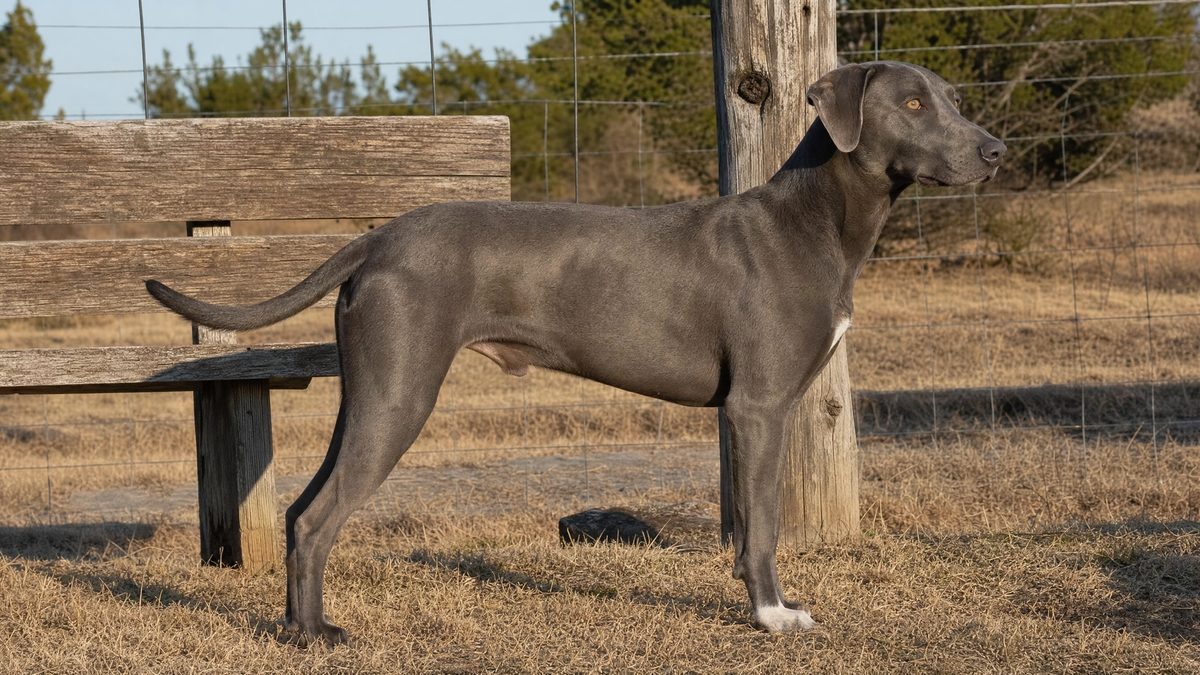
A Blue Lacy is a medium-sized short-coated working dog developed on ranches in Burnet County, Texas, from the 1850s, and it is not recognised as a breed by any major kennel club anywhere in the world.
The dog is named after four brothers, not after its colour. Texas House Concurrent Resolution No. 108 records that Lacys are "named for brothers George, Ewin, Frank, and Harry Lacy, who moved to Texas from Kentucky in 1858 and settled in the area of Burnet County";. The National Kennel Club's page puts the arrival more precisely, "by covered wagon in 1858 to the granite hills near Marble Falls, Texas from Christian Count, Kentucky";. Marble Falls sits in Burnet County, and that one location is the anchor for everything on this page about heat, because it is the origin climate you have to compare an Indian city against.
The founding stock is a story, not a record. Every source that describes the breed's ancestry hedges it. The Texas resolution says the family "is said to have used greyhound, scenthound, and coyote stock";. The National Kennel Club repeats the same three ingredients and then adds, honestly, that "Many people have their theory on the scent hound used. Some believe it was a Red Bone Hound, or Italian Gray Hound, others believe it was a July Hound";. No pedigree, no photograph and no document from the 1850s supports the coyote. A working dog bred to be useful on a ranch is exactly the kind of animal whose origins are recorded in family memory rather than a studbook, and this breed history has never been anything else.
Even the date and the purpose are not agreed. The Texas resolution and the National Kennel Club both put the founding in 1858 and describe a dog bred to work cattle, hogs and chickens, with the National Kennel Club filing the breed under Group: Herding National Kennel Club, Blue Lacy breed page. The National Lacy Dog Association's own front page says something different: "Developed in the late 19th century to work hogs in the Texas Hill Country, the Lacy Dog excels at hunting, herding, tracking, treeing and more";. Its breed standard is blunter still, opening its Characteristics section with "Originally created to be hog dogs";. Wikipedia splits the difference at the mid-19th century. Forty years of founding date and two different founding jobs separate the sources, and nothing settles it.
Size, and why four sources give four answers
The published height range depends entirely on which body you ask, and the spread is not small. The Texas legislature described a dog that "stands from 18 to 25 inches tall when full-grown and weighs approximately 30 to 50 pounds";. The National Kennel Club prints 18 to 25 inches and 25 to 50 pounds. The Lacy Game Dog Registry's standard, revised effective 1 January 2012, gives 18 to 23 inches for both sexes at roughly 30 to 55 lb, and disqualifies any dog "Under 18 inches or over 23 inches in height at the withers". The National Lacy Dog Association's standard gives 17 to 22 inches, with 30 to 45 lb for females and 35 to 50 lb for males, and disqualifies "Dogs measuring under 17 inches or over 22 inches at the withers".
| Source | Height | Weight | Height disqualification |
|---|---|---|---|
| Texas HCR 108 (2005) | 18 to 25 in | approx. 30 to 50 lb | None stated |
| National Kennel Club | 18 to 25 in (46 to 64 cm) | 25 to 50 lb (11 to 23 kg) | None stated |
| Lacy Game Dog Registry (2012) | 18 to 23 in, both sexes | approx. 30 to 55 lb | Under 18 in or over 23 in |
| National Lacy Dog Association | 17 to 22 in | F 30 to 45 lb, M 35 to 50 lb | Under 17 in or over 22 in |
Read that table one column at a time and it stops being a rounding difference. A 24-inch male matches the description the Texas legislature enacted and is disqualified by both breed standards. A 17.5-inch female is correct under the National Lacy Dog Association and disqualified by the Lacy Game Dog Registry. A 23-inch dog is correct under one standard and disqualified under the other. There is no height at which a Blue Lacy satisfies the state resolution and both registries at once above 22 inches, and no height below 18 inches at which it satisfies the Lacy Game Dog Registry at all.
You cannot predict how big this dog will finish. Published adult weights run from 25 lb to 55 lb, which is 11 kg to 25 kg, and the top of that range is more than double the bottom. If you are choosing a dog to fit a flat, a size range that wide is not a specification. Plan for the top of it.
No major kennel club recognises this breed, and here is the proof
No kennel club recognition exists for the Blue Lacy at the FCI, the American Kennel Club, the United Kennel Club or the Royal Kennel Club, and each of those four lists was opened and read in full rather than searched from a distance.
An absence is a strong claim, so each one below is paired with a control taken off the same document in the same session. If the control is missing, the search was broken and the absence proves nothing. Every control here was present.
The FCI holds no Lacy standard
The Federation Cynologique Internationale's nomenclature under L lists eight breeds: Labrador Retriever, Lagotto Romagnolo, Lakeland Terrier, Lancashire Heeler, Landseer, Lapinporokoira, Leonberger and Lhasa Apso. There is no Lacy. Because the breed is also written as Blue Lacy, the B list was checked as well. It carries 42 breeds from Barbet to Bullmastiff, including the Black and Tan Coonhound, and no Blue Lacy. The Coonhound is the control that matters: it proves the FCI does register American breeds, so the gap is about this dog and not about its country.
The AKC has no record of it, not even in Foundation Stock Service
The American Kennel Club's Foundation Stock Service is the programme for rare breeds that are not yet eligible for full registration, and its page carries the AKC's complete breed-name selector. Reading that selector end to end, from Affenpinscher to Yorkshire Terrier, produces no Lacy and no Blue Lacy. The controls are unambiguous. The selector does contain the Mountain Cur, the American Leopard Hound, the Catahoula Leopard Dog, the Carolina Dog, the Plott Hound, the Treeing Tennessee Brindle, the Teddy Roosevelt Terrier, the Rat Terrier, the Working Kelpie, the Taiwan Dog and the Calupoh. The AKC therefore records American landrace cur breeds and obscure foreign ones. It simply has no file on this one.
The UKC recognises twelve cur and feist breeds, and not this one
The United Kennel Club states that it "currently recognizes over 300 separate breeds", and its Breed Standards page enumerates all of them by group. The Scenthound group alone contains the Black Mouth Cur, the Mountain Cur, the Treeing Cur, Stephens' Cur, the American Leopard Hound, the Plott Hound and the Treeing Tennessee Brindle. The Terrier group contains the American Feist, the Mountain Feist and the Treeing Feist. The Herding group contains the Louisiana Catahoula Leopard Dog and the English Shepherd. Twelve American working landraces of exactly this type hold a UKC standard. The Blue Lacy appears nowhere in the nine group lists.
The Royal Kennel Club lists 227 breeds and none is a Lacy
The Royal Kennel Club's Breeds A to Z, read in full, resolves to 227 distinct breed pages across its seven groups, gundog, hound, pastoral, terrier, toy, utility and working. Zero contain the string Lacy. Under L the list runs Lagotto Romagnolo, Lakeland Terrier, Lancashire Heeler, Large Munsterlander, Leonberger, Lhasa Apso and Lowchen. The controls, Labrador Retriever and Bloodhound, are both present, and the list includes imported-register breeds flagged with an (imp) suffix, so it is not restricted to long-established British stock.
Four registries, four complete lists read directly, four controls passed, four absences. Wikipedia's own infobox states the position plainly under Breed status: "Not recognized as a breed by any major kennel club." On this point the internet and the primary documents agree.
What Texas actually passed, and what it did not
Texas designated the Blue Lacy as the official State Dog Breed by concurrent resolution, House Concurrent Resolution No. 108 of the 79th Legislature, adopted by the House on 13 May 2005 and by the Senate on 25 May 2005, and signed by Governor Rick Perry on 18 June 2005.
The operative sentence is one line long. The enrolled text reads: "RESOLVED, That the 79th Legislature of the State of Texas hereby designate the Blue Lacy as the official State Dog Breed of Texas";. The certifications beneath it are equally specific. "I certify that H.C.R. No. 108 was adopted by the House on May 13, 2005, by a non-record vote", and "I certify that H.C.R. No. 108 was adopted by the Senate on May 25, 2005, by a viva-voce vote";. The authors are recorded as Castro and Strama. A non-record vote means no member's individual vote was written down, and a viva-voce vote is a voice vote.
This was not the first time. Four years earlier, Texas Senate Resolution No. 436 of the 77th Legislature, adopted on 8 March 2001 and authored by Todd Staples, resolved "That the Senate of the State of Texas, 77th Legislature, hereby honor the Blue Lacy dog breed as a true Texas breed". The two resolutions do not say the same thing about the breed's status. The 2001 Senate text calls it "Believed to be the first dog breed to have originated in this state". The 2005 text, four years later, upgrades that hedge into a flat assertion, "the only dog breed to have originated in this state";. Nothing was discovered in between to justify the upgrade, and the Silken Windhound was already being developed in Texas at the time.
It is not in the statute book
A concurrent resolution is not a statute, and this one was never codified. Texas Government Code Chapter 3101, State Symbols, is the chapter where Texas keeps its official symbols, and it runs from Section 3101.001 to Section 3101.013. Read straight through, it contains the state seal, the state arms, the rules on using the seal, the state motto, the state song and how to behave during it, the state bird (the mockingbird), the state flower (the bluebonnet), the state tree (the pecan tree), an offence for thrashing pecans, the four official state plays, the Tejano Music Hall of Fame, and the state botanical garden. There is no state dog breed anywhere in it.
That is a real distinction and not a technicality. The mockingbird, the bluebonnet and the pecan sit in the Government Code with an enacting citation attached, "Added by Acts 2001, 77th Leg., ch. 1420, Sec. 7.001, eff. Sept. 1, 2001". The Blue Lacy has no such line, because a concurrent resolution expresses the will of both chambers without amending the codes. The dog is the official state dog breed in the sense that the legislature said so and nobody has said otherwise. It is not the official state dog breed in the sense that the pecan is the state tree.
These two things get conflated on almost every page that ranks for this breed, and they are unrelated. A legislature honours something that already exists in the culture of its state; a kennel club opens a studbook, publishes a written standard, appoints judges and records ancestry. Texas did the first. Nobody has done the second at any major registry. The state resolution carries no studbook, no registration authority, no health scheme and no breed standard that a court or a registry would enforce. Treat it as heritage recognition, which is exactly what it says it is.
There is one further thing the resolution does that no kennel club would. It names the registries. HCR 108 states that "Lacys are recognized and registered through the National Kennel Club, Continental Kennel Club, Universal Kennel International, Lacy Game Dog Registry, Texas Lacy Game Dog Association, and American Pet Registry, Inc.";. Six bodies, listed by a legislature, in 2005. What that list actually means is the subject of the next section, and it is less reassuring than it looks.
Four Lacy bodies define this breed, and they contradict each other
Four organisations currently claim authority over the Blue Lacy, and their published standards disagree on eye colour, eye shape, ear type, height, weight and whether the breed has any health problems at all.
The four are the Lacy Game Dog Registry (LGDR), the Texas Lacy Game Dog Association (TLGDA), the National Lacy Dog Association (NLDA) and the National Lacy Dog Registry (NLDR). The first two work together. The second two do not work with the first two, and the fourth explicitly distances itself from the third. This is a landrace with competing registries, and reporting the disagreement is more useful than pretending one of them wins.
The closed book and the open one
The Lacy Game Dog Registry describes itself as "the 'Official Single Breed Registry' for the 'Blue Lacy Breed'" and "the 'Original' and Official Closed stud file registry for the Breed";. It explains what that means: "A closed stud book is a stud book or breed registry that does not accept outside blood. The registered animals and all subsequent offspring trace back to the foundation stock." It works "in alliance with the Texas Lacy Game Dog Association", and states that "the TLGDA is the only Blue Lacy association the LGDR recognizes and supports";. It also warns buyers directly: "Be aware of certificates stating, 'To the best of our knowledge', or 'member in good standing' of said registry."
The National Lacy Dog Registry is the opposite model, and says so. Its home page runs the banner "No Club Memberships Required & None Rejected" and "All Credible Bloodlines Accepted Based on Standards", and it states that it "operates independently from all clubs, including the National Lacy Dog Association (NLDA)";. It describes the field candidly: "The Lacy world is fragmented into groups of individuals with varying objectives. This creates pockets of genetics that meet the objectives of each group." It adds that it "will support any individuals who have been forcibly exited or socially isolated from breeder groups";. Founded in 2008 and constituted as a 501(c)(3) non-profit, it charges 20 dollars for a traditional four-generation pedigree and registration and 40 dollars for a premium one, with litter registration at 30 or 60 dollars, and it awards video-verified working endorsements including Proven Cowdog, Proven Hogdog, Proven Treedog, Proven Tracking Dog and Proven Trap Dog.
The National Lacy Dog Registry also records the pre-history the other bodies do not. It names the Animal Research Foundation as "The first registry to recognize and register Lacys", notes that the ARF "is now closed as the owner has passed", and states that it holds the records of the first three Lacys ever registered: PRESTON'S BIG BLUE (LDR1), his sire PRESTON'S OLD BLUE (LDR0) and his dam PRESTON'S ELLIE (LDR00). A closed studbook that traces to foundation stock and an open registry that holds the foundation stock's records are two different answers to the same question about who defines the breed.
Where the two written standards actually contradict each other
Put the LGDR and NLDA standards side by side and the disagreements are specific enough to fail a dog in a ring.
| Point | Lacy Game Dog Registry | National Lacy Dog Association |
|---|---|---|
| Eye colour | "orange to yellow"; a brownish eye is a fault | "Colors range from bright yellow to rich brown" |
| Eye shape | Almond, slightly oblique; "A round eye is considered a fault" | "Should be round and set well apart" |
| Height | 18 to 23 in; DQ under 18 or over 23 | 17 to 22 in; DQ under 17 or over 22 |
| Ears | 4 to 5 in, triangular; pricked or heavily leathered a severe fault | Drop and rose acceptable; pricked and hound ears a disqualifying fault |
| Undercoat | Not mentioned | "Very little or no undercoat" |
| Melanistic mask | Not mentioned | "acceptable but less desirable" |
| Alopecia | A disqualification | Not mentioned |
| Cryptorchidism | Not mentioned | A disqualification |
| White marking limit | None above the second joint of the legs, chin, head or body | May stretch chin to groin; DQ on face or above mid-line |
The eye rows are the sharpest. A round, rich-brown eye is a fault twice over under the Lacy Game Dog Registry standard and is explicitly correct under the National Lacy Dog Association standard National Lacy Dog Association. Nothing resolves that. It is not a difference of emphasis; it is two organisations describing two different dogs and calling both of them the breed the state of Texas named.
What the blue in Blue Lacy actually is
The blue is a dilute coat colour, produced by the recessive dilution allele at the D locus in the melanophilin gene, and a dog can be red or tricolour and still be called a Blue Lacy because the breed's own bodies define the name by the dilute gene rather than by the coat you see.
Start with what the sources claim, because it is unusually explicit for a landrace. The Texas resolution states that "all Lacys carry a rare blue-color gene, even though they are divided into three color classifications: blue, red, and tri-color";. The National Kennel Club puts it the same way: "Both the red and tri-colored Lacy's hold the name Blue Lacy due to the blue-color gene they possess", and adds that "The origin of the unusual slate blue coat and nose is a genetic rarity";. The Lacy Game Dog Registry reproduces that sentence nearly verbatim in its own standard.
The three coat colour classifications
All four sources agree on the three colours, and the descriptions are consistent enough to use. Blue is "any shade of gray from light silver to dark charcoal", or in the older wording "light gun-metal gray to almost black". Red "range[s] from light cream to rust". Tricolour is a blue base with red points "over their eyes, on the sides of the muzzle extending to the cheeks, front of the chest, on the lower legs and underneath the tail"; Lacy Game Dog Registry. White is permitted on the brisket and paws and is otherwise limited, though the two standards draw the limit in different places. Eyes are yellow to amber or orange, which is itself a dilute-pigment feature.
What the genetics actually say, and what nobody has done
Canine coat dilution has a known molecular cause and it is not in dispute. A peer-reviewed 2021 study states it directly: "In dogs, color dilution occurs as a result of a single-nucleotide variation (SNV) c.-22G > A in the melanophilin gene";. A dog carrying two copies of that variant, written d/d, has its black pigment diluted to grey and its liver pigment to a pale fawn, and its nose leather, eye rims and lips go slate rather than black. That is exactly the "slate blue coat and nose" the National Kennel Club describes.
The National Lacy Dog Association's own writing on the subject uses the correct genetic shorthand. Its 2009 article states that the condition it is discussing "is related to the double dilute gene, dd, that causes the blue coloration in Lacys", and that "All Lacys carry the dilution gene. The blues and tris express it more intensely";. The mechanism it names is right. What is missing is any study that genotyped a Lacy.
No peer-reviewed paper has ever reported the D locus genotype of a Blue Lacy, a population allele frequency for the breed, or a genetic study of the breed at all. The Brazilian PCR-RFLP study that established a practical test for the c.-22G>A variant reported mutated allele frequencies of 0.1 in Dachshunds, 0.1 in Miniature Pinschers and 0.0875 in Yorkshire Terriers, with no statistical difference between them at p = 0.252. Not one Lacy was in it. So the sentence "all Lacys carry the dilute gene" is a claim made by a legislature and by breed clubs. It has never been tested and published.
Why a red Lacy is a genetics question, not a paint question
A d/d dog with a red coat looks red because dilution acts strongly on black pigment and weakly on the red-yellow pigment. The giveaway is not the coat, it is the trim. Look at the nose leather, the eye rims and the lips. On a genuinely dilute red dog they are slate or liver-grey rather than solid black, and the eye is amber rather than dark. That is why both standards care about pigment: the Lacy Game Dog Registry requires that "The nose leather should be completely pigmented", and both standards specify a yellow-to-amber eye National Lacy Dog Association. If you are ever offered a red Lacy in India, the nose and the eye rims are the two things worth looking at, because they are the only visible evidence for the claim the name is built on.
Colour dilution alopecia, and how much of it is really about this breed
Colour dilution alopecia is documented in this breed only through a single 2009 breed-club blog post whose own supporting links are about Italian Greyhounds and Dobermanns, so treat the specific claims as transferred from other dilute breeds and not as breed-specific evidence.
This deserves careful handling, because the claim is repeated everywhere and its whole weight rests on one page. Wikipedia's health section says: "Color dilution alopecia is very rare but has occurred in Lacys", and it cites exactly one reference for that sentence. That reference is a post on the National Lacy Dog Association's WordPress blog, dated 4 February 2009. Dogbreedslist.info, which ranks in India for this query, reproduces Wikipedia's health paragraph nearly word for word, including the same sentence. Follow the chain back and three pages become one page.
What the single source actually says, and what it rests on
The 2009 post is not worthless. It is plainly written by someone who owns these dogs, and its clinical description matches the textbook picture: onset "as early as six months or as late as three years", starting "on the flanks or along the back", stiff guard hairs remaining over dry skin, and susceptibility to "sunburn, windburn and scaly skin" plus secondary bacterial skin disease because "the hair follicles are damaged";. It correctly names the double dilute genotype. It gives sensible breeding advice, that "Effected dogs, their parents and their siblings should never be used for breeding".
Three things about it have to be said out loud. First, its own further reading consists of three links, and all three are about other animals: a personal website, the University of Prince Edward Island's general canine inherited-disorders entry, and the Italian Greyhound club's colour dilution alopecia page. Not one is about a Lacy. Second, its comparative claim is explicitly borrowed: "It has been noted in other breeds, especially Dobermans, that lines heavily favoring blue dogs are more likely to have problems with alopecia." Third, it contains a clear clinical error. It advises the reader to check for thyroid disease first and names the wrong one: "Hyperthyroidism can cause hair loss and is a serious but treatable condition";. The endocrine cause of symmetrical hair loss in dogs is hypothyroidism. Canine hyperthyroidism is rare and is usually a consequence of thyroid carcinoma. A source that names the wrong disease in the one sentence a reader is most likely to act on has to be labelled, not repeated.
Every quantitative and comparative statement about colour dilution alopecia in the Blue Lacy on the open internet traces to breeds that are not the Blue Lacy, principally the Dobermann. Bonbeno therefore publishes no prevalence figure, no age-of-onset range and no risk ratio for this breed. The mechanism is real and established in dogs generally. Its frequency in Lacys is unmeasured.
One thing here is genuinely breed-specific, and it is a registry rule
The Lacy Game Dog Registry's standard is the exception, and it is the strongest breed-specific evidence that exists. Under COAT it describes the problem in this breed's own words: "Dogs with alopecia will exhibit a dull, rough coat which is sparse and balding, and the skin can be seen readily under the coat. Generally on the tail, ears and across the spine is the most prominent area for alopecia";. It then disqualifies it outright: "Disqualifications: Overall long coat, with flagging on tail and hocks. Dogs with Alopecia or Demodectic Mange." It adds a standing obligation: "Any diagnosed genetic disorder is a disqualifying fault... Diagnosed genetic disorders must be reported to the LGDR when discovered";.
So the breed's own closed-studbook registry writes alopecia into its standard, describes its distribution on the tail, ears and spine, and bars affected dogs from the ring. It never uses the words colour dilution alopecia. That is careful of it, and this page follows the same line: alopecia is documented in the Blue Lacy by the registry that judges it; the attribution of that alopecia to the dilute gene is a reasonable inference from the genetics and from other breeds, and it is an inference.
The National Kennel Club, meanwhile, prints under Health Problems: "None reported at this time. No hip problems and etc...";. One registry disqualifies a skin condition by name and mandates reporting of genetic disorders. Another says nothing is wrong with the breed. Both are describing the same dog.
Blue Lacy price in India, checked page by page
No blue lacy price in india can be verified from any source, because no Indian seller lists the breed at all and every rupee figure the search engines return for the query is the price of lace fabric, a book, a saree or a wall sign.
That is the first line of this section rather than the last, because it is the answer. What follows is how it was established, so you can check it yourself.
What Google actually returns in India
The Google results page for the target term with gl=in, captured on 23 August 2026 at HTTP 200, reports "About 27,40,000 results" and then classifies the query as a shopping query for lace trimming. Google's own refinement facets for it are Colour (White, Navy Blue, Beige, Purple, Brown), Price (Under Rs 100, Rs 100 to Rs 250, Rs 250 to Rs 500, Over Rs 500), Shops (amazon.in, Meesho, Flipkart, Suresh Fashion Hub India) and Brand (Aadvi Boutique, Royal Blue Apparel, Muteyaar, Devino). The products it surfaces are "4.5 Meter Royal Blue Embroidery Sequin Work Lace" at Rs 155, "Navy Blue Crochet Lace" at Rs 190, "Colour Mirror Lace 9 Meter" at Rs 92, "Embroidered Lace 9 Meters Roll" at Rs 1,400, "Navy Blue Mirror Work Lace" at Rs 95, "Blue Banarasi Silk Border Lace" at Rs 499, "Royal Blue cotton Lace" at Rs 153, "Lace per metre" at Rs 5 and two sets of shoelaces at Rs 89 and Rs 133.
Every rupee figure on the first page of Google India for "blue lacy price in india" is a length of lace between Rs 5 and Rs 1,400. Not one of them is a dog.
The organic ten, and what each one is really selling
| Position | Site | What it actually offers | Rupee figure |
|---|---|---|---|
| 1 | amazon.in | A Blue Lacy owner's manual paperback | Rs 1,781 |
| 2 | justdial.com | Auto-generated pet-shop category page for Jabalpur | None printed |
| 3 | gooddog.com | US breeder marketplace, four breeders | None, quotes USD |
| 4 | youtube.com | A 3:27 breed-profile video, 830-plus views | None |
| 5 | etsy.com | A custom Blue Lacy wall sign | Rs 2,162 |
| 6 | dogbreedslist.info | US breed encyclopedia entry | None, quotes USD |
| 7 | pinterest.com | A pin from eight years ago | None |
| 8 | reddit.com | An r/dogs discussion thread | None |
| 9 | suta.in | A saree named 'Blue Lacy Roads' | Rs 5,695 |
| 10 | amazon.in | A second owner's guide paperback | Rs 1,761 |
Bing, queried with cc=IN the same day, is worse. It reports "About 22,300 results" and its top nine are two Amazon listings for a dog food whose flavour variant is literally named "Blue Lacy", Flipkart lace panties, Flipkart lace bras, Myntra women's briefs, Clovia blue bras, Da Intimo lingerie, a Johnnie Walker Blue Label price guide and an Antiquity Blue whisky price guide. Bing flags five of them itself with "Missing: blue lacy / Must include: blue lacy";.
The Indian listing sites that carry every other breed do not carry this one
Four Indian puppy-listing sites dominate rupee price queries for imported breeds. A site-restricted search across petbuy.in, mrnmrspet.com, breednbreeder.com and wrapinfur.com for this breed returned nothing. That is a zero, so it needed a control before it could be reported. The control was run in the same tool in the same session: a site-restricted search of petbuy.in for the Labrador Retriever returned five pages immediately, including a state page printing a live table, "Labrador Rs 8,000 to Rs 30,000, German Shepherd Rs 12,000 to Rs 40,000, Golden Retriever Rs 15,000 to Rs 45,000, Beagle Rs 10,000 to Rs 45,000";. The search works and those sites publish rupee bands freely. They simply have no Blue Lacy page to publish.
Justdial's "Pet Shops For Blue Lacy Dog in Jabalpur" carries the category id nct-13821812, and the identical id serves Sagar and Patna. The ten businesses it lists are ordinary Jabalpur pet shops plus a veterinary hospital, and their own Listed Categories are Pet Shops, Pet Shops For Dog, Pet Shops For Birds, Dog Kennel Dealers and Pet Shops For German Shepherd Dog. Not one is filed under any Blue Lacy category. The page's own meta description names Labrador and German Shepherd rather than the breed in the title. No puppy is offered and no price appears. The body copy is generated filler with the city name slotted in, visible in the stray space in the phrase "pet owners in Jabalpur ,".
So the honest answer to the question this page is named after is that there is no Indian puppy price for a Blue Lacy, because there is no Indian market. The next section deals with the one rupee figure that does get quoted, which is Google's own.
Running the currency test on the only rupee figure anyone quotes
Google's AI Overview is the only place in the Indian results that prints a rupee band for this dog, and dividing that band out shows it is a rounded conversion of an American blog's dollar figure at roughly 82.5 to 83.3 rupees per dollar, not an Indian market price.
Here is the figure, quoted exactly as Google's AI Overview printed it for the target query with gl=in on 23 August 2026: "The Blue Lacy is a rare working dog breed originating from Texas and is essentially unavailable in India. There are no established local breeders or standard market prices in Indian rupees. Importing one from international breeders typically costs between $400 and $600 USD (approximately Rs 33,000 to Rs 50,000 INR), excluding high international shipping and permit charges".
The prose is correct and the numbers are borrowed. Do the arithmetic in both directions.
| Rupee figure | Implied rate to reach the stated USD | Divided by 84.38 | Divided by 74 |
|---|---|---|---|
| Rs 33,000 | 82.50 per USD 400 | USD 391.09 | USD 445.95 |
| Rs 50,000 | 83.33 per USD 600 | USD 592.56 | USD 675.68 |
Neither of this site's two standing test rates fits cleanly. Rs 33,000 divided by 84.38 gives 391.09 dollars and by 74 gives 445.95 dollars, and neither is a round number a blog would print. The rate that does fit is the one Google used itself: 33,000 divided by 400 is 82.50, and 50,000 divided by 600 is 83.33. Those two rates bracket the real USD-INR rate over the period, and the small gap between them is simply rounding to the nearest thousand rupees. The band is a conversion.
Of what? The dollar figure it converts is on the page sitting at position 6 in the same results set. Dogbreedslist.info prints "Average $400 - $600 USD" and the sentence "Texas is the best place to find one of these dogs if you have been looking. A Blue Lacy puppy can range from $400 to $600";. Google took that band and multiplied it. Note also that a second American source in the same results set, the marketplace Good Dog, gives a different band: "Nationally, prices usually range from $500 to $600";. Google chose one of the two and did not mention the other.
The AI Overview attributes its Blue Lacy availability and cost information to a Facebook post by an account named Vikas Yadav, dated 9 December 2025, tagged #reelkarofeelkaro #trendingreels #reelindia, whose visible snippet reads "... ridge hunter knife blue steel hunting knife blue star hunting kit blue hunter kktc blue hunting light blue hunting lamps blue ...";. That is keyword-stuffed hunting-knife spam. Whatever the AI Overview's rupee band is, it is not sourced from anyone who has sold a Blue Lacy in India.
The figure that must never be attached to this breed
Bonbeno has repeatedly caught Rs 98,999 on Indian listing pages, attached to whichever puppy is in stock and printed on pages for breeds the site does not stock at all. It is a house charm price and not a breed price. It does not divide cleanly by any exchange rate, resolving to 1,173.25 dollars at 84.38, so it is rupee-native. If you see Rs 98,999 beside a Blue Lacy, you are looking at a carousel, not at a dog. The same applies to the neighbouring figures that travel with it, Rs 92,599, Rs 94,999, Rs 76,499 and Rs 1,20,000.
What a real Indian dog price list looks like, and why this breed is not on it
For scale, the Indian retail reference that Google itself surfaces for dog-price queries reports that dog prices in India in 2026 run from about Rs 2,000 for an indie or native breed to over Rs 1,50,000 for a KCI-registered show-quality dog. Petbuy's live state tables put Labrador puppies at Rs 8,000 to Rs 30,000 and Golden Retrievers at Rs 15,000 to Rs 45,000. Those are prices that exist because a supply chain exists. The Blue Lacy has no entry on any of them, and the next section explains why one cannot lawfully form.
Why no lawful Blue Lacy supply chain can form in India
Two independent facts close the route: Indian import policy classes dogs as Restricted and rejects any application made for breeding or trading, and the absence of an FCI standard means the Kennel Club of India has no pedigree to issue.
Take the import rule first, from the document itself rather than a summary of it. Directorate General of Foreign Trade Trade Notice No. 22/2022-23, dated 19 December 2022, sets out the policy for ITC (HS) 01061900, "Mammals: Other". The Import Policy column reads "Restricted";.
Policy Condition (7) states that "Import of dogs is allowed only for the following specific purposes: i. Pet dog with valid pet book and relevant records/documents in the name of importer. ii. Dogs imported by the R&D Organisations for conducting research with the recommendation of CPCSEA. iii. For the internal security by the Defence and Police Force";. Policy Condition (8) states that "Import of commercial dogs for breeding or any other commercial activities other than the purposes mentioned above is not permitted." Paragraph 6 of the notice is blunter still: "any applications for trading/breeding purposes, or applications made on behalf of some another person/ entity shall be duly rejected";.
Three practical limits follow from the same document. Permanent import as passenger baggage without a DGFT authorisation is available only to "persons transferring their residence to India after two years of continuous stay abroad", and only for up to two animals. Import is permitted only through the airports and seaports of Delhi, Mumbai, Chennai, Hyderabad, Bengaluru and Kolkata and, since October 2024, Kochi airport, seven entry points for the whole country. An Advance No Objection Certificate must be obtained from the Animal Quarantine and Certification Service officer at that port seven days before travel, relaxable to three, and the notice advises applicants to start the process "at least 2 months in advance of the travel dates". The full route is set out in how to import a dog to India.
A Blue Lacy can lawfully enter India in essentially one situation: you already own the dog, you have a valid pet book in your own name, and you are moving to India after two years abroad. You cannot import one to breed from. You cannot import one on behalf of a friend. A breeder cannot import foundation stock. Because breeding stock cannot enter, no Indian population can be established, which is the structural reason there is no Indian price rather than merely a low one.
No FCI standard means no KCI pedigree route
The Kennel Club of India is India's FCI member body, and an FCI member registers dogs of FCI-recognised breeds against FCI-published standards. The FCI publishes no Lacy standard, as the L and B nomenclature lists both show Federation Cynologique Internationale. With no standard there is no breed number, no group allocation and no basis on which a KCI pedigree could be issued. A dog imported under the pet-book route would live in India as a companion animal with no Indian registration paper of any kind.
That has a specific consequence for anyone who cares about paperwork. The registration certificates that do exist for this breed are issued by American bodies. The Lacy Game Dog Registry issues pedigrees with an embossed seal, signed by the registrar under the wording "The Lacy Game Dog Registry hereby certifies that the foregoing is a true copy of the ancestral pedigree of ....", covering three generations within its own stud files. The National Lacy Dog Registry issues four-generation pedigrees for 20 or 40 dollars. Neither is recognised by the KCI, and neither confers anything in India beyond a document.
A marketplace is already selling a registration that does not exist
This is worth verifying before you send anybody money. The American marketplace Good Dog operates a filter page at gooddog.com/blue-lacy/akc-registered, titled "25 cute AKC Registered Blue Lacy puppies for sale", with a section headed "About the AKC Registered Blue Lacy";. The American Kennel Club has no record of this breed in any programme, including Foundation Stock Service, as its own complete breed selector shows. Opening the filtered page returns the identical four breeders as the unfiltered one, with identical descriptions, and the only registration actually named anywhere on either page is a breeder in Alabama stating "We have a litter of Texas Blue Lacy Puppies that are registered with the TLGDA"; Good Dog, AKC Registered Blue Lacy puppies…. The filter is a search-engine facet, not a fact about any dog.
The unfiltered page has a second, smaller inconsistency worth noticing for the same reason: its title tag says "25 cute Blue Lacy puppies for sale" while the H1 on the page says "40+ Blue Lacy puppies for sale from ethical breeders", against four listed breeders, one of whom shows only future litters due in September and December 2026. Counts on marketplace pages are not inventory.
The real cost of ownership for this dog in India
Budget between Rs 6,500 and Rs 12,000 a month for a healthy 20 kg Blue Lacy in an Indian metro, and treat the acquisition cost as unknowable rather than low, because the only lawful route into the country is relocation with a dog you already own.
The monthly figure is built from the same components as any 18 to 25 kg working dog in India, and none of them is breed-specific. What is breed-specific is the shape of the bill: this dog is cheap to groom, expensive to exercise properly in a hot city, and carries an unquantifiable veterinary tail because no health register holds a single record for it.
| Line item | Monthly range | Note |
|---|---|---|
| Food, quality dry plus fresh | Rs 3,000 to Rs 6,000 | Scaled to a lean, hard-working 18 to 25 kg dog |
| Routine preventives | Rs 700 to Rs 1,500 | Monthly tick and flea control is not optional in India |
| Deworming | Rs 100 to Rs 250 | Quarterly, amortised monthly |
| Vaccination and annual check | Rs 400 to Rs 700 | Annual cost spread across twelve months |
| Grooming | Rs 0 to Rs 300 | A brush and shampoo. No professional groom is required |
| Enrichment and equipment | Rs 500 to Rs 1,200 | Long line, harness, chews, replacement toys |
| Contingency for veterinary care | Rs 1,500 to Rs 2,500 | Set aside rather than spent, see below |
Add those and the band lands between roughly Rs 6,200 and Rs 12,450, which is why Rs 6,500 to Rs 12,000 is the number to plan around. Grooming is the one line where this breed genuinely saves you money against a double-coated import.
Three costs that are specific to this breed rather than to dogs generally
- Relocation, not purchase. The lawful route is a pet book in your own name after two years abroad, so the real acquisition cost is an international pet-relocation bill: crate, health certificate, testing in the exporting country, airline live-animal cargo, and quarantine at one of the seven permitted ports. That is a five-figure rupee cost at minimum and it is entirely outside anything a puppy price would tell you.
- A veterinary contingency you cannot size. For most imported breeds you can look up a screening scheme and price the likely problems. For this one there is no screening scheme, no register and no literature, so the contingency line above is a guess dressed as a budget. Hold it rather than assume you will not need it.
- Exercise infrastructure. Two hours a day of real work for a driven dog in a hot city usually means paying for something: a safely fenced space, a long line and a person's time at 5:30 in the morning, or a walker who will actually run the dog rather than stroll it.
There is no coat trim, no de-shedding package and no professional grooming schedule in this dog's life. The Lacy Game Dog Registry describes the coat as "Smooth, tight, sleek and exceptionally clean in appearance", and the National Kennel Club summarises grooming in four words: "Short hair. Low maintenance"; National Kennel Club, Blue Lacy breed page. Against a Golden Retriever or a Siberian Husky in Chennai that is a genuine saving of a few thousand rupees a month.
Heat tolerance, argued from the coat and the origin
Rate the Blue Lacy 4 out of 5 for heat tolerance, which is high for an imported breed and stops short of 5 because the origin gives this dog a four-month cool season that no Indian plains city offers and a summer that is drier than an Indian one.
This rating is built rather than borrowed, so here is the mechanism piece by piece.
What helps: the coat, the skull and the frame
The coat is the strongest single argument. The National Lacy Dog Association's standard specifies a coat that is "short, smooth, and tight with course guard hairs" and, critically, "Very little or no undercoat", with an excessively long or rough coat a disqualifying fault. The Lacy Game Dog Registry describes it as "Smooth, tight, sleek and exceptionally clean in appearance. It is neither wooly, long or rough";. A single short coat with no insulating undercoat is the best coat configuration an imported breed can bring to India, because the undercoat is what traps a layer of warm air against the skin and defeats convective cooling.
The skull helps too. Both standards describe a muzzle of equal length to the skull or only slightly shorter, moderately tapered, "not dished, disproportionately short, or overly houndish or bully in appearance";. That is a mesocephalic head, and it matters more than almost anything else on this page. In a study of 905,543 dogs under primary veterinary care in the United Kingdom in 2016, brachycephalic dogs had greater odds of all three types of heat-related illness than mesocephalic dogs. A normal-length muzzle means a normal panting apparatus.
The frame is the third factor. At 30 to 55 lb, roughly 14 to 25 kg, this is a light dog for its height, described by both standards as "lightly built but proportionally balanced" and "medium in size and bone"; Lacy Game Dog Registry. Surface area to mass favours a lean 20 kg dog over a 40 kg one, and body weight was one of the risk factors associated with severe disease in dogs affected by heat-related illness.
What hurts: the drive, and one number from the UK data
The single largest risk factor for this particular dog is not its coat, it is its temperament. Exertional heat-related illness was the predominant trigger in the UK dataset, accounting for 74.2 percent of the 879 events with a recorded trigger, against 12.9 percent environmental and 5.2 percent from vehicular confinement. This is a breed the National Lacy Dog Association describes as displaying "incredible drive and determination to work" and which "require a job for proper physical and mental stimulation";. A dog that will not stop is a dog that runs itself into the category that causes three quarters of the cases.
The context figure is the one that should change your behaviour. In the follow-up VetCompass study, the median ambient temperature on days when a heat-related illness event occurred was 16.9 degrees C. British dogs were being hospitalised at an ambient temperature that is cooler than the annual mean of every Indian city checked in the next section, and cooler than Chennai's coldest month by more than seven degrees. Do not read a Texan origin as a licence to exercise this dog at noon.
A dog whose coat thins has less protection from direct sun, and the breed's own registry describes affected dogs as showing "a dull, rough coat which is sparse and balding, and the skin can be seen readily under the coat" on the tail, ears and spine. The 2009 club article adds that such dogs are "susceptible to sunburn, windburn and scaly skin";. Under Indian sun that is a dermatological problem before it is a cosmetic one. If a blue or tricolour Lacy starts thinning along the spine, keep it out of midday sun entirely and see a veterinarian rather than reaching for a supplement.
Marble Falls against nine Indian cities, on one dataset
The Blue Lacy's origin at Marble Falls, Texas, runs an annual mean of 19.77 degrees C with 66.97 percent relative humidity, against 27.95 degrees C and 72.39 percent in Chennai, so the origin summer is genuinely hot but the origin year is more than eight degrees cooler.
Every figure below comes from one source queried one way: NASA POWER's Source Native Resolution Climatology API, MERRA-2, the 20-year monthly and annual climatology covering January 2001 to December 2020, requested by explicit latitude and longitude rather than by place name. Querying by coordinates removes the failure mode that has repeatedly served this project a complete, correctly formatted climate document for the wrong city. The origin point used is 30.578 N, 98.273 W, which is Marble Falls in Burnet County, the area the Lacy brothers settled in 1858.
| Location | Annual mean T (C) | Hottest month mean (C) | Annual mean RH (percent) | Months at or above 28 C |
|---|---|---|---|---|
| Marble Falls, Texas (origin) | 19.77 | 29.70 (Aug) | 66.97 | 2 |
| Chennai | 27.95 | 31.51 (May) | 72.39 | 7 |
| Ahmedabad | 27.57 | 35.06 | 48.32 | 7 |
| Mumbai | 26.77 | 31.19 | 67.39 | 4 |
| Hyderabad | 26.10 | 33.30 | 60.30 | 4 |
| Kolkata | 25.81 | 31.53 | 73.93 | 5 |
| Delhi | 25.60 | 35.88 | 45.56 | 6 |
| Jaipur | 25.58 | 34.57 | 40.94 | 6 |
| Pune | 23.86 | 28.93 | 66.80 | 2 |
| Bengaluru | 23.74 | 28.37 | 67.94 | 1 |
Read the table three ways
First, the origin summer is real. August at Marble Falls averages 29.70 degrees C, which is hotter than Chennai's August at 28.99 degrees C and hotter than the hottest month in Bengaluru or Pune. The highest 2 metre air temperature NASA POWER holds for the origin in any month across the period is 44.22 degrees C, ahead of Chennai's 42.70 and Bengaluru's 40.38. Anyone claiming this dog has never met heat is wrong.
Second, the origin year is not hot. Marble Falls has two months averaging 28 degrees C or above; Chennai has seven and Ahmedabad has seven. The origin January averages 8.91 degrees C and February 11.05, so this dog's ancestors got a genuine four-month recovery window every year. Chennai's coldest month, December, averages 24.41 degrees C. There is no month in Chennai as cool as the coolest four months at the origin, and no month at the origin as warm as Chennai's coolest month plus five degrees.
Third, humidity cuts the other way from what people assume. The origin's August humidity is 58.35 percent at 29.70 degrees C, its driest month of the year. Chennai's August is 72.41 percent at 28.99 degrees C, and its November is 82.33 percent. A dog cools by evaporating water from its respiratory tract, and evaporation slows as the air gets closer to saturation. A slightly cooler but 14 percentage points more humid August is not an easier August for a panting dog. Ahmedabad, Delhi and Jaipur run hotter but much drier, at 48.32, 45.56 and 40.94 percent annual humidity, which is a genuinely different problem, closer to the origin in kind and worse in degree.
How the rating of 4 is built
- Add one for a short single coat with very little or no undercoat, disqualifying long and rough coats.
- Add one for a mesocephalic skull, which carries lower odds of every category of heat-related illness than a brachycephalic one.
- Add one for a light frame of 14 to 25 kg rather than a giant one.
- Add one for an origin whose hottest month, at 29.70 degrees C, is hotter than Chennai's hottest month is not, and whose recorded extreme reaches 44.22 degrees C.
- Withhold the fifth point for two reasons: seven months at or above 28 C in Chennai against two at the origin, and a working drive that pulls the dog straight into the exertional category responsible for 74.2 percent of heat-illness events.
Bengaluru and Pune are the two Indian cities whose thermal year most resembles this dog's origin, at one and two months respectively at or above 28 C, matching Marble Falls exactly on that measure. Chennai and Ahmedabad are the hardest, at seven months each. Delhi and Jaipur are survivable on humidity and brutal on peak temperature, with recorded highs of 48.79 and 46.92 degrees C. In every one of the nine, walk at first light and after dark, and treat the middle of the day as indoor time all year rather than only in summer.
Temperament, and who should not buy one
A Blue Lacy is an intelligent, intense, energetic and naturally territorial working dog that needs a job, and it is a poor choice for a first-time owner, a household that is out all day, or anyone who wants a low-input companion.
The breed's own bodies are unusually frank about this, which is refreshing and worth quoting rather than paraphrasing. The National Lacy Dog Association's standard opens its Characteristics section with "Intelligent, intense, active and always alert" and continues: "Bold and tough with tremendous heart, they have enough grit to stop big game and control difficult livestock. They should be silent on track but loud and brave at the bay. They are easily handled and trained, should show great confidence in their owner, but are naturally territorial and may be wary of strangers. Though they make excellent companions, these dogs require a job for proper physical and mental stimulation";.
Two phrases in there are doing real work. "Naturally territorial and may be wary of strangers" is the sentence that decides whether this dog suits an Indian flat, because a flat has a door and the door has a stream of people behind it. "Require a job" is not a lifestyle suggestion; it is the standard telling you what happens if you do not provide one.
Where the sources disagree about the dog in the house
The National Kennel Club is far softer. It says Lacys are "easy to handle, spectacular workers and pets that are great with children", and under Living Conditions: "They adapt well to any type of living conditions. They make good house dogs, but also love being out door dogs as well";. It also notes something useful and specific: "This breed is very sensitive to yelling. It responds better to stern or soft commands";.
Wikipedia is in between, and adds the caveat the National Kennel Club omits: "Young dogs may have too much energy and drive for small children";. Dogbreedslist.info, the page ranking first in India, scores Child Friendly at 3 stars out of 5, Stranger Friendly at 2, Cat Friendly at 2 and Watchdog Ability at 4. Those four numbers, taken together, describe a wary, high-drive dog with a strong guarding instinct, which is closer to the registry description than to the marketing one.
Who this dog suits in India
- A household with a genuine outdoor commitment: a farm, a plot, an estate with land, or an owner who runs or cycles daily at dawn and dusk and will keep doing it in June.
- An experienced owner who has already lived with a driven working breed and knows what an under-exercised one does to furniture and to a neighbour's temper.
- Someone at home for a meaningful part of the day, because a territorial dog left alone all day in a flat learns to guard the door against the building.
- Not a first dog. Not a gift. Not a dog to buy because a photograph of the blue coat was beautiful.
- Not a good match for a household with frequent domestic help, deliveries and visitors unless you are prepared to manage the door as a daily training exercise.
- Not a dog for a small flat with no reliable outdoor option, whatever a listing page's Apartment Friendly star rating says.
Do not shout at this dog. The National Kennel Club singles out sensitivity to yelling as a defining trait, and both breed standards describe a dog whose defining fault in the other direction is shyness, which the Lacy Game Dog Registry calls "a major fault"; Lacy Game Dog Registry. A sensitive, territorial dog handled with volume becomes a fearful, territorial dog, which is the worst version of this breed and the version most likely to bite.
Training a dog bred to work at a distance
Train a Blue Lacy with short, reward-based sessions and a formal recall programme from week one, because this is a fast, independent breed selected to make decisions out of contact with its handler, and the recall is the skill that keeps it alive in an Indian city.
Every source rates the breed as easy to teach and none of them says it is easy to control. Wikipedia records that Lacys are "easy to train, learning new skills quickly";. The National Kennel Club goes further, describing a dog "capable of handling the meanest longhorn cattle or most jittery of hens, taking the job instinctively, requiring no training";. Read that carefully. A dog that does its job "requiring no training" is a dog with strong autonomous behaviour, and autonomous behaviour is exactly what you have to interrupt when a street dog appears across a Bengaluru main road.
The recall is the whole programme
Build it in this order and do not shorten it. Start indoors with a food reward and a distinct recall word you will never use for anything else. Move to a corridor, then a lift lobby, then a quiet compound, then a compound at 6 pm with people in it. Only after the dog turns reliably in that last setting does anything change outdoors, and even then it changes onto a 10 metre long line clipped to a body harness rather than a collar. Do not take the line off in an unfenced Indian street at any age. A breed selected to trail silently and independently is not a breed that will check in with you when something interesting moves.
What the National Lacy Dog Registry's own tests tell you about the drives
The National Lacy Dog Registry awards video-verified working endorsements, and the list is a useful inventory of what these dogs are built to do: Proven Gundog, Proven Waterdog, Proven Retrieving, Proven Retriever, Proven Shed Dog, Proven Tracking Dog, Proven Cowdog, Proven Hogdog, Proven Treedog and Proven Trap Dog. The evidence standards are specific. A Proven Waterdog video must show the dog "swimming readily of its own volition, in a depth of water where its feet are not touching bottom". A Proven Trap Dog must work "a real trapline that has not been tampered with", initiating "at the point where a trap was set and has been dragged at least 20 yards, then hold at bay";.
You are unlikely to run a trapline in Pune. The point is that a dog which can be certified to bay a wild hog needs an outlet, and in an Indian city that outlet has to be manufactured. Scent work is the cheapest good substitute: this dog will hunt for a hidden food container in a flat for twenty minutes and be genuinely tired afterwards. Nose work, shaped retrieves, and a weekly session teaching the dog to find a specific scented article all use the same machinery the breed was built around.
Realistic timelines
| Skill | Start | Reliable by | Note |
|---|---|---|---|
| Name response and marker | Week 1 at home | 3 to 4 weeks | Food reward, five two-minute sessions a day |
| Sit, down, settle on a mat | Week 1 | 6 to 8 weeks | The mat is the tool that makes the door manageable |
| Loose-lead walking | Week 2 | 4 to 6 months | This is a fast dog. Expect this one to take the longest |
| Indoor and compound recall | Week 1 | 8 to 12 weeks | Never punish a dog that comes back late |
| Long-line outdoor recall | Month 3 | 9 to 18 months | Never assume it transfers to off-lead |
| Door and doorbell protocol | Week 2 | 4 to 6 months | Non-negotiable for a territorial breed in a flat |
Socialise the puppy deliberately across the whole of its first six months, and prioritise the specific Indian stimuli it will meet for life: two-wheelers, autorickshaws, temple bells and firecrackers, cattle, free-roaming dogs, the building's security guard, and the domestic help who will arrive every single morning. A wary breed that meets a hundred calm strangers as a puppy becomes a discerning adult. One that meets ten becomes a suspicious one.
Exercise needs, and what the Indian clock does to them
Give an adult Blue Lacy about two hours of real activity a day, split across the cool hours at either end, and accept that in an Indian summer the entire exercise budget has to fit into the window before 7 am and after 7 pm.
The requirement is not in dispute. Wikipedia records that "The Lacy is a working breed, and does much better when given a job, which allows them to burn off excessive energy", and lists herding livestock, blood trailing, treeing game, running trap lines and hunting wild hogs among the work it excels at. The National Kennel Club states plainly that "The Lacy needs lots of attention and exercise, as most of your working breeds do";. Dogbreedslist.info adds the sentence Indian buyers most need to read: "But walks alone are not enough for Lacys. Many need a challenging job such as herding, hunting, tracking, agility or flyball to be balanced dogs";.
That same page rates Exercise Needs at 3 stars out of 5, which sits oddly beside its own text and beside the standards. Treat this as a 5-star exercise breed and be pleasantly surprised if your individual dog is calmer.
The Indian daily plan
| Slot | Duration | Content |
|---|---|---|
| 5:30 to 6:30 am | 45 to 60 min | The main session. Fast walk, long-line running, fetch on grass |
| Mid-morning | 10 to 15 min | Indoor scent game or shaped training, no heat exposure |
| Afternoon | 0 min | Indoors, fan or cooler, water available. This is not negotiable in summer |
| 7:00 to 8:00 pm | 40 to 50 min | Second walk once surfaces have cooled |
| Before bed | 10 min | Chew, food-dispensing toy or short training set to settle |
The afternoon row is the one people ignore. In Chennai, seven months of the year have a mean temperature at or above 28 degrees C, and in Delhi and Jaipur the recorded peak reaches 48.79 and 46.92 degrees C. Add road surface temperature on top of air temperature and a midday walk is not a shorter version of a morning walk, it is a different activity with a different risk profile.
Three rules that matter more for this breed than for most
- The dog will not tell you to stop. Exertional heat-related illness accounted for 74.2 percent of the heat-related illness events with a recorded trigger, 652 of 879, among 905,543 dogs, and young males had the greatest odds of it. A driven adolescent Lacy is precisely that demographic. You set the duration, not the dog.
- Check the pavement with your hand for five seconds before you step out. If you cannot hold it there, the dog cannot walk on it.
- Carry water on every walk over twenty minutes, and stop the session at the first sign of a widened, spatulate tongue, laboured breathing or a dog that lags rather than pulls.
The median ambient temperature on days when UK dogs suffered a heat-related illness event was 16.9 degrees C, and age, skull shape and clinical grade at presentation were associated with a fatal outcome. India's coolest large city on this page, Bengaluru, has an annual mean of 23.74 degrees C, nearly seven degrees above that median. Treat collapse, disorientation or laboured breathing after exercise as an emergency and cool the dog with water on the way to the clinic rather than after you arrive.
Grooming a short coat in Indian humidity
Brush a Blue Lacy once a week with a rubber curry or bristle brush, bath it only when it is genuinely dirty, dry the ears properly every time, and never shave it, because the short coat is the breed's single largest advantage in a humid Indian climate.
This is the easiest coat this site has covered on an imported working breed. The National Kennel Club's entire grooming entry reads "Short hair. Low maintenance";. Neither breed standard specifies any trimming requirement, and both treat a long or rough coat as a fault serious enough to disqualify: the Lacy Game Dog Registry lists "Overall long coat, with flagging on tail and hocks" as a disqualification, and the National Lacy Dog Association calls an "Excessively long or rough coat" a disqualifying fault National Lacy Dog Association.
The weekly routine, and the monsoon adjustment
- Brush once a week with a rubber curry mitt or a short bristle brush. Ten minutes. Step up to twice or three times a week through the pre-monsoon shed.
- Bath only when needed, roughly every six to eight weeks, with a plain dog shampoo. Over-bathing a tight coat strips it and the standards describe a coat that should look "sleek, glossy and healthy" on its own.
- Dry the ears every single time the dog gets wet, including after rain. Both standards describe drop or rose ears that hang close to the head, which is the configuration that traps moisture in an Indian monsoon.
- Check the skin over the tail base, the ears and along the spine monthly, because that is exactly where this breed's registry says alopecia shows first.
- Trim nails every three to four weeks and check the spoon-shaped feet for grass seeds and cuts after off-road work.
Never shave it, and this is the mechanism
Indian groomers routinely offer a summer shave for short-coated dogs and it is the wrong intervention here. A short single coat is already close to optimal for heat loss, and shaving it removes the layer that reflects and scatters direct solar radiation while exposing skin that has never been exposed. On a dilute-coated dog whose registry already lists alopecia as a disqualifying condition, and whose club literature notes susceptibility to "sunburn, windburn and scaly skin", shaving adds a real dermatological risk for no thermal gain National Lacy Dog Association.
The shedding claim, and the hypoallergenic one
Two Indian-facing sources describe this dog as low-shedding. Dogbreedslist.info gives Shedding Level 1 star with the words "Minimal Shedding: This dog will shed a negligible amount", and Good Dog's breed card lists "Low shedding"; Good Dog, Blue Lacy puppies for sale. Wikipedia contradicts both in four words: "Lacys shed, but require minimal grooming";. A short coat with coarse guard hairs sheds; what it does not do is produce visible tufts, so the hair ends up on dark trousers rather than in drifts. Plan on a lint roller.
Dogbreedslist.info lists Hypoallergenic as "Unknown" for this breed, which at least avoids the lie. The evidence is settled and it is not breed-specific. Vredegoor and colleagues measured the major dog allergen Can f 1 across 196 dogs of so-called hypoallergenic breeds against 160 control dogs and found significantly higher concentrations in the hypoallergenic group, 2.26 against 0.77 micrograms per gram in hair and 27.04 against 12.98 in coat samples, with no difference in airborne levels. Their conclusion is one sentence: "There is no evidence for the classification of certain dog breeds as being 'hypoallergenic'";. Neither Blue Lacy standard makes the claim in the first place.
Health issues, and the register that holds nothing
No verifiable health data exists for the Blue Lacy: the Orthopedic Foundation for Animals holds zero rows for it across 12,269 breed entries in 290 statistics tables, and no breed club publishes a screening scheme or a prevalence figure.
That absence was tested rather than assumed. The OFA disease-statistics page, which ships all of its tables inline, was retrieved in full and searched case-insensitively for LACY, Lacy and lacy. All three returned zero. The controls, run on the same document in the same session, both returned data: LABRADOR RETRIEVER appears in 109 rows and LOUISIANA CATAHOULA LEOPARD in 37. A sample Catahoula row reads "LOUISIANA CATAHOULA LEOPARD | 99 | 237 | 96.2 | 3.8 | 3.8 | .0 | .0";. The Catahoula control is the one that matters, because it proves the dump includes American landrace working breeds and not only registry mainstream ones. Where a Lacy would sort alphabetically, between LAGOTTO ROMAGNOLO and LAKELAND TERRIER, there is nothing.
OFA's own participation threshold explains why. A breed needs 100 hip evaluations, or 50 for its other databases, before it appears in the statistics at all. So the honest reading of zero is not that Blue Lacys have good hips. It is that fewer than 100 Blue Lacys have ever been submitted for a hip evaluation, which is a different and less comforting statement.
What the four bodies say about health, side by side
| Source | Stated health position |
|---|---|
| National Kennel Club | "None reported at this time. No hip problems and etc..." |
| Lacy Game Dog Registry | Disqualifies alopecia and demodectic mange; any diagnosed genetic disorder is a disqualifying fault and must be reported |
| National Lacy Dog Association | Disqualifies unilateral or bilateral cryptorchidism; no health scheme published |
| Wikipedia | "Lacys are generally healthy dogs... However, skin problems and food allergies can occur" |
The National Kennel Club's line and the Lacy Game Dog Registry's line cannot both be right. One says nothing has been reported; the other operates a standing rule that diagnosed genetic disorders "must be reported to the LGDR when discovered" and disqualifies two named conditions Lacy Game Dog Registry. A registry does not write a mandatory reporting rule for a problem that does not exist.
Life expectancy, where nobody has a study
Four published life expectancy figures exist and none rests on data. The National Kennel Club says "About 16 years. There are 16 year old Lacy still working cattle and hunting";. Dogbreedslist.info says 14 to 16 years. Wikipedia gives no lifespan at all. There is no cohort study, no insurance dataset and no breed-club mortality survey behind any of it. Sixteen years as a median for a 20 kg working dog would be remarkable, and remarkable claims made without a denominator are the ones this site declines to repeat. Bonbeno publishes no life expectancy figure for this breed and states instead that none has been measured.
What to actually screen for
In the absence of a breed scheme, screen against the list Indian law already requires of a licensed breeder. The Prevention of Cruelty to Animals (Dog Breeding and Marketing) Rules, 2017, Second Schedule Part III, paragraph 8(10), states: "The dogs shall have been tested for genetic defects, including hip dysplasia, progressive retinal atrophy, night blindness, hypothyroidism, entropion, ectropion, overshot, undershot jaw (when incisors do not touch or mesh), wry mouth, two or more missing teeth, unilateral cryptorchid or full cryptorchid males";. That list is a workable minimum for any dog of unknown genetic background, and it happens to include the cryptorchidism the National Lacy Dog Association disqualifies and the jaw faults both standards penalise.
Zero OFA records against a 12,269-row control set, no breed screening scheme, no published prevalence figure for any condition, no lifespan study, and four sources giving four different accounts of whether the breed has health problems at all. That is the lowest score this site awards, and it is not a judgement about the dogs. Many of them are plainly sound, muscular working animals. It is a statement about how little anybody can prove.
One paper in the world is about this breed, and it is about a parasite
Exactly one indexed PubMed record genuinely concerns a Blue Lacy, a 2007 Canadian Veterinary Journal case report of fatal hookworm infection in a 53-day-old Texas-born puppy, and its closing sentence is the most directly relevant line of veterinary literature this breed has for an Indian owner.
The count needed checking before it could be reported, because a non-zero result is not proof a search worked. PubMed was queried for "blue lacy dog", which returned two records, and "lacy dog breed", which returned one. Controls run in the same session passed cleanly: "canine heat stroke" returned 91, "catahoula" returned 15 and "color dilution alopecia dog" returned 13, so the database was answering properly.
Then all three records were opened. PMID 25875671 turned out to be a Cavalier King Charles Spaniel receiving a hematopoietic cell transplant; it matched because the cytology describes "a large nucleus with lacy chromatin". PMID 18041704 turned out to be a keloidal fibrosarcoma in a mixed-breed dog, matching on "finely stippled to lacy chromatin". Two of the three hits are the word lacy used as an adjective by a pathologist. Had the count been taken at face value, this page would have reported three papers on a breed that has one.
The one real paper
PMID 18050802 is genuine and it is worth reading in full. A 53-day-old male Blue Lacy puppy, born in Texas and moved to Leduc, Alberta a few days earlier, was presented with a two-day history of vomiting and lethargy. On examination it showed 5 to 8 percent dehydration, greyish oral mucous membranes, a temperature of 38.6 degrees C, a heart rate of 180 beats per minute and a grade I/VI systolic murmur. Its haematocrit was 0.09 L/L against a reference range of 0.36 to 0.57 L/L, which is a quarter of the bottom of normal. Faecal flotation was positive at 4+ for hookworm eggs. Despite intravenous fluids, metoclopramide, ranitidine and ampicillin, the dog died two days later, and post-mortem found the jejunum and ileum "distended with watery, blood-tinged fluid containing a myriad of adult nematodes, some still firmly attached to the intestinal mucosa", identified as Ancylostoma caninum.
Why this matters more in India than in Alberta
The authors' conclusion is the line to take away: "This case illustrates that even though rare in western Canada, infection caused by A. caninum should be considered as a differential diagnosis in young anemic dogs historically linked to warmer and more humid parts of the world";. India is the warmer and more humid part of the world that sentence is describing. Ancylostoma caninum is endemic across the country, the paper notes that hookworms consume roughly 0.1 to 0.8 mL of blood per day each and repeatedly change attachment site leaving a bleeding point behind, and it flags the zoonosis: larvae can invade human skin and cause cutaneous larva migrans.
The practical instruction is unglamorous and it saves puppies. Deworm on schedule from two weeks of age, repeat fortnightly to twelve weeks, then monthly to six months, and use a product with proven efficacy against hookworm rather than a general dewormer bought over a counter. Do a faecal flotation at the first veterinary visit rather than assuming the breeder's deworming worked. In this case the puppy's "1st vaccination and deworming had reportedly been carried out in Texas", and it died anyway.
The dog in that case report was 53 days old, which is 7 weeks and 4 days. Rule 8(1)(a) of the Prevention of Cruelty to Animals (Dog Breeding and Marketing) Rules, 2017 requires that every breeder ensure "pups less than eight weeks in age are not sold";. The only Blue Lacy in the world's veterinary literature was moved across a continent at an age that would be unlawful in India, arrived clinically healthy, and was dead within a week. That is one animal and it proves nothing statistically. It is still the single most instructive thing anybody has published about this breed.
Feeding to body condition, because there is no chart for this breed
Feed a Blue Lacy to a body condition score of 4 or 5 out of 9 rather than to a bag chart, because published adult weights for the breed span 25 lb to 55 lb and no chart can tell you which end of that your dog belongs at.
Start from the standards, which describe the shape you are feeding towards rather than a number. The National Lacy Dog Association calls for a dog "Lightly built but proportionally balanced", "Strong, balanced, built for speed, agility, and endurance", with an abdomen that "should be small, narrow and moderately tucked-up at the loins";. The Lacy Game Dog Registry requires that "The bottom line is carried well back with apparent tuck up" and that the body be "firm and muscular";. A correct Blue Lacy has a visible waist from above and a visible tuck-up from the side. If yours does not, it is overweight regardless of what the scale says.
Life-stage guide
| Stage | Meals per day | What to prioritise |
|---|---|---|
| 8 to 16 weeks | 4 | Large-breed-appropriate puppy food, controlled growth, never free-feed |
| 4 to 6 months | 3 | Steady lean growth; recheck body condition fortnightly |
| 6 to 12 months | 2 to 3 | Growth slows; cut portions before the dog looks round, not after |
| 1 to 7 years | 2 | Adjust to workload; a working week and a monsoon week need different amounts |
| 7 years and older | 2 | Maintain muscle, watch for slow weight creep as exercise drops |
Indian specifics that actually change the plan
- Split the ration around the heat, not around your schedule. Feed the larger meal after the evening walk when the dog has cooled, and keep the pre-dawn meal small so the dog is not exercising on a full stomach.
- Water is a feeding item in India. Provide two bowls in different rooms, refill them at least twice daily in summer, and add a third by the door where a territorial dog spends its time.
- Home-cooked additions work well with this coat and this frame, but keep the protein high and the filler low. A dog built for "speed, agility, and endurance" does badly on a rice-heavy bowl.
- Do not add oil supplements as a default. The one club article that recommends fish oil does so specifically for dogs already showing coat and skin failure, not as prevention. Ask your veterinarian before adding fat to a lean working dog's diet.
- Feed to the season. Appetite genuinely drops in an Indian May and returns in November. Follow the dog's condition, not the calendar.
Run your palms flat along the ribcage. You should feel each rib with light pressure and no digging, the way you feel the knuckles on the back of your own hand. Look down at the standing dog: there should be an hourglass waist behind the ribs. Look from the side: the belly should rise from the ribcage towards the hind legs. Two of three failing means cut the ration by ten percent and recheck in three weeks.
The first year, month by month, with Indian law attached
Take a Blue Lacy puppy home no earlier than eight weeks, because Rule 8(1)(a) of the Prevention of Cruelty to Animals (Dog Breeding and Marketing) Rules, 2017 requires that "pups less than eight weeks in age are not sold", and build the first year around socialisation, recall and heat discipline rather than around obedience polish.
| Age | Priority | Practical detail |
|---|---|---|
| 8 to 10 weeks | Legal minimum age, settling, faecal flotation | Do not accept a younger puppy. Vaccination "can start at the age of seven-eight weeks" under the 2017 Rules |
| 10 to 14 weeks | Socialisation window, at pace | Fifty new calm experiences: lifts, autos, guards, cattle, temple bells, other dogs behind a fence |
| 3 to 4 months | Recall foundation and mat settle | Indoors and in a compound only. Long line begins at month three |
| 4 to 6 months | Door protocol, loose lead, teething | A territorial breed learns the door now or fights it for life |
| 6 to 9 months | Adolescence, drive appears | Recall gets worse before it gets better. Do not remove the long line |
| 9 to 12 months | Structured work, scent games | Vaccination course is "usually completed at the age of eighteen weeks", so the year is about behaviour |
| 12 months and beyond | Full two-hour exercise load | Adult joints; build distance gradually across the cool season |
Three legal points that change what an Indian breeder may do
These come from the gazette text of G.S.R. 496(E), read directly rather than from a summary. First, Rule 8(1)(b) requires that "dogs over six months in age are not sold without first being sterilised, unless they are being sold to another licensed breeder";. Second, the Second Schedule Part II, paragraph 6(8), states that "There shall be no tail docking, ear cropping de-barking, de-clawing, branding, dyeing, injecting substances to enhance visual appeal, performing a surgery or procedure to camouflage or hide any defect or infirmity or any other kind of mutilation of any body part of the pup and any change of appearance by artificial means is strictly forbidden";. Third, the Second Schedule Part II, paragraph 6(9), states that "Breeding to create new breeds of dogs or unusual looks shall be strictly prohibited";.
The Lacy Game Dog Registry's standard states that "Dewclaws may be removed or left natural";. Removing a dewclaw for conformity rather than for a diagnosed medical reason is "any other kind of mutilation of any body part of the pup" and is strictly forbidden under paragraph 6(8). Separately, the National Lacy Dog Association's own 2009 article warns that "To capitalize on their unique appearance, some breeders may attempt to breed purely blue liters or purely blue lines of Lacys. They may also try to get more tri pups to fill the demand for this unusual pattern";. Breeding selectively for the dilute colour is breeding for unusual looks, and paragraph 6(9) prohibits it outright in India. An Indian breeder following American colour fashion would be breaking the law twice over.
One consolation: the National Lacy Dog Association's standard is already aligned with Indian law on ears. It states that "Ears should not be erect or cropped" and makes pricked ears a disqualifying fault. Any photograph of a cropped Blue Lacy is either not a Lacy or not a dog you should be shown as normal.
Against the breeds an Indian buyer actually cross-shops
An Indian buyer drawn to the Blue Lacy is almost always choosing between a short-coated, high-drive, heat-tolerant working dog and something available, so compare it against the Indian Pariah Dog, the Mudhol Hound, the Rajapalayam and the Black Mouth Cur rather than against another American import.
The comparison below is deliberately weighted towards what you can actually verify and actually buy, because on those two axes this breed loses to every alternative in the table.
| Blue Lacy | Indian Pariah Dog | Mudhol Hound | Black Mouth Cur | |
|---|---|---|---|---|
| Available in India | No lawful supply chain | Everywhere, free to adopt | Yes, Karnataka and beyond | No |
| Typical Indian price | None exists | Adoption, Rs 0 to Rs 3,000 | Rs 3,000 to Rs 5,000-plus | None verifiable |
| FCI or KCI route | None | KCI recognises the Indian Pariah | KCI recognised | None |
| Coat | Short single, little or no undercoat | Short single | Very short single | Short, close-lying |
| Heat tolerance rating | 4 of 5, heat-tolerant with limits | 5 of 5, evolved here | 5 of 5, Deccan origin | 4 of 5 |
| Verifiable health data | 1 of 5, zero OFA rows | Limited but locally observable | Limited | 1 of 5, zero OFA rows |
| Exercise requirement | About 2 hours daily | Moderate to high | High, sighthound sprints | About 2 hours daily |
| Guarding instinct | High, territorial | Moderate to high | Moderate | High |
| Suits a first-time owner | No | Often yes | Experienced preferred | No |
Where the Blue Lacy genuinely wins
It is a superb all-round working dog, and the endorsement list its own registry certifies shows the range: gundog, waterdog, retriever, shed dog, tracking dog, cowdog, hog dog, treedog and trap dog, each verified by video rather than by reputation. Nothing else in the table above does all nine. If you own land, run cattle or track wounded game, the argument for this breed is real and it is about capability.
Where it loses, and it loses on the things that matter in a city
Availability is the first loss and it is absolute. Dogs enter India as Restricted goods and applications for breeding are "duly rejected";, and no FCI standard exists so no KCI pedigree can follow. The second loss is evidence: a completely unrecognised breed has no health register behind it, and the OFA search returned zero rows against a control set of 12,269. The third loss is fit. Two hours a day of structured work for a territorial dog in a flat is a demanding commitment even for an experienced owner.
The Indian Pariah Dog gives you the same short single coat, the same lean working frame and better heat physiology, for the cost of a vaccination course, and you can meet fifty of them this week. The Mudhol Hound gives you a recognised Indian working breed with an actual registry route and published Indian prices around Rs 3,000 to Rs 5,000-plus. Neither is a compromise on capability. Both are a large upgrade on verifiability.
What Indian buyers get wrong about this breed
Six mistakes recur, and the largest is treating the Texas state designation as though it were a kennel club registration, which it is not and never claimed to be.
1. Reading the state resolution as recognition
Texas designated the breed by concurrent resolution, adopted by a non-record vote in the House and a viva-voce vote in the Senate, and the designation was never codified into Government Code Chapter 3101 where the mockingbird, the bluebonnet and the pecan tree live Texas Government Code, Title 11. It is heritage recognition by a legislature. It confers no studbook, no standard and no registration authority.
2. Paying an Indian puppy price for a breed with no Indian market
Any rupee puppy price quoted to you for this dog is either a conversion of an American figure or an invention. Google's own AI Overview quotes Rs 33,000 to Rs 50,000, which divides out to 82.50 and 83.33 rupees per dollar against the 400 to 600 dollar band printed on an American blog in the same results set, and cites a Facebook hunting-knife reel as its source. Rs 98,999 in particular is a recurring house charm price on Indian listing sites, attached to whichever puppy is in stock, and it is never a breed price.
3. Believing an AKC-registered Blue Lacy exists
A United States marketplace operates a filter page titled "25 cute AKC Registered Blue Lacy puppies for sale" for a breed the American Kennel Club has never recorded in any programme, and the filtered page returns the same four breeders as the unfiltered one American Kennel Club. If a seller offers AKC papers for this breed, the papers are for a different dog or they do not exist.
4. Trusting one registry's standard as the standard
There are at least two written standards in current use and they contradict each other on eye colour, eye shape, ear type, height and weight National Lacy Dog Association. A dog rejected by one is correct under the other. Ask which body a seller registers with before you evaluate any dog against any standard.
5. Assuming a Texan dog is heat-proof
The origin runs an annual mean of 19.77 degrees C with two months at or above 28 C, against Chennai's 27.95 degrees C and seven months. The origin summer is genuinely hot; the origin year is not. Combine that with a breed that will work until it drops and you have the profile behind the 74.2 percent of heat-illness events triggered by exertion.
6. Shaving the coat in summer
The coat is a short single coat with very little or no undercoat, which is already close to the best configuration for Indian heat, and shaving it exposes skin on a breed whose own registry disqualifies alopecia and whose club literature warns about sunburn Lacy Game Dog Registry National Lacy Dog Association. Brush it, do not remove it.
Buying this dog because a photograph of the blue coat was beautiful. The National Lacy Dog Association's own article says it better than any independent site could: "If you are getting a blue Lacy solely because they are beautiful, think twice. Will you still think they're pretty when patches of hair start failing out? Are you willing to spend extra money on vet care and supplements? Remember, there is so much more to these dogs than the color of their coat";. That is a breed club warning buyers off its own most saleable feature, and it deserves to be quoted.
Adoption, and how to verify what you are actually being offered
Adopt rather than import, because the lawful import route requires a pet book already in your own name after two years abroad, and because any dog offered to you in India as a Blue Lacy is far more likely to be a grey-coated Indian dog than a Texas ranch breed.
The adoption case here is unusually strong, and it is not a disclaimer. Indian shelters and street rescues routinely hold short-coated, lean, grey or fawn dogs of 15 to 25 kg with amber eyes and high drive. Physically they are a close match for what a buyer drawn to this breed is imagining. Genetically they are better adapted to Indian heat and humidity than any import. Financially they cost an adoption fee and a vaccination course rather than an international relocation bill.
Where to look
- Municipal and NGO shelters in your own city, in person rather than through a listing site. Ask specifically for medium, short-coated, high-energy adults rather than puppies.
- Foster networks run through local rescue groups, which know each dog's temperament and will tell you honestly whether it can settle in a flat.
- Breed-specific rescue is not realistic for this breed in India. There is no population to rescue from.
- Read the Indian Pariah Dog guide before you look, so you know what you are assessing.
Six questions to ask anyone selling you a Blue Lacy in India
- Which registry issued the pedigree, and may I see the certificate? Only LGDR and NLDR pedigrees exist in a documented form, and neither means anything to the KCI National Lacy Dog Registry, home page.
- Under which import authorisation did the parents enter India, and may I see it? Breeding stock cannot lawfully be imported, so there should be no satisfactory answer.
- How old is the puppy, in days? Below eight weeks the sale is unlawful under Rule 8(1)(a).
- May I see the dam, on the premises, with the litter? A seller who will not show you the mother is not a breeder.
- What is the eye colour and the nose pigment? Both standards specify a yellow to amber or orange eye, and the Lacy Game Dog Registry requires a fully pigmented nose National Lacy Dog Association.
- Has the litter had a faecal flotation and a documented deworming schedule? The one published case in this breed died of hookworm after a deworming that had reportedly been done.
In descending order of likelihood: a grey or fawn Indian dog of unknown parentage, a crossbreed with some visible working-dog conformation, an auto-generated listing page with no animal behind it at all, or a completely different breed. Justdial's Blue Lacy category pages list ordinary pet shops filed under Labrador and German Shepherd categories, with no Blue Lacy anywhere and no price printed. That is not fraud; it is a template. But a template is what you are looking at, and treating it as inventory is how people lose money.
Bonbeno does not broker sales, recommend breeders or link puppy listings. Every price on this page is reported as published editorial content and none of it is an offer. If you want a dog like this one and you live in India, the honest recommendation is to adopt a short-coated Indian working dog and spend the money you saved on training and on a good veterinarian.
Blue Lacy questions Indian buyers actually ask
Which dog is RS 5000?
Around Rs 5,000 in India buys an adoption from a shelter, an Indian Pariah Dog with its first vaccinations, an Indian Spitz from a local breeder, or a Mudhol Hound in parts of Karnataka, where published bands run about Rs 3,000 to Rs 5,000 and above. It does not buy a Blue Lacy, because no Indian seller lists the breed at any price at all.
Which dog is under 10,000 rupees?
Under Rs 10,000 covers most Indian native and indie dogs and the cheaper end of common imports. Petbuy's live state tables put Labrador puppies at Rs 8,000 to Rs 30,000 and Beagles at Rs 10,000 upward. The Blue Lacy appears on none of those tables, so any figure quoted to you under Rs 10,000 for one is either a different dog or an invention.
Which dog costs 50 crore?
No dog has a verifiable market price of Rs 50 crore, and figures at that scale come from publicity stunts and unverified auction claims rather than from any transaction record. Treat every crore-rupee dog headline as marketing until someone produces a receipt. The Blue Lacy has no Indian price at any scale, whether inflated or real.
Which dog is 20 crore price in India?
No dog sale in India at Rs 20 crore has ever been documented with evidence a buyer could check. These stories circulate because they perform well in search, not because a payment was recorded. What is verifiable for this breed is the opposite: zero Indian listings, zero Indian rupee prices and zero lawful route to import breeding stock.
Is the Blue Lacy recognised by any kennel club?
No major kennel club recognises the Blue Lacy. The FCI nomenclature under L and under B holds no Lacy, the AKC's complete breed selector has no entry even in Foundation Stock Service, the UKC's list of over 300 breeds omits it while carrying twelve other American cur and feist breeds, and the Royal Kennel Club's 227-breed A to Z has none.
If Texas made it the state dog, does that count as recognition?
No. Texas designated the Blue Lacy by House Concurrent Resolution No. 108 in 2005, a resolution rather than a statute, and it was never codified into Government Code Chapter 3101 where the mockingbird, bluebonnet and pecan tree sit with enacting citations attached. A legislature honouring a dog is heritage recognition. A registry recognising a breed means a studbook, a written standard and appointed judges, and nobody has done that.
Why is a red Blue Lacy still called blue?
Because the breed's bodies define the name by the dilution gene rather than by the coat you see. The Texas resolution states that all Lacys carry a rare blue-colour gene despite three colour classifications of blue, red and tri-colour, and both standards repeat it. The visible evidence on a red dog is not the coat, it is the slate nose leather and the amber eye.
Do Blue Lacys get colour dilution alopecia?
Alopecia is documented in this breed by its own registry, which describes a sparse balding coat on the tail, ears and spine and disqualifies affected dogs outright. Attributing that alopecia specifically to the dilute gene is an inference. Every quantitative claim circulating online traces to one 2009 club blog post whose further reading is about Italian Greyhounds and Dobermanns, and which names hyperthyroidism where it means hypothyroidism.
How much does a Blue Lacy cost in India?
Nothing verifiable, because there is no Indian market. Google's AI Overview quotes Rs 33,000 to Rs 50,000, but dividing it out gives 82.50 and 83.33 rupees per dollar against the 400 to 600 dollar band an American blog prints in the same results set, so it is a converted figure rather than an Indian one. Its cited source is a Facebook hunting-knife reel.
Can I import a Blue Lacy into India?
Only as your own pet with a valid pet book in your name, and in practice only if you are transferring residence after two years of continuous stay abroad. Dogs are Restricted imports under ITC (HS) 01061900, and DGFT Trade Notice 22/2022-23 states that applications for trading or breeding purposes shall be duly rejected. Entry is limited to six airports and seaports.
Can a Blue Lacy be registered with the Kennel Club of India?
No. The KCI is India's FCI member body and registers dogs of FCI-recognised breeds against FCI standards. The FCI publishes no Lacy standard, so there is no breed number, no group allocation and no basis for a KCI pedigree. American pedigrees from the Lacy Game Dog Registry or the National Lacy Dog Registry exist but carry no weight in India.
Can a Blue Lacy handle Indian heat?
Better than most imports and not without limits. The short single coat, the mesocephalic skull and the light frame all help, and the origin at Marble Falls averages 29.70 C in August with a recorded extreme of 44.22 C. But the origin year averages 19.77 C with two months at or above 28 C, against Chennai's 27.95 C and seven months, so plan for dawn and dusk exercise all year.
How long do Blue Lacys live?
Nobody has measured it. The National Kennel Club claims about 16 years and one ranking page says 14 to 16, but there is no cohort study, no insurance dataset and no breed-club mortality survey behind any figure. Sixteen years as a median for a 20 kg working dog would be exceptional, and Bonbeno publishes no life expectancy for this breed rather than repeat an unsourced one.
Are Blue Lacys hypoallergenic?
No dog breed is hypoallergenic, and neither Blue Lacy standard makes the claim. Vredegoor and colleagues measured Can f 1 across 196 dogs of so-called hypoallergenic breeds against 160 controls and found higher, not lower, concentrations in the hypoallergenic group, concluding there is no evidence for classifying any breed that way. This dog sheds a short coat with coarse guard hairs.
What health tests should a Blue Lacy have before breeding in India?
There is no breed scheme, so use the list Indian law already requires. The 2017 Rules, Second Schedule Part III paragraph 8(10), require testing for hip dysplasia, progressive retinal atrophy, night blindness, hypothyroidism, entropion, ectropion, overshot and undershot jaw, wry mouth, two or more missing teeth and cryptorchidism. Note also that breeding for unusual looks, including selecting for the blue coat, is prohibited under paragraph 6(9).
Compare with similar breeds
Blue Lacy sits in 1 Bonbeno group. Each one compares it directly against the breeds it is genuinely an alternative to, on the same figures.