
Breed profile
Australian Kelpie in India: Working Kelpie or Show Kelpie
Two separately registered populations, one honest answer about heat, and an Indian market that does not survive an audit.
Quick answer
The Australian Kelpie price in India cannot be verified, because none of the Indian listing sites that rank for this breed actually shows one. A single Indian source publishes Rs 20,000 to Rs 40,000. Bonbeno rates heat tolerance 2 of 5. The breed exists as separately registered working and show populations, needs two hours of daily work, and wants a cerebellar abiotrophy DNA test rather than an MDR1 test.
This page reports population-level veterinary and genetic research and is not a diagnosis or a treatment plan for any individual animal. Consult your nearby vet, or a qualified veterinarian registered with a State Veterinary Council, before acting on anything here, and treat collapse, a first seizure, laboured breathing, an uncontrolled body temperature or a puppy with head tremors as an emergency.
Australian Kelpie at a glance
What the Australian Kelpie actually is, and why there are two of them
The Australian Kelpie is two populations, not one, and they are registered by different organisations that do not accept each other's dogs. The working Kelpie is recorded in the Working Kelpie Council of Australia's own National Stud Register, which was created in 1967 specifically because the show ring was damaging the breed. The show or bench Kelpie is registered by Dogs Australia, which describes itself as "the new face of the Australian National Kennel Council";, under a conformation standard adopted on 1 January 1963 and exported to the world as FCI-Standard No 293. Anything advertised in India will be descended from one population or the other, and they are not interchangeable dogs.
Start with the registries, because that is where the split is documented rather than asserted. The Working Kelpie Council was formed in 1965, and its own account of why is blunt. It names "the damage being done by the supply to the Pastoral Industry of the Show Kelpies which through sheer lack of selection for working ability, had been deteriorating rapidly over the last twenty years or more";. The Council spent two and a half years trying to get the state canine bodies to keep central records for working dogs, failed, and set up its own National Stud Register in October 1967. The first volume of the National Stud Book listed 676 dogs. At the end of 2025 the WKC Main Register held over 71,000 fully registered purebred Kelpies, with a further 53,000 or so in an Appendix Register for dogs of shorter verified working background.
The exclusion runs in one direction and it is explicit. The WKC applies a system prefix to dogs whose paperwork it cannot accept, and one of those prefixes is SHOW. In the Council's own words, "SHOW" indicates that the ancestry is registered with one or other of the State canine bodies catering for the exhibition of dogs, and "The WKC does not consider these dogs as eligible for registration, and unlikely to be suitable for breeding purposes";. A dog with a Dogs Australia pedigree cannot enter the working stud book. That is not a stylistic preference. It is a registration rule.
Two standards that contradict each other on the same body part
The two populations are described by two documents, and where they overlap they disagree. The ANKC extended standard and FCI 293 both specify a firm, level topline; the extended standard says in terms that the Kelpie "should have a level topline, neither roached nor swampy"; Federation Cynologique Internationale. The Working Kelpie Council's breed description says the opposite, that the top line should show a rise at the withers sloping to the butt of the tail, and adds the comment "Any tendency to a 'level top line' is undesirable";. Two documents about the same breed, one calling a level back correct and the other calling it undesirable.
The WKC page carries a header that settles any doubt about the relationship. It is titled "Characteristics of the working Kelpie" and prints, twice, the line "Disclaimer - The WKC does not support the FCI standard";. The text goes on to say the working description exists to "remove the emphasis on the unrelated and unsuitable qualities set down in the standard adopted by the Australian National Kennel Control and which is used as a guide by breeders of Show Kelpies";.
| Point | ANKC / FCI 293 show standard | Working Kelpie Council description |
|---|---|---|
| Topline | Firm and level, neither roached nor swampy | Rise at the withers sloping to the tail, a level top line is undesirable |
| Undercoat | A double coat with a short dense undercoat, required | Moderately short flat outer coat, with or without a short dense undercoat |
| Colour | A closed list of seven, black, black and tan, red, red and tan, fawn, chocolate, smoke blue | Any colour and markings historically associated with the development of the breed |
| White markings | Not in the colour list | A white streak on the face or white feet has "nothing to do with his conformation" |
| Ears | Pricked and running to a fine point; semi-pricked or floppy ears are a serious fault | Pricked and widely spaced, but half-up ears are treated as surface, not structure |
| Eyes | Almond shaped, colour to harmonise with the coat | Slightly oval, widely spaced, with placement rated above colour |
| Height | Males 46 to 51 cm, females 43 to 48 cm at the withers | No height given, simply "a medium sized dog" at a 10 to 9 length to height ratio |
| What is judged | Conformation in a show ring, with quality as a named attribute | Ability to move stock, with stock inspected at work before a breeder is listed |
That table is the single most useful thing this page can give an Indian buyer, because the two dogs it describes are shaped by different selection pressures. A show Kelpie is bred to a picture. A working Kelpie is bred to a job, and its breeders must "agree to register ALL their pups with WKC and be prepared to have their stock inspected at work" before they can be listed in the Breeders' Directory.
Other kennel clubs treat them as two breeds outright
Two national registries outside Australia have stopped pretending this is one breed. The Swedish Kennel Club publishes separate breed pages for australian kelpie and working kelpie, with different breed clubs responsible for each. Its working kelpie page states that the breed is registered by SKK under the name working kelpie, that it may take part in most official Swedish competitions but not conformation shows, and that it is not recognised by the FCI. It also notes that no conformation breed standard exists for the working kelpie, only a functional breed description.
The American Kennel Club does the same thing in its own records. Its Foundation Stock Service herding group list runs to 17 breeds and contains Australian Kelpie and Working Kelpie as two separate entries. Its list of accepted domestic registries is even clearer. The Australian Kelpie is fed from the American Rare Breed Association, while the Working Kelpie is fed from the Working Kelpie Council and the North American Australian Kelpie Registry. Two breed names, two pedigree pipelines, one species.
The Kennel Club of India is the FCI's member body for India, and the FCI recognises only the Australian Kelpie, standard number 293. The working Kelpie is not FCI recognised, which means no KCI pedigree can lawfully exist for one. If an Indian seller offers you a KCI-registered Australian Kelpie, you are being offered the show population or you are being told something that cannot be true. Ask which register the parents sit in and ask to see the paper.
The dog on paper
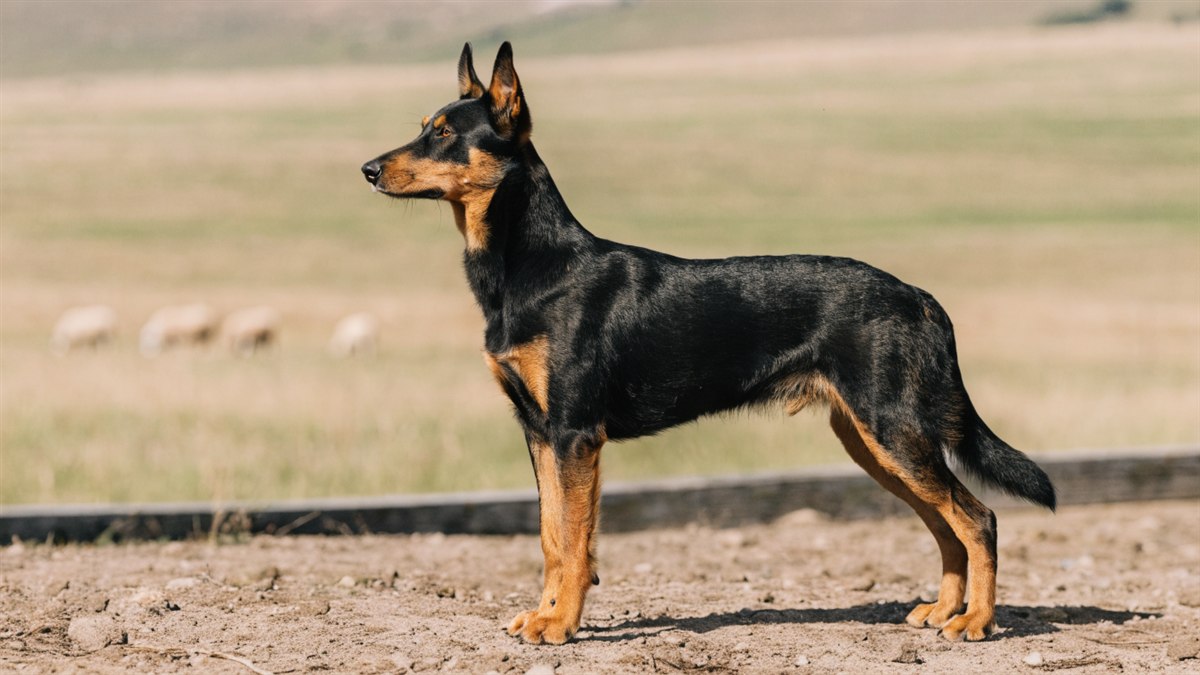
FCI-Standard No 293 describes a lithe, active dog of great quality, hard muscled, supple, and "conveying the capability of untiring work", free from any suggestion of weediness. Males stand 46 to 51 cm at the withers and females 43 to 48 cm. The body is longer than tall in a ratio of 10 to 9. The coat is a double coat with a short dense undercoat and a close, straight, rain-resisting outer coat averaging 2 to 3 cm on the body. Seven colours are permitted. The standard gives no weight at all, despite a heading that reads SIZE AND WEIGHT. The current text was published on 8 October 2012; the FCI first recognised the breed in 1989 and adopted the ANKC standard when it did Australian National Kennel Council.
Temperament is written into the standard rather than left to folklore. The Kelpie is "extremely alert, eager and highly intelligent, with a mild, tractable disposition and an almost inexhaustible energy, with marked loyalty and devotion to duty", and any defect of structure or temperament foreign to a working dog counts as uncharacteristic. Aggressive or overly shy dogs are a disqualifying fault. The working description asks for the same thing in plainer language, "an open friendly, active but placid disposition with a good balance between keenness to work and ability to relax", and names bad temperament, high excitability, nervousness and aggressiveness as undesirable.
Where the breed came from, and one myth worth killing
The Kelpie descends from working collies imported from Scotland in the 1870s, not from dingoes. The ANKC extended standard reproduces the primary account, a letter from Jack King describing a black and tan, long haired, lop eared bitch called Kelpie whose sire and dam were imported from Scotland, and a smooth haired, black, prick eared dog called Moss whose parents were also imports. King's Kelpie won the first Australian sheepdog trial at Forbes in 1872 at twelve months old, demand for her pups followed, and the name stuck to the type. The word itself is Gaelic for water sprite.
On the dingo question the extended standard is direct. Two origin claims have circulated for a century, that the breed came from dogs mating with foxes and that the dingo was used in its development. The document answers both, noting that dogs and foxes cannot breed, and that although dingoes have been mated with Kelpies, the results have generally been unsuccessful as sheepdogs. The Working Kelpie Council makes the same point about colour, that red "is well known in the Working Collie family and was not the result of a Dingo mating here";.
One more piece of history explains why colour is a live issue. Black Kelpies were long shown as a separate breed called Barbs, named after a black Melbourne Cup winner, and eleven Barbs were exhibited in classes of their own at the Canberra Kennel Club show as late as 1943. The Working Kelpie Council argues that showing pushed a section of breeders toward producing only all red or all black pups, and that "Selection over a number of years for colour alone, in preference to selection for sheer natural ability, appears to have caused a loss of working ability in some strains";.
One split, not two
Within the working population there is no second split, and that is worth knowing because Australian sellers talk about yard dogs and paddock dogs as though they were types you buy separately. A University of Sydney study assessed 298 Australian Working Kelpies with the Livestock Herding Dog tool and found real behavioural differences by work type. Paddock Kelpies scored significantly lower for force, for willingness to back the stock and for bite, while Yard Kelpies scored significantly higher for hyperactivity, excitability and impulsiveness. Utility Kelpies sat between the two. The genetic analysis then found that Yard, Utility and Paddock Kelpies are not distinguishable at DNA level, and the authors concluded there is no suggestion of a breed split generated by selection for work type.
So the working versus show division is a registry fact with two stud books behind it, while the yard versus paddock division is a matter of which pup a skilled breeder places where. Both matter, and only the first one changes what dog arrives at your door.
Almost no page an Indian buyer will find says any of this. Of the ten results ranking for this breed in India in August 2026, exactly one mentions the split at all, and it gives it two short subsections headed Working Kelpie and Show Kelpie with no Indian context whatsoever. The Indian sale pages do not mention it, which is convenient for them, because an unregistered dog of unstated ancestry is much easier to sell when the buyer does not know there are two answers to ask for.
Australian Kelpie price in India, and why almost none of it is real
There is no reliable Australian Kelpie price in India, because there is no verifiable Australian Kelpie market in India. Bonbeno audited every page ranking for this query in August 2026. Exactly one Indian source publishes a rupee figure, an editorial breed guide quoting Rs 20,000 to Rs 40,000, and it is not attached to any dog a reader can inspect. The three Indian sale pages that rank either show no price, show no dog, or show dogs of entirely different breeds under an Australian Kelpie heading.
Take the sale pages one at a time, because the pattern only becomes obvious when you look at all of them.
Audit one, the listings that are not this breed
Mr n Mrs Pet runs the top-ranking Australian Kelpie sale page in India and separate city pages for Mumbai and Delhi. All three print a result count. The India page says "3 Result Found", the Mumbai page says "3 Result Found", the Delhi page says "3 Result Found";. Not one of the nine cards rendered across those three pages is an Australian Kelpie. On the India page the dogs shown were a French Bulldog, a Bernese Mountain Dog and a Border Collie, and on a second retrieval the same page served a French Bulldog, a Weimaraner and a Border Collie. Mumbai served a Shiba Inu, a French Bulldog and a Newfoundland. Delhi served two Cavalier King Charles Spaniels and a French Bulldog.
The cards rotate between retrievals, which tells you what they are. They are a generic pool of available puppies rendered under whatever breed name the URL carries. The surrounding copy meanwhile promises "healthy, purebred KCI-certified Australian Kelpie Puppies in India" and invites you to call a phone number. The price on every card is hidden behind a View Price control, so no Australian Kelpie price is published even in principle.
Audit two, the page with no dog at all
Breed n Breeder's Australian Kelpie page contains no listing, no photograph of a Kelpie and no price. Its entire content is a heading, a dropdown of roughly three hundred breed names, a state and city selector, and a line reading "Mr. Vansh will connect with you to discuss the Australian kelpie puppies price, Behaviour and quality";. It is a lead-capture shell that exists at the same URL pattern for every breed in that dropdown. Fetching the same site's Border Collie page returns the identical furniture plus a block of filler prose, which the Kelpie page does not have, so the Kelpie version is the emptier of the two.
Audit three, the single listing with no number
Asia Pets carries one Australian Kelpie listing for all of India. It is marked Vaccinated: No, gives the location as "India, All India", and publishes no price whatsoever. The description reads in part "mother father is direct import 50 days puppy we have puppies are excellent quality and champion line up breed guarantee is life long";. The similar-breeds rail beneath it shows two Labradors and two Poodles. The claim worth pausing on is "direct import", and the next section explains why.
Audit four, the classifieds site with zero ads
Quikr is India's largest general classifieds platform and it carries pet listings in every major city. A national search for Australian Kelpie returns "Unfortunately, there are no ads in this category right now" across Ahmedabad, Bangalore, Chandigarh, Chennai, Coimbatore, Delhi, Gurgaon, Hyderabad, Jaipur, Kochi, Kolkata, Lucknow, Mumbai, Navi Mumbai, Noida, Pune and Trivandrum. Absence on a site that lists thousands of Labradors and Pomeranians is a finding, not a gap in the research.
| Source | Price published | Is a Kelpie actually shown |
|---|---|---|
| Happy Pet Care, editorial breed guide | Rs 20,000 to Rs 40,000, cost of buying | No dog for sale, it is a content page |
| Mr n Mrs Pet, India page | None, hidden behind View Price | No, cards were a French Bulldog, a Bernese Mountain Dog and a Border Collie |
| Mr n Mrs Pet, Mumbai page | None, hidden behind View Price | No, cards were a Shiba Inu, a French Bulldog and a Newfoundland |
| Mr n Mrs Pet, Delhi page | None, hidden behind View Price | No, cards were two Cavalier King Charles Spaniels and a French Bulldog |
| Breed n Breeder | None anywhere on the page | No, the page holds no listing at all |
| Asia Pets | None | One listing, unvaccinated, no photograph of a verifiable Kelpie, no price |
| Quikr, national search | None | No, zero ads returned nationwide |
Happy Pet Care publishes Rs 20,000 to Rs 40,000 as the cost of buying an Australian Kelpie in India. Bonbeno reports it because it exists, not because it is corroborated. Nothing else in India publishes a competing figure, so there is no spread to compare, and the same page also describes Australian Kelpies as "hardy native dogs that have adapted well to local conditions", which is template text written for an Indian breed and not for an Australian one. Treat the number as an unverified single data point.
What a Kelpie costs where Kelpies actually change hands
Australia publishes thirty years of real Kelpie prices, and the numbers are nothing like the Indian ones. The Casterton Kelpie Association has run the Australian Premier Working Dog Auction since 1997 and publishes its own results table by category. The top price for a fully trained dog rose from A$2,000 in 1997 to A$37,000 for Eulooka Hoover in 2021, and stood at A$23,500 for Beloka Stella II in 2026. Started dogs aged four to twelve months topped at A$20,000 in 2026, and pups of three months and under have ranged from A$250 in 1997 to a peak of A$6,500 in 2023, with A$4,750 the 2026 top. In seven of those thirty years, 2004, 2005, 2008, 2009, 2011, 2022 and 2024, no pup was offered for sale at all, and in 2020 there was no auction.
| Year | Fully trained dog | Started dog, 4 to 12 months | Pup, 3 months and under |
|---|---|---|---|
| 1997 | A$2,000 | A$260 | A$250 |
| 2010 | A$8,600 | A$2,250 | A$1,400 |
| 2019 | A$15,000 | A$4,000 | A$3,250 |
| 2021 | A$37,000 | A$9,050 | A$1,750 |
| 2023 | A$25,000 | A$11,000 | A$6,500 |
| 2025 | A$17,500 | A$13,000 | A$3,000 |
| 2026 | A$23,500 | A$20,000 | A$4,750 |
Auction tops are the ceiling, not the going rate. The useful floor comes from a farmer interviewed by the ABC after his Kelpie won a national working dog challenge in 2024, who said of his breeder that "Derek normally sells his pups for about $500";. The same report noted a A$50,000 record for the breed set the month before. So the honest Australian range for a working Kelpie pup starts near A$500 from an ordinary breeder and runs to five figures for a proven adult with a trial record.
Why the supply chain into India cannot legally exist
Indian import law closes the commercial route, and it does so in language that leaves no room. Dogs sit under ITC (HS) 01061900 with an import policy of Restricted. DGFT Trade Notice No 22/2022-23, issued on 19 December 2022, sets out Policy Condition 7, which allows import of dogs only for three purposes, a pet dog with a valid pet book and records in the name of the importer, dogs imported by R&D organisations with a CPCSEA recommendation, and dogs for internal security by the Defence and Police Force. Policy Condition 8 then states that "Import of commercial dogs for breeding or any other commercial activities other than the purposes mentioned above is not permitted";.
Paragraph 6 of the same notice removes the workaround. It says that "any applications for trading/breeding purposes, or applications made on behalf of some another person/entity shall be duly rejected";. Import of pet animals is allowed only through the airports and seaports of Delhi, Mumbai, Chennai, Hyderabad, Bengaluru and Kolkata and, since October 2024, Kochi airport, and an advance No Objection Certificate must be obtained from the Animal Quarantine and Certification Service seven days before travel Department of Animal Husbandry…. Two pets may come in as passenger baggage without a DGFT import authorisation only where the owner is transferring residence to India after two years of continuous stay abroad. The full route is set out in how to import a dog to India.
Read that against Asia Pets saying "mother father is direct import" for a litter offered for sale to the public. A breeding pair imported for a commercial breeding operation is precisely what Policy Condition 8 forbids. Either the parents came in under a personal pet-book route and were then bred commercially, or the claim is decoration. Neither possibility makes the listing more trustworthy.
So what should you expect to pay
Expect to be quoted a number and expect to be unable to verify what it buys. Bonbeno will not publish a recommended price band for a breed with no verifiable Indian market, because doing so would manufacture a market signal that does not exist. If you are quoted Rs 20,000 to Rs 40,000, that matches the only published Indian figure. If you are quoted several lakh on the strength of an "imported champion line", ask for the DGFT import authorisation number, the port of entry from the list of seven, and the quarantine NOC, and expect the conversation to end there.
A cheaper and more honest option exists, and it is covered properly in the adoption section below. India has thousands of medium, short-coated, high-drive dogs in shelters right now, and the Indian Pariah Dog is a genuinely heat-adapted animal that costs nothing to acquire and asks far less of your air-conditioning bill.
The monthly cost of keeping an Australian Kelpie in India
Budget Rs 9,000 to Rs 20,000 a month to keep an Australian Kelpie properly in an Indian city, which is more than the single published Indian estimate because that estimate leaves out the two things this breed forces on you. The one Indian source that costs the breed puts monthly expenses at Rs 3,550 on a basic lifestyle and Rs 5,400 on a premium one. That figure covers food, routine health and grooming, and stops there.
Happy Pet Care's breakdown is internally consistent, which is worth saying because many Indian cost pages are not. It gives monthly food at Rs 2,250 to Rs 3,000, health at Rs 600 to Rs 1,200 and grooming at Rs 700 to Rs 1,200, and those add exactly to the Rs 3,550 and Rs 5,400 totals it publishes. The arithmetic checks out. The scope does not.
What the published estimate leaves out
Two costs dominate Kelpie ownership in India and neither appears in that figure. The first is climate control. A dog that cannot be exercised outdoors for four months of the year has to burn that energy somewhere, and in Delhi, Ahmedabad, Nagpur or Chennai that means a cooled room for a large part of the day. The second is parasite prevention at Indian pressure. A survey of 525 dogs across four Indian cities found ticks, most commonly Rhipicephalus, on 278 of them, which is 53 percent of dogs examined. Year-round tick and flea control is not optional here the way it is in a temperate country.
| Line item | Lower | Upper | Note |
|---|---|---|---|
| Food | Rs 2,250 | Rs 3,000 | Published Indian estimate for this breed |
| Routine health | Rs 600 | Rs 1,200 | Published Indian estimate for this breed |
| Grooming and coat care | Rs 700 | Rs 1,200 | Published Indian estimate for this breed |
| Tick and flea prevention | Rs 500 | Rs 1,200 | Bonbeno estimate, driven by 53 percent tick carriage in Indian dogs |
| Cooling, fans and electricity attributable to the dog | Rs 1,500 | Rs 6,000 | Bonbeno estimate, four to five months of the year in most metros |
| Enrichment, toys and replacement of destroyed items | Rs 500 | Rs 2,000 | Bonbeno estimate, this breed is hard on a flat |
| Reserve for injury | Rs 1,500 | Rs 3,000 | Bonbeno estimate, see the injury rate below |
| Realistic monthly total | Rs 7,550 | Rs 17,600 | Round to Rs 9,000 to Rs 20,000 with variation |
Why an injury reserve belongs in a Kelpie budget
This breed gets hurt doing what it likes. A survey of 526 Australian working farm dogs, most of them Kelpies, interviewed 125 owners about the preceding twelve months. Of the 444 dogs still under those owners' care, 24 percent had a health event, 11 percent had an injury and 13 percent had a non-traumatic illness. The injuries were mostly musculoskeletal or skin, and arthritis was the commonest illness. Those dogs were working stock, not living in Pune, but the trait that causes the injuries is the same trait you are buying.
Indian veterinary costs are low by international standards, which helps. The ICAR-Indian Veterinary Research Institute's referral polyclinic publishes its schedule, with a complete blood count at Rs 250, an X-ray, ultrasound or laparoscopy at Rs 100 and fluid therapy at Rs 150 for pets, plus tax. Private urban clinics charge multiples of that, so the useful planning number is whatever your nearest clinic quotes, not a national average.
The largest hidden cost of this breed is time. A Kelpie that is under-exercised does not become a calm dog; it becomes a destructive one, and the replacement cost of doors, skirting boards and cabling is real. Two hours of your day, every day, is the price. If that is not affordable, the money question is irrelevant.
Set against the purchase, the running cost is the bigger number over a lifetime. At the midpoint of the range above, Rs 14,000 a month over twelve years comes to roughly Rs 20 lakh, which dwarfs any plausible purchase price. That ratio is the reason Bonbeno treats the affordable-looking headline price on Indian listing pages as the least important figure on this page.
Heat tolerance and Indian climate suitability, rated 2 of 5
Bonbeno rates the Australian Kelpie 2 out of 5 for heat tolerance in Indian conditions, and the reasoning has two halves that pull in opposite directions. The coat is genuinely well suited to heat. The temperament is not. A short, flat, rain-resisting coat sheds heat far better than a Husky's, but published veterinary evidence shows that roughly three quarters of canine heat-related illness is triggered by exertion, and the working Kelpie is among the highest-drive dogs in existence.
The half that favours the breed
The Kelpie's construction is the right construction for a hot country. The standard specifies a close outer coat lying flat, with body hair averaging just 2 to 3 cm, short on the head, ears, feet and front of the legs. The working description is looser still, allowing an outer coat that is moderately short and flat "with or without a short dense undercoat", meaning a substantial share of working Kelpies carry less insulation than the show standard demands. The muzzle is of moderate length and cleanly chiselled, so this is a mesocephalic dog with a full-length airway and no brachycephalic penalty.
That matters, because skull shape is the single most consistently identified anatomical risk factor for heat-related illness. In a study of 905,543 UK dogs, brachycephalic dogs had greater odds of all three types of heat-related illness compared with mesocephalic dogs. The Kelpie sits on the safe side of that line. It is also a light dog, 46 to 51 cm at the withers for males, and the same UK dataset found dogs weighing over 50 kg at greater risk. Nothing about the Kelpie's body is a heat liability.
The breed's own history reinforces the point. The FCI standard's historical summary says the dog was developed to work in Australian conditions that "included heat, rough terrain, dust storms and vast distances", describing Kelpies as "Tireless workers in the hottest and dustiest of climates";. The Swedish Kennel Club's working kelpie page says the breed covers enormous distances over stony ground, "often in temperatures of over 40 degrees in the shade";.
The half that sinks the rating
Heat kills dogs through exertion far more often than through weather, and that is where a Kelpie lives. Analysis of 1,259 heat-related illness events among 905,543 UK dogs found that exertional heat-related illness was the predominant trigger at 74.2 percent of the 879 events where a cause was recorded, against 12.9 percent environmental and 5.2 percent from confinement in a vehicle. The same research group put the event fatality rate at 14.18 percent, with a 95 percent confidence interval of 11.08 to 17.96 percent, across 395 confirmed events. In Australia, a review of 119 heat-related illness cases in New South Wales dogs between 1997 and 2017 found a fatality rate of 23 percent.
Now put the Kelpie's actual workload against that. A Kelpie named Bear covered 570 kilometres in a fortnight during a national working dog challenge, an average of 40 kilometres a day at an average speed of 13 kilometres per hour. The peer-reviewed baseline is calmer but still extreme, with Australian working farm dogs travelling 20 to 30 kilometres per day on average. The dog does not moderate this itself. Devotion to duty is written into the breed standard as a defining characteristic, which is another way of saying the dog will keep going after it should have stopped.
The number that settles it, and a disagreement worth publishing
The Australian working literature and the Swedish breed page disagree about the temperature Kelpies actually work in, and the gap is large enough to matter. The peer-reviewed Australian farm dog study states that these dogs work "in ambient temperatures of as high as 30 degrees C";. The Swedish Kennel Club says over 40 degrees in the shade. Bonbeno does not average these. The 30 degree figure is the one carried in a peer-reviewed paper citing measurement studies, while the 40 degree figure is a national kennel club's descriptive prose about the Australian outback. Both are probably true of different situations, mustering days versus record days.
What neither figure supports is an Indian summer. The India Meteorological Department recorded maximum temperatures across Delhi NCR ranging from 45.2 to 49.1 degrees C on 29 May 2024, measured across five departmental observatories and fifteen automatic weather stations, with Mungeshpur reporting 52.9 degrees as a flagged outlier under investigation for sensor error. Even the low end of that range is 15 degrees above the working temperature named in the farm dog literature.
The Indian breed guide that publishes a price for this dog also publishes an ideal weather range, and it is the most honest thing on that page. It gives 5 to 30 degrees C. Its own upper bound is exceeded on most days of the year in most Indian cities.
| Measure | Figure | Source |
|---|---|---|
| Ambient temperature Australian farm dogs work in | As high as 30 C | Peer-reviewed Australian farm dog health study |
| Temperature the Swedish Kennel Club describes for the breed | Over 40 C in the shade | SKK working kelpie breed page |
| Ideal weather range published for the breed in India | 5 to 30 C | Indian breed guide |
| Delhi NCR maximum, 29 May 2024, across 20 stations | 45.2 to 49.1 C | India Meteorological Department press release |
| Share of canine heat-related illness triggered by exertion | 74.2 percent | UK study of 905,543 dogs |
| Fatality rate of heat-related illness, UK | 14.18 percent | UK study of 905,543 dogs |
| Fatality rate of heat-related illness, New South Wales | 23 percent of 119 cases | Australian study, 1997 to 2017 |
One Kelpie-specific finding, honestly stated
The Australian heat-illness study named sixteen breeds at elevated risk compared with cross breeds, and the Kelpie is not one of them. The list runs Australian Stumpy Tail Cattle Dog, British Bulldog, French Bulldog, Maremma Sheepdog, Italian Greyhound, Chow Chow, Airedale Terrier, Pug, Samoyed, English Springer Spaniel, Labrador Retriever, Golden Retriever, Cavalier King Charles Spaniel, Border Collie, Staffordshire Bull Terrier, and pooled non-ANKC breeds. The Border Collie appears. The Kelpie does not.
Read that carefully, because it cuts both ways. The Kelpie is the commonest working dog in Australia, with one survey finding almost 70 percent of Australian herding dogs were Kelpies or Kelpie crosses against about a quarter Border Collies, so its absence from a risk list is not an artefact of rarity. That is a genuine point in the breed's favour. But the study covered only 119 cases over twenty years, its comparisons are against cross breeds rather than against each other, and farm dogs in Australia frequently do not reach a vet at all. In the farm dog survey, only 45 percent of injured dogs and 26 percent of ill dogs received veterinary treatment, which is exactly the mechanism that would keep a working breed out of a clinical dataset.
The Kelpie will not tell you it is overheating, because stopping is the one thing it was not bred to do. Walk before 6:30 am and after 8:30 pm from March to October in most of the country. Test the pavement with the back of your hand for five seconds before you step out. Carry water on every outing and offer it whether or not the dog asks. Watch for a curled tongue, a widened jaw at the base of the tongue, a reluctance to keep going or a sudden slowing, and stop at the first of them rather than the third. Consult your nearby vet about a written heat plan before your first Indian summer with this dog.
Monsoon, humidity and the cities where this changes
Humidity is the second climate problem and it works differently from heat. Panting cools a dog by evaporation, so high humidity removes the cooling mechanism without lowering the temperature. Mumbai, Chennai, Kochi and Kolkata combine 30 to 35 degrees with humidity above 80 percent for months, which is functionally harder on a working dog than a dry 42 degrees in Jodhpur. Delhi and Bengaluru offer a genuine winter window from November to February when a Kelpie can be worked properly. Pune, Hyderabad and Nagpur sit between the two.
The monsoon then creates a skin and ear problem in a dog whose coat sits close to the body. A wet close coat on a humid day does not dry to the skin on its own, and that is the condition in which pyoderma and otitis start. Dry to the skin after every wetting, check between the toes, and treat a persistently damp dog as a veterinary question rather than a grooming one.
Temperament, and the Indian household this breed does not suit
The Australian Kelpie suits an active household with outdoor space, a job for the dog and at least two hours a day to give it, and it suits almost nobody else in urban India. Both governing documents describe the same animal, alert, eager, highly intelligent, mild and tractable, with almost inexhaustible energy and marked loyalty and devotion to duty. Read that last phrase as a warning rather than a compliment, because a dog devoted to duty in a household with no duties invents one.
The Swedish Kennel Club states the household test more bluntly than any English-language source. Its working kelpie page says in plain terms that the breed is not suited to being kept as a companion dog alone, and repeats the point in its own buyer checklist. Its australian kelpie page says the same thing about the show population, that a Kelpie is not suitable purely as a companion and wants an active family that enjoys training the dog. Two separate breed pages, two separate breeds by that registry's own classification, one identical warning.
The one-person tendency, and what it means in a joint family
Kelpies bond narrowly, and the working literature says so without apology. The Working Kelpie Council's own guidance states that "The Kelpie is basically a one man dog. As a rule, he doesn't take to strangers for a long time, especially the good ones";. That sentence has a specific consequence in an Indian home. In a household with grandparents, a domestic help who comes daily, a cook, a driver and cousins visiting, a dog that takes a long time to accept strangers will spend a lot of its life mildly stressed and will bark at the door more than you want.
It is not a guarding breed and should not be bought as one. The standard makes aggressive or overly shy dogs a disqualifying fault, and the ANKC extended standard lists "Cowardly behaviour, backing away from humans" as a serious fault while stating flatly that "Biting is a serious fault and foreign to the breed";. A correctly bred Kelpie is reserved rather than suspicious, and will alert rather than confront.
Herding is not a metaphor, it is the behaviour you will live with
The Kelpie's defining behaviours are gripping, backing and force, and they are selected for. The Sydney study that assessed 298 Working Kelpies scored them on exactly these traits, defining force as pressure applied by the dog to move livestock, backing as willingness to run along a sheep's dorsum, and bite as frequency of using the mouth to grab or bite the livestock. Yard Kelpies scored significantly higher than both other types on hyperactivity, excitability with and without stock, and impulsiveness without stock.
In a flat with children, those traits present as heel-nipping, chasing runners, herding toddlers into corners and mouthing during play. This is not aggression and it is not a training failure, it is the breed doing its job on the only livestock available. It is manageable with early, deliberate work, and it is exhausting for a family that did not expect it.
| Household | Verdict | Why |
|---|---|---|
| Farm, stud or stables with real stock work | Excellent | The dog gets the job it was bred for and the drive has an outlet |
| Independent house with a garden and an owner who runs, cycles or does dog sport | Good | Two hours a day is achievable and there is space to decompress |
| Two-bedroom flat, working couple, no dog sport | Poor | The energy has nowhere to go and destruction follows |
| Joint family with frequent visitors and daily help | Poor | The one-person tendency and stranger reserve work against the household |
| Home with toddlers and no separate space | Poor | Herding instinct plus a mouth that is a working tool |
| First-time dog owner of any kind | Not recommended | This is not a starter breed in any climate, and least of all in this one |
| Owner wanting a guard dog | Wrong breed | Aggression is a disqualifying fault under the standard |
Set against comparable breeds, the Kelpie is more independent than a Border Collie and less handler-dependent in its working style. The working description asks for a dog that can work at distance and think for itself, with eye placement chosen to give "the widest possible field of vision without the need of head movement";. That independence reads as stubbornness in a living room. The Australian Shepherd is generally more biddable in a domestic setting and the Australian Cattle Dog is harder and more reserved again.
A Kelpie is a superb dog for the right person and a genuinely difficult one for everybody else. If you are reading this page because a Kelpie looks handsome in a photograph, that is the wrong reason. If you are reading it because you already run 15 kilometres a week and want a dog that can keep up and then learn something afterwards, keep reading.
Training an Australian Kelpie, and the two things it resists
Train an Australian Kelpie by giving it a job, marking the behaviour you want within a second of it happening, and stopping before the dog wants to. This is one of the most trainable breeds alive, described in its own standard as extremely alert, eager and highly intelligent with a mild, tractable disposition. The resistance is not to learning. It is to repetition without purpose, and to being handled by somebody who did not raise it.
Start the dog yourself
The working tradition is unambiguous that the owner should be the trainer. The Working Kelpie Council's own buying guidance says "Break your own dogs in if possible. Kelpies are very faithful. The pup that grew up with you is generally a better dog than the one I broke in and sold you";. That advice transfers to an Indian flat almost unchanged. Sending a Kelpie away to a board-and-train kennel for three weeks is the single most common Indian training mistake with this breed, and it works less well here than with a Labrador because the bond is doing more of the work.
The same source records a failure mode worth knowing. "A Kelpie will often go sour for some reason with one handler, especially a young dog. If he does, spell him or get a good handler to take him for a while";. A Kelpie that has switched off is not being defiant. It has decided the session is pointless, and the fix is a break, not more pressure.
A realistic Indian timeline
- Weeks 8 to 16, socialise deliberately. Meet the watchman, the delivery riders, the lift, the auto, the cow, the temple bell, the crow. The stranger-reserve tendency documented in the working literature is easiest to soften in this window and hardest afterwards.
- Weeks 8 to 16, teach a settle. This is the most valuable behaviour you will ever put on a Kelpie in India, because it is the one that makes four months of restricted outdoor time survivable.
- Months 4 to 6, put a reliable recall on the dog before the prey drive matures. A Kelpie that has learned to chase before it has learned to return is a much harder animal.
- Months 4 to 8, redirect the mouth. Backing and gripping are selected working traits, so give the dog a legal target, a tug, a flirt pole, a herding ball, rather than trying to extinguish the instinct.
- Months 6 to 12, add scent work and shaping games. Mental work tires this breed faster than distance and can be done indoors at 2 pm in May.
- Months 12 to 18, introduce a real sport. Agility, obedience, rally, canicross in winter, or a herding taster if you can reach stock. The Swedish Kennel Club notes the breed can compete in most official disciplines, and its working population is barred only from conformation shows.
- Throughout, keep sessions short. Five minutes, three times a day, beats forty minutes once.
What actually resists training
Two things resist, and neither is intelligence. The first is repetition of a solved problem. A Kelpie that has performed a sit correctly six times has finished with sits, and asking for a seventh teaches it that you are not worth attending to. The second is a handler who is inconsistent between sessions, because this dog learns the pattern you actually run rather than the one you intended.
There is one more, less often stated. The excitability documented in Yard Kelpies is a training problem in a domestic home. The Sydney study found Yard Kelpies scoring significantly higher on impulsiveness even without stock present, which in a flat means a dog that cannot come down from arousal on its own. Teaching an off-switch is a specific skill, taught with duration on a mat and calm reinforcement, and it is more important than any obedience cue.
The Indian climate hands you a training structure whether you want it or not. Physical work happens in the two cool windows at either end of the day. Everything between 9 am and 7 pm from March to October is mental work, and mental work is what this breed is short of in Indian homes. A Kelpie that gets 30 minutes of shaping, scent games and problem-solving indoors is calmer than one that got an extra kilometre of pavement.
On method, positive reinforcement is not a preference here, it is the only approach that fits the breed's documented temperament. The standard already treats fear and aggression as faults, and the working description names nervousness and high excitability as undesirable. Aversive handling of a sensitive, high-drive herding dog produces exactly the temperament both documents call uncharacteristic.
How much daily exercise an Australian Kelpie actually needs
An Australian Kelpie needs a minimum of two hours a day of real activity, split into a physical block and a mental block, and the working population needs more. The single Indian source that quantifies it says 60 to 120 minutes. Bonbeno treats 120 minutes as the floor rather than the ceiling, because the evidence on what these dogs do when employed sits an order of magnitude above any pet figure.
What a working Kelpie actually covers
The peer-reviewed baseline is 20 to 30 kilometres per day for Australian working farm dogs, a population that is roughly 70 percent Kelpie or Kelpie cross. The competitive ceiling is far higher. In a national working dog challenge measured by GPS collar, a Kelpie called Bear covered 570 kilometres over a fortnight at his home property in Queensland, an average of 40 kilometres a day at an average speed of 13 kilometres per hour. The ANKC extended standard, written decades earlier, records that the Kelpie "has been known to travel more than 50 kilometres in one day".
Nobody is suggesting you replicate that in Bengaluru. The point of the numbers is calibration. A breed whose ordinary working day is 20 to 30 kilometres is not going to be satisfied by a 20-minute walk around a housing society, and the gap between what the dog is built for and what a flat provides is the source of almost every Kelpie behaviour problem reported by urban owners.
| Slot | Cool months, November to February | Hot months, March to October |
|---|---|---|
| Morning | 60 to 75 minutes, brisk walk plus off-lead running or cycling alongside | 45 minutes before 6:30 am, brisk, water carried |
| Midday | 15 minutes of training or scent work | 30 to 45 minutes of indoor mental work in a cooled room |
| Evening | 45 to 60 minutes, including a sport session twice a week | 45 minutes after 8:30 pm, plus a tug or flirt pole session |
| Weekly extra | One long outing, two to three hours, hills or open ground | One long outing only if a hill station, early morning coast or forest track is reachable |
What happens without it
An unexercised Kelpie does not sit quietly. It patrols, it vocalises, it herds whatever moves, it chews structural items rather than toys, and it develops the repetitive behaviours that owners describe as anxiety. The breed standard's phrase is "an almost inexhaustible energy";, and the Working Kelpie Council asks for "a good balance between keenness to work and ability to relax";, which is a reminder that the ability to relax is a bred-for trait that a bored dog loses access to rather than one it never had.
There is a specific Indian trap here. Owners compensate for a missed morning walk by extending the evening one into the hot part of the day, or by playing hard indoors in an unventilated room. Both raise the exertional risk that already accounts for 74.2 percent of heat-related illness events. A missed walk should be replaced by mental work, not by a hotter walk.
Puppies are the exception
Do not run a Kelpie puppy. The Swedish Kennel Club's own buyer note makes the point that a Kelpie puppy looks like a small adult dog but walks should be adapted to a length appropriate for a puppy. Growth plates close between roughly ten and eighteen months in a medium breed, and a dog whose adult career depends on sound hips and stifles is not the animal to over-exercise at seven months. Free play on soft ground beats forced distance on concrete every time.
Grooming a short-coated working dog in Indian humidity
Groom an Australian Kelpie with a rubber curry or a short-bristle brush twice a week, a daily tick check from March to November, and a strict rule that the dog is dried to the skin after every wetting. This is a genuinely low-maintenance coat, and the single Indian estimate puts grooming at Rs 700 to Rs 1,200 a month. The work that matters in India is not brushing. It is drying and parasite control.
Know which coat you have
The two populations do not carry the same coat, and this is one of the few standard differences with a direct practical consequence in India. FCI 293 requires a double coat with a short dense undercoat, a close, straight, hard, flat-lying outer coat that is rain-resisting, longer under the body and behind the legs into a mild breeching, longer and thicker along the neck into a ruff, with a good brush on the tail, and body hair averaging 2 to 3 cm. The Working Kelpie Council's description requires only a moderately short, flat, straight, weather-resisting outer coat "with or without a short dense undercoat";.
The Swedish Kennel Club records the same difference across its two breed pages. Its australian kelpie page describes short straight topcoat with a denser undercoat, while its working kelpie page describes a fairly short, flat, straight coat with or without undercoat Svenska Kennelklubben. A working-bred Kelpie with a thin or absent undercoat sheds less, dries faster and copes better with Chennai. A show-bred double coat sheds seasonally and takes longer to dry through.
The weekly routine
- Brush twice a week with a rubber curry or a short-bristle brush, and daily during a seasonal shed.
- Bathe only when the dog is actually dirty. The Swedish Kennel Club's advice for both populations is to bathe as needed, not on a schedule.
- Dry to the skin every time, with a towel and then air movement from a fan, and pay attention to the ruff, the breeching behind the thighs and the tail brush where the coat is longest.
- Check ears weekly and after every swim or heavy rain, and dry the ear canal opening rather than probing it.
- Trim nails every three to four weeks, because pavement in a city does not wear them the way rough country does.
- Run a tick check daily in the tick season, working through the ears, the neck ruff, the armpits, the groin and between the toes.
Ticks are the real grooming job in India
Tick checking is not fussiness here, it is the highest-value five minutes of the day. Across 525 dogs sampled in four Indian cities, potential tick vectors, most commonly Rhipicephalus and sometimes Haemaphysalis, were found on 278 dogs, which is 53 percent of those examined. In the same study, 261 of 525 dogs, or 49.7 percent with a 95 percent confidence interval of 45.4 to 54.1, tested PCR-positive for at least one tick-borne pathogen. Almost exactly half of Indian dogs sampled carried a tick-borne disease.
| Pathogen | Prevalence | 95% confidence interval |
|---|---|---|
| Any tick-borne pathogen | 49.7% | 45.4 to 54.1 |
| Hepatozoon canis | 30.0% | 26.0 to 34.0 |
| Ehrlichia canis | 20.6% | 17.2 to 24.3 |
| Mycoplasma haemocanis | 12.2% | 9.5 to 15.3 |
| Anaplasma platys | 6.5% | 4.5 to 8.9 |
| Babesia vogeli | 5.5% | 3.7 to 7.8 |
| Babesia gibsoni | 0.2% | 0.01 to 1.06 |
Co-infection was common, occurring in 39 percent of cases, and the authors advised Indian practitioners that finding one such pathogen raises the likelihood of several. That is a reason to ask for a full tick-borne panel rather than a single test when a Kelpie in India presents with lethargy, fever or unexplained anaemia. Consult your nearby vet about a year-round preventive protocol suited to your city rather than treating seasonally.
A double coat insulates against heat as well as cold, and shaving it removes the guard hairs that reflect radiation while leaving the dog's skin exposed to direct sun. Shaved double coats also regrow unevenly and can come back thinner. The correct summer intervention is a thorough de-shed of dead undercoat, shade, water and timing, not clippers. Even the Indian breed guide that ranks for this query runs a separate article asking whether you should shave your dog in summer, which tells you how common the mistake is.
Monsoon skin, and one honest caveat
Wet coat plus Indian humidity is the standing skin risk, and it is worse in the longer-coated show type than in a thin-coated working dog. The mechanism is simple. A close, flat coat holds moisture at the skin surface, humidity prevents evaporation, and warm damp skin under hair is where bacterial pyoderma and yeast overgrowth establish. Bonbeno has not found an Indian dermatology series specific to the Kelpie, and will not borrow figures from studies of other breeds to fill the gap. What transfers is the mechanism, not a prevalence number.
Practically, that means towel and fan after rain and after swims, never crate a damp dog, keep bedding dry and washed, and get any itch that persists beyond a week looked at rather than treated at home. Indian pharmacies sell steroid creams and antifungal shampoos over the counter, and self-treating a Kelpie's skin without a diagnosis is how a two-week problem becomes a two-month one.
Health, cerebellar abiotrophy and the tests worth paying for
Cerebellar abiotrophy is the inherited condition that defines this breed's health profile, it has been known since 1989, and since 2022 it has had two identified risk loci and a commercial DNA test. MDR1, the drug-sensitivity mutation that dominates Australian Shepherd and Collie health advice, has been specifically screened for in the Kelpie and was not detected. Those two facts, taken together, are the whole reason an Indian buyer should read this section rather than a generic herding-breed page.
Cerebellar abiotrophy, the named Kelpie disease
Cerebellar abiotrophy, sometimes written CA or called cerebellar ataxia, is a degeneration of the Purkinje and granule cells of the cerebellar cortex. It was first formally reported in this breed in 1989 by Thomas and Robertson at Murdoch University, in the Australian Veterinary Journal, under the title Hereditary cerebellar abiotrophy in Australian kelpie dogs. The Working Kelpie Council, which funded University of Sydney research into it, notes the condition had been recognised in the breed for more than a decade before that paper.
The clinical picture is consistent across sources. Affected dogs show ataxia, head tremor, poor motor coordination, a wide-based stance and a high-stepping gait. The Working Kelpie Council's research page describes onset soon after weaning, at three to seven weeks in the pups it saw, and states plainly that affected dogs are usually euthanised for humane reasons because no therapeutic treatment exists.
Prevalence is low and honestly reported as such. The 2022 University of Sydney paper states that CA in these populations is "reported to affect less than one percent of dogs in the breeds";. That is the only breed-level prevalence figure Bonbeno could verify, and it is a statement in a peer-reviewed paper rather than a measured survey.
What the 2022 genetics actually found
A genome-wide association study of 45 CA-affected and 290 control Kelpies identified two significantly associated loci, one on canine chromosome 9 and one on chromosome 20, and they behave differently. This matters because it means there are two diseases wearing one name.
| Locus | Candidate variants | Onset | Inheritance and penetrance |
|---|---|---|---|
| CFA20 | DOT1L p.R200Q and LINGO3 p.R359C | Before ten weeks of age | Recessive risk haplotype with incomplete penetrance of 42 percent, 19 of 45 homozygous-risk dogs were affected |
| CFA9 | VMP1 p.P160Q | Later onset, generally after six months | Fully penetrant Mendelian recessive, 11 of 11 homozygous dogs were affected |
Read the penetrance column carefully, because it changes what a test result means. A dog carrying two copies of the CFA9 VMP1 variant will get the later-onset disease. A dog carrying two copies of the CFA20 risk haplotype has roughly a two-in-five chance of showing signs, so a positive result there is a risk marker rather than a diagnosis.
The test, the provider, and the carrier rates with their sample sizes
A commercial test exists in Australia and, since January 2026, in Europe. Dog Breeding Science in Sydney tests both markers and publishes its own running results. Of 286 dogs tested for CA: VMP1, five tested affected and all five were reported by their owners to show signs of CA that worsened over time, and a further 56 dogs were identified as carriers. The laboratory reports a gene frequency of 11.5 percent among the dogs it has tested. Of 224 dogs tested for CA: LINGO3, twelve tested affected and nine of those twelve showed signs, with 71 further carriers identified and a gene frequency of 21 percent among dogs tested.
The laboratory attaches its own caveat and it deserves repeating rather than burying. For both markers it states that "The gene frequency in the general population is likely to be lower, because breeders who have produced affected dogs are more likely to use the test";. These are ascertainment-biased figures from a self-selected testing population, not breed prevalence. Bonbeno publishes them with the sample sizes attached so a later reader can see exactly what they rest on.
A third marker was tested and withdrawn, which is a useful signal about how carefully this laboratory works. CA: NUP153 was identified in a single affected litter. Of 205 dogs tested, seven returned an affected genotype and only three showed signs, and all three of those also tested affected for the LINGO3 form with an age of onset consistent with LINGO3 rather than NUP153. The laboratory concluded the test was not useful for prediction and removed it from the panel to reduce the price.
In Europe, Labogen announced Australian Kelpie CA testing on 29 January 2026, covering both the LINGO3 variant, described as autosomal recessive with incomplete penetrance and first symptoms possible from four to ten weeks, and the second variant with later onset from about four to six months and complete penetrance. So a European-bred import can arrive with a result already on file, and there is now no good reason for a breeder anywhere to be untested.
Ask for the CA: VMP1 and CA: LINGO3 genotypes of both parents in writing, on laboratory letterhead with the dogs' microchip numbers on it. Two carriers should not be mated for either marker, which is the laboratory's own recommendation. If the seller has never heard of the test, you are not talking to a serious breeder of this breed.
MDR1 does not apply to the Kelpie, and here is the evidence
The Kelpie has been specifically looked for and specifically not found. A German study screened 7,378 dogs for the nt230(del4) MDR1 mutation and deliberately included breeds that share breeding history with predisposed breeds but in which the mutation had not been reported. The breeds chosen for that purpose were Bearded Collies, the Anatolian Shepherd Dog, the Greyhound, the Belgian Tervuren, the Kelpie, the Borzoi, the Australian Cattle Dog and the Irish Wolfhound. The paper states that "The MDR1 mutation was not detected in any of these breeds".
In the same study the mutation was found where expected, with mutant allele frequencies of 59 percent in the Collie, 45 percent in the Longhaired Whippet, 30 percent in the Shetland Sheepdog, 24 percent in the Miniature Australian Shepherd, 22 percent in the Australian Shepherd, 17 percent in the Waller, 14 percent in the White Swiss Shepherd, 4 percent in the Old English Sheepdog and 1 percent in the Border Collie. The conclusions rest on roughly 15,000 worldwide MDR1 genotyping records.
Two further sources support the same conclusion from different angles. Washington State University's laboratory, which discovered the mutation, publishes a breed frequency table listing eighteen entries including the Australian Shepherd at 50 percent, the Collie at 70 percent and the Shetland Sheepdog at 15 percent. The Australian Kelpie is not on that table. An Australian study of 4,842 dogs across 27 breeds submitted to two diagnostic laboratories detected the mutation in nine breeds, and named the most commonly affected as collies, Australian shepherds, white Swiss shepherds and Shetland sheepdogs; the Kelpie is not among the breeds it flags. An earlier Australian sample of herding breeds, which found the mutation in Collies, Australian Shepherds and Shelties, did not include Kelpies in its 64 samples at all.
The correct statement is that MDR1 has been actively screened for in the Kelpie in a 7,378-dog study and was not detected, and that the breed does not appear in Washington State University's published frequency table. That is strong evidence, not proof. None of these papers reports how many Kelpies were in the sample, and no study has been done on Indian-resident Kelpies. If your dog is a Kelpie cross, or if its parentage is not documented, the herding-breed cross figure of 10 percent in the WSU table applies to it and testing is sensible. Discuss it with your nearby vet before any high-dose ivermectin for mange.
The practical consequence is a real saving. Our Australian Shepherd page treats MDR1 as the defining, must-do test for that breed, because half of Australian Shepherds carry at least one copy. For a documented purebred Kelpie, the money is better spent on the two cerebellar abiotrophy markers, which are breed-specific and have published Kelpie data behind them.
Hip dysplasia, and what OFA could and could not tell us
Hip dysplasia occurs in the breed and is not quantified anywhere Bonbeno could verify. The Swedish Kennel Club states for the working kelpie that the breed is considered relatively healthy and that hip dysplasia occurs, and for the australian kelpie that a relatively low proportion of individuals are affected by hip dysplasia Svenska Kennelklubben. Neither page gives a percentage or a sample size.
The Orthopedic Foundation for Animals was the obvious next stop and it did not yield a figure. OFA's disease statistics tables load from a separate host, wp.ofa.org, which refused connection from this environment on every attempt, and the advanced-search page served no breed codes to read. Bonbeno therefore publishes no OFA figure for this breed, and states plainly that this is a retrieval failure rather than a confirmed absence. It is worth knowing that OFA does not list a breed at all until a minimum number of evaluations exist, at least 100 for hips and at least 50 for every other database, and the Australian Kelpie is only a Foundation Stock Service breed in the United States rather than a fully recognised one, so a thin or absent OFA record would not be surprising.
One requirement does apply in India regardless. The Prevention of Cruelty to Animals (Dog Breeding and Marketing) Rules 2017 require that dogs used for breeding "shall have been tested for genetic defects, including hip dysplasia, progressive retinal atrophy, night blindness, hypothyroidism, entropion, ectropion" and several jaw and dentition faults. An Indian breeder selling Kelpie puppies without hip screening on the parents is not meeting the standard the law sets, whatever the breed's international data situation.
Lifespan, measured at 12.0 years in McMillan's Table S3
McMillan 2024 gives the breed a median survival of 12.0 years, 95 percent CI 11.6 to 13.5, from 49 recorded deaths, at a hazard ratio of 0.97 (0.74 to 1.29) against the crossbred group. That hazard ratio does not reach significance at p = 0.86, so the honest reading is that a Kelpie lives about as long as a crossbred dog, whose median in the same 584,734-dog analysis is 12.0 years. The study files the breed under the bare name Kelpie, and its Supplementary Table S5 records that label as covering the Australian Kelpie, which is why an earlier version of this page reported the breed as absent. Indian and international content pages repeat 12 to 15 years with no dataset behind it, and the measured median sits at the bottom of that band. The UK life-table study built on 30,563 deaths reports breed-level figures for common UK breeds and not for this one.
For context rather than substitution, that life-table study put life expectancy at birth for UK companion dogs generally at 11.23 years, with a 95 percent confidence interval of 11.19 to 11.27 years, and found females at 11.41 years living longer than males at 11.07. Bonbeno reports that as the all-breed baseline. It is not a Kelpie figure and this page does not present it as one, because the breed now has its own measured median above, and it does not borrow the Border Collie number either.
What actually goes wrong, from the largest Kelpie-heavy dataset there is
The most useful health data on this breed comes from a survey of working farm dogs rather than from a pedigree register. Researchers interviewed 125 Australian farm dog owners at the 2015 Kelpie Muster in Casterton, Victoria, about 526 dogs, most of them Kelpies. In the preceding twelve months, 9 percent of the dogs had been sold, 6 percent had died and 1 percent had been retired from work. Of the 444 dogs remaining under those owners' care, 24 percent had a health event and 13 percent had one that affected their work.
| Category | Share of dogs | Detail |
|---|---|---|
| Any health event | 24% | Twelve-month recall, owner reported |
| Health event affecting work | 13% | |
| Injuries | 11% | Mostly musculoskeletal or skin |
| Non-traumatic illness | 13% | Arthritis commonest |
| Injured dogs receiving veterinary treatment | 45% | Fewer than half |
| Ill dogs receiving veterinary treatment | 26% | Roughly a quarter |
| Heat stress cases | 4 dogs | Recorded within the 'other illness' category |
Two things follow for an Indian owner. First, the injury profile is orthopaedic and dermatological, so a Kelpie budget should carry an injury reserve and an Indian owner should learn what a soft-tissue limp looks like. Second, the low veterinary presentation rate in that population is a reminder that farm-dog datasets systematically under-record illness, which is one reason breed health data for this dog is thinner than for a show breed of the same popularity.
Everything in this section describes groups of dogs, not the animal in front of you. Consult your nearby vet before acting on any of it, take written copies of any DNA results to every appointment, and treat sudden collapse, a first seizure, pale gums, laboured breathing, a body temperature you cannot bring down, or a puppy with head tremors and a wide-based stance as an emergency rather than something to watch overnight.
Feeding an Australian Kelpie in India
Feed an Australian Kelpie to body condition rather than to a chart, split into two meals, with the total set by what the dog actually did that day. The one Indian source that quantifies it gives roughly 1,500 kcal a day for puppies and 1,200 kcal a day for adults, at a monthly food cost of Rs 2,250 to Rs 3,000. Treat those as a starting point from a content page rather than as a measured requirement, because no feeding trial exists for this breed.
The reason a chart fails this breed is that its energy expenditure swings enormously. A Kelpie working stock covers 20 to 30 kilometres a day, and a Kelpie in a Chennai flat in May covers two. The same dog can need double the calories in November that it needs in May. Weigh the dog monthly, run your hands over the ribs weekly, and adjust the food rather than the schedule.
Body condition is the only reliable target
You should feel the ribs easily under a thin covering, see a waist from above and see an abdominal tuck from the side. Working farm dogs are kept lean deliberately, and lean is also protective in an Indian summer, because higher bodyweight relative to the breed mean was identified as a risk factor for heat-related illness in a study of 905,543 dogs. A slightly lean Kelpie is a safer Kelpie in this climate.
| Stage | Meals per day | Focus |
|---|---|---|
| 8 to 16 weeks | 4 | Growth food, small frequent meals, never free-fed |
| 4 to 6 months | 3 | Steady growth, avoid rapid gain which loads developing joints |
| 6 to 12 months | 2 to 3 | Transition toward adult food from around ten to twelve months |
| Adult, 1 to 7 years | 2 | Adjust by season, more in winter when the dog can work |
| Senior, 8 years on | 2 | Lower calories, maintain protein, watch for arthritis-driven inactivity |
Practical Indian points
- Split the day's ration into two meals and keep both away from the hot hours, because feeding immediately before or after hard exercise in heat is poor practice in any deep-chested breed.
- Water is the intervention that matters most. Offer it constantly, carry it on walks and refresh it several times a day in summer, since evaporative cooling by panting is the dog's main heat defence.
- Buy dry food in sizes you will finish within a month. Indian humidity spoils opened kibble faster than the label assumes, and rancid fat is a real cause of intermittent diarrhoea in this country.
- Home-cooked feeding is workable and common in India, but a working-breed diet built without professional input tends to be short on calcium and long on rice. Consult your nearby vet or a veterinary nutritionist before switching a growing puppy.
- Keep treats to a tenth of daily calories. A Kelpie in training earns a lot of treats, and this breed puts on weight faster in a flat than owners expect.
The 1,500 kcal puppy and 1,200 kcal adult figures come from an Indian content page and Bonbeno could find no study behind them. They are plausible for a 17 kg moderately active dog and clearly too low for a Kelpie doing genuine work. Use them to set a starting portion, then let the dog's ribs and waist tell you what to do next.
The first year, month by month, with the Kelpie-specific watch points
Plan an Australian Kelpie's first year around three things Indian owners routinely miss, the eight-week legal floor on sale, the two cerebellar abiotrophy onset windows, and the fact that the puppy's first Indian summer arrives before it is fully grown. Everything else in a Kelpie's first year is ordinary puppy raising done at higher intensity.
Before you collect the puppy
Indian law sets the floor. Rule 8 of the Prevention of Cruelty to Animals (Dog Breeding and Marketing) Rules 2017, under the heading Conditions for sale, requires every breeder to ensure that "pups less than eight weeks in age are not sold";. Asia Pets' Australian Kelpie listing offers a "50 days puppy";, which is roughly seven weeks and one day. That is below the legal floor as written.
The same rules require individual health records for all animals above the age of eight weeks or once weaned, require health records or a copy to accompany the animal on transfer of ownership, and state that vaccination "can start at the age of seven-eight weeks, and are usually completed at the age of eighteen weeks";. Ask for the record. A breeder who cannot produce it is not compliant.
| Age | What to expect | What to watch for |
|---|---|---|
| 8 to 10 weeks | Collection at the earliest legal age. Four small meals a day. Home socialisation only until vaccination allows more. | The early-onset cerebellar abiotrophy form linked to the CFA20 locus shows before ten weeks. Watch for head tremor, wobbling, a wide-based stance and a high-stepping gait. |
| 10 to 16 weeks | The socialisation window. Meet people, surfaces, sounds, lifts, traffic and animals in controlled doses. | Stranger reserve is easiest to soften now. Also complete the vaccination course, usually by eighteen weeks. |
| 4 to 5 months | Teething. Redirect the mouth onto legal targets rather than suppressing it. Begin recall in a safe enclosed space. | First Indian summer if born in winter. Restrict outdoor time to the two cool windows immediately. |
| 5 to 7 months | Adolescent testing begins. Recall degrades. Energy climbs sharply. | Prey drive matures. A Kelpie that starts chasing scooters at six months will still be doing it at six years. |
| 6 to 9 months | Sexual maturity in many individuals. Discuss neutering timing with your vet rather than defaulting to a date. | The later-onset cerebellar abiotrophy form linked to the CFA9 VMP1 variant typically presents from around six to eight months and worsens over time. |
| 9 to 12 months | Adult food transition. Structured exercise can extend. Add a sport. | Growth plates are still closing. Avoid repetitive high-impact work on concrete. |
| 12 to 18 months | Mental maturity arrives late in this breed. Full working stamina develops. | This is when an under-exercised Kelpie's behaviour problems become entrenched rather than transient. |
Why the two onset windows deserve their own line
A Kelpie that passes eight weeks without neurological signs is not clear of cerebellar abiotrophy. The two forms present at different ages. The CFA20 form associated with the DOT1L and LINGO3 variants shows before ten weeks of age, and European testing guidance describes first symptoms from four to ten weeks with severity varying widely Labogen / Laboklin. The CFA9 form associated with the VMP1 variant is later, described by the Australian testing laboratory as beginning at six to eight months, and it is the one that gets steadily worse Labogen / Laboklin.
That is why a DNA result on the parents is worth more than an assurance that the litter looks fine. A litter can look perfectly normal at eight weeks and still carry the later-onset form.
A Kelpie puppy collected in October reaches five to seven months in March, which is exactly when Indian outdoor exercise windows collapse and exactly when its energy is climbing fastest. If you can choose, collect a puppy in late winter so its highest-energy adolescent months fall in the following cool season, and use the first summer for indoor training rather than distance.
First-year training priorities in order
- Settle on a mat, taught from week nine and practised daily, because it is the behaviour that makes summer survivable.
- Name recognition and a recall, built before the prey drive matures at around six months.
- Handling tolerance for ears, feet and mouth, which makes the daily tick check possible.
- Crate or safe-space comfort, so a wet monsoon dog can be dried and rested without a fight.
- Loose-lead walking, because a Kelpie that pulls at 18 kg on a hot pavement raises its own body temperature.
- Impulse control games, which matter more in this breed than in any other herding dog kept in Indian flats.
- A structured sport by twelve to eighteen months, chosen to fit your city and your cool season.
Australian Kelpie against the breeds Indian buyers cross-shop
The difference between Australian Kelpies and Australian Cattle Dogs is substance, and the ANKC standard states it as a judging instruction. Judges are told that "The Kelpie must at all times be distinguished from the Cattle Dog with the latter's greater substance, much stronger head, more pronounced spring of rib and heavier bone";. The Kelpie is the lighter, faster, longer-striding of the two, and it works sheep at distance where the Cattle Dog works cattle close.
That question is the one PetMD's own breed page ends on, which tells you how often buyers ask it. Here is the wider comparison for an Indian buyer, including the option most Indian buyers should be considering and usually are not.
| Breed | Height, males | Coat | Heat tolerance, Bonbeno | Available in India | The honest difference |
|---|---|---|---|---|---|
| Australian Kelpie | 46 to 51 cm | Short double coat, 2 to 3 cm, undercoat optional in working lines | 2 of 5 | Effectively no verifiable market | Independent worker, works at distance, very high drive, MDR1 not detected in the breed |
| Border Collie | About 53 cm | Double coat, moderate to long | 2 of 5 | Yes, widely advertised | More handler-focused, uses eye rather than force, carries MDR1 at low frequency and needs a CEA test |
| Australian Cattle Dog | See our Cattle Dog page | Short, hard, weather-resisting double coat | See our Cattle Dog page | Occasionally | Heavier bone, stronger head, more spring of rib, harder and more reserved with strangers |
| Australian Shepherd | 20 to 23 inches, ASCA standard | Medium double coat, feathering | 2 of 5 | Rare and expensive | About half carry the MDR1 mutation, so drug sensitivity dominates its health advice |
| Belgian Shepherd | 62 cm ideal, 60 to 66 cm allowed | Varies by variety | 2 of 5 | Occasionally | Larger, more protective, a genuine guarding option which the Kelpie is not |
| Indian Pariah Dog | Medium, see our pariah page | Short single coat | 5 of 5 | Free, in every Indian city | Genuinely heat-adapted, hardy, trainable, and asks a fraction of the exercise commitment |
Kelpie or Border Collie
Choose a Kelpie for independence and a Border Collie for partnership. The Kelpie's working description asks for eyes placed to give the widest possible field of vision without head movement, so it can work stock at a distance and make its own decisions. Border Collie work is closer, more handler-directed, and built around eye. In a home, that translates into a Kelpie that entertains itself more readily and heeds you slightly less, and a Border Collie that checks in constantly and unravels faster when ignored.
The health picture differs too, and it is the practical reason to care which one you buy. A Border Collie needs an MDR1 test and a collie eye anomaly test. A Kelpie needs the two cerebellar abiotrophy markers and does not need MDR1 on current evidence Dog Breeding Science (Sydney). Buying the wrong screening panel is a real and avoidable Indian mistake.
Kelpie or Australian Cattle Dog
Choose the Kelpie for speed and distance and the Australian Cattle Dog for grit at close quarters. Beyond the substance difference the ANKC standard spells out, the Cattle Dog is generally more reserved with strangers and more inclined to guard, while the Kelpie standard treats guarding behaviour as no part of the breed. Both were screened in the same German MDR1 study and neither carried the mutation.
Kelpie or Australian Shepherd
These are not close relatives despite the shared adjective, and their health advice barely overlaps. Around half of Australian Shepherds carry at least one copy of the MDR1 mutation, which changes how the dog must be medicated for life, while the Kelpie has been screened and not found to carry it Washington State University Program…. The Australian Shepherd is also the larger, heavier-coated dog and the harder one to keep cool in an Indian summer.
The comparison Indian buyers should actually make
Compare the Kelpie with the dog already sitting outside your gate. The Indian Pariah Dog is short-coated, medium-sized, intelligent, trainable, hardy in this climate by evolution rather than by import, and free. It will not herd sheep and it will not win a working dog challenge, and unless you have sheep, neither of those matters. If what attracts you to a Kelpie is a lean athletic dog that is smart and eager, the pariah delivers most of that at a fraction of the risk in a country where the Kelpie has no verifiable supply chain.
Nine mistakes Indian buyers make with the Australian Kelpie
The commonest Australian Kelpie mistake in India is buying one without knowing which of the two populations it came from, because the working dog and the show dog ask different things of an owner and only one of them can hold a KCI pedigree. The eight that follow are the ones Bonbeno found evidence for while auditing the Indian pages that rank for this breed.
1. Not asking which register the parents sit in
The Working Kelpie Council will not register a dog whose ancestry sits with a state canine body catering for the exhibition of dogs, and marks such dogs SHOW. The FCI recognises only the Australian Kelpie, standard 293, and the Swedish Kennel Club states in terms that the working kelpie is not FCI recognised. Ask which paper the parents hold before you ask anything about colour or price.
2. Believing an Indian listing that claims a KCI-registered Kelpie while showing another breed
Mr n Mrs Pet's Australian Kelpie pages for India, Mumbai and Delhi each report three results and each renders cards for other breeds entirely. If the page cannot show you the breed it is selling, its registration claims are worth nothing. Ask for the KCI certificate number and check it before any money moves.
3. Assuming a dog bred for the outback is heat-proof
The peer-reviewed Australian farm dog literature puts these dogs' working ambient temperature at as high as 30 degrees C, and even the Indian breed guide that sells this dog to Indian readers publishes an ideal weather ceiling of 30 degrees. Delhi NCR ran between 45.2 and 49.1 degrees on a single May afternoon in 2024. Exertion, not weather, triggers 74.2 percent of canine heat-related illness, and this is a dog that will not stop on its own.
4. Buying the MDR1 test and skipping the cerebellar abiotrophy test
This is the specific error a reader would make by applying Australian Shepherd advice to a Kelpie. MDR1 was screened for in a 7,378-dog study that deliberately included the Kelpie, and was not detected. Cerebellar abiotrophy has two identified risk loci, a commercial test in Sydney and, since January 2026, a European one Dog Breeding Science (Sydney) Labogen / Laboklin. Buy the test that has Kelpie data behind it.
5. Accepting a puppy under eight weeks
The Prevention of Cruelty to Animals (Dog Breeding and Marketing) Rules 2017 require breeders to ensure pups less than eight weeks in age are not sold. The one Indian Kelpie listing Bonbeno found offers a 50-day puppy. Fifty days is seven weeks and one day.
6. Copying Australian breeding practice, which is unlawful here
Australian working Kelpie history is full of tight line-breeding, and the ANKC extended standard reproduces a 1946 account of foundation dogs being "well and truly inbred together" to fix the Wilga Downs strain. Indian law does not permit that. The 2017 Rules name four breeding techniques and permit only two, out breeding and line breeding. In breeding, defined as mating within the first four generations including uncle to niece, nephew to aunt, cousin to cousin and grandparent to grandchild, is not permitted, and nor is incest breeding between parents and children or brother and sister. The Rules also bar mating a female after the age of eight years. An Indian breeder replicating an Australian working strain's mating plan would be breaking the law.
7. Shaving the coat in summer
A double coat is insulation in both directions and the guard hairs shield skin from direct sun. Shave it and you remove the protection while leaving the heat problem intact. De-shed instead, and manage heat with timing, shade and water. The show standard's coat is denser than the working description's, which allows an outer coat with or without an undercoat Federation Cynologique Internationale, so know which coat you have before you touch it.
8. Buying a Kelpie for a flat and planning to compensate later
There is no later. A breed whose ordinary working day is 20 to 30 kilometres does not adjust to a two-bedroom flat because you intend to start running next month. The Swedish Kennel Club says of both populations that this is not a dog to keep purely for company Svenska Kennelklubben. Apartment living is possible only where two hours a day genuinely happen outside the apartment, every day, including in May.
9. Treating an imported pedigree as proof of anything
"Direct import" appears in the only Indian Kelpie listing Bonbeno found, and Indian import law makes a commercial breeding import impossible to obtain lawfully. Dogs are a Restricted item, permitted only as a pet with a valid pet book in the importer's name, for R&D with a CPCSEA recommendation, or for Defence and Police use, and applications for trading or breeding purposes "shall be duly rejected";. Ask for the import authorisation and the quarantine NOC. Documents that exist can be shown.
Every error on this list comes from treating the Australian Kelpie as a normal pet breed with a normal Indian market. It is neither. It is a specialist working animal from a country 8,000 kilometres away, split across two registries that do not accept each other's dogs, with no verifiable Indian supply chain and no Indian rescue network to catch it when it goes wrong. Go in knowing that, or do not go in.
Adoption, rescue and how to verify a seller
Adopt rather than buy if what you want is a lean, athletic, intelligent dog in India, because no Australian Kelpie rescue network exists here and the purchase route is unverifiable. Indian shelters hold large numbers of medium, short-coated, high-drive dogs today, and the Indian Pariah Dog is genuinely adapted to this climate in a way no imported working breed is.
Why there is no Kelpie rescue in India
Rescue networks form where a breed exists in numbers, and this one does not. Quikr returns zero Australian Kelpie ads nationwide, no Indian listing site Bonbeno audited displayed a verifiable Kelpie Breed n Breeder, Australian Kelpie puppies…, and the FCI's own statistics show the Kennel Club of India registering 33,880 purebred dogs with its studbook in 2025 across all breeds, down from a peak of 89,571 in 2021. A breed with no measurable population produces no surrendered dogs and therefore no breed rescue.
That is not a reason to relax. It is a reason to think hard before creating the first one. A Kelpie surrendered in India would go into a general shelter with staff who have never handled the breed, and it would be one of the hardest dogs in the building to rehome.
The adoption route that actually works here
- Contact your city's established shelters and ask specifically for a young, medium, short-coated dog with high energy and strong food motivation. Describe the temperament you want rather than a breed name.
- Ask the shelter to let you meet the dog three times before committing, ideally including one session outdoors.
- Ask what the dog does when left alone, because that is the single trait that decides whether a high-drive dog works in a flat.
- Budget for a full tick-borne disease panel at intake, given that 49.7 percent of dogs sampled across four Indian cities were PCR-positive for at least one tick-borne pathogen.
- Expect a home check and expect to be refused if your exercise plan is thin. A shelter that refuses you is doing its job.
If you are determined to buy, verify in this order
- Ask which register the parents are in, the Working Kelpie Council National Stud Register, an ANKC or Dogs Australia pedigree, or a KCI registration, and ask to see the certificate rather than a photograph of one.
- Ask for the CA: VMP1 and CA: LINGO3 results for both parents, on laboratory letterhead, with microchip numbers matching the dogs you are shown.
- Ask for hip screening on both parents, which Indian breeding rules require for breeding dogs alongside tests for progressive retinal atrophy, night blindness, hypothyroidism, entropion and ectropion.
- Ask for the breeder's registration certificate with the State Animal Welfare Board, which the 2017 Rules require to be prominently displayed at the establishment.
- Ask for the individual health record, which those Rules require to accompany the animal on transfer of ownership.
- Ask for the import authorisation number and port of entry if any dog in the pedigree is claimed as imported.
- Visit the establishment. The Rules give the State Board's authorised inspector a right of access, and a breeder who will not let a buyer see the kennel is telling you something.
- Verify the puppy is at least eight weeks old on the day of collection, against a written date of whelping.
A page that says '3 Result Found' and shows a French Bulldog is not a Kelpie source. A page that offers a '50 days puppy' is offering a dog below India's own eight-week floor. Either one on its own is enough to walk away, and both appeared on the first page of Indian search results for this breed in August 2026.
What the law expects of anyone selling you a dog in India
The Prevention of Cruelty to Animals (Dog Breeding and Marketing) Rules 2017 set a real standard that most Indian sellers do not meet. Breeders must be registered with the State Animal Welfare Board and display the certificate prominently, must keep the establishment open for inspection by a person authorised in writing by the Board, must maintain individual health records for every animal above eight weeks, must have a veterinary practitioner examine each dog at least monthly, and must not sell pups under eight weeks or dogs over six months without sterilisation unless the buyer is another licensed breeder. Tail docking, ear cropping, de-barking, de-clawing, branding, dyeing and injecting substances to enhance visual appeal are all prohibited outright.
None of that is exotic. It is the baseline, and asking for it is the most effective single filter an Indian buyer has. A seller who can produce a State Board registration certificate, monthly veterinary records and parental DNA results is in a small minority, and that minority is the only place worth buying a dog of any breed in this country.
Australian Kelpie questions Indian buyers actually ask
How Much Does an Australian Kelpie Cost?
In India, nobody can tell you honestly. Exactly one Indian source publishes a figure, Rs 20,000 to Rs 40,000, and it is not attached to any dog a buyer can inspect. Every Indian sale page Bonbeno audited either hides the price, shows no dog at all, or shows other breeds under an Australian Kelpie heading. In Australia, where Kelpies genuinely change hands, ordinary working pups sell for around A$500 and the Casterton auction top for a fully trained dog was A$23,500 in 2026.
Are Australian Kelpies good with children?
Reasonably, with older children in an active household. The breed standard treats biting as a serious fault foreign to the breed and makes aggression a disqualifying fault, so a correctly bred Kelpie is not a risk in that sense. The complication is herding. Backing and gripping are deliberately selected working traits, so a Kelpie will chase and nip running children, and that behaviour needs redirecting early rather than punishing.
Do Australian Kelpies require a lot of space?
They require a lot of activity, which is not quite the same thing. A Kelpie can physically live in a modest house, but Australian working farm dogs cover 20 to 30 kilometres a day and the breed does not scale that appetite down to fit a floor plan. Space helps because it lets the dog decompress, and a garden makes the Indian summer far easier, but two hours of daily outdoor work matters more than square footage.
Can Australian Kelpies live in apartments?
Only under conditions most Indian flat-dwellers cannot meet. The Swedish Kennel Club states for both the working and the show population that this is not a dog to be kept purely as a companion. Apartment living works where an owner reliably delivers two hours a day outside the flat, every day, including through four months when Indian outdoor windows shrink to before 6:30 am and after 8:30 pm. If that plan is aspirational rather than actual, choose another breed.
How much training do Australian Kelpies need?
Daily, in short sessions, for life. This is one of the most trainable breeds there is, described in its own standard as extremely alert, eager and highly intelligent with a mild, tractable disposition, and the constraint is your consistency rather than the dog's capacity. Five minutes three times a day beats forty minutes once, and the working tradition is explicit that the owner should be the trainer rather than a board-and-train kennel.
Are Australian Kelpies common in the US?
No, and the American Kennel Club's own records show why the question is more complicated than it looks. The Australian Kelpie sits in the AKC's Foundation Stock Service rather than in full recognition, and the FSS herding list carries Australian Kelpie and Working Kelpie as two separate breeds, fed by different registries. In the United States the breed is a working niche rather than a popular pet.
How smart are Australian Kelpies?
Smart enough that intelligence is the wrong thing to worry about. The standard calls the breed highly intelligent with an almost inexhaustible energy, and a University of Sydney study of 298 working Kelpies scored them on traits including impulsiveness and excitability that only a fast-thinking dog would display. The practical risk is not that a Kelpie cannot learn, it is that a bored one teaches itself things you did not want.
What's the difference between Australian Kelpies and Australian Cattle Dogs?
Substance, and the Australian National Kennel Council states it as a judging instruction. Judges are told the Kelpie must at all times be distinguished from the Cattle Dog with the latter's greater substance, much stronger head, more pronounced spring of rib and heavier bone. In practice the Kelpie is the lighter, faster, longer-striding sheep dog that works at distance, while the Cattle Dog is the heavier, harder dog built to work cattle close.
What is the difference between a working Kelpie and a show Kelpie?
They are separately registered and the exclusion is written into the rules. The Working Kelpie Council marks dogs of show ancestry SHOW and states it does not consider them eligible for registration. The show population is registered by Dogs Australia under the standard that became FCI 293. Their descriptions even contradict each other on the topline, which the show standard requires to be level and the working description calls undesirable when level.
Does an Australian Kelpie need an MDR1 test?
On current evidence, no. A German study screened 7,378 dogs and deliberately included the Kelpie among breeds related to MDR1-affected lines, and the mutation was not detected in it. Washington State University's published breed frequency table does not list the Australian Kelpie either. Spend the money on the two cerebellar abiotrophy markers instead, which are breed-specific. If your dog is a Kelpie cross or of undocumented parentage, discuss testing with your nearby vet.
Can you get a KCI-registered Australian Kelpie in India?
In principle for the show population and never for the working one. The Kennel Club of India is the FCI's member body here, and the FCI recognises only the Australian Kelpie, standard number 293. The Swedish Kennel Club states plainly that the working kelpie is not FCI recognised. So a KCI pedigree can only describe a bench-bred dog, and any Indian seller offering a KCI-registered working Kelpie is describing something that cannot exist.
Can an Australian Kelpie handle Indian summer heat?
Less well than its outback reputation suggests. The coat and skull shape are genuinely favourable, but exertion triggers 74.2 percent of canine heat-related illness events, and this is a breed selected to keep working past its own limit. The Australian farm dog literature puts these dogs' working ambient temperature at as high as 30 degrees C, while Delhi NCR ran between 45.2 and 49.1 degrees on a single May afternoon in 2024. Bonbeno rates heat tolerance 2 of 5.
Is cerebellar abiotrophy in Kelpies testable, and how common is it?
Yes, at two loci since 2022, and it is reported to affect less than one percent of dogs in these populations. A Sydney laboratory testing both markers found gene frequencies of 11.5 percent across 286 dogs for the VMP1 marker and 21 percent across 224 dogs for the LINGO3 marker, and warns that the general-population figure is likely lower because breeders who have produced affected pups are the ones who test. Ask for both parents' results in writing.
Compare with similar breeds
Australian Kelpie sits in 2 Bonbeno groups. Each one compares it directly against the breeds it is genuinely an alternative to, on the same figures.