
Breed profile
Australian Stumpy Tail Cattle Dog: the bobtail gene, the registries, and why India has no market
An Australian working breed whose short tail is inherited rather than cut, whose FCI recognition is still provisional twenty-one years on, and which has never been recorded in India at all.
Quick answer
The australian stumpy tail cattle dog is a separate Australian breed, not an Australian Cattle Dog with a docked tail. Its short tail is a natural bobtail, and the genetics database of record files the breed under the canine TBXT bob-tail phene, which is lethal in the homozygous state. FCI recognition is still only provisional. India has no market, no price and no lawful supply route. Bonbeno rates heat tolerance 3 of 5.
This guide is general information for Indian pet owners and is not a diagnosis. Consult your nearby vet, a registered veterinarian, before acting on anything you read here, and treat sudden collapse, laboured panting or any abrupt change in your dog's condition as a veterinary emergency.
Australian Stumpy Tail Cattle Dog traits, rated for Indian conditions
What an Australian Stumpy Tail Cattle Dog actually is
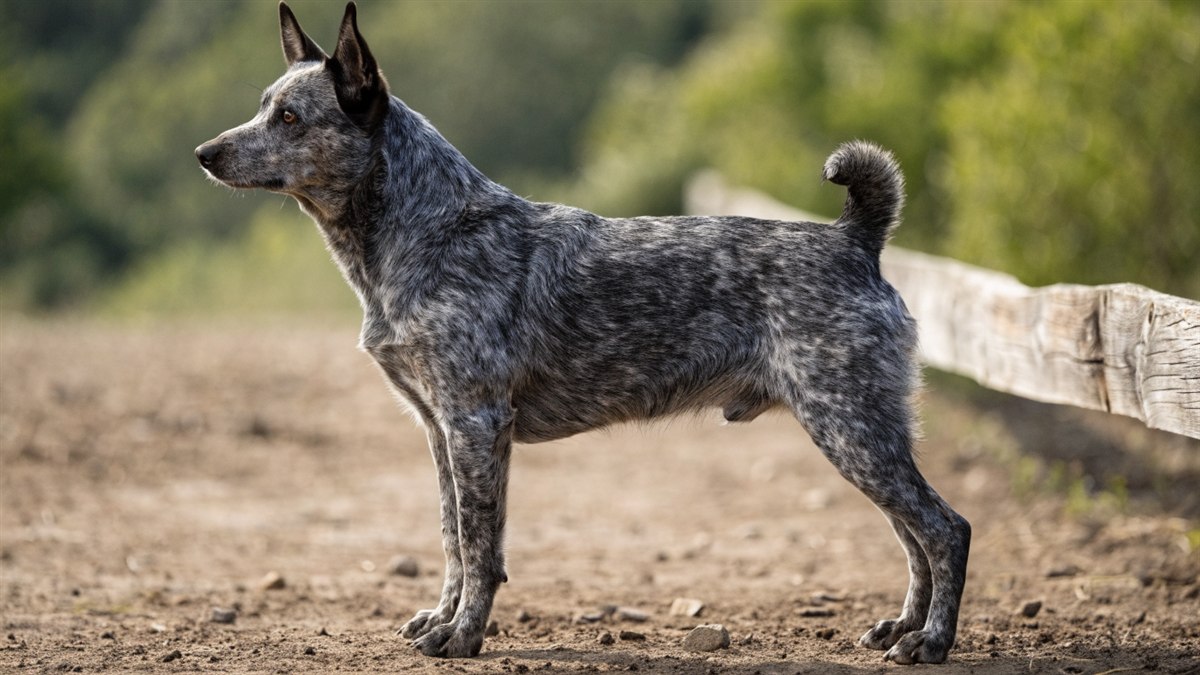
An Australian Stumpy Tail Cattle Dog is a medium Australian cattle-herding breed whose short tail is inherited, not cut. The Federation Cynologique Internationale gives it its own standard, number 351, separate from the Australian Cattle Dog's, and requires a tail that is undocked and naturally no longer than 10 cm. A docked tail is a disqualifying fault. Everything else on this page follows from those two clauses.
Start with the sentence the American Kennel Club puts at the top of its own breed page, because it is the single most useful line published about this breed anywhere. The Australian Stumpy Tail Cattle Dog is not an Australian Cattle Dog with a docked tail. He is a naturally bob-tailed breed and stands square with plenty of leg length under the body. Almost every misunderstanding an Indian reader will meet about this dog is a variation on the mistake that sentence corrects.
Separate breed or variety? What the registries' own documents say
It is a separate breed, and four independent registry documents say so in four different ways. This is worth settling first, because the ranking pages assert it without evidence and a reader has no way to check.
| Body | What its own document shows | What that establishes |
|---|---|---|
| Federation Cynologique Internationale | A standard of its own, FCI-Standard N 351, Group 1 Section 2 Cattledogs, origin Australia, with its own size, colour and tail clauses | A separate standard number. A variety shares its parent breed's standard and is distinguished inside it, as coat varieties are |
| Dogs Australia (ANKC) | A separate breed standard in Group 5 Working Dogs, and a separate line in the National Animal Registration Analysis, carried in every published series back to 1986 | Dogs registered under this breed are counted apart from Australian Cattle Dogs in the breed's own home country, and have been for four decades |
| American Kennel Club | Entered the Foundation Stock Service as its own breed at the May 2018 board meeting, alongside the Romanian Mioritic Sheepdog and the Slovakian Wirehaired Pointer | The AKC treats it as a breed seeking recognition in its own right, not as a tail variant of a breed it already recognises |
| Peer-reviewed veterinary genetics | A University of Queensland study of deafness in this breed refers to the Australian Cattle Dog as the separate, but likely related breed | Researchers who BAER tested 315 of these dogs treat the two as distinct populations, which is the operational test that matters |
The relationship to the Australian Cattle Dog is close and old, and nobody disputes that. What the documents rule out is the idea that a Stumpy is a Cattle Dog whose tail was shortened. Dogs NSW goes further and calls the Stumpy the original Australian working dog, developed before both the Australian Cattle Dog and the Australian Kelpie Dogs NSW breed page for the Australian…, which is a breed-body claim rather than a dated record, and Bonbeno reports it as such.
The standard, clause by clause
The FCI standard is short and unusually specific about the parts that matter here. Height is 46 to 51 cm at the withers for dogs and 43 to 48 cm for bitches, and dogs over or under those sizes are called undesirable. The standard sets no weight at all, which is why the weight figures on the ranking pages disagree: DogBreedsList gives 35 to 50 pounds, roughly 16 to 23 kg, with no source, and DogTime prints two different weight ranges on the same page, 38 to 45 pounds in one place and 35 to 51 pounds in another.
The body should be square, with the length from the point of the breastbone to the point of the buttocks equal to the height at the withers. That squareness is the outline difference a buyer can actually see against a Cattle Dog. The ears are moderately small, pricked and almost pointed, set on high yet well apart. The coat is a double coat: a moderately short, straight, dense outer coat of medium harsh texture over a short, dense, soft undercoat, with a mild ruff at the neck. Colour is either blue or blue mottled whole coloured, or an even red speckle including the undercoat.
| Clause | What the standard says | Why it matters to a buyer |
|---|---|---|
| Tail | Undocked, of a natural length not exceeding 10 cm (4 ins), set on high but not carried much above the level of the back | The whole breed rests here. A tail longer than 10 cm is a severe fault, and a docked tail is a disqualification |
| Size | Dogs 46 to 51 cm, bitches 43 to 48 cm at the withers. No weight given | Any weight figure you read anywhere comes from a source other than the standard |
| Proportions | Length from point of breastbone to point of buttocks equal to height at withers | A square outline, against the Australian Cattle Dog's longer-than-tall build |
| Colour | Blue or blue mottled whole coloured, or an even red speckle including the undercoat | Tan markings are a disqualifying fault, and the tan points normal on an Australian Cattle Dog are not permitted here |
| Severe faults | Tail exceeding 10 cm, brown or flesh nose, pink eye rims, white or cream coat colour, undershot or overshot jaws | A long-tailed puppy from a Stumpy litter is a real and lawful dog. It is simply not a show dog |
| Disqualifying faults | Aggressive or overly shy temperament, any dog clearly showing physical or behavioural abnormalities, docked tail, tan markings | The registry that recognises this breed disqualifies the surgery that Indian pages assume produced it |
The FCI files this breed in Group 1, Sheepdogs and Cattledogs, Section 2 Cattledogs, without working trials. Dogs Australia files it in Group 5, Working Dogs. Those are two different group numbering systems, not two opinions about the dog. Do not read an Australian Group 5 label as contradicting the FCI's Group 1.
History, and the part of it that does not add up
The FCI standard carries the breed's own history and it is refreshingly frank that the origin is disputed. It records two schools of thought about the founder. In the first, Thomas Simpson Hall cross-mated Northern English herding dogs, Smithfields, with the indigenous Australian Dingo. In the second, a drover named Timmins of Bathurst, New South Wales, mated a Smithfield with the Dingo in 1830 and produced red bobtails. Those dogs were great workers but proved too severe on the stock, so a smooth-haired blue merle Collie was introduced.
The standard then attributes each trait to a founder. The Smithfield introduced the natural bob-tail, the Dingo the red colouring as well as a natural acceptance of the harsh outback conditions, and the blue colouring came from the blue merle Collie. The name is recent: in 2001 this long-standing breed was renamed the Australian Stumpy Tail Cattle Dog.
Here is the part no breed page mentions. The University of Queensland team that studied deafness in 315 of these dogs looked at the same origin story and found a problem with it. Congenital deafness in the Stumpy is not easy to reconcile with an origin from the smooth-haired blue merle Collie, they wrote, because the Stumpy does not show the merle colouration or the white head patches associated with increased deafness risk. That is a genuine tension between a breed standard's historical summary and a peer-reviewed observation, and Bonbeno prints it rather than choosing a side.
How rare is it, in numbers
Very rare, and the figures come from the breed's own national kennel body rather than from anybody's impression. Dogs Australia publishes a National Animal Registration Analysis and the Australian Stumpy Tail Cattle Dog has its own line in it.
| Year | Stumpy Tail Cattle Dog | Australian Cattle Dog | Australian Kelpie |
|---|---|---|---|
| 2000 | 230 | 1318 | 269 |
| 2010 | 132 | 1133 | 196 |
| 2018 | 48 | 998 | 196 |
| 2022 | 165 | 749 | 183 |
| 2024 | 95 | 397 | 99 |
| 2025 | 86 | 504 | 123 |
| Total 2000 to 2025 | 3,194 | not totalled here | not totalled here |
Read the last row twice. Across the twenty-six years from 2000 to 2025, Dogs Australia registered 3,194 Australian Stumpy Tail Cattle Dogs in total Dogs Australia, National Animal… Dogs Australia, National Animal…. In 2025 the figure was 86, which is about one percent of the 8,656 dogs registered in the whole of Group 5 that year. The peak in this window was 230, in 2000.
State the caveat honestly in both directions. Against reading these as a population count, a registration statistic counts dogs entered with one show registry in one country, and a working breed can exist in numbers outside it, as the Kelpie visibly does. Against dismissing them, every breed in the table is measured the same way by the same body in the same year, so the ratio is meaningful even if the absolute number is a floor: in 2025 Dogs Australia registered about six Australian Cattle Dogs for every Stumpy. Note also that Group 5 as a whole fell from 13,941 registrations in 2021 to 8,656 in 2025, so part of the Stumpy's recent decline is a group-wide trend rather than a breed-specific collapse.
A breed that registers fewer than a hundred dogs a year in its home country does not have an export market, a global breeder network or an Indian supply chain. The price section below states the Indian position plainly and evidences it from Indian import law rather than from an empty search result. If you are reading this page because you saw an Australian Stumpy Tail Cattle Dog advertised in India, read that section first.
Australian Stumpy Tail Cattle Dog price in India, and the honest answer
There is no Australian Stumpy Tail Cattle Dog price in India, because there is no Australian Stumpy Tail Cattle Dog market in India. Bonbeno could not find a single Indian listing, breeder, kennel or rupee figure for this breed. That is not a gap in our research. It is the finding, and three primary documents explain why it is the expected one.
Say the conclusion first and then evidence it, because a reader who has been quoted a price by a seller deserves to know what they are actually being sold. No lawful commercial supply chain for this breed can form in India, and that follows from Indian import law, from the breed's registry position, and from how few of these dogs exist anywhere.
Reason one: Indian import law forecloses it
Live dogs enter India under ITC (HS) 01061900, Mammals, Other, and the import policy for that line is Restricted. The Directorate General of Foreign Trade set out what that means in Trade Notice No. 22/2022-23 of 19 December 2022, which Bonbeno read in full rather than in summary. Policy Condition 7 permits the import of dogs for exactly three purposes: a pet dog with a valid pet book and relevant records in the name of the importer, dogs imported by research and development organisations with the recommendation of CPCSEA, and internal security use by the Defence and Police Force.
Policy Condition 8 then closes the commercial door explicitly. Import of commercial dogs for breeding or any other commercial activities other than the purposes mentioned above is not permitted. Paragraph 6 of the same notice is blunter still: any applications for trading or breeding purposes, or applications made on behalf of some another person or entity, shall be duly rejected. Entry is confined to the airports and seaports of Delhi, Mumbai, Chennai, Hyderabad, Bengaluru and Kolkata and, since October 2024, Kochi airport Department of Animal Husbandry…. The full route is set out in how to import a dog to India.
The one route that does exist is a personal one. Up to two pets may come as passenger baggage without a DGFT authorisation, but only for a person transferring residence to India after two years of continuous stay abroad. Anything else, including a shorter stay abroad or a pet not travelling as baggage, needs an import authorisation from DGFT, applied for on ANF-2M, with the notice advising owners to start at least two months before travel and to obtain an advance No Objection Certificate from the quarantine officer seven days before the date of travel.
A breeder cannot lawfully import breeding stock of this breed into India, so no Indian bloodline can be founded. The only lawful arrival is a family returning from abroad with their own dog, already theirs, on their own paperwork. If someone in India offers you an Australian Stumpy Tail Cattle Dog puppy, ask which of the three permitted purposes their foundation stock entered under and ask for the import authorisation number. There is no fourth answer.
Reason two: no Indian registry route exists to verify one
The Kennel Club of India is India's Federation Cynologique Internationale member body. In principle that connects India to the FCI nomenclature, and the Australian Stumpy Tail Cattle Dog is in that nomenclature, as standard 351. In practice two things block the route.
First, the breed's FCI recognition is only provisional. It was accepted on a provisional basis on 6 July 2005 and it is still on the provisional list twenty-one years later, alongside nineteen other breeds. The FCI states on that same list that breeds recognised on a provisional basis are not eligible for the CACIB until they are recognised on a definitive basis. A provisional breed is a real breed with a real standard, but it cannot compete for the FCI's international championship certificate, which removes most of the reason a show-oriented registry in a new country would bother to build a register for it.
Second, the Kennel Club of India publishes no list of recognised breeds on its own website. Checked on 20 August 2026, the site offers registration, litter registration, prefix and affix forms and judge contracts, and no breed register a reader can search. So Bonbeno cannot tell you that KCI does register this breed, and cannot tell you that it refuses to. What we can tell you is that no published document we could open shows a route, and that a seller claiming KCI papers for this breed should be asked to produce the certificate itself with a registration number you can put to the club.
Reason three: there are barely enough dogs to supply Australia
Dogs Australia registered 86 Australian Stumpy Tail Cattle Dogs nationally in 2025 and 95 in 2024. A breed producing under a hundred registered dogs a year in its country of origin has no exportable surplus. For comparison, the Australian Cattle Dog registered 504 in the same year and the Australian Shepherd 1,199. The scarcity is not an Indian problem. It is the breed's global situation, and India is simply at the far end of it.
What an Indian search actually returns instead
Searches for this breed from India return the Australian Cattle Dog. The clearest example is Asia Pets, whose page is titled Australian Cattle Dog Puppies for Sale in India and whose every heading offers the Australian Cattle Dog. The Australian Stumpy Tail Cattle Dog is not mentioned anywhere on it. That is the pattern across the India-facing results we opened: the query gets absorbed into the better-known relative.
This matters more for this breed than for most, because the two dogs are genuinely similar and the difference a buyer would check first, the tail, is exactly the thing a seller can misrepresent. An Australian Cattle Dog puppy whose tail has been docked will look like a Stumpy to someone who has only seen photographs. Tail docking is forbidden in India under Second Schedule Part II para 6(8) of the Prevention of Cruelty to Animals (Dog Breeding and Marketing) Rules 2017, so a short-tailed puppy offered here is either a lawfully bred natural bobtail, which the supply argument above makes very unlikely, or evidence of an offence.
Every published price figure we could open, and how far apart they are
Only one page on the ranking set publishes a price at all, and it carries no source.
| Source | Figure published | Currency | Source cited for it | What it is actually evidence of |
|---|---|---|---|---|
| DogBreedsList | 500 to 1000 | US dollars | None | A global template figure. The same page gives no Indian data and no method |
| PetMD | No price published | n/a | n/a | The fullest care page on the SERP declines to price the breed at all |
| Royal Canin | No price published | n/a | n/a | A pet-food manufacturer's breed page with no commercial figures |
| Asia Pets, India-facing | No rupee figure, and a different breed | n/a | n/a | The Indian result for this query is an Australian Cattle Dog sales page |
| Kennel Club of India | No breed list, no fee schedule for this breed | n/a | n/a | No Indian registration cost can be quoted because no Indian route is published |
Bonbeno will not convert the USD 500 to 1000 figure into rupees and print it as an Indian price. Doing that is how a made-up number enters the internet. It is a single uncited claim on one aggregator page about a market on another continent, and it says nothing about what anyone in Pune or Kochi would pay, because nobody in Pune or Kochi is buying this dog.
There are exactly two honest paths. The first is that you are moving to India after two years or more abroad and already own the dog, in which case the DGFT baggage route applies and you should read Trade Notice 22/2022-23 yourself before you book anything. The second is that you want what this breed does rather than what it is called, in which case the Indian Pariah Dog gives you a hardy, heat-adapted, medium working dog for the cost of a vet check, and the comparison section below sets the two side by side. Neither path involves paying a deposit to an Indian seller for a breed with no Indian supply chain.
Monthly cost of keeping one in India, honestly bounded
Budget the Indian medium-breed band, Rs 6,000 to Rs 10,000 a month, and treat every line of it as an estimate imported from other breeds rather than measured on this one. Supertails, India's most-cited price list, puts medium-breed monthly upkeep at Rs 6,000 to Rs 10,000, covering food, vet visits, vaccinations, grooming, training, treats and toys, and flea and deworming. No cost figure specific to the Australian Stumpy Tail Cattle Dog exists in India, because no Australian Stumpy Tail Cattle Dog is known to be kept here.
Treat the whole cost of ownership question here as an estimate transferred from breeds of the same size, because that is exactly what it is. Two things make that band a defensible starting point and one thing makes it uncertain, so take all three.
It is defensible on size. The FCI standard puts this dog at 46 to 51 cm at the withers for a male, and Royal Canin India classifies the breed as Medium. Royal Canin India's own Medium Adult dry food is formulated for adult medium breed dogs from 11 to 25 kg, which brackets every published weight claim for this breed, including DogBreedsList's 35 to 50 pounds, roughly 16 to 23 kg. So the food line, the biggest single cost, sits squarely in the medium band.
It is defensible on coat. The breed has a moderately short outer coat over a short, dense undercoat, with a mild ruff and short hair on head, legs and feet. Dogs NSW says a weekly brush is all that is needed and a bath when necessary. That is the low end of the grooming line, not the high end, which is why Bonbeno would budget nearer the bottom of the band on grooming and nearer the top on parasite control.
It is uncertain because Supertails' 40-breed list contains neither the Australian Stumpy Tail Cattle Dog nor the Australian Cattle Dog. The band is a size-category figure, not a breed figure, and no Indian source has ever costed this breed.
| Cost line | What drives it for this breed | Confidence in the figure |
|---|---|---|
| Food | A working-bred medium dog of roughly 16 to 23 kg. Royal Canin India's Medium Adult range covers 11 to 25 kg and sells in 4 kg, 10 kg and 15 kg packs | Reasonable. The size category is right, though the exact daily gram figure is not published on the India product page and Bonbeno will not guess one |
| Vaccination and routine vet | The same as any medium dog. Nothing about this breed changes the core schedule | Reasonable, inside the medium band |
| Parasite control | Higher than the band assumes. 278 of 525 dogs surveyed across four Indian sites carried ticks, and 261 of 525 were PCR positive for at least one tick-borne pathogen | Direction confident, rupee figure not published. Budget above the band's midpoint |
| Grooming | Low. Weekly brush, bath as needed. No professional clip, and the coat must never be shaved | Confident that it is low, no Indian figure exists |
| BAER hearing test for a puppy | The one breed-specific cost, and it may be unavailable. The breed club states that BAER requires specialised equipment not available through regular veterinarians | No Indian price. Bonbeno could not find a published Indian BAER service and does not claim one exists or does not |
| Eye certification | Dogs NSW notes prcd-PRA occurs in the breed and that bi-annual eye certificates from a canine ophthalmologist help identify other anomalies | No Indian price published |
| Exercise-related costs | A long-line, a secure area and, in most Indian cities, the fuel or fare to reach one. A herding dog with no outlet is the expensive failure mode, not the food bill | Not costable, and not optional |
The cost line nobody puts in a budget
The largest financial risk with this breed in India is not a bill, it is a mistake. A herding dog bought by a household that cannot give it work is the dog that gets rehomed at eleven months, and rehoming a breed with no Indian population means no breed rescue exists to take it. That is not a rupee figure and it is more important than any of them.
The second largest is a purchase that was never this breed. If you pay a premium for an Australian Stumpy Tail Cattle Dog in India and receive a docked Australian Cattle Dog or a crossbreed, you have paid for a name. Tail docking is forbidden under Second Schedule Part II para 6(8) of the 2017 Rules, so a short-tailed puppy sold here is either a lawfully bred natural bobtail, which is improbable for the supply reasons set out above, or a dog that has been mutilated. Neither outcome is worth a premium.
The Kennel Club of India registered 33,880 pure-bred dogs with its studbook in 2025, down from 89,571 in 2021. The FCI publishes no breed-level breakdown for India, so nobody, including us, can tell you how many dogs of any given breed are registered here. When a seller tells you a breed is popular in India, ask what they are counting.
Can it handle the Indian climate? Heat tolerance rated 3 of 5
Bonbeno rates the Australian Stumpy Tail Cattle Dog 3 out of 5 for heat tolerance in India, and the rating is built from four mechanical facts rather than from the breed's outback reputation. Its ancestry is dry-heat ancestry, its coat is short over a dense undercoat, its body mass sits in a favourable band, and its working temperament pushes it straight into the exact activity pattern that causes three quarters of heat-related illness. The first three earn the points. The fourth caps them.
The three mechanical reasons it earns 3 rather than 1 or 2
Reason one, mass. The largest study of heat-related illness in dogs measured 395 confirmed events among 905,543 dogs under primary veterinary care in the UK in 2016. Odds rose with bodyweight: dogs of 10 to under 20 kg carried 1.82 times the odds of dogs under 10 kg, dogs of 20 to under 30 kg carried 2.13 times, and dogs of 50 kg and over carried 3.42 times. This breed sits in the 16 to 23 kg range on every published estimate, so it lands in the 1.82 to 2.13 band, not the 3.42 band. The mechanism behind that gradient is geometric: dogs with high body mass or compact physiques have a lower surface area-to-volume ratio, which reduces their ability to dissipate excess heat. A 20 kg dog sheds heat more easily than a 55 kg one because it has proportionally more skin per kilogram of body to cool.
Reason two, muzzle. Nine breeds carried significantly raised odds in that study, headed by the Chow Chow at 16.61 and the Bulldog at 13.95, with the French Bulldog at 6.49 and the Pug at 3.24. Those are flat-faced or heavily coated dogs. No cattle-herding breed appears on the list. A dog whose main cooling route is panting needs an airway that works, and the FCI standard describes deep powerful jaws tapering to a blunt strong muzzle, which is a normal working muzzle. Panting is the predominant cooling mechanism once ambient or body temperature rises, and it works by evaporating water from the respiratory tract, the nasal turbinates, the sinuses and the tongue.
Reason three, ancestry. The FCI standard's own history says the Dingo contributed the red colouring as well as a natural acceptance of the harsh outback conditions. That is not marketing, it is the recognising registry's account of what the breed was selected in. A dog whose founding population worked cattle in inland Australia is not a cold-weather dog wearing the wrong coat.
The two reasons it does not get 4 or 5
Cap one, the risk profile is exertional and this is a working dog. In the companion study of the same UK population, 1,259 heat-related illness events were identified from 1,222 dogs, and among events with a recorded trigger, exertion accounted for 652 of them, 74.2 percent, against 113 environmental, 12.9 percent, and only 46 from vehicular confinement, 5.2 percent. Exertional cases were fatal in 32 of 420, 7.6 percent. This breed does not lie down in the heat. It is described as ever alert, watchful and obedient, and it will work itself into trouble because that is what it was bred to do. The commonest way a Stumpy would die of heat in India is not being left in a car. It is a 5 pm walk in May that turned into a run.
Cap two, dry heat is not humid heat, and Indian coastal heat is humid. Panting sheds heat by evaporation, and evaporation slows as the surrounding air holds more water. Outback ancestry is an argument for tolerating 44 C in Jodhpur with 15 percent humidity. It is a much weaker argument for 34 C in Chennai in August with the air near saturation, because the cooling mechanism the dog relies on is the one humidity blunts. Bonbeno is stating that as a physical inference from the cited cooling mechanism, not as a measured finding in this breed, because no such measurement exists for this breed.
The same paper adds a second caution that applies directly to a dog flown in from Australia. Some dogs have adapted to hot environments, but those adaptations likely evolved under persistently warm rather than seasonally hot conditions, and limited seasonal acclimation reduces physiological resilience to sudden temperature increases. A dog arriving in Delhi in April has had no acclimation at all.
What the Indian heat season actually looks like
The India Meteorological Department declares a heat wave when a station's maximum reaches at least 40 C in the plains or at least 30 C in hilly regions. Heat waves typically occur from March to June and in some rare cases extend till July, on average five to six heat wave events occur every year over the northern parts of the country, and the peak month over India is May. That is a four to five month exposure window, not a fortnight.
| City type | Examples | Effective heat tolerance | What the owner must do |
|---|---|---|---|
| Dry inland plains, extreme peaks | Delhi, Jaipur, Nagpur, Ahmedabad | 3 of 5, the rating as given | All work before 07:00 and after 20:00 from March to June. Shade and water in the middle of the day. Never a midday run |
| Hot and humid coastal | Chennai, Mumbai, Kolkata, Kochi, Visakhapatnam | 2 of 5, one point lower | The panting route is compromised. Shorten every session, work only at the coolest hours, and treat heavy sustained panting that does not settle within a few minutes of stopping as an emergency |
| Deccan plateau, moderate | Bengaluru, Pune, Hyderabad | 4 of 5, one point higher | Manageable year round with early and late sessions. This is the easiest Indian environment for the breed |
| Hills and north | Shimla, Dehradun, Darjeeling, Srinagar | 5 of 5 | No heat constraint. The double coat is an asset here |
Second Schedule Part IV paragraph 21(1) of the Prevention of Cruelty to Animals (Dog Breeding and Marketing) Rules 2017 says that dogs not accustomed to the temperatures prevalent in the area or region in question, dog breeds that cannot tolerate those temperatures, and sick, infirm, aged or young animals shall not be kept in outdoor facilities unless that practice is specifically approved by the attending veterinary practitioner in writing. A dog imported from Australia is, on the face of it, a dog not accustomed to the temperatures prevalent here. If you plan to keep one in an outdoor kennel anywhere in the Indian plains, that rule is about you, and the written approval it requires is a good idea regardless of whether anyone enforces it.
Never shave the coat, and here is the mechanical reason
The double coat is not a blanket, it is a buffer. The standard requires a moderately short, straight, dense outer coat of medium harsh texture over a short, dense, soft undercoat. Shaving removes the layer that holds still air away from the skin and exposes skin that has never seen direct Indian sun. It is worth noting that the same morphology review found dogs with short smooth coats showed significantly higher surface temperatures than dogs with long or curly fur, likely due to reduced insulation and altered heat flux, which is the opposite of what most owners assume when they reach for the clippers. Brush the dead undercoat out instead, which is the correct way to cool the dog, and the grooming section below sets out how.
Stop the activity, move the dog into shade, wet the coat with cool water and phone a vet if you see any of these. One, panting that stays frantic for more than a few minutes after you stop. Two, a tongue and gums that look dark red or brick coloured rather than pink. Three, thick ropey saliva. Four, staggering, a wobbly hind end, or the dog sitting down and refusing to move. Five, vomiting or diarrhoea after exertion in the heat. Exertional heat-related illness killed 32 of 420 affected dogs in the UK series and Indian summers are hotter than British ones. Consult your nearby vet the same day rather than waiting to see if the dog settles.
Temperament, household fit, and who should not get one
The Australian Stumpy Tail Cattle Dog is a watchful, biddable, one-family working dog that is suspicious of strangers by design. The FCI standard describes a natural aptitude in the working and control of cattle, a loyal, courageous and devoted disposition, and a dog that is ever alert, watchful and obedient, though suspicious of strangers. Read that last clause as a specification rather than a warning, because it is what the breed was selected for.
Four traits define the household experience, and three of them cut both ways in an Indian home.
- Suspicion of strangers. Written into the standard and repeated in Dogs Australia's own characteristics clause. In a bungalow with a gate this reads as a good watchdog. In a Mumbai flat with a shared lift, a courier at the door twice a day and a building full of children, it reads as a management problem you will work on every week for years.
- Attachment to one household. PetMD describes Stumpies as Velcro dogs that prefer to be close to their people. That is a real asset for a family that is home a lot and a real liability for a household where the dog is alone from nine to seven.
- Biddability with independence underneath. The standard requires the dog to be obedient and, at all times, amenable to handling in the show ring. A dog bred to move cattle without a handler at its shoulder still makes its own decisions. It is trainable, not compliant.
- Working drive that does not switch off. This is the trait that decides whether the breed suits you, and the exercise section below quantifies it.
Herding behaviour in a household with children
A cattle dog controls stock by moving in close and using its mouth, and a dog with no cattle will practise on whatever moves. In an Indian home that means children running in a corridor, a cyclist on the society road, or the person carrying groceries. This is not aggression and it is not a training failure. It is the breed doing its job on the wrong species, and it needs redirecting the day it first appears rather than the month it draws blood.
Bonbeno rates the breed 3 of 5 with children, which is a deliberate middle. The dog is devoted and courageous with its own family. It is also mouthy at the ankles by inheritance and suspicious of the visiting children who are not its family. A household with a settled seven-year-old who understands the rules is a different proposition from one with a toddler and a rotating cast of cousins.
The temperament question nobody asks, and it is a hearing question
Assess the puppy's hearing before you assess its temperament. In this breed those two things are entangled, and no other breed page says so. A University of Queensland study BAER tested 315 Australian Stumpy Tail Cattle Dogs and found 56 deaf, 17.8 percent, of which 39 were deaf in one ear only. The breed club states plainly that puppies born deaf in one or both ears are difficult to detect at 8 weeks without a BAER test.
A unilaterally deaf dog behaves almost normally. It will still startle when approached from its deaf side, still fail to locate the direction a sound came from, and still look as though it is ignoring a recall it never heard. Every one of those looks like temperament and none of it is. If you are ever in a position to evaluate a puppy of this breed, treat an apparently stubborn or startle-prone one as a hearing question first.
| Household | Verdict | Why |
|---|---|---|
| Farm, orchard, plantation or large fenced property with daily work | Suits well | The breed was built for exactly this and nothing substitutes for it |
| House with a garden, an owner at home, and a real daily exercise habit | Suits, with effort | The drive still needs an outlet, but the space and the company are there |
| Second or third dog for an experienced handler who does scent work, obedience or agility | Suits | Structured work is the closest urban substitute for cattle |
| Metro apartment, both adults out at work | Does not suit | A watchful, mouthy, high-drive herding dog alone in a flat for ten hours is a welfare problem and a neighbour problem |
| First dog for a family that wanted a low-maintenance medium dog | Does not suit | The coat is low maintenance. Nothing else about the dog is |
| Household in India that has not verified the dog is this breed at all | Do not proceed | See the price section. There is no verified Indian supply and a docked Australian Cattle Dog is the likely substitute |
Breed standards describe the ideal specimen in the show ring, not the average dog in a flat. The FCI wording is that the Stumpy is ever alert, watchful and obedient, though suspicious of strangers, and that at all times it must be amenable to handling in the show ring. The second half of that sentence tells you the first half is a ring requirement. Do not buy a herding breed expecting the obedience clause to arrive pre-installed.
Training an Australian Stumpy Tail Cattle Dog, and what this breed resists
To train this breed, give the herding drive a job before you try to suppress it, and check the dog's hearing before you decide it is disobedient. Those two rules do more work than any technique. Everything else is ordinary reward-based training applied consistently, at the hours of day an Indian summer allows.
Rule one: the hearing check comes before the training plan
Test hearing first, because a fifth of this breed cannot hear normally and most of those dogs look normal. Of 315 Australian Stumpy Tail Cattle Dogs BAER tested in Queensland, 56 were deaf, 17.8 percent, and 39 of those 56 were unilaterally deaf. Unilateral deafness is invisible in a puppy pen. The breed club is explicit that puppies born deaf in one or both ears are difficult to detect at 8 weeks without a BAER test.
The consequences for training are concrete. A unilaterally deaf dog cannot localise sound, so it will look the wrong way when you call from the side and appear to ignore you. A bilaterally deaf dog will not respond to a verbal recall at all, ever, and must be trained on hand signals and a vibration collar rather than a verbal marker. If you train a deaf dog as though it can hear, you will conclude the breed is stubborn, and you will be wrong.
Bonbeno could not find a published list of Indian veterinary practices offering BAER testing, and the breed club notes that BAER needs specialised equipment not available through regular veterinarians. Where testing is not available, run a crude check yourself and repeat it weekly: with the dog awake but not looking at you, and from outside its field of vision, make a sharp sound from the left, then on another day from the right, and note whether the head turns toward the source or merely startles. This is not a diagnosis. It is a reason to ask a veterinary neurologist for a referral, and to train visually until you know. Consult your nearby vet before drawing conclusions about a dog's hearing.
Rule two: redirect the drive, do not suppress it
A dog bred to control cattle will control something. Give it an approved target from the first week, so it never has to invent one. Herding balls, a flirt pole, scent work, retrieve games with rules, and formal obedience all work because they are structured tasks with a start and a finish, which is the shape the dog is looking for.
What does not work is punishing the behaviour without replacing it. A heeler that is corrected for chasing a cyclist and given nothing else to do will find a different moving target next week. The behaviour is not a bad habit, it is the dog's occupation.
The socialisation window, and why the Indian version is harder
The socialisation window is the period in early puppyhood when new sights, sounds, surfaces and people are absorbed as normal rather than assessed as threats, and it closes long before the dog is fully grown. For a breed whose standard specifies suspicion of strangers, the window is the single most important training period in the dog's life, and it is when a manageable adult is made or missed.
Two Indian facts make it harder. The first is legal and practical: rule 8(1)(a) of the Prevention of Cruelty to Animals (Dog Breeding and Marketing) Rules 2017 provides that pups less than eight weeks in age are not sold, so a lawfully acquired puppy arrives with part of the window already spent in the breeder's care, which means you must ask what happened during it. The second is environmental: an Indian street presents far more novel stimulus per minute than a suburban Australian one, with horns, two-wheelers, loose dogs, cattle, festival firecrackers and crowds. Socialise to that density deliberately and in small doses, at the coolest hours, rather than hoping it happens by exposure.
- Weeks 8 to 12. Carry or walk the puppy on quiet edges of busy places rather than into them. Doorbell, lift, gate, delivery rider, and one calm adult stranger a day, each paired with food.
- Weeks 12 to 16. Add surfaces and sounds, including a two-wheeler starting up, a rolling shutter and a pressure horn at distance. Begin recall on a long line in a fenced space.
- Months 4 to 6. Introduce structured work. Start impulse-control games and a formal settle on a mat, which is the single most useful behaviour for a watchful dog in a flat.
- Months 6 to 12. Proof recall around moving stimulus, which for this breed means cyclists, joggers and children. Expect a regression during adolescence and train through it rather than around it.
- Year one onward. Keep a weekly working session for the rest of the dog's life. This breed does not retire from needing a job at two.
What this breed resists
It resists repetition without purpose. Ten identical sits will get you a dog that offers the sit before you ask and then disengages. Vary the task, keep sessions to five or ten minutes, and stop while the dog still wants more.
It resists heavy-handed correction, and the standard itself puts a floor under this: aggressive or overly shy temperament is a disqualifying fault, and shyness is exactly what coercive handling produces in a watchful breed.
It resists being trained only in the house. A dog that performs perfectly in the drawing room and not at all on the road has learned the room, not the behaviour. In Indian summer that means the training walk and the exercise walk are the same walk, taken before 07:00 or after 20:00, which is a scheduling constraint rather than a training one but ends up governing both.
How much exercise it actually needs, and when in an Indian day
Plan on two structured sessions a day totalling at least ninety minutes, and understand that duration matters less than task. The FCI standard describes a dog with sufficient substance to convey the impression of the ability to endure long periods of arduous work under whatsoever conditions may prevail, and calls capability of quick and sudden movement essential. That is a specification for stamina plus bursts, not for a stroll.
State the limitation of that number honestly. No kennel club publishes a daily exercise figure for this breed, and no study has measured one. The ninety minutes is Bonbeno's working recommendation derived from the standard's own description of the breed's job and from the breed's registered classification as a working dog in Group 5. Treat it as a floor for a healthy adult and adjust to the dog in front of you.
The Indian scheduling problem, and it is the whole problem
In most of India the hours a working dog most wants to run are the hours it must not. Heat waves run from March to June with May the peak month, and the plains criterion is a maximum of 40 C or more. Exertion is the trigger behind 652 of the heat-related illness events with a recorded cause in the largest UK series, 74.2 percent, against 46 from vehicular confinement, 5.2 percent. Put those two facts together and the schedule writes itself.
| Slot | Duration | Content | Season constraint |
|---|---|---|---|
| Before 07:00 | 40 to 50 minutes | Brisk walk with training built in, plus one burst activity such as a flirt pole or fetch with rules | March to June, move to before 06:30 and shorten the burst component |
| Midday | 10 minutes indoors | Scent games, food puzzles, a settle on a mat. Mental work, no running | Year round. In summer this replaces any outdoor time |
| After 20:00 | 40 to 50 minutes | Second walk, recall work on a long line, and structured herding-substitute play | In coastal humidity, shorten and check the dog's panting recovery before the last ten minutes |
| Twice a week | 60 to 90 minutes | A real task session: obedience class, agility, scent work, or genuine stock work if you have access | Cooler months only in the plains. This is what actually satisfies the breed |
Why a walk is not enough, mechanically
A cattle dog does not tire from distance, it settles from having completed a task. Walking a dog bred to herd for an hour and a half without asking it to solve anything produces a fitter dog with the same unmet drive, which is why owners report that more exercise made the problem worse. Add decisions to the session. Ask for a stay while a cyclist passes. Send the dog around a tree and back. Hide a toy and let it search. Ten minutes of that does more than thirty minutes of pavement.
What happens without it
The failure mode is predictable and it arrives between six and eighteen months.
- Nipping at moving people, because the drive found the only available target
- Barking at every sound through a shared wall, because a watchful dog with nothing to do watches harder
- Destruction of one specific object class, usually skirting boards, chair legs or the doormat, rather than random chewing
- Escalating reactivity on the lead, because the walk became the only outlet and the dog now arrives at it over threshold
- Rehoming at around eleven months, which for this breed in India means no breed rescue exists to catch the dog
Bonbeno rates apartment suitability 1 of 5 for this breed, which is the lowest rating we give. It is not about floor area. It is that a watchful, vocal, high-drive herding dog in a shared building has a stimulus arriving at the front door every twenty minutes and nowhere to take the resulting arousal. If you live in a flat and you want a medium working dog, the Indian Pariah Dog handles Indian apartment life and Indian heat far better, and the comparison section below sets out why.
Grooming a short double coat in Indian humidity
Groom this breed once a week with a slicker and an undercoat rake, and bathe only when the dog is actually dirty. Dogs NSW puts it in nine words: a weekly brush is all that is needed and a bath when necessary. The coat is genuinely low maintenance. In India the weekly brush is doing a second job that has nothing to do with appearance, and that job is the reason not to skip it.
What the coat actually is
The standard describes a double coat: a moderately short, straight, dense outer coat of medium harsh texture over a short, dense and soft undercoat, with the hair around the neck longer and forming a mild ruff, and short hair on the head, legs and feet. That is a weather coat built for dry heat and cold nights, not a show coat. A double-coated dog of this type sheds year round and heavily twice a year, and the undercoat is what comes out.
The Indian reason the weekly brush matters
In India the brush-out is a parasite inspection with a grooming benefit, not the other way round. A survey of 525 dogs across four Indian sites found 278 of them, 53 percent, infested with ticks, and 261 of 525, 49.7 percent with a 95 percent confidence interval of 45.4 to 54.1, PCR positive for at least one tick-borne pathogen. The individual pathogens were Hepatozoon canis at 30 percent, Ehrlichia canis at 20.6 percent, Mycoplasma haemocanis at 12.2 percent, Anaplasma platys at 6.5 percent, Babesia vogeli at 5.5 percent and Babesia gibsoni at 0.2 percent.
Those are not this breed's figures, and Bonbeno says so plainly: no tick-borne disease study has ever sampled an Australian Stumpy Tail Cattle Dog in India, because there are none here to sample. What the figures establish is the ambient risk any dog in India lives inside, and a dense short undercoat hides an attached tick completely until it has fed. Run your fingertips, not just the brush, through the ruff, behind and inside the ear leathers, in the armpits, between the toes and around the tail base every week.
| Step | Frequency | Why it is on this list |
|---|---|---|
| Slicker brush over the whole coat, then undercoat rake through the ruff and hindquarters | Weekly, twice weekly in shedding season | Removes dead undercoat, which is what traps heat and moisture. This is the correct alternative to clipping |
| Fingertip tick check: ruff, ears, armpits, groin, between toes, tail base | Weekly, and after any walk in long grass | 53 percent of surveyed Indian dogs carried ticks |
| Ear check, looking and smelling, not poking | Weekly | The standard gives pricked, almost pointed ears well furnished with hair on the inner side. An erect ear canal ventilates far better than a dropped one, which is a genuine advantage in a humid climate, but hair inside the leather still holds moisture |
| Dry thoroughly after any bath or rain, especially the ruff and the tail base | Every time | Monsoon humidity means a dense coat left damp stays damp. Towel first, then a cool blow-dry or a fan, never leave the dog to drip dry indoors |
| Nails | Every 3 to 4 weeks | The standard calls for nails strong, short and of dark colour. A working dog on Indian tarmac wears them less evenly than one on paddock ground |
| Bath | Only when dirty, and rarely | Frequent bathing strips the coat's weather resistance and adds a drying problem in the monsoon |
The tail, and what to check on it
This breed's tail is a natural stump of no more than 10 cm carried close to the level of the back. It is skin, hair and a short run of caudal vertebrae, not a surgical stump, and it does not require special care. Two practical points still apply in India.
First, the area under and around a short tail is a warm, poorly ventilated pocket in humid weather, which makes it a place moisture and debris collect. Include it in the weekly check and dry it after rain.
Second, and this is the reassuring part, published radiographic work on natural bobtails in another breed found no congenital spinal defects in any of 19 adult short-tailed dogs examined. The health section below sets out exactly what that study did and did not measure, and why the finding transfers to this breed only as a parallel rather than as evidence.
This is the single most common grooming mistake made with imported double-coated breeds in India and it is made with the best intentions. The outer coat holds a layer of still air off the skin and shields skin that has no pigment protection against direct sun. Removing it does not cool the dog reliably, and one 2025 morphology review found that dogs with short smooth coats showed significantly higher surface temperatures than dogs with longer fur, likely due to reduced insulation and altered heat flux. Rake the dead undercoat out instead. If a groomer offers a summer clip for this breed, decline it.
Health: the bobtail gene, the deafness data, and what nobody has measured
Two health questions matter for this breed and only one of them has been properly measured in it. The measured one is congenital deafness: 56 of 315 Australian Stumpy Tail Cattle Dogs BAER tested in Queensland were deaf, 17.8 percent. The unmeasured one is the tail. The canine bobtail variant is TBXT c.189C>G and the genetics database of record lists this breed against that phene, but no published per-breed genotype count for the Stumpy could be opened, and Bonbeno will not manufacture one.
Part one: what the canine bobtail variant actually is
The gene is TBXT, formerly called T, which encodes the transcription factor Brachyury, and in dogs it sits on chromosome 1. Haworth and colleagues cloned the dog homolog of the T gene, mapped the locus, and identified a unique missense mutation in a bob-tailed dog and its bob-tailed descendants, situated in a highly conserved region of the T-box domain, which alters the ability of the T protein to bind to its consensus DNA target. The breed they worked in was the Pembroke Welsh Corgi.
OMIA records the variant as NM_001003092.1:c.189C>G, protein change p.(I63M), a missense substitution, first reported in 2001, with the mode of inheritance given as autosomal dominant, early embryonic lethal when homozygous, and the phene flagged disease-related.
You will see this variant written as C189G and as C295G, and they are the same change. Haworth's group described a C to G mutation at position 295 in exon 1 of the T gene. Indrebo's group, working on the same variant, noted that the mutation is located at base pair 189 according to the published GenBank sequence, reference gi10636209. OMIA files it as c.189C>G against the reference transcript. Different numbering conventions, one mutation. If a laboratory report says C295G, it is testing the same thing as one that says C189G.
Part two: has this breed actually been genotyped? The honest answer, in three layers
The variant is documented in this breed in the reference database, the primary per-breed counts could not be opened, and the largest population-scale dataset never sampled the breed at all. Those three statements are all true at once and a reader deserves all three, because the confident sentence you will read elsewhere, that the Stumpy's tail is caused by the T-box mutation, rests on a paper almost nobody quoting it has opened.
| Source | Design and sample | What it shows for this breed | Sampling limits, both ways |
|---|---|---|---|
| OMIA:000975-9615, University of Sydney | Curated reference database, not new data. Record checked 20 August 2026 | Names the Australian Stumpy Tail Cattle Dog among the breeds in which the bob-tail phene or its likely causal variants have been documented. Mode of inheritance autosomal dominant, early embryonic lethal when homozygous. Associated gene TBXT | Against over-reading: OMIA records that a phene or variant has been documented in a breed, not how common it is, and it publishes no frequency. Against dismissal: this is the database veterinary geneticists cite, it is curated from the published literature, and it did not create a separate record for this breed |
| Hytonen et al., Journal of Heredity, 2009 | Sequenced the T gene coding regions in 360 dogs across 23 breeds, including 156 naturally short-tailed dogs | Found C189G in 17 breeds with a perfect correlation between the mutation and the short-tail phenotype, and found no T gene coding mutation at all in 6 breeds. The abstract does not name which breeds fell on which side | Against relying on it for a number: Bonbeno could not open the paywalled Table 1, so we can publish no sample size, no count and no allele frequency for this breed and we publish none. Against dismissing it: the paper is the source of every breed list in circulation, and the reference database that names this breed was built partly from it |
| Dreger et al., PLoS ONE, 2019 | Commercial panel genotypes from 11,790 dogs representing 212 breeds and 4 wild canine species, including the T locus | Reports that the T allele had previously been investigated in breeds known to have the natural tailless phenotype, confirming the cause of the trait in 18 breeds, and reports the allele in 38 further breeds. The tailless allele was detected in 48 breeds, with greatest frequencies in the Tenterfield Terrier (30 percent), Swedish Vallhund (18 percent), Spanish Water Dog (14 percent) and Australian Shepherd (13 percent), the remaining 44 breeds carrying it at under 10 percent. The Australian Shepherd was represented by 137 dogs. The paper cautions that its data provides information regarding the existence of particular alleles within breeds but is not likely to be a perfectly accurate estimate of actual breed-wide allele frequencies. Neither the string Stumpy nor the string Cattle Dog appears anywhere in the published article text | Against reading anything into the absence: a breed registering under a hundred dogs a year in Australia would not appear in a North American commercial panel dataset, so this is an absence of sampling, not an absence of the variant. In its favour: it is the largest T locus dataset published and it independently confirms the 18-breed count, one founding breed plus the 17 |
| Indrebo et al., J Small Anim Pract, 2008 | 19 adult natural short-tailed dogs radiographed, plus 2 tailless newborns necropsied and genotyped, plus parents and siblings. All Pembroke Welsh Corgis | Nothing directly. It examined no Australian Stumpy Tail Cattle Dogs. Its value here is mechanistic, because it is the only study anywhere that describes dogs homozygous for this variant | Against transferring it: a different breed, a different gene pool, 19 dogs. In its favour: the variant is the same variant, and no equivalent study exists in any bobtail breed |
| The ranking pages Wikipedia, Australian Stumpy Tail Cattle… PetMD breed page for the Australian Stumpy… | Not studies | DogTime calls the tail the result of a genetic mutation and names no gene. Wikipedia calls the short or absent tail an inherited defect and cites two T-box papers without saying which variant or which breed. PetMD says only that not all Stumpies even have stumps for tails | Against taking any of them as evidence: none cites a per-breed result. In their favour: PetMD's observation that long-tailed dogs occur in the breed is correct and it is the observable consequence of a heterozygous dominant, which the next section explains |
The Australian Stumpy Tail Cattle Dog is listed in the reference database against the canine TBXT bob-tail phene, and there is no published population frequency for the variant in this breed. Anyone who tells you what percentage of Stumpies carry C189G is telling you something no source supports. Note also that the paper behind the breed lists is titled for its negative result: the ancestral T-box mutation is present in many, but not all, short-tailed dog breeds, and 6 of the 23 breeds it tested carried no T gene coding mutation at all. A natural bobtail is not automatically a TBXT bobtail.
Part three: is the homozygous form lethal? Yes, and here is the whole canine evidence chain
Yes. In dogs, two copies of the bobtail variant are lethal in almost every case, and the small number of affected puppies that reach birth are gravely malformed. Four independent lines of evidence say so, and they are all in dogs. Bonbeno is labelling that explicitly because a parallel finding exists in cats and the two literatures must not be mixed.
- No homozygotes found in the founding study. Haworth's group analysed offspring from several independent bobtail by bobtail crosses and concluded that the homozygous phenotype is embryonic lethal. Indrebo's group, reporting the same work, records that all 13 short-tailed puppies from four independent short-tail by short-tail crosses were heterozygous, that the long-tailed puppies did not carry the mutation, that no homozygotes were found, and that the result was significant at P = 0.0045.
- No homozygotes found across 23 breeds. Hytonen's group examined 360 dogs including 156 naturally short-tailed animals and found no dog homozygous for C189G, which they took as evidence that the homozygous condition is lethal.
- A measurable hole in the litters. In the Swedish Vallhund, litter size fell by 29 percent when both parents were short tailed. That is the arithmetic signature of losing roughly a quarter of conceptions, which is what a recessive lethal does in a heterozygote by heterozygote mating.
- The two homozygous puppies that were born. Indrebo's group reported the first dogs anywhere confirmed homozygous for the mutation. Two tailless puppies from two litters of the same short-tail by short-tail pairing were genotyped GG. Both had anorectal atresia and multiple spinal defects. One was born alive and euthanased; the other was effectively stillborn. In those two litters of ten puppies in total, two were long-tailed and genotype CC, six were short-tailed and heterozygous, and two were tailless homozygotes.
OMIA's summary line is the one to remember, and it is the same conclusion by a different route: autosomal dominant, early embryonic lethal when homozygous.
Carrying one copy of this variant appears to do nothing except shorten the tail. Indrebo's group radiographed the cervical, thoracic, lumbar and sacral vertebral column plus the tail of 19 adult short-tailed dogs, all from short-tail by long-tail crossings and therefore presumed heterozygous, and diagnosed no congenital spinal defects in any of them. Their conclusion was that the only effect of the T-gene in heterozygotes is a short tail, and that they could see no ethical problem in a short-tail by long-tail mating. Two caveats stand: that was 19 dogs of a different breed, and the study did not genotype them. Nobody has done the equivalent work in the Australian Stumpy Tail Cattle Dog.
The feline parallel, and why you must not carry a number across it
Short-tailed cats have their own TBXT story and Bonbeno has published it in detail on the American Bobtail page. It is a separate literature and the figures do not transfer in either direction. The feline variants are frameshift deletions in TBXT that segregate in Manx pedigrees, they are associated with a spinal syndrome that has no canine equivalent on this scale, and the per-breed counts published for cats say nothing whatever about a dog.
The structural parallel is real and worth naming as a parallel. In both species the gene is TBXT, in both the short tail behaves as a dominant, and in both the homozygous state is reported as lethal before birth. What differs is the specific variant, the clinical picture in heterozygotes, and the evidence base. If you take one thing from the comparison, take the method rather than the number: on the cat page the same discipline of tabulating what each study measured, with sample sizes and sampling bias stated both ways, produced a conclusion that contradicted the breed club's own account. Applied here, the same discipline produces a smaller and more cautious conclusion, because there is far less canine data on this specific breed.
What the lethal homozygote means for breeding, and the Indian legal twist nobody has written about
The practical consequence is that a responsible mating in this breed is bobtail by long tail, not bobtail by bobtail. That produces roughly 50 percent short-tailed offspring, loses no conceptions, and is the mating the only study of homozygotes explicitly endorsed. It also produces long-tailed puppies, which is why PetMD is right that not all Stumpies even have stumps for tails.
Now put those long-tailed puppies in India, and three separate rules collide in a way that applies to no other breed on this site.
| Rule | What it says | Consequence for a long-tailed puppy in an Indian Stumpy litter |
|---|---|---|
| FCI-Standard 351 | A tail exceeding 10 cm is a severe fault. A docked tail is a disqualifying fault | The dog cannot be shown as it is, and it cannot be made showable by surgery either, because the surgery is itself a disqualification |
| Second Schedule Part II para 6(8), Dog Breeding and Marketing Rules 2017 | There shall be no tail docking, ear cropping, de-barking, de-clawing, branding, dyeing, injecting substances to enhance visual appeal or any other kind of mutilation of any body part of the pup, and any change of appearance by artificial means is strictly forbidden | Docking the puppy to make it look like the breed is an offence in India, and the temptation to do it is created by the breed's own defining trait |
| Second Schedule Part II para 6(3), same Rules | In breeding, defined as breeding between relatives of the 2nd to 4th grade within the first four generations, and incest breeding, between 1st grade relatives, are both prohibited | A breed registering 86 dogs a year in its home country has a small gene pool. Any Indian breeding programme built on a handful of imported dogs would run straight into this prohibition |
There is a wider point buried in that table, and one large genetics study makes it explicitly. As surgical docking bans spread, breeders select for natural bobtails instead, and the authors of the 11,790-dog panel study expect T allele frequencies to increase over time in breeds in countries that ban docking. Indrebo's group had already observed the same pressure, noting that because tail docking is forbidden in many countries, breeding Pembroke Welsh Corgis with natural short tails is becoming increasingly common. India bans docking. Anyone thinking about the long-term effect of that ban on breeds with a docking tradition should read this breed as the worked example of where it leads, including the lethal homozygote at the end of it.
Congenital deafness: the one condition properly measured in this breed
Deafness is the Australian Stumpy Tail Cattle Dog's real, quantified health problem, and it is the figure no ranking page publishes. A University of Queensland team BAER tested 315 of these dogs, recruited through the Queensland Canine Control Council and participating breeders in Queensland and New South Wales, using an agreed protocol and one testing system.
| Finding | Figure | What it means |
|---|---|---|
| Dogs BAER tested | 315 | The largest hearing dataset on this breed anywhere |
| Deaf in one or both ears | 56 (17.8 percent) | About one dog in six |
| Bilaterally deaf | 17 | Roughly 30 percent of the deaf dogs, about 5 percent of all dogs tested |
| Unilaterally deaf | 39 | Roughly 70 percent of the deaf dogs, and the group that looks normal without a test |
| Left versus right bias in unilateral cases | None significant, p = 0.19 | Not a handling or environmental artefact |
| Difference between the sexes | None significant, p = 0.18 | Not sex linked |
| Penetrance | 0.72 | Estimated directly from the ratio of unilaterally to bilaterally deaf dogs |
| Red coat and deafness, without accounting for pedigree | Red dogs 1.8 times more likely to be deaf, p = 0.045 | A weak association on its own |
| Red versus blue coat and deafness, within family | p = 0.00036, correlation 0.48 | A strong within-family association, which is the more reliable test |
| Coat speckling and deafness | p = 0.07 | Approaching significance, limited by only four families co-segregating for both |
Their conclusion was that congenital sensorineural deafness in this breed is an autosomal recessive disease trait with incomplete penetrance, and that the locus for the disease, the red coat and probably the speckled coat pattern all map to CFA10, canine chromosome 10.
The second deafness study, and where it disagrees with the first
Eleven years later a second team went back to the same breed and reached a different chromosome. This is a genuine disagreement in the literature on this breed, it has never been written up for a lay audience, and two authors are shared between the papers.
Xu and colleagues ran a genome-wide association study using 3 bilaterally deaf Australian Stumpy Tail Cattle Dogs, 43 herding dogs and one unaffected Stumpy, plus whole genome sequencing of the same three affected dogs and one unaffected. They found 13 significantly associated loci across six chromosomes, CFA3, 8, 17, 23, 28 and 37, with the most significant association on CFA37, which also carried 7 of the 13 loci. CFA10, the chromosome the 2010 linkage study identified, is not among them.
From the sequencing they filtered to four missense variants present only in affected dogs, discarded one on functional grounds, and put forward a variant in KLF7, Kruppel-like factor 7, at NC_006619.3:g.15562684G>A, protein change p.Leu173Phe, because KLF7 is expressed in the otic placode and is reported to be involved in inner ear development. Genotyping 55 further Stumpies, 28 deaf and 27 normal hearing, kept the association significant at p = 0.014, and penetrance was calculated as 0.75, close to the 0.72 of the earlier study.
| Hearing status | G/G | A/G | A/A | Total | p |
|---|---|---|---|---|---|
| Unilaterally deaf | 10 | 10 | 1 | 21 | 0.054 |
| Bilaterally deaf | 3 | 4 | 3 | 10 | 0.010 |
| All deaf | 13 | 14 | 4 | 31 | 0.014 |
| Normal hearing | 22 | 5 | 1 | 28 | reference |
Read the first column of that table before you read anything else. Thirteen of the 31 deaf dogs carried no copy of the candidate variant at all, and 6 of the 28 normal-hearing dogs carried one or two copies. The authors say so themselves: several homozygous wild type individuals were detected among the deaf Stumpies, suggesting additional genetic risk factors, and the genotyping data supports the view that this is a multigene or multifactorial disease, of which this is one contributing mutation.
Orivet sells a test called Congenital Deafness (Australian Stumpy Tail Cattle Dog Type), described as a linkage candidate gene test on KLF7 g.15562684G>A on chromosome 37, mode of inheritance autosomal recessive with incomplete penetrance, at USD 60. The laboratory's own disclaimer says the test is intended strictly for data gathering and statistical research purposes and that key breeding decisions should not be based on these results alone. That disclaimer is accurate and it matters. A clear result on this test does not mean the dog or its puppies can hear, because 13 of 31 deaf dogs in the study carried none of the variant. Louisiana State University's canine deafness reference also lists the KLF7 mutation for this breed, so the finding is recognised, but recognised as a candidate. The breed club is blunter still and states that to date there is no genetic test available. BAER testing remains the only thing that tells you whether a specific dog can hear.
One comparison figure, clearly labelled as a different breed
The 2010 study offered one benchmark and it is worth carrying, on condition it is read for what it is. Congenital sensorineural deafness has been reported in over 80 dog breeds, and in the United States the incidence is reported at 14.5 percent in the separate, but likely related breed, the Australian Cattle Dog. That 14.5 percent is an Australian Cattle Dog figure and it is not this breed's figure. This breed's own figure is 17.8 percent of 315 dogs. Bonbeno is printing both only so that the reader can see the Stumpy's number is measured in the Stumpy, which is precisely what most breed pages fail to do.
The rest of the health picture, and how thin it is
Everything beyond deafness and the tail is either an uncited list or an honest admission by the breed club.
| Condition | Who names it | Evidence strength |
|---|---|---|
| Progressive retinal atrophy, prcd type | Dogs NSW states prcd-PRA can occur in the breed and causes progressive vision loss, and that a simple DNA test is available to breeders. The breed club recommends bi-annual eye certificates from a canine ophthalmologist. PetMD lists PRA | Named by two breed bodies and testable. No prevalence figure published for this breed anywhere |
| Hip dysplasia | PetMD lists it. The breed club recommends radiographs after 12 months and a low combined hip score | Weak. The club states plainly that the condition is not commonly reported in this breed and that a minimum acceptable breed average for hip scores is yet to be established |
| Elbow dysplasia | PetMD lists it. The club says elbows should be zero | Weak, same caveat. No breed average exists |
| Primary lens luxation | PetMD lists it | Weakest on this list. One uncited care page and no breed-body confirmation Bonbeno could find |
| Congenital deafness | Sommerlad et al. 2010, 315 dogs BAER tested; Xu et al. 2021, 59 dogs genotyped; the breed club; LSU | Strong, and by a wide margin the best evidenced condition in this breed |
Lifespan: four published claims, no study, and one of them misattributes its source
No life table, mortality study or veterinary records analysis gives a life expectancy for the Australian Stumpy Tail Cattle Dog. Bonbeno could locate none. Four sources publish a figure anyway, they disagree by five years, and not one cites a study.
| Source | Figure | Source cited |
|---|---|---|
| DogBreedsList | 10 to 13 years | None |
| PetMD | 12 to 15 years | None |
| DogTime | 12 to 15 years in one place and 13 to 15 years in another, on the same page | None |
| Royal Canin US and India Royal Canin India | 14 to 15 years | States that key facts and characteristics are sourced from the Federation Cynologique Internationale |
That last row needs a correction, and it is a checkable one. Bonbeno read FCI-Standard N 351 in full. It contains no life expectancy at all, in any section. The standard covers origin, utilization, classification, history, general appearance, behaviour, head, body, limbs, gait, coat, colour, size, faults and disqualifications, and it says nothing about how long the dog lives. So the 14 to 15 year figure on Royal Canin's India and US pages is not sourced from the FCI standard, whatever the attribution line says. The honest reading of a 10 to 15 year spread across four uncited sources is that nobody has counted.
Four things, none of them exotic. Keep the dog lean, because body condition is the one variable an owner fully controls and it affects joints, heat tolerance and longevity together. Keep tick prevention continuous rather than seasonal, because 49.7 percent of 525 Indian dogs surveyed carried a tick-borne pathogen. Get hearing established early and train accordingly. And build a relationship with one veterinarian who has examined the dog while it was healthy, so that a change is measured against your dog rather than against a textbook. Consult your nearby vet about a vaccination and parasite schedule for your city, because tick pressure in Chennai and in Shimla are not the same problem, and none of the information on this page substitutes for examining your actual dog.
Feeding by life stage in India, and the honest gap in the data
Feed this breed as a medium adult dog of 11 to 25 kg and adjust by body condition rather than by a chart, because no feeding study, no breed-specific requirement and no published daily gram figure exists for the Australian Stumpy Tail Cattle Dog. Royal Canin India's Medium Adult range is formulated for adult medium breed dogs from 11 to 25 kg, from 12 months to 7 years, and sells in 4 kg, 10 kg and 15 kg packs. That size band brackets every published weight estimate for this breed.
Two framing facts before the life stages. The FCI standard sets a height for this breed and no weight at all, so there is no official target to feed toward. And Royal Canin India classifies the breed as Medium, which is the only India-domain categorisation of it that exists. Everything below follows from those two.
Life stage by life stage
| Stage | Age | What to feed | The Indian adjustment |
|---|---|---|---|
| Weaning and arrival | Up to 8 weeks with the breeder | Whatever the breeder was feeding, changed over 7 to 10 days after arrival, never on day one | Rule 8(1)(a) of the 2017 Rules provides that pups less than eight weeks in age are not sold, so a lawful puppy is already weaned when it reaches you. Ask what it was eating and buy a week of it |
| Puppy | 2 to 12 months | A medium-breed puppy formulation, four meals a day to 4 months, three to 6 months, then two | Split meals away from the hottest part of the day. A puppy that has just eaten and then gets excited in 38 C heat is a bad combination |
| Adult | 12 months to about 7 years | A medium adult formulation, twice daily. Royal Canin India's Medium Adult covers 11 to 25 kg | Feed after the morning walk has finished and the dog has stopped panting, not before it. Do the same in the evening |
| Working or high-activity adult | Any adult age | The same food at a higher volume, adjusted by body condition rather than by a fixed increase | In the Indian hot season the dog will be working less, not more, so the ration usually needs to come down between March and June, not up |
| Senior | About 7 years onward | A senior or mature formulation, with joint support discussed with your vet | Watch weight closely. An older dog exercising less in summer gains fastest in exactly the months its joints least need it |
Body condition is the measurement, not the bag
Feed to the dog's ribs, not to the number on the pack. Every feeding chart is a starting estimate built on an average dog at an average activity level in an average climate, and none of those three averages describes a herding-bred dog in an Indian city. The test takes ten seconds and you should run it fortnightly. Run your flat palm along the dog's side. You should feel the ribs easily under a thin layer of covering without pressing, see a waist from above, and see an upward tuck from the side. If you have to press to find ribs, cut the ration by about ten percent and re-check in three weeks.
This matters more in a square-built working breed than in most, because the standard describes a dog with sufficient substance to endure long periods of arduous work, and substance is easy to confuse with fat when the dog is not working. Weight also feeds directly back into the climate section: heavier dogs carried higher odds of heat-related illness at every step of the UK bodyweight ladder, so keeping the dog lean is a heat intervention as well as a joint one.
Availability in India, and what is actually on the shelf
Medium-breed formulations are the best supplied segment of the Indian pet food market, so this is one area where the breed's obscurity costs nothing. Royal Canin India lists Medium Puppy, Medium Starter and Medium Adult on its own site, and the general Indian monthly upkeep band for a medium breed, which is dominated by food, runs Rs 6,000 to Rs 10,000.
One caution about Indian summer feeding that applies to any dog and is worth stating for this one. Dogs eat less in extreme heat. A drop in appetite between April and June, with normal energy and normal stools, is usually the weather. A drop in appetite with lethargy, vomiting or any change in the gums is not, and it needs a same-day veterinary opinion, particularly in a breed where owners routinely push exercise into hours they should not.
Put out more water than you think in more places than one, and change it rather than topping it up. A working-drive dog in Indian heat will keep going past the point where it should have stopped, and a dog that has to walk to the far end of a flat to drink drinks less. Carry water on every walk from March to June, and offer it before the dog looks like it wants it. Consult your nearby vet if you ever see the combination of heavy panting that will not settle, thick saliva and a wobbly hind end, because that is a heat emergency and not a thirst problem.
Month by month through the first year
The first year of an Australian Stumpy Tail Cattle Dog has three fixed appointments that no other breed page lists: a hearing test as early as it can be done, a decision about what to do with a long-tailed puppy, and radiographs that cannot be taken before twelve months. Everything else is ordinary puppy raising, run on an Indian heat calendar.
| Age | What happens | What you do |
|---|---|---|
| Birth to 6 weeks | With the breeder. Tail length is visible from birth and does not change. Puppies are born deaf in one or both ears where the trait is present | Ask the breeder for photographs of every puppy in the litter, including tails, and ask whether a BAER test is booked |
| 6 to 8 weeks | The earliest practical window for BAER hearing testing. The breed club states that deaf puppies are difficult to detect at 8 weeks without a BAER | Breed-specific. Get the test done or get it booked. A unilaterally deaf puppy behaves normally, and 39 of the 56 deaf dogs in the Queensland study were unilateral |
| 8 weeks | Earliest lawful sale age in India. Rule 8(1)(a) provides that pups less than eight weeks in age are not sold, rule 8(1)(e) requires each pup sold to be micro-chipped with a complete record of treatment and vaccination, and rule 8(1)(f) prohibits displaying pups in public places for immediate sale | Take the microchip number and the vaccination record in writing. A seller who cannot produce both is outside the Rules |
| 8 to 12 weeks | Socialisation window at its most productive. Vaccination course under way | Carry the puppy to the edges of busy places rather than into them. Doorbell, lift, gate, delivery rider, one calm stranger a day, each paired with food |
| 3 to 4 months | Teething. Herding-type mouthing appears, usually at ankles and trouser hems | Breed-specific. Redirect to an approved target the first week it appears. Do not punish it without replacing it |
| 4 to 6 months | Growth is fast. Recall on a long line begins. First real heat season for a spring-born puppy | Keep exercise low-impact and short. Shift all outdoor time to before 07:00 and after 20:00 from March onward |
| 6 months | Rule 8(1)(b) provides that dogs over six months in age are not sold without first being sterilised, unless sold to another licensed breeder | Discuss neutering timing with your vet on the dog's own merits, not on a schedule from an overseas page |
| 6 to 9 months | Adolescence. Recall degrades, reactivity to moving stimulus peaks, watchfulness sharpens | Train through it. This is when most herding breeds get rehomed, and this one has no Indian breed rescue behind it |
| 9 to 12 months | Adult coat comes in. Working drive is now at full strength | Add a weekly structured task session. Scent work, obedience or agility. This becomes permanent |
| 12 months | Earliest age for hip and elbow radiographs. The club states x-rays can only be taken of dogs over 12 months of age, that a low combined hip score is preferable and elbows should be zero | Breed-specific. Book them if the dog will ever be bred from. Note the club's own caveat that no minimum acceptable breed average exists yet |
| Ongoing from puppyhood | Eye examination. Dogs NSW notes prcd-PRA occurs in the breed and that a DNA test is available, and the club recommends bi-annual eye certificates from a canine ophthalmologist Australian Stumpy Tail Cattle Dog Club… | Ask a veterinary ophthalmologist rather than a general practice. Consult your nearby vet for a referral |
The long-tailed puppy, and the decision that must not be taken with a scalpel
If a puppy in this breed is born with a long tail, it stays long. That is the normal, expected outcome of the mating that responsible breeders use. A bobtail by long-tail cross gives roughly 50 percent short-tailed offspring, and it is the mating that avoids the homozygous lethal that a bobtail by bobtail pairing produces Hytonen MK, Grall A, Hedan B, Dreano S. PetMD is describing exactly this when it notes that not all Stumpies even have stumps for tails.
The dog is no less healthy for it. In the only study to radiograph a group of natural bobtails, none of the 19 short-tailed adults had congenital spinal defects, and a long-tailed sibling from the same crossing carries none of the variant at all. What the long tail costs is a show career, because a tail exceeding 10 cm is a severe fault under FCI-Standard 351.
Docking it is not a fix and it is not lawful here. A docked tail is a disqualifying fault in the same standard, and Second Schedule Part II para 6(8) of the Prevention of Cruelty to Animals (Dog Breeding and Marketing) Rules 2017 states that there shall be no tail docking, ear cropping, de-barking, de-clawing, branding, dyeing, injecting substances to enhance visual appeal, performing a surgery or procedure to camouflage or hide any defect or infirmity or any other kind of mutilation of any body part of the pup, and that any change of appearance by artificial means is strictly forbidden. Bonbeno's Dobermann page sets out the full Indian litigation history behind that position, including the parts most Indian pages get wrong.
Ask five, in writing, and the answers will tell you more than any photograph. One, has this puppy had a BAER test, and may I see the report? Two, what are the hearing results for both parents and every littermate? Three, what were the tail lengths of both parents, and was this a bobtail by long-tail or a bobtail by bobtail mating? Four, has either parent been tested for prcd-PRA, and may I see the certificate? Five, what is the registration number and which registry issued it? A breeder who answers question three with bobtail by bobtail is running a mating that loses roughly a quarter of conceptions to a lethal homozygote Indrebo A, Langeland M, Juul HM, Skogmo HK, and that is a reason to walk away.
Compared: the Australian working breeds, and the bobtail cats it is not related to
Against the breeds an Indian buyer would actually cross-shop, the Australian Stumpy Tail Cattle Dog loses on availability and registry standing and wins on nothing a buyer here can use. That is a blunt conclusion and the table below shows the working. Every figure in the registration column comes from Dogs Australia's own national analysis for the same year, measured the same way.
| Breed | FCI standing | Dogs Australia registrations, 2025 | Tail | Breed-specific health data available |
|---|---|---|---|---|
| Australian Stumpy Tail Cattle Dog | Standard 351, provisional since 6 July 2005, not eligible for the CACIB, and absent from the main Group 1 nomenclature listing Federation Cynologique Internationale | 86 | Natural bobtail, undocked, not exceeding 10 cm. Docked tail is a disqualification | Strong on one condition. 315 dogs BAER tested for deafness, 59 genotyped. Nothing else measured |
| Australian Cattle Dog | Standard 287, Group 1 Section 2, on the main nomenclature listing | 504 | Full natural tail | Deafness incidence reported at 14.5 percent in the United States |
| Australian Kelpie | Standard 293, Group 1 Section 1 Sheepdogs | 123 | Full natural tail | Not covered on this page. See the Kelpie guide |
| Australian Shepherd | Standard 342, Group 1 Section 1 Sheepdogs | 1,199 | Natural bobtail occurs in the breed and is permitted by the standard. Carried the T tailless allele at 13 percent in a commercial panel dataset | The best available comparator for the bobtail question, because it was in the 11,790-dog panel study and the Stumpy was not |
| Border Collie | Standard 297, Group 1 Section 1 Sheepdogs | 1,975 | Full natural tail | Not covered on this page. See the Border Collie guide |
| Indian Pariah Dog | Not an FCI breed | Not applicable | Full natural tail | The only one of these that is heat-adapted to India by selection rather than by import |
The comparison that actually decides it for an Indian reader
Set aside the breed characteristics for a moment, because on temperament and drive the Stumpy, the Cattle Dog, the Kelpie and the Border Collie are more alike than different, and none of them belongs in a metro flat. The variable that decides the outcome in India is not temperament. It is whether the dog exists here.
Four of the six rows above describe breeds an Indian buyer can plausibly obtain. Two do not. The Australian Stumpy Tail Cattle Dog has no verified Indian source, no lawful commercial import route, no published Indian registration route, and a global supply of 86 registered dogs a year in its own country. The Indian Pariah Dog, at the other end of the table, is free, everywhere, and adapted by several thousand years of selection to precisely the climate the Stumpy would be flown into.
The Australian Shepherd is the useful bobtail comparator, and here is why
If you want to understand what a natural bobtail means in a breed where the genetics have actually been counted, look at the Australian Shepherd rather than at this breed. The 11,790-dog commercial panel study detected the tailless allele of the T gene in 48 breeds, with the greatest frequencies in the Tenterfield Terrier at 30 percent, the Swedish Vallhund at 18 percent, the Spanish Water Dog at 14 percent and the Australian Shepherd at 13 percent, and records that the remaining 44 breeds carry the allele at under 10 percent. The Australian Shepherd was represented by 137 dogs in that dataset, and its figure sits on the paper's own caveat that panel data provides information about the existence of alleles within breeds but is not likely to be a perfectly accurate estimate of actual breed-wide frequencies. Even with that caveat, it is a real per-breed number in a breed with a real dataset. No equivalent number exists for the Stumpy, and the same study contains no mention of it at all.
The bobtail cats, and why they are a parallel and not a relative
Readers arrive at bobtail pages having read about bobtail cats, so this needs saying explicitly. The canine and feline TBXT findings are separate literatures with separate variants, separate breeds and separate evidence bases. Bonbeno maintains both and does not mix them.
| Australian Stumpy Tail Cattle Dog (dog) | American Bobtail (cat) | |
|---|---|---|
| Gene | TBXT, chromosome 1 in the dog | TBXT. Separate feline literature, covered in full on that page |
| Variant type | A missense substitution, c.189C>G, p.(I63M) | Frameshift deletions first identified in Manx pedigrees. A different class of mutation |
| Inheritance | Autosomal dominant, early embryonic lethal when homozygous | Reported as dominant with a lethal homozygous form. The parallel holds at this level and only at this level |
| Has this specific breed been genotyped? | Listed in OMIA against the phene. No per-breed count could be opened, and the breed was absent from the largest panel dataset Dreger DL, Hooser BN, Hughes AM, Ganesan B | Yes, and the numbers are published. See the American Bobtail page, which tabulates each study with its sample size |
| Spinal disease in heterozygotes | None found in 19 radiographed adult bobtails, in a different dog breed | A documented spinal syndrome exists in the feline literature. Do not read the canine finding across |
Never quote a cat percentage about a dog or a dog percentage about a cat on this subject. The two lines of research share a gene name and nothing else that a reader can safely carry between them. If you see a page that cites a Manx figure while discussing a bobtailed dog breed, or a canine litter-size figure while discussing a bobtailed cat, that page has made the exact mistake this table is here to prevent.
Ten mistakes Indian buyers and owners make with this breed
The first mistake is the expensive one and it happens before any dog changes hands: assuming that a short-tailed cattle dog offered in India is this breed. Nine more follow it, and every one of them is avoidable with a document, a test or a change of schedule.
1. Assuming a short tail proves the breed
It proves nothing on its own. A docked Australian Cattle Dog looks like a Stumpy to anyone who has only seen photographs, and India-facing searches for this breed return Australian Cattle Dog sales pages. Tail docking is forbidden under Second Schedule Part II para 6(8) of the 2017 Rules, so a short-tailed puppy in India is either a natural bobtail from a supply chain that import law does not permit to exist, or a dog that has been cut. Ask for the registration certificate and the parents' photographs before you ask the price.
2. Skipping the BAER test because the puppy seems fine
The puppy will seem fine. Thirty-nine of the 56 deaf dogs in the Queensland study were deaf in one ear only, and a unilaterally deaf puppy plays, eats, startles and follows exactly like a hearing one. The breed club states outright that deaf puppies are difficult to detect at 8 weeks without a BAER. Test, or accept that you do not know.
3. Buying the KLF7 DNA test as a substitute for BAER
A commercial test on the KLF7 candidate variant is sold for this breed at USD 60, and it is a useful research contribution rather than a clearance. Thirteen of the 31 deaf dogs in the study that identified the variant carried no copy of it, the authors describe the condition as multigene or multifactorial, and the laboratory's own disclaimer says key breeding decisions should not be based on the result alone. The breed club's position is simply that no genetic test is available.
4. Reading the dog's behaviour as stubbornness
A dog that ignores a recall from its left, startles when touched from behind and looks blank at a verbal marker is a hearing question before it is a training question. Train visually while you find out, and read the training section above for how.
5. Shaving the coat in April
The most common well-intentioned error made with imported double-coated dogs in India. The outer coat holds still air off the skin and shields unpigmented skin from direct sun, and one 2025 review found short smooth coats produced significantly higher surface temperatures than longer fur. Rake out the dead undercoat instead.
6. Exercising at the wrong hour, which is the one that kills dogs
Exertion accounted for 652 of the heat-related illness events with a recorded trigger in the largest UK series, 74.2 percent, against 46 from being shut in a vehicle, 5.2 percent. Indian heat waves run March to June with May the peak and a plains threshold of 40 C. A high-drive working dog will not stop itself. All real work goes before 07:00 and after 20:00 in that window.
7. Believing any published lifespan figure
Four sources give four answers spanning 10 to 15 years and none cites a study PetMD breed page for the Australian Stumpy… DogTime breed profile for the Australian… Royal Canin US breed page…. Royal Canin's India and US pages attribute their 14 to 15 years to the Federation Cynologique Internationale, and FCI-Standard 351 contains no life expectancy anywhere in it. Treat the whole range as folklore until somebody counts.
8. Reading FCI recognition as full recognition
The breed is FCI recognised, and only provisionally. It was accepted on a provisional basis on 6 July 2005 and remains on the provisional list, which states that such breeds are not eligible for the CACIB until recognised on a definitive basis. It is also absent from the main Group 1 nomenclature listing, where its relatives appear with their standard numbers. If a seller shows you the Group 1 page as proof of the breed's standing, they have shown you the wrong document.
9. Mating two bobtails, or docking the long-tailed puppy that results from not doing so
The canine bobtail variant is early embryonic lethal when homozygous. Across 360 dogs in 23 breeds no homozygote was found alive, litter size fell 29 percent in one breed when both parents were short tailed, and the two homozygous puppies ever reported were born with anorectal atresia and multiple spinal defects. The correct mating is bobtail by long tail, which produces long-tailed puppies about half the time. Those puppies must not be docked: it is a disqualifying fault in the standard and strictly forbidden under Second Schedule Part II para 6(8) in India.
10. Choosing this breed for a flat because it is medium sized
Size is the least relevant thing about it. This is a watchful, vocal, mouthy herding dog written into its own standard as suspicious of strangers, living in a building where a stimulus arrives at the door every twenty minutes. Bonbeno rates apartment suitability 1 of 5. If what appealed to you was a hardy medium working dog that copes with Indian heat, the Indian Pariah Dog is the answer and it costs a vet check.
If you take one thing away, take this. The tail on this breed is genetic, not surgical, and that single fact changes what you should ask a seller, what you should refuse to pay for, what you should not do to a long-tailed puppy, and what you should think when somebody in India offers you one at all. Everything else on this page is downstream of it.
Adoption, responsible sourcing, and the honest route in India
You cannot adopt an Australian Stumpy Tail Cattle Dog in India, because there is no Indian population of the breed to surrender one from. There is no Indian breed rescue, no Indian breed club and no Indian register of the breed to search. This section therefore does two things: it sets out what responsible sourcing looks like for anyone acquiring one outside India, and it says clearly what an Indian reader should adopt instead.
Why no Indian rescue exists, in one paragraph
Breed rescue is downstream of breed population. Dogs Australia registered 86 of these dogs in 2025 and 3,194 in total across the twenty-six years from 2000 Dogs Australia, National Animal… Dogs Australia, National Animal…. Indian import policy permits a dog to enter only as a personal pet with a valid pet book in the importer's name, for CPCSEA-approved research, or for Defence and Police use, and states that applications for trading or breeding purposes shall be duly rejected. A breed cannot accumulate a rescue population in a country where it cannot lawfully be bred or traded. That is the whole explanation.
What to adopt instead, and it is not a consolation prize
Adopt an Indian dog with herding-type drive. If what drew you to this breed was a hardy, square-built, watchful medium working dog that copes with heat, the Indian Pariah Dog delivers on every one of those adjectives, is available in every Indian city, and is adapted to the climate by selection rather than by air-conditioning. Bonbeno rates its heat tolerance far above this breed's 3 of 5, for the mechanical reasons the climate section sets out.
If the herding drive specifically is what you want, the working crossbreeds in Indian shelters near dairy and agricultural belts frequently carry it, and a shelter that assesses temperament will tell you which dogs chase, gather and control movement. Ask for that assessment rather than for a breed label.
And if it is genuinely the Australian type you want and you can meet its needs, the Australian Cattle Dog at least has an Indian presence, a full FCI standard rather than a provisional one, and 504 registrations in Australia in 2025 against the Stumpy's 86. Read that page before you decide, because its drive and its heat constraints are close cousins of the ones described here.
Responsible sourcing outside India, step by step
- Start with the breed clubs, not with a marketplace. The Australian Stumpy Tail Cattle Dog Club of NSW publishes its own health-testing expectations, which is the behaviour of a body that takes the breed's problems seriously.
- Ask for the BAER report, by name, for the puppy and both parents. Not a statement that the litter is fine. The report.
- Ask which mating produced the litter. Bobtail by long tail is the responsible answer. Bobtail by bobtail runs a lethal homozygote.
- Ask for the prcd-PRA DNA result for both parents, which Dogs NSW confirms is a simple test available to breeders.
- Ask for hip and elbow scores if the dog is intended for breeding, noting the club's own caveat that no breed average has been established yet.
- Verify the registration number with the issuing registry directly, rather than accepting a photocopied certificate.
- Expect to be screened yourself. Rule 8(3) of the Indian rules puts the duty on the breeder to screen prospective purchasers to ascertain their potential to take proper care of the breed, to attend to its grooming, socialising, spatial and veterinary needs, and to bear the expense of its upkeep. Any breeder anywhere who does not interview you is telling you something about how they operate.
If you are bringing your own dog to India
This is the one route that genuinely exists, and it is worth doing properly. Up to two pets may enter as passenger baggage without a DGFT authorisation, but only for a person transferring residence to India after two years of continuous stay abroad, and only through the airports and seaports of Delhi, Mumbai, Chennai, Hyderabad, Bengaluru and Kolkata and, since October 2024, Kochi airport Department of Animal Husbandry…. Anything outside that needs an import authorisation applied for on ANF-2M, and the notice advises starting at least two months before travel and obtaining an advance No Objection Certificate from the quarantine officer seven days before the date of travel. Read the notice yourself before you book.
Plan the arrival month as carefully as the paperwork. A dog that has spent its life in Australia has had no seasonal acclimation to Indian heat, and limited seasonal acclimation reduces physiological resilience to sudden temperature increases. Landing in Delhi in May is a materially worse plan than landing in November.
We are not telling you this is a bad dog. It is a well-documented working breed with a genuinely interesting genetic history, one properly measured health problem and a home country that has kept it alive through four decades of very small numbers. We are telling you that it does not exist in India, that no lawful route exists to make it exist here, and that anyone offering you one is almost certainly offering you something else. If you want the dog, move to where it is or bring your own. If you want what the dog does, adopt here.
Australian Stumpy Tail Cattle Dog, common questions answered
What is the difference between a stumpy tail and a Cattle Dog?
No. The American Kennel Club states it directly on its own breed page: the Australian Stumpy Tail Cattle Dog is not an Australian Cattle Dog with a docked tail, he is a naturally bob-tailed breed and stands square with plenty of leg length under the body. The two breeds also carry separate FCI standard numbers, 351 and 287, and separate lines in Dogs Australia's national registration statistics going back to 1986.
What causes the Australian Stumpy Tail Cattle Dog's short tail?
A mutation in the TBXT gene, formerly called T, which encodes the transcription factor Brachyury. The canine variant is a missense substitution recorded as c.189C>G, protein change p.(I63M), on chromosome 1, and the genetics database of record lists this breed against that phene. It behaves as an autosomal dominant, so one copy shortens the tail and the dog can pass it to about half its puppies.
Has the Australian Stumpy Tail Cattle Dog actually been genotyped for the bobtail gene?
Partly, and the honest answer has three parts. OMIA lists the breed among those in which the bob-tail phene or its likely causal variants have been documented. The paper behind those breed lists tested 360 dogs across 23 breeds and found the variant in 17 of them, but Bonbeno could not open its paywalled per-breed table, so no sample size or allele frequency for this breed is published here. And the largest T-locus dataset, 11,790 dogs across 212 breeds, never sampled the breed at all.
Is the bobtail gene lethal in Australian Stumpy Tail Cattle Dogs?
The canine bobtail variant is recorded as early embryonic lethal when homozygous, so two copies kill the embryo. No homozygote was found among 360 dogs across 23 breeds, litter size fell 29 percent in one breed when both parents were short tailed, and the only two homozygous puppies ever reported were born with anorectal atresia and multiple spinal defects. That evidence is canine and comes from other breeds, because nobody has run the equivalent study in this one.
What is the Australian Stumpy Tail Cattle Dog price in India?
There is none. Bonbeno could not find a single Indian listing, breeder, kennel or rupee figure for this breed. Indian import policy makes dogs a Restricted item and states that applications for trading or breeding purposes shall be duly rejected, so no lawful commercial supply chain can form. Searches from India for this breed return Australian Cattle Dog sales pages instead.
Can you import an Australian Stumpy Tail Cattle Dog to India?
Only as your own pet, and only under conditions. DGFT Trade Notice 22/2022-23 permits dog imports for a pet dog with a valid pet book in the importer's name, for CPCSEA-recommended research, or for Defence and Police use. Up to two pets may come as passenger baggage without a DGFT authorisation, but only for someone transferring residence to India after two years of continuous stay abroad, and only through seven named ports.
Is the Australian Stumpy Tail Cattle Dog recognised by the FCI and the AKC?
By both, and only partially by each. The FCI accepted it on a provisional basis on 6 July 2005 as standard 351, and it is still on the provisional list, which states that such breeds are not eligible for the CACIB until recognised definitively. It also does not appear on the FCI's main Group 1 nomenclature listing. The AKC added it to its Foundation Stock Service at the May 2018 board meeting, which is a recording service rather than full recognition.
How common is deafness in Australian Stumpy Tail Cattle Dogs?
About one dog in six. A University of Queensland study BAER tested 315 of these dogs and found 56 deaf, 17.8 percent, of which 17 were bilaterally deaf and 39 were deaf in one ear only. Penetrance was estimated at 0.72, the trait was concluded to be autosomal recessive with incomplete penetrance, and the locus mapped to canine chromosome 10. Red dogs were 1.8 times more likely to be deaf.
Is there a DNA test for deafness in this breed?
A commercial test exists for a candidate variant in the KLF7 gene and it does not clear a dog. In the study behind it, 13 of the 31 deaf dogs carried no copy of the variant and 6 of 28 normal-hearing dogs carried one or two, the authors described the condition as multigene or multifactorial, and the selling laboratory's own disclaimer says the test is for research purposes and that breeding decisions should not rest on it alone. BAER testing remains the only reliable answer.
Can an Australian Stumpy Tail Cattle Dog handle Indian heat?
Bonbeno rates heat tolerance 3 out of 5. Its 16 to 23 kg frame sits well below the bodyweight band where heat-illness odds climb steeply, it is not flat-faced, and its own breed standard credits Dingo ancestry with a natural acceptance of harsh outback conditions. The cap is that outback heat is dry, panting sheds heat by evaporation, and coastal Indian humidity blunts exactly that mechanism. Rate it 2 in Chennai or Mumbai and 4 in Bengaluru or Pune.
Why do some Australian Stumpy Tail Cattle Dogs have long tails?
Because the responsible mating produces them. Since two copies of the bobtail variant are lethal, breeders pair a bobtail with a long-tailed dog, which yields roughly 50 percent short-tailed puppies and loses no conceptions. The long-tailed siblings are healthy dogs that simply carry no copy of the variant. They cannot be shown, because a tail over 10 cm is a severe fault, and they must not be docked, because docking is a disqualifying fault in the standard and is strictly forbidden in India.
How long does an Australian Stumpy Tail Cattle Dog live?
Nobody has counted. No life table, mortality study or veterinary records analysis gives a life expectancy for this breed. Four published sources give figures spanning 10 to 15 years and none cites a study, and DogTime prints two different figures on one page. Royal Canin attributes its 14 to 15 year figure to the FCI, but Bonbeno read FCI-Standard 351 in full and it contains no life expectancy anywhere in it.
Is the Australian Stumpy Tail Cattle Dog related to the American Bobtail cat?
No, and the two literatures must not be mixed. Both involve the TBXT gene and in both species the short tail behaves as a dominant with a lethal homozygous form, which is a genuine structural parallel. The specific variants differ, the canine one being a missense substitution and the feline ones frameshift deletions from Manx pedigrees, the clinical pictures differ, and no figure from one species tells you anything about the other.
Does the Kennel Club of India register the Australian Stumpy Tail Cattle Dog?
Bonbeno cannot say either way, and neither can anyone else from published sources. The Kennel Club of India is India's FCI member body, but its website publishes registration forms and no list of recognised breeds, checked on 20 August 2026. The FCI publishes no breed-level breakdown for India either, only the aggregate of 33,880 pure-bred dogs registered in 2025. Ask any seller claiming KCI papers to produce the certificate and a number you can verify with the club.
Are Stumpy Tail Cattle Dogs rare?
Very rare, on the breed's own national kennel body's figures. Across the twenty-six years from 2000 to 2025, Dogs Australia registered 3,194 Australian Stumpy Tail Cattle Dogs in total, with a peak of 230 in 2000; in 2025 the figure was 86, about one percent of the 8,656 dogs registered in the whole of Group 5 that year, against 504 Australian Cattle Dogs and 1,199 Australian Shepherds. Registration counts are a floor rather than a census, because working dogs can exist outside a show registry, but a breed registering fewer than a hundred dogs a year at home has no export market and no Indian supply chain.
Compare with similar breeds
Australian Stumpy Tail Cattle Dog sits in 1 Bonbeno group. Each one compares it directly against the breeds it is genuinely an alternative to, on the same figures.