
Cat breed profile
American Bobtail Cat: Price in India, the Tail Gene and the Manx Question
What the primary genetics actually show about the American Bobtail's tail, why the Manx comparison is not marketing, what one published Indian price is worth, and how the breed handles 45 C.
Quick answer
The American Bobtail cat has no verifiable price in India, and one fact should shape the decision before any price does. Its short tail is not a separate mutation from the Manx. Sequencing found 13 of 20 short-tailed American Bobtails carrying a Manx TBXT allele, and the reference genetics database files the breed under Manx taillessness. Bonbeno rates its heat tolerance 3 of 5 for Indian conditions.
This guide is general information for Indian pet owners and is not a diagnosis. Consult your nearby vet, a registered veterinarian, before acting on anything you read here, and treat any sudden change in your cat's condition as urgent.
American Bobtail at a glance
What an American Bobtail actually is
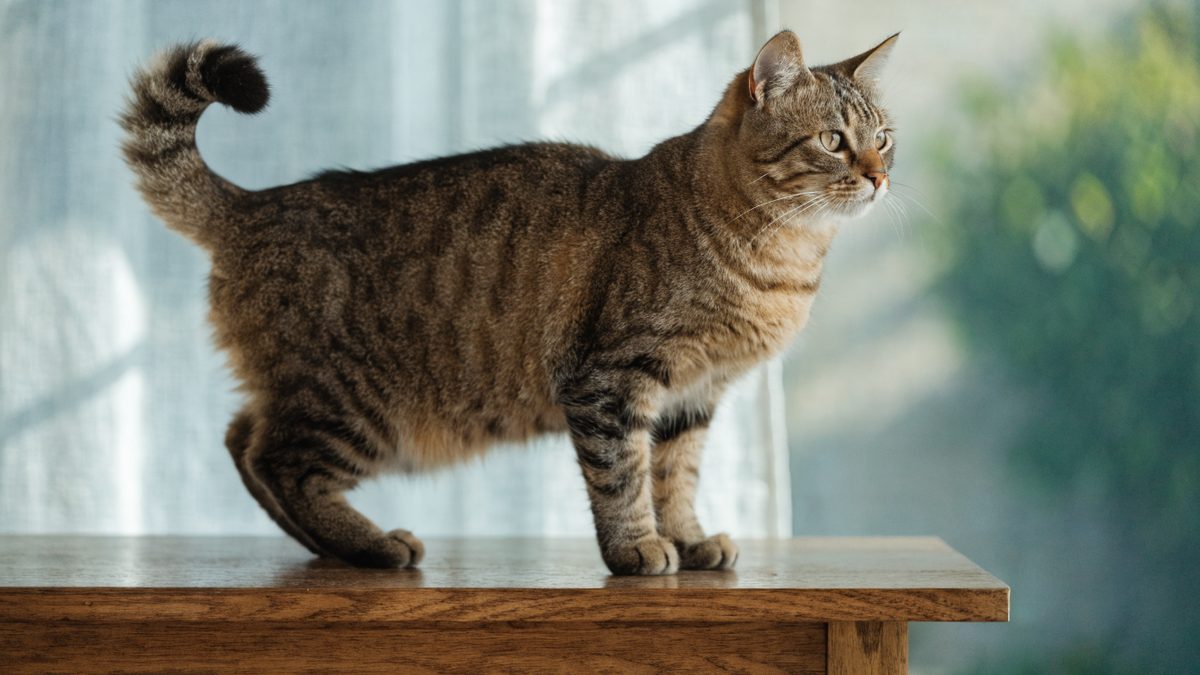
The American Bobtail is a medium to large, naturally occurring short-tailed cat from North America, recognised by two registries, TICA since 1989 and the Cat Fanciers' Association for championship competition since May 2006. It is heavy-boned, muscular and athletic, it comes in both a shorthair and a longhair division, it takes two to three years to finish growing, and its defining feature is a short, flexible, expressive tail that must still be visible above the back when the cat is alert.
Start with the tail, because the breed standard does. In the CFA standard the tail carries 15 of the 100 available points, more than any single feature of the head, and the description is unusually specific. The tail is short, flexible and expressive, and may be straight, slightly curved or slightly kinked, or have bumps along its length. It is set in line with the top line of the hip, broad at the base, and, in the standard's own words, strong and substantial to the touch, never fragile. It must be long enough to be clearly visible above the back when the cat is alert, and it must not extend past a stretched hind hock.
TICA sets a hard floor instead of a description. Its standard requires a minimum of one inch of actual tail bone, allows the tail to reach the hock but not past it, and disqualifies any cat with no tail, a full-length tail, a docked tail, less than one inch of bone, or a tail that is fused and not flexible at the base. Both registries therefore write the same instruction from opposite directions. This is a cat with a short tail, not a cat without one.
The two coat lengths, and what the standard says about each
The breed exists in two divisions and both are double-coated. CFA describes the shorthair division as medium in length and semi-dense, with a hard topcoat over a soft downy undercoat, and the longhair division as medium-longhair and slightly shaggy, tapering to longer hair on the ruff, britches, belly and tail, with mutton chops desirable. TICA words it as a resilient, all-weather coat, double in both hair lengths. That phrase, double coat in both hair lengths, matters more in Chennai than it does in Ohio, and the climate section below is built around it.
Note in passing that Royal Canin's India breed page records the coat simply as short, with no mention of the longhair division at all. It is a small error in a source many Indian buyers will read first, and it is the sort of thing to check against the registry document rather than the brand page.
Size, and why every source gives a different number
Published weights disagree, and the disagreement is mostly about whether the source splits the sexes. TICA gives 7 to 11 pounds for adult females and 12 to 16 pounds for adult males, and adds that the weight should come from muscle and substantial large boning rather than from being overweight. Petfinder and ASPCA Pet Insurance both publish a single combined range of 7 to 16 pounds ASPCA Pet Insurance. American Bobtail Cat…. Cats.com stretches the top end to 18 pounds. Royal Canin India files the breed under its large size category.
In everyday terms, a male American Bobtail is a genuinely large domestic cat, roughly 5.5 to 7.5 kg, in the same weight class as a big British Shorthair and below a large Maine Coon. Both registries also warn buyers not to judge a young one. CFA's standard asks judges to allow for slow development because the breed matures gradually over a period of three years, and TICA says two to three years The International Cat Association. American…. A fourteen-month-old American Bobtail is not a finished cat.
Where the breed came from, and the detail Indian pages get wrong
TICA's published history is short and checkable. In the late 1960s John and Brenda Sanders found a brown tabby kitten with a short tail while driving through an Indian Reservation in Arizona and took him home to Iowa. The cat, Yodi, was bred to the couple's female, Mishi, described by TICA as a non-pedigreed domestic colour point. The kittens inherited the short tail, and family friends Mindy Shultz and Charlotte Bentley used several of those bobtailed kittens, outcrossing to a longhaired colour point, to produce the first true American Bobtails.
India's main breed page for this cat retells that story with one detail changed, saying the founding stray was mated to a Seal Point Siamese. TICA's own history says a non-pedigreed domestic colour point, which is a very different animal from a pedigreed Siamese, and the difference matters because the CFA registration rules for this breed forbid recognised breeds in the background entirely The Cat Fanciers' Association. American…. When a secondary page and a registry disagree about a breed's founding cross, take the registry.
The wider foundation is not one cat. TICA records that the foundation stock came from feral cats possessing a natural short tail from different regions of the United States and Canada, and that most breeders no longer use feral bobtailed cats. That is why CFA's breed page describes the American Bobtail's genetic background as incredibly diverse, and it is also, as the health section shows, why the breed's gene pool contains more than one kind of short tail.
Registry recognition, dated
| Registry | Status | Detail |
|---|---|---|
| TICA | Recognised | Recognised the American Bobtail as a naturally occurring breed in 1989. Registered as ABT for the longhair and ABS for the shorthair The Cat Fanciers' Association. American… |
| CFA | Championship | Registration effective 2/00, provisional status 2/05 effective 5/05, championship status 2/06 effective 5/06. Current show standard revised 2021 The Cat Fanciers' Association. American… |
| FIFe | Not recognised | FIFe's published breed list carries the Manx, the Cymric, the Japanese Bobtail Shorthair and both Kurilean Bobtails, and no American Bobtail at either fully recognised or preliminary level |
| GCCF (United Kingdom) | Not listed | The GCCF's published cat breed list names the Manx and the Kurilian Bobtail. There is no American Bobtail entry |
Read that table as a map of where the breed is real. Registry recognition for the American Bobtail is a North American fact. In Europe, the two bodies that most European breeders register with have recognised four other short-tailed or tailless breeds and not this one, which is worth knowing before anybody quotes you a price for an imported, pedigree American Bobtail in India.
You will see the American Bobtail called the Golden Retriever of the cat world. It is a marketing phrase rather than a finding, but it points at something both registries do assert: CFA describes the breed as easygoing and tolerant, an excellent companion for children and compatible with dogs, easily leash trained, and used in special needs classrooms and with people who have PTSD and anxiety disorders. Those are the registry's claims, published without a citation or a study behind them, and this page treats them as claims rather than as evidence.
American Bobtail cat price in India, and the honest answer about it
There is no American Bobtail price in India worth quoting as a market rate, because there is no Indian market. Exactly one published source anywhere gives a rupee figure for this breed, Happy Pet's breed database at Rs 40,000 to Rs 80,000, and that page states no method and names no seller. India's two most widely read all-breed cat price guides, from Supertails and Wrapinfur, do not list the American Bobtail at all. This section prints what exists, names what is missing, and explains why a range built from one number is not a range.
Take the price in india question at face value and follow every source that claims to answer it. The result is short.
| Source | What it is | American Bobtail figure |
|---|---|---|
| Happy Pet | Indian pet-app breed database, page updated 10 June 2025 | Rs 40,000 to Rs 80,000, described as varying by breeder, coat length and background |
| Supertails | India's largest pet pharmacy, 2026 all-breed cat price guide | No entry. The breed-wise price list covers 14 breeds and the word Bobtail does not appear on the page |
| Wrapinfur | Indian cat price list for 2026, budget, mid-range and luxury tiers | No entry. The word Bobtail does not appear on the page |
| Heads Up For Tails | Indian retailer's 50 Popular Cat Breeds In India | Breed is listed at number 10, with life expectancy and origin. No price, and the page carries no prices at all |
| Justdial | Auto-generated directory category, Pet Shops For American Bobtail Cat in Mumbai | No price. See below for what the listings actually are |
| Amazon.in | Ranked fourth on the India SERP for this query | Rs 797, for a notebook titled I love American Bobtail Cat Breed |
One figure from one source is a data point, not a price band. Bonbeno will not average it with anything, will not present it as a market rate, and will not manufacture a city-by-city table out of it. Compare that with a breed India genuinely trades, the Munchkin, where four published Indian sources give bands that differ from each other by about forty times. A spread of that kind is ugly but it is evidence of a market. One unsourced band is evidence of a breed database filling a required field.
What the Justdial listings actually are
Justdial publishes a category page headed Popular Pet Shops For American Bobtail Cat in Mumbai. Its listings are Shree Pets Shop and Clinic in Virar East, Khan Exotic Pets and Bombay Exotic Pets in Nalasopara, Umaraj Pets and Kennels in Nashik, Gokula Dog Kennel in Vijayapura in Karnataka, Doggy Do in Ahmedabad, Lavi Pets and Pharma and Puppywala in Hoshangabad in Madhya Pradesh, Rushi Aquarium in Khammam in Telangana, and Kitty and Furr in Bengaluru.
A Mumbai category returning ordinary pet shops in six other cities across five states is not a supply chain. It is a directory template that generates one category per breed name and fills it with whatever general pet shops it holds nearby. Bonbeno found the identical pattern on the Aegean cat page. Treat any Justdial breed category as a keyword page rather than as evidence that a breed is available.
The overseas anchor, and what it tells an Indian buyer
In the United States, where the breed is actually bred, Cats.com puts an American Bobtail at USD 600 to USD 1,000. At 2026 exchange rates that converts into broadly the same region as Happy Pet's rupee band, which is interesting for one reason only: an imported pedigree cat costs the price of the cat plus flights, export paperwork, health certification and quarantine handling. A quoted Indian price that merely matches the American breeder price cannot be an imported, registered American Bobtail. It is either an ordinary short-tailed domestic cat, a kitten of another breed, or a number in a database.
Why no lawful Indian breeding population can form
India's import rules for pet cats and dogs are published by the Animal Quarantine and Certification Service. A person transferring residence to India may bring up to two pets under the baggage rules, must show proof of at least two years of continuous stay abroad, must carry an official health certificate and a rabies vaccination given within the last twelve months and more than one month before travel, and must sign a declaration of no commercial intent. Animals may be held under quarantine observation, with final clearance issued after 30 days. The rules state in capitals that import for breeding or any other commercial activity is not permitted.
Put that next to the registry side. CFA will only cross-register American Bobtails from TICA or ACFA, and requires a three-generation certified pedigree. So the lawful route into India is two cats, brought by a returning resident, that cannot be bred commercially. Two animals is not a founder population, and the Kennel Club of India registers dogs rather than cats, so there is no Indian cat registry issuing American Bobtail pedigrees either. Any seller offering you registration papers for an Indian-bred American Bobtail is offering you a document whose issuing body you should insist on seeing named in full.
Short-tailed and stub-tailed cats occur naturally in Indian street populations, and a kitten with a naturally short or kinked tail is a common sight. Such a cat is not an American Bobtail, which is a registered pedigree with three documented generations behind it, but it will photograph exactly like one. If someone in India quotes you Rs 40,000 or more for an American Bobtail kitten, ask for the registry name in full, the registration number, and the three-generation pedigree, then check the number with the registry itself before any money moves. If those three things cannot be produced in writing, you are paying a pedigree price for a domestic short-tailed cat.
The honest bottom line on price
No verifiable American Bobtail market price exists in India in August 2026. The breed is genuinely rare even in its home countries, TICA calls it rare on its own breed page, and rarity plus a two-animal import cap plus an explicit ban on importing for breeding is a complete explanation for why nobody sells one here. If you want this cat specifically, the honest options are to acquire one abroad and bring it in under the baggage rules as your own pet, or to want the cat rather than the label and look at the adoption route in the last section of this page.
Bonbeno reports published price ranges as editorial content. Nothing here is an offer, and we do not broker kitten sales. Where a breed has no verifiable Indian market, we say that instead of building a table. A missing price is a finding, and on this breed it is the most useful finding on the page.
Monthly cost of keeping an American Bobtail in India
The published monthly cost of keeping an American Bobtail in India is Rs 2,800 on a basic lifestyle and Rs 4,200 on a premium one, and that single estimate comes from one source, Happy Pet, which is also the only source publishing a price for the breed. Treat it as a starting frame rather than a measurement, and adjust it upward for two breed-specific reasons: this is a large cat that eats like a large cat, and it is double-coated in both hair lengths, so grooming is not optional.
Here is the only Indian monthly cost breakdown published for this breed, printed as its source publishes it.
| Line item | Basic | Premium |
|---|---|---|
| Food | Rs 1,500 | Rs 2,000 |
| Veterinary | Rs 500 | Rs 700 |
| Grooming | Rs 800 | Rs 1,500 |
| Total published | Rs 2,800 | Rs 4,200 |
Two things about that table are worth saying plainly. It is not breed-specific in any way that a reader could check, because the same source publishes the same structure for other cat breeds. And it omits the two lines that actually surprise Indian first-time cat owners, which are litter and one-off veterinary events.
What the published figure leaves out
- Litter, every month, forever. Clumping litter is the single most reliable recurring cost after food, and a large cat produces more of everything. Budget it as a separate line rather than folding it into grooming.
- Sterilisation, once. A one-off cost in the first year that removes a long list of later problems, and the single highest-value veterinary spend on any cat.
- The core vaccination course. Happy Pet's own schedule for this breed lists FVRCP at 6 to 8 weeks, 10 to 12 weeks and 14 to 16 weeks, with a booster at one year, and the page carries its own note that a qualified veterinarian should guide the actual schedule. Follow your vet's schedule, not a web table.
- Parasite control through the monsoon. Fleas and ticks are a year-round Indian reality rather than a seasonal one, and a dense double coat hides both.
- Cooling, in summer. For a double-coated cat in a Delhi or Nagpur May this is a real line. See the climate section.
- A senior-cat line, from about eight years. Bloodwork, dental care and the arthritis conversation. Feline osteoarthritis is common enough that it should be planned for rather than discovered: 61 percent of 100 client-owned cats aged six and over had radiographic osteoarthritis in at least one joint, and 48 percent in more than one.
Where a large, double-coated cat costs more than a small one
Food scales with body mass, and this breed is at the large end. TICA gives adult males 12 to 16 pounds and adult females 7 to 11 pounds, so a full-grown male is often close to double the weight of a small female cat and will eat accordingly. If you budget from a generic Indian cat cost article built around a 3.5 kg desi cat, you will be short.
Grooming is the other line that moves. Both CFA divisions are double coats, the shorthair with a hard topcoat over a soft downy undercoat and the longhair medium-long and slightly shaggy with longer hair on the ruff, britches, belly and tail. TICA describes the coat as non-matting and easy to keep with minimal combing, and says a bath is rarely necessary unless the cat has got into something messy. In Indian humidity, minimal combing still means twice a week in the cool months and more often through the two annual moults, and you can do that yourself with a comb costing less than one salon visit.
Take your city's actual price for the food you intend to feed, multiply by the daily ration your vet sets for the cat's target weight, add litter at your real usage, add a monthly average for parasite control, then add a sinking fund of a few hundred rupees a month for the veterinary events that arrive without warning. That number is yours and it is checkable. The Rs 2,800 to Rs 4,200 band is one company's estimate for a breed that has no Indian population, and it should be sanity-checked rather than adopted.
Can an American Bobtail handle the Indian climate? Heat tolerance rated 3 of 5
An American Bobtail can live comfortably in most Indian cities with shade, water and an indoor cool spot, and Bonbeno rates its heat tolerance 3 out of 5. The rating is middling for two specific reasons. The breed has a normal muzzle and an unobstructed airway, which puts it far ahead of the flat-faced breeds in Indian heat. Against that, it carries a double coat in both hair lengths and a large body, and no source anywhere has actually measured how this breed copes with 45 C.
Set the conditions first, because the honest version of heat tolerance is a comparison against real numbers. On 19 May 2026 the India Meteorological Department recorded a national maximum of 48.2 C at Banda in Uttar Pradesh, with maxima of 40 to 47 C across northwest, west, central and adjoining east and north peninsular India, and Delhi sitting at 45 to 47 C. IMD's own thresholds classify a heat wave in the plains from a maximum of 40 C, a heat wave on actual temperature from 45 C, and a severe heat wave from 47 C. Those are not outlier days in an Indian summer.
Now the cat. Happy Pet's India breed page gives the American Bobtail an ideal weather band of 18 to 27 C. Heads Up For Tails, in India's most-read 50-breed list, states flatly that the breed is suitable for the Indian climate and gives no source, no measurement and no caveat. Both claims cannot be right about the same animal in the same May, and neither publishes any evidence. This page rates the breed on mechanism instead.
What actually decides a cat's heat tolerance
Cats do not sweat usefully over the body and they do not pant efficiently for long, so they shed heat mainly by evaporation and by behaviour, which means seeking shade, flattening out on cool surfaces, grooming saliva onto the coat and drinking. Experimental work on cats at high ambient temperatures measured evaporative water loss, metabolic rate, body core temperature and respiratory rate together in nine hydrated cats, and studied what changes when the animal is dehydrated. The practical reading of that literature for an Indian owner is simple. Water is not a comfort item in a heatwave, it is the mechanism, and a cat that stops drinking loses its main defence.
Against that background, three features of the American Bobtail matter.
- A normal muzzle, which is a genuine advantage. CFA's standard describes a well-defined broad medium length muzzle with an observable whisker break, and penalises an extremely short muzzle or a nose break. A cat whose standard actively penalises facial shortening keeps a normal airway, which is the single biggest divider between breeds that manage Indian summers and breeds that struggle. Compare a Persian or an Exotic Shorthair, where the flat face is the breed.
- A double coat in both divisions, which is the handicap. CFA specifies a double coat with a hard topcoat and a soft downy undercoat in the shorthair division, and a double coat with undercoat present in the longhair division, and TICA calls the coat resilient and all-weather in both hair lengths. All-weather is a phrase written in North America. In Chennai in May, an insulating undercoat is working against the cat rather than for it.
- A large body, which cuts both ways. A 6 kg cat has less surface area per kilogram than a 3.5 kg one, so it sheds heat more slowly. TICA's own weights put adult males at 12 to 16 pounds. Size is also why an overweight American Bobtail is a summer problem rather than a cosmetic one.
Does the short tail itself affect heat tolerance?
No published study measures the thermoregulatory consequences of tail length in cats, and Bonbeno will not invent one. What can be said is that the mechanisms that matter in the heat, evaporation from the respiratory tract, grooming, posture and water intake, are not tail-dependent, and that no source in the veterinary literature identifies short tails as a heat risk in cats. Read the tail as a spinal and welfare question, covered in the health section, rather than as a climate one.
City by city, for an Indian owner
| Conditions | Cities | What it means in practice |
|---|---|---|
| Dry extreme heat, 45 C and above | Delhi NCR, Jaipur, Nagpur, Banda and the wider Gangetic plain | The hardest case. Fresh water in more than one place, a tiled or stone floor the cat can lie flat on, a shaded room from 11am to 5pm, and no unshaded balcony access. Watch water intake daily Doris PA, Baker MA. Effects of dehydration… |
| Hot and humid coastal | Mumbai, Chennai, Kochi, Kolkata | Evaporation works less well when the air is already wet. The double coat matters most here. Comb out dead undercoat weekly, run a fan and keep the cat's resting spot off soft bedding through summer |
| Moderate plateau | Bengaluru, Pune, Hyderabad | The easiest Indian fit. Ordinary indoor shade and water are enough for most of the year |
| Cool hill stations | Shimla, Ooty, Darjeeling, Gangtok | The double coat becomes an asset rather than a liability, and the longhair division is genuinely well suited |
| Monsoon, everywhere | All of India, June to September | A damp double coat stays damp. Dry the cat properly after any soaking and check the skin under the coat, particularly along the back and at the tail base |
The instinct is understandable and it is wrong. A double coat insulates in both directions and also protects the skin from sun. Removing it does not make a cat heat-tolerant, it removes the layer that regulates and shields. Comb out the dead undercoat instead, which is what actually reduces the insulating load, and if a cat is matted badly enough to need clipping, have a vet or a professional groomer decide that rather than a summer panic. Any cat showing open-mouth breathing, drooling, collapse or unsteadiness in the heat is an emergency: cool it with tepid water, not ice, and get to your nearby vet immediately.
So why 3 out of 5 and not 4?
Because 4 would mean the breed is positively heat-tolerant, and nothing supports that. Its normal face earns it a clear pass over the flat-faced breeds. Its double coat, its size and its North American feral origin, from cats that survived winters in the United States and Canada rather than summers in the Deccan, keep it out of the top band. A 3 means this is a cat that will be fine in an Indian home that plans for summer, and will suffer in one that does not. For apartment living in Bengaluru or Pune, that is an easy yes. For an unairconditioned top-floor flat in Delhi in May, think harder.
Temperament, household fit and who should not buy one
Both recognising registries describe the American Bobtail temperament in almost the same words: confident, intelligent, easygoing, affectionate towards the whole family rather than one person, tolerant of children, and compatible with dogs. Neither registry cites a study for any of it, so read the description as the considered opinion of the people who breed and judge the cat, and weigh it accordingly.
CFA's breed page attributes the breed's character to its ancestry, arguing that because its self-sufficient forebears had to fend for themselves in a variety of environments, American Bobtails possess an unusually high level of intelligence. It describes them as independent but affectionate, forming strong bonds with their human families, and inventing their own interactive games, most of which revolve around hunting. They stalk and pounce on a toy and then carry the captured prey around in their mouths triumphantly.
TICA adds that the breed is a devoted family companion with a clown-like personality, warm and loving rather than demanding or in your face, that it attaches itself to the whole family rather than one person, and that it gets along with older children as well as other pets including the family dog. On activity, TICA is careful and useful: most are moderately active without being either a couch potato or a perpetual motion machine.
Voice, which matters in an Indian flat
This is a quiet cat by breed description. CFA records that although relatively quiet, they will trill, chirp or make clicking sounds when intrigued or engaged, and TICA says bobtails are not as vocal as some breeds and tend to communicate with chirps, clicks and trills alongside the standard purr and meow The International Cat Association. American…. If you have shared a wall with a Siamese you will understand why that is worth knowing before you choose a breed for an apartment.
The therapy claim, examined
CFA states that the breed has a special sensitivity to human moods, has been known to seek out owners who are distressed, and is often used in special needs classrooms and for people with PTSD and anxiety disorders. TICA calls them wonderful therapy cats and notes that some psychotherapists have included American Bobtails in treatment programmes. Bonbeno could locate no published trial, cohort or case series testing any of this in this breed. It is plausible, it is unverified, and it should not be the reason anybody spends money.
Who this cat suits, and who it does not
- Suits a busy family flat. A cat that bonds with everyone and tolerates children and dogs is easier in an Indian joint-family household than a one-person breed.
- Suits an owner who wants to interact. Both registries describe a cat that plays fetch, learns tricks and works puzzle toys. Give it a job or it will invent one.
- Suits a first-time owner willing to comb. Temperament is forgiving. The double coat is the part that needs a habit.
- Does not suit a household that is empty twelve hours a day. A breed described as attaching to the whole family is a breed that notices when nobody is home.
- Does not suit a buyer who wants a guaranteed look. TICA states plainly that the tail mutation gene is not a controllable gene, so tail lengths differ from kitten to kitten within one litter. You cannot order the tail you saw in a photograph.
- Does not suit anyone buying on impulse in India. Read the price section again. The most likely outcome of an impulse purchase here is paying a pedigree price for an unregistered short-tailed cat.
Training an American Bobtail, and what this breed resists
Train an American Bobtail the way you would train a working dog with a short attention span: short sessions, food rewards, and a job that ends in a catch. Both registries record that the breed leash-trains easily and plays fetch, which puts it at the trainable end of the domestic cat range, and the honest limit is not intelligence but consent. This cat cooperates when the exercise is interesting and stops when it is not.
CFA states that they are easily leash trained and love to go for walks with their people. TICA says they can easily be taught to walk on a leash and play fetch, and recommends challenging their brain by teaching them tricks and providing puzzle toys that reward with kibble or treats when the cat works out how to manipulate them. That is the whole training brief in two sentences, and it is a good one.
The litter tray, first and non-negotiable
Get the litter tray right before anything else, because a tray problem is the commonest reason cats are given up. Use one tray per cat plus one, place them away from food and from noisy appliances, scoop daily, and change litter type only gradually. If a previously clean cat starts eliminating beside the tray rather than in it, that is a medical sign before it is a behavioural one. In 100 client-owned cats aged six and over, increased inappropriate elimination was significantly associated with radiographic osteoarthritis, alongside decreased mobility and grooming. On a breed whose spine deserves attention, treat a new tray problem as a reason to see your nearby vet rather than to buy a different litter.
Leash work, done properly for Indian streets
- Fit an H-style or vest harness indoors and let the cat wear it with no lead for a few short sessions before anything is attached.
- Attach the lead indoors and let the cat lead you, not the reverse. A cat that feels steered will sit down and stop.
- Move to a quiet balcony or terrace before any street, and never in the middle of the day in summer.
- Keep street sessions short and rabies vaccination current, because Indian streets carry free-roaming dogs and resident cats, and a leashed cat cannot flee.
- Stop while the cat is still enjoying it. Every session that ends badly costs you three good ones.
What this breed genuinely resists
Repetition without payoff. A cat described as inventing its own hunting games is a cat that will disengage from a drill that never resolves. Structure play so it finishes in a catch and then a small meal, which follows the natural hunt sequence, and you will get a cat that settles afterwards rather than one that escalates at 11pm.
Rough handling of the tail, for reasons that are specific to this breed. TICA's standard requires that the tail remain flexible where it attaches to the body and disqualifies a tail that is fused and not flexible at the base, and CFA asks that the tail be strong and substantial to the touch, never fragile The Cat Fanciers' Association. American…. Both statements exist because tail structure in bobtailed cats varies. Teach children to handle the cat under the chest and hindquarters and never by the tail, and make that a house rule on day one.
Socialise early, and keep socialising
Socialise a kitten to handling, carriers, nail clippers, combs and car journeys in the first four months, when acceptance is cheapest to buy. On a slow-maturing breed that takes two to three years to finish growing, early handling pays for itself repeatedly, because the cat you will be combing through a Mumbai monsoon in year five is the cat you taught to accept a comb in month three.
How much exercise an American Bobtail actually needs
Budget 30 to 45 minutes of active play a day for an American Bobtail, split into two or three short sessions rather than one long one. That figure is the only Indian published estimate for the breed, from Happy Pet, and it sits comfortably with both registries describing a moderately active cat that is neither a couch potato nor in constant motion.
Happy Pet rates the breed's energy level as medium and its exercise routine as 30 to 45 minutes. TICA describes most American Bobtails as moderately active without being either a couch potato or a perpetual motion machine. CFA describes a cat that invents hunting games and carries its toy prey around afterwards. Those three descriptions agree, and they point at the same daily plan.
- Two wand-toy sessions of 10 to 15 minutes, one in the early morning and one in the evening, which are the hours a cat naturally hunts and also the cool hours in an Indian summer.
- One puzzle feeder a day, which TICA specifically recommends for this breed and which converts feeding from a thirty-second event into a fifteen-minute one.
- Vertical space, permanently. A tall cat tree or a cleared shelf run matters more than floor area in a small flat, and this is an athletic, muscular cat built to climb.
- A window with a view, ideally meshed. Indian balconies and open windows are a fall risk, and mesh is cheap.
- Leash walks as a bonus, not a substitute. Both registries note the breed leash-trains well, but a walk on a hot Indian afternoon is a heat risk rather than exercise.
What happens without it
An under-exercised large cat gains weight, and weight is the lever that connects everything else on this page. Non-ideal bodyweight, whether too light or too heavy, was linked to shortened life expectancy in the UK VetCompass life tables built from 7,936 cats. Excess weight also loads joints, and joint disease in cats is already common by middle age. On a breed where the spine and hips are the specific question, as the health section explains, keeping the cat lean is not a cosmetic goal. It is the cheapest intervention available to you.
Run your hands along the cat's flanks once a week. You should feel the ribs easily under a thin fat cover, without pressing, and you should see a waist when you look down from above. If you have to press to find ribs, cut the daily ration by a tenth and recheck in a month. That is the body condition check, it costs nothing, and it is the single most useful habit an Indian cat owner can build.
Grooming an American Bobtail double coat in Indian humidity
Comb an American Bobtail twice a week in both hair lengths, and more often through the two annual moults. The breed's own registries call the coat non-matting and easy to keep, which is true in a temperate climate and slightly optimistic in an Indian monsoon, where a damp double coat stays damp and skin problems begin underneath rather than on top.
TICA's grooming guidance for the breed is specific. The coat does not usually mat or tangle as long as it is combed or brushed a couple of times a week to remove dead hair, bobtails shed more in spring and autumn so grooming should be more frequent then, and a bath is rarely necessary unless the cat has got into something messy. Happy Pet rates shedding as moderate. CFA's standard describes both divisions as non-matting and resilient, and asks judges to recognise seasonal variations of coat.
The routine, adapted for India
- Comb twice a week, all year. Use a metal comb rather than a slicker brush as the primary tool, because the comb reaches the undercoat where the dead hair actually sits.
- Go to every other day through the moults. In much of India the coat turnover follows the shift into and out of the hot season rather than a clean spring and autumn cycle, so watch the cat rather than the calendar.
- Check the skin, not just the coat, weekly through the monsoon. Part the hair along the spine, at the tail base, under the collar line and behind the elbows. Damp warmth plus dense undercoat is how Indian skin problems start.
- Dry the cat properly after any soaking. A towel first, then a fan, and do not let a double-coated cat air-dry in a humid room.
- Trim nails every couple of weeks, which TICA recommends for the breed and which also reduces furniture arguments.
- Brush teeth regularly with a vet-approved toothpaste, never human toothpaste.
- Wipe eye corners with a soft damp cloth, using a separate part of the cloth for each eye so an infection is not carried across.
- Check ears weekly, and if they look dirty wipe them with a cotton ball or soft damp cloth rather than a cotton swab, which can damage the ear interior.
The tail, handled deliberately
Add one step to the routine that no generic cat-grooming article will tell you. Once a week, while the cat is relaxed, run your fingers gently along the whole tail from base to tip. You are checking three things: that the tail is still flexible where it joins the body, that no segment has become hard, swollen or painful, and that the cat does not object to a light touch anywhere along it. TICA disqualifies a show cat whose tail is fused and inflexible at the base, and CFA asks for a tail that is never fragile The Cat Fanciers' Association. American…, which tells you both registries treat tail structure as a variable rather than a constant in this breed.
This is also the single most useful habit for spotting trouble early. Abnormal vertebrae in short-tailed cats are frequently found by chance on radiographs taken for something else, and a tail that has quietly become sore is the kind of thing an owner notices six months late. A weekly ten-second check closes that gap.
Cat skin is thin and lifts with the mat, and scissor injuries under mats are a routine emergency in Indian clinics. Work a mat apart with fingers and a comb, or use a mat-splitter designed for the job, and if it will not come out, book a groomer or your vet. Prevention is the twice-weekly comb, which costs two minutes and removes the problem before it forms.
American Bobtail health, the tail gene, and the Manx question
The American Bobtail's short tail is not a separate mutation from the Manx in most cats that have been tested. It is the same mutation. In the only study to sequence the gene in this breed, 13 of 20 short-tailed American Bobtails carried a Manx TBXT frameshift allele, 12 of them the identical c.998delT that segregates in Manx pedigrees. Seven carried nothing known, so a second mechanism also operates. Every breed page currently ranking in India says the opposite, and none of them cites a paper.
Start with why this section exists. The American Bobtail is sold on a story, that its bobbed tail arose naturally in North American farm cats and has nothing to do with the Manx, a breed whose tail mutation is linked to spina bifida, sacrocaudal dysgenesis and a homozygous form that dies before birth Kitchen H, Murray RE. That story is repeated by registries, by retailers and by every Indian page on this SERP. The primary genetics literature says something different, and it is checkable in about twenty minutes. Bonbeno checked it.
What the 2013 sequencing study actually found
Buckingham and colleagues sequenced the T gene, now called TBXT, across five short-tailed cat breeds and published the result in Mammalian Genome. The paper's own section heading for the relevant result reads Mutant T alleles cause short-tailed phenotypes in the American Bobtail and Pixie-Bob. It is not a hedged finding buried in a supplement.
The numbers are these. Buccal swabs and phenotype data were collected from 196 domestic cats, including 136 Manx, 21 American Bobtails, 15 Pixie-Bobs, 14 Japanese Bobtails and 10 Kurilian Bobtails. Twenty of the 21 American Bobtails were short-tailed. Sequencing exons 8 and 9 of TBXT in those 20 found 12 of 20, or 60 percent, heterozygous for the c.998delT allele, and one further cat heterozygous for c.1199delC. Both of those alleles were first identified in Manx pedigrees in the same study. No TBXT mutation at all was found in seven of the 20, which the paper reports as 35 percent.
Two contrasts inside the same dataset make the finding sharper. No causal TBXT variant was found in any of the 14 Japanese Bobtails or any of the 10 Kurilian Bobtails. The Japanese Bobtail carries a variant in a different gene entirely, HES7, which is separately documented and is not associated with the Manx spinal picture, and the Kurilian Bobtail has not been tested for it Lyons LA, Creighton EK, Alhaddad H Lyons Feline Genetics and Comparative…. So the study did distinguish between breeds. It found the Manx alleles in the American Bobtail and the Pixie-Bob, and not in the two Asian bobtail breeds.
The authors were explicit about what they thought was happening. The spectrum of short-tailed phenotypes observed in the American Bobtail and the Pixie-Bob is similar to that observed in the stumpy Manx, they wrote, and because both breeds are more recent and less common, with more nebulous breeding records, it is not surprising that Manx mutations are segregating within American Bobtails and Pixie-Bobs.
What the genetics registry of record says
OMIA, the Online Mendelian Inheritance in Animals database at the University of Sydney, files the American Bobtail under the same phene record as the Manx. The record is OMIA:000975-9685, Tail, short in Felis catus, whose species-specific name is Manx taillessness and whose species-specific symbol is MX. Its mode of inheritance is recorded as autosomal dominant plus recessive lethal, and it is flagged disease-related. The breeds listed on that record are the American Bobtail, the Kurilian Bobtail, the Manx and the Pixiebob.
Go down to the variant table and the picture gets more specific. Four TBXT alleles are catalogued, and the American Bobtail is named against two of them, variant 523 (MX1, published as c.998delT, p.L333Pfs*22) and variant 525 (MX4, published as c.1199delC) Nicholas FW, Tammen I. The other two Manx alleles, MX2 and MX3, are recorded in the Manx and the Pixiebob only. Those are the same two alleles Buckingham found, entered independently into the reference database that veterinary geneticists actually use.
The second dataset, nine years later and 11,036 cats
One study on 21 cats from two catteries would be thin evidence to hang a page on. It is not the only evidence. Anderson and colleagues genotyped 11,036 domestic cats through a commercial panel, 10,419 pedigreed across 90 breeds and breed types plus 617 non-pedigreed, in what they describe as the largest DNA-based study of domestic cats to date. They tested three of the four known Manx TBXT variants.
Their finding on this breed is one sentence long and it matters. In line with the previous study, they report, the variant c.995delT of the T gene was also observed in American Bobtails, combining both the Longhair and Shorthair varieties. The c.995delT label is the same mutation as c.998delT, renumbered against a newer reference genome, exactly as OMIA notes. So a second, far larger, independently collected cohort found the Manx allele in this breed again.
The same paper carries three other numbers worth having. One of the three tested Manx variants was found in all the Pixiebobs, in 9 of 30 Manx (30.0 percent) and in 7 of 14 Cymrics (40.0 percent). In the Highlander, a breed also believed to have a different cause for its short tail, 94 of 231 cats, or 40.6 percent, carried one of the Manx variants. And photographic evidence in the American Bobtail and Highlander confirmed several short-tailed cats that were not carrying any known bobtail variant, which independently replicates Buckingham's seven unexplained cats.
The paper that says the opposite, and why it probably explains the breed-club line
Here is the disagreement, and it is a real one rather than a marketing invention. In 2015, a short communication in the Journal of Feline Medicine and Surgery on the Japanese Bobtail stated that the Japanese, American and Kurilian Bobtails examined in the Manx study did not have T-Box mutations, suggesting that an additional gene or genes exists in cats that controls tail and vertebrae formation. That sentence is the opposite of what the 2013 data table shows for the American Bobtail, and Leslie Lyons is a co-author of both papers.
Bonbeno is not in a position to say which sentence its authors would stand behind today, and will not guess. What can be said is that the 2013 paper reports per-breed genotype counts and the 2015 statement is a one-line summary in a paper about a different breed. Where a summary sentence and the underlying data table conflict, the data table is the stronger evidence. It is also easy to see how a widely-repeated claim that this breed is unrelated to the Manx could descend from a peer-reviewed sentence rather than from nothing at all.
What the researchers themselves say the position is now
The cleanest answer comes from the laboratory still working on it. The Lyons Feline Genetics and Comparative Medicine Laboratory at the University of Missouri runs an open Manx Cat Short-tail Project, and its published project page addresses this breed directly.
Newer breeds than the Manx, namely American Bobtails, Pixiebobs, Highlanders and Toybobs, are not supposed to perpetuate the Manx DNA variants within their lines of short-tailed cats, the page states, and then adds that some American bobtail and Pixiebob cats were demonstrated to have one of the Manx DNA variants. Its instruction to breeders is blunter still. Besides Manx and Cymrics, all lineages of short-tailed cats should participate until they are proven to not have the Manx DNA variants, such as American Bobtails, Pixiebobs, Highlanders and Toybobs.
Read that twice, because it is the honest summary of the whole question. The breed is not supposed to carry the Manx variants. Some of it demonstrably does. Nobody knows what fraction, because nobody has counted at population scale, and the laboratory is currently asking owners to help it find out. The project page also records the reason the work matters, that trait-related health concerns have led to considerations of the retirement of the Manx breed from all cat fancy registries, and that a study correlating the known DNA variants with health issues and tail length should be conducted before any such decision.
The Missouri project page names the gene as TBX1 in two places. The gene is TBXT, formerly called T, which encodes the transcription factor Brachyury Nicholas FW, Tammen I. TBX1 is a different gene. This is a typo on an otherwise authoritative page rather than a scientific disagreement, and it is flagged here only so a reader who searches the wrong symbol does not conclude the whole account is wrong.
What each source actually measured, with its sampling problem stated both ways
Five sources have looked at the question directly. They differ in size, in method and in conclusion, and the sampling in every one of them cuts against a confident answer in both directions.
| Source | Design and sample | What it found | Sampling bias, both directions |
|---|---|---|---|
| Buckingham et al., Mammalian Genome, 2013 | Sanger sequencing of TBXT exons 8 and 9. 21 American Bobtails within a 196-cat study, 20 of them short-tailed | 12 of 20 short-tailed cats heterozygous for c.998delT, 1 for c.1199delC, 7 with no TBXT mutation. Both alleles are Manx alleles. No TBXT variants in 14 Japanese or 10 Kurilian Bobtails | Against a high estimate: the American Bobtails came from two large pedigrees ascertained from US catteries, so relatives are over-represented and 60 percent is not a breed-wide frequency. Against a low estimate: two independent catteries both carried Manx alleles, and the study found none in the two Asian breeds it sampled the same way, so the result is not a contamination artefact |
| OMIA:000975-9685, University of Sydney Online Mendelian Inheritance in Animals | Curated database record, not new data. Variant table current at August 2026 | Files the American Bobtail under the Manx taillessness phene, symbol MX, inheritance autosomal dominant plus recessive lethal, disease-related. Names the breed against 2 of the 4 catalogued TBXT alleles | Against over-reading: OMIA records where a variant has been documented, not how common it is, and its breed lists may be incomplete, which the record itself states. Against under-reading: OMIA is the reference database veterinary geneticists cite, and it did not create a separate phene record for this breed |
| Anderson et al., PLoS Genetics, 2022 | Commercial panel genotyping of 11,036 cats across 90 breeds, testing 3 of the 4 Manx TBXT variants | Observed c.995delT (published c.998delT) in American Bobtails, longhair and shorthair combined. Also 9/30 Manx (30.0 percent), 7/14 Cymric (40.0 percent), all Pixiebobs, and 94/231 Highlanders (40.6 percent). Photographs confirmed short-tailed American Bobtails carrying no known variant | Against a high estimate: the paper does not publish an American Bobtail denominator in its main text, so no breed frequency can be read off it, and panel customers are a self-selected group of breeders. Against a low estimate: this is a different continent-scale sample, a different laboratory and a different method from 2013, and it found the same allele in the same breed |
| Pollard et al., J Feline Med Surg, 2015 | Short communication on the Japanese Bobtail. Segregation analysis plus radiographs of 24 cats, 21 with the whole spine imaged | States that the Japanese, American and Kurilian Bobtails examined in the Manx study did not have T-Box mutations. Separately establishes the Japanese Bobtail trait as autosomal dominant with variable expression, proposes the locus symbol BTADJ, and finds all 17 whole-spine kinked-tail cats had abnormal vertebral formulae | Against relying on it for this breed: it examined no American Bobtails, and the American Bobtail claim is a one-line summary of someone else's data rather than a finding of its own. In its favour: it is peer-reviewed, shares a senior author with the 2013 paper, and its own radiographic work on a different bobtail breed is careful and well described |
| Missouri Manx Cat Short-tail Project | Open recruitment study by the Lyons laboratory, ongoing at August 2026. No results published yet | Records that some American Bobtails were demonstrated to have one of the Manx DNA variants, and asks American Bobtail, Pixiebob, Highlander and Toybob owners to genotype until their lines are proven not to carry them | Against over-reading: a recruitment page is a statement of an open question, not an answer, and it publishes no counts. Against dismissal: it is written by the laboratory of a co-author of the 2013 paper, and it treats the matter as unresolved rather than settled in the breed's favour |
| CFA and TICA breed pages The International Cat Association. American… | Registry breed descriptions. Not studies | Describe the breed as a naturally occurring short tail of diverse genetic background. TICA states the tail mutation gene is not a controllable gene. CFA's own page notes that spine and hip problems and incontinence can occur in tailless individuals | Against taking the reassurance at face value: neither page cites a study, and both bodies have an interest in the answer. Against dismissing them: their own registration rules and disqualifications, set out below, are written as though Manx-type risk is real, which is more informative than their prose |
Four things are true at once and a buyer deserves all four. First, the Manx alleles are in this breed. Two independent datasets, nine years and one continent-scale cohort apart, found the same c.998delT, and the reference database lists the breed against it Anderson H, Davison S, Lytle KM Online Mendelian Inheritance in Animals. Second, nobody knows the frequency. The 60 percent figure comes from 20 related cats in two catteries and is not a breed rate. Third, the Manx allele does not explain every short tail in the breed, because roughly a third of tested short-tailed American Bobtails carried nothing known, in both datasets Anderson H, Davison S, Lytle KM. Fourth, and this is the part almost nobody states, carrying the allele is not the same as having Manx syndrome. Nobody has correlated the specific variant with health outcomes in any breed, which is precisely why the Missouri project exists. Anyone telling you this breed is genetically unrelated to the Manx, and anyone telling you every American Bobtail is a Manx in disguise, is going past the evidence in opposite directions.
What Manx syndrome is, and which part of the spectrum this breed sits on
Manx syndrome is the collective name for a range of spinal and spinal-cord malformations that accompany the Manx tail mutation. The commonest is spina bifida, in which the neural tube fails to close and the vertebral arches fail to form completely. Documented consequences include sacrocaudal dysgenesis, absence of the sacral spinal cord, tethered cord, meningocele, hydromyelia, syringomyelia and imperforate anus, and the functional picture includes a plantigrade or hopping gait, hind-limb weakness, urinary and faecal incontinence, megacolon and rectal prolapse DeForest ME, Basrur PK. Malformations… Kitchen H, Murray RE Buckingham KJ, McMillin MJ, Brassil MM. Severely affected kittens may die before birth or be euthanised early.
The frequency figure most often quoted comes from DeForest and Basrur, who recorded 7 affected kittens out of 44, or 16 percent, and every one of those was a rumpy, the completely tailless form. That last clause is the important one, and it is the hinge of this whole section.
The Manx phenotype runs along a spectrum described in four categories. A rumpy has no caudal vertebrae at all. A rumpy-riser has one to seven caudal vertebrae fused in an upright position. A stumpy has between two and fourteen caudal vertebrae and may look severely kinked, but retains side-to-side movement in the tail. A longie has a normal-length tail despite carrying the gene Buckingham KJ, McMillin MJ, Brassil MM. Clinical problems concentrate heavily at the rumpy end, where sacral and sometimes lumbar vertebrae are missing and parts of the spinal cord are absent.
The American Bobtail is not bred toward the rumpy end. It is bred away from it, deliberately and in writing. Buckingham placed the breed's phenotype with the stumpy Manx, which is the least neurologically affected category. That is the single most reassuring fact on this page, and it is a genuine one.
It is not a clean bill of health, because the stumpy end has its own documented problem. Manx cats with a short deformed tail, that is stumpies, are prone to arthritis in the joints between the deformed tail bones, and this can be very painful. Supporting the same picture from a different bobtail breed, radiographs of Japanese Bobtails found that all 17 kinked-tail cats whose whole spine was imaged had abnormal vertebral formulae and that 12 of 20 had at least one hemivertebra inside the kink, while noting that the kinks were almost all remote from the sacrum, thereby reducing the likelihood of concurrent neurologic deficits.
So the realistic risk profile for an American Bobtail is a painful tail rather than a paralysed hind end. That is a much smaller worry than Manx syndrome and it is not nothing, and it is exactly why the weekly tail check in the grooming section above is on this page at all.
Palpate the whole tail once a week from base to tip while the cat is relaxed, and get a veterinary opinion if any segment becomes hard, swollen, hot or painful, if the cat flinches at light touch anywhere along it, if the tail stops moving side to side, or if the cat begins holding it rigidly. Ask your vet to include the tail base and sacrum in any routine examination, and to radiograph the caudal spine if the cat is ever anaesthetised for something else, because vertebral anomalies in cats are frequently found incidentally on films taken for unrelated reasons. New litter tray accidents, straining to pass faeces, a hopping hind-limb gait or dribbling urine are not behavioural problems in a short-tailed cat and warrant a same-week appointment. Consult your nearby vet before acting on anything in this section, because none of it substitutes for examining your actual cat.
The breeding arithmetic, and why the registries wrote the rules they did
The TBXT mutation is lethal when homozygous. Buckingham found no cat that was homozygous or compound heterozygous for any mutant allele, which supports the conclusion that complete absence of Brachyury results in early embryonic lethality, and genotyping of three fetal cats that died late in gestation found all three heterozygous. Anderson's 11,036-cat dataset reached the same conclusion by a different route, reporting that the derived T-box variants were always observed in the heterozygous state, further suggesting that in the homozygous state these variants are lethal in utero, so in a mating of two short-tailed cats 25 percent of cats conceived are born with a long tail. OMIA records the inheritance as autosomal dominant plus recessive lethal.
In plain terms, if two carriers are bred together, a quarter of conceptions do not survive to birth. That is the arithmetic underneath every short-tail breeding programme, and it applies to any American Bobtail line that carries a Manx allele, whatever the breed's paperwork says.
Now read the registration rules with that in mind, because they read very differently once you do.
| Registry | Clause | What it is doing |
|---|---|---|
| CFA | Registration rules bar tailless cats, rumpies, docked tails, recognised breeds and wild blood from the breeding programme, and require a three-generation certified pedigree for cross-registration from TICA or ACFA | Excluding the rumpy phenotype is exactly the exclusion that removes the most clinically affected Manx category from the gene pool |
| CFA | The show standard requires a tail that is short, flexible and expressive, strong and substantial to the touch, never fragile, clearly visible above the back when the cat is alert | Never fragile is a structural instruction, not an aesthetic one. It selects against the deformed, brittle caudal vertebrae the arthritis risk sits in |
| TICA | The standard sets a minimum of one inch of actual tail bone and disqualifies any cat with no tail, a full-length tail, a docked tail, less than one inch of bone, or a tail fused and not flexible at the base | A hard floor on caudal vertebrae plus a flexibility requirement at the base. The fused-and-inflexible disqualification is the show-ring equivalent of screening for a fixed, arthritic tail base |
| TICA | The breed page states that the tail mutation gene is not a controllable gene | The registry conceding that tail length cannot be predicted within a litter, which is what variable expressivity of a dominant allele looks like Buckingham KJ, McMillin MJ, Brassil MM |
| CFA | The breed page notes that spine and hip problems and incontinence can occur in tailless individuals | The recognising registry naming the Manx clinical picture on its own breed page, while the breed's marketing elsewhere denies the connection |
| FIFe and GCCF | Neither recognises the American Bobtail. Both recognise the Manx, and FIFe additionally lists the Cymric, the Japanese Bobtail Shorthair and the Kurilian Bobtail Governing Council of the Cat Fancy. Cat… | Not a health verdict. It means no European standard, no European breed committee and no European health scheme exists for this breed, which matters if you are told an Indian kitten has European papers |
Taken together those clauses are a risk-management system for exactly the problem the breed's own marketing says it does not have. That is not hypocrisy. It is the sensible thing to do with a gene pool assembled from feral short-tailed cats of unknown origin across the United States and Canada The Cat Fanciers' Association. American…, and it is far more informative than any sentence on a breeder's website.
Is there a genetic test, and can an Indian buyer get one?
A genetic test for the Manx TBXT variants exists in research and commercial panel form, and it is not on the published menu of the laboratory most often pointed at. The Missouri project instructs owners to send buccal swabs to UC Davis or other commercial cat testing laboratories to determine the specific DNA variant, and links to the UC Davis Veterinary Genetics Laboratory cat test page. That page, checked on 19 August 2026, lists Scottish Fold, Sphynx and Devon Rex coats, Maine Coon HCM, Ragdoll HCM, Maine Coon spinal muscular atrophy, PKD1, pyruvate kinase deficiency and a long list of coat colour tests. It carries no Manx, short-tail, TBXT or Brachyury test.
The variants are testable, because Anderson's group genotyped three of the four on a commercial panel across 11,036 cats. So the honest statement is that the test exists on at least one commercial platform, is not on UC Davis's published list, and is offered by no Indian laboratory Bonbeno could find. For an Indian buyer that adds up to a simple conclusion. You cannot currently walk into an Indian clinic and have a short-tailed cat typed for the Manx alleles, so treat any seller's claim that a kitten is genetically clear of them as unverifiable unless they produce a dated report from a named overseas laboratory with the specific variants listed on it.
Life expectancy, and why no published figure for this breed is a measurement
Published life expectancy figures for the American Bobtail disagree by five years and not one of them comes from a study. Royal Canin India gives 13 to 15 years, crediting the World Cat Congress. ASPCA Pet Insurance and Petfinder both give 13 to 18 years Petfinder. American Bobtail Cat Breed…. Cats.com gives 12 to 15 years. Heads Up For Tails repeats 13 to 18 for its Indian readers.
Bonbeno could locate no life table, mortality study or veterinary records analysis giving a life expectancy for the American Bobtail. The largest relevant work, the UK VetCompass life tables built from 7,936 cats, does not report this breed separately. Every figure above is a community estimate rather than a finding, and the honest reading of a 12 to 18 year spread across four sources is that nobody has counted. What the VetCompass work does establish, and what applies to your cat regardless of breed, is that non-ideal bodyweight in either direction is associated with shortened life expectancy.
The heart, and a finding that runs opposite to the usual mistake
Most breed pages make one particular error about feline heart disease, which is to attach the Maine Coon or Ragdoll HCM mutation to a breed it was never found in. The American Bobtail requires the opposite caution, because the Ragdoll variant has actually been observed in it.
Anderson's group found the MYBPC3 R818W variant, discovered in the Ragdoll, present in the heterozygous state in additional breeds, and their veterinarians interviewed the owners of four American Bobtail cats carrying it. One male had died suddenly at five to six years of age, preceded by laboured breathing over a few days that the owner suspected was cardiac, though no echocardiography had been performed to confirm a diagnosis of HCM. The three females were alive at four years four months, six years five months and ten years five months. The authors' own framing is that this is a potential case calling for further investigation, not a breed finding.
Four cats is four cats. It is not a prevalence, it does not make HCM an American Bobtail breed disease, and no screening programme for this breed exists anywhere. The useful baseline is that cardiomyopathy is common in ordinary cats. In the CatScan study, 1,007 apparently healthy cats aged six months and over were recruited from two UK rehoming centres and complete data were obtained in 780. HCM prevalence was 14.7 percent, with a 95 percent confidence interval of 12.3 to 17.4 percent, rising with age. Heart murmurs were found in 40.8 percent of cats and 70.4 percent of those were considered functional.
The practical consequence for an Indian owner is unglamorous and cheap. Ask for a stethoscope examination at every annual visit, and remember that a murmur is a weak predictor in a young cat and a stronger one in an old cat, with a positive predictive value for HCM of 17.9 to 42.6 percent and a negative predictive value of 90.2 to 100 percent depending on age. If your cat has a murmur, an echocardiogram is the answer rather than a DNA test, because no validated DNA test for this breed exists.
Hips, joints and the baseline every pedigree cat is measured against
Two more numbers belong on this page because a large, heavy-boned cat with an abnormal caudal spine invites the question. In 107 pedigree cats aged at least ten months, recruited prospectively in the Czech Republic, hip dysplasia was found in 46.7 percent, bilateral in 78 percent of those, mostly mild to moderate, with 6.1 percent of hip joints showing severe grade 3 changes, seen in Maine Coon and Siberian cats. Patellar luxation was found in 32.7 percent, bilateral in 91.4 percent and usually grade 1 or 2, and a lumbosacral transitional vertebra was present in 7.5 percent. The authors recommend screening pedigree cats for hip dysplasia before they are used in breeding.
State the sampling problem plainly. That study included no American Bobtails, and the severe hip grades it reports came from two other breeds, so none of those percentages is an American Bobtail figure. What it establishes is a baseline. Hip dysplasia and patellar luxation are common in pedigree cats generally, so finding them in an American Bobtail is not evidence about the tail gene, and CFA's mention of hip problems in tailless individuals should be read against a background where nearly half of pedigree cats radiograph with some hip dysplasia anyway.
Joint disease is likewise common with age. Radiographs of 100 client-owned cats aged six and over found osteoarthritis in at least one joint in 61 percent and in more than one joint in 48 percent, with age related at p equals 0.002, and with decreased mobility and grooming and increased inappropriate elimination significantly associated. On a breed with a structurally abnormal tail base, those three behavioural signs deserve more weight than they would in an ordinary cat.
The India-specific health issues that have nothing to do with the tail
Most of what will actually affect an American Bobtail in India is climate and parasites rather than genetics. A dense double coat in monsoon humidity hides fleas and ticks and holds moisture against the skin, so weekly skin checks along the spine and at the tail base matter more here than in the breed's home countries. Heat is the other one, and the climate section above rates this breed 3 out of 5 for Indian conditions with the reasoning set out Doris PA, Baker MA. Effects of dehydration….
Two habits close most of the gap. Keep the cat lean, because non-ideal bodyweight is the one variable linked to shortened life expectancy that you fully control, and keep a relationship with one vet who has examined the cat when it was healthy, so a change is measured against your cat rather than against a textbook. Consult your nearby vet about a vaccination and parasite schedule for your city, because tick pressure in Chennai and in Shimla are not the same problem.
Ask a seller these three, in writing, and the answers will tell you more than any breed page. One, has this kitten or either parent been genotyped for the Manx TBXT variants, and can I see the dated laboratory report naming the specific variants tested? Two, what is the tail like on both parents and on every littermate, and can I see photographs, given that TICA states the tail mutation gene is not a controllable gene? Three, what is the full registry name and registration number, and may I verify the three-generation pedigree with the registry directly? A seller who cannot answer the third question is not selling a pedigree American Bobtail at all, whatever the price. A seller who answers the first honestly, by saying no test has been done, is being straight with you, because in India that is the normal answer.
Feeding an American Bobtail in India, by life stage
Feed an American Bobtail a complete, named-species animal protein diet split across two or three meals, portioned to a target body weight rather than to a bag chart, and keep wet food in the rotation for water intake. The only Indian published figures for this breed are 400 kcal a day for kittens and 350 kcal a day for adults, and that adult number deserves scepticism, because a 5 kg female and a 7.5 kg male do not eat the same amount.
Take the published Indian guidance first, print it as it stands, then say what is wrong with it. Happy Pet is the only India-specific source that publishes feeding figures for this breed, and it gives 400 kcal per day for kittens and 350 kcal per day for adults, a monthly food cost of Rs 1,500 to Rs 2,000, and a macronutrient breakdown led by protein at 40 percent, fats at 25 percent and carbohydrates at 20 percent, with the remainder split across vitamins, minerals, amino acids, essential fatty acids and fibre.
Three problems with that number, and what to use instead
- One adult calorie figure cannot cover this breed. TICA gives adult females 7 to 11 pounds and adult males 12 to 16 pounds, which is roughly 3.2 to 5 kg against 5.4 to 7.3 kg. A single 350 kcal figure will overfeed the small female and underfeed the large male, and overfeeding is the error with consequences, because non-ideal bodyweight in either direction is linked to shortened life expectancy.
- A percentage-of-diet chart is not how you feed a cat. Cat food is bought by the kilogram and fed by the gram. Read the kcal per 100 g on the actual bag you buy in your actual city, then divide your vet's daily calorie target by it. That arithmetic takes one minute and replaces every macronutrient pie chart on the internet.
- The recommended food list contradicts the avoid list. Happy Pet's suggested foods include chicken described as cooked or raw, while its foods-to-avoid list names raw eggs. Raw chicken in an Indian kitchen in June carries the same bacterial argument as a raw egg. Cook it, or feed a commercially balanced diet.
Feeding by life stage
| Stage | Age | What to do |
|---|---|---|
| Weaning to 4 months | 8 to 16 weeks | Four small meals a day of a complete kitten diet. Keep whatever the breeder or shelter was feeding for the first fortnight and change over across seven days, because a diet change plus a house change together is how a kitten ends up with diarrhoea in week one |
| Kitten, growing | 4 to 12 months | Three meals a day, still on kitten food. This breed matures over two to three years rather than one The International Cat Association. American…, so do not switch to adult food on the first birthday by reflex. Ask your vet at the one-year check |
| Young adult | 1 to 3 years | Two or three meals, transitioning to adult food on veterinary advice. The frame is still filling out, so a cat that looks lean at 18 months is usually correct rather than underfed |
| Adult | 3 to 8 years | Two meals plus a puzzle feeder, portioned to target weight. This is the window where an indoor Indian cat quietly gains a kilogram. Run the rib check weekly |
| Senior | 8 years and over | Two to three smaller meals. Add an annual blood and urine panel, and raise the topic of joint pain, since osteoarthritis was present in 61 percent of 100 cats aged six and over. Weight loss in a senior cat is a veterinary appointment, not a diet success |
Water, which is the Indian half of feeding
Water intake is not a side note in this country. Cats shed heat mainly by evaporation and behaviour, and experimental work on cats at high ambient temperatures measured evaporative water loss, metabolic rate, core temperature and respiratory rate together, and examined what changes when the animal is dehydrated. In a May when the India Meteorological Department is recording maxima of 45 to 47 C across Delhi, a cat that stops drinking has lost its main defence.
- Keep wet food in the rotation year-round, because a cat on dry food alone takes in far less total water. This is the cheapest urinary-health intervention available.
- Put water in more than one room, away from the food and away from the litter tray. Cats routinely drink more from a bowl that is not next to dinner.
- Use a wide, shallow bowl so the whiskers do not touch the sides, and refill rather than top up.
- Watch intake in summer specifically. A cat drinking noticeably less over two or three hot days needs a vet, not a wait-and-see.
- Skip cow's milk. Most adult cats digest lactose poorly, and milk is a common cause of avoidable Indian kitchen diarrhoea.
What to avoid, and what Indian households get wrong
Happy Pet's avoid list for this breed names onions and garlic, xylitol, artificial sweeteners, raw eggs, mouldy or spoiled food, artificial additives and high-salt foods. That list is correct as far as it goes and it misses the two things Indian homes actually do.
The first is feeding from the family plate. Indian cooking is built on onion, garlic, chilli and salt, and every one of those is on the avoid list or close to it. A cat that learns to expect a share of dinner will keep asking for the rest of its life, so the habit is easier never to start.
The second is a tuna-only or fish-only diet. Happy Pet lists tuna and salmon among suggested foods, and as an occasional topper they are fine. As a staple, a single-protein fish diet is a poor way to meet a cat's full nutrient requirement, and taurine, which the same page correctly identifies as important for heart and vision health, is exactly the kind of nutrient a home-assembled diet gets wrong. If you want to home-cook, do it with a formulated supplement and a veterinary nutrition consult rather than from a blog.
You do not need an imported bag. You need a complete and balanced diet with a named animal protein first on the ingredient list, fed in the correct quantity, plus wet food for water. A correctly portioned mid-priced food beats a premium food fed by eye, every time. Where a vet does prescribe a therapeutic diet, check availability before you commit, because prescription lines are routinely unavailable outside the larger Indian cities and a diet you cannot reliably buy is a diet the cat will not stay on. Consult your nearby vet before making any change for a cat with a diagnosed condition.
Obesity appears on Happy Pet's own list of common health problems for this breed, and it is the one item on that list you control completely. A heavy American Bobtail is worse off three separate ways. It carries more load through a spine whose caudal end is already structurally abnormal, it sheds heat more slowly in an Indian summer because a bigger body has less surface area per kilogram, and it sits on the wrong side of the bodyweight association with life expectancy. Excess weight was also among the factors associated with a diagnosis of HCM in 780 screened cats. Keeping the cat lean is free and it is the highest-value thing on this page.
American Bobtail kitten timeline, month by month through the first year
Plan an American Bobtail's first year around three fixed points and one thing that is not fixed. The vaccination course runs at 6 to 8, 10 to 12 and 14 to 16 weeks with a booster at one year, the socialisation window closes at roughly four months, and sterilisation lands in the second half of the year. What is not fixed is the cat. This breed takes two to three years to finish growing, so a twelve-month-old is only part way there.
Most kitten timelines are written for a breed that is done at twelve months. This one is not. CFA's standard asks judges to allow for slow development because the breed matures gradually over a period of three years, and TICA says two to three years The International Cat Association. American…. Read the table below as the first third of the job rather than the whole of it.
| Age | What is happening | What you do |
|---|---|---|
| 8 to 10 weeks | Arrival, in most Indian sales and adoptions. Immune protection from the mother is fading and the first FVRCP dose is due at 6 to 8 weeks | Book a full veterinary examination in the first 48 hours and ask specifically for the tail base and sacrum to be palpated. Keep the previous diet for two weeks. Set up one litter tray per cat plus one, away from food and noisy appliances |
| 10 to 12 weeks | Second FVRCP dose due. The socialisation window is wide open and closing | Handle the paws, ears, mouth and tail daily for thirty seconds. Introduce the carrier as furniture with the door off. Start the comb now, before there is much coat to comb, because a cat who accepts a comb at ten weeks accepts it at ten years |
| 14 to 16 weeks | Third FVRCP dose due. Deworming and the first ectoparasite conversation. Play is getting rough | Redirect biting onto a wand toy rather than a hand, permanently. Agree the house rule that nobody lifts the cat by the tail. Ask your vet for a city-specific tick and flea plan |
| 4 to 6 months | Growth is fast, the kitten looks leggy and unfinished, and this is normal in a slow-maturing breed | Still on kitten food, three meals a day. Begin harness work indoors if you intend to lead-train, which both registries note this breed takes to readily The International Cat Association. American…. Mesh the balcony and any window that opens |
| 6 to 9 months | Sexual maturity arrives, often before the cat looks adult. Yowling, spraying and escape attempts start here | Discuss sterilisation timing with your vet and book it. This is the single highest-value veterinary spend of the first year and it removes a long list of later problems |
| 9 to 12 months | The cat looks adult and is not. Muscle and boning continue filling out for another one to two years | One-year FVRCP booster. Ask at the same visit whether to move to adult food, rather than switching by the calendar. Establish the weekly rib check and the weekly tail check as habits |
| 12 to 36 months | Continued maturation. The adult cat you were promised finally shows up | Annual examination with a stethoscope check every year. Keep weighing. A slow gain of 300 g a year is invisible in the room and obvious on a scale |
The tail, in the first year specifically
The tail on a young American Bobtail is not a finished feature and it is not a predictable one. TICA states plainly that the tail mutation gene is not a controllable gene, so tail lengths differ between kittens in a single litter. Buckingham's data supports that from the genetic side, since the study found no evidence that the presence of a specific mutant allele determined the extent of tail length reduction.
Two practical consequences follow. You cannot order the tail you saw in a photograph, and a breeder who guarantees a tail length is either guessing or selecting kittens after the fact. Separately, get into the habit early of running a hand along the whole tail once a week, because the arthritis risk documented in short deformed Manx tails sits in the joints between the deformed bones, and a cat that has learned to accept the handling at twelve weeks will let you check it at twelve years.
The first monsoon and the first summer
A kitten's first monsoon and first hot season are the two Indian milestones no imported timeline includes. Through the monsoon, part the coat weekly along the spine, at the tail base and behind the elbows, because a double coat holds damp against the skin and Indian skin problems begin underneath rather than on top. Through the first summer, keep water in more than one room and give the kitten a hard cool floor to lie flat on, and treat open-mouth breathing, drooling or unsteadiness as an emergency India Meteorological Department.
The schedule above reproduces what the one India-specific source for this breed publishes, and that source carries its own note that a qualified veterinarian should guide the actual schedule. Local disease pressure, the kitten's history and its health on the day all change the plan. Consult your nearby vet and follow the schedule they set for your cat rather than any timetable on a website, including this one.
Ribs easy to feel under a thin fat cover with a visible waist from above. A tail that is flexible where it meets the body and that the cat lets you handle without objection. A cat that walks into its carrier. Litter tray habits with no accidents. A full core vaccination course with a booster done. Sterilisation done. Nails trimmed without a fight. None of that is about the breed and all of it is what determines how the next fifteen years go.
American Bobtail compared, against the other short-tailed cats and against what India actually sells
Compare the American Bobtail two ways, because buyers arrive from two directions. Against the other bobtailed breeds it sits on the Manx side of a genetic split, sharing TBXT alleles with the Manx and the Pixie-Bob while the Japanese and Kurilian Bobtails carry a different gene entirely. Against the cats India genuinely sells, it loses on availability, on price verifiability and on the existence of a usable DNA test, and it wins on heat tolerance against every flat-faced breed.
Start with the comparison no ranking page publishes. Short-tailed cat breeds are routinely listed together as though they were variations on one theme. Genetically they are two themes and the split runs straight through the middle of that list.
| Breed | Gene behind the short tail | What the genotyping found | Registry position |
|---|---|---|---|
| American Bobtail | TBXT in most tested cats, plus something unidentified | 12 of 20 short-tailed cats heterozygous for the Manx c.998delT and 1 for c.1199delC, with 7 carrying no known variant. The same allele observed again in a separate 11,036-cat cohort. Listed on the Manx phene record against 2 of the 4 alleles | TICA 1989, CFA championship 2006. Not recognised by FIFe or the GCCF The Cat Fanciers' Association. American… Federation Internationale Feline. Breeds Governing Council of the Cat Fancy. Cat… |
| Manx | TBXT, four alleles | 78 of 82 short-tailed Manx carried a mutant allele against 1 of 48 full-tailed, with a maximum LOD score of 6.21 at zero recombination. Separately 9 of 30 Manx in the panel cohort | Recognised by FIFe and the GCCF Governing Council of the Cat Fancy. Cat…. Retirement from cat fancy registries is under active discussion on welfare grounds |
| Cymric (longhaired Manx) | TBXT | 7 of 14 Cymrics carried one of the three tested Manx variants | Recognised by FIFe |
| Pixie-Bob | TBXT, partially | c.998delT in 8 of 14 short-tailed Pixie-Bobs, with the remaining six carrying no mutation in any exon of the gene. One of the tested variants found in all Pixiebobs in the panel cohort. The c.998delT allele was absent from all 8 American Bobcats sampled, which undercuts the bobcat-hybrid origin story | Named on the Manx phene record against all four alleles |
| Japanese Bobtail | HES7, a different gene | No causal TBXT variant in any of 14 cats. The HES7 c.5T>C variant was homozygous in every Japanese Bobtail in the 11,036-cat cohort Xu X, Sun X, Hu XS, Zhuang Y, Liu YC Lyons LA, Creighton EK, Alhaddad H | Recognised by FIFe as Japanese Bobtail Shorthair |
| Kurilian Bobtail | HES7 | No causal TBXT variant in any of 10 cats. HES7 derived variant prevalent in the breed | Recognised by FIFe and listed by the GCCF Governing Council of the Cat Fancy. Cat… |
| Highlander | Believed to be a different cause, but the data disagree | 94 of 231 Highlanders, or 40.6 percent, carried one of the tested Manx variants | Asked by the Missouri project to genotype until proven clear of the Manx variants |
| Toybob | HES7 in some individuals | A few Toybobs carried the HES7 derived variant | Also asked by the Missouri project to genotype |
Read the split down the middle of that table. Four breeds sit on the TBXT side, where the mutation truncates Brachyury, is lethal when homozygous and is the same mutation that produces Manx syndrome at the severe end Godfrey R, Godfrey D. Manx Syndrome.…. Two sit on the HES7 side, where the Missouri laboratory states plainly that the variant is not associated with health concerns. The American Bobtail is on the TBXT side, and the Japanese Bobtail is the breed most often confused with it that genuinely is not.
A buyer who wants a bobtailed cat and does not want the Manx allele is not stuck. The Japanese Bobtail carries a variant in a different gene which the Lyons laboratory describes as not associated with health concerns, and radiographic work on the breed found the tail kinks almost all remote from the sacrum, thereby reducing the likelihood of concurrent neurologic deficits. That is a materially different risk profile from a breed where a majority of tested cats carry a Manx frameshift. Neither breed has an Indian market, so this is a comparison for someone importing a cat as their own pet under the baggage rules, not a shopping list.
Against the cats India actually sells
The second comparison is the one a buyer in Pune is really making, which is between this cat and whatever else is available at a similar price. On that comparison the American Bobtail loses on almost every practical axis, and it is worth being specific about which.
| Breed | Published Indian price | Breed-defining mutation | DNA test a buyer can get | Heat tolerance for India |
|---|---|---|---|---|
| American Bobtail | One source only, Rs 40,000 to Rs 80,000, with no method stated. India's two largest cat price guides do not list the breed at all Supertails. Cat Price in India 2026 Wrapinfur. Cat Price in India 2026 | TBXT short tail, shared with the Manx in most tested cats | No. Not on the UC Davis published cat menu and not offered in India | 3 of 5. Normal muzzle, but a double coat in both hair lengths and a large body |
| Maine Coon | Rs 40,000 to Rs 1,00,000 | None. Size is polygenic, not a single structural variant | Yes. A validated HCM test exists | 3 of 5. Same double-coat problem, same normal muzzle, and a genuinely available cat |
| Persian | Rs 12,000 to Rs 50,000 | Brachycephaly, selected for | Yes. PKD1 | 1 of 5. The flat face is the breed and it is the single worst structural liability in Indian heat |
| Munchkin | A forty-fold published spread across four Indian sources | UGDH chondrodysplasia, short legs | The test exists and no Indian seller offers it | 4 of 5. Normal muzzle and airway, no cooling problem |
| Scottish Fold | A twelve-fold published spread across Indian sources | TRPV4, folded ears plus whole-skeleton osteochondrodysplasia | Yes, and it is on the UC Davis menu | 3 of 5 |
| Indian domestic shorthair | Rs 0 to Rs 2,000 | None. Naturally short and kinked tails occur in Indian street populations without any pedigree | Not needed | 5 of 5. Locally adapted by definition |
Three things fall out of that table and they are the argument of this whole page.
- Every other breed in the row has a price a buyer can triangulate. This one has a single unsourced figure. A price you cannot cross-check is not a price, and the Munchkin page shows what a real Indian market looks like even when it is ugly, which is four sources disagreeing by forty times.
- Every other structural-mutation breed here has a test a buyer can obtain. The Scottish Fold TRPV4 test is on the UC Davis published menu. The Munchkin UGDH test exists. The American Bobtail's TBXT variants are the one case where the mutation is documented in the breed and the test is not reachable from India, which makes the breed's central health question unanswerable at the point of purchase.
- The heat-tolerance ranking does not favour the expensive cat. An Indian domestic shorthair outperforms every pedigree in this table in a Nagpur May, and a Munchkin outperforms an American Bobtail because it has no insulating double coat to carry.
If what you want is a large, sociable, dog-like, family-tolerant cat that leash-trains, the American Bobtail's described temperament is genuinely appealing and the registries are consistent about it The International Cat Association. American…. The problem is that in India you cannot reliably buy one, cannot verify the pedigree of what you are offered, and cannot test the one gene that matters. A Maine Coon gives you the size, the sociability and the double coat with an actual market and an actual DNA test, and a rescued Indian shorthair with a naturally short tail gives you the look, the climate adaptation and a vet bill you can predict. Wanting this specific breed is reasonable. Paying a pedigree price for an unverifiable one in India is not.
Nine mistakes Indian buyers and owners make with this breed
Most American Bobtail mistakes in India happen before the cat arrives, because the breed's Indian information layer is thin, unsourced and in two places simply wrong. The nine below are ranked by what they cost you, starting with the one that costs the most money and ending with the one that costs the cat the most comfort.
1. Paying a pedigree price for an unregistered short-tailed cat
This is the expensive one and it is the most likely. Short-tailed and kinked-tailed cats occur naturally in Indian street populations, and a kitten with a naturally stubby tail photographs exactly like an American Bobtail. The breed itself is registered only by TICA and CFA, CFA will cross-register only from TICA or ACFA and requires a three-generation certified pedigree, and no Indian body registers cats at all. So a seller quoting Rs 40,000 or more must be able to name the registry in full, produce the registration number and produce the three-generation pedigree, and you must check the number with the registry directly before money moves.
2. Treating the Justdial category as evidence the breed is available
Justdial publishes a page headed Popular Pet Shops For American Bobtail Cat in Mumbai. Its listings are general pet shops in Virar, Nalasopara, Nashik, Vijayapura, Ahmedabad, Hoshangabad, Khammam and Bengaluru. A Mumbai category returning shops across five states is a directory template that generates one page per breed name, not a supply chain. The fourth-ranked result on the same India SERP is an Amazon listing for a notebook. Neither is a market.
3. Believing the breed has nothing to do with the Manx
Almost every page selling this cat says the bobbed tail arose naturally and is unrelated to the Manx, and none of them cites a study. The sequencing data say that 13 of 20 short-tailed American Bobtails carried a Manx TBXT allele, a separate 11,036-cat cohort found the same allele in the breed again, and the reference genetics database files the breed under the Manx taillessness phene. The practical cost of believing the marketing is that you skip the weekly tail check and the veterinary tail examination that this breed genuinely warrants.
4. Repeating the Seal Point Siamese founding story
India's main breed page for this cat says the founding stray was mated to a Seal Point Siamese. TICA's own history says the founding male Yodi was bred to Mishi, a non-pedigreed domestic colour point. The difference matters, because CFA's registration rules for the breed exclude recognised breeds from the background entirely. When a secondary page and the registry disagree about a founding cross, take the registry.
5. Thinking you have bought part bobcat
Are American Bobtails related to bobcats is one of the questions the SERP actually asks, and the answer is no. The name describes the tail, not the ancestry. The relevant hard evidence comes from the Pixie-Bob, the breed whose origin story does claim bobcat hybridisation. Buckingham's group sampled eight American Bobcats and found the c.998delT allele in none of them. The short tail in these breeds traces to a domestic cat mutation, not to a wild cat.
6. Expecting the tail in the photograph
TICA states that the tail mutation gene is not a controllable gene, so tail length varies from kitten to kitten within a single litter, and the sequencing found no evidence that a specific allele determined how short the tail would be. Any guarantee about a kitten's eventual tail is a guess. Buy the cat rather than the tail.
7. Believing the breed is suited to the Indian climate because a retailer said so
Heads Up For Tails, in India's most-read fifty-breed list, states that the American Bobtail is suitable for the Indian climate, and publishes no source, no measurement and no caveat. The only other India-specific source gives the breed an ideal weather band of 18 to 27 C, while the India Meteorological Department recorded 48.2 C at Banda and Delhi maxima of 45 to 47 C in a single May. Both claims cannot be right. Bonbeno rates the breed 3 of 5 on heat tolerance and explains the mechanism in the climate section rather than asserting either.
8. Shaving the coat to cool the cat down
This is the mistake with the best intentions behind it. Both CFA divisions are double-coated, with a hard topcoat over a soft downy undercoat in the shorthair and an undercoat present in the longhair, and TICA calls the coat all-weather in both hair lengths The International Cat Association. American…. A double coat insulates in both directions and shields the skin from sun. Removing it does not create a heat-tolerant cat, it removes the regulating layer. Comb the dead undercoat out instead, which actually reduces the insulating load, and let a vet or professional groomer decide if clipping is ever necessary.
9. Reading a new litter tray problem as bad behaviour
A previously clean cat that starts eliminating beside the tray is showing a medical sign first and a behavioural one second. In 100 client-owned cats aged six and over, increased inappropriate elimination was significantly associated with radiographic osteoarthritis, alongside decreased mobility and grooming, and urinary and faecal incontinence are part of the documented picture in short-tailed cats with sacral involvement. On this breed specifically, a new tray problem is a reason to book an appointment rather than to change the litter.
Do not plan to import an American Bobtail in order to breed or sell. India's pet import rules under the baggage route permit up to two animals for a person transferring residence, require proof of at least two years of continuous stay abroad, require an official health certificate and rabies vaccination given within the last twelve months and more than one month before travel, involve quarantine observation with clearance after 30 days, and state that import for breeding or any other commercial activity is not permitted. Two cats brought home by a returning resident, which cannot lawfully be bred commercially, is not a founder population. Nothing on this page is legal advice, and anyone planning an import should read the current AQCS rules themselves before booking anything.
Adoption, and the honest way to get this cat in India
Adopt rather than buy, because in India there is almost nothing to buy. No verifiable American Bobtail market exists here, the lawful import route allows two cats for a returning resident and forbids breeding, and the cat most Indian sellers can actually deliver is a short-tailed domestic shorthair. That animal is available free from any Indian shelter, is better adapted to the heat, and is the same cat minus a certificate.
Say the uncomfortable thing first. If a short-tailed cat is what appeals to you, India already has them in large numbers and they are not for sale. Naturally short, stubby and kinked tails occur commonly in Indian street cat populations, entirely independently of any pedigree, and a shelter kitten with one costs Rs 0 to Rs 2,000 against a claimed pedigree price of Rs 40,000 to Rs 80,000 Happy Pet Care. American Bobtail Cat Breed…. Bonbeno cannot tell you the two cats are genetically the same, because nobody has genotyped Indian street cats for TBXT and we will not pretend otherwise. We can tell you that one of them is verifiable and one of them is not.
The three routes, and what each actually gives you
| Route | What you get | What it costs and what it proves |
|---|---|---|
| Adopt a short-tailed Indian shorthair | A cat with the look, a known health history from the shelter's own vet, and full climate adaptation | Rs 0 to Rs 2,000. Proves nothing about breed and everything about the animal, because you can meet it, handle it and have it examined before you commit |
| Import your own pet under the baggage rules | A genuine registered American Bobtail with a three-generation pedigree, if you buy from a TICA or CFA registered breeder abroad | The cat plus flights, export paperwork, health certification and quarantine handling. Requires transfer of residence, proof of at least two years continuous stay abroad, an official health certificate, rabies vaccination within twelve months and more than one month before travel, and a declaration of no commercial intent. Limited to two animals, with clearance after 30 days of quarantine observation |
| Buy from an Indian seller advertising the breed | Almost certainly a domestic short-tailed cat, a kitten of another breed, or a listing that does not resolve to an animal at all | Rs 40,000 to Rs 80,000 on the only published Indian figure, for paperwork whose issuing body is usually unnamed. Bonbeno does not recommend this route and does not broker sales |
Verify before you pay, in this order
Use this sequence for any claimed pedigree cat in India, not only this breed. Each step is cheap and each one eliminates a category of problem.
- Get the registry name in full and the registration number in writing. TICA and CFA are the only bodies that register American Bobtails, CFA cross-registers only from TICA or ACFA, and a three-generation certified pedigree is required. FIFe and the GCCF do not recognise the breed at all Governing Council of the Cat Fancy. Cat…, so European papers for an American Bobtail should stop the conversation.
- Verify the number with the registry directly, by email, before any payment. Not with the seller, and not against a photograph of a certificate.
- Ask for the parents' tail phenotypes and photographs of the whole litter, since tail length varies within a litter and cannot be controlled.
- Ask whether either parent has been genotyped for the Manx TBXT variants, and expect the answer to be no. In India that is the normal and honest answer, and a seller who claims a clear result should produce a dated report from a named laboratory listing the specific variants tested.
- Insist on seeing the kitten with its mother, in the place it was raised. A seller who will only meet you elsewhere is telling you something.
- Have your own vet examine the kitten before the sale completes, with the tail base and sacrum palpated specifically, and walk away if that is refused.
Adopting an adult short-tailed cat, which is the underrated option
An adult cat is the better decision for most Indian households and nobody markets it, because there is no margin in it. You can see the finished temperament instead of guessing at it, the tail structure is already what it will be and can be examined on the day, litter habits are established, and the socialisation window has closed one way or the other so you know what you are getting. On a breed that takes two to three years to finish maturing, adopting an adult removes the entire question of what the kitten will turn into.
- Ask the shelter for the intake history, including whether the cat was surrendered or found, and why.
- Ask what veterinary work has been done, specifically sterilisation, deworming, vaccination and any FIV or FeLV testing.
- Handle the tail during the meeting and watch for flinching, rigidity or a base that does not flex.
- Watch the cat move across the room. A hopping or plantigrade hind-limb gait in a short-tailed cat is a veterinary question before it is a quirk.
- Take the cat to your own vet within the first week regardless of what the shelter has done, so you have a baseline recorded while the cat is well.
Bonbeno is an independent pet reference. We do not sell animals, we do not broker kitten sales, we do not recommend individual breeders and we do not link to listings. Prices on this page are reported from published sources as editorial content and are not offers. On this breed our position is unusually simple, because the evidence is unusually clear. There is no verifiable Indian market, no accessible genetic test for the breed's defining mutation, and one unsourced price figure in the entire published record. Adopting a short-tailed cat from an Indian shelter costs a fraction of the claimed price, gives you an animal you can examine before committing, and is the only route on this page where what you are told and what you receive are the same thing.
Nothing above is an argument against the cat in your house. Everything on this page that is actionable applies to a cat you already have and most of it is free. Palpate the tail weekly. Keep the cat lean. Comb the undercoat out before summer rather than shaving it. Watch for the three signs associated with joint pain, which are less movement, less grooming and accidents outside the tray. Ask for a stethoscope check at every annual visit. And consult your nearby vet about anything that changes, because a short-tailed cat's spine deserves a professional opinion rather than a search result.
American Bobtail questions Indians actually search
How much does a American Bobtail cat cost?
No verifiable American Bobtail price exists in India. Exactly one published Indian source gives a figure, Rs 40,000 to Rs 80,000, and it states no method and names no seller. India's two largest published cat price guides carry no entry for the breed at all. In the United States, where the breed is actually bred, Cats.com puts it at USD 600 to USD 1,000. One number from one source is a data point rather than a price band, and Bonbeno will not average it with anything or build a city-by-city table out of it.
How big do American Bobtail cats get?
TICA gives adult females 7 to 11 pounds and adult males 12 to 16 pounds, which is roughly 3.2 to 5 kg and 5.4 to 7.3 kg, and specifies that the weight should come from muscle and substantial large boning rather than from being overweight. Petfinder and ASPCA Pet Insurance publish a single combined range of 7 to 16 pounds and Cats.com stretches the top to 18 pounds. A male American Bobtail is a genuinely large domestic cat, and the breed takes two to three years to finish growing, so a fourteen-month-old is not yet full size.
How long do American Bobtail cats live?
Published figures run from 12 to 18 years and not one of them comes from a study. Royal Canin India gives 13 to 15 years, ASPCA Pet Insurance and Petfinder give 13 to 18, and Cats.com gives 12 to 15. Bonbeno could locate no life table, mortality study or veterinary records analysis reporting a life expectancy for this breed, and the largest relevant work, the UK VetCompass life tables built from 7,936 cats, does not report it separately. Read any figure you see as a community estimate rather than a measurement.
Do American Bobtail cats shed?
Yes, moderately, and in both coat lengths, because both the shorthair and longhair divisions are double-coated. TICA says the coat does not usually mat or tangle as long as it is combed a couple of times a week to remove dead hair, and that bobtails shed more in spring and autumn. In much of India the coat turnover follows the shift into and out of the hot season rather than a clean spring and autumn cycle, so watch the cat rather than the calendar and comb every other day through a moult.
Are American Bobtails related to bobcats?
No. The name describes the tail rather than the ancestry, and the hard evidence comes from genetics rather than from breed history. When researchers sequenced the tail gene across five short-tailed cat breeds, they also sampled eight American Bobcats and found the c.998delT tail allele in none of them. The short tail in these breeds traces to a domestic cat mutation. That evidence also undercuts the bobcat-hybrid origin story told about the related Pixie-Bob, which carries the same domestic allele.
Do all American Bobtails have short tails?
No, and the variation is not controllable. TICA states plainly that the tail mutation gene is not a controllable gene, so tail lengths differ from kitten to kitten within one litter, and the sequencing study found no evidence that any specific mutant allele determined how short the tail would be. Full-tailed cats occur in the breed. This means you cannot order the tail you saw in a photograph, and any breeder guaranteeing a tail length is guessing or selecting kittens after the fact.
Are American Bobtails good family pets?
Both recognising registries say yes, in almost the same words, and neither cites a study. CFA describes the breed as easygoing and tolerant, an excellent companion for children, compatible with dogs and easily leash trained. TICA describes a devoted family companion that attaches to the whole family rather than one person and gets along with older children and other pets including the family dog. Treat those as the considered opinion of people who breed and judge the cat rather than as evidence, and add one house rule from day one: nobody handles the cat by the tail.
Do they need special care?
Yes, in two specific ways that generic cat care misses. Comb the double coat twice a week and check the skin underneath weekly through the monsoon, because a damp double coat stays damp and Indian skin problems start under the coat rather than on top. Separately, palpate the whole tail once a week for stiffness, swelling or soreness, because tail structure varies in this breed and the joints between deformed caudal bones can become painful. India's own breed page reaches a similar conclusion, saying that maintaining them is easy except for tailless individuals, who should be evaluated often for spinal health and weight.
Do cats without tails have problems?
Some do, and the risk concentrates at the completely tailless end rather than across all short-tailed cats. In the Manx, the collective term Manx syndrome covers spina bifida, sacrocaudal dysgenesis, tethered cord and absence of the sacral spinal cord, producing a hopping gait, hind-limb weakness, urinary and faecal incontinence and constipation. DeForest and Basrur recorded 7 affected kittens out of 44, and every one was a rumpy, meaning completely tailless. The American Bobtail is bred away from that end, and both registries disqualify taillessness in the breed, which is the single most reassuring fact available on this question.
Which cat is best for a house?
For an Indian house or flat, the best cat is usually a locally adapted domestic shorthair, because it handles the heat without help, costs Rs 0 to Rs 2,000 from a shelter and comes with no breed-specific structural mutation to manage. Among pedigree breeds, prioritise a normal muzzle over any other trait, since a flat face is the single worst structural liability in an Indian summer. If you want a large sociable cat that leash-trains, the American Bobtail's described temperament fits well, but availability in India is the problem rather than the temperament.
How many cat breeds are there in India?
No authoritative count exists, because India has no national cat registry. The Kennel Club of India registers dogs rather than cats, so no Indian body issues cat pedigrees or maintains a breed list. What circulates instead are retailer lists, of which the most widely read names 50 popular cat breeds in India and places the American Bobtail at number 10. Treat any Indian breed count as an editorial selection rather than a registry figure, and note that internationally the recognised total differs between registries too.
Is the American Bobtail the same as the Manx?
They are different breeds that share a mutation in most tested cats. Sequencing of the TBXT gene found 12 of 20 short-tailed American Bobtails heterozygous for the identical c.998delT allele that segregates in Manx pedigrees, plus one carrying c.1199delC, another Manx allele. OMIA files the breed under the same phene record as Manx taillessness, naming it against two of the four catalogued alleles, and a separate cohort of 11,036 cats found the same allele in the breed again. Seven of the 20 carried nothing known, so a second mechanism also operates. The breeds are distinct in appearance, standard and registry, and genetically the tail is often the same tail.
Can I get an American Bobtail DNA tested for the Manx tail variants in India?
Not from an Indian laboratory that Bonbeno could find. The variants are testable, because one research group genotyped three of the four on a commercial panel across 11,036 cats, and the University of Missouri project asks owners to send buccal swabs to UC Davis or another commercial laboratory. However the UC Davis Veterinary Genetics Laboratory published cat test menu, checked in August 2026, lists Scottish Fold, Sphynx and Devon Rex coats, Maine Coon and Ragdoll HCM and PKD1, and carries no Manx, short-tail or TBXT test. Treat any Indian seller's claim that a kitten is genetically clear as unverifiable unless they produce a dated report from a named overseas laboratory listing the specific variants tested.
What is the difference between an American Bobtail and a Pixie-Bob?
They are separate breeds that TICA teaches its judges to distinguish, and they share more genetically than their origin stories suggest. Both carry the Manx c.998delT allele in a substantial share of tested cats, and neither carries bobcat DNA at that locus, since the allele was absent from all eight American Bobcats sampled. Visually the Pixie-Bob is defined by a spotted brown ticked pattern and a wild expression, while the American Bobtail accepts a wide colour range and is judged on a substantial rectangular body, a distinctive brow and a broad medium-length muzzle with an observable whisker break.
Can an American Bobtail live in an Indian apartment without air conditioning?
In Bengaluru, Pune or Hyderabad, yes, with ordinary indoor shade and water for most of the year. In Delhi, Jaipur or Nagpur, think much harder, because the India Meteorological Department recorded a national maximum of 48.2 C at Banda and Delhi maxima of 45 to 47 C in a single May. Bonbeno rates this breed 3 out of 5 for heat tolerance. It has a normal airway, which puts it well ahead of the flat-faced breeds, but it carries an insulating undercoat in both coat lengths and a large body, so an unairconditioned top-floor flat in a northern Indian summer is a genuine welfare question rather than a comfort one.
Is the American Bobtail recognised in India?
No Indian body recognises it, because no Indian cat registry exists. The Kennel Club of India registers dogs. Internationally the breed is recognised by TICA, which accepted it in 1989, and by CFA, which granted championship status effective May 2006 and cross-registers only from TICA or ACFA with a three-generation certified pedigree. Neither FIFe nor the Governing Council of the Cat Fancy in the United Kingdom lists the breed at all, though both recognise the Manx. So anyone offering you European papers for an Indian-bred American Bobtail is offering you a document whose issuing body you should insist on seeing named in full.
Compare with similar breeds
American Bobtail sits in 2 Bonbeno groups. Each one compares it directly against the breeds it is genuinely an alternative to, on the same figures.