
Breed profile
Karelian Bobtail in India: The Cat Google Corrects Into Another Breed
A Russian bobtail from the islands of Lake Ladoga that exactly one international registry holds, whose entire indexed scientific literature is zero papers, and which Google's own spell-checker replaces with a different breed before you finish typing.
Quick answer
No karelian bobtail cat price in India exists, because the breed has no Indian presence at all. Google spell-corrects the query into kurilian bobtail and answers with a different breed. One international registry holds the Karelian Bobtail, the World Cat Federation, under the codes KAS and KAL.
This page reports what one registry's standard and the wider bobtail literature do and do not establish about a breed with no veterinary literature of its own. It is not veterinary advice. Consult your nearby vet before acting on anything here, particularly on tail handling and on any decision about breeding a short-tailed cat.
Karelian Bobtail at a glance
What a Karelian Bobtail actually is
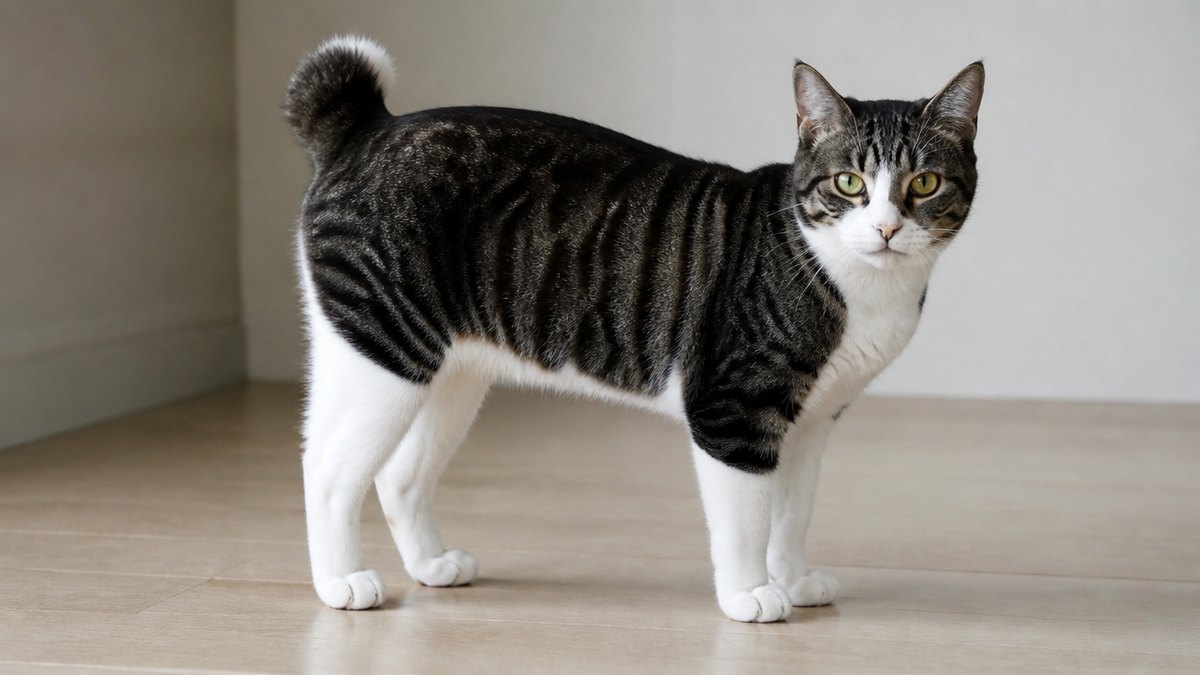
A Karelian Bobtail is a medium-sized Russian native cat with a short kinked tail carried as a pom-pom, from Karelia and the islands of Lake Ladoga. Its bobbed tail is the breed's defining feature and carries a quarter of its show points. Its standard gives a body neither stocky nor elongated, hind legs clearly longer than the front, and a tail of 4 to at most 13 cm whose fur is longer than the fur on the rest of the body.
The head is unusually specific in the standard and is the fastest way to tell this cat from the breed it is confused with. It forms an equilateral triangle with a long, almost straight profile, a flat forehead and flat cheeks, a narrow muzzle with slightly pronounced whisker pads and a narrow but firm chin. The ears are large and upright, set high enough that their outer line runs along the cheeks in a straight line. The eyes are oval and set at a slight slant, in a colour that corresponds with the coat.
Two coat lengths exist and the World Cat Federation treats them as one breed in two documents. The shorthair standard reads short, very dense, with a well developed soft undercoat and a firm glossy top coat. The semi-longhaired standard is identical in every other paragraph and differs only in giving a coat of medium length. Both keep the same tail rule and the same colour refusals, which is what a coat variety looks like rather than a separate cat.
The pom-pom tail, and why it is 25 of 100 points
The tail carries a quarter of the entire scale of points, more than the head and more than the coat and colour combined. That tells you what the breed is for. The requirement is not simply shortness: the tail must be kinked or bent, must fall between 4 and 13 cm, and must carry longer fur than the body so that it reads as a pom-pom. A short tail with body-length fur does not meet the standard.
The World Cat Federation gives this breed the codes KAS and KAL. The Kurilian Bobtail gets KBS and KBL. Four letters apart, and the table's own provisionally recognised colour, carnelian, code z, is annotated Only for KBS/KBL. That colour belongs to the Kurilian and not to this breed. Separately, the Russian catalogue that reproduces the FARUS standard codes the semi-longhaired Karelian KAB rather than KAL, so two bodies use two different codes for the same variety. Read codes out of the document you are actually citing.
The colour rules are the last structural point and they are a genetics statement in disguise. The standard refuses chocolate and cinnamon and their dilutions lilac and fawn, in any combination, and refuses the pointed pattern outright, while permitting every other colour and any amount of white. None of those colours occurs in native northern Russian populations, so the colour restriction is a way of writing outcrossing out of the breed.
Registry recognition, and why the answer is one
Exactly one international registry holds the Karelian Bobtail. The World Cat Federation lists Karelian Bobtail Longhair as KAL and Karelian Bobtail as KAS, and names WCF alone in the recogniser column of its own cross-registry table for both rows. Six other bodies we checked hold neither.
That table is worth trusting on a positive and checking on a negative, because its documented errors are always omissions of a recogniser rather than false claims of one. So the useful method is to read the row and then go and look in each other registry's own current document, which is what the table below records.
| Registry | Position | Document and date |
|---|---|---|
| WCF | Recognised in two coat lengths, KAS and KAL, with published standards | EMS table rows 21 and 69, and both standards dated 01.01.2010 World Cat Federation, WCF Breed standard |
| TICA | Absent from all six registration categories. Zero occurrences in the rules | Registration Rules Version B, 22 November 2024 |
| TICA, show index | Absent from the 73-breed championship index, from Advanced New Breed and from Preliminary | Browse All Breeds, read 10 September 2026 |
| CFA | No breed council and no committee | Declared Candidates for Breed Council Secretary, modified 31 July 2026 |
| FIFe | Absent from the breed index and from the two-breed preliminary block | FIFe Breeds, modified 4 August 2026 |
| LOOF | Absent from both lists, and no pedigrees issued in 2025 | Liste des races, 1 January 2026, and Nombre de chats Livre Officiel des Origines Felines |
| CFF | Absent from both breed indexes | CFF Breed Profiles, modified 13 August 2026 |
| CCA-AFC | No standard among the standards reissued on 12 June 2026 | CCA-AFC Breed Standards |
| GCCF | Not listed, in any grade, and not in the closing list of other breeds it knows of | Unrecognised Breeds, modified 23 September 2025 |
| FARUS, Russia | A national standard exists and is reproduced by a Russian catalogue | CATS-portal reproduction, read 10 September 2026 |
The GCCF's unrecognised-breeds page is the best negative instrument in cat registry work, because it lists breeds OTHER bodies hold and gives a reason for declining each one. It names the American Bobtail, the Japanese Bobtail, the Mekong Bobtail and the Toybob in its amber grade, each with the same owner note about ensuring low risk of spinal, bladder and bowel problems, and it repeatedly recommends the Kurilian Bobtail as an alternative breed. The Karelian Bobtail appears nowhere on it. So this is not a breed the GCCF has declined. It is a breed the GCCF has never had to consider, which is a different and more accurate thing to tell a reader.
The one date we can and cannot document
A Russian felinological catalogue states that the breed was registered and received a standard in 1992 to 1994, and that it is recognised only by World Cat Federation clubs. The World Cat Federation's own current standard carries the stamp Update 01.01.2010 and no earlier date. So the 1990s registration is reported by a Russian source and is not confirmed inside any WCF document we could open, and this page states it that way rather than converting a secondary claim into a registry fact.
Where the Karelian Bobtail came from
The Karelian Bobtail formed naturally in Karelia and on the islands of Lake Ladoga, in north-western Russia on the Finnish border, rather than being created by any breeding programme. Russian sources describe a working mouser long familiar to people in Karelia and only recently described by specialists.
Two things follow from the origin and both matter to an Indian reader. The first is climate. A cat that formed on lake islands at roughly 60 degrees north carries a dense double coat with a well-developed undercoat, which the standard requires rather than merely permits. The second is population. An island population is small and closed, which is precisely the situation the breed's own standard is protecting when it refuses colours that could only have come from outside.
The presumed ancestry, in Russian sources, is the Norwegian Forest cat. That is a plausible geographic claim and it is not a genetic finding, since no study has tested it. Treat it as the tradition the breed's own community holds rather than as established fact, and note that this page has no genetic evidence to offer either way.
| Claim | Stated by | Status |
|---|---|---|
| Formed naturally in Karelia and the islands of Lake Ladoga | Russian felinological catalogue, reproducing the FARUS standard | Consistent across Russian sources, no primary document opened |
| Norwegian Forest cat as a distant ancestor | Same source | A tradition, never tested genetically |
| Registered and standardised in 1992 to 1994 | Same source | Not confirmed inside any WCF document we could open |
| Current WCF standard in force | World Cat Federation | Documented, Update 01.01.2010 |
| Crossing with other breeds not permitted | FARUS standard as reproduced | Documented in the reproduction, and consistent with the WCF colour refusals |
Karelian bobtail cat price in India, and why there is not one
No Karelian Bobtail cat price in India exists, and no Indian site even invents one, which is unusual. The two Indian pages that price rare cats carry no row for this breed: one returns a hard 404 and the other returns HTTP 200 with the title Cat Breed Not Found. India's most-read cat pricing guide does not name the breed.
The reason is stranger than scarcity, and it sits in the search engine rather than the market. Search this breed with a price intent on Google India and the results page opens by correcting your spelling into a different breed, verbatim: Including results for kurilian bobtail cat price in india, and Search only for karelian bobtail cat price in india. The generated panel then answers with Kurilian facts and cites Kurilian pages. Every entry in the related-searches block is a Kurilian query.
| What you searched | What came back | What it actually is |
|---|---|---|
| karelian bobtail cat price in india | Including results for kurilian bobtail | A spelling correction into a different breed |
| The generated answer panel | Yes, the Kurilian Bobtail makes an excellent pet | The wrong breed, with citations to the wrong breed |
| Eight of the ten organic results | Kurilian Bobtail pages, including TICA's at position four | The wrong breed |
| Rupee prices on page one | Japanese Bobtail Rs 1.5 lakh to Rs 4.5 lakh, Himalayan Rs 30,000 to Rs 1,20,000 | Two other breeds entirely |
| Rupee figures naming this breed | An Amazon.in notebook and an Etsy shirt | Merchandise, not cats |
A Kurilian Bobtail, a Japanese Bobtail or a Himalayan, depending on which result they click. Nobody in India is offering a Karelian Bobtail, because the only registry that holds it is a European federation whose members are mostly in Russia and continental Europe. If a seller in India tells you they have one, ask which registry issued the pedigree, then check that registry's own breed list yourself. There are exactly two codes to look for, KAS and KAL, and a certificate naming TICA, CFA or FIFe for this breed is describing a cat those registries do not hold.
The absence of an invented price is worth pausing on, because it is rare. Across this batch, four of the seven breeds had a rupee band published by two Indian sites in identical figures. This one has nothing, which suggests the template that generates those pages is keyed to a breed list that itself was built from the larger registries. When a breed is too obscure even to be fabricated, the honest conclusion is that no Indian market exists at any price.
Import is not a shortcut. India's import policy for pet cats is restricted under ITC(HS) 01061900, and the only route without an authorisation is moving your residence to India permanently with a cat that is already yours, under the Customs Baggage Rules. Anything else needs a DGFT authorisation and, outside the listed purposes, a monthly committee.
Monthly cost of a dense-coated medium cat in India
Budget as you would for a Siberian or a Norwegian Forest Cat rather than for an average shorthair, because the coat is the cost driver. No Indian cost figure specific to this breed exists that is not invented, so the figures below are the ones this page can source.
- Licence, Rs 50 in Chennai. The Greater Chennai Corporation licenses pet animals generally rather than dogs only, so a cat is covered.
- Free municipal treatment and anti-rabies vaccination in Chennai. The corporation's veterinary clinics provide both free of cost, which is the largest recurring saving available to an Indian cat owner.
- Grooming is the real recurring cost. A dense double coat in a humid Indian city needs either your time twice a week or a groomer, and the second option is where the monthly cost actually lands.
- No statutory microchip cost for a kitten. Rule 7(16) of the Pet Shop Rules, 2018 makes microchipping mandatory for puppies only.
- No breed genetic test to buy. The tail mutation has never been identified, so no laboratory sells a panel for it and there is nothing to screen.
The Indian pages that publish a monthly cost for rare cats use a preset row, and the row is easy to recognise once you have seen it. It reads food Rs 1,500 to Rs 2,000, health Rs 500 to Rs 700, grooming Rs 800 to Rs 1,500 and a monthly total of Rs 2,800 to Rs 4,200, and the three component lines sum exactly to the totals, since 1,500 plus 500 plus 800 is 2,800 and 2,000 plus 700 plus 1,500 is 4,200. Those same four lines appear byte-identically on both Indian sites and across breeds of different sizes and coat lengths. This breed has no row at all, which at least spares it a fabricated figure. Build your own monthly cost from your vet's rate card, your groomer's price and your own food brand, and check it against your actual spend after three months.
Heat tolerance and the Indian climate
A Karelian Bobtail is not heat-tolerant by Indian standards, and this is one of the few breeds in this batch where origin genuinely predicts the problem. A dense double coat with a well-developed undercoat, required rather than merely permitted by the standard, evolved for lake-island winters and works against a cat in a Chennai May.
Plan against your own city's real peak rather than a generic Indian summer, because the most common error in Indian climate tables is naming May as the hottest month everywhere, which is wrong for three of the six cities most Indian cat owners live in.
| City | Hottest month and mean | Coolest month and mean | Verdict for a double-coated cat |
|---|---|---|---|
| Delhi | June, 35.88 C | January, 13.61 C | Hardest city in this table. The coat is an asset for six weeks a year and a liability for five months |
| Nagpur | May, 36.73 C | December, 19.97 C | Hardest of all. Indoor cooling is not optional |
| Chennai | May, 31.51 C | January, 24.09 C | Constant load, never a cool season. The undercoat never gets a rest |
| Kolkata | May, 31.53 C | January, 17.31 C | Heat plus a long humid monsoon, which is the worst combination for a dense undercoat |
| Mumbai | May, 31.19 C | January, 23.19 C | Similar to Chennai, with more coastal humidity |
| Bengaluru | April, 28.37 C | December, 20.22 C | The most workable Indian city for this coat |
| Pune | April, 28.93 C | December, 19.62 C | Second most workable, and the December mean is genuinely cool |
What to actually do about it
- Comb the undercoat out, do not shave it. A double coat insulates in both directions and a shaved cat sunburns and overheats faster. Removing dead undercoat with a comb is the intervention that works.
- Increase combing frequency in the monsoon, not just in summer. A damp undercoat is what turns into a skin problem in Kolkata and Mumbai.
- Give the cat a tiled floor and a shaded room. Cats thermoregulate by finding cool surfaces long before they pant.
- Watch for open-mouth breathing. In a cat this is never normal and always a reason to call your nearby vet rather than to wait.
- Prefer Bengaluru or Pune if you have the choice. At an April peak near 29 C and a December mean near 20 C, both are genuinely workable for a northern coat.
The honest summary is that this breed is a poor climate match for most of India and a reasonable one for the Deccan plateau. That is not a reason to write it off, since indoor cats in cooled flats live comfortably in Delhi. It is a reason to be clear-eyed about the grooming and cooling work you are signing up for.
Temperament, household fit and how much of it is measured
Russian sources describe a friendly, affectionate and undemanding cat that does not impose itself, gets on with other cats, likes children and is unusually quiet, chirping rather than meowing and touching a person with a paw instead of calling. Every word of that comes from people who breed the cats rather than from anyone who measured them.
That distinction is the useful part of this section. Breed temperament descriptions across the whole cat fancy are written by breed communities, and for a breed with no scientific literature at all there is nothing to check them against. So read the description as a statement of what the community selects for and values, which is genuinely informative, rather than as a prediction about an individual kitten.
The quietness claim is the one worth testing yourself, because it is the trait with the clearest Indian value. In a flat with shared walls, a cat that chirps instead of yowling is a real advantage over an Oriental breed. If you ever meet one, sit with it for an hour before deciding.
The same catalogue states that male Karelian Bobtails do not mark territory. No breed of cat has been shown to be free of urine marking, spraying is driven by entirety, stress and household density rather than by breed, and neutering is the intervention that works. Repeating a breed-level no-spraying claim would encourage exactly the decision, keeping a male entire, that carries 4.29 times the odds of death before three years compared with a neutered cat. Discuss neutering timing with your nearby vet.
The household fit follows from the origin rather than the temperament. This is a cat that formed as a working mouser on lake islands, and the same source says it suits a country house with outdoor access while adding that flat life is not a burden. In an Indian city, outdoor access means traffic, dogs and disease, so the practical answer is an indoor cat with vertical space and real daily play.
Training a Karelian Bobtail, and the handling the tail needs
To train any bobtail cat, start with the tail, because that is the one part of the animal a normal handling routine treats wrongly. Everything else is ordinary cat training and works on ordinary cat principles.
- Handle the tail gently and never stretch it. The tail is short and kinked by definition, and a kink is a vertebral feature rather than a bend in soft tissue. Teach children to lift the cat under the chest and hindquarters.
- Teach a carrier before you need one. Feed meals in an open carrier for two weeks so the first vet trip is not the first time the door closes.
- Build a weekly ear check into the grooming routine. Two minutes with a cotton pad, no probe, catches monsoon ear problems early in any Indian cat.
- Train tolerance of combing from week one. A double coat needs lifelong grooming, and a cat that fights the comb at eight months will fight it at eight years.
- Monitor weight monthly on a kitchen scale. A medium cat under a dense coat can gain a kilogram before you see it, and body condition is easier to correct early.
Litter training is usually trivial. Choose a large tray with a low entry, because a cat with a raised rump and long hind legs uses a different posture than a level-backed cat, and give one tray per cat plus one.
Leash work is realistic and useful in India, where an unsupervised outdoor cat meets traffic, dogs and disease. Start indoors with a harness, add a corridor, then a quiet balcony, and never a road.
How much exercise a Karelian Bobtail actually needs
Budget 40 to 60 minutes of interactive play a day for a working-origin cat kept indoors, split into two or three sessions. A mouser bred on lake islands has more drive than a lap breed and shows it as destructive behaviour when it is not spent.
- Split the time rather than lumping it. Two sessions of 20 minutes beat one of 40, because cats hunt in bursts.
- Give vertical routes. A shelf run along one wall triples the usable area of a one-bedroom flat and suits a cat with strong hind legs.
- Use puzzle feeders for part of the ration. Working the food is closer to what this cat's ancestors did than eating from a bowl.
- Move play to early morning and after sunset in summer. A closed Nagpur flat at 3 pm in May, where the monthly mean is 36.73 C, is not a place to run a double-coated cat.
- Stop when breathing changes. Open-mouth breathing during play is a stop signal rather than a fitness milestone.
The failure mode for this breed is boredom rather than under-exercise, and it looks like shredded furniture and night activity. A cat selected for hunting on islands needs something to do, and an Indian flat can supply that with routine rather than with space.
Grooming a Karelian Bobtail in Indian humidity
Grooming a Karelian Bobtail means managing an undercoat rather than a topcoat. Comb once a week for the shorthair and twice weekly for the semi-longhaired variety, and increase both during the monsoon.
The standard requires a well-developed soft undercoat under a firm glossy top coat, and for the longhair the top coat is of medium length over the same undercoat. In a Chennai or Kolkata monsoon, that undercoat holds moisture for hours after a bath or after rain on a balcony, and damp undercoat against skin is how Indian cats get skin problems.
- Use a comb rather than a brush. A slicker brush glides over an undercoat. A wide-toothed comb followed by a fine one actually removes it.
- Do the pom-pom tail by hand. The tail carries longer fur than the body by design, so it mats first, and it should be worked with fingers rather than pulled straight with a comb.
- Bathe rarely and dry completely. Towel, then a low cool dryer. Air drying in a humid Indian flat leaves the undercoat damp for hours.
- Add an ear check to the same session. A weekly two-minute look is the whole job, and the monsoon is when it earns its place.
- Never shave the coat for the heat. A shaved double coat regrows unevenly, removes the cat's own insulation against sun and exposes skin that has never seen Indian ultraviolet.
Shorthair or semi-longhaired, for an Indian city
Choose the shorthair if you have the choice. Both varieties carry the same undercoat requirement, so the difference is topcoat length, and in a humid Indian city that difference is the daily grooming time. In Bengaluru or Pune either is workable. In Chennai, Kolkata or Mumbai the semi-longhaired variety becomes a daily job in the monsoon.
Karelian Bobtail health, and an evidence base of zero
No health issues have been reported in this breed and no study has looked for any. A PubMed audit run on 10 September 2026 returned zero records across four query forms, with a control set passing in the same session, so the absence is a finding rather than a broken search. Nothing is published on this breed's genetic diversity either.
The search audit, in full, because a zero has to be earned
The exact phrase Karelian Bobtail with a title and abstract scope returned zero, with PubMed's own quotedphrasesnotfound warning. The plural returned zero the same way. The unquoted form returned zero with the translation genuinely broadened to karelian OR karelians AND bobtail AND cat, which is the stronger negative, because the engine widened the search itself and still found nothing. And Karelian with a title and abstract scope combined with cat returned four records, every one of them homonym capture: two papers on the chemistry of Karelian birch wood and two on allergy in Russian Karelia. Controls in the same session returned 72 records for Scottish Fold and 61 for a feline hip dysplasia query, so the instrument worked.
What the wider bobtail literature does and does not reach
Three separate short-tail mutations are known in domestic cats and none has been tested here. The Manx mutations sit in the T gene and cause haploinsufficiency of Brachyury. The study that mapped them collected buccal swabs from 196 cats across five bobtail breeds, and the Karelian Bobtail is not one of the five. The Japanese Bobtail and Chinese short-tailed cats carry a HES7 missense mutation instead, and that paper concludes that some kinked-tail cats it sampled fit neither gene, implying at least three independent short-tail events in domestic cats.
The Kurilian Bobtail was directly tested and cleared of the Manx mechanism. Ten Kurilians were sequenced across exons 8 and 9 of the T gene and then across all remaining exons, and no causal variant was found. That is a real exclusion for the Kurilian and it says nothing about the Karelian, which was not sampled. Two Russian bobtails from opposite ends of a very large country are not one population, and Google conflating them does not make the genetics transfer. Anyone telling you the Karelian tail is safe because the Kurilian's was cleared is reasoning from a study that did not include this cat.
The nearest measured evidence on bobtail spines
The most useful adjacent finding comes from radiographs of the Japanese Bobtail's entire vertebral column. It found real anomalies, usually one fewer thoracic vertebra than the normal feline formula, an average of 15.8 caudal vertebrae, transitional vertebrae, anomalous ribs, one bifid tail vertebra and hemivertebrae in most cats, generally inside the tail kink. Its conclusion, verbatim, is that the abnormal vertebral formula or the placement of the kink in the tail did not coincide with morbidity or mortality. That is a different breed and a different gene. It is a reason not to panic about a kinked tail, and not a clearance for this one.
| Question | Status | Source |
|---|---|---|
| Any paper naming the breed? | Zero, across four query forms with passing controls | PubMed audit, 10 September 2026 |
| Is the tail mutation identified? | Unknown. Never sequenced | Same audit |
| Is it the Manx T-box mutation? | Untested. The breed was not among the five sampled | Buckingham 2013 |
| Is it the HES7 mutation? | Untested. That study sampled Asian cats and the Japanese Bobtail | Xu 2016 |
| Do bobtail cats show vertebral anomalies? | Yes in the Japanese Bobtail, without measured morbidity or mortality | Pollard 2015 |
| Hereditary disease reported? | Asserted absent by a Russian catalogue, never studied | CATS-portal |
| Breed lifespan measured? | No. Not among the 12 breeds reaching 15 deaths | Teng 2024, Table 6 |
| Screening test available to buy? | None exists, because the locus is unknown | PubMed audit |
The risks that are established apply to any purebred cat and are worth acting on. Entire cats carried 4.29 times the odds of death before three years compared with neutered cats, and purebred cats 1.83 times the odds compared with crossbreds. Neutering is the single largest lever an owner controls. Talk to your nearby vet about timing rather than to a breeder.
One thing this page will not do is convert an absence of studies into a claim of health. A breed nobody has studied is a breed whose problems, if it has any, have not yet been described. That is different from a clean bill, and any page telling you a rare breed is exceptionally healthy on no evidence is telling you about the size of the literature rather than the state of the cats.
Feeding a medium working-type cat in India
Feed to body condition rather than to a chart, because no feeding guidance specific to this breed exists that is not invented. A medium, muscular, active cat under a dense coat is easy to overfeed and hard to assess by eye.
- Assess by hand, not by sight. Under a well-developed undercoat you cannot see a waist. Feel the ribs under a thin fat cover without pressing, every month.
- Weigh the daily ration once and portion it. In a household where several people feed the cat, one labelled container each morning is the whole solution.
- Keep wet food in the mix in Indian summers. Water intake matters, and a cat that will not drink will often eat moisture.
- Feed for activity, not for size. A working-origin cat kept indoors with no play burns far less than the same cat with a play routine, and the ration should follow the activity.
- Ignore any Indian page's calorie figure for this breed. None of them has a row for it, and the ones that do carry rare breeds print the same numbers across cats of different sizes.
Kitten food through 12 months is standard and sensible here. Availability in India is not a constraint, since every major wet and dry line sold in Indian metros carries a complete and balanced formula, and a medium cat simply eats a medium amount of it.
The one breed-linked point is the coat. A dense double coat is protein-expensive to grow and to replace, so a cheap low-protein diet shows in the coat before it shows anywhere else. If the undercoat looks dull and thin after three months on a food, that is worth raising with your nearby vet rather than switching brands blind.
Kitten timeline, month by month through the first year
A Karelian Bobtail kitten follows the ordinary feline timeline with two breed-specific additions, tail handling from the first week and coat training from the second month. Kitten care here is mostly about building habits that a double coat will need for fifteen years.
- Weeks 0 to 8, with the breeder. Indian law treats kittens below eight weeks as un-weaned and prohibits their sale, so a kitten offered before eight weeks is an illegal sale.
- Month 2, home. One room, one tray, one hiding place, and daily gentle handling that never includes the tail.
- Month 2, first comb. Thirty seconds a day with a soft comb, long before there is much coat to remove, builds the tolerance the adult will need.
- Month 2 to 4, core vaccination course. Follow your nearby vet's schedule rather than any breed page's table, since Indian protocols vary by region and disease pressure.
- Month 3, carrier training. Feed in the open carrier daily.
- Month 4, weight baseline. Record it and repeat monthly, because a growth curve is more informative than any single number.
- Month 4 to 6, socialisation to household noise. Pressure cookers, mixers and doorbells, at low volume, paired with food.
- Month 6 to 9, neutering discussion. Entire cats carry 4.29 times the odds of death before three years compared with neutered cats, which makes this the largest health decision of the year.
- Month 8, first monsoon. The first wet season is when ear and skin routines are actually tested. Increase combing and keep the ear check weekly.
- Month 12, adult health check. Ask specifically for the tail and lower spine to be palpated and for a body condition score to be written into the file.
One thing not to do is judge the kitten's tail against a photograph. The standard permits any combination of kink and bend between 4 and 13 cm, so two correct kittens in one litter can look quite different from behind.
Karelian Bobtail versus the cats it is confused with
The comparison that matters is against the Kurilian Bobtail, because that is the breed Google substitutes for this one. The table below sets both beside the two other bobtails an Indian buyer is likely to meet.
| Breed | Origin | Tail | Registries | Tail gene status |
|---|---|---|---|---|
| Karelian Bobtail | Karelia and the islands of Lake Ladoga | 4 to 13 cm, kinked, pom-pom | WCF only, KAS and KAL | Never sequenced, never sampled |
| Kurilian Bobtail | Kuril Islands, Kamchatka and Sakhalin | Short pom-pom, a bigger cat overall | WCF, FIFe, TICA, LOOF, CFF, CCA Federation Internationale Feline | T-box directly tested in 10 cats and excluded |
| Japanese Bobtail | Japan | Kinked bob, spine radiographed | CFA, TICA, FIFe, WCF, LOOF, CCA | HES7 c.5T>C mapped |
| Manx | Isle of Man | Absent to stumpy | All major registries | Four T-box alleles mapped |
| Toybob | Rostov and Ural regions, Russia | Bobbed, minimum two vertebrae | CFA, TICA, WCF, CFF | Never sequenced |
| Indian domestic shorthair | India | Usually full length, kinks common | None, and none needed | Not applicable |
Size and head shape. A Kurilian is a big, substantial cat with a broad head and a heavy build. A Karelian Bobtail is medium sized, and its standard specifies an equilateral triangle head with a long, almost straight profile, flat forehead, flat cheeks and a narrow muzzle. If the cat in front of you is heavy and round-headed, it is not this breed, whatever the certificate says. And if the certificate names TICA, FIFe or LOOF, it is describing the Kurilian, because those three registries hold that breed and not this one Federation Internationale Feline Livre Officiel des Origines Felines.
Mistakes Indian searchers make with the Karelian Bobtail
Almost every mistake with this breed happens before anyone sees a cat, because the search engine makes the first one for you. The list below is ordered by how much each costs.
- Accepting Google's spelling correction. The results page swaps in the Kurilian Bobtail and then answers with Kurilian facts. If you meant the Karelian, click Search only for and read what actually comes back.
- Reading a Kurilian price as this breed's price. Page one carries Kurilian, Japanese Bobtail and Himalayan rupee figures for a Karelian query. None of them is this cat.
- Trusting a certificate that names the wrong registry. Only the World Cat Federation holds this breed, under KAS and KAL. A TICA, CFA or FIFe pedigree for a Karelian Bobtail describes a breed those bodies do not carry.
- Attaching the carnelian colour to this breed. The World Cat Federation's carnelian code is annotated Only for KBS/KBL, which are the Kurilian's codes.
- Buying an unregistered short-tailed cat as this breed. Short and kinked tails are common in Indian street cats, and at least three separate mutations produce them. Such a cat can be a wonderful pet, and it is not a Karelian Bobtail.
A sixth mistake is quieter and worth naming. The Russian catalogue that carries the most detailed description of this breed contradicts the standard it reproduces, printing a tail of 3 to 113 cm in its prose against 4 to 13 cm in the standard beneath. That is a typographical error rather than a dispute, and it is a reminder to quote the standard rather than the article wrapped around it.
Finally, do not read this breed's registry scarcity as a health verdict. One registry holding a breed says something about geography and about how many breeders have organised, and nothing whatever about the cats. The health verdict here is simply that nobody has looked.
Adoption, responsible sourcing and the honest answer for India
Adopt, because in India there is no route to this breed at all. There is no Indian breeder, no listing, no price and no registry presence, and the practical alternatives give you almost everything a Karelian Bobtail buyer actually wants.
- Adopt an Indian domestic shorthair with a naturally short tail. Kinked and short tails are common in Indian street populations, and such a cat is hardy, climate-adapted and free.
- Adopt for temperament rather than for tail. If what you want is a quiet, undemanding, mouse-driven cat, shelters can match that far more reliably than any breeder can promise a phenotype.
- Verify any pedigree against the registry's own list. Two codes exist for this breed and they are KAS and KAL. Check the registry's document, not the certificate's logo.
- Refuse any kitten under eight weeks. Indian law defines kittens below eight weeks as un-weaned and prohibits their sale.
- Ask your own vet to examine the tail and lower spine. For any short-tailed cat of unknown genetics, that examination is worth more than any breeder assurance.
If you specifically want a documented Karelian Bobtail, the honest route is long. It means finding a breeder in a World Cat Federation club, almost certainly in Russia or continental Europe, and then either moving your residence to India permanently with the cat already yours under the Customs Baggage Rules, or applying for a DGFT import authorisation for a purpose the policy actually lists. Nothing shorter than that exists today.
The wider point is worth stating plainly. This page exists because the Indian search index for this breed is about 125 results deep and eight of the top ten are a different cat. A reader who arrives here wanting a Karelian Bobtail leaves knowing what the breed is, which single registry holds it, what its standard actually requires, and that the science on its defining feature is a blank page. That is the whole of what is known, and it is more than any other page in that index offers.
Karelian Bobtail questions Indian searchers actually ask
Do bobtail cats make good pets?
Yes, and the honest caveat is that bobtail is a description of a tail rather than a single genetic condition. At least three separate mutations produce short tails in domestic cats, and they behave differently. The Manx mutations in the T gene cause haploinsufficiency of Brachyury and are associated with the anomalies that give the Manx its reputation. The Japanese Bobtail's HES7 mutation is a different gene, and a radiographic survey of that breed's whole spine found vertebral anomalies that did not coincide with morbidity or mortality. The Karelian Bobtail's mutation has never been identified, so nobody knows which pattern it follows.
What big cat is the friendliest?
None of them, and the reason this question appears in a Karelian Bobtail search is itself the finding. Google returns about 125 results in India for this breed, which is not enough to fill a questions box, so it pads it with generic cat listicle questions. No big cat is a pet, no big cat is friendly in any sense a household should act on, and keeping one in India is a wildlife matter rather than a pet matter. If you want a friendly cat that looks substantial, look at the Maine Coon or an Indian domestic shorthair.
What is the most misbehaved cat breed?
No breed is, and this is another question Google padded into the Karelian Bobtail's results box. Behaviour in cats varies far more between individuals than between breeds, and most breed temperament descriptions, including the ones on this page, come from breeders and registries rather than from measurement. Judge the individual cat, its socialisation between two and seven weeks, and its current home, rather than its label.
What is the calmest nicest cat breed?
There is no measured answer, and any page giving you one is repeating breeder description. What is worth knowing about this particular breed is that Russian sources describe an unusually quiet cat that chirps rather than meows and touches a person with a paw instead of calling. If quietness is what you actually want in an Indian flat, that trait is worth asking any individual cat's owner about, and it is available in shelter cats too.
Is the Karelian Bobtail the same as the Kurilian Bobtail?
No, and Google itself gets this wrong. Search karelian bobtail cat price in india on Google India and the results page opens with Including results for kurilian bobtail cat price in india, then answers with Kurilian facts. They are separate Russian breeds from opposite ends of the country, Karelia in the north west and the Kuril Islands in the far east. The Kurilian is a big cat held by four registries. The Karelian is a medium cat held by one. Even their World Cat Federation codes differ, KAS and KAL for the Karelian against KBS and KBL for the Kurilian.
How much does a Karelian Bobtail cost in India?
No Indian price exists, and unusually for a rare breed, none is even claimed. The two Indian sites that invent prices for rare cats do not carry this one: one returns a hard 404 and the other serves a soft 404 titled Cat Breed Not Found at HTTP 200. The only rupee figures attached to the breed's name anywhere in the Indian index are merchandise, including an Amazon.in notebook and an Etsy shirt. India's most-read cat pricing guide does not name the breed.
Which registries recognise the Karelian Bobtail?
One. The World Cat Federation holds Karelian Bobtail and Karelian Bobtail Longhair under codes KAS and KAL, and its own cross-registry table names WCF alone in the recogniser column for both rows. TICA's registration rules list six categories and the breed appears in none of them. CFA runs no breed council for it. FIFe's breed index does not carry it, the French studbook LOOF does not, the Canadian Cat Association does not, and the GCCF does not list it even among the breeds it declines by name.
What is the lifespan of a Karelian Bobtail?
Nobody has measured it. The largest UK feline life-table study built its breed table from 7,936 confirmed deaths and required 15 or more deaths before a breed received its own row. Twelve breeds reached that threshold and the Karelian Bobtail is not among them. The study's own life expectancy at age 0 was 11.74 years for all cats and 11.89 years for crossbreds, and those are the only defensible numbers to plan around.
Does the Karelian Bobtail have health problems?
None has been reported, and none has been looked for. A PubMed audit on 10 September 2026 returned zero records across four query forms, and the unquoted retry that did return results captured Karelian birch and the Russian region rather than the cat. Russian breed catalogues state that no hereditary diseases have been identified, which is a claim from people who breed the cats rather than a finding from anyone who studied them. Ask your nearby vet to assess an individual animal.
Why does the standard ban chocolate and colourpoint?
Because those colours would prove an outcross. The World Cat Federation standard refuses chocolate and cinnamon and their dilutions, lilac and fawn, in any combination, and refuses the pointed pattern outright, while permitting every other colour and any amount of white. Chocolate and the pointed pattern do not occur in native northern Russian cats and would have to come from Oriental or Siamese lines, so the colour restriction is a purity rule written as a colour rule.
Can I import a Karelian Bobtail into India?
Only as your own pet when you move to India permanently. India's import policy for pet cats and dogs is restricted under ITC(HS) code 01061900, and the Directorate General of Foreign Trade allows import without authorisation only for persons shifting residence permanently to India under the Customs Baggage Rules. Anyone else needs an import authorisation, and cases outside the listed purposes go to a monthly Exim Facilitation Committee. Buying a cat abroad and having it shipped is not the baggage route.
Are Karelian Bobtails hypoallergenic?
No breed is on the current evidence, and this one has never been tested. A 2024 review states flatly that there is no scientific evidence for a hypoallergenic cat breed. A dense double coat with a well-developed undercoat is if anything the opposite of what people imagine when they use the word, because there is more of it to shed. Individual cats differ far more than breeds do.
Compare with similar breeds
Karelian Bobtail sits in 2 Bonbeno groups. Each one compares it directly against the breeds it is genuinely an alternative to, on the same figures.