
Conformation
Bobtail and short-tailed cat breeds
Two short-tail genes are mapped, a third is inferred, and most bobtail breeds have never been sequenced for any of them.
Quick answer
Bobtail cat breeds share a short tail and not a gene. Two mechanisms are mapped. The Manx tail comes from frameshift mutations in T, encoding Brachyury, and the same alleles sit in most tested American Bobtails and Pixie-bobs. The Japanese Bobtail's comes from a missense change in HES7, a different gene. The Kurilian Bobtail has been cleared of the Manx gene and never tested for HES7, and the study that mapped HES7 concluded that at least three independent short-tail events exist in domestic cats. The Karelian, Mekong, Toybob, Raas and Highlander have never been genotyped, so no other breed's welfare answer transfers to them.
The breeds
A short tail is a description, not a diagnosis. Two genes that produce one are mapped, they carry opposite welfare records, and most of the breeds on this page have been tested for neither.
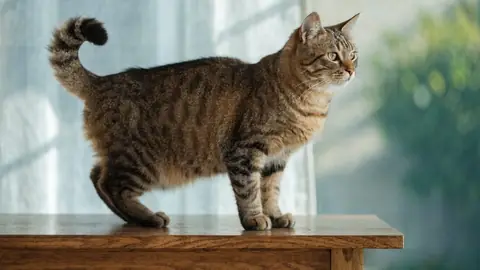 American BobtailWhat the primary genetics actually show about the American Bobtail's tail, why the Manx comparison is not marketing, what one...
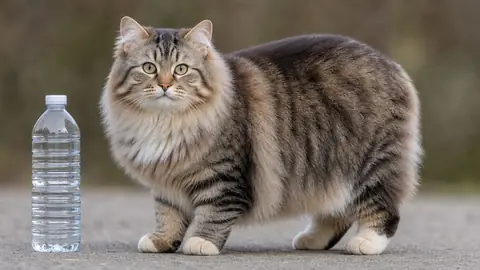 CymricOne tailless gene, four tail lengths, five registries that cannot agree whether this is a breed, and a welfare question the...
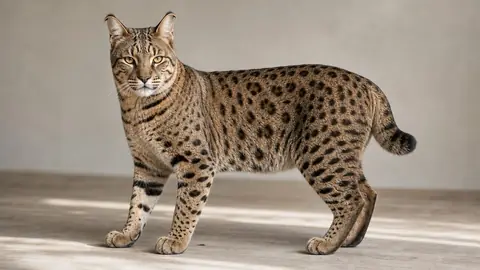 HighlanderA curled-ear, short-tailed cat that TICA has held since 2008 and shows below championship, that the GCCF red-lists by name, and...
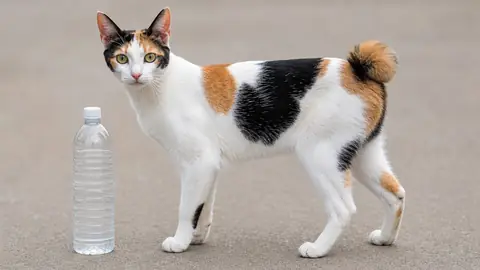 Japanese BobtailA short tail in a cat is usually a welfare question. On this breed the honest answer is largely reassuring, and this page gives...
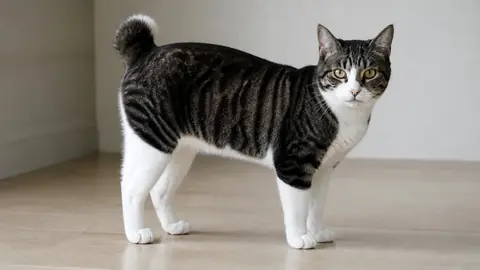 Karelian BobtailA Russian bobtail from the islands of Lake Ladoga that exactly one international registry holds, whose entire indexed scientific...
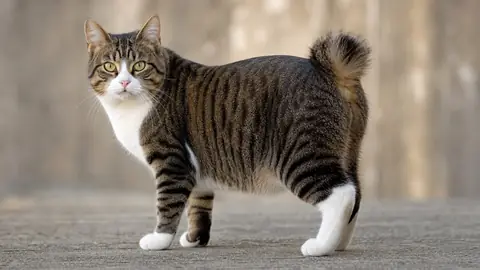 Kurilian BobtailTen Kurilian Bobtails have had their T gene sequenced and none carried the Manx mutation. Nobody has ever tested them for the...
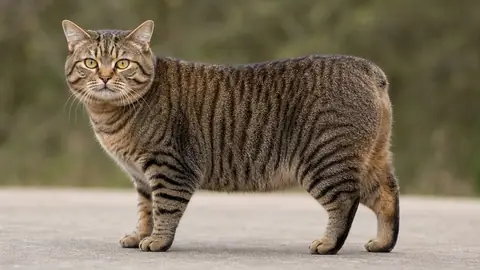 ManxOne in five short-tailed Manx cats carries a further congenital anomaly, and nine in ten of those are the tailless rumpy the show...
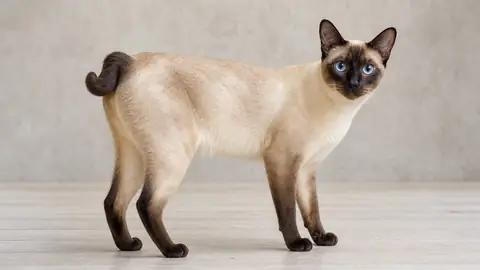 Mekong BobtailThe only breed standard this cat has anywhere requires two things at once: a tail nobody has genotyped, and a tyrosinase allele...
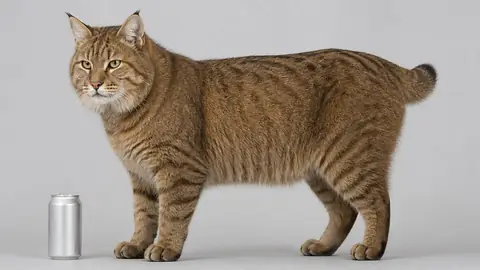 Pixie-bobA large woolly-coated American cat whose defining bobbed tail has been sequenced, and whose one shared allele with the Manx was...
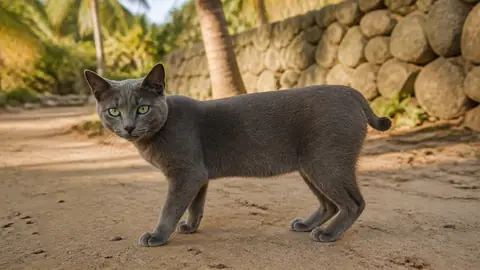 RaasOne island, four colours, a mandatory kinked tail, and about 500 cats left. Almost nothing written in English about this cat is...
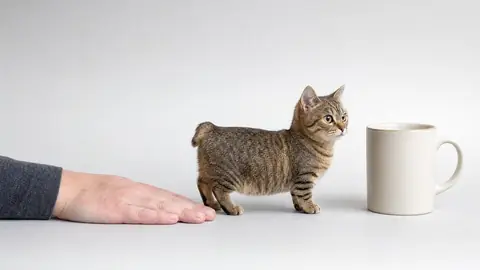 ToybobA cat under 3 kg that CFA advanced to full championship for the 2025-26 show season, that TICA still shows below championship as...
Compare the breeds side by side
To compare these 11 breeds directly, read across the table rather than down the guides. Heat tolerance is a Bonbeno rating out of 5 for Indian conditions, and the reasoning behind each one sits on the breed's own page.
| Breed | Heat tolerance | Published price, India |
|---|---|---|
| American Bobtail | 3 of 5 | 1 |
| Cymric | 2 of 5 | Rs 50 |
| Highlander | 4 of 5 | 0 of 206,421 characters |
| Japanese Bobtail | 2 of 5 | Rs 70,000 to Rs 1,10,000 and Rs 1,50,000 to Rs 7,00,000, which do not overlap |
| Karelian Bobtail | 2 of 5 | See page |
| Kurilian Bobtail | 1 of 5 | None published. The breed is absent from every Indian price list checked |
| Manx | 2 of 5 | Rs 30,000 to Rs 60,000, described as very rare in India |
| Mekong Bobtail | 4 of 5 | Rs 13,895, for a gold necklace |
| Pixie-bob | 2 of 5 | Not sourceable. The only Indian rupee listing for the name is a children's book at Rs 2,569 |
| Raas | 5 of 5 | None sourced. India's 40-breed cat guide and its cat-price guide both return zero for Raas and Busok |
| Toybob | 3 of 5 | See page |
What matters in this group
The points below are what the evidence on these 11 guides actually supports, not what the category is assumed to mean.
- The Manx mechanism is the one with the worst record and the best evidence. Buckingham 2013 sequenced the T gene, encoding Brachyury, in 196 cats across five short-tailed breeds and found four mutant alleles in the Manx, three single-base deletions, c.998delT, c.1169delC and c.1199delC, and one duplication-deletion, every one a frameshift that truncates the protein. Seventy-eight of 82 short-tailed Manx carried one, no cat in the entire sample carried two, and the authors read that as complete absence of Brachyury being lethal before birth, so a rumpy to rumpy mating is expected to lose about a quarter of the litter. Roughly 20 percent of short-tailed Manx carry a further congenital anomaly, sacral agenesis, tethered cord, imperforate anus among them, and about 90 percent of those sit in the rumpy phenotype the show standards reward. The Cymric is the semi-longhaired Manx on the same alleles. The same study found c.998delT in 12 of 20 short-tailed American Bobtails and in 8 of 14 short-tailed Pixie-bobs, and did not find it in eight American bobcats, so the Pixie-bob's defining trait is a Manx tail arriving by a different route.
- The Japanese Bobtail mechanism is a different gene with a different record. The 2013 study found no causal T variant in any of 14 Japanese Bobtails, and in 2016 two independent groups found the cause, a missense change in HES7, a somite segmentation gene, c.5T>C giving p.V2A, mapped to a 5.6 Mb region of chromosome E1 and validated in 245 unrelated cats. All 12 pedigree Japanese Bobtails genotyped were homozygous and alive, against zero homozygotes among 82 short-tailed Manx. Seventeen kinked-tailed cats had the whole spine radiographed and every one had an abnormal vertebral formula, with caudal hemivertebrae in 47 percent, and the abnormalities did not coincide with morbidity or mortality, because the kinks sat remote from the sacrum. Caudal vertebrae ran 11 to 21 with a mean of 15.8, against 0 to 23 in the Manx. The guide states three limits with the finding. The radiographic colony descends from one queen, the cats were all five years old or younger, and the feral-cat health remark is a field observation rather than a cohort. The registries write the difference into their rules, and an absent tail bone disqualifies a Japanese Bobtail under CFA and FIFe while it is the scored ideal for a Manx in the same FIFe edition.
- The third mechanism exists by exclusion, and the Kurilian Bobtail is the breed that shows it. Ten Kurilians were sequenced across exons 8 and 9 of T, where all four Manx mutations sit, and then across every remaining exon, and no causal variant was found, so the Manx gene is excluded from this breed directly. HES7 has never been tested in a single Kurilian. The Xu 2016 genotyping table lists every one of its 245 cats and there is no Kurilian row, and the word appears zero times in Lyons 2016, the other HES7 paper. The same Xu study found that roughly one third of the kinked-tailed Chinese cats it examined carried neither known variant, sequenced the full coding regions of both genes in those 20 cats, found nothing, and concluded that at least three independent short-tail events have occurred in domestic cats. So two tail genes are mapped and a third locus is inferred, which is why one member guide counts two and another counts three and both are right. The Kurilian, with a kinked rather than truncated tail of 2 to 10 caudal vertebrae, excluded from the first gene and never tested for the second, is the candidate its guide names for that third locus, and it labels the candidacy a hypothesis.
- Which breeds have been sequenced is the fact that sorts this page. The 2013 study sampled five breeds, 136 Manx, 21 American Bobtail, 15 Pixie-bob, 14 Japanese Bobtail and 10 Kurilian Bobtail, and the 2016 HES7 work genotyped 12 pedigree Japanese Bobtails. Everything else here is untested. The Karelian Bobtail, held by the World Cat Federation alone as KAS and KAL, returns zero PubMed records across four query forms. The Mekong Bobtail, held by the WCF alone since August 2004, has one mapped mutation and one blank, because its compulsory pointed pattern is the TYR G302R allele and its tail has never been drawn blood for. The Toybob, at CFA championship from the 2025-26 season and in TICA's Category III as a Variant or Mutation breed, has one PubMed record and it is a coat-colour paper. The Raas is held by the Feline Fanciers' Federation as the Busok, on a standard that requires a kinked tail and names no DNA test, and its locus has never been looked for. The Highlander carries curled ears and a short tail, the study that mapped the Manx alleles does not name it, and neither mechanism has been tested in it. Even the American Bobtail is only partly explained, since seven of its 20 tested cats carried nothing known.
- One breed's welfare answer does not transfer to another, and every untested guide here says so in its own words. The Kurilian guide puts it hardest, that the Manx answer does not transfer because the Manx gene has been excluded, the Japanese Bobtail answer does not transfer because nobody has tested the breed for HES7, and transferring either would be fabrication with a citation attached. The Karelian guide warns that anyone calling the Karelian tail safe because the Kurilian's was cleared is reasoning from a study that did not include this cat, since two Russian bobtails from opposite ends of a very large country are not one population. The Toybob guide says the same of the Manx result, and the Highlander guide says that telling an owner their cat carries either gene without a test would be inventing a prognosis. The Raas guide names why it matters, that the Manx allele set carries an embryonic-lethal homozygote and an associated rate of congenital anomaly that the Japanese Bobtail's does not. The reassuring adjacent evidence is the Japanese Bobtail radiographic series, and the Toybob and Karelian guides both read it the same way, as a reason not to panic about a kinked tail and not as a clearance for a breed with a different gene or no known gene.
- For an Indian buyer the practical consequences follow from the genetics. The Manx guide notes that a DNA test for the four published T alleles is scientifically trivial, that no registry requires one and that LOOF's breeding grid asks for none, and the Kurilian, Karelian, Toybob and Raas guides each report no test to buy because the locus is unknown. So the visible tail is the proxy, with 95 percent of short-tailed Manx carrying a mutant allele and 98 percent of full-tailed ones not. Ask what both parents' tails looked like, because a tailless to tailed mating cannot produce a homozygote. Watch the kitten walk away and land from a jump, watch it urinate and defecate, and get the sacrum palpated at the first visit, which is what the Manx and Toybob guides both ask for. Read which registry issued the papers, since the GCCF holds the American Bobtail, Japanese Bobtail, Mekong Bobtail and Toybob at amber, states for the Mekong and the Toybob that genetic and veterinary information would be required before acceptance, and recommends the Kurilian Bobtail as an alternative. And do not buy the shortest tail. In the one breed where the anomalies have been counted, nine tenths of them sit in the phenotype with no tail at all.
Membership is generated from the breed data itself, not typed by hand, so this list cannot drift from the guides it points at and fills in as more publish. The 11 guides here cite 353 sources between them.
This page is a directory of published Bonbeno guides, generated from their data rather than written as clinical guidance, so no veterinarian reviewed this page itself. Each linked guide carries its own veterinary review and its own health sections. Breed level evidence describes populations, and your animal is an individual, so consult your nearby vet before acting on anything you read here.
Common questions
How does Bonbeno decide which breeds belong on this page?
Membership is generated from each breed's own published data rather than chosen by an editor. The group is defined by a shared trait rather than a rating, so its members are named in the site's own cluster definition and each one is checked against the published guide before it appears. A breed appears here the moment its guide publishes and meets that rule, and never before, which is why no link on this page can point at a guide that does not exist.
What is a Bonbeno heat tolerance rating?
It is a 1 to 5 rating of how well a breed copes with Indian conditions, where 5 is best. Almost no international breed reference publishes one, and in a country where summer temperatures pass 45 C it is the most decision-relevant trait there is. It is Bonbeno's own judgement, built from published heat-illness evidence where that exists and stated as inference where it does not.
Are the prices on this page current?
Each price is read from that breed's own guide, where it is compared across published Indian sources and cited. Published Indian breed prices disagree widely between sellers, sometimes by more than a lakh for the same breed, so treat the figure here as the lowest band Bonbeno found and read the guide for the full range.
Does Bonbeno sell or broker any of these cats?
No. Bonbeno does not sell pet food, products or animals and does not broker puppy or kitten sales. Nothing on this page is a listing, and no breeder or seller can pay to appear on it.