
Breed profile
Kurilian Bobtail: What the Genetics Do and Do Not Say
Ten Kurilian Bobtails have had their T gene sequenced and none carried the Manx mutation. Nobody has ever tested them for the Japanese Bobtail's gene. Here is what that leaves an Indian buyer able to say.
Quick answer
The Kurilian Bobtail is a natural Russian breed from the Kuril Islands with a short pompom tail of 2 to 10 kinked caudal vertebrae. Its tail is not the Manx mutation: ten Kurilians were sequenced across the whole T gene and none carried a causal variant. HES7, the gene explaining the Japanese Bobtail, has never been tested here, so the locus is unidentified and homozygote viability unknown. In India the breed has no market and no rupee price for a live cat exists.
This page reports published veterinary and genetic literature, and reports honestly that almost none exists for this breed. Nothing here is veterinary advice and nothing here can diagnose your cat. An absence of published health problems is not evidence of health. Any kitten with an altered gait, a painful tail base, straining to urinate or defecate, or reduced sensation at the hindquarters needs a registered veterinary practitioner the same day.
Kurilian Bobtail at a glance
What the Kurilian Bobtail is, and what its pompom tail actually is
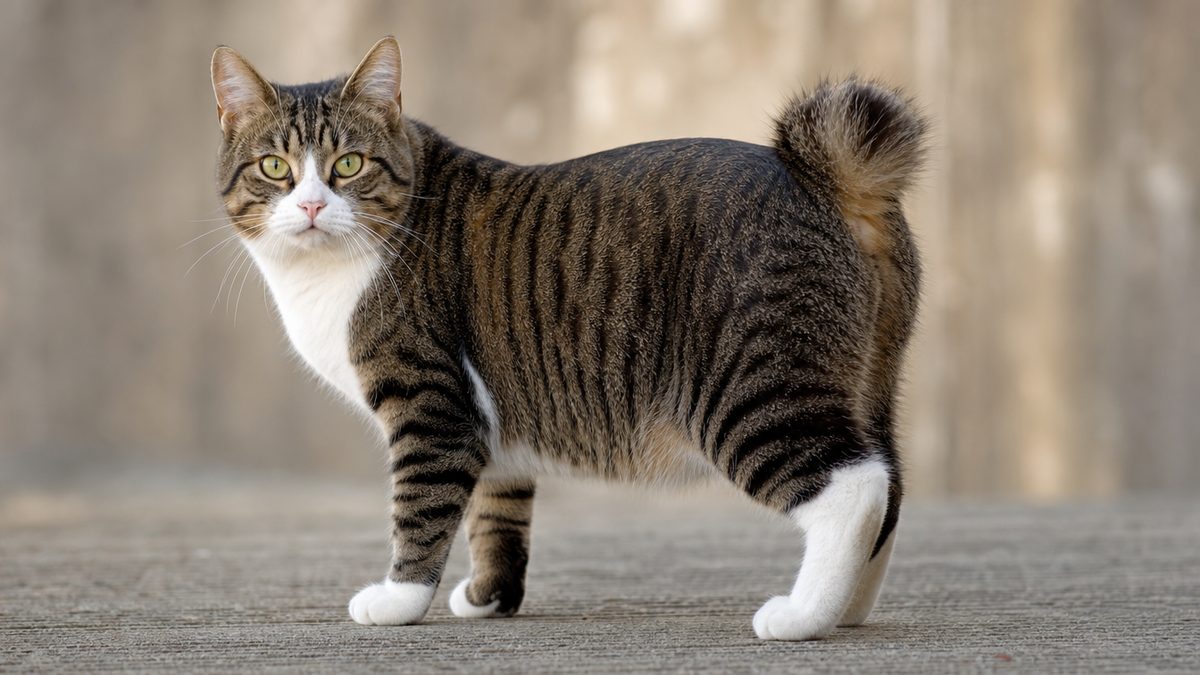
The Kurilian Bobtail is a natural Russian breed from the Kuril Islands whose short pompom tail is built from 2 to 10 kinked caudal vertebrae, and whose tail is worth more show points than any other short-tailed cat's. It is a large, brawny, semi-cobby cat that comes in a shorthair and a semi-longhair.
Start with the tail, because it is the breed. TICA describes it as short and bushy, shaped like a whisk, a spiral or a snag, consisting of anywhere between 2 to 10 caudal vertebrae kinked many times in various directions and with different degrees of articulation, and states that no two are alike. FIFe's standard asks for a compact powerful body with a short pompom-shaped tail.
That is a tail that is present, structured and prized, which is the first thing distinguishing this cat from the Manx. Where CFA's Manx standard treats absence of tail as the perfect specimen, FIFe's Kurilean standard disqualifies absence of the tail bone, a short straight tail without angles and curves, and a tail longer than 12 cm The Cat Fanciers' Association. Manx Show…. The bone must be there and it must be crooked.
The cat around the tail
FIFe describes a large or medium-sized, well-muscled cat with a compact powerful body, a large trapezium-shaped head with rounded contours wide at the cheekbone, and a back showing a delicate curve from the shoulders to a higher rump. TICA puts mature males at up to 15 pounds and females at 8 to 11, and calls the cat brawny with strong substantial boning. This is a heavy cat that does not look heavy until you pick it up.
Coat colour is where the standard is restrictive in an interesting way. FIFe allows all colour varieties except colourpoint, chocolate, cinnamon, fawn and lilac, with any amount of white permitted. Those exclusions are the signature of a breed that has been kept clear of Siamese and Persian introgression, which is what a natural breed claim needs to mean if it is to mean anything.
The Kuril Islands, and why isolation is the mechanism
The Kuril Islands are an archipelago of roughly 56 volcanic islands stretching about 700 miles between the Kamchatka peninsula and the Japanese island of Hokkaido, separating the Sea of Okhotsk from the Pacific. TICA records that short-tailed cats are documented in Russia as having been on the islands for at least 200 years, and were brought back to central Russia in the middle of the twentieth century by military personnel and scientists.
LOOF's own record dates the promotion of the breed to the former Soviet Feline Federation, with official European recognition in 2003, and notes that the breeding of these cats in a vacuum strengthened the trait. FIFe recognised KBL and KBS in 2004 and TICA granted Championship status in 2012 The International Cat Association. Kurilian….
Geographic isolation plus a dominant-looking trait is the same mechanism that produced the Manx on the Isle of Man, which is why it is so tempting to assume the two breeds share a gene. They do not, and the next section sets out how that was tested.
FIFe files this cat as the Kurilean Bobtail, codes KBL and KBS. A search of FIFe's own breed register for the spelling Kurilian returns zero results. TICA, WCF and LOOF all use Kurilian. Anyone checking one registry with the other's spelling will report the breed as unrecognised and be wrong.
The tail genetics: one gene ruled out, one gene never tested, and an open question
The Kurilian Bobtail's tail is not caused by the Manx mutation, and that has been established directly rather than assumed. What causes it instead is unknown, because the gene that explains the Japanese Bobtail has never been genotyped in a single Kurilian.
This is the section every ranking page on this breed leaves out, and it is the only part of the page that could not be written without opening the primary literature. Take the two halves in order: what is proved, and what is not.
Proved: the Manx gene has been excluded
Buckingham 2013 is the study that identified the Manx mutations, and it did not study only Manx cats. It collected buccal swabs and phenotype data from 196 domestic cats across five short-tailed breeds: 136 Manx, 21 American Bobtail, 14 Japanese Bobtail, 15 Pixie-Bob and 10 Kurilian Bobtail, the last collected at European cat shows or submitted by owners.
The Kurilians were sequenced twice over. First across exons 8 and 9 of the T gene, where all four Manx mutations sit. All ten came back with no mutation. Then, for exactly those cats in which nothing was found, the paper states that all remaining exons of T were sequenced and no additional causal variants were identified.
Its discussion states the conclusion without hedging: no evidence was found that mutations in T underlie short-tailed phenotypes in the Japanese Bobtail and the Kurilian Bobtail. So the tailless gene that produces Manx syndrome is not in this breed, and that is a genuine, citable, primary-source finding rather than an inference from the cats looking different.
The one nuance in that exclusion, reported rather than buried
One variant complicates the clean story slightly and it should be stated. Across the whole 196-cat sample, eight coding variants were found in T. Every one appeared in at least one full-tailed cat, with a single exception: the exon 9 missense variant p.T360M, observed in only three short-tailed cats, and two of the three were Kurilian Bobtails.
PolyPhen predicts that variant benign, but it sits at a highly conserved site, and the authors say it could underlie a short-tail phenotype in multiple cat breeds. They then close the door themselves: no segregation data were available and the sample size was too small to power a test of association. Bonbeno reports it as an unresolved observation on two cats rather than a candidate gene, and one later paper does bear on it. Xu 2016 detected p.T360M among four T-box SNPs in southern-Chinese cats and states that it is a common variant in that population and not associated with the target locus, at p = 1.00. That rejects the variant where it was tested and leaves the Kurilian question open, because Xu sampled Chinese cats while two of the three carriers Buckingham found were Kurilians.
Not tested: the Japanese Bobtail's gene has never been looked for here
The gene that does explain the Japanese Bobtail is HES7, a somite segmentation gene, through the missense change c.5T>C giving p.V2A. Xu 2016 mapped it in a Chinese pedigree and validated it in an extended sample of 245 unrelated cats.
| Group | N | Wild type | Heterozygous | Homozygous |
|---|---|---|---|---|
| Minor kink, feral | 13 | 6 | 7 | 0 |
| Medium kink, feral | 45 | 14 | 31 | 0 |
| Extreme kink, feral | 1 | 0 | 0 | 1 |
| Japanese Bobtail, breed | 12 | 0 | 0 | 12 |
| Wild-type cats, feral | 67 | 67 | 0 | 0 |
| Wild-type cats, breed | 107 | 107 | 0 | 0 |
| Total | 245 | 194 | 38 | 13 |
Read the table for what is absent. The 107 breed cats in it are all wild-type, meaning normal-tailed by definition, so a short-tailed Kurilian cannot be hiding among them. The word Kurilian appears once in the whole of Xu 2016, in an introductory list of five short-tailed breeds. It appears zero times in Lyons 2016, the other paper to report the HES7 variant.
So the position is precise and it should be stated precisely. HES7 has never been tested in a Kurilian Bobtail. Not tested and found absent. Never tested.
Xu 2016 predicts a third locus, and this breed is a candidate for it
The same paper found that roughly one third of the kinked-tailed Chinese cats it examined carried no known variant in either HES7 or T-box, sequenced the full coding regions of both genes in those 20 cats, and found nothing. Its conclusion is that at least one locus other than HES7 or T-box produces the short tails seen in southern China and Southeast Asia, and that there have been at least three independent events in the evolutionary history of domestic cats giving rise to short or kinked tails.
The Kurilian Bobtail sits exactly where a third locus would be expected: a geographically isolated population with a kinked rather than a truncated tail, excluded from the first gene and never tested for the second. That is a hypothesis, and Bonbeno labels it one. Bonbeno's overview of cat breeds with mutations sets out where the identified feline structural mutations sit, and how few of them there are.
Nobody knows whether two Kurilian Bobtails can safely be bred together, because no genotyping study of the breed exists. The Manx answer, that homozygotes are presumed embryonically lethal, does not transfer, because the Manx gene has been excluded here. The Japanese Bobtail answer, that all 12 pedigree cats genotyped were homozygous and viable, does not transfer either, because that finding is about HES7 and nobody has tested this breed for HES7. Transferring either one would be fabrication with a citation attached.
Health issues and lifespan: an absence of evidence is not evidence of health
Two papers in the entire PubMed index name the Kurilian Bobtail, and neither is about its health. No radiographic study exists, no life table contains the breed, and no registry mandates a genetic test. The honest verdict is unstudied, which is a different thing from healthy.
TICA states that Kurilians are generally a hearty, natural breed and do not have many known health issues. That sentence is probably true and is certainly not evidence. Nobody has looked, so nothing is known.
The whole published literature on this breed, enumerated
Searched on 8 September 2026 with the query-translation line read on every query, PubMed contains two records naming the Kurilian Bobtail. Both were opened. The controls passed in the same session: Labrador retriever hip dysplasia returned 126 records and Felis catus hip dysplasia 61.
| Paper | What it is | What it says about the Kurilian |
|---|---|---|
| Buckingham 2013, Mammalian Genome 24(9-10):400-8, PMID 23949773 | The study that identified the Manx T mutations | Sequenced the T gene in 10 Kurilians and found no causal variant in any exon |
| Beauvois 2021, Animal Genetics 52(4):482-491, PMID 33970502 | A study of the Siberian sunshine coat colour | Found the CORIN c.2383C>T variant in three Kurilian Bobtails and two ToyBobs |
That is the complete corpus. One tail-gene exclusion and one coat-colour observation. There is no study of this breed's spine, no study of its lifespan, no prevalence survey and no screening scheme anywhere in the indexed literature.
The coat-colour finding, which is more interesting than it looks
Beauvois 2021 was hunting the genetic basis of the golden coat colour in Siberian cats, a phenotype the breed calls sunshine. It identified a homozygous CORIN c.2383C>T missense variant, changing arginine to cysteine at position 795, segregating recessively, and proposed it as the Siberian recessive wideband allele. The variant was also found in three Kurilian bobtail cats and two ToyBob cats from the 99 Lives dataset, while genotyping 106 cats from 13 other breeds found no carriers.
Three Russian breeds share an allele that thirteen other breeds do not. That is a population-genetic signal about where these cats came from rather than a health finding, and it lines up with something TICA does independently: its own similar-breeds module for the Kurilian lists the Japanese Bobtail and the Siberian. Two unrelated lines of evidence pointing at the same relationship is worth more than either alone.
Lifespan: what is claimed and what is measured
TICA states the lifespan ranges from 15 to 20 years, owing to their breed being developed in the wild. That is a claim with a folk rationale and no data attached, and it sits well above the measured average for all cats.
What is measured is this. The largest UK study of feline life expectancy analysed 7,936 confirmed deaths among cats under primary veterinary care in 2019 and published breed rows only for breeds with at least 15 deaths, producing twelve rows: Burmese, Birman, crossbred, Siamese, Persian, Ragdoll, Norwegian Forest Cat, Maine Coon, Russian cats, British cats, Bengal and Sphynx. The Kurilian Bobtail is not among them.
| Measure | Value |
|---|---|
| Life expectancy at age 0, all cats | 11.74 years, CI 11.61 to 11.87 |
| Crossbred cats | 11.89 years |
| Purebred cats | 10.41 years, CI 9.99 to 10.83 |
| Longest breed row, Burmese | 14.42 years |
| Shortest breed row, Sphynx | 6.68 years |
| Odds of death before age 3, entire vs neutered | 4.29 times |
| Odds of death before age 3, purebred vs crossbred | 1.83 times |
Notice that the highest measured breed row in the largest study available is 14.42 years, below the floor of TICA's unsourced 15 to 20 claim. Bonbeno publishes no Kurilian lifespan figure and recommends treating the 15-to-20 number as marketing until somebody counts.
In the absence of a breed scheme, do the generic things that catch most feline disease: a full clinical examination at purchase, an examination of the tail base and hindquarters specifically, and cardiac auscultation. FIFe disqualifies deformities of the spinal vertebrae in this breed, which tells you the federation considers spinal malformation a live possibility rather than a settled non-issue.
Registry status: recognised by four bodies, absent from a fifth, and spelled two ways
FIFe, TICA, WCF and LOOF all register the Kurilian Bobtail. CFA does not, and that absence was confirmed in two CFA documents with in-document controls rather than read off a 404. FIFe spells the breed Kurilean, which is a trap worth knowing before anyone reports it missing.
Recognition claims are easy to get wrong on a Russian breed, so Bonbeno checked each register in its own documents and recorded the controls.
| Registry | Status | Codes | How it was verified |
|---|---|---|---|
| FIFe | Fully recognised 2004, category 3 | KBL, KBS, spelled Kurilean | The breed's own standard PDF, edition 01.01.2026, extracted with pypdf |
| TICA | Championship since 2012 | Shorthair and longhair pages | TICA's own breed page, modified 20 May 2026 |
| WCF | Recognised, both coat lengths | KBS and KBL | All 198 EMS rows pulled from the table's data endpoint |
| LOOF | Registered, both coat lengths | Kurilian Bobtail P.C. and P.L. | LOOF breed record id 30 and the breeding grid |
| CFA | Not registered | None | Zero occurrences in the colour prefix chart and in declared breed council candidates |
The CFA absence, established properly
A guessed CFA URL for this breed returns 404, and a 404 on a URL you assembled proves nothing. So the absence was established two other ways.
First, CFA's Color Prefix Chart enumerates the registration codes for every breed the association registers. Read from raw markup, the string Kurilian appears zero times. The in-document controls are strong in both directions: MANX appears 120 times, American Bobtail 115 and Japanese Bobtail 82, while Pixie appears zero times, which is correct because the Pixie-Bob is a TICA breed.
Second, CFA's list of Breed Council Declared Candidates, which includes the Miscellaneous and Provisional block, carries no Kurilian entry, while listing Manx, Japanese Bobtail, Lykoi, Toybob and a Khao Manee chair for Miscellaneous and Provisional breeds. A breed that CFA registered at any level would be expected in one of those documents. It is in neither.
That absence is consistent with what the breed's own advocates say. TICA writes that the Kurilian is still unknown in North America, with fewer than 100 of the breed in the United States, and LOOF's record says its breeders are struggling to make it known there.
The tail is worth more points here than in any other short-tailed breed
FIFe's scale of points is where the registries make their view of the trait explicit, and reading three standards of the same edition is the cleanest comparison available.
| Breed | Recognised | Tail points of 100 | What the points are for |
|---|---|---|---|
| Kurilean Bobtail, KBL and KBS | 2004 | 30 | The pompom, with angles and curves required |
| Manx and Cymric, MAN and CYM | 1949 and 2006 | 20 | Absence of tail in the rumpy |
| Japanese Bobtail Shorthair, JBS | 1989 | 20 | Length and shape |
Thirty of a hundred points is the highest tail weighting of the three, and the criteria run the opposite way to the Manx's. The Kurilean standard disqualifies absence of the tail bone, a short straight tail without angles and curves and a tail longer than 12 cm, and separately disqualifies deformities of the spinal vertebrae. The Manx and Cymric standard of the same edition carries no disqualification block at all and awards its points for the tail being gone.
A colour code that exists for this breed alone
One WCF detail is worth knowing because it is genuinely unique. The WCF EMS table carries a colour code z, carnelian, marked Only for KBS and KBL on the basic colours black and blue. No other breed has it. A registry inventing a colour term for one breed is a small but real marker of how distinct its gene pool is treated as being.
The same table lists seven bobtail breeds in total, including the Karelian Bobtail and the Mekong Bobtail, both of which WCF alone recognises. So the Kurilian sits in a family of Russian and Asian bobtails whose relationships nobody has mapped genetically.
LOOF's breeding grid requires no genetic test of a Kurilian Bobtail of either coat length at any of its six selection levels. Neither does it for the Japanese Bobtail, the American Bobtail, the Pixie Bob, the Manx or the Cymric. Every bobtail and tailless row on that 82-breed grid is empty, while five rex breeds and both Fold breeds carry named DNA tests. For this breed the blank is honest, because there is no gene to test for. For the Manx it is a choice.
Against the Manx and the Japanese Bobtail: three tails, three answers
The Kurilian Bobtail is the third of the three short-tailed cats an Indian buyer will meet, and it is the one with no answer. One has an identified gene that is dangerous, one has an identified gene that is benign, and this one has an exclusion and a blank.
Bonbeno has now built all three pages from the primary literature. Read the other two at Manx cat in India and Japanese Bobtail cat.
| Measure | Kurilian Bobtail | Japanese Bobtail | Manx |
|---|---|---|---|
| Gene | Unidentified | HES7, somite segmentation | T, encoding Brachyury |
| Tested for T | Yes. 10 cats, all exons, nothing found | Yes. 14 cats, nothing found | Yes. Four mutant alleles found |
| Tested for HES7 | Never | Yes. 12 of 12 homozygous | Not applicable |
| Homozygotes found alive | Never tested | 12 of 12 pedigree cats | None among 82 short-tailed cats |
| Homozygote outcome | Unknown | Viable, extreme kink | Presumed embryonic lethal |
| Caudal vertebrae | 2 to 10, per the registry | Mean 15.8, measured, against a normal 20 to 24 | 0 in the rumpy, rising to a full tail in the longie |
| Radiographic study | None exists | Whole vertebral column, published | Multiple, from 1969 |
| Further anomalies | No study exists | None coinciding with morbidity | About 20 percent |
| FIFe tail points of 100 | 30 | 20 | 20 |
| Absent tail bone | Disqualified | Disqualified | The scored ideal |
Why the Manx answer does not transfer, and that is good news
The Manx's problem is anatomical position rather than tail length. Its defect sits at the sacrum, where the spinal cord ends, which is why sacral agenesis, absence of the sacral cord, tethered cord and imperforate anus travel with it, and why roughly 20 percent of short-tailed Manx carry a further anomaly.
The Kurilian's tail carries 2 to 10 caudal vertebrae and the registry describes them as kinked in various directions with degrees of articulation, which is a tail that formed and then bent rather than a tail that failed to form. That is structurally much closer to the Japanese Bobtail, whose whole-spine radiographs found hemivertebrae usually included in the tail kink and concluded that neither the abnormal vertebral formula nor the placement of the kink coincided with morbidity or mortality. A malformation inside the tail is a different proposition from a malformation at the sacrum.
So the reasonable expectation is that the Kurilian behaves like the Japanese Bobtail rather than the Manx. An expectation is not a finding, and this page will not print it as one. What can be said is that the T gene, which is the mechanism behind the Manx's problem, has been excluded here directly.
Why the Japanese Bobtail answer does not transfer either
It is tempting to close the gap by borrowing. The Japanese Bobtail's reassurance rests on three specific things: 12 of 12 pedigree cats homozygous for HES7 p.V2A and alive; kinked-tailed cats radiographed across the entire vertebral column, with the abnormal formulae and the kink placement not coinciding with morbidity or mortality; and an anatomical explanation of why, namely that the hemivertebrae sit inside the tail kink. The Kurilian has none of those three. Its cats have not been genotyped for HES7, none has been radiographed in a published study, and no mechanism has been described.
Borrowing the conclusion without the evidence is precisely the failure mode that puts wrong health advice on breed pages, and it is what several sites do when they lump bobtails together.
What a buyer can actually do with this
- Treat the Manx precautions as not applying. The gene has been excluded with full-gene sequencing on ten cats. Sacral agenesis is not this breed's documented risk.
- Do not treat the Japanese Bobtail reassurance as applying either. No radiographic or genotyping study exists here.
- Ask to see the parents and littermates. In the absence of a test, family history is the only screening instrument available.
- Examine the tail base by hand. A palpate-able tail with articulating joints is what the standard describes; pain on handling it is not.
- Accept that you are buying into an open question, and price that into the decision rather than being reassured by a registry sentence.
The Kurilian Bobtail almost certainly does not carry the Manx's welfare problem, because the Manx's gene has been directly excluded in it. Whether it carries any welfare problem of its own is unknown, because nobody has looked. Those are two different statements and a buyer deserves both.
Kurilian Bobtail price in India: there is not one, and here is the evidence
No Indian price exists for a live Kurilian Bobtail. Every rupee figure on the first page of results for this query is a book about a different breed, and the breed is absent from all three major Indian cat price and breed lists.
Bonbeno will not convert a euro, pound or dollar figure into rupees and present it as an Indian price. What it will do is show the composition of the results, because composition is what actually evidences a thin market.
What page one for 'kurilian bobtail price in india' actually returns
Searched from an Indian location on 8 September 2026, twelve results came back and four of them are about the Japanese Bobtail, not this breed: a Catster price article, an Amazon.in book at Rs 1,698, a Flipkart book, and a Justdial page for Japanese Bobtail pet shops in Delhi. Google is substituting a different breed on a third of the page because so little exists for the one that was asked about.
Of the rest, cats.com quotes USD 700 to USD 3,000, Pets4Homes quotes GBP 500 to GBP 2,500 for the UK and Europe, and Lapa.shop is a European cattery export service. Supertails' generic Indian cat price guide ranks for the query and does not mention the breed. The only two rupee figures on the page are books, and both books are about the Japanese Bobtail.
The absence, tested against controls
| Source | Breeds covered | Kurilian present | In-document controls |
|---|---|---|---|
| Supertails, cat breeds for the Indian climate | 40 | No. Zero occurrences | Manx present at entry 23, Japanese Bobtail at 22 |
| Supertails, Cat Price in India 2026 | Breed-wise price list | No. Zero occurrences | Persian appears 22 times; the string Bobtail appears zero times |
| Heads Up For Tails, popular cat breeds in India | 50 | No. Zero occurrences | Manx at entry 25, Cymric at 42, Japanese Bobtail at 26 |
Those controls matter. A zero from a document that also returns zero for every other breed would be a broken instrument. Here the same documents return the Manx, the Cymric and the Japanese Bobtail, so the Kurilian's absence is a property of the Indian market rather than of the search Supertails. Cat Price in India 2026.
One Indian-facing page for the breed does exist: Royal Canin publishes a Kurilian Bobtail entry on its Indian site, which is a brand breed library rather than a listing and carries no price.
Why saying nothing is the right answer
The temptation on a page like this is to convert. USD 700 to USD 3,000 at any plausible rate produces a confident-looking rupee band, and that band would describe nothing. It would not be an observation of an Indian transaction, it would not account for import cost or quarantine, and it would immediately be quoted back as fact by aggregators and answer engines.
So the Kurilian Bobtail price in India is: not established, because no Indian supply exists. That is a finding, not a gap. If you want this breed in India you are looking at a private import from a European cattery, and the cost of that is an import question rather than a breed price.
For scale, compare what the same registers say about a breed people do buy in India. LOOF recorded 20 Kurilian Bobtail kittens in the last 365 days, 8 Manx and Cymric, and 584 Chartreux on the same day in the same book Livre Officiel des Origines Felines. Manx…. So this breed is not merely expensive in India, it is genuinely thin on the ground in the largest European register that publishes a live number, at about one twenty-ninth of a mainstream breed's output.
First, the rupee figures on page one are books. A Rs 1,698 Amazon listing is a paperback, not a kitten, and the number is plausible enough to be misquoted. Second, four of the twelve results are for the Japanese Bobtail. Anyone reading a price off this results page without checking the breed name will publish another breed's figure under this one's name.
Cost of ownership in India, once the cat is here
Budget Rs 3,000 to Rs 6,500 a month for a large double-coated cat in an Indian metro, plus a first-year veterinary block of roughly Rs 4,700 to Rs 7,000, and then add the cooling cost that this particular breed's coat makes non-optional in most of the country.
The breed price is not establishable, but the cost of ownership absolutely is, because it is the cost of keeping a large shorthair or semi-longhair cat in India and every line of that is published by a named Indian provider.
| Item | Published price | Source |
|---|---|---|
| Kitten vaccination course, three visits | From Rs 3,999, list Rs 5,065 | Vetic, national page |
| Adult annual booster | From Rs 1,899, list Rs 1,908 | Vetic |
| Anti-rabies, single | Rs 699 | Vetic |
| CRP test | Rs 1,249 | Vetic |
| Veterinary consultation | Rs 500 to Rs 1,000 | VOSD and HDFC ERGO, one data point |
| Grooming, bath from | Rs 934 | Vetic Delhi |
| Grooming, complete bath and styling from | Rs 1,869 | Vetic Delhi |
| Boarding, overnight to 24 hours | Rs 899 | PawSpace Bengaluru |
| Chennai pet animal licence | Rs 50 | Greater Chennai Corporation |
Two notes on that table. The consultation and vaccination ranges published by VOSD and by HDFC ERGO are byte-identical on both quantities, which is evidence against their independence, so they are cited as a single data point. And Greater Chennai Corporation licenses pet animals generally at Rs 50, issued 9,115 licences in 2024, and runs six municipal pet clinics providing treatment and anti-rabies vaccination free of cost, which is the single most useful cost fact for an Indian cat owner on this page. Delhi's municipal portal registers pet dogs only, so there is no Delhi equivalent.
The line most budgets for this breed will miss
Cooling. A cat whose homeland averages 6.24 degrees C a year is not going to be comfortable in a Chennai May without intervention, and for a semi-longhair with a full ruff and britches that intervention is electrical. Whatever a cooled room costs you in your city, that is a Kurilian line item rather than a luxury, and it runs for four to six months of the year in most of India.
Boarding compounds it. A named Bengaluru operator publishes Rs 599 for four hours, Rs 799 for daycare and Rs 899 for an overnight stay to 24 hours. For this breed the question to budget for is not the nightly rate but whether the facility has generator backup for air conditioning, because a Bengaluru boarding directory carries an explicit load-shedding warning for March to May.
Grooming, priced
Both coat lengths are manageable at home with a weekly brush, so professional grooming here is a convenience rather than a necessity. If you use it, Vetic's Delhi list runs from Rs 934 for a bath to Rs 1,869 for a complete bath and styling, with add-ons from Rs 99. VOSD's wider Rs 300 to Rs 2,000 range brackets that.
A realistic monthly figure
Food, litter, parasite control and a share of annual veterinary care for a cat of this size lands at roughly Rs 3,000 to Rs 6,500 a month, higher in the first year because of the kitten course and neutering, and higher again in summer once cooling is counted. Treat that as arithmetic from the rows above rather than a quoted package, and re-price locally: Vetic itself quotes different course prices on its different city pages on the same day, so a Mumbai figure and a national figure are not comparable.
Because there is no Indian supply, acquiring this breed means a private import from a European cattery. That is a customs, quarantine and airline question with its own costs and its own paperwork, and it is not a breed price. Bonbeno does not publish an import estimate because the variables are individual, and any figure quoted as the Kurilian Bobtail price in India is describing a shipment rather than a cat.
Indian climate: the coldest homeland of any cat on this site
Kunashir in the Kuril Islands averages 6.24 degrees C a year with a February mean of minus 4.7, and its annual humidity of 84.82 percent is higher than every Indian metro. Humidity is not the problem for this breed in India. A wet-bulb gap of nearly 11 degrees C is.
Bonbeno queried NASA POWER by explicit latitude and longitude for two points in the breed's homeland and six Indian metros, echoed the returned grid-cell elevation against each place's real elevation, and computed wet bulb from mean temperature and mean relative humidity using the Stull approximation.
| Place | Cell elevation vs real | Annual mean C | Coldest month C | Annual mean RH percent | Peak monthly wet bulb C |
|---|---|---|---|---|---|
| Yuzhno-Kurilsk, Kunashir | 43.58 m vs about 15 m | 6.24 | minus 4.71 in February | 84.82 | 16.23 in August |
| Severo-Kurilsk, Paramushir | 66.98 m vs about 30 m | 3.05 | minus 3.79 in February | 86.67 | 10.81 in August |
| Bengaluru | 841.72 m vs about 920 m | 23.74 | 20.19 in December | 67.94 | 21.86 in May |
| Pune | 635.99 m vs about 560 m | 23.86 | 19.62 in December | 66.80 | 22.97 in June |
| Mumbai | 97.15 m vs about 14 m | 26.77 | 23.20 in January | 67.39 | 25.77 in June |
| Chennai | 48.95 m vs about 6 m | 27.95 | 24.13 in January | 72.39 | 26.11 in May |
| Delhi | 206.37 m vs about 216 m | 25.60 | 13.61 in January | 45.56 | 26.50 in July |
| Kolkata | 7.35 m vs about 9 m | 25.81 | 17.31 in January | 73.93 | 27.09 in June |
Every cell above is coastal or plains and every elevation echo lands within about 85 m of the real town, so none of these figures is the grid-cell artefact that corrupts POWER queries in mountainous terrain. The wet-bulb column tops out at 27.09 degrees C, well inside physical possibility, which is the sanity check that catches the commonest error in this calculation.
Read the humidity column before you read anything else
The reflexive warning about a northern breed in India is humidity, and on this breed it is backwards. Kunashir runs 84.82 percent annual relative humidity and Paramushir 86.67 percent, both higher than Kolkata's 73.93, which is the most humid Indian city here. These are Pacific island cats. Damp air is what they come from.
The gap is heat, and it is enormous. Kunashir peaks at a 16.23 degrees C wet bulb in August. Bengaluru, the mildest large Indian city on the table, peaks at 21.86. Kolkata peaks at 27.09, which is 10.86 degrees C above the breed's homeland maximum, sustained for months rather than spiking.
Why the coat makes this worse than the numbers alone suggest
FIFe asks for a coat of medium length with some guard hair, well-developed awn hairs and a light undercoat, and specifies that a cat in full coat should present a shirt front, a full ruff and britches. That is a double coat built for a February mean of minus 4.7 degrees C. The shorthair carries a short close-lying coat and is the more practical of the two in India, but neither variety is heat-tolerant in the way a Siamese or an Oriental is.
Add the body. TICA describes a brawny cat with strong substantial boning, up to 15 pounds in mature males. A larger, denser animal sheds heat more slowly than a smaller one, which is the same reason large dogs dominate the heat-illness literature.
Where in India this could work
- Bengaluru and Pune are the only two mainland metros on this table where a Kurilian could live without year-round cooling, on a peak wet bulb near 22 degrees C. Even there, the March to May window needs managing.
- Mumbai and Chennai require a cooled room through the pre-monsoon and monsoon, because the wet bulb sits near 26 for months rather than peaking briefly.
- Delhi reads deceptively easy on humidity at 45.56 percent annually and is the second worst on the table by peak wet bulb, at 26.50 in July. The monsoon does the damage, not the dry May heat.
- Kolkata is the hardest posting in the country for this breed, at 27.09 degrees C.
- Hill stations are the obvious thought and the numbers there need checking individually rather than assumed, because satellite climate cells in mountainous terrain frequently describe an elevation the town is not at.
Bonbeno rates heat tolerance 1 out of 5 here, lower than the Manx at 2. The homeland is 4.6 degrees C colder on the annual mean than the Isle of Man, its winters genuinely freeze, and the coat is heavier. If you live in Chennai or Kolkata and cannot guarantee a cooled room, this is not a breed to import.
Temperament and household fit
The Kurilian Bobtail is described consistently by TICA and LOOF as intelligent, sociable, trainable and gentle, with an unusual liking for water and a strong drive to occupy the highest point in a room. It suits an active household with vertical space and does not suit a small closed flat.
The temperament descriptions here come from registries and breed clubs rather than from any behavioural study, and Bonbeno labels them as such. Within that limit they agree closely, which is worth something.
TICA describes an independent, highly intelligent, clever, inquisitive, sociable, playful, trainable cat, absent of aggression and very gentle, devoted to its people and inclined to sleep on the lap or in the bed. It adapts well to other cats, children, dogs and other household pets, and needs to be shown or told only once what is allowed. LOOF calls it a true force of nature that proves sweet and purring despite an impressive look, and adds a detail nobody else mentions: its attraction for water, joining its owner in the bathtub rather than avoiding it.
So the honest character summary is an affectionate, athletic, confident cat with dog-like trainability and an unusual tolerance of handling and of getting wet.
Who this breed suits
- Households with real vertical space. Both registries describe a cat inclined to survey its domain from the highest point available, and LOOF's record explicitly advises giving it a large area to live in.
- Homes with other animals. The adaptability to dogs and other cats is the most consistent claim across sources, and it is unusual enough to be worth acting on.
- Owners who want to train a cat. Trainability is named by both registries, and a cat that learns quickly is a cat that can be taught to accept a carrier, a scale and a nail trim.
- Cool climates, or homes with reliable cooling. This is a climate constraint rather than a temperament one, and it disqualifies more Indian homes than any behaviour trait does.
Who should not
Anyone in a hot Indian city without a cooled room should not, for the reasons the climate section sets out. Anyone in a small flat with no climbing structure should not, because an athletic cat that wants height and does not get it finds height on your shelves.
And anyone importing this breed because they want a cat that looks like a wildcat should think again. TICA's own description leads with a wild appearance, and a cat bought for its look is a cat bought for the wrong reason in any breed. If the appeal is a sturdy, sociable, dog-like cat, an Indian shelter cat delivers the temperament without the import.
The tail, in daily handling
The tail is short but present and articulated, with 2 to 10 caudal vertebrae kinked in various directions. Treat it as a real tail with real joints: do not pull it, do not lift the cat by it, and teach children the same. A cat with a kinked tail structure has more joints in a shorter span than an ordinary cat, and an unfamiliar visitor grabbing at what looks like a pompom is the most likely way that tail gets hurt.
Both registries name trainability, so use it rather than admiring it. Teach a carrier entry, a scale step and calm handling of the tail base and hindquarters in the first month. On a breed with no screening scheme, a cat that tolerates examination is the closest thing to a health programme you have.
Training a Kurilian Bobtail, and why it is easier than most cats
Train this breed with ordinary positive reinforcement and expect it to work faster than it does on most cats, because both registries independently describe a trainable animal that needs telling once. Prioritise carrier, scale and handling before anything else.
TICA states that Kurilians are highly intelligent and need to be shown or told only once what they are allowed or what is forbidden, adding the realistic caveat that it is then up to the individual cat whether it complies. That is a fair description of cat training generally and an unusually confident one about learning speed.
The three behaviours to teach first, and why
- Voluntary carrier entry. Feed in the carrier, leave it open permanently, never use it only for the vet. On an imported cat that may need repeat veterinary visits in an unfamiliar country, this is the highest-value ten minutes a day you will spend.
- Stepping onto a scale. Weekly weighing catches illness earlier than anything else an owner can do at home, and it only works if the cat cooperates.
- Calm handling of the tail base, hindquarters and hind legs. No screening scheme exists for this breed, so a cat that tolerates a hands-on examination is your substitute for one. Start in week one, pair with food, and never force it.
Mechanics that work
Clicker or marker word, a high-value food reward, sessions of two or three minutes, and no punishment of any kind. Punishment does nothing useful to a cat and damages the attachment. Train before meals rather than after, and stop while the cat is still interested rather than when it walks away.
Litter training is usually a non-event in this breed, but set the litter box up sensibly anyway: one tray per cat plus one, sited away from food and away from noisy appliances, with a fine unscented litter. Unlike the Manx, there is no documented reason to expect a Kurilian to have difficulty posturing or stepping into a tray, so a cat that suddenly starts missing is telling you something medical rather than something structural.
Socialisation, and the question to ask a breeder
Socialise the kitten between roughly three and nine weeks, which is the feline sensitive period and which happens at the breeder's premises rather than yours. On an imported cat this is a question to ask before purchase and not a job to plan afterwards: how many people handled the litter, were there children, did they meet a vacuum cleaner, a doorbell, a dog.
One import-specific addition. A kitten that will fly to India should be habituated to a crate and to noise well before travel, and a responsible European breeder will already be doing that. Ask.
The water thing, and how to use it
LOOF's record notes this breed's attraction to water and its willingness to join its owner in the bath. In an Indian summer that is genuinely useful rather than a novelty. A cat that will tolerate a damp cloth wipe-down, or stand in a shallow tray of cool water, has a cooling option most cats refuse. Introduce it as play in cool weather so it is already normal by April.
The single most useful thing you can teach this breed in India is to accept being wiped down with a cool damp cloth. Practise it in December when nothing is at stake, reward it heavily, and you will have a working heat intervention in May instead of a wrestling match.
Daily exercise: an athletic cat that wants height
Give a Kurilian Bobtail two or three structured play sessions a day totalling 30 to 45 minutes, and give it somewhere high to be. This is an active, excellent-jumping breed and the exercise requirement is above average for a cat.
Both registries describe the same thing. TICA calls Kurilians excellent jumpers inclined to survey their domain from the highest point available, with a moderate to high activity level, and says that because they are active they tend to maintain a good weight rather than becoming overweight. LOOF advises channelling the energy and giving the cat a large area to live in.
The hind legs and the powerful semi-cobby body that FIFe describes are built for exactly that: short bursts, vertical jumps and pouncing. Nothing about this cat is sedentary.
What that looks like in an Indian flat
- Two wand sessions a day, one early morning and one after dark, of ten to fifteen minutes each. Chase, pounce, catch, let it win.
- Vertical structure, not floor space. A tall cat tree, wall shelves and a window perch matter more than square footage, and they are what turns a two-bedroom flat into an adequate territory.
- Food puzzles between sessions. A hunting breed that gets its food from a bowl is a bored breed by afternoon.
- A safe high point per room if you can manage it. A cat that has somewhere legitimate to be up high stops finding somewhere illegitimate.
Timing, which is a climate question here
Play in the coolest part of the day. In most Indian metros that is before eight in the morning and after eight at night, and in Chennai or Kolkata between March and September it is only those windows. A double-coated cat from a homeland peaking near 16 degrees C wet bulb should not be encouraged to sprint at three in the afternoon. Panting during play means the session is over and the room is too warm.
Use play to watch the hind end, because nothing else will
There is no screening scheme for this breed, no radiographic study and no published gait description. That makes your own observation the only monitoring available, and play is when it is most informative. Monitor for the same things any short-tailed cat page should list: hind limbs moving together rather than alternating at speed, a collapse or stumble on landing, reluctance to jump down after happily jumping up, a hind paw knuckling over, or one hind limb consistently doing less work.
None of those is expected in this breed and none is documented in it. That is precisely why noticing one would matter, and why a ten-second phone video of the gait is worth taking to a veterinarian rather than describing from memory.
The pompom tail invites grabbing, from children and from adults. It contains 2 to 10 real vertebrae with real joints in a very short span. Teach everyone in the house to leave it alone, and never use it in play.
Grooming in Indian humidity: an easier coat than it looks
Brush a Kurilian Bobtail once or twice a week and daily through a moult. Both registries describe a soft, silky, generally non-matting coat, which makes this an easier grooming job than the semi-longhair look suggests, and the pompom tail is the one place that needs specific attention.
TICA describes the coat as soft and silky, generally non-matting and pleasant to the touch, and says a once-a-week brushing should be sufficient for both coat lengths. FIFe asks for a medium-length coat with some guard hair, well-developed awn hairs and a light undercoat, with a shirt front, a full ruff and britches on a cat in full coat, and a short close-lying coat on the shorthair variety.
In Indian conditions that means the shorthair needs a weekly groom with a rubber curry, and the semi-longhair twice weekly, both moving to daily through the two heavy annual moults. Brush with the lie of the coat rather than against it. Bonbeno's Cymric page covers the harder end of semi-long coat care in Indian humidity for readers cross-shopping the two.
The pompom tail, specifically
The tail is the one part of this cat that is not a normal cat's tail and it needs handling as such.
- Work through the pompom gently with fingers first, then a fine comb. The hair fans out around a short, multi-jointed bone, so it traps debris more readily than a long tail does.
- Never tug a mat out of it. There are joints under there in a very short span. Cut a stubborn mat out or have a groomer do it.
- Check under it after every litter tray session for the first weeks, because a short bushy tail sits closer to everything than a long one does.
- Watch for pain on handling. No study describes what a painful tail base means in this breed, which is exactly why it should be shown to a veterinarian rather than assumed to be nothing.
Do not shave a double-coated cat for the Indian summer
This comes up every year on every northern breed and it is the wrong intervention. A double coat insulates in both directions and shades the skin. Clipping it out removes the sun barrier, exposes skin that has never been exposed, and grows back unevenly. Manage heat with the room, with airflow and with a damp cloth. Where matting has genuinely gone too far, a groomer removing specific mats is a different thing from a full body shave.
Monsoon care, and the advice not to copy
Overseas breed guidance routinely says to towel a cat off and let it air dry. That is written for a climate where air dries things. In an Indian monsoon it is how skin and ear problems start, so dry this cat properly and keep water out of the ears, especially given a breed that will voluntarily get into a bath. If you would rather it were done professionally, Vetic's Delhi list runs from Rs 934 for a bath to Rs 1,869 for a complete bath and styling.
This is genuinely one of the easier long-coated cats to keep. The coat resists matting, the cat tolerates handling and water, and a weekly session covers it. The grooming argument against this breed in India is about heat, not about the brush.
Feeding a Kurilian Bobtail in India
Feed a complete, protein-forward diet in measured portions and keep the cat lean, because a non-ideal body weight was independently linked to a shortened lifespan in the largest feline life-table study, and because a large active cat's food bill in India is the biggest recurring line in its budget.
The feeding rules here are ordinary, which is a relief on a page where most things are not.
Life-stage basics
- Kitten to twelve months. A complete kitten formulation, four meals a day to four months, three to six months, then twice daily. This breed reaches a mature size of up to 15 pounds in males, so the growth phase is longer than a small breed's.
- Adult, one to seven years. Twice daily measured meals rather than free feeding. Feed to body condition rather than to the number printed on the bag.
- Senior, eight years on. Watch for muscle loss over the spine and hips and raise the protein rather than cutting it.
- Water, deliberately. Place the bowl at least three feet from the food and refresh it daily. This is a breed that likes water, so a fountain is more likely to be used here than in most cats.
The weight argument, with the number behind it
TICA states that because Kurilians are active they tend to maintain a good weight and are not prone to being overweight. That is a claim about a cat with room to move, which is not the same as a cat in an Indian flat during a Chennai May when it stops moving for four months.
The number worth acting on comes from the life-table study: a non-ideal body weight was significantly linked to a decreased lifespan across 7,936 confirmed feline deaths, and being entire carried 4.29 times the odds of death before age three. So neuter on veterinary advice about timing, and weigh weekly rather than trusting a registry's assurance about the breed's metabolism.
Indian availability and practicalities
Complete cat diets from the major international manufacturers are widely available in Indian metros both in store and online, so there is no reason to build this cat's diet from home cooking. Where owners do go homemade, taurine is the failure point, and taurine deficiency causes dilated cardiomyopathy and retinal degeneration in cats. Cook only under veterinary supervision with supplementation.
Two Indian practicalities that matter more than they sound. Store dry food in an airtight container away from monsoon humidity, because an open bag in a Mumbai August grows mould faster than it empties. And in a hot kitchen, discard wet food left down for more than about half an hour rather than saving it.
Feeding through the hot season
Appetite drops in heat, which is normal, and a cat that eats less in May and more in December is behaving correctly. What is not normal is weight loss across a season. Feed the larger meal at the coolest end of the day, keep water in more than one place, and consider increasing the wet-food share through summer for the moisture rather than the calories.
Run your hands along the ribs. You should feel them easily under a thin fat layer without pressing, and see a waist from above. Do it monthly alongside the weekly weigh-in and you will catch a drift long before it becomes a number worth worrying about.
The kitten timeline, month by month through the first year
Use this kitten timeline as a schedule of routine care plus a set of observation windows, because on a breed with no screening scheme and no published health study, structured observation by the owner is the whole of the monitoring available.
Most of this kitten timeline is ordinary feline paediatrics. The column that is not ordinary is the third one, and it exists because nobody has published what a Kurilian Bobtail's first year is supposed to look like.
| Age | Routine care | What to observe, and record |
|---|---|---|
| Before purchase | Ask about both parents, littermates and how the litter was handled | Family history is the only screening instrument that exists for this breed |
| 8 to 9 weeks | Home. Full veterinary examination in week one, including the tail base | Baseline gait on video. Never take a kitten under eight weeks; it is un-weaned under the Pet Shop Rules 2018 |
| Weeks 8 to 16 | Kitten vaccination course, three visits, from Rs 3,999 at one national chain | Normal alternating hind-limb gait, clean rear end, formed daily stools |
| 3 to 4 months | Deworming to veterinary schedule. Begin weekly weighing | Growth curve, and any pain response on handling the tail |
| 4 to 6 months | Discuss neutering timing | Jumping up and jumping down with equal confidence |
| 6 to 9 months | Neuter. Adult food transition. First full Indian summer | Heat behaviour: where the cat chooses to lie, and whether it pants |
| 9 to 12 months | Adult booster planning, from Rs 1,899 | Weight gain as growth slows, which is when most cats start getting heavy |
| 12 months | Adult annual booster, anti-rabies Rs 699 | Re-record the gait on video against the 8-week baseline |
What good looks like
A healthy Kurilian kitten at eight weeks walks with alternating hind limbs, jumps down from a low sofa without hesitating, produces formed stools daily, and has a dry clean rear end and a tail that can be handled without a flinch. At six months it is jumping to worktop height and landing cleanly. At a year it is a muscular, semi-cobby cat with a visible waist and a full coat.
The paperwork, which matters more on an imported cat
Verify and keep together: the vaccination record with dates and batch numbers, the pedigree with its registry and EMS code, the import and quarantine documentation if the cat came from abroad, and a written note of both parents' tail phenotypes. That last one is not a standard form anywhere, which is why it should be asked for explicitly.
On the tail phenotype specifically, the reason to record it is not that anything is known to go wrong. It is that if anything ever is established about this breed's breeding pair combinations, an owner with the parents' phenotypes written down will be able to act on it, and an owner without them will not.
Rule 7(16) of the Pet Shop Rules 2018 makes microchipping mandatory for puppies only, so a kitten falls outside it. Do it anyway on an imported cat: the microchip is usually already required for the import paperwork, and registering that number to an Indian address is a five-minute job most importers forget.
Mistakes people make about this breed
Four errors account for most of the confusion about the Kurilian Bobtail, and the biggest is treating all short-tailed cats as one thing. The second biggest is reading an absence of published health problems as evidence of health.
- Assuming it carries the Manx problem. It does not, and this was tested rather than assumed: 10 Kurilians had the whole T gene sequenced and none carried a causal variant. Manx precautions applied here are needless alarm.
- Assuming it carries the Japanese Bobtail's clean bill instead. That reassurance rests on HES7 genotyping and a whole-spine radiographic study, and this breed has had neither. Borrowing the conclusion without the evidence is the same error in the opposite direction.
- Reading no reported problems as no problems. TICA says the breed has few known health issues, and that is accurate as a statement about what is known. Two papers in PubMed name this breed and neither studied its health. Nothing has been ruled out because nothing has been looked for.
- Believing the 15 to 20 year lifespan. It is a registry claim with a folk rationale attached and no data. The highest measured breed row in the largest feline life-table study is 14.42 years, below the floor of that claim.
Two research mistakes that are easy to make on this breed
Searching one spelling. FIFe files this cat as the Kurilean Bobtail and a search of FIFe's own register for Kurilian returns zero. Anyone checking FIFe with TICA's spelling will report the breed unrecognised by FIFe, which is exactly backwards: FIFe has recognised it since 2004.
Reading a price off the search results. Four of the twelve results for this breed's Indian price query are about the Japanese Bobtail, and the only two rupee figures on the page are books. A writer skimming that page will publish another breed's number under this breed's name.
A registry page that contains another breed's copy
One finding is worth recording because it shows how little scrutiny this breed's online material gets. TICA's own Kurilian Bobtail page, modified 20 May 2026, carries a section headed The Breed Standard whose text is entirely about the Lykoi: it opens by explaining that Lykoi is an ancient Greek word meaning wolf and describes a partially hairless cat started from two sibling litters in 2011.
That is a template defect on a registry's own breed page, sitting under the heading a reader would most trust, and it has evidently been there long enough to survive a page update. Bonbeno reports it rather than quietly using the rest of the page, because it is a fair warning about how much of this breed's published description has actually been checked by anybody.
Importing this cat to Chennai or Kolkata without a guaranteed cooled room. The homeland averages 6.24 degrees C a year and peaks at a 16.23 degrees C wet bulb; Kolkata peaks at 27.09 and holds it for months. That is not a discomfort, it is a heat-load problem for a large double-coated animal, and it is entirely predictable before the cat is bought.
Adoption and responsible sourcing in India
There is no Indian source for a Kurilian Bobtail, so the realistic options are a private import from a European cattery or, far better for most people, adopting an Indian cat. If you import, the questions below are the ones that change outcomes.
Say the situation plainly first. The breed appears zero times in a 40-breed Indian cat guide, zero times in that publisher's dedicated Indian price list, and zero times in a 50-breed Indian cat list, all three of which do carry the Manx, the Cymric and the Japanese Bobtail as in-document controls Heads Up For Tails. 50 Popular Cat Breeds…. CFA does not register the breed and TICA puts the entire United States population at fewer than 100 cats. In practice there is nothing in India to buy.
The adoption case, and it is a strong one here
The temperament people want from this breed is sturdy, sociable, confident, dog-tolerant and trainable. That description fits an enormous number of Indian shelter cats, and none of them requires an international flight, a quarantine process or a cooling budget calibrated to a Pacific island.
Greater Chennai Corporation alone issued 9,115 pet licences in 2024 and runs six municipal pet clinics providing treatment and anti-rabies vaccination free of cost, which makes the ongoing care of an adopted cat genuinely affordable in that city. That is a better argument for a cat in India than any breed page.
If you specifically like short tails, note that many Indian cats carry naturally short or kinked tails, and that a rare imported pedigree is not the only route to one. A veterinarian can usually distinguish a congenital short tail from a traumatic amputation, and the two have completely different implications.
If you are importing, the questions that matter
- Which registry issued the pedigree, and what EMS code does it carry? FIFe issues KBL or KBS; a pedigree naming neither is worth a second look.
- May I see video of both parents moving? In the absence of any screening scheme, watching the family move is the closest thing to a health check available.
- Has the tail base been examined, and is it painful to handle? Ask for it explicitly, because a routine kitten check will not cover it.
- What is the cat's coat length, honestly? The semi-longhair is materially harder to keep in an Indian summer than the shorthair, and a breeder describing a KBL as low maintenance is describing a European summer.
- What age will it travel at? Under eight weeks is un-weaned under rule 2(1)(p)(ii) of the Pet Shop Rules 2018 and its sale is barred by rule 7(15).
What Indian law actually covers
The instrument governing cats in India is the Prevention of Cruelty to Animals (Pet Shop) Rules 2018, not the 2017 dog breeding rules that most Indian articles cite by mistake. It defines kittens below eight weeks as un-weaned at rule 2(1)(p)(ii), bars the sale of un-weaned or underage animals at rule 7(15), bars the sale of mutilated animals at rule 7(14), requires a species-suitable environment at rule 7(1), places temperature obligations on the shop at rule 6(5), and carries cat-specific housing requirements at Second Schedule paragraph 2. Microchipping under rule 7(16) applies to puppies only.
Rule 7(14) has a specific application on any bobtail breed. It bars the sale of a mutilated animal, and tail docking is a mutilation. A Kurilian Bobtail's tail is congenital and the FIFe standard requires an actual tail bone with angles and curves, so a docked cat is not this breed and could not be shown as one. If a seller in India offers you a short-tailed cat of any breed, satisfying yourself that the tail is congenital rather than cut is both a welfare check and a legal one.
Bonbeno does not recommend importing this breed into most Indian cities, and the reason is climate rather than health. The genetics are probably fine and are certainly not the Manx's. The heat is not fine, the evidence base is thin enough that you would be on your own if something went wrong, and there is an Indian shelter cat with the same temperament a short drive away.
What the pages ranking for this breed say, and what none of them says
Every page on the first Indian results page describes the pompom tail and not one of them says what causes it. The first result, Wikipedia, has no health section and no genetics section at all.
Bonbeno reads the ranking set rather than assuming what is in it, and on this breed the gap is unusually clean.
| Page | Health section | Genetics section | Names the gene |
|---|---|---|---|
| Wikipedia, Kurilian Bobtail | No | No | No |
| The Spruce Pets | Yes, in a breed profile | No | No |
| Royal Canin | About, breed specifics, key facts only | No | No |
| TICA | Yes, a Health block | No | No |
| Cats.com | Yes, a Health heading | No | No |
| zoomalia.ie | Breed profile | No | No |
Wikipedia is the striking case. Its Kurilian Bobtail article runs History, Breed recognition, Characteristics, References and External links, with Appearance and Behaviour beneath Characteristics. There is no health section and no genetics section. Compare the same encyclopedia's Manx cat article, which carries a Health and genetics section with sub-headings for identification of the Manx cat tailless gene and a Manx Cat Genome Project. One encyclopedia, two short-tailed cats, and only one of them treated as having a genetics question at all.
Cats.com is the most thorough of the ranking set, with headings for Health, Care, Nutrition, Grooming, Exercise and a full anatomy breakdown down to Tail and Body, and it still has no genetics heading. It also prints The Breed Standard as an H2 twice, and was last modified in November 2022.
The claim that circulates and should not
The commonest confident statement about this breed online is that its short tail is a natural mutation that arose spontaneously and repeated down the generations, which LOOF's own record phrases as according to geneticists without naming a gene, a study or a geneticist. That formulation is not wrong so much as empty. It describes what any dominant trait in an isolated population looks like from the outside, and it has been repeated for twenty years in place of the sequencing that would settle it.
The sequencing has in fact been done for one gene, and it came back negative. Nobody has published that fact on a page an Indian buyer will find.
What Bonbeno is claiming, stated plainly
Four claims, each from a document that was opened rather than summarised. That the Manx T gene has been directly excluded in this breed on ten cats with full-gene sequencing. That HES7 has never been tested in it, so homozygote viability is unknown and neither sibling breed's answer transfers. That CFA does not register the breed, established in two CFA documents with in-document controls rather than off a 404. And that FIFe scores this tail at 30 of 100 while disqualifying the absent tail bone that the Manx standard treats as the ideal, under two documents of the same edition date.
For readers comparing the wider group, Bonbeno also covers the American Bobtail, which does carry Manx alleles, and the Cymric, the semi-longhaired Manx. CFA's registration rules for the Manx allow no outcross for the shorthair and only a pre-1977 Persian for the longhair, which is the kind of closed-book arrangement this breed has never needed.
The Manx exclusion rests on ten cats. Ten is enough to say no causal T variant was found in that sample and full-gene sequencing makes it a strong negative, but it is not enough to prove no Kurilian anywhere carries a T mutation, and the p.T360M variant seen in two of those ten remains formally unresolved. If a larger study, or any HES7 genotyping of this breed, is published, this page will change.
Kurilian Bobtail questions people actually ask
How much does a Kurilian Bobtail cost?
No Indian price exists for a live Kurilian Bobtail and Bonbeno will not invent one by converting a foreign figure. Page one in India for this query returns a UK marketplace quoting GBP 500 to GBP 2,500 and a US guide quoting USD 700 to USD 3,000, plus two rupee figures that are both books about a different breed.
Are Kurilian bobtails rare?
Yes, but less rare than the Manx in the one register that publishes a live count. The French studbook LOOF recorded 20 Kurilian Bobtail kittens in the last 365 days, against 8 Manx and Cymric and 584 Chartreux on the same day. TICA puts the United States population at fewer than 100 cats, and CFA does not register the breed at all.
What are the top 5 rarest cats?
Bonbeno will not rank the world's rarest breeds, because no register publishes comparable global counts and every published list is guesswork. What can be measured is one register at a time. Inside LOOF's own book on 8 September 2026 the Kurilian Bobtail sat at 20 kittens in 365 days and the Manx and Cymric at 8, against 584 for the Chartreux.
How rare is a bobtail cat?
It depends entirely on which bobtail, because at least three different genes are involved. The Kurilian recorded 20 LOOF kittens in 365 days and the Manx 8, while the WCF cross-registry map lists seven separate bobtail breeds including the Karelian and Mekong Bobtails, which no registry outside the WCF recognises at all.
Does the Kurilian Bobtail have the Manx gene?
No, and this has been tested directly rather than assumed. Buckingham 2013 sequenced exons 8 and 9 of the T gene in ten Kurilian Bobtails, then sequenced all remaining exons, and found no causal variant in any of them. The paper states that no evidence was found that mutations in T underlie short-tailed phenotypes in the Japanese Bobtail and the Kurilian Bobtail.
Which gene causes the Kurilian Bobtail's short tail?
Nobody knows. T has been excluded in the breed with a sample of ten cats and full-gene sequencing. HES7, the gene that explains the Japanese Bobtail, has never been tested in a Kurilian: Xu 2016's genotyping table lists 12 Japanese Bobtails and no Kurilians, and Lyons 2016 does not mention the breed once.
Can two Kurilian Bobtails safely be bred together?
Nobody has published the evidence to answer that, which is itself the answer worth having. Homozygote viability is established for the Japanese Bobtail, where all 12 pedigree cats genotyped carried two copies, and effectively excluded for the Manx, where none of 82 short-tailed cats did. For the Kurilian no genotyping study exists, so no equivalent statement can honestly be made.
Is the Kurilian Bobtail recognised by CFA?
No. The breed appears zero times in CFA's colour prefix chart, which names every breed the association registers, against 120 occurrences of Manx, 115 of American Bobtail and 82 of Japanese Bobtail in the same document. It is also absent from CFA's list of declared breed council candidates, which includes the Toybob and the Khao Manee.
Why do some registries spell it Kurilean rather than Kurilian?
FIFe files the breed as Kurilean Bobtail Longhair and Shorthair, codes KBL and KBS, and a search of FIFe's own breed register for the spelling Kurilian returns zero results. TICA, WCF and LOOF all use Kurilian. Searching one spelling on the other registry's documents manufactures a false absence, which is worth knowing before anyone reports the breed as unrecognised.
Do Kurilian Bobtails have spinal problems like the Manx?
No study has looked, so the honest answer is unknown rather than no. FIFe disqualifies deformities of the spinal vertebrae in this breed, which shows the federation considers the question live. The only radiographic study of any bobtail breed covered 17 Japanese Bobtails, and its central finding was that the kinks sat remote from the sacrum.
How long do Kurilian Bobtail cats live?
TICA states 15 to 20 years and attributes it to the breed being developed in the wild, with no data behind it. No life table contains the breed: the largest UK study analysed 7,936 confirmed deaths and published rows for 12 breeds, none of them this one. All cats in that study averaged 11.74 years and purebreds 10.41.
Can a Kurilian Bobtail live in an Indian city?
It is the least heat-suited cat Bonbeno has profiled. Its homeland on Kunashir averages 6.24 degrees C a year with a February mean of minus 4.7 and a hottest month of 17.45, while carrying 84.82 percent humidity, which is higher than any Indian metro. Humidity is not the shock. The peak wet bulb gap of nearly 11 degrees C is.
Compare with similar breeds
Kurilian Bobtail sits in 2 Bonbeno groups. Each one compares it directly against the breeds it is genuinely an alternative to, on the same figures.