
Breed profile
Toybob Cat in India: Four Registries, Four Different Answers
A cat under 3 kg that CFA advanced to full championship for the 2025-26 show season, that TICA still shows below championship as one of only two Advanced New Breeds, that the World Cat Federation recognises in seal point only, and whose short tail no laboratory has ever genotyped.
Quick answer
No verified toybob cat price in india exists. The two Indian pages that publish one both print Rs 70,000 to Rs 1,20,000, to the rupee, alongside monthly figures they share with unrelated breeds. That ceiling sits below the cheapest advertised overseas price for the breed, which no import cost can explain.
This page reports what registry documents and the peer-reviewed literature do and do not contain about a breed whose defining mutation has never been sequenced. It is not veterinary advice. Consult your nearby vet before acting on anything here, especially on tail handling, weight and any decision about breeding.
Toybob at a glance
What a Toybob actually is
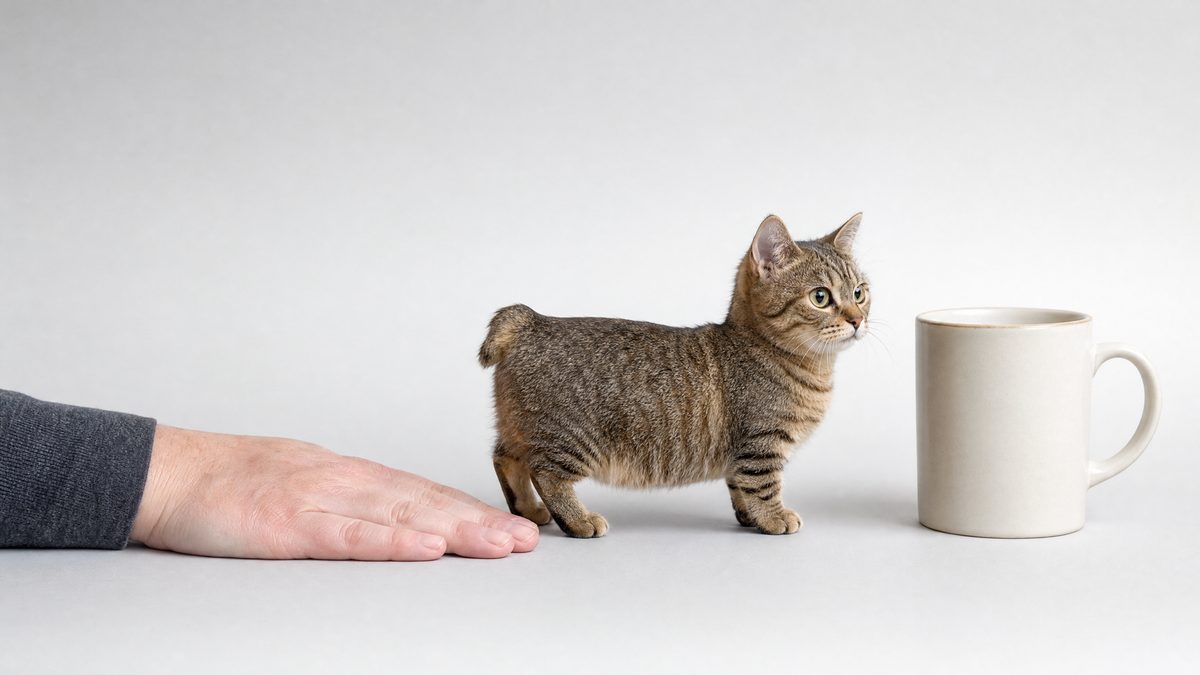
A Toybob is a naturally small, bobtailed domestic cat from Russia whose short tail is built from kinked vertebrae and whose adult size stays close to that of a six-month kitten. TICA describes compact, muscular bodies with short bobbed tails consisting of several kinked vertebrae, and states that the body should not look nor feel refined or delicate.
The size is the whole point and it is stated differently by the two registries that matter most. The World Cat Federation gives a preferred adult weight of less than 2 kg and asks for a square body smaller than medium size. CFA sets no weight figure at all, and instead says the cat reaches full maturity at 1.5 years with little to no size difference between the sexes, and should ideally retain a kitten-like appearance as an adult. Both agree the cat is small and solid. Neither agrees with the 1.8 to 3 kg that Indian breed pages print.
The head is a medium modified wedge with rounded contours and a flat plane above the eyebrows, slightly longer than broad, with cheekbones curving inward to a short, gently rounded muzzle. The profile is distinctly curved with a dip from forehead to nose at mid-eye level, and a definite stop is not allowed. The eyes must be large to very large, rounded, wide set and slightly upward slanted, which CFA says is what gives the breed its sweet-faced look. The neck is short and thick with an almost no-neck appearance.
The tail, described by two registries in incompatible numbers
The tail is the breed, and each breed standard measures it in different units. CFA sets a minimum of two vertebrae and a maximum down to the hock, and instructs that the bone length measures the tail and must be gently handled and unstretched. WCF sets a visible length of not less than 3 cm and not longer than one third of the body length, and disqualifies a cat with fewer than two to three vertebrae in the tail or with no tail at all. Read together, both registries are insisting the tail be present. Neither wants a tailless cat.
The Toybob's CFA disqualification list is unusually explicit about what this cat must not be. It disqualifies the Dominant Blue Eye (DBE) gene by name, allowing blue eyes only in pointed, solid white, calico, bi-color or van patterns. It disqualifies disproportionately short legs to the cat's overall body balance, which is the Munchkin mutation. It disqualifies extra toes, which is polydactyly. And its permissible outcross is a Russian domestic shorthair or longhair with similar phenotype and no structural mutation(s). A registry that spells out three foreign mutations it will not accept is telling you exactly which crosses it has seen attempted.
The coat comes in two lengths. The shorthair is medium-short, soft, moderately plush and slightly crisp, resilient rather than close lying, with an undercoat almost the same length as the topcoat. The longhair is semi-long to long, softer, with a full plumed tail, visible ear and toe furnishings and no ear tufts. In India the shorthair is the sensible choice, and not for grooming reasons alone.
Registry recognition, breed by breed and dated
Four registries of the seven we checked hold the Toybob, and they place it at three different levels. CFA advanced it to full championship for the 2025-26 show season, TICA shows it below championship as one of only two Advanced New Breeds, and the World Cat Federation holds it under the two-word name Toy Bob with EMS code TOB.
A registry class is a dated event rather than a permanent label, so each line below carries the document it came from and the date we read it. That matters here more than usual, because this breed moved recently and several published pages have not caught up.
| Registry | Position | Document and date |
|---|---|---|
| CFA, show class | Championship, from the 2025-26 show season | CFA Cat Talk, How Breeds Get their Start, 27 February 2025 |
| CFA, governance | Breed council secretary listed among the Shorthair Breeds, not in the Miscellaneous or Provisional block | Declared Candidates for Breed Council Secretary, modified 31 July 2026 |
| TICA, registration | Category III, Variant or Mutation Breeds. Outcross: Russian domestic cat, not a member of a recognized breed | Registration Rules Version B, 22 November 2024, Standing Rule 307.4 |
| TICA, show class | Advanced New Breed. The class holds exactly two breeds, the Serengeti and the Toybob | TICA Advanced New Breeds index, read 10 September 2026 |
| WCF | Recognised as Toy Bob, code TOB, in Category 4, Oriental Group. Seal point only | WCF EMS table row 291 and the Toy Bob standard of 01.09.2018 World Cat Federation, WCF Breed standard |
| CFF | Holds the breed with its own standard | CFF Breed Profile K to Y, modified 13 August 2026 |
| GCCF | Amber. Concerns about breeding for small size | Unrecognised Breeds, modified 23 September 2025 |
| FIFe | Absent from the breed index and from the two-breed preliminary block | FIFe Breeds, modified 4 August 2026 |
| LOOF | Absent from the championship list and from the new-breeds list, and no pedigrees issued in 2025 | Liste des races, 1 January 2026, and Nombre de chats Livre Officiel des Origines Felines |
Read CFA's Toybob page today and its Breed Future section says breeders continue to work together to promote the breed and increase its visibility to help it advance to championship status in CFA. Read CFA's Cat Talk article and the caption under a Toybob photograph says the Toybob is the newest breed to achieve full Championship status, beginning with the 2025-26 show season. Both are CFA documents. The tiebreaker is the third one: the declared-candidates list carries a Toybob breed council secretary among the shorthair breeds, and the Cat Talk article itself explains that a breed committee chair converts to breed council secretary only once the breed is advanced to Championship. The breed page paragraph is stale text left behind by the advancement, and the breed is at championship.
Why the GCCF holds this one at amber rather than red
The GCCF grades unrecognised breeds green, amber and red, and the Toybob sits at amber. Amber is defined on that page as breeds that may not be recognised because they are based on a physical anomaly that may cause problems to some breed members and could be detrimental to welfare, with the burden of evidence on the applicant. Its stated Genetics Committee comment on the Toybob is short and specific: concerns about breeding for small size, genetic and veterinary info would be required, acceptance would depend on favourable reports. The owner-facing note reads that recognition would ensure low risk of spinal, bladder and bowel problems. The objection is to deliberate miniaturisation, and secondarily to the tail, and it is a request for evidence rather than a refusal.
Note what the GCCF page also confirms, which no ranking page uses: it lists the Toybob's recognising bodies as CFA and TICA. A British registry that declines the breed independently corroborates that two American registries hold it.
Where the Toybob came from, and what is documented
The Toybob came out of native Russian cats in the Rostov and Ural regions, from a spontaneous tail mutation rather than from any deliberate cross. TICA states that the bobbed tail is due to a spontaneous mutation or mutations that appears in native cats in Russia, and CFA repeats the same account in its standard's general description Cat Fanciers' Association.
The name is a compound the registries explain themselves. Toy describes a playful small-sized cat and bob refers to the bobbed tail. The Cat Fanciers' Federation adds a duration rather than a date, describing a naturally small bobbed tailed cat originated in Russia and existing there for almost three decades.
| Claim | Which body states it | What is missing |
|---|---|---|
| Developed primarily in Russia, Rostov and Ural regions | TICA | No founding date and no founder named |
| Tail arose by spontaneous mutation in native Russian cats | TICA and CFA | No gene, no variant, no publication |
| Existing in Russia for almost three decades | CFF | A duration rather than a year |
| Traces to a single founding kitten born in 1988 | An Indian breed page, sourced to a commercial DNA-test site | No registry document we opened carries this, so treat it as unverified |
That last row is the honest limit of this section. A founding animal and a 1988 date circulate widely, and we could not find either inside any registry document, so this page does not assert them. Where a claim rests on one commercial page quoting another, it belongs in a table of what is unverified rather than in a history.
Toybob cat price in India, and the arithmetic that kills it
No verified toybob cat price in India exists. Two Indian sites publish Rs 70,000 to Rs 1,20,000 and they publish it to the rupee, alongside four monthly figures that are byte-identical on both sites and on those sites' pages for unrelated breeds poodles.in, Toybob cat page. India's most-read cat pricing guide does not name the breed at all.
Start with the template, because it is visible in one minute. Both Indian pages print a food line of Rs 1,500 to Rs 2,000, a health line of Rs 500 to Rs 700, a grooming line of Rs 800 to Rs 1,500 and a monthly total of Rs 2,800 to Rs 4,200. The three component lines sum exactly to the totals, 1,500 plus 500 plus 800 giving 2,800 and 2,000 plus 700 plus 1,500 giving 4,200, which is what a preset row looks like rather than an observation. The same four lines appear on the same sites' Foldex, Ukrainian Levkoy and York Chocolate pages, and on the Munchkin, which is a completely different cat.
| Rupee figure | Divided by 84.38 | Divided by 74 | Divided by 80 | Verdict |
|---|---|---|---|---|
| Rs 70,000 | 829.58 | 945.95 | 875 | No clean quotient. 875 is not a price a seller prints |
| Rs 1,20,000 | 1,422.14 | 1,621.62 | 1,500 | 1,500 is plausible, 875 is not, so the pair does not behave as one converted band |
The floor-price test, which settles it without any exchange rate
A genuine Indian price for an imported cat cannot sit below the source price, because import adds cost rather than removing it. Overseas Toybob catteries advertise the breed at roughly USD 2,000 to USD 3,000. At 84.38 rupees to the dollar, the cheapest of those is about Rs 1,68,760, which is above the ceiling the Indian pages print. A claimed Indian ceiling of Rs 1,20,000 for one of the most expensive small cats in the world is not a market observation, and no freight, quarantine or documentation cost can make a landed price cheaper than the animal.
Every rupee figure attached to the words toy bob on page one of an Indian search is merchandise. The set includes an Etsy digital-download clipart bundle, an Amazon.in novel that matched on the sentence she made the cat toy bob and dance, a plush figure of a video-game character named Bob, and a solar-powered car ornament. One social post gives Rs 3,500 and it is a cat-show entry fee. There is no identified Indian breeder, no Indian classified listing and no cattery, and the guide that exists to list Indian cat prices does not list this one. Anyone in India offering you a Toybob today is offering you something they cannot document.
Import is not a route around that. India's import policy for pet cats and dogs is restricted under ITC(HS) code 01061900 and needs a DGFT authorisation, and the only route that works without one is moving your residence to India permanently with the cat already yours, under the Customs Baggage Rules. Anything else goes to an Exim Facilitation Committee that meets once a month. Buying a cat abroad and having it shipped to you is not the personal-baggage route and should not be sold to you as one.
One more Indian tell worth naming, because it is on the page itself. Two of the three photographs on the Indian page that prices this breed are labelled in their own alt text as a Tonkinese and a Burmese. A page that cannot illustrate the breed correctly is not a page that priced it.
Monthly cost of keeping a small cat in India, with real figures
Budget for a small cat rather than for this breed, because no Indian cost figure specific to the Toybob exists that is not a template. A cat under 3 kg eats less than an average cat and costs the same for everything else, so the honest monthly cost is set by veterinary care, litter and parasite control rather than by food.
The figures below are the ones we can source. Where we cannot source an Indian figure, this page says so rather than filling the gap.
- Licence, Rs 50 in Chennai. The Greater Chennai Corporation licenses pet animals generally rather than dogs only, so a cat is covered.
- Free municipal treatment in Chennai. The corporation's veterinary clinics provide treatment and anti-rabies vaccination free of cost, which is the single largest recurring saving available to an Indian cat owner and is almost never mentioned on breed pages.
- No statutory microchip cost for a kitten. Rule 7(16) of the Pet Shop Rules, 2018 makes microchipping mandatory for puppies only, so a kitten falls outside it and any shop telling you otherwise is inventing a legal duty.
- No breed genetic test to buy. The tail mutation has never been sequenced, so there is no laboratory panel for this breed and nothing to screen.
- Food cost scales with body size, so budget below an average cat. A 2 kg adult eats far less than a 5 kg one. Treat any Indian page quoting Rs 1,500 to Rs 2,000 a month for this breed as a preset, because the identical line appears on that site's pages for cats three times the weight.
The two Indian sites that price the Toybob label it a Small Breed and then give it the identical monthly cost row they give to medium breeds and to the Munchkin poodles.in, Toybob cat page. A cost table that does not change when the animal's body weight halves is not measuring the animal. Use it as evidence that the page is templated, and budget from your own vet's rate card instead.
Heat tolerance and the Indian climate
A Toybob handles Indian heat about as well as any short-coated cat and no better, because nothing in the breed changes thermoregulation. No registry describes this cat as heat-tolerant and none publishes heat guidance for it, so the sensible planning figures are your own city's climate numbers rather than anything breed-specific.
Use your own city's real peak rather than a generic Indian summer. The most common error in Indian climate tables is naming May as the hottest month everywhere, and it is wrong for three of the six cities most Indian cat owners live in.
| City | Hottest month and mean | Coolest month and mean | Cell elevation |
|---|---|---|---|
| Delhi | June, 35.88 C | January, 13.61 C | 206.37 m, matches the city |
| Chennai | May, 31.51 C | January, 24.09 C | 48.95 m, matches the city |
| Mumbai | May, 31.19 C | January, 23.19 C | 97.15 m, matches the city |
| Kolkata | May, 31.53 C | January, 17.31 C | 7.35 m, matches the city |
| Bengaluru | April, 28.37 C | December, 20.22 C | 841.72 m, matches the plateau |
| Pune | April, 28.93 C | December, 19.62 C | 635.99 m, matches the city |
What a very small body actually changes
- Surface area to mass runs against a small cat in the cold and with it in the heat. A 2 kg cat sheds heat proportionally faster than a 5 kg one, which is mildly helpful in a Chennai May and unhelpful in a Delhi January night at a 13.61 C mean.
- Less thermal mass means faster swings. A small body heats and cools quickly, so a Toybob left in a closed, unventilated room warms up faster than a bigger cat would. Ventilation matters more than air conditioning.
- Dehydration arrives sooner in absolute terms. A cat under 3 kg has a small water reserve, so two or three missed drinks matter more. Put out more bowls than you think you need, in more rooms.
- The Indian page's ideal weather band is a preset, not a limit. One Indian page gives 18 to 24 C as this breed's ideal weather, which would exclude every large Indian city for most of the year. No registry publishes any such band.
The practical Indian rule is unremarkable and works. Keep the room under about 30 C in summer, keep water available in several places, avoid midday balcony access in Delhi and Nagpur, and watch for open-mouth breathing, which in a cat is always a reason to call your nearby vet rather than to wait.
Temperament, household fit and who should not get one
The Toybob is described by its own registry as perky and playful, interactive but not overly active, docile and affectionate enough for families with children and senior citizens, and sociable with other pets. The disqualifying condition for most Indian households sits in the same paragraph.
CFA states that Toybobs do not like being left alone for long periods, and suggests that if nobody will be home during the day you may wish to consider a pair. That is a registry telling you the cost of ownership is two cats rather than one for a working couple, and it is the single most useful sentence on any Toybob page anywhere. Two small cats still weigh less than one Maine Coon, so the practical burden is smaller than it sounds.
The voice is worth knowing before you buy. CFA describes a cat that is not particularly vocal but has a large repertoire of chirps, trills and purrs with the occasional meow. In a flat with shared walls, that is an advantage over an Oriental breed.
Skip this breed if you are out of the house eleven hours a day and do not want two cats, if you have a household where a 2 kg animal will be underfoot on stairs or under furniture being moved, or if you want a cat you can leave on a balcony. Small size is not a robustness feature. It is the reason the GCCF's stated objection to the breed is concerns about breeding for small size.
Training a Toybob, and the handling that actually matters
To train a Toybob, work with its sociability rather than against its size, and start with handling the tail correctly, because that is the one part of this cat a normal cat-handling routine gets wrong.
- Handle the tail unstretched, always. CFA's own standard instructs judges that tail length must be gently handled and unstretched. If a registry writes that instruction for a trained judge, it applies to a family at home. Teach children to lift the cat under the chest and hindquarters and never by or near the tail.
- Teach a carrier before you need one. A cat this small is easy to over-restrain in a panic. Feed meals in an open carrier for two weeks so the vet trip is not the first time it closes.
- Train a weekly ear check into the routine. Two minutes a week, with a cotton pad and no probe, catches monsoon-season ear problems early in any Indian cat.
- Use food puzzles rather than free feeding. A small cat gains proportionally more from a few extra grams, and obesity is the most likely thing to actually shorten this cat's life.
- Practise weighing. A kitchen scale and a box gives you a monthly number. On a 2 kg animal, 200 g is a tenth of body weight and is visible on a scale long before it is visible to your eye.
Litter training is usually trivial and the tray is the thing to get right. Choose a low-entry tray, because a cat with short body length and a short tail uses a different posture to balance than a long-tailed cat does, and a high lip is a real obstacle for a kitten of this size.
Leash work is realistic for this breed and useful in India, where an unsupervised outdoor cat meets traffic, dogs and disease. Start indoors with a harness, add a corridor, and only then a quiet balcony.
How much exercise a Toybob actually needs
Budget 30 to 45 minutes of interactive play a day, split into two or three sessions. CFA describes a cat that is interactive but not overly active and may choose the lap over the toy, so the owner has to start the game rather than wait for the cat to.
- Two sessions of 15 minutes beat one of 30. Cats hunt in short bursts, and a small cat tires sooner within each burst.
- Vertical space costs nothing in a flat. A shelf run along one wall triples the usable area of a Mumbai one-bedroom.
- Wand toys suit this breed better than chase toys. A cat that prefers your lap will still work for something moving at eye level.
- Stop when the breathing changes. Open-mouth breathing during play in a hot room is a stop signal, not a fitness milestone.
In an Indian summer, move play to early morning and after sunset. A closed flat at 3 pm in Nagpur, where the May mean is 36.73 C, is not the place to run a cat.
The failure mode is boredom rather than under-exercise. A sociable cat left alone all day with no vertical route and no puzzle feeder becomes a cat that overgrooms and overeats, and both show up first on the scale.
Grooming a Toybob in Indian humidity
Grooming a Toybob takes about ten minutes a week for the shorthair. Brush once a week, check the ears once a week, and treat the tail as the part that needs care rather than combing.
The coat is short, dense and resilient, with an undercoat nearly as long as the topcoat, so it sheds moderately and mats rarely. In Chennai and Kolkata, where the annual humidity sits high and the monsoon adds months of damp, the practical work is skin and ears rather than hair.
- Brush weekly with a rubber curry mitt. It lifts loose undercoat without pulling, which matters on a cat you can lift with one hand.
- Check ears weekly and dry them after any bath. An Indian monsoon is when ear problems present, and a cotton pad at the visible part of the ear is the whole job.
- Trim nails every two to three weeks. A small cat's nails still catch on upholstery, and a caught nail on a 2 kg animal is a bigger event than on a 5 kg one.
- Do not comb the tail hard. The tail contains kinked vertebrae. Work around it with fingers rather than a comb, and never straighten it to see how long it is.
- Bathe rarely and dry fully. Air drying in a humid Indian flat leaves a damp undercoat for hours, which is a skin problem waiting to happen. Towel and then a low, cool dryer.
The longhair variety in an Indian city
The longhair Toybob carries a semi-long to long coat with a full plumed tail and heavy ruff. In Bengaluru or Pune, both of which peak near 29 C, that is manageable with twice-weekly brushing. In Chennai or Kolkata it is a daily job in the monsoon, and the honest advice is to choose the shorthair.
Toybob health, and the difference between no evidence and good evidence
No breed-specific health problem has been demonstrated in the Toybob, and no study has looked. CFA states that the breed enjoys a very high level of genetic diversity and that to date no breed-specific health issues have been identified. That is a registry's position and it is not the same thing as published evidence, so this section says which is which.
What the published literature contains about this breed
One record. A PubMed search on 10 September 2026 returned exactly one paper naming the Toybob, and it is a coat-colour study: Beauvois and colleagues identified a CORIN variant behind the Siberian sunshine wideband phenotype and reported finding it in two ToyBob cats drawn from the 99 Lives genome dataset. It says nothing about the tail, the skeleton or health. The plural and the two-word spellings both returned zero, so the count is not an artefact of the query.
What is known about the tail, and what is only assumed
Two feline short-tail genes are mapped, and neither has been tested in this breed. In the Manx, four mutant T alleles cause haploinsufficiency of Brachyury, and the paper reporting them names five short-tailed breeds, the American Bobtail, the Manx, the Pixie-Bob, the Kurilian Bobtail and the Japanese Bobtail. The Toybob is not among them. In Asian short-tailed cats and the Japanese Bobtail, a HES7 missense mutation c.5T>C accounts for the phenotype, and the same paper concludes that some kinked-tail cats it sampled fit neither gene, implying at least three independent short-tail events in domestic cats.
So the honest position on a Toybob's tail is that it is a third case that has never been sequenced, and that neither the Manx mechanism nor the Japanese Bobtail mechanism has been excluded or confirmed in it. Anyone telling you the Toybob tail is safe because it is not a Manx tail is reasoning from a study that did not include this breed.
The most useful adjacent evidence is the Japanese Bobtail radiographic study. It examined the whole vertebral column of kink-tailed cats and found real anomalies: usually one fewer thoracic vertebra than the normal feline formula, an average of 15.8 caudal vertebrae, several transitional vertebrae, anomalous ribs, one bifid tail vertebra and hemivertebrae in most cats, usually inside the kink. Its conclusion is the part that matters, verbatim: the abnormal vertebral formula or the placement of the kink in the tail did not coincide with morbidity or mortality. That is a different breed and a different gene, so it is a reason not to panic rather than a clearance for this one.
Lifespan, and why no figure belongs on this page
The largest UK feline life-table study built its breed table from 7,936 confirmed deaths and required 15 or more deaths before a breed got its own row. Twelve breeds reached that threshold, and the Toybob is not among the 12. Neither CFA nor TICA publishes a lifespan for the breed The International Cat Association. The 12 to 15 years printed by Indian pages is a template value that appears on those sites' pages for unrelated cats. The only figures this page will give you are that study's own life expectancy at age 0, which is 11.74 years for all cats and 11.89 years for crossbreds.
| Question | Status | Source |
|---|---|---|
| Is the tail mutation identified? | Unknown. Never sequenced | PubMed audit, 10 September 2026 |
| Is it the Manx T-box mutation? | Untested. The Manx paper does not include this breed | Buckingham 2013 |
| Is it the Japanese Bobtail HES7 mutation? | Untested. The HES7 paper does not include this breed | Xu 2016 |
| Do bobtail cats show vertebral anomalies? | Yes in the Japanese Bobtail, without measured morbidity or mortality | Pollard 2015 |
| Any breed-specific disease reported? | Asserted absent by the registry, never studied | CFA breed page |
| Breed lifespan measured? | No. Not among the 12 breeds reaching 15 deaths | Teng 2024, Table 6 |
| Screening test available to buy? | None exists, because the locus is unknown | PubMed audit |
The general risks worth knowing are the ones that apply to any purebred cat. Entire cats had 4.29 times the odds of dying before three years compared with neutered cats, and purebred cats 1.83 times the odds compared with crossbreds. Neutering is the single largest lever an owner controls, and it applies here regardless of what the breed's own literature does not say. Discuss timing with your nearby vet.
Ask to see the parents' tails and to watch both cats walk and jump. Ask whether any kitten in the last three litters was born tailless, since both the CFA and WCF standards disqualify absence of tail, which means it happens. Ask for the registration papers and read which registry issued them, because a CFA pedigree and a WCF pedigree describe cats that cannot both be shown. And ask your own vet to palpate the tail and the lumbosacral area at the first visit rather than accepting any breeder's assurance, including a registry's.
Feeding a very small cat in India
Feed a Toybob by measured weight rather than by bowl, because on a 2 kg animal the margin for error is a quarter of what it is on an average cat. Body condition scoring beats any printed gram figure.
- Weigh the food, do not scoop it. A 10 g overshoot per meal on a 2 kg cat is proportionally the same as 25 g on a 5 kg cat.
- Split into three small meals where your schedule allows. A small stomach handles frequency better than volume.
- Keep wet food in the mix in Indian summers. Water intake matters more in a small animal, and a cat that will not drink will often eat moisture.
- Monitor body condition monthly. You should feel ribs under a thin fat cover without pressing, and see a waist from above. That check is worth more than any brand's feeding chart.
- Ignore the calorie figures on Indian breed pages. One prints 300 kcal for kittens and 250 kcal for adults, which has adults eating less than kittens as a printed rule and is a template artefact rather than a feeding plan.
Kitten food through 12 months is the standard advice and it holds here, with one adjustment: CFA gives full maturity at 1.5 years, so discuss with your nearby vet whether to run kitten food to 12 or to 15 months for an individual cat rather than switching on a birthday.
Availability in India is not a constraint. Every major wet and dry line sold in Indian metros carries a complete-and-balanced adult formula, and a small cat simply eats less of it. What is a constraint is portion discipline in a household where several people feed the cat, so put the daily ration in one labelled container each morning.
Kitten timeline, month by month through the first year
A Toybob kitten follows the ordinary feline timeline with two breed-specific additions, tail handling from week one and a size check that never becomes a size worry. Full maturity comes at about 1.5 years rather than at one year.
- Weeks 0 to 8, with the breeder. Indian law treats kittens below eight weeks as un-weaned and prohibits their sale outright, so a kitten offered to you before eight weeks is an illegal sale.
- Month 2, home. One room, one tray, one hiding place. Begin daily gentle handling that never includes the tail.
- Month 2 to 4, core vaccination course. Follow your nearby vet's schedule rather than any breed page's table, since Indian protocols differ by region and by disease pressure.
- Month 3, carrier training. Feed in the open carrier daily. This is the cheapest intervention in the whole first year.
- Month 4, first weight baseline. Record it. A growth curve on a small cat is more informative than any single number.
- Month 4 to 6, socialisation to household noise. Pressure cookers, mixers and doorbells, at low volume with food.
- Month 6 to 9, neutering discussion. Entire cats carry 4.29 times the odds of death before three years compared with neutered cats, so this is the single largest health decision of the year. Time it with your vet.
- Month 9, adult food transition begins. Ask your vet whether to hold kitten food longer given the 1.5-year maturity.
- Month 12, first adult health check. Ask specifically for the tail and lower spine to be palpated and for a body condition score to be recorded in the file.
- Month 18, full maturity. Expect the adult to look kitten-like, because the standard asks for exactly that.
The one thing not to do is compare your kitten's weight against a chart for average cats. A Toybob that plots below the tenth percentile of a generic feline growth curve may be exactly where its own standard wants it.
Toybob versus the cats Indian buyers cross-shop it against
Indian buyers arrive at the Toybob from three directions, small cats, bobtailed cats and cats that stay kitten-like. The table below sets it beside the breed most often confused with it and the two it is genuinely comparable to.
| Breed | Size | Tail | Registry position | Available in India |
|---|---|---|---|---|
| Toybob | Preferred under 2 kg by WCF | Bobbed, kinked, minimum two vertebrae | CFA championship, TICA Advanced New Breed, WCF, CFF | No identified breeder |
| Toyger | Ordinary adult cat size | Full length | TICA championship | Occasionally, at high prices |
| Singapura | Small, but a full-sized adult cat | Full length | TICA and CFA championship | Rare |
| Kurilian Bobtail | Substantial, well above 3 kg | Bobbed pom-pom | TICA Category II natural breed, FIFe, LOOF, WCF Federation Internationale Feline | Rare, and often what a Karelian search returns |
| Japanese Bobtail | Medium | Bobbed, HES7 mapped | CFA, TICA, FIFe, WCF, LOOF | Very rare |
| Indian domestic shorthair | 3 to 4.5 kg typical | Usually full length, kinks common | None, and none needed | Free, from any shelter |
Google's own People also ask box for the Toybob returns the question Are Toyger cats friendly?. The two breeds share four letters. A Toyger is a normal-sized striped cat with a full tail, developed to resemble a tiger. A Toybob is a Russian bobtail under 3 kg. If an Indian listing uses the words loosely, it has not seen either cat.
Mistakes Indian buyers make with the Toybob
Five mistakes account for most of what goes wrong, and four of them happen before the cat arrives. The list below is ordered by how much each costs.
- Paying an Indian price for a breed with no Indian supply. The published Indian band sits below the cheapest overseas asking price, which means the seller either does not have the breed or did not price it.
- Treating any small bobtailed cat as a Toybob. A short or kinked tail is common in Indian street cats and in several Asian populations, and a genuine short-tail mutation there may be neither of the two mapped genes. An unregistered cat with a naturally short tail is a lovely cat, and it is not this breed.
- Assuming international recognition means one standard. CFA allows every colour and WCF allows only seal point. Ask which registry issued the pedigree before you accept the phrase internationally recognised.
- Handling or measuring the tail by stretching it. The breed's own registry tells judges not to. Nobody tells buyers.
- Leaving a sociable cat alone all day. The registry recommends a pair for households where nobody is home during the day, and ignoring that produces the overgrooming and overeating that actually shorten a small cat's life.
A sixth mistake is quieter and worth naming. Several Indian pages illustrate the breed with photographs their own alt text identifies as other breeds, so buyers arrive with a mental picture of a Tonkinese or a Burmese and then judge a real Toybob against it. Look at the registry photographs before you look at anything else.
Finally, do not read the GCCF's amber grade as a verdict that the breed is unhealthy. It is a request for evidence that nobody has yet supplied, which is a different and more honest thing.
Adoption, responsible sourcing and the honest answer for India
Adopt rather than import, because there is no lawful and practical route to buying this breed in India and there is a very good route to a small, sociable, short-coated cat. Indian shelters are full of cats that meet every functional requirement a Toybob buyer has except the pedigree.
- Adopt a small Indian shorthair, and ask the shelter for a lap cat rather than a size. Temperament is the thing a Toybob buyer actually wants, and shelters can match temperament far more reliably than any breeder can promise size.
- Adopt a pair if you work full days. The registry's own advice for this breed applies to any sociable cat, and shelters actively want bonded pairs rehomed together.
- Verify the paperwork if you do buy. Read which registry issued the pedigree, and check that registry's own breed list yourself rather than trusting a logo on a certificate.
- Refuse any kitten under eight weeks. Indian law defines kittens below eight weeks as un-weaned and prohibits their sale.
- Ask about the tail before you ask about the price. Ask whether any tailless kitten has been born in the line, since both standards disqualify it, and get your own vet to examine the animal.
If you specifically want a documented Toybob, the honest route is a long one. It means buying from a registered cattery abroad, moving your residence to India with the cat already yours under the Customs Baggage Rules, or applying for a DGFT import authorisation for a purpose the policy actually lists. Anything shorter than that is somebody selling you a story.
The wider point is worth stating plainly for a buyer weighing a rare breed against a shelter cat. A rare breed page like this one exists to tell you what is known, and for this cat what is known is a set of registry documents and a single coat-colour paper. A shelter cat comes with no documents and no mystery. In an Indian city, that trade is usually the right way round.
Toybob questions Indian buyers actually ask
What is the lifespan of a Toybob cat?
No study has measured it. The Toybob is not among the 12 breeds that reached the threshold in the largest UK feline life-table study, which required 15 or more recorded deaths to give a breed its own row, and neither CFA nor TICA publishes a lifespan figure for the breed at all. The 12 to 15 years that Indian breed pages print is a template value shared with unrelated cats. For scale, that study put all cats at 11.74 years and crossbred cats at 11.89 years.
What is the personality of a Toybob cat?
Perky, playful and interactive but not overly active, on its registry's own account. CFA describes a cat that may choose to stay in your lap rather than chase a toy, then follow you anywhere with supervising curiosity, that is docile enough for families with children and senior citizens, and that gets along well with other pets. The important caveat is in the same paragraph: Toybobs do not like being left alone for long periods, and CFA suggests considering a pair if nobody is home during the day.
Are Toybob cats healthy?
The registry says yes and the literature says nothing. CFA states that the breed enjoys a very high level of genetic diversity and that to date no breed-specific health issues have been identified. That is a real statement from a body that registers the cats, and it is not the same thing as evidence. There is no published study of the breed's health, no screening scheme, and no genetic test, because the mutation behind the tail has never been sequenced. Consult your nearby vet rather than any breed page for an individual cat.
Are Toyger cats friendly?
Yes, and the Toyger is a different breed, which is worth knowing because Google returns that question inside the Toybob's own results box. A Toyger is a striped domestic cat bred to look like a tiger, roughly the size of an ordinary cat, with a full-length tail. A Toybob is a Russian bobtail under 3 kg. The two share four letters and nothing else, and an Indian listing using the words interchangeably is describing neither accurately.
How much does a Toybob cost in India?
No verified Indian price exists. Two Indian sites print Rs 70,000 to Rs 1,20,000 to the rupee, and both surround it with monthly figures of Rs 2,800 and Rs 4,200 and food figures of Rs 1,500 to Rs 2,000 that they also print for unrelated breeds. The ceiling is the giveaway: overseas catteries advertise the breed at USD 2,000 to USD 3,000, so a claimed Indian ceiling of Rs 1,20,000 sits below the cheapest source price before a single import cost is added.
Is the Toybob recognised by CFA?
Yes, at full championship, from the 2025-26 show season. CFA's own Cat Talk article on how breeds advance names the Toybob as the newest breed to achieve full championship status, and CFA's declared-candidates list carries a Toybob breed council secretary among the shorthair breeds, which is the post a breed committee chair converts into once a breed reaches championship. One caveat: CFA's own breed page still carries a paragraph saying breeders are working to help the breed advance to championship, which is stale text left behind by the advancement.
Is a Toybob the same as a Kurilian Bobtail?
No. They are separate breeds in separate TICA registration categories, from different Russian populations and of very different sizes. TICA files the Kurilian Bobtail as a Category II natural breed with Russia named as its origin, and the Toybob as a Category III variant or mutation breed whose permitted outcross is a Russian domestic cat with no structural mutation. A Kurilian is a substantial cat. A Toybob is preferred under 2 kg by the World Cat Federation.
Does the short tail hurt a Toybob?
Nobody has measured it in this breed, and the nearest evidence is reassuring rather than alarming. In the Japanese Bobtail, radiographs of the whole vertebral column found reduced thoracic vertebrae, hemivertebrae, transitional vertebrae and one bifid tail vertebra, and the authors state plainly that the abnormal vertebral formula and the placement of the kink did not coincide with morbidity or mortality. That is a different breed with a different gene, so it is a comparison and not a finding about the Toybob. Ask your nearby vet to examine the tail rather than assuming either way.
What colours does a Toybob come in?
It depends entirely on which registry you ask, and the two answers are incompatible. CFA allows every genetically possible colour and pattern and says soundness of colour is unimportant. The World Cat Federation recognises seal point and disqualifies any other colour outright, and requires intense deep blue eyes. So a cat that is a champion under one standard cannot be shown at all under the other, which is a fact worth knowing before you buy from any breeder describing a cat as internationally recognised.
Can I import a Toybob into India?
Only as your own pet when you move to India, not as a purchase. India's import policy for pet cats and dogs is restricted under ITC(HS) code 01061900, and the Directorate General of Foreign Trade states that import is allowed without authorisation only for persons shifting residence permanently to India under the Customs Baggage Rules. Everyone else must apply for an import authorisation, which for anything outside the listed purposes goes to a monthly Exim Facilitation Committee.
How big does a Toybob get?
Smaller than any other championship cat, and the registries state it differently. The World Cat Federation gives a preferred adult weight of less than 2 kg and describes a square body smaller than medium size. CFA sets no weight at all and instead says the cat should reach full maturity at 1.5 years with little to no size difference between the sexes, and should ideally retain a kitten-like appearance as an adult. An Indian page giving 1.8 to 3 kg is quoting neither standard.
Are Toybob cats hypoallergenic?
No breed is, on the current evidence, and the Toybob has never been tested. A 2024 review of the field states flatly that there is no scientific evidence for a hypoallergenic cat breed. Individual cats vary widely in how much Fel d 1 they produce, and sex and neuter status are better evidenced than breed. A small cat produces less coat and dander in absolute terms simply by being small, which is not the same claim and should not be sold as one.
Compare with similar breeds
Toybob sits in 2 Bonbeno groups. Each one compares it directly against the breeds it is genuinely an alternative to, on the same figures.