
Breed profile
Ojos Azules in India: An Extinct Breed, Still Being Sold
A blue-eyed American breed that collapsed in the 1990s because of a birth-defect problem nobody ever published, that TICA still lists in a registration-only category, and that Indian pages are still selling as though a kitten could be found.
Quick answer
There is no ojos azules cat price in India, because the breed is extinct. Any cat offered in India under that name is not one. The claim that two copies of the gene kill the kittens is real breeder and geneticist observation and has never appeared in a peer-reviewed paper, while four newer studies of the same phenotype in other cats have.
This page separates a widely repeated genetic claim that has never been published from four peer-reviewed studies of a related trait that have. It is not veterinary advice and it is not a diagnosis of any individual cat. Consult your nearby vet about any blue-eyed cat, particularly about hearing, and have hearing formally tested rather than assessed at home.
Ojos Azules at a glance
What the Ojos Azules was
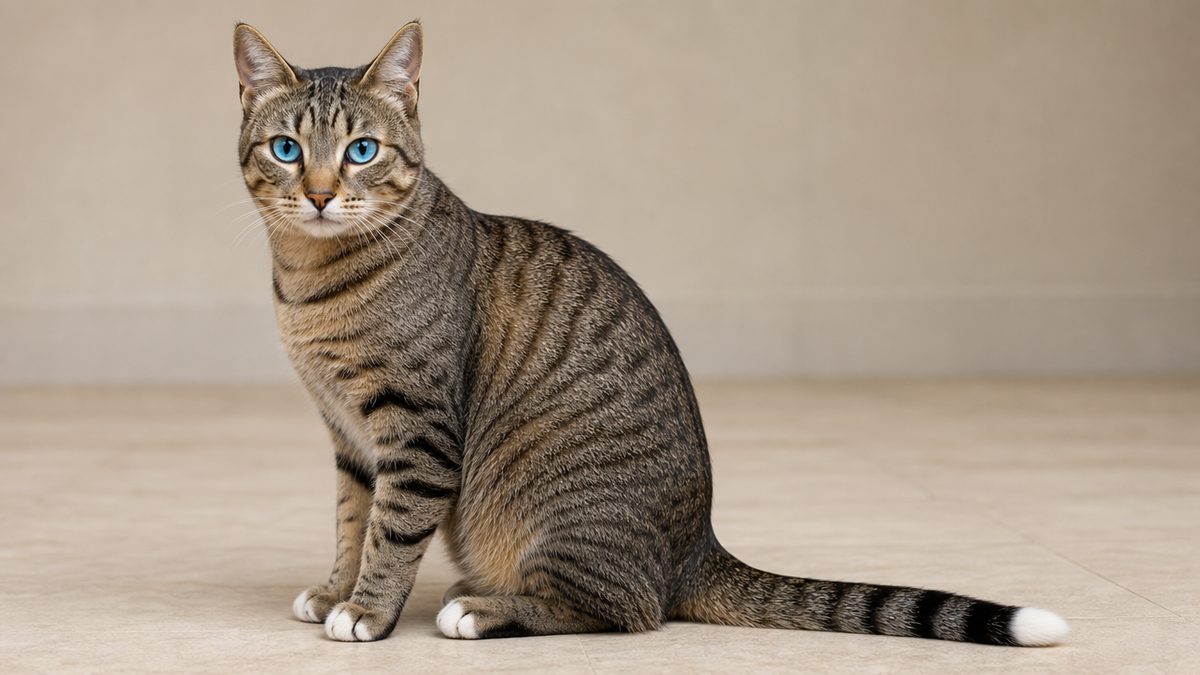
The Ojos Azules was a short-haired American cat breed defined by two things: deep blue eyes on a cat with an ordinary dark or patterned coat, and descent from a single foundation queen. Its name is Spanish for blue eyes, and the breed is now recorded as extinct.
The physical description is unremarkable except for the eyes, which is the point. The standard described a medium-sized cat with large round blue eyes, an arched neck, a tail proportionate to the body, a somewhat triangular head with a slightly rounded forehead, an angular muzzle and a slight nose break, and a short, fine, soft, silky and shiny coat without much undercoat. All colours were allowed.
Two markings mattered. White markings on the extremities were common and accepted, and a white tail tip was treated as the indicator of the gene, while a white locket on the chest or a white patch on the belly counted as faults. Solid white was undesirable, because a solid white blue-eyed cat is indistinguishable from an ordinary blue-eyed white cat without a test Sarah Hartwell, Blue-eyed breeds.
Why blue eyes on a dark cat was the whole idea
Blue eyes in cats normally come attached to something else. The dominant white and white-spotting genes remove pigment from coat and iris together. The colourpoint allele that gives a Siamese its blue eyes comes with the pointed pattern. The Ojos Azules gene was reported to do neither: it produced deep blue eyes on cats of any colour, unlinked to coat colour or pattern, which is what made a blue-eyed dark tortoiseshell look, in the words of the geneticist who first examined one, like a cat that was not supposed to exist.
Only cats descending from the foundation queen Cornflower and expressing the deep blue eye gene were ever called Ojos Azules. That definition is why the breed cannot be revived and why no modern blue-eyed cat is one. Blue-eyed cats turn up at random across the world, and the dominant blue eye trait has since been developed independently in Kazakhstan, Russia and the Netherlands into the Altai, Topaz and Celestial lines. Those cats are genuinely interesting and they are not this breed.
Registry recognition, and the one listing that survives
One registry still lists the Ojos Azules, and not as a show breed. TICA's Registration Rules of 22 November 2024 place Ojos Azules Shorthair and Longhair in Category VI, Experimental (Developing) Breeds, described in the rules themselves as breeds advanced to Registration Only. Every other body we checked holds nothing.
That listing is worth reading carefully rather than as recognition. Rule 37.7.1 describes the category's purpose verbatim: this category is for new breeds which are still in active development, use of both hybrid crosses and outcrosses to cats of unknown or unregistered parentage is permitted, and there are no limitations or restrictions on the breeding programs. A breed can sit in that list without a single living representative, and the list is not a population count.
| Registry | Position | Document and date |
|---|---|---|
| TICA | Category VI, Experimental (Developing), registration only | Registration Rules Version B, 22 November 2024, Standing Rule 307.7 |
| TICA, history | Accepted for registration 1991, returned to registration only in 2014 | Reported by Wikipedia from a single enthusiast source |
| TICA, standard | Breed Group Standard dated 5 January 2004 | Reported by Wikipedia, historical standard reproduced from 2001 board papers |
| CFA | No breed council, and the DBE gene disqualified by name in a current standard | Declared Candidates, 31 July 2026, and the Toybob standard Cat Fanciers' Association |
| WCF | Zero occurrences of Ojos or Azules in the 198-row table | WCF EMS code table, pulled 10 September 2026 |
| FIFe | Absent from the breed index and the two-breed preliminary block | FIFe Breeds, modified 4 August 2026 |
| LOOF | Absent. The studbook lists the modern revival instead, as Celeste | Liste des races, 1 January 2026 |
| CCA-AFC | Absent, on a list that does carry dormant and experimental breeds | CCA-AFC Breed Standards, reissued 12 June 2026 |
The clearest single indication of how the cat fancy currently regards the dominant blue eye trait is in a live 2025 breed standard for a different cat. The Cat Fanciers' Association's Toybob standard lists among its disqualifications, verbatim: Dominant Blue Eye (DBE) gene, blue eye color in cats other than pointed, solid white, calico, bi-color or van coat patterns. That is a registry writing the trait out of a championship breed rather than merely declining to recognise a breed built on it. The Ojos Azules was the same trait, thirty-five years earlier.
The French studbook's position is the interesting one on the other side. LOOF's list of new breeds not accessing championship, dated 1 January 2026, holds exactly four entries, and two of them are CELESTE PC and CELESTE PL. That is the Celestial, the modern dominant blue-eyed breed whose PAX3 insertion was characterised in 2024. A national studbook lists the revival and not the original, which is exactly the right way round.
Where the Ojos Azules came from, and how it ended
The Ojos Azules began with one cat in a New Mexico animal shelter in the early 1980s and ended within about a decade, abandoned by its own breeders over birth defects. Only ten cats were known in 1992.
The foundation queen was a very dark tortoiseshell with a small white throat locket, a few white toes on each hind foot and brilliant blue eyes, found in a shelter in Albuquerque and named Cornflower. She was brought to the attention of Dr Solveig Pflueger, then TICA's chief geneticist, and when bred to unrelated males her kittens inherited the eye colour, which established the trait as dominant.
| Date | Event | Source and status |
|---|---|---|
| Early 1980s | Cornflower found in an Albuquerque shelter | Enthusiast account and a 1991 newspaper interview |
| 1984 | First breeding, kittens inherit the eye colour, trait shown dominant | Reported by Wikipedia and the enthusiast account |
| 7 June 1991 | Contemporaneous newspaper report, cats shown publicly, TICA votes provisional new breed and colour status | The Republican, Springfield, Massachusetts, pages 35 to 36, reproduced |
| 1991 | TICA accepts the breed for registration in short and long hair | Wikipedia |
| 1992 | Only ten cats known | Enthusiast account |
| 1990s | Breeders leave the programme over the risk of deformed kittens | Enthusiast account |
| 5 January 2004 | Date on the last TICA breed standard | Wikipedia |
| 2014 | TICA returns the breed to registration-only status | Wikipedia, from the same enthusiast source |
| 22 November 2024 | TICA still lists Ojos Azules SH/LH in Category VI | TICA Registration Rules, read directly |
The 1991 newspaper report is the only contemporaneous, independently published source about the programme that survives, and it is worth quoting for what it shows about intentions. It records the breeders' plan to sell cats at 300 to 350 dollars, deliberately below what the market would bear, because they did not want a situation where someone buys one because it is prestigious and then loses interest in the cat. It also records Annie Gass saying that they were hovering around sixty percent for blue or odd eyes.
What ended it was arithmetic rather than scandal. Breeders could avoid the defects only by mating a blue-eyed cat to a non-blue-eyed cat, which produced roughly half non-blue-eyed kittens every time, and the distinctive facial conformation was likely to be lost within a few generations if outcrossed to ordinary domestic cats. That was commercially and ethically unworkable, and the risk that less careful breeders would simply mate blue-eyed cats together was the reason serious breeders left.
Ojos azules cat price in India, and the Rs 212 that is not a cat
There is no Ojos Azules cat price in India, because there is no Ojos Azules. The only rupee figure carrying the breed's own name anywhere in the Indian index is Rs 212, on a craft marketplace page titled Buy Ojos Azules Cat Online In India, and the product is a digital download.
That listing is the merchandise trap in its purest form. The page title says Buy, the product line says Ojos Azules Cat Price, the price string says Rs 212 reduced from Rs 471, and the item is a file. A reader skimming and a price scraper parsing would both record it as this breed's Indian price.
| Figure | Where it appears | What it actually is |
|---|---|---|
| Rs 212 | A craft marketplace page titled Buy Ojos Azules Cat Online In India | A digital download file |
| Rs 18,000 | An Indian pet retailer, carried as a rich-snippet price on this query | A blue-eyed PERSIAN kitten |
| USD 700 to 1,500 | An American breed guide | A price for a breed that no longer exists |
| Twelve of twelve images | Google's own image block for the query | Persian kittens, captioned Persian Cat Price In India |
| No entry at all | Both Indian sites that fabricate rare-breed prices | A hard 404 and a Cat Breed Not Found page |
A blue-eyed Persian, at Rs 18,000, and clipart Etsy India market page for ojos azules cat. Nobody in India is selling this breed, because nobody anywhere is. The only thing worth adding is a caution about the commercial pages that rank for it. One page at position four runs a full Ojos Azules FAQ section and a fresh-food subscription funnel, with a heading reading Benefits of fresh cat food for Ojos Azules, for a breed its own encyclopaedia entry files under Extinction Ojos Azules, Wikipedia.
There is nothing to import either, and for once the DGFT answer is the short one. India's import policy for pet cats is restricted under ITC(HS) 01061900 with a personal-baggage exemption for people relocating permanently, and none of that matters when no exporting population exists.
One thing this page will not do is convert the American USD 700 to 1,500 figure into rupees. Converting a price for an animal that cannot be bought produces a number that looks like market information and is not, and that is exactly how a fabricated Indian price gets born.
Monthly cost, and the cat you should actually be budgeting for
Budget for an ordinary Indian domestic shorthair, because that is what a person searching for this breed will end up living with. The Ojos Azules had no structural mutation, no special coat and no documented breed-specific illness, so its running costs would have been an ordinary cat's.
- Licence, Rs 50 in Chennai. The Greater Chennai Corporation licenses pet animals generally rather than dogs only, so a cat is covered.
- Free municipal treatment and anti-rabies vaccination in Chennai. The corporation's veterinary clinics provide both free of cost, which is the largest recurring saving available to an Indian cat owner.
- One hearing test, if your cat is white or blue-eyed. A brainstem auditory evoked response test is the only way to know, and it is worth doing once rather than guessing, because deafness prevalence in solid white kittens with two blue irises reached 50 percent in a UK study.
- No breed genetic test to buy for this breed. The Ojos Azules variant was never sequenced, so no laboratory can screen for it. Tests do exist for three of the four PAX3 variants found in other lineages.
- No statutory microchip cost for a kitten. Rule 7(16) of the Pet Shop Rules, 2018 makes microchipping mandatory for puppies only.
- Neutering, and it is the highest-value line here. Entire cats carried 4.29 times the odds of death before three years compared with neutered cats.
A crossbred cat is the cheapest cat to keep and, on the largest available evidence, the longest lived of the categories that study measured. Crossbred cats had a life expectancy at age 0 of 11.89 years against 11.74 for all cats, and purebred cats carried 1.83 times the odds of dying before three years. An Indian domestic shorthair costs nothing to acquire, arrives already adapted to the climate, and needs the same food, litter and vaccinations as anything else. That is not a consolation prize.
Heat tolerance and the Indian climate
Nothing about the Ojos Azules would have made it unusual in an Indian climate. It was a heat-tolerant short-coated cat of medium size with little undercoat and no structural mutation, so the advice below is the advice for any short-coated cat, applied to the blue-eyed cat you may actually own.
Use your own city's real peak rather than a generic Indian summer, because the commonest error in Indian climate tables is naming May as the hottest month everywhere, which is wrong for three of the six cities most Indian cat owners live in.
| City | Hottest month and mean | Coolest month and mean | Cell elevation |
|---|---|---|---|
| Delhi | June, 35.88 C | January, 13.61 C | 206.37 m, matches the city |
| Nagpur | May, 36.73 C | December, 19.97 C | 282.60 m, matches the city |
| Chennai | May, 31.51 C | January, 24.09 C | 48.95 m, matches the city |
| Kolkata | May, 31.53 C | January, 17.31 C | 7.35 m, matches the city |
| Mumbai | May, 31.19 C | January, 23.19 C | 97.15 m, matches the city |
| Bengaluru | April, 28.37 C | December, 20.22 C | 841.72 m, matches the plateau |
| Pune | April, 28.93 C | December, 19.62 C | 635.99 m, matches the city |
One thing blue eyes do change, and it is not temperature
A blue iris contains less melanin than a green or copper one, which is why blue-eyed cats are sometimes said to be light-sensitive. The historical record for this breed contains exactly one relevant observation and it is worth quoting at its real size: one longhaired red and white male had a problem contracting his pupils and may have been visually impaired, and visual impairment was not found in any other Ojos Azules. One cat is one cat.
- Keep the room under about 30 C in summer. A short-coated cat manages Indian heat well and still needs shade, ventilation and water in several places.
- Give shaded rest sites rather than sunny windows. Useful for any cat, and marginally more so for one that squints in bright light.
- Do the ear check weekly. Two minutes with a cotton pad catches monsoon ear problems early in any Indian cat, and costs nothing.
- Watch for open-mouth breathing. In a cat this is never normal and is always a reason to call your nearby vet rather than to wait.
- Do not assume a blue-eyed cat is deaf, and do not assume it is not. Have hearing tested formally rather than by clapping behind the animal.
Temperament, and what the historical record actually says
Contemporary accounts describe the Ojos Azules as active, friendly and affectionate cats, and a 1991 newspaper report calls them outgoing and friendly in a quiet, unaggressive way. That is a description of a handful of animals rather than a measured breed trait, and it should be read that way.
The breed never had enough cats for a temperament to be established. Ten known individuals in 1992 is not a population from which anyone can generalise, and no controlled behavioural work was ever done PubMed search audit run on 10 September…. What the record does add, incidentally, is that Cornflower and her kittens liked water, which is a charming detail and not a breed trait.
For a reader who has landed here because somebody in India described a cat to them as an Ojos Azules, the useful reframing is this. Whatever temperament that cat has is its own, shaped by its socialisation between two and seven weeks, its health and its current home. A breed label attached to an extinct breed carries no information about it at all.
Nobody is choosing this breed on temperament, because nobody can choose this breed. This section exists because Indian pages selling the idea of the animal print temperament claims with confidence, and a reader deserves to know that the claims trace to fewer than a dozen cats in New Mexico in the early 1990s, described in a local newspaper and on one website. If you want an affectionate, water-tolerant, blue-eyed cat, a shelter can match temperament far more reliably than any of that.
Training a blue-eyed cat, and the one test worth doing first
To train any blue-eyed cat, establish whether it can hear before you build a training plan around sound. That is the single most useful thing an owner of a white or blue-eyed cat can do, and it is a veterinary test rather than a home one.
- Have hearing formally tested. A brainstem auditory evoked response test is objective, and home tests are unreliable because cats respond to air movement and vibration. Unilateral deafness in particular is almost impossible to detect at home.
- Train to hand signals as well as voice. Useful for every cat and essential for a deaf one, and it costs nothing to do both from the start.
- Approach into the visual field, never from behind. A deaf or partially deaf cat startles, and a startled cat scratches.
- Teach a carrier before you need one. Feed meals in an open carrier for two weeks so the first vet trip is not the first closed door.
- Keep a deaf cat indoors without exception in India. Traffic, dogs and monkeys all announce themselves by sound, and a cat that cannot hear them has no warning.
Beyond that, nothing about this breed's training differs from any other cat's. Litter training is usually trivial with a large low-entry tray and one tray per cat plus one, and leash work is realistic and useful in Indian cities where free roaming means traffic and disease.
One habit worth building early is the weekly handling routine. Handle ears, feet and tail once a week from the first month, and any veterinary examination later becomes a two-minute job rather than a wrestling match.
How much exercise a cat like this needs
Budget 30 to 45 minutes of interactive play a day for an ordinary active short-coated cat, split into two or three sessions. Nothing about the Ojos Azules changed exercise requirements, because the mutation affected the iris rather than the skeleton.
- Split the time. Two sessions of 15 to 20 minutes beat one of 40, because cats hunt in bursts.
- Give vertical space. A shelf run along one wall triples the usable area of an Indian one-bedroom flat.
- Use visual toys for a deaf cat. A wand with a ribbon works where a crinkle ball does not.
- Move play to early morning and after sunset in summer. A closed Nagpur flat at 3 pm in May, where the monthly mean is 36.73 C, is not a place to run a cat.
- Stop when breathing changes. Open-mouth breathing during play is a stop signal rather than a fitness milestone.
The failure mode for any indoor cat is boredom rather than under-exercise, and it shows up as overeating and night activity. Enrichment matters more than duration, and puzzle feeders do more for a flat-dwelling cat than an extra ten minutes of wand play.
Grooming, and what the coat standard actually asked for
Grooming an Ojos Azules would have taken about five minutes a week. The standard described a short, fine, soft, silky and shiny coat with little undercoat, which is the lowest-maintenance coat type a cat can have and a good one for an Indian climate.
- Brush weekly with a rubber mitt. A fine coat with little undercoat sheds moderately and mats almost never.
- Do a weekly ear check with a cotton pad. The visible part only, no probe, and more often in the monsoon.
- Trim nails every two to three weeks. Ordinary maintenance for any indoor cat.
- Bathe rarely and dry fully. Air drying in a humid Indian flat leaves fur damp for hours even on a short coat.
- Check the eyes when you groom. Not for the colour, which does not change, but for squinting or discharge, which is what a light-sensitive cat shows.
For a reader who owns a blue-eyed cat of unknown breeding, the grooming answer is simply whatever that cat's coat requires. A blue iris tells you nothing about hair length, density or undercoat.
The one grooming observation the historical standard treats as diagnostic
Look at the tail tip. The historical standard treated a white tail tip as the indicator of the gene, and particolours were required to have one, while a white locket on the chest or a white spot on the belly counted as faults Sarah Hartwell, Blue-eyed breeds. One account also describes the tail tip as flattened. That is a curiosity now rather than a check anyone needs to perform, and it is included because it is the kind of specific detail that separates the historical record from the invented breed descriptions circulating today.
Ojos Azules health, and a famous claim with no paper behind it
The best-known fact about this breed is that two copies of its gene killed the kittens, and that claim has never been published in a peer-reviewed paper. A PubMed audit on 10 September 2026 returned zero records naming the breed across two query forms with four controls passing in the same session, so every statement about Ojos Azules health issues in circulation today traces back to breeder correspondence rather than to a study. Google's own question box for this breed reflects the confusion, asking about the lifespan of a white cat with blue eyes, which is a different gene.
What the claim actually is, and where it comes from
The account is specific, which is part of why it has travelled so well. Homozygous kittens were reported to have cranial deformities, white fur and a small curled tail, and to die in the womb. The deformities were described as similar to those seen in double merle dogs, where two copies of the merle allele produce deafness, eye defects and extensive white. Heterozygous cats showed none of it, which is why breeding a blue-eyed cat to a non-blue-eyed cat was the recommended pairing and produced roughly half blue-eyed kittens.
One further figure circulates from the same source and deserves its own caution. Limited breeding data reportedly found that 9.5 percent of non-standard orange-eyed carriers, cats that were genetically blue-eyed without showing it, also had birth defects. No denominator is given, so that percentage cannot be checked.
The account is attributed to the late Dr Solveig Pflueger, a medical geneticist and TICA's chief geneticist at the time, and it is recorded by a long-running cat genetics website whose author has documented this material for decades. Wikipedia footnotes almost the entire breed article to that one website and tags it, in the article's own lead, as an unreliable source. A PubMed search returns nothing under Ojos Azules[tiab] with a quotedphrasesnotfound warning, and nothing under an unquoted retry whose translation broadened the search across all fields. So the honest statement is that a qualified geneticist's breeding observations were reported second-hand and never peer-reviewed, and that no independent replication exists. That is weaker evidence than a paper and much stronger than a rumour.
What HAS been published, in other cats, since
The same phenotype has been worked on properly in the last three years, in lineages unrelated to Cornflower, and the results are more interesting than the folklore.
| Study | Population | Finding | Deafness |
|---|---|---|---|
| Abitbol 2024, Animal Genetics | French Celestial breed, 52 DBE cats plus 22 non-DBE littermates and 87 controls | An endogenous retrovirus LTR insertion in PAX3 intron 4, fully associated. Proposed DBE-CEL | Verbatim: does not appear to be associated with deafness |
| Rudd Garces 2024, G3 | 58 Maine Coons from two lineages, Dutch and Topaz, including 8 stillborn kittens | PAX3 nonsense c.937C>T, p.Gln313*, absent from 461 control genomes. Proposed DBE-RE | Reduced to absent auditory response in ALL 8 examined DBE animals |
| Abitbol 2024, Animals | 117 DBE cats, and DBE cats from 14 lineages genotyped | A second LTR insertion in PAX3 intron 4, proposed DBE-ALT. Four of 14 lineages carried NONE of the three known variants | Not the study's focus |
| Abitbol 2025, Animal Genetics | A Maine Coon Agostino line, 13 DBE cats, more than 300 control genomes | A fourth variant, PAX3 c.160del frameshift losing 78 percent of the protein. Proposed DBE-AGO | Calls for the prevalence of deafness to be reassessed, and reports latent carriers |
Three things follow that matter for anyone reading about this breed. First, dominant blue eyes in cats are genetically heterogeneous: four PAX3 variants are now described and four of fourteen genotyped lineages carried none of the first three Abitbol M, Cloquell A, Kaczmarska. Second, deafness travels with the trait in some lineages and explicitly not in others, so a blanket claim in either direction is wrong Rudd Garces G, Farke D, Schmidt MJ. Third, latent carriers exist, meaning cats that carry the variant without showing blue eyes.
The enthusiast record of the Ojos Azules programme describes a cat called Billie, a red mackerel tabby with deep amber eyes but the facial features of an Ojos Azules, who when bred to a non-Ojos cat produced four kittens, three blue-eyed and one odd-eyed, proving that some genetically blue-eyed cats did not show blue eyes. In 2025 a peer-reviewed paper reported the existence of latent cats in a Maine Coon dominant blue eye lineage. Two independent observations of the same phenomenon, three decades apart, in unrelated cats. That does not verify the lethal claim, and it is a reason to take the rest of the account seriously rather than dismiss it.
The gene this trait is constantly confused with
Blue eyes in a solid white cat come from a different mechanism with measured consequences. A UK study of 132 solid white purebred kittens found congenital sensorineural deafness in 30.3 percent, 15.9 percent bilateral and 14.4 percent unilateral, and found prevalence rising with blue irises, 22.2 percent with none, 44.4 percent with one and 50 percent with two, with kittens carrying at least one blue iris 3.2 times more likely to be affected. That is the white gene. The Ojos Azules gene was specifically reported as unlinked to coat colour and not associated with deafness, squinting or crossed eyes. Anyone quoting the 30.3 percent figure for a dominant blue-eyed cat has confused two genes.
Life expectancy for the breed was never measured and cannot be. The largest UK feline life-table study required 15 or more deaths for a breed row, twelve breeds reached that threshold, and this one is not among them. Its all-cats figure of 11.74 years and crossbred figure of 11.89 years are the only numbers worth planning around. Talk to your nearby vet about any individual blue-eyed cat, and have its hearing tested.
Feeding, for the cat you actually have
Feed by measured portion and body condition, because that is the advice for every cat and nothing about this breed changed it. The Ojos Azules had no reported dietary requirement, no digestive condition and no metabolic difference.
- Weigh the daily ration once and portion it each morning. In a household where several people feed the cat, one labelled container solves the problem.
- Monitor body condition monthly by hand. Feel ribs under a thin fat cover without pressing, and look for a waist from above.
- Keep wet food in the mix in Indian summers. Water intake matters, and a cat that will not drink will often eat moisture.
- Feed kitten food through 12 months. Standard advice, and availability in India is not a constraint since every major line sold in Indian metros carries a complete and balanced formula.
- Ignore any breed-specific diet claim for this breed. There is no literature to base one on, and a page selling a fresh-food subscription against an extinct breed's name is selling the subscription.
Obesity is the condition most likely to shorten any Indian indoor cat's life, and it is entirely under the owner's control. That is a duller answer than a breed-specific nutrition plan and a much more useful one.
Kitten timeline, month by month through the first year
Kitten care for a blue-eyed cat follows the ordinary feline timeline with one addition, a formal hearing test. Everything else is the standard first year, and it is worth setting out because a reader arriving here usually has a real kitten rather than a breed in mind.
- Weeks 0 to 8, with the mother. Indian law treats kittens below eight weeks as un-weaned and prohibits their sale, so a kitten offered before eight weeks is an illegal sale.
- Month 2, home. One room, one tray, one hiding place, and daily gentle handling of ears, feet and tail.
- Month 2 to 4, core vaccination course. Follow your nearby vet's schedule rather than any breed page's table, since Indian protocols vary by region and disease pressure.
- Month 2 to 4, hearing test if the kitten is white or blue-eyed. Deafness prevalence reached 50 percent in solid white kittens with two blue irises in a UK study, and unilateral deafness cannot be detected at home.
- Month 3, carrier training. Feed in the open carrier daily.
- Month 4, weight baseline. Record it and repeat monthly.
- Month 4 to 6, socialisation to household noise. Pressure cookers, mixers and doorbells at low volume with food, and visual reassurance if the kitten cannot hear them.
- Month 6 to 9, neutering discussion. Entire cats carried 4.29 times the odds of death before three years compared with neutered cats.
- Month 12, adult health check. Ask for a body condition score to be written into the file so there is a baseline to compare against.
One thing not to do is buy a kitten because its eyes are blue at eight weeks. Kitten eyes are blue in almost every cat until roughly six to eight weeks and often later, and the adult colour is not settled until three to four months. Several Indian listings trade on exactly that.
Ojos Azules versus the blue-eyed cats you can actually get
The comparison worth making is between the three separate routes to blue eyes in cats, because that is what distinguishes this breed from everything an Indian buyer will be offered instead.
| Route | What the coat looks like | Deafness | Available in India |
|---|---|---|---|
| Dominant white and white spotting | Solid white, or white patches | Measured. 30.3 percent in solid white purebred kittens, rising to 50 percent with two blue irises | Yes, common |
| Colourpoint allele | Siamese-type points on a pale body | Not associated. Blue eyes come with the pattern | Yes, very common |
| Dominant blue eyes, PAX3 | Any colour, minimal white spotting | Varies by lineage. Present in one Maine Coon line, absent in the Celestial breed Abitbol M, Couronne A, Dufaure de Citres C | No |
| Ojos Azules specifically | Any colour, white tail tip | Reported as not associated, in unpublished data | No. Extinct |
| An ordinary blue-eyed Indian cat | Usually white, part-white or pointed | Depends which of the first two routes it is | Yes, from any shelter |
Look at the coat before the eyes. A solid white blue-eyed cat is the white gene, and its hearing should be tested. A pale cat with dark ears, mask, feet and tail is a colourpoint, and its blue eyes come with the pattern. A dark or fully patterned cat with deep blue eyes and no white is the interesting one, and in India it is far more likely to be an unregistered domestic cat with an unusual eye colour than anything with a pedigree. All three make good pets, and only the third has anything to do with this breed.
Mistakes Indian searchers make with the Ojos Azules
Five mistakes account for almost everything that goes wrong here, and the first is not noticing that the breed no longer exists.
- Treating a commercial page as current. Wikipedia files this breed under Extinction and the enthusiast site headlines it CONSIDERED EXTINCT, while a subscription food page in the same result set runs a full buyer FAQ KatKin, Facts about cats, Ojos Azules.
- Reading a Rs 212 craft download as a cat price. The page is titled Buy Ojos Azules Cat Online In India and the product is a file.
- Buying a blue-eyed Persian as this breed. That is what the Indian result set actually offers, at Rs 18,000, with twelve of twelve images being Persian kittens.
- Repeating the lethal claim as published science. It is unpublished breeding observation, reported second-hand, and PubMed returns zero records naming the breed.
- Applying white-cat deafness figures to a dominant blue-eyed cat. The 30.3 percent figure is from solid white purebred kittens and is a different gene.
A sixth mistake is the opposite one, and this page is careful about it. Concluding that the lethal claim is false because no paper exists would be as wrong as repeating it as fact. A qualified geneticist's breeding observations, reported in specific detail and consistent with what a double-merle-like allele does in dogs, are real evidence of a weak kind. What is missing is publication, replication and a denominator.
Finally, do not describe an Altai, a Topaz or a Celestial as an Ojos Azules. Those are separate lines from unrelated founders in Kazakhstan, Russia and the Netherlands, three of their PAX3 variants have been characterised, and the French studbook lists the Celeste in its own right Livre Officiel des Origines Felines. Calling them by this breed's name would repeat the confusion this page exists to fix.
Adoption, responsible sourcing and the honest answer for India
Adopt, because there is nothing to buy. The Ojos Azules is extinct, no registry issues pedigrees for kittens, and every Indian listing under the name is another cat.
- Adopt a blue-eyed Indian cat if that is what you want. White, part-white and pointed cats with blue eyes are common in Indian shelters and street populations, and none of them costs anything.
- Have hearing tested if you adopt a white or blue-eyed cat. It is a single test, it changes how you train and how you keep the cat, and a home test cannot detect unilateral deafness.
- Refuse any kitten under eight weeks. Indian law defines kittens below eight weeks as un-weaned and prohibits their sale.
- Verify any pedigree against the registry's own list, not the certificate. No registry issues a competitive pedigree for this breed, and TICA's only listing is registration-only.
- Walk away from any Indian seller offering this breed. There is no supply chain to be at the end of, and the animal in the photograph is something else.
If what draws you is the specific thing this breed had, deep blue eyes on a dark or patterned cat, that trait genuinely exists and it exists in the Altai, Topaz and Celestial lines, three of whose PAX3 variants have been characterised and one of which the French studbook now lists Livre Officiel des Origines Felines. Those cats are almost as hard to find in India as this one, and at least they are alive.
The wider point is the reason this page was written. Two breeds in this batch are extinct or effectively so, and both still have live commercial pages in India describing them in the present tense. A page that tells a reader plainly that a breed no longer exists, and then tells them what happened to it, is more useful than any price. What happened here is that a small group of careful people found a beautiful mutation, discovered it carried a cost they could not breed around, and stopped. That is the most creditable thing in this whole story, and it is the part no ranking page tells you.
Ojos Azules questions Indian searchers actually ask
Are Ojos Azules cats rare?
They are extinct rather than rare, which is a different answer and the one every commercial page avoids. Only ten cats were known in 1992, the breeding programme was abandoned because of birth defects, and the breed is now recorded as extinct with no standardised registry recognition. TICA continues to list Ojos Azules Shorthair and Longhair in its Category VI, which is registration-only and explicitly for breeds still in development, and that listing is not the same thing as a living population.
How much does a Ojos Azules cat cost?
Nothing, because none is for sale. In India the only rupee figure that carries the breed's own name is Rs 212, and it is a digital download on a craft marketplace whose page is titled Buy Ojos Azules Cat Online In India. The only rupee figure on that results page attached to a living animal is Rs 18,000 for a blue-eyed Persian kitten. American breed pages quote USD 700 to 1,500, which is a figure for a breed that no longer exists and should not be converted into rupees or anything else.
Which breed of cat has the least health problems?
The crossbred cat, on the largest evidence available. The biggest UK feline life-table study found crossbred cats had a life expectancy at age 0 of 11.89 years against 11.74 for all cats, and separately found purebred cats carried 1.83 times the odds of dying before three years compared with crossbreds. Among the twelve breeds that reached its threshold, the Burmese and the Birman had the longest life expectancies at 14.42 and 14.39 years. An Indian domestic shorthair from a shelter is the practical answer to this question.
What is the average lifespan of a white cat with blue eyes?
No study gives a separate lifespan for white blue-eyed cats, and the question worth asking instead is about hearing. A UK study of 132 solid white purebred kittens found congenital sensorineural deafness in 30.3 percent, 15.9 percent bilateral and 14.4 percent unilateral, and prevalence rose with blue irises, 22.2 percent with none, 44.4 percent with one and 50 percent with two. Kittens with at least one blue iris were 3.2 times more likely to be deaf. That is the white gene rather than the Ojos Azules gene, and confusing them is the commonest error on this subject.
Is the Ojos Azules gene really lethal when doubled?
That claim is real observation and has never been published in a peer-reviewed paper. The account, recorded by a long-running cat genetics website and attributed to the late Dr Solveig Pflueger, TICA's chief geneticist at the time, is that homozygous kittens had cranial deformities, white fur and a small curled tail and died in the womb, that the defects were compared to double merle in dogs, and that about 9.5 percent of non-blue-eyed carrier cats also had birth defects. A PubMed search on 10 September 2026 returned zero records naming the breed under two query forms with passing controls. So the claim rests on unpublished breeding data.
What is the Ojos Azules gene, genetically?
Nobody sequenced it, and the modern work on the same phenotype is in other cats. Four variants in the PAX3 gene have now been identified behind dominant blue eyes in different lineages, and a 2024 study genotyping dominant blue-eyed cats from 14 lineages found that four of those lineages carried none of the first three variants, confirming genetic heterogeneity. The Ojos Azules line predates all of that work and was never sampled, so the honest statement is that its variant is unknown and may or may not be one of the ones now described.
Are dominant blue-eyed cats deaf?
The lineages differ, which is why a single answer would be wrong. In one Maine Coon bloodline a PAX3 nonsense variant was found alongside deafness, with brainstem auditory testing showing reduced to absent responses in all eight animals examined and eight stillborn kittens in the sampled group. In the French Celestial breed, a different PAX3 insertion segregates with dominant blue eyes and the authors state it does not appear to be associated with deafness. A 2025 paper describing a fourth variant explicitly calls for the prevalence of deafness to be reassessed.
Is a blue-eyed cat in India an Ojos Azules?
No. Blue eyes in cats arise from at least three separate mechanisms, the dominant white and white-spotting genes, the colourpoint allele that gives a Siamese its blue eyes, and the dominant blue eye trait that is unlinked to coat colour. Only the third resembles the Ojos Azules, and the breed itself was defined by descent from one foundation queen. Twelve of twelve images returned by an Indian search for this breed are Persian kittens, and the priced listing on that page is a blue-eyed Persian. A blue-eyed Indian cat is a blue-eyed Indian cat, and that is not a lesser thing.
Does any registry recognise the Ojos Azules?
One registry still lists it, and not as a show breed. TICA's Registration Rules of 22 November 2024 place Ojos Azules Shorthair and Longhair in Category VI, Experimental (Developing) Breeds, described in the rules as breeds advanced to Registration Only. No other registry holds it. The World Cat Federation's 198-row table has no row, FIFe does not list it, the French studbook does not, the Canadian Cat Association does not, and CFA runs no breed council. Wikipedia records that TICA returned it to registration-only status in 2014.
What did the Ojos Azules actually look like?
An ordinary medium-sized cat with extraordinary eyes. The standard described a medium cat with large round blue eyes, an arched neck, a proportionate tail, a somewhat triangular head with a slightly rounded forehead, an angular muzzle and a slight nose break, and a short fine soft silky coat without much undercoat. All colours were allowed, and white markings on the extremities were common, with a white tail tip treated as the indicator of the gene. A white locket on the chest or a white patch on the belly counted as faults.
Could the breed be revived?
The dominant blue eye phenotype has been revived in other cats, and the Ojos Azules itself cannot be, because the breed was defined by descent from one foundation queen. Breeders in Kazakhstan and Russia developed the Altai, Topaz and Celestial lines from unrelated founders, and the French studbook lists Celeste in its non-championship new breeds as of 1 January 2026. Four PAX3 variants have been characterised across those lines. Those cats are not Ojos Azules, and calling them that would repeat the error this page exists to correct.
Are Ojos Azules hypoallergenic?
No breed is on the current evidence, and this one could not be tested even in principle. A 2024 review states flatly that there is no scientific evidence for a hypoallergenic cat breed. Individual cats vary far more in how much of the major cat allergen they produce than breeds do, and sex and neuter status are better evidenced than breed. Any page selling an extinct breed on an allergy claim is making two unsupported claims at once.