
Cat breed profile
Siamese Cat Price in India, Colour Genetics and Full Breed Guide
What a Siamese cat actually costs in India, why published prices disagree by eight times, why your cat's coat colour tracks your room temperature, and the blindness variant found in roughly a third of Siamese that no Indian seller page mentions.
Quick answer
The Siamese cat price in India runs Rs 15,000 to Rs 1,20,000 in 2026, with published sources disagreeing by roughly eight times at the top of the range. Two facts change the decision and no ranking page carries either. UK veterinary records put Siamese life expectancy at 11.69 years, below the 11.89 years of crossbred cats, and the rdAc blindness variant sits at roughly 33 percent allele frequency in Siamese populations with a DNA test available.
This guide is general information for Indian pet owners and is not a diagnosis. Always consult a registered veterinarian near you before acting on anything you read here, and treat any sudden change in your cat's condition as urgent.
Siamese cat at a glance
What a Siamese cat actually is
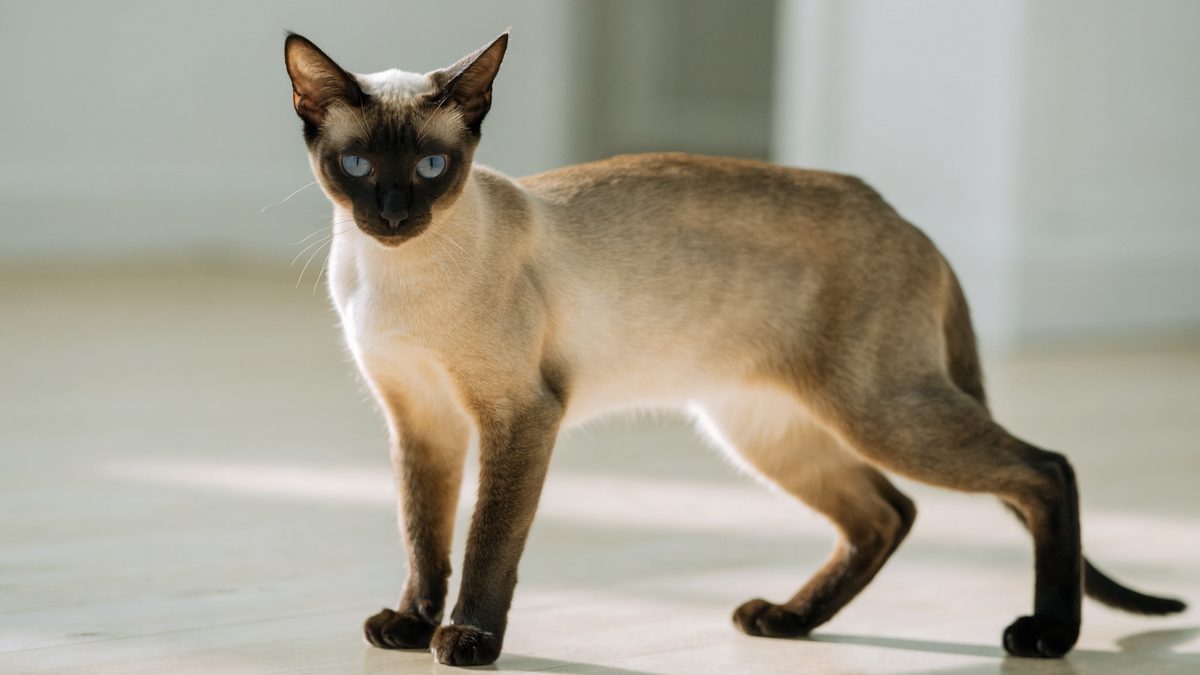
A Siamese is a medium-sized, slender, short-coated cat with a long wedge-shaped head, strikingly large ears, deep blue almond eyes and dark points on the face, ears, legs and tail. The Cat Fanciers' Association calls the ideal Siamese svelte and refined, with long tapering lines, very lithe but muscular. Every practical thing on this page traces back to two facts about that description. The points exist because of a temperature-sensitive enzyme, and the head shape is contested between registries.
Start with the breed standard, because it is free, public, and it settles arguments that Indian sellers otherwise settle with adjectives. The CFA describes the head as a long tapering wedge, medium in size in good proportion to body, where the total wedge starts at the nose and continues in straight lines to the tips of the ears forming a triangle, with no break at the whiskers. The skull is flat, showing a long straight line in profile from the top of the head to the tip of the nose, with no bulge over the eyes and no dip in the nose. Ears are strikingly large, pointed and wide at the base. The body is medium size, graceful, long and svelte, combining fine bones with firm muscles, and the tail is long, thin and tapering to a fine point.
Two lines in that standard matter more to an Indian buyer than the rest put together. The first is on eyes, which must be almond shaped, medium size, slanted towards the nose, and uncrossed. The second is on colour, where the standard instructs judges to allow for darker colour in older cats because Siamese generally darken with age, but insists there must be definite contrast between body colour and points. Hold on to both. The first is the answer to the most-asked question about this breed, and the second is the reason a Siamese in Chennai does not look like a Siamese in a Scandinavian photograph.
| Attribute | What the record shows | Source |
|---|---|---|
| Origin | Thailand, formerly Siam. Described in the West by Harrison Weir in 1889 and shown at the Crystal Palace from 1881 | CFA |
| Body | Medium size, graceful, long and svelte, fine bones with firm muscles | CFA standard |
| Head | Long tapering wedge, flat skull, no break at the whiskers | CFA standard |
| Eyes | Almond, medium, deep vivid blue, uncrossed. Eyes other than blue disqualify | CFA standard |
| Coat | Short, fine textured, glossy, lying close to body. Longhair disqualifies | CFA standard |
| Colours accepted | Seal point, chocolate point, blue point, lilac point only | CFA standard |
| Allowable outcross breeds | None | CFA standard |
| Weight, Indian listing | Males 4 to 6 kg, females 3 to 5 kg | Mr n Mrs Pet |
| Weight, second Indian source | 2.5 to 5.5 kg | Carry My Pet, Puppiezo |
| Height, Indian listings | 10 to 13 inches, or 8 to 10 inches, or 20 to 25 cm | Mr n Mrs Pet, Puppiezo, Justdial |
| Life expectancy, Indian listings | 12 to 20 years, 12 to 18 years, or 15 to 20 years | Mr n Mrs Pet, Carry My Pet, Justdial |
| Life expectancy at age 0, UK primary care | 11.69 years (95% CI 10.56 to 12.82), 88 recorded deaths | VetCompass |
Read the last two rows together, because they are the single largest factual disagreement on this page. Three Indian sources quote a life expectancy of 12 to 20 years Carry My Pet. Siamese Cat Breed Guide Justdial. Siamese Cat Secrets: History. The largest veterinary life-table study of UK companion cats, built from primary-care clinical records, gives the Siamese a life expectancy at age 0 of 11.69 years from 88 recorded deaths. Bonbeno does not average those. The seller figures describe what a well-kept individual cat can reach. The VetCompass figure describes what a population actually does, including the kittens that die young, and it is the number to budget against.
The colourpoint pattern, and why it is a thermometer
The dark points on a Siamese are produced by a temperature-sensitive form of the enzyme tyrosinase, so pigment forms only where the skin is cool. Lyons and colleagues identified the causal variant as an exon 2 G to A transition in the tyrosinase gene, changing glycine to arginine at position 302, and every cat in their sample with a pointed phenotype was homozygous for it. Their paper describes the resulting colouration as temperature-sensitive in plain terms, producing pigment at the extremities of the body such as the ears, tail and paws, and a mask on the face. The CFA's own breed history puts it the same way, calling the Siamese colour pattern the consequence of a temperature-controlling enzyme that restricts colour to the coolest parts of the body. The UC Davis Veterinary Genetics Laboratory sells a Colorpoint Restriction DNA test on exactly that basis, describing reduced pigment production in warmer areas of the body and darker pigmentation in the cat's cooler extremities.
That single mechanism explains four separate things Indian buyers ask about, and the climate section below turns it into practical advice. Kittens are born almost white because the womb is warm, which one Indian seller states correctly, noting that a very young kitten will look far paler than the adult it becomes. Adults darken with age, which the CFA standard formally instructs judges to allow for. A cat kept in a consistently warm room stays paler than the same cat kept cool. And the colourpoint pattern is a recessive trait that exists in the general domestic cat population, not a Siamese trademark, which is why a pointed kitten alone proves nothing about pedigree.
Apple head versus wedge head, and why the registries disagree
Two body types are sold as Siamese in India and the registries do not agree on whether both are the same breed. The modern show Siamese is the extreme wedge described in the CFA standard. The older, rounder-headed, heavier-boned cat, nicknamed the apple head, was recognised by the World Cat Federation as a separate breed called the Thai with full championship status in 1990, and The International Cat Association granted the Thai championship status in January 2010. TICA's Thai standard describes a medium to slightly large pointed cat of foreign type with a laterally rounded upper head from which projects a distinctly wedge-shaped muzzle, and states flatly that the Thai should not be extreme in any way.
The CFA takes the opposite view in print. Its own published breed history describes the post-war surge in demand producing cats with heavy boning, round heads and washed-out blue eyes, calls that a sure sign of mixed ancestry and indiscriminate breeding, and refers to the resulting notion of a so-called Traditional Siamese as a misconception that still lingers. So one registry calls the apple head a distinct heritage breed with championship status and another calls it a misconception. Bonbeno prints both positions rather than picking one, because an Indian buyer being offered an apple-head kitten deserves to know the argument exists. What settles it commercially is paperwork: ask which registry issued the pedigree and what breed name is written on it.
The apple head versus wedge head argument is usually presented as taste. One published genetic survey turned it into a health question. Among Siamese sampled from the Traditional Cat Association registry, zero of 31 apple-head cats carried the rdAc blindness variant, while wedge-faced Siamese from the same and other registries carried it at allele frequencies of 0.265 to 0.364. The health section below explains what that variant does. Treat the sample sizes with care, because 31 cats is not a national survey, but no Indian page mentions the finding exists.
Five checks before you pay for a Siamese in India
Bonbeno found no published count of registered Siamese cats in India, so no one can honestly say what share of Indian cats sold as Siamese are pedigreed and what share are pointed domestic cats. Say that plainly rather than guess. What you can do is run five free checks in daylight on the actual kitten, not on a photograph sent over WhatsApp.
- Check the eye colour first. Eye colour must be deep vivid blue, and eyes other than blue are an outright disqualification under the CFA standard. Green or gold eyes on a pointed cat rule out a show-standard Siamese immediately.
- Check the point colour against the accepted list. The CFA accepts seal point, chocolate point, blue point and lilac point, and nothing else. Indian sellers advertise flame, cream, lynx and tortie points as premium options. Those cats may be perfectly nice pets, but they are not CFA-standard Siamese colours, so do not pay a pedigree premium for them without seeing the pedigree.
- Check the coat length. The coat must be short, fine textured, glossy and lying close to the body, and longhair is a disqualification. A semi-longhaired pointed cat is a different breed. UC Davis offers a long hair DNA test that identifies the variants involved.
- Check the tail and the feet. A visible kink disqualifies, as do white toes or feet and an incorrect number of toes. These take ten seconds and cost nothing.
- Ask which body issued the pedigree, in full words. The top-ranking Indian seller page lists four registries and defines FCI on that page as the Feline Club of India. A three-letter acronym on a certificate is not a pedigree. Ask for the registry's full name, the registration number, and the sire and dam names, then check that the registry actually recognises the breed you are buying.
One last piece of context frames everything below. The Siamese is not a modern designer breed. It appeared in the catalogues of the Crystal Palace Show as early as 1881, Harrison Weir published a description of the ideal specimen in 1889, Siamese appear in the Beresford Cat Club stud books in 1900, and the first Siamese won Best Cat in Show in 1907. CFA recognised the blue point in 1934, the chocolate point in 1952 and the lilac point in 1955. A breed with that much documented history has documented health data too, and the health issues section uses it.
Siamese cat price in India
A Siamese cat costs Rs 15,000 to Rs 1,20,000 in India in 2026 depending entirely on which published source you read. Bonbeno compared five Indian sources visible for this query on 15 August 2026. At the top of the range they disagree by roughly eight times, at the bottom by more than three times, and the number one result disagrees with itself twice on the same page.
Read the table across, not down. The disagreement is the finding.
| Source | Quoted price | What the quote covers |
|---|---|---|
| Mr n Mrs Pet | Rs 50,000 to Rs 1,20,000+ | Stated average for a Siamese cat in India |
| Mr n Mrs Pet, basic quality | Rs 50,000 to Rs 70,000 | Purebred pet without show traits |
| Mr n Mrs Pet, FCI registered | Rs 70,000 to Rs 9,00,000 | Body text figure |
| Mr n Mrs Pet, FCI registered | Rs 70,000 to Rs 90,000 | Product card figure, same page |
| Mr n Mrs Pet, champion bloodline | Rs 90,000 to Rs 1,20,000+ | Award-winning parents |
| Supertails, breed guide | Rs 15,000 to Rs 40,000 | General India range |
| Supertails, all-breed guide | Rs 15,000 to Rs 40,000 | Same range, separate 2026 article |
| Carry My Pet, pet quality | Rs 15,000 to Rs 25,000 | Pet-quality kitten |
| Carry My Pet, reputed breeder | Rs 25,000 to Rs 40,000 | Reputed breeder |
| Carry My Pet, show or imported | Rs 40,000 to Rs 65,000 | Show quality or imported bloodline |
| Puppiezo, live listings | Rs 63,599 to Rs 87,999 | Three named 8-week-old kittens on the page |
| Khan Kittens | Not published | Price given only on contact |
Two things in that table deserve naming. The first is that the page ranking number one for this query quotes FCI-registered kittens at Rs 70,000 to Rs 9,00,000 in its text and Rs 70,000 to Rs 90,000 on its own product card, a factor of ten apart, on the same page on the same day. The second is that its floor of Rs 50,000 sits above the entire range published by Supertails and by Carry My Pet Carry My Pet. Siamese Cat Breed Guide. Neither of the low-quoting sources mentions the high one, and the high one does not mention them.
Price by city, where the two published tables collide
Both marketplaces publish a price by city table, and for the same cities they disagree by two to three and a half times. Take Bangalore. One source quotes Rs 55,000 to Rs 1,20,000, the other quotes Rs 18,000 to Rs 35,000 Supertails. Siamese Cat Price. Both were live on the same day.
| City | Mr n Mrs Pet | Supertails | Top-of-range gap |
|---|---|---|---|
| Delhi | Rs 50,000 to Rs 1,15,000 | Rs 20,000 to Rs 40,000 | 2.9x |
| Mumbai | Rs 55,000 to Rs 1,15,000 | Rs 22,000 to Rs 40,000 | 2.9x |
| Bangalore | Rs 55,000 to Rs 1,20,000 | Rs 18,000 to Rs 35,000 | 3.4x |
| Chennai | Rs 55,000 to Rs 1,20,000 | Rs 15,000 to Rs 30,000 | 4.0x |
| Hyderabad | Rs 50,000 to Rs 1,20,000 | Rs 18,000 to Rs 32,000 | 3.8x |
| Pune | Rs 55,000 to Rs 1,15,000 | Rs 18,000 to Rs 35,000 | 3.3x |
| Kolkata | Not listed | Rs 15,000 to Rs 25,000 | n/a |
| Jaipur | Rs 55,000 to Rs 1,10,000 | Not listed | n/a |
Sources: Mr n Mrs Pet city table and Supertails city-wise breakdown. A separate 2026 Supertails guide gives generic city bands for any cat, from Rs 10,000 entry level in Kolkata to Rs 80,000-plus premium in Mumbai, and calls Mumbai the most expensive city for cats in India.
What actually moves the number
Four variables explain most of the spread, and only two of them are about the cat.
- Channel. The high band comes from brokered marketplaces that arrange delivery, health screening and after-sales plans, and that sell paid buyer plans alongside the kitten. The low band comes from editorial guides describing breeder-direct pricing Carry My Pet. Siamese Cat Breed Guide. You are comparing a retail price with a wholesale one.
- Paperwork. Registered kittens are quoted above unregistered ones by every source that splits them out, with one Indian seller pricing basic quality at Rs 50,000 to Rs 70,000 against Rs 90,000 to Rs 1,20,000-plus for champion bloodline.
- Point colour. Sellers charge a premium for rarer points. One Indian breeder ranks lilac point as the rarest of the traditional four and the top of the range, with chocolate priced above seal and blue. Supertails puts common colours at Rs 18,000 to Rs 25,000 and rare variations at Rs 30,000-plus.
- Age. Kittens are quoted above adults because most buyers want kittens. The three live Siamese listings on one Indian site were all 8 weeks old at Rs 63,599, Rs 64,999 and Rs 87,999.
What Indian law says about the seller, which no ranking page mentions
Anyone selling you a kitten online in India is operating a pet shop in law. The Prevention of Cruelty to Animals (Pet Shop) Rules, 2018 define a pet shop to include online platforms over which the sale and purchase of pet animals is carried out, and define pet animal to include the cat. That definition carries obligations, and they are checkable before you pay.
- Registration. No person may carry on the business of sale or trade in pet animals, retail or wholesale, without a certificate of registration from the State Animal Welfare Board, and the certificate must be prominently displayed. Registration costs a non-refundable fee of five thousand rupees and is valid for five years.
- Minimum age. The rules define an un-weaned animal to include kittens below eight weeks, and no pet shop shall sell un-weaned or underage animals. Eight weeks is the legal floor, not the recommended age, and the kitten timeline section explains why the recommended age is later.
- Prices on display. The species and numbers of pet animals, and the prices for which they are offered for sale, shall be prominently displayed. Judge for yourself how a listing that hides the number behind a sign-up form sits with that.
- A receipt. Receipts shall be issued for every pet animal sold in Form IV and a copy retained. Ask for it by name.
- Breeder registration. No pet shop shall sell any pet animal acquired from a breeder unless the breeder is registered as required by the relevant rules in force. Ask who bred the kitten and whether that breeder is registered.
- Records. Every pet shop owner must maintain a record book of breeders and suppliers with names, addresses, contact details and dates, and those records shall be available at the pet shop for inspection by the State Board or any intending purchaser. You are an intending purchaser. You may ask to see the book.
The 2018 rules require microchipping of every puppy and require each pet shop to keep a functional microchip reader on the premises. The word used is puppy. Bonbeno found no equivalent kitten microchipping requirement in the same rules. That is a real gap, and it means a kitten's identity in India rests on the seller's paperwork rather than on an implanted chip. Ask for a microchip anyway and get the number written on the receipt.
Finally, the cheapest legitimate route is not on any of these pages. Supertails puts Siamese adoption at Rs 5,000 to Rs 10,000, and its 2026 all-breed guide puts shelter adoption generally at Rs 500 to Rs 5,000 including basic vaccination, against Rs 10,000 to Rs 1,20,000-plus from a breeder. The adoption section covers how that works for a pointed cat in India.
What a Siamese actually costs to keep in India
Budget Rs 2,300 to Rs 9,000 a month for a Siamese in India, and Rs 35,000 to Rs 2,40,000 for the whole first year including the kitten. Two Indian sources publish a monthly cost for this breed specifically. They quote Rs 3,000 to Rs 5,000 and Rs 3,000 to Rs 8,000, and the higher one justifies the gap with a claim about the coat that is factually wrong for a short-coated cat.
Supertails puts the monthly cost of maintaining a Siamese at Rs 3,000 to Rs 5,000, covering food, litter, occasional grooming and routine vet visits. Mr n Mrs Pet puts it at Rs 3,000 to Rs 8,000 and explains the upper end by saying that their long, silky coats require more maintenance than short-haired breeds, so grooming and hygiene are a key part of the monthly budget. The Siamese coat is short, fine textured and glossy, lying close to the body, and longhair is a disqualification under the breed standard. The same page elsewhere lists low grooming needs as a reason to choose the breed. Do not budget a long-coat grooming line for this cat.
| Line item | Budget | Mid-range | Premium |
|---|---|---|---|
| Cat food, dry plus wet | Rs 800 to Rs 1,500 | Rs 1,500 to Rs 3,000 | Rs 3,000 to Rs 6,000 |
| Kitten food, under 1 year | Rs 1,000 to Rs 2,000 | Rs 2,000 to Rs 3,500 | Rs 3,500 to Rs 5,000 |
| Litter and litter box | Rs 300 to Rs 600 | Rs 600 to Rs 1,200 | Rs 1,200 to Rs 2,500 |
| Routine vet visits | Rs 300 to Rs 600 | Rs 600 to Rs 1,000 | Rs 1,000 to Rs 2,000 |
| Professional grooming | Rs 500 to Rs 1,000 | Rs 1,000 to Rs 2,000 | Rs 2,000 to Rs 4,000 |
| Treats | Rs 150 to Rs 300 | Rs 300 to Rs 600 | Rs 600 to Rs 1,500 |
| Toys and enrichment | Rs 100 to Rs 300 | Rs 300 to Rs 600 | Rs 600 to Rs 1,500 |
| Flea and tick prevention | Rs 150 to Rs 300 | Rs 300 to Rs 600 | Rs 600 to Rs 1,200 |
| Total | Rs 2,300 to Rs 4,600 | Rs 4,600 to Rs 9,000 | Rs 9,000 to Rs 21,700 |
Three adjustments turn that generic table into a Siamese budget. Cut the professional grooming line to near zero, because a short close-lying coat needs a weekly brush and nothing else The Cat Fanciers' Association. Siamese…. Raise the toys and enrichment line, because this breed's problems come from boredom and isolation rather than from coat care, and one published survey found separation-related problems in cats significantly associated with not having access to toys. Keep the flea and tick line at full value year-round, because Indian conditions do not give you a winter off.
First-year cost, kitten included
The first-year cost is where buyers are caught out, because the purchase price is the smaller half of it in the mid-range case.
| Expense | Type | Estimated cost |
|---|---|---|
| Purchase or adoption fee | One-time | Rs 500 to Rs 1,20,000 |
| Initial vet checkup | One-time | Rs 500 to Rs 1,500 |
| Vaccination, full year 1 schedule | Annual | Rs 1,500 to Rs 3,000 |
| Deworming, initial courses | One-time | Rs 300 to Rs 600 |
| Spay or neuter surgery | One-time | Rs 3,000 to Rs 8,000 |
| Litter box plus initial litter | One-time | Rs 600 to Rs 2,500 |
| Bowls and water dispenser | One-time | Rs 400 to Rs 2,000 |
| Carrier | One-time | Rs 800 to Rs 3,000 |
| Bed or mat | One-time | Rs 500 to Rs 3,000 |
| Scratching post or cat tree | One-time | Rs 800 to Rs 4,000 |
| Collar and ID tag | One-time | Rs 200 to Rs 800 |
| Initial toy kit | One-time | Rs 300 to Rs 1,500 |
| Grooming kit | One-time | Rs 400 to Rs 1,500 |
| Monthly running costs, twelve months | Annual | Rs 24,000 to Rs 96,000 |
| First year total | Rs 35,000 to Rs 2,40,000+ |
Spend the Rs 3,000 to Rs 8,000 on neutering early. In the UK VetCompass life-table study, entire cats had 4.29 times the odds of dying before three years of age compared with neutered cats (95% CI 3.72 to 4.95). Nothing else on that table buys you that much.
For scale, a US price guide puts the one-time costs of acquiring and setting up for a Siamese at 750 to 4,175 dollars. Indian buyers pay far less for the kitten and broadly comparable amounts for food, litter and veterinary care, which is why the recurring lines above matter more here than the purchase price does.
Two costs the Indian tables leave out apply specifically to this breed. A DNA panel to test for the rdAc blindness variant is offered by university laboratories abroad and is not routinely included in Indian kitten pricing, so budget for it or demand the breeder's result. And air conditioning or reliable fan cooling through April and May is a real recurring cost in most Indian cities, which the climate section quantifies. Neither appears on any competing page's cost table.
Heat, humidity and the Indian monsoon
A Siamese handles Indian heat better than any long-coated or flat-faced breed, because a short close-lying coat and a long normal muzzle give it no structural cooling problem. Its ancestors are tropical. TICA's Thai standard ties the breed's very short coat directly to its roots in tropical Thailand. What Indian heat does change is how your cat looks, and that surprises more buyers than anything else on this page.
Set the scale first. In the April to May 2026 heat season, India Meteorological Department bulletins recorded maximum temperature departures of 1.6 to 3.5 degrees Celsius above normal across Odisha, Chhattisgarh, Vidarbha and Madhya Pradesh in early to mid April, then a north-westward migration through Rajasthan, Haryana, Chandigarh, Delhi, Punjab and Uttar Pradesh by late April. At the peak on 27 April 2026, Banda in Uttar Pradesh registered 47.6 degrees Celsius, roughly 8 degrees above its climatological norm, and Akola in Maharashtra recorded 46.9 degrees the same day. In the same season Shimla reached 27 degrees and Mussoorie and Nainital reached 30 degrees, while parts of Assam, Meghalaya and West Bengal stayed at or below normal.
Your cat's coat is a record of your room temperature
The colourpoint pattern is produced by a temperature-sensitive form of tyrosinase, so pigment forms only where skin is cool. UC Davis states the consequence directly: pigment production is reduced in warmer areas of the body, producing darker pigmentation in the cat's cooler extremities such as paws and ears. CFA's own breed history describes the same enzyme restricting colour to the coolest parts of the body.
Follow that through to an Indian flat. A seal point Siamese living in an air-conditioned Bengaluru apartment and the same cat living in a naturally ventilated house in Banda are running different skin temperatures for months at a time, and their coats will not match. The warmer cat will show paler, less defined points and a lighter body. The cooler cat will darken. Neither is a fake and neither is unwell. This is also why breed standards handle it explicitly, with CFA instructing judges to allow for darker colour in older cats while still requiring definite contrast between body colour and points, and TICA's Thai standard allowing darker body shading in older cats as long as a definite contrast remains.
Siamese kittens are born almost white and develop their point colour over the following weeks, which one Indian breeder states correctly on its own sales page. If the kitten you collected at eight weeks looks paler than the adult in the photograph you were shown, that is the expected biology, not a substitution. If the eye colour is not deep vivid blue, that is a different conversation, because the standard disqualifies eyes other than blue.
The real Indian climate risk is not heat, it is what you breathe
The Siamese is the one breed repeatedly named as over-represented in feline lower airway disease. In a Greek referral series of 22 affected cats, 12 were Siamese, 55 percent of the sample, and statistical analysis against the hospital's own feline population of 957 cats showed only the Siamese breed at increased risk, with P equal to 0.018. Coughing was the presenting complaint in 20 of the 22 cats, and in nine of them, 41 percent, chest auscultation revealed no abnormality at all. Thoracic radiographs were normal in 23 percent. A normal-sounding chest and a normal X-ray do not clear a coughing Siamese.
One detail in that study is the most useful thing in it for an Indian owner. Of the nine cats that became permanently asymptomatic, one did so only when the owner moved to another city, which the authors read as hypersensitivity to a local aeroallergen. Indian homes are full of candidate aeroallergens and irritants that a Scandinavian cattery is not: mosquito coils, incense, cooking smoke, construction dust, dusty clumping litter and seasonal outdoor particulate. If your Siamese develops a persistent cough, treat the room as a suspect alongside the cat.
- Stop burning things in the cat's room. Mosquito coils and incense produce respirable particulate at close range, and this is the breed with a documented airway predisposition.
- Switch to a low-dust litter. Environmental avoidance and an alternate litter were among the management steps attempted in the same case series.
- Treat coughing as a veterinary sign, not a hairball. In the series, cough was the only symptom in every cat with intermittent disease, while the two most severely affected cats did not cough at all.
- Keep a cool room available all day in April and May. Peak recorded temperatures in the 2026 season passed 47 degrees Celsius in the plains, and a cat that plays hard needs somewhere cool to do it.
Monsoon and humidity
Humidity is easier on a Siamese than on a long-coated breed because there is no undercoat to hold moisture against the skin. Keep the weekly brush going through the monsoon anyway, because that is when you catch a damp patch or an ear problem early, and because brushing is the cheapest health check you own. Maintain flea and tick prevention at full strength year round rather than seasonally, and budget for it, since the Indian monthly cost tables carry it as a standing line of Rs 150 to Rs 1,200.
One practical note on apartment living in a hot city. Supertails' own advice for this breed in India is a cool, ventilated environment with air conditioning in summer and a warm resting spot in winter, and Carry My Pet says the short coat suits India's climate but asks owners to avoid prolonged exposure to extreme summer heat. Both are right and both are incomplete. The missing half is that a Siamese left alone all day in a cooled but empty flat has a behaviour problem waiting, which the temperament section takes up next.
Temperament, vocal behaviour and who should not buy one
A Siamese is a social, affectionate, intelligent cat that talks constantly and does not cope with being left alone. The CFA states it plainly: the Siamese is unsurpassed by any other breed in its ability to communicate with humans, makes its desires known through a large repertoire of vocalizations, and does not tolerate isolation or being ignored well. Read that as a requirement, not a charm.
Every Indian page agrees the breed is talkative and every Indian page frames it as a feature. Mr n Mrs Pet lists vocal and communicative among six reasons to buy one. Supertails answers the question are Siamese cats noisy with yes, they are famously vocal, and adds that a Siamese might not be the best fit if you want a quiet pet. Carry My Pet lists exceptionally vocal among the breed's defining traits. Nobody quantifies it and nobody warns you what happens when the talking is a complaint rather than a greeting.
Separation intolerance, and the numbers behind it
The CFA's own guidance is the strongest warning published by any registry about this breed. A Siamese wants to be with you, on you, or actively involved in whatever you are doing, and you should expect loud protests should you need some time and space to yourself. It adds that the best companion for a Siamese is likely either a human or another Siamese. That is separation intolerance described by the body that writes the breed standard.
The research on separation-related problems in cats is thin but it exists. A questionnaire study of 223 cats belonging to 130 owners found that 13.45 percent, 30 cats, met at least one behavioural criterion for a separation-related problem. Among those 30 cats, destructive behaviour was reported in 66.67 percent, excessive vocalization in 63.33 percent, urination in inappropriate places in 60 percent, depression or apathy in 53.33 percent, aggressiveness in 36.67 percent, agitation or anxiety in 36.67 percent, and defecation in inappropriate places in 23.33 percent. The occurrence was significantly associated with not having access to toys, P equal to 0.04, and with no other animal residing in the house, P equal to 0.04. The same paper records that the Siamese and Burmese breeds have previously been suggested as more prone to developing separation-related problems.
Destructive behaviour, screaming, and urinating outside the litter box are the top three reported signs of separation-related problems in cats. They are also three of the most common reasons an Indian household decides a cat is not working out. The breed most associated with the problem is the one whose Indian sales pages describe it as ideal for busy professionals who want an interactive pet.
What the largest breed-behaviour study found
A Finnish survey of 5,726 cats tested for behaviour differences across 19 breeds and breed groups using logistic regression with multiple environmental factors, and found significant breed differences in all ten traits examined. The Siamese was analysed inside a group labelled ORI, which combined Balinese, Oriental Longhair, Oriental Shorthair, Seychellois Longhair, Seychellois Shorthair and Siamese, so the results describe the Siamese family rather than the Siamese alone. Two findings stand out. Burmese and Oriental cats had the highest probability for excessive grooming, and Oriental and Persian cats were the most likely to have an owner-evaluated behaviour problem, while European and British Shorthairs were the least likely.
That is the honest position. This is not an aggressive breed and the study did not find it so, with Turkish Vans rather than Orientals topping every aggression measure. It is a breed whose owners report more behaviour problems, and the mechanism the literature points at is understimulation and isolation rather than temperament defect.
Who should buy a Siamese, and who should not
| Household | Verdict | Why |
|---|---|---|
| Someone at home most of the day | Good fit | The breed does not tolerate isolation well |
| Work-from-home professional | Good fit | Interactive, trainable, wants to be involved in what you are doing |
| Household with children | Good fit with supervision | Gentle and playful with children per Indian sellers, and robust enough for a busy house |
| Household with a second cat | Good fit | No other animal in the house was associated with separation-related problems |
| Empty flat 10 hours a day | Poor fit | The highest-risk configuration for separation-related problems The Cat Fanciers' Association. Siamese… |
| Anyone who needs a quiet home | Poor fit | Even the sellers say so |
| Shared accommodation with thin walls | Poor fit | Excessive vocalization is a reported separation sign in 63.33 percent of affected cats |
| First cat, owner rarely home | Poor fit | Consider an adult Indian domestic shorthair instead |
Carry My Pet gives the practical version of this and deserves credit for it, advising that if your home is empty for most of the day you should arrange companionship through another pet or interactive toys. Take that further. If you are out ten hours a day and you still want this breed, adopt two, not one, and treat the second cat as part of the purchase price rather than an optional extra.
Litter training, handling and enrichment
Train a Siamese the way you would train a small dog, because it will cooperate and because the alternative is a bored cat inventing its own job. Indian sellers describe the breed as quick learners who can be taught tricks and routines, and the CFA calls it often considered the most intelligent of cats. The work that matters is not tricks. It is litter reliability, carrier tolerance, and enough daily enrichment that the cat never has to escalate.
Litter training is usually already done, and that is the trap
Litter training is rarely the problem with a Siamese, because kittens sold in India are advertised as litter trained before delivery. The problem is litter box failure later, and the literature points at stress rather than at teaching. Urination in inappropriate places was reported in 60 percent of the cats identified with separation-related problems in one survey of 223 cats, and inappropriate defecation in 23.33 percent. A Siamese that used its litter box perfectly for a year and then stopped is telling you something about its day, not forgetting its lessons.
- Keep the box away from the kitchen and away from noise. The Indian pet-shop standard for housing pet animals requires accommodation free from noise pollution and away from noxious fumes and odours. Apply the same logic at home.
- Use a low-dust litter. An alternate litter is one of the environmental changes tried in cats with lower airway disease, the condition this breed is over-represented in.
- Treat a new accident as a medical question first. Book the vet before you buy a deterrent spray, because a cat that has started urinating outside the box may be ill, stressed or both.
- Do not punish it. Nothing in the separation-problem literature suggests punishment helps, and the associated factors that did show up were the absence of toys and the absence of another animal in the house.
Handling, the carrier, and the vet
Carry My Pet makes a point that no other ranking page does and it is correct: crate training is usually associated with dogs, but it helps cats feel comfortable during vet visits or travel, and introducing a crate gradually with treats, toys and positive reinforcement helps the cat see it as a safe space rather than something to fear. For this breed that matters more than average, because a cat with a documented airway predisposition will need veterinary handling at some point, and a Siamese that fights the carrier arrives at the clinic already stressed and breathing hard.
Start carrier work in week one. Leave the carrier open in the room with a blanket in it, feed meals inside it, and close the door for thirty seconds at a time before you ever drive anywhere. Do the same with nail trims and with a toothbrush. You have an unusually cooperative cat to work with, so use the cooperation while it is a kitten rather than discovering at four years old that you cannot get it into a box.
Enrichment is the actual training programme
Carry My Pet's care advice is the closest any ranking page gets to the right answer, listing puzzle feeders, cat trees, interactive toys, scratching posts and short training sessions, and stating that mental enrichment is just as important as physical exercise for this breed. The research backs the toy half of that specifically. Not having access to toys was one of only three factors significantly associated with separation-related problems in the 223-cat survey.
Set a floor and hold it. Two short interactive play sessions a day with a wand toy, one puzzle feeder for at least one meal, a vertical route through the room, and a window perch. That is the same list one Indian seller quantifies as 30 to 45 minutes of daily exercise for this breed, and the exercise section below deals with the physical half.
Two separate findings stack against a Siamese kitten bought at the legal minimum age. Burmese and Oriental cats, the group containing the Siamese, had the highest probability of excessive grooming in a study of 5,726 cats. And in a study of the same population, cats weaned after 14 weeks of age had a lower probability of stereotypic behaviour, specifically excessive grooming, than cats weaned at 12 weeks, while weaning before 8 weeks increased the risk of aggression. Indian listings advertise kittens at 8 weeks, which is the floor the Pet Shop Rules set, not the age the evidence favours. If a breeder offers to keep the kitten until 12 to 14 weeks, take the offer.
One thing not to bother with. Do not try to train the vocalising out of a Siamese. The CFA describes the breed as making its desires known through a large repertoire of vocalizations and warns of loud protests when you want space, and its published breed history observes that the degree to which they talk depends a good deal on the amount of conversation directed their way. You can change the reason your cat is shouting. You cannot make it a quiet cat.
How much exercise a Siamese actually needs
Give a Siamese 30 to 45 minutes of active daily exercise, split across at least two interactive sessions. That figure comes from an Indian seller's own breed specification and it is the only quantified number published for this breed in India. Treat it as a floor rather than a target, because in this breed the exercise and the mental work are the same activity.
Play with this cat properly rather than leaving toys on the floor and hoping. The physical requirement is modest by dog standards. A Siamese is a slender cat of medium size with fine bones and firm muscles and it does not need distance. What it needs is intensity in short bursts and a reason to think. One Indian source rates the breed's energy level as high and its ideal space as an apartment in the same specification block, and those two are compatible only if somebody in the flat is willing to hold a wand toy twice a day.
- Run two wand sessions of ten to fifteen minutes, one in the morning and one in the evening, ending each with a catchable target so the hunt completes.
- Feed one meal from a puzzle feeder rather than a bowl, which Carry My Pet lists among the enrichment tools this breed needs.
- Build a vertical route with a cat tree and a window perch, because climbing costs the cat energy and costs you no time.
- Rotate the toys weekly rather than leaving all of them out, since access to toys was one of the three factors significantly associated with separation-related problems.
- Add a second cat if you are out all day, because no other animal residing in the house was also significantly associated with those problems.
What happens if you skip it
Understimulation in this breed does not produce a placid cat, it produces a loud one. The Oriental group that contains the Siamese was the most likely of 19 breed groups to have an owner-evaluated behaviour problem and had the highest probability of excessive grooming. Destructive behaviour and excessive vocalization were the two most frequently reported separation signs in cats identified with a separation-related problem, at 66.67 percent and 63.33 percent respectively. Those are the failure modes, and both of them are cheaper to prevent with a wand toy than to fix later.
Do not run play sessions in the hottest part of the day between April and May, when plains stations recorded maxima above 46 degrees Celsius through the 2026 season. Move both sessions to early morning and after sunset, and keep the cat's water bowl full and shaded. A short coat helps with heat but it does not substitute for a cool room.
Grooming a short coat in Indian humidity
Groom a Siamese once a week with a soft brush and stop there. The CFA standard describes the coat as short, fine textured, glossy and lying close to the body, and disqualifies longhair outright, which means there is no undercoat to strip, no mats to cut out and no reason to book a salon. This is the lowest-maintenance coat of any popular pedigree cat in India.
Carry My Pet gets this right, describing weekly brushing as usually enough to remove loose hair and keep the coat shiny, alongside regular nail trimming, ear cleaning and dental care. Supertails agrees, calling the breed relatively low maintenance for grooming because of the short coat. Mr n Mrs Pet lists low grooming needs as a selling point on the same page where its FAQ claims Siamese cats have dense curly coats needing trimming every 4 to 6 weeks to prevent matting, and long silky coats that push up the monthly bill. Those sentences describe a different animal. The breed standard settles it.
| Task | Frequency | Why |
|---|---|---|
| Soft brush over the whole coat | Weekly | Removes loose hair, reduces hairballs |
| Nail trim | Every 3 to 4 weeks | Listed alongside brushing in standard breed care |
| Ear check and clean if needed | Weekly | Large open ears collect dust and monsoon damp |
| Tooth brushing | Several times a week | Dental disease is named among this breed's health concerns |
| Professional grooming | Never required | Short close-lying coat, longhair disqualifies |
| Clipping or trimming | Never | Removes the coat's role in regulating skin temperature, which sets point colour |
Two Indian-specific cautions
The first is about shaving. Indian groomers routinely offer summer clips, and for a Siamese that is a bad trade twice over. It removes the coat's protection without solving a heat problem the cat does not structurally have, and because pigment production tracks skin temperature Veterinary Genetics Laboratory, hair regrowing over a cooled patch of skin can come back darker than the surrounding coat. Owners meet this after surgical shaving for a spay too. It is temporary and harmless, and no Indian page warns you it is coming.
The second is about dust. Brush the cat once a week in good light and use the two minutes as a health check, because this is the breed with a documented over-representation in feline lower airway disease, and that weekly session is your chance to notice a cough, a wheeze or a change in breathing before it becomes an emergency. Do the brushing somewhere quiet and calm, and use the two minutes to run a hand over the ribs and check body condition, which the feeding section explains how to score.
Health issues, life expectancy and the DNA tests to demand
A Siamese lives 11.69 years on average in UK primary-care records, below the 11.89 years recorded for crossbred cats in the same dataset. Four conditions matter for this breed specifically: a blindness variant with a DNA test available, a fatal liver amyloidosis with no test available, an airway disease it is over-represented in, and a young-onset chest cancer it is over-represented in. Indian sellers quote 12 to 20 years and mention none of them.
Life expectancy, the real number
The VetCompass life-table study drew on primary-care clinical records from UK practices in 2019 and calculated life expectancy at age 0 for 12 breed groups. Life expectancy for UK companion cats overall was 11.74 years, 95 percent CI 11.61 to 11.87.
| Breed | Life expectancy (95% CI) | Recorded deaths |
|---|---|---|
| Burmese | 14.42 years (12.91 to 15.93) | 45 |
| Birman | 14.39 years (12.87 to 15.91) | 38 |
| Crossbred | 11.89 years (11.75 to 12.03) | 7,117 |
| Siamese | 11.69 years (10.56 to 12.82) | 88 |
| Persian | 10.93 years (9.63 to 12.23) | 80 |
| Ragdoll | 10.31 years (8.86 to 11.76) | 69 |
| Maine Coon | 9.71 years (8.42 to 11.00) | 69 |
| Bengal | 8.51 years (7.12 to 9.90) | 73 |
| Sphynx | 6.68 years (4.53 to 8.83) | 18 |
Two more findings from the same study change what you do rather than what you believe. Entire cats had 4.29 times the odds of dying before three years of age compared with neutered cats, 95 percent CI 3.72 to 4.95. Purebred cats had 1.83 times the odds of dying before three compared with crossbred cats, 95 percent CI 1.50 to 2.23. Being entire, purebred and of non-ideal body weight were all significantly linked to a shortened lifespan. You control two of those three.
Progressive retinal atrophy, the one you can test for
Progressive retinal atrophy in the Siamese is caused by rdAc, a single nucleotide variant in the CEP290 gene, and it is common. A survey genotyping 846 pedigree cats across 41 breeds plus 92 random-bred cats found the rdAc allele in 14 of 41 breeds and reported the highest frequencies in the Siamese breed group, ranging from 0.27 to 0.36. UC Davis states the same figure plainly, putting the CEP290 mutation frequency in Siamese at about 33 percent and calling it a significant health risk in the Siamese breed group. For contrast, the same survey found the allele in only 2 of 92 random-bred cats sampled in Maryland, a frequency of 0.01.
| Population | Cats tested | rdAc allele frequency | Expected affected |
|---|---|---|---|
| Siamese, CFA, TICA and TCA combined | 71 | 0.265 | 7.0% |
| Siamese, CFA | 25 | 0.340 | 11.6% |
| Siamese, TICA | 25 | 0.118 | 1.4% |
| Siamese, TCA wedge-faced | 21 | 0.357 | 12.8% |
| Siamese, TCA apple head | 31 | 0.000 | 0.0% |
| Oriental Shorthair | 46 | 0.340 | 11.6% |
| Balinese and Javanese | 28 | 0.333 | 11.1% |
| Colorpoint Shorthair | 11 | 0.364 | 13.2% |
| Random-bred cats, Maryland | 92 | 0.010 | negligible |
The apple head row is the finding nobody in India reports. No rdAc alleles were identified in any of the 31 apple-head cats examined, while the allele was found at high frequencies in all wedge-faced Siamese regardless of registry. Handle it carefully. Thirty-one cats from one registry is a small sample and the paper does not claim the wedge head causes the variant, only that the two populations were bred separately and the allele landed in one of them. But it converts a styling argument into something worth asking a breeder about.
The disease itself is slow and silent early. Affected kittens may have reduced retinal function by 8 months of age, with early funduscopic changes detectable at 1 to 2 years and visual impairment by 5 to 6 years. The genetic test is straightforward. Cats with two normal copies cannot pass it on, carriers with one copy have normal vision but pass it to half their offspring, and two carriers bred together are predicted to produce 25 percent affected kittens. UC Davis lists the Siamese among the breeds appropriate for testing. Ask any Indian breeder for the rdAc result on both parents. If the answer is a blank look, you have learned something about the breeding programme.
Amyloidosis, the one you cannot test for
Amyloidosis is the condition the CFA itself flags as the harder of the breed's two priorities, noting that research is still ongoing to determine the responsible genes and advising buyers to ask whether there is any history of it in a kitten's lines. In Siamese and Oriental cats the amyloid deposits concentrate in the liver and thyroid gland, and the main cause of death is rupture of the liver with blood loss into the abdomen and hypovolaemic shock. The disease is lethal, the age at death varies between one and seven years, and there is no sex predisposition.
The reason no commercial DNA test exists is the inheritance. A segregation analysis of 17 clinically affected cats found a complex mode of inheritance, a polygenic component plus a major locus with Mendelian inheritance, with heritability estimated at 0.56 plus or minus 0.09. A 2023 genome-wide association study of 20 affected and 48 healthy Siamese and Oriental cats found eight significantly associated SNPs across four chromosomes, in regions containing 55 genes, one of which is SAA1, the gene encoding the precursor protein of amyloid A. That is progress toward a test, not a test. Until one exists, pedigree history is the only screening tool, which is exactly what CFA says.
Airway disease and mediastinal lymphoma
Two more conditions show a Siamese excess in published case series. In a Greek series of 22 cats with feline lower airway disease, 12 were Siamese and the breed was the only one at significantly increased risk, P equal to 0.018. In a UK multi-institutional review of 55 cats with mediastinal lymphoma from five referral centres, the median age was 3 years with a range of 0.5 to 12 years, 12 of the 55 cats, 21.8 percent, were Siamese, and the male to female ratio was 3.2 to 1.0. The prognosis is better than the reputation suggests. Overall response to chemotherapy was 94.7 percent across 38 treated cats, overall median survival was 373 days, and cats achieving a complete response survived a median of 980 days against 42 days for a partial response.
A young Siamese with laboured breathing, a persistent cough, reduced appetite or sudden lethargy needs a same-day appointment. In one series, 41 percent of cats with lower airway disease had a completely normal chest on auscultation and 23 percent had normal radiographs, so a clean listen does not close the question. In mediastinal lymphoma the median age was 3 years, which is young enough that owners assume a young cat cannot be seriously ill.
Crossed eyes and nystagmus, and why they happen
Crossed eyes in Siamese cats are not a myth and they are not simply a cosmetic fault. The pigment mutation that produces the colourpoint pattern also reduces pigment in the retina, and that reduction misroutes a large part of the projection from the eye to the brain. Fibres cross at the optic chiasm that should not, so the lateral geniculate nucleus receives an abnormally large input from the contralateral eye and a reduced input from the same-side eye. Ray Guillery discovered this in the late 1960s after noticing that one cat's thalamic layering looked strangely abnormal, and the cat turned out to be Siamese. The work went on to explain the neural basis of visual problems in albino humans. Convergent squint and nystagmus in this breed sit downstream of that wiring.
Both major registries treat it as a fault to breed away from. CFA requires the eyes to be uncrossed. TICA's Thai standard lists crossed eyes as a mandatory disqualification. A cross-eyed Siamese can live a completely normal life and most do. It is not a reason to reject a pet kitten, and it is a reason not to pay a show-quality price for one.
| Condition | What to ask for | Test available |
|---|---|---|
| Progressive retinal atrophy, rdAc | CEP290 rdAc result on sire and dam | Yes, DNA test |
| Amyloidosis | Written family history, cause of death of relatives | No commercial DNA test Esders SL, Hulskotter K, Schreiner T |
| Mucopolysaccharidosis VI | MPS VI result if the line is unknown | Yes, DNA test |
| Feline lower airway disease | Any history of coughing in the line | No genetic test, clinical diagnosis |
| Mediastinal lymphoma | Age and cause of death of related cats | No genetic test |
| Crossed eyes and nystagmus | Look at the kitten in daylight | Visual check The International Cat Association. Thai… |
| Dental disease | Ask what dental care the breeder does | Clinical check |
One test on that list is worth explaining because no Indian page names it. UC Davis lists Mucopolysaccharidosis VI among the DNA tests appropriate for the Siamese breed, describing an inherited lysosomal storage disease with mild and severe forms whose signs may include retarded growth, wide faces with shortened noses, reduced flexibility and degenerative joint disease. It is rare. It is also cheap to rule out, and a breeder who has heard of it is a breeder who reads.
Diet and nutrition through the life stages
Feed a Siamese a complete, protein-rich cat food matched to its life stage, in measured meals rather than a permanently full bowl. One Indian source publishes daily energy figures for this breed of roughly 400 kcal for a growing kitten and 350 kcal for an adult. Use those as a starting estimate only, then correct against body condition, because body weight is one of the three factors independently linked to a shortened feline lifespan.
Diet and nutrition advice on the ranking pages is thin and largely generic. Carry My Pet says to choose a high-quality, protein-rich food suitable for your cat's age, keep fresh water always available and give treats only in moderation. Supertails says a high-quality diet is essential to maintain the sleek coat and energetic personality. Both are correct and neither tells you how much or how to tell if it is working.
Portion by condition, not by the bag
Body condition scoring beats a feeding chart because the chart does not know your cat. In a cross-sectional study in a first-opinion practice in Glasgow, 39 percent of cats scored overweight or obese on a validated five-point scale, 95 percent CI 30.2 to 47.8 percent. The risk factors that emerged were feeding frequency and neutered status, and the authors recorded owner misperception of their own cat's condition. Your hands are the instrument. Run them along the ribs weekly at brushing time. You should feel the ribs easily under a thin layer of fat, see a waist behind the ribs from above, and see a tuck-up from the side.
| Stage | What to feed | Notes |
|---|---|---|
| 8 to 16 weeks | Complete kitten food, four small meals a day | Indian kitten food budgets run Rs 1,000 to Rs 5,000 a month |
| 4 to 12 months | Kitten food, three meals a day | Growth is not finished at six months |
| 1 to 7 years | Complete adult food, two measured meals | Roughly 350 kcal a day as a starting estimate |
| 7 years and older | Senior or adult food, two meals, vet check twice yearly | UK Siamese life expectancy is 11.69 years, so seven is genuinely middle-aged |
| Any age | Fresh water available at all times | Required even in a pet shop under Indian rules |
Two Indian-market cautions
The first is about food lists on seller pages. One Indian listing publishes a do-not-feed list for this breed consisting of almonds, avocados, cherries, grapes, lemon, onions, salt and sugar. Onions belong on any such list. Several of the others are borderline and the list omits items that matter more for cats. Do not use a sales page as your toxicology reference. Ask a registered veterinarian, which the Indian pet-shop rules define as one registered under the Indian Veterinary Council Act, 1984.
The second is about fish. A common Indian feeding pattern is daily fish, and one veterinary case series specifically checked whether fish-based diets were driving lower airway disease in its cats, noting that none of the affected animals was fed exclusively fish-based diets, which did not support the histamine theory. So fish is not the villain that theory made it. It is still not a complete diet on its own, and a breed already carrying an airway predisposition and a documented amyloidosis risk is the wrong cat to experiment on. Use a complete commercial diet as the base and treat home food as a topping.
Two measured meals a day plus a puzzle feeder does three jobs at once. It controls weight, which is independently linked to lifespan. It slows eating. And it provides the enrichment whose absence is associated with separation-related problems. It costs nothing beyond the feeder.
Kitten timeline, month by month through the first year
A Siamese kitten's first year has four decision points that actually change the adult cat: the age it leaves its mother, the socialisation it gets before eight weeks, the age it is neutered, and whether the rdAc genetic test was run on the parents. This kitten timeline puts each one where it falls.
| Age | What is happening | What you do |
|---|---|---|
| Birth to 2 weeks | Kitten is born almost white because the womb is warm. Points have not developed Lyons LA, Imes DL, Rah HC | Nothing. The kitten is with its mother |
| 2 to 8 weeks | The critical socialisation period for cats | Ask the breeder what handling and household exposure the litter gets |
| 8 weeks | Legal floor for sale in India. Kittens below eight weeks are un-weaned animals and may not be sold | Do not collect yet if the breeder will hold longer |
| 8 to 12 weeks | Points are visible and deepening. Weaning before 8 weeks raises the risk of aggression | Get the first vaccinations and deworming under way |
| 12 to 14 weeks | Cats weaned after 14 weeks show lower probability of aggression to strangers and of excessive grooming than cats weaned at 12 weeks | The best window to bring a kitten home |
| 3 to 4 months | Litter habits set, carrier training should start | Complete the year-one vaccination schedule, Rs 1,500 to Rs 3,000 |
| 4 to 6 months | Rapid growth, high energy, vocalising increases | Establish two daily play sessions and a puzzle feeder |
| 5 to 8 months | Neutering window. Entire cats carry 4.29 times the odds of death before three years | Book the surgery, Rs 3,000 to Rs 8,000 |
| 8 months | rdAc-affected kittens may already show reduced retinal function | If parental test results were never provided, ask your vet about an eye examination |
| 8 to 12 months | Adult coat colour still darkening, and it will keep darkening with age | Switch to adult food, keep two measured meals |
| 12 months | Full first-year spend lands between Rs 35,000 and Rs 2,40,000 | Book the first adult annual health check |
The eight-week problem
Eight weeks is where Indian listings and the evidence part company. The Prevention of Cruelty to Animals (Pet Shop) Rules, 2018 define kittens below eight weeks as un-weaned and bar their sale, and Indian listings advertise Siamese kittens at exactly 8 weeks. A survey of 5,726 cats across 40 breeds found that weaning before 8 weeks of age increased the risk of aggression, and that cats weaned after 14 weeks had a lower probability of aggression towards strangers than early-weaned cats and a lower probability of excessive grooming than cats weaned at 12 weeks. The critical socialisation period runs from 2 to 8 weeks, which is exactly the window a kitten sold at eight weeks spends being packed and transported.
For this breed the stakes are higher than average, because the Oriental group containing the Siamese already carries the highest probability of excessive grooming among 19 breed groups studied. Buying at the legal floor stacks a known risk factor on top of a known predisposition. Ask the breeder to hold the kitten to 12 weeks and offer to pay for the extra month of food. A breeder who refuses is telling you something.
Indian rules require pet shops to issue a receipt in Form IV, to maintain vaccination and health records, and to provide pet care leaflets or written care instructions free of charge at the time of purchase. Ask for all three by name, plus the vaccination card, the deworming dates, the sire and dam names, and the rdAc test results. A CFA pedigree for this breed runs to eight generations, so a one-page certificate is not a pedigree.
Siamese against the cats Indian buyers cross-shop
Indian buyers comparing a Siamese are usually weighing it against a Persian, a Bengal, a Ragdoll or an Indian domestic shorthair. On price the Siamese sits in the lower half of the pedigree range. On life expectancy it beats every pedigree in the table except the Burmese and the Birman, and loses to the crossbred cat.
| Breed | Published India price | UK life expectancy at age 0 | Grooming | Main trade-off |
|---|---|---|---|---|
| Siamese | Rs 15,000 to Rs 40,000, or Rs 50,000 to Rs 1,20,000+ | 11.69 years | Weekly brush | Loud, and cannot be left alone |
| Persian | Rs 12,000 to Rs 50,000 | 10.93 years | Very high | Daily coat work in Indian humidity |
| Bengal | Rs 30,000 to Rs 80,000 | 8.51 years | Low to medium | Shortest life expectancy of the group |
| Ragdoll | Rs 25,000 to Rs 60,000 | 10.31 years | Moderate | Bigger cat, more coat, quieter |
| Maine Coon | Rs 40,000 to Rs 1,00,000 | 9.71 years | High | Heavy coat in a hot country |
| Burmese | Not separately published in India | 14.42 years | Low | Longest-lived breed in the dataset, also very vocal |
| Indian domestic shorthair | Rs 0 to Rs 2,000 | 11.89 years, crossbred | Weekly brush | No pedigree, and adapted to the climate you live in |
Three conclusions follow from that table and none of them appear on a ranking page. First, the Siamese is not an expensive cat by pedigree standards once you use the editorial price band rather than the marketplace one. Second, the crossbred Indian cat outlives every pedigree in the table except the Burmese and Birman, at 11.89 years against the Siamese's 11.69, and purebred cats overall carried 1.83 times the odds of dying before three years compared with crossbreds. Third, if grooming load is your deciding factor, the Siamese and the Bengal are the two low-maintenance coats on the list Supertails. Cat Price in India 2026.
Siamese against Thai, the comparison Indian sellers do not offer
The closer comparison is between the modern Siamese and the Thai, the apple head type recognised as a separate breed by the World Cat Federation in 1990 and given championship status by TICA in January 2010. FIFe also publishes a Thai standard, describing a modified wedge of medium size, medium bone structure, moderately large oval eyes and an intense deep blue eye colour, with any other eye colour leading to disqualification.
| Feature | Siamese, CFA | Thai, TICA and FIFe |
|---|---|---|
| Head | Long tapering wedge, flat skull, straight profile | Modified wedge, laterally rounded upper head, slight dip at eye level Federation Internationale Feline. Thai |
| Eyes | Almond, uncrossed | Oval, crossed eyes disqualify Federation Internationale Feline. Thai |
| Body | Long, svelte, fine bones | Medium bone, powerful but not heavily built, heavier than it looks |
| Coat | Short, fine, glossy, close lying | Short, fine, glossy, slight undercoat |
| Colour with age | Allow darker colour in older cats | A deeper body colour is allowed on older cats |
| Outcrosses allowed | None, 8-generation pedigree required | Indigenous pointed cats imported from Thailand since 2001 |
| rdAc allele in sampled cats | 0.265 to 0.357 in wedge-faced Siamese | 0.000 in 31 apple-head cats sampled |
All three registries agree on the one thing an Indian owner will actually notice, that a pointed cat darkens with age and that this is normal Federation Internationale Feline. Thai. They disagree about whether the apple head is a breed or a fault White B. The Siamese. The Cat Fanciers'…. Bonbeno prints the disagreement and leaves the choice with you.
Common mistakes Indian Siamese owners make
Seven mistakes account for most of the trouble Indian Siamese owners run into, and six of them are made before the cat arrives. Each one below is traceable to a specific claim on a page currently ranking for this query.
- Budgeting for a long-coat grooming schedule. The number one result tells Indian buyers that Siamese cats have dense curly coats needing trimming every 4 to 6 weeks and long silky coats that raise the monthly bill. The standard says short, fine textured, glossy, close lying, and disqualifies longhair. Delete that line from your budget.
- Planning around a 20-year life expectancy. Three Indian pages quote 12 to 20 years Carry My Pet. Siamese Cat Breed Guide Justdial. Siamese Cat Secrets: History. UK primary-care records give 11.69 years at age 0. Plan your finances and your insurance on the population figure.
- Buying at the legal minimum age. Eight weeks is the floor set by the Prevention of Cruelty to Animals (Pet Shop) Rules, 2018, not the optimum. Cats weaned after 14 weeks showed less aggression towards strangers and less excessive grooming than cats weaned at 12 weeks.
- Never asking to screen the parents. The rdAc blindness variant sits at roughly 33 percent allele frequency in Siamese populations and a DNA test exists. No Indian seller page mentions it. Ask, and put the answer in writing.
- Leaving the cat alone all day in a cooled flat. The CFA states the breed does not tolerate isolation or being ignored well, and the absence of another animal in the house was significantly associated with separation-related problems in cats. A quiet flat and an air conditioner do not substitute for company.
- Treating a cough as a hairball. The Siamese is the breed named at significantly increased risk of feline lower airway disease, P equal to 0.018 in one series where 12 of 22 affected cats were Siamese. Burning mosquito coils and incense in the same room makes it worse.
- Assuming a pale cat has been swapped. Points darken with skin temperature and with age, which all three registries state in their standards Federation Internationale Feline. Thai, and which traces to the temperature-sensitive tyrosinase variant. In a hot Indian city your cat will run paler than a European photograph.
One Indian seller publishes a replacement guarantee stating that if your pet perishes because of a covered health concern within the guarantee period, confirmed by a licensed vet, it will offer a replacement, with cover running 1 week at Gold tier and 2 weeks at Platinum. Read that as what it is. A replacement clause is a product warranty applied to an animal, and a one-to-two-week window covers roughly the incubation period of the things a stressed, transported eight-week-old kitten catches. It is not a health guarantee. Ask instead for the vaccination card, the deworming dates, a Form IV receipt and the parents' test results.
One mistake is subtler and worth a paragraph of its own. Indian buyers routinely pay a premium for rare point colours such as flame, cream, lynx and tortie, which one Indian breeder markets as uncommon and usually booked in advance. The CFA registers Siamese in four colours only, seal, chocolate, blue and lilac, with specific registration prefixes for each The Cat Fanciers' Association. Siamese…. A cat outside those four is not a CFA-registrable Siamese colour. It may be a lovely cat. It is not a reason to pay a pedigree premium unless the pedigree itself is produced.
Adoption, breeder verification and responsible sourcing
Adopt before you buy, and if you buy, verify the seller against the rules that already govern them. Adoption of a Siamese or a Siamese cross in India is quoted at Rs 5,000 to Rs 10,000, and general shelter adoption at Rs 500 to Rs 5,000 including basic vaccination, against Rs 10,000 to Rs 1,20,000-plus from a breeder.
The case for adopting an adult is stronger for this breed than for most, and one ranking page almost makes it. Supertails notes that shelter cats may be older or have mixed characteristics, and its all-breed guide points out that with an adult you get temperament certainty, what you see is what you get, while a kitten's temperament can vary. For a breed whose commonest failure mode is a mismatch between a loud, socially demanding cat and an empty flat, meeting the adult animal before committing removes most of the risk.
Two more facts favour it. Purebred cats carried 1.83 times the odds of dying before three years of age compared with crossbred cats in UK primary-care records, and crossbred cats had a longer life expectancy at age 0 than the Siamese. And the colourpoint trait is a recessive variant that exists in the wider domestic cat population, not a pedigree exclusive Veterinary Genetics Laboratory, which is why pointed cats and pointed crosses do turn up in Indian shelters.
Breeder verification, using the rules that already exist
Breeder verification in India does not require you to be an expert. It requires you to ask for documents the seller is already legally obliged to hold. The Prevention of Cruelty to Animals (Pet Shop) Rules, 2018 apply to online platforms selling pet animals, and cats are pet animals under them.
- Ask to see the certificate of registration. It must be issued by the State Animal Welfare Board and prominently displayed.
- Ask to see the record book of breeders and suppliers. Those records must be available at the pet shop for inspection by the State Board or any intending purchaser, and you are an intending purchaser.
- Ask whether the breeder is registered. No pet shop may sell an animal acquired from a breeder unless that breeder is registered as required by the rules in force.
- Ask for the monthly veterinary fitness certificate. Every pet shop owner must engage a veterinary practitioner to check each animal and issue a certificate of fitness once every month.
- Ask for the pedigree by generation count. A CFA Siamese pedigree runs to eight generations, allows no outcross breeds, and will not register cats with white toes in the cat or in its background.
- Ask for the rdAc result on both parents, since the DNA test is commercially available and the Siamese is listed among the breeds it is appropriate for.
- Ask for a written amyloidosis family history, because no DNA test exists and pedigree history is the only screening tool the CFA itself recommends.
A serious seller holds kittens past the eight-week legal floor and tells you why Ministry of Environment, and hands over written care instructions at the point of sale, which the rules require to be provided free of charge. A seller who does both is worth paying more for. A seller who does neither is selling you a transaction.
Finally, be honest with yourself about the noise before you commit either way. This cat will vocalise at you every day of its life, and the CFA's own breed history says the degree of talking depends partly on how much conversation you direct at it. If you want a healthy, low-maintenance, short-coated cat that suits Indian heat and asks nothing of your attention, the Indian domestic shorthair does the job for Rs 0 to Rs 2,000 and lives slightly longer on the available evidence. If you want a cat that follows you between rooms and comments on everything, and you are home enough to answer, the Siamese is one of the best companion cats there is.
Siamese cat questions Indian buyers actually ask
What is the average price of a Siamese Cat in India?
There is no single average. Indian sources published on the same day quote Rs 15,000 to Rs 40,000, Rs 15,000 to Rs 65,000 and Rs 50,000 to Rs 1,20,000 or more for the same breed. Live listings on one Indian site showed three 8-week-old Siamese kittens at Rs 63,599, Rs 64,999 and Rs 87,999. Compare at least three sources before you accept any quote.
Is a Siamese cat expensive?
Not by pedigree standards in India. Siamese sits below Bengal, Maine Coon, Siberian and Himalayan on the published Indian price ladder, at Rs 15,000 to Rs 40,000. In the United States the same breed is quoted at 750 to 4,175 dollars in one-time costs, so Indian buyers pay far less for the kitten and roughly the same for the care.
How much does it cost to maintain a Siamese Cat in India monthly?
Budget Rs 2,300 to Rs 9,000 a month depending on food quality, with Indian sources quoting Rs 3,000 to Rs 5,000 and Rs 3,000 to Rs 8,000 for this breed specifically. Delete the professional grooming line, because a short close-lying coat needs a weekly brush and nothing else, and add money for toys instead.
Why do siamese cats change color?
The dark points come from a temperature-sensitive form of the enzyme tyrosinase, caused by an exon 2 variant that changes glycine to arginine at position 302. Pigment forms only where skin is cool, so kittens are born almost white, extremities darken first, and a cat kept in a hot Indian room stays paler than the same cat kept cool.
Why do siamese cats get darker as they age?
Skin temperature drops slightly with age and pigment production rises where the skin is cooler, so the body colour deepens over years. All three major registries write this into their standards, with CFA instructing judges to allow for darker colour in older cats and FIFe stating that a deeper body colour is allowed on older cats.
Are siamese cats cross eyed?
Some are, and the cause is real rather than cosmetic. The same pigment mutation reduces retinal pigment and misroutes fibres at the optic chiasm, so the visual thalamus receives an abnormally large input from the opposite eye. Both major registries breed against it, with CFA requiring uncrossed eyes and TICA disqualifying crossed eyes in the Thai.
Why do siamese cats have nystagmus?
Nystagmus in this breed sits downstream of the same misrouted retinogeniculate pathway that causes the squint. Reduced retinal pigment sends fibres across the optic chiasm that should stay on the same side, and the brain's attempt to reconcile the abnormal input can produce involuntary eye movement. It usually does not stop the cat living normally.
Why do siamese cats meow so much?
Because the breed was selected for it and its registry says so. The CFA describes the Siamese as unsurpassed in its ability to communicate with humans, using a large repertoire of vocalizations, and warns of loud protests if you want time to yourself. Its published breed history adds that they talk in proportion to the conversation directed at them.
Are siamese cats mean?
No. In a study of 5,726 cats across 19 breed groups, Turkish Vans rather than Orientals topped every aggression measure, and the Siamese group was not flagged for aggression. What the same study did find is that Oriental cats were among the most likely to have an owner-evaluated behaviour problem, which usually traces to boredom and isolation.
Are siamese cats hypoallergenic?
No. The Indian seller page that lists this breed most prominently answers hypoallergenic with a plain no. Short hair reduces visible shedding, it does not reduce the Fel d 1 protein that causes most cat allergy. Anyone allergic should spend time with an adult Siamese before committing to one.
Are siamese cats rare?
Not internationally. The Siamese has been registered since 1906, has no allowable outcross breeds and requires an eight-generation pedigree with CFA. In India, availability is real but unmeasured, and Bonbeno found no published count of registered Siamese cats in the country, so nobody can honestly say how many pedigreed Siamese exist here.
Can Siamese cats live in India?
Yes, and better than most pedigree cats. A short close-lying coat and a normal muzzle give no structural cooling problem, and TICA ties the breed's very short coat to its tropical Thai origins. Provide a cool room through April and May, when plains stations recorded 47.6 degrees Celsius at Banda in 2026.
Do Siamese Cats require professional grooming?
No. The breed standard describes a short, fine textured, glossy coat lying close to the body and disqualifies longhair, so a weekly brush covers it. The Indian page claiming Siamese cats have dense curly coats needing trimming every 4 to 6 weeks is describing a different animal on the same page where it lists low grooming needs.
Should I buy or adopt a Siamese Cat?
Adopt first if you can. Adoption of a Siamese or Siamese cross is quoted at Rs 5,000 to Rs 10,000 in India against Rs 50,000 or more from a marketplace, an adult's temperament is already visible, and UK records give crossbred cats a longer life expectancy at age 0 than the Siamese. If you buy, ask for the seller's State Animal Welfare Board registration.
Why are Siamese cats so special?
Three documented things, none of them marketing. The colourpoint coat is a thermometer: a temperature-sensitive form of the enzyme tyrosinase, caused by an exon 2 variant changing glycine to arginine at position 302, produces pigment only where the skin is cool, so kittens are born almost white and adults darken with age. The CFA calls the breed unsurpassed by any other in its ability to communicate with humans, through a large repertoire of vocalisations. And the history is unusually deep: shown at the Crystal Palace from 1881, described by Harrison Weir in 1889, in stud books by 1900 and Best Cat in Show in 1907.
Is a Siamese cat a good pet?
Yes, for someone at home most of the day, and a poor fit for an empty flat ten hours a day or a home that needs quiet. The CFA states that the Siamese does not tolerate isolation or being ignored well, wants to be with you, on you, or involved in whatever you are doing, and protests loudly when it is not. It is not an aggressive breed: in a study of 5,726 cats, Turkish Vans rather than Orientals topped every aggression measure. Indian sellers describe it as gentle and playful with children, and if you are out all day, adopt two rather than one.
Compare with similar breeds
Siamese sits in 2 Bonbeno groups. Each one compares it directly against the breeds it is genuinely an alternative to, on the same figures.