
Breed profile
Thai Cat in India: One Name, Two Different Cats
The old-style Siamese, recognised under four different registry filings, absent from every Indian price list, and called a subpopulation of the Siamese by the only pedigree study that has measured it.
Quick answer
No Thai cat price in India could be sourced on 9 September 2026. India's leading cat-price guide lists 14 breeds and the Thai is not one of them, and the marketplace that ranks first for the query offers ten breeds, none of them the Thai. FIFe registered 234 Thai worldwide in 2024 against 929 Siamese. Indian care costs are real and quotable, so this page publishes those instead.
This page summarises published veterinary and genetic research on the Thai cat, including what the pointed coat allele does to the eye and the visual pathway. It is reference material, not a diagnosis and not a treatment plan. Consult your nearby vet, a registered veterinarian who can examine the animal in front of them, before acting on anything here, and take any sudden change in a cat's vision, balance or appetite to a clinic the same day.
Thai at a glance
What a Thai cat is
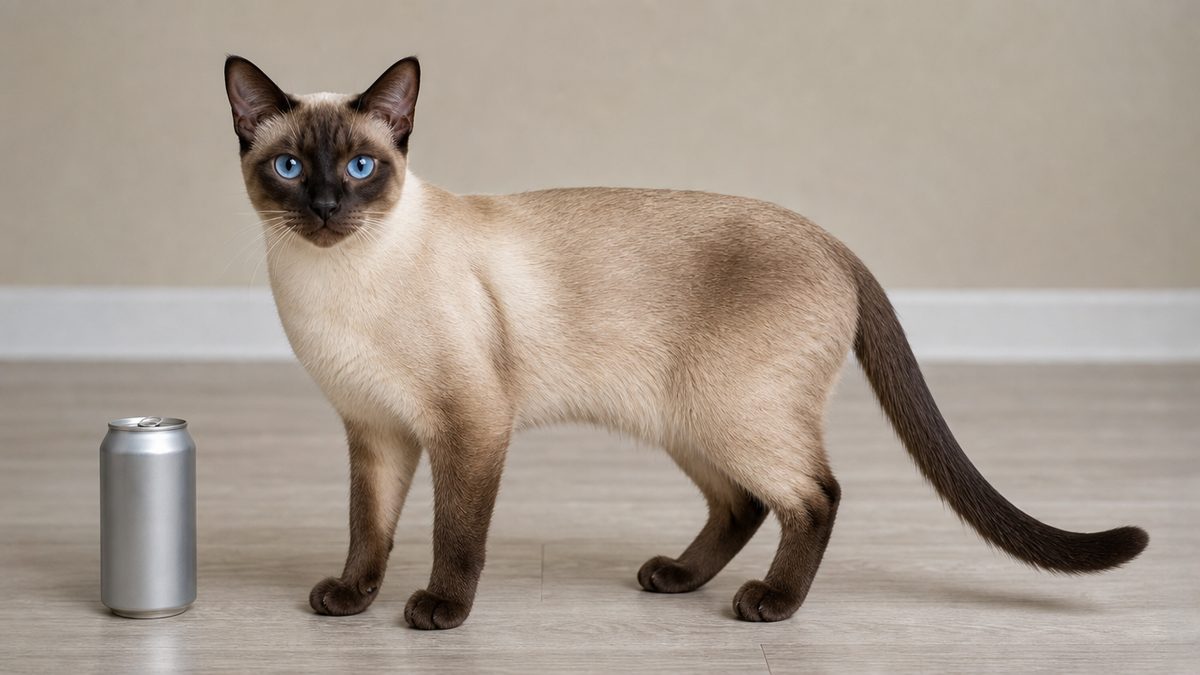
A Thai cat is the moderate, old-style Siamese: a short-coated pointed cat with deep blue eyes, descended from the native pointed cats of Thailand and bred deliberately to look the way the Siamese looked before the show ring stretched it.
The breed is known in Thailand as the Wichienmaat, in North America and Europe as the Thai, and colloquially as the Old-Style Siamese or the traditional Siamese. All three names describe one animal, and the last of them is the one an Indian buyer is most likely to meet in a WhatsApp forward.
Physically the Thai is defined by what it is not. The registry standard calls for a modified wedge head of medium width, longer than wide but never narrow, with a laterally rounded upper head from which a distinctly wedge-shaped muzzle projects, rounded on the end like a tapering garden spade. The modern Siamese by contrast is a straight-line wedge from nose tip to ear tips. The Thai standard penalises a narrow upper head and a genuinely round eye alike, and withholds all awards for a pronounced stop in profile, so this is a moderate cat pinned between two extremes rather than a rounder version of one of them. The body follows the same logic: moderately long, lithe and muscular, medium-boned throughout, with a tail as long as the torso and tapering gradually to the tip.
| What | Figure | Where it comes from |
|---|---|---|
| Adult female weight | 7 to 9 pounds, about 3.2 to 4.1 kg | TICA breed page |
| Adult male weight | 9 to 12 pounds, about 4.1 to 5.4 kg | TICA breed page |
| Coat | Very short to short, silky, close-lying, very little undercoat | TICA standard, revised 05/01/2010 |
| Eye colour | Blue only. Any other colour disqualifies at FIFe | FIFe THA standard, valid 01.01.2026 |
| Permissible outcross | Siamese at TICA. None at LOOF | TICA standard and LOOF mariages autorises |
| FIFe recognition | Code THA, recognised 2017 | FIFe THA standard header |
| FIFe registrations, 2024 | 234, rank 24 of 54 | FIFe Breeding Statistics 2024 |
The coat is the part that matters most in India. FIFe describes it as short, fine, glossy and smooth with a slight undercoat; TICA asks for very short to short, silky, close-lying and with very little undercoat, and withholds all awards for fluffy fur with a dense undercoat The International Cat Association. A short-coated tropical cat is not a marketing line here. It is written into the standard twice, by two registries, as a fault list.
The pointed pattern is a mutation, not a colour choice
Every Thai is homozygous for one specific mutation, and that is a statable fact rather than a rumour. The pointed pattern maps to a tyrosinase change in exon 2, a G to A transition swapping glycine for arginine at position 302, and in the study that mapped it every cat with a pointed coat colour was homozygous for that variant. Full albinism sits at the same locus, which is what makes the pointed allele one rung on an allelic series rather than a standalone colour gene.
That matters because the same allele produces the blue eyes. A standard that requires blue eyes and points is requiring homozygosity for one allele, and the consequences of that allele are documented further down this page under health.
Two cats, one name, and you need to know which one you are being offered
The word Thai identifies two unrelated cats in two current registry documents, and an Indian buyer reading an imported pedigree needs to know which. At the WCF, FIFe, TICA and LOOF, Thai means the pointed old-style Siamese described above. At the GCCF, THAI (TAI) is a group of Korat-type cats in colours the Korat is not permitted, and the standard says the Thais should not vary from the Korat in any respect.
A pedigree reading THA is the pointed cat in this article. A pedigree reading TAI is a Korat in another colour. The two documents are current, both bodies are legitimate, and nothing on either pedigree warns you which cat you are looking at World Cat Federation, EMS code table.
Registry recognition, and the map that gets it wrong
Five bodies recognise a cat called Thai, four of them mean the same pointed cat, and the fifth means something else entirely. State registry recognition per body rather than as one global claim, because on this breed the bodies do not merely differ on status, they differ on which animal they are talking about.
Two instruments make this checkable rather than a matter of reading breed pages. FIFe's breeds index, parsed on the three-letter EMS code, returns 52 code rows of which two are house-cat categories, and THA sits in that list beside SIA as a separate row. The CFA runs one breed council per recognised breed, and its 2026 ballot lists 12 longhair and 32 shorthair councils with no Thai council among them. Same cat, two registries, two different answers, both visible in a list rather than in prose. Two further indexes agree with FIFe. LOOF's Liste des Races of 1 January 2026 carries THAI with code THA in the championship list and no coat-length correspondence beside it, which is how that studbook files a standalone breed rather than a coat variant, and TICA's own A to Z index carries Thai as its own entry alongside Balinese, Korat and Siamese.
| Registry | What it means by Thai | The document that settles it |
|---|---|---|
| TICA | A pointed breed of foreign type, code TH, listed among TICA's breeds with its own standard and breed committee. TICA's page dates its Advanced New Breed promotion to 2009 in its history section, and prints no current class marker | The breed standard revised 05/01/2010, whose PERMISSIBLE OUTCROSS line reads Siamese |
| FIFe | A separate Category 4 breed, code THA, recognised 2017 | Its own four-page standard, valid 01.01.2026, in which the word Siamese never appears |
| WCF | Recognised, code THA, in Category 4 Oriental Group | Row 288 of the EMS code table, and the same row in the downloadable EMS PDF actualised 2026-06-06 |
| LOOF | Championnat oui, code THA, no coat-length correspondence | The Liste des Races of 1 January 2026 and the Mariages Autorises, which permit Thai x Thai only |
| GCCF | A DIFFERENT CAT. Korat type in a non-Korat colour, code TAI | Standard of Points June 2026, printed page 173, three varieties only |
| CFA | Not recognised. No Thai breed council exists | Declared Candidates for Breed Council Secretary, 2026 ballot |
The cross-registry map conflates the two cats
The World Cat Federation publishes a cross-registry map naming, for each breed, the bodies that recognise it. Its Thai row sits inside CATEGORY 4 ORIENTAL GROUP, gives the code THA, and lists the recognisers as WCF, FIFE, TICA, GCCF and LOOF. The same table appears in WCF's own downloadable PDF, actualised 6 June 2026, so the two WCF documents agree with each other.
The GCCF entry on that row is the problem. The GCCF does publish a Thai standard, at printed page 173 of its June 2026 Standard of Points, and that standard describes a cat of Korat type in three varieties: Thai Blue Point TAI 33 a, Thai Lilac Point TAI 33 c and Thai Lilac TAI c. Its General Type Standard opens by saying the Thai Group is the name used for cats of Korat type, but non Korat colour or pattern, and that the Thais should not vary from the Korat in any respect. The GCCF Korat standard sits immediately before it at printed page 171 and shares the same scale of points, the same head clause, the same body clause and the same coat clause word for word.
This site has already recorded three errors in the WCF's cross-registry map and all three were omissions, a recogniser left off a row. This one is not an omission. The GCCF really does recognise something called Thai, so the cell is not empty and not obviously wrong, and it is still misleading, because the cat the GCCF recognises under that name is a Korat in another colour rather than the Category 4 pointed cat the row is describing World Cat Federation, EMS code table. Use the map to know where to look, then read the registry's own standard.
The one registry that says no, and why it matters
The CFA does not recognise the Thai. Its 2026 breed council ballot lists a secretary candidate for every recognised breed, 12 longhair and 32 shorthair, plus a separate block for miscellaneous and provisional breeds holding one entry, and there is no Thai anywhere on the page. The pedigree study says the same thing in its introduction, noting that in the United States the CFA does not recognise the Thai as a breed while TICA does.
The practical consequence for an Indian buyer is direct. A cat imported from an American cattery will carry a pedigree reading Siamese, because the CFA has no other word for it, and that pedigree is not wrong. A cat imported from Europe will carry THA. Both animals can be the same type of cat.
There is no Indian feline register to appeal to
No Indian cat registry publishes a breed list, so no Indian position on the Thai can be quoted in either direction. That is an instrument limit rather than a finding, and this page states it as one. What follows practically is simple: any Indian pedigree offered for a Thai traces to a foreign register or to nothing at all, and asking which foreign register, in writing, is the first question to put to a seller.
History: how one breed became two
The Thai and the Siamese separated in the twentieth-century show ring rather than in Thailand, when Western breeders stretched the imported cat and a minority refused to follow.
Siamese cats were imported into the United Kingdom in the late nineteenth century and spread across Europe from there. From the mid-twentieth century a very slender body and a wedge-shaped head became fashionable, the classical cats stopped being registered or accepted for shows, and the original type came close to extinction in Europe.
A few breeders began re-introducing the classical type, and in 1995 the traditional Siamese was accepted again by some registries. The registered name Siamese stayed with the modern type. The classical cat needed a new word, and it got one: LOOF's own history says the name SIAMOIS remained attached to the long, very svelte forms, so a name had to be found for the older, rounder, stockier cat, and THAI was chosen after Siam, today called Thailand.
| Year | What happened | Source |
|---|---|---|
| Late 19th century | Siamese imported into the United Kingdom from the Kingdom of Siam | Pistorius and Blokker 2021 |
| 1950s | Breeders around the world continue with the moderate, early 20th-century type | TICA breed page |
| 1980s | First breed clubs dedicated to the old-style cat form in the United States and Europe | TICA breed page |
| 1990 | The World Cat Federation grants championship status and changes the name to Thai | TICA breed page |
| 1995 | The breed name Thai is registered and the traditional Siamese is accepted again | Pistorius and Blokker 2021 |
| 2001 | Breeders begin importing indigenous pointed cats from Thailand to widen the gene pool | TICA breed page |
| 2007 | TICA grants Preliminary New Breed status | TICA breed page |
| 2009 | TICA promotes the Thai to Advanced New Breed | TICA breed page |
| 2017 | FIFe recognises the Thai as code THA | FIFe THA standard header |
India is in the founding story, and almost nobody mentions it
The founders of the European Siamese and Thai population were imported from three countries, and one of them was India. The CFA Siamese Breed Council's database lists 49 animals imported from Thailand, Hong Kong or India in the early twentieth century, and the pedigree study treats those 49 as the founders of the whole European population. The most distant of them was traced more than 50 generations back.
That is worth stating plainly on an Indian page, because it is the only genuine Indian connection this breed has and it runs in the opposite direction to the one a reader expects. India was a source of founding cats for a European breeding programme a century ago. It is not a market for the result today.
What the Thai is not
The Thai is not the applehead Siamese, at least not reliably. TICA's own page says that to some the Thai is synonymous with applehead Siamese and to others it is not, and that applehead is a colloquial American term rather than an official breed name that means different things to different people. Anyone buying on the strength of the word applehead is buying an adjective, not a breed.
The Thai is also not the Korat, even though one registry uses the name for exactly that. And it is not the Balinese, which is the semi-longhaired member of the same group and carries the same pointed allele on a longer coat.
What the pedigree data says about breed versus variety
The genetics answer the variety-or-breed question directly, and they disagree with the registries. A pedigree analysis of 39,576 cats concluded that the Thai could be considered as a subpopulation of the Siamese cat, which shares common ancestors, although they are considered as separate breeds.
That sentence is quoted verbatim from the Results of Pistorius and Blokker's 2021 paper in Genetics Selection Evolution, and it is the most direct evidence anyone has produced on this question. The study is not a survey of opinions. It is a cluster analysis of kinship and inbreeding coefficients computed from pedigrees.
| Group | Pedigree entries |
|---|---|
| Siamese (SIA) | 28,770 |
| Thai (THA) | 4,998 |
| Oriental Shorthair (OSH) | 4,446 |
| Balinese (BAL) | 737 |
| 25 other breeds | 625 |
| Total | 39,576 |
Four of those five rows are the breeds LOOF allows to interbreed with each other, which is the same relationship arriving from a different direction. LOOF's Mariages Autorises lists ten permitted combinations for the Balinese alone, spanning BALINAIS, MANDARIN, ORIENTAL and SIAMOIS, and the Siamese entry mirrors it. The Thai entry in that same document permits THAI x THAI and nothing else.
Two registries, two opposite answers, on one page of one document
TICA lists Siamese as the permissible outcross on the Thai standard. LOOF permits Thai to Thai only. Those are not two ways of saying the same thing. One registry treats the Thai as a population that still needs Siamese blood; the other treats it as a closed register that must not receive any.
FIFe takes a third position that is visible in its filing rather than in its prose. It publishes one standard document covering the Balinese, Siamese, Oriental Longhair and Oriental Shorthair together, which is how FIFe files coat and colour variants of a single type. The Thai gets its own separate four-page standard in which the word Siamese does not appear once. FIFe has therefore decided the opposite of what its own filing convention would suggest for a variety.
The numbers that describe the population
The Thai population is small, young and unusually outbred. In 2016 and 2017 its average inbreeding coefficient was 0.05 and its population mean kinship 0.03, against 0.12 and 0.08 for the Siamese at the end of that study's Siamese data collection in 1998 and 1999. The distribution of pairwise kinship values peaks at zero, which the authors read as a population in which outcrossing is the predominant breeding strategy.
| Measure | Thai | Siamese |
|---|---|---|
| Founder genome equivalent, peak | 23.8 in 2007 | 7.0 in 1998-1999 |
| Founder genome equivalent, latest | 15.2 in 2016-2017 | 7.0 in 1998-1999 |
| Native genome equivalents, latest | 3.1 in 2016-2017 | 4.2 in 1998-1999 |
| Potential diversity with a supervised programme | About 26 | Not modelled |
| Potential diversity from regional exchange alone | About 23 | Not modelled |
Read the two halves of that table together and the picture is honest rather than reassuring. The Thai is currently more diverse than the Siamese was when its data ended, and its own diversity has fallen by a third since 2007. The number of unique Thai breeding individuals peaked in 2011 and had fallen to 101 by 2017. FIFe's registration count runs in the same direction. It registered 234 Thai worldwide in 2024, rank 24 of 54, against 929 Siamese at rank 17, which makes this a rare cat even in the countries whose registries recognise it.
A founder genome equivalent is the number of unrelated founding animals that would be needed to produce the diversity a population actually has. A population of thousands can have the diversity of fifteen. The practical consequence is that two Thai cats offered as unrelated may not be, and a breeder who cannot produce a pedigree deep enough to check is asking you to take that on trust.
And the cats in Thailand are a separate question again
The cats still living in Thailand have been genotyped, and they are not the same dataset as the European breed. A 2024 study sampled 184 cats across five Thai breeds using 15 microsatellite markers plus mitochondrial D-loop sequencing, and found observed and expected heterozygosity above 0.5 in all five. That is a study of the native populations, not of the Western Thai breed, and it should not be quoted as though it measured the registered cat.
Thai cat price in India, and why this page publishes none
No Thai cat price in India could be sourced on 9 September 2026, and that absence was tested rather than assumed. Every Indian page opened either does not list the breed or does not exist.
Start with the source an Indian buyer is most likely to find. Supertails publishes India's most visible cat-price guide, dated 25 March 2026 and reviewed by a named veterinarian, and its quick-reference table was parsed straight out of the raw HTML rather than read off a screenshot. It carries a header row plus exactly 14 named breeds, running from Indian Domestic (Desi) to Turkish Angora. The word Thai appears zero times in the article. There is no row to quote.
The page that ranks first for the commercial query is a marketplace, and it does not stock the breed either. MyKitten lists ten breeds by name and prices eight of them, and the Thai is not among either set. A marketplace ranking first for a breed it does not sell is the clearest single description of this market: the query has demand, the supply chain has nothing to attach to it.
| Breed | Supertails, 25 March 2026 | MyKitten, read 9 September 2026 | Gap at the floor |
|---|---|---|---|
| Thai | Not listed | Not listed | No figure exists |
| Siamese | Rs 15,000 to Rs 40,000 | Rs 50,000 to Rs 75,000 | 3.3 times |
| Persian | Rs 12,000 to Rs 50,000 | Rs 20,000 to Rs 35,000 | 1.7 times |
| British Shorthair | Rs 20,000 to Rs 60,000 | Rs 95,000 to Rs 1,45,000 | 4.75 times |
| Bengal | Rs 30,000 to Rs 80,000 | Rs 50,000 to Rs 90,000 | 1.7 times |
| Ragdoll | Rs 25,000 to Rs 60,000 | Rs 25,000 to Rs 70,000 | None |
| Maine Coon | Rs 40,000 to Rs 1,00,000 | Rs 35,000 to Rs 1,80,000 | 1.1 times |
| Himalayan | Rs 30,000 to Rs 1,20,000 | Rs 30,000 to Rs 50,000 | None |
Read the Siamese row before accepting any Thai figure a seller offers you. The Thai's nearest relative is priced by one Indian source at a floor of Rs 15,000 and by another at a floor of Rs 50,000, on the same day, for the same breed. Two Indian sources that disagree by 3.3 times at the floor are not two confirmations of anything, and a Thai price quoted to you privately will sit somewhere inside that noise with nothing to anchor it. An imported cat is also more expensive than any sticker suggests, because flights, quarantine paperwork and the monthly Exim Facilitation Committee route sit on top of whatever a breeder charges.
What you would actually be offered
Ask what the animal in front of you is, because in India a cat sold as an old-style Siamese is most likely a Siamese, a Siamese cross, or an Indian domestic cat with a pointed coat colour. The pointed pattern is a single recessive allele that occurs in free-breeding cat populations, so a pale cat with dark points and blue eyes is evidence of one allele, not of a pedigree. The pedigree is the only thing that separates the two, which is why this page keeps returning to registers rather than to appearance.
Divide it by 84.38 and by 74 first, because an Indian page that publishes a converted US dollar list produces a clean whole-dollar quotient. Then ask whether the quotient is a price a shop would actually print, because a figure that only divides at a round rate proves nothing. Then ask which country the Rs belongs to, since Pakistani and Sri Lankan listings use the same two letters for a different currency. This page runs no such conversion because it publishes no breed price at all.
Why an absence is the honest answer here
Publishing a number would take one of two routes and both are fabrication. Converting a European asking price into rupees produces a figure no Indian ever paid, and it is detectable afterwards because it divides cleanly by whatever rate was used. Repeating a rupee band from an Indian page that does not name the breed produces a figure that describes a different cat. This page does neither, and says so where a reader will see it.
What a Thai costs to keep in India, month by month
Budget roughly Rs 4,600 to Rs 9,000 a month to keep any medium-sized short-coated cat in an Indian metro, and about Rs 35,000 to Rs 2,40,000 across the whole first year once the one-time costs are added.
Those are India's published figures rather than this site's estimates, and they apply to a Thai because they apply to any cat of this size and coat. The cost of ownership question has real Indian answers even where the purchase price has none, which is the distinction this page draws throughout.
| Category | Budget | Mid range | Premium |
|---|---|---|---|
| Cat food, dry plus wet | Rs 800 to Rs 1,500 | Rs 1,500 to Rs 3,000 | Rs 3,000 to Rs 6,000 |
| Litter and litter box | Rs 300 to Rs 600 | Rs 600 to Rs 1,200 | Rs 1,200 to Rs 2,500 |
| Routine vet visits | Rs 300 to Rs 600 | Rs 600 to Rs 1,000 | Rs 1,000 to Rs 2,000 |
| Professional grooming | Rs 500 to Rs 1,000 | Rs 1,000 to Rs 2,000 | Rs 2,000 to Rs 4,000 |
| Flea and tick prevention | Rs 150 to Rs 300 | Rs 300 to Rs 600 | Rs 600 to Rs 1,200 |
| Treats, toys and enrichment | Rs 250 to Rs 600 | Rs 600 to Rs 1,200 | Rs 1,200 to Rs 3,000 |
| Monthly total as published | Rs 2,300 to Rs 4,600 | Rs 4,600 to Rs 9,000 | Rs 9,000 to Rs 21,700 |
The guide contradicts itself, and the contradiction is worth knowing
The same article prices twelve months of running costs at Rs 24,000 to Rs 96,000 in its first-year table, which works out at Rs 2,000 to Rs 8,000 a month. Its own monthly table puts the premium tier at Rs 9,000 to Rs 21,700 a month. The premium column therefore starts above the top of the annual figure printed a few paragraphs later in the same guide. Both numbers are that publication's; neither is wrong on its face; they simply do not describe the same cat.
Use the mid-range row and treat the premium column as what a show household spends rather than as a planning figure. That is the reading the annual table supports.
| Item | Cost | Note |
|---|---|---|
| Kitten vaccination course, three visits | From Rs 3,999 | One national chain's own price, against a struck-through Rs 5,065 |
| Adult annual booster | From Rs 1,899 | Same chain, national page |
| Anti-rabies alone | Rs 699 | Same chain |
| Chennai pet licence | Rs 50 | 9,115 issued in 2024; municipal clinics vaccinate free |
| Spay or neuter | Rs 3,000 to Rs 8,000 | India's leading cat-price guide |
| Initial vet check | Rs 500 to Rs 1,500 | Same guide |
| Carrier, bed, tree, bowls, toys | Rs 2,800 to Rs 14,300 combined | Same guide, one-time |
| First-year total as published | Rs 35,000 to Rs 2,40,000 | Same guide, including purchase price |
Two Indian facts change that arithmetic more than any breed trait. The Greater Chennai Corporation licenses pet animals for Rs 50 and its municipal clinics provide all treatment and anti-rabies vaccination free of cost, and it issued 9,115 pet animal licences in 2024. A Chennai household that uses the municipal route can vaccinate for nothing while a Delhi household pays a private chain from Rs 3,999 for the same kitten course. That spread is a delivery-model difference rather than a drug difference, and it is the single most useful thing an Indian cat owner can act on.
The Thai's own contribution to the monthly cost is low and predictable. A short-coated cat with very little undercoat does not need professional grooming at all, which removes the Rs 1,000 to Rs 2,000 mid-range grooming line for most households, and a 3.2 to 5.4 kg cat eats at the bottom of the food range rather than the top.
Heat tolerance: the one imported cat whose homeland is already Indian
The Thai handles Indian heat better than almost any imported breed, because its native climate and coastal India's are the same climate to within a tenth of a degree.
Bangkok returns an annual mean of 27.85 degrees C at 74.45 percent relative humidity from the NASA POWER climatology, queried by explicit latitude and longitude with the cell elevation echoed back and checked. The cell reads 4.48 m against a real elevation near 2 m, an error of about 2.5 m, so this is genuinely the city and not a mountain cell wearing its name. Chennai returns 27.95 degrees C at 72.39 percent.
| Place | Annual mean T2M | Annual mean RH2M | Hottest month | Peak Stull wet bulb |
|---|---|---|---|---|
| Bangkok, Thailand | 27.85 C | 74.45 % | April, 30.73 C | May, 25.99 C |
| Chennai | 27.95 C | 72.39 % | May, 31.51 C | May, 26.11 C |
| Kolkata | 25.81 C | 73.93 % | May, 31.53 C | June, 27.09 C |
| Mumbai | 26.77 C | 67.39 % | May, 31.19 C | June, 25.77 C |
| Hyderabad | 26.10 C | 60.30 % | May, 33.30 C | June, 23.35 C |
| Delhi | 25.60 C | 45.56 % | June, 35.88 C | July, 26.50 C |
| Bengaluru | 23.74 C | 67.94 % | April, 28.37 C | May, 21.86 C |
Chennai is the closest match on this site to any breed's homeland. The gap is 0.10 degrees in annual mean temperature and 2.06 points in humidity, and Bangkok is the more humid of the two. A Thai in Chennai is a tropical cat in a tropical city, which is not something that can be said of a Persian, a Maine Coon or a Siberian.
Where the match breaks down
Delhi is the exception and it breaks in a way the annual mean hides. Delhi's annual mean is 2.25 degrees cooler than Bangkok's, and its January mean is 13.61 degrees C against Bangkok's coolest month at 24.95. A very short single coat with very little undercoat has no reserve for that. A Delhi winter is the season a Thai will want a warm bed and a closed room, and a Delhi June at 35.88 degrees is hotter than anything Bangkok records.
Bengaluru is the opposite problem in miniature. At 23.74 degrees annual mean it is four degrees cooler than the homeland year-round, which suits the cat perfectly and makes it the easiest Indian city for the breed.
Heat tolerance is a comparative rating, not an exemption. Any cat shut in an unventilated Indian flat in May is at risk regardless of where its ancestors came from, and Indian law reaches this directly: the Pet Shop Rules 2018 require a species-suitable environment and set housing conditions for cats specifically. Shade, moving air and a full water bowl are the owner's job in every month of the Indian year. Consult your nearby vet if a cat pants, drools or goes quiet on a hot afternoon.
Humidity is not the enemy people think it is
The Thai's homeland is more humid than five of the six Indian cities above, so nothing about Indian damp is new to this breed's ancestry. What actually loads a cat is heat combined with humidity, which the wet-bulb column measures. Chennai peaks at 26.11 degrees C wet bulb in May against Bangkok's 25.99 in the same month, a difference of 0.12 degrees. Kolkata in June, at 27.09, is the hardest Indian month in this table for any cat, and it is 1.1 degrees above anything the homeland produces.
Temperament and household fit
A Thai suits a household that is home, talks back, and wants a cat involved in everything. It suits a long-working-hours household badly, and the registry says so in writing.
TICA describes the breed as communicative and extremely people-oriented, thriving on being involved in everything that goes on in its environment, and says outright that because they form such strong ties with their owners, they do not like being left on their own for any length of time. The same page calls them physically easy to maintain and emotionally high maintenance, and warns that without daily attention they will suffer and, suffering, will act out.
Take that seriously rather than reading it as breed-club warmth. It is the single strongest predictor of whether this cat works in a given Indian household, and it has nothing to do with flat size.
- Choose this breed if somebody is home most of the day, or if a second cat lives with it.
- Choose this breed if you want a cat that follows you room to room and comments on it.
- Choose another breed if the flat is empty from nine to nine on weekdays.
- Choose another breed if you or your neighbours need a quiet home.
- Choose another breed if you want a cat that ignores you politely.
The noise is a real constraint in an Indian flat
This is a genuinely vocal cat. TICA calls Thais great talkers, notes they are not necessarily loud but are chatty, and describes them greeting you at the door and starting to chat, communicating with taps of the paw, and jumping to your shoulder to put their face in yours. In a Mumbai or Bengaluru apartment with shared walls that is a question about neighbours, not only about preference.
Households with older children fit this breed better than households with toddlers, because the cat's activity level rewards a play partner who can keep up. The same page notes the breed appears quite fond of dogs, which matters in Indian homes that already keep one, although the Pet Shop Rules make the opposite point in a commercial setting by requiring that cats or kittens be kept in a room not shared by other, inimical animal species such as dogs.
Training a Thai, and what it will refuse
To train a Thai, use its need for attention as the reward and never as the punishment, because withdrawal of company is the one consequence this breed genuinely cannot handle.
The breed is described as highly intelligent, curious and mischievous, a stellar jumper that will readily learn to open cabinets, drawers and even doors. That is a training brief rather than a compliment. A cat that opens doors will find the balcony, and an Indian balcony is a fall risk on any floor above the ground.
- Net the balcony before the cat arrives, not after the first escape.
- Teach a recall in week one using food, because this cat will come when called if it is worth its while.
- Redirect climbing onto a tall tree or shelf rather than trying to stop it.
- Latch or child-lock the cupboards you care about, since the breed opens them.
- Train with short daily sessions instead of long weekend ones, because attention is the currency.
Two things this breed resists. It resists being ignored, which rules out the common Indian approach of ignoring a cat that yowls at 4 am; ignoring a Thai teaches it to escalate. And it resists confinement to a single room, because the whole temperament is built around following the household around.
Litter training is usually a non-event. The harder habit to establish in an Indian home is leaving the kitchen counter alone, and the reliable answer is to make the counter boring and the cat tree interesting rather than to punish.
Daily exercise for an athletic indoor cat
Give a Thai two structured play sessions a day plus vertical space, because this is an active, athletic, inquisitive cat that will invent its own exercise if you do not supply any.
The registry recommends playing daily with wands and other toys, and specifically suggests a cat exercise wheel so the animal can entertain itself while alone. That is unusual advice on a breed page and it follows directly from the breed's energy rather than being generic.
- Wand play for ten to fifteen minutes, twice a day, ending with a catch.
- One tall vertical route, since a stellar jumper wants height more than floor.
- Puzzle feeders for the hours the household is out.
- A window perch with a view, which costs nothing and works.
- Play in the cooler hours in an Indian summer, morning and after dark rather than mid-afternoon.
A bored Thai does not sleep it off. It talks, it opens things and it climbs what you did not want climbed, which is how most complaints about this type of cat begin.
Grooming a very short coat in Indian humidity
Groom a Thai once a week with a rubber brush or a grooming glove, and that is the whole routine. The coat is very short to short, silky and close-lying with very little undercoat, so there is nothing to mat and nothing to blow out.
TICA calls the Thai a shorthaired, sleek breed capable of maintaining its own coat and bathing itself unless the coat is soiled with something harmful if licked off. That is as close to a no-grooming cat as a pedigree gets, and it is the practical reason the breed is easy in a humid Indian city while a semi-longhair is not.
| Task | Frequency | Why |
|---|---|---|
| Rubber brush or glove | Once a week | Removes loose hair; the coat has no undercoat to mat |
| Nail tips trimmed | Every two weeks | The registry's own interval |
| Ears cleaned | Regularly | Registry guidance; check after any bath |
| Teeth brushed | Twice per week | Registry guidance, recommended from middle age |
| Bath | Only when genuinely soiled | The cat manages its own coat otherwise |
The one Indian adjustment
Dry the ears after any bath rather than letting the cat air dry. Overseas breed clubs routinely advise towelling and air drying, which is written for a temperate climate; in an Indian monsoon a damp ear canal is a different proposition. That advice does not come from the breed standard, it comes from the climate, and it is the sort of instruction to change rather than copy when it arrives from Wisconsin or Yorkshire.
The coat colour changes with age and that is normal rather than a fault. Both the TICA and FIFe standards allow darker body shading in older cats provided the contrast between body and points survives Federation Internationale Feline. A Thai that darkens in a warm Indian flat is doing exactly what a temperature-sensitive coat allele does, which is the next section's subject.
Health: what the coat allele does, and what nobody has measured
The Thai has no breed-specific DNA test and no published life table of its own, and the best-evidenced health fact about it is a consequence of the allele that makes it pointed in the first place.
Start with what is actually established. The pointed pattern is caused by a tyrosinase mutation, an exon 2 G to A transition changing glycine to arginine at codon 302, and every pointed cat in the mapping study was homozygous for it. Full albinism sits at the same locus, one rung further down the same allelic series. A breed standard that requires points and blue eyes is therefore requiring homozygosity for that allele in every registered animal.
What that allele does to the eye
In albinism of all species, perturbed melanin biosynthesis in the eye leads to foveal hypoplasia, retinal ganglion cell misrouting and, consequently, altered binocular vision. That review describes the discovery of the aberrant circuitry from eye to brain in the Siamese cat specifically, and attributes it to the temperature-sensitive tyrosinase mutation and thus to melanin synthesis.
Read that carefully before repeating it. It is a statement about visual pathway wiring in pointed cats, not a disease diagnosis and not a reason to avoid the breed. Pointed cats function normally as pets. What it does explain is the cross-eyed appearance and the occasional wobbly gaze that pointed breeds carry a reputation for, and it locates that reputation in the coat allele rather than in any breed's particular breeding.
Everything in the two paragraphs above applies equally to the Siamese, the Balinese, the Birman, the Ragdoll, the Himalayan and every other pointed cat, because they all carry the same allele. A page that presents it as a Thai problem is misreading a species-level finding as a breed-level one. Consult your nearby vet about any individual cat's vision rather than acting on a genotype.
The inherited-disease picture, and an honest gap
The pedigree study makes a claim about the Thai's health that is worth quoting because it is unusual: up to the date of that paper, the Thai population is essentially free from the hereditary diseases that have been detected within the contemporary Siamese breed except for isolated cases, and the authors name progressive retinal atrophy among those Siamese problems. Their explanation is that heavy selection pressure and outcrosses drove disease prevalence up in the modern Siamese while the Thai population was rebuilt on a different founder set.
That is a claim from a pedigree-analysis paper rather than from a disease survey, and it should be read as one. Nobody has run a health survey on the Thai. There is no breed-club screening scheme, no DNA test sold for the breed by name, and no prevalence figure to quote in either direction.
| Question | Answer | Evidence |
|---|---|---|
| Is there a breed-specific DNA test? | No test is sold for the Thai by name | No registry or laboratory page found one |
| Is there a published median lifespan? | No. The breed is not among the 12 that reached the threshold | Teng 2024, Table 6 |
| Is there a breed health survey? | None found | PubMed search audit, controls passing |
| Is PRA reported in the breed? | Reported in the modern Siamese, not in the Thai except in isolated cases | Pistorius and Blokker 2021 |
| Is the population inbred? | Average inbreeding 0.05, mean kinship 0.03 in 2016-2017 | Pistorius and Blokker 2021 |
| Is it hypoallergenic? | No cat breed is | Hilger 2024 |
Lifespan, and the comparator to use
The largest UK study of feline lifespan gives no Thai figure, and the reason is stated in its own Methods: breeds with fewer than 15 deaths were grouped into other, and its Table 6 carries exactly 12 breed rows. The Thai is not among the 12 breeds that reached that threshold, which is a statement about how many Thai cats die under UK primary veterinary care rather than about how long they live.
| Breed | Life expectancy (95% CI) | Observed lifespan range | Deaths |
|---|---|---|---|
| Burmese | 14.42 (12.91-15.93) | 0.74-21.29 | 45 |
| Birman | 14.39 (12.87-15.91) | 0.94-22.25 | 38 |
| Crossbred | 11.89 (11.75-12.03) | 0.00-26.69 | 7,117 |
| Siamese | 11.69 (10.56-12.82) | 0.66-21.48 | 88 |
| Persian | 10.93 (9.63-12.23) | 0.01-21.68 | 80 |
| Ragdoll | 10.31 (8.86-11.76) | 0.36-21.34 | 69 |
| Bengal | 8.51 (7.12-9.90) | 0.14-21.22 | 73 |
| Sphynx | 6.68 (4.53-8.83) | 0.13-14.67 | 18 |
Use the Siamese row as the comparator and say that is what you are doing. It is the nearest relative, it shares most of the genome, and at 11.69 years it sits marginally below the crossbred figure of 11.89. TICA's own page claims Thais are generally healthy and known for living into their late teens to early twenties, which is a breeder observation rather than a measured median, and the two should not be presented as though they were the same kind of statement.
What the literature search actually returned
A PubMed search for this breed returns papers about the wrong thing, and saying so is more useful than a silent zero. Thai cat in title or abstract returns 5 records and Thai cats returns 7, a singular-plural split, and opening every one of them shows they are studies of cats living in Thailand rather than of the breed: haemoplasma, feline calicivirus, feline bocavirus and Mycoplasma. One of the five is a validation of a COPD questionnaire translated into Thai. A 2003 Toxoplasma survey in the same result set measured cats in Bangkok households, not registered Thai cats. The Labrador retriever hip dysplasia control returned 126 in the same session, so the instrument was working.
Ask the breeder for the parents' eye examination results and for a written pedigree deep enough to check the two sides are not the same line, because no test kit substitutes for either. Screen any imported cat for the ordinary Indian risks on arrival, which are far more likely to matter than any breed-specific gene: FeLV and FIV status, deworming, and a full clinical examination. Consult your nearby vet, who can examine the animal, before acting on anything here.
Feeding a Thai in India
Feed a Thai a high-quality complete cat food twice a day as an adult and three times a day between three and eight months, and keep the water bowl at least three feet from the food.
Those intervals are the registry's own, and so is the water advice: TICA notes that Thais adapt to most diets but thrive on a high-quality premium commercial food, that kittens of three to eight months should be fed three times a day while adults can be fed twice, and that free feeding dry food all day tends to deter a cat from drinking enough. The three-foot rule for the water bowl comes from the same page, on the reasoning that a cat's nose is sensitive and an overwhelming smell of food suppresses drinking.
| Stage | Meals per day | What to watch |
|---|---|---|
| 8 weeks to 3 months | Four small meals | Weight gain every week; the cat should never look sharp over the hips |
| 3 to 8 months | Three meals | Registry's own interval |
| 8 to 12 months | Two to three meals | Slow the growth curve rather than the food quality |
| Adult | Two meals | Body condition, not the bowl |
| Senior, from about 8 years | Two meals, re-checked annually | Kidney and thyroid screening at the annual visit |
Budget Rs 800 to Rs 1,500 a month at the budget tier and Rs 1,500 to Rs 3,000 at the mid tier for food, which is where a cat of this size sits. A Thai does not eat like a Maine Coon and there is no reason to buy for one.
The Indian water problem is the one worth solving
Cats fed mainly dry food in a hot climate drink less than they need, and India supplies the heat. Wet food is the simplest fix, a fountain is the second simplest, and moving the bowl away from the food is free. Do all three in a Chennai or Kolkata summer rather than choosing between them.
Kitten timeline: month by month through the first year
A Thai kitten arrives at eight weeks at the earliest, finishes its vaccination course by about four months, and darkens steadily in coat colour through the whole first year.
Eight weeks is not a preference, it is the line Indian law draws. The Pet Shop Rules 2018 define kittens and pups below eight weeks as un-weaned and bar the sale of un-weaned or underage animals. Anyone offering a six-week kitten is offering to break that rule in front of you.
| Age | What to do | What the cat is doing |
|---|---|---|
| 8 to 10 weeks | Home visit, first vaccination, deworming | Points still pale; the mask may be incomplete |
| 10 to 16 weeks | Complete the three-visit kitten course | Peak socialisation; introduce the carrier and the nail trim now |
| 4 to 6 months | Discuss sterilisation timing with your vet | Climbing everything; balcony netting must already be up |
| 6 to 9 months | Switch to a two to three meal routine | Adult voice arrives; the talking starts in earnest |
| 9 to 12 months | First adult booster; annual routine begins | Body fills out; points deepen |
| 12 months | Adult weight, 3.2 to 4.1 kg female, 4.1 to 5.4 kg male | Coat colour still darkening and will continue to |
The coat is the part new owners misread. Both standards allow incomplete point colour and an incomplete mask in kittens and young adults up to twelve months, and both allow darker body shading in older cats provided the contrast survives Federation Internationale Feline. A Thai kitten that looks almost white is normal, and a five-year-old Thai that has gone noticeably darker in a warm Indian flat is also normal.
Thai against the cats it is actually confused with
The Thai is cross-shopped against four cats, and only one of the four comparisons is about looks. The others are about which registry's paperwork you are holding.
| Cat | How it differs | Where the difference is written |
|---|---|---|
| Modern Siamese | Straight-line wedge head, finer bone, tubular body, much more extreme | TICA Thai standard penalises exactly those features |
| Balinese | The same pointed group with a semi-long coat and a plumed tail | FIFe covers BAL, SIA, OLH and OSH in one standard |
| Oriental Shorthair | Same body type, solid colour, green eyes, not pointed | LOOF permits Oriental to Siamese matings |
| Korat | Silver-tipped blue, heart-shaped head, green eyes, not pointed | GCCF Standard of Points, printed page 171 |
| GCCF Thai (TAI) | A Korat in blue point, lilac point or lilac | GCCF Standard of Points, printed page 173 |
The Siamese comparison is the one that matters for a buyer, and the honest version is uncomfortable for both breeds. The registries call them two breeds; the pedigree analysis calls the Thai a subpopulation of the Siamese; TICA permits a Siamese outcross onto Thai; LOOF forbids it The International Cat Association Livre Officiel des Origines Felines. There is no settled answer to give, and a page that gives one is picking a registry rather than reporting the evidence.
The comparison that catches people out
A GCCF pedigree reading TAI 33 a is not this cat. That is a Thai Blue Point in the GCCF's sense, which is a pointed Korat, and the 33 in the code is the EMS number for Siamese pointed rather than a breed identifier The Governing Council of the Cat Fancy. An Indian buyer importing from the United Kingdom is more likely to meet that cat than the Category 4 Thai, because the GCCF is the register a British breeder uses.
Availability in India decides more than type does
Of the five cats in the table, exactly one has a published Indian price. The Siamese is priced by two Indian sources at floors of Rs 15,000 and Rs 50,000 MyKitten, Cats for Sale in India. The Balinese, the Oriental Shorthair, the Korat and both Thais have no Indian price at all. For most Indian readers the practical comparison is not Thai against Siamese; it is an imported cat with paperwork against a pointed Indian domestic cat from a shelter, and the second is the one this page recommends.
What Indian buyers and Indian pages get wrong about this breed
Five errors recur, and four of them come from taking a word at face value instead of reading a document.
- Treating Thai as one breed name. It identifies two unrelated cats in two current registry documents, and the code on the pedigree is what tells them apart.
- Treating a pointed coat as proof of pedigree. The pointed pattern is one recessive allele that occurs freely in Indian street cats, so appearance settles nothing.
- Quoting a Siamese price as a Thai price. Two Indian sources disagree about the Siamese by 3.3 times at the floor on the same day, so even the substitute figure is unstable.
- Reading the CFA's silence as evidence the breed is not real. The CFA simply files these cats as Siamese, and its 2026 breed council list has no Thai entry at all.
- Repeating the hypoallergenic claim. No cat breed is hypoallergenic, and a short coat changes the hair on your sofa rather than the allergen the cat makes.
The mistake this page had to work hardest to avoid
The tempting move on a breed with no Indian price is to reach for a number anyway, and there are two ways to do it. One is to convert a European asking price at whatever rate makes it look plausible, which produces a figure that divides cleanly by that rate and describes nothing. The other is to lift a rupee band off an Indian page that never names the breed. This page does neither and says so in the price section, because a fabricated price is the one error a reader cannot detect from the outside. The pages currently ranking make a milder version of the same choice and it is worth naming. The UK magazine profile in the ranking set carries no rupee figure at all, which is honest, and no Indian content either. The page ranking first on the informational query runs an FAQ heading asking how much Thai cats cost, with no Indian figure behind it.
If you take one thing from this page, take the code. THA on a pedigree is the pointed old-style Siamese. TAI on a GCCF pedigree is a Korat in another colour. SIA is the modern Siamese, and an American cattery will use it for a moderate cat too, because the CFA has no other word The Governing Council of the Cat Fancy Cat Fanciers' Association.
Adoption, import and the honest recommendation
Adopt a pointed Indian cat rather than importing a Thai, because the cat you want is already in Indian shelters and the import route is a paperwork exercise with no supply behind it.
The pointed pattern is a single recessive allele, not a Western invention, and it is common in South and Southeast Asian free-breeding cat populations. A pale cat with dark ears, mask, feet and tail and blue eyes turns up in Indian shelters regularly. It will not have a pedigree, and for a pet home that is the only thing it lacks.
If you want the registered cat anyway, here is the actual route
There is no lawful commercial route to import a cat into India for resale, so the only path is a personal pet import. The Directorate General of Foreign Trade treats live cats as restricted under ITC(HS) 01061900, routes applications through a monthly Exim Facilitation Committee, and permits entry only through the airports and seaports of Delhi, Mumbai, Chennai, Hyderabad, Bangalore and Kolkata. DAHD added a seventh port, Cochin International Airport at Kochi, for pets arriving under the baggage rules in October 2024. Read that notice yourself before spending anything, and note what it does not contain: the strings CITES, wild, hybrid and exotic each occur zero times in it. The full route, which covers cats too, is set out in how to import a dog to India.
- Verify which register the cat is on and ask for the pedigree in writing before any payment.
- Verify the code, THA or TAI or SIA, because the three describe different animals.
- Verify the cat is at least eight weeks old, which the Pet Shop Rules 2018 make the floor for a sale in India.
- Verify the import paperwork against the DGFT notice rather than against a shipper's summary.
- Verify the parents' health records, because there is no breed screening scheme to fall back on.
What Indian law actually requires once the cat is here
The Pet Shop Rules 2018 govern the commercial end and they are worth knowing even as a buyer. Rule 2(1)(p)(ii) treats kittens below eight weeks as un-weaned, rule 7(15) bars the sale of un-weaned or underage animals, and Second Schedule paragraph 2 sets cat-specific housing including that cats or kittens shall be kept in a room which is not shared by other, inimical animal species such as dogs. One absence in the same instrument is worth knowing: rule 7(16) makes micro-chipping mandatory for puppies only, so a kitten sold in India is under no chipping requirement at all.
Registration is municipal and cheap where it exists. Chennai licenses pet animals for Rs 50, issued 9,115 licences in 2024, and provides free treatment and anti-rabies vaccination at its own clinics. Delhi's municipal scheme registers pet dogs only, so a Delhi cat owner has no equivalent licence to take out.
For an Indian household that wants this cat's temperament, adopt a pointed Indian domestic cat from a shelter and spend the saved money on the vaccination course, sterilisation and a good cat tree. For a household that specifically wants the registered breed, budget for a personal import through one of the seven named ports and expect a wait measured in months rather than weeks, because no Indian supply chain exists to shorten it Department of Animal Husbandry….
Thai cat questions people actually ask
Where to buy kittens in India?
Buy an Indian kitten from a shelter or a breeder you can visit in person, because no Thai is offered for sale anywhere in the Indian market. The marketplace that ranks first for this breed's commercial query offers ten breeds by name and the Thai is not one of them, and India's leading cat-price guide prices 14 breeds without listing it either. Ask any seller to show the queen, the litter and a written pedigree naming a registry, and walk away if the pedigree names none.
How much does a cat cost in India?
A pedigree cat in India costs from about Rs 10,000 to Rs 1,50,000 depending on breed and city, and an adopted Indian domestic cat costs Rs 0 to Rs 2,000. Those bands come from India's leading cat-price guide, which also puts the first year of ownership at Rs 35,000 to Rs 2,40,000 once vaccination, sterilisation, equipment and twelve months of running costs are added. None of its 14 priced breeds is the Thai.
How much does a Persian cat cost in India?
The Persian is priced at Rs 12,000 to Rs 50,000 by India's leading cat-price guide and at Rs 20,000 to Rs 35,000 by the marketplace ranking first for the Thai query, on the same day. Those two Indian sources disagree by Rs 15,000 at the top of the range, which is the ordinary state of Indian cat pricing and the reason this page publishes disagreement rather than an average.
What is the cheapest cat breed in India?
The Indian domestic cat is the cheapest cat in India at Rs 0 to Rs 2,000, and among pedigree breeds the Bombay at Rs 10,000 to Rs 30,000 carries the lowest published floor. The Thai has no Indian price at all, so it cannot be placed on that scale in either direction. A cat with no local supply chain is not cheap; it is unavailable.
Are Thai cats the same as Siamese cats?
Thai cats and Siamese cats are the same cat under two breeding programmes that separated in the 1950s, and every registry that holds both files them as two breeds. A pedigree analysis of 39,576 cats reached a different answer from the registries, concluding that the Thai could be considered a subpopulation of the Siamese which shares common ancestors, although they are considered as separate breeds.
Is the Thai a separate breed or a variety of the Siamese?
Registries answer that question two ways and both answers are current. TICA lists the Siamese as a permissible outcross on the Thai standard, which is how a registry treats a variety, while LOOF permits Thai to Thai matings only, which is how a registry treats a closed breed. FIFe splits the difference by giving the Thai its own standard while putting the Balinese, Siamese and both Orientals in one shared document.
Why does the GCCF call a Korat a Thai?
The GCCF uses the name Thai for a group of Korat-type cats in colours a Korat may not be, and says so in the standard itself: the Thai Group is the name used for cats of Korat type, but non Korat colour or pattern, and the Thais should not vary from the Korat in any respect. Its three varieties are Thai Blue Point, Thai Lilac Point and Thai Lilac. That cat has no relationship to the pointed Thai of TICA, FIFe, LOOF and the WCF.
How much does a Thai cat cost in India?
No Thai cat price in India could be sourced on 9 September 2026 from any page that was opened. The Thai is absent from India's leading cat-price guide, absent from the marketplace ranking first for the query, and absent from every Indian listing checked. This page publishes no rupee figure for the cat itself, because the only ways to produce one would be to convert a foreign price or to repeat an invented number.
Can I import a Thai cat into India?
Import a cat into India as a personal pet, because that is the only route the rules keep open to an individual. The Directorate General of Foreign Trade classifies live cats as restricted under ITC(HS) 01061900, routes applications through a monthly Exim Facilitation Committee, and allows entry only through the airports and seaports of Delhi, Mumbai, Chennai, Hyderabad, Bangalore and Kolkata. DAHD added a seventh port, Cochin International Airport at Kochi, for pets arriving under the baggage rules in October 2024. Read the notice yourself before booking anything.
Do Thai cats handle Indian heat?
Thai cats handle Indian heat better than almost any imported breed, because their homeland is already an Indian climate. Bangkok runs an annual mean of 27.85 degrees C at 74.45 percent relative humidity against Chennai's 27.95 at 72.39, a gap of one tenth of a degree, and the coat is very short with very little undercoat. Heat is still dangerous to any cat in a closed room, so shade, water and airflow remain the owner's job.
Are Thai cats hypoallergenic?
No cat breed is hypoallergenic, including this one. The current review of the evidence states that to date there is no scientific evidence for a hypoallergenic cat breed, and that even hairless Sphynx cats produce Fel d 1. A short coat changes how much hair lands on your sofa; it does not change the allergen the cat produces. Anyone allergic should spend time with an adult cat of the breed before committing.
How long do Thai cats live?
No published life table gives a Thai figure. The largest UK study of feline lifespan reports 12 breed rows and the Thai is not among the 12 that reached the threshold of 15 or more deaths, so no breed-specific median exists. The closest published comparator is the Siamese at 11.69 years with a 95 percent confidence interval of 10.56 to 12.82, measured on 88 deaths, against 11.89 years for crossbred cats.
Are Thai cats vocal?
Thai cats are among the most vocal cats kept as pets. The registry's own breed page calls them chatty, says they will greet you at the door and start telling you about their day, and warns that they will need a response and daily attention. In an Indian flat with shared walls that is a neighbour question as much as a preference, and it is the single most common reason this type of cat is rehomed.
Compare with similar breeds
Thai sits in 2 Bonbeno groups. Each one compares it directly against the breeds it is genuinely an alternative to, on the same figures.