
Breed profile
Balinese Cat Price in India, Registry Status and Full Breed Guide
What a Balinese actually costs in India, why two of the top-ranking price pages are now Indonesian gambling sites, why the long coat is not a Balinese mutation at all, and why one registry says this breed is free of the disease another says it carries.
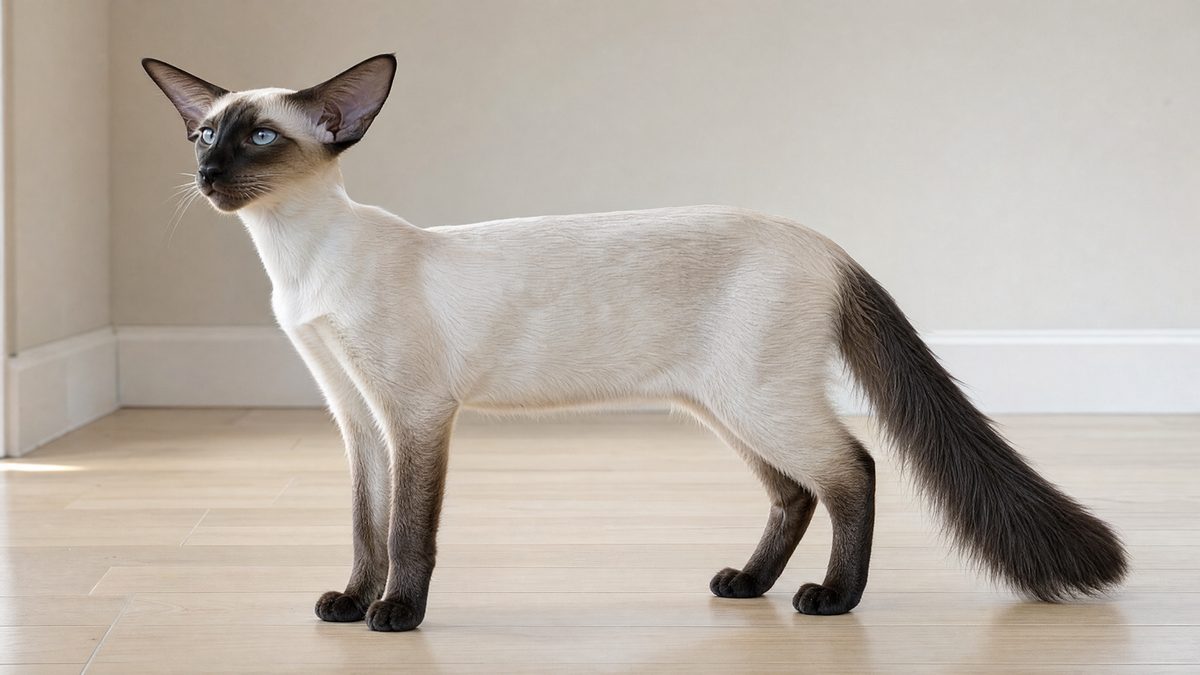
Quick answer
The Balinese cat price in India cannot be verified. Only two Indian pages publish a figure, quoting Rs 20,000 to Rs 50,000 and Rs 25,000 to Rs 1,50,000-plus, and two more of the top-ranking results are hijacked domains now serving Indonesian gambling sites. No Indian marketplace stocks the breed. The Balinese is a longhaired Siamese, and its coat carries the same FGF5 variant every long-haired cat carries.
This guide is general information for Indian pet owners and is not a diagnosis. Always consult your nearby vet, a registered veterinarian, before acting on anything you read here, and treat sudden collapse, laboured breathing, a swollen abdomen or any rapid change in your cat's condition as an emergency.
Balinese traits, rated for Indian conditions
What a Balinese cat actually is
A Balinese is a Siamese with a long coat, and every registry that publishes a position says so in its own words. TICA files it inside a four-breed Siamese Breed Group and judges it against a document titled Siamese Breed Group Standard (SI/BA/OS/OL). FIFe prints one line above the standard text stating that Balinese, Oriental Longhair, Oriental Shorthair and Siamese have the same standard. CFA describes the breed on its own page as the longhaired variety of the Siamese and Colorpoint Shorthair. GCCF calls it a Siamese cat in a long coat and files it under Section 6, Siamese and Oriental.
CFA puts the same idea in a single sentence on its breed page, writing that you should soften a Siamese with a longer, silkier coat and presto, you have a Balinese, and calling these svelte, elegant creatures the perfect compromise for people attracted to the outgoing, interactive personality of the Siamese but who prefer a slightly less vocal companion. FIFe's shared standard opens with the same word, describing the ideal cat of all four breeds as svelte, elegant, with long tapering lines, supple and well-muscled.
Bonbeno re-checked all four positions against the registries' own current documents rather than repeating what the sibling Oriental Shorthair page found. Every claim held up, and three of the four documents have moved to a newer edition since that page was written, so the dates below are the ones to quote.
| Registry | Position on the Balinese | The document that proves it | Edition checked |
|---|---|---|---|
| TICA | One breed group, four breeds, one point score. The standard opens by defining all four in a single paragraph and states that the Balinese (BA) is a medium-sized semi-longhair, pointed cat, oriental in type | Siamese Breed Group Standard (SI/BA/OS/OL) | Revised 120109, dated 05/01/2009 |
| FIFe | Separate breed names, one standard. The General row reads that Balinese, Oriental Longhair, Oriental Shorthair and Siamese have the same standard | FIFe Standards, Category 4 | Date of issue 01.01.2026 |
| CFA | Separate breed, but the Siamese is an allowable outcross and a longhaired kitten in a Siamese litter is registered as a Balinese | Registration Rules, Balinese/Javanese | Revised 02/26 |
| GCCF | Separate breed with its own standard, moved out of the Longhair Register into the Siamese Section in 1980 so it could be judged by Siamese judges | GCCF Balinese breed page and Balinese Standard of Points The Governing Council of the Cat Fancy.… | SOP September 2025 |
| GCCF, registration | Shorthaired cats of Siamese appearance are registered as Balinese Variants on the Supplementary Register | GCCF Registration Policy for Balinese | Effective 1 May 2026 |
Two updates matter for anyone quoting these documents. FIFe's Category 4 file still sits at a 2023 upload path, but the document inside it now carries a date of issue of 01.01.2026, so the standard is current even though the URL looks old. CFA's Balinese registration rules were revised in February 2026 and now push the Oriental Longhair outcross window out to litters born on or before 31 December 2035, replacing an earlier 31 December 2030 cut-off that is still visible in the document.
The three registry rules that settle the argument better than any standard does
Standards describe what a judge should see. Registration rules describe what a registry will actually write on a certificate, and on this question they are far more revealing. Three clauses in CFA's own Balinese rules do more to answer whether the Balinese is a separate breed than any amount of breed-club prose.
- A longhaired kitten in a Siamese litter is a Balinese. CFA's breed notes state that if both parents are Siamese and one or more kittens in the litter is a longhair, the litter should be registered as Siamese and the longhair kittens registered as Balinese. Two breeds, one litter, same parents.
- A Balinese crossed to a Siamese produces only shorthairs. The same notes state that first generation breeding of a Balinese to a Siamese will always produce only shorthairs, and that for the purposes of genetics, Balinese is a longhair. That is a plain statement that the only genetic difference under discussion is coat length.
- An Oriental Longhair can become a Balinese on request. A CFA rule effective 02/20 permits Oriental Longhairs to be re-registered as Balinese or Javanese, depending on colour, upon request. The cat does not change. The paperwork does.
GCCF goes one step further and creates a category for the shorthaired cat itself. Its registration policy defines a Balinese Variant as a shorthaired cat of Siamese appearance whose pedigree contains only permitted breeds, entered on the Supplementary Register. A registered shorthaired Balinese exists, on paper, in Britain.
What the genetics literature says, which no registry controls
Two peer-reviewed studies have looked at the question independently of any registry, and both reached the same conclusion. A survey of retinal disease across 41 cat breeds states that its authors were unable to identify genetic distinctiveness between the Siamese, Colorpoint Shorthair, Oriental Shorthair, Balinese and Javanese breeds, which it goes on to call the Siamese breed group. The largest published study of heritable cat behaviour, covering 5,726 cats across 40 breeds, merged the Balinese into a single group with the Oriental Shorthair, Oriental Longhair, Seychellois Shorthair, Seychellois Longhair and Siamese, explicitly on the basis of known genetic relationships and small sample sizes.
The practical consequence is not academic. If the Balinese is genetically a Siamese in a long coat, then the Siamese line's inherited risks are the Balinese's inherited risks, and the genetic test list you should demand is the Siamese list. The health issues section below works through which of those risks have actually been measured in Balinese cats and which have only been assumed.
The Foreign White, and why its EMS code proves the point
The clearest single piece of evidence that these registries treat the whole group as one gene pool is a code, not a sentence. GCCF's Registration Policy for Foreign White Cats prints the breed's EMS code as SIA w 67, filing an all-white, blue-eyed, non-pointed cat under the Siamese prefix. FIFe uses the identical code and adds a remark against the white row of the Category 4 colour table reading that these Siamese are known as Foreign White.
FIFe applies the same logic on the long-coated side. A white Balinese is registered BAL w 67 and is judged in the same class as an Oriental Longhair coded OLH w 61. So a white cat with a long coat is a Balinese, a white cat with a short coat is a Siamese, they are shown against the same standard, and the code carries the difference. That is a coat-length filing system wearing four breed names.
Where the standards genuinely differ, line by line
Only four attributes separate a Balinese from a Siamese in the written standards, and two of them are the same attribute described twice. FIFe runs one shared description of head, ears, eyes, neck, body, legs, paws and tail across all four breeds, then splits into per-breed rows for coat structure and colour.
| Attribute | Siamese | Balinese | Source |
|---|---|---|---|
| Coat structure | Very short, fine, glossy, silky and lying close to the body. Almost no undercoat | Fine and silky, of medium length on the body, slightly longer at the frill and shoulders and on the tail, which forms a plume. No woolly undercoat | FIFe |
| Coat structure, second registry | Very short, tight, close-lying, fine textured | Semi-longhair, close-lying, slight undercoat, fine, silky texture. A shorter coat is permitted over the shoulders | TICA |
| Tail | Narrow at base, tapering to a fine point, whippy | Plume. Long and feathery | TICA |
| Eye colour | Intense deep blue | Intense deep blue, identical row | FIFe |
| Head, body, legs, paws | One shared description | The same shared description, unchanged | FIFe, TICA |
| Point colour | Mask, ears, legs and tail with clear contrast to body colour | The same clause, same row | FIFe |
| Permissible outcrosses | None | None | TICA |
| Category | Pointed | Pointed | TICA |
Read the coat rows against each other and one difference jumps out that no consumer page mentions. FIFe writes that the Balinese has no woolly undercoat. TICA's standard writes that it has a slight undercoat. Those are two registries describing the same clause of the same breed standard in opposite directions, and as the heat tolerance discussion below shows, it is the single most decision-relevant sentence on this page for an Indian buyer.
CFA moved ten points out of the eyes and into the coat
CFA is the only registry that scores the Balinese on a separate 100-point scale from the Siamese, and comparing the two scales quantifies exactly how much of the breed difference is coat. Both totals are 100. Head is 20 in both. Body is 30 in both.
| Section | Siamese | Balinese | Difference |
|---|---|---|---|
| Head | 20 | 20 | 0 |
| Eye shape, size, slant and placement | 10 | 5 | -5 |
| Body | 30 | 30 | 0 |
| Coat (length and texture) | 10 | 20 | +10 |
| Body colour | 10 | 10 | 0 |
| Point colour | 10 | 10 | 0 |
| Eye colour | 10 | 5 | -5 |
| Total | 100 | 100 | 0 |
Sources for both columns are the CFA breed standards published on the association's own breed pages The Cat Fanciers' Association. Balinese…. The Balinese standard splits its 20 coat points evenly into Length 10 and Texture 10, which the Siamese standard does not do at all because a Siamese coat has only one dimension to judge. CFA took ten points away from the eyes and gave them to the coat. That is the breed difference, expressed as arithmetic.
The 'traditional versus modern' split does not exist in this breed
There is no apple-head Balinese recognised anywhere, and that is worth stating plainly because the equivalent argument is loud in the Siamese. The World Cat Federation and TICA both recognise a separate breed, the Thai, for the older rounder-headed pointed cat, and the argument over whether a so-called Traditional Siamese is a heritage type or a misconception is a live one. No registry has created a long-coated equivalent. FIFe lists exactly four breeds in the group and none of them is a traditional or classic Balinese. TICA's group standard names four breeds and no fifth. GCCF's Balinese registration policy lists eight categories of cat acceptable in a Balinese pedigree and every one of them is a Siamese, Balinese, Oriental or Foreign White of the modern type.
One registry does describe an older Balinese type, but as history rather than as a recognised variety. GCCF's own breed page records that the Balinese of today have developed from the heavier set, thick coated cats imported in the 1970s, which also had much longer coats than the Balinese breed today, with full ruffs and britches, and that breeders improved the physical form by outcrossing to Siamese so that the features became leaner and longer, just as the modern Siamese has. So the heavier Balinese existed, it was bred out deliberately, and no registry preserved it as a separate breed the way the Thai was preserved.
Ask which registry issued the pedigree and what breed name is printed on it. There is no registry in the world that will write 'Traditional Balinese' or 'Applehead Balinese' on a certificate, because no registry recognises the variety. A rounder-headed long-coated pointed cat may be a perfectly good pet. It is not a differently-graded Balinese, and it is not worth a premium.
Where the breed came from, and why the three registries disagree about it
The Balinese is an American breed named after Indonesian dancers, and it has nothing to do with Bali. TICA states plainly that while named after dancers from Bali, the breed does not originate from Bali but rather the United States. Purina India gives the country of origin as America. Beyond that, the three registries tell three different founding stories, and a page that picks one is guessing.
| Registry | Founders named | Decade given | Earliest record cited |
|---|---|---|---|
| TICA | Marion Dorsey (Rai-Mar) in California and Helen Smith (MerryMews) in New York | 1950s | A CFF registration record for one in 1928, and an 1871 Penny Illustrated reference |
| CFA | Helen Smith (Merry Mews) and Sylvia Holland (Holland's Farm) | 1940s | Longhaired kittens known in Siamese litters as far back as the early 1900s |
| GCCF | Helen Smith of Merry Mews, New York, who conferred the name, with Sylvia Holland of Holland's Farm, California, establishing the standard later | Mid-1950s, with Holland working in the 1960s and 1970s | 'Long-haired Siamese' first registered as show cats with the Cat Fanciers Association in 1928, and an 1871 Penny Illustrated reference |
Two things in that table are checkable disagreements rather than differences of emphasis. CFA puts the founding work in the 1940s and TICA puts it in the 1950s. And the 1928 registration is credited to the CFF by TICA and to the Cat Fanciers Association by GCCF, which are two different American registries The Governing Council of the Cat Fancy.…. Bonbeno does not know which is right and will not average them. What all three agree on is the mechanism, that longhaired kittens turned up in Siamese litters because the long-hair allele is recessive, and breeders chose to develop them rather than give them away.
Recognition dates, which do not agree either
| Registry | Milestone | Date |
|---|---|---|
| CFA | Registration effective | 9/66 |
| CFA | Provisional 9/66, effective | 1/67 |
| CFA | Championship voted 2/70, effective | 5/70 |
| CFA | Balinese and Javanese merged into one breed with separate divisions, effective | 05/08 |
| TICA | Recognised for competition | 1979 |
| FIFe | Recognised (Siamese 1949, Oriental Shorthair 1959, Oriental Longhair 1985) | 1983 |
| GCCF | Accepted into the Siamese Section | 1980 |
| GCCF | Championship status granted October 1985, first certificates awarded | June 1986 |
The FIFe row rewards a second look. FIFe recognised the shorthaired Siamese in 1949 and the shorthaired Oriental in 1959, then waited until 1983 for the Balinese and 1985 for the Oriental Longhair. The long coats arrived roughly a quarter of a century after the short ones in the same gene pool, which is what you would expect of a recessive allele that breeders had to deliberately fix rather than a separate ancestral breed.
Size and weight, where TICA disagrees with itself
Published Balinese weights differ by up to 4 lb at the top of the male range, and the clearest disagreement is inside a single registry page. TICA's At a Glance block gives adult females at approximately 5 to 8 pounds and adult males at approximately 8 to 12 pounds. TICA's own General Description block, further down the same page, gives males weighing from 6 to 8 pounds and females ranging from 5 to 7 pounds. GCCF matches the second figure exactly, stating males usually weigh around 6 to 8 lbs and females 5 to 7 lbs, and lists breed size as 5 to 8 lbs.
Take the lower pair as the working number, because two independent registry sources give it and only one block on one page gives the higher one. Roughly 2.3 to 3.6 kg for a male and 2.3 to 3.2 kg for a female is a small cat by Indian pedigree standards, well under a British Shorthair or a Maine Coon. One more number matters more than the weight. TICA states that kittens mature slowly and do not fully develop until 18 to 24 months, and GCCF adds that Balinese do not normally achieve full coat until they are adult and allowance should be made for this. A ten-month-old Balinese is a thin, short-coated adolescent, and a seller describing that as a fault or a runt is describing normal development.
Balinese cat price in India
There is no verifiable Balinese cat price in India, and saying so is the most useful thing this page can do. Bonbeno searched India-region results on 20 August 2026 and found exactly two live pages publishing a rupee figure for the breed. Two further pages that rank for the query are hijacked domains that now serve Indonesian gambling sites. No Indian kitten marketplace stocks the breed at all. Any number quoted below is an editorial estimate, not a price in india observed in a transaction.
Say the weakness before the table, because it is what a buyer about to send a deposit actually needs. Neither of the two sources that publish a figure cites a transaction, a breeder invoice, a survey or a sample size. They disagree with each other by three times at the top of the range, and one of them prints a heading reading How to Choose a Healthy Puppy in an article about a cat.
| Source | Quoted price | What sits behind the number |
|---|---|---|
| HappyPet India | Rs 20,000 to Rs 50,000 | Breed database entry. No tier split, no sample, no date on the figure |
| Charwaha, pet quality | Rs 25,000 to Rs 50,000 | Content article dated 26 May 2026, one of at least five near-identical breed articles the site published in two days |
| Charwaha, show quality | Rs 60,000 to Rs 1,20,000 | Same article, same day, no evidence of a show-quality Balinese existing in India |
| Charwaha, imported bloodline | Rs 1,50,000 or more | Same article. India restricts live-animal imports, so this tier is the least evidenced of the three |
| Supertails | Not published | India's most detailed published cat-price guide. The word Balinese does not appear on it once |
| Purina India | Not published | Carries a full Balinese breed page on its Indian domain and gives no price |
| thepawtailco.com | No price. Domain hijacked | URL path cat-price-in-india/balinese-cat returns HTTP 200 with the page title CETAR4D, an Indonesian gambling brand |
| msuplants.com | No price. Domain hijacked | URL path balinese-cat-price-in-india redirects to a page titled ZEUS138, an Indonesian slot site, with zero mentions of the breed |
Two of the ranking results are now gambling sites, and that is checkable in ten seconds
The two domains that rank for this exact query and appear to be Indian pet-information sites are not. Bonbeno fetched both directly. thepawtailco.com/cat-price-in-india/balinese-cat returns HTTP 200, still contains the word Balinese 65 times as leftover template text, contains zero rupee figures, and carries the page title CETAR4D ~ Tidak Perlu Pola Daftar Sekarang Pasti Menang, which is Indonesian gambling copy. msuplants.com/balinese-cat-price-in-india returns HTTP 302 and resolves to a page titled ZEUS138 | Website Slot Terlengkap dengan RTP Dan Update Game Terbaru Saat ini, with the breed name appearing zero times.
Open the page and read the browser tab, not the article. A hijacked domain usually keeps the old article body so it still ranks, while the title tag, the sidebar and the outbound links point somewhere else entirely. If the tab says something in a language you did not search in, close it. Neither of these two sites is a source about cats any more, and any price copied from them into a WhatsApp negotiation is copied from nothing.
The supply check, which is the real finding
No Indian kitten marketplace lists a Balinese. Bonbeno checked the sites that dominate the Indian cat-buying SERP and found the breed absent from every one of them, while the shorthaired parent breed is stocked by name.
- Read MyKitten's own breed list. The site describes itself as connecting families to verified cat breeders across India and names ten breeds it supplies, Persian, Maine Coon, Ragdoll, Siamese, British Shorthair, Exotic Shorthair, Bengal, Scottish Fold, Siberian and Himalayan. The Siamese is there. The Balinese is not.
- Open India's biggest cat-price reference. Supertails publishes an all-breed 2026 cat price guide with monthly budgets and city bands, and the Balinese appears nowhere in it.
- Check the brand pages. Purina runs a Balinese breed page on its Indian domain, purina.in, and offers no price, no availability note and no Indian context at all.
- Note what CFA says about supply at source. CFA writes that Balinese are one of the rarer breeds that it registers, that kittens may be a challenge to find, and that buyers should be prepared to travel and consider a retired adult because there may be a long wait. If the breed is scarce in its home registry, an Indian pipeline is unlikely to exist quietly.
Put those together and the honest conclusion is short. A published band of Rs 20,000 to Rs 1,50,000-plus exists in Indian content, it rests on two pages, and Bonbeno found no Indian kitten you could go and look at. If a seller quotes you a number inside that band, they are not confirming the range. They are creating the first data point in it.
What you are probably actually being offered
The most likely thing behind an Indian Balinese listing is a Siamese, and the registries themselves explain why that confusion is so easy. A first-generation Balinese to Siamese mating produces only shorthairs, so a longhair carrier looks exactly like a Siamese. A longhaired kitten in a Siamese litter is a Balinese under CFA's own rule. And GCCF registers shorthaired cats of Siamese appearance as Balinese Variants. In a market with no pedigree infrastructure for the breed, a semi-longhaired pointed cat of unknown parentage is indistinguishable from a Balinese by eye.
- Ask for the registry name in full and the registration number. Not an acronym. A certificate that does not name a registry that recognises the Balinese by that name is not a Balinese pedigree.
- Look at the coat lying down, not standing up. CFA's standard requires a coat that lies close to the body so the cat may appear shorter-coated than it is, and disqualifies a definite double coat, meaning a downy undercoat. A fluffy, standing coat is a disqualifying fault, not a premium feature.
- Check the tail against the body coat. TICA gives body hair at half an inch to two inches and tail plume hair up to 5 inches. A cat with a long body coat and an ordinary tail is not built like a Balinese.
- Check the eyes. Any eye colour other than blue is an outright disqualification under both CFA and FIFe. Green eyes on a long-coated pointed cat rule out the breed immediately.
- Ask for the PRA result by name. The one genetic test that matters here has a real answer, and the health issues section explains what it is and why the figure for this breed is high.
What Indian law says about whoever quotes you a price
Anyone selling you a kitten online in India is running a pet shop in law, and the rules are checkable before you pay. The Prevention of Cruelty to Animals (Pet Shop) Rules, 2018 were notified as G.S.R.844(E) on 6 September 2018 and define a pet shop to include online platforms over which the sale and purchase of pet animals is carried out wherever the context permits.
Two earlier Bonbeno cat pages cited these rules from the Department of Animal Husbandry and Dairying copy at dahd.gov.in. That file is a fifteen-page PDF in which every page is a single image object carrying no font resources, so no text can be extracted from it at all. The provisions themselves are real and verbatim, but the readable copy is the gazette text hosted by the Karnataka Department of Animal Husbandry and Veterinary Services, and that is what this page cites and what those pages should cite. A document nobody can read is not a source, even when the thing it says is true.
- Ask for the certificate of registration. An application is made in Form-I to the State Animal Welfare Board with a non-refundable fee of five thousand rupees, the certificate is valid for five years, and the pet shop owner shall prominently display the licence granted to him for operating the facility.
- Expect the price to be on display. Rule 7(12) states that the species and numbers of pet animals, and the prices for which they are offered for sale, shall be prominently displayed at the pet shop. A listing that reveals the number only after you hand over a phone number sits awkwardly with that.
- Check the kitten's age against the definition. The rules define an un-weaned animal to include kittens and pups below eight weeks, and Rule 7(15) states that no pet shop shall sell un-weaned or underage animals or birds. Eight weeks is the legal floor, and the puppy timeline section explains why later is better.
- Demand the receipt by its form number. Rule 7(13) requires that receipts shall be issued for every pet animal sold in Form IV, and Form IV records the category, common name, technical name, breed, age and vaccination details of the animal sold. On a breed with no Indian supply chain, that written breed entry is the only paperwork tying the seller to the claim.
- Know the microchip gap. Rule 7(16) states that every puppy shall be micro-chipped by a veterinary practitioner and that each pet shop shall have a functional micro-chip reader within the premises. The word used throughout is puppy. Bonbeno found no equivalent kitten requirement anywhere in the rules, so a kitten's identity in India rests on paperwork rather than an implanted chip. Ask for a chip anyway and get the number written on the Form IV receipt.
The cheapest legitimate route is not on any seller page, and the adoption section covers it in full. A pointed, semi-longhaired cat of unknown ancestry in an Indian shelter is genetically closer to a Balinese than most of what is sold as one, and costs a fraction of any figure in the table above.
What a Balinese actually costs to keep in India each month
Budget Rs 2,800 to Rs 6,000 a month for a Balinese in an Indian city, and treat anything above that as a lifestyle choice rather than a breed requirement. Two Indian sources publish a monthly cost and they disagree by more than three times at the top, mostly because one of them is pricing a premium lifestyle and the other is pricing a cat. Both include a grooming line that this breed does not need.
Read the two published estimates side by side before deciding which one describes your household.
| Line item | HappyPet India | Charwaha | Bonbeno note |
|---|---|---|---|
| Food | Rs 1,500 to Rs 2,000 | Rs 2,000 to Rs 6,000 | The single biggest line either way, and the one worth spending on |
| Health and vet | Rs 500 to Rs 700 | Variable, not costed | An honest 'variable' is more useful than a fake average. Vaccination and neutering are lumpy, not monthly |
| Grooming | Rs 800 to Rs 1,500 | Rs 500 to Rs 1,500 for supplies | This breed needs a steel comb and nothing else. See the correction below |
| Litter | Not itemised | Rs 800 to Rs 2,000 | Real and recurring. Two cats double it |
| Toys and accessories | Not itemised | Rs 500 to Rs 2,000 | Not optional for this breed. See the exercise section |
| Total, basic | Rs 2,800 | Rs 4,000 | Sources Charwaha. Balinese Cats Breed in India |
| Total, premium | Rs 4,200 | Rs 15,000 | The gap is lifestyle, not breed |
HappyPet budgets Rs 800 to Rs 1,500 a month for grooming a Balinese, on the same page where it states that the silky coat of a Balinese does not mat or tangle easily and that brushing them weekly is enough to keep their coat healthy. Those two statements cannot both be planning the same cat. CFA calls the Balinese single-coated with no downy undercoat, not susceptible to mats and extremely easy to care for, and recommends combing or brushing several times a month. TICA calls the silky single coat the easiest longhaired cat to keep in perfect condition. GCCF calls it probably the easiest of longhair cats to keep looking perfect. Three registries agree there is no professional grooming bill here. A one-time steel comb is the whole line item.
What Bonbeno would actually budget, and why
Strip the grooming line out and add back the two costs neither page prices properly, and the picture gets simpler. A Balinese is a small cat, well under 4 kg in every registry weight range, so its food volume is low. What it is not is a low-attention cat, and the costs that actually bite are enrichment and the vet.
| Line | Realistic monthly range | Why |
|---|---|---|
| Food, complete wet and dry | Rs 1,500 to Rs 3,000 | Small cat, high activity. TICA advises feeding adults at least twice a day and kittens three to four times |
| Litter | Rs 700 to Rs 1,500 | Non-negotiable and recurring. An indoor-only cat in an Indian flat uses the tray every day |
| Grooming | Rs 0 to Rs 100 | A stainless steel comb, replaced roughly never. No salon visits |
| Enrichment, rotated | Rs 300 to Rs 800 | Wand toys and puzzle feeders wear out. Under-stimulation in this group has a measurable behavioural cost |
| Preventive vet, amortised | Rs 400 to Rs 900 | Annual vaccination, deworming, parasite prevention, spread across twelve months |
| Working total | Rs 2,900 to Rs 6,300 | Close to HappyPet's basic figure and far below Charwaha's premium one Charwaha. Balinese Cats Breed in India |
The three one-off costs an Indian buyer should plan for
- Neutering, early. In the largest UK primary-care life table for cats, entire cats had 4.29 times the odds of death before three years of age compared with neutered cats, with a 95 percent confidence interval of 3.72 to 4.95. No premium food or imported bloodline buys a healthy cat that much. Tell the surgeon about the breed group's anaesthetic sensitivity first, because TICA states plainly that Balinese have a tendency to be sensitive to anaesthesia and that it is important to make the veterinarian aware of this before any type of surgery, including routine neutering, spaying and dental cleanings.
- The PRA DNA test, if the seller has not already done it. UC Davis lists a progressive retinal atrophy test on its Balinese breed page, and this is the one screening result worth paying for on this breed. GCCF states directly that there is a test for Progressive Retinal Atrophy for Balinese cats.
- Vertical space. A cat tree or a cleared shelf run is a one-time spend of a few thousand rupees that converts a small Indian flat into usable territory for a cat TICA describes as highly intelligent, agile and athletic. Skipping it is the most expensive saving on this list, because the replacement cost is your curtains.
One line does not belong in an Indian budget at all, and it is worth naming because overseas cost guides carry it. There is no reason to budget for professional blow-drying, de-matting or coat clipping on a single-coated cat whose own registries describe it as rarely tangling or matting The Governing Council of the Cat Fancy.…. If an Indian groomer quotes you a four to six week schedule for a Balinese, they have pasted a Persian template onto a cat that is closer to a Siamese with a plume.
Heat, humidity and how a Balinese adapts to the Indian climate
A Balinese handles Indian heat far better than its coat length suggests, and the reason sits in one clause of the breed standard rather than in the length of the hair. Three registries state that the breed carries no woolly or downy undercoat, and CFA disqualifies a cat that has one The Governing Council of the Cat Fancy.… The Cat Fanciers' Association. Balinese…. A single coat lying flat is a very different thermal object from the double coat of a Persian or a Maine Coon, and that is why Bonbeno rates this breed's heat tolerance at 4 out of 5 rather than the 2 that coat length alone would suggest.
Read the coat clause, not the coat length
The insulating part of a cat's coat is not the long outer hair. It is the dense, downy undercoat that traps a still layer of air against the skin, and that layer is what stops a double-coated northern breed from shedding heat in an Indian May. The Balinese standards remove it explicitly, in four separate documents, in four separate wordings.
| Source | Wording | Verdict |
|---|---|---|
| FIFe, Category 4 standard | Fine and silky; of medium length on the body, slightly longer at the frill and shoulders and on the tail, which forms a plume. No woolly undercoat | No undercoat |
| GCCF, Balinese Standard of Points | Medium-long, fine and silky in texture, without woolly undercoat, lying mainly flat along the body | No undercoat |
| CFA, Balinese breed standard | Fine, silky without downy undercoat lying close to the body, the coat may appear shorter than it is. DISQUALIFY: definite double coat (i.e., downy undercoat) | No undercoat, and a double coat is disqualified |
| CFA, grooming guidance | Balinese are single-coated cats; with no downy undercoat, they are not susceptible to mats | No undercoat |
| GCCF, breed page | The Balinese has a single coat, in contrast to the double coat of other longhairs | No undercoat |
| Purina India | The Balinese cat has no woolly undercoat and so it is classed officially as 'semi-longhaired' | No undercoat |
| TICA, breed page, General Description | The Balinese has a single coat that lies close to the long, slim body. The lack of undercoat reduces the likelihood of matting | No undercoat |
| TICA, breed page, Colors block | The main coat of the Balinese is light and wispy complete with a plume tail and shaggy undercoat | Shaggy undercoat |
| TICA, Siamese Breed Group Standard | (BA/OL): Semi-longhair, close-lying; slight undercoat; fine, silky texture | Slight undercoat |
Six independent statements say there is no undercoat. Three say there is one, and all three are TICA, which contradicts itself twice on a single web page and a third time in its own standard The International Cat Association. Siamese…. Bonbeno does not average that. The weight of evidence, including the only registry that treats the trait as a disqualifying fault, is that the Balinese is single-coated, and TICA's own General Description agrees with the other three registries against TICA's own standard.
Why that rates 4 and not 5, and not 2
Four physical facts from the standards drive the rating, and none of them is coat length on its own.
- No trapped-air layer. Without a downy undercoat there is no insulating dead-air blanket at skin level, so the cat can dump heat by conduction onto a cool floor the way a short-coated cat does. This is the whole reason a semi-longhaired Balinese behaves nothing like a double-coated Norwegian Forest Cat in Chennai.
- The coat lies flat. GCCF specifies that the coat lies mainly flat along the body, and CFA notes that because it lies close to the body the coat may appear shorter than it is. A flat coat presents far less loft than a standing one of the same measured length.
- A normal muzzle and an unobstructed airway. The head is a long straight wedge with a long straight nose, and CFA disqualifies mouth breathing due to nasal obstruction. There is no brachycephalic penalty here at all, which is the single biggest heat liability in the Persian and the Exotic Shorthair.
- A long, fine-boned, tubular body. FIFe describes it as long and slender, well muscled but still dainty. A small cat at roughly 2.3 to 3.6 kg with a long body has a high surface area for its mass, which favours heat loss.
Two facts pull the rating back from 5. The first is that there is still real hair on the surface. TICA gives the body coat at half an inch to two inches and the tail plume at up to 5 inches, and hair that length holds water in Indian humidity even when it holds very little air. The second is respiratory rather than thermal, and it belongs to the whole Siamese line. In a Greek referral series of 22 cats with lower airway disease, the Siamese breed made up 55 percent of cases and was the only breed significantly over-represented. Indian indoor air routinely carries mosquito-coil smoke, agarbatti smoke and cooking smoke, and a cat from an airway-predisposed line breathing that in a closed, air-conditioned room is the risk worth managing.
How that plays out city by city
Indian heat is not uniform, and the India Meteorological Department's own language for the April to May 2026 season described heat wave conditions occurring in isolated pockets or isolated to scattered locations rather than as a pan-India event, with the season's highest observed temperature of 47.6 degrees Celsius recorded at Banda in Uttar Pradesh on 27 April 2026 and 46.9 degrees at Akola in Maharashtra the same day. Dry 45 degree heat and humid 34 degree heat are different problems for a cat, and this breed handles one of them much better than the other.
| City type | The dominant problem | What it means for this breed |
|---|---|---|
| Delhi, Jaipur, Lucknow, Nagpur | Dry extreme heat, April to June | Manageable. A single-coated cat with a normal airway sheds dry heat well. Shade, a tiled floor and constant water do most of the work |
| Mumbai, Chennai, Kochi, Kolkata | Sustained high humidity | The harder case. Evaporative cooling from grooming saliva works poorly in humid air, and the plume tail and shoulder hair stay damp |
| Bengaluru, Pune, Hyderabad | Mild, with a hot pre-monsoon spike | The easiest Indian cities for this breed. No structural problem for most of the year |
| Anywhere, June to September | Monsoon damp | Skin and coat rather than temperature. See the grooming section |
| Any air-conditioned flat | Closed rooms and indoor smoke | The real risk. A Siamese-line airway in a sealed room with a mosquito coil burning is worse than the outdoor temperature |
Purina's Balinese page on its Indian domain, purina.in, lists 'Outdoor cat' in its need-to-know summary. That line comes from a template written for a British audience and it does not transfer. In an Indian city an outdoor pointed pedigree cat faces traffic, free-roaming dogs, tick and flea pressure and theft, and every other source on this breed describes a cat that must not be left alone, let alone left out. TICA states Balinese demand a lot of attention and should not be left alone for long periods. GCCF says the same. Keep this cat indoors, net the windows and the balcony, and read the 'Outdoor cat' line as a printing artefact rather than advice.
What Indian sources say about the climate question, and where they are right
The one Indian article that addresses climate directly gets the mechanism right, which is worth acknowledging. Charwaha writes that since they lack a dense undercoat, they usually tolerate moderate warmth better than extremely fluffy breeds, and recommends ventilation, cool resting areas, hydration and avoiding direct heat exposure. That is correct reasoning from the coat clause, and it is the same conclusion Bonbeno reaches from the standards.
HappyPet is the one to treat carefully. It lists an ideal weather range of 20 to 25 degrees Celsius for the Balinese. Read literally, that rules out most of urban India for most of the year, including Bengaluru in April and Delhi from March to October. It is a comfort band, not a survivability band, and it should not be read as a warning against keeping the breed in India.
Five things that actually work in an Indian summer
- Give it a cool hard surface. A bare tiled or stone floor in the shade lets a single-coated cat dump heat by conduction, which is the mechanism the missing undercoat leaves open.
- Keep water in more than one place, away from food. TICA's own advice is to place the water bowl at least three feet away from any food because cats' noses are sensitive and an overwhelming smell of food may cause them to drink less.
- Shift play to the cool hours. This is a high-activity breed that TICA describes as needing stimulation or lots of toys to keep them occupied. Run those sessions before 10am and after 6pm in summer rather than cancelling them.
- Never shave the coat. Shaving a single-coated cat removes its sun barrier and gains almost no cooling, because the insulation you are imagining is not there. The coat is one layer, and CFA disqualifies the second one.
- Stop burning coils and incense in the cat's room. The Siamese line's documented airway predisposition makes this the cheapest health intervention available in an Indian home.
One cosmetic consequence of Indian heat is worth setting expectations on. Point colour in this group is produced by temperature-sensitive pigment, so a cat kept warm year-round runs paler than the same cat kept cool, and CFA's Balinese standard formally instructs judges to allow for darker colour in older cats because Balinese generally darken with age while insisting on definite contrast between body colour and points. A Balinese photographed in Scandinavia and a Balinese living in Chennai will not look the same, and neither is wrong. The mechanism is explained in full on the Siamese page.
Temperament, household fit and who should not buy one
A Balinese is an intelligent, affectionate, demanding cat that must not be left alone all day, and the registries agree on that far more than they agree on anything else about the breed. TICA states they demand a lot of attention and get into mischief so should not be left alone for long periods. GCCF says they demand lots of attention and game-playing and do not like to be left alone for long periods. Purina India says their need for attention means they suit someone who is not out all day. That is the buying criterion, not the coat.
TICA's At a Glance block gives the breed's temperament in one word, Playful, and the longer description that follows explains what that costs an owner: they like to be helpful and follow family members around throughout the day, and they get into mischief so should not be left alone for long periods. A playful cat with nobody to play with is the failure mode this breed has, and it is a household problem rather than a cat problem.
The voice, and how much quieter it really is
Every source agrees the Balinese is quieter than a Siamese and none of them calls it quiet. TICA states its voice is a bit quieter and softer than that of the Siamese and it is not quite as insistent. CFA writes that breeders and pet owners agree Balinese are somewhat less talkative than Siamese and possess softer voices, then adds that ongoing conversation is the norm and may range from a comforting purr to an occasional wail of protest that you are not providing them with enough attention. GCCF says they are said to be less vocal and with a softer voice than the Siamese, however, they are not for those who think cats should be seen and not heard. Purina India says some owners think the Balinese is somewhat quieter and that it is likely still to be something of an extrovert.
Read that as one finding. If a Siamese is a 5 out of 5 for noise, a Balinese is a 4. In an Indian apartment with shared walls that difference is real but small, and nobody should buy this breed hoping for silence. The CFA sentence about a wail of protest is the honest description of what a Balinese does when it is bored, and boredom is the default state of an under-stimulated cat in a flat that is empty from nine to seven.
What the largest behaviour study can and cannot tell you
There is no Balinese-specific behaviour data, and the reason is instructive. The largest published study of heritable cat behaviour surveyed 5,726 cats and merged the Balinese into a single group with the Oriental Shorthair, Oriental Longhair, Seychellois Shorthair, Seychellois Longhair and Siamese, on the stated grounds of known genetic relationships and small individual breed sample sizes. Every figure below therefore describes the Siamese group as a whole, and Bonbeno labels it as such rather than presenting it as a Balinese figure.
| Trait | Finding for the Oriental group | How to read it for a Balinese |
|---|---|---|
| Excessive grooming | Burmese and Oriental cats had the highest probability of all breed groups | Direct relevance. Over-grooming a semi-longhaired coat in humid weather causes visible thinning and skin problems |
| Owner-evaluated behaviour problem | Oriental and Persian cats were the most likely to have one | This is the group where under-stimulation shows up as a complaint, not as a quiet cat |
| Contact seeking with people | Abyssinian and Oriental cats were likely to seek contact, contradicting older studies that ranked them low in friendliness | Consistent with every registry description of a cat that follows you around |
| Aggression towards people | Highest in Turkish Van and Angora, not in the Oriental group | This is not an aggressive breed group |
| Wool sucking | Highest in house cats, Norwegian Forest Cats, Turkish Vans and Maine Coons | Worth noting, because wool sucking is often blamed on Siamese-line cats and this study did not find that |
The excessive-grooming finding is the most actionable thing in the table for an Indian owner of a long-coated cat. A Balinese that grooms itself bald on the belly or the inner thighs is usually telling you it is under-occupied, stressed or itchy, not that it has a coat problem. Check the enrichment and the parasite control before you buy a coat supplement, and consult your nearby vet if bald patches appear, because over-grooming and skin disease look identical from across the room.
Children, dogs and other cats, where the sources disagree
Three registries say this is a family cat and one Indian-domain page says it is not. TICA calls the active and social Balinese a perfect choice for families with children and cat-friendly dogs and says they bond closely with people of all ages including children. GCCF says they get on well with children, other pets and cat-friendly dogs and so fit in easily with family life. CFA is more careful, writing that they appear to be quite fond of dogs and that older children may be better able to keep up with their high activity level than very young ones. Purina India goes further the other way, listing 'May require familiarisation before living with children' and stating that this breed is not widely recognised as one of the best breeds for children.
Bonbeno's reading sides with CFA. This is a small, fine-boned cat of roughly 2.3 to 3.6 kg with high energy and low tolerance for being ignored. It is genuinely social, and it is not a robust cat for a toddler to handle unsupervised. Older children who will actually play with it are the best match, and a household where nobody is home is the worst regardless of who lives there.
Who should buy a Balinese in India
- Someone at home during the day. Work-from-home households, joint families, retired owners. This is the single strongest predictor of the cat doing well.
- Someone who wants an interactive cat. CFA describes cats that learn to play fetch and will retrieve toys until you are tired of throwing them, then figure out how to open the drawer where you hid the toy. If that sounds exhausting rather than charming, buy a different breed.
- A flat with vertical space. GCCF names having a home that is friendly for jumping and climbing as a practical consideration for anyone thinking of acquiring a Balinese.
- Someone who will keep it indoors and net the windows. Non-negotiable in an Indian city, and it overrides the outdoor-cat line on Purina India's page.
Who should not
- Households empty from nine to seven. Three registries independently warn against long periods alone, and this group has the highest measured probability of an owner-evaluated behaviour problem Salonen M, Vapalahti K, Tiira K.
- Anyone buying for a quiet cat. Softer than a Siamese is not the same as quiet.
- Anyone buying to solve a cat allergy. The hypoallergenic claim is examined in the health section and it does not survive contact with the literature.
- Anyone who wants a low-input pet. The grooming is genuinely light. The attention requirement is not, and it does not decrease with age the way it does in most breeds.
Training a Balinese, what works and what this breed resists
To train a Balinese, use short reward-based sessions built around things the cat already wants to do, because this is one of the most trainable cats there is. TICA states they excel at the feline sport Agility, are very receptive to training, can play fetch as well as any Retriever and can easily learn to walk on a leash. CFA reports the same fetch behaviour and adds that they will retrieve toys until you are tired of throwing them. The thing this breed resists is not a command. It is being ignored.
The four things worth teaching, in order
- Carrier training, first and always. A cat that walks into its carrier voluntarily is a cat you can get to a vet during a monsoon night. Feed every meal inside an open carrier for two weeks, then start closing the door for ten seconds. This matters more in this breed than most, because a cat with a documented anaesthetic sensitivity is a cat you want examined early rather than late.
- Handling for the comb. A Balinese needs combing only a few times a month, but the tail plume and the shoulders are the two places where hair actually collects, and both are places cats dislike being held. Groom in thirty-second sessions with food, long before there is a knot to remove.
- Fetch, because the cat already offers it. Both TICA and CFA record spontaneous retrieving in this breed. Name it, reward it, and you have converted the breed's own behaviour into fifteen minutes of daily exercise you do not have to invent.
- Harness and leash, for balcony-free flats. TICA states they can easily learn to walk on a leash. In an Indian city this is an enrichment tool for a corridor or a terrace, not a plan for street walking, which exposes a pedigree cat to dogs, traffic and parasites.
Litter training is usually already done, which is the trap
Almost every kitten arrives litter trained, so the training question in India is not how to teach it but how not to break it. Three things break it in Indian homes, and all three are environmental rather than behavioural. A tray placed next to the food bowl, a scented litter that a cat with a sensitive nose refuses, and a tray in a bathroom whose door gets closed during the day. Fix the environment first and consult your nearby vet if a previously reliable cat starts going outside the tray, because sudden litter-box failure in a cat is a medical sign at least as often as it is a behavioural one.
Enrichment is the training programme, not an extra
For this breed, enrichment and training are the same activity, and skipping it has a measured cost. Burmese and Oriental cats had the highest probability of excessive grooming in a 5,726-cat survey, and Oriental and Persian cats were the most likely to display an owner-evaluated behaviour problem. TICA describes cats that require stimulation or lots of toys to keep them occupied. GCCF specifies that toys and scratching posts should be provided.
| Day pattern | Activity | Time |
|---|---|---|
| Every morning, before the heat | Wand toy session ending in a catch and a meal | 10 minutes |
| Every evening, after 6pm | Fetch or chase, then a puzzle feeder | 15 minutes |
| Twice a week | New cardboard box, paper bag or rotated toy | Free |
| Twice a week | Two-minute clicker session, one behaviour only | 2 minutes |
| Once a week | Comb through, tail plume and shoulders | 3 minutes |
| Daily, unattended | Window perch with a netted window and a view | All day |
A hunting sequence that ends with a catch and then a meal settles a cat far better than one that stops when you get bored. It is free, it takes no extra time, and in a breed that TICA describes as getting into mischief when under-occupied it is the difference between a cat that naps at 9pm and a cat that hunts your ankles at 3am.
What this breed genuinely resists
- Being left out of things. CFA writes that Balinese are eager to provide assistance with all of your daily activities, to sleep under the covers with you and, if not properly discouraged, to eat dinner off your plate. Closed doors are the thing this cat argues with.
- Punishment of any kind. A cat that is shouted at simply stops offering the behaviours you can shape. Redirect to a legal target instead.
- A single unchanging toy. CFA notes they can make a toy out of anything and will then figure out how to open the drawer where you hid it. Rotation beats quantity.
- Silence as a training goal. You can teach a Balinese to wait, to sit and to come. You cannot train it to stop talking, and every registry says so The Governing Council of the Cat Fancy.….
How much exercise a Balinese actually needs each day
A Balinese needs 30 to 60 minutes of active play a day, split into at least two sessions, and it does not grow out of the requirement. HappyPet gives the figure as 30 to 60 minutes of play time daily at a medium energy level. TICA describes a highly intelligent, agile and athletic cat that requires stimulation or lots of toys to keep them occupied and that excels at feline Agility. The number is not the hard part. The consistency is.
Three registry descriptions frame what that time should look like. CFA says there is a bit of a clown hiding inside every Balinese and that just when you think it will go on playing forever it will curl up in your lap and go to sleep. TICA says cat trees, teaser toys and games of fetch keep them on their toes. GCCF says they are extrovert, with high energy levels, and demand lots of attention and game-playing. None of them describes a cat that exercises itself.
What a day looks like in an Indian flat
| Time | Activity | Why this slot |
|---|---|---|
| 6.30am to 7am | Wand toy, 10 to 15 minutes, ending with a catch and breakfast | Coolest part of an Indian day and the natural feline hunting window |
| Midday | Puzzle feeder or a frozen treat toy, unattended | Occupies the hottest hours without asking the cat to run |
| Any time | Netted window perch | Free enrichment. Birds and traffic do the work |
| 7pm to 7.30pm | Fetch or chase, 15 to 20 minutes | The second hunting window. This is the session that decides whether the cat sleeps |
| Before bed | Final small meal | Completes the hunt, eat, groom, sleep sequence |
What happens if you skip it
Under-exercised cats in this group do not become calm cats. They become loud, destructive and over-groomed ones. The 5,726-cat behaviour survey found Burmese and Oriental cats had the highest probability of excessive grooming of any breed group, and Oriental and Persian cats the highest probability of an owner-evaluated behaviour problem. Both of those are what an unstimulated Siamese-line cat looks like in a flat. CFA's own description of the breed's protest wail when you are not providing enough attention is the same finding in plain English.
TICA notes that the Balinese is known to leap onto their human's shoulders, perching there for a ride. A cat that jumps to shoulder height on a whim is a cat that will clear a balcony railing. In a fifteenth-floor Indian flat that is not a training problem, it is a fatal one. Mesh the windows and the balcony before the cat arrives, not after the first scare.
Age changes the shape, not the amount
TICA states that kittens mature slowly and do not fully develop until 18 to 24 months, and this breed's play drive persists well past that. A four-year-old Balinese still wants two sessions a day. What changes is intensity, so trade one long chase for two shorter ones, keep the puzzle feeder, and watch the body condition rather than the clock, because a cat whose exercise quietly halves while its food stays constant gains weight without anyone noticing. The feeding section covers how to spot that on a longhaired cat, which is harder than it sounds.
Grooming a semi-longhaired coat in Indian humidity
To groom a Balinese, comb it through with a stainless steel comb a few times a month and pay attention to the tail plume, because a single coat with no undercoat does not mat. CFA states that Balinese are single-coated cats, that with no downy undercoat they are not susceptible to mats and are extremely easy to care for, and recommends combing or brushing several times a month to control shedding. That is the entire routine. The Indian complication is not matting, it is moisture.
Why the coat is easy, in the registries' own words
- TICA. The silky single coat makes the Balinese an easy longhaired cat to keep in perfect condition. It rarely tangles or mats and a quick combing easily removes any loose dead hair while keeping the spectacular plumed tail at its very best.
- GCCF. Their silky single coat means that the Balinese is probably the easiest of longhair cats to keep looking perfect, and is noted for only minimal shedding. The fur is not inclined to matt or tangle, and can be groomed by use of a wide-toothed comb to remove any loose hair.
- Purina India. Requires grooming once a week.
- HappyPet India. The silky coat of a Balinese does not mat or tangle easily. Brushing them weekly is enough to keep their coat healthy, and the shedding level is low.
Four sources, one conclusion, and it is the opposite of what most Indian buyers expect from a long-coated cat. There is no salon bill here. The coat length is real, TICA gives it as half an inch to two inches over the body with tail hair up to 5 inches, but the structure that causes matting in a Persian is the dense undercoat, and the Balinese standards exclude it The Governing Council of the Cat Fancy.….
The bath instruction that does not transfer to India
CFA's grooming guidance says that occasionally the natural oils in the coat will cause some cats to appear greasy, that a quick bath is in order, and then that blow drying is not necessary, simply confine the cat in a warm area of your home and allow it to air dry. That is sound advice in a heated American house in winter. In an Indian monsoon it is a different instruction entirely, because a warm area of the home in Mumbai in July is a warm damp area, and a semi-longhaired coat left to air dry in 85 percent humidity stays wet for hours.
The relevant evidence is from a tropical Asian city rather than from Europe or North America. A 2026 mycological survey of 59 cats and their owners in urban Bangkok found that long-haired cats, defined as those with hair over 3 cm, made up a significantly higher share of Microsporum canis positive cats than short-haired cats, at 76.47 percent against 23.53 percent, with p = 0.024, and concluded that long-haired cats are at higher risk of M. canis carriage. The same study found significant associations between cats and their owners for M. canis with p = 0.010, which makes this a household matter rather than only a cat matter.
The Bangkok paper's own two presentations of its hair-length split do not reconcile, and a careful reader should know that. The percentages 76.47 and 23.53 imply 13 and 4 of the 17 positive cats. The breed breakdown in the same paragraph names 9 Persians, 2 mixed long-haired and 1 Scottish Fold among the long-haired positives, which is 12, and 5 domestic shorthairs among the short-haired positives. That is 12 and 5, not 13 and 4. The direction of the finding and its p value stand. The exact counts do not, and no Balinese was in the sample at all, so treat this as evidence about long coats in a humid Asian city rather than about this breed.
A monsoon routine that actually fits this coat
- Bathe rarely and dry properly. This coat almost never needs a bath. When it does, towel hard and then use a cool or low-warm dryer on a low setting rather than leaving the cat to air dry, and pay particular attention to the tail plume, the shoulders and behind the ears.
- Comb the plume and the shoulders first. GCCF's standard notes that the coat lies flat except around the chin, neck and tail, where there may be a tendency to frill. Those are the three places loose hair collects, and they are the three places to check weekly during the monsoon.
- Check the skin, not just the coat. Part the hair on the belly and the inner thighs once a week and look for scale, redness or a circular patch of broken hair. Consult your nearby vet before applying anything, because ringworm, flea allergy and over-grooming all look similar to an owner and are treated completely differently.
- Keep the parasite prevention year-round. An indoor Indian cat still meets fleas that come in on a human, and a long coat hides them better than a short one.
- Never shave for the summer. A single-coated cat gains almost nothing thermally from a shave and loses its sun barrier. CFA disqualifies a definite double coat, which is to say the layer you would be removing is not there in the first place.
The four-minute weekly routine
| Task | Frequency | Tool | Registry source |
|---|---|---|---|
| Comb through, body then tail plume | Once or twice a week | Stainless steel comb or wide-toothed comb | GCCF, CFA |
| Nail tip trim | Weekly | Human nail clipper, tipping the white area only | TICA |
| Ear check and wipe | Weekly | Warm damp cloth or cotton square | TICA |
| Eye corner wipe | Weekly | Damp cotton | TICA |
| Tooth brushing | As often as the cat allows | Vet-approved pet toothpaste | TICA |
| Bath | Rarely, only when greasy | Cat shampoo, rinsed well, dried properly | CFA, with the Indian drying correction above |
| Professional grooming | Never | None required | All four sources agree The Governing Council of the Cat Fancy.… The Cat Fanciers' Association. Balinese… HappyPet India. Balinese Cat price |
One judging note doubles as a useful owner tip. GCCF's Balinese standard tells judges that because coat length tends to disguise tail markings on tabby point and tortie point cats, the tail should be held by the tip, shaken and viewed from the rear. That is also the fastest way for an owner to see what is going on inside the plume, which is where a knot, a burr or a flea dirt trail will show up first.
Health issues, life expectancy and the one DNA test to demand
The Balinese has one measured, breed-specific inherited risk with a DNA test available, and it is blindness rather than anything the ranking pages list. A survey of 41 cat breeds genotyped 24 Balinese and Javanese cats and found the rdAc retinal degeneration allele at a frequency of 0.333, with 12 carriers and 2 affected cats in that group, and separately documented a five-year-old male Balinese with clinically confirmed disease. GCCF states plainly that there is a test for Progressive Retinal Atrophy for Balinese cats. Ask for that result by name.
This section reports published veterinary research, not a diagnosis for your cat. Inherited eye disease is silent for years and amyloidosis presents with vague signs that look like a dozen ordinary illnesses, so consult your nearby vet rather than self-diagnosing from a web page. Treat sudden abdominal swelling, collapse, pale gums or laboured breathing in any cat of this breed group as an emergency.
Progressive retinal atrophy, the risk that has actually been measured
The rdAc variant is a single change in the CEP290 gene that causes late-onset blindness, and it is far more common in this breed group than in cats generally. The survey that established this genotyped 846 pure-bred and 92 outbred cats and reported that individuals in the Siamese and Siamese-related breeds, which it names as Colorpoint Shorthair, Oriental Shorthair, Balinese and Javanese, exhibited the highest allele frequencies for the rdAc mutation, ranging from 0.27 to 0.36. In outbred cats sampled in Maryland the frequency was 0.01.
| Breed | Cats genotyped | Normal | Carriers | Affected | Allele frequency |
|---|---|---|---|---|---|
| Balinese and Javanese | 24 | 10 | 12 | 2 | 0.333 |
| Colorpoint Shorthair | 11 | 5 | 4 | 2 | 0.364 |
| Oriental Shorthair | 25 | 11 | 11 | 3 | 0.340 |
| Siamese, CFA registry | 17 | 14 | 2 | 1 | 0.118 |
| Siamese, TCA classic and wedge-faced | 7 | 3 | 3 | 1 | 0.357 |
| Siamese, TCA applehead | 18 | 18 | 0 | 0 | 0.000 |
| Outbred cats, Maryland | 92 | Not broken out | 2 | 0 | 0.011 |
All figures are from the same published table. The Balinese and Javanese row is the one that matters here, and the sample size next to it matters just as much: 24 genotyped cats is a small survey, not a national screening programme, and the paper itself cautions that sample sizes were small for some of the breeds and may not accurately reflect the true frequencies.
The paper's Results text states that frequencies in US breeds ranged from 0.02 in the Cornish Rex to 0.36 in the Balinese. Its own table does not support that. The 0.364 figure belongs to the Colorpoint Shorthair, and the Balinese and Javanese row reads 0.333. Divide the numbers out and the table is internally consistent: 12 carriers plus 2 affected across 24 cats gives 16 mutant alleles in 48, which is 0.333, while the Colorpoint Shorthair's 4 carriers plus 2 affected across 11 cats gives 8 in 22, which is 0.364. Quote 0.333 for the Balinese. The paper also reports the number of breeds carrying rdAc as 16 of 43 in its abstract and 14 of 41 in its Results, which is a second internal inconsistency worth knowing about before citing either.
Two facts make this the test to insist on rather than an eye examination. The variant is recessive, so a carrier looks completely normal and will pass the exam. And the disease is late-onset, described as similar to the slowly progressive degeneration in rdAc Abyssinians, in which affected kittens may have reduced retinal function by 8 months of age with early funduscopic changes detectable at 1 to 2 years and visual impairment by 5 to 6 years. A clear-eyed two-year-old kitten proves nothing. The certificate does. UC Davis lists a progressive retinal atrophy test on its Balinese breed page, and among the seven cats in that study found homozygous with clinical signs, one was a Balinese.
Amyloidosis, where two registries flatly contradict each other
This is the most consequential disagreement on the page, and neither side publishes data. TICA states that Balinese can be susceptible to Amyloidosis, that much research is being done to find a test for this disease, but that to date there is no test available to detect Amyloids. GCCF states the opposite, writing that because of its close relationship to the Siamese it may suffer from similar inherited disorders such as Feline Asthma, however, to date Balinese seem to be free of amyloidosis which has been found in some Siamese and Oriental lines.
Bonbeno checked whether the published literature settles it. It does not, because nobody has looked at the Balinese.
| Study | Breeds studied | Balinese included? | Key finding |
|---|---|---|---|
| Complex segregation analysis of familial amyloidosis in Oriental shorthair cats | Oriental shorthair, pedigree data from 17 affected cats | No. The word Balinese does not appear | Heritability 0.56 plus or minus 0.09, best explained by a mixed Mendelian and polygenic model, clinical signs usually apparent by 1 to 7 years of age, no sex predisposition |
| SNPs associated with AA-amyloidosis in Siamese and Oriental shorthair cats | 20 affected mixed Siamese and Oriental cats and 48 healthy controls from the same breeds | No. The word Balinese appears zero times in the paper | Eight significantly associated SNPs on chromosomes A1, D1, D2 and D3, in regions containing 55 genes, one of which is SAA1 |
| Predisposed breeds, as stated in that paper | Abyssinian and Somali, along with Siamese and Oriental | Not named | In Siamese and Oriental cats the organs mostly affected are the liver and the thyroid gland, and the main cause of death is rupture of the liver with subsequent blood loss into the abdominal cavity |
So the position is this. AA-amyloidosis is a documented, lethal, heritable disease in the Siamese and Oriental shorthair, killing between one and seven years of age. The Balinese is genetically indistinguishable from those breeds according to a separate genetic survey and is bred to them by rule in every registry The Governing Council of the Cat Fancy.…. And no published study has counted a single Balinese case either way. TICA's warning and GCCF's reassurance are both opinions, and GCCF's own wording, that Balinese seem to be free of it, is honest about being an impression rather than a finding.
Nobody can hand you a clear amyloidosis certificate for any cat in this group, because a heritability of 0.56 with a polygenic component means the disease does not follow a single gene you can test for. What a breeder can honestly give you is family history. Ask whether any cat in the pedigree died young of liver failure or internal bleeding, and ask specifically about the Siamese and Oriental ancestors, because those are the lines where the disease is documented. Do not accept 'the Balinese does not get it' as an answer, because the only registry that says so does not cite data.
The long coat is FGF5, it is sequenced, and it is not a Balinese mutation
The Balinese coat has been sequenced, and the answer is deflating in a useful way. Hair length in the domestic cat is determined by the fibroblast growth factor 5 gene, and four separate mutations in it produce long hair, inherited as an autosomal recessive Veterinary Genetics Laboratory. Three of those four are close to breed-specific. The fourth is universal, and it is the one the Balinese carries.
| Variant | Change | Breeds it is found in |
|---|---|---|
| Mutation 1 | c.ins356T | Ragdolls Kehler JS, David VA, Schaffer AA, Bajema K |
| Mutation 2 | c.C>T406 | Norwegian Forest Cats Kehler JS, David VA, Schaffer AA, Bajema K |
| Mutation 3 | c.del474 | Maine Coons and Ragdolls Kehler JS, David VA, Schaffer AA, Bajema K |
| Mutation 4 | c.A>C475, predicted to substitute proline for threonine at position 159 | All breeds of long-haired cats, including the Balinese Kehler JS, David VA, Schaffer AA, Bajema K |
In the study that established this, two Balinese cats were genotyped and both carried Mutation 4 at an allele frequency of 1.00, with no other variant present. Mutation 4 was detected in all 14 long-haired breeds sampled and was the only mutation detected in 11 of them. The paper's discussion names the breed directly, noting that it would not be unexpected to find carriers of Mutation 4 in extended populations of short-haired breeds such as the Siamese from which the long-haired Balinese breed was derived.
No. It is the same FGF5 variant carried by a long-haired village cat, a Persian and a Turkish Angora, and it has been sequenced since 2007. That is worth knowing at the point of sale, because it means the long coat is not rare, not fragile and not a reason for a premium. It also means the coat is testable: UC Davis sells a Long Hair test at 47 dollars that reports whether a cat is N/N, a carrier, or homozygous. The sample behind the Balinese figure is two cats, so publish that alongside the result rather than treating 1.00 as a population frequency.
What UC Davis will and will not test for
The Balinese test list at UC Davis runs to coat colour, coat type, blood group and parentage, plus one health test. Reading it is the fastest way to separate real screening from marketing.
| Test | What it tells you | Worth paying for? |
|---|---|---|
| Progressive Retinal Atrophy (PRA rdAc) | Inherited late-onset blindness. Affected cats have normal vision at birth that slowly degenerates | Yes. This is the one health test on the list and the one condition with measured Balinese data |
| Long Hair | Which of the four FGF5 variants the cat carries | Only for breeders. It confirms coat length, not health |
| Colorpoint Restriction | The temperature-sensitive pigment variant that makes a cat pointed | Only for breeders |
| Dilute, Brown, Agouti, Cat Coat Color Panel | Coat colour genetics | Cosmetic. No health value to a pet buyer |
| Dominant White and White Spotting | White patterning | Cosmetic |
| AB Blood Group | Blood type A, B or the rare AB | Genuinely useful before any surgery or transfusion, and cheap |
| Parent Verification / Genetic Marker Report | Microsatellite comparison against the claimed parents | The only test that can verify a pedigree claim rather than trust it |
Two absences are the finding. There is no amyloidosis test, which matches what TICA says in prose. And there is no hypertrophic cardiomyopathy test, because the two feline HCM mutations with commercial DNA tests were identified in the Maine Coon and the Ragdoll and are not breed-appropriate here. Cats of any breed can develop HCM. What does not exist is a Balinese HCM gene test, and paying for a Maine Coon or Ragdoll panel on a Balinese does not screen it.
The hypoallergenic claim, tested against the literature
The Balinese is not a hypoallergenic cat, and the clearest statement of that comes from a peer-reviewed paper that names the breed. A study of salivary Fel d 1 in domestic cats writes that several feline breeds have the reputation of being hypoallergenic, such as the Siberian or Balinese, and that an often cited ownership survey reported light-coloured cats as being less likely to cause allergen-related sensitivities, then states directly that the scientific data supporting particular cats as hypoallergenic is lacking.
The same study measured what actually varies. Across 64 cats sampled twice daily every other day for a year, salivary Fel d 1 averages ranged from 0.4 to 35 micrograms per millilitre, sex, coat colour and body size did not relate to a cat's average Fel d 1 production, older cats tended to have lower levels, and cats producing stable low levels could be identified by analysing a few saliva samples rather than by their physical appearance. In other words, the variation is between individual cats and is not readable off the outside of the animal.
GCCF is careful about this and deserves credit for it, writing that Balinese are said to be one of the few breeds to produce less of the Fel D1 protein than other cats, causing fewer allergic reactions in allergy sufferers, although there is no reliable genetic test for Fel D1 production as yet. HappyPet is equally careful in its FAQ, answering that no cat breed is hypoallergenic but that the Balinese sheds less than other breeds. Charwaha hedges the same way. Low shedding and low allergen are not the same thing, and an allergic buyer should spend time with the specific cat rather than trusting the breed name.
The Siamese-line conditions this breed shares by design
| Condition | What the record shows | How to read it for a Balinese |
|---|---|---|
| Progressive retinal atrophy (rdAc) | Allele frequency 0.333 in 24 genotyped Balinese and Javanese cats, with one clinically affected Balinese documented | Direct and testable. There is no excuse for an untested breeding cat |
| AA-amyloidosis | Documented in Siamese and Oriental shorthair, heritability 0.56, death between 1 and 7 years Esders SL, Hulskotter K, Schreiner T | Unresolved. TICA says susceptible, GCCF says apparently free, no study has counted a Balinese The Governing Council of the Cat Fancy.… |
| Feline lower airway disease | In a Greek series of 22 cats, the Siamese made up 55 percent and was the only breed significantly over-represented | Shared line, not a Balinese figure. GCCF names feline asthma for the Balinese specifically |
| Anaesthetic sensitivity | TICA states Balinese have a tendency to be sensitive to anaesthesia and the vet should be told before any surgery | Registry guidance rather than a controlled study, and free to act on |
| Crossed eyes and tail kinks | CFA names crossed eyes and tail kinks among minor conditions dating back to Siamese ancestors. GCCF notes squints are occasionally seen | Cosmetic in most cases. Both are show disqualifications, not health emergencies |
| Flat chest and sternal deformity | TICA disqualifies visible protrusion of the cartilage at the end of the sternum, and CFA penalises the same thing The Cat Fanciers' Association. Balinese… | Two registries policing chest conformation in this group is consistent with a real structural risk |
| Excessive grooming | Burmese and Oriental cats had the highest probability of any group in a 5,726-cat survey | Behavioural, and it damages a semi-longhaired coat faster than a short one |
Life expectancy, and the number that does not exist
No published life table gives a Balinese life expectancy. The largest veterinary life-table study of UK companion cats, built from primary-care clinical records, names 12 breeds, and the Balinese is not one of them. Bonbeno will not borrow a neighbouring breed's figure and print it as this one. What the record does support is a labelled comparison.
| Breed | Life expectancy at age 0 | 95 percent confidence interval |
|---|---|---|
| Burmese | 14.42 years | 12.91 to 15.93 |
| Birman | 14.39 years | 12.87 to 15.91 |
| Crossbred | 11.89 years | 11.75 to 12.03 |
| All cats | 11.74 years | 11.61 to 11.87 |
| Siamese | 11.69 years | 10.56 to 12.82 |
| Persian | 10.93 years | 9.63 to 12.23 |
| Ragdoll | 10.31 years | 8.86 to 11.76 |
| Norwegian Forest Cat | 9.95 years | 7.55 to 12.35 |
| Maine Coon | 9.71 years | 8.42 to 11.00 |
| Russian cats (Russian Blue and Russian unspecified) | 9.65 years | 7.20 to 12.10 |
| British cats (British Blue and British Longhair) | 9.58 years | 8.73 to 10.43 |
| Bengal | 8.51 years | 7.12 to 9.90 |
| Sphynx | 6.68 years | 4.53 to 8.83 |
| Balinese | Not measured | Breed absent from the study |
All figures are from the VetCompass life table, and the breed labels are the study's own, including its footnoted groupings for the Russian and British categories. Now compare that last row against what the ranking pages publish. GCCF's breed characteristics box gives a lifespan of 18 years and its care text gives an average life span of 18 to 22 years. TICA gives 10-plus years and adds that Balinese can live longer than other cat breeds, reaching an above average life expectancy, and have been known to live 20-plus years. HappyPet gives 12 to 18 years. Charwaha gives 15 to 20 years.
Those are breeder and editorial estimates of what a well-kept individual can reach, not population figures. The nearest measured population figure in the same family is the Siamese at 11.69 years with a confidence interval of 10.56 to 12.82, and that number includes the cats that died young, which is exactly what a lifespan figure is supposed to do. Bonbeno prints the Siamese figure here as a labelled contrast, not as a Balinese figure, because no Balinese figure exists. A page that quotes 18 to 22 years as a Balinese life expectancy is quoting an aspiration.
A correction to the page ranking for this query in India
HappyPet's Balinese page lists eight Common Health Issues for the breed: dental problems, obesity, hyperthyroidism, gastrointestinal issues, kidney disease, skin allergies, hairballs and feline immunodeficiency virus. Every one of those is a general feline condition and not one of them is breed-linked. More importantly, the list omits both conditions the registries actually name for this breed. Progressive retinal atrophy, which has a DNA test and a measured allele frequency in Balinese cats, does not appear The Governing Council of the Cat Fancy.…. Amyloidosis, which TICA names explicitly for the Balinese, does not appear either. Read that block as a generic template rather than as screening guidance, and take your test list from UC Davis and the registries instead.
Feeding a Balinese through the life stages in India
Feed an adult Balinese at least twice a day and a kitten three to four times a day, on a complete diet, and judge the amount by body condition rather than by the number on the bag. TICA states that adult Balinese cats need to be fed at least twice a day and that kittens should be fed more often, at least three or four times per day, as they burn off calories more quickly. HappyPet puts the daily requirement at roughly 250 kcal for kittens and 200 kcal for adults and recommends two to three small meals spread through the day.
The body-condition problem that is specific to a long coat
Owners misjudge body condition in longhaired cats more often than in shorthaired ones, and that is a measured finding rather than an impression. A cross-sectional study of 118 cat owners at a first-opinion practice found the prevalence of overweight or obese cats at 39 percent, and reported that owner misperception of body condition was more likely in cats scored 1 and 4 on a five-point scale and in longhaired cats. A Balinese hides its outline under half an inch to two inches of coat, which is exactly the situation that study describes.
Run both hands along the ribcage weekly. You should feel the ribs easily under a thin covering, with a visible waist behind them when you look down from above. A cat you cannot find the ribs on is overweight regardless of what the coat suggests. Weigh the cat monthly on a kitchen scale in its carrier and subtract the carrier, because a 300 g gain on a 3 kg cat is a 10 percent change and is invisible under a plume.
Life stage by life stage
| Stage | Frequency | What matters most |
|---|---|---|
| 8 to 16 weeks | 3 to 4 small meals a day, kitten formulation | Keep the food the breeder used for the first two weeks, then transition over seven days |
| 4 to 12 months | 3 meals a day | Growth is slow in this breed. TICA notes cats do not fully develop until 18 to 24 months, so a thin adolescent is normal |
| 12 to 24 months | 2 to 3 meals a day, transition to adult food | Coat is still filling in. GCCF notes Balinese do not normally achieve full coat until adult |
| 2 to 8 years | 2 meals a day minimum | The neutering weight-gain window. Cut the portion by roughly 20 percent after surgery and reassess in a month |
| 8 years and older | 2 to 3 smaller meals a day | Watch water intake and weight. Any unexplained loss needs your nearby vet, not a food change |
Water, which matters more in India than the food does
TICA gives one specific and useful piece of advice here that most Indian pages skip. Fresh, clean water is best so cats do not hesitate to drink, and if you worry about your cat drinking enough, place the water bowl at least three feet away from any food, because cats' noses are sensitive and an overwhelming smell of food may cause them to drink less. Filtered drinking fountains can be used in place of a water bowl. In an Indian summer that separation is worth doing in every room the cat uses, not just the kitchen.
TICA also notes that canned foods are often the preferred method for feeding, being more convenient, higher in protein and lower in carbohydrates. Wet food carries roughly three quarters of its weight as water, which is a real advantage for an indoor cat in Chennai or Delhi in May.
Indian availability and the two cautions worth naming
Complete cat food is now widely available in Indian metros and by delivery in most tier-two cities, so there is no supply argument for feeding this breed a home-cooked diet. What Indian households actually get wrong is more specific.
- Milk is not a cat food. Charwaha's own list of foods to avoid names excess milk alongside chocolate, onions, garlic, grapes, spicy Indian food and deep-fried leftovers, and that list is correct.
- Table food is the fastest route to obesity. CFA notes that a Balinese will, if not properly discouraged, eat dinner off your plate. A cat that succeeds at that once will try every day for the rest of its life.
- Treats stay under 10 percent of daily calories. HappyPet gives that figure and it is the standard veterinary guidance.
- Raw meat and raw egg carry a salmonella risk, which HappyPet flags on its own page. In Indian ambient temperatures the cold-chain assumptions behind a raw diet are harder to hold than in a temperate country.
- Feed a complete diet, not a supplemented one. A single-coated cat's coat quality is a health readout, not something a coat supplement improves. If the coat dulls, look for parasites, over-grooming or illness and consult your nearby vet.
One thing worth saying plainly for this breed. It is a small cat, roughly 2.3 to 3.6 kg in the registry weight ranges, so its total daily food is small in absolute terms. That makes premium complete food genuinely affordable here in a way it is not for a 7 kg Maine Coon, and it makes every unmeasured extra treat a larger proportion of the day's calories than owners expect.
Balinese kitten timeline, month by month through the first year
A Balinese kitten takes far longer to finish than most breeds, so judge it against a two-year timeline rather than a one-year one. TICA states that kittens mature slowly and do not fully develop until 18 to 24 months, and GCCF adds that Balinese do not normally achieve full coat until they are adult and allowance should be made for this. Almost everything an Indian buyer worries about in months three to nine is normal development.
The eight-week problem
Indian law sets eight weeks as the floor for selling a kitten and the research says later is better. The Pet Shop Rules define an un-weaned animal to include kittens and pups below eight weeks, and Rule 7(15) states that no pet shop shall sell un-weaned or underage animals. A survey of 5,726 cats found that weaning before 8 weeks of age increases the risk for aggression, that cats weaned after 14 weeks of age had a lower probability of aggression towards strangers than early-weaned cats, and that later weaning also lowered the probability of stereotypic excessive grooming compared with cats weaned at 12 weeks.
Excessive grooming is the behaviour this breed group scores highest on in the same survey, and it is the behaviour that does the most visible damage to a semi-longhaired coat. A kitten collected at fourteen weeks rather than eight is a cheap insurance policy against a problem you would otherwise spend years managing. If a seller pushes you to collect at eight weeks because the kitten is 'ready', that is the legal minimum being quoted as a recommendation.
Month by month
| Age | What is happening | What you should be doing |
|---|---|---|
| 8 to 12 weeks | Legal minimum age to sell. Coat is short and body colour is pale, because pigment forms where the skin is cool and a kitten has spent its life warm | Ideally leave the kitten with its mother and litter. Ask the breeder for the PRA result and the vaccination record |
| 12 to 16 weeks | Best window to bring a kitten home. Primary vaccination course completes in this period | Set up the carrier as a feeding station from day one. Net every window and balcony before arrival |
| 4 to 6 months | Rapid growth, very high play drive, first serious climbing | Two play sessions a day. Introduce the comb in thirty-second sessions. Start nail tipping weekly |
| 6 to 9 months | Looks lanky and thin. Coat still short. Points darkening | Do not overfeed to 'fill it out'. This is normal for a breed that finishes at 18 to 24 months |
| 6 to 12 months | Neutering window, timed with your vet | Tell the surgeon about the breed group's anaesthetic sensitivity before the day, not on the day |
| 9 to 12 months | Tail plume starts to show properly. Voice arrives in full | Cut food by roughly a fifth after neutering and reassess in a month |
| 12 to 18 months | Body fills out. Coat lengthens toward its adult flat-lying form | Weigh monthly. A longhaired cat's weight gain is easy to miss |
| 18 to 24 months | Fully developed adult, full coat, adult point colour | Now, and only now, is the cat you bought finished The Governing Council of the Cat Fancy.… |
Socialisation, and what a good breeder will already have done
A kitten that has met visitors, vacuum cleaners, carriers and a car before it leaves the litter is a different animal from one that has met only its breeder. Ask what the kitten has been exposed to, and ask to see it with its mother. Any breeder who will not let you socialise with the litter in person, or who will only send photographs, is a breeder you cannot verify. On a breed with no established Indian supply chain, that in-person check is the whole of your due diligence.
The five things to confirm before you take a kitten home
- Age, against the legal definition. Kittens below eight weeks are un-weaned in law and may not be sold.
- The PRA rdAc result for both parents. The one health test with measured Balinese data and a real answer.
- Eye colour, in daylight. Any colour other than blue disqualifies under both CFA and FIFe, so a green-eyed long-coated pointed kitten is not this breed.
- The coat lying flat. CFA disqualifies a definite double coat, meaning a downy undercoat. Part the hair on the flank and look at the base.
- The Form IV receipt, filled in. It records category, common name, technical name, breed, age and vaccination details, and it is the seller's own written commitment to the breed claim.
Balinese against the cats Indian buyers actually cross-shop
The Balinese loses on availability to every breed it is compared with in India and wins on coat maintenance against every long-coated one. The honest head-to-head is not Balinese against Persian, it is Balinese against Siamese, because the two are the same cat with different hair and only one of them is stocked in India.
| Breed | Coat structure | Heat tolerance | Grooming load | Available in India? |
|---|---|---|---|---|
| Balinese | Single, semi-longhaired, no woolly undercoat | 4 of 5 | Comb a few times a month, no salon | No. Absent from every Indian marketplace checked |
| Siamese | Single, very short, almost no undercoat | 4 of 5 | Weekly brush at most | Yes. Stocked by name and priced by multiple Indian sources |
| Oriental Shorthair | Single, very short, almost no undercoat, non-pointed | 5 of 5 | Comb every couple of weeks | Barely. Priced by Indian content pages, not visibly stocked |
| Oriental Longhair | Single, semi-longhaired, no woolly undercoat, non-pointed | 4 of 5 | Same as Balinese | No. Same gene pool, same absence |
| Persian | Dense double coat with heavy undercoat | Low | Daily, plus professional grooming | Yes, and the most stocked pedigree cat in India |
| Maine Coon | Heavy double coat | Low | Frequent, plus de-matting | Yes |
| Ragdoll | Semi-longhaired, pointed, larger and heavier | Moderate | Regular | Yes |
| Birman | Semi-longhaired, pointed, with white gloves | Moderate | Regular | Occasionally |
Two rows in that table deserve reading together. The Balinese and the Oriental Longhair have the same coat clause in the same paragraph of the same FIFe standard, differing only in whether the cat is pointed. The Balinese and the Siamese have the same everything except coat length and tail. So the cross-shopping question is much narrower than it looks, and it comes down to whether you want the plume.
Balinese against Siamese, the comparison that actually matters
| Attribute | Balinese | Siamese | Practical difference in India |
|---|---|---|---|
| Coat | Medium length, fine, silky, flat-lying, no woolly undercoat, tail forms a plume | Very short, fine, glossy, lying close to the body, almost no undercoat | One comb session a week versus none. That is the whole grooming difference |
| CFA coat points | 20 of 100, split Length 10 and Texture 10 | 10 of 100, undivided | CFA moved ten points out of the eyes and into the coat |
| Voice | Softer and less insistent, but still conversational The Cat Fanciers' Association. Balinese… | The loudest common pedigree cat | Real but small. Neither is a quiet cat |
| Body, head, eyes | Identical clauses in the shared standard | Identical clauses in the shared standard | No difference to buy on |
| Measured life expectancy | None published. Breed absent from the UK life table | 11.69 years, 95 percent CI 10.56 to 12.82 | Use the Siamese figure as a labelled contrast, never as a Balinese figure |
| rdAc allele frequency | 0.333 in 24 genotyped Balinese and Javanese cats | 0.118 in 17 CFA-registry Siamese, 0.357 in 7 TCA wedge-faced Siamese | Both need the DNA test. Neither is safe on appearance |
| Availability in India | Not stocked by any marketplace checked | Stocked and priced by multiple Indian sellers | This is the deciding row for most Indian buyers |
| Published Indian price | Rs 20,000 to Rs 1,50,000-plus across two pages Charwaha. Balinese Cats Breed in India | Priced by several Indian marketplaces with city-level tables | The Siamese price has a market behind it. The Balinese price does not |
If you want the Siamese temperament and you can find a Siamese in India, buy the Siamese and read the Siamese page. If you specifically want the plumed tail and the flat silky coat, understand that you are shopping in a market with no verified supply, and that the safest route to a semi-longhaired pointed cat in India is the adoption section below rather than a breeder search.
Balinese against the long-coated breeds India actually stocks
Against a Persian, a Maine Coon or a Norwegian Forest Cat, the Balinese wins decisively on two axes and loses on one. It wins on grooming, because a single coat with no undercoat does not mat and needs no professional attention The Governing Council of the Cat Fancy.…. It wins on heat, because the insulating undercoat those breeds carry is the layer this breed's standards exclude. It loses on availability, comprehensively, because all three of those breeds are stocked by Indian marketplaces and this one is not.
It also differs from the Turkish Angora in a way worth naming, since the two are often described together as silky single-coated longhairs. The Turkish Angora was genotyped in the same FGF5 survey and carried Mutation 4 at a frequency of 1.00, exactly as the Balinese did. The coats are genetically the same solution. The body type, the head and the pointed pattern are not.
Mistakes Indian owners actually make with this breed
The eight mistakes below are the ones that come directly out of the evidence on this page, and most of them are made before the cat arrives rather than after. The largest is paying a premium for a coat that is genetically ordinary and unverified paperwork that nobody in India issues.
- Paying a rarity premium for the coat. The Balinese long coat is FGF5 Mutation 4, the same variant found in all 14 long-haired breeds sampled in the study that identified it, and the only one detected in 11 of them. It is testable at UC Davis for 47 dollars. It is not rare, it is not fragile, and it is not a reason to pay more.
- Trusting a price page whose tab says something else. Two of the domains ranking for this query in India now serve Indonesian gambling sites while keeping the old article text. Read the browser tab before you read the article.
- Buying it as a hypoallergenic cat. A peer-reviewed study names the Balinese among breeds with a hypoallergenic reputation and states directly that the scientific data supporting particular cats as hypoallergenic is lacking. GCCF hedges the same claim with 'said to be' and notes there is no reliable genetic test for Fel d 1 production yet. Spend time with the actual cat.
- Budgeting for professional grooming. HappyPet's own Balinese budget carries Rs 800 to Rs 1,500 a month for grooming on a page that also says weekly brushing is enough. Three registries call this the easiest longhaired coat there is The Governing Council of the Cat Fancy.… The Cat Fanciers' Association. Balinese…. Buy a steel comb and stop.
- Shaving the cat for summer. The insulating layer people imagine they are removing does not exist in this breed, and CFA disqualifies a cat that has one. Shaving costs the cat its sun barrier and gains almost nothing.
- Letting it air dry after a bath in the monsoon. CFA's own guidance says blow drying is not necessary and to let the cat air dry in a warm area of the home, which is written for a heated house in an American winter. A Bangkok survey found long-haired cats significantly over-represented among Microsporum canis carriers, with a significant cat-to-owner association. Dry the coat properly.
- Letting it outside because a brand page says 'Outdoor cat';. Purina India's Balinese page carries that line in its need-to-know summary, and it is a template artefact from a British original. Every other source describes a cat that should not even be left alone indoors The Governing Council of the Cat Fancy.….
- Accepting 'this breed does not get amyloidosis';. One registry says the Balinese can be susceptible and another says the breed seems to be free of it, and no published study has counted a single Balinese case in either direction Esders SL, Hulskotter K, Schreiner T. Ask for family history instead, and ask about the Siamese and Oriental ancestors specifically.
Three more that cost money later rather than at purchase
- Skipping the PRA test because the kitten's eyes look fine. The variant is recessive and the disease is late-onset, with visual impairment typically at 5 to 6 years of age. A clear exam at four months proves nothing at all.
- Under-stimulating it and then treating the symptom. This breed group has the highest measured probability of excessive grooming and of an owner-evaluated behaviour problem. A bald belly is usually a boredom problem or a parasite problem, and a coat supplement fixes neither. Consult your nearby vet before assuming it is the coat.
- Missing weight gain under the plume. Owner misperception of body condition is more likely in longhaired cats, and 39 percent of cats in one first-opinion sample were overweight or obese. Feel the ribs weekly and weigh the cat monthly.
Sending a deposit for a Balinese kitten in India that you have not seen in person, from a seller whose registration certificate you have not seen, on the strength of a price copied from a page that no longer belongs to a pet publisher. The Pet Shop Rules give you the tools to check: registration in Form-I with a five thousand rupee fee, a licence prominently displayed, prices prominently displayed, and a Form IV receipt naming the breed. Use them, or use the adoption route instead.
Adoption, responsible sourcing and how to verify a seller
To get a Balinese-type cat in India, adopt a semi-longhaired pointed cat rather than chase a breeder, because no Indian marketplace stocks the breed and no registry infrastructure exists here to verify a pedigree claim. CFA itself advises buyers to be prepared to travel and to consider a retired adult, because Balinese are one of the rarer breeds it registers and there may be a long wait for kittens.
Why adoption is the realistic route for this breed in India
The colourpoint pattern is a recessive trait that exists throughout the general domestic cat population, and the long-hair allele is the single most widespread of the four FGF5 variants, found in all 14 long-haired breeds sampled and in crossbred cats Veterinary Genetics Laboratory. Put those two facts together and semi-longhaired pointed cats turn up in Indian shelters and street populations without any breeder involvement at all. Such a cat is not a Balinese, because a breed is a pedigree rather than a phenotype. It is, in every practical respect an Indian household will notice, the same animal.
A shelter cat in India arrives at a fraction of any figure in the price table, usually neutered, vaccinated and dewormed. Neutering alone is the highest-value health intervention available, because in the largest UK primary-care life table entire cats had 4.29 times the odds of death before three years compared with neutered cats, with a 95 percent confidence interval of 3.72 to 4.95. The same model found purebred cats had 1.83 times higher odds of dying before three years than crossbred cats, with a confidence interval of 1.50 to 2.23. You also skip the entire verification problem, because nobody is making a breed claim you cannot check.
Where to look, in order
- Local municipal and NGO shelters. Ask specifically for pointed or semi-longhaired cats. Most Indian shelters do not list by coat type online, so a phone call or a visit finds cats a website never shows.
- Breed-adjacent rescue and rehoming. Adult cats surrendered by owners moving abroad are common in Indian metros and are often exactly the pedigree-type cat people are searching for.
- Retired breeding adults. CFA explicitly suggests considering a retired adult for this breed. An adult cat's temperament, coat and health status are all visible, which removes most of the guesswork a kitten involves.
- Foster-to-adopt. For a breed group with a documented behaviour-problem risk when under-stimulated, a two-week foster period tells you more about the match than any breed description can.
If you do buy, verify the seller using the rules that already exist
Anyone selling a kitten in India, including through an online platform, is running a pet shop in law under the Prevention of Cruelty to Animals (Pet Shop) Rules, 2018, notified as G.S.R.844(E) on 6 September 2018. That gives you five checks that cost nothing.
| Check | What the rules say | What to ask for |
|---|---|---|
| Registration | Application in Form-I to the State Animal Welfare Board with a non-refundable fee of five thousand rupees, valid five years | The certificate number and the issuing State Board |
| Display | Every pet shop owner shall prominently display the licence granted to him for operating the facility | A photograph of the displayed licence |
| Price on display | Species, numbers and the prices for which animals are offered for sale shall be prominently displayed | The price before you share a phone number |
| Minimum age | Kittens below eight weeks are un-weaned, and no pet shop shall sell un-weaned or underage animals | Date of birth in writing, and prefer 12 to 14 weeks |
| Receipt | Receipts shall be issued for every pet animal sold in Form IV, recording category, common name, technical name, breed, age and vaccination details | The completed Form IV, with the breed written in |
First, the PRA rdAc result for both parents, in writing, from a named laboratory. UC Davis lists the test for this breed and GCCF confirms one exists for Balinese cats The Governing Council of the Cat Fancy.…. Second, the registry name in full plus the registration number, and then check that the registry actually recognises the Balinese under that name. TICA, CFA, FIFe and GCCF all do, and all four publish their standards publicly so you can read what the certificate is claiming The Cat Fanciers' Association. Balinese… Federation Internationale Feline. FIFe… The Governing Council of the Cat Fancy.….
What Bonbeno will not do
Bonbeno does not recommend breeders, link kitten listings or quote a live price as an offer. The figures on this page are reported from published sources as editorial content, and the honest headline is that a Balinese cat price in India rests on two content pages and no observable market. If that changes and a verifiable Indian supply appears, this page will say so and will name the evidence.
Balinese cat questions Indian buyers actually ask
What is the price of a Balinese cat in India?
Two Indian pages publish a figure and they disagree. HappyPet gives Rs 20,000 to Rs 50,000 and Charwaha gives Rs 25,000 to Rs 50,000 for pet quality, Rs 60,000 to Rs 1,20,000 for show quality and Rs 1,50,000 or more for imported lines. Neither cites a transaction, and no Indian marketplace stocks the breed, so treat every one of those numbers as an estimate rather than a market price.
Are Balinese cats hypoallergenic?
No. A peer-reviewed study of salivary Fel d 1 names the Balinese among breeds with a hypoallergenic reputation and states directly that the scientific data supporting particular cats as hypoallergenic is lacking. The same work found that sex, coat colour and body size did not predict a cat's Fel d 1 output, and that low producers can only be identified by testing saliva rather than by appearance.
Can Balinese cats survive Indian summers?
Yes, and better than their coat length suggests. Three registries state the breed carries no woolly or downy undercoat and CFA disqualifies a cat that has one, so there is no insulating layer trapping heat at skin level. The muzzle is long and the airway unobstructed. Bonbeno rates heat tolerance 4 out of 5 for Indian conditions, with humidity rather than temperature being the harder problem.
What is the difference between a Balinese and a Siamese cat?
Coat length and tail, and almost nothing else. FIFe prints one shared standard for both breeds and splits into separate rows only for coat structure and colour. TICA judges them against a single Siamese Breed Group Standard document with one point score. CFA registers a longhaired kitten from two Siamese parents as a Balinese, which is the same cats in the same litter under two breed names.
Do Balinese cats shed a lot?
No. GCCF describes the silky single coat as noted for only minimal shedding and says the fur is not inclined to matt or tangle. HappyPet rates the shedding level as low. CFA recommends combing or brushing several times a month to control shedding, which is the whole grooming routine for this breed. Low shedding is not the same thing as low allergen.
How long do Balinese cats live?
Nobody has measured it. The largest veterinary life-table study of UK companion cats names 12 breeds and the Balinese is not one of them, so no population life expectancy figure exists for this breed. GCCF publishes 18 to 22 years and TICA publishes 10-plus years with some reaching 20-plus, but those are estimates of what a well-kept individual reaches rather than population figures.
Is the Balinese cat a rare breed?
In India it is effectively absent. CFA calls Balinese one of the rarer breeds it registers and warns that kittens may be a challenge to find even in the United States. Bonbeno found the breed in no Indian marketplace, absent from India's most detailed cat-price guide, and unpriced on Purina's own Indian breed page, while the Siamese is stocked and priced by several Indian sellers.
Is the long coat of a Balinese a special mutation?
No. Hair length in cats is controlled by the FGF5 gene, and four long-hair variants have been sequenced. Three are close to breed-specific, for Ragdolls, Norwegian Forest Cats and Maine Coons. The Balinese carries the fourth, c.A>C475, which is found in every long-haired cat breed and in crossbred cats. In the study that established this, both Balinese cats sampled carried it and nothing else.
Do Balinese cats get amyloidosis?
Two registries disagree and no study has counted a Balinese case. TICA says Balinese can be susceptible to amyloidosis and that no test exists. GCCF says that to date Balinese seem to be free of amyloidosis, which has been found in some Siamese and Oriental lines. The published research covers only Siamese and Oriental shorthair cats. Ask the breeder for family history instead, and consult your nearby vet about screening.
Are Balinese cats suitable for apartments?
Yes, on floor space. This is a small cat of roughly 2.3 to 3.6 kg that copes well with an Indian apartment provided it gets vertical space and company. GCCF names a home that is friendly for jumping and climbing as a practical consideration. The real constraint is not square feet, it is empty hours, because three registries independently warn against leaving this breed alone for long periods.
Is there a traditional or applehead Balinese?
No registry recognises one. TICA lists four breeds in the Siamese Breed Group and FIFe lists the same four, and none of them is a traditional or classic Balinese. GCCF's own history records that the heavier, thicker-coated Balinese imported in the 1970s was deliberately bred toward the modern type by outcrossing to Siamese. A seller offering an applehead Balinese cannot produce a certificate saying so.
Are Balinese cats good with children and dogs?
Sources disagree, so match the household rather than the label. TICA calls it a perfect choice for families with children and cat-friendly dogs, GCCF says it gets on well with children and other pets, and CFA says older children may be better able to keep up with its activity level than very young ones. Purina India goes the other way and lists it as needing familiarisation before living with children.
How much does it cost to keep a Balinese cat per month in India?
Budget roughly Rs 2,900 to Rs 6,300 a month for food, litter, enrichment and amortised preventive veterinary care. HappyPet publishes Rs 2,800 basic and Rs 4,200 premium, and Charwaha publishes Rs 4,000 to Rs 15,000. Both include a monthly grooming line of Rs 500 to Rs 1,500 that this breed does not need, because three registries describe a single coat that needs no professional grooming at all.
Which DNA test should I ask for before buying a Balinese?
Progressive retinal atrophy, the rdAc variant. A survey of 41 cat breeds genotyped 24 Balinese and Javanese cats and found the allele at a frequency of 0.333, with 12 carriers and 2 affected, and documented a clinically affected five-year-old Balinese. The variant is recessive and late-onset, so a clear eye examination on a kitten proves nothing. UC Davis lists the test on its Balinese breed page.
Compare with similar breeds
Balinese sits in 1 Bonbeno group. Each one compares it directly against the breeds it is genuinely an alternative to, on the same figures.