
Cat breed profile
Abyssinian Cat Price in India, Health Tests and Full Breed Guide
What an Abyssinian actually costs in India, the two cheek-swab DNA tests that decide whether your kitten stays healthy, why the ticked coat is one of the few pedigree coats suited to Indian heat, and how to tell a real Abyssinian from a ticked street cat.
Quick answer
The Abyssinian cat price in India runs Rs 15,000 to Rs 50,000 in 2026, and India's two largest cat-price guides do not list the breed at all. Two facts change the decision. The full DNA panel from UC Davis costs 95 US dollars as a home cheek swab and settles two of this breed's four documented conditions, and the ticked coat makes it one of the few pedigree cats genuinely suited to Indian heat.
This guide is general information for Indian pet owners and is not a diagnosis. Always consult a registered veterinarian near you before acting on anything you read here, and treat any sudden change in your cat's condition as urgent.
Abyssinian cat at a glance
What an Abyssinian cat actually is
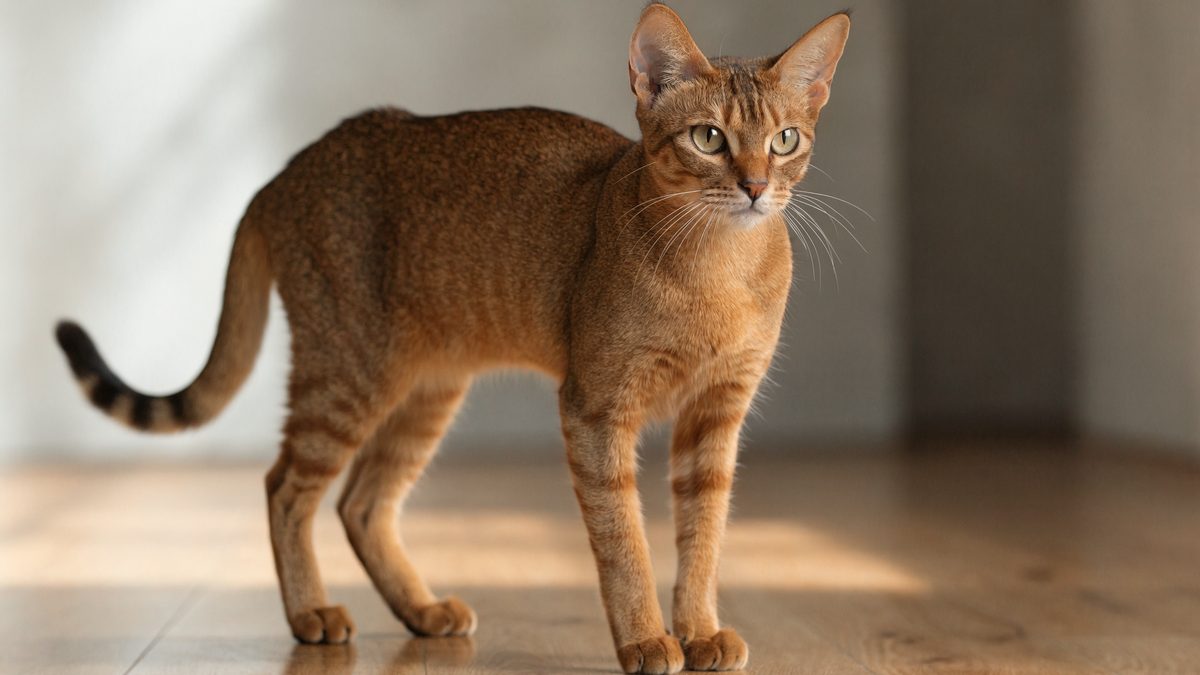
An Abyssinian is a medium-sized, short-coated domestic cat defined by one thing above all others, a ticked coat in which every single hair carries alternating bands of dark and light colour instead of stripes, spots or rosettes. Get that one feature right and you can tell a real Abyssinian from a ticked Indian street cat in about ninety seconds, which is the entire difference between Rs 18,000 and free.
The Cat Fanciers' Association describes the ideal Abyssinian as a colourful cat with a distinctly ticked coat, medium in size and regal in appearance, lithe, hard and muscular, showing eager activity and a lively interest in all surroundings. The International Cat Association adds the mechanism, that the coat pattern is genetically a form of agouti ticking with even, dark-coloured ticking contrasted with lighter bands giving a translucent effect. That translucent shimmer is not marketing language. It is the optical result of agouti banding on every hair shaft, and it is the only pattern the breed has.
Two registries disagree on how many bands there should be, and the disagreement is worth knowing before you inspect a kitten. CFA's standard says the coat is medium in length but long enough to accommodate two or three dark bands of ticking. TICA's breed description says each shaft of hair has 4 to 6 bands of alternating rich colour, similar to that of a bunny coat. Bonbeno is not going to average those into a fake number. What both agree on is the thing you actually check, which is that the banding runs along the length of each hair rather than the coat carrying a pattern made of separate marks.
The breed standard, in the words the registries actually use
| Attribute | What the record shows | Source |
|---|---|---|
| Coat | Soft, silky, fine in texture, dense and resilient, with a lustrous sheen. Medium length, long enough for two or three dark bands of ticking | CFA standard |
| Ticking | Distinct and even, dark bands contrasting with undercoat-coloured bands on the hair shafts. Undercoat clear and bright to the skin | CFA standard |
| Bands per hair | Two or three (CFA) against 4 to 6 (TICA). The registries do not agree | CFA, TICA |
| Accepted colours, CFA | Four only: ruddy, cinnamon, blue and fawn. Any other colour is a disqualification | CFA standard |
| Accepted colours, TICA | Traditional division of ruddy, cinnamon, chocolate, blue, fawn and lilac, plus a full silver division | TICA |
| Body | Medium long, lithe and graceful, well-developed muscular strength without coarseness. Stands well off the ground as if on tip toe | CFA standard |
| Ears | Alert, large and moderately pointed, broad and cupped at the base | CFA standard |
| Eyes | Almond shaped, large and expressive, accentuated by a fine dark line and encircled by a light-coloured area. Gold or green only | CFA standard |
| Adult weight, TICA glance panel | Females 6 to 9 pounds, males 7 to 12 pounds | TICA |
| Adult weight, Indian seller listing | 3 to 5 kg, height 20 to 25 cm | Asia Pets |
| Allowable outcross breeds | None | CFA |
| Breed-specific life expectancy from a mortality study | None exists. The Abyssinian was not among the 12 breeds analysed in the UK life-table study | VetCompass |
Six checks that separate an Abyssinian from a ticked Indian street cat
Indian buyers overpay for ordinary ticked or tabby domestic cats sold as Abyssinians, and the CFA standard hands you six free physical checks that settle it. None needs a document, a laboratory or a vet. Do them in daylight, on the actual cat, not on a photograph sent over WhatsApp.
- Pull a single hair and look along it. It must carry distinct alternating dark and light bands from root to tip, with the extreme outer tip the darkest and the undercoat colour clear and bright right down to the skin. A brown tabby hair is largely one colour with the pattern living in the coat rather than in the hair.
- Look at the legs. Barring on the legs is penalised in the standard. Almost every ticked Indian domestic cat carries leg bars, and they are the single most common giveaway.
- Look at the tail. Rings on the tail are penalised, and preference is given to cats with a tail without rings. A ringed tail on a ticked cat is a tabby tail.
- Look at the throat. A dark broken necklace marking is penalised and a dark unbroken necklace is an outright disqualification. A complete dark ring around the neck rules the cat out.
- Look for white. A white locket, or white anywhere other than the nostril, chin and upper throat area, is a disqualification. White paws, a white bib or a white belly patch are common on Indian domestic cats and disqualifying here.
- Check the eye colour and the eyeliner. Eyes must be gold or green, almond shaped, accentuated by a fine dark line and encircled by a lighter area. TICA allows gold, copper, green or hazel, and describes the facial markings precisely, a short vertical darker pencil stroke above each eye amid the light area and a curved darker pencil line at the sides of each eye like a continuation of the upper eyelid. Blue eyes on an adult ticked cat are not an Abyssinian.
- Look at the back of the ears. TICA's standard says a thumb print marking on the back of the ear is desirable. It is not a disqualifier if it is missing, but it is a positive sign that costs you nothing to check.
- Check the direction of the ticking. TICA's standard withholds all awards for reversed ticking, meaning the outermost tip of the hair is light instead of dark. Combine this with the first check. The tip must be the darkest part of the hair.
TICA's show standard adds three faults that map directly onto what an ordinary Indian tabby looks like, which makes them useful buyer checks rather than judging trivia. It faults speckling in the unticked areas, meaning the underside of the body, the chest and the inside of the legs, and it faults tabby stripes or bars anywhere. It also withholds all awards for an unbroken necklace and for a white locket or white anywhere on the body other than around the nostril, chin and upper throat, which is the same rule CFA applies. Two registries agreeing on the same disqualification is the strongest signal a buyer gets.
A live Delhi listing offers a vaccinated three-month-old ruddy Abyssinian male at Rs 18,000. A ticked Indian domestic cat is free. An Indian breed guide puts the Abyssinian at Rs 30,000 to Rs 50,000. The six checks above are the entire difference between those numbers, and they cost nothing.
The origin story is wrong, and the correction is an Indian one
The name says Ethiopia and the genetics say the Arabian Sea. TICA states plainly that no documentation links the founding cat Zula to the cats of today, and that recent genetic studies identify the cats in the coastal area of the Bay of Bengal in India as the Abyssinian's potential forebears. The published study behind that claim is a microsatellite survey of over 1,100 cats representing 17 random-bred populations and 22 breeds, which found that cats from the rim of the Arabian Sea, meaning the Abyssinian and Sri Lanka, bridged the European and Asian groups. The authors wrote that Sri Lankan cats and the Abyssinian breed bridged cats of the East and West, perhaps resulting from maritime trade routes in the Arabian Sea or from recent British colonialism.
That finding was strong enough that the researchers excluded the Abyssinian from one of their statistical analyses entirely, because its geographical origin and its placement in the analyses were unclear. A US breed guide reviewed by a veterinary surgeon puts the same point more simply, that genetic studies point to the coast of the Indian Ocean and parts of Southeast Asia rather than Ethiopia. For an Indian buyer this is more than trivia. The breed you are being sold as an exotic African import has a documented genetic bridge to the subcontinent, and the highest-ranking Indian page on this query already half-knows it, saying the breed is known to have sprung from the Indian Ocean and Southeast Asia while still printing an Ethiopian flag in its origin panel.
One more piece of history matters to buyers. The first cat genome ever sequenced belonged to an Abyssinian named Cinnamon, in 2007. That is not a curiosity. It is the reason this breed has more usable DNA tests available to an ordinary buyer than almost any other cat, which the health section turns into a shopping list.
Abyssinian cat price in India
The Abyssinian cat price in India runs Rs 15,000 to Rs 50,000 across the published sources Bonbeno could find, and the more useful finding is that India's two biggest cat-price guides do not list the breed at all. That absence tells you more than any number in the range does.
Start with what is actually published. Only three Indian sources put a figure on this breed, and one of them is a single live listing rather than a market survey.
| Source | What it publishes | What it does not say |
|---|---|---|
| Happy Pet, position one on this query | Rs 15,000 to Rs 50,000, varying by breeder, location and pedigree | No split by quality, no city breakdown, no sample size |
| VetScan Diagnostics | Rs 30,000 to Rs 50,000 | No split by quality, no method, one line in a 20-breed listicle |
| Asia Pets, live listing, New Delhi | Rs 18,000 for a vaccinated three-month-old ruddy male | No registry named, no parent test results, no breeder identified |
| Supertails, Cat Price in India 2026 | Nothing. The Abyssinian appears nowhere in its 14-breed price table | The guide is vet-reviewed and covers 14 breeds. The Abyssinian is not one |
| PawSpace, Cat Price in India all breeds | Nothing. The Abyssinian appears nowhere in its 10-breed price list | Covers Persian, Siamese, Maine Coon, Ragdoll, Bengal, Sphynx and others |
Read that table as a statement about supply, not about value. Supertails publishes a 2026 cat price guide reviewed by a senior veterinarian and covering fourteen breeds from the desi cat to the Turkish Angora. PawSpace publishes a ten-breed price list built around the same market. Neither mentions the Abyssinian once. When two national price guides that are competing for exactly this kind of traffic both leave a breed out, the honest reading is that the breed barely trades in India, not that it is being hidden.
The number that should stop you, compared with what the breed costs everywhere else
Here is the comparison no Indian page makes. Set the Indian figures against what an Abyssinian costs in the market where the breed is actually bred at scale.
| Route | Published price | What comes with it |
|---|---|---|
| Indian live listing, Delhi | Rs 18,000 | Vaccinated, health checked, breed certificate offered, home delivery across India |
| Indian breed guide range | Rs 15,000 to Rs 50,000 | Not stated |
| US rescue or shelter adoption Petful, Abyssinian Cat: Personality | 50 to 150 US dollars | Adoption fee only. Finding a purebred Abyssinian in a shelter is described as lucky |
| US breeder, pet quality Petful, Abyssinian Cat: Personality | 900 to 2,000 US dollars | Health-tested lines, spay or neuter often included |
| US breeder, show or rare colour | 1,500 to 2,500 US dollars and up | Silver, fawn and proven show lines run highest |
| US cattery live listings, Florida | 2,250 to 3,200 US dollars, with individual kittens listed at 2,650 to 3,200 | Raised in home, health guarantee, USDA-compliant licence |
| European cattery, published range | 2,500 to 3,000 US dollars | Cattery states it tests breeding cats and is negative for FIV, FeLV, FIP, Trichomonas, PRA and PK deficiency |
| Pet insurer's price guide | 500 to 2,000 US dollars, show quality 1,500 to 4,000, adoption 100 to 250 | Estimates lifetime cost at 10,000 to 30,000 US dollars |
Convert at any plausible rate and Rs 18,000 is a small fraction of the lowest price a US breeder charges for the same breed, and it sits inside the American shelter adoption band rather than the breeder band Asia Pets, Abyssinian Kitten Ruddy Delhi. That does not prove any specific Indian kitten is not an Abyssinian. It does mean the price is telling you something, and what it is most likely telling you is that you are buying a ticked domestic cat with a printed certificate rather than a registered pedigree animal from tested parents.
What breeder reputation should mean when you buy in India
Indian price pages name breeder reputation as a price factor without ever defining it PawSpace, Cat Price in India: All Breeds. Define it yourself with a checkable list, because for this breed the list is unusually short and unusually concrete.
One number makes the pedigree question concrete. CFA's Abyssinian registration rules require eight generations on a pedigree, allow no outcross breeds at all, and instruct registrars not to accept non-CFA colours. The same rules carry a detail that no buyer guide mentions and that is worth knowing if a seller offers you a longhaired sibling from an Abyssinian litter: a cat registered under the Somali Variant prefix can be re-registered as an Abyssinian only if it has eight generations of Abyssinian to Abyssinian breeding and a DNA test showing it does not carry the longhair gene. CFA also renamed the colour Red to Cinnamon in 2021, and instructs that where TICA, GCCF or LOOF recognise both Red and Cinnamon, only Cinnamon should be accepted. If an Indian seller quotes you a price premium for a Red Abyssinian, that is the colour naming you are paying for.
- Ask which registry issued the pedigree, by name. A breed certificate issued by the seller is not a pedigree. CFA and TICA are the two registries that publish an Abyssinian standard, and a registered cat has a registry number you can quote back to the registry.
- Ask for the parents' PK deficiency result. TICA states that pyruvate kinase deficiency and progressive retinal atrophy can both be diagnosed through genetic testing, and says to ask the breeder for certification. That is the breed registry telling you to demand paperwork.
- Ask for both PRA results, not one. The Abyssinian carries two genetically separate blinding diseases with different inheritance, and a clear result on one says nothing about the other. The health section below explains why this trips up almost everybody.
- Ask the kitten's age at handover. Kittens should stay with the breeder until at least 12 weeks so they are fully weaned, litter trained and socialised. The Delhi listing above is a three-month-old, which meets that bar.
- Ask to see the parents in the place the kitten was raised. An Indian buyer guide lists refusing a video call or a physical visit, being unable to show parent cats, and offering very low prices for premium breeds among its red flags. All three apply here.
Price by city, and why nobody publishes one for this breed
No Indian source publishes an Abyssinian price by city. Google's own related searches for this query include Abyssinian Cat price in bangalore, so buyers are asking, but the answer does not exist in any published form. What does exist is a general city band for cats overall, which one Indian guide puts at Rs 5,000 to Rs 1,50,000 in Bangalore, Rs 8,000 to Rs 1,50,000 in Mumbai, and Rs 5,000 to Rs 1,50,000 in Delhi NCR, attributing metro premiums to demand, breeder availability and transport. Those are all-breed numbers and applying them to one uncommon breed would be inventing data.
Bonbeno will not publish an Abyssinian price table by city, because doing so honestly would need a sample of Indian Abyssinian transactions that does not exist. What we will say is that the same Delhi seller lists Abyssinians in Mumbai and Noida as well, which means the supply in Indian metros runs through a small number of listing platforms rather than through catteries, and that shapes the price more than the city does.
There is one more piece of evidence about the Indian channel and it is unusually clear. Justdial, India's largest local business directory, maintains a category called Pet Shops For Abyssinian Cat in Mumbai. Open it and the businesses returned are general pet shops and kennels, several of them outside Mumbai altogether, including listings in Palghar, Nashik, Hyderabad, Hoshangabad in Madhya Pradesh and a dog kennel in Bijapur, Karnataka. Not one is an Abyssinian cattery. A category page for a breed that returns dog kennels in other states is telling you the same thing the two national price guides are telling you by omission.
If what you want is the look, an athletic ticked cat with big ears and green-gold eyes, India already has that cat and it costs Rs 0 to Rs 5,000 through a shelter VetScan Diagnostics. It will not be a registered Abyssinian and it will not carry a pedigree, but the UK life-table study found that crossbred cats lived 1.27 years longer than purebred cats and that purebred cats had 1.83 times the mortality hazard. If what you want is a registered Abyssinian from tested parents, budget for the tests rather than the certificate.
Monthly cost of owning an Abyssinian in India
Budget Rs 2,800 to Rs 4,200 a month for an Abyssinian in India on the only breed-specific Indian estimate published, and treat that as the floor rather than the answer. Two lines nobody in India costs are the DNA panel, which is a one-off of roughly Rs 8,500, and the vertical space, which is furniture rather than a toy.
One Indian source publishes an Abyssinian-specific monthly cost. Two others publish an all-breed monthly cost for India. Bonbeno prints all three rather than averaging them.
| Line item | Happy Pet, Abyssinian-specific | Supertails, all breeds | PawSpace, all breeds |
|---|---|---|---|
| Food | Rs 1,500 to Rs 2,000 | Not itemised | Rs 1,500 to Rs 6,000 |
| Veterinary | Rs 500 to Rs 700 | Not itemised | Rs 500 to Rs 2,000 |
| Grooming | Rs 800 to Rs 1,500 | Rs 800 to Rs 2,500 per professional session in Bengaluru | Rs 500 to Rs 3,000 |
| Litter | Not itemised | Not itemised | Rs 800 to Rs 2,500 |
| Toys and scratching posts | Not itemised | Not itemised | Rs 300 to Rs 1,500 |
| Stated monthly total | Rs 2,800 basic, Rs 4,200 premium | Rs 2,000 to Rs 8,000 | Rs 3,000 to Rs 12,000 and up |
The Abyssinian-specific figure sits at the very bottom of both all-breed ranges PawSpace, Cat Price in India: All Breeds. That is defensible on grooming, where the breed genuinely is cheap, and questionable on everything else, because the same page rates the breed's energy level as medium and its exercise routine at 30 to 45 minutes while TICA describes an extremely high activity level and warns that if you would be distressed by a cat sitting on your ceiling fan, this is not the breed for you. A cat that climbs that hard destroys more furniture and needs more enrichment than a Rs 2,800 budget contains.
First-year cost, using the two Indian sources that build one properly
Neither Indian first-year cost model is Abyssinian-specific, so use them as brackets rather than answers. Supertails builds a first-year total of Rs 35,000 to Rs 2,40,000 and up, itemised as a purchase or adoption fee of Rs 500 to Rs 1,20,000, an initial vet checkup at Rs 500 to Rs 1,500, the year-one vaccination schedule at Rs 1,500 to Rs 3,000, deworming at Rs 300 to Rs 600, spay or neuter surgery at Rs 3,000 to Rs 8,000, a scratching post or cat tree at Rs 800 to Rs 4,000, and twelve months of running costs at Rs 24,000 to Rs 96,000. PawSpace builds a wider first-year cost of Rs 50,000 to Rs 2,50,000 and up, with vaccinations at Rs 2,000 to Rs 6,000 and sterilisation at Rs 4,000 to Rs 15,000.
Three Abyssinian-specific lines nobody in India budgets for
- The DNA panel, roughly Rs 8,500 as a one-off. The University of California, Davis Veterinary Genetics Laboratory charges 47 US dollars for any one of the three Abyssinian tests, 71 US dollars for any two, and 95 US dollars for all three together, meaning pyruvate kinase deficiency plus the CEP290 and CRX forms of progressive retinal atrophy Veterinary Genetics Laboratory. It is a cheek swab you collect at home with four cotton swab heads and post, with a turnaround of at least 15 business days. Against a Rs 18,000 kitten it is roughly half the purchase price, which is exactly why it is worth doing.
- A cat tree that will actually hold a climbing adult. Indian guides fold enrichment into a Rs 300 to Rs 1,500 toy line and price a cat tree at Rs 800 to Rs 4,000. The feline life stage guidelines report that cats scratched their preferred substrate more often when the post was a simple upright type or a cat tree with two or more levels and at least 3 feet high, and that rope was the substrate most frequently used when offered. Buy tall, narrow and rope-wrapped rather than wide and carpeted.
- Cooling, which lands on your electricity bill rather than a pet invoice. Only 8 percent of Indian households have air conditioning, and an Abyssinian that cannot play in the afternoon heat will play at 2 am instead. Nobody costs this line and every Indian owner pays it.
Every monthly cost above is somebody else's estimate, reproduced so you can see the spread. None of the three Indian sources states a sample size, a set of cities or a collection date, so treat all of them as estimates rather than measurements. The only cost on this page that comes from a primary source is the DNA panel, which is published by the university laboratory that runs the tests.
Can an Abyssinian handle the Indian climate
An Abyssinian handles Indian heat better than almost any other pedigree cat sold here, and this is one of the few sections on any Bonbeno breed page where the honest verdict is positive. The reason is structural. It carries a short, close-lying single coat and a normal muzzle, so it has neither the insulation problem of a Persian nor the airway problem of a flat-faced breed. Rate its heat tolerance in the upper middle of the scale.
The climate adaptation argument, and why the coat is the whole of it
The coat is short, fine in texture, close lying and single layered, with no dense woolly undercoat trapping air against the skin Petful, Abyssinian Cat: Personality. TICA calls the breed the wash and wear cat and states that grooming requirements are low because they shed very little. In a Chennai August that combination matters more than any other physical trait, because a short coat neither mats nor holds moisture at skin level, which is where monsoon dermatology problems start in long-coated breeds. An Indian breed comparison rates climate suitability for India as good for short-coated breeds and not ideal for the heat-sensitive Persian, and the Abyssinian belongs firmly in the first group.
The genetics point the same way. The breed's markers bridge Southeast Asian and Western cat populations, and the study authors placed it on the rim of the Arabian Sea alongside cats from Sri Lanka. TICA names the coastal area of the Bay of Bengal in India as the likely forebears. Whatever the breed became in British catteries, its founding stock did not come out of a temperate climate, and nothing about its build fights an Indian summer.
Where the Indian problem actually is
The position-one Indian page states the Abyssinian's ideal weather as 18 to 30 degrees Celsius. Hold that against what 2026 actually delivered. On a single day in late April all fifty of the world's hottest cities were inside India, and by May that had climbed to ninety-seven of the top one hundred, with Balangir in Odisha at 48 degrees Celsius. Across the northern and eastern belt, temperatures between 45 and 48 degrees became routine within weeks. An ideal range topping out at 30 degrees is exceeded by most of India for four to five months a year, so the real question is not whether the cat copes but whether your flat does.
Three second-order facts decide that, and none of them appears on any Indian cat page. First, only 8 percent of Indian households have air conditioning. Second, India's average relative humidity rose from 67.1 percent across 2015 to 2019 to 71.2 percent across 2020 to 2024, with Delhi showing the sharpest single-state increase at 8 percentage points. Third, nights are no longer recovery time. Average night-time temperatures are rising at roughly 0.21 degrees Celsius per decade and 35 of India's 36 states and union territories are getting hotter at night. A cat that is naturally most active at dawn and dusk is losing its cool window.
| Condition | Where and when | What it means for an Abyssinian |
|---|---|---|
| Dry extreme heat | Delhi, Rajasthan, UP, MP, Odisha, March to June | Coat and muzzle cope. Move play to dawn and after dark, keep water in two or three places, and never let the cat onto an unshaded balcony |
| Humid heat | Mumbai, Chennai, Kolkata, Kerala coast | Closest to the climate the founding population came from. Comfortable for the cat, still too hot for afternoon chase play |
| Monsoon humidity | Most of India, June to September | The breed's strongest season. A short close-lying single coat does not mat or hold moisture at skin level |
| Night-time power cuts | Parts of Chennai during peak demand | The real risk in an Indian flat. A fan stops, the room stays at 34 degrees, and a lean short-coated cat still has nowhere cooler to go |
| Hill cold | Himachal, Uttarakhand, the Northeast in winter | A short single coat gives less protection than a double coat. Keep an indoor Abyssinian indoors and give it a warm elevated bed |
What actually reduces the risk
- Move play to the cool hours. Two sessions, early morning and after dark, beat one session at 4 pm in May. This costs nothing and it is the single change that makes the breed's activity level survivable in an Indian summer.
- Give it height, because height is where it wants to be anyway. TICA states that Abyssinians prefer the highest ground they can reach and love to be on the highest level possible where they can observe the room. In a flat without air conditioning the top of a wardrobe is often the worst place in the room for heat, so give it a cooler shaded shelf lower down as an alternative.
- Put water in three places, not one. TICA's own nutrition guidance suggests placing the water bowl at least three feet from any food because an overwhelming smell of food can make cats drink less, and notes that filtered drinking fountains can be used in place of a bowl. Hydration is the cheapest heat intervention there is.
- Keep the cat lean. A lean, muscular, athletic build is what the standard asks for and an overweight cat carries more heat load. Measure portions rather than free-feeding.
- Keep it strictly indoors. An Indian street is hot, loud and full of free-roaming dogs, and this is a curious cat that treats every closed door as a personal challenge. Secure your window nets before the kitten arrives, which Indian first-time owner guidance calls non-negotiable.
If you have talked yourself out of a Persian, a Himalayan or a Maine Coon on Indian climate grounds, the Abyssinian is a legitimately better fit. Its grooming load in an Indian monsoon is a weekly brush, not a daily de-matting session, and there is no flat face to compromise breathing in humid heat. You are trading a grooming problem for an exercise problem, and the exercise problem is the one this page keeps returning to.
Temperament, household fit and living conditions
An Abyssinian suits a household that is home a lot, wants to interact constantly, and has vertical space. It does not suit anyone who wants a quiet lap cat, and it does not suit a flat that is empty for ten hours a day. Both registries say so in unusually direct language, and Indian sellers do not repeat it.
CFA describes Abyssinians as indomitable problem-solvers, intensely curious about everything, leaving no inch of their environment unexplored and constantly on the move unless asleep. Because of that high activity level, CFA says, the average Aby may not be a long-term lap snuggler, though they will still seek out attention and may reach out with a gentle paw to request it. TICA is blunter still, warning that if you would be distressed by a cat sitting on your ceiling fan, this is not the breed for you.
The single most important line either registry publishes
CFA states that Abyssinians do not like to be left alone for long, so quieter homes may want to acquire two instead of one. That sentence has a direct financial consequence in India that no Indian page follows through on. If you work from an office five days a week, the honest version of this purchase is two cats, which doubles the kitten cost, doubles the food and litter line, and doubles the DNA panel. Petful reaches the same conclusion from the other direction, noting that Abyssinians dislike being left alone for long stretches, which is why many owners keep them in pairs or alongside a playful, cat-friendly dog.
TICA adds a caution that cuts the other way and that nobody quotes. While exceedingly social, Abyssinians are not always content in large cat populations where they have to share attention. So the answer is a second cat, not a fifth.
Noise, which is where this breed differs from the obvious alternative
Abyssinians are quiet. CFA states that they are not particularly talkative and excel at communicating their desires to their owners without much noise. Petful describes them as vocal but soft-voiced, communicating with quiet chirps and trills rather than loud meows. For an Indian flat with shared walls that is a real advantage over the breeds Indian buyers usually cross-shop, and it is one of the few places where an Abyssinian is an easier housemate than a Bengal or a Siamese.
Who should buy one
- Good fit. Households with someone home most of the day, real floor-to-ceiling vertical space, and an appetite for daily interactive play.
- Good fit. Families with children old enough to play properly. CFA states the Aby's activity level makes it an excellent choice for families with children, who will enjoy engaging it with toys and hunting games.
- Good fit. Homes that already have a confident cat or a cat-friendly dog. TICA describes Abyssinians as generally great with children, dogs and other cats.
- Good fit. People who actively want a trainable cat and will teach fetch, harness walking and tricks rather than treat them as party pieces.
- Poor fit. Anyone who wants a cat that sleeps sixteen hours and asks for nothing. This is not that cat, and no amount of training makes it one.
- Poor fit. A household out for ten hours a day that intends to keep one cat. Read the CFA line about acquiring two instead of one as the price of entry.
- Poor fit. A flat with no vertical space and no intention of adding any. Abys prefer the highest ground they can reach, and if you do not supply it they will use your curtain rails and your fridge.
The page ranking first in India for this query rates the Abyssinian's energy level as medium and prescribes 30 to 45 minutes of exercise. Both registries contradict that. CFA describes a high activity level and a cat constantly on the move; TICA describes an extremely high activity level and says most Abys stay kitten-like throughout much of their life. A buyer who plans around medium energy will be surprised, and the surprise usually arrives as a knocked-over shelf at 3 am.
Litter training, handling and enrichment for an Abyssinian
To train an Abyssinian, set the litter box up correctly on day one, then spend your real effort on handling and enrichment, because in this breed those two are what keep the cat sane and what make its three DNA tests and its lifelong kidney monitoring possible without sedation.
Litter training, which is mostly a setup problem
Litter training an Abyssinian is normally a matter of arrangement rather than teaching. Cats are innately fastidious and may be naturally attracted to sand-type substrates for elimination, and elimination tends to occur away from primary resting locations. Place one more tray than the number of cats, keep trays away from food and from the noisiest corner of the flat, use an unscented clumping litter, and scoop twice a day. The feline life stage guidelines add a useful point for a kitten you are collecting from a seller, that kittens may be most accepting of the litter they observed their mother using, so it can help to offer a young kitten a variety of toileting substrates so it grows into an adult that accepts several litter types. In India, where a specific litter brand can vanish from your local shop for a month, that flexibility is worth building deliberately.
Handling training, and why it pays more in this breed than most
Teach an Abyssinian kitten to accept restraint, mouth handling and a carrier in its first weeks home, because this breed needs three specific procedures that most cats do not. It needs a cheek swab for the DNA panel, which means four cotton swab heads rubbed between gum and cheek for 15 seconds each. It needs repeat bloodwork as it ages because renal amyloidosis has no genetic test and is watched for through routine bloodwork instead Petful, Abyssinian Cat: Personality. And it needs regular dental attention, because CFA notes that some breeders now instruct kitten buyers on how to brush their cat's teeth to prevent dental issues such as gingivitis.
The guidelines are specific about the window. The sensitive socialisation period for new experiences, people and other animals begins as early as 2 to 3 weeks and may be closing by 9 to 10 weeks, and kittens should ideally have pleasant interactions with people for 30 to 60 minutes per day. Kittens should be gently, gradually and positively acclimated to any stimuli or procedures they may encounter during their lifetime, including nail trims, grooming and medicating, by pairing the stimulus with food or other rewards.
| Skill | Start | Why it matters in this breed |
|---|---|---|
| Cheek swabbing | Week 1 home | The DNA panel uses four cotton swab heads rubbed between gum and cheek for 15 seconds each |
| Carrier entry | Week 1 home | Kidney monitoring means repeat clinic visits for bloodwork over the cat's life |
| Tooth brushing | Week 2 home | CFA notes breeders now teach buyers to brush teeth to prevent gingivitis |
| Nail handling | Week 2 home | TICA recommends nails be trimmed every two weeks |
| Harness wearing | Week 3 home | CFA notes well-socialised Abys may enjoy going out in public on a harness |
| Standing still to be weighed | Month 2 | Weight creep strains joints and organs in a lean, athletic breed |
Trick training, which is where the energy actually goes
Train this cat deliberately every day, because ten minutes of thinking tires an intelligent cat more than thirty minutes of a laser pointer and it does not need floor space. Kittens and even older cats can be taught many behaviours with well-timed positive reinforcement, including coming when called, getting onto a mat, accepting grooming and nail trimming, and taking medication. Abyssinians learn to fetch and to walk on a harness, and a US cattery describes them as a cat that treats every closed door as a personal challenge, which is a training opportunity rather than a defect.
- Charge a clicker or a marker word first. Click, then treat, twenty times, asking for no behaviour. The cat learns the sound predicts food.
- Teach a nose touch to a target. This becomes the tool you use to move the cat onto a scale, into a carrier, or off a curtain rail without grabbing it.
- Add fetch. It delivers more running per minute of your attention than anything else you can do indoors.
- Introduce the harness indoors for two weeks before any door opens. Feed meals in it. A balcony or terrace is the realistic Indian version of a harness walk.
- Keep sessions to five minutes, twice a day. Stop while the cat still wants more.
Enrichment, and the two rules that prevent the classic injuries
The feline life stage guidelines give two instructions that matter more in a high-drive breed than in an average cat. First, clients should be taught not to use their hands or feet as toys during play, because cats learn that this is an appropriate form of play and it can lead to scratching or biting injuries. In a muscular, energetic athlete that stays kitten-like for years, a hand-play habit learned at twelve weeks becomes a real injury at three years. Second, scratching posts and a variety of scratching surfaces should be provided as soon as the cat enters the home, positioned near resting areas and high-traffic pathways.
A bored Abyssinian is a destructive Abyssinian, so puzzle feeders, climbing trees and daily interactive play sessions are not optional. A US cattery selling the breed says the same thing in its own buying guide, that cat trees, puzzle feeders and window perches are less of a luxury and more of a requirement. When the seller warns you, believe the seller.
How much exercise an Abyssinian actually needs
An Abyssinian needs at least two genuine interactive play sessions a day plus free access to climbing space for the other twenty-three hours. The one Indian figure published, 30 to 45 minutes, is the floor and it sits under a breed description that both registries contradict.
This is the requirement that decides whether the breed works in an Indian flat. TICA describes an extremely high activity level and states that Abyssinians are extremely graceful, lithe and elegant, show a lively interest in their surroundings, and that most Abys will stay kitten-like throughout much of their life. CFA describes a cat constantly on the move unless asleep. An Abyssinian does not settle down at four years old the way many cats do, which is the single most useful expectation to set before you buy.
What a day actually looks like in a 2BHK
- Two wand sessions of 15 minutes, one at dawn and one after dark, in the coolest room in the flat. Move the toy like prey, away from the cat and into cover, rather than waving it in the cat's face.
- One fetch session of 10 minutes. Abyssinians learn fetch readily and it delivers the most running per minute of owner attention available indoors.
- Food puzzles instead of a bowl for at least one meal. These deliver foraging activity while you are at work and slow the eating down, which matters in a breed where measured portions prevent the weight creep that strains joints and organs.
- Free access to vertical space all day. Wall shelving, a tall tree, the top of a wardrobe cleared and made safe. Abys prefer the highest ground they can reach and love to observe the room from it, and this is the outlet that runs while nobody is home.
- Ten minutes of training. Mental work tires an intelligent cat faster than physical work, and it is the only part of this list that works at 44 degrees Celsius.
What happens without it
Without an outlet the energy comes out as damage. A bored Abyssinian invents its own entertainment, usually at the furniture's expense, and the breed's own sellers say the same thing before taking your money. In an Indian rented flat that is not an abstract cost. It is a security deposit.
The Indian heat compresses the day when this can happen. In 2026, temperatures of 45 to 48 degrees Celsius became routine across the northern and eastern belt within a few weeks, and night-time temperatures are climbing at roughly 0.21 degrees Celsius per decade across 35 of India's 36 states and union territories. That squeezes both ends of the natural dawn and dusk activity window. Plan for the play to happen inside a cooled room, or plan for it to happen at hours you would rather be asleep.
An apartment with an owner who actually delivers two daily sessions beats a large house with an absent owner, every time. If your honest answer is fifteen minutes on weekdays, this is the wrong breed, and a second cat is a better solution than a bigger cat tree. CFA says it plainly, that Abys do not like to be left alone for long and quieter homes may want to acquire two instead of one.
Grooming an Abyssinian coat in Indian humidity
Groom an Abyssinian once a week with a rubber mitt or a fine comb, trim its nails every two weeks, and brush its teeth. That is the entire routine, and it makes this one of the two or three lowest-maintenance pedigree coats available in India.
TICA calls Abyssinians the wash and wear cat, states that their grooming requirements are low because they shed very little and have a short, easy-to-maintain coat, and says an occasional brushing is all that is required to remove dead hair, with an intermittent rub down using a cold damp cloth to keep the coat glossy. Nails should be trimmed every two weeks, and teeth brushing should begin at an early age with a vet-approved pet toothpaste. Petful reaches the same conclusion, describing a weekly once-over with a rubber grooming mitt or fine comb, with cats rarely needing a bath.
Why the ticked coat is easy in a monsoon
The coat is short, fine, close lying and single layered Petful, Abyssinian Cat: Personality. There is no dense woolly undercoat to trap water at skin level during a Mumbai or Kochi monsoon, which is where the fungal and bacterial skin problems that plague long-coated breeds in India begin. The one thing worth doing after a wet-season bath is what TICA describes, pat the cat down with a towel and let the coat drip-dry on its own, and then let it finish drying in a moving-air room rather than a closed bathroom.
| Task | Frequency | Note |
|---|---|---|
| Brush with a rubber mitt or fine comb | Weekly | Removes the small amount of dead hair and spreads skin oils |
| Extra brushing during coat change | Spring and autumn | Shedding ticks up slightly at seasonal coat changes and drops back |
| Nail trim | Every two weeks | TICA's stated interval for this breed |
| Tooth brushing | Several times a week, from kittenhood | CFA notes breeders now teach buyers to brush teeth to prevent gingivitis |
| Bath | Only as needed | Start when the cat is a kitten, towel and drip-dry after |
| Professional grooming session | Not required | Indian sessions run Rs 500 to Rs 3,000 and this breed does not need them |
Two grooming claims to ignore
First, hypoallergenic. No cat is truly hypoallergenic and every Abyssinian produces the Fel d 1 protein in its saliva and skin that triggers most cat allergies. The low-shedding coat means less allergen-coated hair drifting around the flat, which is a real but partial benefit, and an allergy-prone buyer should spend time with an adult Abyssinian before committing rather than assuming the coat will spare them.
Second, the Indian monthly grooming budget. The position-one Indian page puts Abyssinian grooming at Rs 800 to Rs 1,500 a month while simultaneously rating the breed as low shedding. Those two statements do not fit together. On both registries' guidance this coat needs a weekly brush, a fortnightly nail trim and nothing else The Cat Fanciers' Association, so a recurring four-figure grooming line is money you can redirect straight into the DNA panel.
Dental care is the exception to this breed's easy reputation. Abyssinians are prone to early-onset gingivitis and periodontal disease, sometimes including tooth resorption, so regular dental checks, professional cleanings and at-home tooth brushing matter. CFA frames it as part of what responsible breeders now hand over with the kitten. Start in week two, before the cat has opinions.
Abyssinian health issues, genetic testing and life expectancy
The Abyssinian has four documented breed-associated health issues, and two of them can be settled before you pay with a cheek swab that costs 95 US dollars for the full panel. That is the single most actionable fact on this page, and no page currently ranking in India mentions any of the three tests by name.
TICA's own health list for the breed names four conditions: pyruvate kinase deficiency, which it describes as a hereditary form of anaemia; progressive retinal atrophy, a hereditary disease of the retina that eventually leads to permanent blindness; patellar luxation, where the kneecap slips out of position; and renal amyloidosis, in which an amyloid substance accumulates in the cells of the kidney and possibly in the thyroid gland, stomach and spleen. TICA then adds the sentence that should drive your whole purchase, that pyruvate kinase deficiency and progressive retinal atrophy can be diagnosed through genetic testing, so be sure to ask for certification from the breeder, and that there is no DNA or genetic testing for renal amyloidosis.
| Test | Gene and inheritance | What an affected cat gets | Price |
|---|---|---|---|
| Erythrocyte pyruvate kinase deficiency (PK deficiency) | PKLR, autosomal recessive | Intermittent haemolytic anaemia with variable age of onset. Signs can include severe lethargy, weakness, weight loss, jaundice and abdominal enlargement | 47 US dollars alone |
| Progressive retinal atrophy, rdAc | CEP290, autosomal recessive | Normal vision at birth, degeneration first detectable at about seven months, most cats blind at about 3 to 5 years. No treatment | 47 US dollars alone |
| Progressive retinal atrophy, Rdy | CRX, autosomal dominant | Rod cone dysplasia. Retarded development and degeneration of photoreceptors leading to blindness by 7 weeks of age | 47 US dollars alone |
| Any two of the three together | Package price for Abyssinian, Somali and domestic shorthair | 71 US dollars | |
| All three together | Package price for Abyssinian, Somali and domestic shorthair | 95 US dollars |
All three run on the same sample. Cat DNA tests at the laboratory are carried out using cells brushed from the cat's cheeks and gums with ordinary household cotton swabs, four swab heads in total, each rubbed between gum and cheek for 15 seconds, with the cat having eaten and drunk nothing for an hour beforehand. Turnaround is at least 15 business days. You do not need a laboratory in India to do this, which is the point.
The two forms of progressive retinal atrophy, and why one clear test proves nothing
This is the part that confuses buyers, breeders and most breed guides, so read it slowly. The Abyssinian carries two genetically separate causes of blindness, and they behave in opposite ways.
- rdAc is recessive and late. A single nucleotide mutation in CEP290 produces a defective protein associated with this progressive retinal atrophy. Two copies are required for a cat to lose its vision, and carriers with one copy are unaffected with normal vision. Affected cats see normally at birth, degeneration is first detected by electroretinographic examination at about seven months, and most become blind by 3 to 5 years. Matings between two carriers are predicted to produce 25 percent affected kittens.
- Rdy is dominant and early. The mutation is a single base pair deletion in a different gene, CRX, which results in a defective protein critical for eye development. Cats carrying even one copy are affected, not carriers, and go blind by 7 weeks of age. A single N/Rdy parent bred to a normal cat produces affected kittens 50 percent of the time, and two N/Rdy parents produce them 75 percent of the time. Current information suggests the Rdy mutation is restricted to the Abyssinian and Somali breeds, and it is rare.
The laboratory states the consequence directly, that since both forms of blindness are found in the Abyssinian breed, all associated breeds may have a concern for these diseases, and that the test on each page detects only its own mutation Veterinary Genetics Laboratory. So a breeder who shows you a clear PRA certificate has told you nothing until you read which gene it names. This is exactly where the ranking pages fail. The most thorough US guide on this query, itself reviewed by a veterinary surgeon, describes a single reliable DNA test for the rdAc mutation and does not mention Rdy at all.
Ask this exactly: which gene does your PRA certificate name, CEP290 or CRX? A breeder running a genuine programme will answer in a sentence. A reseller in an Indian metro will not know the question exists. Nothing else you can ask costs so little and tells you so much Veterinary Genetics Laboratory.
Pyruvate kinase deficiency, the test with the strongest published evidence that testing works
Pyruvate kinase deficiency is an inherited haemolytic anaemia caused by insufficient activity of the regulatory enzyme pyruvate kinase, which results in instability and loss of red blood cells. It was first documented in an Abyssinian in the USA, and later in Abyssinian and Somali cats in Germany and Australia. The causal variant is an intron 5 single nucleotide polymorphism at position 304, and it was found in 14,179 American and European cats representing 38 breeds at an overall frequency of 6.31 percent, rising to 9.35 percent when restricted to the 15 groups that carry it.
For the Abyssinian specifically, the paper reports that the variant frequency ranged from 3 to 15 percent in Abyssinians and Somalis between the USA and the UK. An earlier Australian study of 60 Abyssinian and Somali cats gave frequencies of 0.13 and 0.29 respectively, though the authors of that work noted the sampling may have been biased towards breeders with known carrier cats.
Then comes the finding that should reassure any buyer who is willing to insist on paperwork. Abyssinian and Bengal breeders have been actively screening for the variant and represent over 81 percent of all samples submitted for PK deficiency testing. In the Abyssinian data the observed number of carriers was higher than predicted while the observed number of homozygous affected cats was 54.8 to 57.6 percent lower than predicted, depending on the sample set. The authors read that as breeders using genetic data to actively avoid producing affected kittens. CFA says the same thing in plain language, that thanks to innovations in genetic testing, Abyssinian breeders are now able to easily remove carriers of an inherited disease that once caused anaemia from their gene pool.
How common is rdAc in the breed, by country
A survey of 43 cat breeds published the rdAc genotype counts for four Abyssinian populations. Read it as evidence that the risk is real but not uniform, and that where you buy matters.
| Population | Cats tested | Normal / carrier / affected | Risk allele frequency | Anticipated frequency of affected cats |
|---|---|---|---|---|
| Abyssinian and Somali, USA | 16 | 14 / 2 / 0 | 0.070 | 0.005 |
| Abyssinian, UK | 34 | 22 / 10 / 2 | 0.206 | 0.042 |
| Abyssinian, Australia | 57 | 46 / 10 / 1 | 0.105 | 0.011 |
| Abyssinian and Somali, Scandinavia | 130 | 85 / 39 / 6 | 0.196 | 0.038 |
Work the genotype counts out and the picture is clear. In the UK sample, 12 of 34 cats were carriers or affected, which is 35 percent. In the Scandinavian sample, 45 of 130 were carriers or affected, which is 35 percent again. In Australia it was 11 of 57, or 19 percent, and in the small US sample 2 of 16, or 13 percent. No equivalent Indian data exists, and Bonbeno will not estimate one. What the table supports is the practical point, that in the breed's established markets this variant is common enough that a serious breeder screens for it, so a seller who has never heard of it is not running that kind of programme.
Renal amyloidosis, the one with no test and the hardest facts
Renal amyloidosis is the condition that should decide whether you can commit to this breed for fifteen years, and it is the one you cannot screen out. A familial form has been described in the Abyssinian breed. The three consistently reported features are its occurrence in related cats, systemic deposition of AA protein with a significantly higher presence in the kidneys, and early death from renal failure. The trait is described as autosomal, and the influence of sex on onset or development has not been reported in cats.
Two further findings from the same multi-omic study matter to a buyer. First, the prevalence of the disease in any cat breed is unknown, so anyone quoting you a percentage is inventing it. Second, and this is why no DNA test exists, the authors concluded that the familial amyloid renal form in Abyssinians is not a simple monogenic trait and that amyloid deposition is not triggered by mutated amyloidogenic proteins but by a mix of proteins coded by wild-type genes. There is no single mutation to test for.
Cornell's Feline Health Center puts the breed association more starkly than any breed page does. Renal amyloidosis is rare overall, but when it is diagnosed the patient is almost always an Abyssinian cat, with the condition also occurring at disproportionate frequency in Oriental breeds. Cornell also gives the one diagnostic tell that separates it from ordinary kidney disease, that in other chronic renal disease the kidneys are typically small and shrunken while in amyloidosis they remain normal in size. Associate professor Richard Goldstein's published advice to Abyssinian owners is specific and easy to follow in India: have bloodwork done at least once a year while the cat is young and twice a year when it is older.
The study's case definition is the number that lands hardest. Cats were classified as affected when they died at five years of age or younger with amyloidosis confirmed on renal tissue by Congo red staining and with other conditions excluded, while the control cats were those older than five at death with amyloidosis excluded. That is what a bad outcome in this breed looks like. It is not a manageable chronic condition diagnosed at fourteen.
You cannot test for it, so do three things instead. Ask the breeder directly whether any cat in the line has died of kidney failure before six years, because the disease occurs in related cats. Run baseline bloodwork and urine testing when the cat is young, and repeat annually. And learn the early signs of kidney disease, meaning increased thirst and urination, weight loss and poor appetite, which is exactly what veterinary guidance for this breed advises.
The one blood test to name at your Indian vet clinic
Since you cannot screen for renal amyloidosis genetically, screening early matters more in this breed than in an average cat, and there is a specific test worth naming. Cornell University's Feline Health Center explains that blood creatinine concentrations do not generally rise until a cat has lost almost 75 percent of its renal function, while symmetric dimethyl arginine, or SDMA, is detectable when about 40 percent of kidney function is lost, potentially allowing chronic kidney disease to be diagnosed sooner. SDMA is also less affected by dehydration and muscle mass than creatinine, which matters for a lean, muscular cat in an Indian summer.
Cornell adds three practical points that turn an annual visit into real monitoring. A low urine specific gravity, meaning poorly concentrated urine, can be one of the earliest indicators of kidney disease in the cat. Interpretation should ideally rest on at least two blood and urine samples taken within two weeks of one another from a stable, well-hydrated cat, rather than a single panel taken on a sick day. And roughly 60 percent of cats with chronic kidney disease also develop hypertension, so blood pressure measurement belongs in the workup. For scale, chronic kidney disease affects up to 40 percent of cats over the age of 10 and 80 percent of cats over 15, and the only known risk factor for its development in cats generally is age. In the Abyssinian you are watching for something that arrives far earlier than that.
Patellar luxation, and the calibration nobody publishes
TICA lists patellar luxation as a breed risk and the orthopaedic literature agrees that Abyssinian and Devon Rex breeds are reported as more prone to it. The useful context is how mild most feline cases are. A prevalence study of 78 cats found patellar luxation in 58 percent of them, of which 78 percent were grade 1 and only 11 cats had pelvic limb lameness caused by it, and medial patellar subluxation was recorded in 31 of 33 cats with otherwise normal stifle joints and no lameness at all. Clinically significant patellar luxation in cats has a prevalence of about 14 percent, and the majority of those cases do not require surgery.
Scale matters too. Pooling records from four UK referral centres over more than a decade produced only 85 surgical cases in 71 cats, and just two of those cats were Abyssinians against 43 domestic shorthairs and 10 Bengals. Where surgery is needed, 74 percent of stifles had no complication, 20 percent had a major complication requiring revision surgery and 5 percent had the kneecap luxate again, and at a median follow-up of 18 months, 89 percent of stifles had a good outcome with mild intermittent lameness. Ask your kitten's vet to check both knees at the first visit, then stop worrying about it.
Life expectancy, where the honest answer is that nobody knows
No mortality study has ever produced a life expectancy figure for the Abyssinian. The UK life-table study built from 7,936 cats that died under primary veterinary care between January 2019 and March 2021 analysed 12 breeds, and the Abyssinian was not one of them. Every number you will see quoted for this breed comes from a registry or a content page rather than from a survival analysis, and they disagree by eight years.
| Source | Figure published | Basis |
|---|---|---|
| TICA | 14 to 17+ years, many known to live well into their 20s | Registry breed description |
| Petful, vet reviewed | 9 to 15 years | Breed guide |
| VetScan | 12 to 15 years | Indian breed listicle |
| Happy Pet, panel | 12 to 15 years | Indian breed page data panel |
| Happy Pet, body text | 9 to 15 years | Same page, contradicting its own panel |
| Asia Pets, live listing | 9 to 15 years | Indian seller listing |
Bonbeno will not average those. What we can give you is the comparison that actually has a survival analysis behind it. UK companion cats overall had a life expectancy at age 0 of 11.74 years, crossbred cats 11.89 years and purebred cats 10.41 years, and purebred cats had 1.83 times the mortality hazard of crossbred cats. Being purebred was itself associated with a shortened life expectancy. That is the honest frame for any pedigree purchase in India, and it applies to the Abyssinian whether or not anyone has measured the breed directly.
Diet and nutrition for an Abyssinian in India
Feed an Abyssinian a high-quality, protein-rich food matched to a lean, muscular, athletic build, measure the portions rather than free-feeding, and put fresh water somewhere the cat will actually use it. The Indian sources publish calorie numbers that do not survive inspection, so this section separates what is measured from what is copied.
The diet and nutrition brief for this breed is short because the breed is not unusual. Petful's guidance, reviewed by a veterinary surgeon, is to feed a high-quality, protein-rich cat food that matches the breed's lean, muscular, active build, and to measure portions to prevent the weight creep that strains joints and organs. An Indian buyer guide states the underlying rule plainly, that cats are obligate carnivores, so protein-rich nutrition is important, and advises consulting a vet before making major diet changes.
The Indian calorie figures do not work
The page ranking first for this query publishes calories per day of 300 kcal for kittens and 350 kcal for adults, with no body weight attached to either figure. A calorie target without a body weight cannot be used, because the same page states the breed weighs 3 to 5 kg as an adult in one Indian listing and TICA gives 6 to 12 pounds depending on sex. The same page also publishes a macronutrient breakdown of 30 percent protein, 15 percent fat and 40 percent carbohydrate, which sits oddly against the obligate carnivore rule quoted above. Bonbeno cannot verify either figure against a primary nutrition source, so we are not repeating them as guidance. Ask your veterinarian for a daily calorie target based on your cat's actual weight and body condition score.
What food costs in India, by feeding style
The Abyssinian-specific figure is the lowest number on that table and it comes from the page that also underrates the breed's energy. A cat that climbs and plays as hard as both registries describe The International Cat Association is not a cheap eater. Budget at the premium-dry line rather than the budget line, and put the difference into food that supports dental health, which Petful recommends specifically for this breed.
Water, which matters more in this breed than in most
TICA's nutrition guidance for the Abyssinian is unusually specific about drinking. Give fresh, clean water daily, and if you worry your cat is not drinking enough, place the water bowl at least three feet away from any food, because cats' noses are sensitive and an overwhelming smell of food may cause them to drink less. Filtered drinking fountains, with stainless steel preferred, can be used in place of a bowl. In a breed carrying a documented familial kidney disease, and in a country where summer dehydration is a real background risk, that is worth taking literally. Two bowls in different rooms plus one fountain is a reasonable Indian setup.
Portion control, and the one thing CFA warns about
CFA notes that Abys love their owners, their toys, which can be anything, and all food. That enthusiasm plus an indoor Indian flat plus a summer where afternoon play is impossible is the recipe for a heavy cat. Weigh the cat monthly on a kitchen scale, feed measured meals rather than leaving a bowl down, and use at least one food puzzle a day so some of the calories cost the cat effort.
Move one meal a day from a bowl to a food puzzle. It costs nothing after the first purchase, it delivers foraging activity while you are at work, and in a breed where the whole management problem is unspent energy it converts a feeding event into an enrichment event.
Abyssinian kitten timeline, month by month through the first year
The Abyssinian kitten timeline has four dates that actually matter, and three of them are not on any Indian page. The socialisation window closes by 9 to 10 weeks, an Rdy-affected kitten is already blind by 7 weeks, kittens should not leave the breeder before 12 weeks, and rdAc retinal degeneration first becomes detectable at about seven months.
| Age | What is happening | What you do |
|---|---|---|
| 2 to 3 weeks | The sensitive socialisation period for new experiences, people and other animals opens | Nothing, if you are the buyer. This happens at the breeder, which is why where the kitten was raised matters |
| By 7 weeks | A kitten carrying the dominant Rdy variant is already blind, because Rdy causes blindness by 7 weeks of age | Watch the kitten navigate an unfamiliar room and follow a moving toy before you pay |
| 8 weeks | First core vaccination point in the schedule an Indian breed page publishes, covering feline herpesvirus, calicivirus and panleukopenia | Ask for the vaccination card, and confirm the schedule with your own registered vet |
| 9 to 10 weeks | The socialisation window may already be closing | A kitten that has met people, noises and handling by now will be an easier adult. Ask what it has been exposed to |
| 12 weeks | Intercat social play peaks at around 12 weeks, after which object play becomes more prevalent. Kittens should stay with the breeder until at least 12 weeks so they are fully weaned, litter trained and socialised | This is the earliest sensible collection date. The Delhi listing on this SERP is a three-month-old, which meets it |
| Week 1 home | The cat is learning where the litter tray, the food and the high places are | Start cheek-swab practice and carrier training now. Order the DNA panel; turnaround is at least 15 business days |
| 12 weeks | Second core vaccination point in the published Indian schedule | Book it. Indian year-one vaccination costs run Rs 1,500 to Rs 3,000 or Rs 2,000 to Rs 6,000 |
| 16 weeks | Rabies in the published Indian schedule | Non-negotiable in India. Confirm timing with your vet rather than a breed page |
| 4 to 6 months | Predatory-type play continues through the first year, and this is when the destruction starts if there is no outlet | Vertical space up, cables away, hands never used as toys |
| About 7 months | rdAc retinal degeneration first becomes detectable on electroretinographic examination in affected cats | If you skipped the DNA panel, this is when an ophthalmologist could first find it. The swab was cheaper |
| 6 to 9 months | Sexual maturity approaches | Spay or neuter. Indian costs run Rs 3,000 to Rs 8,000 or Rs 4,000 to Rs 15,000 |
| 1 year | Year-one booster covering the core vaccines and rabies in the published Indian schedule | Take baseline bloodwork and urine testing at the same visit, so you have a kidney baseline to compare against later |
Two notes on the vaccination schedule, and both of them point at the same conclusion. The Indian page that publishes the schedule above attaches its own disclaimer, that the list is for reference only and that owners should consult a qualified veterinarian for proper guidance on cat vaccines. The World Small Animal Veterinary Association publishes the 2024 Guidelines for the Vaccination of Dogs and Cats, along with downloadable core and non-core vaccination tables for cats and a set of regional guidelines written specifically for veterinarians in Asia. Those are the documents your vet works from, and they are free to read.
The reason this matters is on the search results page itself. The cattery ranking sixth in India for this query tells buyers that the FeLV and FIV vaccine is a very difficult vaccine that is known to cause cancer, and instructs them not to give the FIP vaccine on pain of voiding the kitten's health guarantee. Bonbeno is not adjudicating that claim and is not repeating it as fact. We are pointing out that a seller with a commercial interest in your kitten is giving veterinary instructions on a page that ranks in India, and that vaccination decisions belong with a registered veterinarian working from published guidelines. The same page also states that its kittens move to their new homes at about 12 to 16 weeks old with the full core FVRCP series completed, which is a reasonable handover standard and a useful benchmark to hold an Indian seller to.
What to expect from the cat itself in the first year
Abyssinian kittens are busier than the adults, relentlessly curious, fearless climbers and into absolutely everything, and the honest advice is to expect a whirlwind for the first year. Before the kitten arrives, cat-proof the flat, secure tall furniture, and set up vertical territory so the climbing energy has a legitimate outlet. Indian first-time owner guidance adds the item that is specific to this country, that securing windows with nets is non-negotiable. In a high-rise flat with a cat that prefers the highest ground it can reach, that is the difference between a good story and a dead cat.
First, watch the kitten move through an unfamiliar room and track a moving toy, because Rdy causes blindness by seven weeks and a twelve-week affected kitten is already blind. Second, pull a hair and look for the banding, because that is the only pattern this breed has. Both checks are free, both take under a minute, and neither one is described on any page currently ranking in India for this query.
Abyssinian compared with the breeds Indian buyers cross-shop
Indian buyers who search for an Abyssinian almost always end up comparing it against the Bengal, the Siamese, the Persian, the Somali and the Indian domestic shorthair, and Google's own related searches for this query confirm it. Here is the comparison built from published figures rather than adjectives.
| Breed | Published Indian price | Life expectancy at age 0, UK primary care | Coat | Indian heat fit |
|---|---|---|---|---|
| Abyssinian | Rs 15,000 to Rs 50,000, Rs 30,000 to Rs 50,000 | Not measured. Not among the 12 breeds analysed | Short, fine, close lying, ticked | Good. Short single coat, normal muzzle |
| Bengal | Rs 20,000 to Rs 60,000, Rs 30,000 to Rs 80,000 | 8.51 years, the second shortest of 12 breeds | Short, spotted or rosetted | Good, rated good for India |
| Siamese | Rs 10,000 to Rs 25,000, Rs 15,000 to Rs 40,000 | 11.69 years | Short, pointed | Good, rated good for India |
| Persian | Rs 15,000 to Rs 35,000, Rs 12,000 to Rs 50,000 | 10.93 years | Long, needs daily brushing | Not ideal, rated heat sensitive |
| Somali | Not published in India | Not measured | Semi-long haired, a longhaired Abyssinian | Moderate. Same cat with more coat |
| Indian domestic shorthair | Rs 0 to Rs 3,000, Rs 0 to Rs 2,000 | Crossbred cats 11.89 years | Short, variable | Excellent, rated excellent for India |
The health comparison, which is the one that actually decides it
Price and coat are the comparisons Indian pages make. The genetic risk comparison is more useful and nobody publishes it, so here it is from the laboratory and survey data.
| Breed | PK deficiency risk | rdAc risk allele frequency | DNA tests a buyer can demand |
|---|---|---|---|
| Abyssinian | Significant frequency, testing recommended | 0.206 in the UK sample, 0.196 in Scandinavia | Three: PK deficiency, rdAc and Rdy Veterinary Genetics Laboratory Veterinary Genetics Laboratory |
| Somali | Significant frequency, testing recommended | Sampled with the Abyssinian populations | The same three, and Rdy is restricted to these two breeds |
| Bengal | Significant frequency, testing recommended | 0.056 | PK deficiency, a Bengal-specific PRA test, and rdAc or Rdy where Abyssinian ancestry exists |
| Siamese | Not listed among the significant-frequency breeds | 0.265, the highest of the mainstream breeds surveyed | rdAc |
| Persian | Very low frequency, under 0.2 percent, classed low risk | 0.000 in the sample | Neither of these two |
| Maine Coon | Significant frequency, testing recommended | 0.000 in the sample | PK deficiency |
Two things fall out of that table. First, the Abyssinian is not an unusually unhealthy cat, it is an unusually well-characterised one. It carries risks that other breeds also carry, and the difference is that for this breed you can buy certainty for 95 US dollars. Second, the Siamese, which is cheaper in India than the Abyssinian on both published sources Supertails, Cat Price in India 2026, carries a higher rdAc frequency than the Abyssinian in the same survey. Cheap does not mean lower risk.
Abyssinian against Somali, which is the same cat with more coat
TICA states it directly, that the Somali is simply and beautifully a semi-long-haired Abyssinian, with the same expressive face but a shaggy ticked coat, ear tufts and a fox-like tail. Petful confirms that the two share ancestry and many of the same health considerations, including renal amyloidosis. The practical difference is coat care, a weekly comb for the Abyssinian against a couple of grooming sessions a week for the Somali. In India that difference is bigger than it sounds, because a semi-long coat in a Chennai monsoon is a genuine liability while a short ticked coat is not. Priced side by side at the same US cattery, Somali kittens are listed at 3,500 US dollars against 2,950 for Abyssinians.
Both are short-coated athletic cats that climb. The measured difference is life expectancy, where the Bengal has an actual figure and it is not a good one, 8.51 years at age 0 in a UK study of 7,936 cat deaths, the second shortest of the twelve breeds analysed. The Abyssinian has no measured figure at all. Absence of a number is not evidence of a better one, but the Bengal's number is real and published, and it belongs in the comparison.
Common mistakes Indian owners make with this breed
Indian Abyssinian buyers make eight predictable mistakes, and six of them are made before the cat comes home. Every one is traceable to something a ranking page either got wrong or left out.
- Buying the certificate instead of the test. A breed certificate issued by a seller is a printed document. A DNA result from the University of California, Davis Veterinary Genetics Laboratory is a laboratory finding on a named gene, and all three Abyssinian tests together cost 95 US dollars. TICA tells buyers to ask the breeder for certification on pyruvate kinase deficiency and progressive retinal atrophy, and almost nobody in India does.
- Accepting one PRA certificate and stopping there. The breed has two separate blinding diseases, the recessive rdAc in CEP290 and the dominant Rdy in CRX, and each test detects only its own mutation. Ask which gene the certificate names.
- Planning around medium energy. The position-one Indian page rates the breed's energy level as medium. TICA describes an extremely high activity level and a cat that will sit on your ceiling fan; CFA describes a cat constantly on the move unless asleep. Buyers who plan for medium buy a cat tree in month three, after the bookshelf.
- Buying one cat and working from an office. CFA states that Abys do not like to be left alone for long and that quieter homes may want to acquire two instead of one. In India this is treated as a nice-to-have. It is closer to a requirement, and it doubles the budget you should be planning with.
- Budgeting Rs 800 to Rs 1,500 a month for grooming. That is what the position-one page publishes for a coat that both registries describe as needing a weekly brush and a fortnightly nail trim The Cat Fanciers' Association. Twelve months of that budget is more than the entire three-test DNA panel.
- Skipping window nets in a high-rise. Indian first-time owner guidance calls securing windows with nets non-negotiable, and this is a breed that prefers the highest ground it can reach and treats a closed door as a challenge KittensUp4Sale, Abyssinian Kittens…. Do it before the carrier opens, not after the first scare.
- Assuming any ticked cat is an Abyssinian. Barring on the legs, rings on the tail, a dark unbroken necklace and any white locket are all penalised or disqualifying under the breed standard. India has a large population of ticked and tabby domestic cats and most of them fail at least two of those checks.
- Ignoring the teeth until there is a problem. The breed is prone to early-onset gingivitis and periodontal disease, sometimes including tooth resorption, and CFA notes that breeders now teach buyers to brush their cat's teeth to prevent exactly this. Start in week two.
Two mistakes made by the sources, not the owners
The first is the origin story. Indian pages print an Ethiopian flag and an exotic-import framing while the published genetics places the breed on the rim of the Arabian Sea alongside cats from Sri Lanka, with markers common to both Southeast Asian and Western breeds. TICA itself names the coastal Bay of Bengal in India as the likely forebears. An import premium justified by an African origin is being charged for a cat whose genetic bridge runs through this subcontinent.
The second is the health list. A pet insurer's Abyssinian cost guide names pyruvate kinase deficiency, progressive retinal atrophy, patellar luxation and hip dysplasia as the breed's conditions. Hip dysplasia appears in neither registry's Abyssinian health list The Cat Fanciers' Association, and the same page lists the breed's origin as Southeast Asia in its own characteristics panel while its meta description quotes a price band of 1,200 to 2,400 US dollars that its body text contradicts with 500 to 2,000. Take breed health lists from the registries and the laboratories, not from pages selling insurance against them.
The third is the life expectancy figure. Four Indian and international sources publish a range for this breed and they disagree by eight years Petful, Abyssinian Cat: Personality VetScan Diagnostics Happy Pet, Abyssinian Cat Breed Guide, and one page contradicts itself between its own data panel and its own body text. No mortality study has measured the breed. Treat any confident Abyssinian lifespan number you are quoted by a seller as a sales figure rather than a health figure.
Buying a Rs 18,000 kitten and then spending nothing on verification. The purchase price is the smallest number in a fifteen-year commitment. The three-test panel is roughly half the purchase price and it is the only spend on this page that can change the outcome, because a cheek swab you post yourself settles two of the four documented breed conditions before you fall in love with the cat Veterinary Genetics Laboratory Veterinary Genetics Laboratory.
Adoption, responsible sourcing and how to verify a seller
Adopt if you can, and understand that adopting a purebred Abyssinian in India is close to impossible, so the realistic adoption route is a ticked Indian domestic shorthair at Rs 0 to Rs 3,000 that will very likely outlive a pedigree cat.
Start with the number that makes the case. In the UK life-table study, crossbred cats had a life expectancy at age 0 of 11.89 years against 10.41 years for purebred cats, purebred cats carried 1.83 times the mortality hazard, and purebred status was itself listed as a factor linked to shortened life expectancy. Indian sources reach the same conclusion from local observation, describing the Indian domestic shorthair as arguably the best-suited cat for Indian conditions, incredibly adaptable, intelligent and hardy, with an excellent climate rating and a longer typical lifespan than the imported breeds.
How rare a rescued Abyssinian actually is
Running into an Abyssinian at a shelter or adoption event is described as lucky even in the United States, where the breed is common. Where they do appear, US shelter and rescue adoption fees run 50 to 150 US dollars, and breed-specific rescues occasionally have Abyssinians and Abyssinian mixes Petful, Abyssinian Cat: Personality. Bonbeno could not find a single Indian Abyssinian-specific rescue, and given that two national Indian cat price guides do not list the breed at all PawSpace, Cat Price in India: All Breeds, that is unsurprising. If you want this breed in India in 2026, you are buying, so buy carefully.
The verification checklist, in order
- Do the coat check first, in daylight, on the cat. Banding along each hair, no leg bars, no tail rings, no unbroken dark necklace, no white locket, gold or green eyes. If it fails, nothing else matters.
- Watch the kitten navigate an unfamiliar room. A kitten carrying the dominant Rdy variant is blind by seven weeks, so any kitten offered at twelve weeks or older can be observed for this directly.
- Ask which registry, by name, and for the registration number. CFA and TICA publish the standards this breed is judged against.
- Ask for the parents' DNA results and read which genes they name. PK deficiency in PKLR, PRA rdAc in CEP290, PRA Rdy in CRX Veterinary Genetics Laboratory.
- Ask whether any cat in the line died of kidney failure before six. Renal amyloidosis occurs in related cats, has no genetic test, and the published case definition is death at five years of age or younger.
- Ask for vaccination and deworming records, a vet health certificate, parent photos or video, and the kitten's age proof, which is the document list an Indian buyer guide recommends.
- Insist on seeing where the kitten was raised. Refusing a video call or a physical visit, an inability to show the parent cats, pressure for immediate payment and stock photography are all listed as red flags.
- Treat a very low price as a warning, not a bargain. Offering very low prices for premium breeds is itself on that red-flag list, and Rs 18,000 sits inside the American shelter adoption band rather than the American breeder band Catster, Abyssinian Cat Price.
If you adopt an Indian ticked cat instead
You lose the pedigree and you keep almost everything else that made you want this breed. What you should still do is the health work, because two of the breed's conditions are not confined to pedigrees. The pyruvate kinase deficiency variant has been found at significant frequency in domestic shorthair and longhair cats, and the laboratory lists them among the breeds appropriate for testing. The rdAc variant has also been detected in the American Shorthair and European Shorthair among others. So the cheek swab is worth doing on a rescue too, and both PRA tests are offered at the Abyssinian, Somali and domestic shorthair package price.
Bonbeno is an independent pet reference for India. We do not sell animals, we do not broker kitten sales, and we do not recommend or link breeders. Every price on this page is reported from a published source and is not an offer. Where sources disagree we print both. Where no data exists, as with Abyssinian life expectancy and Indian city pricing, we say so rather than filling the gap.
Abyssinian questions Indians actually search
Is the Abyssinian cat expensive?
In India the Abyssinian is mid-priced rather than expensive, quoted at Rs 15,000 to Rs 50,000, with a live Delhi listing at Rs 18,000. Internationally it is expensive, with US breeders charging 900 to 2,000 US dollars and catteries listing kittens at 2,250 to 3,200 dollars. The gap between those two markets is the single most useful fact on this page.
What is the 3 most expensive cat?
Bonbeno cannot verify a ranked list of the three most expensive cat breeds from a primary source and will not repeat an unsourced ranking. What is verifiable is that headline figures of 20,000 or 100,000 US dollars refer to exotic hybrids rather than Abyssinians, and that a few thousand dollars is the genuine ceiling for a rare-colour show Abyssinian kitten.
Are Abyssinian cats rare?
Abyssinian cats are not rare worldwide, where they rank among the most popular shorthair breeds, but they are genuinely uncommon in India. Neither Supertails nor PawSpace lists the breed in its 2026 Indian cat price guide, covering 14 and 10 breeds respectively, and Bonbeno found only three Indian sources that publish an Abyssinian price at all.
What is the cheapest cat price in India?
The Indian domestic shorthair is the cheapest cat in India at Rs 0 to Rs 3,000, often free from a shelter with only a nominal adoption fee. It is also rated excellent for the Indian climate and typically lives longer, and UK mortality data gives crossbred cats 11.89 years at age 0 against 10.41 years for purebred cats.
Abyssinian Cat price in bangalore
No published source gives an Abyssinian price for Bangalore specifically, and Bonbeno will not invent one. The all-breed Bangalore band published by an Indian guide is Rs 5,000 to Rs 1,50,000, attributed to demand, breeder availability and transport. The national Abyssinian range of Rs 15,000 to Rs 50,000 is the closest honest answer.
Black abyssinian cat price in india
There is no black Abyssinian, so there is no price for one. CFA recognises exactly four colours, ruddy, cinnamon, blue and fawn, and states that any colour other than the four accepted ones is a disqualification. A solid black cat with no ticking is not this breed, whatever the seller calls it.
How do I tell a real Abyssinian from a ticked street cat?
Pull one hair and look along it. It must carry alternating dark and light bands from root to tip, with the outer tip darkest and the undercoat clear to the skin. Then check that the legs have no barring, the tail has no rings, there is no dark unbroken necklace, and there is no white locket anywhere. All four are penalised or disqualifying under the breed standard.
What genetic tests should I ask for before buying an Abyssinian in India?
Ask for three by name. Pyruvate kinase deficiency in the PKLR gene, progressive retinal atrophy rdAc in CEP290, and progressive retinal atrophy Rdy in CRX. All three run on the same home cheek swab at the University of California, Davis, priced at 47 dollars for one, 71 for any two and 95 for all three, with a turnaround of at least 15 business days.
Why does an Abyssinian need two different PRA tests?
Because the breed carries two genetically separate blinding diseases with opposite inheritance. rdAc sits in CEP290, is recessive, and blinds affected cats at three to five years. Rdy sits in CRX, is dominant so a single copy causes disease, and blinds affected kittens by seven weeks. Each test detects only its own mutation, so one clear certificate proves nothing about the other.
How long do Abyssinian cats live?
Nobody knows, and that is the honest answer. Published figures range from 9 to 15 years up to 14 to 17 years and beyond, an eight-year spread, and one Indian page contradicts itself between its own data panel and its own body text. The UK life-table study built from 7,936 cat deaths analysed 12 breeds and the Abyssinian was not one of them.
Can an Abyssinian handle Indian heat?
Yes, better than most pedigree cats sold in India, because it has a short, fine, close-lying single coat and a normal muzzle. The Indian constraint is the play schedule rather than the cat. In 2026, 45 to 48 degrees Celsius became routine across the northern and eastern belt, and only 8 percent of Indian households have air conditioning.
Are Abyssinians lap cats?
No. CFA states that because of the high activity level the average Aby may not be a long-term lap snuggler, though it still seeks attention and may reach out with a gentle paw to request it. Expect affection expressed through proximity, supervision and play rather than long motionless cuddles.
Do Abyssinians shed a lot?
No. The coat is short, fine, close lying and single layered, and TICA states that Abyssinians shed very little, calling them the wash and wear cat. Shedding rises slightly at the spring and autumn coat changes. A weekly rubber mitt or fine comb handles it, and professional grooming sessions are not needed.
Are Abyssinian cats hypoallergenic?
No cat is truly hypoallergenic and every Abyssinian produces the Fel d 1 protein in its saliva and skin that triggers most cat allergies. The low-shedding coat means less allergen-coated hair drifting around a flat, which is a real but partial benefit. Spend time with an adult Abyssinian before committing.
How big do Abyssinians get?
Medium sized and lighter than they look. TICA gives adult females at 6 to 9 pounds and adult males at 7 to 12 pounds, while a US guide gives 6 to 10 pounds overall and an Indian listing gives 3 to 5 kg with a height of 20 to 25 cm. The breed looks taller than it weighs because it stands well off the ground on slim, fine-boned legs.
What health problems are Abyssinian cats prone to?
TICA lists four: pyruvate kinase deficiency, progressive retinal atrophy, patellar luxation and renal amyloidosis. The first two can be settled with DNA tests before you buy. Renal amyloidosis has no genetic test, is not a simple monogenic trait, and the published case definition is death at five years of age or younger. Early-onset dental disease is a fifth worth planning for.
Should I buy an Abyssinian or adopt an Indian cat?
Adopt if the ticked look rather than the pedigree is what you want, because an Indian domestic shorthair costs Rs 0 to Rs 3,000 and UK data gives crossbred cats a longer life expectancy and 1.83 times lower mortality hazard than purebred cats. If you want a registered Abyssinian, budget for the DNA panel rather than the paperwork.
Compare with similar breeds
Abyssinian sits in 1 Bonbeno group. Each one compares it directly against the breeds it is genuinely an alternative to, on the same figures.