
Cat breed profile
German Rex Cat in India: The Cornish Rex Under a German Name
One rex mutation, two breed names, and a French studbook that demands two DNA tests the ranking pages say are unnecessary.
Quick answer
The german rex cat is a medium-sized, curly-coated breed whose wavy coat comes from a four-base-pair deletion in LPAR6, the identical mutation that defines the Cornish Rex. FIFe and the World Cat Federation recognise it; CFA, TICA and the GCCF do not. There is no Indian price, no Indian breeder Bonbeno could find, and no lawful commercial route to import one.
This page reports published veterinary genetics and registry documents for general information. It is not a diagnosis and it is not a treatment plan. Breed-level findings describe populations, not your individual cat. Consult a qualified veterinarian before acting on anything here, and take any cat showing heat stress, sudden lethargy, pale gums, laboured breathing, skin disease or vision loss to a veterinarian the same day.
German Rex at a glance
What the German Rex actually is
The German Rex is a medium-sized curly cat carrying the same coat mutation as the Cornish Rex, in a different body. That single sentence is the thing no page ranking for this term puts in front of a reader, and everything else on this page follows from it.
The curl comes from a four-base-pair deletion, c.250_253delTTTG, in exon 5 of the lysophosphatidic acid receptor 6 gene, LPAR6, on cat chromosome A1. The deletion shifts the reading frame and introduces a premature stop codon at amino acid 92, cutting the protein off before its third trans-membrane domain, so the receptor is largely or wholly lost. It is recessive, so a cat needs two copies to be curly. That is the same gene, the same chromosome and the same mutation that defines the Cornish Rex, and it is not the gene behind the Devon Rex, which is a recessive allele of the keratin gene KRT71.
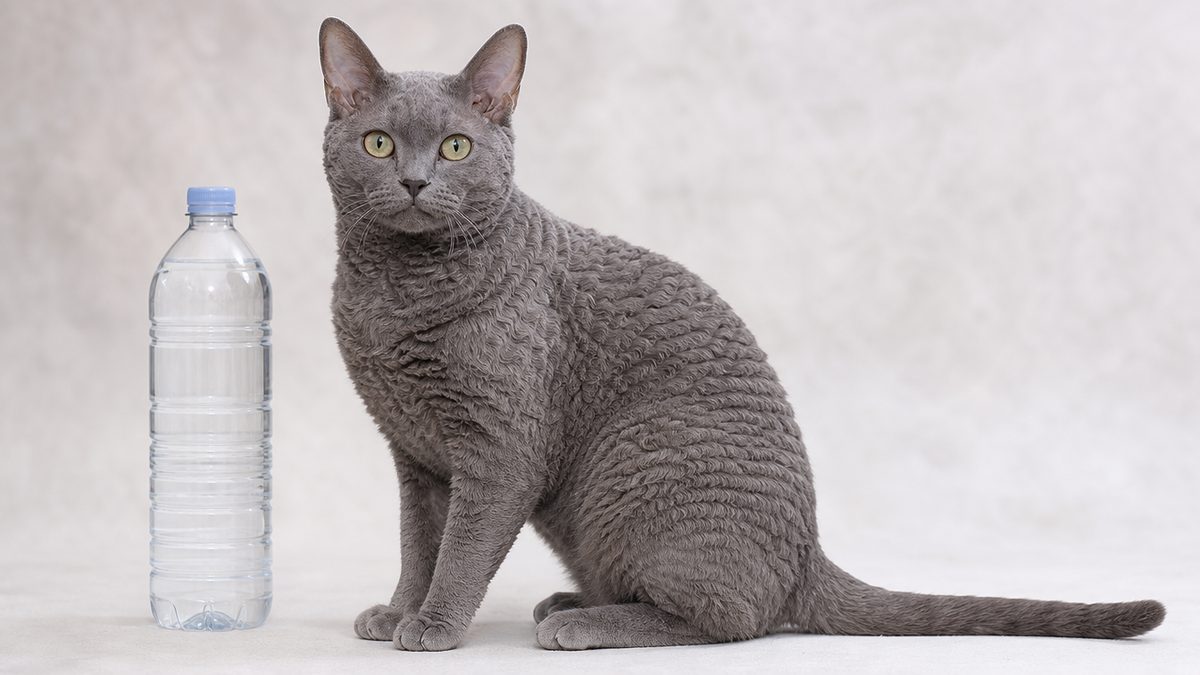
The FIFe breed standard for the German Rex, valid 1 January 2026, describes a medium-sized cat with a rounded head, good breadth between the ears, well-developed cheeks and a strong chin, a body of medium length that is strong and muscular but not massive or coarse, and legs of medium length and rather fine. The back is straight from the shoulders to the rump. The coat is short and velvety, soft and very silky, and its defining feature is stated flatly: wavy, without guard hairs, which the standard calls characteristic for this breed. All colours and patterns are recognised, including any amount of white.
The straight back is the whole difference
Put the two standards side by side and the divergence is structural rather than genetic. The FIFe Cornish Rex standard opens by describing a cat distinguished by its slender and graceful appearance, high on legs, with a wavy soft coat. The German Rex standard asks instead for a straight back from shoulders to rump on a strong, medium body. English Wikipedia puts it in one line: the body development is heavier than in the Cornish Rex, more like the European Shorthair. So a buyer looking at two curly cats is looking at one coat gene expressed on two different frames.
The whiskers are in the standard, and that matters
Both standards score the vibrissae. FIFe asks the German Rex for whiskers shorter than usual, curly, and awards five of one hundred points for the crinkling. The Cornish Rex standard asks for whiskers and eyebrows crinkled or curved, also for five points. The underlying observation is older than either document: the paper that identified the mutation records that the majority of Cornish and German Rex cats have bent and twisted vibrissae. A cat's whiskers are a sensory organ, not decoration, and the health section returns to what is and is not known about that.
| Breed | Gene | Chromosome | Inheritance |
|---|---|---|---|
| German Rex | LPAR6, c.250_253delTTTG | A1 | Recessive |
| Cornish Rex | LPAR6, the identical deletion | A1 | Recessive |
| Devon Rex | KRT71, the re allele | B4 region | Recessive |
| Sphynx | KRT71, the hairless allele | B4 region | Recessive, dominant over the Devon allele |
| Selkirk Rex | KRT71, a splice variant | B4 | Autosomal dominant |
A commercial DNA test exists for the Cornish Rex coat variant. Because the German Rex carries the same LPAR6 deletion, a positive result proves the allele and not the breed. Only a pedigree issued by a FIFe or WCF member club distinguishes a German Rex from a Cornish Rex on paper, and that is the document an Indian buyer is least likely to be shown.
German Rex price in India: there is not one
There is no German Rex price in india, and saying so is the most useful thing this section can do. Bonbeno found no Indian breeder, no Indian retailer, no Indian marketplace listing and no Indian price guide that carries this breed.
The search was run on 3 September 2026 through google.com with gl=IN and hl=en, rendered rather than raw-fetched, and a Labrador control passed in the same session on the same endpoint, so the instrument was working. The commercial query returned no Indian listing for a German Rex. What it returned instead is worth naming, because each item is a different way of looking like a price without being one.
- A livestock marketplace offering Devon Rex kittens under a Curly Coat Cat category, which is breed substitution rather than supply.
- An Amazon.in result at Rs 1,974 shipped by a seller trading as Infinite Books, which is a book about the Devon Rex and not a cat.
- A veterinary pharmacy page at Rs 422 attached to a Devon Rex grooming URL, which is a product.
- A Google AI answer that opens by stating the breed is virtually unavailable in India, then prints a rupee band anyway.
The answer engine says there is no price, then prints one
Google's AI Mode answer for the commercial query states that the German Rex is extremely rare in India with no standard or fixed market price available locally, and in the next breath gives roughly Rs 60,000 to Rs 2,00,000. Do the division. The band it cites is the European one, 650 to 2,200 euros, published by zooplus. Sixty thousand divided by 650 is 92.31, and two lakh divided by 2,200 is 90.91. Those are euro conversion rates, not observations of an Indian market. The same answer then offered a further figure of Rs 3,00,000 to Rs 5,000,000 with no source attached and with the digit grouping switching mid-sentence.
A converted price is not a price. A price is what someone in India actually charged for a cat of this breed, and no such transaction is visible anywhere Bonbeno looked.
What the nearest comparison costs, and why even that is boilerplate
The closest thing to an Indian rex price is the Cornish Rex, which one Indian breed site puts at Rs 1,50,000 to Rs 4,00,000. Read the rest of that page before leaning on it. Its running-cost rows are Rs 2,800 basic and Rs 4,200 premium a month, food Rs 1,500 to Rs 2,000, health Rs 500 to Rs 700 and grooming Rs 800 to Rs 1,500. Bonbeno has recorded that exact set of five lines, to the rupee, on unrelated cat breeds on the same site, including breeds whose coats could not possibly cost the same to maintain. It is a preset row assigned per breed from a shared table, not an observation of a Cornish Rex.
| Figure | Attached to | What it actually is |
|---|---|---|
| Rs 60,000 to Rs 2,00,000 | Google AI Mode | 650 to 2,200 euros divided at about 91 |
| Rs 3,00,000 to Rs 50,00,000 | Google AI Mode | No source given |
| Rs 1,974 | Amazon.in | A book, shipped by a bookseller |
| Rs 422 | A veterinary pharmacy | A grooming product |
| Rs 1,50,000 to Rs 4,00,000 | An Indian breed site | The Cornish Rex, on a page whose cost rows are a shared template |
If a seller in India offers you a German Rex, the first question is not the price. It is which registry issued the pedigree and what the parents' coat genotype is. FIFe and the World Cat Federation are the bodies that register this breed for showing, and WCF lists LOOF alongside them on its own GRX row, so a German Rex without paperwork from one of those is a curly cat of unknown breeding, whatever you are asked to pay. LOOF is the careful case rather than a third option: it holds a German Rex row on its breeding-qualification grid while the breed appears in none of its published pedigree years, which is a stronger statement of rarity than absence would be.
Monthly cost of keeping a curly-coated cat in India
Budget between Rs 3,500 and Rs 7,000 a month for a medium-sized indoor cat in an Indian metro, and treat the first year as roughly double that because of the vaccination course and neutering. Those figures describe a cat of this size in this climate, not a German Rex specifically, and the difference matters.
There is no Indian monthly cost figure for the German Rex because there are no German Rex cats in India to observe. What can be sourced is what any indoor cat costs here, and that is genuinely useful, because it is the number a buyer actually needs.
Vaccination, priced from a live rate card
Vetic, a chain with clinics across seven metros, publishes its cat prices openly. Read live on 3 September 2026, the kitten course runs three visits on days 60, 90 and 120 and starts at Rs 3,999 against a struck-through Rs 5,065; the adult annual booster starts at Rs 1,899 against Rs 1,908; anti-rabies alone is Rs 699 and the CRP combination vaccine, covering panleukopenia, calicivirus and rhinotracheitis, is Rs 1,249. Note the arithmetic: bought separately, rabies plus CRP is Rs 1,948, so the Rs 1,899 booster package saves Rs 49. None of these figures divides cleanly at 84.38, 80 or 74 into a number a seller would print, so they are rupee-native rather than a converted foreign list.
One caution on that rate card. The clinic list it displayed was Bengaluru while the per-vaccine block was headed Mumbai, and Bonbeno has previously recorded Vetic quoting different course prices on different city pages on the same day. Always verify the figure on the page for your own city rather than the national one.
| Item | Typical monthly | Note |
|---|---|---|
| Food, wet and dry | Rs 1,500 to 2,500 | Scale with body weight, not breed |
| Litter | Rs 600 to 1,200 | Clumping clay is the cheapest reliable option |
| Parasite control | Rs 300 to 600 | Year-round in coastal metros |
| Vaccination, amortised | Rs 160 | Rs 1,899 annual booster divided by twelve |
| Routine veterinary | Rs 400 to 900 | Two consultations a year plus contingency |
| Grooming | Rs 0 to 400 | A rex coat needs little; ear care is the real line |
| Realistic total | Rs 3,500 to 7,000 | Before any emergency |
Municipal costs are smaller than people expect, and one of them does not apply
Greater Chennai Corporation licenses pet animals at Rs 50, issued 9,115 pet animal licences in 2024, and runs six veterinary pet clinics that provide all treatment and anti-rabies vaccination free of cost. That last line is worth more to most Indian cat owners than any breed price. Two honest caveats: the heading above that passage reads Licensing of Pet Dogs while the text beneath it says pet animals, so confirm scope at your zonal office; and Delhi's municipal portal registers pet dogs only, so its Rs 500 fee is not a cat cost.
Neutering early is the single largest lever on lifetime cost and on welfare, and it removes the roaming, spraying and fight-abscess costs that dominate unplanned veterinary spending. It also settles the question of what happens to a rare coat allele in an unplanned litter.
Can a German Rex handle the Indian climate?
A German Rex can live comfortably in an Indian flat and cannot live comfortably in an Indian summer without one. The reason is not the humidity, which is the assumption most pages make and which the data contradicts.
Bonbeno queried NASA POWER by explicit latitude and longitude and echoed the elevation of every grid cell returned, because the model reports a cell rather than a place. The Berlin cell sits at 48.98 m against a real city elevation near 34 m, an error of about 15 m, so the figures below describe Berlin.
The homeland is damper than India, not drier
Berlin runs 79.79 percent annual relative humidity. Chennai runs 72.39, Kolkata 73.93, Bengaluru 67.94, Mumbai 67.39, Pune 66.80 and Delhi 45.56. Every one of those Indian cities is drier on an annual mean than the city where this breed was founded. So the standard warning that Indian damp will overwhelm a European cat is, for this breed, simply wrong.
The gap is temperature. Berlin's annual mean is 9.68 degrees C against Chennai's 27.95, and the warmest month in Berlin is July at 20.47 degrees C, which is cooler than the coolest month in Chennai. The useful way to express combined load is wet-bulb temperature, which is what a body can actually shed heat into. Berlin peaks at 16.08 degrees C in July. Kolkata peaks at 27.09 in June, Delhi at 26.50 in July, Chennai at 26.11 in May.
| Place | Cell elevation | Annual mean C | Annual RH percent | Peak wet bulb C |
|---|---|---|---|---|
| Berlin | 48.98 m | 9.68 | 79.79 | 16.08 (Jul) |
| Bengaluru | 841.72 m | 23.74 | 67.94 | 21.86 (May) |
| Pune | 635.99 m | 23.86 | 66.80 | 22.97 (Jun) |
| Delhi | 206.37 m | 25.60 | 45.56 | 26.50 (Jul) |
| Mumbai | 97.15 m | 26.77 | 67.39 | 25.77 (Jun) |
| Kolkata | 7.35 m | 25.81 | 73.93 | 27.09 (Jun) |
| Chennai | 48.95 m | 27.95 | 72.39 | 26.11 (May) |
What a coat with no guard hairs changes
The FIFe standard states that the German Rex coat is wavy and without guard hairs, and calls that the breed's essential characteristic. Guard hairs are the coarse outer layer, and they are the part of a cat's coat that carries most of its protection against direct sunlight. A rex coat is therefore not a hot-weather advantage. It is thinner cover on skin that still burns, which is why this cat belongs indoors in India and why a sunny window ledge in May is not a kindness.
The heat tolerance rating on this page is 2 for that combination: a founder climate eleven degrees cooler than Chennai on an annual mean, and a coat with less physical protection than an ordinary shorthair's. A heat-sensitive cat in India needs shade, airflow and water more than it needs anything a breed page usually discusses.
- Keep the cat indoors between 11am and 4pm from March to June in every city in the table above.
- Provide two shaded rest spots on hard cool surfaces, because a cat will choose floor tile over a bed when it is hot.
- Run airflow rather than only cooling, since evaporative loss from the paw pads and by grooming is how a cat sheds heat.
- Set out more water than you think, in wide bowls placed away from food, because cats drink poorly near a strong food smell.
- Plan for power cuts if you rely on air conditioning, which in Bengaluru specifically means checking generator backup during the March to May load-shedding season.
The obvious answer to Indian heat is a hill station, and the data will mislead you if you take it at face value. The NASA POWER cell over Shimla sits at 897.65 m against a real town elevation near 2,200 m, an error of about 1,302 m, and it duly reports a June mean of 30.25 degrees C for a place that is nothing like that warm. Shimla is genuinely cooler than the plains. The model just cannot tell you by how much.
Temperament and who should not buy one
The German Rex is described everywhere as devoted, intelligent, friendly, lively, active and playful, and as a cat that attaches hard to its people. Treat that as consensus rather than measurement, because no behavioural study of this breed exists.
The temperament descriptors are consistent across the sources, which is worth something even without data behind it. Wikipedia's account is that a German Rex is very friendly, quickly bonds with its human, and is lively, playful and intelligent, with a temperament much the same as a Cornish Rex. Zooplus reaches the same conclusion and adds a practical recommendation that matters in India: it advises a multi-cat household rather than a single cat.
The part that is a warning, not a selling point
A cat that bonds hard and dislikes being alone is a poor fit for the household most Indian buyers actually have, which is two working adults out of the flat for nine hours. An affectionate breed is not a low-maintenance breed. If nobody is home during the day, the honest answer is either a second cat or a different animal.
- Buy this breed if you are home often, want an interactive cat, and can keep it entirely indoors.
- Buy a second cat with it if the flat is empty during working hours, which is what the breed's own literature recommends.
- Do not buy it if you want a cat that tolerates long solitude, or one that can safely spend afternoons on a Chennai balcony.
- Do not buy it at all if the seller cannot name the registry, because in India the realistic outcome is that you are buying an unrelated curly cat.
Every ranking page for this breed is warm about the personality and thin about the genetics. Those are separate questions. A friendly cat can still carry a coat allele you cannot verify and a screening requirement its own national studbook takes seriously.
Training a German Rex, and what it resists
Train a German Rex the way you would train any intelligent, food-motivated cat: short sessions, a marker sound, and a reward within two seconds. The breed's own literature describes it as intelligent and people-oriented, which is the profile that responds best to shaping and worst to correction.
There is no breed-specific training literature for the German Rex, so this section says what applies to a bright, active domestic cat and marks it as such rather than dressing it up as breed knowledge.
The three things worth teaching in an Indian flat
- Carrier training, first and above everything. A cat that walks into a carrier voluntarily is a cat that gets to the vet in an emergency instead of being fought into a box. Feed every meal in an open carrier for two weeks.
- Handling tolerance for ears, paws and skin, because a rex coat means you will be checking ears and skin more often than a shorthair's owner does.
- Recall to a sound, which is the cheapest safety tool there is in a building with open stairwells and monsoon-open windows.
What this cat resists is the same thing every cat resists. Punishment does not teach a cat what to do instead, it teaches the cat that hands are unpredictable, and with a breed this attached to its people that is an expensive lesson to undo. Train in two-minute blocks before a meal, never after one.
Litter training is not a breed question
One tray per cat plus one, unscented clumping litter, and a tray that is never beside the food or the noisy washing machine. In Indian flats the commonest cause of a house-soiling complaint is a covered tray in a hot bathroom, which concentrates ammonia and smells worse to the cat than to you.
Because the coat has no guard hairs and the whiskers are shortened and curled, get this cat used to close inspection early. You want to be able to look at skin, ears and eyes without a wrestling match, and the time to build that is at twelve weeks, not at three years when something is already wrong.
Daily exercise, and what happens without it
Give a German Rex two to three interactive play sessions a day, ten to fifteen minutes each, and build the flat upwards. This is an active breed described as lively and playful by every source, and an active cat in a small Indian flat with nothing to climb becomes a destructive or an overweight one.
The requirement is not a distance or a duration on a chart. It is a pattern: short, intense bursts that end in a catch, because a hunt sequence that never resolves leaves a cat wound up rather than settled. Finish the last session before the evening meal and the cat will sleep when you do.
Vertical space is the Indian constraint
Most Indian flats have floor area problems and ceiling height opportunities. A single tall cat tree, two wall shelves and a windowsill perch triple the usable territory without taking a square foot from the living room. That matters more for an indoor-only cat than any toy does.
- Rotate three toys rather than leaving twelve out, because novelty is what sustains interest.
- Use wand toys for the interactive sessions and let the cat catch the lure at the end.
- Skip laser pointers as the main game, since a hunt with no catch is frustrating rather than satisfying.
- Feed part of the ration from a puzzle feeder, which converts eating into activity and slows an indoor cat's weight gain.
- Watch the weight monthly, because an indoor neutered cat in an air-conditioned flat gains quietly.
What happens without it is predictable and is the commonest reason a young cat ends up rehomed: night-time zoomies, furniture damage, over-grooming, and a body condition score creeping upward until a vet raises it at the annual booster.
The exercise answer for a rex-coated cat in India is not a garden. A coat without guard hairs offers less protection from direct sun, and outdoor access in an Indian city also means traffic, territorial fights and tick exposure. Build the exercise indoors.
Grooming a coat with no guard hairs, in Indian humidity
Groom a German Rex less than you would groom almost any other pedigree cat, and check its ears and skin more. The short, soft, silky, guard-hairless coat does not mat, so brushing is close to optional; the work moves to the parts a brush never reaches.
The FIFe standard describes the coat as short and velvety, soft and very silky, with density varying from a thin and soft to a thick uppercoat, and wavy without guard hairs. A coat like that has nothing to tangle. Weekly hand-smoothing or a rubber mitt lifts loose hair and spreads skin oil, and that is the whole of the grooming routine for the body.
Ears are where the Indian work is
The standard asks for the outside of the ear to be well covered with fine hair and the inside only slightly covered. Less hair inside a large open ear means less of the natural barrier that keeps debris out, and an Indian metro supplies plenty of debris plus warmth and moisture. Check ears weekly. A little pale wax is normal; a dark crumbly discharge, a smell, or head-shaking is a vet visit, not a cotton-bud job.
- Smooth the coat weekly with a rubber mitt or a bare hand rather than a slicker brush, which can break a fine coat.
- Inspect ears weekly, and never insert anything rigid into the canal.
- Bathe only when genuinely dirty, and never leave the cat damp in a humid room, because a coat this fine holds water against skin longer than it looks like it should.
- Watch the skin, not the fur, since thinning cover shows problems earlier than a dense coat does.
- Trim claws every two to three weeks, which is a task, not a mutilation. Declawing is amputation and is not something to ask for.
Shedding, and the claim that gets attached to it
Yes, this cat sheds, and yes, it is less visible than a double coat because the hair is short and there are no guard hairs. That is a housekeeping benefit and nothing more. Zooplus raises the allergy question under its own heading and stops short of claiming immunity, which is the correct place to stop. Cat allergy is driven by Fel d 1, a protein produced in saliva and skin that a curly coat still carries and still deposits around a flat. No cat breed is hypoallergenic, and an Indian buyer paying a premium on that promise is buying a claim nobody can support.
A coat with no guard hairs is already the thinnest protection a cat can have while still being coated. Clipping it for the summer removes what remains and exposes skin that has never seen direct sun. If a groomer in an Indian metro suggests a summer clip for this breed, decline.
German Rex health: two ranking pages say there are no problems, a national studbook disagrees
Two pages ranking on page one for this breed state that it has no known genetic disorders. The French national studbook requires every German Rex breeding cat to be DNA tested for two named diseases before it can be graded. Both statements are in print, and only one of them is a rule that binds anybody.
Cats.com writes that German Rex cats are generally very healthy with no known genetic disorders. Scrumbles writes that they are exceptionally healthy with no known genetic predisposition to particular health issues. Set against that, the Livre Officiel des Origines Félines, the French national feline studbook, publishes a Grille de Qualification des Reproducteurs that names what breeding cats of each breed must be tested for. The German Rex row reads, at every one of the three grading levels: PKDef: N/N or N/PKLR and PRA-rdAc: N/N or N/CEP290.
PKDef is pyruvate kinase deficiency, an inherited enzyme defect that causes intermittent haemolytic anaemia. PRA-rdAc is the rdAc form of progressive retinal atrophy, which causes late-onset blindness. A national registry does not write two mandatory genetic tests into its breeding grid for a breed with no health question.
The asymmetry inside that same table is the sharper finding
Look one row up. The Cornish Rex must be PRA-rdAc: N/N at every level, with no carrier state permitted. The German Rex is allowed N/N or N/CEP290, meaning a carrier may still be graded. Same disease, same table, same registry, two different bars. The most likely explanation is population size: a breed this small cannot afford to exclude carriers without collapsing its gene pool. Bonbeno cannot prove that motive, and says so, but the two-tier rule is on the page and no ranking source mentions it.
| Breed | Required at grade 3, Selectionne | Carrier permitted? |
|---|---|---|
| German Rex | PKDef N/N or N/PKLR; PRA-rdAc N/N or N/CEP290 | Yes, for both |
| Cornish Rex | PRA-rdAc N/N | No |
| Devon Rex | CMS N/N or N/COLQ | At grade 3 only |
| Selkirk Rex | PKD N/N | No |
| Cymric and Manx | None listed | Not applicable |
What the coat gene does elsewhere in the body
The paper that identified the mutation says something the breed pages never quote. LPAR6 mutations in humans cause autosomal recessive woolly hair, reported in Pakistani, Turkish and Indian families, and disruption of the same gene can cause hypotrichosis, meaning sparse or short hair. The authors then measure the cat against that: although the alteration to the LPAR6 protein is severe, the cat presents mild hypotrichosis compared with humans, in whom point mutations affecting the receptor can be associated with complete hair loss. So the cat is at the gentle end of a spectrum whose severe end is human baldness.
In dogs, hairlessness runs on FOXI3, and the same haploinsufficiency produces a dental phenotype, which is why hairless dog breeds have missing teeth Wiener DJ, Gurtner C, Panakova L. It is tempting to carry that across to a thin-coated cat. Do not. A PubMed search for FOXI3 together with cat returns zero records, while FOXI3 with dog and hairless returns seven in the same session, so the term is indexed and the zero is real. Feline rex and hairless coats run on at least four genes, none of them FOXI3, and there is no published feline equivalent of the canine tooth-loss finding. LPAR6 carries the Cornish and German Rex and KRT71 the Devon, Sphynx and Selkirk, while OMIA adds LIPH for the Ural Rex (OMIA:002273-9685) and HR for the Lykoi (OMIA:002229-9685), both filed in 2020.
Which registries hold this breed, and the origin story the paper and the record disagree on
Two international registries hold the German Rex as a breed and three do not, and the disagreement is not a technicality. It decides whether the cat you are offered has any paperwork at all.
FIFe recognises the German Rex fully, under the EMS three-letter code GRX, in category 4, recognised in 1982, and files it in the same judging group as the Cornish Rex, Devon Rex, Don Sphynx, Sphynx, Abyssinian, Japanese Bobtail, Russian Blue and Somali. The World Cat Federation also holds it, again as GRX, in its shorthair list. FIFe recognised the Cornish Rex fourteen years earlier, in 1968.
Against that, three bodies do not register it. CFA's Color Prefix Chart, which lists every breed CFA registers under 46 breed headings, contains no German Rex heading and the string German appears zero times, while Cornish Rex, Devon Rex, Selkirk Rex, LaPerm and Sphynx are all present as in-document controls. TICA holds no German Rex in any of its four classes: it is absent from the championship index that carries Cornish Rex, Devon Rex, Selkirk Rex and Tennessee Rex, absent from Advanced New Breeds, which held only the Serengeti and Toybob when checked on 3 September 2026, and absent from the Preliminary New Breed class, which on that date was empty.
The GCCF says out loud what the problem is
The British registry is the most useful of the three, because it explains itself. The GCCF lists the German Rex on its unrecognised-breeds page at Acceptance Grade A, on the green list, with the Genetics Committee comment: not applied, probable acceptance if different from other breeds and supported by the Rex Breed Advisory Committee. Its recommended similar breed is the Cornish Rex. That conditional is precisely the question the genetics answer, and the answer is unhelpful to the application.
| Body | Status | Code | In-document control |
|---|---|---|---|
| FIFe | Fully recognised, category 4, since 1982 | GRX | CRX, DRX, SPH present |
| World Cat Federation | Recognised, shorthair | GRX | CRX, DRX, MAN present |
| CFA | Not registered | None | CRX, DRX, Selkirk present |
| TICA | Absent from all four classes | None | CRX, DRX, Selkirk, Tennessee Rex present |
| GCCF | Unrecognised, green list, grade A | None | Cornish Rex named as the similar breed |
| LOOF | Recognised, with two mandatory DNA tests | None quoted | Cornish, Devon, Selkirk rows present |
A rarity number nobody else publishes
The French studbook is the only body found that publishes a live per-breed count, and its numbers are stark. Across 2003 to 2022 it issued 1,423 Cornish Rex pedigrees and 3,163 Devon Rex, and in 2024 alone 82 Cornish Rex, 246 Devon Rex and 120 Selkirk Rex longhair Livre Officiel des Origines Félines. The German Rex appears in no year of either table. That is not a zero row: the tables do carry zero rows, since the European Shorthair is printed at 0 for both 2023 and 2024. The German Rex simply never enters the pedigree tables at all, while holding a row in the same registry's health-screening grid. A recognised breed with mandatory DNA tests and no recorded births is an unusually precise picture of how rare this cat is.
Where the breed came from, and where the sources part company
The record and the paper tell different stories about direction of descent, and both are in print. Gandolfi and colleagues describe the German Rex as a breed with few individuals developed from Cornish Rex, and conclude it was established from a mutation unique to the Cornish Rex breed. The historical account runs the other way. English Wikipedia records that a Berlin doctor, Rose Scheuer-Karpin, found a black curly-coated cat in the Hufelandklinik hospital garden at Berlin-Buch in the summer of 1951, that clinic staff had known the cat since 1947, that she named it Lammchen, and that Lammchen is the maternal ancestor of all current German Rex cats; it further states that most of her descendants were used to improve other breeds, the Cornish Rex among them.
The dates matter. The Cornish founder, Kallibunker, was born in 1950, and staff knew Lammchen from 1947. The earlier literature also treats the two as separate discoveries: Robinson published the German Rex as a rexoid coat mutant in its own right in 1968, then in 1971 asked whether the rex mutants of the domestic cat were the same locus, and named the Oregon Rex as a fourth rexoid mutant in 1972. Gandolfi's paper genotyped four German Rex cats and did no pedigree analysis, so it establishes the shared allele beyond argument and does not establish the direction of descent.
CFA settles the question from the paperwork side
There is one more document, and it is the bluntest of the lot. CFA does not register the German Rex, but its Rules of Registration for the Cornish Rex carry a breed note consisting of a single sentence: Listed in Germany as German Rex. The same document records the Cornish Rex's registration as effective April 1962, championship effective 1 July 1964, a five-generation pedigree requirement, an allowable outcross to the American Shorthair for cats born before 1 January 1984, and colourpointed cats accepted in October 1980. So the largest registry in the world states in its own registration rules that the breed Germany calls the German Rex is the cat it calls the Cornish Rex. That is a filing position rather than a genetic finding, and it happens to agree with the genetics.
That the German Rex and Cornish Rex carry the same LPAR6 deletion is settled. Whether the German Rex descends from Cornish stock, whether the same deletion arose twice, or whether Berlin supplied Cornwall, is not settled by any document we opened, and the two accounts that exist point opposite ways. We publish the disagreement rather than picking the more convenient half. Wikipedia's own history carries a citation-needed marker in places and gives two different death years for Lammchen, so treat its detail as an account rather than a record.
Feeding a German Rex in India
Feed a German Rex the way you would feed any medium-sized active indoor cat: a meat-based diet, measured portions twice a day, and constant fresh water. There is no published feeding requirement specific to this breed and no evidence that a rex coat changes nutritional need.
The claim that a rex cat has a higher metabolism because it lacks guard hairs circulates widely and rests on nothing published. What is true is simpler. A cat is an obligate carnivore, an indoor neutered adult burns less than an entire outdoor one, and body condition is the number to watch rather than the bowl.
Life stages, and the only figures worth writing down
| Stage | Feeding pattern | What to watch |
|---|---|---|
| 8 to 16 weeks | Four meals a day, kitten formulation, free access to water | Weight gain every week, formed stools |
| 4 to 12 months | Three meals a day, still kitten formulation | Growth flattening at about ten months |
| 1 to 7 years | Two measured meals a day, adult formulation | Body condition score, monthly |
| 7 years and over | Two meals, senior formulation if the vet advises | Weight loss, thirst, appetite change |
Feed wet food as a meaningful share of the ration in India. A cat evolved to take most of its water from prey and drinks poorly by choice, and in a hot climate that gap shows up as concentrated urine long before it shows up as thirst. Wet food is the cheapest urinary insurance there is.
- Measure the ration with a scale rather than a cup, because kibble density varies by brand.
- Place water away from food, at least a metre, since cats drink less near a strong food smell.
- Offer wide shallow bowls, which avoid whisker contact with the rim. That matters more here than for most breeds, since the whiskers are already shortened and curled.
- Avoid free-feeding in an air-conditioned flat, where an indoor cat will eat from boredom.
- Budget Rs 1,500 to Rs 2,500 a month for food for a cat of this size.
A standard that asks for whiskers shorter than usual and curly describes a cat whose sensory map of a narrow space is different from an ordinary cat's. Nobody has studied whether that changes feeding behaviour, and Bonbeno will not invent a finding. A wide shallow bowl costs nothing and removes the question.
The first year, month by month
A German Rex kitten's first year follows the ordinary feline timetable with two breed-specific twists: the coat changes character as it matures, and Indian law sets no microchipping requirement for kittens, so the paperwork is on you.
Indian law sets the earliest legal handover. The Prevention of Cruelty to Animals (Pet Shop) Rules, 2018 define an un-weaned animal to include kittens and pups below eight weeks at rule 2(1)(p)(ii), and rule 7(15) states that no pet shop shall sell un-weaned or underage animals. Eight weeks is the floor, not the target. Twelve weeks is better for socialisation and for the second vaccine.
| Age | What happens | What you do |
|---|---|---|
| Day 60 | First CRP vaccine | Kitten course begins, from Rs 3,999 for three visits |
| Day 90 | Anti-rabies and CRP | Second visit |
| 8 to 12 weeks | Earliest lawful handover is 8 weeks | Wait for 12 if you can |
| Day 120 | CRP and anti-rabies complete | Only now begin outside-household socialisation |
| 4 to 6 months | Rapid growth, coat still changing | Build carrier and handling tolerance |
| 5 to 6 months | Neutering window | Discuss timing with your vet |
| 6 to 9 months | Adult coat character settles | Judge the wave now, not at ten weeks |
| 12 months | First annual booster due | From Rs 1,899 including rabies and CRP |
Do not judge the coat at ten weeks
A rex coat is unreliable in a young kitten. The FIFe standard itself allows that density varies from a thin and soft to a thick uppercoat, and rex coats in general are known to change through the first year before settling. That cuts both ways for a buyer: a genuine kitten can look wrong at ten weeks, and a straight-coated kitten of another breed can be sold on the promise that the wavy coat is coming. Neither is resolved by looking.
Rule 7(16) of the Pet Shop Rules, 2018 requires that every puppy be microchipped by a veterinary practitioner and that only microchipped puppies are sold. The rule names puppies and nothing else, so kittens fall outside it. Rule 7(17)'s written exercise plan is likewise for pups. Ask for a chip anyway, and get the number written on the receipt the shop must issue under rule 7(13).
German Rex against the curly cats you can actually get in India
Compare the German Rex against the Devon Rex, the Cornish Rex and an Indian shorthair, because those are the real alternatives. Two of them are obtainable here, one is a paperwork problem, and the German Rex is the only one with no Indian supply at all.
The comparison that matters to an Indian buyer is not German Rex against Cornish Rex on breed points. It is which of these cats you can obtain, verify and keep well in this climate.
| German Rex | Cornish Rex | Devon Rex | Indian shorthair | |
|---|---|---|---|---|
| Coat gene | LPAR6 deletion | The same LPAR6 deletion | KRT71, re allele | None |
| Body type | Medium, straight back, muscular | Slender, arched, high on legs | Medium, cobby, huge low ears | Variable |
| Registered by | FIFe, WCF | All five majors | All five majors | Not applicable |
| Indian availability | None found | Listed, at a premium | The most available of the three | Everywhere, free |
| Published Indian price | None exists | Rs 1,50,000 to 4,00,000 | Quoted below the Cornish | Adoption fee at most |
| DNA test tells you | That it carries the allele, not which breed | CR/CR confirms the variant | DR/DR confirms the variant | Not applicable |
| Heat suitability | Indoor only | Indoor only | Indoor only | Adapted |
The verification problem is the deciding factor
For a Devon Rex, a coat genotype result of DR/DR tells you the cat carries the Devon allele of KRT71. For a Cornish Rex, the equivalent result confirms the LPAR6 deletion. But because the German Rex carries the identical LPAR6 deletion, that same test cannot distinguish a German Rex from a Cornish Rex. There is no DNA test in the world that will tell you which of those two breeds you are holding. Only a FIFe or WCF pedigree does that, and there is no Indian route to one.
How the breeders proved this in 1961, before anyone could sequence
The Cornish and Devon curls were shown to be different genes by a test mating: cross a curly Devon to a curly Cornish and every kitten is straight-coated, because the two recessives sit at different loci and neither parent supplies a second copy of the other's allele. The same logic ran the other way for the German Rex. Robinson's breeding studies concluded that the Cornish and German rex mutants were either identical or different alleles at the same locus, and the molecular work fifty years later showed which: identical.
If you want a curly cat in India and you want to know what you bought, the Devon Rex is the answer, because it is the one that is actually here and the one whose coat test is diagnostic. If you want a cat suited to this climate at no purchase cost, the adoption section below is the answer.
What Indian buyers get wrong about the German Rex
Every mistake on this list starts from the same place: treating the German Rex as a distinct rare breed that happens to look like a Cornish Rex, rather than as the same coat allele on a different frame. Get that right and the rest follows.
Paying a rarity premium for a curl anyone can produce
The German Rex is genuinely rare, and that is not a reason to pay a premium in India, because there is nothing here to buy. Any curly kitten offered in India is far more likely to be a Devon Rex, a Cornish Rex or a curly cat of no fixed breeding than a German Rex. The only marketplace listing that surfaced on the commercial query was a Devon Rex filed under a curly-coat heading.
Believing the no-known-health-problems line
Two page-one sources say this breed has no known genetic disorders Scrumbles, German Rex Cat Breed Guide. The French national studbook requires two DNA tests of every German Rex breeding cat. When a marketing claim and a registry rule disagree, follow the rule. Screening exists because somebody had a reason to write it down.
Assuming a coat test settles the breed
It does not, and this is the single most expensive misunderstanding available here. The German Rex and the Cornish Rex carry the identical LPAR6 deletion, so a positive coat test is consistent with either breed and with a well-bred mixed cat carrying two copies. Ask for the pedigree and the issuing registry, not the lab report alone.
Trusting a rupee figure produced by an answer engine
Google's AI answer for this breed states that no Indian price exists and then prints one, converted from a euro band at roughly 91 rupees to the euro, followed by a further range with no source at all. That is arithmetic wearing the clothes of a market observation. Any rupee figure you are shown for this breed should be traced to a page, and that page checked for whether it is selling a cat, a book or a grooming product.
Shaving the cat for the Indian summer
A coat that the standard itself describes as without guard hairs is already minimal protection. Clipping it exposes skin with no history of sun. The correct summer response is shade, airflow, water and an indoor routine, which is what the climate section sets out.
Buying on the hypoallergenic promise
No cat is hypoallergenic. A short coat without guard hairs sheds less visibly, and that is a housekeeping fact, not an immunological one. Spend an hour with a curly cat before you commit, and if the reaction is the reason you are buying this breed, buy nothing.
Taking an eight-week kitten because the seller is ready to hand it over. Eight weeks is the legal floor under rule 7(15) read with rule 2(1)(p)(ii) of the Pet Shop Rules, 2018, not a recommendation. Twelve weeks gives a second vaccine and three more weeks of social learning, and costs you nothing but patience.
Adoption, and what to do instead
Adopt rather than import, because there is no lawful commercial route to a German Rex in India and there is a very good cat waiting in every Indian city. This section is the practical answer to a page that has spent nine sections explaining why the breed is unobtainable here.
India's import rules permit a pet animal to accompany a returning owner under baggage provisions with proper documentation, and reject applications to import animals for trading or breeding purposes. Combine that with the absence of any Indian breeding population and the conclusion is not a matter of opinion: no lawful supply chain for this breed can form here. That is the finding, and it is more useful than a price would be.
What is actually available, and why it is a better cat for this climate
The Indian shorthair, the ordinary domestic cat of every Indian city, is adapted to the climate this page has spent a section describing. It carries no coat mutation, needs no genetic screening, costs nothing beyond a shelter's fee, and arrives with the one thing no imported rare breed can offer, which is a body evolved for 27 degrees C and high humidity.
- Contact your municipal veterinary service first. Greater Chennai Corporation runs six pet clinics providing all treatment and anti-rabies vaccination free of cost, and licenses pet animals at Rs 50.
- Ask shelters for an adult, not only a kitten. An adult cat's temperament is already visible, which removes the single biggest gamble in taking any animal.
- Budget the same money you would have spent on a purchase and put it into neutering, vaccination and a good first year instead.
- Take the vaccination course seriously, which starts at Rs 3,999 for three visits and is the best value in Indian pet care.
- Register the cat where you can. Chennai issued 9,115 pet animal licences in 2024; Delhi's municipal system covers pet dogs only, so there is nothing for a cat owner to file there.
If you are determined to have a curly cat
Buy the breed that is actually here and can be verified. The Devon Rex is the most available of the three rex breeds in India, and its coat test is diagnostic for the KRT71 re allele. Ask for the registration document, ask which registry issued it, and ask for the parents' results. A seller who cannot answer those three questions is not selling you a pedigree cat, whatever the price list says.
What the law requires of anyone selling you a cat in India
The Pet Shop Rules, 2018 give an Indian buyer more leverage than most people use. A pet shop must be registered; may not sell an un-weaned or underage animal under rule 7(15); may not sell any animal with any form of mutilation under rule 7(14); must display species, numbers and prices prominently under rule 7(12); must issue a receipt in Form IV under rule 7(13); and must offer only animals certified healthy in writing by a veterinary practitioner. The Second Schedule paragraph 2, headed FOR CATS, additionally requires elevated resting surfaces, matting, clean play toys, and that cats or kittens are kept in a room not shared with inimical species such as dogs, and it excludes the litter box area from the enclosure size calculation.
Rule 7(13) requires a receipt in Form IV for every pet animal sold, and rule 6(5) makes the shop responsible for providing an ambient and comfortable temperature appropriate to the breed it chooses to deal in. Asking for the Form IV receipt in writing, with the microchip number on it, converts a verbal promise into a document. It is the cheapest protection an Indian buyer has and almost nobody asks for it.
Life expectancy, and how to check what you were sold
Bonbeno publishes no life expectancy figure for the German Rex, because no study of this breed's lifespan exists. Every number in circulation is a general domestic-cat range with a breed name attached to it.
Scrumbles gives 10 to 15 years, which is the ordinary span of a well-kept indoor domestic cat and is not a measurement of this breed. There is no published life table that separates the German Rex from cats in general, no breed health survey, and no mortality dataset. Where a number cannot be sourced, this site says so rather than borrowing the Cornish Rex's and relabelling it.
That absence is not neutral. Two of the sources ranking for this breed assert positive health claims with the same evidential backing, which is none. A page that can tell you a breed is exceptionally healthy but cannot tell you how long it lives is describing a hope rather than a population.
The founder cat, and what a single ancestor means
The breed traces to one animal. The founder cat was a black curly female found in the Hufelandklinik hospital garden in Berlin-Buch in the summer of 1951 by a doctor named Rose Scheuer-Karpin, known to clinic staff since 1947 and named Lammchen, and English Wikipedia describes her as the maternal ancestor of all current German Rex cats. The first deliberately bred German Rex kittens came in 1957 from Lammchen mated back to her own straight-coated son.
A breed founded on one female and continued through a mother-to-son mating starts with an extremely narrow gene pool, and that context is what makes the French studbook's screening rule read the way it does. It also explains why LOOF permits a German Rex carrier to be graded while requiring the Cornish Rex to be clear. Treat Wikipedia's account as a history rather than a register: it carries a citation-needed marker in places and gives two different death years for Lammchen.
The four checks that are actually available
- Ask which registry issued the pedigree. Only FIFe and the World Cat Federation register this breed, so any other answer means the cat is not a documented German Rex.
- Ask for the parents' PKDef and PRA-rdAc results. The French studbook requires both of every German Rex breeding cat, so a serious breeder anywhere will have them.
- Look at the whiskers. Curly whiskers, shorter than usual, are written into the FIFe standard and scored at five of one hundred points, and straight full-length whiskers on a curly-coated cat are a question worth asking about.
- Look at the back. The German Rex standard asks for a straight back from shoulders to rump while the Cornish Rex is arched and high on legs. That is the only visible difference between two cats carrying the same coat allele.
The paper that identified the mutation states in its abstract that the deletion is absent in all straight-haired cats analysed, and states in its results that it was found heterozygous in two straight-haired German Rex cats. Both sentences are in the same paper. A heterozygote carries the deletion without showing the curl, which is what recessive means, so the results section is the one to follow. We flag it rather than quietly picking a side.
German Rex questions Indian readers actually ask
What is the temperament of a German Rex cat?
The German Rex is described by every registry and ranking source as devoted, intelligent, friendly, lively, active and playful, and as strongly people-oriented. Zooplus recommends keeping one in a multi-cat household rather than alone. Treat this as breeder and registry consensus, because no behavioural study of the breed exists.
What is a rex breed of cat?
A rex cat is one whose coat is curled or waved by a mutation, and there are at least four separate ones. The Cornish and German Rex share a deletion in LPAR6 on chromosome A1. The Devon Rex and Sphynx carry different alleles of KRT71. The Selkirk Rex carries a third KRT71 variant that is dominant rather than recessive.
Are Devon Rex expensive cats?
In India the Devon Rex is the cheapest of the three rex breeds with a published price, and it is the only one an Indian buyer is realistically offered. Happy Pet puts the Cornish Rex at Rs 1,50,000 to Rs 4,00,000, which starts above where the published Devon Rex bands finish. No Indian price exists for the German Rex at all.
Are Selkirk Rex cats rare?
Less rare than the German Rex by a wide margin, and the French national studbook gives the number. LOOF issued 120 Selkirk Rex longhair pedigrees in 2024 and 82 Cornish Rex, while the German Rex appears in no year of its published pedigree tables at all. Rarity claims about curly cats are usually made without a denominator.
Is the German Rex the same as the Cornish Rex?
Genetically, yes at the coat locus. Gandolfi and colleagues found the identical four-base-pair LPAR6 deletion in German Rex cats, homozygous in two curly cats and heterozygous in two straight-haired ones, and concluded the German Rex was established from the mutation that defines the Cornish Rex. The two breeds differ in body type, not in the gene that curls the coat.
How much does a German Rex cost in India?
No Indian price exists. Bonbeno found no Indian breeder, retailer, marketplace or price guide listing the breed. Google's own AI answer says the same thing and then prints a rupee band converted from a European euro figure at roughly 91 to 92 rupees per euro, which is arithmetic rather than a market observation.
Is the German Rex hypoallergenic?
No cat breed is hypoallergenic, and a coat without guard hairs does not change that. Cat allergy is driven by Fel d 1, a protein in saliva and skin that a curly coat still carries and still spreads. Zooplus raises the question under its own heading and does not claim immunity. Meet the cat before you commit.
Does the German Rex have health problems?
Two ranking pages say it has none. The French national studbook disagrees in writing, requiring every German Rex breeding cat to test clear or carrier for pyruvate kinase deficiency and for progressive retinal atrophy before it can be graded at any level. Nobody imposes that on a breed with no health question.
Why are the German Rex's whiskers short and curly?
Because the same LPAR6 mutation that waves the coat also affects the vibrissae. Gandolfi and colleagues record that the majority of Cornish and German Rex cats have bent and twisted whiskers, and the FIFe standard describes them as shorter than usual and curly while awarding five of one hundred points for the crinkling.
Can I import a German Rex into India?
Not as a purchase. Indian import policy allows a pet cat to accompany a returning owner under baggage rules with a valid pet book, but applications to import animals for trading or breeding are rejected. Between that and the absence of any Indian breeding population, no lawful commercial supply chain for this breed can form.
Do German Rex cats shed?
Yes, but less visibly than a double-coated breed, because the coat is short and lacks guard hairs. That is a grooming convenience, not an allergy benefit. In Indian humidity the practical issue is skin and ear hygiene rather than hair on the sofa.
How long do German Rex cats live?
No lifespan study of the German Rex exists, and Bonbeno publishes no figure for it. Ranking pages quote 10 to 15 years, which is a general domestic-cat range rather than a measurement of this breed. Treat any breed-specific lifespan number for the German Rex as unsourced.
Compare with similar breeds
German Rex sits in 1 Bonbeno group. Each one compares it directly against the breeds it is genuinely an alternative to, on the same figures.