
Cat breed profile
Bombay Cat in India: An American Breed With an Indian Name
An American breed with an Indian name, two inherited risks borrowed from the Burmese, and four registries that cannot agree on what colour its eyes should be. Here is what the primary documents actually say.
Quick answer
The bombay cat is an American breed, made in Kentucky from a black American Shorthair and a sable Burmese, and named after an Indian city only because its creator wanted the look of a black leopard of India. It has no Indian ancestry. CFA and TICA both recognise it, CFA permitting two outcross breeds and TICA none. Indian pages publish Rs 10,000 to Rs 30,000, a figure copied between sites and far below any registered price worldwide.
This guide is general information for Indian pet owners and is not a diagnosis. The two inherited conditions described here are confirmed by DNA test, not by appearance, and the heart condition is confirmed by echocardiography, not by listening. Always consult a registered veterinarian near you before acting on anything you read here, and treat collapse, laboured breathing, an inability to lift the head, or a cat that is panting at rest as an emergency rather than a question for the internet.
Bombay at a glance
What the Bombay cat actually is
The Bombay cat is an American breed, created in Louisville, Kentucky, by crossing a black American Shorthair with a sable Burmese, and it carries the name of an Indian city only because its creator wanted a cat that looked like a black leopard of India The International Cat Association. Bombay…. It has no Indian ancestry, no Indian foundation cat and no Indian breeding history. If you searched for this breed because the name sounded local, that is the single most important sentence on this page.
The Cat Fanciers' Association says so in its own show standard, in a clause most breed pages never quote. It is not a natural breed but a genetic hybrid, with distinctive features that separate it from its foundation (parent) breeds. TICA's history section is equally direct, recording that Nikki Horner had in mind a cat that resembled the black leopard of India and named the breed she developed from black American Shorthairs and Burmese after the Indian city.
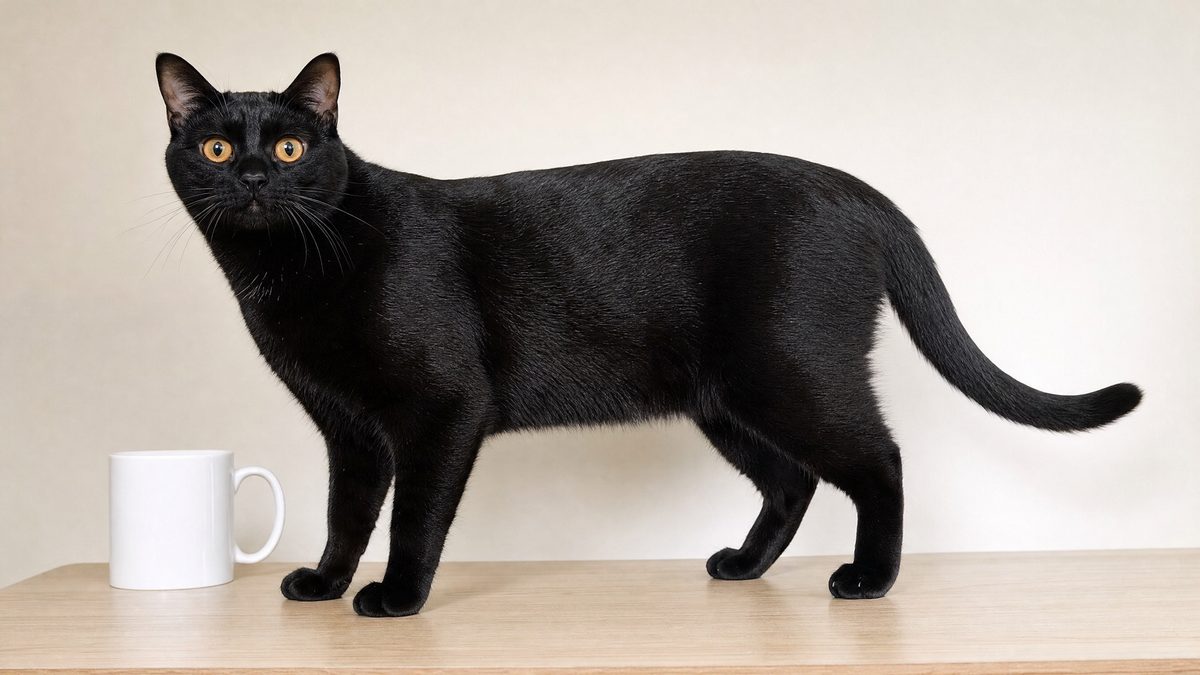
So the Bombay is a manufactured look. The Burmese supplied the body, the rounded head and the close, glossy coat. The American Shorthair supplied the dense black and the eye colour. What emerged is a medium-sized cat that feels heavier than it looks, with a coat CFA describes as fine, short, satin-like and close-lying with a shimmering patent leather sheen.
What the standard actually measures
CFA's 100 points are weighted more towards colour than anything else, which tells you what the breed is for. Colour takes 30 points, split 20 for body colour and 10 for eye colour. Head and ears take 25, coat takes 20, body takes 20, and eye placement and shape take 5. A cat can be structurally excellent and still lose on a rusty coat.
| Source | Weight | Lifespan given |
|---|---|---|
| Purina UK breed page | 3.6 to 6.8 kg | 12 to 20 years |
| GCCF (as the Asian group) | Males 5 to 7 kg, females 3.5 to 5.5 kg | 16 years in the box, 16 to 18 in the text |
| TICA breed page | Medium to large, males larger, no figure given | 12+ years |
| Happy Pet (India) | Not given | 12 to 16 years |
Those four ranges do not agree, and the spread is not trivial. Purina UK's upper bound of 20 years is eight years above TICA's stated floor The International Cat Association. Bombay…. GCCF contradicts itself inside one page, printing 16 years in its characteristics box and 16 to 18 years in its care text. None of the four cites a study. The health section below sets those numbers against the only large longevity dataset that exists for cats.
The disqualification Indian pages never mention
CFA disqualifies a Bombay for an extreme break that interferes with normal breathing and tearing of eyes. Read that twice. The registry that created the breed has written a brachycephaly brake into its own standard, because the Burmese side of the family has been selected towards a shorter, rounder face and the extreme version of that face does not breathe well. CFA's breed page separately notes that Bombays do sometimes have issues with overly teary eyes that need regular wiping.
The other disqualifications are cosmetic rather than clinical. A kinked or abnormal tail, lockets or spots, the wrong number of toes, nose leather or paw pads other than black, green eyes, and an improper bite all end a show career. Hold on to the green eyes clause. It becomes the sharpest evidence on this page that the four major registries are not describing the same animal.
An Indian buyer paying a premium for a 'Bombay' is buying an American breed with an Indian brand name. That is not a scandal and it is not a fake, but it is worth knowing before you pay, because the name is doing marketing work that the pedigree does not support.
Who made the Bombay, and why the dates do not agree
Nikki Horner, a breeder in Louisville, Kentucky, made the Bombay, and the four organisations that tell her story give four different start dates. CFA dates the birth of the breed to 1966. TICA says she began in 1953 and that the combinations she used from 1965 led to success. Purina UK dates her first cross to 1953. Wikipedia says 1958. Bonbeno reports the disagreement rather than picking one, because there is no primary document available to settle it.
Here is what the two registries that actually register the breed put in writing.
| Event | CFA record | TICA record |
|---|---|---|
| Breeding programme begins | Birth of the breed in 1966 | Horner began in 1953, successful combinations from 1965 |
| Accepted for registration | Effective 6/70 | Not stated on the breed page |
| Provisional status | Effective 5/1/74 | Not stated |
| Championship status | Effective 5/1/76 | June 1979 |
| First national win | 1982 | Not stated |
| Pedigree requirement | 5 generations, from 05/76 | Not stated |
The registration dates are the reliable part. They come from CFA's Rules of Registration for the breed, a one-page administrative document that exists to be precise, and it records registration effective 6/70, provisional 5/1/74 and championship 5/1/76. CFA's public breed page gives the same 1970 and 1976 milestones in prose. TICA accepted the Bombay for championship competition in June 1979, three years behind CFA.
What the narrative dates are worth
Very little, individually. CFA's 1966 and TICA's 1953 are not reconcilable as the same event, and both are editorial prose on a marketing page rather than a dated record. TICA's account is the more detailed of the two, and it is internally coherent: Horner started in 1953, her early efforts failed, and the combinations she used from 1965 finally worked. Read that way, CFA's 1966 is the date the breed arrived rather than the date the work started, and Purina UK's 1953 is the date the work started. That reading is plausible. It is not proven, and this page does not present it as fact.
TICA adds two details worth keeping. Horner had been breeding cats since she was 16, and she stopped breeding in the 1970s once her creation was accepted for championship competition. Herb and Suzanne Zwecker then developed new lines from the same two parent breeds, and the Shawnee and Road To Fame lines sit behind many of today's Bombays.
Why a founder story matters for a buyer in India
Because it tells you how narrow the gene pool is. A breed built by one person from one cross, then carried forward by a handful of catteries, has far less genetic depth than a landrace. CFA calls the Bombay one of its rarer breeds even while noting it is popular in the show ring. Rarity is exactly why the allowable outcross list matters, and why a registry either permitting or forbidding an outcross is a health decision rather than a paperwork decision.
No primary document from the 1950s or 1960s naming Horner's foundation cats was reachable for this build. Bonbeno therefore publishes no foundation cat names, no litter sizes and no cattery prefix from that period, and reports the date disagreement as unresolved rather than resolving it with a guess.
The Bombay has no connection to India beyond its name
The Bombay cat has no Indian origin, no Indian ancestor and no Indian breeding history. The connection is a naming choice made in Kentucky in the 1960s, when Nikki Horner picked the name of an Indian city for a cat she wanted to look like the black leopard of India Wikipedia. Bombay cat. States that…. Nothing else about the breed is Indian.
Trace the ancestry back and it goes to two places, neither of them India. The American Shorthair is the working cat of the United States. The Burmese descends from a single female, Wong Mau, imported to the United States from Rangoon and accepted for CFA stud book registration in 1936, with genetic studies supporting a South-East Asian origin for the breed. Burma is not India. Rangoon is roughly 2,000 kilometres from Mumbai, and the two cat populations are separate.
What the name is actually referring to
A black leopard, not a cat. The Indian leopard's melanistic form is what people mean by a black panther in South Asia, and Horner's stated aim was a parlour-sized version of that animal. TICA still trades on the resemblance, telling readers that Bombay cats sway when they walk, similar to that of an Indian black leopard. That is a description of a gait, offered as a marketing detail. It is not a claim of shared ancestry, and no registry makes one.
How Indian pages handle the problem
Badly, and in three distinct ways. Every ranking Indian breed page prints the correct origin in a spec box and then writes around it without ever telling the reader what the name means. One Indian seller page goes further and prints Origin: Thailand and United States, which is wrong twice, because neither parent breed is Thai. And Indian classified listings routinely attach the word Bombay to any black kitten, which is how a page selling the breed can headline its own FAQ 'What is the black cat price in India?' as if the two questions were the same.
They are not the same question. All Bombay cats are black; almost no black cats are Bombays. Purina's own FAQ puts it plainly, that while all Bombay cats are black, not all black cats are Bombay, and many cat breeds can have black coats. In a country with a very large free-ranging cat population and a very small pedigree cat registry footprint, the base rate says that a black kitten offered to you in India is overwhelmingly likely to be a black domestic shorthair.
- Check the eye colour. CFA disqualifies green eyes and TICA withholds all awards for them; a mature American-line Bombay's eyes run gold to copper.
- Check the roots. The standard requires black to the roots, and FIFe allows a lighter root colour only up to two years of age.
- Check the nose leather and paw pads. Anything other than black is a disqualification in CFA and withholds all awards in TICA.
- Check for ghost tabby markings in bright light. A non-agouti black domestic shorthair often shows them; a well-bred Bombay should not.
- Check the paperwork against the registry, not the seller. A pedigree is a claim until you can trace it to a registry that recognises the breed.
If an Indian seller implies that the Bombay is an Indian breed, or that it is native to Mumbai, or that it is adapted to Indian conditions because of its name, that seller is either mistaken or selling you a story. The breed is American. The name is a reference to a leopard.
Four registries, four different Bombays
CFA and TICA both recognise the Bombay at championship level, and they define it differently. CFA permits two outcross breeds; TICA permits none. FIFe recognises it only provisionally and rewrote its breeding rules on 1 July 2026. GCCF does not recognise it as a breed at all. Bonbeno read the registration document, the show standard or the rule text in each case, and confirmed the breed name printed inside every document before taking anything off it.
| Registry | Status | Allowable outcross | Mandatory DNA test |
|---|---|---|---|
| CFA (United States) | Championship since 5/1/76, breed code 23 | Black American Shorthair, Sable Burmese | None stated in the registration rules |
| TICA (international) | Championship since June 1979, in the Burmese/Bombay breed group | None | None stated in the standard |
| FIFe (Europe) | Preliminary recognised, category 3, for 2023 to 2027 | Burmese brown (BUR n), American Shorthair black (AMS non n) | Burmese Head Defect, from 01.07.2026 |
| GCCF (United Kingdom) | Not a breed. The Black Self of the Asian group | Seven, including Korat, Abyssinian and Somali. Not the American Shorthair | Hypokalaemia, from 01/01/2018 |
Read a breed standard before you read a breed page. A breed standard is a registry's written definition of the animal, and it is the only document in this field that is written to be precise rather than persuasive. All four of the documents summarised below are breed standards or registration rules, and Bonbeno confirmed the breed name printed inside each one before taking a single line off it.
CFA permits two outcrosses and TICA permits none
CFA's Rules of Registration for breed name BOMBAY list the allowable outcross breeds as Black American SH and Sable Burmese, set the breed code at 23, and require a five-generation pedigree from 05/76. TICA's Burmese/Bombay breed group standard, which covers both breeds on one sheet, records the Bombay as category Traditional, division Solid, colour Black ONLY, and states PERMISSIBLE OUTCROSSES: None.
That is a real difference with a real consequence. A CFA breeder can bring in fresh blood from either founding breed and stay inside the studbook. A TICA breeder cannot. Since the Bombay is a rare breed built by one person from one cross, an outcross permission is the main tool a registry has for keeping the gene pool from closing, and the two American registries have taken opposite positions on it.
FIFe changed the rules eight weeks before this page was written
FIFe lists BOM Bombay as a preliminary recognised breed in category 3 for the period 2023 to 2027, not as a fully recognised breed. On 25 June 2026 FIFe published new breeding and registration rules for the Bombay under section 7.2, effective 01.07.2026. They permit outcross to Burmese brown and black American Shorthair, and then impose the strictest health condition any registry places on this breed: all cats used in breeding BOM must have a DNA-test for Burmese Head Defect, unless both parents are proven free, with only BHD-free by BHD-free and BHD-free by BHD-carrier matings allowed, results registered and published, and the breeder obliged to inform buyers when selling a carrier.
In the United Kingdom the Bombay is not a breed
GCCF files the Bombay as the Black Self inside the Asian group, alongside 16 other recognised self and tortie colours, in Section 5, Burmese, Group 2. The Asian group did not begin with an American Shorthair at all. It began with an accidental mating between a Chinchilla Persian male and a Lilac Burmese female belonging to Baroness Miranda von Kirchberg, and the four resulting female kittens founded the Burmilla.
The permitted outcross list follows from that different history and shares nothing with CFA's. GCCF permits Korat or Thai Lilac, Abyssinian, Tonkinese with Burmese colour restriction, Egyptian Mau, Ocicat and Ocicat Classic, Australian Mist and Somali, each with its own required genetic clearances, and sets a four-generation route from an outcross back to full Asian registration.
What happens to a non-black kitten in a Bombay litter
A non-black kitten in a Bombay litter is registrable in CFA and unshowable everywhere. CFA's own registration rules carry a colour prefix for a SABLE Bombay, 0412, and a BCS code series 0412-0413 for sable, so the kitten gets papers as a Bombay of the wrong colour. TICA and FIFe both say black only, and neither offers a class for anything else Fédération Internationale Féline. Bombay. In the United Kingdom the same kitten is simply another recognised Asian Self.
The sable kitten exists because of what the Bombay is made of. The Burmese carries a temperature-sensitive mutation in tyrosinase, and every Burmese is homozygous for it, which is what produces the sable coat. Cross a sable Burmese into a black line and the allele travels with it. Two carriers eventually meet, and a brown kitten arrives in a black litter.
| Registry | Registrable? | Showable? | What the document says |
|---|---|---|---|
| CFA | Yes, as Bombay Sable | No | Registration prefixes 0410 Bombay, 0412 Bombay Sable, 0012 Bombay for breeding only. Colour class AOV: None |
| TICA | Not addressed in the standard | No | Colour: Black ONLY |
| FIFe | No | No | No other colour nor any pattern shall be recognised by the FIFe |
| GCCF | Yes, as a different Asian Self | Yes | 17 recognised self and tortie colours, of which Black is the Bombay |
CFA's arrangement is the odd one. The Bombay colour class table on the standard prints Black 0410 and 0411, then AOV: None, meaning there is no Any Other Variety class to show a sable in. Yet the registration rules give sable its own prefix and its own BCS code series, plus a third prefix, 0012 Bombay for breeding only. So the sable kitten is a registered Bombay that can never be exhibited and may be restricted to breeding use.
Green eyes are the cleanest proof that these are different animals
Three registries treat green eyes as a defect and one treats them as normal. CFA lists green eyes as a disqualification. TICA withholds all awards for green eyes. FIFe lists green eyes among the faults precluding the certificate. GCCF describes the Asian group's eyes as ranging from pale green through shades of green and yellow chartreuse to golden yellow and amber, and Purina's own fun-fact box states that British Bombays usually have green eyes while American Bombays can have copper eyes.
A green-eyed black cat is therefore a disqualified Bombay in Ohio, an award-withheld Bombay in TICA, an uncertificated Bombay in FIFe and a perfectly correct Bombay in Britain. If you are buying in India from an importer or a line of unclear origin, ask which registry the pedigree is written against before you judge the eye colour.
White kittens, white patches and darkening coats
Kitten coats legitimately start lighter. CFA's colour clause says kitten coats should darken and become more sleek with age, and FIFe allows a lighter coat colour at the roots for kittens and younger cats up to two years of age. Purina goes further and says a Bombay kitten can be born pure white, with the colour darkening within the first few months.
White patches are a different matter. Lockets or spots are a CFA disqualification and a FIFe fault leading to no Excellent, and they do not disappear with age Fédération Internationale Féline. FIFe…. A faint locket on a twelve-week kitten will still be there at three years.
Bombay cat price in india, and what the published numbers survive
Two Indian sources publish a Bombay cat price in india of Rs 10,000 to Rs 30,000, a third publishes no figure at all on a page titled Bombay Cat Price in India, and a fourth attaches Rs 98,999 to the animals standing next to the Bombay rather than to the Bombay Happy Pet. Bombay Cat breed guide. Indian… Lovely Kittens. Bombay Black Cat breed… Puppiezo. Bombay Cat product page.…. Bonbeno ran every rupee figure through the exchange-rate test and reports what each one survives.
| Source | Figure published | Divided by 84.38 | Verdict |
|---|---|---|---|
| Supertails, key takeaways | Rs 10,000 to Rs 30,000 | USD 118.51 to USD 355.53 | Not a dollar conversion |
| Supertails, average | Rs 15,000 to Rs 25,000 | USD 177.77 to USD 296.28 | Not a dollar conversion |
| Happy Pet, cost of buying | Rs 10,000 to Rs 30,000 | USD 118.51 to USD 355.53 | Identical to Supertails, not independent |
| Lovely Kittens | No figure anywhere on the page | Not applicable | Title promises a price, body asks you to WhatsApp |
| Puppiezo | No price on the Bombay listing | Not applicable | Rs 98,999 belongs to two Maltipoos and a Doxiepoo |
The rupee band passes the exchange-rate test and fails the independence test
None of the Indian figures resolves to a round dollar amount. Rs 10,000 divided by 84.38 is USD 118.51, Rs 30,000 is USD 355.53, and Rs 25,000 is USD 296.28. None of those is a price anybody would set in dollars, so this band was not manufactured by running an American figure through an exchange rate. That is a genuine pass, and Bonbeno says so rather than implying otherwise.
The band fails a different test. Supertails and Happy Pet publish the same purchase band, the same monthly food figure of Rs 1,500 to Rs 2,000 and the same veterinary figure of Rs 500 to Rs 700 Happy Pet. Bombay Cat breed guide. Indian…. Two sources printing three identical numbers are one observation, not two. Treat the Indian consensus as a single unverified figure that has been copied, and note that Supertails then contradicts its own food figure later in the same article, budgeting Rs 1,000 to Rs 2,500 a month for food nine paragraphs after saying Rs 1,500 to Rs 2,000.
Rs 98,999 is a house price point, not a Bombay price
The Puppiezo Bombay Cat page carries no price for the Bombay. Beside it, an Other Available Pets carousel prices a Maltipoo named Fizey at Rs 98,999, a Maltipoo named Samy at Rs 98,999 and a Doxiepoo named Yoki at Rs 98,999, with two Poodles at Rs 92,599, a Cane Corso at Rs 94,999, a Goldendoodle at Rs 120,000 and a Rottweiler at Rs 76,499. Three different breeds share one number on one page. Bonbeno has now caught Rs 98,999 attached to whatever animal is in stock on four separate breed pages on this site. It is a shelf price, and reporting it as a Bombay price would be a fabrication with a number attached to it.
The Indian band sits in the American adoption range, not the American breeder range
In the United States a pet-quality Bombay kitten from a breeder runs USD 500 to USD 2,000, show lines exceed USD 2,500, and shelter adoption costs USD 50 to USD 300. At 84.38 rupees to the dollar that breeder floor is Rs 42,190 and the ceiling is Rs 168,760, while the American adoption range is Rs 4,219 to Rs 25,314. The published Indian band of Rs 10,000 to Rs 30,000 overlaps the American adoption fee almost exactly and sits entirely below the American breeder floor.
A Rs 15,000 kitten in India is not being priced as a registered Bombay from a health-screened line, because nowhere in the world is one sold for that. It is being priced as a black kitten. That may still be a lovely cat. It is not the thing the price page is describing, and it will not come with the ALX1 and hypokalaemia clearances that a registry-line Bombay should carry.
Monthly cost of keeping a Bombay in India
Budget Rs 2,800 to Rs 4,200 a month for a healthy adult Bombay in an Indian city, which is what the one Indian source that itemises the spend actually publishes. Add one line the Indian sources all omit, a cardiac screen, and the honest annual figure moves. The cost structure below is the published Indian one with that gap marked rather than filled with a guess.
| Line | Happy Pet | Supertails |
|---|---|---|
| Food | Rs 1,500 to Rs 2,000 | Rs 1,500 to Rs 2,000, then Rs 1,000 to Rs 2,500 later in the same article |
| Veterinary | Rs 500 to Rs 700 | Rs 500 to Rs 700 |
| Grooming | Rs 800 to Rs 1,500 | Rs 200 to Rs 300 a year for supplies |
| Litter | Not itemised | Rs 500 to Rs 1,000 |
| Toys and enrichment | Not itemised | Rs 200 to Rs 500 |
| Stated total | Rs 2,800 basic, Rs 4,200 premium | No total given |
The two sources disagree hardest on grooming, and the disagreement is instructive. Happy Pet budgets Rs 800 to Rs 1,500 a month for grooming a short-coated cat that its own page rates 2 out of 5 for grooming needs. Supertails budgets Rs 200 to Rs 300 a year for brushes, clippers and shampoo. For a cat CFA calls wash-and-wear, and that needs a rubber curry brush two or three times a month, the annual figure is the credible one. A monthly grooming salon line for a Bombay is money spent on a problem the breed does not have.
The line every Indian page leaves out
Cardiac screening. Both CFA and TICA name hypertrophic cardiomyopathy on their Bombay pages, and TICA says screening by echocardiogram performed by a veterinary cardiologist is of paramount importance for breeders and worth doing proactively as an owner The Cat Fanciers' Association. Bombay breed…. The American cost guide budgets USD 300 to USD 600 for that echo. Bonbeno found no published Indian price for a feline echocardiogram and does not invent one, so treat this as a real cost of unknown size and ask two veterinary cardiology referral centres in your city before you buy.
What a realistic first year looks like
Take the Indian monthly total at face value and a year of routine keeping is Rs 33,600 at the basic level and Rs 50,400 at the premium level, before the kitten, before vaccination, before neutering and before any cardiac work. Set that against a purchase price of Rs 10,000 to Rs 30,000 and the arithmetic says the obvious thing: the cat costs more to keep for one year than to buy, and considerably more over a life.
- Feed to body condition rather than to a bag chart, because a stocky, indoor breed gains weight quietly.
- Budget separately for a cardiac screen rather than folding it into the monthly veterinary line.
- Screen the parents before purchase, since the tests that matter here are done on the breeding cats, not on your kitten.
- Compare two Indian veterinary practices on consultation and vaccination pricing before committing, because published Indian figures vary widely and none of them is audited.
- Verify what the seller's monthly estimate includes, and assume litter is excluded unless it is named.
Bonbeno publishes the Indian monthly range as reported and refuses to average it into a single tidy number. The two Indian sources are not independent, neither cites a survey, and the cardiac line is missing from both. A range with its gaps marked is more useful than a mean with its gaps hidden.
Origin climate against Indian cities, queried by coordinates
The Bombay was built in a city whose January average is below freezing, and every Indian city it is now sold in is warmer year-round and receives more sunlight. Bonbeno queried NASA's POWER climatology by explicit latitude and longitude for Louisville, Kentucky and four Indian cities, using one source and one methodology, so that no place name could be silently swapped for another.
| Location | Mean annual air temp | Hottest month mean | Annual solar irradiance, kWh/m2/day | Annual relative humidity |
|---|---|---|---|---|
| Louisville, Kentucky (38.2527, -85.7585) | 12.67 C | 24.51 C in July | 14.58 | 78.88 percent |
| Chennai (13.0827, 80.2707) | 27.95 C | 31.51 C in May | 18.80 | 72.39 percent |
| Mumbai (19.0760, 72.8777) | 26.77 C | 31.19 C in May | 19.06 | 67.39 percent |
| Delhi (28.6139, 77.2090) | 25.60 C | 35.88 C in June | 17.60 | 45.56 percent |
| Bengaluru (12.9716, 77.5946) | 23.74 C | 28.37 C in April | 19.73 | 67.94 percent |
Divide it out
Chennai receives 18.80 kWh per square metre per day against Louisville's 14.58, which is 28.9 percent more. Mumbai's 19.06 is 30.7 percent more. Delhi's 17.60 is 20.7 percent more. Bengaluru's 19.73 is 35.3 percent more, the largest gap of the four, which surprises people who think of Bengaluru as the mild option.
Temperature separates them further. Chennai's annual mean runs 15.28 degrees Celsius above Louisville's. Delhi's hottest month averages 35.88 degrees, which is 11.37 degrees above Louisville's hottest month. Louisville's own January mean is minus 0.71 degrees, so the breed's home city spends part of every year below freezing.
One finding that runs the other way
Louisville is more humid, on the annual average, than any of the four Indian cities in this table. Its 78.88 percent beats Chennai's 72.39, Bengaluru's 67.94, Mumbai's 67.39 and Delhi's 45.56. Bonbeno publishes that because it is what the data says, not because it is convenient. The Indian humidity problem is seasonal rather than annual: Mumbai reaches 89.56 percent in July and 90.36 percent in August, both above Louisville's wettest month of 86.02 percent in December, and it reaches them at 26 degrees rather than at 1 degree.
That combination is the one that matters. Heat plus humidity together defeat evaporative cooling, and a cat's evaporative options are narrow to begin with, since it cannot sweat through its coat. Mumbai in August and Chennai in October and November are the periods where an indoor Bombay most needs airflow, not the dry May peak that everyone plans for.
City by city, in plain terms
- Delhi is the extreme-temperature problem. Highest hottest-month mean of the four, lowest humidity, so evaporative cooling still works and a fan does real work. Shade and water matter more than a dehumidifier.
- Mumbai is the humidity problem. Two months above 89 percent relative humidity at temperatures in the high twenties, which is when a close-coated cat gets skin trouble and when panting stops helping.
- Chennai is both, staggered. May heat, then a long humid stretch from September to December above 77 percent.
- Bengaluru has the mildest temperatures and the highest annual solar load of the four, which is the pairing people underestimate for a black cat on a sunny balcony.
- Apartment living is the mitigation in all four. This breed is designed to live indoors, and indoors is where you control both variables.
Each POWER response was checked against the coordinates requested before any figure was used, and each returned the point asked for. Bonbeno uses coordinate-addressed climate data on breed pages precisely because a slug-addressed climate page can serve you a complete, correct-looking record for the wrong city.
How often do cats actually present with heat illness?
Rarely, in a temperate country, and that is the only denominator anybody has published. UK veterinary practices in the SAVSNET surveillance network recorded 16 cats with heat-related illness across the six years from 2013 to 2018, against 146 dogs. Environmental heat was the trigger for every cat with a recorded trigger, 62.5 percent of the cats had no trigger recorded at all, 75 percent of feline cases presented in June and July, and cats over 15 years old made up 25 percent of them.
Sixteen cats is a small number and it comes from a country where the hottest month averages under 20 degrees. Bonbeno reports it as the shape of the problem rather than as a rate that transfers to India. What does transfer is the pattern: for cats, unlike dogs, heat illness is environmental rather than exertional, so the risk is the room your cat is shut in, not the exercise you gave it. The other transferable finding is that old cats are over-represented, which matters for a breed people keep into its mid-teens.
Does a black coat cook a cat in Indian sun?
A black coat absorbs more solar energy than a light one, and that is where the simple version of this argument ends and the real physics begins. Dark surfaces absorb more sunlight all else being equal, but the relationship between colour and body temperature is complex and depends on the environment, the coat's physical properties, the animal's behaviour and its physiology. Bonbeno reasons this through rather than asserting a scare.
Start with what is settled. Colour determines how much shortwave radiation the coat surface absorbs. Coat structure determines where that absorbed energy ends up. Walsberg measured both in two desert rodents and found that changes in coat structure and hair optics produce differences of up to 40 percent in solar heat gain between animals of similar colour, while dark skin colouration by itself increases solar heat gain by 5 percent or less. Structure, in other words, can matter more than colour.
Three coat properties, and how the Bombay scores on each
| Property | What the standard specifies | Effect on heat load |
|---|---|---|
| Colour | Shimmering jet black, even to the roots | Maximum shortwave absorption at the coat surface |
| Depth | Short, close-lying | Absorbed energy is deposited close to the skin rather than at the tips |
| Undercoat | Little to no undercoat | Less insulating air trapped between the absorbing surface and the skin |
All three point the same way, which is unusual and is why this breed is worth reasoning about rather than waving through. A deep, loose, dark coat can hold absorbed heat at the tips where wind strips it away. A short, close-lying, undercoat-light black coat does the opposite: the absorbing layer sits a few millimetres from the skin with little insulation between them Fédération Internationale Féline. FIFe….
Wind speed is the variable nobody mentions, and it is near zero indoors
Convection is what rescues a dark coat. In the classic plumage experiments, black plumages acquired much greater radiative heat loads than white at low wind speeds, and the two converged as wind speed rose. An Indian flat in May, with the windows shut against dust and heat, is the low-wind case. A cat asleep in a sunbeam on a still afternoon is the worst combination this breed can be put in, and it is also the thing Bombays most enjoy doing.
Where the honest answer stops
There is no measurement of solar heat gain in a Bombay, or in any domestic cat sorted by coat colour, that Bonbeno could find. The near-infrared band matters as much as the visible band for absorbed heat, and visible reflectance is often a poor predictor of near-infrared reflectance, which means a cat that looks jet black to you may or may not behave like it under the wavelengths that carry most of the heat. Nobody has measured a black cat's near-infrared reflectance and published it.
So the claim this page will make is the narrow one. A solid black, short, close-lying coat with little undercoat is the worst combination of the three properties that govern radiant heat load, and Indian sun delivers 21 to 35 percent more of that radiation than the breed's origin city. The claim this page will not make is that a Bombay overheats faster than another short-coated cat, because nobody has measured that.
Keep a Bombay out of direct sun through a window between roughly 11am and 4pm from March to June, and give it a shaded, ventilated place it prefers to the sunbeam. That costs you nothing, works whatever the physics turns out to be, and is the same advice a cardiologist would give a cat with an undiagnosed murmur.
Temperament, and the one household this cat does not suit
The Bombay is an attention-seeking, people-following, talkative cat that does badly when left alone all day, and TICA says so in plain terms: their craving for company means they are unhappy if left alone for long periods, so consider getting another cat if you will be gone most of the day. That single sentence disqualifies more Indian households than any health issue on this page.
CFA describes the breed as part cat, part dog and part clown, balancing the easy-going temperament of the American Shorthair against the inquisitive, lap-loving personality of the Burmese, with a mischievous streak and an intense love of toys that are the Bombay's own. TICA adds shoulder-riding, ankle-rubbing, lap-occupying and getting under the covers at night. The two registries agree, which they do not always do on this breed.
TICA's standard also records something judges are told to expect. Both the Burmese and the Bombay are talkative, vocal and very happy to express their opinions, and a judge should expect a mouthy cat that is completely relaxed and unthreatening. A vocal cat in a 2BHK with thin walls is a consideration, not a defect.
Who this breed suits in India
- Households with somebody home most of the day, which Purina states as a requirement rather than a preference, noting the breed needs someone at home for a good part of each day.
- Apartment living, which TICA specifically endorses, calling the calm disposition a good fit for any living situation including a flat.
- Families with older children who can respect a cat's space, per Purina, and with the caveat that a very hectic household can be stressful.
- Homes with an existing cat or a dog, given a proper introduction, which both registries recommend.
- People who want an affectionate cat and will say so, because this breed's whole selling point is that it does not leave you alone.
Who should not buy one
A single working professional out of the house from nine to eight should not buy a Bombay as a solo cat. That is the honest version of the sentence Indian seller pages soften into 'adaptable'. Puppiezo's own Bombay spec card rates the breed near the top for need for attention while also selling it as an apartment pet, and both things are true at once. The resolution is a second cat, not a longer workday.
The second group to think twice is anybody buying for the look. This is a cat that will sit on your keyboard, talk back, take possession of a grocery bag and follow you into the bathroom. If what you wanted was a decorative black cat that keeps to itself, a calmer breed will make you both happier.
Purina's own UK FAQ states that Bombay cats tend to be dominant and may be very protective of their spaces, items and even people. That claim sits in a marketing FAQ with no behavioural source behind it, and neither CFA nor TICA describes the breed that way; both describe a cat that greets visitors at the door The International Cat Association. Bombay…. Treat resource guarding in a cat as an individual behaviour to manage, not a breed trait to expect.
Training a Bombay, and the one thing it resists
Train a Bombay the way you would train a clever dog, with short reward-based sessions, because both registries and Purina agree the breed learns tricks, fetches and takes to a harness Purina UK. Bombay cat breed page. History…. The one thing it resists is being ignored, and almost every behaviour problem owners report with this breed traces back to that.
TICA says Bombays thrive with families willing to teach them tricks, play games and provide puzzle or interactive toys. Purina goes further, noting that Bombay cats can be lead trained and taught to fetch, and that a skilled trainer could teach them a wide range of useful behaviours, singling out teaching a cat to go into a carrier on cue as extremely useful for vet trips.
That carrier cue is the highest-value thing you can teach in India specifically. A cat that walks into its carrier on request turns a monsoon emergency vet run from a twenty-minute wrestling match into a two-minute departure, and it removes the single most common reason Indian owners postpone a veterinary visit.
A realistic first-year training order
- Weeks 8 to 12: name and hand-target. Two sessions a day of two minutes each, food reward, ending before the kitten loses interest.
- Weeks 10 to 16: carrier as furniture. Leave the carrier open in the living room with bedding and treats inside, and never close it in this phase.
- Weeks 12 to 20: handling tolerance. Paws, ears, mouth and a light restraint hold, ten seconds at a time, so that a future echocardiogram is a calm appointment.
- Months 4 to 6: recall and fetch. Both work with this breed, and both burn energy an indoor cat has nowhere else to put.
- Months 6 to 12: harness, if you want one. Purina notes lead training is realistic, though it also warns that a Bombay outdoors is a theft risk and can be mistaken at a distance for something it is not.
What goes wrong
Boredom, and it looks like mischief. Purina describes the pattern exactly: without sufficient entertainment and enrichment from you, the Bombay is inclined to create its own fun, taking personal items and hiding them and knocking things off high shelves. CFA makes the same observation warmly, noting these cats will happily take possession of grocery bags or cracker boxes and amuse themselves for hours.
The remedy is rotation rather than volume. Keep four or five toy types available, put the rest away, and swap them weekly, which Purina recommends explicitly so that none become boring. A cardboard box costs nothing and outperforms most bought toys with this breed.
One training note specific to a talkative breed. Do not reward vocalising with attention on demand, because a Bombay learns that contingency faster than almost anything else you will teach it deliberately. Answer the cat when you have decided to, not when it asks.
Daily exercise, and what an Indian flat does not provide
Give an adult Bombay two structured play sessions a day of roughly 15 to 20 minutes each, because an indoor cat burns only the calories you arrange for it. The Indian sources that quantify this land on 30 to 60 minutes daily, which is a reasonable target and not a demanding one.
TICA describes the activity curve honestly. As kittens they are very active and curious and adapt easily to change; as they get older they tend to become more tranquil, preferring to watch rather than get involved. That tranquil adult is the cat that quietly gains weight, and body condition score is one of the factors associated with a hypertrophic cardiomyopathy diagnosis in the CatScan population, alongside male sex, increased age and a murmur.
What vertical space does that floor space cannot
An Indian flat is usually short on floor area and long on wall height. Use it. A tall scratching post or cat tree, a shelf run and a window perch out of direct afternoon sun convert an ordinary 2BHK into a cat-sized territory, and TICA's own care note asks for a nice tall scratching pole to serve the natural scratching instinct. Purina recommends catio furniture, climbing spots and hidey-holes for the same reason.
- Two sessions a day, one before your morning departure and one in the evening, each ending with a food reward so the hunt has a resolution.
- Wand toys over laser pointers, because a laser never lets the cat catch anything and leaves an intelligent breed frustrated.
- Puzzle feeders for part of the daily ration, which TICA recommends and which slows a stocky cat's eating.
- Rotate toys weekly, keeping most of them out of sight, per Purina's specific advice.
- Play at the cooler ends of the day from March to June, for the same reason you would not exercise a dog at 2pm in Chennai.
Outdoor access is the wrong answer in an Indian city
Purina, writing for a British audience, already advises against unsupervised outdoor access for this breed on two grounds: theft risk, and the fact that a striking black cat can be mistaken at a distance for a stray big cat. Both apply more strongly in India, and a third applies here that does not apply in Britain. Trauma is the single largest recorded cause of death across all cats in the VetCompass dataset at 12.2 percent, ahead of every disease, and Indian traffic and free-roaming dogs make that a larger risk, not a smaller one.
A harness and a supervised balcony or terrace session is the compromise that works. Build the harness habit young, keep the sessions to shaded hours, and never leave a harnessed cat unattended.
Grooming a patent-leather coat in Indian humidity
Groom a Bombay with a rubber curry brush two or three times a month and almost nothing else, which is CFA's own instruction for a breed it calls one of the easiest to groom. In Indian humidity the useful addition is not more brushing but a weekly skin and ear check, because the risk in Mumbai in August is fungal and bacterial rather than matted.
The coat is short, fine, satin-like and close-lying, with little to no undercoat, so there is very little to shed and nothing to mat The International Cat Association.…. CFA rates shedding moderate to minimal and calls Bombays wash-and-wear cats that typically take well to bathing. TICA suggests a rubdown with a rubber brush, notes that stroking the cat with your palm distributes natural oil that helps the sheen, and offers a chamois polish for a show finish.
Where the overseas advice does not transfer
Bathing. A British or American page can tell you to bath a Bombay casually because the cat dries in a heated, dehumidified house. In an Indian coastal monsoon, where Mumbai runs 89.56 percent relative humidity in July and 90.36 percent in August, a damp cat stays damp, and damp skin under a close-lying coat is where trouble starts. If you bath a Bombay in the monsoon, towel it properly and dry it with a fan on a low setting rather than leaving it to air dry, and keep water out of the ears.
The second transfer failure is frequency. Happy Pet budgets Rs 800 to Rs 1,500 a month for grooming this breed while rating its grooming needs 2 out of 5 on the same page. There is no professional grooming a Bombay needs monthly. Spend that money on a good nail clipper, a rubber brush and one veterinary skin check at the end of the monsoon.
A monsoon-adjusted routine
- Brush with a rubber curry twice or three times a month year-round, and weekly from June to September when shed hair sticks to a humid coat.
- Check the skin along the spine, under the collar line and between the toes once a week in the monsoon, looking for damp patches, scurf or a yeasty smell.
- Clean the ears only when they need it, and dry them after any bath, because water left in an ear canal in a humid month is the commonest own goal in Indian cat care.
- Trim the nails every two to three weeks, which TICA lists alongside ear cleaning and tooth brushing as routine care.
- Wipe the eyes if they run, which CFA specifically flags for this breed, noting Bombays do sometimes have issues with overly teary eyes that need regular wiping.
Shaving removes the coat layer that holds absorbed radiation away from the skin and exposes bare skin to direct sun and to abrasion. The measured work on solar heat gain says coat structure matters as much as colour, and a shaved cat has no coat structure left to work with. The coat is not the reason the cat is hot. The room is.
Burmese head defect: the one health figure that is genuinely about Bombays
Forty-three of 133 Bombays tested for the ALX1 craniofacial variant carried it, which is 32.3 percent, against 151 of 3,250 Burmese, or 4.6 percent. That is the only published health statistic on this page with a Bombay denominator rather than a borrowed one, and it comes with a sampling caveat that matters as much as the number.
Burmese head defect is a congenital craniofacial malformation caused by a 12 base-pair deletion in the aristaless-like homeobox protein 1 gene, c.496delCTCTCAGGACTG, identified by the Lyons Feline Genetics Research Laboratory after a 20-year investigation University of California Davis Veterinary…. Inheritance is autosomal co-dominant. One copy may shorten the face into brachycephaly and causes no defect. Two copies produce a craniofacial defect that is incompatible with life, and affected kittens are stillborn or require euthanasia.
| Group | Tested | Carriers | Wildtype | Carrier rate |
|---|---|---|---|---|
| Bombay | 133 | 43 | 90 | 32.3 percent |
| Burmese | 3,250 | 151 | 3,099 | 4.6 percent |
| Asian | 2 | 0 | 2 | 0 percent |
| Australian Mist | 1 | 0 | 1 | 0 percent |
| Burmilla | 5 | 0 | 5 | 0 percent |
| Tonkinese | 6 | 0 | 6 | 0 percent |
| Other breeds | 2,456 | 0 | 2,456 | 0 percent |
Every row divides out. 43 plus 90 is 133, and 43 divided by 133 is 32.3 percent. 151 plus 3,099 is 3,250, and 151 divided by 3,250 is 4.6 percent. The variant was found in no cat outside the Burmese-derived breeds, including 2,456 cats from other brachycephalic breeds such as the Persian, Exotic Shorthair, Scottish Fold, Selkirk Rex and British Shorthair.
Two caveats, and neither of them is small
First, these are cats submitted for testing, not a random survey. Testing was performed at UC Davis and at Langford Veterinary Services on samples sent in by breeders, and the paper says plainly that its allele-frequency estimate is biased as breeders know the at-risk cats. The Bombay sample is smaller and more concentrated than the Burmese one, and the breed also supplied cases and controls to the study's genome-wide association analysis, so 32.3 percent is a carrier rate among tested Bombays and not a population prevalence. Do not read it as one in three Bombays anywhere.
Second, the pooled row is worth checking. The paper's Burmese Breeds line reads 3,264 tested with 194 carriers, which is the 5.9 percent figure UC Davis publishes on its test page. Add the tested counts of the Asian, Australian Mist, Burmese, Burmilla and Tonkinese rows and you get exactly 3,264, with the 133 Bombays excluded. Add the carriers of those same five rows and you get 151, not 194, and the missing 43 is precisely the Bombay figure. So the widely quoted 5.9 percent appears to draw its numerator and its denominator from different breed sets. Recomputed across all six Burmese-derived rows the rate is 194 of 3,397, or 5.7 percent. The Bombay's own 43 of 133 is unaffected by any of this.
The reason the allele stays common
Because heterozygotes win shows. The brachycephaly of the Contemporary Burmese is the heterozygous phenotype of the same deletion, the trait is under intense positive selection in those lines, and the paper describes the arrangement as a heterozygous advantage. Breeding for the fashionable short face is breeding the lethal allele forward. That is also why CFA had to write a brake into its Bombay standard, disqualifying an extreme break that interferes with normal breathing and tearing of eyes.
Ask for the ALX1 result on both parents, written on a laboratory certificate with the cat's microchip number, not on the seller's letterhead. FIFe has required exactly that of its Bombay breeders since 1 July 2026, permitting only clear by clear and clear by carrier matings, and obliging the breeder to tell the buyer when the kitten's parent is a carrier. There is no reason an Indian buyer should accept less.
Hypokalaemia, and what a borrowed figure is worth
Burmese hypokalaemic polymyopathy is a recessive muscle disease that carries to the Bombay by descent, and no Bombay-specific carrier frequency has ever been published. The authors of the review that defines the condition name the Bombay directly, writing that elimination should be possible from the Burmese breed and from pedigree cats infused with Burmese lines such as the Bombay, Tonkinese and Tiffanie. Bonbeno labels every figure below as borrowed and explains why the transfer is reasonable.
Affected cats usually present in the first year of life with episodic muscle weakness and muscle pain, most characteristically a ventroflexion of the head and neck, though some cats never show that sign. Weakness is usually periodic and occasionally constant, and it waxes and wanes, possibly with dietary factors and stress, to the point that some cats appear to grow out of it.
The cause is a nonsense mutation in WNK4 producing a premature stop codon and a truncated protein, identified by a genome-wide study of 35 cases and 25 controls in the Burmese, with the likely mechanism a potassium-losing nephropathy. The disease is not typically fatal and affected cats are usually managed with potassium supplementation, which is a genuinely reassuring sentence and one Indian breed pages never print.
A discrepancy worth knowing before you order a test
The published mutation coordinate differs between the paper and the laboratory. The PLoS ONE abstract records the WNK4 nonsense mutation as c.2899C>T. UC Davis's own test page records it as c.2902C>T. That is a three-base difference in the same variant, and Bonbeno reports it rather than picking whichever looks tidier. It does not affect the test you order, which is requested by name, but it is the kind of detail that tells you whether a page has read its sources.
Which figures are borrowed, and how far
| Figure or statement | Species or breed it was measured in | Transfers to the Bombay? |
|---|---|---|
| Autosomal recessive, 25 percent affected from carrier by carrier | Mendelian, breed-independent | Yes, directly |
| Onset in the first year, ventroflexion of the head and neck | Burmese case series | Reasonable, same allele, same protein |
| Genome-wide study of 35 cases and 25 controls | Burmese only | Borrowed. No Bombay was in the case set |
| Carrier frequency in the breed | Not published for the Bombay | No figure exists |
| Mandatory testing from 01/01/2018 | GCCF Asians, which include the UK Bombay | Yes, in the UK, as a rule rather than a rate |
The transfer is reasonable for one specific reason. This is a single recessive allele in a shared founder population, not a polygenic tendency, and both UC Davis and Langford list the Bombay among the breeds appropriate for testing precisely because the Bombay's Burmese half is the same Burmese population the allele was found in. What does not transfer is any number. An Indian page that prints a hypokalaemia percentage for the Bombay has invented it.
The registry that turned the risk into a rule
GCCF made hypokalaemia testing mandatory from 1 January 2018 for all Asians registered with active status and intended for breeding, which in the United Kingdom includes every Bombay. The scheme is specific: a cat goes on the Active Register only if it has tested normal, or both parents have, or it can be deemed normal from testing across every pedigree line; carriers go on a Genetic Register and may be mated only to proven-clear cats; and any Asian cat which has inherited two copies of the HK recessive gene must not be bred from.
GCCF also adds a useful negative. While polycystic kidney disease and progressive retinal atrophy have been identified in the Asian's ancestral breeds, so far only evidence of hypokalaemia has arisen in the Asian itself. Purina's UK page nonetheless lists polycystic kidney disease for the Bombay while noting the risk is lower than in the breeds actually prone to it. Both statements can be true; the registry's is the more precise one.
Heart disease and how long a Bombay actually lives
Hypertrophic cardiomyopathy affects 14.7 percent of apparently healthy cats of every kind, so both registries are right to flag it for the Bombay and neither has a breed-specific number to attach. On lifespan, the honest answer is that the 12 to 20 year ranges printed on breed pages have no study behind them, while the largest dataset that exists puts the median for all cats at 14.0 years and for purebred cats at 12.5.
The CatScan study screened 1,007 apparently healthy cats aged six months or older with two-dimensional echocardiography and obtained complete data on 780. Hypertrophic cardiomyopathy prevalence was 14.7 percent, with a 95 percent confidence interval of 12.3 to 17.4 percent, and prevalence rose with age. Congenital disease came in at 0.5 percent and other cardiomyopathies at 0.1 percent.
That is the baseline against which to read CFA's line that hypertrophic cardiomyopathy has also been found in Bombays and that responsible breeders test before breeding, and TICA's stronger statement that screening by echocardiogram performed by a veterinary cardiologist is of paramount importance and that owners should screen proactively too. Neither registry claims the Bombay is worse than average, and no published figure says it is.
Why a murmur is not a diagnosis, and why silence is not a clearance
The same study measured how much a stethoscope tells you. Heart murmurs were present in 40.8 percent of these apparently healthy cats, and 70.4 percent of those murmurs were considered functional. The positive predictive value of a murmur for hypertrophic cardiomyopathy ran from 17.9 to 42.6 percent, higher in old cats, and the negative predictive value ran from 90.2 to 100 percent, higher in young cats.
Read that as a buyer. A murmur in a Bombay kitten is more likely to be functional than to mean disease, so do not panic and do not let a seller talk you into a discount cat on the strength of it. A clean auscultation in a young cat is fairly reassuring, and in an older cat it is not. Only an echocardiogram settles it, and that is a cost you plan for rather than discover.
Lifespan, with a denominator
| Source | Figure | Evidence behind it |
|---|---|---|
| Purina UK | 12 to 20 years | None cited |
| GCCF (Asian group) | 16 years, and 16 to 18 years on the same page | None cited |
| Happy Pet (India) | 12 to 16 years | None cited |
| Lovely Kittens (India) | 9 to 15 years, and 12 to 20 years on the same page | None cited |
| TICA | 12+ years | None cited |
| VetCompass, all cats | Median 14.0 years, IQR 9.0 to 17.0 | 4,009 confirmed deaths from 118,016 cats at 90 English practices |
| VetCompass, purebred cats | Median 12.5 years | Same study, pooled across purebred breeds |
The VetCompass study found crossbred cats outliving purebred cats, at a median 14.0 years against 12.5 years, with the difference significant at p under 0.001, while noting that individual purebred breeds varied substantially. It reports no Bombay-specific figure, which is unsurprising in a UK dataset where the breed is filed inside the Asian group and is rare even there.
So the ranges on the breed pages are not lies, but they are not measurements either. A 20-year upper bound is a thing that has happened to a cat, not a life expectancy. The defensible sentence for an Indian buyer is that a well-kept indoor Bombay is a cat you should plan to look after into its mid-teens, and that the leading recorded causes of death across all cats are trauma at 12.2 percent, renal disorder at 12.1 percent, non-specific illness at 11.2 percent, neoplasia at 10.8 percent and mass lesion disorders at 10.2 percent.
Trauma is the single largest recorded cause of death in that dataset, ahead of every disease. A Bombay is an indoor cat by temperament and by design, and keeping it genuinely indoors in an Indian city, away from traffic and from free-roaming dogs, removes the largest item on the list.
Feeding a stocky indoor cat in India
Feed a Bombay to body condition rather than to a bag chart, and get most of its water in through wet food, because this is a muscular, deceptively heavy, indoor-living breed that gains weight quietly The International Cat Association. Bombay…. TICA's own nutrition note reduces to two things: exercise and a high-quality diet are key to keeping them healthy, and fresh clean water must be available daily.
The reason body condition matters more here than for most cats is on the standard. CFA requires a body that is muscular in development, neither compact nor rangy, with a surprising weight for its size. A cat that is supposed to feel heavy is a cat whose owner will not notice the first kilogram. Increased body condition score was one of four factors associated with a hypertrophic cardiomyopathy diagnosis in the CatScan population, so this is not a cosmetic point.
Hydration, and one trick that costs nothing
TICA passes on a specific placement tip from cat behaviourists: put the water bowl at least three feet away from any food, because a cat's nose is sensitive and an overwhelming smell of food can make it drink less. In an Indian summer that is a free intervention. A second bowl in a different room, and a wet-food component in the daily ration, do more for water intake than any fountain.
What the Indian pages get wrong about feeding this breed
Two things, and the second is funny. The published Indian daily calorie figures for a Bombay are 250 kcal for kittens and 199 kcal for adults on one page, while a second Indian page prints Puppies: 400 kcal, Adult: 350 kcal on a cat's specification card. The second page is running a dog template. Its forbidden-foods list for a cat reads almonds, avocados, cherries, grapes, lemon, onions, salt and sugar, which omits the two things that actually matter most for cats, and its exercise line asks for 30 to 40 minutes daily under the heading Energy Level: High.
Take the calorie question back to first principles instead. An adult cat's maintenance requirement scales with metabolic body weight and with whether it is neutered and indoor-living, both of which lower it. A 4 kg neutered indoor Bombay needs considerably less than a 6 kg entire male. Weigh the cat monthly on a kitchen scale, feel the ribs, and adjust the ration by 10 percent at a time.
- Feed two to three measured meals a day rather than free-feeding a bowl, which is the single biggest lever on weight in an indoor cat.
- Include wet food daily for water intake, particularly from March to June.
- Weigh monthly and record it, because a 300 gram gain is invisible and a 12 percent gain is not.
- Avoid the toxic list that actually applies to cats, including onion and garlic in any form, which matters in an Indian kitchen where both are in almost every dish.
- Ignore breed-specific formula marketing unless you can verify the product exists for this breed, and buy on the label's nutritional adequacy statement instead.
One Indian page recommends a 'Royal Canin Indoor Adult or Bombay Formula' for this breed. Bonbeno could not verify from the manufacturer's own product pages that any Bombay formula exists, because the product listing did not render for this build, so this page makes no claim either way. Do not go shopping for a product on the strength of a breed page, including this one. Read the tin.
Kitten timeline, month by month through the first year
Plan a Bombay kitten's first year around three fixed points: the coat darkens over the first few months, the vaccination course runs from 6 to 16 weeks, and the cat matures sexually early enough that GCCF warns owners to arrange neutering at the earliest opportunity Governing Council of the Cat Fancy. Asian….
| Age | What is happening | What you do |
|---|---|---|
| Under 8 weeks | Still with the mother and littermates. Coat may still be light, and can even start pure white | Do not take the kitten home. Ask to see the mother and the parents' test certificates |
| 6 to 8 weeks | First core vaccine, FVRCP, is due at the breeder | Get the vaccination card with batch numbers, not a verbal assurance |
| 8 to 12 weeks | Homecoming window. Neophobia has not set in yet | Name and hand-target training, carrier left open as furniture, one quiet room to start in |
| 12 to 16 weeks | FVRCP and rabies due. Socialisation window closing | Socialise deliberately: visitors, the vacuum cleaner, car sounds, handling of paws and ears |
| 4 to 6 months | Coat darkening should be well advanced. Rapid growth | Weigh fortnightly, start recall and fetch, book the neutering conversation |
| 5 to 8 months | Sexual maturity arrives early in this group | Neuter or spay on veterinary advice, which GCCF flags specifically for Asians |
| 6 to 12 months | Activity peaks, then begins to settle | Two structured play sessions daily, monthly weigh-in, first adult dental check |
| 12 months | FVRCP and rabies boosters due | Baseline auscultation, and discuss whether an echocardiogram is warranted |
The coat question every new owner asks
A Bombay kitten that is not fully black is usually normal. CFA's colour clause says kitten coats should darken and become more sleek with age, and FIFe formally allows a lighter coat colour at the roots for kittens and younger cats up to two years of age. Purina reports that a Bombay kitten can even be born pure white, with the colour darkening within the first few months.
What does not resolve with age is a locket, a white patch or a paw pad that is not black, all of which are faults in every registry that recognises the breed Fédération Internationale Féline. FIFe… The International Cat Association.…. Nor do green eyes resolve into copper, so a green-eyed kitten sold to you as a show-quality American-line Bombay is being misdescribed.
Eight weeks is Bonbeno's own floor, and it is offered as advice rather than as a citation of Indian law, because Bonbeno did not open the domestic breeding rules for this build and will not paraphrase a statute it has not read. What the government document Bonbeno did read says is narrower: DGFT's pet-import FAQ refuses new-born animals in the import channel outright, in a sentence whose own age threshold reads oddly as 'less than 7 months';. A seller pushing a six-week kitten is telling you something about the rest of their operation, whatever the paperwork says.
Bombay against the cats Indian buyers actually cross-shop
Compare the Bombay against a black domestic shorthair first, because that is the real decision, and only then against the pedigree breeds an Indian buyer is offered alongside it. On price, availability and verifiability the black domestic shorthair wins outright; on predictability of type and temperament, the registered Bombay wins.
| Option | Published India price | Heat tolerance | The real difference |
|---|---|---|---|
| Bombay | Rs 10,000 to Rs 30,000, though the band is one copied figure | Rated 3 of 5 on this page | Predictable type and a demanding, people-following temperament. Two Burmese-derived genetic risks to test for |
| Black domestic shorthair | Adoption fee or free | Varies with the individual, generally high | Same look, no pedigree, no breed-specific inherited risk, and immediately available in every Indian city |
| Bengal | Not priced by any source cited on this page | Short coat, active, needs more space | Costs several times as much and needs far more outlet for activity |
| British Shorthair | Widely sold in India | Dense double coat, less suited to a hot flat | Calmer and far more independent. The opposite temperament choice |
| Burmese | Rarely offered in India | Similar short coat and similar face | The Bombay's own parent breed, carrying the same ALX1 and hypokalaemia risks, and where both were measured |
The comparison that actually decides it
A black domestic shorthair gives you 90 percent of the look for none of the price, and Petful's own American cost guide says so in its money-saving section, noting that a sleek black cat from a shelter delivers the same mini-panther charm for an adoption fee. In India that argument is stronger, not weaker, because the Indian pedigree market for this breed is unverifiable and the shelter supply of black cats is large.
What you give up is predictability. A registered Bombay from a screened line comes with a known type, a known temperament profile and, if the breeder has done the work, two DNA clearances. A shelter black cat comes with none of that and also with none of the two inherited risks that are specific to the Burmese-derived breeds, because it is not Burmese-derived.
Tell the two apart before you pay
The distinguishing marks are all in the standard, and all checkable in ten seconds in daylight. A Bombay's eyes run gold to copper, its nose leather and paw pads are black, and its coat is black to the roots with a patent leather sheen. A black domestic shorthair frequently has green or hazel eyes, may have grey or pink paw pads, and often shows faint ghost tabby markings in bright light.
One caveat on the eye test. It only works against the American standard. A UK-line Bombay is an Asian Self whose registry describes eye colour running from pale green through chartreuse to amber, so green eyes there are correct rather than disqualifying. Ask which registry the pedigree is written against before you judge the eyes, and treat any seller who cannot answer that question as a seller without a pedigree.
Black cats in India: what is documented, and what is only repeated
One named Delhi shelter operator has told a national newspaper that she received reports of two dead black cats on Diwali morning, and that adopters have withdrawn because of family objections. That is the documented Indian evidence Bonbeno could find. Everything beyond it, including every claim about organised ritual killing of black cats in India, is repeated rather than sourced, and this page will not repeat it.
Here is the full extent of what a named Indian source has said on the record. Swati Singh, who runs The Wet Nose, an adoption centre and cat boarding in Mayur Vihar, told The New Indian Express in October 2021 that her operation has to be extra careful during Diwali, that many people perform strange practices at that time, and that last year, we received reports of two dead black cats on Diwali morning. In the same piece she describes an owner surrendering a black cat because her family would not accept it, and a prospective adopter withdrawing after saying he would ask his parents.
What that is, and what it is not
It is a first-hand account from a named person running a real facility, published in a national daily with a named reporter and a date. It is worth more than a hundred anonymous forum posts. It is also two reported deaths at one shelter on one morning, and the report reached the shelter second-hand. It is not a statistic, it does not establish a rate, and it does not establish a cause of death.
So the honest sentence is this. Reluctance to adopt black cats is documented in India by people who run adoption centres, and organised ritual killing of black cats in India is not documented by any source Bonbeno could open. That absence was tested rather than assumed. The same search that returned nothing on cats returned a great deal on owls: TRAFFIC reports that significant numbers of owls are illegally trapped and sacrificed in India each year for tantric rituals around Diwali, in estimated thousands, with 15 of India's 30 owl species found in illegal trade and trapping peaking in northern India in the Diwali month. The tool works, the phenomenon is real for one species, and the reporting on cats does not exist. That is a weaker claim than 'it does not happen', and it is the only one this page is entitled to make.
The shelter research is Western, and it does not agree with itself
| Study | Population | Finding |
|---|---|---|
| Kogan et al. 2013 | US shelter records | Black cats, regardless of age or sex, took the longest to adopt |
| Brown and Morgan 2015 | New York no-kill shelter, mean stay 61.2 days | Darker cats slower than lighter ones, but YELLOW cats had the longest stay, and colour had no effect in kittens |
| Miller et al. 2019 | 2,584 cats, Sydney, median stay 39 days | White cats stayed longer than black. 648 black cats at 38 days against 144 white at 45 days, hazard ratio 0.72 for white |
| Bonbeno search | India | No Indian shelter has published outcome data by coat colour that Bonbeno could find |
The Sydney authors draw the conclusion this page needs. They note that several studies conducted outside Australia show black coat colour associated with a longer or the longest length of stay, that their own shelter showed the reverse, and that this demonstrates the relationship between coat colour and length of stay can vary between geographic regions Brown WP, Morgan KT. Age Kogan LR, Schoenfeld-Tacher R.
If the effect flips between New York and Sydney, importing either result into Delhi is guesswork. An Indian reader should treat black cat disadvantage as a plausible local reality supported by shelter testimony, not as a measured effect with a number attached.
If your household includes someone who objects to a black cat, settle that before the kitten arrives rather than after. The one Indian account on the record describes exactly that failure twice, once as a surrender and once as a withdrawn adoption. A Bombay is a fourteen-year commitment to an animal that will follow you from room to room, and it is the wrong cat to bring into a house that has not agreed to it.
Seven mistakes Indian buyers make with this breed
The commonest mistake is assuming the name means the cat is Indian. The rest follow from believing an Indian breed page instead of a registry document, and each one below is drawn from a specific error Bonbeno found on a page currently ranking for this term.
- Assuming an Indian origin. The breed is American, made in Kentucky from a black American Shorthair and a sable Burmese, and named for a leopard. One Indian page compounds this by printing 'Origin: Thailand and United States', which is wrong about both halves.
- Paying a pedigree price for a black kitten. The published Indian band of Rs 10,000 to Rs 30,000 sits below the American breeder floor and inside the American adoption range, so the number itself is telling you what you are buying.
- Taking Rs 98,999 as a Bombay price. It is a house price point on an Indian listing site, attached on one page to two Maltipoos and a Doxiepoo while the Bombay listing itself carries no price at all.
- Skipping the two DNA tests. Ask for ALX1 and hypokalaemia results on both parents, on laboratory certificates. FIFe now requires the first of those of its own breeders, and GCCF has required the second since 2018 Governing Council of the Cat Fancy. GCCF….
- Buying a green-eyed kitten as an American-line show cat. Green eyes are a CFA disqualification, a TICA withhold-all-awards and a FIFe fault precluding the certificate Fédération Internationale Féline. FIFe….
- Budgeting for monthly professional grooming. One Indian page asks Rs 800 to Rs 1,500 a month to groom a cat it rates 2 out of 5 for grooming needs, on a coat CFA says needs a rubber brush two or three times a month.
- Leaving the cat alone all day. TICA states the breed is unhappy if left alone for long periods and advises a second cat if you will be out most of the day. Indian sellers reliably soften this into 'adaptable'.
Two errors that come from the seller's template rather than the seller
Watch for dog copy on a cat page. One Indian listing prints calorie guidance headed 'Puppies: 400 kcal, Adult: 350 kcal' on its Bombay page, an exercise routine of 30 to 40 minutes daily and an energy level of High, none of which was written about a cat. A page that cannot keep the species straight is not a source for the breed's needs.
Watch also for a page contradicting itself within one screen. One Indian seller gives the Bombay's life span as 9 to 15 years in its specification box and 12 to 20 years three paragraphs later. Supertails prints two different monthly food budgets in one article. Neither is dishonest, and both tell you the figures were assembled rather than researched.
Which registry is the pedigree registered with, and what is the registration number? A seller with a real answer will give you a registry, a number and a breed code. A seller without one will talk about the parents' beauty, the kitten's temperament and a discount for taking it today.
Can you import a Bombay into India? Read the trade notice, not the summary
Cats are covered by India's restricted import policy, and the dog position does not simply transfer to them. DGFT Trade Notice 22/2022-23 is titled Guidelines for import of Pet Animals and opens by addressing the import policy for pet animals (cats/dogs), yet every one of its enumerated permitted purposes is written about dogs. Bonbeno read the notice and the department's own FAQ and reports exactly which clauses bind a cat importer.
The classification is the same for both species. The notice sets out ITC(HS) 01061900, Mammals: Other, with an import policy of Restricted, subject to Policy Condition 6 of that chapter, and DGFT's FAQ confirms that ITC(HS) code 01061900 is the code to select for the import authorisation application for pet animals (cats/dogs). So a cat is a restricted import into India, exactly like a dog.
The clauses that name dogs, and the clauses that do not
| Provision | What it says | Does it bind a cat importer? |
|---|---|---|
| ITC(HS) 01061900, Restricted | Mammals: Other, restricted, subject to Policy Condition 6 | Yes. DGFT names cats under this code |
| Policy Condition 7 | Import of dogs is allowed only for three purposes: pet dog with a valid pet book, R&D with CPCSEA recommendation, and Defence and Police internal security | Written for dogs. It does not mention cats |
| Policy Condition 8 | Import of commercial dogs for breeding or any other commercial activity is not permitted | Written for dogs. It does not mention cats |
| Baggage rule | Only cats and dogs can be imported under baggage rules, up to two, on transfer of residence after two years abroad | Yes, and this clause names cats explicitly |
| Paragraph 6 | Any applications for trading or breeding purposes, or made on behalf of another person or entity, shall be duly rejected | Yes. It restricts applications, not dogs |
| Paragraph 7 | Import allowed only through the airports and seaports of Delhi, Mumbai, Chennai, Hyderabad, Bangalore and Kolkata; DAHD added Kochi for pets arriving under the baggage rules in October 2024 | Yes. It says pet animals |
The quotable sentence for anyone hoping to build an Indian Bombay breeding line is paragraph 6, and it does not depend on the dog clauses at all. It may be noted that any applications for trading/breeding purposes, or applications made on behalf of some another person/ entity shall be duly rejected. That sentence governs applications, and a cat import application is an application.
DGFT's own FAQ is looser and less consistent than the trade notice. It states that the import policy of pet dogs and cats is restricted, then lists every permitted purpose in terms of dogs, bars dogs for commercial purposes like breeding or as a gift, and bars new born puppies. Yet the same document annexes a separate Animal Health Certificate for Import of Cat into India, with feline-specific disease wording covering rabies, feline enteritis, feline panleukopenia and leptospirosis, which is a form that exists only because cats are imported under this regime.
What a private buyer actually has to do
- Import up to two pets as passenger baggage without a DGFT authorisation only if you are transferring residence to India after two years of continuous stay abroad.
- Apply for a DGFT authorisation in every other case, using form ANF-2M against your own IEC or the permanent IEC IIHIE0153E for personal-use imports.
- Start at least two months before travel, which is DGFT's own advice.
- Obtain an advance No Objection Certificate from the AQCS Quarantine Officer at your port, seven days before travel, relaxable to three.
- Arrive at Delhi, Mumbai, Chennai, Hyderabad, Bengaluru, Kolkata or, since October 2024, Kochi, because no other port is permitted, and expect quarantine at the government station where required Department of Animal Husbandry…. The full route, which covers cats too, is set out in how to import a dog to India.
A person moving home to India can bring a Bombay. A person trying to import breeding stock to found an Indian Bombay line cannot, because paragraph 6 rejects breeding applications on its face. That is why India has no visible registered Bombay breeding population, and why an Indian kitten advertised as a Bombay is most often locally bred from unregistered parents.
India does have a cat registry, and it is not one the Bombay's registries recognise
The Feline Club of India registers cats, and no international cat registry accepts its pedigrees. TICA publishes the complete list of associations whose pedigrees it will accept for registration, roughly 60 organisations across five continents, and no Indian body appears on it. That single fact decides what an Indian pedigree claim for a Bombay is worth.
Bonbeno assumed at first that India had no cat registry at all and was wrong, so the correction is published rather than quietly dropped. The Feline Club of India describes itself as the sole organisation in India which helps you register your cat, says it came into existence in 2018, and reports 40 or more active regional clubs in major Indian cities. It is real, it runs shows, and it issues documents.
What an FCI registration actually is
A breed authentication certificate, an ownership certificate and a microchip. FCI's own registration page defines the service exactly that way, adds ancestral recording of up to seven generations, and describes work with the Indian Institute of Science on genetic fingerprints. That is a useful identity document. It is not the same thing as a studbook entry in a registry that publishes a Bombay breed standard, and FCI does not claim it is.
| Document | Proves | Does not prove |
|---|---|---|
| CFA, TICA, FIFe or GCCF registration | Recorded parentage inside a registry that defines the breed | That the individual cat meets the standard |
| Feline Club of India certificate | Ownership, a microchip number and FCI's own breed assessment | Parentage accepted by any international registry |
| A seller's pedigree printout | Nothing until you check the number against the issuing registry | Anything at all |
| A DNA test certificate for ALX1 or WNK4 | That specific cat's genotype for that specific variant | Breed identity or the health of the litter |
Check the numbers on the registry's own pages
FCI's two public pages disagree with each other, and the gap is worth knowing before you weigh the certificate. The home page claims 500K Cat registered and says the club was founded 8 years ago with 40+ regional clubs. The registration page carries counters reading 400+ Cats, 80+ Training Programs and 20 Cat Shows, and says the club was formed 4 years ago with 45 regional clubs. Five hundred thousand and four hundred are three orders of magnitude apart.
Bonbeno does not know which is right, and says so. Website counters break, older pages go unrevised, and a marketing number is not a lie. What the disagreement does establish is that neither figure has been audited, so no reader should treat either as the size of India's registered cat population.
The practical consequence for a Bombay buyer
An FCI certificate cannot be transferred into TICA, because TICA's accepted-associations list is explicit and India is absent from it. If you buy a kitten in India on an FCI breed authentication certificate and later move abroad, or want to show, or want to breed inside an international registry, you start from nothing. If what you want is a documented, microchipped companion cat with a recorded owner, the certificate does that job well.
Decide which one you are making before you pay. A companion Bombay-type black cat with an Indian identity document is a reasonable purchase at a modest price. A registered Bombay whose pedigree an international registry will recognise is a different transaction, and in India today Bonbeno could find no seller demonstrably offering one.
Adoption, and how to verify a Bombay in India
Adopt a black cat if what you want is a black cat, and verify the pedigree ruthlessly if what you want is a Bombay. Those are two different projects, and in India the first one is easy, immediate and cheap, while the second one requires you to check documents that most Indian sellers of this breed cannot produce.
The adoption case, on the evidence
Black cats are abundant, and in at least some places they are harder to rehome. Kogan's US work found black cats took the longest to adopt regardless of age or sex. A New York no-kill shelter found darker cats slower than lighter ones though yellow cats slowest of all, across a mean length of stay of 61.2 days. A Sydney shelter found the reverse. In India the one named shelter voice on the record describes adopters withdrawing over family objections to a black cat.
Whichever way the effect runs where you live, the adoption route removes every problem on this page at once. There is no import authorisation, no pedigree to verify, no ALX1 risk, no Burmese hypokalaemia risk, and no rupee figure copied between two websites. What you lose is predictability of type, which matters if you are buying for the show ring and matters much less if you are buying a companion.
Breeder verification in India is a document exercise, not a conversation. Ask for four things in writing and treat the absence of any one of them as the answer: the registry and registration number, the sire's and dam's laboratory certificates, the vaccination card with batch numbers, and the breeder's written take-back undertaking. None of those costs a genuine breeder anything to produce.
If you are buying, verify in this order
- Verify the registry first. Ask which registry the pedigree is registered with and for the registration number, then check that registry actually recognises the breed at the level claimed. CFA and TICA both do; FIFe recognises it only provisionally; GCCF files it inside the Asian group Fédération Internationale Féline. Breeds… Governing Council of the Cat Fancy. Asian….
- Screen the parents, not the kitten. Ask for ALX1 and hypokalaemia certificates on the sire and dam, issued by a laboratory, carrying the cat's microchip number.
- Compare the seller's claims against the standard in daylight: eye colour, nose leather, paw pads, roots, and any locket.
- Recognise what the price is telling you. A registered, health-screened Bombay does not exist anywhere in the world at Rs 12,000.
- Socialise the kitten from the day it arrives, and ask the breeder what socialisation the litter has already had, because a people-following breed raised in isolation is a different animal.
- Adopt instead if any of the first four checks fails. A seller who cannot produce a registry number and two laboratory certificates is selling you a black cat at a pedigree price.
What a responsible breeder does that an Indian listing site does not
Takes the cat back. Petful's summary of what the price actually buys is the right list: health testing, a clean cattery, registration with TICA or CFA, and a breeder who will take the cat back at any point in its life. Compare that with the replacement guarantee published by one Indian listing site, which offers a replacement animal if your pet perishes from a covered health concern within the guarantee period. A replacement policy treats a cat as stock. A take-back policy treats it as a life the breeder remains responsible for.
Bonbeno does not broker sales, recommend breeders or link listings, and the price figures on this page are reported from published sources as editorial context rather than offered as prices. If you want the look, an Indian shelter has a black cat waiting today. If you want the breed, do the four checks above and be prepared to walk away.
Bombay cat questions Indian buyers actually ask
What is the typical price range for a Bombay cat in India?
Two Indian sites publish Rs 10,000 to Rs 30,000, with an average of Rs 15,000 to Rs 25,000, and they publish identical food and veterinary figures alongside it, so treat that as one copied observation rather than two independent ones. Divided by 84.38 none of those figures resolves to a round dollar amount, so the band is not an exchange-rate conversion. It does sit entirely below the American breeder floor of USD 500, which is Rs 42,190.
Is a Bombay cat a rare cat?
Yes. CFA calls the Bombay one of its rarer breeds even while noting it is popular in the show ring, litters are small, and buyers in the United States commonly wait months on a breeder list. In India rarity takes a different form: black cats are abundant and verifiable registered Bombays are not, and the import rules refuse any application made for breeding purposes.
Are all black cats Bombay cats?
No. All Bombay cats are black, and almost no black cats are Bombays. Purina states the same thing in its own FAQ. The distinguishing features are gold to copper eyes, black nose leather and paw pads, coat black to the roots, and no ghost tabby markings in bright light. A green-eyed black cat with pink pads is a domestic shorthair, however glossy its coat.
How long do Bombay cats live?
Published figures range from 12 years to 20 years and none of them cites a study. The largest dataset that exists, covering 118,016 cats at 90 English practices, puts the median for all cats at 14.0 years and for purebred cats at 12.5 years, with no Bombay-specific figure. Plan for a cat you will look after into its mid-teens.
Do Bombay cats shed?
Yes, but very little. CFA rates shedding moderate to minimal because the coat is short, fine and close-lying with little to no undercoat, and recommends a rubber curry brush two or three times a month. One Indian listing page prints Shedding: YES on its spec card without any qualifier, which is technically true and practically misleading.
Are Bombay cats hypoallergenic?
No cat is hypoallergenic, and the Bombay is not an exception. Even the Indian page selling the breed concedes the point, noting that Bombays still produce the Fel d 1 protein that causes allergies. No registry standard for this breed says anything at all about allergens, and a short coat reduces the hair you see rather than the protein you react to.
Can a Bombay cat have a white patch?
A kitten can and an adult should not. Kitten coats legitimately darken with age, FIFe allows a lighter root colour up to two years old, and Purina reports that a Bombay kitten can even be born pure white. A locket or a white spot is different: it is a CFA disqualification and a FIFe fault, and it does not fade with age.
Are There Other Bombay Cat Colors?
Officially no, and unofficially one. TICA and FIFe both say black only, and FIFe states that no other colour nor any pattern shall be recognised. CFA's registration rules nonetheless carry a prefix for a Bombay Sable, code 0412, so a brown kitten from a Burmese outcross can be registered as a Bombay while having no class to be shown in.
Where can I buy a Bombay cat in India?
Bonbeno does not recommend sellers and links no listings. What this page can tell you is what to check before you pay anyone: the registry and registration number, laboratory certificates for ALX1 and hypokalaemia on both parents, black nose leather and paw pads, and gold to copper eyes. If a seller cannot produce a registration number, you are being offered a black cat at a pedigree price.
Do they need special care in cold weather?
The wrong question for India, where the real problem runs the other way. This breed came from a city whose January mean is minus 0.71 degrees Celsius, and every Indian city it is sold in is warmer year-round and receives 21 to 35 percent more solar radiation. Plan for shade, airflow and water rather than for warmth.
Is the Bombay cat from India?
No. The breed was created in Louisville, Kentucky, from a black American Shorthair and a sable Burmese, and named after the Indian city because its creator wanted a cat that resembled the black leopard of India. There is no Indian foundation cat, no Indian breeding history and no Indian registry recognition. The name is a reference to a leopard, not a provenance.
What health issues do Bombay cats have?
Two inherited risks come from the Burmese side and one is shared with all cats. Forty-three of 133 Bombays tested carried the ALX1 craniofacial variant, which kills homozygous kittens. Hypokalaemic polymyopathy is a recessive muscle disease the review authors name the Bombay for. Hypertrophic cardiomyopathy affects 14.7 percent of apparently healthy cats generally, with no breed-specific figure published.
Can I import a Bombay cat into India?
Only as a personal pet, and only under conditions. Cats fall under ITC(HS) 01061900 as a restricted import, up to two may enter as passenger baggage on transfer of residence after two years abroad, everything else needs a DGFT authorisation, entry is limited to seven ports, and any application made for trading or breeding purposes is rejected outright.
Is there a cat registry in India?
Yes. The Feline Club of India registers cats, issues a breed authentication certificate, an ownership certificate and a microchip, and reports 40 or more regional clubs. No international cat registry accepts its pedigrees, though. TICA publishes its list of associations whose pedigrees it will accept, running to roughly 60 organisations, and no Indian body appears on it.
Compare with similar breeds
Bombay sits in 1 Bonbeno group. Each one compares it directly against the breeds it is genuinely an alternative to, on the same figures.