
Cat breed profile
American Shorthair Price in India, Standard and Full Breed Guide
What an American Shorthair actually costs in India, why published prices differ by 38 times, the four points in the breed standard that separate one from an ordinary domestic shorthair, and the two registrations Indian sellers charge for that cannot exist.
Quick answer
The American Shorthair price in India runs Rs 10,000 to Rs 3,87,499 across six published sources, a spread of roughly 38 times. Two facts change the decision and no ranking Indian page carries either. The breed was renamed from Domestic Shorthair in 1966 precisely because it resembles ordinary short-haired cats, and neither FIFe nor Britain's GCCF recognises it, so a genuine pedigree can only come from CFA, TICA, ACFA, the Canadian Cat Association or SACC.
This guide is general information for Indian pet owners and is not a diagnosis. Always consult a registered veterinarian near you before acting on anything you read here, and treat laboured breathing, collapse or any sudden change in your cat's condition as an emergency.
American Shorthair at a glance
What an American Shorthair actually is
An American Shorthair is a registered pedigree cat with a written breed standard, described by the Cat Fanciers' Association as a true breed of working cat: strongly built, well balanced and symmetrical, with a conformation indicating power, endurance and agility, and with no part of the anatomy so exaggerated as to foster weakness. It is medium to large, slightly longer than tall, with a large oblong head, a squared muzzle and a short, thick, even, hard-textured coat. That last sentence is the whole problem in India, because it also describes a great many ordinary street cats, and the breed exists as a separate thing only because of paperwork.
The breed's own history says this out loud. Until 1966 the American Shorthair was called the Domestic Shorthair, and it was renamed, in Wikipedia's summary of the registries' own accounts, both to represent its all-American origins and to reinforce the breed's pedigreed status as distinct from the random-bred non-pedigreed domestic short-haired cats in North America, which may nevertheless resemble the American Shorthair. TICA dates the renaming to the early 1960s and says the same thing in different words, that although the American Shorthair is a natural breed, it is the process of selective breeding that has developed the American as we know it today.
Read that twice before you pay Rs 60,000 for a grey shorthaired kitten. The registries renamed the breed sixty years ago specifically because people could not tell it apart from an ordinary shorthaired cat by looking. Nothing about that problem has improved, and in India, where no widely used cat registry operates, it is considerably worse.
The breed standard, and what it actually rewards
Two registries publish an American Shorthair standard that an Indian buyer can read for free, and they weight the cat differently. CFA allocates 30 of 100 points to the head, 30 to the body, 15 to the coat, 20 to colour and 5 to eye colour. TICA gives 40 points to the head, 35 to the body and only 15 to coat, colour and pattern together. Neither treats colour as the main event, which matters because every Indian seller page prices this breed on coat colour Justdial JD Collections.
| Section | CFA points | TICA points |
|---|---|---|
| Head, including eyes, ears and nose | 30 | 40 |
| Body, including bone, musculature and tail | 30 | 35 |
| Coat | 15 | 15 (with colour and pattern) |
| Colour and pattern | 20 | included above |
| Eye colour | 5 | included in head |
The body clause is worth quoting in full, because it is what a working cat is supposed to feel like under your hands. CFA requires a body that is solidly built, powerful and muscular, with well-developed shoulders, chest and hindquarters, a back that is broad, straight and level, and legs medium in length and bone and heavily muscled. TICA scores musculature alone at 10 of its 100 points and requires firm, hard muscle tone that is not soft or flabby. TICA's own breed page summarises the result as a medium-sized cat with an athletic build.
The measurable points in the CFA standard are the ones worth memorising, because they are the ones you can check on a live kitten. Proportions are slightly longer than tall. The head is large with a full-cheeked face giving the impression of an oblong just slightly longer than wide. The distance between the ears, measured from the lower inner corners, is twice the distance between the eyes. The upper eyelid is shaped like half an almond and the lower lid is a fully rounded curve. The muzzle is squared, with definite jowls in mature males. The jaws are strong and long enough to successfully grasp prey. There are five toes in front and four behind.
CFA's standard says PENALIZE: excessive cobbiness or ranginess. Cobby means short, deep and compact, and cobby is exactly the British Shorthair's required type. TICA states the contrast directly on its American Shorthair page: it is not a large, heavy boned cat as is the British, it is a very balanced medium size, medium boned cat. If a seller shows you a round, heavy, thickset grey cat and calls it an American Shorthair, the standard is telling you that is a fault, not a feature. See our British Shorthair guide for what that breed is supposed to look like.
The disqualification list is unusually blunt
CFA disqualifies an American Shorthair for any appearance of hybridisation with any other breed, including long or fluffy fur, a nose break, a bulging eye set or a brow ridge. It also disqualifies the colours chocolate, sable, lavender and lilac, and the point-restricted Siamese pattern, on the grounds that they are evidence of hybridisation. Kinked or abnormal tails, lockets or buttons, an incorrect number of toes, an undershot or overshot bite and a persistently protruding tongue are all disqualifications.
One item on that list has no equivalent in most cat standards. Obesity or emaciation is a disqualification in its own right. A show judge is instructed to throw out a fat American Shorthair. That single line is the most useful sentence in the document for an Indian owner, and the feeding section of this page turns it into something you can check at home.
Size, weight and the three to four year clock
Adult males weigh 5 to 7 kg and females 2.5 to 5.5 kg on CFA's published figures, making this a medium to large cat rather than a giant. Indian seller pages give 4 to 8 kg, which overlaps but flattens the sex difference the standard is explicit about. CFA itself publishes no kilogram range in the standard at all, describing proportion, balance and bone instead.
TICA adds the timing detail that no Indian page carries. Americans do not really mature until they are around three or four years old, and the features of the breed are then at their best. A twelve-week kitten is not a small version of the adult, and anyone describing a nine-month-old cat as fully grown show quality is describing an animal roughly a quarter of the way through its development.
| Source | Adult weight | Other figures given |
|---|---|---|
| CFA, via Wikipedia's summary | Males 5 to 7 kg, females 2.5 to 5.5 kg | Medium to large, head oblong with more length than width |
| CFA breed standard | No weight stated | Medium to large, females less massive in all respects |
| Puppiezo, India | 4 to 8 kg | Height 10 to 12 inches, energy level medium |
Colour, and why the silver tabby costs more
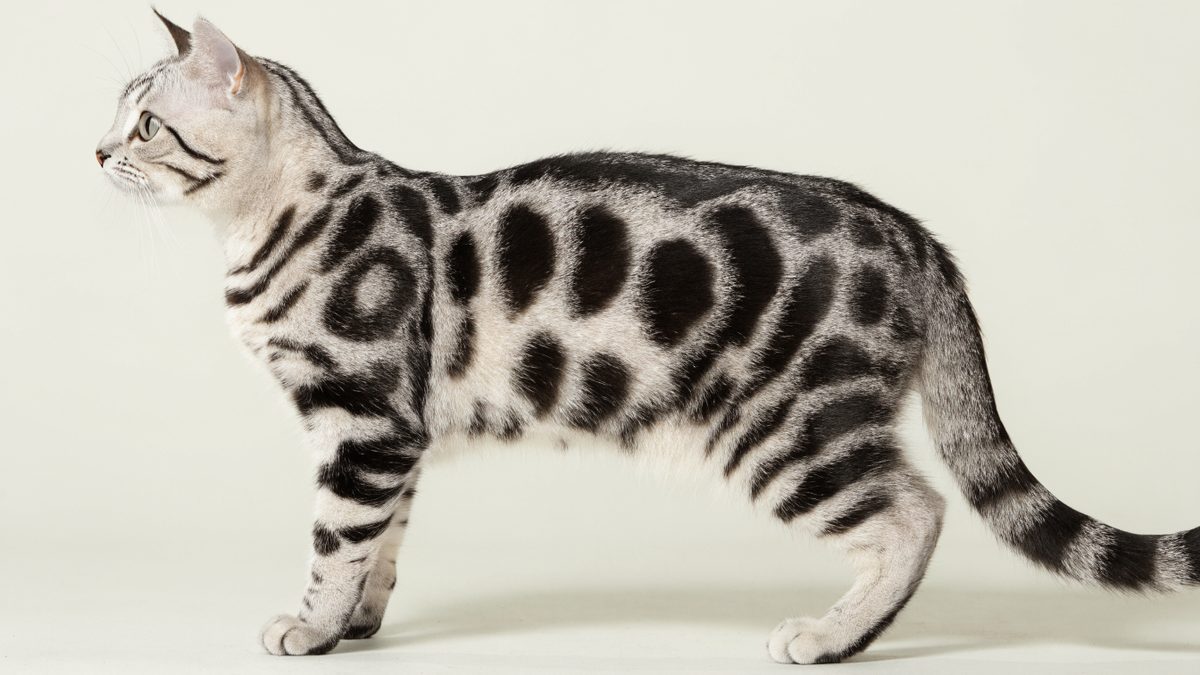
The American Shorthair is recognised in more than eighty colours and patterns, from the brown patched tabby to the blue-eyed white, through the silvers and the Van-patterned calico. The signature look is the silver classic tabby, which CFA describes as a pale clear silver ground with dense black markings, a white undercoat and green to hazel eye colour, green preferred. The classic pattern itself is precisely specified: an intricate letter M on the forehead, a butterfly across the shoulders with both wings distinctly outlined, three well-separated stripes down the spine, and a large solid blotch on each side encircled by one or more unbroken rings.
Indian sellers charge a premium for that pattern and say so. The premium is real in the market, but it is worth knowing that colour and pattern together are worth 20 of 100 points to CFA and 15 to TICA, while head and body together are worth 60 and 75 The International Cat Association. The market prices the coat. The standard prices the cat.
History, and why it produced a hardy animal
The breed descends from European cats carried to North America by early settlers to protect stores from mice and rats, and it was among the first five breeds registered by CFA in 1906. TICA records that these early cats earned their living with their hunting skills, and that they were valued long before anyone thought of showing them. CFA's coat clause still reflects that job: the coat must be dense enough to protect from moisture, cold and superficial skin injuries, with regional and seasonal variation in thickness allowed.
That working-cat ancestry is the honest basis for the breed's reputation for robustness, and it is why an American Shorthair is a more sensible imported breed for India than a flat-faced Persian or a heavily coated Maine Coon. It is not, however, a guarantee of health, and the health section of this page sets out where the registries and the veterinary literature disagree about that.
Is it a real American Shorthair, or a domestic shorthair with a price tag
To tell a real American Shorthair from an ordinary domestic shorthair, ask for the registration certificate and its pedigree, then check the cat against four measurable points in the breed standard. Appearance alone cannot settle it, because the breed was renamed in 1966 precisely because it resembles the random-bred short-haired cats it came from. In India this is the single most important thing on this page, because more cats are sold under this name than could plausibly be registered anywhere.
Start with the document, because the document is the breed. CFA's Rules of Registration for the American Shorthair are two pages long and unusually strict, and they give you the exact questions to ask.
| Rule | What CFA states | What it means for an Indian buyer |
|---|---|---|
| Allowable outcross breeds | None | An American Shorthair may not be bred to any other breed and stay registrable. A cat with a Persian or Exotic parent is not one. |
| Pedigree requirement | 5 generations | A one-page 'certificate' with no ancestry behind it does not meet the registry's own bar. |
| Parentage, effective 1 May 1985 | Both parents must be registered. Unknown or unregistered parents no longer accepted | A kitten from an unregistered mother cannot be registered, whatever it looks like. |
| Street cats, effective 15 February 1986 | Possible to register a street cat with a special form and Breed Council approval | There is a legitimate route from a street cat, but it runs through a named CFA Breed Council secretary, not a WhatsApp claim. |
| Do not accept, in the cat or in its background | Any lilac, any chocolate, longhair, curly coat, wavy coat, pointed, spotted tabby | A spotted or pointed 'American Shorthair' is being sold under the wrong name. |
| Championship status | Effective 1906 | Among the first breeds CFA recognised, so genuine pedigrees are long and traceable. |
Which registries can even issue that paper
Three organisations recognise the American Shorthair according to Britain's own registry: CFA, TICA and SACC, the Southern Africa Cat Council. Wikipedia records that the breed is accepted by all North American cat registries, which adds ACFA and the Canadian Cat Association. That is the whole list a buyer needs.
Two of the world's best-known registries are not on it. The Fédération Internationale Féline publishes its complete breed list, and the American Shorthair does not appear in any of its four fully recognised categories or among its preliminary recognised breeds. Britain's Governing Council of the Cat Fancy lists the American Shorthair on its Unrecognised Breeds page, with the genetics committee note 'Not applied, probable acceptance', and names the British Shorthair as the recommended similar breed. GCCF also states that cats of breeds without its recognition are not eligible to be present at GCCF-licensed shows at all.
One ranking page sells an 'FCI Registered / Import Bloodline' American Shorthair at Rs 1,40,000 to Rs 2,55,000, and in its own FAQ calls the same tier 'KCI-registered'. A second advertises 'FCI / WCI Certified' cats with purebred certificates available. The Fédération Cynologique Internationale states on its own site that it is the World Canine Organisation and recognises 364 breeds, all of them dog breeds. The Kennel Club of India is a dog registry. Neither body registers cats. A premium is being charged for a document that does not exist, and the two claims on the same page contradict each other.
Four physical checks you can run in ten minutes
If paperwork is not available, and in India it usually is not, the standard still gives you measurable points. None of these proves a pedigree. All of them can disprove one.
- Measure the outline, not the face. The proportions are slightly longer than tall, and viewed from above the outer lines of the body are parallel. A short, deep, round cat is cobby, and cobbiness is penalised.
- Check the ear-to-eye ratio. The distance between the ears, measured from the lower inner corners, is twice the distance between the eyes. This is the single most useful check because it is a ratio, so it works on a kitten as well as an adult.
- Look at the eye shape. The upper lid is half an almond and the lower lid a fully rounded curve. TICA adds that the eyes should not be round as they are in the Exotic Shorthairs. A fully round eye points away from this breed.
- Feel the coat texture. It is short, thick, even and hard, dense enough to protect from moisture and superficial skin injuries. TICA describes it as lustrous and warns that even a show bath can leave it too soft or fluffy. Soft, silky or fluffy is wrong for the breed.
Count the toes as well. Five in front and four behind is the standard, and an incorrect number of toes is a disqualification. Polydactyly is common in random-bred cats and would immediately settle the question.
What being a recognised breed actually takes
It is worth understanding how much institutional work sits behind the word 'breed', because it explains why a seller cannot simply declare one. To move a breed to championship status, GCCF requires a Breed Advisory Committee with a constitution approved by the board, a Standard of Points, a registration policy, a breeding policy approved by the genetics committee, 50 registered specimens of the breed, and 15 cats awarded a minimum of four merit certificates by at least four different judges.
That is the machinery a registered breed rests on. When an Indian listing says a kitten is purebred because the seller says so, compare it against that list and the gap is obvious.
A shorthaired Indian cat that does not meet the American Shorthair standard is not a lesser animal. In the largest UK primary-care life-table study, crossbred cats reached a life expectancy at age 0 of 11.89 years against 10.41 years for purebred cats. If what you want is a hardy, short-coated, easygoing cat that suits an Indian flat, the desi shorthair delivers that for an adoption fee of Rs 0 to Rs 1,500. What you should not do is pay Rs 60,000 for one under a name it does not hold.
American Shorthair price in India, and why the sources disagree by 38 times
The published American Shorthair price in India runs from Rs 10,000 to Rs 3,87,499 across six sources we read in full on 16 August 2026, a spread of roughly 38 times for the same breed name Puppiezo, American Shorthair Cats…. No source explains the gap, and one seller carries three different prices for the same Delhi kitten on a single page. Bonbeno publishes the whole spread rather than averaging it, because the spread is the finding.
Here is every published Indian figure we could verify by opening the page, in the words each source used.
| Source | Published price | What the source says it covers |
|---|---|---|
| Happy Pet Care | Rs 10,000 to Rs 40,000 | Depending on pedigree or breeder. Lists life expectancy 12 to 15 years |
| Vetscan Diagnostics | Rs 25,000 to Rs 45,000 | Breed guide entry, lifespan 15 to 18 years, climate suitability rated Excellent |
| Justdial | Rs 25,000 to Rs 80,000 | Depending on pedigree, colour and breeder reputation |
| Nearby Pets India, New Delhi | Rs 38,700 to Rs 38,800 in body text, Rs 46,799 on the product card, Rs 35,499 in the page description | Three different prices on one URL for the same kitten |
| GoodPaws | Rs 60,000 to Rs 2,55,000 | Three tiers: pet quality, silver tabby show quality, and an 'FCI Registered / Import Bloodline' tier |
| Puppiezo | Rs 3,87,499 for one listed 12-week kitten | A single named kitten on the breed's own product page |
Take the two ends seriously. A page that lists this breed at Rs 10,000 and a page that lists one kitten at Rs 3,87,499 are not describing the same transaction. Somewhere in that range the word 'American Shorthair' stops meaning a registered pedigree cat and starts meaning a short-coated cat that looks about right.
What is actually driving the top of the range
GoodPaws is the only Indian source that breaks its price into tiers, so it is the most useful to examine. Its table runs Rs 60,000 to Rs 80,000 for standard pet quality, Rs 70,000 to Rs 90,000 for silver tabby show quality, and Rs 1,40,000 to Rs 2,55,000 for 'FCI Registered / Import Bloodline'. The page also states that prices depend on FCI registration status, and its FAQ describes the Rs 2,55,000 top of the range as 'KCI-registered silver tabby show-quality cats with import bloodlines';.
The FCI is the World Canine Organisation and its 364 recognised breeds are dog breeds. The Kennel Club of India is likewise a dog registry. So the premium tier on the highest-priced Indian breed page is defined by two registrations that do not exist for cats, and the page names both of them for the same tier. A second seller advertises the breed as 'FCI / WCI Certified';.
Ask which registry issued the pedigree certificate, then ask for the registration number and the name of the cattery. A genuine American Shorthair pedigree comes from CFA, TICA, ACFA, the Canadian Cat Association or SACC, and CFA requires five generations behind it Governing Council of the Cat Fancy. If the answer is FCI, KCI, WCI or 'we have papers', the premium has nothing behind it. Bonbeno does not broker sales and does not recommend sellers. This is reporting on what published pages claim.
The colour premium, checked against the standard
The silver tabby premium is real in the Indian market and roughly Rs 10,000 on GoodPaws' own tiers. It is worth knowing what you are paying for. CFA's silver tabby description requires a pale clear silver ground including lips and chin, dense black markings, a white undercoat, brick red nose leather, black paw pads and green to hazel eyes with green preferred. A grey tabby kitten with gold eyes and a muddy ground colour is not that cat, whatever the invoice says.
The breed's colour range is enormous, which is one reason colour-based pricing is so slippery here. More than eighty colours and patterns are recognised, and the CFA registration prefix list alone runs to well over sixty separate colour codes Cat Fanciers' Association. A seller can describe almost anything as a recognised American Shorthair colour, and for a cat with real papers that would even be true.
What a realistic budget looks like
Bonbeno does not publish a recommended price, because we do not broker sales and a recommended price would function as an offer. What we can do is set out the three transactions the published figures actually describe, so you can decide which one you are in.
| What you are buying | Published range | The document that should exist |
|---|---|---|
| A short-coated Indian domestic cat sold under the breed name | Rs 10,000 to Rs 45,000 Vetscan Diagnostics | None. No registry paperwork will be produced, because none exists |
| A cat from an Indian cattery breeding to type without registry papers | Rs 25,000 to Rs 90,000 GoodPaws, American Shorthair Kittens… | Vaccination record and a written health certificate, but no pedigree certificate |
| A registered cat from imported registered parents | Rs 1,40,000 upward Puppiezo, American Shorthair Cats… | A CFA or TICA registration certificate with five generations of pedigree behind it |
Notice that the middle row is where most Indian buyers actually sit, and that it is an honest place to be as long as nobody pretends otherwise. A well-bred, healthy, well-socialised cat without registry papers is a good cat. It is simply not a Rs 2,55,000 cat, and the price gap between the second and third rows is entirely a paperwork gap.
Certified Indian shelters rehome cats for Rs 0 to Rs 1,500, and the fee typically covers vaccination, deworming and shelter care. Google's own related searches for this query include 'Domestic Shorthair price in India' and 'Cat price in India under 2,000', which suggests a good number of people searching this term are already asking the right question.
What an American Shorthair costs to keep, month after month
Budget between Rs 2,800 and Rs 4,200 a month for an American Shorthair in an Indian city on the only published Indian breed-specific figures, split as Rs 1,500 to Rs 2,000 for food, Rs 500 to Rs 700 for routine veterinary care and Rs 800 to Rs 1,500 for grooming. Those numbers understate two costs this breed specifically creates, and this section adds both.
Start with what the Indian sources publish, because it is a reasonable floor and it is the only breed-specific monthly cost anyone has bothered to write down.
| Line item | Basic | Premium |
|---|---|---|
| Food | Rs 1,500 | Rs 2,000 |
| Veterinary | Rs 500 | Rs 700 |
| Grooming | Rs 800 | Rs 1,500 |
| Total published monthly | Rs 2,800 | Rs 4,200 |
The grooming line is the one to question. This breed has a short, thick, hard coat that a weekly comb handles, and TICA states plainly that it is not really a coat to be brushed and that a bath is rarely necessary unless the cat is being shown. GoodPaws agrees that no professional grooming is required for most coat types. A grooming package at Rs 800 to Rs 1,500 a month is therefore a choice, not a requirement, and cutting it takes the realistic floor closer to Rs 2,000 a month.
Two costs the Indian pages leave out
The first is cooling. An American Shorthair kept in an Indian flat through April, May and June needs one room that stays reliably cool, and the electricity that keeps it cool is a real recurring cost that scales with your city and your tariff. Happy Pet Care lists this breed's ideal weather as 15 to 30 degrees Celsius, and the India Meteorological Department does not even call it a heatwave in the plains until the maximum reaches 40 degrees. Cooling is not optional in most of the country, and no ranking page prices it.
The second is cardiac screening. Because no DNA test for hypertrophic cardiomyopathy exists in this breed, the only meaningful screen is an echocardiogram, and the ACVIM consensus statement describes a standard-of-care echocardiographic scan as the minimum for screening pedigree breeding cats. For a pet owner this is not an annual expense, but budgeting for one specialist cardiac scan in the cat's life, and knowing where the nearest veterinary cardiologist is before you need one, is the single most useful preparation you can make.
- Litter is the cost most first-time owners underestimate. Two litter boxes for one cat is the standard recommendation, and clumping litter for two boxes runs materially higher than one.
- Vaccination in the first year is front-loaded, with a core FVRCP course and rabies through the kitten months rather than spread evenly.
- Neutering is a one-off cost in the first year and is the single most cost-effective veterinary spend you will make.
- Insurance is thin in the Indian market and worth checking rather than assuming, particularly for a breed where a cardiac condition is the main inherited risk.
Compared with the other pedigree cats Indian buyers cross-shop, an American Shorthair is low-cost on the two lines that usually hurt. The coat needs a weekly comb and no salon, and the breed has significantly lower odds of developing urate uroliths than mixed-breed cats in a 5,072-case study, which is a real and unglamorous cost saving on urinary work-ups.
American Shorthair in the Indian climate, heat, humidity and monsoon
An American Shorthair copes with the Indian climate better than most imported pedigree cats and worse than a desi shorthair, which is why Bonbeno rates its heat tolerance 3 out of 5. The coat is short but the CFA standard requires it to be thick, even and dense enough to protect from moisture and cold, so it is insulating by design. One Indian source rates the breed's climate suitability Excellent while another puts its ideal weather at 15 to 30 degrees Celsius. Both cannot be right for Nagpur in May.
Set the scale first, because Indian summers are not a mild inconvenience. The India Meteorological Department declares a heatwave when maximum temperatures reach 40 degrees Celsius or more in the plains, or at least 30 degrees in hilly regions, and those maximums must also sit at least 4.5 degrees above the region's normal average for at least two consecutive days. A published analysis estimates a single day of extreme heat causes roughly 3,400 excess human deaths nationally in India, against official heatwave death counts of between 500 and 1,500 annually.
Against that, Happy Pet Care's stated ideal weather band for the breed, 15 to 30 degrees Celsius, is exceeded across most of the country for months at a time. The honest reading is that this breed is manageable in India with one reliably cool room, and stressed without one.
Why the short coat is not the whole story
The coat clause in the CFA standard is written for a working cat in a temperate climate: short, thick, even and hard in texture, with regional and seasonal variation in coat thickness allowed, and dense enough to protect from moisture, cold and superficial skin injuries. That phrase 'dense enough to protect from moisture and cold' is the operative one. Density is insulation. A short coat sheds heat better than a Persian's, but it is not the same as a thin coat.
The seasonal-variation clause is the useful part for India. The standard explicitly allows regional and seasonal variation in coat thickness, and a cat living in Chennai will carry a lighter coat than the same cat would in Delhi in January. That is normal and correct. It also means a heavy summer shed is expected, not a symptom.
Heatstroke, and the exact scenario that causes it in Indian flats
Cats are generally good at moving themselves out of the heat, and International Cat Care notes that most cats will nap in the sun and then retire to a shady spot on their own. The failure mode is confinement. International Cat Care states the risk directly: cats may be confined to a room or conservatory which gets very hot, and in this situation heatstroke is a risk. In an Indian flat, that room is the one you shut the door on when you leave for work.
Excessive panting, lethargy, drooling, a high temperature, vomiting, and collapse or unconsciousness are the signs International Cat Care lists. A cat that is panting is already in trouble, because cats do not pant to cool down the way dogs do. Contact your veterinary team immediately. Consult your nearby vet before you need one, so you know who is open at 3 pm in May.
City by city, what actually changes
| City type | The dominant problem | What to change |
|---|---|---|
| Delhi, Jaipur, Lucknow, Nagpur | Extreme dry heat well past the 40 degree heatwave threshold | One air-conditioned or cooler-served room from March to June, with the door propped so the cat can choose it. Multiple water bowls, refreshed several times a day |
| Mumbai, Chennai, Kochi, Kolkata | Humidity rather than peak temperature | Airflow matters more than a low set point. A ceiling fan plus tile or porcelain floor space, which cats gravitate to when hot |
| Bengaluru, Pune, Hyderabad | The mildest of the metros for this breed | Manageable without permanent cooling in most of the year. Watch April and May only |
| Any city, monsoon months | Damp coat and skin, plus indoor confinement | Comb weekly to lift dead hair out of a damp coat, and add indoor play because the cat will move less |
| Shimla, Dehradun, Darjeeling and the hills | Cold rather than heat | The least demanding placement for this breed. The standard's dense coat is doing what it was selected for |
The monsoon deserves its own line. A dense coat that stays damp is uncomfortable and slow to dry, and a cat that grooms a damp coat swallows more hair. Combing weekly through the wet months is not cosmetic, it is the cheapest hairball prevention available, and TICA recommends running a comb through the coat as needed to help the cat avoid swallowing excess hair.
This breed is a reasonable choice for Indian conditions if you can cool one room reliably through the hot months, and a poor choice if you cannot. That is a lower bar than a Maine Coon or a Persian and a higher bar than a desi shorthair, which is exactly where a heat tolerance rating of 3 out of 5 sits.
Temperament, and who should not buy this cat
An American Shorthair is easygoing, people-oriented and independent enough to amuse itself while its owners are at work, which is the specific combination that makes it work in a two-income Indian household. CFA describes it as easygoing and relatively sedate, tolerant of other animals and small children, and skilled at communicating without loud vocalisations. It is the least dramatic pedigree cat on the Indian market, and that is its whole appeal.
TICA opens its description with the claim that carries the most weight for an Indian buyer: the American Shorthair is one of the most adaptable breeds for any type of household, suiting a person living alone, a senior citizen, a family with children and a busy household equally, and apartment living suits them as well as a house. Justdial's Indian guide makes the same observation from the other direction, noting that this breed does not fall apart under change, and adjusts to a new house, a new schedule or new people more easily than a British Shorthair does.
The registries agree on the temperament to an unusual degree, which is worth noting because they disagree about this breed's health. CFA calls it affectionate, appreciative of human company and particularly fond of interactive play, while independent enough to amuse itself while owners are away at work. TICA calls it good-natured and easy-going, an excellent companion for a person living alone, a calm devoted pet for a senior citizen, and known to be excellent with children.
TICA adds a detail worth planning around. Female cats tend to be busier than the males, and males are more easygoing. If you want the quieter animal, that points at a male, which is the opposite of the assumption most first-time Indian buyers make.
The silent meow, and what it tells you about noise
CFA records that the breed is known for its 'silent meow' of greeting, politely requesting attention with an open mouth yet making no sound. That is a charming detail and also a practical one. For anyone in a flat with shared walls, or with a household that includes a night-shift worker or a small baby, a cat that does not announce itself is a genuinely different living experience from a Siamese.
Hunting drive is not a marketing line, it is a design brief
This breed was selected to catch things. The CFA standard requires jaws strong and long enough to successfully grasp prey, and TICA notes that many Americans retain their hunting instincts with any insects that venture into the house. In an Indian home that is partly an advantage and partly a management problem.
- Secure your windows and balconies with netting before the cat arrives. A cat with prey drive plus an open balcony in a high-rise is the most common preventable accident in Indian flats, and Indian guides list window netting as non-negotiable.
- Play in hunting sequences, not random bursts. CFA notes the breed particularly enjoys hunting games with feather or toys on wands or strings, and that a cat played with at the same time each day will start anticipating it.
- Expect problem-solving. CFA warns that these cats are quite capable of figuring out how to open cupboard drawers and sometimes doors, especially where the treats are kept.
- Introduce other pets properly. GoodPaws notes the breed gets along with children, dogs and other cats with appropriate introductions, and the qualifier is doing real work in that sentence.
Who should not buy an American Shorthair
Four buyers should look elsewhere, and saying so is more useful than another paragraph about how friendly the breed is.
| If this is you | Why it does not fit | What to consider instead |
|---|---|---|
| You cannot cool one room through the hot months | A dense protective coat in 40 degree heat with no escape is the confinement scenario that causes heatstroke Euronews, Heatwaves are killing tens… | An adopted Indian shorthair, adapted to the climate you actually live in |
| You want a cat that will insist on your attention all day | This breed is content alone through a working day and is described as non-demanding | A Ragdoll or a Siamese, both far more people-dependent |
| You want a guaranteed pedigree and a short wait | Genuine registration comes from CFA, TICA, ACFA, CCA or SACC only, and FIFe and GCCF do not recognise the breed at all Governing Council of the Cat Fancy | A British Shorthair, which FIFe and GCCF both register, so the paper trail is easier to verify |
| You will free-feed and not weigh the cat | Obesity is a disqualification in the breed standard itself and this is a food-motivated, relatively sedate cat | A more active breed, or a firm commitment to measure meals |
Strip out the registration confusion and the price spread, and what is left is a genuinely well-designed companion animal: quiet, tolerant, robustly built, low-grooming, content alone, and good with children and dogs The International Cat Association. That is a real thing worth wanting. It is just not a thing you can verify from a photograph.
Training an American Shorthair, litter box to carrier
Train an American Shorthair with food and repetition, and expect it to learn faster than most cats. CFA states that given their high level of intelligence these cats are easily trainable and can be taught to stay off counters, use scratching posts and even retrieve toys. TICA agrees they are easy to train and like to play fetch. The two things worth training deliberately in India are carrier tolerance and handling, because both matter for the cardiac screening this breed may need.
Litter training is rarely a problem with a cat that came from a properly run litter, and the practical variables are box count and placement rather than technique. Two boxes for one cat is the working standard, placed in quiet locations away from food and water. International Cat Care recommends placing water at least a short distance from food because cats' noses are sensitive and an overwhelming smell of food can reduce drinking, and the same logic applies to the litter box.
If a settled adult cat starts avoiding the litter box, treat it as a medical sign rather than a behavioural one until a vet says otherwise. Consult your nearby vet promptly, because urinary problems in cats can move from inconvenient to life-threatening in under a day.
Carrier training is the one that pays for itself
Here is the argument nobody makes on the Indian pages. Because no DNA test for hypertrophic cardiomyopathy exists in this breed, the only real screening tool is an echocardiogram, and the ACVIM consensus statement describes a standard-of-care scan as the minimum for screening pedigree breeding cats. That scan is done on a conscious cat lying still on its side while a stranger presses a probe against its chest. A cat that panics in a carrier will not get a usable scan.
- Leave the carrier out permanently, door open, with a blanket inside, from the day the kitten arrives. It becomes furniture rather than an ambush.
- Feed one meal a week inside it so the association is food rather than the vet.
- Practise handling weekly. Hold the cat on its side for ten seconds, reward, release. Build to sixty seconds over a few months.
- Weigh the cat monthly on a kitchen scale, on the same day, and write the number down. This doubles as handling practice and as the obesity check the breed standard implies.
What this breed resists
It resists being hurried, and it resists working for praise alone. The registries describe a cat that is independent and non-demanding, content to entertain itself Cat Fanciers' Association. That independence means it is not especially motivated to please you, so training that depends on approval does not land. Training that pays in food does.
It also resists being outsmarted on food storage. CFA's own warning about cupboard drawers and doors is not a joke, and in an Indian kitchen where dry food often lives in an accessible container, that is a direct obesity risk.
A realistic training timeline
| Age | Focus | Success looks like |
|---|---|---|
| 8 to 12 weeks | Litter box, name response, gentle handling | Reliable box use, comes when called for food |
| 3 to 6 months | Carrier, scratching post, no counters | Walks into the carrier for a treat |
| 6 to 12 months | Body handling, monthly weighing, wand play routine | Tolerates sixty seconds on its side, plays twice daily |
| 1 year onward | Maintenance, plus food puzzles as the metabolism slows | Weight stable, plays without being coaxed |
Both registries independently list retrieving toys and playing fetch as things this breed does The International Cat Association. For an Indian flat with no outdoor access, a cat that will genuinely fetch is the cheapest exercise programme available, and it costs one wand toy.
Daily exercise, and what happens without it
Give an American Shorthair 30 to 60 minutes of active play a day, split into at least two sessions, because this is a moderate-energy cat that will not exercise itself indoors. Indian breed pages put the exercise routine at 30 minutes daily and the energy level at medium Happy Pet Care, American Shorthair Cat…, and CFA describes the breed as easygoing and relatively sedate. Sedate plus a full food bowl is how a disqualifying body condition develops.
The published Indian figures cluster tightly for once. Happy Pet Care lists an exercise routine of 30 to 60 minutes and an energy level of medium. Puppiezo lists 30 minutes daily and medium energy. Justdial describes the activity level as moderate, steady rather than frantic. Those are consistent with a working cat that hunts in short bursts rather than an athlete.
The structure matters more than the total. Cats hunt in short intense sequences followed by rest, and CFA notes this breed particularly enjoys hunting games chasing feather or toys on wands or strings with their owners. Two ten-minute wand sessions that end with a catch and a meal will do more than an hour of a cat idly batting a ball.
What happens without it, in numbers
Weight gain, and it is not a minor risk. In a dataset of approximately 1.3 million cats seen at primary practices across the USA, 47.2 percent of adult cats were overweight and a further 13.9 percent obese, rising to 44.8 percent overweight and 21.7 percent obese in the mature life stage. That is roughly two thirds of adult cats carrying excess weight in a population with far better access to veterinary weight management than most Indian cities have.
For this breed specifically, the consequence is written into the standard. Obesity is a disqualification alongside emaciation in CFA's American Shorthair standard. And because hypertrophic cardiomyopathy is the main inherited concern in cats generally, with a prevalence of 14.7 percent in 780 apparently healthy rehoming-centre cats, a heavy sedentary cat is exactly the animal you do not want carrying a cardiac condition.
A cat with no outdoor access, no vertical space and a free-fed bowl of dry food will move approximately as much as it needs to reach the bowl. Nearby Pets India's own care advice for Delhi tells buyers to shift walks to early morning and late evening, which is dog advice pasted onto a cat page. Cats in Indian cities do not need walks. They need vertical space, two daily play sessions and measured meals.
What to actually provide
- Vertical space. A tall scratching post or cat tree, which TICA lists as a standard recommendation for the breed alongside nail trimming and ear cleaning.
- A window perch. TICA notes these cats like to watch birds and other activity from a windowsill, and a netted window is safe enrichment that costs nothing to run.
- Wand toys, used by you. GoodPaws is right that play mimicking hunting satisfies the instinct safely indoors. The cat cannot do this alone.
- Food puzzles, which convert eating from a thirty-second event into a ten-minute one and are the simplest weight intervention available.
One caution on laser pointers. They are listed as suitable enrichment on Indian breed pages, and they do get a cat moving, but a hunting sequence that never ends in a catch can leave a cat frustrated. Finish a laser session by landing the dot on a physical toy the cat can actually grab.
Grooming a hard, dense coat in Indian humidity
Comb an American Shorthair once a week with a metal comb and skip the salon entirely. TICA states the short coat is easy to care for and not really a coat to be brushed, recommends running a comb through it as needed to help the cat avoid swallowing excess hair, and notes that these cats keep themselves clean and do not typically need a bath. Indian grooming packages quoted at Rs 800 to Rs 1,500 a month are buying you something this coat does not require.
The coat is specified as short, thick, even and hard in texture, dense enough to protect from moisture, cold and superficial skin injuries. Hard is the word that matters. This is not a plush coat and it is not a silky one. It is a functional working coat, and its texture is part of the standard rather than an afterthought, worth 15 of 100 points to CFA.
TICA adds a detail that is genuinely surprising and tells you how easily this coat is damaged by over-handling. When bathed for a show, care must be taken or the coat ends up too soft or fluffy. Washing this cat makes its coat worse by the standard's own measure. That is about as clear a signal as a registry can send about monthly professional grooming.
The weekly routine, and what it costs
| Task | Frequency | Why |
|---|---|---|
| Comb through with a metal comb | Weekly, twice weekly in shed season | Lifts dead hair the cat would otherwise swallow |
| Nail trim | Monthly | Listed as standard care by both TICA and Indian breed guides GoodPaws, American Shorthair Kittens… |
| Ear check and clean | Monthly | Same source, and worth doing in humid months when ears stay damp |
| Tooth brushing with vet-approved paste | Ideally several times weekly | TICA lists it as standard care for all cats |
| Bath | Rarely, and only if genuinely dirty | TICA states a bath is rarely necessary unless the cat is being shown |
| Professional grooming | Not required | GoodPaws itself states no professional grooming is required for most coat types |
That schedule costs the price of one good metal comb and one nail clipper, roughly a one-off spend rather than a monthly one. Removing the grooming line from the published Indian monthly budget takes Rs 2,800 to Rs 4,200 down toward Rs 2,000 to Rs 2,700.
Shedding, and what the Indian pages get wrong about it
Indian sources contradict each other on shedding, which is a useful signal in itself. Happy Pet Care rates the shedding level Low, Puppiezo simply answers YES to shedding, and GoodPaws describes moderate shedding managed by regular brushing. TICA settles it: they do shed.
The CFA standard explains why the amount varies so much between sources. Regional and seasonal variation in coat thickness is explicitly allowed. A cat carrying a heavier winter coat in Delhi will drop far more hair in March than the same cat in Kochi ever does. Judge the shed against your own city, not against a breed page written elsewhere.
Humidity, monsoon and skin
The monsoon is the season that turns an easy coat into a slightly harder one. A dense coat holds moisture, a damp coat mats less than a long one but harbours more, and a cat grooming a damp coat swallows more hair. Three practical adjustments cover it.
- Comb twice a week through the wet months rather than once, working right down to the skin.
- Dry the cat properly if it gets genuinely wet, because a coat this dense takes longer to dry than it looks.
- Check the skin while you comb. Indian breed guides list fleas, ticks and skin and coat disorders among common problems for cats here, and the weekly comb is your inspection.
The coat is dense enough to protect from moisture and superficial skin injuries by design, and it also protects against sunburn. International Cat Care specifically warns owners not to underestimate the risk of sunburn to a cat and to use pet-safe sunscreen where necessary. Shaving removes the protection without solving the heat, because the heat problem is the room, not the coat.
American Shorthair health, screening and life expectancy
The American Shorthair has no DNA test for its main inherited concern, so screening means an echocardiogram rather than a cheek swab. Three authorities describe this breed's health differently and Bonbeno prints all three: CFA says hypertrophic cardiomyopathy has largely disappeared from the breed, TICA says the breed is not known to be prone to any genetic or hereditary illnesses, and Cornell's Feline Health Center lists the American Shorthair among the breeds with higher HCM prevalence. This section explains why they differ and what a buyer should actually do.
This guide is general information for Indian cat owners and is not a diagnosis. Consult your nearby vet, and a registered veterinary cardiologist where cardiac screening is involved, before acting on anything here.
Hypertrophic cardiomyopathy, the one that matters
Hypertrophic cardiomyopathy is the most common heart disease of cats, and the ACVIM consensus statement puts its prevalence at approximately 15 percent in the general cat population, rising to as much as 29 percent in older cats Cornell Feline Health Center. The best single prevalence study screened 780 apparently healthy cats aged six months or older available for rehoming and found HCM in 14.7 percent of them, with a 95 percent confidence interval of 12.3 to 17.4 percent. That baseline applies to every cat, pedigree or not.
Cornell's Feline Health Center names the American Shorthair among breeds with higher prevalence, alongside the Maine Coon, Ragdoll, British Shorthair, Sphynx, Bengal, Chartreux, Norwegian Forest, Siberian and Persian. CFA's own breed page tells a different story: hypertrophic cardiomyopathy was noted in some cats in the 1980s and 90s, but thanks to preventive testing and selective breeding it has largely disappeared from the breed. TICA goes further and states the breed is not known to be prone to any genetic or hereditary illnesses.
Only two feline sarcomeric mutations have been identified, MYBPC3 A31P in Maine Coons and MYBPC3 R820W in Ragdolls, and the ACVIM consensus statement is explicit: genetic testing for the A31P and R820W MYBPC3 mutations in non-Maine Coon or non-Ragdoll cats is not recommended, because these two mutations are almost completely specific to Maine Coon and Ragdoll cats. A 2024 review reaches the same conclusion, attributing the presence of A31P in other breeds to crossbreeding with the Maine Coon and R818W in other cats to Ragdoll ancestry. UC Davis offers both tests and states the breeds appropriate for testing as Maine Coon for one, and Ragamuffin, Ragdoll and related outcrosses for the other UC Davis Veterinary Genetics Laboratory. Neither list includes the American Shorthair.
So what does screening look like here. Cornell states that HCM is diagnosed by echocardiography, and warns that similar heart thickening is also caused by high blood pressure and hyperthyroidism, which must be ruled out before diagnosing HCM. The ACVIM consensus recommends a standard-of-care scan as the minimum for screening pedigree breeding cats. In practice, for an Indian pet buyer, that means asking a breeder whether the parents have been scanned by a cardiologist and accepting that in most of India the honest answer will be no.
What to watch for at home
Cornell lists laboured or rapid breathing, open-mouthed breathing and lethargy, along with acute hind-limb pain or in extreme cases hind-limb paralysis caused by blood clots. The prognosis is not uniformly grim: cats that do not display clinical signs are often able to survive for years with only mildly compromised heart function. A cat breathing hard at rest is an emergency. Consult your nearby vet the same day.
Polycystic kidney disease, and a Japanese finding no Indian page carries
PKD is usually described as a Persian problem, and for good reason, but there is a published finding in this breed that anyone importing lines from Asia should know. A 2019 study in the Journal of Veterinary Medical Science tested 377 cats in Japan for the feline PKD1 mutation and found it in 16 of 34 American Shorthairs, or 47 percent.
| Breed | Positive | Tested | Percent |
|---|---|---|---|
| Scottish Fold | 37 | 69 | 54% |
| Japanese mixed breed | 26 | 48 | 54% |
| American Shorthair | 16 | 34 | 47% |
| Persian | 36 | 79 | 46% |
| Munchkin | 6 | 16 | 38% |
| Exotic Shorthair | 16 | 71 | 23% |
Read that table carefully, because the headline number is easy to misuse. Every cat in the study was clinically or genetically suspected of PKD by the referring veterinarian, either because of abnormal ultrasonography or because they were relatives of PKD-affected cats. That is a selected population, so 47 percent is not the breed prevalence and nobody should quote it as one. What it does establish is that the PKD1 mutation is present in American Shorthair lines in Japan, which is a real consideration for imported bloodlines and a reason to ask about ultrasound screening rather than assume the breed is exempt.
Where this breed is genuinely lower risk
A case-control study of 5,072 cats with urate uroliths against 437,228 controls found that while purebred cats overall had significantly higher odds of urate uroliths than mixed-breed cats, the American Shorthair was one of five breeds with significantly lower odds than mixed breeds, alongside the Abyssinian, Himalayan, Manx and Persian. That is a rare piece of breed-specific good news backed by a large dataset.
Life expectancy, and the figure nobody has
No large primary-care life-table study has published a life expectancy for the American Shorthair, and it is worth saying that plainly rather than borrowing a number. The largest UK study analysed twelve breed groups with at least fifteen deaths each and the American Shorthair was not among them. Indian pages fill the gap with figures ranging from 12 to 15 years through 15 to 18 years to 15 to 20 years Justdial JD Collections Nearby Pets India, none of them sourced.
| Group | Life expectancy | Basis |
|---|---|---|
| All UK cats | 11.74 years (95% CI 11.61 to 11.87) | Primary-care records, 7,936 confirmed deaths |
| Crossbred cats | 11.89 years (95% CI 11.76 to 12.03) | 7,117 deaths |
| Purebred cats | 10.41 years (95% CI 9.99 to 10.83) | 819 deaths |
| British cats | 9.58 years (95% CI 8.73 to 10.43) | 194 deaths, for comparison with the breed most often confused with this one |
| American Shorthair | Not analysed | Fewer than the fifteen deaths needed to appear in the study |
| Indian seller claims Vetscan Diagnostics Happy Pet Care, American Shorthair Cat… | 12 to 20 years across sources | No study cited by any of them |
The honest position is that a well-kept American Shorthair is a robust cat with a working-cat background and no proven breed-specific inherited disease with a DNA test, and that anyone quoting 20 years is quoting marketing rather than data. Crossbred cats in the best available dataset reached 11.89 years. That is the realistic frame.
The screening checklist to take to a breeder
- Ask whether both parents have had an echocardiogram by a veterinary cardiologist, and when.
- Ask whether the parents have had a renal ultrasound, which is the practical PKD screen where DNA testing is not available.
- Ask for the vaccination record, which the Pet Shop Rules require a registered seller to maintain.
- Ask for the written health certificate signed by a veterinary practitioner, which those rules also require before an animal is offered for sale.
- Book an independent vet check within seven days of taking the cat home, which Indian adoption guidance recommends and which applies equally to a purchase.
Feeding an American Shorthair in India, by life stage
Feed an American Shorthair measured meals rather than a free-topped bowl, because this is a food-motivated, relatively sedate cat whose breed standard disqualifies obesity outright Cat Fanciers' Association. Indian breed pages put daily intake at roughly 200 kcal for an adult and 250 kcal for a kitten, with a monthly food budget of Rs 1,500 to Rs 2,000. The number that should govern your feeding decisions is not the calorie count, it is the body condition score.
TICA's feeding guidance for the breed is unusually relaxed and worth reading against the obesity data. It suggests a small portion of wet food once daily, that these cats like variety, and that a bowl of dry food can be left out as they like to eat a little at a time. That last part works for an active outdoor working cat in a temperate country. It works considerably less well for an indoor cat in a Mumbai flat.
The reason is scale. In approximately 1.3 million cats seen at primary practices across the USA, 47.2 percent of adult cats were overweight and 13.9 percent obese, and at the mature life stage the figures were 44.8 percent overweight and 21.7 percent obese. Free feeding is the single largest contributor to those numbers, and this breed's own registry treats the outcome as a disqualification.
Life-stage feeding, in practical Indian terms
| Life stage | Approach | The specific risk |
|---|---|---|
| 8 weeks to 6 months | Kitten food, three to four measured meals a day, roughly 250 kcal daily | Underfeeding during rapid growth. Kittens genuinely need the calories |
| 6 to 12 months | Move to two or three meals, keep kitten food until about 12 months | The post-neuter energy drop, which is where weight gain usually starts |
| 1 to 3 years | Adult food, two measured meals, roughly 200 kcal daily | The cat is still filling out until three or four years, so growth and fat are easy to confuse |
| 3 to 7 years | Two measured meals, food puzzles, monthly weighing | Peak obesity years. 47.2 percent of adult cats are overweight |
| 7 years and older | Reassess with your vet, watch for weight loss as well as gain | Weight loss in an older cat is a medical sign, not a diet success |
Note the third row carefully. Because Americans do not really mature until around three or four years old, an Indian owner watching a cat get visibly bigger at eighteen months cannot tell from the scale alone whether that is bone and muscle or fat. This is exactly why the body condition score matters more than the weight.
The body condition check, run at home
TICA's British-comparison line gives the standard its practical test: the weight should come from muscle rather than food. Run your hands over the cat once a week and check three things. You should feel the ribs easily under a thin layer of fat without pressing. You should see a waist behind the ribs when you look down from above. The abdomen should tuck up rather than hang below the line of the elbows.
If you cannot feel ribs, the cat is overweight regardless of what the scale says. If the abdomen hangs, the cat is obese. Weigh monthly on the same kitchen scale, write the number down, and take the record to your vet. Consult your nearby vet before starting any weight-reduction plan, because cats that lose weight too fast can develop hepatic lipidosis.
Water, and why it matters more in India
Fresh clean water daily is the baseline, and International Cat Care recommends replacing water several times a day in extreme heat, using fountains, and placing multiple bowls around the house so water is within easy reach wherever the cat rests. TICA adds a behavioural detail: place the water bowl at least three feet away from any food, because cats' noses are sensitive and an overwhelming smell of food may cause them to drink less.
Wet food is the other lever. It carries far more moisture than kibble, which supports hydration and urinary tract health, and in a hot climate that is a real advantage rather than a luxury. A useful compromise for an Indian household is a measured wet meal morning and evening with a small measured dry portion in a puzzle feeder during the day.
- Never feed onions or garlic, which appear on every credible avoid list for cats.
- Skip dairy as a routine item, because many cats are lactose intolerant and it causes digestive upset.
- Avoid grapes and raisins, listed as a risk of acute kidney failure in cats.
- Never substitute dog food, which lacks the taurine cats require.
- Change brands gradually over about a week, which is standard advice and prevents the digestive upset that makes owners abandon a good food.
The American Shorthair kitten timeline, month by month
Bring an American Shorthair kitten home at 12 weeks, not earlier, and expect the cat to keep developing until it is three or four years old. GoodPaws sets 12 weeks as its own minimum, saying kittens fully weaned, initially vaccinated and properly socialised by 12 weeks adjust best to new homes. Two other Indian sellers list kittens at 55 to 90 days and at 45 days and older, which is well below that bar.
The Prevention of Cruelty to Animals (Pet Shop) Rules, 2018 state that no pet shop shall sell un-weaned or underage animals or birds, and separately that a pet shop shall not display or house pregnant animals or mothers caring for un-weaned young for sale. A 45-day-old kitten offered for doorstep delivery sits uncomfortably against both.
| Age | What is happening | What you do |
|---|---|---|
| 0 to 8 weeks | With the mother and litter. Core socialisation window | Nothing. The kitten should not be with you yet |
| 8 to 12 weeks | Weaning completes, first vaccinations, litter habits set | Visit if you can. Meet the mother. Ask to see the vaccination record |
| 12 weeks | Ready to move home | Collect in person, never by courier. Set up carrier, two litter boxes, a quiet room |
| 3 to 4 months | Rapid growth, teething, boundless play | Three to four measured meals daily. Start carrier training. Complete the vaccination course |
| 4 to 6 months | Adult teeth in, coordination sharp, prey drive obvious | Fix window netting if you have not. Book neutering with your vet |
| 6 to 9 months | Neutering window, energy needs drop afterwards | Cut portions after neutering. Start monthly weighing |
| 9 to 12 months | Looks adult, is not | Move to adult food around 12 months. Establish two daily play sessions |
| 1 to 3 years | Head, jowls and bone keep filling out | Body condition check weekly. Male jowls develop last |
| 3 to 4 years | Full maturity. The breed's features are at their best | This is the cat you actually bought |
Vaccination in the first year
The published Indian schedule for this breed runs a core FVRCP course and rabies from 6 to 8 weeks with boosters at 8 to 10 weeks and 12 to 16 weeks, then boosters every one to three years from a year onward. Treat that as a reference and confirm the exact protocol with your nearby vet, because local disease pressure and vaccine availability vary considerably across Indian cities and the source itself carries that caveat. Our cat vaccination schedule for India covers the timing in more detail.
Why the delivery model is the wrong way to buy this kitten
One ranking seller advertises 5 to 7 day doorstep delivery of kittens aged 55 to 90 days, taken on a 25 percent advance, with the kitten travelling in a carrier after a video call. Another offers home delivery of pets from 45 days old and a two-week replacement guarantee, stating that if your pet perishes because of a health concern confirmed by a licensed vet, a replacement will be offered.
A business that has written a replacement policy for kittens that die in the first two weeks is telling you something about its base rate. GoodPaws, by contrast, states that it does no courier deliveries ever and that the buyer meets the kitten in person in their own city. In-person collection is the single most protective decision an Indian buyer can make, because it is the only way to see the mother, see the conditions and check the cat against the standard before money changes hands.
Collect in person. Ask to see the kitten with its mother and littermates. Check the ear-to-eye ratio and the eye shape while you are there. Then book an independent vet check within seven days.
American Shorthair compared with the cats Indian buyers cross-shop
The American Shorthair is cross-shopped against the British Shorthair above all, and the two are confused so routinely in India that one ranking guide has British Shorthair headings inside its American Shorthair article. Britain's own registry names the British Shorthair as the recommended similar breed when listing the American Shorthair among breeds it does not recognise. This section separates them, and then places both against the alternatives.
Start with the pair that causes the trouble. These are not near-identical cats. They are built to opposite specifications in the parts of the standard that matter most.
| Feature | American Shorthair | British Shorthair |
|---|---|---|
| Body proportion | Slightly longer than tall, outer lines of body parallel from above | Compact and cobby, which the American standard penalises as a fault |
| Head shape | Large, full-cheeked, an oblong just slightly longer than wide | Round and massive |
| Eye shape | Upper lid half an almond, lower lid a fully rounded curve | Large and fully round |
| Muzzle | Squared, definite jowls in mature males | Rounded, with a distinct whisker break |
| Bone | Medium in length and bone, heavily muscled | Heavy. TICA states the American is not a large heavy boned cat as is the British |
| Coat | Short, thick, even and hard in texture | Very dense and crisp, often described as plush |
| FIFe recognition | Not recognised, absent from the published breed list | Fully recognised in category 3 |
| GCCF recognition | Unrecognised, 'not applied, probable acceptance'; | Recognised, and the most popular pedigree cat in the UK |
| Published UK life expectancy | Not analysed, too few deaths in the dataset | 9.58 years for British cats, 95% CI 8.73 to 10.43 |
| Published price in India | Rs 10,000 to Rs 3,87,499 across six sources Puppiezo, American Shorthair Cats… | Rs 30,000 to Rs 50,000 on the same comparison table |
The practical takeaway is that a heavy, round-headed, round-eyed, cobby grey cat is a British Shorthair type, and if it is being sold as an American Shorthair either the label or the cat is wrong. Read our British Shorthair guide alongside this page before you buy either.
Against the wider Indian shortlist
| Breed | Published price in India | Published lifespan | Grooming | Climate suitability for India |
|---|---|---|---|---|
| American Shorthair | Rs 25,000 to Rs 45,000 | 15 to 18 years | Low | Excellent |
| British Shorthair | Rs 30,000 to Rs 50,000 | 12 to 16 years | Low | Good |
| Indian Shorthair, desi cat | Rs 0 to Rs 3,000 | 12 to 16 years and beyond | Very low | Excellent |
| Persian | Rs 15,000 to Rs 35,000 | 12 to 15 years | High | Not ideal, heat sensitive |
| Exotic Shorthair | Rs 20,000 to Rs 35,000 | 12 to 15 years | Low to medium | Not rated on the table |
| Maine Coon | Rs 40,000 to Rs 80,000 and above | 12 to 15 years | Medium to high | Moderate, needs air conditioning |
| Ragdoll | Rs 25,000 to Rs 40,000 | 12 to 15 years | Medium | Moderate, needs air conditioning |
| Bombay | Rs 10,000 to Rs 20,000 | 10 to 14 years | Low | Excellent |
Two of those rows deserve a note. The Exotic Shorthair is genetically a Persian in a short coat, so it carries the flat face and the associated breathing and eye problems, and CFA disqualifies an American Shorthair for a nose break precisely to keep that structure out of this breed. The Bombay was created by crossing a black American Shorthair with a sable Burmese, which is why it looks like a sleek relative of this breed.
What this breed contributed to other breeds
The American Shorthair sits behind a surprising number of the cats on the Indian market. The Exotic Shorthair came from crossing it with the Persian, the Ocicat from crossing it with the Abyssinian and Siamese, the Snowshoe from crossing it with the Siamese, and the Selkirk Rex used it alongside the Persian, Himalayan, Exotic and British Shorthair. If you find yourself comparing several shorthaired American-origin breeds, that shared ancestry is why they rhyme.
The most honest comparison for most Indian buyers is not American Shorthair versus British Shorthair. It is American Shorthair versus the adopted Indian shorthair sitting in a shelter twenty minutes away, which the same Indian comparison table rates Excellent for climate, Very Low for grooming, and Rs 0 to Rs 3,000. Crossbred cats also reached a longer life expectancy than purebreds in the best available primary-care dataset, 11.89 years against 10.41.
Mistakes Indian American Shorthair owners actually make
Six mistakes account for most of what goes wrong with this breed in India, and five of them start before the cat arrives. They are, in order of how much they cost: paying a registration premium for paperwork that cannot exist, buying an unregistered domestic shorthair under the breed name, free-feeding an easily fattened cat, buying a courier-delivered kitten under twelve weeks, treating the short coat as heat-proof, and paying for professional grooming a hard coat does not need.
1. Paying an FCI or KCI premium on a cat
This is the most expensive single error available on the Indian SERP. One page charges Rs 1,40,000 to Rs 2,55,000 for an 'FCI Registered / Import Bloodline' tier and calls the same tier KCI-registered elsewhere on the page. Another advertises 'FCI / WCI Certified' cats. The FCI is the World Canine Organisation and its 364 recognised breeds are dogs. A genuine American Shorthair pedigree comes from CFA, TICA, ACFA, the Canadian Cat Association or SACC Wikipedia, American Shorthair. Ask which registry, and ask for the number.
2. Buying a domestic shorthair under the breed name
The breed was renamed in 1966 to separate it from the random-bred short-haired cats it resembles, and that resemblance has not gone anywhere. Even one of the ranking sellers concedes the point, writing that the breed's appearance can overlap with domestic shorthairs and that documentation is what ensures you are getting a genuine pedigree cat. Run the four physical checks in the identity section, and be honest with yourself about which of the three transactions you are actually in.
3. Free-feeding a cat whose standard disqualifies obesity
TICA's guidance that a bowl of dry food can be left out gets read in India as permission to free-feed, and the result is predictable. Nearly half of adult cats in a 1.3 million cat dataset were overweight and a further 13.9 percent obese, and CFA disqualifies obesity in this breed outright. Measure the meals, weigh monthly, and use the rib and waist check rather than the scale alone.
4. Accepting doorstep delivery of an underage kitten
Kittens are advertised in India at 55 to 90 days with 5 to 7 day doorstep delivery, and at 45 days and older with home delivery. The Pet Shop Rules, 2018 state that no pet shop shall sell un-weaned or underage animals, and the seller with the most protective policy on the SERP states that it does no courier deliveries ever and sets 12 weeks as the minimum age. Collect in person, at twelve weeks or later.
5. Assuming a short coat means heat tolerance
The CFA standard requires the coat to be dense enough to protect from moisture, cold and superficial skin injuries, and Happy Pet Care puts the breed's ideal weather at 15 to 30 degrees Celsius, a band most Indian plains cities exceed for months. The specific failure is a cat shut in a hot room, which International Cat Care names as the heatstroke scenario. Leave a cooled room accessible, not just cooled.
6. Buying a grooming package this coat does not need
Indian monthly budgets allocate Rs 800 to Rs 1,500 to grooming for this breed, while TICA states it is not really a coat to be brushed, that a bath is rarely necessary, and that bathing can leave the coat too soft or fluffy. A metal comb and a weekly ten minutes replaces the package.
Two smaller errors worth naming
- Assuming a Maine Coon or Ragdoll HCM DNA test covers this cat. It does not, and the ACVIM consensus statement recommends against running those two tests in non-Maine Coon and non-Ragdoll cats at all.
- Skipping window netting. This breed retains a real hunting instinct and Indian guides list securing windows with nets as non-negotiable for cats in Indian flats.
Write down what you are told, then check it against a registry document. Ask which registry issued the pedigree certificate. Ask for the vaccination record and the written health certificate, both of which a registered Indian pet shop is required to hold. Ask to see the mother. Every mistake on this list survives only in the gap between a seller's claim and a document.
Adoption, responsible sourcing and your rights as an Indian buyer
Adopt first, because the cat most Indian buyers actually want is available for Rs 0 to Rs 1,500 at a certified shelter, with vaccination, deworming and shelter care included in the fee. If you have decided on a registered American Shorthair, Indian law gives you a specific and largely unused right: a registered pet shop must make its breeder and customer records available for inspection by any intending purchaser.
Take the legal point first, because no ranking page mentions it and it changes the balance of a purchase conversation. The Prevention of Cruelty to Animals (Pet Shop) Rules, 2018 require every registered pet shop to keep a record book in Form V of the breeders and suppliers of its animals, including name, address, contact details and date of transaction, and a record in Form VI of customers buying animals, with names, addresses, contact details and the price paid.
The rules state that the records maintained under this rule shall be available at the pet shop for inspection by the State Board or any intending purchaser. You are an intending purchaser. Asking to see the Form V breeder record is not rude, it is the mechanism the rules built for exactly this. A registered shop should produce it. A seller who cannot is telling you either that it holds no such record or that it is not registered.
Two more provisions are worth knowing. No person may carry on the business of sale or trade in pet animals without a certificate of registration in Form II, and every pet shop owner must keep the shop open for inspection by an inspector authorised by the State Board or the SPCA. Only healthy animals certified in writing by a veterinary practitioner may be offered for sale, and adequate measures must be taken to maintain health records including details of vaccination.
The microchip gap that affects cats specifically
Here is a detail that matters for anyone buying a cat in India and that no competitor page carries. The same rules state that every puppy shall be micro-chipped by a veterinary practitioner, that each pet shop must have a functional micro-chip reader on the premises, and that only micro-chipped puppies shall be sold. There is no equivalent clause for kittens.
The practical consequence is that a cat sold in India carries no mandated permanent identity document. There is no chip number to check against a database, no way to prove a year later which animal you bought, and no legal trail linking a specific kitten to a specific litter. That is precisely the environment in which an unregistered domestic shorthair can be sold as a pedigree cat, and it is why the seller's own Form V record and the registry's pedigree certificate carry so much weight here. Nothing else does.
The adoption route, city by city
Certified Indian shelters rehome cats for a fee that covers vaccination, deworming and shelter care, and the process is well documented.
| City | Typical adoption fee | Organisations named |
|---|---|---|
| Mumbai | Rs 0 to Rs 1,500 | PAWS Mumbai, RAWW, Cat Cafe Studio |
| Bengaluru | Rs 500 to Rs 1,500 | CUPA, Cessna Lifeline, Cat Haven |
| Delhi | Rs 500 to Rs 1,200 | Friendicoes, PFA Delhi, Cat Welfare Society |
| Chennai | Rs 500 to Rs 1,500 | Blue Cross of India, Madras SPCA, CARE |
| Hyderabad | Rs 500 to Rs 1,200 | PFA Hyderabad, Prani Animal Welfare |
| Pune | Rs 500 to Rs 1,500 | PAWS Pune, Vihar Animal Welfare |
Most shelters ask for a government-issued photo ID such as an Aadhaar card, passport or driving licence, proof of address and a completed adoption application, and some request a recent photo of your home where a physical visit is not possible. You sign an adoption agreement setting out your responsibilities, including not abandoning or rehoming the cat without contacting the shelter, and you receive the cat's vaccination records and health certificate.
Note that animal shelters operated by or on behalf of a local authority, and Animal Welfare Organisations registered with the Board, are exempt from the pet shop registration requirement entirely. A shelter is not a shop, and the rules treat it differently for good reason.
Bringing the cat home
Let the cat come out and explore on its own schedule rather than forcing interaction, and schedule a vet check within the first seven days for an independent health assessment. That seven-day check is the most valuable Rs 500 you will spend, whether you adopted or bought, because it is your only independent read on the animal's condition before any guarantee period expires.
Bonbeno is an independent pet reference for India. We do not sell pet food, products or animals, and we do not broker kitten sales or recommend breeders. Price ranges on this page are reported from published sources we opened and read, and they are not offers. Where sources disagree, we print the disagreement rather than averaging it.
American Shorthair questions Indian buyers actually ask
Is American Shorthair available in India?
Yes, cats are sold under the American Shorthair name across Indian metros, but availability of genuinely registered cats is a separate question. No widely used cat registry operates in India, and a genuine pedigree must come from CFA, TICA, ACFA, the Canadian Cat Association or SACC. Many cats sold under this name in India are unregistered domestic shorthairs.
What is the 3 most expensive cat?
Bonbeno does not publish a global most-expensive-cat ranking, because the figures circulating online are not traceable to any registry or auction record we could verify. What we can report is the Indian market: the highest published American Shorthair price we found on 16 August 2026 was Rs 3,87,499 for a single listed 12-week kitten.
Which cat is the lowest price?
The Indian domestic shorthair, the desi cat, is the lowest-price cat in India by a wide margin. Published Indian breed comparisons put it at Rs 0 to Rs 3,000, and certified shelters rehome cats for Rs 0 to Rs 1,500 including vaccination, deworming and shelter care. The same comparison rates its climate suitability for India as Excellent.
How much is 2 kittens?
Two adopted kittens from a certified Indian shelter cost Rs 0 to Rs 3,000 in total, since fees run Rs 0 to Rs 1,500 each. Two kittens sold as American Shorthairs would cost anywhere from Rs 20,000 to well over Rs 5,00,000 depending on which published Indian source you use, because the range for a single kitten spans roughly 38 times.
How do I tell an American Shorthair from a domestic shorthair?
Ask for the registration certificate and its pedigree first, because the breed is defined by paperwork. Then check four points from the CFA standard: the body is slightly longer than tall rather than cobby, the head is a full-cheeked oblong, the distance between the ears is twice the distance between the eyes, and the coat is hard rather than soft.
What is the difference between an American Shorthair and a British Shorthair?
The American Shorthair is slightly longer than tall with an oblong head and almond-topped eyes, while the British Shorthair is cobby and round with fully round eyes. CFA penalises excessive cobbiness in the American, and TICA states plainly that the American is not a large heavy boned cat as is the British. FIFe and GCCF recognise the British but not the American.
Can an American Shorthair handle Indian heat?
Yes, with one reliably cool room through the hot months, and poorly without one. The coat is short but the standard requires it to be dense enough to protect from moisture and cold, so it insulates. The published ideal weather band for the breed is 15 to 30 degrees Celsius, while the India Meteorological Department declares a plains heatwave at 40 degrees.
Is there a DNA test for HCM in American Shorthairs?
No. Only two feline HCM mutations have been identified, MYBPC3 A31P in Maine Coons and R820W in Ragdolls, and the ACVIM consensus statement states these are almost completely specific to those two breeds and recommends against testing other breeds for them. Screening an American Shorthair means an echocardiogram by a veterinary cardiologist.
How long do American Shorthairs live?
No large primary-care study has published a life expectancy figure for this breed, and Indian sellers claim 12 to 20 years without citing one. For context, the largest UK life-table study put all cats at 11.74 years, crossbred cats at 11.89 years and purebred cats at 10.41 years. Treat any claim of 20 years as marketing rather than data.
Do American Shorthairs need professional grooming?
No. TICA states the short coat is easy to care for, is not really a coat to be brushed, and that these cats keep themselves clean and rarely need a bath, warning that bathing can leave the coat too soft or fluffy. A weekly comb with a metal comb replaces the Rs 800 to Rs 1,500 monthly grooming package Indian budgets allocate.
What is the American Shorthair price in India for a silver tabby?
Published Indian silver tabby show-quality prices run Rs 70,000 to Rs 90,000, roughly Rs 10,000 above standard pet quality on the same seller's tiers. Worth knowing that colour and pattern are worth only 20 of 100 points to CFA and 15 to TICA, while head and body together are worth 60 and 75. The market prices the coat, the standard prices the cat.
What should I check before buying an American Shorthair in India?
Ask which registry issued the pedigree certificate and for its number, since FCI and KCI are dog registries and cannot register a cat. Ask to see the Form V breeder record, which the Prevention of Cruelty to Animals (Pet Shop) Rules, 2018 require a registered shop to make available to any intending purchaser. Collect in person at 12 weeks or later.
Are American Shorthairs good for first-time cat owners in India?
Yes, on temperament and care load. The breed is quiet, tolerant of children and dogs, content alone through a working day, needs no professional grooming and carries no mandatory health testing regime. The difficulty is not living with the cat, it is verifying that the cat you are buying is actually one, which is where most Indian buyers come unstuck.
Are American Shorthair cats prone to obesity?
Yes, and unusually for a cat breed the CFA standard disqualifies obesity outright alongside emaciation. This is a food-motivated, relatively sedate indoor cat, and in a dataset of about 1.3 million cats seen in US primary practices, 47.2 percent of adult cats were overweight with a further 13.9 percent obese. Measure meals and weigh monthly.
Is the American Shorthair recognised by FIFe or the GCCF?
No to both. The American Shorthair does not appear anywhere in FIFe's published list of recognised or preliminary recognised breeds, and Britain's GCCF lists it on its Unrecognised Breeds page with the note 'Not applied, probable acceptance', naming CFA, TICA and SACC as the recognising bodies and the British Shorthair as the similar breed.
At what age should I bring an American Shorthair kitten home?
Twelve weeks at the earliest, by which point the kitten is fully weaned, initially vaccinated and properly socialised. Two Indian sellers advertise kittens at 55 to 90 days and at 45 days and older with doorstep delivery, and the Pet Shop Rules, 2018 state that no pet shop shall sell un-weaned or underage animals. Collect in person rather than by courier.
Compare with similar breeds
American Shorthair sits in 1 Bonbeno group. Each one compares it directly against the breeds it is genuinely an alternative to, on the same figures.