
Cat breed profile
Bengal Cat Price in India, Legal Status and Full Breed Guide
What a Bengal cat actually costs in India, why published prices disagree by 25 times, what the law says about a breed descended from a Schedule I protected wild species, and the life expectancy figure no Indian seller publishes.
Quick answer
The Bengal cat price in India runs Rs 20,000 to Rs 5,00,000 in 2026, with published sources disagreeing by roughly 25 times. Two facts change the decision and no ranking page carries either. The Bengal descends from a wild species protected under Schedule I of India's Wild Life (Protection) Act, 1972, and UK veterinary records put its life expectancy at 8.51 years, the second shortest of twelve cat breeds studied.
This guide is general information for Indian pet owners and is not a diagnosis. Always consult a registered veterinarian near you before acting on anything you read here, and treat any sudden change in your cat's condition as urgent.
Bengal cat at a glance
What a Bengal cat actually is
A Bengal is a short-coated, muscular, spotted domestic cat created by crossing domestic cats with the Asian leopard cat, a small wild felid native to Asian forests. Every practical thing about owning one traces back to that origin, including the price, the activity level, the legal questions, and the reason a spotted street tabby gets sold as one.
The International Cat Association describes the Bengal as developed from crossing domestic cats with the leopard cat, Prionailurus bengalensis, a small wildcat native to Asian forests, with the aim of combining a wild look and the gentle temperament of a domestic cat. The breed's own name references the scientific name of that wild species. Jean S. Mill made the first cross in 1963, the modern breed traces to cats she bred from the early 1980s, TICA accepted the Bengal as a new breed in 1986, and it gained championship status in 1991.
The single most important sentence about the modern breed is this one. Breeders breed modern Bengal cats exclusively from Bengal-to-Bengal pairings. A Bengal you buy in Bengaluru in 2026 is a domestic cat with a domestic mother and a domestic father. It is not a cross with a wild animal, and anyone selling you one on that basis is either wrong or is selling you something else entirely, which the legal section below deals with.
The breed standard, and why you should read it before you buy
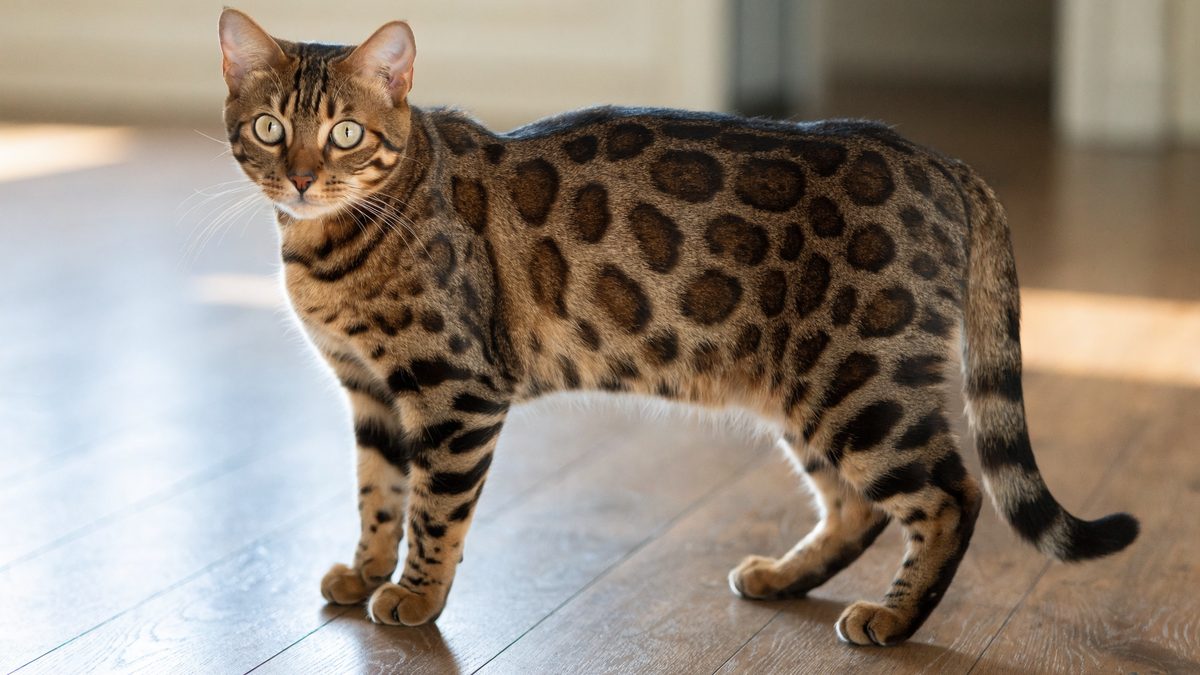
The Cat Fanciers' Association standard describes a medium to large cat with a sleek, muscular build and substantial boning, hindquarters slightly higher than the shoulders, and a thick tail with a rounded tip carried lower than the back. The head is a broad, modified wedge with rounded contours and high cheekbones, slightly small in proportion to the body, carrying medium to small ears with a wide base and rounded tips, where tufts are undesirable. The coat is short, close lying, soft and luxurious, and may be glittered, which the standard defines as an iridescent shimmer caused by light reflection at the hair tips.
| Attribute | What the record shows | Source |
|---|---|---|
| Origin | Domestic cat crossed with the Asian leopard cat, Prionailurus bengalensis, from 1963 | TICA |
| Modern breeding | Bengal-to-Bengal pairings only | TICA |
| Body | Medium to large, sleek and muscular, substantial boning, hindquarters slightly higher than shoulders | CFA standard |
| Coat | Short, close lying, soft and luxurious, may be glittered | CFA standard |
| Pattern | Rosetted or spotted with horizontal flow, or marbled. Belly must be patterned | CFA standard |
| Adult weight, TICA | Females roughly 6 to 12 pounds, males roughly 9 to 15 pounds, full size by 2 years | TICA |
| Adult weight, Indian seller listing | Males 5 to 8 kg, females 4 to 6 kg | Mr n Mrs Pet |
| Life expectancy at age 0, UK primary care | 8.51 years (95% CI 7.12 to 9.90), 73 recorded deaths | VetCompass |
| Life expectancy claimed by Indian sellers | 12 to 16 years | Three Indian pages Wrapinfur, Bengal Cat Price in India 2026 Puppiezo, Bengal Cats/Kittens For Sale… |
| Allowable outcross breeds, CFA | None | CFA registration rules |
Six checks that separate a Bengal from a spotted street cat
Indian buyers overpay for ordinary spotted domestic cats sold as Bengals, and the breed standard gives you six specific, free, physical checks that take about ninety seconds. Use them before any money moves.
- Turn the cat over and look at the belly. The CFA standard requires the belly to be spotted in the rosetted and spotted pattern, and lists a belly that is not patterned as an outright disqualification. TICA's standard says the same thing twice, specifying that the belly must be spotted and then listing belly not patterned under withhold all awards. An ordinary tabby has a plain belly. Both registries agree, which makes this the fastest and most decisive single check there is.
- Look at the direction of the markings. Rosettes and spots should be random with a horizontal flow to their alignment. Both registries penalise spots running together vertically to form a mackerel tabby pattern The International Cat Association. Vertical stripes down the flank are what an ordinary tabby has. TICA also frames the whole goal in one useful line, that the overall look of the head should be as distinct from the domestic cat as possible.
- Look inside a spot. Rosettes are two toned, with dark outlines and a lighter centre, and TICA calls the Bengal the only domestic breed with rosettes reminiscent of wild cat patterns. A flat single-tone spot is a spot, not a rosette. The standard does allow a spotted pattern without rosettes, so this check alone is not decisive.
- Check the contrast. Contrast with the ground colour must be extreme, showing distinct pattern with sharp edges. A muddy, low-contrast coat is a fail.
- Check the ears and the tail. Ears are medium to small with a wide base and rounded tips, and tufts are undesirable. The tail is thick and tapered with a rounded tip, carried lower than the back. A clearly visible tail kink or deformity is a disqualification.
- Look for a locket. Any distinct locket on the neck, chest, abdomen or anywhere else is a disqualification. A white bib is common on Indian domestic cats and rules out a show-standard Bengal.
A registered pedigree Bengal is quoted in India at Rs 70,000 to Rs 1,60,000. An Indian domestic shorthair with tabby spots is free. The six checks above are the entire difference between those two numbers, and none of them requires a document, a laboratory or a vet. Do them in daylight, on the cat you are actually buying, not on a photograph sent on WhatsApp.
The confusion this breed generates in India is worth naming, because it is on the search results page itself. The Quora thread ranking third for this query asks whether a Bengal cat is available in India and what its price is, and its top answer replies that yes it is, but is on point of extinction, that the price is roughly 1 lakh or more, and that it is illegal to buy one as it is a protected species. That answer is describing the wild Asian leopard cat while the question is about the domestic breed, and it is the third result an Indian buyer sees. A separate answer from an owner of seventeen years in the same thread is more useful, warning that Bengals are very very very vocal, that her female screams loud enough to be heard for a block, and advising buyers to ensure their Bengal is ten generations domestic through its pedigree.
One more piece of context sets up everything below. The Bengal is a hybrid breed, and hybrid breeds are treated differently by welfare bodies, by registries and, in some countries, by law. The Cat Group, a coalition of UK cat welfare organisations, names the Bengal alongside the Savannah and the Chausie as examples of hybrid cats and states that it does not support the breeding of wild cat hybrids nor the keeping of them as pets, on welfare grounds. That is a strong position and it is contested by breeders, but it is a real published position from a real body, and no Indian page mentions it exists.
Bengal cat price in India
A Bengal cat costs Rs 20,000 to Rs 5,00,000 in India in 2026 depending entirely on which published source you read, and the sources disagree by roughly 25 times at the extremes. Bonbeno compared six Indian sources currently visible for this query. They do not agree with each other, and two of them do not agree with themselves.
Read the table across, not down. The point is the disagreement, not any one number in it.
| Source | Pet or basic quality | Registered or premium | Show or imported |
|---|---|---|---|
| Supertails | Rs 25,000 to Rs 60,000 overall, no quality split | Not stated | Not stated |
| Mr n Mrs Pet | Rs 50,000 to Rs 1,25,000 | Rs 70,000 to Rs 1,60,000 (FCI registered) | Rs 90,000 to Rs 1,90,000+ (champion bloodline) |
| Wrapinfur | Rs 40,000 to Rs 80,000 | Rs 80,000 to Rs 1,50,000 | Rs 1,50,000 to Rs 3,00,000 show, Rs 2,50,000 to Rs 5,00,000+ imported |
| PetIndiaOnline | Rs 42,000 to Rs 98,000 | Not stated | Rs 90,000 to Rs 2,00,000+ show, Rs 2,00,000 to Rs 4,00,000+ imported |
| Puppiezo, live listing | Rs 85,000 for one 12-week kitten | Not stated | Not stated |
| TradeIndia, live listing | Rs 85,000 per cat, listed under Livestock | Not stated | Not stated |
The floor for a pet-quality Bengal kitten moves from Rs 25,000 to Rs 50,000 depending purely on who is publishing, a doubling for what is described as the same animal. The ceiling moves from Rs 60,000 to Rs 5,00,000, which is a factor of more than eight. Four things drive that spread.
- Whether the publisher also sells kittens. The narrowest, lowest band comes from the one source that is primarily a pet pharmacy and content site. The widest, highest bands come from marketplaces that broker the sale Wrapinfur, Bengal Cat Price in India 2026. A high ceiling makes a mid-price listing feel like a bargain, which is what a wide published band is for.
- Registration paperwork. Registered kittens are quoted at Rs 70,000 to Rs 1,60,000 against Rs 50,000 to Rs 1,25,000 for basic quality by the same seller. Whether that paperwork is worth Rs 20,000 depends entirely on which registry issued it, which the next section covers.
- Coat pattern and colour. Sellers name coat pattern first among price factors, listing golden clouded, golden rosetted, silver, charcoal, brown and snow variants as separate products, and another names large rosettes, strong contrast and glitter coats as the desirable features. Contrast and pattern are genuinely in the breed standard, so this factor is at least real.
- Import claims. Imported bloodlines carry the largest premium of all, quoted at Rs 2,00,000 to Rs 5,00,000 Wrapinfur, Bengal Cat Price in India 2026. Import of live animals into India sits on the restricted list, requires a licence from the Director General of Foreign Trade, and is only permitted through the sea ports and airports of Bangalore, Chennai, Delhi, Hyderabad, Kolkata and Mumbai where animal quarantine and certification services exist, plus, since October 2024, Kochi airport for a pet arriving under the baggage rules Department of Animal Husbandry…. An import claim is therefore a documentable claim. Ask for the documents. The full route, which covers cats too, is set out in how to import a dog to India.
What an established foreign cattery actually charges, for comparison
Here is a check no Indian page offers. If an Indian seller quotes you Rs 2,50,000 to Rs 5,00,000 for an imported bloodline, compare that with what two established TICA-registered catteries publish on their own websites.
| Cattery and location | Published price | What the price includes |
|---|---|---|
| Royal Bengal Cattery, Westminster, Maryland, USA | Pet 2,700 to 4,000 US dollars, show quality 3,000 to 5,000, breed quality 5,000 and up | Vaccination and rabies certificates, spay or neuter, deworming, TICA registration and breeder slip, a one-year genetic health guarantee and a two-year HCM guarantee |
| Wild N Sweet Bengals, Magog, Quebec, Canada | Kitten 700 to 2,500 US dollars, retired adult cat 500 to 1,200 | Neuter or spay, veterinary examinations, all necessary vaccines, wormers, international microchip, international health certificate, TICA registration certificate, HCM guarantee, guarantee against congenital defects |
The Maryland cattery also publishes a colour-by-colour list, with brown black marbled kittens from 1,700 US dollars and charcoal spotted from 3,500. Convert at any plausible rate and the top of the Indian imported-bloodline band sits at or above what an established North American cattery charges before shipping, veterinary paperwork and quarantine are added. That does not prove any specific Indian quote is wrong. It does mean an imported-bloodline premium is not self-evidently justified by foreign prices, and you are entitled to ask what the extra buys.
Breeder reputation, and what it should actually mean
Indian price pages name breeder reputation as a top-three price factor Mr n Mrs Pet, Bengal Kitten For Sale Wrapinfur, Bengal Cat Price in India 2026 without ever defining it. Define it for yourself using what the foreign catteries publish, because that is a checkable list rather than a feeling. One includes progressive retinal atrophy and pyruvate kinase deficiency testing on the parents in the price. The other includes a written guarantee against hypertrophic cardiomyopathy and against congenital defects. Breeder reputation means documents of that kind on the table before you pay, not a rating on a marketplace listing.
Price by city, where the sources contradict each other outright
Two Indian sources publish a Bengal price by city and they disagree on every single city, in the same direction, by roughly three times. Neither states a sample size, a method or a collection date.
| City | Supertails | Mr n Mrs Pet | Wrapinfur |
|---|---|---|---|
| Delhi / Delhi NCR | Rs 30,000 to Rs 65,000 | Rs 50,000 to Rs 1,75,000 | Rs 50,000 to Rs 2,00,000+ |
| Mumbai | Rs 35,000 to Rs 70,000+ | Rs 65,000 to Rs 1,85,000 | Rs 60,000 to Rs 2,50,000+ |
| Bangalore | Rs 25,000 to Rs 60,000 | Rs 75,000 to Rs 1,65,000 | Rs 50,000 to Rs 2,00,000+ |
| Chennai | Rs 25,000 to Rs 55,000 | Rs 65,000 to Rs 1,65,000 | Rs 45,000 to Rs 1,80,000+ |
| Pune | Rs 25,000 to Rs 55,000 | Rs 65,000 to Rs 1,75,000 | Rs 50,000 to Rs 2,00,000+ |
| Hyderabad | Rs 20,000 to Rs 50,000 | Rs 70,000 to Rs 1,50,000 | Rs 45,000 to Rs 1,80,000+ |
| Lucknow | Not stated | Rs 70,000 to Rs 1,75,000 | Not stated |
| Jaipur | Not stated | Rs 55,000 to Rs 1,65,000 | Not stated |
Look at Hyderabad. One source puts the floor at Rs 20,000, another at Rs 70,000. That is a 3.5 times difference in the same city in the same year for an animal described in identical terms. Bonbeno is not going to average those into a fake consensus, because averaging would produce a number that no seller in Hyderabad has ever quoted anyone. The honest position is that city variation almost certainly exists, driven by breeder availability and transport, but no published Indian source states a method that would let you trust its city figures.
The lowest published Bengal figure Bonbeno found anywhere is the rehoming band of Rs 5,000 to Rs 25,000, which describes an adult cat being given up by its owner rather than a kitten from a breeder. Below the kitten floor of roughly Rs 20,000 to Rs 25,000, what is usually being sold is a spotted domestic cat. The six physical checks in the overview section cost nothing and settle it.
One listing is worth reading closely because of what it reveals about the market. A TradeIndia seller in Junnar, Maharashtra lists Bengal cats at Rs 85,000 each under the Livestock category, alongside Siberian Husky puppies, Gir cows and copper wire scrap, with a stated supply ability of ten per month and a delivery time of five minutes. A supply of ten Bengal kittens a month from a single trader, in a country with no cat breeding regulation, is not a cattery. Bonbeno does not broker kitten sales and does not publish breeder listings. We report published figures so buyers can see the disagreement themselves.
Monthly cost of owning a Bengal cat in India
Published Indian monthly expenses for a Bengal run from roughly Rs 3,000 to Rs 17,000, and the first-year cost including the kitten is quoted at Rs 1,22,000 to Rs 4,04,000. Nobody publishes the two lines that actually matter in this breed, which are enrichment furniture and the DNA screening panel.
Three Indian sources publish a monthly expenses figure and none of them states a sample size or a collection method. Bonbeno publishes all three rather than averaging them.
| Line item | Supertails | Wrapinfur | PetIndiaOnline |
|---|---|---|---|
| Food | Rs 1,000 to Rs 2,500 | Rs 3,000 to Rs 8,000 | Rs 3,500 to Rs 7,000 |
| Litter | Not itemised | Rs 1,000 to Rs 2,500 | Not itemised |
| Veterinary care | Rs 1,000 to Rs 3,000 per year | Rs 500 to Rs 2,000 per month | Rs 2,000 to Rs 5,000 per month |
| Toys and enrichment | Rs 500 to Rs 1,000 | Rs 1,000 to Rs 3,000 | Rs 1,000 to Rs 3,000 |
| Grooming | Rs 500 to Rs 1,000 per session if used | Described as low | Weekly brushing, minimal |
| Miscellaneous | Not itemised | Rs 500 to Rs 1,500 | Not itemised |
| Stated monthly total | Not stated, itemised lines total roughly Rs 1,500 to Rs 3,500 | Rs 6,000 to Rs 17,000 | Rs 7,000 to Rs 15,000+ |
A fourth source, the same marketplace that quotes the highest purchase prices, puts monthly upkeep at Rs 3,000 to Rs 8,000. Set those four side by side and the spread on a single month is more than five times. That tells you the numbers are estimates written to fill a table, not measurements.
First-year cost, the only figure anyone publishes properly
One source builds a first-year total properly, and it is worth reproducing because it is the most honest cost figure on the Indian Bengal SERP. It puts the kitten at Rs 40,000 to Rs 1,50,000, initial setup at Rs 10,000 to Rs 50,000 or more, annual maintenance at Rs 72,000 to Rs 2,04,000, and a total first-year cost of Rs 1,22,000 to Rs 4,04,000 or more. Setup includes a litter box, carrier, bowls, scratching post, bedding, grooming tools, interactive toys and, because Bengals are active climbers, a cat tree or climbing structure.
The three Bengal-specific lines nobody budgets for
- The DNA screening panel, roughly Rs 6,000 to Rs 7,000 once. The University of California, Davis Veterinary Genetics Laboratory charges 47 US dollars for the Bengal progressive retinal atrophy test and 71 US dollars for that test combined with pyruvate kinase deficiency Veterinary Genetics Laboratory. That is a cheek swab you post yourself, with a turnaround of at least 15 business days. Against a Rs 85,000 kitten it is under ten percent, and it is the only line on this page that can change a fifteen-year outcome.
- Cardiac screening. Hypertrophic cardiomyopathy requires an echocardiogram to detect, and the CFA notes that most Bengal breeders have their breeding cats scanned by a cardiologist before the first litter and repeat it at regular intervals. There is no DNA test for it in this breed. An echocardiogram at a metro referral clinic is a four-figure cost and is not on any Indian price page.
- Vertical space, which is furniture, not a toy. A Bengal that is not given climbing structures gets its climbing somewhere else, and 89.5 percent of 256 surveyed Bengals climbed. Wall shelving, a tall cat tree and a cat wheel are the enrichment TICA names for this breed. Indian sources fold this into a Rs 1,000 to Rs 3,000 toy line PetIndiaOnline, Bengal Cat in India: Price, which does not buy a cat tree that holds a 7 kg cat.
- Cooling, meaning electricity. A cat that needs 45 to 60 minutes of active play a day cannot get it in a room at 43 C, and Delhi's Safdarjung recorded 43.6 C in May 2026 with 47.6 C at Banda in Uttar Pradesh. Nobody costs this because it lands on your electricity bill rather than a pet invoice.
When we publish cost figures we state the sample size, the cities covered and the collection date. Where we cannot verify a number we say so rather than repeating an unsourced estimate. Every monthly total above is somebody else's figure, reproduced so you can see how far apart they sit. The only cost on this page that comes from a primary source is the DNA test price, which is published by the laboratory that runs the test.
Can a Bengal cat handle the Indian climate
A Bengal handles Indian heat better than any long-coated purebred cat, and the reason is structural. It carries a short, close-lying coat and a normal muzzle, so it has neither the insulation problem nor the airway problem that makes Indian summers dangerous for flat-faced and long-haired breeds. Rate its heat tolerance in the middle of the scale, not the bottom.
The wild ancestor is a tropical Asian forest species
Indian pages that discuss climate adaptation in this breed say only that it adapts moderately well and is better than long-haired breeds. That is right but it undersells the reason, and the reason is worth knowing.
There is a genuine climate argument in this breed's favour and no Indian page makes it. The Asian leopard cat occurs in tropical rainforests and warmer tropical forests through South and Southeast Asia, and its Indian range covers south-western India and the eastern coast. It has been recorded breeding in coffee plantations in southern India. The wild half of this breed's ancestry evolved in the same monsoon-forest climate that Kerala and Karnataka have. Compare that with a Persian, whose long dense coat came from a temperate breeding programme. On coat and skull alone, the Bengal is the better-adapted cat for an Indian summer.
The leopard cat also usually lives close to water sources and is a good swimmer, having colonised offshore islands throughout its range. That is the honest origin of the Bengal's famous fascination with water, which 79.7 percent of 256 surveyed Bengals displayed. It is a useful thing to know in a Chennai June, because a shallow water tray is genuine enrichment for this breed and a cooling one.
Where the Indian heat problem actually is
The Bengal's climate problem is not thermoregulation, it is the collision between an activity requirement and an Indian afternoon. Indian sellers themselves quote 45 to 60 minutes of active play daily and one to two hours of active play with climbing, interactive toys and puzzle feeders. In May 2026 the India Meteorological Department issued severe to extreme heat warnings across much of the country, with maximum temperatures of 40 to 47 C across northwest, west, central and north peninsular India, and Delhi recording its warmest night in 14 years. You cannot run an hour of hard chase play in that. The play has to move to a cooled room or to dawn and after dark, and if it does not happen at all you get the destructive behaviour that 33.2 percent of Bengal owners reported as a problem.
| Condition | Where and when | What it means for a Bengal |
|---|---|---|
| Dry extreme heat | Delhi, Rajasthan, UP, MP, March to June | Coat and muzzle cope. Play must move to a cooled room or to dawn and night, or the energy comes out as damage. |
| Humid heat | Mumbai, Chennai, Kolkata, Kerala coast | The closest match to the wild ancestor's native climate. Fine for the cat, still too hot for daytime chase play. |
| Monsoon humidity | Most of India, June to September | A short close-lying coat does not mat or hold moisture at skin level. The lowest-risk popular breed in an Indian monsoon. |
| Indoor confinement | Any Indian metro flat, year round | The real risk. Hybrid cats are often confined indoors for the safety of wildlife, and that confinement is usually detrimental to their wellbeing. |
| Hill cold | Himachal, Uttarakhand, Northeast winter | A short single coat gives less protection than a double coat. Keep an indoor Bengal indoors and warm. |
What actually reduces the risk
- Move play to the cool hours. Two sessions, early morning and after dark, beats one session at 4 pm in April. Indian buyers will not always plan this, and it is the single change that makes the activity requirement survivable.
- Give it height, because height is cooler and it is what the cat wants. 89.5 percent of surveyed Bengals climbed, and TICA names a cat wheel, interactive play and puzzle toys as the outlets that keep them satisfied.
- Use water as enrichment. 79.7 percent of surveyed Bengals played with water, and the wild ancestor lives near water and swims well. A shallow tray or a fountain is a real outlet for this breed and not a gimmick.
- Keep the cat lean. Being overweight was the most common breed-typical health condition reported by Bengal owners in a survey of 256 cats, and TICA warns that after neutering they have a greater tendency to become overweight.
- Keep it strictly indoors. An outdoor Bengal in India is a hunting animal loose in a country with an intact small-wildlife population, which is exactly the risk welfare bodies raise about hybrid cats introducing wild-type characteristics into free-roaming populations.
A short, close-lying coat in a Chennai monsoon is a genuine advantage. Where a long-coated cat mats, traps moisture at the skin and develops dermatological problems, a Bengal needs a weekly brush and nothing else. If you have talked yourself out of a Persian on climate grounds, the Bengal is a legitimately better climate fit. Just be honest that you are trading a grooming problem for an exercise problem.
Temperament, household fit and living conditions
A Bengal suits an active household that is home a lot, has vertical space, and genuinely wants an interactive animal. It does not suit a quiet flat, a household out all day, or anyone who wants a cat that sleeps sixteen hours and asks for nothing. The evidence for that is unusually good, because 256 Bengal owners were surveyed about exactly this.
The Cat Fanciers' Association describes Bengals as confident, curious and athletic, extremely intelligent, and maintaining a kitten-like energy and attitude well into their senior years. TICA puts it more bluntly. While you can train a Bengal to have good manners, they are an active, inquisitive cat that loves to be up high, and if you do not like a cat to leave the floor, a Bengal is probably not the right cat for you.
What 256 Bengal owners actually reported
A Belgian and Dutch survey of Bengal owners analysed 256 cats and asked which behaviours they saw and which of those they found problematic. The results are the best household-fit data that exists for this breed and no Indian page cites them.
| Behaviour | Cats affected | Percentage |
|---|---|---|
| Climbing | 229 | 89.5% |
| Vocalising | 227 | 88.7% |
| Playing with water | 204 | 79.7% |
| Hunting | 202 | 78.9% |
| Destructive behaviour, classed as a problem | 85 | 33.2% |
| Pica, classed as a problem | 42 | 16.4% |
| Aggression toward animals, classed as a problem | 41 | 16.0% |
| Urination outside the litter box, classed as a problem | 34 | 13.3% |
Read the top four rows and the bottom four rows differently. The top four are near-universal breed behaviours and the owners rarely considered them problematic. The bottom four are the ones owners called problems, and a third of households reporting destructive behaviour is a real number for anyone buying a Bengal for a rented flat in Gurugram.
Indian sellers lean on generation as a temperament guarantee, implying that a later-generation Bengal is calmer. The survey tested exactly that and found no significant differences in behaviour between cats from early generations (F1 to F4) and later generations (F5 and beyond), nor between cats with and without outdoor access. Sample sizes in the early-generation group were small, so this is not the last word. But if a seller offers generation as proof that a kitten will be placid, they are offering you something the published research did not find.
Who should buy one
- Good fit. Households with someone home most of the day, floor-to-ceiling vertical space, and a genuine appetite for daily interactive play.
- Good fit. Homes that already have a confident cat or a cat-friendly dog, since TICA notes Bengals often bond well with another animal as a playmate.
- Good fit. People who actively want a trainable cat. Bengals rank among the most trainable cat breeds and learn fetch and harness walking.
- Poor fit. Anyone who wants a quiet home. 88.7 percent of surveyed Bengals vocalised, and no training regime removes that.
- Poor fit. Households out for ten hours a day. Hybrid cats have complex environmental needs and are not suited to life as pets in small indoor dwellings without them being met.
- Poor fit. First-time cat owners buying on appearance. The breed's own registry warns that a Bengal in full play mode is rather like trying to hold on to running water.
Why people buy them, and why that matters
In the owner survey, 60.5 percent of respondents chose the breed for a combination of looks and character, and 99.2 percent looked for information about the breed before acquiring a cat. The authors concluded that this combination, informed buyers who wanted the temperament and not only the coat, could translate into a lower rate of relinquishment. That is a genuinely reassuring finding and Bonbeno is publishing it in full even though it cuts against the welfare position quoted elsewhere on this page. The counterweight is that the same authors note some of those behaviours may still indicate welfare problems regardless of what owners perceive, and that Indian buyers arriving from a SERP full of leopard photographs are a different population from Belgian owners who researched the breed first.
Litter training, handling and enrichment for a Bengal
To train a Bengal, start with the litter box, then move straight to harness and trick training, because in this breed training is not a nicety, it is the exercise. Bengals rank among the most trainable cat breeds and eagerly learn tricks such as playing fetch or walking on a harness, especially with food treats or clicker training.
Litter training, and the one Bengal-specific failure
Litter training a Bengal is normally a matter of setting up correctly rather than teaching anything. Place one more tray than the number of cats, keep trays away from food and from the noisiest corner of the flat, use an unscented clumping litter, and scoop twice a day. The Bengal-specific complication is that 13.3 percent of surveyed owners reported urination outside the litter box as a problem, which is higher than most owners expect from a short-coated breed with no anatomical difficulty. Rule out a urinary problem first with a veterinarian, then look at tray count, tray placement and whether the cat is under-stimulated, because a frustrated Bengal marks.
Clicker and trick training, which is where the energy goes
Train a Bengal deliberately every day, because these sessions burn energy and strengthen the bond. Owners can train Bengals to perform tricks like sit, stay and fetch, and many enjoy walking on a leash. This is the single highest-leverage thing an Indian owner in a flat can do, because ten minutes of clicker work is more tiring for an intelligent cat than thirty minutes of a laser pointer and it does not depend on floor space.
- Charge the clicker first. Click, then treat, twenty times, with no behaviour asked for. The cat learns the sound predicts food.
- Start with a target stick or your fingertip. Reward any nose touch. This becomes the tool you use to move the cat onto a scale, into a carrier or off a curtain rail.
- Add sit, then a hand target, then fetch. Bengals learn fetch readily and it is the best single indoor energy burner available in a flat.
- Introduce a harness indoors for two weeks before any door opens. Feed meals in it. Many Bengals enjoy going for walks with a harness and leash, but an Indian street is loud, hot and full of free-roaming dogs, so a balcony or a terrace is the realistic version.
- Keep sessions to five minutes, twice a day. Stop while the cat still wants more.
Handling training, and why it pays in this specific breed
Teach a Bengal kitten to accept restraint, mouth handling and a carrier in the first weeks home, because this breed will need three specific procedures that other cats do not. It needs a cheek swab for the DNA panel, it needs an echocardiogram for cardiac screening, and it needs an ophthalmic examination, because a French study diagnosed cataracts in 45 percent of Bengals in a screening population without any owner reporting visual impairment. A cat that fights handling turns each of those into a sedation event.
| Skill | Start | Why it matters in this breed |
|---|---|---|
| Cheek swabbing | Week 1 home | DNA tests use four cotton swabs rubbed between gum and cheek for 15 seconds each |
| Carrier entry | Week 1 home | Cardiac and eye screening both mean clinic visits Bourguet A, Chaudieu G, Briatta |
| Harness wearing | Week 2 home | The realistic outlet for a high-energy cat in an Indian flat |
| Nail handling | Week 2 home | TICA recommends monthly nail trimming |
| Lying still on one side | Month 2 | An echocardiogram needs a calm cat in lateral recumbency |
| Weighing on a kitchen scale | Month 2 | Being overweight was the most common health issue owners reported |
Enrichment is the actual training problem
The behaviours you need to redirect are climbing, hunting and chewing, and all three appeared in the owner survey. 89.5 percent climbed, 78.9 percent hunted, and 16.4 percent of owners reported pica, which is chewing or eating non-food items, as a problem. Give each one a legal outlet. Wall shelves and a tall tree for the climbing, a wand toy and a food puzzle for the hunting, and safe chew items plus removal of cables and hair ties for the pica. TICA names a cat wheel, consistent interactive play sessions and puzzle toys as what keeps this breed satisfied.
The AAHA and AAFP feline life stage guidelines give two specific instructions that matter more in this breed than in any other. First, clients should be taught not to use their hands or feet as toys during play, because cats learn that this is an appropriate form of play and it can lead to scratching or biting injuries. In a heavily muscled, high-drive cat that hunts in 78.9 percent of households, a hand-play habit learned at twelve weeks becomes a real injury at three years. Second, the guidelines summarise a study of scratching-post preference, reporting that rope was the substrate most frequently used when offered, that cats scratched the preferred substrate more often when the post was a simple upright type or a cat tree with two or more levels and at least 3 feet high, and that narrower posts were used more often than wider ones. Buy tall and narrow with rope, not wide and carpeted.
A third of surveyed Bengal owners reported destructive behaviour as a problem, and an Indian seller page warns that bored Bengals get devastating. That is one of the few things Indian pages get right. If you cannot commit to daily interactive play and real vertical space, the destruction is not a training failure you can fix later, it is the predictable output of an unmet need.
How much exercise a Bengal cat actually needs
A Bengal needs 45 to 60 minutes of genuine active play every day, split across at least two sessions, and Indian sellers themselves publish that number. One Indian guide puts it at one to two hours of active play with climbing, interactive toys and puzzle feeders. Treat the lower end as the floor, not the target.
This is the requirement that decides whether a Bengal works in an Indian flat, and it is the requirement most buyers discount. Bengals are a high-energy breed, constantly climbing to high places, exploring their surroundings, and engaging in mentally and physically stimulating play. The CFA describes them as maintaining a kitten-like energy and attitude well into their senior years. A Bengal does not settle down at four years old the way many cats do.
What an hour a day actually looks like in a 2BHK
- Two wand sessions of 15 minutes, morning and evening, in the coolest room. Move the toy like prey, away from the cat and into cover, not waved in its face.
- One fetch session of 10 minutes. Bengals learn fetch readily, and it delivers more running per minute of your attention than anything else.
- Two food puzzles instead of a bowl. These deliver foraging activity without your involvement and slow down eating, which matters in a breed where being overweight is the commonest owner-reported health issue.
- Free access to vertical space all day. Wall shelving, a tall tree, the top of a wardrobe cleared and made safe. 89.5 percent of surveyed Bengals climb and this is the outlet that runs while you are at work.
- Ten minutes of clicker training. Mental work tires an intelligent cat faster than physical work.
What happens without it
Without an outlet, the energy comes out as damage and noise. A third of surveyed owners reported destructive behaviour as a problem, 16 percent reported aggression toward other animals, and 16.4 percent reported pica. Welfare bodies make the point more strongly. Hybrid cats have complex environmental needs to ensure sufficient mental and physical stimulation and are not suited to life as pets in small indoor dwellings, and confinement, which hybrid cats often need for the safety of other animals and wildlife, is usually detrimental to their physical and emotional wellbeing.
The UK Animal Welfare Committee states it in one sentence that every Indian buyer in a 700 square foot flat should read. The hybrids of all three species, meaning Savannah cats, Chausies and Bengals, have complex environmental needs to ensure sufficient mental and physical stimulation and are not suited to life as pets in small indoor dwellings. The committee adds that many hybrids beyond F1 still maintain wild-type anatomical and behavioural characteristics that make them challenging to keep as pets, and that this is true even of hybrid cats beyond the F5 and F6 generations. An energetic breed does not stop being energetic because its pedigree is long.
One Indian seller page lists the Bengal's ideal space as Apartment while in the same table specifying an exercise routine of 45 to 60 minutes daily and an energy level of Very High. Both halves are true only if you actually deliver the hour. An apartment with a hard-playing owner beats a large house with an absent one, every time. If your honest answer is twenty minutes on weekdays, buy a different breed rather than a bigger cat tree.
Grooming a Bengal coat in Indian humidity
Groom a Bengal about once a week with a rubber brush and trim its nails monthly. That is the whole routine. The Bengal has the lowest grooming load of any popular purebred cat in India, and this is the one area where the breed is genuinely low-maintenance rather than marketed as such.
The coat is short, close lying, soft and luxurious, and TICA states plainly that shorthaired Bengals do not require much grooming because their short hair results in little shedding. Most cats shed a winter coat in the spring, so a rubber grooming brush is useful then, a chew toy helps keep the teeth clean, and monthly nail trimming is recommended.
The factual error on the highest-ranking Indian page
The page currently ranking first in India for this query tells buyers that Bengal cats have dense, curly coats that need trimming every 4 to 6 weeks to prevent matting, and elsewhere that their long, silky coats require more maintenance than short-haired breeds. Both statements are wrong. The CFA standard specifies a short, close-lying coat and TICA specifies little shedding and minimal grooming. This looks like a long-haired breed template applied to the wrong page, and it matters because a buyer who believes it will budget for a grooming schedule that does not exist and may accept a long-coated cat as normal for the breed.
| Task | Frequency | Note |
|---|---|---|
| Brush with a rubber grooming brush | Weekly, more in spring shed | TICA names a rubber-type brush for the spring coat change |
| Nail trim | Monthly | Recommended by the breed registry |
| Dental care | Ongoing | A chew toy or strips of meat help keep teeth clean |
| Ear check | Weekly | Indian sellers list ear cleaning among basic hygiene |
| Bath | Rarely required | An Indian source states bathing is rarely required in this breed |
| Professional grooming | Optional | Quoted at Rs 500 to Rs 1,000 per session if you choose it |
| Longhair Bengal only | Daily | TICA states longhair Bengals require daily grooming with a comb or brush |
The longhair Bengal, which is now a real thing
A longhair Bengal division exists and it changes the grooming answer completely. The CFA standard now describes a longhair coat that is medium to long, flowing and soft, with feathering behind the ears blending into a moderate ruff, and it granted championship status to the longhair division with an effective date in 2026 The Cat Fanciers' Association. TICA states that longhair Bengals require daily grooming with a comb or brush. If an Indian seller offers you a fluffy Bengal, that is a longhair, sometimes marketed as a Cashmere, and it carries a daily grooming commitment in Indian humidity that the standard shorthair does not.
If you are choosing between a Bengal and a Persian on grooming grounds, this is not close. A Persian needs a steel comb through to the skin every day of its life. A shorthair Bengal needs a rubber brush once a week and a nail trim once a month. In a Mumbai monsoon that difference is the difference between a matted, skin-infected cat and a cat that needs nothing. The Bengal's demands are real, but they are demands on your time and attention, not on your comb.
Bengal cat health, life expectancy and the genetic tests to demand
The Bengal's life expectancy at age 0 was 8.51 years in a UK study of 7,936 confirmed cat deaths under primary veterinary care, the second shortest of the twelve breeds analysed. Every Indian page currently ranking says 12 to 16 years. That gap is the most important thing on this page after the legal section, and it is why this section comes before you look at prices again.
Life expectancy, and where the Indian figures come from
The VetCompass programme at the Royal Veterinary College built life tables from 7,936 confirmed deaths in cats under primary veterinary care at UK clinics in 2019. Life expectancy at age 0 for UK companion cats overall was 11.74 years, with 95 percent confidence interval 11.61 to 11.87. For Bengals specifically it was 8.51 years, with 95 percent confidence interval 7.12 to 9.90, based on 73 recorded Bengal deaths, with individual lifespans ranging from 0.14 to 21.22 years.
| Breed | Life expectancy at age 0 (95% CI) | Recorded deaths |
|---|---|---|
| Burmese | 14.42 years (12.91 to 15.93) | 45 |
| Birman | 14.39 years (12.87 to 15.91) | 38 |
| Crossbred | 11.89 years (11.75 to 12.03) | 7,117 |
| Siamese | 11.69 years (10.56 to 12.82) | 88 |
| Persian | 10.93 years (9.63 to 12.23) | 80 |
| Ragdoll | 10.31 years (8.86 to 11.76) | 69 |
| Maine Coon | 9.71 years (8.42 to 11.00) | 69 |
| British cats | 9.58 years (8.73 to 10.43) | 194 |
| Bengal | 8.51 years (7.12 to 9.90) | 73 |
| Sphynx | 6.68 years (4.53 to 8.83) | 18 |
Three things need saying honestly about that table. First, the confidence interval on the Bengal figure is wide, 7.12 to 9.90 years, because it rests on 73 deaths rather than thousands. Second, the study authors explicitly conclude that purebred cats lived over 1.5 years less than crossbred cats and that some breeds, such as Sphynx and Bengal, had a particularly short life expectancy. This is not Bonbeno's inference, it is the paper's own conclusion. Third, the figure is improving. An earlier VetCompass study put the Bengal median lifespan at 7.3 years, while the 2019 data puts it at 8.40 years.
Three Indian pages state a Bengal lifespan of 12 to 16 years Wrapinfur, Bengal Cat Price in India 2026 Puppiezo, Bengal Cats/Kittens For Sale… and one live marketplace listing states 12 to 16 years in its product specification table. The breed registry itself says 12 to 20 years depending on many factors including environment and nutrition. None of those figures comes from a mortality study. The one figure that does comes from 7,936 confirmed deaths and says 8.51 years. Bonbeno is printing both, because that is the honest thing to do, and because you deserve to know that the two are not close.
The three tests a buyer can name
TICA states that Bengal breeders should test for hypertrophic cardiomyopathy and provide genetic testing for progressive retinal atrophy and pyruvate kinase deficiency. That is the registry's own list, and it gives an Indian buyer three specific things to ask for by name. Ask for them in that order.
| Screen | Method and cost | What it tells you |
|---|---|---|
| Progressive retinal atrophy (PRA-b) | Cheek swab DNA test, 47 US dollars, at least 15 business days | Autosomal recessive blindness specific to Bengals. Carriers are detectable only by DNA test |
| Pyruvate kinase deficiency (PK deficiency) | Cheek swab DNA test, 47 US dollars alone or 71 US dollars combined with PRA-b | Autosomal recessive haemolytic anaemia. Bengal is on the significant-frequency breed list |
| Hypertrophic cardiomyopathy (HCM) | Echocardiogram by a cardiologist, repeated at intervals | No DNA test exists for this breed. Most breeders scan before the first litter |
Progressive retinal atrophy, the one that blinds kittens
Bengal progressive retinal atrophy causes an autosomal recessive blindness by destroying the photoreceptor cells at the back of the eye. Loss of those cells begins around 7 weeks of age and progresses until the cat has very compromised vision by approximately 2 years of age. Affected cats have more dilated pupils than normal cats in the same lighting and tend to carry their whiskers in a more forward position. The causative variant appears to be novel to the Bengal breed and occurred early in a popular lineage, so affected cats have been reported in the United Kingdom, Europe and the USA.
The primary characterisation study is worth reading because the timeline is faster than owners expect. Researchers established a breeding colony and found that ophthalmoscopic signs of retinal degeneration were noted at 9 weeks of age and became more noticeable over the next 4 months, while electroretinography demonstrated reduced rod and cone function at 7 and 9 weeks respectively. Rod responses were mostly extinguished at 14 weeks of age and cone responses were minimal by 26 weeks, with histologic degeneration first observed at 8 weeks. Visual deficits were behaviourally evident by 1 year of age.
Read those two sentences together and the practical problem is obvious. The retina is already failing measurably at 7 weeks, which is before an Indian kitten leaves the seller, and the owner will not see anything wrong until around a year old. The authors concluded that this is a recessively inherited primary photoreceptor degeneration characterised by early onset and rapid progression to blindness. By the time you notice, the parents have produced more litters.
How common is it? A study of 11,036 domestic cats, of which 10,419 were pedigreed across 90 breeds and breed types, found the KIF3B variant associated with this early-onset PRA present in 6.9 percent of the Bengal breed, giving a frequency of 1.1 percent across all cats tested. Roughly one Bengal in fourteen carries it. Two carriers bred together are predicted to produce 25 percent affected kittens.
Blindness can be detected either by the DNA test or by an eye examination before breeding age, but carriers, meaning cats with one copy of the mutation, can only be detected by the DNA test. A clear eye examination on both parents tells you neither parent is blind. It tells you nothing about whether they are both carriers, which is the situation that produces blind kittens. If an Indian seller offers you a vet certificate saying the eyes look normal, that is not a PRA screen and you should say so.
Pyruvate kinase deficiency, the anaemia that comes and goes
Pyruvate kinase deficiency is an inherited haemolytic anaemia caused by insufficient activity of the enzyme, which makes red blood cells unstable and destroys them. The anaemia is intermittent, the age of onset is variable, and the clinical signs are variable, which is exactly what makes it hard to spot. Symptoms can include severe lethargy, weakness, weight loss, jaundice and abdominal enlargement. Based on a survey of 38 breeds, the mutation has been found in significant frequency in the Bengal among others, and genetic screening is recommended for those breeds.
The paper that identified the mutation surveyed 14,179 American and European cats representing 38 breeds, plus 76 western random bred cats and 111 cats of unknown breed, and found the causative intronic single nucleotide polymorphism at an overall frequency of 6.31 percent, rising to 9.35 percent when restricted to the 15 groups carrying it. Its conclusion names the breeds directly. PK testing is recommended for Bengals, Egyptian Maus, La Perms, Maine Coon cats, Norwegian Forest cats, Savannahs, Siberians and Singapuras, in addition to Abyssinians and Somalis. The Bengal is first on that list.
In the 11,036-cat study, several cats from the Bengal, Maine Coon and Maine Coon Polydactyl breeds were identified genetically at risk with two copies of the PK deficiency variant, and the researchers interviewed the owners of three affected Bengal cats aged between 2 years 9 months and 6 years 7 months. One female had stopped eating and seemed sick after an attempted rehoming, then fully recovered. That intermittent pattern is the disease, and it is why an Indian owner can easily read an episode as a stomach upset.
Hypertrophic cardiomyopathy, and why standard cat reference values mislead
Hypertrophic cardiomyopathy is the most common heart disease in all domestic cats and the Bengal has been listed as an at-risk breed for it Scansen BA, Morgan KL. Reference intervals…. It requires an echocardiogram to detect, and there is no genetic test for it in this breed. A study at The Ohio State University set out to build Bengal-specific echocardiographic reference intervals precisely because the breed's genetic influence from the leopard cat means standards derived from ordinary domestic cats may not apply.
Two findings from that study matter to an Indian owner. First, of 60 Bengal cats identified in the hospital's echocardiographic database, 8 were excluded from the reference population because they had been diagnosed with HCM. That is a referral-hospital population and not a random sample of pet Bengals, so it does not give you a breed prevalence, but it is a real count of a real disease in a real Bengal population. Second, the study concluded that the heart size of Bengal cats is similar to reported normal values in cats, though left atrial size, interventricular septal thickness and left atrial-to-aortic ratios were greater than previously reported in the feline population at large.
A Bengal's normal heart measurements sit higher than the general cat population on three specific parameters. A general practitioner scanning against standard feline reference ranges could therefore read a healthy Bengal as early HCM. If you are having a Bengal scanned in an Indian metro, ask whether the cardiologist is using breed-specific or weight-scaled reference intervals. The paper that provides them is Scansen and Morgan, Journal of Veterinary Cardiology, 2015, and naming it is a reasonable thing for an owner to do.
Cataracts, which are commoner than anyone expects
A French study examined two populations of Bengal cats and found cataracts in 23 of 51 cats, which is 45 percent, in the observational screening group, and in all 12 cats in a referral group, mostly affecting both eyes. Affected cats ranged from 3 months to 9.6 years old, with a median of 1.9 years. The critical line for an owner is this one. Visual impairment was never reported. The authors concluded that presumed inherited cataracts appear to have a high prevalence in Bengal cats in France, in a nuclear or subcapsular form, mostly bilateral, symmetrical and apparently non-progressive, and that pedigree analysis suggests a hereditary component.
That is a French population and it may not transfer to Indian lines, which have a different and largely undocumented ancestry. Bonbeno is reporting it because it is the only published cataract prevalence figure for this breed anywhere, and because it gives you a concrete reason to ask for an ophthalmic examination on a Bengal that shows no symptoms at all.
Bengal polyneuropathy, the one that looks like a broken leg
A chronic-relapsing form of polyneuropathy associated primarily with episodes of demyelination and remyelination was identified in 37 young Bengal cats, with the prognosis for recovery described as good, although relapses are possible and there can be residual motor deficits. In plain terms, a young Bengal can develop weakness in the limbs that looks like an injury, recover largely on its own, and then relapse. Indian veterinarians outside referral centres will not have seen many of these, and the breed name is the clue. If a Bengal under two years old develops unexplained weakness or an unsteady gait, ask specifically about Bengal polyneuropathy.
The full list of Bengal health issues named by a government committee
The DEFRA Animal Welfare Committee's 2024 opinion on feline breeding practices lists the health issues associated with Bengal cats in one place, which no Indian page does. It names hereditary cataracts and progressive retinal degeneration, hypertrophic cardiomyopathy described as a form of constrictive heart failure, polyneuropathies, and an increased incidence of thoracic wall deformities in related Bengal cats. That last one is the entry most Indian owners have never heard of, and it appears in related kittens, meaning it clusters in lines.
The breed's own registry treats it as serious. TICA's Bengal standard lists depression of the sternum or an unusually small diameter of the rib cage itself among the mandatory show disqualifications. That is pectus excavatum described in show-ring language, and it is worth knowing that the condition is genuinely under-documented. A British Veterinary Association review notes that pectus excavatum is an unusual congenital condition and that there is a relative paucity of published information concerning the condition in companion animals. Practical translation for an Indian buyer: run your hand along the underside of a Bengal kitten's chest. A dip in the breastbone or a chest that feels narrow front to back is worth a veterinary opinion before you pay, and if a breeder has produced a litter with chest wall deformities before, that is information you are entitled to and will not be volunteered.
What owners actually report
Set against all of the above, the owner-reported picture is calmer. In the survey of 256 Bengals, breed-typical health conditions as described by International Cat Care were reported in 9.9 percent of cats, 24 animals, with being overweight the most common one. Bonbeno is publishing both pictures because they measure different things. Owner surveys capture what owners noticed. Mortality tables capture when cats died. A breed can look healthy to its owners and still have an 8.51 year life expectancy, which is precisely the pattern here.
Feeding a Bengal cat in India
Feed a Bengal a high-protein complete diet in two measured meals, use food puzzles for at least part of the ration, and weigh the cat monthly. Being overweight was the most common breed-typical health condition Bengal owners reported, and TICA warns that after neutering they have a greater tendency to become overweight.
The registry's own guidance is short and worth following. Similar to any cat, Bengals require proper protein and nutrients, a high-quality diet is recommended, owners should be aware of both the quality and the quantity of what they feed, and most breeders would recommend avoiding free feeding of adult cats. Indian sources add a feeding schedule of three to four meals a day for kittens and two a day for adults.
Diet and nutrition, the parts specific to this breed
- Do not free feed. A high-energy cat that is under-exercised in an Indian summer plus a full bowl available all day is the standard route to an overweight Bengal.
- Use food puzzles for a real share of the ration. They meet the hunting drive that 78.9 percent of surveyed Bengals showed and they slow eating down. Indian sources list puzzle feeders as essential equipment for this breed.
- Feed a high animal-protein diet. An Indian guide specifies high-protein, meat-based nutrition and flags digestive sensitivity and obesity as the two commonest diet-linked issues in the breed.
- Place water away from food. TICA relays a behaviourist tip that placing the water bowl at least three feet from any food raises intake, because cats' noses are sensitive and an overwhelming smell of food may reduce drinking. A fountain works well in a breed where 79.7 percent play with water.
- Weigh monthly, do not eyeball. A short coat makes a Bengal easier to assess by sight than a long-coated cat, but the breed is muscular and heavily boned, which hides fat. Indian listings put adult males at 5 to 8 kg and females at 4 to 6 kg, and TICA gives roughly 9 to 15 pounds for males and 6 to 12 pounds for females.
The raw feeding question in India
TICA notes that Bengals also do well on a raw diet and that freeze-dried raw diets are available in most pet stores, while an Indian source recommends premium cat food or raw and high-protein diets with the caveat to check with a veterinarian. Bonbeno's position is that a fresh or raw diet can be appropriate when it is formulated by someone qualified to balance it, that home-mixed diets are the commonest route to a nutritional deficiency, and that the cold chain and raw-meat hygiene requirements in an Indian summer are a real and underdiscussed obstacle. Set the decision with a veterinarian who has examined your cat.
There is a specific, published reason to be careful here. Secondary nutritional hyperparathyroidism, meaning metabolic bone disease, has been reported in Bengal cats and is commonly seen in larger felid species because of their rapid growth rates. It is the classic outcome of feeding a growing cat muscle meat without balanced calcium, which is exactly what an Indian household means when it says it feeds chicken. A raw or home-cooked diet for a Bengal kitten needs a formulated calcium and phosphorus balance, not a butcher's bag, and this breed has a documented record of what happens without it.
16.4 percent of surveyed Bengal owners reported pica, meaning chewing or eating non-food items, as a problem behaviour. That is one household in six. Before you assume a Bengal's vomiting is a food intolerance, check what it has been chewing. Cables, hair ties, plastic bags and cling film are the usual culprits in an Indian flat, and a linear foreign body is a surgical emergency, not a feeding issue.
Feeding quantities depend on the individual cat's age, weight, body condition and health status. Set them with a registered veterinarian who has examined your cat, particularly in a breed with a documented inherited anaemia that can present as weight loss and lethargy.
Bengal kitten: month by month through the first year
A Bengal kitten's first year has four jobs, which are completing the vaccination course, banking the DNA screening results, building handling and harness tolerance, and establishing a daily play habit you can actually sustain for a decade. Get those four right and the rest is maintenance.
| Age | What is happening | What you do |
|---|---|---|
| Before purchase | Parental screening should already exist | Ask for PRA-b and PK deficiency results on both parents and an HCM scan on the queen. Ask for the five-generation pedigree. |
| 7 weeks | PRA-b photoreceptor loss begins in affected kittens | This is why the parental DNA result matters more than any examination of the kitten. Cell loss begins around 7 weeks of age. |
| 8 to 12 weeks | Kitten comes home | Refuse any kitten under 8 weeks. Start cheek-swab handling, carrier feeding and daily play. Set up vertical space before the cat arrives. |
| 3 to 4 months | Vaccination course completing | Indian sources cost vaccination and routine vet care at Rs 1,000 to Rs 3,000 a year. Rabies is not optional in India. |
| 4 to 6 months | Climbing drive arrives in full | 89.5 percent of adult Bengals climb. If the shelving is not up by now, the curtains become the shelving. |
| 6 to 9 months | Sexual maturity approaching | Discuss neutering timing with your vet, and watch the weight afterwards. |
| 9 to 12 months | Own DNA results, if the parents' were not provided | The genetic test works at any age. A cheek swab costs 47 US dollars for one test or 71 for both. |
| 12 months | First adult health check | Baseline ophthalmic examination, given a 45 percent cataract rate in a screened Bengal population with no visual impairment reported. |
| Up to 24 months | Still growing | Bengals reach their full size by the age of 2. Kitten-like energy persists well into the senior years. |
Socialisation and vaccination, in Indian conditions
Two windows are already closing when an Indian Bengal kitten arrives. The sensitive socialisation period for new experiences, people and other animals begins as early as 2 to 3 weeks and may be closing by 9 to 10 weeks, and what matters most within it is the quality of the experience rather than the calendar. Most Indian buyers receive a kitten at or after 8 weeks, so part of that window has already passed with the seller. What is still available to you is quality, and the guidelines set a usable target of 30 to 60 minutes of pleasant interaction with people per day. In a breed that needs 45 to 60 minutes of play anyway, those two requirements are the same hour.
On vaccination, the WSAVA guidelines set the framework used worldwide. Core vaccines are those recommended for all animals globally, rabies included, and in young animals the core course is repeated to overcome interference from maternal antibody, with regular health checks preferred over automatic annual revaccination of every component. India is a rabies-endemic country, so the rabies component is not optional here whatever a seller tells you. Indian sources cost the whole first-year vaccination and routine veterinary line at Rs 1,000 to Rs 3,000, which is the cheapest genuinely protective spending on this entire page.
The three questions to settle in year one
- PRA-b status. If you did not get parental results, swab the cat yourself. The variant is present in 6.9 percent of the breed and affected cats have very compromised vision by about 2 years of age. Knowing early changes how you set up the house and whether you ever breed.
- PK deficiency status. Same swab, and the combined price is 71 US dollars rather than 94 for two separate tests. Severity in affected cats cannot be predicted, so a result changes how you read future episodes of lethargy.
- A cardiac baseline. Ask at the 12-month check whether an echocardiogram is warranted, and if one is done, keep the numbers. Bengal left atrial size and interventricular septal thickness run higher than the general feline population, so a personal baseline is worth more than a single reading against a general range.
The commonest mistake is spending Rs 85,000 on a kitten and nothing on the Rs 6,000 test panel that tells you whether it will go blind. Indian buyers routinely negotiate the purchase price and then skip the screening entirely, which is exactly backwards. The purchase price is a sunk cost the moment you pay it. The screening result is information you will use for the next decade.
Bengal cat vs the Indian domestic shorthair, and vs a Persian
Choose an Indian domestic shorthair over a Bengal if budget, life expectancy or time at home is a real constraint. Choose a Bengal over a Persian if you want a cat that suits the Indian climate and hates grooming. The three animals fail in completely different ways and the comparison is worth doing properly.
The Indian domestic shorthair, the cat most Indian households call the billi, is not a breed. It is a landrace shaped by generations of survival in the exact climate you live in, with a short coat, a normal muzzle and no selected conformational defect. In the UK mortality data, crossbred cats had a life expectancy at age 0 of 11.89 years against 10.41 years for purebred cats, and the odds of a purebred cat dying before 3 years of age were 1.83 times higher than for a crossbred cat.
| Factor | Bengal | Indian domestic shorthair | Persian |
|---|---|---|---|
| Purchase price | Rs 20,000 to Rs 5,00,000 Wrapinfur, Bengal Cat Price in India 2026 | Free to nominal adoption fee | Rs 8,000 to Rs 3,00,000 |
| Life expectancy at age 0, UK data | 8.51 years | 11.89 years for crossbred cats | 10.93 years |
| Daily grooming | None. Weekly brush | None | Mandatory, to the skin, every day |
| Daily exercise requirement | 45 to 60 minutes of active play | Self-regulating | Short low-intensity sessions |
| Heat tolerance | Good. Short coat, normal muzzle | Best. Locally adapted by selection | Worst of any common cat in India |
| Vocal level | 88.7 percent of surveyed cats vocalise | Variable by individual | Quiet |
| Named inherited conditions with a DNA test | PRA-b and PK deficiency Veterinary Genetics Laboratory | None breed-specific | Polycystic kidney disease |
| Legal complexity | Wild ancestor is Schedule I protected | None | None |
| Suits a small flat with an absent owner | No The Cat Group, Position Statement on Hybrid… | Yes | Yes |
| Suits a first-time owner | Only an active, present one | Yes | Only a diligent one |
Be fair to the Bengal on the points where it genuinely wins. It is the best climate fit of the three for an Indian summer, because it carries neither the coat nor the skull that make the Persian dangerous in April. It is the most trainable, which means an owner who wants a cat that interacts, fetches and walks on a harness gets something no landrace cat reliably delivers. And it is the lowest-maintenance coat in the comparison, which in a Kolkata monsoon is not a small thing.
If you want a calm, cheap, long-lived cat for an Indian city, adopt an Indian domestic shorthair. If you want a Persian's looks, read our Persian page before you commit, because the climate maths is brutal. If you specifically want an athletic, interactive, trainable cat, are home a lot, have vertical space, and will pay for the DNA panel, a Bengal is a legitimate choice and a rewarding one. What does not work is buying a Bengal because it looks like a leopard in a reel and discovering the hour of daily play afterwards.
The Savannah and Toyger footnote
Two related cats come up in the same searches. The Savannah is a domestic cat crossed with the serval, and welfare bodies treat it as a substantially more serious case than the Bengal, noting that servals can weigh up to 15 kg against an average 4 to 5 kg domestic cat, which creates real injury risk to the domestic parent during mating. The Toyger is a striped domestic breed. All three, along with the Highlander, are appropriate for the same PRA-b DNA test, which tells you how closely their gene pools are connected. If a seller in India offers you a Savannah, the legal and welfare questions on this page apply with more force, not less.
Mistakes Indian Bengal owners actually make
The common mistakes Indian Bengal buyers make are predictable, and most of them come from buying the coat and discovering the animal afterwards. Indian pages that carry a common mistakes list name four items, which are ignoring exercise needs, buying without checking legality, feeding a low-quality diet and failing to provide stimulation. Those are fair. Here are ten, each with the figure behind it, in order of how much damage they do.
- Believing the 12 to 16 year lifespan figure. Four Indian sources publish it Puppiezo, Bengal Cats/Kittens For Sale… TradeIndia, Bengal Cat Price In India and the only mortality study of the breed puts life expectancy at age 0 at 8.51 years. Plan a budget and an emotional commitment around the lower figure and be delighted if you are wrong.
- Skipping the DNA panel to save 71 US dollars. The PRA-b variant sits in 6.9 percent of the breed, carriers are invisible to an eye examination, and the combined test with PK deficiency costs less than a tenth of a typical Indian Bengal purchase price.
- Buying a spotted domestic cat. The CFA standard disqualifies an unpatterned belly outright and penalises vertically aligned mackerel markings. Both checks are free and take seconds, and both are the difference between a Rs 70,000 registered cat and a free one.
- Underestimating the exercise requirement. Indian sellers themselves publish 45 to 60 minutes daily, and a third of surveyed owners reported destructive behaviour as a problem. The destruction is the unmet requirement arriving in a different form.
- Treating the flat as adequate because the cat is small. Hybrid cats have complex environmental needs and are not suited to life as pets in small indoor dwellings. Vertical space is the fix, and it is furniture, not a toy.
- Buying a Bengal for a silent home. 88.7 percent of surveyed Bengals vocalised. TICA describes chirps, trills and meows used to chat with their humans. If that will annoy you, it will annoy you for a decade.
- Budgeting for a grooming schedule that does not exist. The top-ranking Indian page describes Bengal coats as dense and curly, needing trimming every 4 to 6 weeks, while the breed standard specifies a short close-lying coat and the registry specifies little shedding.
- Accepting a generation claim without a pedigree. There is no commercially available genetic test to prove which generation a hybrid cat is, and assessment is unreliable, based on opinion and, where available, breeding records. A verbal F5 claim is worth nothing. A five-generation pedigree is worth something.
- Letting the cat outdoors because it hunts anyway. 78.9 percent of surveyed Bengals hunt, and free-roaming hybrid cats risk introducing wild-type characteristics into un-neutered outdoor cat populations, with subsequent harm to native wildlife. In India that free-roaming population is enormous.
- Ignoring an eye check because the cat sees fine. In a French Bengal screening population, cataracts were found in 45 percent of cats and visual impairment was never reported by owners. Normal behaviour is not a normal eye examination.
Google's own related searches for this query in India include Asian leopard cat price in India and Leopard Cat Price in India, sitting alongside snow, silver, blue, white, grey and black Bengal cat price queries. People in India are searching for the price of a wild species that is protected under Schedule I of the Wild Life (Protection) Act, 1972 and whose Indian population is listed on CITES Appendix I. Not one page ranking for the Bengal query tells those searchers what they are looking at. The next section does.
Legal status, responsible sourcing and adopting a Bengal in India
The legal position in India is more specific than any ranking page states, and it turns on one distinction. The domestic Bengal breed is not itself named in Indian wildlife law, but its wild ancestor is. The Asian leopard cat, Prionailurus bengalensis, is listed in Schedule I of the Wild Life (Protection) Act, 1972. Anything that is, or contains as a parent, that species is a completely different legal object from a Bengal-to-Bengal domestic kitten.
What the primary sources actually say
Bonbeno went to the underlying texts rather than to other pet pages. Here is what each one establishes, and what it does not.
| Source | What it establishes | What it does not establish |
|---|---|---|
| Wild Life (Protection) Act, 1972, Schedule I, Part A: Mammals | The Leopard Cat is listed as entry 44 in Schedule I, Part A: Mammals, under the sub-heading CATS, the Act's highest protection category, two entries after the Jungle Cat and one after the Leopard | It says nothing about hybrid domestic cats, and names no generation threshold |
| CITES, via the IUCN Cat Specialist Group | The leopard cat is on CITES Appendix II, and the Indian, Bangladeshi and Thai populations are on Appendix I as Prionailurus bengalensis bengalensis. Hunting is prohibited in India | CITES governs international trade in the species, not domestic ownership of a domestic breed |
| IUCN Cat Specialist Group | Leopard cats can hybridise with domestic cats and such hybrids are sold on the pet market under the name Bengal Cat or Safari cat. The leopard cat is still hunted throughout most of its range for its fur and meat or for the pet trade, with illegal trade recorded in India | It does not state that any particular Indian Bengal came from such a cross |
| TICA breed information | Modern Bengal cats are bred exclusively from Bengal-to-Bengal pairings. Foundation crosses are registered as F1, 2G and 3G and are not eligible for show | A registry rule is not a law and does not bind an Indian seller |
| CFA Bengal registration rules | A five-generation pedigree is required, allowable outcross breeds are none, and the Asian Leopard Cat is explicitly listed as not accepted in the cat to be registered or in the five-generation pedigree | It does not certify anything about an unregistered Indian cat |
| DAHD, Government of India | Import of live animals is on the restricted list, requires a licence from the Director General of Foreign Trade, and is permitted only through seven ports where animal quarantine services exist | It does not single out cats or hybrid cats by name |
| Wild Life (Protection) Act, 1972, Section 49B | No person shall commence or carry on the business as a dealer in any captive animals being scheduled animals | It addresses dealing in scheduled animals, and does not mention hybrid or domestic breeds |
| DEFRA Animal Welfare Committee, 2024 | To import or export hybrid cats, CITES import and export permits are required for F1 to F4 hybrids. From the F5 generation on, no CITES permit is needed, and instead a TICA five-generation pedigree proving the cat is five generations removed from the wild cat is required | This describes the CITES mechanism, which India is party to. It is not an Indian domestic-ownership rule |
| The Cat Group, quoting the DEFRA Animal Welfare Committee DEFRA Animal Welfare Committee | The AWC recommended legislation banning further deliberate breeding of domestic cats with any non-domestic felid, banning breeding with F1 and F2 hybrids, and banning importation of hybrids except Bengals of generation F5 or later | These are UK recommendations. They are not Indian law and were recommendations, not enacted statute |
India has its own CITES rules, and they are specific
This is the finding that no page ranking for this query carries, and it settles the wild-ancestor question rather than leaving it open. India made the Wild Life (Protection) International Trade of Specimens Rules, 2023 on 21 December 2023, under Section 63 of the Wild Life (Protection) Act, 1972, to provide for international trade of specimens. Those rules define Appendix as the Appendix specified under Schedule IV appended to the Act, which is where the CITES appendices now sit in Indian law. The Indian leopard cat population is on CITES Appendix I, and CITES itself states that Appendix I includes species threatened with extinction and that trade in specimens of these species is permitted only in exceptional circumstances.
Read Rule 5 and the answer to whether you can lawfully bring an Asian leopard cat into India for the pet trade stops being ambiguous.
- Every person engaging in trade of any specimen must apply electronically to the Management Authority in Form I, with a fee of one thousand rupees. There is no informal route.
- An import application for an Appendix I specimen must carry an export permit or re-export certificate from the Management Authority of the country of export.
- It must also carry an undertaking in Form IV that the specimen shall not be considered for commercial purposes. Form IV is a signed declaration that the animal is not for primarily commercial purposes.
- The Scientific Authority must advise that the import will not be detrimental to the survival of the species and that the proposed recipient of a living specimen is suitably equipped to house and care for it. CITES imposes the same two tests at the treaty level.
- The Management Authority may cancel a permit if it has reason to believe the specimen may be used for commercial purposes, or that the proposed recipient of a living specimen is not suitably equipped to house and care for it.
Selling a cat is a commercial purpose. Indian law requires a signed Form IV undertaking that an imported Appendix I specimen will not be used for primarily commercial purposes, and allows the permit to be cancelled if the Management Authority believes it will be. An Asian leopard cat therefore cannot lawfully be imported into India to be sold as a pet or to be bred for the pet market. Add that the species is entry 44 in Schedule I, Part A of the Act, that Section 49B of the same Act bars any person from carrying on business as a dealer in any captive animals being scheduled animals, that hunting it is prohibited in India, and that CITES permits Appendix I trade only in exceptional circumstances, and the Indian search interest in asian leopard cat price in India has no lawful answer. If a seller offers you one, or a cat they describe as part leopard cat, you are being offered a wildlife-crime risk, not a pet.
One caveat Bonbeno will state rather than bury. These rules govern international trade in specimens. They do not, on their face, regulate the domestic keeping of a Bengal-to-Bengal domestic cat born in India, and CITES itself notes that national laws may be stricter and should always be checked. That is precisely the gap in which the F1 to F4 question sits, and it is why the honest reading below says unresolved rather than banned.
The five-generation rule, which is the operative one internationally
There is a workable, documented, international threshold and it is five generations, not four. The UK government's Animal Welfare Committee states it directly. To import or export hybrid cats, CITES import and export permits are required for F1 to F4 hybrids, and from the F5 generation on no CITES permit is needed, with a TICA five-generation pedigree proving the cat is five generations removed from the wild cat required instead. India is a CITES party, and the Indian leopard cat population sits on Appendix I rather than Appendix II, which is the stricter of the two.
That single paragraph gives an Indian buyer more than every ranking page combined. It tells you what the document is called, who issues it, and where the line falls. It also explains why the CFA's own registration rules demand a five-generation pedigree with no Asian Leopard Cat anywhere in it, and why the AWC records that the CFA accepts Bengals providing they are an F6 generation or later. Five clear generations and F6 or later are the same requirement stated two ways.
There is no commercially available genetic testing to prove which generation a hybrid cat is, so assessment relies on expert review of the cat's characteristics and morphology and, where available, breeding records, which the Animal Welfare Committee deems inherently unreliable. The committee also records that some hybrid cats who should be subject to dangerous wild animal licensing are sold as such and then subsequently presented to veterinary surgeons as being of a later generation, to circumvent those requirements. If that happens in a country with a licensing regime and Freedom of Information audits, assume it happens in a country with neither. Records or nothing.
How rare the wild animal itself is in captivity, for scale
A 2023 Freedom of Information survey of UK local authorities found 187 dangerous wild animal licences for cats, issued by 48 local authorities, covering 219 animals in total, of which 53 were servals, 42 were F1 Savannah cats, 6 were leopard cats, 2 were jungle cats and 1 was a Bengal. Six licensed leopard cats in an entire country. Set that against the volume of Indian listings advertising leopard-look kittens, and against Google's own related search for asian leopard cat price in India, and the scale mismatch tells you what most of that Indian supply actually is. It is domestic Bengals, which is fine, and spotted domestic cats, which is not what buyers are paying for.
The welfare position, stated as strongly as its authors state it
Bonbeno is going to quote the strongest published position against this breed in full rather than soften it, because you should decide with it in front of you. Based on scientific evidence, the Animal Welfare Committee does not believe that the welfare needs of hybrid cats can be met in a domestic setting, does not find it ethically acceptable that hybrid cats should be kept as pets, bred from or imported for that purpose, and concludes that hybrid cats and their offspring cannot have their welfare needs adequately met when kept as pets in the UK. The committee further notes that many hybrids beyond F1 still maintain wild-type anatomical and behavioural characteristics that make them challenging to keep as pets, and that this is true even of hybrid cats beyond the F5 and F6 generations.
Two things need saying honestly about that. First, it is a recommendation from a UK advisory committee, not enacted law anywhere, and it is contested by breeders and by many owners. Second, the owner-survey evidence points the other way. In 256 Bengal households, breed-typical health conditions were reported in only 9.9 percent of cats and the authors concluded the results did not reveal strong indications of severe breed-related behavioural or health problems from the owners' perspective. Both of those are real. Bonbeno's position is that an informed buyer who delivers the exercise, the vertical space and the screening is doing right by the animal, and that a buyer who has read neither is the case the committee is describing.
The honest reading, stated plainly
Bonbeno found no Indian statute, rule or notification that names the Bengal breed, sets a generation threshold for it, or requires a permit to keep one. We are not going to assert a ban that does not exist. Equally, we are not going to tell you a Bengal is simply legal, because two Indian pages do exactly that with no source behind it. One states that Bengal cats do not require a special permit to own in India and that beyond the F4 or F5 generation Bengals are acceptable, and another answers the question Are Bengal cats legal in India with a single unsourced sentence saying yes, domestic Bengal cats sold by reputable breeders are legal to own. Neither cites a single instrument. The F4 or F5 threshold in particular appears in no Indian text we could find. A five-generation threshold is real, but it comes from the CITES permitting mechanism for international movement of hybrid cats, not from any Indian rule on keeping one, and the version those pages publish is the wrong number stated with the wrong authority.
- A Bengal-to-Bengal domestic kitten several generations from any wild cross is, on the sources available, an ordinary domestic cat in Indian law. No Indian instrument we located treats it otherwise.
- An Asian leopard cat is a Schedule I protected wild animal. Possessing, hunting or trading one engages the Wild Life (Protection) Act, 1972, and the Indian population is on CITES Appendix I. This is not a grey area.
- An early-generation hybrid, meaning F1 to F4, is the genuinely unresolved case in India and a regulated one internationally. Such an animal has a Schedule I species in its recent ancestry, and CITES import and export permits are required for F1 to F4 hybrid cats. Bonbeno could not find any published Indian ruling, notification or guidance stating how the Wild Life (Protection) Act applies to a domestically bred early-generation hybrid, and we are not going to invent one. If you are considering an early-generation cat in India, the correct step is written advice from a lawyer and from the state Chief Wildlife Warden, not a page on the internet, including this one.
- The import route is separately regulated regardless of generation. Import of live animals is restricted, requires a DGFT licence, and is permitted only through seven named ports with animal quarantine and certification services. On top of that, an F1 to F4 hybrid needs CITES import and export permits, while an F5 or later cat needs a TICA five-generation pedigree instead. An imported-bloodline claim at Rs 2,50,000 to Rs 5,00,000 is therefore a documentable claim, and you now know exactly which documents to name.
Ask the seller one question. How many generations of this cat's pedigree can you show me, and does an Asian leopard cat appear anywhere in them? The CFA will not register a Bengal if an Asian Leopard Cat appears anywhere in the required five-generation pedigree. That is the cleanest documentary standard that exists, it is published by a registry rather than invented here, and an Indian seller either can meet it or cannot. Note also what the welfare literature says about verbal claims. There is no commercially available genetic test to prove which generation a hybrid cat is, and assessment is unreliable, based on opinion and, where available, breeding records. Records or nothing.
Why the wild ancestor is a live conservation issue in India specifically
This is not an abstract concern. The IUCN Cat Specialist Group records that the leopard cat is still hunted throughout most of its range for its fur and meat or for the pet trade, and that illegal trade and hunting have been recorded in India among other range states. It also notes that in India the leopard cat is considered endangered, that its populations in the north and south of the country appear not to be connected, and that urbanisation is its main threat in the Western Ghats. India is a range state for this species. Demand for a leopard-patterned pet in India is demand generated inside the wild population's home territory, which is a different situation from the same demand in Europe.
Reporting on the 2021 Red List assessment names the mechanism directly. The leopard cat is traded or hunted for its meat and fur, as well as for illegal adoption, domestication, and hybrid breeding, in parts of its range. The same reporting notes that a global listing of least concern can mask serious local declines, that isolated populations such as the leopard cats of India's Western Ghats face inbreeding risk, and that country-level population data for the species is spotty or generally does not exist. Hybrid breeding is not a side effect of this trade. It is one of the named reasons the animal is taken.
India's own trade machinery reflects all of this. The DGFT publishes its export policy with Appendix 1 as the list of wildlife entries in the Wild Life (Protection) Act, 1972 and Appendix 2 as CITES Appendix I, described as prohibited species, and Appendix II, described as endangered species. Import of pets, meaning dogs and cats, sits in a separate general-information note under the import schedule. In other words, the Indian state already distinguishes cleanly between a pet cat and a listed wild animal. The Indian Bengal market is the only place where that line gets blurred.
Adopting a Bengal, which is a real route
Adopt a Bengal rather than buying one where you can, because an adopted adult removes the two largest unknowns in a kitten purchase and because the surrender pattern for this breed is well documented. Welfare bodies note that a lack of research into the specific welfare needs of hybrid cats means they are at risk of poor welfare as pets, particularly around the need to exhibit normal behaviour and the need for suitable housing, which may lead to abandonment or relinquishment to shelters, many of which are ill-equipped to meet these cats' needs. The Belgian owner survey noted that as Bengal popularity has grown, US rescue centres have reported high volumes of requests to take in Bengal cats due to behaviours such as aggression toward people, spraying and excessive vocalisation.
An Indian source publishes a Bengal adoption and rehoming band of Rs 5,000 to Rs 25,000 and notes that adult Bengals occasionally become available through rescue groups, breed communities and private owners looking to rehome. Even a marketplace that sells kittens concedes that adoption is a wonderful and compassionate choice, especially if you are open to adult cats. Take them at their word.
- Metro rescue organisations and breed communities. Most Indian metros have cat-specific rescue groups that rehome through foster networks, and Bengal rehoming appeals circulate constantly in Indian pet groups.
- Ask the foster what the cat is like at 3 am. A foster who has lived with a Bengal for six weeks can tell you about vocalising, climbing, night activity and litter box habits. Every one of those is a guess when you buy a kitten.
- An adopted adult shows you its temperament. Given that behaviour is what drives Bengal surrenders, seeing the adult behaviour before you commit is worth more in this breed than in almost any other.
- Ask whether the cat has been DNA tested. If not, swab it yourself. The test works at any age.
If you buy, the verification checklist
India has no meaningful regulatory coverage of cat breeding and no cat registry with real national reach, which means verification falls entirely on you. Indian sellers name the Feline Club of India, the CFA, the World Cat Federation and TICA as the bodies that register cats here, and the value of any certificate depends on which of those issued it.
- Ask for the five-generation pedigree and read it. The CFA requires five generations and does not accept an Asian Leopard Cat anywhere in them. Use that as your benchmark whatever registry the seller names.
- Ask for the parents' PRA-b and PK deficiency results by name. TICA states breeders should provide genetic testing for progressive retinal atrophy and pyruvate kinase deficiency. A result names the cat and comes from a laboratory. A verbal assurance is not a result.
- Ask whether the queen has had an echocardiogram, and listen carefully to the answer. HCM requires an echocardiogram to detect and most breeders scan before the first litter and repeat at intervals. Not all of them do. One TICA-registered US cattery states on its own website that it does not do HCM screening because it does not make sense to them, that they are confident their cats do not have heart problems, and that they offer a two-year guarantee instead. Publishing that is honest of them, and it is also exactly the substitution to refuse. A guarantee pays you after your cat develops heart disease. A scan is how you avoid buying into the line that carries it.
- Do the six physical checks in daylight. Patterned belly, horizontal pattern flow, two-toned rosettes, extreme contrast, small rounded ears with no tufts, no locket.
- Watch the kitten play for ten minutes. You are buying an animal that will do that for the next decade, not a photograph.
- Refuse any kitten under 8 weeks, and refuse any seller who will meet you somewhere other than where the cats live.
- Get a written veterinary health certificate dated close to handover, separate from any claim about pedigree or generation.
A breeder worth buying from will bring up PRA-b before you do, will show you a laboratory result rather than describe one, will hand over a multi-generation pedigree without being pushed, will ask what vertical space you have and how many hours a day the flat is empty, and will tell you honestly that the cat is loud. A seller who tells you Bengals are low-maintenance because the coat is short has told you they have never had to explain the exercise requirement to a returning buyer.
Bonbeno does not broker kitten sales, does not recommend individual breeders and does not publish listings. Nothing on this page is legal advice. If the honest conclusion of this page is that you should adopt an adult Indian domestic shorthair instead, that is a conclusion we are comfortable with.
Bengal cat questions Indians actually search
Why is a Bengal cat so expensive?
Bengal cats are expensive in India because sellers price on coat pattern, registration paperwork and claimed imported bloodlines, and because the published bands are set by marketplaces that broker the sale. Registered kittens are quoted at Rs 70,000 to Rs 1,60,000 against Rs 50,000 to Rs 1,25,000 for basic quality from the same seller, and imported bloodlines are quoted above Rs 2,50,000.
Which cat is low price?
The Indian domestic shorthair is the lowest-price cat in India, free to nominal from any rescue, and UK mortality data gives crossbred cats a life expectancy at age 0 of 11.89 years against 8.51 years for Bengals. Among purebreds, the cheapest published Bengal route is adoption or rehoming, quoted at Rs 5,000 to Rs 25,000 for an adult cat.
What is the top 1 expensive cat?
Bonbeno cannot verify a single most expensive cat breed from a primary source and will not repeat an unsourced ranking. What we can verify for India is the top of the published Bengal band, which reaches Rs 2,50,000 to Rs 5,00,000 or more for a claimed imported bloodline, and Rs 1,50,000 to Rs 3,00,000 for a show-quality Bengal.
What is the 3-3-3 rule for cats?
The 3-3-3 rule is a rehoming rule of thumb, not a veterinary standard, and Bonbeno could not verify it against any primary source. For a Bengal specifically the useful settling-in facts are documented ones. 89.5 percent climb, 88.7 percent vocalise and 78.9 percent hunt, so a new Bengal needs vertical space and daily interactive play from day one rather than a quiet room.
Are Bengal cats legal in India?
No Indian statute or notification that Bonbeno could find names the Bengal breed or sets a generation threshold for it, so a Bengal-to-Bengal domestic cat appears to be an ordinary domestic cat in Indian law. The wild ancestor is different. The Leopard cat is listed in Schedule I of the Wild Life (Protection) Act, 1972, and the Indian population is on CITES Appendix I. Early-generation hybrids are the genuinely unresolved case and warrant written legal advice.
bengal cat price in indian rupees
In Indian rupees the published Bengal price bands run from Rs 20,000 at the lowest quoted city floor to Rs 5,00,000 or more for a claimed imported bloodline. Pet-quality kittens are quoted at Rs 25,000 to Rs 80,000 depending on the source, registered pedigree cats at Rs 70,000 to Rs 1,60,000, and show quality at Rs 1,50,000 to Rs 3,00,000.
asian leopard cat price in India
There is no lawful price for an Asian leopard cat in India. The Leopard cat is listed in Schedule I of the Wild Life (Protection) Act, 1972, the Act's highest protection category, and the Indian population is listed on CITES Appendix I. The IUCN Cat Specialist Group records that leopard cats are still hunted for the pet trade and that illegal trade has been recorded in India. If you are searching this term because you want the look, the Bengal breed is the domestic answer.
are bengal cats good pets
Bengal cats are good pets for active households that are home a lot and have vertical space. In a survey of 256 Bengal owners, 60.5 percent chose the breed for both looks and character and 99.2 percent researched the breed first, which the authors linked to a lower likelihood of relinquishment. The same survey found 33.2 percent reported destructive behaviour as a problem, which is what an unmet exercise requirement looks like.
are bengal cats good for apartments
A Bengal works in an Indian apartment only with real vertical space and 45 to 60 minutes of daily active play, which Indian sellers themselves publish as the requirement. Welfare bodies warn that hybrid cats have complex environmental needs and are not suited to life as pets in small indoor dwellings without them being met. Wall shelving and a tall cat tree matter more than floor area.
are bengal cats aggressive
Bengal cats are not generally aggressive toward people. In a survey of 256 Bengals, 16 percent of owners reported aggression toward other animals as a problem behaviour and aggression toward people was not among the four most frequently reported problems. The behaviours owners actually saw most were climbing at 89.5 percent, vocalising at 88.7 percent, water play at 79.7 percent and hunting at 78.9 percent.
How long do Bengal cats live?
Bengal cats had a life expectancy at age 0 of 8.51 years, with a 95 percent confidence interval of 7.12 to 9.90, in a UK study of 7,936 confirmed cat deaths under primary veterinary care. That was the second shortest of the twelve breeds analysed, against 11.74 years for UK companion cats overall. Indian seller pages commonly state 12 to 16 years and the breed registry states 12 to 20 years, neither of which comes from a mortality study.
What genetic tests should I ask for before buying a Bengal in India?
Ask for three by name. Progressive retinal atrophy PRA-b and pyruvate kinase deficiency are both cheek-swab DNA tests, priced at 47 US dollars each or 71 US dollars combined, and hypertrophic cardiomyopathy requires an echocardiogram because no DNA test exists for it in this breed. The breed registry itself states that Bengal breeders should test for all three.
How do I tell a real Bengal from a spotted street cat?
Turn the cat over. The breed standard requires the belly to be patterned and disqualifies a belly that is not. Then check that the markings flow horizontally rather than running vertically into mackerel stripes, that rosettes are two toned with a dark outline and a lighter centre, that contrast is extreme, that the ears are medium to small with rounded tips and no tufts, and that there is no distinct white locket anywhere.
Do Bengal cats shed a lot?
No. Shorthaired Bengals have a short, close-lying coat and the breed registry states that their short hair results in little shedding, with a rubber brush useful mainly during the spring coat change and monthly nail trimming recommended. Longhair Bengals are the exception and require daily grooming with a comb or brush.
Can a Bengal cat handle Indian heat?
Yes, better than any long-coated or flat-faced breed, because a Bengal has a short close-lying coat and a normal muzzle. The wild ancestor is native to tropical Asian forests including parts of India and has been recorded breeding in south Indian coffee plantations. The real Indian constraint is that 45 to 60 minutes of daily hard play cannot happen in a room at 43 C, so play has to move to dawn, night or a cooled room.
What does a Bengal cat cost per month in India?
Published Indian monthly estimates run from roughly Rs 3,000 to Rs 17,000 and the sources disagree by more than five times. One source builds a first-year total of Rs 1,22,000 to Rs 4,04,000 including the kitten, setup and maintenance. None states a sample size or a collection method, so treat every one of them as an estimate rather than a measurement.
Compare with similar breeds
Bengal sits in 2 Bonbeno groups. Each one compares it directly against the breeds it is genuinely an alternative to, on the same figures.