
Breed profile
Norwegian Forest Cat Price in India, Climate Reality and Health Guide
The published Indian price, the profile test that separates it from a Maine Coon, and the two DNA tests worth more than the pedigree.
Quick answer
The Norwegian Forest Cat price in India is published as Rs 40,000 to Rs 70,000, and four unrelated Indian sources print that identical band with no listings behind it. Two facts decide the purchase and no ranking page carries either. UK veterinary records put life expectancy at 9.95 years, not 14 to 16, and the breed's signature disease, glycogen storage disease type IV, has a DNA test costing USD 47.
This guide is general information for Indian pet owners and is not a diagnosis. Always consult a registered veterinarian near you before acting on anything you read here, and treat any sudden change in your cat's condition as urgent.
Norwegian Forest Cat at a glance, scored for India
What a Norwegian Forest Cat actually is
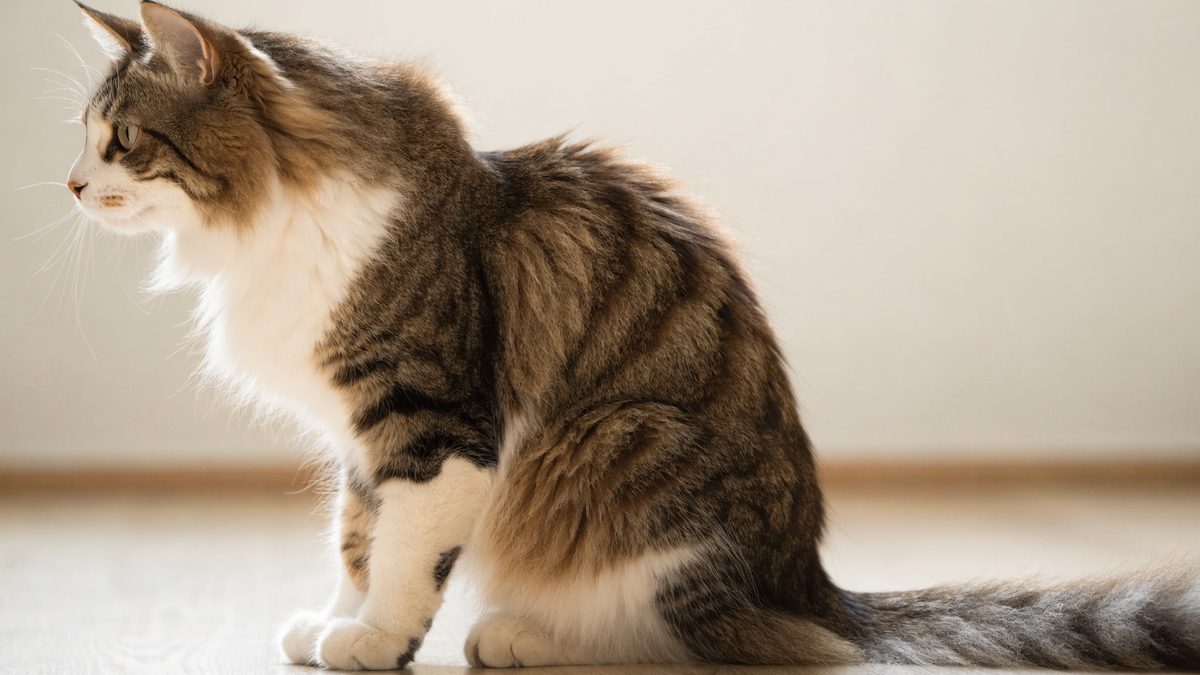
A Norwegian Forest Cat is a large, semi-long-haired natural breed from Norway, defined by three things a registry will check and a photograph will not: an equilateral triangle head, a straight nose profile that runs from the brow ridge to the tip of the nose without a break, and a dense water-repellent double coat. It is a slow-maturing breed that reaches full growth at about five years of age.
The Cat Fanciers' Association standard is unusually specific about the head, and that specificity is the reason this page exists. CFA describes the head as an "equilateral triangle, where all sides are of equal length as measured from the outside of the base of the ear to the point of the chin", and the nose profile as "straight from the brow ridge to the tip of the nose without a break in the line", with a flat forehead continuing into a gently curved skull. Of the 100 points in the CFA scale, 50 sit in the head, and nose profile alone carries 10 of them, the same weight as the entire body torso.
The FIFe standard, the one the breed was originally registered under and the source most European and Australian registries follow, says the same thing in different words: "Triangular shape, with all sides of equal length" and "long, straight profile without break in line (no stop)";. The GCCF standard, published in full by the Norwegian Forest Cat Club, says it a third time: "Triangular, where all sides are equal" and "Long straight profile from the tip of the nose to the brow without a break in line", with "Break (stop) in profile" and "Round or square head" both listed as faults. Three independent registries describing the same head the same way is what makes the straight profile a usable test rather than an opinion.
The breed club adds a viewing tip the registries do not. Look for the internal triangle from the front, because "A broad, parallel nose bridge can spoil the NFC 'look'", and the ears should follow the outer lines of the triangle to create an outer triangle. It also states what the coat is worth: "The coat is 25% of the points in the NFC standard. It must be waterproof and reasonably self maintaining. It should never be soft and fluffy";. A soft, fluffy, non-waterproof coat is therefore not a prettier version of the breed, it is a quarter of the standard failed.
The registries do disagree on one visible detail, and it is worth knowing before you argue with a seller. CFA asks for ears "rounded at the tip";, while the GCCF standard asks for ears "Large, not rounded"; and FIFe asks for "pointed tips";. Use the nose profile and the head triangle as your test, not the ear tips.
The disqualification list is the buyer's checklist
CFA disqualifies a Norwegian Forest Cat for a severe break in the nose, a square muzzle, whisker pinch, a long rectangular body, a cobby body, an incorrect number of toes, crossed eyes, a kinked or abnormal tail, delicate bone structure, and malocclusion. FIFe lists as faults "Round or square head; profile with a break (stop)", small ears, short legs, insubstantial boning, a short tail, and a dry coat with any tendency to matting. Read that CFA list again and notice what is on it. A square muzzle and a long rectangular body are two of the features the Maine Coon standard positively requires. In this breed they are grounds for disqualification. That is not a nuance, it is a wall, and it is the single most useful thing an Indian buyer can carry to a viewing.
Size, and why the published ranges disagree
Published adult weights differ by registry because they are measured and reported differently, so the honest answer is a range rather than a number. Royal Canin India gives males 4 to 9 kg and females 3 to 7 kg, with height 23 to 30.5 cm in both sexes. TICA gives adult females 8 to 12 pounds and adult males 12 to 18 pounds. GCCF gives a breed range of 9 to 16 lbs, with males from 12 to 16 pounds or more and females 9 to 12. The Times of India, reporting for an Indian audience, quotes about 16 pounds, or 7.2 kg.
| Source | Male | Female | Height |
|---|---|---|---|
| Royal Canin India | 4 to 9 kg | 3 to 7 kg | 23 to 30.5 cm |
| TICA | 12 to 18 lb (5.4 to 8.2 kg) | 8 to 12 lb (3.6 to 5.4 kg) | not stated |
| GCCF | 12 to 16 lb or more (5.4 to 7.3 kg) | 9 to 12 lb (4.1 to 5.4 kg) | not stated |
| Times of India | about 16 lb (7.2 kg) | not stated | 12 to 18 inches long |
The practical read is that a mature male sits somewhere between 5.5 and 8 kg and a female between 3.5 and 5.5 kg, and that anyone quoting you a guaranteed 10 kg cat is selling a number no registry publishes. Bonbeno's Maine Coon guide sets out why paying a premium for extreme size is a bad trade, and the point applies with more force here.
The coat, described properly
The coat is a genuine double coat, not a long single coat. CFA describes "a dense undercoat, covered by long, glossy and smooth water-resistant guard hairs hanging down the sides", with a bib in three separate sections, a short collar at the neck, side mutton chops and a frontal ruff, plus full britches on the hind legs. FIFe adds that a fully coated cat has a shirtfront, a full frill and knickerbockers, and that length of coat and density of undercoat vary with the seasons. TICA notes bluntly that in summer the coat is short. Kittens can take up to six months to develop guard hairs at all, which matters when you are being shown an eight-week-old kitten and told to judge its coat.
Colour is almost unrestricted. Every colour and pattern is allowable except those showing hybridisation, meaning chocolate, sable, lavender, lilac, cinnamon, fawn and point-restricted Himalayan-type markings. The breed also owns a colour of its own. Amber and light amber are recognised only in this breed, produced by a melanocortin 1 receptor variant, and an amber kitten is born black or blue and warms to a honey-chestnut or pale beige as it matures. Allowable outcross breeds: none, in both the CFA and the FIFe-derived standards Australian Cat Federation.
History, and one date the sources cannot agree on
The breed is old as a landrace and young as a pedigree. Norwegian cat fanciers formed the Norwegian Forest Cat Club in Oslo in 1938 to save a population that was being absorbed by free-roaming shorthairs, the Second World War stopped the work, and the official breeding programme restarted in the 1970s. FIFe registered the breed in 1976 through the Norwegian fancier Carl-Fredrik Nordane, Sweden recognised it in 1978, TICA granted championship status in 1984 as the first North American registry to do so, CFA accepted registration in 1987 and granted championship in 1993, and GCCF gave preliminary recognition in 1989 and championship in 1997 The International Cat Association.
Sources conflict on when the breed became the official cat of Norway, and Bonbeno prints the conflict rather than picking one. GCCF says the late King Olaf V designated them in the 1950s. TICA states 1938 in its facts list and, two paragraphs later, describes the royal recognition as happening in the 1970s. CFA's own account, as quoted by the top-ranking Indian page for this query, puts it in the 1970s. Three registries, three dates, one of them contradicting itself. Nothing about your cat depends on the answer, but a page that quietly picks one has told you something it does not know.
The Norwegian Forest Cat is among the top 10 breeds registered by GCCF in the UK. In India it is described by Supertails as "very rare";, and that scarcity, not any special quality, is what most of its Indian price tag is made of.
Norwegian Forest Cat price in India
The Norwegian Forest Cat price in India is published as Rs 40,000 to Rs 70,000, and every Indian source Bonbeno could find prints that exact band. Four sources agreeing to the rupee is not corroboration, it is copying, and it tells you there is no real Indian market data behind the number.
Start with what is actually on the record. Happy Pet, the page currently ranking first in India for this query, gives Rs 40,000 to Rs 70,000 and repeats it in its FAQ. The Times of India gives Rs 40,000 to Rs 70,000. VetScan, a Delhi veterinary laboratory, gives Rs 40,000 to Rs 70,000. Supertails gives Rs 40,000 to Rs 70,000 and adds the detail the other three omit, that the breed is "very rare" in India.
| Source | Type of source | Published band | City split? | Availability note |
|---|---|---|---|---|
| Happy Pet | Indian pet platform, breed database | Rs 40,000 to Rs 70,000 | No | None given |
| The Times of India | National newspaper, lifestyle desk | Rs 40,000 to Rs 70,000 | No | None given |
| VetScan | Indian veterinary laboratory blog | Rs 40,000 to Rs 70,000 | No | "They struggle in extreme heat" |
| Supertails | Indian pet retailer, vet-reviewed guide | Rs 40,000 to Rs 70,000 | No | "Very rare" |
| Vetic | Indian veterinary clinic chain | No price published | No | Listed as a rare breed |
Compare that with how the same market prices the breed most buyers cross-shop. On Bonbeno's Maine Coon page the published Indian bands run from Rs 25,000 to more than Rs 6,00,000 depending on which seller you read, and three of those sellers publish city tables whose Bangalore ceilings differ by a factor of nine. That spread is ugly but it is real: it reflects actual listings from actual sellers. The Norwegian Forest Cat's tidy, unanimous Rs 40,000 to Rs 70,000 is the opposite. It is what a number looks like when nobody is selling enough of the animal to generate a spread.
What the breed costs where it is actually traded
In the United States, where the breed has registered breeders and waiting lists, Petful reports a pet-quality kitten from a reputable health-testing breeder at USD 800 to USD 1,800, adoption through a rescue at USD 100 to USD 300, and show or breeding-quality kittens from proven lines at USD 1,800 to USD 3,000 and up. Convert those at whatever rate your bank quotes and the American floor for a screened pet kitten lands at or above the ceiling of the Indian band. That gap has one of two explanations. Either Indian sellers are absorbing a loss, which nobody does, or the Indian kitten is not the same product.
Petful names five price drivers: lineage and show quality, breeder reputation and health testing, colour and pattern, location, and scarcity. On testing it is unambiguous: "Responsible breeders DNA-test for Glycogen Storage Disease Type IV (GSD IV), screen for hypertrophic cardiomyopathy (HCM) by echocardiogram, and check hips. That testing costs real money per breeding cat, and it is folded into the kitten price";.
The genetic testing costs less than you think, which changes the argument
Here is the number that reframes the whole negotiation. The University of California Davis Veterinary Genetics Laboratory charges USD 47 for the GSD IV test and USD 47 for the pyruvate kinase deficiency test, per animal. Langford Vets at the University of Bristol, the laboratory GCCF's own breeder guidance points to, charges GBP 31.50 excluding VAT for one test and GBP 45.25 for two, dropping to GBP 36.20 for two on the breed-society rate. Testing both parents for both conditions is therefore a low four-figure rupee cost against a kitten selling for Rs 40,000 to Rs 70,000. A seller who tells you genetic testing is too expensive has not done the arithmetic, or is hoping you will not.
What no Indian listing can give you, and what that is worth
GCCF operates the discipline that a price should be paying for. Under its policy every Norwegian Forest Cat registered as active for breeding must sit on one of two registers, Active for cats clear of all genetically tested diseases listed for registration, or Genetic/Non-Active for carriers, and "any cat tested as Affected for one or more of the genetically tested diseases listed for registration cannot be registered as active and should be neutered";. The two diseases on that list are PKDef and GSD IV. India has no equivalent register for this breed. That is not a criticism of Indian breeders, it is a structural fact, and it means the burden of verification moves from the registry to you.
- Ask for the GSD IV result for both parents, by name. The report should say N/N, N/GSD or GSD/GSD and name the laboratory.
- Ask for the PK deficiency result for both parents. The report should say N/N, N/K or K/K.
- Ask for an echocardiogram report on both parents, not a stethoscope opinion. There is no DNA test for hypertrophic cardiomyopathy in this breed.
- Ask what the kitten's age is at handover. Petful's benchmark for a responsible breeder is not releasing kittens before about 12 to 14 weeks.
- Ask which registry the litter is registered with, and ask to see the paperwork. Petful notes that because Wegies are pricey and scarce, some sellers pass off a fluffy domestic longhair as the real thing.
Bonbeno does not broker kitten sales and does not recommend breeders. What the evidence supports is narrow and worth stating plainly. The Rs 40,000 to Rs 70,000 band is the only published Indian figure, it appears identically across four unrelated sources, and none of them shows a listing, a city breakdown or a date behind it. Treat it as a rough expectation, not a market rate, and treat any quote outside it as a question rather than a bargain. What genuinely changes the value of the animal is documented screening, and that is verifiable for a few thousand rupees.
Monthly cost and first-year cost of a Norwegian Forest Cat in India
Budget Rs 2,800 to Rs 4,200 a month for a Norwegian Forest Cat on the only breed-specific Indian estimate published, and Rs 4,600 to Rs 9,000 a month on the wider mid-range figure for a pedigree cat in India. First-year cost, including the kitten, realistically starts around Rs 75,000 and can pass Rs 1,50,000 once cooling and screening are counted.
Happy Pet publishes the only monthly cost figure Bonbeno could find that is specific to this breed in India: an average of Rs 2,800 on a basic lifestyle and Rs 4,200 on a premium one, split as food Rs 1,500 to Rs 2,000, veterinary Rs 500 to Rs 700, and grooming Rs 800 to Rs 1,500. That is a reasonable floor and it is missing two lines that matter enormously for this particular animal in this particular country.
Supertails, whose cat cost guide is reviewed by a practising Indian veterinarian, publishes a fuller structure for any cat in India. Its monthly cost table runs Rs 2,300 to Rs 4,600 on a budget lifestyle, Rs 4,600 to Rs 9,000 mid-range and Rs 9,000 to Rs 21,700 premium, itemised across food, litter, routine vet visits, professional grooming, treats, toys and parasite prevention. Its first-year table adds one-time costs including an initial vet checkup at Rs 500 to Rs 1,500, the full year-one vaccination schedule at Rs 1,500 to Rs 3,000, deworming at Rs 300 to Rs 600, spay or neuter surgery at Rs 3,000 to Rs 8,000, and a scratch post or cat tree at Rs 800 to Rs 4,000, for a first-year total of Rs 35,000 to Rs 2,40,000 and up.
| Line item | Happy Pet, breed-specific | Supertails, budget | Supertails, mid-range |
|---|---|---|---|
| Food | Rs 1,500 to Rs 2,000 | Rs 800 to Rs 1,500 | Rs 1,500 to Rs 3,000 |
| Litter and litter box | not itemised | Rs 300 to Rs 600 | Rs 600 to Rs 1,200 |
| Routine veterinary | Rs 500 to Rs 700 | Rs 300 to Rs 600 | Rs 600 to Rs 1,000 |
| Grooming | Rs 800 to Rs 1,500 | Rs 500 to Rs 1,000 | Rs 1,000 to Rs 2,000 |
| Parasite prevention | not itemised | Rs 150 to Rs 300 | Rs 300 to Rs 600 |
| Toys and enrichment | not itemised | Rs 100 to Rs 300 | Rs 300 to Rs 600 |
| Monthly total as published | Rs 2,800 to Rs 4,200 | Rs 2,300 to Rs 4,600 | Rs 4,600 to Rs 9,000 |
Two lines every Indian estimate leaves out
Cooling. No Indian breed page prices the air conditioning this cat needs, and Bonbeno will not invent a figure, because the honest answer depends on your city, your tariff slab, your room volume and how many hours you run the unit. What can be stated is the requirement. Supertails' own climate guide says the breed's dense water-repellent double coat overheats above roughly 32 degrees Celsius and calls it "Not a practical choice for most Indian cities without robust year-round cooling". Price that against your actual electricity bill before you commit, not after. If running a room at 26 degrees for eight months of the year is not something you would do for yourself, this is the wrong breed.
Cardiac screening. Because there is no DNA test for hypertrophic cardiomyopathy in this breed, TICA recommends that breeding cats have regular echocardiogram screening every couple of years. Bonbeno could find no published Indian price for a feline echocardiogram, and rather than guess, the useful advice is to ring two or three referral clinics in your city and ask for the cost of a feline echocardiogram by a cardiologist before you buy the kitten, not after a murmur turns up. Budget for it as a recurring, not a one-off.
For a sense of scale from a market where the breed is common, Petful puts American first-year setup at USD 450 to USD 1,200 on top of the purchase price, ongoing running cost at roughly USD 50 to USD 100 a month or USD 600 to USD 1,200 a year, and optional pet insurance at USD 20 to USD 50 a month. It also flags the two items you buy for the breed rather than for an average cat: a large carrier, because a Wegie outgrows a standard small one, and a stainless steel comb for the spring molt.
Kitten at the published band, Rs 40,000 to Rs 70,000. Year-one vaccination Rs 1,500 to Rs 3,000, deworming Rs 300 to Rs 600, initial vet check Rs 500 to Rs 1,500, spay or neuter Rs 3,000 to Rs 8,000, setup including a tall cat tree Rs 3,000 to Rs 12,000. Twelve months of running costs at the breed-specific estimate, Rs 33,600 to Rs 50,400. That lands between roughly Rs 82,000 and Rs 1,45,000 before a single unit of electricity for cooling and before one echocardiogram. Anyone telling you this is a Rs 50,000 decision has counted the kitten and stopped.
Can a Norwegian Forest Cat handle the Indian climate
A Norwegian Forest Cat can live in India only in a home with reliable year-round cooling, and its heat tolerance is the weakest thing about it. Supertails rates the breed "Poor, needs AC" for the Indian climate and states that the dense water-repellent double coat overheats above roughly 32 degrees Celsius. Happy Pet puts its ideal weather at 15 to 25 degrees Celsius.
Two Indian sources, one a retailer with a vet-reviewed guide and one a breed database, give the same verdict from different directions. Supertails' climate table lists the breed as "Poor, needs AC" with a long double coat, and its entry reads: "Built for Scandinavian winters. Dense water-repellent double coat overheats above ~32 degrees C. Not a practical choice for most Indian cities without robust year-round cooling";. Happy Pet lists ideal weather as 15 to 25 degrees Celsius. VetScan, writing as an Indian veterinary laboratory, says the breed suits "colder regions of India (like the North)" and adds flatly, "They struggle in extreme heat";. Vetic, an Indian clinic chain, says the thick coat "causes discomfort in hot climates" and that grooming to prevent matting "can be difficult in humid regions";.
The coat is not an accident of fashion, which is exactly why it will not adapt. TICA describes it as "water-resistant, semi-long coat with a dense undercoat developed to help the cat survive in the harsh Scandinavian climate", and notes that during cooler months "the ruff is full and the dense woolly undercoat thickens";. FIFe records that length of coat and density of undercoat vary with the seasons. That seasonal thinning is real and it helps. It is also calibrated to a Norwegian summer, not to Nagpur in May.
What the veterinary evidence actually says, and what it does not
The Royal Veterinary College's clinical guidance names the risk group directly. Among the animals more susceptible to heatstroke it lists "Pets with thick coats", alongside overweight animals, flat-faced breeds, the very old and very young, and animals with pre-existing airway, lung or heart problems. It also explains the mechanism: "Animals are unable to cool down by sweating as humans do, so they are less able to regulate their body temperature", and heatstroke is "a life-threatening condition where the body temperature increases to a point where serious consequences, including organ failure and even death, can occur";. Critically for cat owners, it warns that the early signs are "often more subtle" in cats than in dogs.
Now the limit, stated plainly. There is no published study giving an odds ratio or a relative risk for heatstroke in long-coated versus short-coated cats. Bonbeno searched for one and did not find it. What exists is a clinical risk list that includes thick coats, a breed origin in a subarctic climate, and Indian retail and veterinary sources independently saying the breed overheats. That is enough to act on. It is not enough to put a number on, and any page that gives you one has made it up.
The Indian number that matters is the night, not the day
Everyone quotes Indian daytime maxima. The figure that should decide this purchase is the overnight low. Reporting from Banda in Uttar Pradesh, the hottest district in the country during the May 2026 heatwave, the BBC recorded temperatures hovering at 47 to 48 degrees Celsius for more than a week and, crucially, "Overnight temperatures remain around 30C";. One resident's description of the effect was "It feels as if mornings and nights no longer exist";. The report also notes that heat across India increasingly arrives "as a combination of heat and humidity that places greater stress on the human body";.
A double-coated northern cat survives warm days by dumping heat at night. Take away the night and there is no recovery window. That, and not the headline 47 degrees, is why an uncooled Indian summer is a different proposition for this breed than a hot Norwegian afternoon, and it is why a fan is not a substitute for a cooled room.
| Where you live | Realistic verdict | What it takes |
|---|---|---|
| Delhi, Jaipur, Nagpur, Ahmedabad, Lucknow | Hardest case. Long stretches above the ~32 C overheating threshold, plus warm nights | A dedicated cooled room running most of the day, all summer, plus a power backup plan |
| Mumbai, Chennai, Kolkata, Kochi | Humidity is the problem, not peak heat. Matting and skin trouble compound it | Year-round cooling and dehumidification, plus a stricter grooming routine |
| Bengaluru, Pune, Hyderabad | The most workable Indian cities, still not easy | Cooling through March to June, ventilation the rest of the year |
| Shimla, Dehradun, Gangtok, Srinagar, Ooty | The only Indian climates that resemble what the coat was built for | Ordinary care, with monsoon coat management |
A practical hot-weather protocol
- Give the cat one permanently cool room rather than trying to cool a whole flat. Cooling a single room is what makes this affordable in most Indian apartments.
- Brush the undercoat out properly in spring. GCCF's own care note says extra attention is needed in spring when moulting, to remove dead coat and avoid knotting. Dead undercoat is trapped insulation.
- Never shave the coat to cool the cat. The guard hairs are the water-repellent, sun-blocking layer described in the standard; removing them removes protection, not heat.
- Move play to early morning and after dark, and keep water available everywhere. RVC's prevention list includes constant access to a cool shaded area, drinking water always available, and adding ice to keep it cool.
- Learn the early signs. Panting, restlessness, pacing, drooling, red gums or tongue, increased heart rate, vomiting or diarrhoea, progressing to lethargy, confusion, weakness, collapse and seizures.
RVC's first-aid instruction is "cool first, transport second": move the animal somewhere cool and ventilated or use a fan, offer small sips of water without forcing it, and use evaporative cooling, pouring water cooler than the animal over it combined with air movement. Do not use ice-cold water, because it reduces blood flow to the skin and can cause shivering, which generates more heat. Start cooling, then call your vet, and have the cat checked even if it seems to recover, because the more serious signs may not be immediately apparent.
Temperament, household fit and living conditions
The Norwegian Forest Cat temperament is gentle, independent and companionable without being clingy, and every registry says the same thing in the same order. It is not a lap cat on demand, it is moderately active with sudden bursts, it talks in chirps rather than yowls, and it will climb whatever you leave standing.
CFA describes "an independent, intelligent breed, in keeping with its long history of self-sufficiency", and adds a sentence that tells you more about living with one than any adjective list: "They can be lap cats, but it will always be THEIR decision as to when to get on or off that lap";. It calls them moderately active, sensitive, friendly and adaptable, notes their "random bursts of energy", and records that their vocalisations "range from a soft purr to bird-like chirps when they are excited";.
TICA is blunter for prospective buyers: "If you are looking for a 'lap cat', the Norwegian Forest Cat might not be the best choice. This breed prefers to stay close to their family, such as on the back of the couch";. It also notes that it is common for one of these cats to pick a favourite person, and that they are "not excessively loud or vocal, but tend to 'talk' in chirps and meows";. GCCF adds the practical version: "They have a quiet voice, except when it comes to dinnertime";.
How it behaves with children, dogs and other cats
All three registries agree, which is unusual and worth weighting. CFA says they get along well with other cats, dogs and children. TICA says the calm temperament "makes them a good choice for families with children and other pets";. GCCF says they are "tolerant of respectful children, other cats and cat-friendly dogs", with the qualifier doing real work.
The caveat is strangers, not family. Royal Canin notes the breed "can be a little shy around strangers" and gives the specific remedy: "Selecting a kitten that comes from a breeder who practises early handling and socialisation can help with this";. GCCF says the same, that they can be reserved with strangers. In an Indian household with frequent visitors, domestic help and extended family, that is a real consideration and it is fixed at the breeder, not later.
| Trait | Score | What it means day to day |
|---|---|---|
| Energy level | 3 of 5 | Moderate, in bursts. Not a Bengal, not a Persian |
| Vocal tendencies | 1 of 5 | The quietest thing about the breed. Chirps, not yowls |
| Can stay alone | 2 of 5 | The weakest score. This cat notices when the flat is empty all day |
| Family pet | 4 of 5 | Robustly built and even-tempered around children |
| Cohabitation with other pets | 4 of 5 | Generally fine with cats and cat-friendly dogs |
| Grooming needs | 4 of 5 | Higher than the registries' "low maintenance" language suggests |
Living conditions: what the home has to provide
Vertical space is not optional. CFA warns that "Wegies have a fondness for high places" and that without tall scratching posts or cat trees "your cat may decide its favorite spot is on top of the kitchen cabinet";. TICA notes their long muscular hind legs let them jump high and with ease, and specifically recommends a scratching post wrapped in sisal rope with seats they can jump to and climb. GCCF asks for "a strong climbing frame designed to hold the weight of a large cat", which is the detail most Indian cat trees fail on.
Two smaller household facts. GCCF records a "penchant for fishing", so an unprotected aquarium is a problem, and Royal Canin notes the breed is one of the few that likes water, warning owners with fishponds and even baths. And GCCF flags anecdotal susceptibility to feline urinary syndrome, advising care with diet in that respect, which in Indian conditions means making water genuinely easy to reach in every room the cat uses.
Buy this cat if you have a cooled home, someone around during the day, ceiling-height vertical space, and you want a companion that follows you room to room without sitting on you. Do not buy it if you want a cat that will lie on your lap on demand, if the flat is empty from 9 to 8, if you cannot run cooling through an Indian summer, or if your reason for choosing it is that it looks like a Maine Coon and costs less.
Litter training, handling and enrichment for a Norwegian Forest Cat
To train a Norwegian Forest Cat, start inside the socialisation window that opens at two to three weeks and may be closing by nine to ten weeks, and spend the first year teaching three things: the litter tray, tolerance of the comb, and calm acceptance of handling. Royal Canin notes the breed learns fast and house-trains very easily, so the difficulty is not intelligence, it is timing.
The AAHA and AAFP Feline Life Stage Guidelines set the window precisely. "The sensitive socialization period for new experiences, people, and other animals begins as early as 2 to 3 weeks and may be closing by 9 to 10 weeks", and what matters most is the quality of the experience rather than the count. The guidelines put a number on the daily dose: "Ideally, kittens should have pleasant interactions with people for 30 to 60 minutes per day";. Read that against Petful's benchmark that a responsible breeder does not release kittens before about 12 to 14 weeks and the arithmetic is uncomfortable. Most of the window closes before the kitten reaches you, which is why what the breeder did is not a nice extra, it is most of the outcome.
Litter training, and the one trick that shortens it
Litter training is usually the easiest part. AAHA notes that cats are innately fastidious and "may be naturally attracted to sand-type substrates for elimination", and that elimination tends to happen away from primary resting locations. The useful, rarely quoted detail follows: "Some practitioners believe that kittens are most accepting of the litter they observe their queen using, which may influence future preferences", and so it may be beneficial to offer a young kitten a variety of toileting substrates so it becomes an adult with broader acceptance.
In Indian terms that means two things. Ask the breeder which litter the queen used and buy that brand for the first fortnight, because a litter switch on day one is the commonest cause of an accident that then gets blamed on the kitten. Then, once the tray is established, deliberately offer a second tray with a different substrate, so that a stock shortage or a move to another city does not become a toileting problem later. Buy the largest tray you can fit. This is a cat that will reach five to eight kilograms, and a standard Indian kitten tray will be undersized within six months.
Handling training is the training that actually pays
AAHA is explicit that cats can be taught far more than owners attempt: "cats can be taught to voluntarily accept grooming, nail trimming, instillation of ear treatments, application of topical antiparasitics, and administration of medications both orally and subcutaneously", and it makes the case simply, that "almost every cat is going to require medication at some time in its life";. It even gives a method for pill training in advance, by giving soft treats that could wrap a pill, or empty pill pockets, before any pill is needed.
For this breed the priority list is short and specific.
- Comb tolerance first. Start combing the kitten in short sessions from the week it arrives, long before the coat needs it. TICA advises a comb with deep tines, or one with tines that rotate, and a cat that fights the comb in April is a cat that mats in May.
- Carrier training second. AAHA notes that teaching a cat to come when called for a treat can be used in carrier training, building a positive association that helps at the veterinary practice. You will need this every time you screen the heart.
- Nail trims third. AAHA recommends nails be kept short to minimise damage to household items and people; TICA recommends clipping at least monthly, preferably every two weeks.
- Never use hands or feet as toys. AAHA warns that cats learn this is appropriate play and it leads to scratching or biting injuries. On a cat this size, that is not a small problem.
- Introduce the cooled room as a good place, not a punishment. Feed the cat there and put the best sleeping surface there, so that in May it goes there by choice.
Enrichment, with the scratching-post evidence spelled out
The scratching post is where most Indian owners waste money, and there is real data on it. One study summarised in the AAHA guidelines found rope was the most frequently used substrate when offered, although carpet was offered more commonly; cats scratched the preferred substrate more often when the post was a simple upright type or a cat tree with two or more levels and at least three feet high; and narrower posts, with a base width of three feet or less, were used more often than wider posts of five feet or more. TICA independently notes that Norwegian Forest Cats "prefer one wrapped in sisal rope";.
So the specification is a tall, narrow, sisal-wrapped upright with at least two levels, built solidly enough to hold a large muscular cat that will climb it at speed. GCCF's phrasing, "a strong climbing frame designed to hold the weight of a large cat", is the part Indian retail most often gets wrong. A wobbly tree gets abandoned, and then the cat climbs your curtains instead.
Royal Canin closes the training question honestly: the breed learns fast and house-trains easily, "However, as this is a breed that takes a long time to fully mature, expect kitten antics for some time to come. They are even quite playful into adulthood";. Plan for a four-year-old that still behaves like a teenager, because on this breed's timetable it is one.
Train the handling, not the tricks. A Norwegian Forest Cat that lets you brush its britches, clip its nails and put it in a carrier without a fight is a cat whose coat stays out of trouble in an Indian summer and whose heart can actually be screened. Everything else is optional.
How much exercise a Norwegian Forest Cat actually needs
Give a Norwegian Forest Cat two interactive play sessions a day, in the cool hours, plus permanent access to a climbing route. Royal Canin scores the breed 3 out of 5 for energy and says a full-size adult "needs a fair amount of physical activity to keep them in shape". This is a moderate-energy cat with sudden bursts, not a Bengal.
CFA's description is the most accurate one for planning your day: "Moderately active, Forest Cats are known to have random bursts of energy. They can entertain themselves with toys, running, hiding, and then ambushing them like prey";. GCCF agrees that they have a lot of energy, enjoy interactive games, and "will entertain themselves with games if you are not at home during the day", and adds the line that tells you what the climbing frame is for: they "think nothing of climbing trees and descending head first";.
TICA fills in what actually works. Norwegian Forest Cats like cat toys, love catnip, and most enjoy chasing a laser light, with one specific warning: be very careful with toys containing mylar, which can cause harm if ingested. Their long, muscular hind legs let them jump high and easily, which is why TICA expects to find them on top of cabinets.
The registry advice that does not transfer to India
Royal Canin recommends regular access to the great outdoors and, where that is not viable, an enclosed area in the garden. GCCF says they love the outdoors. For most Indian buyers neither is available and, in summer, neither is desirable. RVC lists among the causes of heatstroke "Exercising excessively in warm weather, or being left in a warm or humid environment that is poorly ventilated", and notes it does not have to be hot for an animal to overheat. A heavy double-coated cat playing hard on a Chennai balcony at 3pm is the exact scenario that guidance describes.
So the Indian version of this breed's exercise requirement is indoor, vertical and time-shifted.
- Two sessions of 10 to 15 minutes of interactive play a day, one before 8am and one after sunset, using a wand toy that lets the cat chase, pounce and catch rather than only chase.
- A continuous vertical route, not one tall tree in a corner. Shelf, window ledge, cupboard top, back to floor. This breed uses height the way other cats use floor space.
- Food puzzles for the middle of the day, which give a cat that is home alone something to hunt without generating heat in the way a chase does.
- A cooled room as the play space in summer. If the only cool room is the bedroom, the cat tree goes in the bedroom.
- Enclosed balcony netting rather than open access. It gives the cat the height and the view without the traffic, the birds of prey or the midday sun.
What happens if you skip it
The first consequence is weight, and weight is measurably expensive on this animal. The UK VetCompass life-table study found that lifespan decreased by 0.02 years for every 100 g of increase or decrease in adult body weight away from the median for that breed and sex. Read the direction carefully. This is not a simple obesity penalty, it is a penalty for deviating from your own breed's normal weight in either direction, and on a cat marketed for size that is the more interesting half of the finding. A kilogram above your breed-and-sex median works out to about 0.2 years off the estimate. The CatScan screening study independently found increased body condition score among the factors associated with a diagnosis of hypertrophic cardiomyopathy, so weight is buying you two problems, not one.
If you want a genuinely high-drive cat, the Bengal is the one, and the daily play requirement Indian sellers quote for it is far above anything asked here. Royal Canin scores this breed 3 of 5 for energy and CFA calls it moderately active. The trade is that the Bengal's short coat handles Indian heat far better, so on exercise you are choosing between a cat that demands more of your time and a cat that demands more of your electricity.
Grooming a semi-long water-repellent coat in Indian humidity
Groom a Norwegian Forest Cat at least twice a week with a deep-tined steel comb, and daily through the spring moult. The registries say weekly is enough and Royal Canin says twice weekly is the minimum, and in Indian humidity you should follow the higher number, because the failure mode here is a matted undercoat you cannot see until it has already pulled the skin.
This is one of the few genuine disagreements between good sources on this breed, so here it is laid out rather than averaged.
| Source | Routine frequency | Moult frequency | Overall verdict |
|---|---|---|---|
| TICA | Weekly combing | Extra combing at the once or twice yearly molt | "Fairly low maintenance" |
| GCCF | Weekly grooming | Extra attention in spring | "Fairly low maintenance" |
| Royal Canin India | At least twice a week | Daily during moulting periods | Grooming needs 4 of 5, shedding 4 of 5 |
| VetScan (India) | Twice a week | More during shedding season | "Medium to High" |
TICA calls them "fairly low maintenance" cats and says a weekly combing is usually sufficient, using a comb with deep tines or one with tines that rotate, adding that they molt once or twice a year and shed very little between molts. GCCF says much the same, that although semi-longhaired "they are fairly low maintenance", with extra attention paid in spring when moulting to ensure dead coat is removed and avoid knotting. Royal Canin, writing for an Indian audience, disagrees: "They will need brushing at least twice a week, and daily during the moulting periods when they can shed a lot", and scores both hair length and grooming needs at 4 out of 5. VetScan, an Indian veterinary laboratory, rates grooming "Medium to High" and specifies twice a week, more during shedding season.
Bonbeno's position is that the Indian sources are right for Indian conditions, and there is a reason. Two of the three registry sources are describing a cat in a temperate climate with a clean seasonal moult. Vetic, an Indian clinic chain, names the actual problem: the thick coat requires regular grooming to prevent matting, "which can be difficult in humid regions";. Matting is also a fault in the breed standard itself, which lists "Dry coat, any tendency to matting, too silky" among the faults, so a matted Wegie is not just uncomfortable, it is off-standard.
What you are actually combing
Understand the structure and the technique follows. The coat is a dense woolly undercoat covered by long, coarse, glossy water-repellent guard hairs over the back and flanks, with a three-part bib and full britches on the hind legs Australian Cat Federation. The guard hairs shed water and sun. The undercoat is the part that mats, and it mats where you cannot see it: behind the ears, in the armpits, under the ruff, and in the britches. A brush that only glides over the guard hairs is doing nothing. Petful is blunt that "A steel comb is essential for the spring molt";.
- Comb, do not brush. Work a deep-tined steel comb down to the skin, in sections, and stop when the comb runs clear.
- Cover the four hidden zones every session. Behind the ears, armpits, under the frontal ruff, and the britches on the hind legs.
- Escalate in March and April. GCCF's spring warning is the Indian owner's cue too, because the moult and the first heatwave arrive together.
- Dry the cat properly after any wetting. A water-repellent coat sheds surface water and holds damp underneath, and in a Mumbai or Kochi monsoon that damp undercoat is where skin trouble starts.
- Never shave to cool the cat. You would be removing the guard hairs that block sun and repel water while leaving the undercoat that traps heat.
The rest of the routine
Nails should be clipped at least once a month, preferably every two weeks. Royal Canin recommends wiping the corner of the eyes daily with a different cloth for each eye, and notes that regular brushing prevents foreign bodies getting trapped in the fur and causing skin abscesses. Both Royal Canin and TICA recommend brushing the teeth as often as possible, at least weekly The International Cat Association. Bathing is optional but not harmful, using a mild shampoo.
Happy Pet puts breed-specific grooming at Rs 800 to Rs 1,500 a month in India and Supertails puts professional grooming for a long-haired cat at Rs 500 to Rs 2,000 a month depending on tier. Most of that spend disappears if you comb the cat yourself twice a week from kittenhood. A steel comb is a one-time cost. A dematting session at a salon is not, and neither is the sedation some badly matted cats need.
Norwegian Forest Cat health issues, life expectancy and the genetic testing to demand
Three inherited conditions matter in this breed and two of them have a DNA test you can demand by name: glycogen storage disease type IV and pyruvate kinase deficiency. The third, familial cardiomyopathy, has no breed-specific DNA test and needs an echocardiogram. UK primary-care records put life expectancy at age 0 at 9.95 years, against the 14 to 16 years every Indian page quotes.
Life expectancy: the number nobody in India publishes
The VetCompass life-table study of UK cats, run by the Royal Veterinary College, is the largest breed-stratified dataset available and it puts the Norwegian Forest Cat at a life expectancy at age 0 of 9.95 years (95% CI 7.55 to 12.35), from 15 recorded deaths spanning 1.71 to 19.05 years. UK companion cats overall reached 11.74 years, crossbred cats 11.89 years and purebred cats 10.41 years.
Every other source you will read quotes a longer figure. GCCF says 14 to 16 years. Royal Canin says an average age of 14 to 16 years. TICA says 13 or more. Happy Pet and Supertails both say 12 to 16 years Supertails, Cat Breeds In India. VetScan says 13 to 16 years. Those are potential-lifespan figures. The VetCompass number is an actual-outcome figure built from cats that died in veterinary practice, which is a different measurement and a more useful one for a buyer.
| Breed | Life expectancy at age 0 (95% CI) | Number of deaths |
|---|---|---|
| Burmese | 14.42 years (12.91 to 15.93) | 45 |
| Birman | 14.39 years (12.87 to 15.91) | 38 |
| Crossbred | 11.89 years (11.75 to 12.03) | 7,117 |
| Siamese | 11.69 years (10.56 to 12.82) | 88 |
| Persian | 10.93 years (9.63 to 12.23) | 80 |
| Ragdoll | 10.31 years (8.86 to 11.76) | 69 |
| Norwegian Forest Cat | 9.95 years (7.55 to 12.35) | 15 |
| Maine Coon | 9.71 years (8.42 to 11.00) | 69 |
| Russian cats | 9.65 years (7.20 to 12.10) | 19 |
| British cats | 9.58 years (8.73 to 10.43) | 194 |
| Bengal | 8.51 years (7.12 to 9.90) | 73 |
| Sphynx | 6.68 years (4.53 to 8.83) | 18 |
The Norwegian Forest Cat figure rests on 15 deaths, the smallest breed sample in the study, and the study grouped breeds with fewer than 15 deaths into an "other" category, so this breed sits exactly on the inclusion threshold. Its confidence interval runs from 7.55 to 12.35 years, which is wide enough to overlap almost every other breed in the table. The correct reading is not "Wegies live 9.95 years". It is that the best available primary-care evidence does not support the 14 to 16 years being advertised, and that the breed sits statistically indistinguishable from the Maine Coon at 9.71 years.
Glycogen storage disease type IV, the condition that defines this breed
Glycogen storage disease type IV is the signature Norwegian Forest Cat genetic disease, it is usually fatal, and it has a DNA test that costs USD 47. If you take one thing from this page, take that sentence.
The disease is caused by deficiency of the glycogen branching enzyme, so abnormal glycogen accumulates in muscle, liver and neurons and causes progressive organ dysfunction. Fyfe and colleagues at the University of Pennsylvania characterised the exact molecular lesion in 2007: affected cats are homozygous for a complex rearrangement of genomic DNA in GBE1, "a 334 bp insertion at the site of a 6.2 kb deletion that extends from intron 11 to intron 12", which removes exon 12. Inheritance is autosomal recessive.
The clinical course is the cruel part. Most affected kittens die at or soon after birth, presumably from hypoglycaemia. The ones that survive the perinatal period "appear clinically normal until onset of progressive neuromuscular degeneration at 5 months of age", after which they develop persistent fever, then muscle tremors, then generalised muscle atrophy, then death Veterinary Genetics Laboratory. Royal Canin's Indian page describes the same window, "it can also manifest at five to seven months with progressive decline";, and GCCF puts it at four or five months. In practice that means a kitten sold at 12 weeks can look completely healthy and be dead within four months of arriving.
The carrier rate is not trivial. Fyfe's team screened 402 privately owned Norwegian Forest Cats and found "4 affected, 58 carrier, and 341 genetically normal cats, suggesting a mutant allele frequency of 0.082, albeit in a biased sample";. That is 58 carriers in 402 cats, a carrier rate of 14.4 percent, and 4 affected cats already alive in the sampled population. The paper's own caveat about the sample being biased is reproduced here because it matters: cats submitted for testing are not a random sample. Two of the carriers had been imported to the USA independently from different catteries in Europe, which tells you the variant travels with the breed rather than sitting in one bloodline.
| Result | Meaning | Can it be bred? |
|---|---|---|
| N/N | Normal. No copies of the GSD IV variant. Cannot transmit it | Yes, freely |
| N/GSD | Carrier. One copy. The cat is healthy but passes the variant to 50 percent of offspring | Only to an N/N mate, and GCCF puts it on a non-active register |
| GSD/GSD | Affected. Two copies. A fatal condition | No. GCCF says an affected cat cannot be registered active and should be neutered |
More than one laboratory offers the test, which removes the last excuse. Langford Vets at the University of Bristol runs a PCR-based test that "can reliably distinguish between Affected, Carrier and Normal cats" and issues a certificate specifying which of the three the cat is. UC Davis reports the same three genotypes as N/N, N/GSD and GSD/GSD. Either certificate answers the question permanently, at any age, from a cheek swab.
Two carriers bred together produce 25 percent affected kittens The Governing Council of the Cat Fancy. That is why GCCF requires a clear result for active breeding registration and why the Norwegian Forest Cat Breed Advisory Committee recommends that where a breeder is aware of the potential presence of this disease in their pedigree lines, all entire cats are tested and any that are positive removed from the breeding programme. Ask any Indian seller for the GSD IV result on both parents, in writing, with the laboratory named. There is no version of "we do not have it" that is acceptable, because the test exists, it is cheap, and it is definitive at any age.
Familial cardiomyopathy, and why a Maine Coon heart test is worthless here
The most important cardiac study on this breed is not about hypertrophic cardiomyopathy as such. In 2014 a Royal Veterinary College team led by Marz and Luis Fuentes published the first characterisation of cardiomyopathy in the breed, combining a prospective echocardiographic study, necropsy examinations and open-source pedigree data for 871 Norwegian Forest Cats. Of those, 97 (11 percent) were classified as affected with cardiomyopathy, 41 (5 percent) equivocal and 733 (84 percent) unaffected.
Three findings from that paper change how you should buy.
- It hits young cats. 42 of the 97 affected cats, or 43 percent, were under three years of age. TICA independently notes HCM has been diagnosed in cats as young as four months and as old as 16 years.
- You cannot hear it. The authors concluded that "Affected cats typically had no murmur or LV outflow tract obstruction, mild LV hypertrophy". A clean stethoscope check at the seller's house proves nothing.
- It looks inherited and dominant. Extending the pedigree analysis to open-source databases identified 13 affected cats with screened parents, 11 of which had one affected or equivocal parent, "suggestive of an autosomal dominant trait", with the paper concluding autosomal dominant inheritance with incomplete penetrance while noting other modes should not be excluded.
The paper also suggests the disease in this breed "has characteristics of both HCM and RCM", a mixed hypertrophic and restrictive phenotype with endomyocardial fibrosis, which is not the classic Maine Coon picture at all. Cornell lists Norwegian Forest among the breeds with higher HCM prevalence alongside Maine Coon, Ragdoll, British Shorthair, American Shorthair, Sphynx, Bengal, Chartreux, Siberian and Persian.
One piece of context stops that 11 percent from being read as a horror figure. The CatScan study screened 1,007 apparently healthy adult cats from rehoming centres and obtained complete data on 780, finding HCM prevalence of 14.7 percent (95% CI 12.3 to 17.4) in the general cat population, with congenital disease at 0.5 percent and other cardiomyopathies at 0.1 percent. So the Norwegian Forest Cat's 11 percent is not above the background rate for cats generally. What distinguishes this breed is the age profile, with 43 percent of affected cats under three, and the apparent dominant inheritance, which is a breeding problem rather than an individual-cat one.
CatScan also supplies the hardest evidence against relying on auscultation, and the numbers deserve to be read carefully. Heart murmur prevalence in those 780 healthy cats was 40.8 percent, and 70.4 percent of those murmurs were considered functional. The positive predictive value of a heart murmur for indicating HCM was only 17.9 to 42.6 percent. In other words, most murmurs in healthy cats mean nothing, and in this breed most affected cats have no murmur at all. The factors that were associated with HCM in that study were male sex, increased age, increased body condition score and a murmur of grade III/VI or louder, and of those four, body condition is the only one you control.
Screening breeding cats by echocardiogram is now standard practice in the pedigree cat world, and the reason it is standard is precisely that the alternative does not work. As Haggstrom, Luis Fuentes and Wess put it in their review, cats are often screened for HCM because of a heart murmur, "but screening for breeding purposes has also become common", and those cats are usually purebred.
The ACVIM consensus statement on feline cardiomyopathies is explicit: "Genetic testing for the A31P and R820W MYBPC3 mutations in non-Maine Coon or non-Ragdoll cats is not recommended, because these 2 mutations are almost completely specific to Maine Coon and Ragdoll cats", graded at a high level of evidence. TICA states the position for this breed directly: "there are no DNA detection tests specifically for the Norwegian Forest Cat available at this time. Right now, regular echocardiogram screening is our best defense against HCM", and recommends breeders test breeding cats every couple of years. If a seller shows you an HCM DNA certificate for a Wegie, ask which mutation it tested. If the answer is A31P or R820W, that certificate tells you nothing about this cat.
What to ask for instead is an echocardiogram report on both parents. The ACVIM protocol for screening pedigree breeding cats specifies a standard-of-care scan covering left atrial size, left ventricular wall thickness and diameter, fractional shortening and a qualitative assessment of chamber geometry and systolic anterior motion of the mitral valve, with any doubtful cat classified as equivocal and re-examined later. At home, the free monitoring tool is the resting or sleeping respiratory rate, which the consensus recommends owners track.
Pyruvate kinase deficiency, and the honest size of the evidence
Pyruvate kinase deficiency is an inherited haemolytic anaemia caused by a PKLR variant, inherited autosomal recessive, in which red cells become unstable and are lost. The anaemia is intermittent, the age of onset is variable, and the signs can include severe lethargy, weakness, weight loss, jaundice and abdominal enlargement. UC Davis lists the Norwegian Forest Cat among the breeds appropriate for testing and states that, based on a survey of 38 breeds, the mutation was found "in significant frequency" in Norwegian Forest among others. GCCF requires a clear PKDef result for active breeding registration.
Here is the part no page tells you. The underlying survey, Grahn and colleagues in 2012, genotyped 13 Norwegian Forest Cats: 10 normal, 3 carriers, 0 affected, giving a mutant allele frequency of 0.1. Thirteen cats. For comparison the same study genotyped 1,955 Abyssinians, 1,340 Bengals, 2,226 Persians and 633 Somalis. The paper still recommends PK testing for the breed, and Bonbeno agrees with that recommendation, because a USD 47 test against a recessive haemolytic anaemia is a good trade at almost any prior. But you should know that the Norwegian Forest Cat carrier estimate rests on three carrier cats, not on a population study, and anyone quoting you a confident percentage is over-reading it.
| Breed | Cats tested | Carriers | Affected | Mutant allele frequency |
|---|---|---|---|---|
| Abyssinian | 1,955 | 465 | 14 | 0.126 |
| Bengal | 1,340 | 390 | 25 | 0.164 |
| Somali | 633 | 104 | 2 | 0.085 |
| Siberian | 377 | 16 | 1 | 0.024 |
| Singapura | 150 | 55 | 7 | 0.23 |
| Maine Coon | 118 | 15 | 0 | 0.064 |
| Norwegian Forest Cat | 13 | 3 | 0 | 0.1 |
| All breeds combined | 14,179 | 1,564 | 112 | 0.063 |
Hip dysplasia: the Maine Coon finding does not transfer, and saying so matters
Bonbeno's Maine Coon page carries a striking finding: in 5,038 pedigree-registered Maine Coons screened over 20 years through the PawPeds programme, feline hip dysplasia prevalence was 37.4 percent, heritability of the radiographic severity categories was 0.36, and severity was genetically correlated with body mass at 0.285, leading the authors to conclude that "selection for a large body type in this breed concurrently selects for FHD";. It is a powerful argument against paying for size.
It is also a Maine Coon study. All 5,038 cats in it were Maine Coons. The authors note that the only other type of cat with sufficient sampling to give a good prevalence estimate is the domestic shorthair, at 10.4 percent from a combined total of 899 cats. There is no equivalent published prevalence figure for the Norwegian Forest Cat. The PawPeds hip register is open to other breeds and explicitly welcomes them, but its own statistics page says the participating population is "mostly Maine Coon";. Petful and Vetic both list hip dysplasia among the things to ask about in this breed Vetic (Indian veterinary clinic chain), and neither publishes a number, because there is not one to publish.
So the honest position is this. Hip dysplasia is worth asking about, because the breed is large and heavily boned and the mechanism identified in the Maine Coon is plausible here. But plausible is not measured, and a page that quotes you 37.4 percent for a Norwegian Forest Cat has swapped one breed's data for another's. What does transfer, because it was calculated within breed and sex strata across the whole UK cat population, is the weight finding: lifespan fell by 0.02 years for every 100 g of deviation from the median adult body weight in either direction.
The rest of the list, briefly
- Eyes. Royal Canin flags conjunctivitis, glaucoma and retinal dysplasia, the last of which can occur in the womb or in a newborn kitten, and advises checking the eyes regularly for discomfort or irritation.
- Teeth. Plaque mineralises to tartar, then gingivitis, then periodontal disease. Royal Canin recommends brushing as often as possible plus regular dental checks.
- Urinary. GCCF records anecdotal evidence that the breed is susceptible to feline urinary syndrome and advises care with diet. Anecdotal is the word GCCF uses and Bonbeno keeps it.
- Joints and weight. Happy Pet notes that given their size and activity level the breed may be more prone to joint issues, making portion control central.
- General. In the largest DNA study of domestic cats, covering 11,036 individuals, 22.5 percent carried at least one disease-associated variant and 4.1 percent were potentially at risk for at least one condition given the modes of inheritance. Carrier status is normal. Untested breeding is the problem.
GSD IV DNA result for both parents, N/N ideally, laboratory named. PK deficiency DNA result for both parents. Echocardiogram report on both parents from within the last two years, not a stethoscope opinion, and not an A31P or R820W certificate Luis Fuentes V, Abbott J, Chetboul V. Hip radiograph result if the breeder participates in a screening programme, with the honest acknowledgement that no breed prevalence figure exists. Registration paperwork from a recognised registry. If a seller can produce the first three, you are dealing with someone serious. If they cannot produce any, the Rs 40,000 to Rs 70,000 is buying appearance.
Feeding a Norwegian Forest Cat in India: diet and nutrition by life stage
Feed a Norwegian Forest Cat a complete AAFCO-compliant diet split between wet and dry food, in small servings across the day, and keep it on kitten food longer than you would a normal cat because this breed matures slowly. Happy Pet's published Indian figures are roughly 250 kcal a day for kittens and 199 kcal a day for adults.
Start with the physiology, because it changes how you feed rather than what. Royal Canin notes that cats are "naturally adapted to eating small servings, between 7 and 10 times a day", and that giving the recommended daily ration of kibble once a day lets the cat regulate its own consumption. Happy Pet's Indian guidance recommends a balance of wet and dry food to keep the cat hydrated while managing dental health, and a diet compliant with AAFCO feeding guidelines.
The kitten window is longer here than in other breeds
Royal Canin splits kitten growth into construction, from birth to four months, and consolidation, from four to twelve months, with adult teeth arriving between four and seven months and a lower-fat food recommended after four months, particularly after sterilisation. The standard advice is that digestive maturity arrives around twelve months and the cat can then move to adult food. For this breed, do not take that as automatic. Happy Pet's Indian page flags the breed-specific point directly: Norwegian Forests take time to reach adulthood, so check with your vet on when to make the transition from kitten to adult food. Three registries put full maturity at four to five years The International Cat Association The Governing Council of the Cat Fancy, so a twelve-month-old Wegie is still building frame. That is a conversation for your vet, not a date on a bag.
| Life stage | Age | What the diet is for |
|---|---|---|
| Growing kitten | 4 to 12 months | Energy, highly digestible protein, antioxidants, EPA and DHA for neuro-cerebral development |
| Adult | 1 to 7 years | Hairball control through selected fibres, skin and coat support, ideal body weight for a large powerful cat, oral hygiene |
| Mature | 7 to 12 years | Maintaining condition as activity falls |
| Senior | 12 years and over | Highly digestible food, adapted kibble size and texture for a more fragile jaw, monitored calories |
Two goals that are specific to this coat and this build
Hairballs. Royal Canin's first stated adult nutritional goal for the breed is "Stimulating the elimination of hair ingested during grooming, thanks to selected fibers, to help reduce hairballs". On a cat with a dense undercoat and a full ruff, that is not a marketing line. Happy Pet makes the same connection from the other end, noting that frequent grooming sessions reduce the likelihood of matting and hairballs. Comb the cat and the diet has less work to do.
Weight. Royal Canin's third goal is "Contributing to maintaining an ideal body weight for this large, strongly built, and powerful cat, with an adapted level of calories, to help support healthy bones and joints". Happy Pet warns that portion sizes need to be kept in check to prevent overfeeding, which could lead to obesity, and that given their size and activity level the breed may be more prone to joint issues. The UK life-table evidence gives that a hard edge: lifespan fell 0.02 years for every 100 g of deviation from the breed-and-sex median adult weight, in either direction.
Water, and the urinary caveat
GCCF records anecdotal evidence that the breed is susceptible to feline urinary syndrome and advises that care should be taken with diet in that respect. Royal Canin's standing advice is that clean, fresh water should be available at all times to support good urinary regularity. In an Indian summer, with a cat that is already thermally stressed, hydration is doing two jobs at once. Practical measures: a water point in every room the cat uses, wet food as a real fraction of the diet rather than a treat, and bowls kept away from the food, because a strong food smell can suppress drinking.
What to keep out of the bowl
Happy Pet's Indian list of foods to avoid is standard and worth repeating because Indian kitchens contain most of it: onions and garlic, caffeine, chocolate, alcohol, bones, raw eggs, grapes and raisins, and artificial sweeteners. It also advises against high-carbohydrate diets, which drive weight gain, and against packaged food loaded with fillers that add empty calories, and cites guidance that raw meat and raw eggs should be avoided because of salmonella risk. TICA adds a small but useful point: use stainless steel or ceramic bowls rather than plastic, which can cause chin acne.
Happy Pet puts monthly food for this breed at Rs 1,500 to Rs 2,000. Supertails' wider Indian cat data puts adult cat food at Rs 800 to Rs 1,500 on a budget tier, Rs 1,500 to Rs 3,000 mid-range and Rs 3,000 to Rs 6,000 premium, with kitten food under one year running Rs 1,000 to Rs 2,000, Rs 2,000 to Rs 3,500 and Rs 3,500 to Rs 5,000 across the same tiers. A large adult male eats toward the top of those bands, and the kitten year is the expensive one.
Norwegian Forest Cat kitten timeline: month by month through the first year
The Norwegian Forest Cat kitten timeline has one date on it that no other breed's does. At about five months, a kitten carrying two copies of the GBE1 variant stops developing normally, develops a persistent fever and then muscle tremors. Everything else on this timeline is routine. That one is why you get the DNA result before money changes hands.
| Age | What is happening | What you do |
|---|---|---|
| 2 to 3 weeks | The sensitive socialisation period opens | Nothing. The kitten is with the breeder. Ask what handling they do |
| 3 to 6 weeks | Weaning. Milk teeth arrive, kitten cannot yet crunch | Ask whether the breeder used rehydrated kibble or wet food |
| 4 to 12 weeks | The immunity gap. Maternal immunity falls, own immunity builds | First core vaccines at 8 to 10 weeks, second at 12 to 14 weeks |
| 9 to 10 weeks | The socialisation window may be closing | This is why breeder handling matters more than anything you do later |
| 12 weeks | Intercat social play peaks, then object play takes over | Do not accept a kitten released earlier than about 12 to 14 weeks |
| 12 to 16 weeks | Arrival in your home | Same litter brand for two weeks. Start comb sessions. Start carrier training |
| 16 to 18 weeks | Rabies vaccination window in the Indian schedule | Book it. Rabies is endemic in India |
| About 5 months | The GSD IV window. Affected survivors stop developing, run a persistent fever, then show muscle tremors | If you have an N/N result on both parents, this is a non-event. If you do not, this is the month you find out |
| 4 to 7 months | Milk teeth replaced by permanent teeth | Move to a kibble big enough to encourage crunching |
| 6 months | Guard hairs are typically developed by now | The coat you were shown at 8 weeks is not the coat you have |
| 6 to 12 months | First Indian summer, first real moult | Escalate combing. Establish the cooled room as the default sleeping place |
| 12 months | Digestive maturity in an average cat | Annual boosters. Ask your vet before switching off kitten food, not automatically |
| 2 to 5 years | Slow maturation continues. Males broaden, coat fills in | This breed is not finished at one year. Expect kitten behaviour for years |
Weeks 0 to 12 happen without you, and that is the problem
The AAHA and AAFP guidelines put the sensitive socialisation period at two to three weeks through to nine or ten weeks, recommend 30 to 60 minutes a day of pleasant human interaction, and say kittens should be gently, gradually and positively acclimated to any stimuli or procedures they will meet in life, including nail trims, grooming and medicating, by pairing the stimulus with food or another reward. They also warn that a kitten startled or roughly handled may develop fears that last a lifetime. Meanwhile Petful's responsible-breeder benchmark is not releasing kittens before about 12 to 14 weeks.
Both are right, and together they mean the window closes at the breeder's house. Royal Canin makes the breed-specific version of the point: because the Norwegian Forest Cat can be a little shy around strangers, "Selecting a kitten that comes from a breeder who practises early handling and socialisation can help with this";. When you visit, ask to see where the kittens are kept. Petful's marker is that a good breeder raises kittens underfoot in the home. A kitten raised in a cage in a back room has lost something you cannot buy back.
Month five, in detail
It is worth being precise about this milestone rather than vague, because vagueness here costs a kitten. Fyfe and colleagues describe survivors of the perinatal period as appearing "clinically normal until onset of progressive neuromuscular degeneration at 5 months of age";. UC Davis describes the sequence as normal development ceasing at about five months, then persistent fever, then muscle tremors, progressing to generalised muscle atrophy and death. Royal Canin's Indian page puts the window at five to seven months and GCCF at four or five months.
The condition is autosomal recessive, so a kitten can only be affected if both parents carry it, and two carriers bred together produce 25 percent affected kittens. That is the whole argument for demanding the parental test results. A GSD IV DNA test on both parents costs USD 47 each at UC Davis and closes this line on the timeline permanently.
The vaccination schedule as published for India
Happy Pet publishes the Indian core schedule as feline herpesvirus 1, feline calicivirus and feline panleukopenia at 8 to 10 weeks, a second dose of the same three at 12 to 14 weeks, rabies at 16 to 18 weeks, and annual boosters for all four thereafter, with its own disclaimer that the list is for reference and a qualified veterinarian should guide the actual schedule. Supertails puts the full year-one vaccination schedule at Rs 1,500 to Rs 3,000 and deworming courses at Rs 300 to Rs 600. Bonbeno reproduces both and repeats the disclaimer: your vet sets the schedule, not a web page.
Teach the cat to accept the comb and the carrier before it needs either. AAHA notes cats can be taught to voluntarily accept grooming, nail trimming, ear treatments, topical antiparasitics and oral medication, and that almost every cat will need medication at some point. On a semi-long-coated breed in an Indian climate that will also need periodic echocardiograms, those two habits are worth more than any product you will buy.
Norwegian Forest Cat vs Maine Coon vs Siberian: the profile test that settles it
Tell a Norwegian Forest Cat from a Maine Coon by the nose profile, because the two standards demand opposite things. The Norwegian Forest Cat standard requires a profile "straight from the brow ridge to the tip of the nose without a break in the line". The Maine Coon standard says a profile "straight from the brow line to the tip of the nose is not acceptable". One registry, two breeds, mutually exclusive requirements.
This is the most useful paragraph on this page, so read it slowly. CFA's Norwegian Forest Cat standard specifies an "equilateral triangle" head and a nose profile that runs "straight from the brow ridge to the tip of the nose without a break in the line", with a flat forehead continuing into a gently curved skull. CFA's Maine Coon standard specifies a head "medium in width and slightly longer in length than width with a squareness to the muzzle", a muzzle that "is visibly square, medium in length and blunt ended when viewed in profile", and a profile that "should exhibit a slight concavity when viewed in profile", adding in the same clause that "A profile that is straight from the brow line to the tip of the nose is not acceptable";.
Then look at the disqualification lists. CFA disqualifies a Norwegian Forest Cat for a square muzzle and for a long rectangular body. CFA's Maine Coon standard requires a visibly square muzzle and "a well-balanced rectangular appearance";. The two features that define one breed are grounds for disqualifying the other. This is not a subtle distinction that only judges can see. It is a wall, and it is visible in profile from a metre away.
| Feature | Norwegian Forest Cat | Maine Coon | Siberian |
|---|---|---|---|
| Nose profile | Straight from brow ridge to nose tip, no break in the line | Slight concavity. A straight brow-to-tip profile is NOT ACCEPTABLE | Gentle slope from forehead to nose with a slight concave curvature before the tip. A straight profile is PENALISED |
| Head shape | Equilateral triangle, all three sides equal from outer ear base to point of chin | Medium in width, slightly longer than wide, with high cheekbones | Modified wedge with rounded contours, cheekbones neither high set nor prominent |
| Muzzle | Part of the straight line to the ear base, no pronounced whisker pads, no pinch. A SQUARE MUZZLE IS A DISQUALIFICATION | Visibly square, medium length, blunt ended, with a 90 degree chin angle in profile | Moderately short, full and rounded, with a gentle inconspicuous transition |
| Body | Solidly muscled, moderate in length, broad chest, great flank depth. A LONG RECTANGULAR BODY IS A DISQUALIFICATION | Long, well-balanced, rectangular | Medium length, barrel-shaped firm belly, back arched slightly higher than shoulders. A long body is PENALISED |
| Eyes | Large, almond shaped, set at a slight angle, outer corner higher | Large, wide set, opened oval, slightly oblique | Medium to large, ALMOST ROUND. Almond-shaped eyes are PENALISED |
| Ears | Medium to large, ROUNDED AT THE TIP, broad at base, set as much on the side of the head as on top, cup pointing a bit sideways. Lynx tips desirable not required | Large, well-tufted, wide at base, TAPERING TO APPEAR POINTED, about one ear's width apart, not flared | Medium-large, rounded, wide at base, tilt slightly forward, set as much on the sides as on top |
| Legs | Hind legs longer than front, rump higher than shoulders, paws appear to "toe out" from the front | Substantial, wide set, medium length, forelegs straight | Medium length, hind legs slightly longer than front |
| Tail | Long and bushy, desirable length equal to the body from tail base to neck base | Long, wide at base, tapering, fur long and flowing | Medium length, SOMEWHAT SHORTER than the body, tapering to a blunt tip |
| Coat | Distinguishing DOUBLE coat: dense undercoat under long glossy water-resistant guard hairs. Three-part bib | Heavy and shaggy, shorter on the shoulders, longer on stomach and britches, silky texture falling smoothly | Moderately long to longhaired with a TRIPLE coat, abundant full collar ruff |
| Head share of the point score | 50 of 100 | 30 of 100 | 45 of 100 |
How to run the test in a seller's front room
- Get the cat in profile against a plain wall and look at the bridge of the nose. A straight unbroken line from between the eyes to the nose tip means Norwegian Forest Cat. A gentle dish or scoop means Maine Coon or Siberian.
- Look at the muzzle from the front. Square with a blunt end means Maine Coon. A muzzle that continues the triangle without pinching means Norwegian Forest Cat. Short, full and rounded means Siberian.
- Check the eye shape. Almond means Norwegian Forest Cat. Almost round means Siberian. Open oval means Maine Coon.
- Check the ear tips. Rounded at the tip means Norwegian Forest Cat, tapering to a point means Maine Coon.
- Check the tail against the body. Roughly body length means Norwegian Forest Cat. Noticeably shorter than the body means Siberian.
- If the seller cannot describe the nose profile, stop looking at the cat and ask for the pedigree. Petful warns that because Wegies are scarce and pricey, some sellers pass off a fluffy domestic longhair as the real thing.
Beyond looks: which of the three is the better buy in India
On measured outcomes the three are closer than their marketing suggests. UK life expectancy at age 0 is 9.95 years for the Norwegian Forest Cat and 9.71 years for the Maine Coon, confidence intervals that overlap heavily. Cornell lists Norwegian Forest, Siberian and Maine Coon together among the breeds with higher HCM prevalence. All three are large, all three are semi-long or long coated, and all three face the same Indian heat problem.
Three real differences do separate them.
- Genetic testability. The Norwegian Forest Cat wins here. Two of its three named conditions have definitive DNA tests at USD 47 each Veterinary Genetics Laboratory, and GCCF requires clear results for active breeding registration. The Maine Coon's A31P test exists but explains only part of its HCM, and the Norwegian Forest Cat's cardiomyopathy has no DNA test at all.
- Hip dysplasia evidence. The Maine Coon has a measured 37.4 percent prevalence in 5,038 screened cats and a documented genetic correlation between hip severity and body mass. The Norwegian Forest Cat has no published prevalence figure, which is not the same as a low one.
- Coat load in Indian humidity. The Siberian carries a triple coat by the CFA standard, against the Norwegian Forest Cat's double coat. On heat and matting alone, that ranks the Siberian hardest of the three in an Indian summer.
If you want a large semi-long-haired cat in an Indian city and you are choosing on merit rather than appearance, the Indian domestic shorthair is the better animal for the climate, the budget and the odds, and the UK data puts crossbred life expectancy at 11.89 years, above every pedigree breed in the study except two. If you specifically want this breed, the Norwegian Forest Cat is a genuinely good-tempered, low-drama, moderately active cat that asks less of your time than a Bengal and less of your grooming hours than a Persian. Buy it only with a cooled room, a GSD IV and PK deficiency result on both parents, an echocardiogram report, and a profile check you did yourself.
Common mistakes Indian Norwegian Forest Cat owners actually make
Most of the damage done to this breed in India happens before the cat arrives, in the choices a buyer makes about verification and cooling. Ten mistakes account for nearly all of it, and eight are free to avoid.
- Buying the photograph instead of the profile. A fluffy grey longhair in good light looks like whatever you were hoping for. The nose profile does not lie, and CFA's two standards make it a binary test: straight brow-to-tip is required in this breed and explicitly not acceptable in the Maine Coon.
- Accepting a Maine Coon or Ragdoll HCM certificate. The ACVIM consensus says genetic testing for A31P and R820W in non-Maine Coon and non-Ragdoll cats is not recommended because those two mutations are almost completely specific to those two breeds. A certificate for the wrong mutation is not a partial reassurance, it is no information at all.
- Trusting a stethoscope. In the Royal Veterinary College study of this breed, affected cats "typically had no murmur or LV outflow tract obstruction". Only an echocardiogram answers this question.
- Skipping the GSD IV test because the kitten looks healthy at 12 weeks. That is exactly what an affected survivor looks like at 12 weeks. Decline begins at about five months. The test costs USD 47, and 58 of 402 screened Norwegian Forest Cats were carriers.
- Believing the 14 to 16 year lifespan. UK primary-care records put life expectancy at age 0 at 9.95 years for this breed against 11.74 years for UK cats overall. Plan the budget and the emotional arithmetic on the lower figure.
- Under-budgeting the cooling and calling it a fan problem. Supertails' own climate rating for the breed is "Poor, needs AC", with the double coat overheating above about 32 degrees Celsius, and Indian overnight temperatures during a heatwave sit around 30 degrees. A fan moves hot air.
- Taking "low maintenance" grooming literally in a humid Indian city. The registries say weekly and Royal Canin says at least twice weekly with daily combing during the moult. Vetic notes matting prevention is difficult in humid regions. Follow the higher number.
- Shaving the coat in summer. The guard hairs are the water-resistant outer layer described in the standard. Shaving removes the protection and leaves the insulating undercoat behind, which is the opposite of what you intended.
- Switching to adult food at exactly 12 months. This is a slow-maturing breed that reaches full growth at about five years, and Happy Pet's Indian guidance is explicitly to check with your vet on the timing of the transition rather than assume the standard date.
- Buying the biggest kitten in the litter. The UK life tables found lifespan fell 0.02 years for every 100 g of deviation from the breed-and-sex median adult weight, in either direction. Size is not a quality signal, and in the closely related Maine Coon, selection for a large body type was shown to select concurrently for hip dysplasia.
Two more that are specific to the Indian market
Reading the identical Rs 40,000 to Rs 70,000 as market validation. Four Indian sources publish that exact band with no listings, no city split and no date behind it VetScan (veterinary laboratory, Delhi) Supertails, Cat Breeds In India. Unanimity across sources that do not sell the animal is a sign the number was copied, not measured. Use it as a rough expectation and let the screening file, not the price, tell you what the kitten is worth.
Buying from a social media listing. The second-ranked result on the Indian SERP for this query is an Instagram post from a pet shop. Petful's breeder red-flag list is worth carrying verbatim: walk away from anyone who has kittens always available with no waiting list, will not show health testing, offers to ship a very young kitten with no questions asked, has no registration paperwork, or prices a purebred kitten suspiciously far below the going range.
Every item above is recoverable except one. A kitten from two untested carriers has a one in four chance of glycogen storage disease type IV, and that condition has no treatment. Everything else on this page is a matter of money, time or comfort. That one is the cat's life, and it is prevented by a request you can make in a single sentence.
Adoption, responsible sourcing and how to verify a seller in India
Adoption is the cheapest and kindest route to this breed, and in India it is also the least likely to succeed, because purebred Norwegian Forest Cats are rare in shelters anywhere and Supertails describes the breed as "very rare" in India. Three realistic routes exist, and the honest ranking of them is not the one most buyers expect.
Route one: adopt an Indian domestic shorthair instead
This is Bonbeno's first recommendation and it is not a consolation prize. In the UK life tables crossbred cats reached a life expectancy at age 0 of 11.89 years, against 10.41 years for purebred cats, a gap of nearly 1.5 years, and after adjusting for sex, neuter status and weight, crossbred cats lived 1.27 years longer than purebred cats on average. An Indian domestic shorthair also arrives already adapted to the climate you actually live in, needs no cooled room to survive May, and costs Rs 500 to Rs 5,000 through adoption according to Supertails' own Indian price range. If your reason for wanting a Wegie is that you want a large, gentle, self-possessed cat, an Indian shorthair delivers two of those three and outlives it.
Route two: a retired breeding adult
Petful calls this the adult shortcut and it is genuinely underused. A breeder retiring a cat from their programme may rehome a fully health-tested adult for a few hundred dollars, sometimes essentially the spay or neuter cost, and those cats are past the destructive kitten stage, litter-trained, and arrive with a known health history. For this breed specifically that last point is worth a great deal: a retired breeding cat has usually been echocardiogram screened and DNA tested, because that is why it was in the programme. Ask breeders directly whether they have retirees looking for a home.
Route three: buy a kitten, and verify properly
If you buy, the verification is the purchase. Petful's guidance is to start with the CFA or TICA breeder directories rather than a classified advertisement or a social media listing, and it names the non-negotiable question: "Glycogen Storage Disease Type IV is the signature Norwegian Forest cat genetic disease and is usually fatal in affected kittens. It is DNA-testable, so there is no excuse for skipping it. Ask the breeder to show you the GSD IV results for both parents in writing. A breeder who cannot or will not is a hard pass";. TICA's own position is that its website is the only place to find TICA member breeders who have signed the TICA Code of Ethics, and that owners should not hesitate to ask for copies of test results.
| Ask for | A good answer | A bad answer |
|---|---|---|
| GSD IV DNA result, both parents | A laboratory report naming the lab, the cat and the microchip, reading N/N | "The line is clear", a verbal assurance, or a photo of a certificate with the cat's name cropped out |
| PK deficiency DNA result, both parents | A laboratory report reading N/N or N/K with a clear mate | "That is only in Abyssinians" |
| Echocardiogram report, both parents | A report from a veterinary cardiologist within the last two years | A stethoscope check, or an A31P or R820W DNA certificate |
| Registration paperwork | Litter registered with a recognised registry, pedigree available | "Papers on request later" |
| Age at handover | 12 to 14 weeks, raised underfoot in the home | 8 weeks, or shipping offered with no questions |
| Where the kittens live | In the home, among people and normal household noise | A cage in a back room, or refusal to let you visit |
| Written health guarantee and neuter agreement | Provided as standard for pet kittens | Not offered |
What responsible breeding looks like from the registry side
It is useful to know what the discipline looks like where it exists, because it gives you the vocabulary to ask. Under GCCF policy, every Norwegian Forest Cat registered as active for breeding must be clear of all genetically tested diseases listed for registration, carriers go on a Genetic or Non-Active register, and any cat testing Affected cannot be registered active and should be neutered. The two listed diseases are PKDef and GSD IV. The Breed Advisory Committee's own recommendation goes further, that where a breeder is aware of the potential presence of GSD IV in their pedigree lines, all entire cats are tested and any that are positive removed from the breeding programme. CFA's testing culture is described on its own breed page: hereditary hypertrophic cardiomyopathy and glycogen storage disease have occurred in the breed, "but breeders now routinely test for them and are working to remove carrier cats from the gene pool";.
India has no equivalent register for this breed. That is a structural gap rather than an accusation, and it has one practical consequence: in the absence of a registry doing the filtering, the paperwork you personally collect is the only filter there is.
Bonbeno does not sell cats, does not broker kitten sales, does not accept payment from breeders and does not recommend named sellers. The published price bands on this page are reported as editorial content from sources we opened, not offered as quotes. If you want a Norwegian Forest Cat in India, the two things worth your effort are a documented screening file and a cooled room. If you cannot get both, the kindest version of this decision is to adopt an Indian shorthair and put the Rs 40,000 to Rs 70,000 toward its care.
Norwegian Forest Cat in India: the questions buyers actually ask
How much does a Norwegian Forest Cat cost?
Rs 40,000 to Rs 70,000 is the only published Indian figure, and Happy Pet, The Times of India, VetScan and Supertails all print that identical band. None of them shows a listing, a city split or a date behind it, so treat it as a rough expectation rather than a market rate.
Can norwegian forest cat live in india?
Yes, but only in a home with reliable year-round cooling. Supertails rates the breed Poor for the Indian climate and says the dense double coat overheats above about 32 degrees Celsius, and Indian heatwave nights stay near 30 degrees, which removes the recovery window a northern cat depends on.
Is a Norwegian Forest Cat a good pet?
Yes. CFA says they get along well with other cats, dogs and children, TICA says the calm temperament makes them a good choice for families with children and other pets, and GCCF says they are tolerant of respectful children and cat-friendly dogs.
Do Norwegian Forest Cats require a lot of grooming?
Less than a Persian, more than the registries suggest for India. TICA and GCCF call weekly combing sufficient, while Royal Canin specifies at least twice a week and daily during the moult. In humid Indian cities, follow the higher figure because matting is the failure mode.
How much does it cost to own a Norwegian Forest cat per year?
Happy Pet puts the Indian monthly cost at Rs 2,800 to Rs 4,200, which is roughly Rs 33,600 to Rs 50,400 a year before cooling and cardiac screening. Supertails' wider Indian first-year total, including the kitten and setup, runs Rs 35,000 to Rs 2,40,000 and up.
Are Norwegian Forest cats rare, and does that raise the price?
Yes on both counts. Supertails describes the breed as very rare in India, and Petful explains that scarcity in the United States creates waiting lists and pushes prices toward the higher end. Scarcity, not any measurable quality, is what most of the Indian price tag represents.
What is the cheapest way to get a Norwegian Forest cat?
Adoption first, then a retired breeding adult from a reputable breeder, then a pet-quality kitten without a colour premium. Petful notes purebred Wegies are uncommon in shelters, so in India the realistic cheap route is a retired adult, which also arrives already health tested.
Are Norwegian Forest Cats hypoallergenic?
No. Royal Canin states plainly that there is no such thing as a hypoallergenic cat. The allergen is Fel d 1, produced in the glands and spread over the body during grooming, so it has nothing to do with whether the coat is long, short or absent.
How big do Norwegian Forest cats get?
Royal Canin gives males 4 to 9 kg and females 3 to 7 kg, at 23 to 30.5 cm tall. TICA gives males 12 to 18 pounds and females 8 to 12. Full growth takes about five years, so a one-year-old is not finished.
How do I tell a Norwegian Forest Cat from a Maine Coon?
Look at the nose in profile. The Norwegian Forest Cat standard requires a line straight from the brow ridge to the nose tip with no break, while the Maine Coon standard requires a slight concavity and says a straight brow-to-tip profile is not acceptable. A square muzzle disqualifies a Wegie and defines a Maine Coon.
What is the Norwegian Forest Cat lifespan?
UK primary-care records give a life expectancy at age 0 of 9.95 years, with a confidence interval of 7.55 to 12.35 years from 15 recorded deaths. Registries and Indian pages quote 12 to 16 years, but those are potential lifespans rather than measured outcomes.
Which genetic tests should I demand before buying a Norwegian Forest Cat kitten?
Two DNA tests on both parents, glycogen storage disease type IV and pyruvate kinase deficiency, each USD 47 at UC Davis, plus an echocardiogram report because no DNA test for cardiomyopathy exists in this breed. GCCF requires clear results on both DNA tests for active breeding registration.
Do Norwegian Forest Cats get hip dysplasia like Maine Coons?
Nobody knows, and any page giving you a percentage has borrowed the Maine Coon's. The 37.4 percent figure comes from a study of 5,038 Maine Coons, and no equivalent prevalence has been published for this breed, though it is still worth asking a breeder about.
Which is larger, a Maine Coon cat or a Norwegian Forest Cat?
The Maine Coon is the longer cat by standard, and this page does not publish a weight comparison because it cites no Maine Coon weight figure. The CFA Norwegian Forest Cat standard describes a solidly muscled body of moderate length and disqualifies a long rectangular body, while the CFA Maine Coon standard requires a long, well-balanced rectangular appearance. The Norwegian Forest Cat itself is not small: Royal Canin gives males 4 to 9 kg and females 3 to 7 kg, TICA gives adult males 12 to 18 pounds, and full growth takes about five years.
What is the cost of a Norwegian Forest Cat?
Count the whole first year, not the kitten. The kitten is Rs 40,000 to Rs 70,000 on the only published Indian band. Add year-one vaccination at Rs 1,500 to Rs 3,000, deworming at Rs 300 to Rs 600, an initial vet check at Rs 500 to Rs 1,500, spay or neuter at Rs 3,000 to Rs 8,000, setup including a tall cat tree at Rs 3,000 to Rs 12,000, and twelve months of running costs at Rs 33,600 to Rs 50,400, and the first year lands between roughly Rs 82,000 and Rs 1,45,000 before a single unit of electricity for cooling and before one echocardiogram.
Compare with similar breeds
Norwegian Forest Cat sits in 1 Bonbeno group. Each one compares it directly against the breeds it is genuinely an alternative to, on the same figures.