
Breed profile
Neva Masquerade in India: A Colour, Not a Breed
The colourpoint Siberian, coded as a breed by exactly one registry of six, described inside the Siberian's own standard even there, and priced in India only as a premium on another cat.
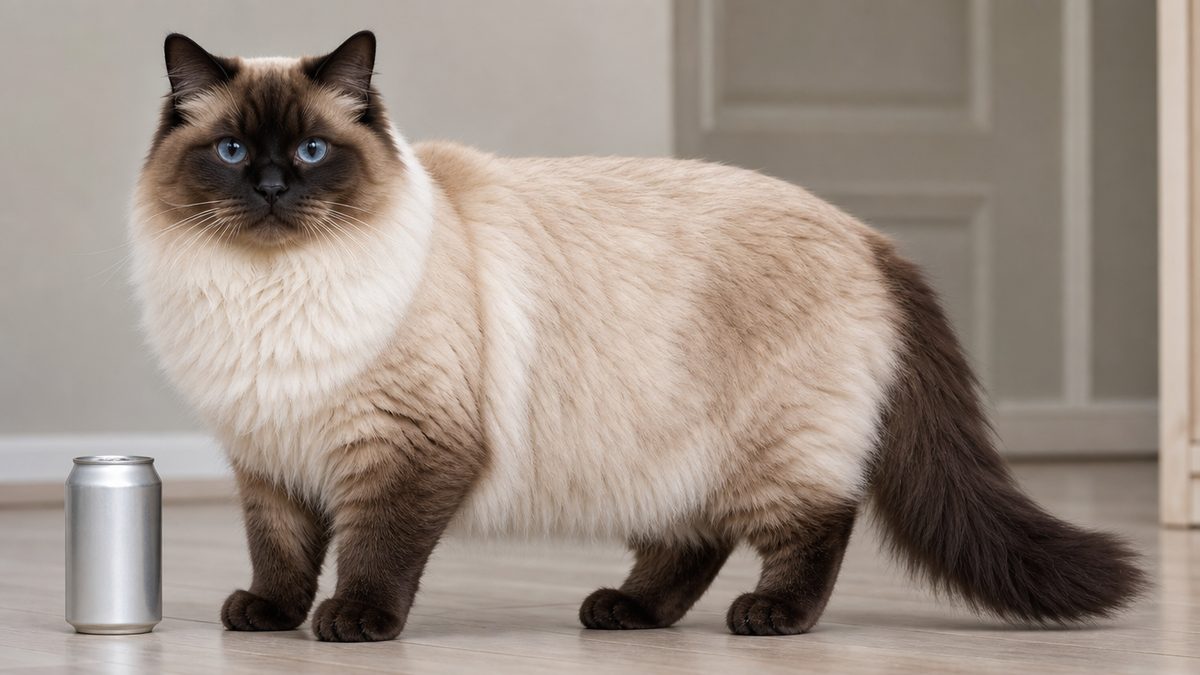
Quick answer
The Neva Masquerade cat price in India works out at roughly Rs 35,000 to Rs 1,30,000, because the only Indian source that prices it adds a Rs 5,000 to Rs 20,000 colourpoint premium to the Siberian's own city bands of Rs 30,000 to Rs 1,10,000. Five of the six registries this site checks call it a colour of the Siberian rather than a breed, and the World Cat Federation says so in one sentence.
This page summarises published veterinary and genetic research on the colourpoint Siberian, including hypertrophic cardiomyopathy screening and what the pointed coat allele does to the eye. It is reference material, not a diagnosis and not a treatment plan. Consult your nearby vet, a registered veterinarian who can examine the animal in front of them, before acting on anything here, and take any breathlessness, sudden hind-limb weakness or collapse in a cat to a clinic immediately.
Neva Masquerade at a glance
What a Neva Masquerade is
A Neva Masquerade is a Siberian cat wearing a Siamese coat allele. Everything about the animal is Siberian except the colour distribution and the eye colour, and the registry that treats it as a breed still describes it inside the Siberian's own standard.
Start with the document rather than the marketing. FIFe publishes one standard covering both codes, headed SIBERIAN / SIBIRER / SIBERIEN - NEVA MASQUERADE, valid from 1 July 2026, and its header line reads SIBERIAN SIB Rec. 1997 alongside NEVA MASQUERADE NEM Rec. 2011. Across 13 pages the head, ears, body, legs, paws, tail and coat structure are one shared text. Three things split: eye colour, colour, and a single line of the scale of points where the eye entry reads shape and placement for SIB and shape, placement and colour for NEM.
That is what a colour variety looks like from the inside of a registry document, and it is the clearest evidence available on the question this page exists to answer.
| What | Figure | Where it comes from |
|---|---|---|
| Body | Medium to large, muscular and heavy, rectangular in outline | WCF standard, actualised 2022-02-24 |
| Coat | Semi-long, very dense undercoat that does not lie flat, water-repellent topcoat | FIFe SIB/NEM standard |
| Eye colour | Blue, the darker the better. Any other colour disqualifies in a pointed cat | WCF standard |
| Permitted point colours | Seal, blue, red, cream, seal and blue tortie, smoke, tabby, silver or golden, with or without white | FIFe SIB/NEM standard |
| Forbidden colours | Chocolate, lilac, cinnamon and fawn in any combination | FIFe and WCF standards, and the GCCF |
| FIFe recognition | Code NEM, recognised 2011, fourteen years after SIB | FIFe SIB/NEM standard header |
| FIFe registrations, 2024 | 2,977, rank 9 of 54 | FIFe Breeding Statistics 2024 |
| Maturity | Full development can take four to five years | GCCF Standard of Points, June 2026 |
The coat is the reason this cat is hard in India
The Siberian coat is a genuine double layer built for a subarctic winter. The GCCF describes a very dense undercoat that is soft, fine and somewhat springy, covered by a coarser and more substantial topcoat, with the hair firm to the touch and waterproof, and adds that one should feel the definite resilience of the dense undercoat when a hand is placed on the coat. FIFe's own wording is that the undercoat does not lie flat and the overcoat is water repellent and slightly hard to touch, with a summer coat distinctly shorter than the winter coat.
A semi-longhaired cat with that much insulation is the opposite of a tropical animal, and the climate section below puts numbers on how far the opposite it is.
The name is a river, not a breeder
Neva Masquerade takes its name from the river Neva in Saint Petersburg, and the second word describes the mask. There is no Neva Masquerade separate from the Siberian in the way that, say, the Thai is separate from the Siamese: nobody set out to build a new breed, they simply bred pointed Siberians and gave the colour a name.
The World Cat Federation's own Siberian standard, actualised 24 February 2022, contains this sentence verbatim: The Neva Masquerade is a colourpoint variety of the Siberian cat and not a separate breed. The document's own title is Siberian Cat - Neva Masquerade (SIB), one code for both.
Registry recognition: one body of six says breed
Exactly one of the six registries this site checks gives the Neva Masquerade a code of its own, and five file it as a colour of the Siberian. State registry recognition per body rather than as one global claim, because on this cat the bodies genuinely disagree and the pedigree in your hand will carry one answer.
Two positive instruments carry most of the weight. FIFe's breeds index, parsed on the three-letter EMS code, returns 52 code rows of which two are house-cat categories, and SIB and NEM both appear in it as separate Category 2 rows. The WCF's cross-registry EMS table, retrieved complete rather than from the ten rows the page renders, has one row for both: row 33 reads Siberian Cat / Neva Masquerade, code SIB, recognised by ALL. Two registries, two filings, both visible in a list. Three more indexes agree with the WCF rather than with FIFe. TICA's Browse All Breeds A to Z carries Siberian once and no Neva entry of any kind; the CFA's 2026 breed council ballot lists one Siberian council among its 12 longhair councils and no Neva council; and the French studbook's permitted-matings document lists SIBERIEN x SIBERIEN and contains no Neva entry at all, which matches its single Siberien breed record.
| Registry | Breed or colour | The document that settles it |
|---|---|---|
| FIFe | BREED. Own EMS code NEM, recognised 2011 | But described inside the Siberian's own standard, where only colour, eye colour and one scale-of-points line differ |
| WCF | COLOUR. Explicitly not a separate breed | The Siberian Cat - Neva Masquerade (SIB) standard, actualised 2022-02-24, says so in one sentence |
| GCCF | COLOUR. Registered as a Siberian with Colourpointed colour distribution | Standard of Points June 2026, Section 2 Group C, printed page 100 |
| CFA | COLOUR. Shown in traditional and colorpointed colors | The breed page, plus a COLORPOINT COLORS block in the standard itself |
| TICA | COLOUR. No Neva entry exists | The Browse All Breeds A to Z, and the Siberian page where Neva appears zero times |
| LOOF | COLOUR. One Siberien record, code SIB | Liste des Races of 1 January 2026, where Neva returns zero occurrences |
India's leading breed guide has this backwards
The page an Indian buyer is most likely to read gets the registry question wrong in a specific and checkable way. Supertails' Siberian price guide, dated 29 April 2026 and reviewed by a named veterinarian, tells readers that TICA and CFA list the Neva Masquerade as a colour of the Siberian while FIFe and WCF list it as a separate breed. Half of that is right. The WCF half is not: the WCF's own standard says the Neva Masquerade is a colourpoint variety of the Siberian cat and not a separate breed.
The same guide also omits the two registries whose documents are the most explicit. The GCCF's Siberian standard says the Colourpointed Siberian is registered by the GCCF as a Siberian with Colourpointed colour distribution, and the French studbook's Liste des Races of 1 January 2026 has one Siberien row and no Neva anywhere in the document.
The article uses its registry sentence to justify a Rs 5,000 to Rs 20,000 premium on the pointed coat. If a reader believes two international registries consider the cat a separate breed, that premium reads as a breed premium. Once you know that five bodies of six call it a colour, the same premium reads as what it is, a price for a coat pattern that is in demand on social media. Both readings can support paying it. Only one of them is accurate.
How rare is it, honestly
The Neva Masquerade is far from rare where it is bred. FIFe's 2024 registration count puts NEM at rank 9 of 54 with 2,977 kittens, which is more than the Persian, more than the Sphynx and more than the Oriental Shorthair in the same table. Set against SIB's 4,420, the pointed form is 40.2 percent of the 7,397 kittens FIFe registered across the two codes.
Within FIFe's Category 2 the pair together are 20.8 percent of 35,572 registrations, against the Maine Coon at 66.8 percent. So this is a mainstream European cat rather than an obscure one, and its scarcity in India is a supply problem rather than a rarity problem.
There is no Indian feline register to appeal to
No Indian cat registry publishes a breed list, so no Indian body's position on the Neva Masquerade can be quoted in either direction. That is an instrument limit rather than a finding. One consequence is worth flagging: the leading Indian guide's price tiers name FCI registration, and on a cat page that abbreviation is ambiguous, because the Federation Cynologique Internationale registers no cats at all while the Feline Club of India publishes no breed list. Ask a seller which register, spelled out in full, and check the pedigree against that register's own documents.
History: where the mask came from
The colourpoint Siberian appeared inside the Russian Siberian programme, reached the West in the 1990s, and was given a code by one registry in 2011 and by nobody else since.
The parent breed's Western history is well dated. The first breeding Siberians reached the United States in 1990. TICA accepted them into its New Breed programme in 1992 and granted championship status in 1996. The CFA accepted the breed for registration in 2000 and granted Championship in 2007. FIFe recognised SIB in 1997.
The colourpoint form arrived separately and later. TICA's own history records that the first colorpoints reached the United States in 1997, a seal lynx point male and a seal tortie point female, with the first colour point litter born in 1998. FIFe recognised NEM as a code in 2011, fourteen years after it recognised the parent breed.
| Year | What happened | Source |
|---|---|---|
| 1990 | First breeding Siberians imported into the United States | CFA breed page |
| 1992 | TICA accepts the Siberian into its New Breed programme | TICA breed page |
| 1996 | TICA grants the Siberian championship status | TICA breed page |
| 1997 | FIFe recognises SIB; first colourpoint Siberians reach the United States | FIFe standard header and TICA breed page |
| 1998 | First colour point litter born in the United States | TICA breed page |
| 2000 | CFA accepts the Siberian for registration | CFA breed page |
| 2007 | CFA grants Championship status | CFA breed page |
| 2011 | FIFe recognises NEM as a separate EMS code | FIFe SIB/NEM standard header |
| 2022 | WCF's standard states the Neva Masquerade is not a separate breed | WCF standard, actualised 2022-02-24 |
| 2025 | GCCF standard restates the colourpoint filing | GCCF Standard of Points, Updated Council February 2025 |
The allele is older than the breed and came from somewhere else
The mask is not a Russian invention. FIFe's own colour clause for NEM does not describe the pattern at all; it refers the reader to the description of the EMS code 33, Siamese Pointed. That code is the pointed pattern of the Siamese, and the WCF's own code table confirms the reading, giving 33 as himalayan, Siamese pointed.
Genetically the allele is a single mapped mutation. The pointed phenotype comes from a tyrosinase change in exon 2, a G to A transition swapping glycine for arginine at codon 302, and every cat with the pointed phenotype in the mapping study was homozygous for it. Full albinism sits at the same locus, which makes the pointed allele one rung of an allelic series rather than a standalone colour gene.
So a Neva Masquerade is a Russian cat carrying a Southeast Asian coat allele, and that is a more interesting sentence than anything the marketing says.
Neva Masquerade cat price in India, and how it is actually built
A Neva Masquerade in India costs roughly Rs 35,000 to Rs 1,30,000, and that figure is arithmetic rather than a quoted price. It is the Siberian's Indian price plus a published colourpoint premium, and this page shows the working.
Only one Indian source prices the variety at all. Supertails' dedicated Siberian guide, dated 29 April 2026, prices the parent breed three ways and then adds a line for the pointed coat: typically Rs 5,000 to Rs 20,000 premium. Nothing else Indian carries a Neva figure. The marketplace that prices eight breeds for Indian buyers lists the Siberian among its ten named breeds without pricing it, and the words Neva and Masquerade appear nowhere on the page. So the pointed coat is expensive in India in a way that rests on a single published sentence, which is worth knowing before paying for it.
| Tier | Price range | What the guide says you get |
|---|---|---|
| Basic or unregistered | Rs 30,000 to Rs 50,000 | No documentation, parentage unverified, health testing absent |
| Registered, pet quality | Rs 50,000 to Rs 80,000 | Verified pedigree and registered ancestry |
| Show quality or champion bloodline | Rs 80,000 to Rs 1,20,000 plus | From titled parents, closest to the breed standard |
| City | Siberian band | Plus colourpoint premium | Working range for a Neva |
|---|---|---|---|
| Delhi and NCR | Rs 55,000 to Rs 1,10,000 | Rs 5,000 to Rs 20,000 | Rs 60,000 to Rs 1,30,000 |
| Mumbai | Rs 50,000 to Rs 1,00,000 | Rs 5,000 to Rs 20,000 | Rs 55,000 to Rs 1,20,000 |
| Bengaluru | Rs 45,000 to Rs 90,000 | Rs 5,000 to Rs 20,000 | Rs 50,000 to Rs 1,10,000 |
| Hyderabad and Pune | Rs 40,000 to Rs 85,000 | Rs 5,000 to Rs 20,000 | Rs 45,000 to Rs 1,05,000 |
| Chennai and Kolkata | Rs 35,000 to Rs 75,000 | Rs 5,000 to Rs 20,000 | Rs 40,000 to Rs 95,000 |
| Tier-2 cities | Rs 30,000 to Rs 60,000 | Rs 5,000 to Rs 20,000 | Rs 35,000 to Rs 80,000 |
The right-hand column is this page's addition and it is labelled as one. The city bands and the premium are both published; joining them is arithmetic, and it is shown rather than hidden because a reader should be able to redo it.
The same publisher gives two different Siberian bands
Supertails' general cat-price guide, dated 25 March 2026, prices the Siberian at Rs 40,000 to Rs 1,00,000. Its own dedicated Siberian guide, five weeks later, runs from Rs 30,000 at the unregistered floor to Rs 1,20,000 plus at the show ceiling. Same publisher, same year, a Rs 10,000 gap at the floor and Rs 20,000 at the ceiling. Neither figure is wrong; they are measuring different things, and a reader who quotes one at a breeder should know the other exists.
What the pages ranking above the Indian guide actually say
The two results ranking above it for the Indian commercial query are American. One is a US cattery blog stating that Siberian Neva Masquerade kitten prices typically range from 3,500 to 5,500 US dollars or more, on a page where a word-boundary search returns India zero times, Rs zero times and the rupee glyph zero times. The other is a worldwide-shipping boutique with the same zeros.
Convert those figures only to see how far apart the two markets are. At 84.38 rupees to the dollar, 3,500 dollars is about Rs 2,95,000 and 5,500 is about Rs 4,64,000, which is two to eight times the Indian working range above. An Indian reader who anchors on the American number will pay far too much, and an Indian seller who quotes it is quoting a different country's market.
Divide it by 84.38 and by 74 and look at the quotient. A figure that resolves to a round dollar number is a converted American price rather than an Indian observation, and this site has caught that repeatedly. Then ask what the price is for: an unregistered cat with no health testing at Rs 30,000 and a show-line cat with echocardiogrammed parents at Rs 1,20,000 are not the same purchase, and the guide's own tier table says so.
And check that the cat is actually a documented colourpoint
The Indian guide's own warning is the most useful sentence in it. It states that most Siberians being sold in India as Neva Masquerade are not from documented Neva bloodlines, that the colourpoint look is in demand, and that some breeders use the name loosely. Since the pointed allele is recessive and turns up in ordinary cat populations, a pointed semi-longhair kitten proves nothing on its own. Ask for papers in which the colourpoint ancestry is traceable, and verify the register named on them.
The monthly cost of ownership in India, including the air conditioner
Budget Rs 6,200 to Rs 15,200 a month for a Siberian or Neva Masquerade in an Indian metro, and understand that the single biggest line in that range is electricity rather than food.
The Indian guide breaks it down, and its air-conditioning line is the one that separates this breed's cost of ownership from every short-coated cat on this site.
| Category | Monthly estimate | Note |
|---|---|---|
| Premium cat food, dry plus wet | Rs 1,800 to Rs 3,500 | High-protein diet for a large, muscular breed |
| Cat litter | Rs 600 to Rs 1,200 | Quality clumping litter |
| Grooming supplies at home | Rs 300 to Rs 600 | Brushes, combs, detangling spray |
| Professional grooming, amortised | Rs 500 to Rs 1,500 | A full groom every six to eight weeks, more during the coat blow |
| Air conditioning in summer | Rs 2,000 to Rs 6,000 | Described as unavoidable in most Indian cities from April to June |
| Flea and tick prevention | Rs 300 to Rs 700 | Year-round in most Indian climates |
| Routine vet and supplements | Rs 500 to Rs 1,200 | Monthly average including periodic check-ups |
| Toys and enrichment | Rs 200 to Rs 500 | Consistent mental stimulation |
| Total | Rs 6,200 to Rs 15,200 | Higher in peak summer, lower in cooler months |
Read the air-conditioning row against the food row. At the top of both ranges, cooling costs more than feeding, and that is a fact about this breed in this country rather than a general truth about cats. A short-coated cat in the same flat carries none of it.
One-time and first-year costs
| Item | Cost | Source |
|---|---|---|
| Vaccination course, FVRCP plus rabies | Rs 2,500 to Rs 5,000 | Indian Siberian guide |
| Kitten course at one national clinic chain | From Rs 3,999 for three visits | Vetic national page, against a struck-through Rs 5,065 |
| Adult annual booster | From Rs 1,899 | Same chain |
| Spay or neuter | Rs 4,000 to Rs 8,000 | Indian Siberian guide |
| Cat tree large enough for the breed | Rs 3,000 to Rs 8,000 | Indian Siberian guide |
| Grooming starter kit | Rs 1,500 to Rs 3,500 | Indian Siberian guide |
| Coat blow de-shedding session | Rs 2,000 to Rs 5,000 | Indian Siberian guide |
| First-year total beyond purchase | Rs 15,500 to Rs 37,000 | Indian Siberian guide |
| Chennai pet licence | Rs 50 | Greater Chennai Corporation, 9,115 issued in 2024 |
The municipal route changes the arithmetic more than any brand choice. Chennai licenses pet animals for Rs 50 and its own clinics provide all treatment and anti-rabies vaccination free of cost, while a private national chain starts a kitten course at Rs 3,999. Same vaccine, two delivery models, and the gap is the whole cost.
The other thing to budget for is the grooming you cannot skip. Two to three brushing sessions a week is the routine, and a de-shedding session during a coat blow is quoted at Rs 2,000 to Rs 5,000 in India. A household that will not do the home brushing pays for the salon instead.
Heat tolerance: 23.5 degrees between the homeland and Chennai
The Neva Masquerade has the lowest heat tolerance of any cat on this site, because its homeland runs an annual mean of 4.41 degrees C and Chennai runs 27.95.
Saint Petersburg, the city the river Neva runs through, returns an annual mean of 4.41 degrees C at 88.87 percent relative humidity from the NASA POWER climatology, queried by explicit latitude and longitude with the cell elevation echoed back. That cell reads 36.38 m against a real elevation near 3 m, an error of about 33 m on flat coastal ground, which is within the range where the cell is still the place.
| Place | Annual mean T2M | Annual mean RH2M | Coolest month | Hottest month |
|---|---|---|---|---|
| Saint Petersburg | 4.41 C | 88.87 % | January, -9.12 C | July, 18.31 C |
| Novosibirsk | 0.90 C | 81.24 % | January, -20.04 C | July, 19.46 C |
| Bengaluru | 23.74 C | 67.94 % | December, 20.22 C | April, 28.37 C |
| Pune | 23.86 C | 66.80 % | December, 19.62 C | April, 28.93 C |
| Delhi | 25.60 C | 45.56 % | January, 13.61 C | June, 35.88 C |
| Mumbai | 26.77 C | 67.39 % | January, 23.19 C | May, 31.19 C |
| Chennai | 27.95 C | 72.39 % | January, 24.09 C | May, 31.51 C |
Saint Petersburg's hottest month, July at 18.31 degrees, is 1.9 degrees cooler than Bengaluru's coolest month. There is no Indian city where this cat's homeland climate exists, and the hill stations that come closest are not places POWER measures reliably, so this page does not offer one.
Humidity is not the problem. Heat is
The homeland is more humid than every Indian city in the table, at 88.87 percent against Chennai's 72.39. So damp air is not new to this breed's ancestry and the coat is explicitly water-repellent. What loads the cat is heat, and heat combined with humidity, which is why the wet-bulb figures matter: Chennai peaks at 26.11 degrees C Stull wet bulb in May and Kolkata at 27.09 in June, against a Saint Petersburg peak of 15.98 in July.
| City | Annual mean | Verdict |
|---|---|---|
| Bengaluru | 23.74 C | The easiest Indian city for the breed, and still 19 degrees above the homeland |
| Pune | 23.86 C | Close second, with an April peak rather than a May one |
| Delhi | 25.60 C | Workable in winter, hardest in June at 35.88 C, and the driest air in the table |
| Hyderabad | 26.10 C | Manageable with cooling; a May peak of 33.30 C |
| Mumbai | 26.77 C | Humid year-round with a narrow annual range, so there is no cool season to recover in |
| Chennai | 27.95 C | The hardest of the six; the coolest month is warmer than the homeland's hottest |
India's leading Indian guide for this breed states that air conditioning during summer months is essential and not optional, and prices it at Rs 2,000 to Rs 6,000 a month from April to June. Indian law reaches the same point from a different direction: the Pet Shop Rules 2018 require a species-suitable environment and set housing conditions for cats. If your household cannot guarantee cooling through an Indian summer, choose a short-coated cat. Consult your nearby vet immediately if a cat pants, drools or becomes unresponsive on a hot day.
One more thing follows from the coat rather than the thermometer. The standards describe a summer coat distinctly shorter than the winter coat and a seasonal moult The Governing Council of the Cat Fancy. In an air-conditioned Indian flat the cat never gets the temperature cue that drives a clean seasonal shed, so the moult smears across the year and the brushing routine has to be constant rather than seasonal.
Temperament and household fit
A Neva Masquerade has a Siberian's temperament, because it is a Siberian: sociable, curious, easygoing, owner-following and only moderately vocal.
The CFA's description is the most concrete available. It calls the breed extremely intelligent, keenly interested in its surroundings and fond of investigating cabinets, cupboards and suitcases, while adding that this does not make it overactive or intrusive, and that these are sociable, curious, easygoing cats who want to be near their owners and to know what is going on at all times. It also notes that they quickly learn the meaning of the word no.
That combination is unusually forgiving for a large cat, and it is why this breed suits Indian family households better than most imports.
- Choose this cat if you want a large, affectionate, dog-like companion that follows you around.
- Choose this cat if you have children old enough to be gentle, because the breed is patient and tolerant.
- Choose another cat if your flat has no reliable cooling through April to June.
- Choose another cat if nobody in the household will brush twice a week.
- Choose another cat if you travel constantly and cannot arrange company or a sitter.
The colour changes nothing about the character
There is no evidence that a pointed Siberian behaves differently from a tabby one, and no registry standard claims otherwise. The FIFe document that covers both codes has one temperament-free type standard and splits only on colour and eye colour. Any seller who prices a Neva higher on temperament grounds is selling a story rather than a difference.
Two households should think twice. The first is the household buying for allergy reasons, covered in its own section below, because the evidence does not support the purchase. The second is the household in a hot city without air conditioning, because a heavily coated cat in a closed Indian flat in May is a welfare question rather than a preference.
Training a Neva Masquerade, and what it resists
To train a Neva Masquerade, start with the grooming table rather than with tricks, because the one habit this cat has to accept is being handled for twenty minutes twice a week.
The breed is easy to work with. The CFA notes that Siberians quickly learn the meaning of the word no, although it adds that they may translate it loosely, and describes them as problem-solvers who will work out how to open a door to reach their owners. That intelligence is the training asset and the containment risk in one animal.
- Introduce the brush in week one, in short sessions, before there is any mat to fight over.
- Pair every grooming session with food so the cat learns the table means something good.
- Net the balcony, because a cat that opens doors will find it.
- Teach carrier entry early, since an annual cardiac check means regular clinic visits.
- Practise nail trims monthly from kittenhood, so the paws are already familiar.
The resistance shows up in two places. A Siberian that has not been handled young will fight the de-matting comb, and a mat behind the ears or in the breeches is exactly where an Indian humid summer produces one. And a cat left alone all day will find its own occupation, which usually means the kitchen counter.
Litter training is generally trivial, but the Indian guide flags one breed habit worth knowing: Siberians prefer clean boxes and will avoid a dirty one, so the litter budget line is not optional.
Daily exercise for a large climbing cat
Give a Neva Masquerade two play sessions a day and a tall vertical route, because this is a moderate-to-high energy cat that climbs and jumps rather than pacing.
The Indian guide rates the activity level moderate-to-high, notes that the breed loves climbing, jumping and interactive play, and says apartment life works with enrichment provided there is vertical space in the form of cat trees and shelves. The cat tree it prices at Rs 3,000 to Rs 8,000 is sized for the breed rather than generic.
- Wand play twice a day, ten to fifteen minutes, ending with a catch.
- One tall climbing route that a five to eight kilogram cat can actually hold.
- Puzzle feeders for the working day.
- Play scheduled for the cool hours in summer, early morning and after dark.
- A second cat if the household is out for long stretches.
Time the play around the heat rather than around your own schedule. A double-coated cat pushed into hard play at three in the afternoon in a Chennai May is being asked to shed heat it cannot shed, and the cooler hours cost nothing to choose.
Grooming a triple-layered coat in Indian humidity
Brush a Neva Masquerade two to three times a week all year, and more during the coat blow, because the undercoat is dense enough that a skipped fortnight becomes a mat.
The coat is the breed's defining feature and the standards treat it as such. Indian pages usually call it a triple coat, meaning down, awn and guard hair, and while no registry standard uses that phrase the structure it describes is real. The GCCF gives coat 25 of its 100 points and describes a very dense undercoat that is soft, fine and somewhat springy under a coarser, more substantial topcoat, with the hair firm to the touch and waterproof. FIFe adds that the undercoat does not lie flat and that the winter coat carries a well-developed shirtfront, full frill and knickerbockers.
| Task | Frequency | Indian cost |
|---|---|---|
| Home brushing | Two to three times a week, year-round | Rs 300 to Rs 600 a month in supplies |
| De-matting check behind ears and in breeches | Weekly | Free, and the check that prevents the salon bill |
| Professional full groom | Every six to eight weeks | Rs 1,500 to Rs 3,500 per visit |
| Coat blow de-shedding session | As needed during a moult | Rs 2,000 to Rs 5,000 |
| Nail trim | Monthly | Included in a full groom |
| Ears dried after any bath | Every bath | Free, and an Indian-monsoon necessity |
The Indian adjustment that overseas guidance misses
Overseas breed guidance routinely says to towel a cat and let it air dry. That is written for a temperate climate. In an Indian monsoon a thick undercoat that is still damp at the skin is a different proposition, and a damp ear canal is worse. Dry the coat down to the skin and dry the ears, rather than copying advice written for a Northern European autumn.
The second adjustment is about the moult. In a temperate climate the seasonal shed is a discrete event. In an air-conditioned Indian flat the cat never gets a clean seasonal cue, so the shed spreads out and the brushing has to be a habit rather than a spring project. That is a consequence of the climate rather than of the breed, and it is the single most common reason Indian owners of coated cats end up at a salon.
Coat colour will change, and that is normal
A Neva Masquerade kitten is born pale and develops its full point colouration over months to years. Adult cats darken further, and the standards allow it: the GCCF says allowances should be made for colourpointed Siberians with tummy spots and shading, and notes that the blue of the eye is generally less intense in this breed than in other colourpointed breeds. A darkening Indian cat in a warm flat is doing what a temperature-sensitive allele does.
Health: one screen that matters, and one allele nobody mentions
Ask a Neva Masquerade breeder for the parents' echocardiogram, because hypertrophic cardiomyopathy is the named concern in this breed and it is screened by ultrasound rather than by a swab.
Hypertrophic cardiomyopathy is the condition the Indian guide names as the primary hereditary concern in Siberian cats, and its reviewing veterinarian's stated specialism includes veterinary cardiology, which is why the guide leans on early detection and cardiac monitoring. Its own price tiers note that breeders who echocardiogram their parents charge more.
That is the right screen to ask about and the wrong one to accept a certificate for without a date. An echocardiogram describes a heart on the day it was scanned. A clear scan at two years old is not a clear scan at six, and a cat's first breeding season is not the end of the risk window.
| Question | Answer | Evidence |
|---|---|---|
| Is there a breed-specific DNA test? | No cardiac DNA test is validated for this breed; the screen is an echocardiogram | Indian Siberian guide, reviewed by a veterinary cardiologist |
| Is there a published median lifespan? | No. Neither SIB nor NEM reached the 15-death threshold | Teng 2024, Table 6, 12 rows |
| Does the colourpoint form differ in health? | No registry standard says so, and the FIFe document splits only on colour | FIFe SIB/NEM standard |
| Is polycystic kidney disease established in the variety? | Claimed as possible in some lines by the Indian guide; no peer-reviewed breed prevalence found | Indian Siberian guide, reported as a claim |
| Is it hypoallergenic? | No cat breed is | Hilger 2024 |
| Does the pointed allele have health consequences? | Yes, for the eye and visual pathway, and it applies to every pointed breed | Mason and Guillery 2019 |
The allele that makes the mask also wires the eye
This is the part no Neva Masquerade page carries, and it belongs here because the variety is defined by the allele. In albinism of all species, perturbed melanin biosynthesis in the eye leads to foveal hypoplasia, retinal ganglion cell misrouting and, consequently, altered binocular vision, and that review describes the aberrant eye-to-brain circuitry in the Siamese cat specifically as a consequence of the temperature-sensitive tyrosinase mutation. The Neva Masquerade carries that same mutation, because FIFe defines its colour by reference to the Siamese pointed code and the pointed phenotype maps to TYR G302R with every pointed cat homozygous for it.
This is a statement about visual pathway wiring in every pointed cat, not a disease diagnosis and not a reason to avoid the variety. Pointed cats function normally as pets. What it does is locate the cross-eyed look and the occasional wandering gaze in the coat allele rather than in any breed's particular breeding, and it applies equally to the Siamese, the Ragdoll, the Birman and the Himalayan. Consult your nearby vet about any individual cat's vision rather than acting on a genotype.
Lifespan, and the comparator to use
No published life table gives a figure for either code. The largest UK study of feline lifespan states in its Methods that breeds with fewer than 15 deaths were grouped into other, and its Table 6 carries exactly 12 breed rows. Neither the Siberian nor the Neva Masquerade is among the 12 breeds that reached that threshold, which is a statement about how many die under UK primary veterinary care rather than about how long they live.
| Breed | Life expectancy (95% CI) | Deaths |
|---|---|---|
| Burmese | 14.42 (12.91-15.93) | 45 |
| Birman | 14.39 (12.87-15.91) | 38 |
| Crossbred | 11.89 (11.75-12.03) | 7,117 |
| Siamese | 11.69 (10.56-12.82) | 88 |
| Persian | 10.93 (9.63-12.23) | 80 |
| Ragdoll | 10.31 (8.86-11.76) | 69 |
| Norwegian Forest Cat | 9.95 (7.55-12.35) | 15 |
| Maine Coon | 9.71 (8.42-11.00) | 69 |
The Indian guide gives a 12 to 18 year lifespan for the breed. That is a breeder-derived range rather than a measured median, and the honest way to present it is beside the crossbred figure of 11.89 years so a reader can see the difference between a claim and a measurement.
Two general points close the section. Screen any imported cat for FeLV and FIV on arrival, deworm it, and get a full clinical examination, because in India those risks are far more likely to matter than any breed-specific gene. And keep an annual cardiac check in the calendar rather than treating the breeder's scan as permanent.
The hypoallergenic claim, and the six cats it rests on
No cat breed is hypoallergenic and the Neva Masquerade is not an exception, but the honest position is that no breed-level claim is supported rather than that Siberians have been shown to be ordinary.
This matters here because the pointed coat and the allergy claim are the two things a Siberian is sold on in India, and the Indian guide leads its buyer-fit table with the row Allergic to cats and the assessment best natural option available. That is a strong recommendation resting on a thin evidence base, so here is the base.
The 1999 fur test, and what the laboratory said about it
The famous figures come from four fur samples tested in December 1999. They read mixed breed 62,813 micrograms per gram, Siberian male 2001, Abyssinian 385 and Siberian female 206. The laboratory that ran them published its own comments, and they are the part almost nobody quotes: it did not carry out the research, was not responsible for collecting the samples or validating the results, would not provide pet-ownership recommendations on that basis, and the samples were disposed of and cannot be re-tested.
Its verdict on the numbers is unambiguous. The results do not provide convincing scientific data that Siberian cats are hypoallergenic, and the levels found in the Siberian samples, 200 to 2000 micrograms per gram, are high and indicate that these cats produce significant amounts of allergen. The laboratory adds that part of the confusion comes from the mixed-breed sample being exceptionally high for reasons that were unclear and were not investigated.
The one peer-reviewed Siberian paper, and its sample size
One paper has looked at Fel d 1 in Siberians specifically. It took blood from 39 cats of which 4 were Siberian, and saliva Fel d 1 was measured on only 3 of them by an outside laboratory, at 2.19, 1.66 and 0.48 micrograms per millilitre, with no measured control group. The authors describe the breed in their own words as supposed to be low level allergenic, according to some breeders' statements, and conclude that further analyses are recommended.
So the entire breed-level evidence base is four fur samples the testing laboratory disowned and four sequenced cats of which three had saliva measured. That is six cats in total, and it is why a review of the field states that to date there is no scientific evidence for a hypoallergenic cat breed, and that even hairless Sphynx cats produce Fel d 1.
The honest position is that no breed-level claim is supported, not that Siberians have been shown to produce ordinary amounts of allergen. Nobody has run the study that would settle it. What the same review does establish is that there is individual variation in Fel d 1 production and that unneutered males produce more on average than females, which means the variable an allergic buyer can actually act on is the individual cat and its sex, not the pedigree.
What an allergic Indian buyer should actually do
Do three things before money changes hands. Get tested, so you know whether you react to Fel d 1 or to something else in the house. Spend real time with the specific adult cat, not with the breed, because individual variation is the part the evidence supports. And if a seller charges a premium for a hypoallergenic cat, ask for the measurement, the laboratory and the date, because in India that premium is being charged on top of a colourpoint premium that is itself justified by a registry claim this page has already corrected. The full analysis lives on the Siberian page.
Feeding a large semi-longhair in India
Feed a Neva Masquerade a high-protein complete food twice a day as an adult, budget Rs 1,800 to Rs 3,500 a month for it, and keep water available in more than one place.
The Indian guide's food line is Rs 1,800 to Rs 3,500 a month for premium dry plus wet, and it explains the figure as a high-protein diet for a large, muscular breed rather than as a generic cat number. A male Siberian at five to eight kilograms genuinely eats more than a 4 kg cat.
| Stage | Meals per day | What to watch |
|---|---|---|
| 8 weeks to 4 months | Four small meals | Steady weekly gain; this breed matures slowly and should not be rushed |
| 4 to 8 months | Three meals | Coat and frame develop before the weight does |
| 8 to 18 months | Two to three meals | Full development takes four to five years, so do not feed for adult size at one year |
| Adult | Two meals | Body condition rather than the bowl; a heavy coat hides weight gain |
| Senior, from about 8 years | Two meals, reviewed annually | Annual cardiac check plus kidney and thyroid screening |
The slow maturity is the part Indian owners underestimate. The GCCF states that the Siberian matures slowly and that full development can take four to five years. A cat that looks under-built at eighteen months is usually on schedule.
Water, heat and a heavy coat
A double-coated cat in an Indian summer needs to drink, and cats fed mainly dry food drink less than they need. Wet food is the simplest fix, a second bowl in another room is the cheapest, and a fountain works for cats that dislike still water. Do all three from April to June rather than choosing between them, and keep the bowls away from the food.
Kitten timeline: month by month, and a coat that arrives late
A Neva Masquerade kitten arrives at eight weeks at the earliest, finishes its vaccination course by about sixteen weeks, and will not look like its adult photograph for years.
Eight weeks is the legal floor in India rather than a preference. The Pet Shop Rules 2018 define kittens and pups below eight weeks as un-weaned and bar the sale of un-weaned or underage animals. A seller offering a six-week kitten is offering to break that rule in front of you.
| Age | What happens | What the cat looks like |
|---|---|---|
| 6 to 8 weeks | First FVRCP vaccine, usually given by the breeder | Almost white; the mask is barely there |
| 8 weeks | Earliest lawful sale in India | Points beginning to show on ears and tail |
| 10 to 12 weeks | FVRCP booster plus first FeLV vaccine | Mask filling in; coat still kitten-soft |
| 14 to 16 weeks | FVRCP booster plus rabies | Undercoat starting to thicken |
| 6 months | Spay or neuter, on your vet's timing | Frame lengthening faster than it fills |
| 12 months | Annual FVRCP and rabies booster plus a cardiac check | Points noticeably darker; ruff beginning |
| 4 to 5 years | Nothing to do; the cat finishes arriving | Full development, per the GCCF standard |
Two expectations to set. The coat colour arrives late, because a Neva Masquerade is born pale and develops full point colouration over months to years, and the body arrives later still, because the standard itself allows four to five years for full development.
Deworming runs every three months through the first year and twice a year for adults on the Indian schedule, alongside year-round flea and tick prevention, which the same guide budgets at Rs 300 to Rs 700 a month. Vaccinate on the schedule above rather than on the seller's word, and keep the record card, because a cat imported or resold later will need it.
Neva Masquerade against the cats it is cross-shopped with
Four cats compete for the same Indian buyer, and three of them are pointed. The differences that matter are coat weight, published lifespan and whether the cat can be sourced locally at all.
| Cat | Coat | Published median lifespan | Indian price |
|---|---|---|---|
| Neva Masquerade | Semi-long, very dense double coat | None; below the study threshold | About Rs 35,000 to Rs 1,30,000, derived |
| Siberian, non-pointed | The same coat | None; below the study threshold | Rs 30,000 to Rs 1,20,000 plus |
| Ragdoll | Semi-long, little undercoat | 10.31 years (8.86-11.76), 69 deaths | Rs 25,000 to Rs 70,000 |
| Maine Coon | Semi-long, heavy | 9.71 years (8.42-11.00), 69 deaths | Rs 35,000 to Rs 1,80,000 |
| Siamese | Very short, single | 11.69 years (10.56-12.82), 88 deaths | Rs 15,000 to Rs 75,000 across two sources |
The Ragdoll is the comparison that matters most in India, because it is pointed, semi-longhaired, blue-eyed, cheaper and widely available. The differences are real: the Ragdoll's coat has far less undercoat, which is a serious advantage in an Indian summer, and it has a published median lifespan while this cat does not.
The Maine Coon is the other large semi-longhair, it outnumbers both Siberian codes five to one at FIFe, and its published median of 9.71 years is the lowest of the four Teng KT, Brodbelt DC, Church DB. Anyone buying on size should look at that row before the price row.
The comparison inside the breed
Against a non-pointed Siberian, the Neva Masquerade differs in exactly two respects that any registry document will confirm: colour distribution and eye colour. In India it costs Rs 5,000 to Rs 20,000 more for those two things. Whether that is worth paying is a matter of taste, and this page has no view on taste. It has a view on being told the premium buys a different breed.
What Indian buyers and Indian pages get wrong
Five errors recur, and the biggest of them is printed on the page most Indian buyers read.
- Believing two international registries call this a separate breed. The World Cat Federation's own standard says the opposite in one sentence, and only FIFe codes it separately.
- Buying it for allergy reasons. The whole breed-level evidence base is six cats, and the laboratory behind the famous figures disowned them in writing.
- Treating a pointed semi-longhair kitten as proof of Neva ancestry. The pointed allele is recessive and common, so appearance settles nothing without papers.
- Anchoring on an American price. The pages ranking above the Indian guide quote 3,500 to 5,500 US dollars and mention India zero times, and the encyclopaedia entry that sits second on the informational query carries no Indian price either.
- Underestimating the electricity. The Indian guide puts summer air conditioning at Rs 2,000 to Rs 6,000 a month and calls it essential rather than optional.
The error worth correcting in public
India's best breed guide for this cat is careful, veterinarian-reviewed and mostly right, and its registry sentence is wrong in a way a reader cannot check without opening two PDFs. It tells buyers that FIFe and the WCF list the Neva Masquerade as a separate breed. FIFe does. The WCF explicitly does not, in a standard actualised on 24 February 2022. The same guide omits the GCCF, which says the Colourpointed Siberian is registered as a Siberian with Colourpointed colour distribution, and the French studbook, which has no Neva row at all.
Count the bodies rather than trusting a summary. Six registries, one code of its own, five colour filings, and the one registry that codes it separately still writes it into the Siberian's standard. If a seller tells you the pointed coat makes it a different breed, the WCF's own sentence is the shortest reply available Federation Internationale Feline.
Adoption, import and the honest recommendation
Adopt or buy in India rather than importing, because this is one of the few breeds on this site with a genuine Indian supply chain and a published Indian price.
The Siberian is one of the 14 breeds India's leading cat-price guide prices, it has its own dedicated Indian guide, and Indian breeders exist in every metro that guide names Supertails, Siberian Cat Price in India…. That is unusual, and it removes the import question for most buyers.
- Verify the register named on the pedigree, spelled out in full, and check it against that body's own documents.
- Verify the parents' echocardiogram reports and their dates, since this is the screen that matters.
- Verify the colourpoint ancestry is traceable in the papers, because the Indian guide warns most local Nevas have none.
- Verify the kitten is at least eight weeks old, which the Pet Shop Rules 2018 make the floor for a sale in India.
- Verify your own summer cooling before you commit, because a double coat and an Indian May are not negotiable.
If you do import
There is no lawful commercial route to import a cat into India for resale, so the only path is a personal pet import. The Directorate General of Foreign Trade treats live cats as restricted under ITC(HS) 01061900, routes applications through a monthly Exim Facilitation Committee, and permits entry only through the airports and seaports of Delhi, Mumbai, Chennai, Hyderabad, Bangalore and Kolkata. DAHD added a seventh port, Cochin International Airport at Kochi, for pets arriving under the baggage rules in October 2024. Read that notice yourself rather than a shipper's summary of it. The full route, which covers cats too, is set out in how to import a dog to India.
What Indian law requires once the cat is here
The Pet Shop Rules 2018 govern the commercial end and are worth knowing as a buyer. Rule 2(1)(p)(ii) treats kittens below eight weeks as un-weaned, rule 7(15) bars the sale of un-weaned or underage animals, and Second Schedule paragraph 2, FOR CATS, requires elevated resting surfaces, matting, soft clean toys, a solid-surfaced enclosure floor large enough for free movement, and that cats or kittens be kept in a room not shared by other, inimical animal species such as dogs. One absence is worth knowing: rule 7(16) makes micro-chipping mandatory for puppies only, so an Indian kitten is under no chipping requirement.
Registration is municipal and cheap where it exists. Chennai licenses pet animals for Rs 50, issued 9,115 licences in 2024, and provides free treatment and anti-rabies vaccination at its own clinics.
For an Indian household in Bengaluru or Pune with reliable cooling and somebody willing to brush twice a week, this is a genuinely good cat and it can be bought locally with papers. For a household in Chennai, Mumbai or Kolkata without air conditioning, choose a short-coated breed instead: the coolest month in Chennai is warmer than the hottest month in this cat's homeland. And if the reason you are buying is allergy, read the evidence section above first, because that reason is not supported.
Neva Masquerade questions people actually ask
How much does a Neva Masquerade kitten cost?
A Neva Masquerade kitten in India costs roughly Rs 35,000 to Rs 1,30,000, because the only Indian source that prices the variety quotes the Siberian's own city bands of Rs 30,000 to Rs 1,10,000 and adds a typical Rs 5,000 to Rs 20,000 colourpoint premium on top. The two pages ranking above it for the same Indian query are American catteries quoting 3,500 to 5,500 US dollars, which is a different market entirely.
What is a Neva Masquerade cat?
A Neva Masquerade is a Siberian cat with a colourpoint coat and blue eyes. It carries the same tyrosinase allele that makes a Siamese pointed, which is why FIFe's own colour clause for the variety simply refers the reader to the description of EMS code 33, Siamese pointed. Everything else about the cat, the head, the body, the bone, the coat structure, is Siberian.
Where are Neva Masquerade kittens bred?
Neva Masquerade kittens are bred wherever Siberians are bred, and Europe is where the numbers are. FIFe registered 2,977 of them in 2024 across its member clubs, ranking the code ninth of 54, against 4,420 plain Siberians at rank four. In India they are bred alongside Siberians rather than separately, and the Indian guide warns that many cats sold locally under the name have no documented colourpoint pedigree.
Are Neva Masquerade kittens healthy?
Neva Masquerade kittens carry the same health profile as any Siberian, and hypertrophic cardiomyopathy is the condition to ask about. The screen is an echocardiogram on the parents rather than a cheek swab, so ask for the report and its date rather than for a certificate. No published life table gives a figure for either code, because neither reached the 15-death threshold in the largest UK study.
Is Neva Masquerade a separate breed?
Five of the six registries this site checks say no. The World Cat Federation states in its own standard that the Neva Masquerade is a colourpoint variety of the Siberian cat and not a separate breed; the GCCF says the Colourpointed Siberian is registered as a Siberian with Colourpointed colour distribution; the CFA shows them as Siberians in colorpointed colours; TICA lists no Neva at all; and the French studbook holds one Siberien record. Only FIFe gives it a code of its own.
Is Neva Masquerade a Russian cat?
Yes, the Neva Masquerade is a Russian cat, and the name is a Russian place name. It comes from the river Neva in Saint Petersburg. The parent breed is Russia's own natural cat, and the colourpoint form was developed there before reaching the United States, where the first colourpoints arrived in 1997 and the first colour point litter was born in 1998.
Who is a reputable Neva Masquerade (Siberian) breeder?
A reputable breeder is one who shows you the parents' echocardiogram reports, a written pedigree naming an actual registry, and the queen with the litter. This page names no breeder and recommends none. In India the specific thing to check is whether the colourpoint ancestry is traceable in the papers, because the leading Indian guide states that most cats sold locally as Neva Masquerades come without documented colourpoint pedigree.
Where did Neva Masquerade cats come from?
Neva Masquerade cats came from Russia, from the Siberian breeding programme around Saint Petersburg. FIFe recognised the Siberian in 1997 and the Neva Masquerade code in 2011, fourteen years apart, and the two are still described in a single standard document. The colourpoint allele itself did not originate in Russia; it is the Siamese pointed mutation, mapped to tyrosinase.
Is a Neva Masquerade a Siberian?
Yes. A Neva Masquerade is a Siberian with a pointed coat. FIFe, which is the one registry that gives it a separate code, still describes it inside the Siberian's own standard, and in that 13-page document the only clauses that differ are eye colour, colour, and one line of the scale of points where the eye entry gains the word colour for NEM.
Why should I buy a Neva Masquerade?
Buy a Neva Masquerade if you want a Siberian and prefer the pointed coat, because that is the whole difference. It is not a hypoallergenic cat, it is not rarer than a Siberian, and it is not a different temperament. In India the pointed coat costs a documented Rs 5,000 to Rs 20,000 more than the same cat in a tabby coat.
Is a Neva Masquerade a breed?
A Neva Masquerade is a breed at exactly one registry and a colour at five. FIFe codes it NEM and counts it separately in its statistics. The World Cat Federation, the CFA, the GCCF, TICA and the French studbook all file it as a Siberian. Which answer applies to your cat depends entirely on which register its pedigree came from.
Is a Neva Masquerade hypoallergenic?
No cat breed is hypoallergenic, including this one. The current review of the evidence states that to date there is no scientific evidence for a hypoallergenic cat breed and that even hairless Sphynx cats produce Fel d 1. The laboratory behind the famous 1999 Siberian fur figures said in writing that its results do not provide convincing scientific data that Siberian cats are hypoallergenic, and that the levels it found were high.
Can a Neva Masquerade survive an Indian summer?
A Neva Masquerade survives an Indian summer with air conditioning and struggles without it. Its homeland runs an annual mean of 4.41 degrees C against Chennai's 27.95, a gap of 23.5 degrees, and it wears a dense water-repellent double coat built for that. India's leading breed guide calls summer air conditioning essential rather than optional and puts it at Rs 2,000 to Rs 6,000 a month.
Compare with similar breeds
Neva Masquerade sits in 1 Bonbeno group. Each one compares it directly against the breeds it is genuinely an alternative to, on the same figures.