
Breed profile
Ragdoll Cat Price in India: The Complete 2026 Guide
What a Ragdoll actually costs in India, why published prices disagree by twenty times, the life expectancy figure no Indian seller publishes, and the one DNA test that separates a real breeder from a marketplace listing.
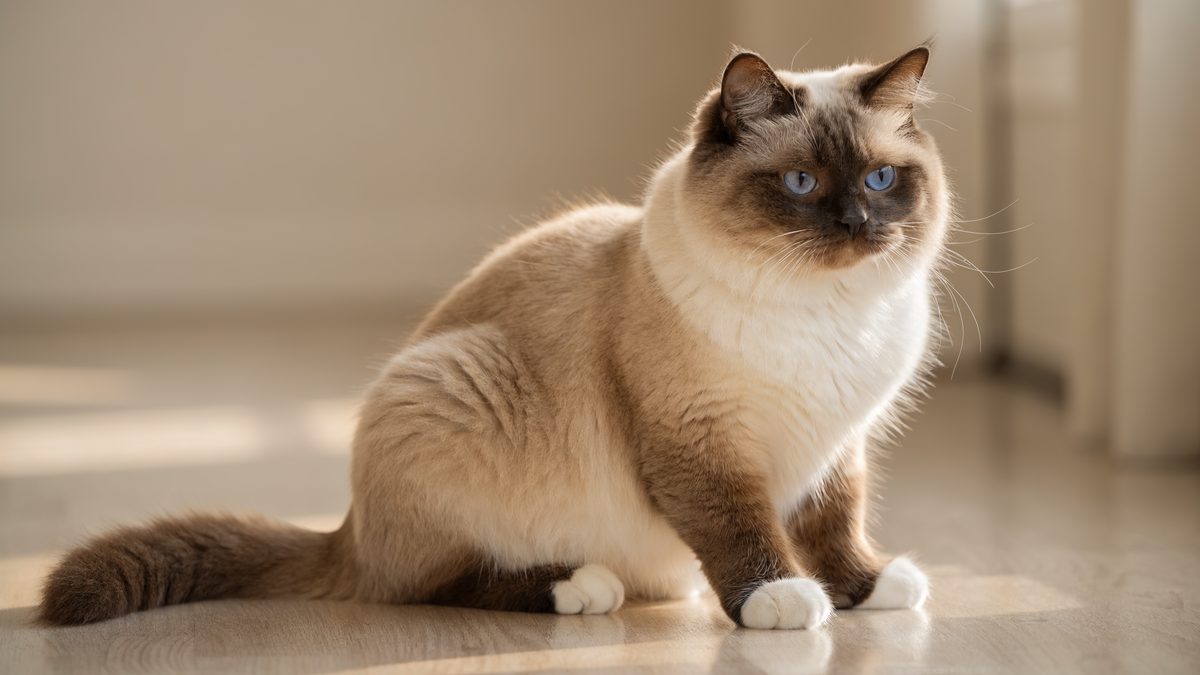
Quick answer
The Ragdoll cat price in India runs Rs 15,000 to Rs 3,00,000 or more in 2026, with published sources disagreeing by roughly twenty times at the floor. Two facts change the decision and no ranking page carries either. UK primary-care life tables put Ragdoll life expectancy at age 0 at 10.31 years, shorter than a crossbred cat, and a single named DNA test for the MYBPC3 R820W heart mutation separates a real breeder from a marketplace listing.
This guide is general information for Indian pet owners and is not a diagnosis. Always consult a registered veterinarian near you before acting on anything you read here, and treat any sudden change in your cat's condition as urgent.
Ragdoll cat at a glance
What a Ragdoll cat actually is
A Ragdoll is a large, semi-longhaired, blue-eyed pointed cat developed in Riverside, California in the early 1960s, and blue eyes are not a preference in this breed, they are a requirement written into both major registry standards. The Cat Fanciers' Association disqualifies a Ragdoll with eyes other than blue, and The International Cat Association withholds all awards for any eye colour other than blue.
That single fact is the most useful thing an Indian buyer can learn, because it is free to check and it settles the most common mis-sale in the market. India's top-ranking Ragdoll sales listing publishes a specification table giving the breed's eye colours as "aqua (blue-green), gold eyes, copper";. Every one of those is a disqualification or a withhold under the standards the same page cites as proof of pedigree The International Cat Association. Ragdoll…. A gold-eyed cat sold to you as a Ragdoll is not a Ragdoll.
The breed standard, in the words the registries actually use
The CFA standard describes the ideal Ragdoll as a well balanced cat with no extreme features, medium to large, moderately longhaired, blue-eyed and pointed, slow maturing and reaching full coat and colour at about three years of age. TICA's standard opens the same way, calling the Ragdoll a large semi-longhair, blue eyed pointed cat of moderate type, and adds that the breed may not reach full weight and size for four years.
Both registries score the cat out of 100 points, and the split tells you what matters.
| Area | CFA points | TICA points |
|---|---|---|
| Head | 40 (wedge 20, eyes 10, ears 5, profile 5) | 40 (shape 9, profile 9, eyes 7, chin 5, ears 5, muzzle 4, neck 1) |
| Body | 30 (size and boning 15, rectangular body 10, legs and tail 5) | 35 (boning 10, torso 8, musculature 8, legs and feet 5, tail 4) |
| Coat, colour and pattern | 30 (coat 20, colour 10) | 25 (texture 8, colour 7, pattern 6, length 4) |
Note what the point split does not reward. Neither standard gives a single point for size in kilograms, and neither gives a point for a coat being long. TICA states it explicitly: "Correct coat texture is more important than coat length";.
Three patterns, eight colours, and why the colour premium is mostly invented
TICA recognises three Ragdoll patterns and eight base colours. The patterns are colourpoint, which is pointed with no white anywhere; mitted, which adds white paws on the front feet, white boots on the hind legs, a white chin and a white belly stripe; and bicolour, which has a white chest, legs, stomach and ruff with a white inverted V on the face. The colours are seal, blue, chocolate, lilac, red, cream, cinnamon and fawn, with tortie and lynx (tabby) variations layered on top.
The registries do not agree perfectly here, and the difference is worth knowing before a seller uses it on you. CFA recognises four patterns, adding Van to colourpoint, mitted and bicolour, and lists six point colours rather than eight, omitting cinnamon and fawn. So a cinnamon Ragdoll is a recognised TICA colour and not a CFA one, and a Van-pattern Ragdoll is a CFA pattern that TICA folds into its bicolour division. Neither registry permits any outcross: CFA states "Ragdoll allowable outcross breeds: none", and TICA's standard records "PERMISSIBLE OUTCROSSES: None"; The International Cat Association. Ragdoll….
Indian sellers price those combinations as separate products. One publishes a premium ladder running from base price for a seal point up to 20 to 30 percent above base for chocolate and lilac point, and 15 to 25 percent above base for a white or blue bicolour. Another lists six colour variants as distinct catalogue items. The registries do not rank the colours against each other. CFA allocates 10 points to colour and divides them evenly, 5 for white markings and symmetry and 5 for body and point colour, and it applies the same standard to every recognised colour. A chocolate point is rarer in Indian breeding programmes than a seal point, and rarity can move a price. It does not make the cat a better Ragdoll.
The 60-second identification check, free, before you pay
Run these six checks on the kitten in front of you and on both parents. Every one comes straight from a published registry standard, every one is visible without a vet, and together they filter out most of what gets sold as a Ragdoll in India.
- Check the eye colour. Blue, and specifically large vivid blue ovals, wide set and moderately slanted. CFA disqualifies eyes other than blue and penalises blue so pale it washes out or so dark it looks black. TICA withholds all awards for any eye colour other than blue.
- Check the coat texture with your hand, not your eyes. TICA asks for silky soft with minimal undercoat, and explicitly penalises a wooly or cottony coat texture. CFA describes naturally non-matting fur with abundant guard hairs and minimal woolly undercoat, and penalises a thick undercoat standing off from the body. A dense, standing, cotton-wool coat is a Persian trait, not a Ragdoll trait.
- Check the profile. Slightly curving, ending in a straight medium-length nose, with a strong chin in line with the nose and upper lip. CFA disqualifies any nose break. A pushed-in flat face is a Persian or Himalayan.
- Check the tail. TICA requires a tail equal to the length of the body, thicker at the base with a slight taper. CFA penalises a short tail and disqualifies a directional kink.
- Check for white in the wrong place. In a colourpoint Ragdoll, CFA disqualifies the presence of any locket or white spot anywhere on the cat's body. In a mitted Ragdoll, TICA withholds awards for lack of a white chin.
- Count the toes and look at the eyes head on. Extra toes and crossed eyes are disqualifications in both standards.
These six checks tell you whether the animal in front of you conforms to the Ragdoll standard. They cannot tell you whether it carries the heart mutation the health section covers, because that mutation is invisible. A cat can pass all six checks and still be homozygous for MYBPC3 R820W. Physical inspection and DNA testing answer different questions and you need both.
Where the breed came from, including the part sellers leave out
Ann Baker of Riverside, California developed the Ragdoll in the early 1960s from a pure white longhaired cat named Josephine, a seal point mitted male called Daddy Warbucks and a solid black cat called Blackie. A VetCompass study describes the same founding lines as a pure white longhaired cat of Angora appearance, a seal mitted male and a solid black cat, with the breed first introduced into the UK in 1981.
TICA records the origin story honestly, including the part that the sales pages omit. "Ann insisted Josephine's genes were altered at a nearby medical center where she was taken after being hit by a car. Litters born after her return from the hospital had the limp, loving personalities Ragdolls are known to exhibit, while those born prior to her hospitalization did not display the same traits";. Baker's programme ran as franchises under her control until breeders including Denny and Laura Dayton broke away to develop the breed as a legitimate registered animal. TICA accepted the Ragdoll for championship competition in June 1979.
The British Ragdoll Cat Club, which has published the breed's history for decades, is blunt about that account. "To begin with, Ann Baker saw this new trait as a kind of 'act of God', a 'phenomenon'; that the trauma of the collision with the cat had altered Josephine's genetic constitution and that this was passed on to her kittens and subsequent generations. However, scientifically this is nonsense";. It adds that it would be "most suspicious of any claims that this kind of procedure was practiced in the mid 1960's on a stray cat";.
The pain-threshold myth, and the quote that settles it
Ragdolls feel pain exactly like any other cat, and the claim that they do not is not merely wrong, it is dangerous. This is the one claim on this page where a breed authority has stated the position in terms strong enough to end the argument.
"The one major characteristic identified by Ann Baker as setting the Ragdoll apart from any other breed was its astonishingly equable character and gentility. You can dismiss the floppiness which gave them their name as pure hype, and the assertion that they have a low pain threshold is positively dangerous. Clinical tests have proved absolutely conclusively that the Ragdoll is no different in its physical responses and attributes to any other breed of cat." The late Alan Edwards, former president of The British Ragdoll Cat Club and an international judge, published on the GCCF Ragdoll breed page and by the club itself The British Ragdoll Cat Club. Portrait….
CFA goes further and questions whether the limpness is even typical any more: "Baker claimed that Josephine was so placid that she went limp when held. While this characteristic is not typical of most of today's Ragdolls, it did give rise to the name of the breed";. Wikipedia's account states the position on the pain claim in one line, that "The extreme docility of some individuals has led to the myth that Ragdolls are pain resistant", and records that "Some breeders in Britain have tried to breed away from the limpness owing to concerns that extreme docility 'might not be in the best interests of the cat'";.
What is real is documented in the standard itself. TICA requires that a Ragdoll's "Temperament must be unchallenging; any sign of definite challenge shall disqualify";. The breed is bred for not fighting back. Treating that as immunity to injury is how gentle cats get hurt, and it is why an Indian seller who repeats the pain myth has told you something useful about themselves.
The registry timeline, and the breed's rank today
Ann Baker did not register her cats with an established body. As Wikipedia's account records, "Baker, in an unusual move, spurned traditional cat breeding associations. She trademarked the name Ragdoll, set up her own registry, the International Ragdoll Cat Association (IRCA), around 1971, and enforced stringent standards on anyone who wanted to breed or sell cats under that name". The British Ragdoll Cat Club describes the same arrangement from the inside: "A highly complex breeding policy formulated by Ann Baker had to be rigidly adhered to, otherwise registration of the kittens would not be forthcoming and the kittens could not be called Ragdolls";. Denny and Laura Dayton acquired their first pair in 1969, court actions followed, and "finally the franchise was legally broken";. The first kittens registered as Ragdolls, Raggedy Ann Kyoto and Raggedy Ann Tiki, were born in June 1965 The Governing Council of the Cat Fancy.….
Mainstream recognition followed slowly, and the milestones are worth knowing because sellers quote them loosely. Denny Dayton's own account records that the Ragdoll "was first recognized as a pure breed in 1965 by NCFA (now defunct)", that a 1975 Cat Fanciers Federation show in Ohio granted championship status in all patterns, and that the Ragdoll Club was founded in Ohio that same year. TICA accepted the Ragdoll for championship competition in June 1979. GCCF recognition came in March 1990, nine years after the first UK imports in 1981 O'Neill DG, Bass O, Brodbelt DC, Church DB. CFA accepted the breed for registration in 1993 and advanced it to championship status in 2000.
The end point of that story is the reason this page exists. CFA now states that "In just a few decades, Ragdolls have risen from obscurity to become the most popular breed of cat in the world, according to CFA registration statistics", and its own annual breed ranking places the Ragdoll first The Cat Fanciers' Association. Most Popular…. In UK primary care the Ragdoll was the second most common pure breed by 2019, having doubled its share since 2014, with annual proportional birth rates rising from 0.70 percent of all cats born in 2005 to 3.72 percent in 2019. India is now on the same curve about fifteen years behind, which is precisely when a breed's health and welfare problems tend to arrive.
How big is a Ragdoll really
This is the sharpest gap between the registry description and Indian marketing copy. TICA's breed page gives fully developed males 15 to 20 pounds, roughly 6.8 to 9.1 kg, and females 10 to 15 pounds, roughly 4.5 to 6.8 kg. Indian pages repeat those numbers, with one giving males 6 to 9 kg and females 4.5 to 6.5 kg and another 4 to 9 kg overall.
Now the real-world figure. Across 2,025 Ragdolls under UK primary veterinary care, median adult bodyweight was 4.46 kg, with an interquartile range of 3.79 to 5.19 kg. Males had a median of 4.97 kg and females 3.83 kg. The registry describes show-standard adults at the top of the breeding pool. The clinical data describes the animals actually living in homes. A 4.5 kg Ragdoll is normal, not undersized, and an Indian buyer who was promised a 9 kg cat and got a 4.5 kg cat has almost certainly not been cheated. The same study found Ragdolls grow rapidly through the first year and keep gaining until about two years of age, which fits the registries' warning that full size may take four years and full colour three The Cat Fanciers' Association. Ragdoll….
Ragdoll cat price in India
A Ragdoll cat costs Rs 15,000 to Rs 3,00,000 or more in India in 2026 depending entirely on which published source you read, and the sources disagree by twenty times at the floor. Bonbeno compared six Indian sources currently visible for this query. They do not agree with each other, and two of them do not agree with themselves.
Read the table across, not down. The point is the disagreement, not any one number in it.
| Source | Pet or basic quality | Show or registered | Champion or imported | Adoption or rehoming |
|---|---|---|---|---|
| Supertails | Rs 25,000 to Rs 55,000 | Rs 55,000 to Rs 1,00,000 | Rs 1,00,000 to Rs 1,50,000 champion; Rs 1,50,000 to Rs 3,00,000+ imported | Rs 2,000 to Rs 10,000 |
| Wrapinfur | Rs 45,000 to Rs 70,000 | Rs 80,000 to Rs 1,20,000+ | Rs 1,50,000+ | Rs 5,000 to Rs 20,000 |
| Mr n Mrs Pet | Rs 75,000 to Rs 1,50,000 | Rs 1,50,000 to Rs 2,00,000 (FCI registered) | Rs 2,00,000 to Rs 3,00,000+ | Not stated |
| PetIndiaOnline | Rs 40,000 to Rs 80,000 | Rs 80,000 to Rs 1,50,000+ | Rs 1,50,000 to Rs 3,00,000+ | Not stated |
| Fluffyn | Rs 25,000 to Rs 60,000 (verified breeder) | Not stated | Not stated | Rs 8,000 to Rs 20,000 quoted as unverified-source pricing |
| Happy Pet | Rs 15,000 to Rs 70,000 overall, no quality split | Not stated | Not stated | Not stated |
The floor for a pet-quality Ragdoll kitten moves from Rs 15,000 to Rs 75,000 depending purely on who is publishing, a five-fold gap for what is described as the same animal. The ceiling moves from Rs 70,000 to Rs 3,00,000 or more, a factor of at least four. Four things drive that spread.
- Whether the publisher also sells kittens. The two highest bands in the table come from a marketplace that brokers the sale and lists 62 Ragdoll kittens live on the page and from a page that quotes an imported ceiling of Rs 3,00,000 while its own headline band starts at Rs 25,000. The lowest comes from a breed-information site that sells neither. A high published ceiling makes a mid-price listing feel like a bargain, which is what a wide published band is for.
- Registration paperwork, and which registry issued it. The largest single step in any of these tables is Rs 75,000 to Rs 1,50,000 for basic quality against Rs 1,50,000 to Rs 2,00,000 for what the seller calls FCI registered, a Rs 75,000 jump for a document. The next section explains why that particular label deserves a hard question.
- Coat pattern and colour. Sellers name coat pattern first among price factors and publish colour premium ladders of 5 to 30 percent, while another describes seal point and bicolour as the most requested and then concedes that "pricing is usually determined more by pedigree and breeder reputation than by color alone";. Contrast and pattern are genuinely in the standard, so the factor is at least real, but the premium is set by demand rather than by any registry.
- Import claims. Imported bloodlines carry the largest premium in every table that has one, quoted at Rs 1,50,000 to Rs 3,00,000 or more Pet India Online. Ragdoll Cat in India. That is a documentable claim, and the paperwork is specific. Ask for it.
What an import claim actually requires, and how to test one
Here is a check no Indian Ragdoll page offers. An imported cat entering India leaves a paper trail that a seller either has or does not have. The published procedure requires a health certificate endorsed by the exporting country's veterinary authority, a licence from India's Directorate General of Foreign Trade on form ANF-2M for pets not permanently relocating, which takes about one month to process, and a No Objection Certificate issued in advance by an Animal Quarantine and Certification Station, which takes about five working days.
On arrival the animal is examined by a quarantine officer and, when imported as accompanied or unaccompanied baggage, is quarantined for 15 days. Thirty days later a certificate of health from a local veterinarian must be produced at the quarantine station before a permanent health certificate is issued. AQCS stations operate at Delhi, Mumbai, Kolkata, Chennai, Bangalore and Hyderabad, and the temporary-visit exemption applies to a maximum of two pets.
So when a seller quotes you Rs 3,00,000 for an imported bloodline, there are four documents that should exist: the exporting country's endorsed veterinary health certificate, the DGFT licence, the AQCS No Objection Certificate, and the post-quarantine health certificate. If the claim is that the parents were imported rather than the kitten, the same documents should exist for the parents. A seller who cannot produce any of them is not necessarily lying, but they are asking you to pay a premium on an unevidenced claim.
The registry question, and one label worth challenging
One Indian marketplace lists four bodies for registering a Ragdoll in India and describes the first as "FCI - Feline Club of India: India's largest and most trusted cat registry", alongside CFA, WCF and TICA. The same page prices FCI registration at a Rs 75,000 premium over basic quality.
Feline Club of India is a real organisation. Its own website describes it as "the sole organization in India which helps you register your cat and give it its own identity" and states that it "came into existence in 2018";. Beyond that, its published figures do not hold together. The homepage claims "500K Cat registered" and "40+ active regional clubs"; the About page says the club "was formed 4 years ago" and runs "32 active regional clubs"; the registration page says "45 active regional clubs" beside a counter reading "400+ Cats";. Founded eight years ago or four, thirty-two clubs or forty-five, four hundred cats registered or five hundred thousand. Those are the organisation's own numbers, on its own site, disagreeing with each other by three orders of magnitude.
Two further points a buyer should weigh. Bonbeno checked the membership and patronage lists of FIFe, TICA, WCF and CFA. India appears on two of them, and Feline Club of India appears on none. CFA's own club status list includes the Cat Fanciers Alliance of India in its International Division, and the World Cat Federation lists two Indian patronage clubs, Alliance of Cat Fanciers in Bangalore and Indian Cat Club in Hyderabad. And the abbreviation itself is a problem in India, because FCI internationally means the Federation Cynologique Internationale, which describes itself as "the World Canine Organisation" with 101 members and contract partners and 364 recognised breeds, all of them dogs. A certificate marked FCI does not, on its face, tell an Indian buyer which organisation issued it.
So Bonbeno's position is narrow and checkable. We are not saying Feline Club of India is not a registry. We are saying that a Rs 75,000 price step should rest on a document you can verify, and that the two registries whose standards define this breed both run free public directories. TICA states that "The TICA website is the only place where you can find TICA member breeders who have signed the TICA Code of Ethics";, and CFA runs its own breeder finder. Both are searchable from India in under two minutes.
The practical rule follows from that. If a seller claims registration, ask which body, ask for the certificate number, and look the cattery up in that body's own public directory before you transfer money. A registration certificate is worth exactly as much as the registry that issued it, and the ones you can independently verify are the ones worth paying for.
Price by city, where the sources contradict each other outright
Four Indian sources publish a Ragdoll price by city and they disagree on every single city, in the same direction, by roughly three times. None states a sample size, a method or a collection date.
| City | Supertails, pet quality | Fluffyn, verified breeder | Wrapinfur | Mr n Mrs Pet |
|---|---|---|---|---|
| Delhi / NCR | Rs 30,000 to Rs 55,000 | Rs 25,000 to Rs 50,000 | Rs 50,000 to Rs 1,10,000 | Rs 70,000 to Rs 2,75,000 |
| Mumbai | Rs 35,000 to Rs 60,000 | Rs 35,000 to Rs 60,000 | Rs 55,000 to Rs 1,20,000 | Rs 75,000 to Rs 2,75,000 |
| Bengaluru | Rs 30,000 to Rs 55,000 | Rs 30,000 to Rs 55,000 | Rs 50,000 to Rs 1,15,000 | Rs 75,000 to Rs 2,85,000 |
| Hyderabad | Rs 28,000 to Rs 50,000 | Rs 25,000 to Rs 48,000 | Rs 45,000 to Rs 1,00,000 | Rs 75,000 to Rs 2,50,000 |
| Chennai | Rs 25,000 to Rs 48,000 | Rs 28,000 to Rs 50,000 | Rs 45,000 to Rs 95,000 | Rs 75,000 to Rs 2,90,000 |
| Pune | Rs 28,000 to Rs 50,000 | Rs 27,000 to Rs 50,000 | Rs 45,000 to Rs 1,00,000 | Rs 75,000 to Rs 2,75,000 |
| Kolkata | Rs 25,000 to Rs 45,000 | Not stated | Rs 45,000 to Rs 95,000 | Not stated |
| Ahmedabad | Not stated | Not stated | Rs 45,000 to Rs 90,000 | Not stated |
| Jaipur | Not stated | Not stated | Not stated | Rs 75,000 to Rs 2,60,000 |
| Lucknow | Not stated | Not stated | Not stated | Rs 70,000 to Rs 2,85,000 |
| Kochi / Thiruvananthapuram | Rs 25,000 to Rs 45,000 | Not stated | Not stated | Not stated |
Look at Hyderabad. One source puts the floor at Rs 25,000, another at Rs 75,000. That is a three-fold difference in the same city in the same year for an animal described in identical terms. Bonbeno is not going to average those into a fake consensus, because averaging would produce a number no seller in Hyderabad has ever quoted anyone. The honest position is that city variation almost certainly exists, driven by breeder availability and transport, but no published Indian source states a method that would let you trust its city figures. Two of them add a transport cost of Rs 2,000 to Rs 5,000 for buyers outside the metros, which is the only city-linked number in the whole set with an obvious mechanism behind it.
The floor is where the risk lives
One source publishes something the others do not: a side-by-side of verified-breeder against unverified-source pricing in each city, putting Delhi at Rs 25,000 to Rs 50,000 from a verified breeder against Rs 8,000 to Rs 15,000 from an unverified one, and Mumbai at Rs 35,000 to Rs 60,000 against Rs 10,000 to Rs 20,000. Another warns that a kitten offered at Rs 10,000 to Rs 15,000 "is almost certainly not a purebred Ragdoll" because at that price no responsible health or genetic screening is financially possible.
Both are describing the same thing from opposite sides. Below roughly Rs 20,000, what is usually being sold in India is a colourpoint domestic cat, and the six physical checks in the overview section cost nothing and settle it in a minute. Note also that a low price and a genuine bargain are not the same event. The lowest legitimate route to a Ragdoll in India is the rehoming band of Rs 2,000 to Rs 10,000 for an adult cat being given up by its owner, and the adoption section covers how to find one.
We report published price ranges as editorial content so buyers can see the disagreement themselves. We do not list breeders, we do not link kitten listings, and nothing on this page is an offer. If a figure here differs from what you are quoted, the quote is the live number and this page is the context.
Monthly cost of owning a Ragdoll cat in India
Budget Rs 4,000 to Rs 12,000 a month for a Ragdoll in India, and add a cooling line item that most published budgets leave out entirely. Six Indian sources publish a monthly figure and they disagree by more than four times, and the reason is not inflation. It is that they are costing different lives.
| Source | Monthly total | Food | Grooming | Vet | Cooling included? |
|---|---|---|---|---|---|
| Happy Pet | Rs 2,800 to Rs 4,200 | Rs 1,500 to Rs 2,000 | Rs 800 to Rs 1,500 | Rs 500 to Rs 700 | No |
| Mr n Mrs Pet | Rs 3,000 to Rs 8,000 | Not itemised | Not itemised | Not itemised | No |
| Fluffyn | Rs 4,000 to Rs 8,000 | Rs 2,500 to Rs 5,000 | Rs 700 to Rs 1,500 | Rs 800 to Rs 2,000 | No |
| Wrapinfur | Rs 4,100 to Rs 12,000 | Rs 2,000 to Rs 5,000 | Rs 500 to Rs 2,000 | Rs 500 to Rs 2,000 | No |
| Supertails | Rs 5,300 to Rs 12,700 | Rs 2,500 to Rs 5,000 | Rs 500 to Rs 1,500 | Rs 800 to Rs 2,000 | No |
| PetIndiaOnline | Rs 9,000 to Rs 18,000+ | Rs 3,000 to Rs 6,000 | Rs 2,000 to Rs 4,000 | Rs 2,000 to Rs 5,000 | Yes, Rs 2,000 to Rs 5,000 |
The floor moves from Rs 2,800 to Rs 9,000 across the six, and the ceiling from Rs 4,200 to Rs 18,000 or more Pet India Online. Ragdoll Cat in India. Once you look at what each budget includes, most of the gap resolves.
The line item five out of six budgets forget
Five of the six sources state that air conditioning is essential for a Ragdoll in India. One writes that in cities where temperatures regularly exceed 35 C between April and June, "an air-conditioned indoor environment is not optional, it is essential";. Another says air conditioning during hot months is important and tells you to keep indoor temperatures below 26 C. A third lists cooling units as a boon for Kolkata, Delhi and Chennai.
Exactly one of them then puts cooling in the monthly budget, at Rs 2,000 to Rs 5,000. That single omission accounts for most of the spread in the table above. If your page tells a buyer that a Ragdoll cannot live in Chennai without an air conditioner and then quotes a monthly cost that assumes no air conditioner, the budget is not wrong by a rounding error, it is wrong by the largest recurring cost the breed imposes in an Indian summer.
A realistic Indian figure has to sit on your own tariff and your own room, so Bonbeno will not invent one. What we will say is the shape of it. If your Ragdoll needs one room cooled for eight to ten hours a day through April, May and June, price that on your last three electricity bills before you buy the cat, not after.
The first year is the expensive one
One Indian source itemises year-one costs separately and puts core vaccination for a kitten at Rs 3,500 to Rs 7,000 across the first year, amortising to Rs 300 to Rs 600 a month, on top of a monthly vet line of Rs 800 to Rs 2,000 that already includes an annual wellness check, deworming and cardiac screening. Its stated year-one total of Rs 12,700 a month at the high end reflects setup costs and cardiac screening; the Rs 5,300 low end is settled adult maintenance.
Add to that the one-off setup a first-time owner actually buys. None of the six sources publishes a complete setup list with prices, so treat any single figure with suspicion, but the items are not in dispute: a litter box and litter, a carrier, food and water bowls or a fountain, a scratching post, a steel comb, nail clippers, and interactive toys. TICA calls cat trees and good scratching and resting areas "mandatory" for the breed.
The costs nobody budgets, and the one that can end you
Two contingencies dominate the real financial risk of this breed and no Indian page prices either.
- Cardiac screening and cardiology. The breed's named heart mutation is discussed in the health section. Echocardiographic screening by a cardiologist is not universally available in Indian cities, and where it is, it is a specialist referral cost rather than a routine clinic cost. Budget for the DNA test on the parents before you buy, which is a one-time cost borne by the breeder, and for the possibility of adult echocardiography later.
- Feline infectious peritonitis treatment. FIP was until recently uniformly fatal. The current antiviral, GS-441524, achieved an overall treatment success rate of 84.6 percent across 11 studies and 650 treated cases in a 2025 systematic review. In the United States, where it is available through compounding pharmacies in every state, the treatment course for a 3 kg cat costs roughly 200 to 1,200 US dollars. India is not on the list of countries with GS-441524 available through veterinary channels; it appears instead on the list of countries where molnupiravir and remdesivir, both approved for human use in India, can be accessed by veterinarians. That is a materially different treatment landscape from the one the international literature describes, and for the breed with the highest recorded FIP odds ratio it belongs in the buying decision, not in a footnote.
Take the monthly figure you settle on, add your own cooling estimate, and then set aside the equivalent of two months of that total as a standing veterinary reserve before the kitten arrives. A Ragdoll is a long-lived indoor cat whose two headline risks, cardiac disease and FIP, both present as sudden events rather than gradual ones.
Can a Ragdoll cat handle the Indian climate
A Ragdoll can live comfortably in almost any Indian city as an indoor cat, but climate adaptation for this breed is not what Indian pages say it is, and the standard advice to keep the room below 26 C is based on a misunderstanding of feline physiology. The thermoneutral zone for cats is 30 C to 38 C, which is far higher than for humans or dogs, so a cat at 24 C is not comfortable, it is cold.
The National Research Council puts the feline thermoneutral zone at 30 C to 38 C. Humans prefer 18 C to 25 C and dogs prefer 20 C to 30 C. As a veterinary review of the figure puts it, sharing a house with humans "makes the cat feel like we humans would feel indoors at 8 C, cold and miserable";. The same review notes that in summer, when air conditioning holds homes near 24 C, "similar silent cold distress occurs for cats", and that this is why cats hog window sills to soak up sun through the glass.
Set that against the Indian advice. One ranking page instructs buyers to "keep indoor temperatures below 26 C during summer";. Another prescribes temperature-controlled rooms and limited heat exposure. A third calls air conditioning not optional but essential in Chennai, Hyderabad and Mumbai. None of them names a target temperature that a cat would choose.
So what is the actual Indian risk
The risk is not that 30 C is too warm for a Ragdoll. It is the combination of four things that Indian summers deliver together.
- Peak temperatures well above the top of the zone. The highest temperature recorded anywhere in India on 21 May 2026 was 47.6 C at Banda, Uttar Pradesh, and across northwest, west, central and north peninsular India maximum temperatures ranged between 40 C and 47 C. The upper limit of the feline thermoneutral zone is 38 C. A closed flat in Delhi in May routinely runs above that.
- Warm nights, which remove the recovery window. The IMD classes a warm night as a minimum temperature 4.5 C to 6.4 C above the seasonal normal, and issued warm-night warnings for Delhi, Haryana, Uttar Pradesh and Vidarbha in May 2026, with Delhi recording its warmest night in 14 years. A cat that cannot cool overnight accumulates heat load across days.
- Humidity, which is the part the temperature reading hides. The same IMD bulletin flagged hot and humid weather over Gangetic West Bengal and Odisha separately from the dry heat further inland. Cats do not sweat effectively and rely on grooming saliva evaporation and panting, both of which fail as ambient humidity rises. Coastal Mumbai, Chennai and Kolkata are harder on a semi-long coat than their maximum temperatures suggest.
- A semi-long coat over a large body. TICA describes the coat as semi-long, varying in length and density according to season, silky, soft and plush, with some undercoat. That is far less insulating than a Persian's dense standing coat, which is why the Ragdoll is the easier of the two in India, but it is materially more than a domestic shorthair carries.
City by city, honestly
Bonbeno has no Ragdoll-specific Indian climate study to cite, and neither does any page currently ranking, so treat the following as reasoning from published temperature data rather than as measured breed data.
| City type | Dominant problem | What it changes for a Ragdoll |
|---|---|---|
| Delhi, Lucknow, Jaipur, inland UP | Extreme dry heat plus warm nights | Cooling for one room through April to June is the binding cost. Dry heat at least leaves evaporative cooling working, so hydration and airflow matter as much as the thermostat. |
| Mumbai, Chennai, Kochi, Kolkata | Sustained humidity | Lower peak temperatures but the cat's own cooling routes work poorly. Coat management and dehumidification matter more here than raw AC setting. This is where matting and skin problems concentrate. |
| Bengaluru, Pune | Mildest of the metros | The easiest Indian cities for this breed. One source names Bangalore and Pune's milder climate as suiting Ragdolls year-round. |
| Hyderabad, Ahmedabad, Nagpur | Long hot season | The duration is the issue rather than the peak. Budget cooling across more months, not a higher setting. |
What to do instead of chasing a number
Give the cat a temperature gradient and let it choose. That is the practical translation of the thermoneutral zone finding, and it is the opposite of picking one thermostat setting.
- Cool one room, not the flat. Leave the rest of the home warmer and leave the doors open so the cat can move between the cooled room and the warmer one at will.
- Never put the carrier or the bed in the direct air path. The same veterinary review specifically advises clients driving cats to the clinic not to sit the carrier in the flow of the air conditioner. The rule holds at home.
- Watch for cold distress, not just heat distress. A cat that curls up tightly, hugs the window sill in June, or sits on the router may be telling you the room is too cold rather than too warm.
- Keep water where the cat will use it. TICA recommends non-tipping bowls, towers or fountains and notes that Ragdolls in particular like filtered drinking fountains, and passes on a behaviourist tip to place the water bowl at least three feet away from food because a strong food smell can suppress drinking.
- Do not shave the cat. A semi-long coat insulates in both directions and also protects skin. Grooming, not clipping, is the answer, and the grooming section covers it.
The Ragdoll is a better Indian heat proposition than a Persian and a worse one than a domestic shorthair. It is an indoor cat by design, which means the question is not whether the breed can survive Indian weather but whether you can afford to keep one room habitable through summer for the next decade. Answer that before you answer the price question.
The indoor-only life, and its own costs
One point deserves stating because every Indian Ragdoll page assumes indoor-only living without ever examining it. Neither of the two leading feline welfare bodies recommends indoor-only life as a default, and neither makes any pedigree-specific or Ragdoll-specific indoor recommendation.
International Cat Care writes that "There's no right or wrong answer when it comes to either keeping your cat indoors only or allowing them to explore outdoors", and is direct about the trade-off: "the biggest issue facing indoor-only cats, is the potential negative impact on their mental wellbeing which can lead to long-term stress and subsequent physical illness. An indoor lifestyle can be predictable and monotonous, and there's less opportunity to exhibit certain natural behaviours, such as hunting and exploring." It adds that "Indoor-only cats are more likely to develop obesity due to a more sedentary lifestyle and reduced energy expenditure", and that a cat which accidentally escapes is at greater risk than one used to the outdoors.
Cats Protection reaches the same conclusion from the other end: "Ideally all cats would be allowed access to the outdoors to express their natural behaviour. However, cats can adapt to living indoors, particularly if they are used to it from a young age." It lists the failure modes plainly, naming scratching furniture, spraying, over-grooming, aggression, house soiling and depression, and warns that "a static environment can be detrimental";.
In India the calculus still lands on indoor-only for this breed, because traffic, theft risk, the rabies picture and a trusting non-defensive temperament are not abstract concerns. But indoor-only is a choice with a welfare cost that you pay in enrichment, and the obesity link runs straight into the breed's third most common recorded disorder International Cat Care. Should I keep my…. That is the real argument for the cat tree, the food puzzle and the two daily play sessions, and it is why the exercise section is not optional reading.
Temperament, household fit and who should not buy one
The Ragdoll's temperament is the most accurately described thing about the breed in Indian marketing, and the one place where the sales copy and the registries agree almost completely. CFA describes Ragdolls as loving without being demanding, gentle, calm and sociable, and notes that it is rare for a Ragdoll to be aggressive or temperamental. Household fit and living conditions follow directly from that, and apartment living suits this breed better than almost any other pedigree cat sold in India.
TICA describes a relaxed, happy, quiet cat with a very laidback disposition, adds that many will go limp and flop like a stuffed doll when cuddled, and is blunt about the trade-off: "If you are looking for a very active cat or a talkative cat, a Ragdoll probably is not the breed for you";. CFA says owners describe them as kittens that never quite grow up, that they greet you at the door, stay close to your side and often sleep with their owners.
Indian pages report the same picture. One calls the Ragdoll cuddly, affectionate, calm and people-oriented, and flags that Ragdolls "do not enjoy being left alone for extended periods of time";. Another notes low aggression and high patience and says Ragdolls rarely scratch or hiss.
The floppiness, and the myth attached to it
The limp reaction when picked up is real, documented by both registries and by the VetCompass study, which records that the breed name "originates from their typically placid, friendly nature and tendency to go limp 'like a ragdoll' when picked up"; The International Cat Association. Ragdoll….
What is not documented anywhere is the claim that follows it around: that Ragdolls do not feel pain, or feel it less. No registry says this. No study says this. It appears to be a folk extension of Ann Baker's original claim that Josephine's genes were altered after a road accident, a claim TICA records without endorsing. Treat any seller who repeats it as either uninformed or dishonest, and in either case as someone you should not buy a cat from.
The real behavioural fact underneath the myth is more useful and more worrying. TICA's standard requires that temperament be unchallenging and disqualifies any sign of definite challenge. CFA warns that a Ragdoll's "trusting nature means they should be introduced with extra care to existing cats or dogs, who might not be quite as gentle";. This is a cat that has been selected across sixty years for not fighting back. In a household with a resident dog, a resident territorial cat, or small children, the Ragdoll is the animal that needs protecting, not the one that needs managing.
Who a Ragdoll genuinely suits in India
- A family with young children. CFA calls Ragdolls excellent pets for children, and TICA notes that many will allow themselves to be dressed in doll clothes and carried around by youngsters with no resistance. That tolerance is exactly why the child needs supervising, not the cat.
- A first-time cat owner in a flat. Low aggression, quiet, litter-trained on arrival and undemanding of space. CFA states that Ragdolls adapt easily to most environments and do not need a lot of living space.
- A household with a resident dog, introduced properly. Both registries and every Indian source agree the breed tolerates dogs well.
- Someone at home a reasonable amount. The breed bonds hard and one Indian source flags separation as a specific issue.
Who should not buy one
- Anyone who wants an outdoor or free-roaming cat. A trusting, slow, conspicuous, expensive, non-defensive cat on an Indian street is a theft and a road-traffic risk before it is anything else. Every source on this page treats the Ragdoll as an indoor cat and one states directly that outdoor living is not suitable.
- Anyone who cannot cool a room through summer. Covered in the climate section, and it is a harder constraint than the purchase price.
- Anyone buying on the strength of the low published price. The Rs 15,000 to Rs 25,000 end of the published range is where mislabelled colourpoint cats live.
- Anyone who wants a low-cost cat. The honest comparison is in the comparison section: an Indian domestic shorthair is free, better adapted to the climate and, on the UK data, longer lived than a purebred.
Litter training, handling and enrichment for a Ragdoll
Litter training a Ragdoll is usually a non-event, because a kitten from a responsible breeder arrives at 10 to 12 weeks already using a litter box, and the breed is among the more trainable cats. CFA states that Ragdolls are not only playful but very trainable and can be taught to fetch and to come when called.
TICA says the same and notes Ragdolls are often compared to dogs because of their friendliness and intelligence. That trainability is the lever you use for everything else on this page, because a cat that will tolerate handling is a cat you can groom, weigh, brush and medicate without a fight, and all four matter more in this breed than in most.
The litter box, and the Indian specifics
Get the box right first and the training takes care of itself.
- Size the box to the adult cat, not the kitten. A Ragdoll is one of the largest domestic breeds and a box sized for a kitten will be outgrown inside six months.
- Run one box per cat plus one. Standard feline guidance, and it costs almost nothing to implement in a flat.
- Budget realistically for litter. Indian sources put litter at Rs 600 to Rs 2,000 a month, with clumping litter changed every two to three days.
- Keep the box away from the cooled-room air vent and away from food. Cats reject boxes in draughts, and TICA's own guidance on water placement makes the wider point that Indian flats often put resources too close together.
- Treat a sudden litter box change as a medical sign. Diarrhoea was the second most common disorder recorded in UK Ragdolls at 7.11 percent, with vomiting seventh at 4.05 percent, and the study found the breed appears predisposed to enteropathy. A Ragdoll that starts missing the box is telling you something.
Handling training, which is not optional in this breed
Teach four specific tolerances in the first six months, in short sessions, with food.
- Tolerate a full-body comb, down to the skin. TICA is specific that you must brush down to the skin and not just superficially over the top of the hair, and recommends a stainless steel or greyhound comb. A cat that will not accept this at six months will not accept it at six years, and the armpit and britches mats form long before you see them.
- Tolerate nail trimming. TICA recommends nails trimmed once a month. Overgrown nails were the fourth most common disorder recorded in UK Ragdolls, at 5.68 percent, which is a purely preventable finding in an indoor cat.
- Tolerate having the mouth opened. Periodontal disease was the single most common disorder recorded in UK Ragdolls, at 8.84 percent, and the dental disorder group reached 14.52 percent, rising to a prevalence above 35 percent around nine years of age. Toothbrushing a few times a week, with cat toothpaste only, is the intervention.
- Tolerate the carrier and the scale. Weigh the cat monthly on a kitchen scale as a kitten and a bathroom scale as an adult. Weight is the earliest and cheapest early-warning signal you have, and the feeding section explains what to do with the number.
Enrichment for a calm cat in a small flat
The Ragdoll's enrichment problem is the opposite of a Bengal's. This is a moderately active cat that, in CFA's words, appreciates play sessions but does not insist upon them. Left to itself it will simply not exercise, which is how a docile indoor breed reaches a 6.91 percent obesity prevalence.
TICA calls balls, catnip toys and cat trees or other good scratching and resting areas "mandatory" for the breed, recommends feather wands and other interactive toys, and states directly that it is important to make sure your adult Ragdoll gets plenty of interactive playtime to help avoid excess weight gain. Indian sources converge on 15 to 20 minutes of active play per session, twice daily.
Two additions work particularly well with this breed in an Indian flat. Ragdolls are noted by TICA to be intrigued by running water, so a fountain doubles as enrichment and hydration. And because the breed will genuinely learn recall and fetch, a five-minute clicker session before a meal converts training into the exercise, which is the only reliable way to make a lazy cat move.
A Ragdoll will usually accept a harness, and outdoor time in a cooler month is good enrichment. Two Indian cautions apply. First, an unvaccinated or lapsed-vaccination cat should not be outside at all, given the rabies picture in the vaccination discussion below. Second, this is a trusting, non-defensive, visibly expensive animal. Supervise every second and never tether and leave.
How much exercise a Ragdoll cat actually needs
A Ragdoll needs about 30 to 40 minutes of owner-driven interactive play a day, split into two or three sessions, and the word that matters in that sentence is owner-driven. Exercise and activity in this breed is a demand on your time rather than on the cat's energy, because a moderately active cat that will not self-exercise leaves the whole job to you.
Indian sources put the figure at 15 to 20 minutes of active play per session, twice daily, and describe activity level as moderate with indoor play and light climbing. CFA describes the breed as moderately active and appreciative of play sessions without insisting on them. TICA frames the requirement in terms of its consequence: plenty of interactive playtime is important "to help avoid excess weight gain";.
What happens without it, with numbers
Obesity was the third most prevalent disorder recorded across 2,025 UK Ragdolls under primary veterinary care, at 6.91 percent, behind only periodontal disease and diarrhoea, and males had a statistically significantly higher probability of obesity than females. CFA names it as a breed risk in plain terms, noting Ragdolls are "known for their love of food" and may be at risk for obesity.
The wider feline data explains why an indoor, calm, food-motivated breed is exposed. Across roughly 1.3 million cats seen at US primary practices between 2020 and 2023, overweight or obese body condition was recorded in 36.2 percent and 3.6 percent of young adults, 47.2 percent and 13.9 percent of adults, and 44.8 percent and 21.7 percent of mature cats. The same study found that a cat recorded as overweight or obese during growth had 1.52 times the odds of being overweight or obese in adulthood. A fat Ragdoll kitten becomes a fat Ragdoll adult, and the window to prevent that closes in the first year.
Two of the breed's other risks compound it. Excess weight loads a heart that may already carry a cardiomyopathy mutation, and it makes a semi-longhaired cat physically unable to groom its own rear and hindquarters, which is one route to the matting that the grooming section covers.
A workable Indian daily routine
| When | What | Why it works |
|---|---|---|
| Before the morning meal, 10 to 15 minutes | Wand or feather toy, ending in a catch | Hunt-then-eat sequence matches feline behaviour and makes the cat work before food rather than after |
| Midday, passive | Food puzzle or scatter-fed portion of the daily ration | Costs you nothing in time and slows intake in a food-motivated breed |
| Evening, 10 to 15 minutes | Fetch or recall training with a clicker | Uses the breed's genuine trainability so training is the exercise |
| Any time, standing | Cat tree, shelves, scratching posts | TICA calls these mandatory for the breed |
| Cooler months only, supervised | Harness time on a balcony or in a secure yard | Novel enrichment, but never unsupervised and never for an unvaccinated cat |
Do not substitute a second cat for the play sessions. Two Ragdolls will often lie next to each other rather than chase each other, and the FIP data in the health section gives a specific reason to think carefully before running a multi-cat household with this breed.
Grooming a Ragdoll coat in Indian humidity
Groom a Ragdoll by combing it down to the skin once or twice a week with a stainless steel comb, and do not have the coat trimmed. Both registries describe a silky, semi-long, largely non-matting coat that needs weekly attention and no clipping, which directly contradicts the single most widely repeated grooming claim on India's top-ranking Ragdoll sales page.
That page states: "Ragdoll Cats have dense, curly coats that need trimming every 4-6 weeks to prevent matting. Regular grooming also keeps them cool in Indian weather and reduces skin infections";. Set it against the standards.
| Claim | Source | What the registry standard says |
|---|---|---|
| Coat is "dense, curly" | Mr n Mrs Pet | TICA: "Silky soft. Minimal undercoat gives the coat body, but coat still falls smoothly. Not wooly or cottony." A wooly or cottony texture is a listed penalty |
| Needs "trimming every 4-6 weeks" | Mr n Mrs Pet | CFA: "the naturally non-matting moderately long fur is characterized by abundant guard hairs and minimal woolly undercoat". No trimming schedule appears in either standard |
| Professional grooming every 6 to 8 weeks | Supertails, Fluffyn Fluffyn. Ragdoll Cat Price in India 2026 | TICA: "The Ragdoll's plush, silky coat requires little routine grooming, although it should be brushed or combed weekly with a steel comb"; |
| "Shedding Level: No Shedding" | Happy Pet | TICA: "There is little shedding of the coat except in the spring and fall"; |
| Coat has "no dense undercoat" | Supertails | TICA: "The coat texture is silky, soft, and plush, with some undercoat";. CFA specifies minimal woolly undercoat, not none |
The commercial logic behind the curly-coat claim is not subtle. A cat that needs professional trimming every four to six weeks is a cat that generates a recurring grooming bill, and the same page that publishes the claim also sells grooming services. Bonbeno's position is the registries' position: comb it weekly, comb it properly, and do not clip a coat that both standards describe as naturally non-matting.
The one place the registries are too optimistic
Here is a genuine disagreement worth printing rather than resolving. CFA calls the fur naturally non-matting. TICA agrees the coat requires little routine grooming but warns to "watch for some tangles under the armpits" during shedding season.
The clinical record is less forgiving than either. Across 2,025 UK Ragdolls, haircoat disorder including matting was recorded in 4.00 percent of cats, making it the eighth most common disorder in the breed, against 2.6 percent of all UK cats in a comparable study. The authors conclude that "the Ragdoll is predisposed to haircoat disorders", and note that this predisposition is supported despite warnings from cat organisations that the breed's coat knots easily, especially under the front and hind legs, when not regularly groomed. Skin as a disorder group reached 7.75 percent, the third largest group in the breed.
So the registry describes the coat's potential under ideal grooming and the veterinary record describes what actually happens in homes. Both are true. The practical reading is that the coat is forgiving compared to a Persian and unforgiving compared to a shorthair, and that the difference between the two outcomes is entirely the weekly comb.
The Indian humidity adjustment
Nothing in either standard was written for a Chennai monsoon. Four adjustments follow from the Indian environment rather than from the breed.
- Comb twice a week from June to September in coastal cities. Humidity keeps the coat damp for longer after grooming and after any bath, and a damp mat is where skin problems start. Indian sources independently arrive at brushing two to three times a week.
- Dry the cat completely if it gets wet. TICA notes Ragdolls can be taught from an early age to tolerate, and even enjoy, bathing and blow-drying. In an Indian monsoon that tolerance is worth training deliberately.
- Check four places every week. Under the armpits, the britches on the hind legs, behind the ears and around the base of the tail. TICA flags the armpits by name and the VetCompass discussion flags under the front and hind legs.
- Bathe rarely, and only with a cat product. One Indian source recommends bathing once every four to six weeks. Neither registry prescribes any bathing frequency. Over-bathing a silky coat in high humidity is a good way to create the skin problem you were trying to prevent.
Finally, do not use grooming as a cooling strategy. The claim that regular grooming "keeps them cool in Indian weather"; confuses removing dead undercoat, which genuinely helps airflow, with shortening the coat, which removes insulation in both directions and exposes skin. Combing removes the dead hair. Clipping removes the protection.
Ragdoll cat health, life expectancy and the one DNA test to demand
Ragdoll life expectancy at age 0 is 10.31 years according to UK primary-care life tables, which is 1.58 years shorter than a crossbred cat and shorter than every figure published by any Indian source. That single number is the most important thing on this page, and no page currently ranking for this query carries it. The breed's health issues divide into two groups: a small set of named inherited risks with tests attached, and a much larger set of everyday problems that owners cause or prevent.
Here is what the Indian sources say, and what the veterinary literature says.
| Source | Stated lifespan | Basis |
|---|---|---|
| Supertails | 12 to 17 years, many reaching 18 or beyond | "According to veterinary guidance", unattributed |
| Wrapinfur | 12 to 17 years | Overview table, no source |
| Mr n Mrs Pet | 13 to 18 years | Specification table, no source |
| Happy Pet | 12 to 15 years, FAQ says "up to 17 years" | No source, and the page disagrees with itself |
| TICA | "Many Ragdolls live to their mid- or high teens" | Registry description, no dataset |
| Teng et al., UK life tables | 10.31 years at age 0 (95% CI 8.86 to 11.76) | 69 confirmed Ragdoll deaths within 7,936 confirmed UK cat deaths |
| O'Neill et al., VetCompass 2025 | Median age at death 12.85 years (IQR 5.71 to 16.11) | 133 Ragdoll deaths from a random sample of 2,025 UK Ragdolls |
Two of those figures are from primary sources and they measure different things, which is why they differ. Life expectancy at age 0 is the average remaining lifespan of a newborn and therefore includes every kitten and young adult that dies early. Median age at death is the midpoint of cats that actually died in the study window. The first is the number that should govern a purchase decision. The second is the number a surviving owner experiences.
For context from the same life table study: overall UK companion cat life expectancy at age 0 was 11.74 years, crossbreds reached 11.89 years, and purebred status was associated with a reduction of 1.27 years (95% CI -1.74 to -0.80) and 1.83 times the odds of dying. An earlier VetCompass study of 4,009 confirmed cat deaths in England put median longevity at 14.0 years overall, with crossbreds at 14.0 years against 12.5 years for purebreds, and recorded median Ragdoll age at death at 10.1 years.
| Breed | Life expectancy at age 0 (95% CI) | Deaths analysed |
|---|---|---|
| Burmese | 14.42 years (12.91 to 15.93) | 45 |
| Birman | 14.39 years (12.87 to 15.91) | 38 |
| Crossbred | 11.89 years (11.75 to 12.03) | 7,117 |
| Siamese | 11.69 years (10.56 to 12.82) | 88 |
| Persian | 10.93 years (9.63 to 12.23) | 80 |
| Ragdoll | 10.31 years (8.86 to 11.76) | 69 |
| Norwegian Forest Cat | 9.95 years (7.55 to 12.35) | 15 |
| Maine Coon | 9.71 years (8.42 to 11.00) | 69 |
| British cats | 9.58 years (8.73 to 10.43) | 194 |
| Bengal | 8.51 years (7.12 to 9.90) | 73 |
| Sphynx | 6.68 years (4.53 to 8.83) | 18 |
The Ragdoll interval of 8.86 to 11.76 years overlaps the crossbred interval at its top end, so the honest statement is that Ragdolls in UK primary care lived shorter lives than crossbreds on average, not that every Ragdoll will. It also rests on 69 deaths against 7,117 for crossbreds. Bonbeno is telling you the number exists and what it says. We are not telling you it is a prophecy for your cat.
Hypertrophic cardiomyopathy and the MYBPC3 R820W mutation
Hypertrophic cardiomyopathy is the Ragdoll's defining inherited risk, and it is the one condition on this page with a named mutation, a named DNA test and a published survival figure attached to a genotype.
In 2007 a substitution mutation in the cardiac myosin binding protein C gene, MYBPC3, was reported in Ragdoll cats with HCM. The mutation changes a conserved arginine to tryptophan and appears to alter the protein structure. Because the Ragdoll is unrelated to the Maine Coon and the mutation sits in a different domain from the previously identified Maine Coon mutation, the authors concluded the two arose independently rather than descending from a common founder. The variant is known as R820W.
How common is it? Researchers at the University of Bristol's Langford Veterinary Services analysed genetic test results from 2,018 Ragdolls in the British Isles and found the R820W mutation in 27 percent, comprising 25.6 percent heterozygous and 1.4 percent homozygous carriers. The median age of tested cats was 6.4 months and cats from more than 60 counties were represented. The authors' stated clinical significance is that "the prevalence is high, which is of relevance for breeding and screening programmes";. A separate review puts reported prevalence in screened populations at 17 to 30.1 percent.
What does carrying it mean? A questionnaire study of 236 genotyped Ragdoll cats, comprising 156 wild type, 68 heterozygous and 12 homozygous, found median survival time for homozygous cats of 5.65 years (95% CI 0.4 to 10.9 years) against greater than 16.7 years for heterozygous cats and greater than 15.2 years for wild type. Homozygous cats were significantly more likely to die a cardiac death (p = 0.004 against wild type, p = 0.003 against heterozygous) and had a significantly shorter time to cardiac death. The authors concluded the mutation follows an incomplete dominance pattern of inheritance.
| Genotype | Cats | Median survival time |
|---|---|---|
| Wild type (no copies) | 156 | Greater than 15.2 years |
| Heterozygous (one copy) | 68 | Greater than 16.7 years |
| Homozygous (two copies) | 12 | 5.65 years (95% CI 0.4 to 10.9) |
Read that table carefully, because it contains the single most useful piece of practical advice on this page. Heterozygous cats in this study did not differ significantly from wild type in survival. Homozygous cats did, dramatically. Two heterozygous parents can produce a homozygous kitten. That is precisely the mating a DNA test on both parents prevents, and precisely the mating that happens by accident when nobody tests.
This is not a fringe recommendation. The 2020 ACVIM consensus statement on feline cardiomyopathies states it at the highest level of evidence the panel awards: "Genetic testing for the MyBPC3-A31P mutation and the MyBPC3 R820W mutation is recommended in Maine Coon and Ragdoll cats (respectively) intended for breeding (level of evidence high)", adding that cats homozygous for either mutation should not be bred, and that heterozygous cats can be bred to genotype-negative cats. The same statement puts HCM prevalence at approximately 15 percent in the general cat population, rising to as much as 29 percent in older cats, and names the Ragdoll among the pedigree breeds believed to be at increased risk.
TICA states the position plainly: "Ragdolls have the great fortune to have a DNA test for HCM... When looking for a cat, be sure to select a reputable Ragdoll breeder that will do a HCM DNA test on all cats they are breeding";. CFA says breeders now routinely test for it and are working to remove carrier cats from the gene pool. The UK's GCCF has gone furthest of all and made it compulsory: under the GCCF Registration Policy for Ragdolls, every Ragdoll registered active for breeding from 24 February 2016 must be tested for the Ragdoll HCM gene, and GCCF tells buyers to "ask to be given copies of the parents test results along with their other kitten paperwork".
What the test costs, so nobody can tell you it is expensive
The most useful number on this page for an Indian buyer is the price of the test, because it removes the only excuse a breeder has for not doing it.
| Laboratory | Published price | What it involves |
|---|---|---|
| UC Davis Veterinary Genetics Laboratory | 47 US dollars, one test per animal | Cotton cheek swab, at least 15 business days turnaround |
| Langford Veterinary Services, University of Bristol | GBP 35.80 excluding VAT, GBP 42.96 including VAT, for one test per cat; GBP 28.64 excluding VAT with a registered breed society discount | Single test rate; two tests per cat GBP 53.00 and three tests GBP 70.20, excluding VAT |
That is the whole cost, once, per breeding cat, for life. Set it against a claimed registration premium of Rs 75,000 or an imported-bloodline premium above Rs 1,50,000. A breeder charging either of those and telling you the DNA test is not worth doing is telling you the premium is not about the cat's health.
UC Davis also publishes what the result means, in language a buyer can act on. Inheritance is autosomal dominant with incomplete penetrance. "Ragdoll cats with two copies of the disease-associated mutation are at high risk of developing severe signs of HCM, usually between 1-2 years of age, and have a greater likelihood of early cardiac death. Cats that carry one copy of the mutation are not likely to show signs of the disease and may live a normal lifespan." And on breeding: "Breedings between 2 heterozygous cats are expected to produce 25% high risk kittens. It is not recommended to use cats homozygous for the R820W mutation in a breeding program";.
Ask for the R820W result on the mother and the father, in writing, with the laboratory's name on it. One naming point will save you an argument. Online Mendelian Inheritance in Animals records the variant as c.2453C>T with the protein change now written p.(R818W), noting it was "published as p.(R820W); coordinates in the table have been updated to a recent reference genome", and classifies it as pathogenic with autosomal dominant inheritance. Commercial laboratories follow suit, describing it as "the R818W (previously R820W) mutation found in the Ragdoll";. R820W and R818W are the same variant and the same test.
Two further details are worth having before you talk to a breeder. The mutation is not confined to the Ragdoll: OMIA also records it in the Ragamuffin, American Bobtail, American Bobtail Shorthair, Highlander and Munchkin, which are the breed's related outcross populations. And the onset is early. One laboratory states that in Ragdoll cats specifically "the disease has an early onset with an average age of diagnosis being only fifteen months", with age of onset given as one to four years. That is a cat diagnosed before it has finished growing, which is why the test belongs in the purchase decision rather than in a later health check.
The wider genetics literature supports treating this as a breed-specific test rather than a general one. A study of myosin-binding protein C variants in domestic cats examined A31P, A74T and R820W and their association with hypertrophic cardiomyopathy across breeds, and the ACVIM consensus concludes that testing non-Maine Coon or non-Ragdoll cats for these two mutations is not recommended "because these 2 mutations are almost completely specific to Maine Coon and Ragdoll cats (level of evidence high)";. International Cat Care puts the clinical bottom line simply: "Certain breeds of cat are more at risk of heart disease, for example, Maine Coons and Ragdolls are at greater risk of hypertrophic cardiomyopathy (HCM)";.
First, a clear result does not mean the cat cannot develop HCM. The ACVIM consensus is explicit: "Maine Coon and Ragdoll cats that test negative for these MYBPC3 mutations have been reported with HCM (level of evidence high), and thus regular echocardiographic screening should be considered even in Maine Coon and Ragdoll cats without these mutations";. Genetic testing and echocardiography answer different questions and neither replaces the other. Second, the test tells you the parents' genotype, not the kitten's, unless the kitten itself was tested. If both parents are clear, the kitten cannot inherit the variant. If either parent carries it, ask whether the kitten was tested.
Where the prevalence figures disagree, and what to make of it
Three sources give three different prevalence figures for the same mutation, and the spread is worth showing rather than resolving.
| Source | Reported prevalence | Population |
|---|---|---|
| Casamian-Sorrosal et al., peer-reviewed | 27% (25.6% heterozygous, 1.4% homozygous) | 2,018 Ragdolls, British Isles, genetic testing laboratory database |
| Borgeat et al., survey population | 33.9% overall (66.1% wild type, 28.8% heterozygous, 5.1% homozygous) | 236 questionnaire-returned Ragdolls, self-selected |
| Borgeat et al., citing commercial laboratories | 17% Italy, 22.9% USA, 30.1% UK | Screened populations, range stated as 17 to 30.1% |
| Langford Veterinary Services test page | "around 13%" | Undated, no source or sample size given |
The Langford figure is the outlier and it is also the least documented, with no date, sample size or method stated, and it sits below every peer-reviewed figure including one published by Langford's own team Langford Veterinary Services. It may well be a genuine post-screening decline, which is what a mandatory testing policy is supposed to achieve, but nobody has published the working. Bonbeno's reading is that roughly one in four to one in three tested Ragdolls has carried this variant, and that the direction of travel in countries with mandatory testing is downward. Neither number tells you anything about the specific kitten in front of you. The parents' certificates do.
Langford's own page adds a useful gloss on what carrying two copies means in practice: "The fact that about 20% of Homozygous cats were still alive at around 12 years of age indicates the incomplete penetrance of this mutation. Over half of the Ragdolls Homozygous for the mutation did not survive 5 years, which shows that genetic testing to identify Heterozygous cats, and hence avoid breeding Homozygous kittens, is still important for Ragdoll breeders";.
The other tests, and one Indian pages get wrong
UC Davis publishes a Ragdoll breed test list, which is the closest thing to an authoritative answer on what is worth screening in this breed. It runs to ten items, of which four are health tests: the Ragdoll HCM test, progressive retinal atrophy (PRA rdAc), polycystic kidney disease (PKD1) and mucopolysaccharidosis VI (MPS VI). MPS VI is genuinely breed-appropriate, with its test page naming "Domestic Shorthair, Birman, Oriental Longhair, Oriental Shorthair, Ragdoll, Siamese and related breeds" as appropriate for testing. Pyruvate kinase deficiency, by contrast, lists fourteen breeds appropriate for testing and the Ragdoll is not among them, which is worth knowing because PK deficiency appears on generic Indian screening advice lifted from other breeds.
Then there is PKD, which two Indian sources present as standard Ragdoll screening Happy Pet. Ragdoll Cat Care. The accurate position is narrower than that. UC Davis does list Ragdoll for PKD1 testing, but only inside a parenthetical of Persian-derived breeds, and explains the rationale as ancestry rather than breed-native disease: "Feline polycystic kidney disease (PKD1) is a heritable form of polycystic kidney disease commonly seen in Persians and cats with Persian ancestry" and "Any breed that has used Persians in their foundation or propagation should have concerns for PKD1";. Cornell's Feline Health Center, describing the disease independently, names Persians, Himalayans and British Shorthairs and does not mention the Ragdoll.
So PKD screening in a Ragdoll is defensible on ancestry grounds and is not wrong to do. Calling it standard practice for the breed overstates it, and no published PKD1 prevalence figure specific to Ragdolls appears to exist. The test with an actual registry mandate behind it, an ACVIM level-of-evidence-high recommendation and a published survival curve is the HCM test Luis Fuentes V, Abbott J, Chetboul V Borgeat K, Casamian-Sorrosal D, Helps C.
Blood type, the risk nobody in India mentions
GCCF lists exactly two health issues for the Ragdoll. One is HCM. The other is blood group: "A sub blood group B3 has been recognised, therefore mating cats to a compatible blood group is strongly recommended";. The VetCompass review of Ragdoll predispositions independently lists blood group incompatibility between Ragdoll parents among the breed's published predispositions, and notes that GCCF names it as one of only two health issues for the breed.
This matters to a buyer for one specific reason. Blood type incompatibility between a queen and her kittens causes neonatal isoerythrolysis, which kills kittens in the first days of life. It is a breeder's problem rather than an owner's, which is exactly why it belongs on your list of questions: a breeder who can discuss blood typing in their lines is a breeder who is managing the breed's two named risks rather than one.
Feline infectious peritonitis, and why it matters more in India
The Ragdoll carries the highest recorded odds ratio for feline infectious peritonitis of any breed in the study that established breed predisposition. Across 11,535 cats of known breed seen at a US veterinary teaching hospital over 16 years, Ragdolls had an FIP prevalence of 15.3 percent (2 of 13 cats), with an odds ratio of 52.22 (95% CI 11.14 to 244.79, p = 0.001). Purebred cats overall had a prevalence of 1.3 percent against 0.35 percent in mixed breeds, an odds ratio of 4.5.
Bonbeno is going to be honest about that number rather than dramatic with it. It rests on 2 affected cats out of 13 Ragdolls seen. The confidence interval runs from 11 to 245, which is another way of saying the study could not pin the risk down. What it does establish is direction and company: Abyssinians, Bengals, Birmans, Himalayans, Ragdolls and Rexes all showed significantly higher risk, while Burmese, Exotic Shorthairs, Manxes, Persians, Russian Blues and Siamese did not. The independent VetCompass review of the Ragdoll literature separately lists FIP among 13 disorders with published evidence of predisposition in the breed.
Three findings from the same study change what a buyer should do. FIP cats had a median age of 0.96 years and 67 percent were under two years of age. Sexually intact cats were significantly over-represented, at 45.6 percent of the FIP population against 15.8 percent of the general population. And 75 percent of cases historically occur in multi-cat environments.
That points at the kitten's first two years, at neutering, and at the cattery it came from. It also points at the Indian treatment picture. GS-441524 achieved an overall 84.6 percent treatment success rate across 11 studies and 650 treated FIP cases, with the best outcomes at 5 to 10 mg/kg once daily. But access is geographic. India does not appear on the list of countries with GS-441524 available through veterinary channels; it appears on the list of countries where molnupiravir and remdesivir, both approved for human use in India, can be accessed by veterinarians. If you are buying the breed with the highest published FIP odds ratio, know that before the diagnosis, not after.
What Ragdolls actually get treated for, in order
The best answer to that question is not a list of scary inherited conditions. It is the record of what 2,025 Ragdolls under primary veterinary care were actually diagnosed with in a single year.
| Disorder | Prevalence (95% CI) |
|---|---|
| Periodontal disease | 8.84% (7.60 to 10.08) |
| Diarrhoea | 7.11% (5.99 to 8.23) |
| Obesity | 6.91% (5.81 to 8.02) |
| Overgrown nails | 5.68% (4.67 to 6.69) |
| Dental disease | 5.58% (4.58 to 6.58) |
| Vomiting | 4.05% |
| Haircoat disorder including matting | 4.00% |
Grouped, dental disorders reached 14.52 percent, enteropathy 13.48 percent, skin 7.75 percent and obesity 6.91 percent. Read that list again. The top five are dentistry, gut, weight, nail clipping and dentistry again. Four of the five are things an owner influences directly, and none of them is a heart condition.
Cause of death tells a different story. Of 133 Ragdolls that died during the study year, 85 had a recorded cause. Kidney disorder was the most common at 21.18 percent (95% CI 12.49 to 29.86), followed by poor quality of life at 12.94 percent. Of the 107 deaths with a recorded method, 98, or 91.59 percent, involved euthanasia. The wider English data ranks trauma, renal disorder, non-specific illness, neoplasia and mass lesions as the leading causes across all cats, and renal disease sits near the top of both.
One mechanism links the top disorder to the top cause of death. Periodontal disease in cats has been linked with increased risk of developing chronic kidney disease and azotaemia. Brushing your Ragdoll's teeth is not a cosmetic activity.
Vaccination, and the specific Indian reason not to skip rabies
Core feline vaccination is FVRCP with rabies, and Indian sources put year-one core vaccination at Rs 3,500 to Rs 7,000 with an FVRCP series at 6 to 8 weeks, 12 to 14 weeks and 16 to 18 weeks, then FVRCP plus rabies annually. Confirm the schedule with your own veterinarian, because protocols vary and no page can prescribe for your cat.
The Indian argument for rabies vaccination in an indoor cat is not about the cat. India records approximately 9.1 million animal bites annually, with over three-quarters caused by dogs, and Indian Council of Medical Research estimates published in 2024 put human rabies deaths at 5,726 a year, down from an estimated 20,000 two decades ago. Rabies spreads to people mainly through bites or scratches via infected saliva and remains almost universally fatal once clinical signs appear. An indoor cat that gets out for one afternoon, or a stray that gets in, is a low-probability event with an irreversible outcome. Vaccinate.
Polycystic kidney disease is named as a Ragdoll hereditary condition by two Indian sources Happy Pet. Ragdoll Cat Care, and one lists heartworm disease among the breed's common health issues. Neither TICA nor CFA names PKD as a Ragdoll issue; both name hypertrophic cardiomyopathy and TICA names exactly one DNA test, for HCM The Cat Fanciers' Association. Ragdoll…. Bonbeno could not verify a Ragdoll-specific PKD predisposition from a primary source and is not going to repeat it. Ask your breeder for the HCM DNA test first, and ask your veterinarian whether any additional screening is warranted for the lines your kitten comes from.
Feeding a Ragdoll cat in India
Feed an adult Ragdoll a measured portion of a complete cat food twice a day, include wet food for hydration, and weigh the cat monthly. Diet and nutrition for this breed is not a question of what to feed but of how much, because a calm, indoor, food-motivated cat in a flat is the exact profile that reaches a 6.91 percent obesity prevalence.
TICA's nutrition guidance for the breed is short and lands on the same point: "It is important not to allow your Ragdoll to become obese. This can lead to serious health issues, such as diabetes";. CFA notes the breed is known for its love of food and tells owners to monitor portion sizes. One Indian source flags obesity as the breed's single common dietary concern and says to monitor portion sizes carefully.
Life stage feeding, with the numbers Indian sources publish
| Stage | Meals per day | What changes |
|---|---|---|
| Kitten, 8 weeks to 6 months | 3 to 4 | Growth food, free access to water, and this is the window where lifelong body condition is set |
| Junior, 6 to 12 months | 2 to 3 | Transition toward adult food on your vet's timing. Weigh monthly and plot the trend, not the single reading |
| Adult, 1 to 4 years | 2 | The Ragdoll is still growing structurally until roughly four years, so do not cut portions on the assumption growth has stopped at one year |
| Adult, 4 to 10 years | 2 | Peak obesity risk window. In US primary-practice data, adult and mature cats showed 47.2 percent and 44.8 percent overweight and 13.9 percent and 21.7 percent obese |
| Senior, 10 years and older | 2, smaller | Kidney function and dental disease both matter here. Kidney disorder was the leading recorded cause of death in UK Ragdolls at 21.18 percent |
Wet food, water and the hydration argument
Two Indian sources recommend mixing wet and dry food specifically because Ragdolls are said to be prone to urinary or bladder issues, with wet food aiding hydration Fluffyn. Ragdoll Cat Price in India 2026. The VetCompass Ragdoll study does not list lower urinary tract disease among the breed's most prevalent disorders in 2019, though the disorder-predisposition literature it reviews does include calcium oxalate, struvite and urate urolithiasis among 13 published Ragdoll predispositions. So the recommendation is reasonable and the stated mechanism is plausible, but the Indian pages state it with more confidence than the evidence carries.
The hydration advice stands on its own merits regardless, particularly in an Indian summer. TICA's guidance is practical: fresh clean water daily, in non-tipping bowls, towers or fountains of plastic, glass, ceramic or stainless steel, and place the water bowl at least three feet from the food because a strong food smell can suppress drinking. TICA adds that Ragdolls in particular love filtered drinking fountains.
Body condition, which beats any feeding chart
Stop trying to hit a target weight and learn to score body condition instead, because a healthy adult Ragdoll can legitimately weigh anywhere from about 3.8 kg to 5.2 kg and no chart can tell you which end your cat belongs at.
Both registries describe the check. TICA notes that a thin layer of fat around the lower abdomen is normal for the breed, that too much could indicate obesity, and that "The best place to check for optimal weight and condition are along the spine and ribcage";. Both breed standards accept a fat pad on the lower abdomen as correct conformation The Cat Fanciers' Association. Ragdoll…, which is exactly why Indian owners misread it as fat and why some genuinely overweight Ragdolls get excused as "just the breed".
- Run your palms along the ribcage. You should feel the ribs easily under a thin layer of covering, without pressing.
- Run a hand along the spine. The vertebrae should be palpable but not sharp.
- Look down from above. There should be a visible waist behind the ribs.
- Ignore the belly pouch. The lower abdominal fat pad is standard in this breed and is not the measure.
- Weigh monthly and write it down. A 300 g gain over three months in a 4.5 kg cat is a 6.7 percent gain and it is invisible under a semi-long coat.
Availability in India, and what the budgets assume
Indian sources put monthly food cost at Rs 1,500 to Rs 6,000 depending on the page, with the mid-range clustering at Rs 2,000 to Rs 5,000 for premium dry plus wet Fluffyn. Ragdoll Cat Price in India 2026 Supertails. Ragdoll Cat Price in India…. Premium imported brands are widely available in Indian metros and the same brands are the ones every one of these budgets prices against.
One correction is worth making. One Indian source recommends a Persian-specific formula for Ragdolls on the grounds that it suits large semi-longhaired cats. Persian-specific diets are formulated around a brachycephalic skull and a dense coat, and a Ragdoll has neither: CFA disqualifies any nose break and penalises a thick standing undercoat. A complete life-stage-appropriate cat food is the requirement. The kibble shape designed for a flat face is not.
Measure the daily ration once, in the morning, into a container, and feed only from that container all day. It removes the two mechanisms that make indoor cats fat, which are unmeasured top-ups and multiple people feeding the same cat. In a food-motivated breed with a documented obesity predisposition, this one habit does more than any diet choice.
Ragdoll kitten: month by month through the first year and beyond
A Ragdoll kitten should come home no earlier than 10 to 12 weeks, will look like a small adult by one year, and will not be a finished adult until three or four. That last fact is written into both registry standards and it changes how you read every stage below.
CFA states Ragdolls are slow maturing, reaching full coat and colour at about three years of age. TICA states the breed grows large and heavy but is slow to mature and may not reach full weight and size for four years, with full colour not reached until three. UK bodyweight curves built from 70,518 weight readings in 10,390 males and 54,837 readings in 8,586 females show Ragdolls grow rapidly during their first year and continue to gain until around two years of age.
| Age | What is happening | What you do |
|---|---|---|
| 0 to 8 weeks | With the mother and litter at the breeder. Colour is undeveloped; both standards allow for undeveloped colour in young cats | Visit in person or by video. See the kitten with its mother in the home environment. Ask for the parents' HCM DNA results now, not at handover |
| 8 to 10 weeks | First vaccinations typically begin around 6 to 8 weeks | Confirm the vaccination and deworming record exists and is in the kitten's name |
| 10 to 12 weeks | Handover window. Indian guidance is proof the kitten is at least 10 to 12 weeks old at handover | Run the six-point identification check from the overview. Set up the litter box, water station and a cooled room before arrival |
| 3 to 4 months | Settling, litter habits confirmed, socialisation window. FIP risk concentrates in this period and the following two years | Start comb training, nail training and mouth handling now. Complete the vaccination series on your vet's schedule |
| 4 to 6 months | Rapid growth. Body condition set here persists: overweight during growth carried 1.52 times the odds of overweight adulthood | Move to a full-size litter box. Weigh monthly. Discuss neutering timing with your vet; intact status was strongly associated with FIP diagnosis |
| 6 to 12 months | Adolescent. Coat lengthens, points darken, energy peaks then settles | Lock in the twice-daily play routine. This is when a Ragdoll's activity habit is set for life |
| 1 to 2 years | Still gaining weight. Median adult bodyweight is only 4.46 kg, so do not push for size | Switch to adult food on vet timing. Annual health check and dental assessment |
| 2 to 3 years | Full colour arrives at about three years | Expect the cat to look different from the kitten you bought. This is normal and is not a mis-sale |
| 3 to 4 years | Full weight and size | Recalibrate portions to the finished adult. Most Indian owners overfeed at exactly this point |
| 4 years and beyond | Prime adult years, then senior from about 10 | Peak obesity risk window. From 10 onward, watch kidney function and dental disease, the two leading Ragdoll concerns in later life |
Pointed kittens are born pale and darken with age. Both standards allow for undeveloped colour in young cats and for darker body colour in older cats. The pale, high-contrast kitten in the seller's photograph will be a darker adult, and in warm climates point colour is influenced by temperature. That is normal breed biology, not a swapped cat.
Ragdoll vs Persian, Maine Coon and the Indian domestic shorthair
A Ragdoll beats a Persian on heat tolerance, grooming load and life expectancy, beats a Maine Coon on life expectancy and calmness, and loses to an Indian domestic shorthair on every measure except predictability. Those are the three cats Indian buyers actually cross-shop against, and the comparison is more one-sided than the price gap suggests.
| Ragdoll | Persian | Maine Coon | Indian domestic shorthair | |
|---|---|---|---|---|
| Life expectancy at age 0, UK primary care | 10.31 years | 10.93 years | 9.71 years | 11.89 years (crossbred) |
| Published Indian price band | Rs 15,000 to Rs 3,00,000+ Mr n Mrs Pet. Ragdoll Kitten For Sale | Widely available and the most listed breed on Indian marketplaces | Second most listed pedigree cat on the same marketplace | Free to nominal from any rescue |
| Coat and grooming | Semi-long, silky, minimal undercoat, weekly comb | Dense standing coat, the heaviest grooming load of the three pedigrees | Long, heavy, seasonal | Short, self-maintaining |
| Heat tolerance in India | Moderate. Indoor with cooling in summer | Poorest of the four. Dense coat plus a brachycephalic airway | Poor. Built for a cold climate | Best of the four. Locally adapted |
| Named DNA test available | Yes. MYBPC3 R820W for HCM Meurs KM, Norgard MM, Ederer MM | PKD1 historically the breed's defining test | Yes. MYBPC3 A31P, found in 39.4 percent of British Maine Coons tested | Not applicable |
| FIP risk in the breed-predisposition study | Significantly raised, OR 52.22 | Not significantly raised | Zero cases in 151 cats seen, too few to test significance | Baseline, 0.35 percent prevalence |
| Temperament | Docile, quiet, non-defensive | Placid, low activity | Large, sociable, more active | Highly variable by individual |
| Best for | A flat with children and an air conditioner | An owner who enjoys daily grooming | Space and a cooler city | Almost every Indian household |
Ragdoll against Persian
The Persian is the Ragdoll's closest competitor in Indian marketplaces and the more common cat by a wide margin, with one platform listing 1,117 Persian kittens against 62 Ragdolls at the time of writing. On life expectancy the two are close, with the Persian marginally ahead at 10.93 years against 10.31, and both confidence intervals overlap heavily.
The Ragdoll wins the Indian-specific comparison for two structural reasons. Its coat has minimal woolly undercoat by standard, where the Persian's density is the point of the breed, so the grooming load and the humid-climate skin risk are both lower. And the Ragdoll has no brachycephalic airway. CFA disqualifies any nose break in a Ragdoll and requires a slightly curving profile ending in a straight medium-length nose. In a country where the highest recorded May 2026 temperature was 47.6 C, a normal muzzle is not a cosmetic preference.
Ragdoll against Maine Coon
These two are the same purchase decision viewed from different angles: both are large, semi-longhaired, slow-maturing, expensive pedigree cats with a named MYBPC3 heart mutation. The Ragdoll is the calmer, quieter and, on UK data, longer-lived of the two, at 10.31 years against 9.71.
The mutation comparison is instructive. The Maine Coon's A31P variant was found in 39.4 percent of 742 British Maine Coons tested, against 27 percent for R820W in 2,018 Ragdolls, and the two mutations sit in different domains of the same gene and arose independently. Both breeds have a test. Neither breed's Indian sellers name it.
Ragdoll against the Indian domestic shorthair, honestly
The Indian domestic shorthair wins on cost, on climate adaptation and on the one number that matters most. In UK primary care, crossbred cats had a life expectancy at age 0 of 11.89 years against 10.31 for Ragdolls, and purebred status alone was associated with 1.83 times the odds of dying and a 1.27 year reduction in lifespan. An earlier study of 4,009 confirmed cat deaths found the same direction, with crossbreds at 14.0 years median longevity against 12.5 for purebreds. On FIP, mixed-breed prevalence was 0.35 percent against 1.3 percent for purebreds overall.
What the Ragdoll buys you is predictability. You know in advance that the cat will be docile, quiet, tolerant of children, tolerant of dogs and content in a flat, because the breed has been selected for exactly that for sixty years and both registries write it into the standard The International Cat Association. Ragdoll…. A rescue kitten's adult temperament is a genuine unknown. That predictability is what the money is for, and it is a real thing to want. It is not the same thing as a better cat, and any page that tells you otherwise is selling.
Mistakes Indian Ragdoll owners actually make
The most expensive Ragdoll mistake in India is not overpaying for the kitten, it is buying the breed without budgeting for a cooled room and then keeping the cat in a flat that hits 40 C in May. Here are the eight common mistakes ranked by how much they cost the animal, each with the fix.
- Treating the purchase price as the cost. Five of six Indian sources say air conditioning is essential and only one puts it in the monthly budget. Price one cooled room across April to June on your own tariff before you commit, not after.
- Setting the air conditioner to a human temperature and calling it care. The feline thermoneutral zone is 30 C to 38 C, so a room held at 24 C leaves a cat in silent cold distress. Cool one room, leave the rest warmer, keep the doors open, and let the cat choose. Never park the bed or carrier in the direct air stream.
- Not asking for the HCM DNA test. Twenty-seven percent of tested British Ragdolls carried the R820W mutation and homozygous cats had a median survival of 5.65 years against more than 15 years for wild type Borgeat K, Casamian-Sorrosal D, Helps C. TICA tells buyers to select a breeder who tests every breeding cat. No Indian ranking page names the test. Ask for both parents' results in writing.
- Believing the eye colour and coat descriptions on sales pages. India's top-ranking Ragdoll listing gives the breed's eye colours as aqua, gold and copper and describes the coat as dense and curly, needing trimming every four to six weeks. Both registries disqualify or withhold on non-blue eyes and describe a silky, naturally non-matting coat that needs a weekly comb and no trimming The International Cat Association. Ragdoll… The International Cat Association. Ragdoll….
- Clipping the coat to keep the cat cool. A semi-long coat insulates in both directions and shields skin. Comb out the dead undercoat instead. Haircoat disorder including matting was already recorded in 4.00 percent of UK Ragdolls against 2.6 percent of cats overall, and skin was the third largest disorder group in the breed.
- Free-feeding a calm indoor cat. Obesity was the third most common disorder in UK Ragdolls at 6.91 percent, males significantly more than females, and CFA warns the breed loves food. Measure the daily ration into one container each morning and feed only from it.
- Skipping the teeth. Periodontal disease was the single most common disorder in the breed at 8.84 percent, dental disorders as a group reached 14.52 percent, and prevalence climbs above 35 percent by around nine years of age. Feline periodontal disease has been linked with increased risk of chronic kidney disease, and kidney disorder was the leading recorded cause of death in the breed at 21.18 percent.
- Assuming the docile temperament is armour. TICA's standard disqualifies any sign of definite challenge and CFA warns that a Ragdoll's trusting nature means it needs extra care around existing cats and dogs that may be less gentle. The claim that Ragdolls do not feel pain is unsupported by any registry or study. Supervise children, manage introductions, and never let this cat roam.
Three smaller errors that show up in the clinical record
- Not trimming nails. Overgrown nails were the fourth most common disorder in UK Ragdolls at 5.68 percent, which is remarkable given TICA recommends a monthly trim and the cat is indoors.
- Ignoring loose stools as a breed quirk. Diarrhoea at 7.11 percent and vomiting at 4.05 percent made enteropathy the second largest disorder group at 13.48 percent, and the study concluded the breed appears predisposed to enteropathy. Persistent diarrhoea in a Ragdoll under two is a veterinary visit, not a diet experiment, given the FIP picture.
- Buying a second cat to keep the first company. Reasonable in principle, but 75 percent of FIP cases historically occur in multi-cat environments and the Ragdoll carries the highest recorded breed odds ratio. If you do it, quarantine the newcomer, use separate litter trays initially, and tell your vet both cats' ages.
Responsible sourcing, breeder verification and adopting a Ragdoll in India
Adopt if you can, and if you buy, verify five documents before any money moves. Cat breeding in India is unregulated, with no equivalent of the Kennel Club of India for cats, which means the buyer is the only quality control in the transaction.
Two Indian sources state the regulatory position plainly. One writes that "cat breeding in India is entirely unregulated, there is no KCI equivalent for cats", and that this makes documentation and breeder reputation more important because there is no central registry to verify lineage. Another repeats it in near-identical terms. Bonbeno does not list breeders, link listings or broker sales, so what follows is a verification method rather than a recommendation.
The five documents, in the order you should ask for them
- The MYBPC3 R820W DNA result for both parents, with the laboratory's name on it. This is the document that separates a breeding programme from a supply chain. TICA instructs buyers to select a breeder who performs the HCM DNA test on all cats they are breeding, and CFA states breeders now routinely test and are working to remove carrier cats from the gene pool. Ask first, because the answer tells you everything about the rest.
- Registration for both parents, from a registry you can independently check. TICA states its website is the only place to find TICA member breeders who have signed its Code of Ethics, and CFA runs its own breeder finder. Look the cattery up in the registry's own directory yourself.
- The kitten's vaccination and deworming record, in the kitten's name, matching the dates the breeder gave you verbally.
- Proof of age at handover, at least 10 to 12 weeks.
- Import documents if an import premium is being charged. The endorsed veterinary health certificate, the DGFT licence, the AQCS No Objection Certificate and the post-quarantine health certificate. A premium of Rs 1,50,000 or more is being charged for exactly this paperwork Pet India Online. Ragdoll Cat in India, so ask to see it.
The visit, and what to look at when you are there
See the kitten with its mother in the home environment, in person or on a live video call, and treat refusal as an answer. Indian guidance converges on the same red flags: sellers who cannot show parent documentation, who refuse video calls, who request full payment before a visit, or who advertise kittens under Rs 15,000. One marketplace's own published payment structure is 20 percent at booking, 30 percent after quality check and before medical screening, and 50 percent at delivery, which is a useful benchmark for how unusual a full-payment-upfront demand should look.
While you are there, run the six-point identification check from the overview section on the kitten and on both parents. Look at the mother's condition, the litter's eyes and noses, and how many litters are on site. Note that FIP risk concentrates in multi-cat environments and in cats under two, and that the FIP study found sexually intact cats significantly over-represented among affected animals.
The adoption route, which is real for this breed
Ragdolls and Ragdoll mixes do turn up in Indian rescue, primarily in Bengaluru, Mumbai and Delhi, with adoption fees typically quoted at Rs 2,000 to Rs 10,000. Another source puts a rehoming band at Rs 5,000 to Rs 20,000. One marketplace's own FAQ concedes the point: "Adoption is a wonderful and compassionate choice, especially if you are open to adult cats or mixed breeds";.
The case for adopting an adult Ragdoll is stronger than it first looks. You skip the kitten stage where FIP risk concentrates, you can see the adult temperament rather than predicting it, and a cat past four years has already shown its full coat and colour. Ask the rescue whether the cat has ever been echocardiographed, and if the answer is no, discuss screening with your vet given the breed's cardiac profile.
The wider Indian context, and why it matters
India's pet cat population grew from 2.37 million in 2020 to 4.48 million in 2025, a compound rate of 13.6 percent a year, and is forecast to reach 4.89 million in 2026 and 6.59 million by 2030. Cat-owning households rose from 1.5 million to 1.9 million over the same period, from 0.5 percent to 0.6 percent of all Indian households. Cats are the fastest-growing pet segment in the country, and premium pedigree breeds are the fastest-growing part of that segment.
A market growing at 13.6 percent a year with no breeding regulation and no cat registry of record is a market where demand outruns the supply of responsible breeders. The UK data shows what that pattern looks like a decade later: Ragdoll annual proportional birth rates there rose from 0.70 percent of all cats born in 2005 to 3.72 percent in 2019, making it the second most common pure cat breed under UK primary veterinary care, and the study's authors flag rapid popularisation as a recognised driver of new health and welfare problems in a breed.
If you want a docile, quiet, child-friendly indoor cat and you can cool a room through an Indian summer, a Ragdoll is a genuinely good choice, provided you refuse to buy one without the MYBPC3 R820W results for both parents. If you cannot get those results, walk away and adopt instead. The breed's own registries are asking you to do exactly this.
Ragdoll cat questions Indian buyers actually ask
Is Ragdoll cat available in India?
Yes, Ragdolls are available in India, concentrated in Bengaluru, Mumbai, Delhi NCR, Hyderabad, Chennai and Pune, and waiting lists of two to six months for a specific colour and pattern are normal at established catteries. One Indian marketplace listed 62 Ragdoll kittens against 1,117 Persians at the time of writing, which is a fair picture of how much rarer the breed is here.
What is the cheapest cat breed in India?
The Indian domestic shorthair is the cheapest cat in India, free to nominal from any rescue, and UK primary-care life tables give crossbred cats a life expectancy at age 0 of 11.89 years against 10.31 years for Ragdolls. Among pedigree routes, the cheapest published way to a Ragdoll is adoption or rehoming, quoted at Rs 2,000 to Rs 10,000 for an adult cat.
Is Ragdoll a lazy cat?
No, a Ragdoll is calm rather than lazy, and the distinction matters because it is the owner who has to supply the exercise. CFA describes the breed as moderately active, appreciating play sessions but not insisting upon them. That is exactly why obesity was the third most common disorder recorded in 2,025 UK Ragdolls under veterinary care, at 6.91 percent.
What is the 3 most expensive cat?
Bonbeno cannot verify a single ranking of the three most expensive cat breeds from a primary source and will not repeat an unsourced list. What we can verify for India is the top of the published Ragdoll band, which reaches Rs 2,00,000 to Rs 3,00,000 or more for a champion bloodline and Rs 1,50,000 to Rs 3,00,000 or more for a claimed imported bloodline.
How long do Ragdoll cats live in India?
No Indian lifespan dataset exists for the breed, so the best available figure is from UK primary-care life tables, which put Ragdoll life expectancy at age 0 at 10.31 years with a 95 percent confidence interval of 8.86 to 11.76 years. Indian pages quote 12 to 18 years without naming a source. A separate VetCompass study of 133 Ragdoll deaths recorded a median age at death of 12.85 years.
Do Ragdoll cats really not feel pain?
No, that claim is false and no registry or veterinary study supports it. It appears to be a folk extension of Ann Baker's original assertion that the founding cat's genes were altered after a road accident, which TICA records without endorsing. What is real is that the breed is selected for a non-challenging temperament, so a Ragdoll is less likely to defend itself, which is a reason to protect it rather than to handle it roughly.
What DNA test should I ask a Ragdoll breeder for?
Ask for the MYBPC3 R820W result on both parents. The mutation was found in 27 percent of 2,018 British Ragdolls tested, and cats homozygous for it had a median survival of 5.65 years against more than 15 years for wild type cats. TICA tells buyers directly to choose a breeder who performs the HCM DNA test on every cat they breed, and no Indian page currently ranking for this query names the test.
Can a Ragdoll cat survive Indian summer without AC?
It depends on your city and your building, and the honest answer is that the risk is real above roughly 38 C, which is the top of the feline thermoneutral zone. India's highest recorded temperature on 21 May 2026 was 47.6 C at Banda, Uttar Pradesh, with 40 C to 47 C across large parts of the country. Cooling one room the cat can choose to use, rather than chilling the whole flat, is the correct approach.
Do Ragdoll cats need professional grooming and trimming?
No, a Ragdoll does not need trimming, and the widely repeated Indian claim that the breed has dense curly coats needing trimming every four to six weeks contradicts both registry standards. CFA describes naturally non-matting moderately long fur with minimal woolly undercoat, and TICA asks for a weekly brush or comb with a steel comb, brushing down to the skin rather than over the top.
Why are Ragdoll cats so expensive in India?
Ragdolls are expensive in India because supply is thin, because sellers price registration paperwork and claimed import bloodlines as separate premiums, and because the published bands are set largely by marketplaces that broker the sale. The same seller quotes Rs 75,000 to Rs 1,50,000 for basic quality and Rs 1,50,000 to Rs 2,00,000 for a registered cat, a Rs 75,000 step for a document.
How much does a Ragdoll cat cost per month in India?
Budget Rs 4,000 to Rs 12,000 a month, and add cooling. Six Indian sources publish monthly figures ranging from Rs 2,800 to Rs 18,000 or more, and the single largest reason for that spread is that only one of the six includes electricity for air conditioning, at Rs 2,000 to Rs 5,000, despite five of the six saying air conditioning is essential for the breed.
How big does a Ragdoll cat get?
TICA gives fully developed males 15 to 20 pounds and females 10 to 15 pounds, but the real-world figure is smaller: median adult bodyweight across 2,025 UK Ragdolls under primary veterinary care was 4.46 kg, with males at 4.97 kg and females at 3.83 kg. A 4.5 kg adult Ragdoll is normal, and the breed keeps growing until roughly two to four years of age.
Are Ragdoll cats prone to FIP?
Yes, and the Ragdoll carries the highest odds ratio recorded in the study that established feline infectious peritonitis breed predisposition, at 52.22 with a 95 percent confidence interval of 11.14 to 244.79. That interval is very wide because it rests on 2 affected cats out of 13 Ragdolls seen, so treat it as direction rather than precision. FIP concentrates in cats under two years old and in multi-cat environments.
Is FIP treatment available in India?
Not through the same channel as most Western countries. GS-441524, the antiviral with an 84.6 percent overall success rate across 11 studies and 650 treated cases, is not listed as available in India through veterinary channels. India appears instead among countries where molnupiravir and remdesivir, both approved for human use here, can be accessed by veterinarians. Discuss the current position with your vet before you need it.
What colour eyes does a real Ragdoll have?
Blue, and only blue. CFA disqualifies a Ragdoll with eyes other than blue and penalises blue so pale it washes out or so dark it appears black. TICA withholds all awards for any eye colour other than blue. An Indian sales listing giving the breed's eye colours as aqua, gold or copper is describing a cat that both registries would reject, which makes eye colour the fastest free check a buyer has.
Should I buy or adopt a Ragdoll in India?
Adopt if you can find one, and buy only against documents. Adult Ragdolls and Ragdoll mixes appear in rescue in Bengaluru, Mumbai and Delhi at Rs 2,000 to Rs 10,000, an adult shows you its real temperament and full coat rather than a prediction, and you skip the first two years in which FIP risk concentrates. If you buy, the MYBPC3 R820W results for both parents are the document that matters most.
Compare with similar breeds
Ragdoll sits in 1 Bonbeno group. Each one compares it directly against the breeds it is genuinely an alternative to, on the same figures.