
Cat breed profile
Exotic Shorthair Cat Price in India, Care and Full Breed Guide
What an Exotic Shorthair actually costs in India, which Persian health findings have been measured in Exotics and which are being assumed, the real grooming load behind the phrase low maintenance, and why Exotic litters keep producing longhaired kittens.
Quick answer
The Exotic Shorthair cat price in India runs Rs 20,000 to Rs 1,50,000 in 2026, and published sources disagree by a factor of seven. The breed is a Persian with a short coat, so the grooming load genuinely halves and the flat-faced health risk does not change at all. One French study found polycystic kidney disease in 39.1 percent of Exotic Shorthairs screened.
This guide is general information for Indian pet owners and is not a diagnosis. Always consult a registered veterinarian near you before acting on anything you read here, and treat any sudden change in your cat's condition as urgent.
Exotic Shorthair at a glance
What an Exotic Shorthair actually is
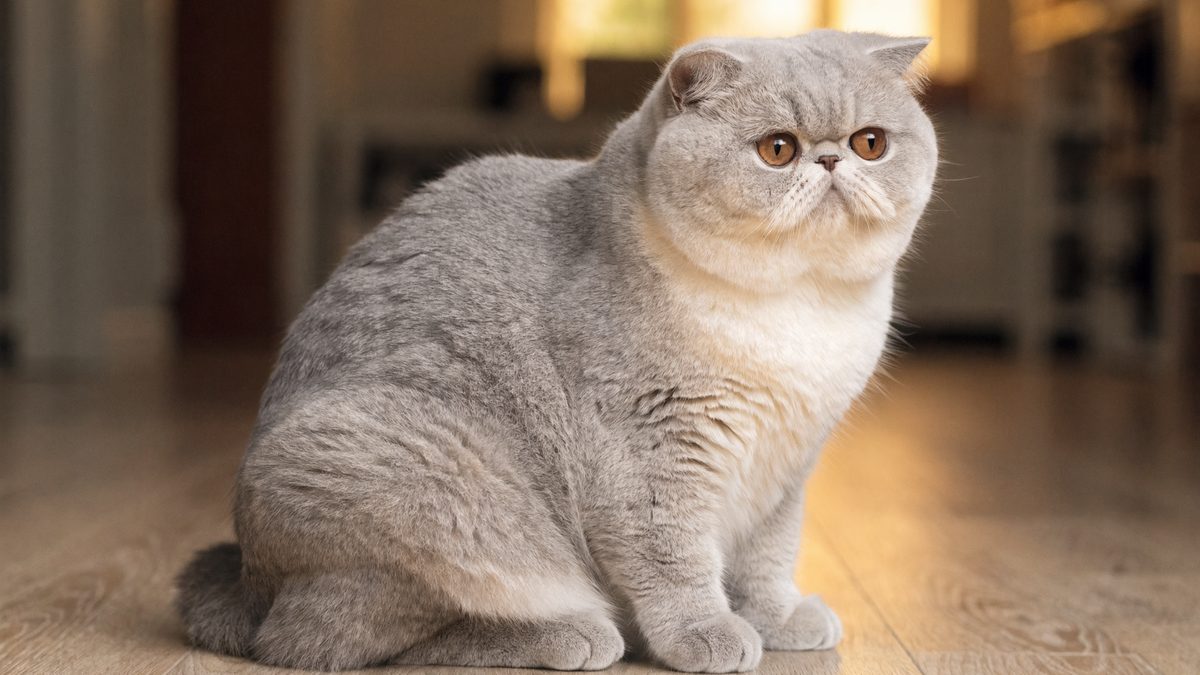
An Exotic Shorthair is a Persian with a short coat, and that is not a marketing line, it is what the registries wrote down. The Cat Fanciers' Association standard for the Exotic is the Persian standard with one section changed, and The International Cat Association judges the Exotic under a document titled the Persian Breed Group Standard. Everything on this page follows from that single fact.
CFA states the goal in one sentence. Once the original cross was made, Exotics were consistently bred back to Persians rather than to their shorthaired ancestors, which is why there is now practically no difference between the two breeds when it comes to personality and intelligence. TICA puts the Exotic Shorthair inside the Persian Breed Group alongside the Persian and the Himalayan, and says all three have the same head and body type, with coat and coloration the only characteristics distinguishing them The International Cat Association.
So when you compare an Exotic Shorthair against a Persian in India, you are not comparing two breeds. You are comparing two coat lengths on one animal. That changes what transfers between them and what does not, and this page is careful about the difference throughout. Grooming load genuinely changes. The flat face does not.
Where the breed came from, and why it was nearly called the Sterling
American Shorthair breeders created the Exotic by accident. They bred American Shorthairs to Silver Persians to pick up the silver coat colour and green eye colour, and the resulting kittens were pleasing to look at but did not resemble true American Shorthairs. Jane Martinke noticed both the harm this was doing to the American Shorthair type and the appeal of the kittens, and in 1966 she proposed to the CFA Board of Directors that they create a new breed. The name originally proposed was Sterling, after the silver colour, and these cats were to look like Persians but with a short, plush coat. CFA registration became effective in September 1966 and championship status on 1 January 1967. TICA granted championship recognition in June 1979.
Early breeders used more than one shorthaired breed to introduce the short-coat gene. American Shorthair and Burmese were used for body and moderate head, and a few breeders went to the Russian Blue for the plush double coat The International Cat Association. The volume of that outcrossing is much smaller than Indian sellers imply. CFA litter registration statistics show that for the five years before the Exotic to American Shorthair cut-off, only five percent of registered Exotic litters had an American Shorthair parent. American Shorthairs were removed from the allowable outcross list in 1987, and since then the Exotic's only allowable cross has been to the Persian. Today CFA lists exactly one allowable outcross breed, Persian, and TICA lists permissible outcrosses as none The International Cat Association.
| Year | What changed | Source |
|---|---|---|
| 1966 | Jane Martinke proposes the new breed to the CFA Board, provisionally named Sterling. Registration effective September 1966 | CFA The Cat Fanciers' Association |
| 1967 | Championship status effective 1 January | CFA |
| 1973 | The words 'with break' added to the standard, because early Exotics from American Shorthairs had no nose break | CFA |
| 1975 | Allowable outcrosses narrowed to Persian and American Shorthair | CFA |
| 1979 | TICA grants championship recognition in June | TICA |
| 1984 | CFA splits shows into longhair and shorthair groups and places the Exotic in the longhair group | CFA |
| 1987 | American Shorthair removed from allowable outcrosses, leaving Persian alone | CFA |
| 1990 | Exotic standard realigned to be identical to the Persian standard except for the coat description, voted through by an 89 percent margin of Exotic breeders | CFA |
| 1993 | CFA changes the breed name from Exotic Shorthair to Exotic in February | CFA |
| 2009 | A Longhair Exotic show division is created, effective May | CFA |
| 2026 | Blue-eyed and odd-eyed Exotics, except solid whites and colourpoints, must submit a DNA test proving the cat does not carry the PAX3 dominant blue eye gene, plus a microchip number and a five-generation pedigree, before CFA will register them | CFA registration rules revised February 2026 |
The 1984 line in that table is the one worth pausing on. When CFA established longhair and shorthair groupings, the board moved the Exotic into the longhair group because it was a Persian-type cat and should be judged in the same specialty as Persians. The breed's own historian writes that by doing so, CFA acknowledged that the Exotic was indeed a Persian.
The breed standard, in the parts that matter to a buyer
Read the coat clause first, because Indian listings get it wrong more often than any other line. CFA describes the Exotic coat as dense, plush, soft and full of life, standing out from the body due to a rich, thick undercoat, and medium in length, with acceptable length depending on proper undercoat. Medium, not short. TICA is more specific still, calling for a coat longer than that of other shorthair breeds but still short enough not to flow. The Persian by contrast is long and thick, standing off from the body, with an immense ruff. An Exotic is therefore not a smooth-coated cat. It is a cat with a short-but-not-that-short double coat, and the grooming section below treats it that way.
The rest of the standard is Persian. The head is round and massive with great breadth of skull, set on a short thick neck, with small round-tipped ears set far apart and low, and large round full eyes set level and far apart. The nose is short, snub and broad, with open nostrils and a break centred between the eyes. The body is cobby, low on the legs, broad and deep through the chest, with short thick strong legs and a short tail carried lower than the back. Good muscle tone with no evidence of obesity is written into the standard, which matters more in this breed than in most.
Four checks from the standards that cost you nothing
Both registries publish rules that double as free buyer tests, and no page currently ranking in India reproduces a single one of them. Use these on the actual kitten, in daylight, before any money moves.
- Watch the nose break against the eye. CFA disqualifies an Exotic whose break is level with or higher than the top of a fully opened eye. TICA is stricter and requires the break to sit above the bottom edge of the eyes and no higher than the centre of the eyes. A face flatter than that is outside both standards, and the health section explains why the flattest faces are also the worst-breathing ones.
- Listen to the cat breathe. TICA withholds all awards for audible or heavy breathing, and separately for pinched or very narrow nostrils. Sit quietly with the kitten for two minutes. If you can hear it breathing across a quiet room, a TICA judge would not award it, and neither should you.
- Watch it breathe with its mouth shut. TICA disqualifies outright, under show rule 216.12.10, any cat with an inability to breathe normally with a closed mouth. This is the single most useful test on this page. It takes ten seconds and it needs no equipment.
- Look up the nostrils. Both CFA standards for this breed group specify open nostrils, and the Persian standard spells out that the nares must be sufficiently open to allow the cat to breathe without restriction. Pinched slits are a fault the registries themselves penalise.
Every check above comes from a document written by people who award titles to these cats, not from a welfare campaign and not from us. That makes them very hard to argue with. When an Indian seller tells you a flatter face is the premium version, you can answer that CFA disqualifies the flattest ones and TICA will not award a cat you can hear breathing The International Cat Association. You are not being difficult. You are quoting the standard the kitten is supposedly bred to.
How big an Exotic actually gets
Expect a medium cat that looks bigger than it is. TICA notes that Exotics are medium sized but appear larger than they really are because of the dense fur, with males larger than females. Indian listings publish a tighter range than that, and they broadly agree with each other, which is unusual on this SERP.
| Source | Height | Weight | Note |
|---|---|---|---|
| Mr n Mrs Pet | 10 to 12 inches | Males 4 to 6 kg, females 3 to 5 kg | India-facing spec table |
| Puppiezo | 10 to 12 inches | 4 to 8 kg | Filed under 'Puppies For Sale' |
| MyKitten | Around 12 inches | Up to 15 pounds, males 5 to 7 kg | Says weight is dense bone, not fat |
| TICA | Not stated numerically | Medium, males larger than females | Warns the dense coat exaggerates size |
| UK primary care, Persians | Not stated | Mean adult bodyweight 3.9 kg | The nearest large dataset, Persian only |
Note the last row carefully. The mean adult bodyweight of 3.9 kg comes from 3,235 Persians under UK first-opinion veterinary care and is a Persian figure, not an Exotic one. It sits well below the 4 to 8 kg Indian sellers quote. Bonbeno is not going to claim it transfers, because no equivalent study of Exotics exists. What it does tell you is that a 7 kg Exotic in an Indian flat is worth weighing against a body condition score rather than a seller's brochure, and the feeding section returns to that.
Exotic Shorthair cat price in India
An Exotic Shorthair costs Rs 20,000 to Rs 1,50,000 in India in 2026 depending on which published source you read, and one source contradicts itself by Rs 1,50,000 inside a single page. Treat any single quoted number as unreliable and read the spread instead.
Bonbeno compared every Indian source currently visible for this query that publishes an actual figure. Four do. They do not agree, and the disagreement is larger in proportional terms than it is for the Persian.
| Source | Quoted price band | What the band is said to cover |
|---|---|---|
| Vetscan | Rs 20,000 to Rs 35,000 | The breed overall, in a 20-breed roundup |
| Happy Pet, spec panel | Rs 20,000 to Rs 50,000 | Stated as 'cost of buying' |
| Happy Pet, body text on the same page | Rs 80,000 to Rs 2,00,000 | 'Depending on the breeder, colour, and show quality' |
| MyKitten | Rs 45,000 to Rs 85,000 | Varies by location and age of the cat |
| Mr n Mrs Pet | Rs 55,000 to Rs 1,50,000+ | Split three ways by documentation, below |
Read the two Happy Pet rows together, because they are the clearest illustration on this page of why you should not trust one number. The same page states a buying cost of Rs 20,000 to Rs 50,000 in its specification panel and then, a few hundred pixels below, tells you to expect anywhere around Rs 80,000 to Rs 2,00,000. The floor of the second statement is 60 percent above the ceiling of the first. Neither figure carries a sample size, a collection date or a method.
What the price tiers are actually selling you
Only one Indian source splits its price by anything concrete, and what it splits by is paperwork rather than the cat.
| Tier | Quoted price | What the tier is said to add |
|---|---|---|
| Basic quality | Rs 55,000 to Rs 90,000 | A purebred companion with no show emphasis |
| FCI registered | Rs 90,000 to Rs 1,20,000 | Verified pedigree, health verification, breeder accountability, official pedigree documentation |
| Champion bloodline | Rs 1,20,000 to Rs 1,50,000+ | Descent from award-winning parents |
The jump from tier one to tier two is roughly Rs 35,000 and it buys a document. That can be worth paying for, because a pedigree is the only thing that tells you which cats are behind the kitten, and the health section explains why that matters enormously in a breed where every ancestor is a Persian. It is worth paying for only if you actually see the document. Ask to be shown the registration certificate and the parents' registered names before you pay a premium that is defined entirely by that certificate existing.
Price by city is published, and it barely varies
Indian pages usually assert that metros run more expensive without evidence. On this breed one platform publishes an actual city table, and the interesting thing about it is how flat it is.
| City | Quoted band |
|---|---|
| Mumbai | Rs 55,000 to Rs 1,50,000 |
| Delhi | Rs 55,000 to Rs 1,50,000 |
| Chennai | Rs 55,000 to Rs 1,50,000 |
| Hyderabad | Rs 55,000 to Rs 1,50,000 |
| Pune | Rs 55,000 to Rs 1,50,000 |
| Jaipur | Rs 55,000 to Rs 1,50,000 |
| Bangalore | Rs 60,000 to Rs 1,50,000 |
| Lucknow | Rs 60,000 to Rs 1,50,000 |
Six of the eight cities carry an identical band and the other two differ by Rs 5,000 at the floor only. Bangalore and Lucknow sharing a price while Mumbai and Jaipur share a different one is not a market signal, it is a template. Bonbeno's honest reading is that no published source quantifies genuine city variation for this breed in India, and we are not going to invent one. If a seller in your city quotes outside these bands, ask what specifically justifies it and expect a concrete answer about pedigree, screening results or import cost.
The number that actually explains the price: there are almost no Exotics in India
The Exotic Shorthair is genuinely rare in the Indian market, and one platform's own inventory proves it. On the day this page was researched, Mr n Mrs Pet returned 6 results for Exotic Shorthair kittens across the whole of India. On the identical filter on the same site, Persian returned 1,117. The Exotic does not appear anywhere in that platform's own list of the ten most popular cat breeds, which runs Persian 1,117, Maine Coon 96, Bengal 78, Himalayan 64, Ragdoll 62, British Shorthair 54, Siamese 51, Calico 46, Siberian 37 and British Longhair 23.
Six listings against 1,117 is a ratio of roughly 186 to 1 on India's largest cat listing site. That scarcity is the real reason an Exotic is quoted above a Persian in India, and it has a practical consequence. When a breed is that thin on the ground, the incentive to sell you a flat-faced Persian kitten with a shortish coat, or a random domestic shorthair, as an Exotic is high. On the same listing page, one kitten advertised under the Exotic Shorthair breed filter carries the seller's own description 'Persian kitten, Very active, Friendly';. The breed checks in the overview section are what protect you here.
How this compares with a Persian
Expect to pay more for an Exotic than a Persian in India and to get a scarcer cat rather than a healthier one. The same roundup that prices the Exotic at Rs 20,000 to Rs 35,000 prices the Persian at Rs 15,000 to Rs 35,000, and the British Shorthair at Rs 30,000 to Rs 50,000. Our Persian cat price in India page tracks that breed's own spread across six sources, which runs far wider. The premium you pay for the short coat is real and it is defensible on grooming-time grounds alone. It is not defensible on health grounds, and the health section explains exactly which Persian findings follow the Exotic across and which stop at the coat.
Bonbeno does not broker kitten sales, does not publish breeder listings and does not recommend sellers. Every figure above is reported from a third-party published source so you can see the disagreement yourself instead of trusting whichever page you happened to open first. None of these bands is an offer.
Monthly cost of owning an Exotic Shorthair in India
Budget Rs 3,200 to Rs 8,000 a month for an Exotic Shorthair in India, and add a conformation line that no Indian source itemises. Two published Indian estimates exist for this breed and they overlap at the bottom and diverge by Rs 4,800 at the top.
Neither published estimate states a sample size, a set of cities or a collection date. Bonbeno is reproducing both rather than averaging them into a false precision.
| Line item | Happy Pet, Exotic-specific | Mr n Mrs Pet, Exotic-specific |
|---|---|---|
| Food | Rs 1,500 to Rs 2,000 | Included in the total, not itemised |
| Routine veterinary | Rs 500 to Rs 700 | Included in the total, not itemised |
| Grooming | Rs 1,200 to Rs 1,500 | Included in the total, not itemised |
| Stated monthly total, basic | Rs 3,200 | Rs 3,000 to Rs 8,000 overall |
| Stated monthly total, premium | Rs 4,200 | Not split |
The Happy Pet grooming line is the one to question. It allocates Rs 1,200 to Rs 1,500 a month to grooming an Exotic Shorthair, which is a professional-salon budget, while the same page's own FAQ says once a week is usually enough to groom the breed. Those two statements do not fit together. If you comb the cat yourself, which both registries describe as straightforward for this coat, that line falls close to zero and the realistic Indian monthly total sits nearer Rs 2,000 to Rs 3,000 for food, litter and routine care.
The four Exotic-specific lines nobody budgets for
Every cost below follows from the flat face rather than the coat, which is exactly why an Exotic does not cost meaningfully less to run than a Persian even though it costs far less time to groom.
- More vet visits, measured. In a survey of 278 brachycephalic cat owners, 36 percent visited the vet three to five times a year, against 20 percent of non-brachycephalic cat owners. That is roughly one extra consultation a year, every year, before anything goes wrong.
- Dental work under general anaesthetic. In the only prospective study to include Exotics, periodontal disease was reported in 44 of 50 purebred brachycephalic Persian and Exotic cats, which is 88 percent, and tooth resorption was evident in 35 of them, 70 percent. A scale, polish and extraction under anaesthetic is a four-figure cost in every Indian metro, and in this breed it is a conformation problem rather than a hygiene one, so brushing reduces it without removing it.
- Eye care, daily and sometimes surgical. Owners of flat-faced cats reported epiphora, meaning constant tear overflow, in 193 of 278 cats, which is 69.4 percent, and 26 of those cats, 9.3 percent, had undergone conformation-related ocular surgery. Daily cotton and saline is a small recurring line. Corneal ulcers, reported by 12.2 percent of those owners, are not.
- Cooling, which lands on your electricity bill. No Indian source publishes this figure because it never appears on a pet invoice, and Bonbeno is not going to estimate it. What is documented is that 51 of 278 flat-faced cat owners, 18.3 percent, reported breathing distress in hot climatic conditions, and 49, 17.6 percent, reported outright heat intolerance. In an Indian summer that translates into running a cooled room, and the climate section covers what that actually requires.
One cost you probably will not have
You will almost certainly not pay for de-matting or clip-outs, and that is the single genuine saving over a Persian. A Persian coat that has been clipped out can take six months to two years to regrow fully, and Indian guidance for that breed advises bathing every week to ten days through monsoon to keep the undercoat from felting. An Exotic coat is dense but it is medium length and does not flow, so it does not mat on that clock The International Cat Association. Over a fifteen-year life that is a real difference in both money and in weekly hours.
When we publish a cost figure we state the source, the sample size where one exists and the collection date. Where no reliable figure exists, as with the electricity cost of cooling a flat-faced cat through an Indian summer, we say so plainly rather than repeating an unsourced estimate. The monthly totals above are other people's numbers, reproduced so you can see how far apart they sit.
The first-year figure to plan against
Plan the first year as the purchase price plus roughly Rs 40,000 to Rs 60,000. That is twelve months at the published Rs 3,200 to Rs 4,200 range, plus a kitten vaccination course at 8, 12 and 16 weeks, plus neutering, plus one baseline health workup. If you are buying from a seller who has not screened the parents for polycystic kidney disease, add the cost of an ultrasound scan or a genetic test on your own kitten, because the health section explains why that test is not optional in a cat with Persian ancestry.
Can an Exotic Shorthair handle the Indian climate
An Exotic Shorthair copes with Indian heat better than a Persian and worse than almost anything else, and the reason is that the short coat solves half the problem and the flat face solves none of it. One Indian breed guide puts the Exotic's ideal weather at 15C to 30C, which is a band most of urban India spends four to six months a year above.
Start with the number, because it is the most useful single figure on this page for an Indian buyer. Happy Pet's Exotic Shorthair specification panel lists ideal weather as 15C to 30C. Now set that against what India actually did in May 2026. On 21 May, Delhi's Safdarjung recorded a maximum of 43.6C on the capital's warmest night in fourteen years, the highest temperature anywhere in the country was 47.6C at Banda in Uttar Pradesh, and maximum temperatures across northwest, west, central and north peninsular India ranged between 40C and 47C. Delhi, Haryana, Uttar Pradesh and Vidarbha were under warm-night forecasts at the same time.
A cat rated for 30C living through 43.6C is not a marginal mismatch. It is a design problem you manage with equipment, and you should decide whether you are willing to run that equipment for the next twelve to fifteen years before you buy.
Why the flat face is the heat problem, not the coat
Cats cool themselves largely by evaporation and by moving air, and a shortened muzzle interferes with both. The RSPCA states the mechanism plainly: brachycephalic cats have the normal amount of soft tissue in the mouth and throat but in a much smaller space due to their shortened skulls, which restricts movement of air when breathing, with narrow nostrils, a long soft palate and a narrow windpipe as the specific features. Indian guidance for the Persian makes the heat link explicit, noting that Preventive Vet listed Persians among the brachycephalic breeds at the highest heatstroke risk in hot weather because their shortened airways limit panting.
That mechanism is conformational, and the Exotic's conformation is the Persian's by written intent. CFA's Exotic standard is the Persian standard with the coat clause changed, and TICA judges both under one Persian Breed Group document The International Cat Association. Bonbeno will not tell you the Persian airway measurements transfer as numbers, because no study has measured Exotic airways. What we will say is that the registries themselves define the two skulls as the same, and the burden of proof sits with anyone claiming the Exotic breathes better.
What flat-faced cat owners actually report about heat
Owner data exists and it is specific. In a survey of 278 owners of flat-faced cats, a group whose brachycephalic breeds the authors name as including the exotic shorthair, 51 owners reported breathing distress in hot climatic conditions, which is 18.3 percent, and 49 reported heat intolerance, 17.6 percent. Snoring was reported for 113 cats, 40.6 percent, and noisy breathing for 117, 42 percent. That survey was run in Italy. India is hotter for longer.
| Reported sign | Owners affected | Share | What it means in July in Chennai |
|---|---|---|---|
| Noisy breathing | 117 | 42% | Baseline airway restriction that heat makes worse |
| Snoring during sleep | 113 | 40.6% | Sleep is already compromised before the room warms |
| Breathing distress in hot climatic conditions | 51 | 18.3% | Direct heat intolerance, reported by owners in a temperate country |
| Heat intolerance | 49 | 17.6% | The cat stops coping before you think it should |
| Breathing distress after activity | 44 | 15.8% | Play plus heat is the combination to avoid |
| Open-mouth breathing | 25 | 8.9% | In a cat this is an emergency sign, not a warm-day habit |
A dog panting is normal. A cat breathing through an open mouth is not. Take it as an emergency and go to a vet the same hour. TICA's own show rules disqualify a cat that cannot breathe normally with a closed mouth, which tells you how abnormal the registries consider it. Do not wait to see whether the cat settles once the room cools.
The coat is a genuine advantage, and a smaller one than sellers claim
The short coat helps, and it helps less than Indian listings suggest, because an Exotic is not smooth-coated. CFA describes the coat as dense and plush, standing out from the body due to a rich thick undercoat, and medium in length. TICA calls it longer than that of other shorthair breeds. That is still a double coat with insulating undercoat, just a shorter one than a Persian's long coat and immense ruff. Against a Persian in a Pune June the Exotic is clearly better off. Against an Indian domestic shorthair it is not close.
Do not shave the cat to cool it. Indian guidance for the Persian is explicit that full shaves should be avoided for cooling and trimming saved for severe matting only, and a clipped coat can take six months to two years to regrow fully. A double coat insulates against heat as well as cold, and removing it exposes skin.
Humidity, monsoon and dust, city by city
Indian conditions add two problems the temperate literature barely covers. Vetic, an Indian veterinary chain, states that Persian cats in India often face skin issues and breathing issues because of the high humidity, pollution and temperatures. Both problems reach the Exotic. Severe brachycephaly can cause excessive skin folds on the face which may predispose to bacterial or fungal skin infections, and a facial fold that stays damp through a Mumbai monsoon is the ideal setup for one. Dermatitis was the leading veterinary diagnosis reported by flat-faced cat owners, in 50 of 278 cats, 17.9 percent.
Dust is the second. TICA's own care note for the Exotic says the eyes can get irritated by dust because of their large surface. In Delhi or Ahmedabad that is not an occasional issue, and it is why the grooming section treats daily eye cleaning as a fixed task rather than a response to visible discharge.
| Condition | What to do | Why |
|---|---|---|
| Above 30C indoors | Run a cooled room the cat can always reach | The breed's stated ideal weather tops out at 30C |
| Heatwave alert in your state | Keep the cat indoors and in the cooled room through the hottest hours | Brachycephalic animals overheat more easily and should be kept out of the sun and hydrated |
| Warm nights | Do not switch cooling off overnight | IMD issued warm-night warnings for Delhi, Haryana, UP and Vidarbha in the same May 2026 spell |
| Monsoon humidity | Dry the face folds and the coat fully after any bath | Damp folds predispose to bacterial or fungal skin infection |
| High dust or poor air days | Wipe the eye corners twice rather than once | The large exposed eye surface is irritated by dust |
| Any noisy breathing at rest | Stop, cool the cat, call a vet | Audible or heavy breathing is a withhold-all-awards fault in the standard, not a breed quirk |
Heatstroke, and the first aid to know before you need it
A US veterinary resource names this breed explicitly. Its list of predisposing factors for heatstroke in cats opens with brachycephalic breeds, given as Persians, Himalayans, Exotic Shorthairs, Scottish Folds and snub-nosed mixes of these breeds, and separately flags excess weight, because fat cells act as insulation and overweight cats generate more heat from even mild exercise. It also notes that stressed cats often pant, which makes recognising heatstroke harder.
Learn the signs: panting, unusually wet paw prints, disorientation, vomiting, restlessness, lethargy, drooling or thick sticky saliva, a bright red tongue or mouth, and a rectal temperature above 105F against a normal of about 101.5F. First aid starts at home and does not replace a vet. Move the cat into a cool or air-conditioned space, wet the fur thoroughly and continuously with cool or tepid water rather than ice or cold water, pet the excess water off as it absorbs heat, run a fan gently over the body, and stop cooling once the temperature reaches 102.5F to 103F. Then go to a vet even if the cat looks recovered.
The same source reinforces the no-shaving rule from the other direction, noting that trimming a cat's fur is not always a good idea because the skin is thin and fragile and the fur protects against sunburn, while routine brushing to remove tangles, mats and loose undercoat lets air flow freely to the skin. Brush more, clip less.
One honest caveat on the whole section. India has no published veterinary dataset on brachycephalic cats in Indian conditions. Everything above combines registry standards, UK and Italian veterinary literature, IMD temperature records and Indian veterinary advice. If you want a single sentence: an Exotic Shorthair is keepable in an Indian metro flat with air conditioning, and it is a poor choice for a home that cannot cool a room reliably through May and June.
Temperament, household fit and who should not buy one
An Exotic Shorthair is a quiet, gentle, undemanding lap cat that follows you around the house and rarely meows. Both registries describe the same animal, and CFA is explicit that there is practically no difference between the Exotic and the Persian in personality and intelligence.
CFA's description is worth quoting almost in full because it is the most accurate summary published anywhere. Exotics are quiet, loyal companions, devoted but not intrusive, content to remain close to you without requiring inclusion in your activities, and they speak to you with their large eyes rather than with their voices, so you may hear purrs but meows will be rare. The breed is endearing and easy going, adaptable enough to fit into a new home at any age, an excellent choice as a pet for young children, and although it may be initially shy with other animals it soon learns to peacefully coexist with dogs and other cats.
TICA adds one nuance. Exotics have the quiet manners of the Persian but are livelier and more inquisitive thanks to their shorthaired ancestry, and their shorthaired ancestors have given them a love of play, so they will jump to catch a toy and study how to reach one you put out of reach. TICA also notes the voice, describing a cat seen but rarely heard, with a soft voice and a vocabulary of chirping sounds.
CFA offers a mildly different explanation for the same observation, suggesting some consider Exotics a bit more active and playful than Persians, perhaps because there is not the same need to train them to sit still for lengthy grooming sessions. The two registries agree the Exotic is slightly livelier. They disagree about why, and neither claim is measured. Treat the difference as small.
One Indian claim to discard
MyKitten's page tells Indian buyers that the Persian cat breed is very chirpy and vocal, that one can hear a continuous Persian meow all day long, and that Exotics are quieter and more active by comparison. That is not what either registry says. CFA describes the Persian and the Exotic as practically indistinguishable in personality, and the same page notes the Exotic rarely meows without making any claim about Persians being loud. If you are choosing between the two breeds on noise, you are choosing on a difference that no registry documents.
The uncomfortable part of the calm temperament
The placid temperament is genuinely the reason most people buy this cat, and it may not be entirely temperament. In a survey of 278 owners of flat-faced cats, character was the main motivation for acquiring the breed for 257 of them, 92.4 percent. Set against that, the RSPCA states directly that cats with natural features are able to interact with their environment displaying a full range of normal behaviours, while brachycephalic cats experience chronic pain and behavioural inhibition creating a social silence.
That is a strong claim and Bonbeno is not going to overstate it. It is a welfare body's position, not a measured finding, and plenty of Exotics are calm because Persians were bred to be calm. But it is worth knowing that a quiet, still, undemanding cat can also be a cat that has learned moving is uncomfortable, and it gives you a practical rule. If your Exotic becomes noticeably quieter, stiller or less interested over weeks or months, treat that as a possible medical sign rather than the breed settling down. The RSPCA notes that cats often hide their pain and discomfort, so noticing they are suffering can be difficult.
Household fit, honestly scored
| Household | Fit | Why |
|---|---|---|
| A 2BHK metro flat with air conditioning | Very good | Low activity, strictly indoor, and the cooled room the flat face needs The Cat Fanciers' Association |
| A family with young children | Good | CFA calls the breed an excellent choice as a pet for young children |
| A home with a resident dog or cat | Good, after a slow start | May be initially shy with other animals but soon learns to coexist peacefully |
| A first-time cat owner | Good | Easy going, adaptable at any age, and low grooming demand The International Cat Association |
| A house with no reliable cooling | Poor | Ideal weather is stated as 15C to 30C and Indian metros run far above that for months Time Out India, Delhi sees warmest night… |
| Someone who wants an outdoor or free-roaming cat | Poor | A flat-faced cat overheats more easily and needs to be kept out of the sun |
| A buyer who cannot afford unplanned vet bills | Poor | 36 percent of brachycephalic cat owners visited a vet three to five times a year |
| Someone who wants an interactive, athletic cat | Poor | The breed is a lap cat with a love of gentle play, not an athlete |
Temperament is written into the standard
A show Exotic is required to be even-tempered. TICA's standard states that temperament must be unchallenging and that any sign of definite challenge shall disqualify, while allowing that a cat may complain aloud, exhibit fear or seek to flee without threatening harm. CFA describes the ideal as a cat with a sweet expression, and the whole breed group standard calls for a cat that is well balanced physically and temperamentally, gentle and amenable to handling The International Cat Association.
Temperament in cats is shaped by early handling as much as by breed, and a calm, confident, people-friendly queen is the best single predictor you get to observe. Ask to see the mother in the room where the kittens are raised. A seller who will not show you the mother is telling you something, and in a breed with six listings across the whole of India you have the leverage to insist.
Litter training, handling and enrichment for an Exotic Shorthair
Train an Exotic Shorthair for handling before you train it for anything else, because this breed needs four daily hands-on tasks that most cats never require. Litter training is usually effortless. Getting a cat to accept its face, teeth, rear and carrier being handled is the work, and the window for it is short.
The AAHA and AAFP Feline Life Stage Guidelines put the kitten socialisation period between roughly two to three weeks and nine to ten weeks of age, and warn that the kitten that is startled or subjected to rough handling may develop fears that last a lifetime. Most Indian kittens go home at eight to twelve weeks, which means a good part of that window closed at the breeder's house. Ask what handling the litter has already had, and start your own the day the kitten arrives.
The four handling habits to build in the first month
- Face and eye corners. Aim for a daily wipe with damp cotton. Epiphora, meaning constant tear overflow, was reported in 69.4 percent of flat-faced cats by their owners, and the cause is anatomical rather than hygienic, so it returns within a day of cleaning. A cat that fights this at six months is a cat you will clean badly for fifteen years. Pair it with food from day one.
- Mouth and teeth. The RSPCA's advice for brachycephalic cats is to clean the teeth daily, just as we do ours. In the one study that included Exotics, periodontal disease was reported in 88 percent of purebred brachycephalic Persian and Exotic cats. Start by touching the lip, then a finger on a tooth, then a brush, over weeks rather than days.
- The rear and the tail base. A flat-faced cat's jaw deformities can lead to problems with eating, drinking and grooming, which means the cat may not be able to clean its own back end properly, and the area is prone to becoming stained with faeces. Handle it early so that checking it is routine rather than a fight.
- The carrier. Leave it open in the room permanently with a blanket in it. Given that 36 percent of brachycephalic cat owners visit a vet three to five times a year, the carrier is not an occasional object in this breed.
Habituation works on repetition rather than duration. Two ten-second sessions a day, each ending with food while the cat is still relaxed, builds tolerance faster than one long session that ends with the cat struggling. Stop before the cat wants to stop, every time, for the first month.
Litter training, and one thing to do differently
Litter training an Exotic kitten is usually straightforward, and the useful refinement is substrate. The AAHA and AAFP guidelines recommend offering a variety of toileting substrates to young kittens so they evolve into adults with greater acceptance for an array of litter types. In India that pays off directly, because supply of any one imported litter is unreliable and a cat that only accepts one brand becomes a problem the week that brand is out of stock. Run two trays with two different substrates for the first few months.
Choose the tray for the body shape rather than the cat's age. An Exotic is cobby and low on the legs with short, thick legs by standard, so a high-sided tray with a tall lip is harder to enter than it looks. Use a low-entry tray, keep one on every floor the cat uses, and scoop daily.
Watch litter box behaviour as a health signal, not just a housekeeping one. Changes in litter box behaviour are listed among the signs of stress in this breed, and the health section explains why urinary problems deserve particular attention in cats with Persian ancestry International Cat Care.
Enrichment for a cat that will not chase you around the flat
Enrichment for an Exotic is about frequency and floor level, not intensity. TICA notes that simple things amuse them, whether that is chasing paper balls around the house or watching water drip out of a tap, and that they will jump to catch a toy or sit studying how to reach one you put out of reach. That is the ceiling of this breed's ambition and it is enough.
| Item | Why it fits this breed | Note |
|---|---|---|
| Two scratching posts, one horizontal and one upright | Indian sellers report the breed scratches persistently and will use furniture if nothing else is offered | Place one near the sleeping spot |
| A food-dispensing toy | Slows eating and adds activity to a low-activity cat | Choose a wide-opening design, because a flat face struggles with narrow ones |
| Wand toy, two short sessions a day | The shorthaired ancestry gives a genuine love of play | Stop before the cat starts breathing audibly |
| A low, broad platform rather than a tall cat tree | Cobby body, short legs, low on the legs by standard | Steps rather than jumps |
| A dripping tap or a water fountain | TICA names watching water drip as a genuine amusement for the breed | Also helps water intake, which matters for kidneys |
| A cooled room the cat can always reach | Stated ideal weather tops out at 30C | This is enrichment in an Indian summer, not a luxury |
Know the stress signs before you need them
Watch for hiding, changes in litter box behaviour, increased vocalisation, aggression, overgrooming and compulsive behaviours such as excessive licking or chewing. In a breed that is quiet by default, increased vocalisation is a particularly loud signal. So is a cat that stops using a spot it always used. Neither is naughtiness and neither responds to correction.
One last training note that is specific to this face. Do not teach an Exotic to chase hard or wrestle roughly. Breathing distress after activity was reported in 15.8 percent of flat-faced cats by their owners, and exercise intolerance sits on the RSPCA's list of subtle signs that a brachycephalic cat is struggling. Short, frequent, gentle play is the correct dose.
How much exercise an Exotic Shorthair actually needs
Give an Exotic Shorthair 20 to 60 minutes of gentle daily activity, split into short sessions, and stop the moment its breathing becomes audible. The two Indian sources that publish a figure disagree by a factor of two, and the ceiling matters less than the way you break the time up.
Neither Indian figure is sourced and neither is wrong in a useful sense. Take 30 minutes as a working target, delivered as three ten-minute sessions rather than one long one, and let the cat's breathing set the actual limit on any given day.
The stop signal is breathing, not tiredness
Stop play the moment you can hear the cat breathe. The RSPCA lists exercise intolerance, and collapse or fainting especially after playing or exercise, among the signs that a brachycephalic cat is struggling. Owner-reported data puts breathing distress after activity in 44 of 278 flat-faced cats, 15.8 percent. In an Indian summer that threshold arrives sooner than it does in the studies, because heat and airway restriction compound.
Stop and cool the cat if it opens its mouth to breathe, if breathing becomes audible across the room, or if it lies down mid-play and does not get up when the toy moves. Open-mouth breathing in a cat is an emergency, not a sign of enthusiasm. Play indoors, in the cooled room, in the early morning or after dark, and never in the afternoon during a heatwave alert.
Why doing nothing is also a risk
A sedentary Exotic is not a safe compromise. In the survey that measured facial conformation against owner-reported breathing in 1,000 cats, respiratory score was significantly associated with a sedentary lifestyle as well as with a shorter muzzle. That is an association rather than a proven cause, and it plausibly runs both ways, because a cat that struggles to breathe moves less. Either way the practical conclusion holds. Do not let a flat-faced cat become an ornament, and do not let it become fat.
Obesity is the default outcome without effort. Indian guidance lists obesity among the breed's common health problems specifically because Exotics do not move around much, and recommends portion control plus regular play. CFA writes the requirement into the standard itself, calling for good muscle tone with no evidence of obesity. In a cat that already has restricted airways, extra weight around the chest and abdomen makes breathing harder rather than merely making the cat rounder.
What activity should look like in an Indian flat
- Three sessions of eight to ten minutes, morning, evening and just before your bedtime, with a wand toy at floor and low-shelf level.
- Feeding from a puzzle for at least one meal a day, so eating costs some effort.
- Steps rather than jumps between levels, because the breed is cobby and low on the legs with short thick legs.
- Play only in the cooled room between March and June in most of India, given a stated ideal weather ceiling of 30C and metro maxima of 40C to 47C in the May 2026 spell Time Out India, Delhi sees warmest night….
- A weekly weigh-in on a kitchen scale for the first year and monthly after that, so you catch weight gain before it shows.
Weigh the cat rather than looking at it, because a dense plush coat standing out from the body hides body condition, and TICA warns that Exotics appear larger than they really are because of that coat The International Cat Association. Run your hands over the ribs weekly. You should feel them under a thin layer without pressing. If you cannot, the cat is carrying weight the coat is concealing.
One thing an Exotic does not need is a garden. This is a strictly indoor cat in India, both because a flat-faced cat overheats more easily outdoors and should be kept out of the sun, and because a Rs 55,000 to Rs 1,50,000 cat that cannot run well is not a candidate for a balcony without a net. Net every window and balcony before the kitten arrives.
Grooming an Exotic Shorthair coat in Indian humidity
Comb an Exotic Shorthair two or three times a week and clean its face every single day. The coat is the half of Persian grooming this breed genuinely removes. The face is the half it does not, and Indian listings sell you the saving without mentioning which half stays.
Get the coat right first, because most Indian pages describe it wrongly. CFA specifies dense, plush, soft and full of life, standing out from the body due to a rich, thick undercoat, and medium in length, with acceptable length depending on proper undercoat. TICA describes a distinct short, plush and stand-away coat texture, longer than that of other shorthair breeds but still short enough not to flow. The Persian, for contrast, is long and thick, standing off from the body, with an immense ruff continuing in a deep frill between the front legs.
So an Exotic has a genuine double coat with a thick undercoat, just short enough that it does not flow and does not felt. That is why the maintenance drops without disappearing.
Three coat claims on ranking Indian pages that contradict both registries
- 'Dense, curly coats that need trimming every 4 to 6 weeks to prevent matting.'; That sentence appears in the FAQ of a page ranking for this query. Neither registry describes the Exotic coat as curly, neither prescribes trimming, and Indian guidance for the related Persian explicitly says to avoid full shaves and save trimming for severe matting only The International Cat Association CatsCart, How to Care for a Persian Cat…. Trimming a plush double coat every six weeks is a service you would be paying for and the cat does not need.
- 'Their long, silky coats require more maintenance than short-haired breeds.'; This appears on the same Exotic Shorthair page, in the answer about monthly costs. It is a Persian sentence left in a template. The Exotic's coat is medium at most.
- 'HYPOALLERGENIC: Highly.'; The same specification table marks the breed as highly hypoallergenic. No cat breed is hypoallergenic, and a cat with a dense undercoat that sheds is a strange candidate for the claim. One Indian source lists the breed's shedding as low, another simply answers yes Puppiezo, Exotic Shorthair Price. If someone in your home reacts to cats, do not buy this one on that basis.
What the coat actually needs
TICA's own care note is one sentence long and it is accurate. Grooming is easy, with simple combing removing loose dead hair and a wipe of the eyes that can get irritated by dust because of their large surface. Indian sources land in a similar place, with one saying once a week is usually enough and to increase during shedding seasons.
Bonbeno's recommendation for Indian conditions is two to three combings a week rather than one, for a specific reason. Dermatological disorders were the most common disorder group in 3,235 Persians under UK primary care at 17.9 percent, with haircoat disorders the single most common specific diagnosis at 12.7 percent. Dermatitis was also the leading veterinary diagnosis reported by owners of flat-faced cats, in 17.9 percent of 278 cats. Skin is the weak point in this family of cats, and Indian humidity is harder on skin than a British winter. Combing twice as often as the minimum is cheap insurance.
| Task | Exotic Shorthair | Persian | Does the saving transfer? |
|---|---|---|---|
| Comb to the skin | 2 to 3 times a week, roughly 5 minutes | Daily, and many Persians cannot keep their coat mat-free on their own | Yes. This is the real saving |
| De-matting and clip-outs | Rare | A recurring cost, and a clipped coat can take 6 months to 2 years to regrow | Yes |
| Bathing | Occasional | Roughly weekly to ten-daily through monsoon | Yes |
| Face and eye corners | Daily | Daily | No. Identical |
| Tear staining management | Daily | Daily | No. Identical |
| Rear and tail base check | Daily to every other day | Daily | Partly. Less fur to foul, same inability to reach |
| Teeth | Daily brushing advised | Daily brushing advised | No. Identical |
| Nail check | Weekly | Weekly. Overgrown nails affected 7.2 percent of Persians in one year | No. Identical |
Daily face cleaning is a separate job, and it is the one that never goes away
Clean the face every day, separately from the coat, because the tear overflow is structural. Computed tomography of brachycephalic and mesocephalic cats showed that increased brachycephaly displaces the facial bones and the upper canine teeth upward, dislocating nasal structures and leaving the nasolacrimal drainage system inefficient, adopting a V-shaped course in severe cases. International Cat Care describes the same thing in plainer terms, that the ducts which should drain tears into the nose are deformed, so the eyes run constantly, causing tear-staining on the face and sometimes sores because the skin is always wet.
The rust-coloured tear staining that runs from the inner eye corner down each side of the nose is the visible result, and it returns within a day of cleaning because the cause is anatomy rather than dirt. Use damp cotton with cooled boiled water or saline, one piece per eye, never reused. Where severe brachycephaly has produced facial skin folds, clean and dry between them daily as well International Cat Care.
TICA names dust specifically as an irritant for this breed because of the large exposed eye surface. On high-dust days in Delhi, Ahmedabad or any city in construction season, wipe twice rather than once, and do it after the cat has been near an open window. This is the cheapest preventive step on the entire page and no Indian guide currently mentions it.
A workable Indian schedule
| Task | Frequency | Note |
|---|---|---|
| Comb through the coat | 2 to 3 times a week | A metal comb reaches the undercoat that a soft brush skims over |
| Wipe eye corners | Daily, twice on dusty days | Damp cotton, one piece per eye, cooled boiled water or saline |
| Check and dry facial folds | Daily where folds are present | Damp folds predispose to bacterial and fungal infection |
| Brush teeth | Daily | 88 percent of purebred brachycephalic Persian and Exotic cats had periodontal disease |
| Check the rear and tail base | Daily to every other day | The conformation limits the cat's ability to groom itself there |
| Trim nails | Every 2 to 3 weeks | Overgrown nails were the third commonest disorder in Persians |
| Bath | Only when genuinely needed | Dry the undercoat completely before letting the cat settle |
| Full clip | Avoid | Save trimming for severe matting only, and never shave for cooling |
Add up the two columns and the honest summary is this. An Exotic Shorthair saves you roughly five to seven hours a month of combing against a Persian, and saves you the de-matting bills entirely. It saves you nothing at all on the face, the teeth or the nails. If you are buying this breed because you were told it is low maintenance, the accurate version is that it is low coat maintenance and identical face maintenance, and the face is the part people give up on.
Exotic Shorthair health, life expectancy and which Persian findings transfer
The Exotic Shorthair carries the Persian's flat-faced health burden and sheds the Persian's coat-related one, and almost all the published evidence is Persian evidence. Only four peer-reviewed datasets contain Exotic Shorthairs at all, and the largest of them holds 44 cats. This section separates what has actually been measured in Exotics from what has been measured in Persians and is being assumed.
Start with the evidence map, because no page ranking in India publishes one and it changes how you should read every figure below.
| Study | Exotics included | What it measured |
|---|---|---|
| Barthez 2003, France | Reported separately from Persians, within 310 cats | PKD prevalence by ultrasound. The only study that publishes a standalone Exotic Shorthair figure |
| Bonazzi 2007, Italy | 44, alongside 288 Persians | Ultrasound screening for polycystic kidney disease |
| Bonazzi 2009, Italy | 7, alongside 63 Persians | Ultrasound against genetic testing for early PKD diagnosis |
| Mestrinho 2018, multicentre | 8, alongside 42 Persians | Oral and dental anomalies under anaesthetic, with full-mouth radiography |
| Noori 2019, Iran, via OMIA | 9, genotyped | PKD1 variant testing |
| Berteselli 2023, Italy | Named among the breeds surveyed, 278 owners in total | Owner-reported signs in flat-faced cats |
| O'Neill 2019, UK VetCompass | None. 3,235 Persians | Demography, disorders and mortality in first-opinion practice |
| Sieslack 2021, Germany | None. 69 Persians against 10 domestic shorthairs | CT skull measurement against brachycephaly grade |
| Teng 2024, UK life tables | None. 12 breeds analysed, the Exotic is not one | Life expectancy at age 0 from 7,936 confirmed deaths |
| Farnworth 2016, UK | Measured by facial conformation rather than by breed | Owner-reported respiratory score against skull measurements |
Life expectancy, where the registry and the Indian sellers disagree by four years
TICA states that the Exotic Shorthair is a very healthy breed and can be expected to live between 8 and 11 years. Every Indian source publishing a figure says 12 to 15 years, or 10 to 15 Puppiezo, Exotic Shorthair Price Vetscan, 20 Best Cat Breeds in India Happy Pet, Exotic Shorthair Cat Breed…. That is a gap of roughly four years at the top and it is not a rounding difference.
| Source | Figure | What kind of figure it is |
|---|---|---|
| TICA | 8 to 11 years | The world's largest genetic registry of pedigreed cats, breed page |
| Mr n Mrs Pet | 12 to 15 years | Indian listing platform specification table |
| Puppiezo | 12 to 15 years | Indian listing platform specification panel |
| Vetscan | 12 to 15 years | Indian veterinary lab blog roundup |
| Happy Pet | 10 to 15 years | Indian breed guide |
| Persian, UK life tables | 10.93 years (95% CI 9.63 to 12.23), n = 80 | Life expectancy at age 0. Persian only, no Exotic figure exists |
| Persian, UK primary care | 13.5 years (IQR 9.9 to 16.0) | Median longevity. Persian only, a different measure |
| All UK cats | 11.74 years (95% CI 11.61 to 11.87) | Life expectancy at age 0, whole population |
| UK purebred cats | 10.41 years (95% CI 9.99 to 10.83) | Against 11.90 years for crossbred cats |
Read that table carefully rather than picking a number. No life expectancy figure for the Exotic Shorthair has ever been derived from veterinary records, because the largest study of its kind analysed twelve breeds from 7,936 confirmed UK cat deaths and the Exotic was not among them. TICA's 8 to 11 years is a registry statement, not a dataset, and it sits below the 11.74-year life expectancy of the UK cat population as a whole, which makes the accompanying description of a very healthy breed hard to square Teng KTY, Brodbelt DC, Church DB. The Indian 12 to 15 figure is unsourced everywhere it appears.
The two Persian figures are also not interchangeable. The 13.5-year median longevity comes from cats that died in UK first-opinion care, while the 10.93-year figure is life expectancy at age 0 from a life table, which counts kitten and young-adult deaths that a median of deaths does not weight the same way. Both are real. Neither is an Exotic figure. Bonbeno's honest position is that nobody knows how long Exotic Shorthairs live, and anyone quoting you a precise number is guessing.
Breathing, and why the standard is the argument
Brachycephalic obstructive airway syndrome is the condition that defines this breed group. It means difficulty breathing caused by a very narrow external opening of the nose, narrow nasal passages or nasopharynx, or a relatively long soft palate, and in some cases the breathing difficulties can be severe. The RSPCA explains why nothing was removed to create it, noting that brachycephalic cats have the normal amount of soft tissue in the mouth and throat but in a much smaller space due to their shortened skulls, which restricts movement of air.
The relationship has been measured. A survey of 1,000 cat owners, with 494 valid photographs allowing nose position ratio to be measured and 373 allowing muzzle ratio, found that reductions in both were significantly associated with respiratory score, with a significant negative correlation of r = -0.56. Flatter face, worse breathing, measured rather than asserted. That study classified cats by conformation rather than by breed, which is precisely why it applies to an Exotic. What determines the risk is how flat the individual cat's face is, not what the pedigree calls it.
Brachycephaly is a spectrum, not a switch. The German CT study graded 69 Persians and reported that the measured values had a broad range, and that values of some individual Persian cats overlapped with those of domestic shorthairs. A moderately built Exotic can sit inside the normal range for a domestic cat on some measures. An extreme one does not. That is why the four registry checks in the overview section matter more than the breed label, and it is why choosing a moderate individual is the highest-leverage decision you will make about this cat's health.
The Schlueter CT study makes the same recommendation from the other direction. Its authors conclude that the rotation of the upper canine teeth provides a basis for classifying brachycephalia in cats, and they recommend that breeders avoid breeding from affected individuals and give preference to cats with longer facial bones. A peer-reviewed paper telling breeders to prefer longer faces is about as clear as veterinary literature gets.
Eyes
An extremely flat face causes large protruding eyes with a reduced ability to close the eyelids, increasing exposure of the cornea and contributing to keratitis and corneal sequestrum. The RSPCA calls the whole cluster brachycephalic ocular syndrome, explaining that a flattened skull leaves a shallow eye socket, the eyes bulge forward, and the eyelids do not properly cover them when the animal blinks, reducing protection and lubrication.
The Persian measurements quantify how far this goes. The mean extra-orbital part of the eyeball was 39.9 percent on the right and 40.22 percent on the left in Persians, against 9.90 percent and 8.81 percent in domestic shorthairs, and individual Persians ranged from 4.06 percent to 65.72 percent. Roughly two-fifths of the eyeball sitting outside the bony socket is not a cosmetic quirk. This figure is Persian only and no equivalent Exotic measurement exists, but the range is the point again. Some individuals in that Persian group sat close to normal.
The consequences show up in practice records. Ophthalmological disorders were the second commonest disorder group in 3,235 Persians at 15.3 percent, and ocular discharge was the fourth commonest specific diagnosis at 5.8 percent. Among owners of flat-faced cats, 12.2 percent reported corneal ulcers and 9.3 percent had already paid for conformation-related ocular surgery.
Teeth, the one area measured in Exotics directly
This is the strongest Exotic-specific evidence that exists, and it is not reassuring. A prospective multicentre study anaesthetised 50 purebred brachycephalic cats, 42 Persian and 8 Exotic, and performed a complete dental examination, dental charting, three-view oral photography and full-mouth dental radiography on every one.
| Finding | Cats affected | Share |
|---|---|---|
| Periodontal disease | 44 | 88% |
| Numerical abnormalities of the teeth | 38 | 76% |
| Malocclusion | 36 | 72% |
| Tooth resorption | 35 | 70% |
| Malpositioned teeth | 32 | 64% |
| Hypodontia, missing teeth | 32 | 64% |
| Crowding, incisors most commonly affected | 28 | 56% |
| Hyperdontia, extra teeth | 6 | 12% |
Across 1,349 teeth examined, 123 showed external inflammatory resorption, 8.7 percent, and 82 showed external replacement resorption, 6.1 percent, with premolars most commonly affected by the first and canines by the second. The authors conclude that because of their brachycephaly, Persian and Exotic cats have unique oral and dental features that may predispose them to dental disease.
International Cat Care gives the mechanism. Skull abnormalities affect the jaws and teeth as well as the nose, so the teeth do not align properly and the cat cannot bite and chew properly, and jaw deformities can lead to dental disease and to problems with eating, drinking and grooming. The RSPCA describes the same overcrowding, that these cats have the same number of teeth but a much smaller jaw, so teeth overlap or do not erupt. Dental disease here is a conformation problem before it is a hygiene problem, which is why daily brushing reduces it without solving it.
Polycystic kidney disease, and the test to demand by name
Ask for a PKD result on both parents before you pay anything, because every Exotic Shorthair alive has Persian ancestry by registry rule. CFA lists exactly one allowable outcross for the breed, Persian, and TICA lists none at all The International Cat Association. Set that against the clearest sentence in the welfare literature: there is no justification to breed any Persian cat, or a cat known to have a Persian ancestor, without testing for PKD first. Read together, those two facts mean an untested Exotic litter is an untested Persian litter.
The condition is an autosomal dominant one caused by a variant in the PKD1 gene, so only one copy from either parent is needed and there is no carrier state, every cat with the gene is affected. Around 36 to 49 percent of all Persians have been reported to have it across surveys from the UK, continental Europe, the USA and Australia, and it is believed to be the commonest genetic disease in cats. Breeds related to Persians, named as Himalayans, Exotic shorthairs, Ragdolls and Chinchillas, have also been shown to be affected. International Cat Care records that the condition was found in more than a third of all Persian and Exotic shorthaired cats in the 1990s when screening tests became available.
| Population | Result | Method |
|---|---|---|
| 310 healthy Persian and Persian-related cats, France | 41.8 percent of Persians and 39.1 percent of Exotic Shorthairs, with no significant difference between the breeds | Ultrasound |
| 288 Persians and 44 Exotic Shorthairs, Italy, screened 2003 to 2005 | 136 cats, 41.0 percent, had more than one cyst in at least one kidney. Prevalence was similar in both age groups | Ultrasound |
| 63 Persians and 7 Exotic Shorthairs, Italy | 41.4 percent showed renal cysts on ultrasound, 37.1 percent were positive on genetic testing | Ultrasound and DNA |
| 9 Exotic Shorthairs, Iran | None carried the PKD1 mutation | Genotyping, reported via OMIA |
| Persians across the published literature | Around 36 to 49 percent | Mostly ultrasound |
| Persian and Exotic shorthaired cats, 1990s | More than a third | Early screening |
| 377 Japanese cats genotyped | Persian 46 percent, Scottish Fold 54 percent, American Shorthair 47 percent | PKD1 genotyping, reported via OMIA |
Read the first row twice, because it is the single most useful number on this page and no page ranking in India carries it. The French study is the only one that publishes a standalone Exotic Shorthair prevalence figure, and it found 39.1 percent of Exotic Shorthairs affected against 41.8 percent of Persians, with no significant difference between the breeds. That is the answer to the question this whole page circles. On polycystic kidney disease, the Persian finding does transfer, and it has been measured rather than assumed.
The other rows need more care. The 2007 Italian study screened 44 Exotics but did not split its 41.0 percent figure between the two breeds, so treat it as a combined result. The nine-cat Iranian result is genuinely encouraging and genuinely too small to conclude anything from.
The good news is that the tests work and they are decisive. Ultrasound compared with genetic testing gave a sensitivity of 96.2 percent and a specificity of 91 percent, with agreement between the two methods at a Cohen's kappa of 0.85. A genetic test detects the PKD1 mutation at any age or stage of disease, while ultrasound is most sensitive once the cat is over 10 months old. Submissions to one UK laboratory dropped from 29 percent positive in 2005 to 10 percent in 2009 after a screening programme was set up.
International Cat Care's advice is to always ask the breeder to show proof that the parents have tested negative for PKD, for example the queen's PKD certificate. The test needs a microchipped cat and a sample collected by a veterinary surgeon who read that microchip to count for an official register. In India most sellers have not done this. One platform advertises kittens 'born from PKD Negative parents' in its sales copy without publishing any certificate. A claim is not a result. If the seller cannot show you paperwork with the parents' names and microchip numbers on it, budget for scanning or testing your own kitten instead.
The other inherited conditions to ask about
Beyond PKD, International Cat Care lists hypertrophic cardiomyopathy, progressive retinal atrophy, hip dysplasia seen more commonly than in many other cat breeds, alpha-mannosidosis, Chediak-Higashi syndrome in blue-smoke cats with yellow eyes, and suspected inherited cryptorchidism. Studies have shown increased predisposition to feline idiopathic cystitis, calcium oxalate urinary stones, dystocia, pyometra, stillborn kittens, pulmonary carcinoma, aspergillosis, intervertebral disease and entropion. An Indian breed guide names polycystic kidney disease, brachycephalic airway syndrome, eye issues, calcium oxalate stones and obesity as the five to watch.
There is one new screening requirement almost nobody in India knows about. As of its February 2026 revision, CFA will not register a blue-eyed or odd-eyed Exotic, other than solid whites and colourpoints, unless the cat is microchipped and submits a DNA test proving it does not carry the PAX3 dominant blue eye gene, together with a five-generation pedigree. If you are being sold a blue-eyed non-white Exotic in India as a premium colour, that is the document to ask about.
What actually kills cats in this family
Renal disease was the commonest grouped cause of death in Persians under UK primary care at 23.4 percent, followed by neoplasia at 8.5 percent and mass-associated disorder at 8.0 percent. Nearly a quarter of deaths being kidney-related, in a breed group with a documented inherited kidney disease and a cheap definitive test for it, is the entire argument for demanding that test before you buy.
The signs to learn, because cats hide them
The RSPCA states directly that cats often hide their pain and discomfort, so noticing they are suffering can be difficult. Learn this list and act on any of it.
- Noisy breathing such as snorting, snoring, wheezing or rasping, or increased breathing effort.
- Disrupted sleep, which is easy to miss in a cat that sleeps a great deal anyway.
- Exercise intolerance, or collapse and fainting especially after playing.
- Open-mouth breathing, coughing, gagging, retching or vomiting.
- Dropping food when eating, chewing on one side only, drooling, bad breath, jaw chattering or facial swelling.
- Pawing at the mouth or rubbing the eyes, plus brown stained fur in the corner of the eye.
- Changes in eating habits, including avoiding a food the cat previously ate happily.
- Increased thirst and urine volume, weight loss or reduced appetite, which are the early signs of chronic renal failure.
Breeding an Exotic is a separate and much worse decision
Do not breed from a pet Exotic. Persians and related breeds show increased predisposition to dystocia, difficulty giving birth, and the RSPCA notes it has been reported that brachycephalic cats are less able to give birth naturally because the pelvis may be too small to accommodate the larger head sizes of their kittens, so the kittens cannot pass through without medical or surgical treatment RSPCA, Caring for cats with brachycephaly. Owners of flat-faced cats reported dystocia in 9.1 percent of the females in one survey. Add the PKD position, that there is no justification to breed any cat with a Persian ancestor without testing first, and the case closes. Neuter your pet and leave breeding to people running screened programmes.
Feeding an Exotic Shorthair in India: diet and nutrition
Feed an Exotic Shorthair from a shallow wide bowl, using kibble it can physically pick up, and weigh the portions. Diet and nutrition in this breed is a mechanical problem before it is a nutritional one, because the jaw that makes the face cute also makes eating awkward.
Start with the mouth. In the study that included Exotics, 64 percent of the cats had missing teeth, 72 percent had a malocclusion and 56 percent had crowding with the incisors most commonly affected. International Cat Care explains the consequence, that the teeth do not align properly so the cat cannot bite and chew properly, and jaw deformities can lead to problems with eating and drinking. Dropping food when eating and chewing on one side only are on the RSPCA's list of signs to watch for.
Owner reports show how often this goes wrong at the bowl. Among 278 owners of flat-faced cats, 16.5 percent reported vomiting during or after meals, 15.8 percent reported regurgitation and 14.7 percent reported retching. Roughly one flat-faced cat in six has a problem with the act of eating itself.
- Use a shallow, wide, flat-bottomed bowl. A deep narrow bowl forces a flat face into the sides and makes an already hard job harder.
- Choose kibble shaped for the breed. Royal Canin's Persian Adult food uses an almond-shaped kibble designed for the way a Persian uses the underside of its tongue to eat, so the cat can pick it up, chew it and crunch away tartar. Note that the manufacturer markets that product for Persians and does not name the Exotic Shorthair on it, while an Indian guide is the one extending the recommendation to Exotics Happy Pet, Exotic Shorthair Cat Breed…. The shape principle holds either way. Any kibble the cat can actually pick up works, and flat, small, hard discs are the worst case.
- Raise the bowl slightly if the cat regurgitates after meals, and split the daily ration into three or four smaller meals rather than two large ones.
- Include wet food for water intake, which one Indian guide links directly to hydration and urinary tract health.
The calorie figure Indian pages disagree on by 75 percent
Those two numbers cannot both be right, and the higher pair sits on a page headed Exotic Shorthair Puppies For Sale, which suggests a dog template rather than a cat calculation. Feeding an adult Exotic 350 kcal against a 200 kcal requirement is 75 percent overfeeding, in a low-activity breed where obesity is already listed as a common health problem and the CFA standard itself calls for good muscle tone with no evidence of obesity. Ignore both figures and get a requirement from your vet based on the cat's actual weight and body condition, then weigh the food rather than scooping it.
Two things to get right because of the kidneys
Renal disease was the commonest grouped cause of death in Persians under UK primary care, at 23.4 percent, and polycystic kidney disease runs through this breed group by descent. That makes water intake and mineral load worth attention from the first week rather than from the first blood test.
- Drive water intake. Wet food, multiple water bowls away from the food, and a fountain or a dripping tap, which TICA notes this breed finds genuinely entertaining.
- Avoid high-mineral diets. Indian guidance for the breed advises choosing foods with controlled phosphorus and magnesium, because high-mineral diets may contribute to stone formation, and calcium oxalate urinary stones are among the conditions Persians show increased predisposition to.
One Indian listing page tells buyers that Exotic Shorthairs love eating a variety of homemade food and that turkey, chicken, fish and other seafood are easy for them to digest. Cats are obligate carnivores with specific taurine requirements, and a fish-and-rice household diet is a common route to deficiency and to urinary problems. Use a complete commercial cat food as the base, and treat home food as a topping rather than the meal.
Exotic Shorthair kitten: month by month through the first year
Expect an Exotic Shorthair kitten to look confusingly fluffy for its first four months, because the breed's coat does not settle until then and because roughly half of what an Exotic litter produces is not shorthaired at all. This is the part of the breed no Indian page explains, and it changes what you should be looking at when you view a litter.
Exotic litters contain longhaired kittens, and always will
Longhair is recessive, so it hides. A geneticist quoted in CFA's own breed article puts it plainly: dilute colour, pointedness and longhair are all recessives and can therefore be carried, hidden, essentially forever by cats that have the dominant phenotype, which means two Exotic Shorthairs could throw longhair, dilute or pointed kittens if they carried the appropriate genes. The breed's own historian is blunter still: because all of our cats carry the recessive longhair gene, it is impossible to eliminate all longhair kittens.
That is not a defect and it is not a scam. It is a structural feature of a breed created by putting a shorthair gene into a Persian population and then breeding back to Persians for sixty years. CFA describes it as a genuine frustration for breeders, because a longhaired kitten from an Exotic litter has no place in the shorthair show ring, and notes that those kittens breed like Persians, needing to be bred to a shorthair to produce shorthair kittens at all.
The registries have made room for these cats. CFA created a Longhair Exotic show division effective May 2009, registers the offspring of Longhair Exotic to Longhair Exotic and Longhair Exotic to Persian pairings as Longhair Exotics, and marks them with an L after the colour code. Registration under the AOV numbers 7798 and 7799 ranked fifth among all Exotic colours registered in the year CFA's breed article was written, and CFA admits it does not have an accurate count of how many longhair Exotics exist because breeders are often issued a regular Exotic colour number by mistake.
A fluffy kitten in an Exotic litter is not evidence that the seller is lying to you. It may be a genuine, registrable Longhair Exotic from a real Exotic pairing. What matters is that you are told which one you are buying, because a Longhair Exotic needs Persian-level daily combing rather than the twice-weekly routine this page describes. Ask directly whether the kitten is a shorthair or a longhair, and ask how the breeder knows.
How breeders tell them apart, and when
CFA publishes the working method and it costs nothing to use on a viewing. While kittens are still wet the longhair coat may look wavy, and once dry, rubbing the hair backwards along the back gives a more bristly feel in a shorthair kitten. Hold a kitten up to the light and look at the top of the head, where a shorthair shows a halo-like appearance with guard hairs standing slightly above the rest. The most reliable sign is the tail. Longhair kittens develop tails that resemble little Christmas trees, while the tails of shorthair kittens stay short.
Do not panic at the spiky stage. At around eight or nine weeks a shorthair kitten's guard hairs stick out all over, and CFA notes that kittens who go through this usually end up with excellent thick, plush coats, with the stage gone by about four months.
| Age | What is happening | What you should be doing |
|---|---|---|
| 2 to 3 weeks | The socialisation period opens. Coat type is still hard to call | At the breeder. Ask what handling the litter gets |
| 3 to 6 weeks | All the kittens look fuzzy. Tails start to separate the longhairs from the shorthairs | If you are choosing from a litter, look at tails and ask which kittens are which |
| 6 to 8 weeks | Core vaccination can begin. WSAVA core vaccines are feline parvovirus, feline calicivirus and feline herpesvirus-1, starting at 6 to 8 weeks | Confirm the first dose has been given and recorded |
| 8 to 10 weeks | The socialisation window closes. Shorthair kittens go through the spiky guard-hair stage | Start daily face wipes and mouth handling the day the kitten arrives |
| 8 to 16 weeks | Vaccination doses continue every 2 to 4 weeks until a final dose at 16 weeks or older. An Indian schedule commonly runs 8, 12 and 16 weeks with rabies at 16 Day MJ, Horzinek MC, Schultz RD | Keep the kitten indoors until the course is complete |
| 3 months | Early PKD screening becomes practical. Ultrasound at three months compared very closely with genetic testing in one study group Bonazzi M, Volta A, Gnudi G, Cozzi MC | If the parents were not screened, arrange a scan or a genetic test now |
| 4 months | The spiky coat evens out and the adult plush texture appears | You can finally judge the coat you actually bought |
| 5 to 6 months | Neutering window in most Indian practices | Book it. Do not breed from a pet Exotic |
| 10 months | Ultrasound reaches its most sensitive age for PKD | Scan now if you have not tested genetically |
| 12 months | Adult weight and body condition settle | Weigh monthly. The dense coat hides weight gain |
Two notes on vaccination in India. WSAVA sets adult core revaccination at no more than every three years for most cats, with annual boosters reserved for higher-risk animals, which is worth knowing because annual-for-everything is still the default offer in many Indian clinics. And rabies vaccination follows local law and local risk rather than the core schedule, so take your vet's advice on timing for your city.
Exotic Shorthair vs Persian, British Shorthair and the Indian desi cat
Choose an Exotic Shorthair over a Persian if you want the same cat with a fraction of the combing, and choose neither if what you actually wanted was a round-faced plush cat that breathes normally, in which case you wanted a British Shorthair. Indian buyers confuse these three constantly, and the confusion is measurable.
Exotic Shorthair vs Persian, the comparison that matters most
| Point | Exotic Shorthair | Persian | Verdict |
|---|---|---|---|
| Breed standard | Identical to the Persian standard except the coat clause, realigned in 1990 by an 89 percent breeder vote | The reference standard | Same cat on paper |
| Coat | Dense, plush, medium in length, standing away from the body | Long and thick with an immense ruff | The one real difference |
| Combing | 2 to 3 times a week | Daily, and many cannot stay mat-free unaided | Exotic wins clearly |
| Clip-outs and de-matting | Rare | A recurring cost, regrowth 6 months to 2 years | Exotic wins clearly |
| Face, eye and dental care | Daily | Daily | No difference at all |
| Flat-face health risk | Same conformation by design | Same conformation | No difference |
| Heat tolerance in India | Poor, helped slightly by the shorter coat | Worse, flat face under a long coat | Exotic wins slightly |
| Temperament | Practically no difference in personality or intelligence, perhaps slightly livelier The International Cat Association | The template | No meaningful difference |
| Indian price | Rs 20,000 to Rs 1,50,000+ Mr n Mrs Pet, Exotic Shorthair Kittens… | Rs 15,000 to Rs 35,000 in the same roundup | Exotic costs more, mainly through scarcity |
| Availability in India | 6 listings nationally on one major platform | 1,117 on the same platform | Persian is far easier to find |
The honest summary is that an Exotic Shorthair buys you back roughly five to seven hours of combing a month and the de-matting bills, and buys you nothing on the flat face. If the Persian's grooming load was your only hesitation, the Exotic solves it. If the Persian's breathing, eyes and teeth were your hesitation, the Exotic solves nothing, and our Persian cat price in India page carries the same evidence base for that breed.
Exotic Shorthair vs British Shorthair, and why India mixes them up
These are different breeds and Indian buyers routinely conflate them. Google's own autocomplete for the exact phrase exotic shorthair cat price in india returns seven British Shorthair suggestions in its top ten, including british shorthair cat price in india olx and golden british shorthair cat price in india. The page currently ranking for the Exotic query on one platform carries the H1 Exotic Shorthair Breeders - English Shorthair Cat Price, and a Mr n Mrs Pet page for the British Shorthair appears on page one of the Exotic search itself Mr n Mrs Pet, Exotic Shorthair Kittens….
The confusion has a genuine historical root. CFA's own breed notes record that before the British Shorthair was accepted for CFA registration, imported cats of that breed were registered as Exotic or as American Shorthair. The registry itself once filed them together.
| Point | Exotic Shorthair | British Shorthair |
|---|---|---|
| Head and face | Persian head, short snub nose with a break centred between the eyes | Round face and round eyes, described in Indian sources as a stocky, robust cat with a dense plush coat |
| Coat | Dense, plush, medium in length | Dense coat needing brushing once a week |
| Indian price | Rs 20,000 to Rs 35,000 in the same roundup | Rs 30,000 to Rs 50,000 |
| Stated lifespan | 12 to 15 years in Indian sources, 8 to 11 years per TICA The International Cat Association | 12 to 16 years |
| UK life expectancy at age 0 | No figure exists. Not among the 12 breeds analysed | British cats 9.58 years (95% CI 8.73 to 10.43), n = 194 |
| Climate suitability for India | Not rated in that roundup | Rated good |
Bonbeno publishes the British Shorthair separately. If you are shopping on the round face and the plush coat rather than on the flat face specifically, read that page before you commit, because it is a different animal with a different risk profile.
Exotic Shorthair vs the Indian desi cat
The Indian domestic shorthair is free to adopt, is rated excellent for Indian climate, needs very low grooming and is quoted at 12 to 16 years or more of life. Against that, UK life tables put crossbred cats at 11.90 years of life expectancy at age 0 against 10.41 years for purebreds. Nobody buys an Exotic Shorthair because it is the sensible option, and this page is not going to pretend otherwise. If you want a cat that thrives in a Chennai summer with a weekly brush and no conformation risk, adopt a desi cat. If you specifically want this face and this temperament, buy the most moderate Exotic you can find and use the registry checks.
Common mistakes Indian Exotic Shorthair owners actually make
The eight mistakes below all come from the same root: the phrase low maintenance, which Indian listings apply to the whole cat when it only ever applied to the coat. None of these is about being a careless owner. Most of them are about believing a page that was wrong.
- Skipping the daily face clean because the coat is easy. The coat is easy. The face is not, and the tear overflow is anatomical, so it comes back within a day of cleaning. Owners of flat-faced cats reported epiphora in 69.4 percent of cases. Ten seconds a day prevents the wet-skin sores that International Cat Care describes.
- Paying more for the flattest face. The flattest faces are the ones the registries reject. CFA disqualifies an Exotic whose nose break sits level with or higher than the top of a fully opened eye, and TICA requires the break no higher than the centre of the eyes. Measured work shows the flatter the face, the worse the breathing, with a significant negative correlation of r = -0.56. Paying a premium for an extreme face is paying extra for a documented problem.
- Trimming or shaving the coat. One ranking Indian page tells buyers the breed needs trimming every four to six weeks. Neither registry says anything of the kind, and Indian guidance for the related Persian says to avoid full shaves and save trimming for severe matting, with regrowth taking six months to two years The Cat Fanciers' Association. A double coat insulates against heat as well as cold.
- Assuming the short coat makes the cat heat-proof. It does not, because the airway is the limiting factor, not the fur. One Indian guide puts the breed's ideal weather ceiling at 30C while Delhi recorded 43.6C and Banda 47.6C in a single May 2026 day Time Out India, Delhi sees warmest night…. Flat-faced cat owners reported breathing distress in hot climatic conditions at 18.3 percent.
- Accepting a verbal PKD assurance. One Indian platform advertises kittens born from PKD negative parents without publishing any certificate. International Cat Care's advice is to always ask the breeder to show proof, for example the queen's PKD certificate. Given there is no justification to breed any cat with a Persian ancestor without testing first, and every Exotic has Persian ancestry by registry rule, this is the single most valuable question you can ask The Cat Fanciers' Association.
- Overfeeding from the wrong number. Published Indian calorie figures for this breed differ by 75 percent, and the higher pair appears on a page headed Exotic Shorthair Puppies For Sale Puppiezo, Exotic Shorthair Price. In a low-activity breed where the standard itself demands no evidence of obesity, that gap becomes a fat cat with a compromised airway.
- Reading stillness as good temperament. A calm cat is what you bought, and character was the main motivation for 92.4 percent of flat-faced cat owners. But the RSPCA states that brachycephalic cats experience chronic pain and behavioural inhibition creating a social silence, and that cats often hide their pain. Treat a cat that gets steadily quieter and stiller as a medical question, not a settled personality.
- Leaving windows and balconies unnetted. This is a strictly indoor cat that should be kept out of the sun and cannot run or jump well, on a cobby body with short legs. Net everything before the kitten arrives, not after the first scare.
The most expensive error is buying the wrong cat entirely. Google's autocomplete for this exact query returns seven British Shorthair suggestions out of ten, one ranking page's H1 mixes the two breeds in a single line, and CFA's own notes record that imported British Shorthairs were once registered as Exotic MyKitten, Exotic Shorthair Breeders The Cat Fanciers' Association. Meanwhile one Exotic listing on India's largest platform is described by its own seller as a Persian kitten. Use the standard, not the label on the advertisement.
Responsible sourcing, verification and adopting an Exotic Shorthair in India
Verify four documents before you buy an Exotic Shorthair in India, and check the shelters first, because pedigree cats do appear in Indian rescue. Cat breeding in India is largely unregulated, so the burden of checking sits entirely with you.
Adoption first, because it is a real option for this breed
The RSPCA's advice to anyone wanting a flat-faced cat is direct: instead of buying a cat, consider rescuing one, because adopting reduces the demand for cats with health issues while giving a cat a home. That is not a lecture, it is a practical route, and pedigree cats do occasionally appear in Indian shelters when surrendered by owners who can no longer care for them.
Cat adoption in India takes one to two weeks from inquiry to bringing the cat home and runs in five steps: find a certified shelter in your city, submit an adoption application, complete a home check, pay the fee and sign the agreement, then allow an adjustment period. Shelters typically ask for a government-issued photo ID such as an Aadhaar, passport or driving licence, proof of address and a completed application form. The home check looks for a safe, escape-proof environment with no hazards such as exposed wiring or accessible balconies without grilles, plus a stable household.
Named organisations that rehome cats include PAWS Mumbai, RAWW and Cat Cafe Studio in Mumbai, CUPA, Cessna Lifeline and Cat Haven in Bangalore, and Friendicoes, PFA Delhi and Cat Welfare Society in Delhi. Register your interest with two or three and wait. Given there were 6 Exotic Shorthair kittens listed for sale across the whole of India on one major platform, waiting for a rescue is not a dramatically slower route than waiting for a litter.
The four documents to demand if you buy
| Document | What it proves | What a weak answer sounds like |
|---|---|---|
| A PKD result for both parents | The kitten is not from a pairing that had no business breeding, since there is no justification to breed any cat with a Persian ancestor without testing first | 'Our cats are healthy' or 'PKD negative parents' with no certificate |
| The registration certificate and the parents' registered names | The kitten is what the advertisement says, and the pedigree tier you are being charged for actually exists | 'Papers will come later' or a photograph of a certificate with the numbers cropped |
| The vaccination record | The core series has actually started, WSAVA core vaccines being feline parvovirus, feline calicivirus and feline herpesvirus-1 from 6 to 8 weeks | A verbal 'fully vaccinated' with no card and no dates |
| A DNA test for the PAX3 dominant blue eye gene, if the kitten is blue-eyed or odd-eyed and not a solid white or colourpoint | The kitten meets CFA's February 2026 registration requirement, alongside a microchip number and a five-generation pedigree | Blank incomprehension, which is common and tells you how current the breeder's knowledge is |
The checks that need no documents at all
Do these on the kitten in front of you, in daylight, before you discuss money. They are drawn from the registries' own rules and they take about two minutes.
- Watch it breathe with its mouth closed. TICA disqualifies a cat that cannot breathe normally with a closed mouth. This is the most important thing you will do all day.
- Listen for noise at rest. Audible or heavy breathing withholds all awards under the TICA standard. Sit quietly with the kitten for two minutes in a quiet room.
- Check the nose break against the eye. Above the bottom edge and no higher than the centre of the eyes under TICA, and disqualified by CFA if level with or higher than the top of a fully opened eye.
- Look up the nostrils. Pinched or very narrow nostrils are a withhold-all-awards fault, and the standard calls for open nares.
- Ask whether it is a shorthair or a longhair, and check the tail. Longhair kittens develop tails like little Christmas trees while shorthair tails stay short. A Longhair Exotic is a legitimate, registrable cat, and it needs Persian-level grooming.
- Meet the mother in the room where the litter is raised. Temperament and early handling both trace back to her, and the socialisation window runs from about two to three weeks to nine to ten weeks.
In a breed this scarce, sellers rely on urgency. There is no version of this decision that is improved by hurrying. A kitten that fails the breathing checks is a cat you will be paying for at a veterinary clinic for a decade, and 36 percent of brachycephalic cat owners were already visiting a vet three to five times a year. Schedule a vet check within the first seven days of taking any cat home, as Indian adoption guidance advises, so you get an independent assessment while you still have recourse.
One closing point on sourcing. Bonbeno does not recommend breeders, does not link kitten listings and does not broker sales. Everything above is a check you run yourself. If a seller resists any of it, that resistance is your answer, and there are shelters in every major Indian city that will let you ask as many questions as you like.
Exotic Shorthair cat questions Indian buyers actually ask
How much does an Exotic Shorthair cat cost in India?
Published Indian prices run Rs 20,000 to Rs 1,50,000 and above, and the sources disagree sharply. One roundup says Rs 20,000 to Rs 35,000, one platform says Rs 55,000 to Rs 1,50,000 or more, and one guide contradicts itself between Rs 20,000 to Rs 50,000 and Rs 80,000 to Rs 2,00,000 on the same page.
Is exotic shorthair a persian?
Effectively yes. The CFA standard for the Exotic is the Persian standard with only the coat clause changed, agreed by an 89 percent breeder vote in 1990, and TICA judges the Exotic under a document titled the Persian Breed Group Standard alongside the Persian and Himalayan.
Is exotic shorthair hypoallergenic?
No. One Indian listing platform marks the breed as highly hypoallergenic, which is wrong, because no cat breed is hypoallergenic. The Exotic carries a dense double coat with a thick undercoat and it sheds. Do not buy this breed to manage an allergy.
Do they have breathing issues?
Yes, and the severity tracks how flat the individual cat's face is. A study of 1,000 cat owners found a significant negative correlation of r = -0.56 between muzzle measurements and respiratory score. TICA disqualifies any cat that cannot breathe normally with its mouth closed.
How often should I groom them?
Comb the coat two or three times a week and clean the face every single day. The coat saving over a Persian is real, but the daily face, eye and tooth care is identical, because it follows from the flat face rather than the coat length.
Do Exotic Shorthair Cats require professional grooming?
No. One Indian page claims the breed has dense curly coats needing trimming every four to six weeks, which contradicts both registries. CFA describes a dense plush coat of medium length, and Indian guidance for the related Persian says to avoid full shaves and trim only for severe matting.
How much does it cost to maintain a Exotic Shorthair Cat in India monthly?
Published Indian estimates run Rs 3,000 to Rs 8,000 a month, with one source itemising Rs 3,200 basic and Rs 4,200 premium. Budget separately for extra vet visits, since 36 percent of brachycephalic cat owners visited a vet three to five times a year.
Do Exotic Shorthair litters produce longhaired kittens?
Yes, routinely, and it cannot be prevented. Longhair is recessive and CFA's own breed article states that because all Exotics carry the recessive longhair gene it is impossible to eliminate all longhair kittens. CFA registers them as Longhair Exotics with their own codes.
Can an exotic shorthair be an indoor cat?
It should be an indoor cat in India. A flat-faced cat overheats more easily and should be kept out of the sun, one Indian guide puts the breed's ideal weather at 15C to 30C, and the breed is a low-activity lap cat well suited to a cooled flat.
Can an Exotic Shorthair survive an Indian summer?
Only with reliable cooling. A veterinary resource names Exotic Shorthairs among the brachycephalic breeds predisposed to heatstroke, and 18.3 percent of flat-faced cat owners reported breathing distress in hot conditions. Delhi hit 43.6C and Banda 47.6C on one May 2026 day.
How long do Exotic Shorthair cats live?
Nobody knows precisely. TICA states 8 to 11 years while Indian sources say 12 to 15. The largest UK life table study analysed twelve breeds from 7,936 confirmed deaths and the Exotic was not among them, so no figure from veterinary records exists.
Should I buy or adopt a Exotic Shorthair Cat?
Check shelters first. The RSPCA advises rescuing rather than buying a flat-faced cat, pedigree cats do occasionally appear in Indian shelters, and adoption takes one to two weeks with fees typically between zero and Rs 1,500 depending on the organisation.
What is the difference between an Exotic Shorthair and a British Shorthair?
They are different breeds that Indians constantly confuse. Google's autocomplete for the Exotic price query returns seven British Shorthair suggestions out of ten, and CFA's own notes record that imported British Shorthairs were once registered as Exotic before the breed was recognised.
How much do Exotic Shorthair cats cost?
In India, Rs 20,000 to Rs 1,50,000 and above in 2026, and only one published source splits its price by anything concrete, which is paperwork rather than the cat. Mr n Mrs Pet quotes Rs 55,000 to Rs 90,000 for basic quality, Rs 90,000 to Rs 1,20,000 for an FCI registered cat with verified pedigree and health documentation, and Rs 1,20,000 to Rs 1,50,000 and up for a champion bloodline. Its published city table barely varies between metros. No Indian figure carries a sample size, a collection date or a method, so read the spread rather than any single number.
Compare with similar breeds
Exotic Shorthair sits in 1 Bonbeno group. Each one compares it directly against the breeds it is genuinely an alternative to, on the same figures.