
Breed profile
Minuet Cat in India: What Is Measured, and What Is Only Claimed
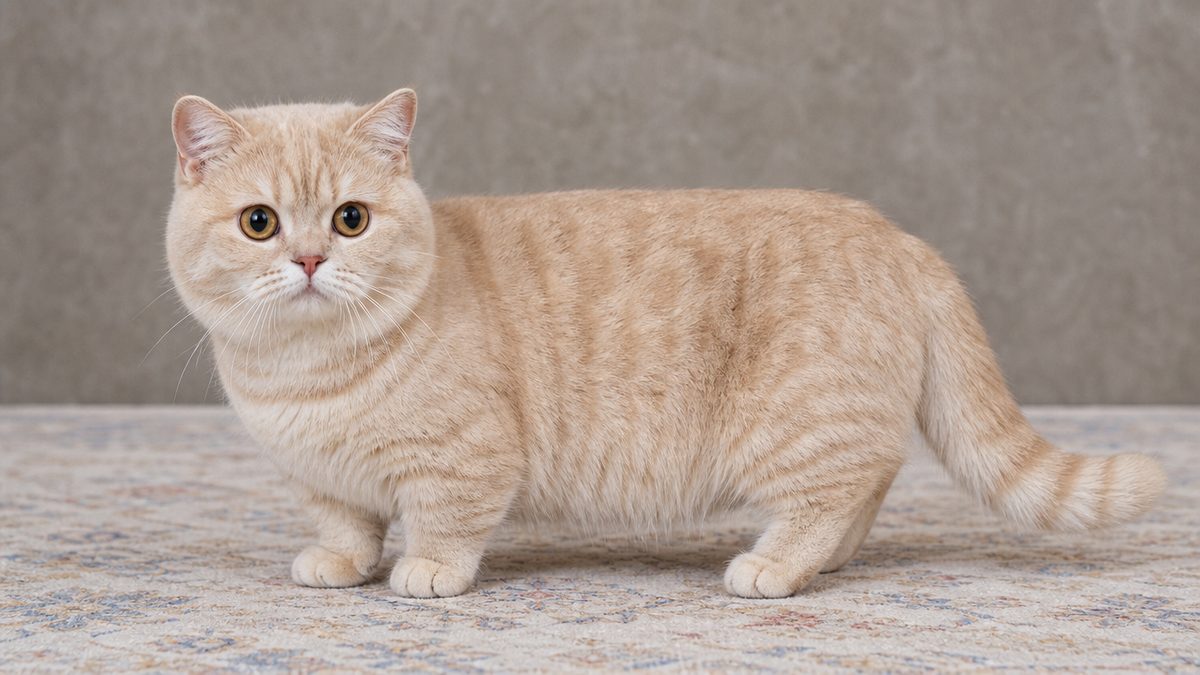
A Munchkin crossed with the Persian group, held at TICA championship since 2016, issued EMS codes by the WCF, named on the GCCF red list and barred outright by FIFe.
Quick answer
No minuet cat price in India could be sourced on 9 September 2026. India's most-read cat pricing guide returns zero occurrences of Minuet and zero of Napoleon across 206,421 characters, while pricing the parent Munchkin at Rs 30,000 to Rs 60,000. TICA has held the breed at championship since 23 January 2016, the World Cat Federation issues it EMS codes, and FIFe and the GCCF both refuse it on stated welfare grounds.
This page reports published veterinary research on chondrodysplasia in cats, including imaging studies with sample sizes as small as one and two animals, and it states in the text where the evidence runs out. It is reference material, not a diagnosis and not a treatment plan, and no figure here should be used to decide whether an animal needs care. Consult your nearby vet, a registered veterinarian who can examine your own cat, before acting on anything you read here, and treat any change in how a cat walks, any difficulty breathing and any straining in the litter tray as urgent.
Minuet at a glance
What a Minuet actually is
A Minuet is a deliberate cross between the Munchkin and the Persian breed group, short in the leg and round in the face, and TICA has held it at full championship status since 23 January 2016. It was called the Napoleon until TICA renamed it in 2015, and Google's own knowledge panel still files it under the old name.
The genetics are two separate inheritances arriving in one cat, and keeping them apart is the whole of understanding this breed. The short leg comes from the Munchkin and is a chondrodysplasia caused by a structural variant in the UGDH gene. The round head, the coat and the flat-faced tendency come from the Persian group, which TICA's own standard defines as Persian, Himalayan and Exotic.
Size is small to medium. TICA gives an average adult weight of 7 to 8 pounds, which is 3.2 to 3.6 kg, and describes the cat as medium-sized with short or long legs.
Standard and nonstandard, or Shorts and Talls
Half of every Minuet litter is not short-legged, and TICA says so openly. The short-legged form is the standard and the long-legged form the nonstandard, many breeders now call them Shorts and Talls, and at this time only Minuet Standards are eligible to be shown. A long-legged Minuet is a fully registrable cat of the breed that simply cannot enter a show ring.
TICA's breed history repeats the founder's recollection that even when two short-legged cats are bred together there will always be approximately 50 percent long-legged cats that do not carry the short-legged gene. The genetics published in 2020 give a different expectation. If the short leg is a dominant allele that is lethal in the homozygote, a short by short mating yields one third normal-legged and two thirds short-legged among surviving kittens, with a quarter of conceptions lost before birth. Struck and colleagues observed no homozygous mutant cats at all and recorded reduced litter sizes, and concluded an autosomal recessive lethal trait in the homozygote state. Both statements are published by people who know the breed. Only one of them has a genotype behind it.
Which registries hold the Minuet, and which forbid it
Two registries of six hold the Minuet and two forbid it in writing. TICA holds it at championship in Category IV, the WCF issues it EMS codes, while FIFe bars the whole class of short-legged cats from breeding, registration, showing and advertising, and the GCCF names the Minuet by name on its red list World Cat Federation, WCF EMS code table Federation Internationale Feline The Governing Council of the Cat Fancy.
This is the sharpest split in registry recognition on any cat Bonbeno has built, and it is not a matter of one body being slow. FIFe and the GCCF have both looked at short-legged cats and said no on stated welfare grounds, in documents they publish and maintain.
Championship status also means a real breed standard exists, which matters for anyone judging a kitten. MINUET BREED GROUP appears in TICA's 59-page standards compilation under the codes MNT and MNL, alongside MUNCHKIN BREED GROUP, while the strings Minskin and Lambkin each return zero occurrences in that same document. So of the four Munchkin derivatives an Indian buyer is likely to meet, only two have a written standard anyone can hold a cat against.
| Registry | Position | Document and date |
|---|---|---|
| TICA | Championship since 23 January 2016. Category IV, Domestic Hybrid Breeds, source breeds Munchkin Breed Group and Persian Breed Group | Registration Rules Version B, 22 November 2024, Standing Rule 307.5; breed page |
| WCF | Recognised. Minuet MIS and Minuet Longhair MIL, credited to WCF and TICA only | WCF EMS code table, 198 rows pulled 9 September 2026 |
| GCCF | Red Status. Named in the row reading Munchkin, Minuet (and other dwarf breeds), Ineligible due to reported health problems | Unrecognised Breeds, modified 23 September 2025 |
| FIFe | Prohibited. Will not register or recognise any breed showing achondroplasia or pseudo-achondroplasia, or any other mutation foreshortening the limbs | Health and Welfare Rules, read 9 September 2026; absent from the 52-breed EMS list |
| CFA | No breed council, and not in the Miscellaneous or Provisional block | Declared Candidates for Breed Council Secretary, modified 31 July 2026 |
| LOOF | No breed group and no pedigrees. The Munchkin has its own row at 126 pedigrees in 2025 | Nombre de chats, pedigrees issued 2025 |
What FIFe actually wrote, because paraphrases soften it
FIFe's Health and Welfare Rules say that the association will not register or recognise any breed showing as a breed characteristic achondroplasia or pseudo-achondroplasia, an autosomal dominant gene resulting in dwarfism, shortened limbs and legs and other physical defects, giving the Munchkin as its example, and, in its own words, any other form of genetic mutation which results in a miniaturised cat or a foreshortening of the limbs of the cats. That last clause reaches the Minuet on its face, without the breed ever being named.
Rule 3.6.2 goes further than non-recognition. Cats suffering from pseudo-achondroplasia, or with such a cat in their ancestry, are not allowed for breeding, cannot be registered with FIFe, cannot be exhibited at a FIFe show and cannot be promoted or advertised, and the show rules separately list dwarf cats among cats not admitted. The ancestry clause is the one that catches people out, because it reaches a normal-legged Talls Minuet too.
It matters that the GCCF's red row reads Munchkin, Minuet (and other dwarf breeds) rather than naming only the parent breed. Red Status is defined on that page as breeds most unlikely to be recognised without new information, being those where scientific evidence exists of links to serious health problems. The Genetics Committee comment is Ineligible due to reported health problems and the note to owners reads Risk of suffering as they age, possible heart problems. A buyer told that the Minuet is simply too new for British recognition is being told something the GCCF's own page contradicts.
From Napoleon to Minuet, and why the name changed
The breed began in 1995 when Joe Smith, a Basset Hound breeder, read about the Munchkin and decided the new short-legged cat needed the substantial bone that short-legged dog breeds carry. He crossed Munchkins with the Persian group, TICA renamed the result the Minuet in 2015, and the Board voted it to championship on 23 January 2016.
The founder's reasoning is worth reading because it explains the cat's shape. Coming from Basset Hounds, Smith had observed that every short-legged dog breed from the 60-pound Basset to the eight-pound miniature Dachshund shared substance and substantial boning, and he judged that this had to be built into a new dwarf cat breed. That is why a Minuet is heavy for its length rather than delicate.
The Persian side was chosen deliberately and broadly. All members of the Persian group were used, being Persian, Himalayan and Exotic, which gave the new breed both coat lengths and an unlimited colour palette. TICA's registration rules still record Persian Breed Group as an accepted source breed alongside Munchkin Breed Group.
Two controversial parents, and a name that had to go
TICA's own account is unusually frank about the reception. It records that the short Munchkin had the cat world reeling, that cat folk were up in arms and quite leery of a dwarf gene in cats, and that combining it with the Persian group, itself the subject of ongoing arguments over the Himalayan and the Exotic, created an uproar. The Napoleon name was never met with total acceptance either, and lingered as a problem until the 2015 vote.
The naming problem has outlived the rename by more than a decade. Google India's knowledge panel for the query minuet cat was still headed Napoleon cat on 9 September 2026, so a buyer searching either name will find a different half of the same breed's material.
Minuet cat price in India, and what the rupee figures actually are
No Minuet cat price in India could be sourced on 9 September 2026. India's most-read cat pricing guide runs to 206,421 characters and returns zero occurrences of Minuet and zero of Napoleon, while pricing the Munchkin at Rs 30,000 to Rs 60,000 and naming it seven times on the same page.
So the honest starting point is the parent breed's Indian price, clearly labelled as the parent breed's. Anything an Indian seller quotes for a Minuet is either the Munchkin figure with a premium on top or a converted foreign number, and the section below shows how to tell.
| Figure | Source | What it actually is |
|---|---|---|
| Rs 30,000 to Rs 60,000 | Supertails 2026 quick-reference table, for the Munchkin | The published Indian price of the parent breed, from India's most-read cat pricing guide. Not a Minuet price |
| Rs 80,000 to Rs 2,50,000 | Google India's generated answer, attributed to two Indian listing sites | An answer engine restating listing-site asking prices for the Munchkin. It is not an observation and it is not about this breed |
| INR 3,000 to INR 8,000 a month | The same generated answer | A plausible monthly cost for any medium cat in an Indian metro, and consistent with the sourced figures in the next section |
| Rs 30,000 to Rs 70,000 | Supertails 2026 table, for the Scottish Fold | The Indian price of the other breed FIFe bars on the same welfare rule, useful only as a comparison |
| Rs 0 to Rs 2,000 | Supertails 2026 table, for the Indian Domestic or Desi cat | The price of a normal-legged cat with no chondrodysplasia at all |
This is the one price question specific to this breed and almost no Indian listing answers it. Roughly half of every Minuet litter is long-legged, TICA calls those cats nonstandard or Talls, and only the short-legged Standards can be shown. A Talls kitten is a genuine registered Minuet, is very likely free of the UGDH variant altogether, and is a healthier animal by the only measurement anyone has taken. If a seller is charging a short-legged premium, ask in writing which form the kitten is and get the answer before you pay.
Import is not a route around the price either. Live cats are a Restricted import in India under ITC(HS) code 01061900, with anything outside the personal pet baggage route referred to the Exim Facilitation Committee. A cat that FIFe forbids from being registered, shown or advertised also has a smaller legitimate European supply than the price suggests.
Monthly cost of a Minuet in India, plus the costs nobody quotes
Budget Rs 3,000 to Rs 8,000 a month for a 3.2 to 3.6 kg cat in an Indian metro, and then budget separately for two things a normal-legged cat does not need. A PKD DNA certificate before purchase and a realistic orthopaedic contingency after it are the two line items this breed adds.
The routine costs are the routine costs. Vetic, a chain with clinics across eleven Indian cities, prices a kitten course of three visits at days 60, 90 and 120 from Rs 3,999 against a struck-through Rs 5,065, an adult annual booster from Rs 1,899, anti-rabies alone at Rs 699 and a feline CRP at Rs 1,249.
- Licence, Rs 50 in Chennai. The Greater Chennai Corporation licenses pet animals generally rather than dogs only, and issued 9,115 licences in Tamil Nadu during 2024.
- Free municipal treatment in Chennai. Its pet clinics provide all treatment and anti-rabies vaccination free of cost.
- Microchipping, Rs 1,250 at a Chennai clinic's own transacted price.
- No statutory microchip duty for a kitten. Rule 7(16) of the Pet Shop Rules, 2018 makes microchipping mandatory for puppies only.
- A PKD genetic test certificate on both parents, before you pay. TICA's own breed page says all Minuets should come with a certificate stating that their parents have been checked and cleared for PKD, because of the heavy Persian background. A breeder who does not screen for it has skipped the one health issue the registry itself flags.
- Budget nothing for an imported cat. An unregistered kitten with no paperwork is the common Indian offering under this name, and there is no route to a registered imported one.
The contingency nobody puts in a monthly budget
One published case gives a sense of scale, and it is worth reading before you buy rather than after. A one-year-old Minuet with progressive hind-limb paralysis needed myelography, computed tomography, MRI, a right-sided hemilaminectomy across four vertebrae and vertebral stabilisation with threaded pins and bone cement. That is a specialist neurosurgical workup and procedure, and in India it is available in a small number of referral hospitals in Bengaluru, Mumbai, Delhi and Chennai at a cost most owners have not planned for.
The published record also shows what happens when money runs out. In a chondrodystrophic cat with elbow subluxation, financial restrictions limited treatment to a single surgical procedure, the lameness resolved, and a degree of radial head subluxation persisted. That is an honest outcome rather than a failure, and it is the realistic one.
Weight control is free and it is the single most useful daily intervention for a cat whose limbs already carry abnormal alignment. Feed measured meals rather than leaving a bowl down, and put rugs on polished Indian floors so a cat with externally rotated radii has something to grip.
Heat tolerance and the Indian climate
A Minuet's climate risk is its face rather than its legs. The short leg does nothing to a cat's ability to lose heat, but the Persian-group head can, and TICA's own buying advice tells you to check for excessively narrowed nasal passages before you buy.
Take those two inheritances in turn, because they affect heat tolerance differently. The chondrodysplasia shortens the limbs and leaves the trunk, the airway and the coat normal, so a Minuet cools itself exactly as any other cat of its size does. The Persian group contributes the round face, and the further a cat sits toward the flat-faced end of that range the less airway it has to work with in a Chennai May.
What the short leg does change in an Indian home
Access, not thermoregulation. A cat that cannot jump onto a windowsill cannot reach the coolest air in the room, and a cat that cannot get onto a bed cannot get off a hot floor. In an Indian flat in April and May the practical job is to build a route to height in steps rather than in leaps.
- Stepped platforms rather than a tall cat tree. Three 20 cm rises beat one 60 cm jump for a short-legged cat.
- A cool tiled floor in shade the cat can reach when you are out, in Delhi, Pune, Hyderabad, Kolkata or Ahmedabad alike.
- Water at least three feet from the food bowl. Cats drink less when they can smell food nearby.
- Watch breathing, not just panting. Open-mouth breathing in a cat is always urgent, and more so in one carrying Persian-group facial structure.
Indian law puts the temperature duty on the seller, breed by breed. Rule 6(5) of the Pet Shop Rules, 2018 sets that obligation on the establishment rather than fixing one number for all animals, and rule 7(1) requires a species-suitable environment. A shop holding a short-legged flat-faced cat in an unventilated Karnataka summer is in breach of its own licence conditions.
Temperament, household fit and who should not buy one
A Minuet is described by its own registry as charming, extremely affectionate and people-oriented, with the gentleness of the Persian and the energy and curiosity of the Munchkin. In practice it is a lap cat that sprints, and both halves of that are real.
Activity level sits at the lower end. TICA describes the breed as very Persian-like in its level of activity but not a total couch potato, and adds that if you feel more activity is a good idea you should make it playful and the Minuet will be very cooperative. Many will chase a ball the length of a hallway, and a low centre of gravity lets them corner faster than a normal-legged cat.
Household fit is genuinely good. TICA rates the breed as making very good companions for families and older people, with lap warming as its second favourite activity after chasing a toy. Nothing in the temperament argues against an Indian flat.
Anyone who wants a cat they can show internationally should not buy this breed, because FIFe will not admit a dwarf cat to a show and will not register one with such a cat in its ancestry. Anyone who cannot fund an orthopaedic or neurological contingency should think hard, because the published cases in chondrodysplastic cats needed specialist surgery Lunde K, Langley-Hobbs SJ. Radial head…. And anyone buying on the promise that the breed is demonstrably healthy should read the health section first, because the strongest claim the evidence supports is narrower than that.
Training a short-legged cat, and the two lessons that matter
Teach the lift and teach the comb. For a short-legged, Persian-coated cat those two handling lessons prevent more trouble than every trick combined, and the window that makes them easy is the first sixteen weeks.
The lift matters because of where the deformity is. Every radius in the five dwarf cats radiographed carried external torsion, with varus proximally and valgus distally, and the elbow, ulnocarpal and radiocarpal joints showed incongruity Struck AK, Braun M, Detering KA. A cat lifted by the forelimbs is being lifted through exactly those joints.
- One hand under the chest, one under the hindquarters, every time. Never lift a short-legged cat by the front legs or under the armpits.
- Comb after a meal, one region per session. Shoulders, then flank, then the lower back and tail base.
- Comb the lower back yourself, always. A short-legged cat cannot reach it, and this is where the mats form.
- Handle every paw each session. A cat that lets you hold a foot is a cat whose claws you can clip at home.
- Teach the carrier before you need it. A calm carrier entry saves heat stress on a Chennai afternoon.
Litter training is easy once the tray suits the cat. Use a low-sided tray a short-legged cat can walk into rather than climb into, and put a second one in a different room, because a cat that has to cross a house to reach a tray will sometimes not bother.
One more habit is worth building deliberately. Monitor the cat moving on a non-slip floor once a week and know what normal looks like for your animal, because the earliest sign in the published Minuet case was chronic progressive difficulty walking rather than any sudden event. Health issues in this breed announce themselves slowly, and a weekly look is what turns a slow change into a noticed one.
How much exercise a Minuet actually needs
Budget 30 to 45 minutes of horizontal play a day, split into two or three sessions, and drag the toy along the floor rather than lifting it. This cat runs well and jumps poorly, and its exercise should follow that.
- Wand toys along the floor, down a corridor. TICA notes that many Minuets love to chase a ball the entire length of a long hallway.
- Stepped routes to height rather than jumps. A ramp or a stair of shelves gives climbing exercise without loading a deformed elbow on landing.
- Food puzzles for the working day, which matter more in a breed at the lower end of the activity scale.
- Ten minutes before bed, in the cool hours, in any Indian city in summer.
Weight is the reason this section is not optional. TICA's own guidance is that being at the lower end of the activity scale, Minuets should be watched to make sure there is a minimum of excess body fat, and that the cat should feel firm and solid rather than excessively flabby. On a 3.2 kg cat an extra 300 g is roughly a tenth of body weight loaded onto joints that already sit at abnormal angles.
Do not read reduced jumping as pain by itself. A cat with shortened limbs jumps less because the limbs are shorter, and the honest signal to watch is a change from that cat's own baseline rather than a comparison with a normal-legged cat.
Grooming a Minuet in Indian humidity
Comb daily if the coat is long and twice weekly if it is short, and comb the lower back and tail base yourself every single time. TICA's breed committee recommends a steel comb with close and more distant teeth because it reaches down to the skin, and the lower back is where a short-legged cat cannot reach.
The coat is Persian-derived but not Persian. TICA describes it as plush with an undercoat, and states that it should not be as thick or heavy as a Persian's, though this varies between individuals. That undercoat is the difference between this breed and the semi-longhairs that carry none, and it is what makes Indian monsoon humidity a real grooming problem rather than a cosmetic one.
- Behind the ears, the tummy, and between the front and rear legs, which TICA names as the hard-to-reach areas.
- The lower back and tail base, which the cat cannot reach at all because of the leg length.
- Clip a mat out rather than bathing it out, with a comb held between the mat and the skin.
- Nails every two to three weeks. A short-legged cat hooks its own coat more easily than a normal-legged one.
Bathing in an Indian monsoon
TICA suggests getting a long-haired kitten used to bathing and blow-drying early, done slowly and gently. That advice is written for a temperate climate and needs one adjustment here. Between June and September, dry the coat completely and mechanically rather than letting a cat with an undercoat air dry, because in Mumbai, Kochi or Kolkata humidity a damp undercoat stays damp for hours.
One grooming observation doubles as a health check. Reduced grooming over the lower back is one of the changes owners most often reinterpret as a cat mellowing with age, and in a breed with measured limb deformity it deserves a veterinary opinion rather than a note in the diary.
Minuet health, what is measured and what is asserted
Two things are measured about short-legged cats and almost everything else is asserted. Every limb of every dwarf cat that has been radiographed carried deformity, and one young Minuet has been published with vertebral canal stenosis and vertebral instability. No study has ever compared osteoarthritis rates between short-legged and normal-legged cats, and no life expectancy exists for this breed.
The gene, and what its own authors concluded
The short leg is a chondrodysplasia caused by a 3,303 base pair deletion with a 108 base pair insertion inside UGDH, the gene for UDP-glucose 6-dehydrogenase. Struck and colleagues found no homozygous mutant cats at all in their study population and recorded reduced litter sizes, concluding an autosomal recessive lethal trait in the homozygote state with an autosomal dominant mode of inheritance for the short-legged condition. UGDH-deficient mouse, drosophila and zebrafish mutants are likewise embryonically lethal.
Those same authors wrote the sentence the breed's supporters quote, and it should be quoted accurately. Their discussion states that heterozygous standard Munchkins exhibit reduced leg length without impaired health, as found in Dexter cattle. That is a genuine conclusion by the people who found the gene. It sits in the same paper as a computed tomography description of one Munchkin whose radius was bent about 43 degrees in its longitudinal axis, producing incongruity in the ulnocarpal and radiocarpal joints.
What imaging has actually found
| Study | Cats | What it found |
|---|---|---|
| Struck 2020, computed tomography | 1 standard Munchkin against 1 normal control | Shortening of all proximal and distal long bones with normal metatarsals, a humerus rotated internally producing moderate elbow incongruity, and a radius bent about 43 degrees producing ulnocarpal and radiocarpal incongruity. The hind limbs showed no rotation or structural effects |
| Anderson 2021, radiographic joint orientation angles | 5 dwarf cats, 10 thoracic and 10 pelvic limbs, against 24 thoracic and 100 pelvic normal limbs | All limbs from dwarf cats possessed deformities. Every radius had external torsion. Humeri, radii, femurs and tibiae each showed a characteristic pattern of angulation |
| Anderson 2021, spinal MRI | 2 dwarf cats | No spinal pathology was detected. The authors call the incidence of intervertebral disc degeneration inconclusive |
| Kihara 2024, case report | 1 Minuet, aged one year | Thoracic vertebral canal stenosis with dynamic compression at T1 to T4, vertebral endplate osteolysis, bone sclerosis, disk space narrowing and spondylotic bridging at C6 to T4. Full recovery after hemilaminectomy and vertebral stabilisation |
| Lunde 2025, case report | 1 Dwelf, aged ten months | Bilateral thoracic angular limb deformity secondary to chondrodystrophism, with elbow subluxation and radial head displacement. Described by the authors as the first reported developmental radial head subluxation in a chondrodystrophic cat |
First, the limb evidence is consistent and it is not reassuring: every limb of every dwarf cat imaged carried measurable deformity, across two independent studies Anderson LM, Fox DB, Chesney KL, Coates JR. Second, the spine evidence points both ways and the sample sizes are tiny: MRI in two dwarf cats found no spinal pathology, while one one-year-old Minuet needed four-vertebra spinal surgery. Two cats imaged and one cat operated on is not a prevalence in either direction. Third, the link from deformed limbs to clinical pain has never been measured in any short-legged cat breed. Anyone telling you every Minuet is in pain, and anyone telling you the breed is demonstrably as sound as any other, is arguing past the same missing study.
Osteoarthritis, and the baseline the argument has to be read against
Feline osteoarthritis is common in ordinary cats and always has been. One hundred cats euthanised in Britain in 1972 and 1973 were radiographed post mortem, and 74 percent had appendicular osteoarthritis, which is two decades before any short-legged cat breed existed. The authors state that there is no evidence that feline osteoarthritis is a novel disease. A 2025 review puts current prevalence at well over a quarter of the feline population and notes that detection and diagnosis rates remain low because owners do not recognise the signs.
That baseline cuts both ways and both ways should be said. It means a Minuet developing osteoarthritis in old age proves nothing about the breed, because most cats do. It also means the mechanism argument is not answered by that fact, because abnormal joint alignment is an established route to osteoarthritis and this breed has abnormal joint alignment by measurement in every limb examined. The study that would settle it, comparing rates between short-legged and normal-legged cats, has not been done.
What a proper breed-level investigation looks like, and why it matters here
Compare the short-legged breeds with what has been done for the Bengal. Thoracic wall deformity in Bengal cats was investigated with whole-body computed tomography, macroscopic and microscopic examination of the rib cage, and a breeder questionnaire covering 311 litters over two years. Affected kittens appeared in 38 of 311 litters, or 12 percent. Stillbirths and deaths within the first 24 hours occurred significantly more often in affected litters, at 20 percent against 12 percent with p equals 0.025. Male kittens were over-represented at 72 percent, and the proportion of affected litters varied between sires, suggesting a genetic background. Nothing of that kind exists for the Minuet, the Munchkin or any other short-legged breed, and that absence is a choice rather than a technical obstacle.
The two inherited conditions this breed's parents actually carry
- Polycystic kidney disease, from the Persian side. TICA's own breed page states that with their heavy Persian background all Minuets should come with a certificate stating that their parents have been checked and cleared for PKD. That is the registry telling you to demand a document, and it is the single most actionable line on this page.
- Xanthinuria, documented in a Munchkin family. Four related Munchkin pedigree cats, three of them full siblings, developed xanthine urolithiasis with signs starting at three to eight months. Routine urinalysis was insufficient to diagnose any of them, and infrared mass spectrometry of the stone or the urine was needed. A protein-restricted diet reduced signs in all cats. One family is not a breed prevalence, but if a young cat passes blood or strains in the tray, ask for the stone to be analysed rather than discarded.
Life expectancy, and the number you keep reading
TICA gives 15 plus years, depending on many factors including environment and nutrition. That is a community expectation rather than a measurement. The Minuet is not among the 12 breeds that reached the 15-death threshold in the largest UK feline life-table study, so it sits inside the grouped other category holding 111 of that study's 7,936 confirmed deaths. For reference from the same table, crossbred cats reached 11.89 years at age 0 and Persians, one of this breed's two parents, reached 10.93 years on 80 deaths.
Nothing on this page is a diagnosis or a treatment plan. Book an appointment this week for any of the following: a change in how the cat walks, reluctance to use a step it used to manage, stiffness first thing in the morning, objecting when an elbow or a carpus is handled, reduced grooming over the lower back, eliminating beside the tray rather than in it, blood in the urine or straining, or any difficulty breathing. Chronic pain in cats is quiet and owners routinely reinterpret it as a cat mellowing. Consult your nearby vet, a registered veterinarian who can examine your own cat, before acting on anything you read here.
Feeding a Minuet in India
Feed measured meals rather than leaving a bowl down, and check body condition by hand every fortnight. Weight control is the single most useful daily thing an owner can do for a cat whose limbs carry abnormal alignment.
TICA's own feeding guidance is unusually specific about why. Being at the lower end of the activity scale, Minuets should be watched to make sure there is a minimum of excess body fat, and the cat should feel firm and solid rather than excessively flabby. Its suggestion that many do well on self-feed dry food is the one line worth treating with caution in an Indian home, where a permanently full bowl and a low-activity cat is a reliable way to gain weight.
- Kitten to twelve months, three to four small measured meals.
- Adult, two measured meals, weighed once with a kitchen scale.
- Wet food daily where the budget allows, because the water matters in an Indian summer.
- Treats under ten percent of daily calories, which on a 3.2 kg cat is a very small number.
- An omega-3 enriched diet is worth discussing with your vet if osteoarthritis is diagnosed. In a 2025 review it demonstrated therapeutic efficacy comparable to standard pharmacological treatments, without side effects and with high compliance, and was equally effective in severe as in moderate disease.
One dietary caution is breed-specific rather than general. If a young cat in a Munchkin-derived line shows any urinary sign, a protein-restricted diet is the management that reduced clinical signs in all the documented xanthinuria cases, but it belongs to a confirmed diagnosis rather than to a hunch, and the diagnosis needs stone or urine analysis.
Kitten timeline, month by month through the first year
A Minuet kitten's first year has three decisions that are specific to this breed and the rest is ordinary. Ask for the PKD certificate before you pay, learn the correct lift in the first fortnight, and know what your own cat's normal gait looks like before anything changes.
- Before you pay, ask for both parents' PKD clearance. TICA's own page says every Minuet should come with one.
- Before you pay, ask whether the kitten is a Standard or a Talls, because both are registered Minuets and only one carries the UGDH variant.
- Weeks 0 to 8, do not take the kitten. The Pet Shop Rules, 2018 treat kittens below eight weeks as un-weaned and rule 7(15) bars their sale.
- Week 8 to 9, home and settle, with a low-sided tray and a stepped route to one high place.
- Day 60, first vaccination. Vetic's kitten course runs three visits from Rs 3,999.
- Weeks 9 to 16, the handling window. Teach the two-handed lift, the comb and the carrier.
- Day 90 and day 120, visits two and three, adding anti-rabies at Rs 699 when your vet advises.
- Months 3 to 8, watch the litter tray. Xanthinuria signs in the documented Munchkin family began at three to eight months.
- Month 4 to 5, microchip at Rs 1,250 and licence at Rs 50 where your municipality issues one.
- Month 5 to 7, neuter.
- Months 6 to 12, film the cat walking once a month. The published Minuet case presented with chronic progressive difficulty rather than a sudden event, and a monthly video is the cheapest way to notice a slow change.
- Month 12, first annual booster from Rs 1,899.
One thing does not belong on this list and it is worth saying why. There is no DNA test to demand for the short leg itself in a cat you are buying as a pet, because the phenotype tells you what the genotype is: a short-legged Minuet carries one copy of the UGDH variant and a long-legged one carries none. The tests worth paying for are the ones for conditions you cannot see.
Minuet versus the Munchkin and the other short-legged crosses
Four short-legged breeds all carry the same UGDH variant and differ only in what else was crossed in. The table below sets out what each one adds to the short leg, because that second inheritance is the thing worth choosing between.
| Breed | Second inheritance | Registry position | Extra evidence available |
|---|---|---|---|
| Munchkin | None. The short leg alone, on a domestic outcross | TICA Category III championship, WCF, CCCA, SACC and LOOF, which issued 126 pedigrees in 2025 Livre Officiel des Origines Felines | Its own gene paper, its own imaging and a documented xanthinuria family Pritchard EC, Haase B, Wall MJ, O'Brien CR |
| Minuet | The Persian group, bringing coat, a round face and PKD risk | TICA Category IV championship since 2016, plus WCF codes MIS and MIL World Cat Federation, WCF EMS code table | One published case report, a one-year-old with spinal surgery |
| Minskin | Sphynx and Devon Rex coat, plus Burmese | TICA Category VI, Registration Only. Absent from the WCF map entirely World Cat Federation, WCF EMS code table | None of its own. PubMed returns three records for the name and none is the cat |
| Lambkin | The Selkirk Rex curl | Absent from all six TICA categories and from the WCF map World Cat Federation, WCF EMS code table | None of its own. PubMed returns thirteen records for the name and none is the cat |
| Dwelf | Sphynx coat plus American Curl ears | Not held by TICA or WCF under that name | One published case report, a ten-month-old with elbow subluxation |
The comparison an Indian buyer should actually make
| Breed | What it shares | What it avoids | Indian price |
|---|---|---|---|
| Exotic Shorthair | The Persian-group round face and plush coat, and it is an accepted Minuet source breed | The UGDH chondrodysplasia entirely | Not separately priced in the Supertails table, which lists Persian at Rs 12,000 to Rs 50,000 |
| Persian | The coat, the head and the temperament | The short leg, and it has a measured life expectancy of 10.93 years | Rs 12,000 to Rs 50,000 |
| British Shorthair | Round face, substantial bone, calm temperament | Everything the GCCF red-lists, and the GCCF names it as the alternative to dwarf breeds | Rs 20,000 to Rs 60,000 |
Mistakes Indian buyers make with the Minuet
Five mistakes account for most of what goes wrong, and the first one costs the most because it is invisible until a kidney fails.
- Buying without the PKD certificate. TICA's own page says every Minuet should come with one because of the heavy Persian background.
- Lifting the cat by the front legs. Every radius measured in a dwarf cat carried external torsion, with incongruity at the elbow, ulnocarpal and radiocarpal joints.
- Paying a short-legged premium without asking which form you are buying. Roughly half of every litter is long-legged, and both are registered Minuets.
- Reading FIFe's silence as slowness. FIFe has an explicit rule barring the whole class from breeding, registration, showing and advertising, and it reaches cats with such a cat in their ancestry.
- Believing the hypoallergenic claim. There is no scientific evidence for a hypoallergenic cat breed.
A sixth mistake is a research error rather than a buying one. Do not take a rupee band from a generated answer. Google India's answer on 9 September 2026 gave Rs 80,000 to Rs 2,50,000 for the Munchkin in India and attributed it to two listing sites, which is an engine restating asking prices rather than observing a market. India's most-read cat pricing guide gives the Munchkin Rs 30,000 to Rs 60,000 on the same day, and neither figure is about the Minuet at all.
One more caution about searching. If you search PubMed for this breed yourself, Minuet[tiab] returns 51 records and exactly one is about the cat, because minuet is a musical form and a cardiology author group shares the string. A large result count is not a literature.
Adoption, responsible sourcing and the honest answer
No Minuet breeder operates in India that Bonbeno could identify, and the breed is absent from India's leading price guide entirely. Adoption of a normal-legged cat is the route that exists, and it is also the route that avoids the one thing this page is about.
- Ask for the PKD certificate and the registry number, and verify both. A TICA registration for this breed is a Category IV championship registration, which is a real document, so it can be checked.
- Ask whether the kitten is a Standard or a Talls. A Talls kitten carries no UGDH variant and is the same breed.
- Check the age before anything else. Sale below eight weeks is prohibited outright.
- Consider the British Shorthair, which is what the GCCF itself names as the alternative to the dwarf breeds on its red list.
- Use the municipal route where it exists. Chennai licenses pet animals at Rs 50 and treats and vaccinates them free at its own clinics.
There is an argument for adopting a short-legged cat that already exists, and it is a good one. A cat with this conformation is already born, already carries whatever deformity it carries, and needs a home that will manage its weight, give it stepped routes and watch its gait. Adopting one changes nothing about how many are bred; buying one does.
Bonbeno does not broker cats and does not recommend breeders. Import is not a route either, because live cats are a Restricted import under ITC(HS) 01061900.
Minuet questions Indian buyers actually ask
Are Minuet cats healthy?
The honest answer is that two things are measured and most of the rest is asserted. Every limb of every dwarf cat radiographed so far carried deformity, across two independent studies, and one one-year-old Minuet has been published with vertebral canal stenosis needing four-vertebra spinal surgery. Against that, spinal MRI in two dwarf cats found no pathology, and the authors who identified the gene concluded that heterozygous short-legged cats show reduced leg length without impaired health. No study has ever compared osteoarthritis rates between short-legged and normal-legged cats.
How much does a Minuet cat cost?
No Indian price exists for the Minuet. India's most-read cat pricing guide runs to 206,421 characters and returns zero occurrences of both Minuet and Napoleon, while pricing the parent Munchkin at Rs 30,000 to Rs 60,000 and naming it seven times. Google India's generated answer gives Rs 80,000 to Rs 2,50,000 for the Munchkin, attributed to two Indian listing sites, which is an engine restating asking prices rather than a market observation.
Are Minuet cats rare?
Rare enough that only two registries count them. TICA holds the breed at championship and the WCF issues it the codes MIS and MIL, but the French national studbook issued no Minuet pedigrees at all in 2025 while issuing 126 for the parent Munchkin, and FIFe, the CFA and the GCCF hold nothing. In India the breed does not appear in the leading cat pricing guide at all.
Are Minuet cats friendly?
Yes, and unusually so by its registry's account. TICA describes the Minuet as charming, extremely affectionate and people-oriented, with the gentleness of the Persian and the energy and curiosity of the Munchkin, and rates it as making very good companions for families and older people. Its second favourite activity after chasing a toy is lap warming, and it sits at the lower end of the activity scale.
Is the Minuet the same as the Napoleon cat?
Yes. The breed was originally known as the Napoleon and TICA renamed it the Minuet in 2015, then voted it to full championship status on 23 January 2016. The old name has outlived the change: Google India's knowledge panel for the query minuet cat was still headed Napoleon cat on 9 September 2026.
Why do FIFe and the GCCF refuse to recognise the Minuet?
Both give welfare reasons in writing. FIFe's Health and Welfare Rules say it will not register or recognise any breed showing achondroplasia or pseudo-achondroplasia as a breed characteristic, nor any other mutation resulting in a miniaturised cat or a foreshortening of the limbs, and rule 3.6.2 bars affected cats and cats with such a cat in their ancestry from breeding, registration, showing and advertising. The GCCF places the Minuet by name on its Red list with the comment Ineligible due to reported health problems.
Do all Minuet kittens have short legs?
No, and roughly half do not. TICA calls the short-legged form the standard and the long-legged form the nonstandard, and notes that many breeders now use Shorts and Talls. Only Minuet Standards are eligible to be shown. A long-legged Minuet is a fully registered cat of the breed that carries no copy of the UGDH variant at all, which makes it the healthier animal by the only measurement anyone has taken.
What health tests should a Minuet breeder have done?
Ask for polycystic kidney disease clearance on both parents. TICA's own breed page states that with their heavy Persian background all Minuets should come with a certificate stating that their parents have been checked and cleared for PKD, and advises buyers to check that the parents do not have teary eyes or excessively narrowed nasal passages. There is no useful DNA test to demand for the short leg itself, because the leg length tells you the genotype.
How long do Minuet cats live?
No measured life expectancy exists. TICA gives 15 plus years depending on environment and nutrition, which is a community expectation rather than a measurement. The Minuet is not among the 12 breeds that reached the 15-death threshold in the largest UK feline life-table study, so it sits inside the grouped other category holding 111 of that study's 7,936 confirmed deaths. From the same table, crossbred cats reached 11.89 years and Persians, one of this breed's two parents, 10.93 years.
Do Minuet cats get arthritis?
Nobody has measured it in this breed, and the baseline matters. Radiographs of 100 British cats euthanised in 1972 and 1973, two decades before any short-legged breed existed, found appendicular osteoarthritis in 74 percent, and the authors concluded that feline osteoarthritis is not a novel disease. So a Minuet developing arthritis in old age proves nothing by itself. What is established is that abnormal joint alignment is a route to osteoarthritis, and that every limb measured in a dwarf cat carried abnormal alignment.
Can a Minuet cat live comfortably in an Indian flat?
Yes, with two adjustments. Build routes to height in steps rather than leaps, because a short-legged cat cannot reach the windowsill that holds the coolest air, and give it a shaded tiled floor it can reach when you are out. The bigger climate question is the face rather than the legs, since the Persian side can narrow the nasal passages, and TICA's own buying advice tells you to check for that before you buy.
Are Minuet cats hypoallergenic?
No, and no cat breed is. A 2024 review in Allergologie Select states in its full text that to date there is no scientific evidence for a hypoallergenic cat breed, and that even hairless Sphynx cats produce Fel d 1. Its conclusion adds that dander analyses across breeds show high individual variation but provide no evidence for the concept. Sex and neuter status are better evidenced than breed, since unneutered males average more Fel d 1 than females.
Compare with similar breeds
Minuet sits in 1 Bonbeno group. Each one compares it directly against the breeds it is genuinely an alternative to, on the same figures.