
Breed profile
Foldex Cat in India: The Breed Whose Own Registry Judges Out the Disease
A Scottish Fold crossed with an Exotic Shorthair, held by one registry in Canada, whose own show standard withholds awards for fused tail vertebrae and calcium deposits in the legs, which are the two cardinal signs of the disease the fold gene causes.
Quick answer
The only foldex cat price in India, Rs 40,000 to Rs 80,000, comes from two template pages that print identical figures for unrelated breeds. One registry holds the Foldex, the Canadian Cat Association, and its own standard withholds awards for the two skeletal signs the Scottish Fold's cartilage mutation produces.
This page reports what six peer-reviewed studies do and do not establish about the cartilage mutation this breed carries, and it publishes the disagreement between them rather than resolving it. It is not veterinary advice and it is not a diagnosis of any individual cat. Consult your nearby vet about any fold-eared cat, particularly about tail flexibility, limb comfort and pain in an older animal.
Foldex at a glance
What a Foldex actually is
A Foldex is a Scottish Fold crossed with an Exotic Shorthair. Its own registry calls it a man-made breed established by mating the Scottish Fold and the Exotic, and describes the result as a compromise between the Scottish Fold, which has a snout, and the Exotic, which has a very short nose Canadian Cat Association.
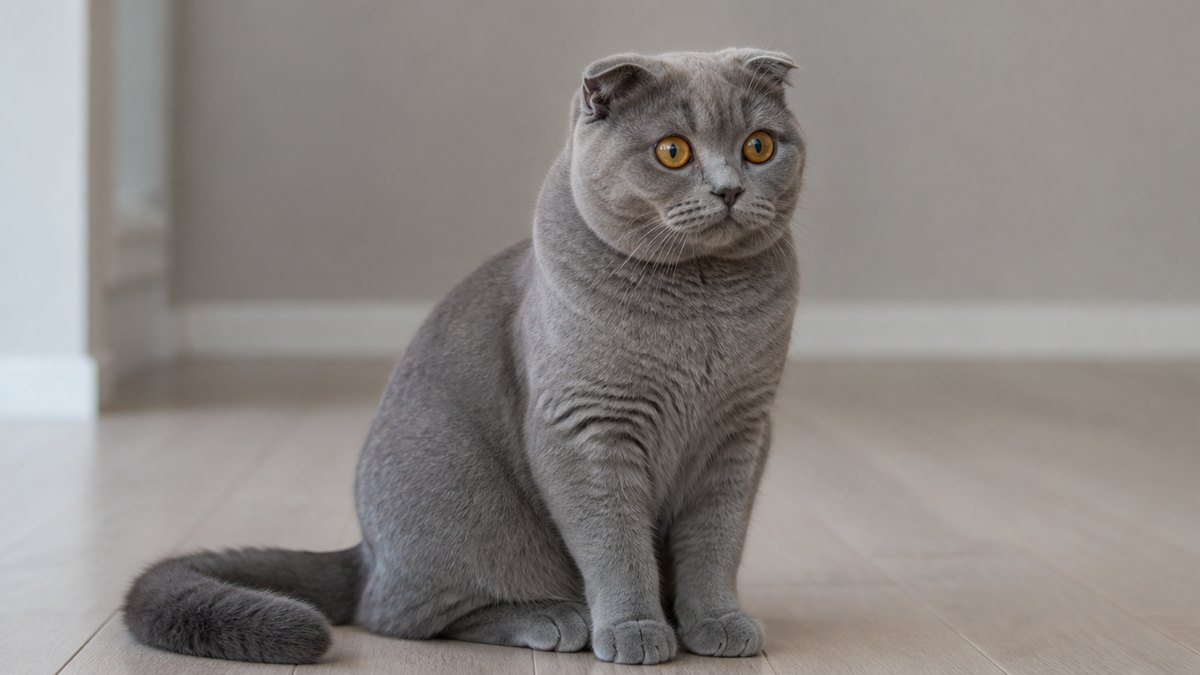
The physical description comes straight from the standard. The body is medium in size, compact, with well-developed musculature, medium to heavy boning, a wide chest and legs that are strong and short. The head is a broad, round, massive skull with a rounded forehead and prominent cheeks, a short muzzle and powerful jaws. The eyes are large, round and set far apart. The tail is medium, thick and, in the standard's own capitals, FLEXIBLE.
The ears are the breed. They are small with rounded tips and have a single fold forward in a downward direction. A 90 degree angle is permitted, but the ear cannot be folded tight against the head in a cap-like fashion, and they sit far apart and low on the head. That is a deliberately moderate fold compared with the tight triple fold favoured in modern Scottish Folds, and the standard backs it up with a three to five point deduction for ears tightly folded against the head.
The nose, and a standard that caps its own extreme
The Exotic side supplies a short broad nose with a definite break, and the standard puts a limit on it: the break must not exceed 90 degrees, the nostrils must be open, and a nose break exceeding 90 degrees costs two to four points while pinched nostrils or tiny pinholes cost two to five. That is a registry writing a ceiling on brachycephaly into its own judging, which is unusual and worth crediting. A 2024 review of purebred welfare describes hypertypes as taking a breed's distinctive appearance to extremes beyond the intended interpretation of breed standards, and a numerical cap is one of the few tools a standard has against that.
The Foldex standard's WITHHOLDS list is two lines long before it defers to the general preface, and both lines describe skeletal disease. Verbatim: Tail, whole or portion of, lacking in flexibility due to fused vertebrae. And: Abnormalities of the legs and feet due to calcium deposits. Those are the two cardinal signs of Scottish Fold osteochondrodysplasia, which the paper identifying the causal gene describes as malformation in the distal forelimbs, distal hindlimbs and tail, with progressive joint destruction. The general preface adds two more withholds that reach the same thing, any deformity or disfigurement, hereditary, congenital or acquired, and kinks, visible or invisible, with small invisible bumps or calcium deposits ranked as a fault. A registry does not write a withhold for a sign that never appears.
Registry recognition, and the one body that holds it
One registry holds the Foldex. The Canadian Cat Association carries it under the code FX with a standard dated 1 May 2026, having accepted the breed as Experimental in November 1998 and as a New Breed in August 2006 Canadian Cat Association. No other registry we checked holds it at any class.
The interesting registry question here is not about the Foldex, though, but about its parent. The Scottish Fold's own position varies more sharply between bodies than almost any breed in the cat fancy, and where a registry stands on the parent tells you why it does or does not hold the cross.
| Registry | Foldex | Scottish Fold |
|---|---|---|
| CCA-AFC, Canada | Held as FX, standard dated 1 May 2026, New Breed since August 2006 Canadian Cat Association | Held as SF, standard reissued 12 June 2026 |
| TICA | Absent from all six registration categories, zero occurrences in the rules | Category III, Variant or Mutation Breeds, championship |
| CFA | No breed council | Breed council under Shorthair Breeds |
| WCF | No row in the 198-row EMS table | SFS and Highland Fold SFL, recognised by eight bodies |
| FIFe | Absent | ABSENT. FIFe holds no Scottish Fold at all |
| LOOF | Absent from both lists | Championship as SFS and SFL, 951 pedigrees in the group in 2025 |
| GCCF | Not named on the unrecognised-breeds page at all | RED. Ineligible, known serious health problems, osteochondrodysplasia |
What the GCCF actually says, and what it recommends instead
The GCCF grades breeds it does not recognise green, amber or red, and defines Red Status as breeds most unlikely to be recognised without new information, being those where scientific evidence exists of links to serious health problems. Its Scottish Fold row reads, verbatim, Ineligible. Known serious health problems (osteochondrodysplasia), with an owner-facing note reading A pet who suffers with joint pain in mid-old age, and the British Shorthair given as the alternative breed. That is one national registry declining the parent breed, in writing, on stated evidential grounds.
FIFe reaches the same destination silently. Europe's largest federation lists every breed it holds by EMS code and there is no Scottish Fold, no Highland Fold and no Scottish Straight anywhere on it. It does hold the Exotic and the Persian, so the absence is specific to the fold rather than to the cross's other half.
TICA does not hold the Foldex, and its own rules explain why a new fold cross would struggle there. Rule 31.6 defines a structural mutation as an appearance of the skeletal or cartilage expression different from the average domestic cat, naming folded ears first. Rule 33.9.4 states that structural mutations are owned by the first breed establishing championship status that displays them, naming folded ears for the Scottish Fold, and that new breeds may only use such a mutation with a majority vote of the owning breed section. A Foldex would need the Scottish Fold breed section's permission to exist inside TICA at all.
None of that makes the Canadian Cat Association an outlier for holding the breed. What it makes it is the only registry whose position on the Foldex can be read at all, and its position is unusually explicit: it registers the cats, it publishes a standard, and it withholds awards from cats showing the disease.
Where the Foldex came from
The Foldex was developed in Quebec, Canada, and first appeared in a show hall in 1993, presented by Betty-Ann Yaxley. Jeanne Barrette carried the breeding programme onward, and the Canadian Cat Association accepted the breed as Experimental in November 1998 and as a New Breed in August 2006.
The stated goal was a moderation rather than an extreme. The registry describes the aim as a cat possessing a rounder head, a shorter nose, upright or folded ears and beautiful big round eyes with a plush fur which gives him the look of a small teddy bear, and says plainly that the appearance is a compromise between the Scottish Fold, which has a snout, and the Exotic, which has a very short nose.
| Date | Event | Source |
|---|---|---|
| 1993 | First appearance in a show hall, presented by Betty-Ann Yaxley | CCA-AFC breed description |
| November 1998 | Accepted by CCA-AFC as an Experimental breed | CCA-AFC breed description |
| August 2006 | Accepted by CCA-AFC as a New Breed | CCA-AFC breed description |
| 1 May 2026 | Date on the current breed standard, published 12 June 2026 | CCA-AFC Foldex standard |
| Still today | Held by no other registry anywhere | TICA, CFA, WCF, FIFe, LOOF and GCCF documents World Cat Federation, WCF EMS code table |
One historical detail on the standard is worth pulling out because it anticipates a 2026 research finding by decades. The registration note says that kittens without folded ears are registered as Foldex Straights and may not be shown, and that kittens which develop temporarily folded ears at three to four weeks but straighten as they mature must still be registered as Foldex, since those kittens carry the FOLDS gene. A registry writing that rule already knew that ear phenotype and genotype come apart.
Foldex cat price in India, and what the one figure is made of
The only Foldex cat price in India is Rs 40,000 to Rs 80,000, and two Indian sites print it to the rupee alongside monthly figures they also print for unrelated breeds. India's most-read cat pricing guide does not name the breed at all.
Run the division tests and the band refuses to behave like a converted price, which is itself informative.
| Rupee figure | At 84.38 | At 74 | At 80 | At 66.67 | Verdict |
|---|---|---|---|---|---|
| Rs 40,000 | 474.05 | 540.54 | 500 | 599.97 | Two rates give a plausible seller price |
| Rs 80,000 | 948.09 | 1,081.08 | 1,000 | 1,199.94 | The same two rates again |
Two different rates both producing printable quotients is the tell rather than the confirmation. A flat 80 divides any figure ending in three zeros cleanly by construction, so 500 and 1,000 prove nothing on their own, and a table that cannot pick a single rate was not priced by conversion in the first place. The honest reading is that the figure is rupee-native and arbitrary.
poodles.in's Foldex page carries a social preview image named Highlander_cat_(2010)_Hugo_by_TAnthony.jpg. A Highlander is a curled-ear, short-tailed cat with no relationship to the Foldex at all. A page that illustrates a forward-folded ear with a backward-curled one has not seen the animal it is pricing, and its price should be read accordingly. The same site prints the same four monthly cost lines for this breed as for the Toybob, the Ukrainian Levkoy and the York Chocolate.
What an Indian buyer is actually offered is a Scottish Fold. Every genuine cat result on page one of a Foldex price search in India is a Scottish Fold, quoted variously at Rs 40,000 to Rs 1,50,000, Rs 40,000 to Rs 70,000 and Rs 70,000 to Rs 2,00,000. Notably, happypet.care's own Scottish Fold page outranks its own Foldex page for the Foldex query, which means the site's own template is being read by the search engine as a Fold page.
Google's own questions box says the same thing in a different way. Across three query shapes on 10 September 2026, not one People also ask question named the Foldex: the bare form produced no box at all, the question form produced two questions about exotic cats generally, and the price form produced three Indian price-cluster questions of which two name this breed's own parents, the Scottish Fold and the Persian. An engine that answers a Foldex query with Fold and Persian questions has correctly worked out what the cat is made of and has no material about the cross itself.
There is a second and stranger substitution in India. The token foldex is primarily a motorcycle silencer brand here, so the price query also returns OLX listings for a foldex silencer at Rs 1,600 and a splendor foldex silencer, plus an Amazon.in cat food with the word Foldex inserted into the product title and an Etsy necklace. Anyone scraping rupee figures for this breed will collect exhaust parts.
Import is not a route around any of it. India's import policy for pet cats is restricted under ITC(HS) 01061900, and import without a DGFT authorisation is allowed only for persons shifting residence permanently to India under the Customs Baggage Rules. The only registry that can issue a Foldex pedigree is in Canada.
Monthly cost of a fold-eared, flat-faced cat in India
Budget an ordinary cat's running costs plus two lines specific to this cross, a genetic test once and orthopaedic attention over the animal's life. Neither appears in any Indian monthly cost table, and both are more predictable than the purchase price.
- Licence, Rs 50 in Chennai. The Greater Chennai Corporation licenses pet animals generally rather than dogs only, so a cat is covered.
- Free municipal treatment and anti-rabies vaccination in Chennai. The corporation's veterinary clinics provide both free of cost.
- One TRPV4 genetic test, and it is the most useful money on this list. The variant is a single known substitution, c.1024G>T, and a 2026 study concluded that genotyping is necessary because visual inspection is insufficient. Screen the parents if you are buying, and consider testing a cat you already own so your vet knows what they are treating.
- Budget for radiographs at least once. The signs this breed's own standard withholds for are radiographic, and a baseline set at twelve months gives your vet something to compare against later.
- Assume a higher lifetime analgesia line than for an ordinary cat. The GCCF's owner-facing note for the parent breed reads a pet who suffers with joint pain in mid-old age. Plan for the possibility rather than assuming it away.
- No statutory microchip cost for a kitten. Rule 7(16) of the Pet Shop Rules, 2018 makes microchipping mandatory for puppies only.
Both Indian pages that price this breed print a monthly total of Rs 2,800 to Rs 4,200, made of food Rs 1,500 to Rs 2,000, health Rs 500 to Rs 700 and grooming Rs 800 to Rs 1,500, with the components summing exactly to the totals. The identical four lines appear on those sites' pages for cats of quite different sizes. A health line of Rs 500 to Rs 700 a month is not a plausible figure for a breed whose registry withholds awards for skeletal signs. Build your own from your vet's rate card.
Heat tolerance and the Indian climate
A Foldex is not heat-tolerant, and the reason is the nose rather than the ears. The Exotic Shorthair side brings a shortened face, and cats use nasal airflow as part of how they shed heat, so a flat face is a real disadvantage in a Delhi June.
Plan against your own city's real peak rather than a generic Indian summer, because the commonest error in Indian climate tables is naming May as the hottest month everywhere, which is wrong for three of the six cities most Indian cat owners live in.
| City | Hottest month and mean | Coolest month and mean | Verdict for a shortened face |
|---|---|---|---|
| Delhi | June, 35.88 C | January, 13.61 C | Hardest in this table. Cooling is not optional in June |
| Nagpur | May, 36.73 C | December, 19.97 C | Hardest of all |
| Chennai | May, 31.51 C | January, 24.09 C | Constant load and high humidity, which compounds a flat face |
| Kolkata | May, 31.53 C | January, 17.31 C | Heat plus a long humid monsoon |
| Mumbai | May, 31.19 C | January, 23.19 C | Similar to Chennai, with more coastal humidity |
| Bengaluru | April, 28.37 C | December, 20.22 C | The most workable Indian city for this face |
| Pune | April, 28.93 C | December, 19.62 C | Second most workable |
Three Indian care points that follow from the two mutations
- Watch breathing after play, not just at rest. A shortened face shows its cost under load. Open-mouth breathing in a cat is never normal and is always a reason to call your nearby vet.
- Do the ear check weekly, and twice weekly in the monsoon. A forward-folded pinna covers the canal opening and holds moisture that a straight ear sheds, and it cannot be unfolded to look inside. Wipe only the visible part.
- Keep jumping modest in hot weather. A cat with possible joint involvement in the distal limbs is a cat that lands harder, and heat reduces the willingness to move that would otherwise let it self-regulate.
- Give cool tile and shade rather than relying on air conditioning alone. Cats thermoregulate by relocating long before they pant, and a flat-faced cat needs that option available at floor level.
The summary is that Bengaluru and Pune are workable for this cross and Delhi, Nagpur, Chennai and Kolkata demand indoor cooling for months. That is a real constraint and it belongs in the buying decision rather than in the care section.
Temperament, household fit and who should not get one
The Foldex is described by its own registry as active, cheerful, intelligent and curious, affectionate, approaching strangers with ease and enjoying being petted, with a very charming personality. That is a registry description rather than a measurement, and it matches both parent breeds' reputations.
Temperament is not the deciding factor for this breed, and pretending otherwise is what most breed pages do. The deciding factors are whether you are willing to have the cat genotyped, whether you can afford orthopaedic attention over fifteen years, and whether you accept a shortened face in a hot country.
- Good with children, on the registry's account. A calm, sociable cat that likes being handled suits a family flat.
- Quiet. Neither parent breed is talkative, which matters in Indian apartments with shared walls.
- Not an athlete, and that is fine. A moderate, compact cat with possible joint involvement should not be encouraged to leap. Give routes rather than challenges.
- Sensitive to being handled roughly around the hindquarters and tail. If a cat objects to having its tail touched, that is information to give your vet rather than a training problem.
Skip this breed if you are unwilling to have the cat's TRPV4 status established, if you cannot commit to veterinary follow-up on joints in later life, if you live in Delhi or Nagpur without cooling, or if you want a cat that climbs. And skip it if the appeal is entirely the folded ear, because that is the part carrying the risk. A 2024 review puts the general case plainly: the popularity of characteristics perceived as cute, quirky and anthropomorphic has driven increasingly exaggerated breed features appealing to aesthetics rather than health.
Training a Foldex, and the handling that matters
To train a Foldex, build the two routines the cat's genetics make necessary before you teach anything else, a weekly ear check and comfortable handling of the tail and hind limbs. Both are veterinary preparation rather than tricks.
- Handle the tail gently every week from day one. The standard's first withhold concerns tail flexibility, so a cat that tolerates having its tail felt is a cat whose vet can assess it without sedation.
- Teach the ear check. Two minutes with a cotton pad on the visible part only, never lifting or unfolding the ear, and never inserting anything.
- Build ramps rather than teaching jumps. Give a route onto the bed and the sofa so the cat never has to test its limbs against a height.
- Teach a carrier before you need one. Feed meals in an open carrier for two weeks, because a cat that may need repeated veterinary visits should not fight the box each time.
- Monitor weight monthly. Extra body weight loads joints, and on a breed with a documented cartilage variant that is the owner's highest-value daily decision.
Litter training is ordinary. Choose a large tray with a low entry, because a cat with any distal limb involvement finds a high lip harder than it looks, and a cat that finds the tray uncomfortable finds somewhere else.
One thing to watch rather than train. If an adult Foldex begins to sit oddly, to refuse a jump it used to make, to walk stiffly after rest or to become reluctant about being picked up, those are the changes to report to your nearby vet rather than to attribute to age. The parent breed's condition is described in the literature as involving progressive joint destruction, and progressive means it announces itself gradually.
How much exercise a Foldex actually needs
Budget 30 to 40 minutes of gentle interactive play a day, kept horizontal and split into two sessions. A moderate, compact cat with a possible cartilage variant needs muscle and a lean body weight rather than athletic challenge.
- Play along the floor. Wand toys dragged across a corridor build the same muscle as a leap without the landing.
- Avoid repeated high jumps. If the cat is jumping down from a height several times an hour, lower the perch or add a step.
- Keep the sessions short and frequent. Two sessions of 15 to 20 minutes suit a cat that tires more easily than a domestic shorthair.
- Stop on any breathing change. A shortened face makes exertion costlier, and open-mouth breathing is a stop signal.
- Move play to early morning and after sunset in summer. A closed Nagpur flat in May, where the monthly mean is 36.73 C, is not a place to exercise a flat-faced cat.
The point of the exercise plan is weight rather than fitness. Keeping this cat lean is the single intervention most likely to postpone joint problems, and it is entirely under the owner's control.
Grooming a Foldex in Indian humidity
Grooming a Foldex takes about fifteen minutes a week for the plush shorthair and twice that for the longhair, and the ears take the longest. The coat is ordinary. The folded pinna is not.
The standard describes the shorthair coat as short, plush, even, soft and silky, dense enough to stand out from the body including the tail, and the longhair as medium to long, soft, glossy and standing out from the body due to its density, with a full tail plume. In an Indian city the longhair is a daily job during the monsoon and the shorthair is a weekly one.
- Groom the coat weekly with a comb, not just a brush. A plush dense coat mats at the armpits and behind the ears first.
- Never unfold the ear to clean it. Wipe the visible outer surface with a soft cotton pad and leave the canal to your vet.
- Increase ear checks in the monsoon. A covered canal opening in a Kolkata or Mumbai wet season is the single most predictable problem in this breed's daily care.
- Clean the face fold and eye corners if the nose is short. A shortened muzzle can mean tear staining, and a daily wipe with plain warm water prevents the skin problem that follows.
- Dry completely after any bath. Air drying in humid Indian air leaves a dense coat damp for hours.
The one grooming observation that is also a health observation
When you handle the tail during grooming, notice whether it moves freely along its whole length. The Foldex standard's own first withhold is for a tail, whole or in part, lacking flexibility due to fused vertebrae, and the general preface adds kinks, visible or invisible, defined as a rigid deflection of the tail line whether visible or not. An owner who grooms the tail weekly will notice a change in it long before a vet appointment would. Report any stiffness rather than assuming it is normal for the breed.
Foldex health, and six studies that do not agree with each other
The Foldex carries the Scottish Fold's cartilage mutation, and that mutation has an unusually good evidence base for a cat trait, six relevant studies. They agree on the gene and disagree on how much disease it causes, and this section publishes the disagreement rather than resolving it.
The mechanism, which is settled
The folded ear and the osteochondrodysplasia are the same mutation. A 2016 genome-wide study genotyped 44 Scottish Fold and 54 control cats and identified a p.V342F substitution, c.1024G>T, in TRPV4, a calcium-permeable ion channel. The variant was not found in 648 unaffected cats. Functional work showed the mutant channel is poorly expressed at the cell surface, with a reduced maximum response to an agonist, a higher basal activity and an increased response to hypotonic conditions. The paper describes the condition as a dominantly inherited osteochondrodysplasia involving malformation in the distal forelimbs, distal hindlimbs and tail, and progressive joint destruction.
The disagreement, laid out
| Study | Design and size | Finding | Its own limitation |
|---|---|---|---|
| Takanosu 2008 | Three-generation pedigree, folded mated to straight | All folded-ear cats, presumed heterozygous, developed osteochondrodysplasia in distal limbs. Severity varied and mild cases were clinically unaffected | One pedigree, no blinding, no genotyping |
| Rorden 2021 | 22 cats, DNA plus radiographs, four reviewers blinded to ear phenotype | All 10 folded cats heterozygous, no straight-eared cat carried the variant. Folded cats scored numerically worse on average, but with much milder radiological signs than previously published | Small sample. Authors present it as adding to a complicated debate |
| Sartore 2023 | 17 cats, 12 Fold and 5 Straight, genotyped and radiographed, 1.5-year follow-up on four | All and only the Folds carried the variant heterozygous. Only 1 of 12 showed clinical signs, and no cat showed skeletal change at follow-up. Concludes the variant is supposedly not the only cause or risk | Very small sample, short follow-up |
| Velie 2023 | 34,926 consultation events, 1,131 Scottish Folds, Australian VetCompass records 1992 to 2018 | 12 clinical diagnoses of osteochondrodysplasia, plus 69 suspected cases. Diagnosed cats were significantly younger and generally under 30 months. Suggests relatively low prevalence of clinically diagnosed disease | Counts recorded DIAGNOSES in general practice, not radiographic findings |
Read that table as a genuine scientific disagreement rather than as a progression from wrong to right. The 2008 study says the skeletal change is universal in fold-eared cats. The 2021 study, which was explicitly designed to fix the earlier work's lack of blinding, controls and genotypes, agrees that fold-eared cats score worse and says the signs are much milder than previously published. The 2023 Italian series finds one clinically affected cat in twelve. The Australian records study finds twelve diagnoses in 1,131 cats, and its own background sentence records that all Scottish Fold cats are believed to be affected, which the study then declines to confirm.
Homozygotes are severely affected, and every source agrees. A 2020 report describes two Scottish Fold crossbred cats, one a Fold crossed with a Munchkin and one a Fold crossed with an American Curl, both dominant homozygous for c.1024G>T, both showing severe exostosis in the hind leg on radiographs at around one year of age. Its conclusion is verbatim: Cross breeding with Scottish Fold cats could produce unknown phenotypes, and should be avoided. A Foldex is a Scottish Fold cross, and its own registry's allowed matings permit Foldex to Foldex and Foldex to Scottish Fold. Both of those pairings can produce homozygous kittens. Ask a breeder which pairing produced the litter, and get the answer before anything else.
The 2026 finding that changes what a buyer can see
You cannot identify a carrier by looking at it. Researchers followed 114 cats with longitudinal photographs and found seven whose ears changed from folded to straight as they matured. All seven were heterozygous carriers, amounting to 12.7 percent of the heterozygous cats, and morphometry showed their ear flaps were smaller than those of genetically wild-type straight-eared cats. The authors name these cryptic folds and conclude that visual inspection for breeding selection is insufficient and that TRPV4 genotyping is necessary to prevent unintentional production of homozygous offspring.
The Canadian standard already encodes that risk in its registration rules, which require kittens that develop temporarily folded ears at three to four weeks and then straighten to be registered as Foldex rather than Foldex Straight, because those kittens carry the FOLDS gene. A registry rule written from observation and a 2026 genotyping study reaching the same conclusion is a rare and reassuring convergence.
The evidence that genotyping works
A 2026 Japanese survey genotyped 8,610 cats across 14 breeds and tracked Scottish Fold allele frequencies between 2017 and 2024. The proportion of homozygous cats fell from 14.2 percent to 1.9 percent, a significant decline, while heterozygote frequency stayed stable at 39.3 against 51.5 percent. The authors conclude that integrating genotyping into breeding programmes can effectively reduce the prevalence of this hereditary disorder. That is the single most useful practical finding on this page: the severe form is avoidable and a genetic test is how.
The same paper carries a second finding worth knowing, because it widens the question beyond fold-eared breeds. The variant was identified primarily in Scottish Folds but was also detected in American Curls, Norwegian Forest Cats, Munchkins and Minuets. A cat need not have folded ears to carry it.
The other half of the cross
The Exotic Shorthair side brings brachycephaly rather than a cartilage variant. A 2025 welfare review of UK purebred cats names the two obvious conformational concerns as osteochondrodysplasia in Scottish Folds and the increasingly flattened faces of brachycephalic cats. The Foldex is made of exactly those two, which is worth stating plainly. What partly offsets it is that this breed's own standard caps the nose break at 90 degrees and penalises pinched nostrils, which is more restraint than many brachycephalic standards show.
Life expectancy has never been measured for the Foldex or for the Scottish Fold, and the two health issues named above are the ones a buyer can act on. The largest UK feline life-table study required 15 or more deaths for a breed row, twelve breeds reached that threshold, and neither breed is among them; the closest relative present is the Persian at 10.93 years on 80 deaths. What that study does establish and does apply is that entire cats had 4.29 times the odds of death before three years compared with neutered cats, and purebred cats 1.83 times the odds compared with crossbreds.
Five things, in order. Have the cat's TRPV4 status established, because a genetic test settles in one result what no amount of looking can. Ask any breeder which pairing produced the litter and refuse a fold-to-fold mating. Get a baseline set of radiographs from your nearby vet, ideally around twelve months, so later change is measurable rather than remembered. Keep the cat lean for life. And report stiffness, reluctance to jump, tail sensitivity or a change in gait to your vet promptly, since the literature describes progressive joint destruction rather than a fixed defect. None of that is alarmist and all of it is actionable.
Feeding a Foldex in India
Feed a Foldex to keep it lean, because body weight is the one joint-loading factor entirely under an owner's control. Everything else about the diet is ordinary for a medium cat.
- Weigh the daily ration and portion it once each morning. In a household where several people feed the cat, one labelled container solves the problem.
- Monitor body condition monthly by hand. Feel the ribs under a thin fat cover without pressing, and look for a waist from above. A plush coat hides both.
- Consider a shallow, wide bowl. A shortened muzzle can make a deep narrow bowl awkward, and a wide shallow one costs nothing to try.
- Keep wet food in the mix in Indian summers. Water intake matters more in a hot climate, and a cat that will not drink will often eat moisture.
- Ask your vet before adding a joint supplement. They are widely sold for this breed's parent and the evidence base is thin. That is a conversation with your nearby vet rather than a purchase off a breed page.
Kitten food through 12 months is the standard advice and it holds here. Availability in India is not a constraint, since every major wet and dry line sold in Indian metros carries a complete and balanced formula.
One thing not to do is treat weight gain as a cosmetic issue in a breed whose registry describes a plush, rounded look. A cat that reads as pleasingly round in photographs can be carrying weight its joints do not need.
Kitten timeline, month by month through the first year
Kitten care for a Foldex follows the ordinary feline timeline with three additions no ordinary kitten needs, an early genetic test, a weekly ear routine and a baseline radiographic assessment at around twelve months.
- Before you commit, ask which pairing produced the litter. A fold-to-fold mating produces homozygotes, and homozygotes are the severe form.
- Weeks 0 to 8, with the breeder. Indian law treats kittens below eight weeks as un-weaned and prohibits their sale, so a kitten offered earlier is an illegal sale.
- Weeks 3 to 4, the ears declare themselves and can change again. Kittens that fold early and straighten later still carry the gene, which the registry's own registration note says in as many words.
- Month 2, home, with a TRPV4 test arranged. Genotyping is the only reliable way to know what the cat carries.
- Month 2 to 4, core vaccination course. Follow your nearby vet's schedule rather than any breed page's table.
- Month 3, ear routine and carrier training begin. Both are lifelong and both are easiest now.
- Month 4, weight baseline. Record it and repeat monthly.
- Month 6 to 9, neutering discussion. Entire cats carry 4.29 times the odds of death before three years compared with neutered cats.
- Month 8, first monsoon. The wet season is when the ear routine is genuinely tested.
- Month 12, adult check with baseline radiographs. Ask specifically for distal limbs and the tail, since those are the sites the literature and the breed's own standard both name.
One thing not to do is take a straight-eared littermate as evidence of a clear line. Some straight-eared cats from fold matings are genetically wild type and some are cryptic folds whose ears straightened as they matured. Only a test tells them apart.
Foldex versus the cats it is cross-shopped against
Indian buyers arrive at the Foldex from the Scottish Fold and from the Exotic Shorthair, and the useful comparison sets it against both parents plus the breed the GCCF recommends instead.
| Breed | Conformational trait | Registries holding it | Documented condition | Available in India |
|---|---|---|---|---|
| Foldex | Folded ears plus a capped short nose | 1, the Canadian Cat Association | Carries the fold variant. Its own standard withholds for the signs | No identified breeder |
| Scottish Fold | Folded ears | 8 in the WCF table, not FIFe, red-listed by the GCCF Governing Council of the Cat Fancy | Osteochondrodysplasia, TRPV4 c.1024G>T | Yes, widely and expensively |
| Scottish Straight | None. A Fold-line cat without folded ears | Held by CFA, TICA, LOOF and CCA | May still carry the variant. GCCF says DNA screening would be required | Occasionally |
| Exotic Shorthair | Shortened face | All major registries including FIFe | Brachycephaly, named in the 2025 welfare review | Yes |
| British Shorthair | Round head, no mutation | All major registries | None conformational. The GCCF's recommended alternative | Yes |
| Indian domestic shorthair | None | None, and none needed | None | Free, from any shelter |
The British Shorthair gives you the round head, the big round eyes and the plush dense coat with no cartilage variant and no shortened face, and every major registry holds it. The GCCF names it as the alternative to the Scottish Fold on its own unrecognised-breeds page. In India it is also far easier to find than a Foldex, which has no identified breeder here at all.
Mistakes Indian buyers make with the Foldex
Five mistakes account for most of the harm, and the first one is treating a moderate fold as a different gene from a tight fold. It is the same variant.
- Assuming a moderate fold means a milder gene. The Foldex's fold is deliberately less extreme than a modern Scottish Fold's, and the standard penalises a tight cap. That is a conformational choice, not a different mutation. The variant is TRPV4 c.1024G>T either way.
- Judging a cat's genotype by its ears. A 2026 study found 12.7 percent of heterozygous carriers straighten as they mature, and those cats had measurably smaller ear flaps. Only a genetic test answers the question.
- Buying without asking about the pairing. Fold to fold produces homozygotes, and the two published homozygous crossbred cats both showed severe exostosis by one year.
- Reading a low diagnosis rate as an all-clear. The Australian study counted 12 clinical diagnoses in 1,131 cats and its authors say further evidence is required to assess clinical relevance. A general-practice diagnosis count is not a radiographic prevalence.
- Paying an Indian price for a Canadian breed. The only registry that can issue a pedigree is in Canada, and the Indian figure of Rs 40,000 to Rs 80,000 is a template value on two sites, one of which illustrates the breed with a photograph of a Highlander.
A sixth mistake is the opposite of alarm and it is worth naming too. Reading the 2008 pedigree study alone and concluding that every fold-eared cat is in pain is not what the evidence supports either. Three later studies, one of them blinded and controlled and one built on 34,926 consultation records, found milder radiographic signs and low clinical diagnosis rates Sartore S, Moretti R, Piras LA, Longo M Velie BD, Milden T, Miller H. The honest position sits between the two, and it is why this page prints all four.
Finally, do not treat an unregistered fold-eared cat in India as a Foldex. There is no registry here that could confirm it, and the breed exists in Canada. What you would be buying is a Scottish Fold or a Fold cross of unknown parentage, and the questions to ask are the same regardless of the name on the advertisement.
Adoption, responsible sourcing and the honest answer for India
Adopt, because there is no documented Foldex to buy in India and the alternative gives you the same cat without the variant. If you already have a fold-eared cat, this section is about what to do next rather than about what to regret.
- Adopt a British Shorthair-type domestic cat or an Indian shorthair. Round head, plush coat, no cartilage variant, and available from shelters in every Indian metro.
- Adopt a fold-eared cat that is already in rescue. Rehoming an existing cat creates no demand and gives an animal that may need veterinary follow-up a home that knows to provide it.
- Verify the registry if you do buy. Only the Canadian Cat Association issues a Foldex pedigree, under the code FX. Check that registry's own document rather than a certificate's logo.
- Refuse any kitten under eight weeks. Indian law defines kittens below eight weeks as un-weaned and prohibits their sale.
- Ask for the parents' TRPV4 genotypes in writing. It is the one question that separates a breeder who has read the literature from one who has not.
For an owner who already has a fold-eared cat, none of this is a verdict on the animal in front of you. It is a list of things worth doing: establish the genotype, get a baseline set of radiographs, keep the cat lean, and treat stiffness or reluctance as a veterinary matter rather than as ageing. A 2025 welfare review makes the point that negative messaging about purebred cats is often poorly evidenced and can be alienating to owners and breeders, with limited or even negative welfare gain. Being specific about what the evidence shows is more useful than being loud about it.
If you specifically want a documented Foldex, the honest route is long. It means a Canadian Cat Association breeder, and then either moving your residence to India permanently with the cat already yours under the Customs Baggage Rules, or a DGFT import authorisation for a purpose the policy actually lists. And the question worth asking yourself first is whether the moderate fold is worth the variant, given that the British Shorthair supplies the same round, plush look with no mutation at all and a registry in every country.
Foldex questions Indian buyers actually ask
Which exotic cat makes the best pet?
The Exotic Shorthair, if you mean the breed rather than a wild species, and it is worth answering because Google returns this question inside a Foldex search after latching onto the word Exotic. The Foldex is one half Exotic Shorthair, which is a shorthaired Persian, and its registry describes the resulting cat as active, cheerful, intelligent and curious, approaching strangers with ease. No genuinely exotic species, meaning a wild cat or a wild hybrid, makes a good pet, and India regulates that as a wildlife question rather than a pet one.
Which is the best cat to pet?
There is no measured answer, and for this breed the more useful reframing is which cat you can pet without buying a conformational problem. A 2025 welfare review of UK purebred cats names two obvious conformational concerns by name, osteochondrodysplasia in Scottish Folds and the increasingly flattened faces of brachycephalic cats. A Foldex is a Scottish Fold crossed with a shorthaired Persian, so it is made of exactly those two. If plush and round is what you want to pet, the British Shorthair gives you it with neither.
How much does a Scottish Fold cat cost in Indian rupees?
Indian sites quote Rs 40,000 to Rs 2,00,000 for a Scottish Fold, and the spread tells you the figures are not observations. One Indian breed site prints Rs 70,000 to Rs 2,00,000 while another gives Rs 40,000 to Rs 70,000 and a third Rs 40,000 to Rs 1,50,000, all on the same day. The more important point for anyone typing that query is that the Scottish Fold is the breed with the strongest published evidence of a painful skeletal condition in the entire cat fancy, and Indian pages selling it almost never say so.
What is the lowest price for a Persian cat in India?
Indian guides quote Persian floors around Rs 20,000, and that question reaches a Foldex search because the Foldex is half Exotic Shorthair, which is a shorthaired Persian. The relevant warning is the same for both. A shortened face is a conformational trait with documented consequences, a 2025 welfare review names increasingly flattened faces as one of the two clearest problems in purebred cats, and price is a poor guide to whether an individual animal breathes comfortably. Ask to watch a kitten breathe after playing, before you ask its price.
How much will a cat cost in India?
Far less than the purchase price suggests, because the recurring costs dominate and some of them are free. The Greater Chennai Corporation licenses pet animals generally at Rs 50 and its municipal clinics provide treatment and anti-rabies vaccination free of cost. Indian breed pages print a monthly figure of Rs 2,800 to Rs 4,200, but that figure is a template constant repeated across unrelated breeds and should not be treated as a budget. Build your own from your vet's rate card, your food brand and your litter.
Is a Foldex the same as a Scottish Fold?
No, and yes in the way that matters. A Foldex is a distinct breed produced by mating the Scottish Fold and the Exotic Shorthair, with a rounder head and shorter nose than a Fold and a more moderate ear fold. Its own registry calls it a man-made breed and says the appearance is a compromise between the Scottish Fold and the Exotic. But the fold itself comes from the Scottish Fold, which means the Foldex carries the same TRPV4 mutation, and the standard's allowed matings include the Scottish Fold directly.
Do Foldex cats have health problems?
The breed's own registry writes two health issues into its judging rules. The Canadian Cat Association's Foldex standard withholds awards for a tail, whole or in part, lacking flexibility due to fused vertebrae, and for abnormalities of the legs and feet due to calcium deposits. Those are the two cardinal skeletal signs of Scottish Fold osteochondrodysplasia. A registry does not write a withhold for something that never appears, so read it as the registry acknowledging what the mutation does and judging against it.
Is osteochondrodysplasia in every fold-eared cat?
The studies disagree, and this page publishes the disagreement rather than picking a side. A 2008 three-generation pedigree concluded that all Scottish Fold-related cats with the folded-ear phenotype, even heterozygotes, suffered from some degree of osteochondrodysplasia of the distal limbs, with severity varying and mild cases clinically unaffected. A blinded 2021 radiographic survey of 22 cats found folded-ear cats scored worse on average but with much milder radiological signs than previously published. A 2023 Italian series found only 1 of 12 Folds clinically affected. An Australian records study found 12 clinical diagnoses among 1,131 Folds. Ask your nearby vet about an individual cat.
Can you tell by looking whether a cat carries the fold gene?
No, and that is a 2026 finding rather than an old caution. Researchers followed 114 cats with photographs over time and found seven that changed from folded to straight ears as they matured, all of them heterozygous carriers, amounting to 12.7 percent of the heterozygous cats. Those cats also had measurably smaller ear flaps than genetically wild-type straight-eared cats. The authors call them cryptic folds and conclude that visual inspection for breeding selection is insufficient and TRPV4 genotyping is necessary.
Is it safe to breed two fold-eared cats together?
No, and there is a published case series showing what happens. Two Scottish Fold crossbred cats, one a Fold crossed with a Munchkin and one a Fold crossed with an American Curl, were both dominant homozygous for TRPV4 c.1024G>T and both showed severe exostosis in the hind leg on radiographs at around one year of age. The authors conclude verbatim that cross breeding with Scottish Fold cats could produce unknown phenotypes and should be avoided. Fold to fold matings produce homozygotes, which is the outcome to avoid.
Which registries recognise the Foldex?
One. The Canadian Cat Association holds the Foldex under the code FX with a standard dated 1 May 2026, and it accepted the breed as Experimental in November 1998 and as a New Breed in August 2006. TICA's registration rules list six categories and the Foldex appears in none. CFA runs no breed council for it. The World Cat Federation's 198-row table has no Foldex row, though it does hold the Scottish Fold and the Highland Fold. FIFe holds no Scottish Fold at all. The French studbook holds Scottish Fold and Highland Fold in championship and no Foldex.
Are Foldex cats hypoallergenic?
No breed is on the current evidence, and this one has never been tested. A 2024 review states flatly that there is no scientific evidence for a hypoallergenic cat breed. Individual cats vary far more in how much Fel d 1 they produce than breeds do, and sex and neuter status are better evidenced than breed. A plush double coat is if anything more coat to shed rather than less.
Compare with similar breeds
Foldex sits in 1 Bonbeno group. Each one compares it directly against the breeds it is genuinely an alternative to, on the same figures.