
Breed profile
Ukrainian Levkoy in India: The Registry Nobody Names, and the Ear Gene Nobody Mentions
A hairless cat with folded ears, built from a Donskoy and a Scottish Fold, held at provisional class by one Ukrainian registry that no ranking page names, and appearing in the entire indexed veterinary literature exactly once.
Quick answer
There is no verified ukrainian levkoy price in India. Google India states that no standard market price exists and then prints Rs 1,50,000 to Rs 3,00,000, which is the same figure two Indian template sites publish and which divides to an impossible rate against the dollar band it cites. One registry holds the breed, in Kyiv, at provisional class.
This page reports what one registry's standard, one dermatology case series and the wider hairless-cat and fold-gene literature do and do not establish. It is not veterinary advice and it is not a diagnosis of any individual cat. Consult your nearby vet about any hairless or fold-eared cat, particularly about skin, sun exposure, ear hygiene and joint comfort.
Ukrainian Levkoy at a glance
What a Ukrainian Levkoy actually is
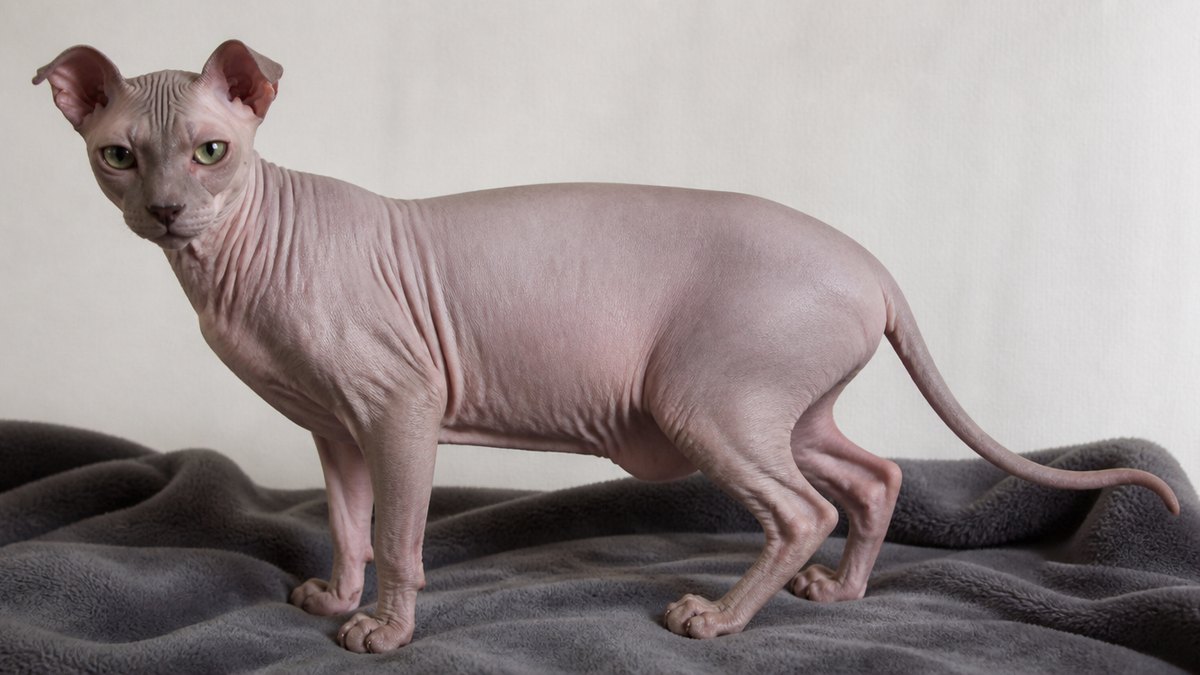
A Ukrainian Levkoy is a hairless cat with folded ears, produced by crossing the Scottish Fold with the Donskoy. Its own registry standard opens by describing a cat of very original appearance, hairless and with folded ears, of medium size, with a rather long, muscular and slender body of rectangular format.
The head is the most distinctive thing about the breed after the skin. From above it reads as a soft pentagon a little longer than it is broad, with the muzzle occupying only a third of the head length. The forehead is low, the skull long and flat, and prominent cheekbones and eyebrows give the outline its angles. The profile is stepped, in two levels, with the upper lines of the nose bridge and the head running almost parallel, which is what produces the dog-like look breeders describe.
The ears are large, set high and wide apart, with between a third and a half of each ear folded forward and down in a rounded fold that does not touch the head. That is a more moderate fold than a modern Scottish Fold's tight triple fold, and it comes from the same source.
The skin, which carries a fifth of the show points
The standard gives skin and coat 20 of 100 points, split evenly between naked and rugosity. The skin is described as thick, excessive, elastic and wrinkled on the head, above and under the eyes, on the neck, belly, legs and groin. Totally bare skin is preferred, but young cats and early-selection show cats may carry remnants of fur on the points or a 1 to 3 mm velour coat all over, and brush-variation cats with coarser curly fur are acceptable for breeding.
A histological study of Sphynx skin found hair follicles that were small, curved and kinked, with infundibular hyperkeratosis and dilatation, abnormal inner root sheath layers and dermal papillae lacking the normal flame shape, producing misshapen, thin, rarely medullated hair shafts. Its key finding for owners is that follicular density was SIMILAR in sphynx cats and controls: the conclusion reads that sphynx cats demonstrated hair follicle dysplasia, with abnormal shaft production but without a decrease in follicle quantity. That is a Sphynx study rather than a Levkoy one, and it is quoted here because it explains why hairless cats still produce sebum from a full complement of follicles, which is the reason bathing is part of routine care rather than an occasional treat.
Colour is unrestricted. All colours are accepted and tabby cats are not differentiated by pattern. On hairless skin the colour shows as pigment rather than as fur, so a black Levkoy is a grey-black cat and a red one is pinkish. Nothing in the standard describes this cat as heat-tolerant, and nothing about hairless skin makes it so in Indian sun.
Registry recognition, and the body no ranking page names
One registry holds the Ukrainian Levkoy, and its own standard says what class the breed sits in. Rolandus Union International in Kyiv publishes a document headed RUI Breed Standard: UKRAINIAN LEVKOY (Provisional). No international registry holds the breed at all.
That is the single most useful fact this page can give an Indian reader, because not one page in the Indian result set names any registry. Wikipedia's own infobox for the breed leaves every registry standard field empty, all nine of them, which is an unusually honest blank and also an unhelpful one.
| Registry | Ukrainian Levkoy | Donskoy | Scottish Fold |
|---|---|---|---|
| Rolandus Union International, Kyiv | Held, standard marked Provisional | Named as a permitted outcross | Named as a permitted outcross |
| WCF | No row in the 198-row table. The hairless category holds three breeds | DSX, recognised by five bodies | SFS and Highland Fold SFL, eight bodies |
| TICA | Zero occurrences in the registration rules | Category III | Category III |
| CFA | No breed council | No breed council | Breed council under Shorthair Breeds |
| FIFe | Absent | DSP, fully recognised | ABSENT. FIFe holds no Scottish Fold |
| LOOF | Absent from both lists | Championship, 27 pedigrees in 2025 | Championship, group total 951 in 2025 |
| CCA-AFC | Absent | Standard DS, reissued 12 June 2026 | Standard SF, reissued 12 June 2026 |
| GCCF | Not named, but three Red grounds reach it | RED, hairlessness and reported health problems | RED, osteochondrodysplasia |
The World Cat Federation's EMS table runs to 198 rows and its CATEGORY 5, HAIRLESS contains exactly three breeds: the Canadian Sphynx, the Don Sphynx and the Peterbald. That is a short, closed list rather than a long index where a breed could be missed, and this breed is not on it. A whitespace-tolerant search of the entire table for Ukrain, Levkoy and Lewkoy returns zero. The World Cat Federation's documented errors in that table are always omissions of a recogniser rather than false claims of one, so this page checked every other registry in its own documents too, and all of them agree.
Three separate grounds the GCCF has already stated
The GCCF does not name the Ukrainian Levkoy anywhere. What it does is state three grounds that each reach it, in three separate Red rows. On hairlessness, its Don Sphynx row reads verbatim: No intention to recognise further hairless breeds and reported health problems associated with hairlessness. Unpredictable gene. On combinations, its Elf row reads: No intention to recognise further hairless breeds or breeds combining multiple structural and/or coat mutations. On the fold, its Scottish Fold row reads: Ineligible. Known serious health problems (osteochondrodysplasia), with the owner note A pet who suffers with joint pain in mid-old age.
A breed that is hairless, that combines two mutations and that carries the fold meets all three at once. That is not the same as the GCCF having adjudicated this breed, and this page will not claim it is. It is a registry stating its reasoning clearly enough that a reader can apply it.
The Ukrainian registry's own English name, as it appears on its site, is The International Cat Fanciers' Association, Inc. Rolandus Union International. That is NOT the Cat Fanciers' Association, the American registry usually called CFA, which runs no breed council for this breed. A pedigree naming an international cat fanciers association is a Kyiv document rather than an American one, and the two should not be treated as interchangeable. Note also that the RUI site's footer copyright line reads 1995 to 2005, so the standard may not have been revised recently.
Where the Ukrainian Levkoy came from
The Ukrainian Levkoy was created in Ukraine by crossing the Scottish Fold with the Donskoy, and the account is documented in a veterinary textbook rather than only in breed literature. Wikipedia cites Englar's Common Clinical Presentations in Dogs and Cats, in its chapter on hypotrichosis and alopecia, for the parentage.
The registry's permitted outcross list is the best evidence of how the breed is actually maintained. It names Don Sphynx, Scottish Fold, Peterbald and household cats phenotypically corresponding to the morphological type of the Ukrainian Levkoy. A breed whose outcross list still includes both parents and an unregistered household cat is one being actively assembled rather than one closed off.
| Element | Comes from | What is documented |
|---|---|---|
| Hairlessness | Donskoy | The Donskoy's hairless variant has never been published. The KRT71 paper that mapped the Sphynx and Devon Rex alleles does not name the Donskoy at all |
| Folded ears | Scottish Fold | The Scottish Fold's fold is TRPV4 c.1024G>T, dominant, and causes osteochondrodysplasia. Nobody has genotyped this breed |
| The straight-eared variety | The breeding rule | One parent must be straight-eared, and roughly half of each litter is straight-eared |
| Permitted outcrosses | The registry standard | Don Sphynx, Scottish Fold, Peterbald and phenotypically matching household cats |
| Registry class | The registry standard's own heading | Provisional |
One caution about importing genetics from elsewhere. Hairlessness in dogs is a different mutation in a different gene from hairlessness in cats, and neither is the same as the Donskoy's variant. This page draws no inference from canine hairless breeds and neither should any other, because the mechanisms have been separately established and are not shared.
Ukrainian Levkoy price in India, and an answer engine caught converting
No verified Ukrainian Levkoy price in India exists. Google India's own generated answer states that there is no standard market price because specialised local breeders do not exist, then prints Rs 1,50,000 to Rs 3,00,000 in the very next sentence. That band is byte-identical to the figure two Indian template sites publish.
Run the arithmetic on the engine's own numbers and it does not close. The same answer cites a global price of USD 400 to 800. Divide each end of the rupee band by each end of the dollar band and both give exactly 375.00, which is not an exchange rate that has ever existed. Converted honestly at 84.38 rupees to the dollar, USD 400 to 800 is about Rs 33,752 to Rs 67,504.
| What the answer printed | Implied rate | Honest conversion at 84.38 | Ratio |
|---|---|---|---|
| Rs 1,50,000 against USD 400 | 375.00 | Rs 33,752 | 4.44 times |
| Rs 3,00,000 against USD 800 | 375.00 | Rs 67,504 | 4.44 times |
| Ongoing care Rs 3,000 to Rs 8,000 a month | No source cited at all | Not applicable | Not applicable |
| The identical rupee band on two Indian sites | Not a conversion | Not applicable | The engine is repeating a template figure |
The 4.44 multiple is carried entirely by the phrase international air freight, health clearances, permits, and documentation, and the answer cites no instrument for any of it. The actual instrument, India's DGFT import policy, is a restricted-import regime under ITC(HS) 01061900 with a monthly Exim Facilitation Committee for anything outside the personal-baggage route, and it publishes no landed-cost figure of any kind.
A Sphynx, most often, and the engine recommends it by name. The Indian result set for this breed puts a Sphynx at Rs 50,000 to Rs 1,20,000 at position one, a Siberian at Rs 15,000 to Rs 1,00,000 and a Persian at Rs 20,000 to Rs 90,000. Amazon.in also sells a 3.5 kg bag of dry cat food with the words Ukrainian Levkoy inserted into the product title, which is a contamination mechanism worth naming because it is a consumable rather than a poster or a mug, and a price scraper will collect it as a breed price. There is no identified Indian breeder of this cat.
The template underneath the figure is visible in a minute. Both Indian sites print the same monthly row for this breed as for a Toybob, a Foldex and a York Chocolate: food Rs 1,500 to Rs 2,000, health Rs 500 to Rs 700, grooming Rs 800 to Rs 1,500 and a monthly total of Rs 2,800 to Rs 4,200, with the components summing exactly to the totals. A grooming line identical for a hairless cat and a semi-longhaired one is the clearest proof available that nobody costed either.
Monthly cost of a hairless cat in India, honestly bounded
Budget higher than for a coated cat, and expect the extra to land on skin care rather than on food. A hairless cat needs bathing supplies, sun management and more frequent veterinary attention to skin, and none of that appears in any Indian monthly cost table.
- Licence, Rs 50 in Chennai. The Greater Chennai Corporation licenses pet animals generally rather than dogs only, so a cat is covered.
- Free municipal treatment and anti-rabies vaccination in Chennai. The corporation's veterinary clinics provide both free of cost.
- Bathing supplies, recurring. A cat-safe shampoo and soft cloths are the single most frequently replaced item for this breed, because bare skin accumulates sebum a coat would otherwise absorb.
- Sun protection, recurring. A 2026 review names indoor confinement during peak ultraviolet periods, shade and sun-protective clothing as the primary strategies, with sunscreen as an addition. In India that is a year-round line rather than a summer one.
- Dermatology consultations, likely. The only paper naming this breed is a dermatology case series in which lesions persisted from 1.2 to 56 months and no medical intervention achieved remission. Budget for a skin problem you may have to manage rather than cure.
- No statutory microchip cost for a kitten. Rule 7(16) of the Pet Shop Rules, 2018 makes microchipping mandatory for puppies only.
- No genetic test to buy for the coat. The Donskoy hairless variant has never been published, so no laboratory sells a panel for it and there is nothing to screen.
Two Indian sites give this breed a grooming line of Rs 800 to Rs 1,500 a month and a health line of Rs 500 to Rs 700, and print the identical two lines for a semi-longhaired York Chocolate and a plush Foldex. A hairless cat's grooming cost is not a brushing cost, and its health line has to carry skin. Build your own budget from your vet's rate card, your shampoo and your electricity bill, and expect the honest total to sit above a coated cat's rather than equal to it.
Heat tolerance and the Indian climate, with the usual advice inverted
Every overseas page frames hairless cats around cold, and in India the risks invert. A bare cat sheds heat efficiently and burns easily, so the Indian care questions are ultraviolet exposure, sebum in humidity and shade, rather than sweaters and heated beds.
Plan against your own city's real peak rather than a generic Indian summer, because the commonest error in Indian climate tables is naming May as the hottest month everywhere, which is wrong for three of the six cities most Indian cat owners live in.
| City | Hottest month and mean | Coolest month and mean | What matters for bare skin |
|---|---|---|---|
| Delhi | June, 35.88 C | January, 13.61 C | Both extremes. Sun management in June, and a genuine cold problem in January at a 13.61 C mean |
| Nagpur | May, 36.73 C | December, 19.97 C | Hottest in the table, and December is mild enough to need nothing |
| Chennai | May, 31.51 C | January, 24.09 C | No cold season at all, so heating is never the issue. Humidity and sebum are |
| Kolkata | May, 31.53 C | January, 17.31 C | A long humid monsoon, which is the hardest season for bare skin |
| Mumbai | May, 31.19 C | January, 23.19 C | Coastal humidity year round |
| Bengaluru | April, 28.37 C | December, 20.22 C | The easiest Indian city for this breed |
| Pune | April, 28.93 C | December, 19.62 C | Comfortable, with a mild cool season worth a blanket |
The three Indian care points that no overseas page makes
- Sun protection is the first-order risk, not warmth. A 2026 review states that ultraviolet-associated cancers typically develop in sparsely haired or hairless regions, and recommends indoor confinement during peak ultraviolet periods, shade and sun-protective clothing, with sunscreen as an additional strategy. In India that means no unshaded balcony access between about ten and four, all year.
- Do not put a hairless cat behind a sunny window. Glass reduces some ultraviolet but a cat that sleeps in a sunbeam every afternoon is accumulating exposure on exactly the skin that has no coat.
- Humidity is a skin problem rather than a coat problem. In Chennai, Kolkata and Mumbai, sebum plus warm damp air is what produces the greasy film owners describe. Bathing frequency goes up in the monsoon, not down.
- Delhi and Pune have a real cold season for this cat. A January mean of 13.61 C in Delhi is cold for bare skin, and a blanket, a covered bed and a warm room genuinely matter for two months.
- Check the ear fold weekly all year. A forward-folded pinna covers the canal opening and holds moisture that a straight ear sheds, and the fold cannot be opened to look inside.
The summary is that Bengaluru and Pune are the easiest Indian cities for this breed, coastal cities are the hardest for skin, and Delhi is the only one where an owner has to plan for both extremes in the same year.
Temperament, household fit and who should not get one
The Ukrainian Levkoy is described as friendly and active by its registry and as affectionate and very sociable in the breed literature, enjoying human and family company as well as the company of other domestic pets Ukrainian Levkoy, Wikipedia. Google's own questions box for the breed asks about exactly that trait. All of it is breeder and registry description rather than measurement.
Temperament is rarely the deciding factor for a hairless breed, and pretending otherwise is what most breed pages do. The deciding factors are whether you can commit to daily skin care for fifteen years, whether your home can keep a bare cat out of Indian sun, and whether you accept a fold gene whose consequences in this breed have never been measured.
- Indoor only, without exception, in India. Sun, dogs, traffic and disease all argue the same way, and for a hairless cat sun is the one an ordinary cat does not face.
- Warm surfaces are sought out. A bare cat will find laps, radiators, laptops and sunbeams, and the last of those is the one to manage.
- Sociable enough that solitude is a real cost. A cat described as very sociable in a household that is empty eleven hours a day is a cat that will overgroom bare skin.
- Handling is part of the routine rather than a bonus. Weekly bathing means a cat that must be comfortable being held, which is easier to build in a kitten than to retrofit in an adult.
Skip this breed if you cannot commit to weekly bathing and daily skin inspection, if your flat has an unshaded balcony the cat will reach, if you want a low-maintenance pet, or if you are buying because a hairless cat sounds hypoallergenic. It is not, and the allergen is produced in saliva and skin glands rather than in hair. And skip it if the ears are the appeal, since that is the part carrying an untested cartilage variant.
Training a Ukrainian Levkoy, and the handling that matters
To train a Ukrainian Levkoy, teach tolerance of handling first, because this is a breed whose owner has to bathe, wipe and inspect it every week for its whole life. Everything else is ordinary cat training.
- Introduce water in the first fortnight. A shallow warm bath with a cloth, twice in two weeks, is what makes a fifteen-year routine possible.
- Handle the ear fold weekly without unfolding it. Wipe only the visible outer surface, and let your vet look inside the canal.
- Handle the limbs and tail weekly. The fold gene's consequences in the Scottish Fold are distal limbs and tail, so a cat that tolerates limb handling is a cat your vet can assess without sedation.
- Teach a carrier before you need one. Feed meals in an open carrier for two weeks.
- Monitor weight monthly. A bare cat's body condition is unusually easy to see and unusually easy to misjudge, because visible ribs on a hairless cat look alarming when they are normal. Feel rather than look.
Litter training is ordinary. Use unscented, low-dust litter, because dust settles directly on bare skin, and a large tray with a low entry.
One thing to train deliberately is acceptance of clothing, if you plan to use it. A sun-protective shirt is one of the strategies a 2026 review names, and a cat that has never worn anything will not accept one at four years old. Start with thirty seconds, in a kitten, with food.
How much exercise a Ukrainian Levkoy actually needs
Budget 40 to 60 minutes of interactive play a day for an active, sociable indoor cat. This breed is described as active by its own registry, and an indoor-only life makes the owner responsible for all of it.
- Split into three sessions. Cats hunt in bursts, and a sociable breed engages more readily with short frequent play.
- Use vertical space, but keep landings soft. The fold gene's untested status in this breed is a reason to prefer a carpeted or matted landing to a tiled one.
- Watch the skin during play. Bare skin scuffs and scratches where a coated cat's would not. A cat tree with rough sisal at cat height is a bad choice here.
- Play in shade, always. A window-lit room in an Indian afternoon delivers real ultraviolet exposure to unhaired skin.
- Keep the room under about 30 C for hard play. A hairless cat radiates heat well but still overheats, and open-mouth breathing is a stop signal.
The failure mode here is not under-exercise but overgrooming. A sociable, active cat with bare skin and nothing to do will lick itself, and on unhaired skin the damage shows immediately. Enrichment is skin care by another name.
Grooming a Ukrainian Levkoy in Indian humidity
Grooming a Ukrainian Levkoy means skin care rather than brushing, and it is the most demanding routine in this batch. Plan on a weekly bath or full wipe-down, a daily quick check of the skin folds, and a weekly ear check.
The reason is anatomical. Hairless cats retain a full complement of hair follicles that produce abnormal shafts rather than none, so the sebaceous output continues with no coat to absorb it. That is what produces the greasy film owners describe, and it is worse in Indian humidity than in the cooler climates this breed came from.
- Bathe weekly with a cat-safe shampoo, more often in the monsoon. Rinse completely and dry gently rather than rubbing.
- Wipe the skin folds daily. The standard describes wrinkling on the head, above and under the eyes, on the neck, belly, legs and groin, and every one of those is a place moisture and sebum collect.
- Do the ear check weekly and never unfold the ear. Clean only the visible surface.
- Clean around the eyes daily. A breed with a low forehead, wrinkled skin above and below the eyes and no lashes accumulates debris there.
- Trim nails every two weeks. Bare skin means a scratch draws blood where a coated cat's would not.
- Inspect for new marks every time you bathe. The one paper naming this breed describes erythematous plaques with a linear, annular or gyrate configuration appearing mostly on the trunk and extremities, with scaling trailing the expanding edge. An owner who looks weekly will notice one early.
Do not use human skincare products, human sunscreen or scented wipes on a hairless cat. A cat grooms itself, so anything you apply is eaten. A 2026 review concludes that sunscreens containing non-nanoparticle zinc oxide appear safe for dogs and cats when ingestion is prevented or minimised, whereas the safety of organic ultraviolet filters remains unclear, and calls for evidence-based guidelines that do not yet exist. Ask your nearby vet what to use before you use anything, and treat shade and indoor confinement as the main tools.
Ukrainian Levkoy health, and one paper for one breed
The Ukrainian Levkoy appears in the entire indexed veterinary literature exactly once, as a single cat among eleven in a 2024 dermatology case series. Everything else on this page is evidence about its two parent mutations, and this section says which is which.
The one study that names this breed
A 2024 case series described figurate erythema in 11 Eastern European sphynx cats, comprising seven Donskoys, one Peterbald, one Ukrainian Levkoy and two presumed Canadian sphynxes. All but one were male, and onset was under 12 months in eight cats. Lesions lasted between 1.2 and 56 months and consisted of erythematous plaques in linear-to-serpiginous, annular, gyrate or iris configurations predominating on the trunk and extremities, with scaling often trailing the edge of a centrifugally expanding erythema. Cats were otherwise asymptomatic or mildly itchy. Dermatophytosis was ruled out in eight. Microscopically there was focal mild-to-moderate epidermal hyperplasia and hyperkeratosis, minimal-to-mild dysplasia and subepidermal collagen smudging.
Two things about that result matter for a buyer. Clinical remission was not achieved with diet changes or medical interventions, yet spontaneous transient partial or complete improvement occurred in most cats. And one cat of this breed in an eleven-cat series is a case report rather than a prevalence figure, so nobody should tell you a proportion of Levkoys are affected. What it does establish is that this is a described condition in Eastern European hairless cats and that an Indian vet may not have seen it.
The hairlessness, which has never been mapped
The Sphynx's hairlessness is a splice-site variant in KRT71, and the Devon Rex's curl is a separate splice-altering change in the same gene, giving the allelic series KRT71 wild type greater than hr greater than re. That paper scanned ten curly, wire-haired and hairless cat breeds and reports verbatim that mutations in the coding region of KRT71 were not identified in the two additional hairless breeds and the six other wired and rexoid cat breeds. The words Donskoy and Don Sphynx appear zero times in its full text, so this page does not claim the Donskoy was one of those two. What it does establish is that KRT71 does not explain every hairless cat, and that no published variant explains the Donskoy line's coat.
Hairlessness in dogs has its own mapped mutation in a different gene, and it is not the mechanism behind any hairless cat breed. Applying canine ectodermal dysplasia findings, including the dental consequences they carry, to a Donskoy or a Levkoy would be a species error, and it is a mistake this site has caught being made before. The honest position is that the Donskoy line's hairlessness is dominantly expressed with graded coat variants, that the French studbook registers the brush variety separately as a breeding auxiliary, and that its causal variant is unpublished.
The folded ears, which are the best-documented thing about this cat and have never been tested in it
The Scottish Fold's fold and its osteochondrodysplasia are the same dominant mutation, a p.V342F substitution in TRPV4 identified in 44 Scottish folds and absent from 648 unaffected cats, causing malformation in the distal forelimbs, distal hindlimbs and tail and progressive joint destruction. The Ukrainian Levkoy's ears come from that breed. Nobody has genotyped a Levkoy.
What the breed's own literature does carry is the breeding rule, and the rule is the tell. One parent must have normal straight ears while the other has folded ears in the heterozygous form, all straight-eared kittens carry no dominant fold gene, and the straight variety is described as the complemented and necessary partner of the breed, with roughly half of each litter straight-eared. That is precisely the rule you write to avoid producing cats with two copies. A published case series found severe exostosis in the hind leg by about one year in two homozygous Scottish Fold crossbred cats and concluded that cross breeding with Scottish Fold cats could produce unknown phenotypes and should be avoided.
| Question | Status | Source |
|---|---|---|
| Any paper naming the breed? | One, and it is a dermatology case series with one Levkoy in it | Mendoza-Kuznetsova 2024 |
| Is the hairless variant identified? | No. Never published for this line | Gandolfi 2010 |
| Do hairless cats lack hair follicles? | No. Follicle density is normal, shaft production is abnormal | Genovese 2014, in the Sphynx |
| Is the fold gene identified? | Yes, in the Scottish Fold. TRPV4 c.1024G>T, dominant | Gandolfi 2016 |
| Has this breed been genotyped for it? | No published test exists in this breed | PubMed audit, 10 September 2026 |
| What happens to fold homozygotes? | Severe exostosis by about one year in two published crossbred cases | Takanosu 2020 |
| Is there a documented Donskoy variant? | Yes, a separate one. HPS5 splice-site, recessive, causing albinism | Meriot 2020 |
| Breed lifespan measured? | No. Not among the 12 breeds reaching 15 deaths | Teng 2024, Table 6 |
On life expectancy, the closest relevant figure is a warning rather than a number for this breed. The largest UK feline life-table study gives the Sphynx a life expectancy at age 0 of 6.68 years, the shortest of the twelve breeds that reached its threshold, on 18 deaths and an observed range of 0.13 to 14.67 years. That is the Sphynx and not this breed, the Levkoy did not reach the threshold, and a different hairless breed's figure should not be handed to it. It is quoted here because it is the only hairless-breed lifespan anyone has measured and because it is markedly below the all-cats figure of 11.74 years.
The risks that are established and that do apply are general. Entire cats had 4.29 times the odds of death before three years compared with neutered cats, and purebred cats 1.83 times the odds compared with crossbreds. A 2025 welfare review makes a useful point about how to talk about all of this: negative messaging about purebred cats is often poorly evidenced and can be alienating to owners and breeders, with limited or even negative welfare gain. Being specific is more useful than being loud, which is why this page prints what each study did and did not measure. Consult your nearby vet about an individual animal.
Feeding a hairless cat in India
Feed a Ukrainian Levkoy to hold a stable, lean body condition, and expect a slightly higher maintenance requirement than a coated cat of the same weight, because a bare animal loses more heat to the room.
- Weigh the daily ration and portion it once each morning. Guessing is how a hairless cat becomes visibly round.
- Monitor body condition by hand rather than by eye. On bare skin, ribs and hip bones are visible in a perfectly healthy cat, so feel for a thin fat cover instead of judging from a photograph.
- Expect a slightly higher intake in a cooled Indian flat than in a warm one. A cat in constant air conditioning at 22 C burns more on maintenance than the same cat at 28 C.
- Keep wet food in the mix. Water intake matters in a hot climate and a cat that will not drink will often eat moisture.
- Do not use diet to treat a skin lesion without veterinary advice. In the one series naming this breed, diet changes did not achieve remission.
Kitten food through 12 months is standard and sensible. Availability in India is not a constraint, since every major wet and dry line sold in Indian metros carries a complete and balanced formula.
One myth worth retiring is that hairless cats need to eat constantly. They have a modestly higher maintenance requirement, not a dramatic one, and free feeding produces the same obesity in this breed as in any other.
Kitten timeline, month by month through the first year
Kitten care for a Ukrainian Levkoy follows the ordinary feline timeline with three additions, an early bathing habit, sun management from the day the kitten arrives, and a weekly ear and skin inspection that becomes lifelong.
- Before you commit, ask which parent was straight-eared. The breeding rule requires one straight-eared parent, and roughly half of each litter should be straight-eared. A breeder who cannot answer that question has not read their own breed's guidance.
- Weeks 0 to 8, with the breeder. Indian law treats kittens below eight weeks as un-weaned and prohibits their sale, so a kitten offered earlier is an illegal sale.
- Month 2, home, and the first bath within a fortnight. Warm water, a cloth, and a very short session.
- Month 2, block the sunny window. Sun management starts immediately rather than at the first burn.
- Month 2 to 4, core vaccination course. Follow your nearby vet's schedule rather than any breed page's table.
- Month 3, weekly ear and skin inspection becomes routine. Two minutes, every week, for fifteen years.
- Month 4, weight baseline. Record it and repeat monthly.
- Month 6 to 9, neutering discussion. Entire cats carry 4.29 times the odds of death before three years compared with neutered cats.
- Month 8, first monsoon. Bathing frequency usually has to rise, and this is when an owner learns their own cat's skin.
- Month 12, adult health check. Ask specifically for a skin examination, a look at the ear canals and an assessment of the distal limbs and tail.
One thing not to do is treat visible ribs on a young hairless cat as underfeeding. Bare skin shows skeleton that a coat hides, and a kitten that looks thin in a photograph may be exactly right under your hand.
Ukrainian Levkoy versus the cats it is cross-shopped against
Indian buyers reach this breed from the Sphynx, and Google's own related searches offer Ukrainian levkoy vs sphynx directly. The table below sets it against both parents and the two hairless breeds that do have international recognition.
| Breed | Mutations | Registries | Coat variant mapped? | Available in India |
|---|---|---|---|---|
| Ukrainian Levkoy | Hairless plus folded ears | 1, RUI Kyiv, provisional | No Gandolfi B, Outerbridge CA, Beresford LG | No identified breeder |
| Donskoy | Hairless | WCF, FIFe, TICA, SACC, LOOF, CCA | No. A separate albinism variant is mapped | Very rare |
| Sphynx | Hairless | All major registries | Yes, KRT71 hr allele | Yes, Rs 50,000 to Rs 1,20,000 quoted |
| Peterbald | Hairless, graded coats | WCF, FIFe, TICA, LOOF, CCA | No | Rare |
| Scottish Fold | Folded ears | Eight bodies, not FIFe, red-listed by GCCF Governing Council of the Cat Fancy | Yes, TRPV4 c.1024G>T | Yes, widely |
| Indian domestic shorthair | None | None, and none needed | Not applicable | Free, from any shelter |
The Sphynx is the hairless breed with a mapped coat variant, histological description of its skin, a measured life expectancy and recognition by every major registry Genovese DW, Johnson TL, Lamb KE Teng KT, Brodbelt DC, Church DB. It is also the hairless breed actually available in India. Choosing it gives you the same daily skin routine, far more documentation, and no fold gene. That measured life expectancy is 6.68 years and is the shortest in its study's table, which is a reason to read the Sphynx page carefully rather than a reason to prefer an unmeasured breed.
Mistakes Indian buyers make with the Ukrainian Levkoy
Five mistakes account for most of the harm, and the first is believing a rupee figure that the engine printing it has already said does not exist.
- Taking the Rs 1,50,000 to Rs 3,00,000 band seriously. The answer that prints it says in the previous sentence that no standard market price exists, and both ends divide to exactly 375.00 against the dollar band it cites. It is a template figure from two Indian sites, laundered back as a conclusion.
- Treating a hairless cat as hypoallergenic. The allergen is produced in saliva and skin glands, not hair, and a 2024 review states there is no scientific evidence for a hypoallergenic cat breed.
- Following overseas care advice about cold. Almost every page for this breed is written for a European climate and talks about sweaters and heated beds. In Chennai and Mumbai the risks are ultraviolet exposure and sebum in humidity.
- Ignoring the ear gene entirely. The ears come from the Scottish Fold, that fold is caused by a variant with a documented skeletal disease, and no ranking page mentions it.
- Buying without asking which parent was straight-eared. The breed's own breeding rule requires one straight-eared parent, and a fold-to-fold mating is what produced the two homozygous cats with severe exostosis in the published case series.
A sixth mistake belongs to publishers rather than buyers. Four American veterinary clinic websites in this breed's Indian result set run the same syndicated article, three of them dated 1 April 2022, and one of the four has had a heading added reading Our Advice on Meet The Ukrainian Levkoy in 2025 while its metadata names two different authors. A veterinary clinic's logo above syndicated text is not veterinary review, and a reader should check who actually wrote a page before treating it as clinical advice.
Finally, do not read this breed's registry scarcity as proof it is dangerous, or its provisional status as proof it is safe. Both are statements about how many breeders have organised, in one country, under one body. The health questions are separate and this page has set them out on their own evidence.
Adoption, responsible sourcing and the honest answer for India
Adopt, because there is no documented Ukrainian Levkoy in India and no registry here that could paper one. If hairless is genuinely what you want, the Sphynx exists in India, has a mapped coat variant and carries no fold gene.
- Adopt an Indian domestic shorthair. Climate-adapted, hardy, free from any shelter, and needing none of the skin routine this breed demands.
- Adopt a hairless cat already in rescue if one appears. Hairless cats are surrendered precisely because the skin routine surprises people, and rehoming one creates no demand.
- Verify the registry rather than the certificate. Only Rolandus Union International in Kyiv publishes a standard for this breed, and its own heading marks the class as provisional. A certificate naming an international cat fanciers association is a Ukrainian document rather than an American one.
- Refuse any kitten under eight weeks. Indian law defines kittens below eight weeks as un-weaned and prohibits their sale.
- Ask which parent was straight-eared, and get the answer in writing. It is the one question that distinguishes a breeder following the breed's own guidance from one who is not.
If you specifically want a documented Ukrainian Levkoy, the route is long and it starts in Ukraine. It means a breeder registered with Rolandus Union International, and then either moving your residence to India permanently with the cat already yours under the Customs Baggage Rules, or a DGFT import authorisation for a purpose the policy actually lists. No shorter route exists, and any Indian seller offering one is offering something they cannot document.
The wider point is worth stating plainly for a reader weighing this against a shelter cat. This page found one registry, one breed standard, one paper naming the breed, and an answer engine converting a template figure into a landed cost. That is the whole of the record. A cat from a shelter in your own city comes with no record and no mystery, needs no sunscreen, and will be waiting today.
Ukrainian Levkoy questions Indian buyers actually ask
What is the temperament of the Ukrainian Levkoy?
Friendly and active, on its registry's own account, and very sociable in the breed literature, enjoying human and family company as well as the company of other domestic pets. The registry standard adds one detail with practical consequences: the breed expresses sexual dimorphism, so males and females differ noticeably in size. Note that every temperament description available for this breed comes from breeders and the registry rather than from any measurement, which is true of most cat breeds and worth saying out loud for one with a single published paper.
How much does a Ukrainian Levkoy cat cost?
Overseas prices of USD 400 to 800 are quoted, and no verified Indian price exists. Google India's own answer says that the breed is extremely rare in India and that there is no standard market price because specialised local breeders do not exist, and then prints Rs 1,50,000 to Rs 3,00,000 for an import. Divide each end by the dollar band the same answer cites and both give exactly 375.00, which is not an exchange rate. Converted honestly at 84.38, USD 400 to 800 is about Rs 33,750 to Rs 67,500, so the printed band is roughly 4.4 times the arithmetic.
What are the common health issues for Donskoy cats?
Two are documented and neither is what breed pages usually list. A 2024 dermatology case series described figurate erythema in 11 Eastern European sphynx cats, seven of them Donskoys, with erythematous plaques on trunk and extremities, onset before 12 months in eight cats, and no remission achieved with diet or medication although most improved spontaneously. Separately, a 2020 study identified a recessive HPS5 splice-site variant behind the pink-eye phenotype in Donskoys, a form of oculocutaneous albinism. Beyond that, the general hairless-cat issues apply: skin care, sun exposure and temperature.
What is the most popular cat breed in Ukraine?
No published registration table answers that, and the question lands in this breed's results box because the Indian index for the Levkoy is only about 89 results deep. What can be said is that Ukraine has its own felinological body, Rolandus Union International in Kyiv, which publishes breed standards in Ukrainian, Russian and English and holds the Ukrainian Levkoy at provisional class. That registry is the correct place to look for Ukrainian breed information, and no ranking page mentions it.
Which registry recognises the Ukrainian Levkoy?
Rolandus Union International in Kyiv, and its own standard heading marks the class: RUI Breed Standard, UKRAINIAN LEVKOY, Provisional. No international registry holds the breed. The World Cat Federation's hairless category contains exactly three breeds, the Canadian Sphynx, the Don Sphynx and the Peterbald, and this is not one of them. TICA's registration rules name every breed in six categories and the Levkoy appears in none. CFA runs no breed council. FIFe, the French studbook LOOF, the Canadian Cat Association and the Cat Fanciers' Federation all lack it.
Does the Ukrainian Levkoy carry the Scottish Fold gene?
Its ears come from the Scottish Fold and nobody has genotyped the breed to confirm which variant produces them. The Scottish Fold's fold is caused by a dominant TRPV4 variant, c.1024G>T, that also causes osteochondrodysplasia, and a published case series of Scottish Fold crossbred cats found severe exostosis in the hind leg by about one year in two homozygous cats, concluding that cross breeding with Scottish Fold cats could produce unknown phenotypes and should be avoided. The breed's own breeding rule, that one parent must be straight-eared, is exactly the rule you would write to avoid homozygotes.
Do Ukrainian Levkoys need sunscreen in India?
Shade and indoor living come first, and sunscreen is an additional measure rather than the main one. A 2026 review of ultraviolet-induced skin cancer in pets states that ultraviolet light is strongly implicated in a range of dermatoses from actinic keratosis to squamous cell carcinoma in dogs and cats, that these tumours typically develop in sparsely haired or hairless regions, and that indoor confinement during peak ultraviolet periods, shade and sun-protective clothing reduce exposure. It notes that non-nanoparticle zinc oxide appears safe for cats when ingestion is prevented, and that the safety of organic filters remains unclear. Ask your nearby vet before applying anything.
Is the Ukrainian Levkoy hypoallergenic?
No, and hairlessness does not make it so. A 2024 review states flatly that there is no scientific evidence for a hypoallergenic cat breed. The major cat allergen is produced in saliva and skin glands rather than in hair, so a bare cat that grooms itself still deposits it, and in this breed's case the skin produces enough sebum that owners bathe the animal regularly. Individual cats vary far more than breeds do. Do not pay a premium for an allergy claim.
Why do Levkoy litters have straight-eared kittens?
Because the breeding rule requires it. The breed's published breeding guidance says one parent must have normal straight ears while the other has folded ears in the heterozygous form, and that roughly half of each litter will be straight-eared, with the straight variety described as the complemented and necessary partner of the breed. Straight-eared kittens carry no dominant fold gene. That is the same arrangement the Canadian registry uses for the Foldex, and it exists to avoid producing cats with two copies of the fold variant.
How big does a Ukrainian Levkoy get?
Medium, long-bodied and slender rather than heavy. The registry standard describes a medium-sized cat with a rather long, muscular and slender body of rectangular format, a slightly arched back line, an oval and not broad chest, rather long strong-boned legs, oval paws with long mobile toes and a rather long tapering tail. It gives no weight figure at all, and it notes that the breed expresses sexual dimorphism, so males run noticeably larger than females.
Can I import a Ukrainian Levkoy into India?
Only as your own pet when you move to India permanently. India's import policy for pet cats and dogs is restricted under ITC(HS) code 01061900, and the Directorate General of Foreign Trade permits import without authorisation only for persons shifting residence permanently to India under the Customs Baggage Rules. Everyone else needs an import authorisation, and cases outside the listed purposes go to a monthly Exim Facilitation Committee. Any Indian figure presented as a landed import cost for this breed cites no instrument at all.
What is the lifespan of a Ukrainian Levkoy?
Nobody has measured it. The largest UK feline life-table study built its breed table from 7,936 confirmed deaths and required 15 or more deaths before a breed received a row. Twelve breeds reached that threshold and this one is not among them, nor is the Donskoy. The most relevant figure in that table for a hairless breed is the Sphynx at 6.68 years, the shortest life expectancy of the twelve, on 18 deaths, and that is the Sphynx rather than this breed. Plan against the study's all-cats figure of 11.74 years and ask your nearby vet about the individual animal.
Compare with similar breeds
Ukrainian Levkoy sits in 2 Bonbeno groups. Each one compares it directly against the breeds it is genuinely an alternative to, on the same figures.