
Breed profile
Bambino Cat Price in India, and the Two Mutations Stacked in One Cat
The Bambino is a deliberate cross of the Sphynx and the Munchkin, so it carries two mutations at once. A Dutch university worked out the breeding arithmetic, a Dutch regulator prohibits breeding it by name, and no Indian source publishes a price for it.
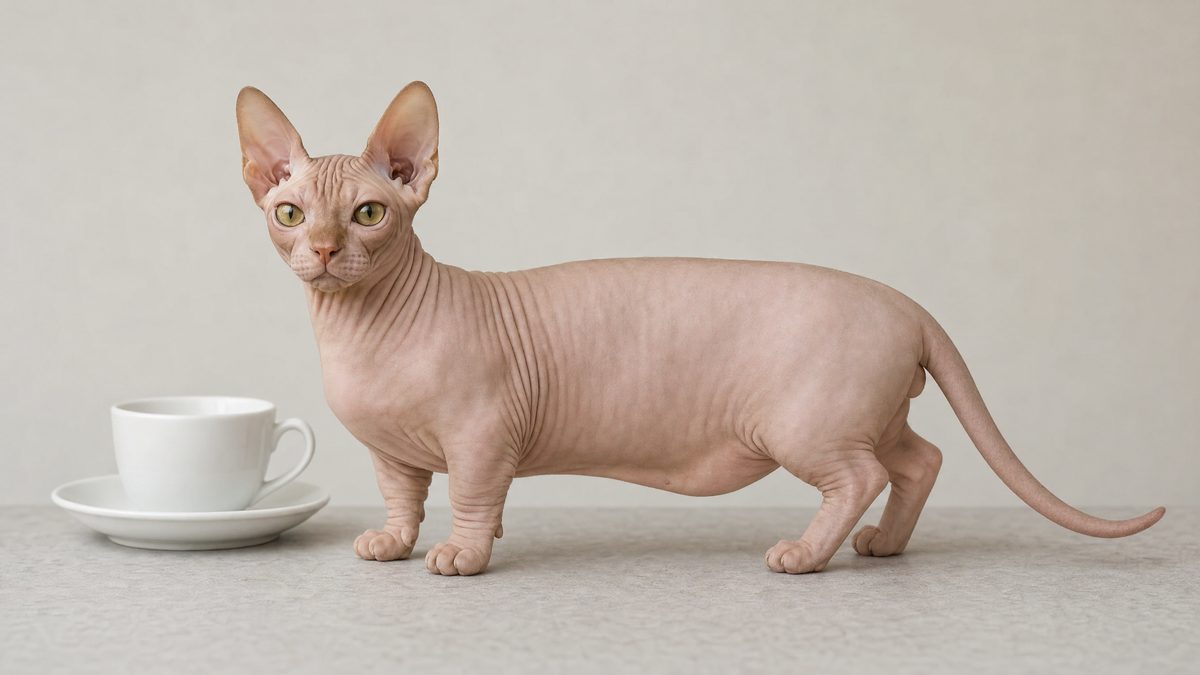
Quick answer
No Indian source publishes a Bambino cat price in India. The breed is a deliberate Sphynx and Munchkin cross that stacks two mutations in one cat, hairlessness and short legs, and Bonbeno could find no Indian price, listing or breed page for it in August 2026. What does exist is the science, the registry record, and a Dutch prohibition that names this cross specifically.
This guide is general information for Indian pet owners and is not a diagnosis. Consult your nearby vet, a registered veterinarian you can actually reach, before acting on anything you read here, and treat any sudden change in your cat's condition as urgent.
Bambino at a glance
What a Bambino cat actually is
A Bambino is a domestic cat carrying two separate mutations at once, one that removes its coat and one that shortens its legs. The Rare and Exotic Feline Registry, which publishes the only Bambino breed standard Bonbeno could open, defines the breed as the deliberate hybrid of long-boned shortened dwarf cats, including the Munchkin, and the extremely short-coated or hairless cats including the Sphynx. Everything else about the cat follows from those two variants and from whichever ordinary cats were bred in behind them.
Both mutations have names, catalogue numbers and DNA tests, which is unusual and useful. The hairlessness comes from a KRT71 splice variant, NM_001195239.1:c.816+1G>A, catalogued by the University of Sydney as OMIA:001583-9685, Hypotrichosis with whiskers short and curled in Felis catus, inherited autosomal recessive and first reported in 2010. The short legs come from a 3,303 base pair deletion with a 108 base pair insertion inside UGDH, the gene for UDP-glucose 6-dehydrogenase, catalogued as OMIA:002541-9685 with the mode of inheritance recorded as autosomal dominant plus recessive lethal and first reported in 2020 Struck AK, Braun M, Detering KA.
Hold those two lines side by side, because the whole page turns on them. One variant is recessive, so a Bambino needs two copies of it. The other is dominant with a lethal homozygote, so a Bambino needs exactly one copy of it and can never have two. That asymmetry is not a detail. It dictates how the breed is made, how big the litters are, what a breeder can and cannot pair, and what the reader is actually being sold.
| Hairlessness | Short legs | |
|---|---|---|
| Gene | KRT71, keratin 71 | UGDH, UDP-glucose 6-dehydrogenase |
| Variant | NM_001195239.1:c.816+1G>A, a splice variant | 3,303 bp deletion plus 108 bp insertion on chromosome B1 |
| Inheritance | Autosomal recessive | Autosomal dominant plus recessive lethal |
| Copies a Bambino carries | Two, written hr/hr | Exactly one, written M/m |
| Homozygous form | Is the normal state for this breed and for every Sphynx | Presumed embryonically lethal, no cat with two copies has ever been observed |
| First reported | 2010 | 2020, independently by two labs Buckley RM, Davis BW, Brashear WA |
| Commercial DNA test | Yes, offered as a Sphynx coat-type test | Yes, offered for Munchkin and related breed lines |
The two-step cross, which is what makes this a designer cat rather than a breed
Making a Bambino takes two generations, and a Dutch university wrote the arithmetic down. In an expert statement prepared for the Netherlands Food and Consumer Product Safety Authority in November 2018, titled after this breed, two veterinarians at the Faculty of Veterinary Medicine at Utrecht University set out the cross step by step. Step one pairs a short-legged, coated Munchkin, genotype MmHH, with a hairless, normal-legged Sphynx, genotype mmhrhr. Every kitten in that first litter is coated and every kitten carries one copy of the hairlessness allele, and half of them are short-legged. Not one of them is a Bambino.
Step two breeds those short-legged carriers on. Only then does a kitten appear with both features, hairless and short-legged, genotype Mmhrhr, which is the cat sold as a Bambino. The statement uses a word for this that no ranking page uses: mutantenfokkerij, mutant breeding, defined as breeding in which parent animals are deliberately selected for a mutation that produces a harmful hereditary characteristic. Its opening summary states plainly that breeders consciously stack, in two steps, the recessively inherited mutation that makes the Sphynx hairless on top of the dominantly inherited lethal mutation that gives the Munchkin its shortened legs.
A Bambino is not a blend of two breeds the way a crossbred kitten is a blend of its parents. It is one cat carrying two independent mutations at two unrelated genes on two different chromosomes, each doing its own thing. The coat gene does nothing to the legs and the leg gene does nothing to the skin. What stacks is not the genetics, which stay separate, but the consequences: a cat that cannot hold its body heat AND cannot jump to the warm shelf it would choose. Utrecht's conclusion puts it in one sentence, that with the stacking of the mutations, the welfare risks of missing a coat and of having shortened limbs also stack, with respect to the way the cat moves, its heat regulation and its skin health.
Half of what a Bambino breeder produces is not a Bambino
The registry standard says so itself. REFR records that Bambino litters produce both short-legged and long-legged kittens, and that Bambino long-legs are vital to the Bambino breeding program. That is the same commercial structure the Munchkin world runs on, where breeders call the short-legged cats standard and the naturally proportioned ones non-standard, a framing Utrecht's statement flags explicitly.
For an Indian buyer the practical consequence is blunt. A long-legged kitten out of a Bambino litter is a hairless cat with ordinary legs, which is a Sphynx in everything but paperwork. It is a perfectly good cat. It is not the cat in the photograph, and there is no visual test that will tell you which one a two-month-old kitten will grow into if the seller crops the picture at the chest.
The breed standard, and how thin the published record is
REFR's standard describes a two-planed wedge head longer than it is wide, large almond-shaped eyes set wide and slightly slanted, a short muzzle that looks square from above, ears set well onto the top of the head with lynx tipping, a level back, and short well-developed legs with medium feet and prominent knuckles. On the coat it is deliberately loose: the coat ranges from complete hairlessness to slight down, and the texture matters more than the amount. On the body it asks for strength and muscularity, stocky and very muscular rather than thin or whippy.
Compare that with what the recognised breeds get. The Cat Fanciers' Association publishes a full Sphynx standard describing an appearance of hairlessness with short fine hair possible on the feet, the outer edges of the ears, the tail and the scrotum, and a body that feels warm and soft to the touch with a skin texture like a soft peach or a smooth nectarine. There is no equivalent CFA document for the Bambino, because cfa.org/breed/bambino/ returns HTTP 404 while cfa.org/breed/sphynx/ returns a complete breed page. Bonbeno tested both on 20 August 2026.
TICA's website refused every request from this environment on 20 August 2026, returning HTTP 403 for its breed pages, its all-breeds list and its registration rules PDF, and the Internet Archive holds no snapshot of a TICA Bambino page. Pet-media pages widely report that TICA registered the Bambino as an experimental breed in 2006, and the ASPCA's breed resource reports the 2005 origin, but Bonbeno could not open TICA's own text to confirm any of it and therefore does not print a TICA status as a verified fact. What is verified is what the other registries publish, and that is set out in the health section below. An unreachable source is not a source.
History, size and lifespan, with the gaps marked
The history is short and undisputed in outline. The breed did not appear until 2005, when the breeders Stephanie and Pat Osborne combined a Sphynx with a Munchkin, and the name was chosen because bambino means baby in Italian and these cats keep a kitten-like look for life. Utrecht's statement places the Bambino inside a wider wave of the same practice, naming the Ukrainian Levkoy, the Elf Cat, the Dwelf and the Minskin as breeding lines created the same way, by crossing hairless cats with lines carrying other harmful outward characteristics such as short legs and folded ears.
On size, the published figures are thin and come from pet media rather than measurement. The ASPCA's breed resource gives five to nine pounds, roughly 2.3 to 4.1 kg, and a lifespan of 9 to 15 years. Read that lifespan as an expectation and not a finding. No life table, mortality study or veterinary records analysis for the Bambino exists anywhere Bonbeno could search, and the large UK study that does report breed-specific feline life expectancy covers 12 breeds and does not include this one. The health section returns to that number and to what the parent-breed data actually say.
One last framing point, because it decides how to read everything below. This is a designer cat with a two-decade history, no peer-reviewed literature of its own, one openable breed standard, and two of the best-characterised mutations in feline genetics. That is an unusual combination: the parts are well studied and the assembled animal is not studied at all.
Bambino cat price in India, and why there is not one
No Indian source publishes a Bambino cat price in India. Bonbeno checked the Indian pages that rank for cat pricing, the two Indian pages that cover this breed's parents, and the search results for the exact phrase, and found no Indian price band, no Indian listing and no Indian breed entry for the Bambino in August 2026. That absence is the finding. This section evidences it, prints the only prices that do exist, and explains what an Indian buyer is most likely being offered when a seller says the word.
Start with what was searched, because a claim of absence is only worth anything if you can see how it was tested.
| Source checked | What it is | Bambino price found |
|---|---|---|
| Supertails, Cat Price in India 2026 | The Indian all-breed price guide that ranks for cat pricing queries. Covers 14 breeds from Indian Domestic at Rs 0 to 2,000 up to Sphynx at Rs 50,000 to 1,50,000 | None. The word Bambino does not appear on the page |
| Supertails, Sphynx Cat Price in India | Dedicated Indian price guide for the hairless parent breed, with quality tiers and a city table | None. No mention of Bambino, Munchkin or short-legged hairless cats |
| Supertails, Munchkin Cat Price in India 2026 | Dedicated Indian price guide for the short-legged parent breed, with a city table | None. The word Bambino does not appear |
| Search results for the exact phrase | Every page returned was United States pet media, a United States insurer or a United States cattery, priced in dollars Hepper Pet Resources. How Much Does… | None in rupees |
| Indian kitten marketplaces | The marketplace that carries per-city Munchkin listings refused connections from this environment on 20 August 2026, so Bonbeno reports no finding from it either way | Could not be checked, and is reported as unchecked rather than as empty |
A price range for this breed in India would be easy to manufacture. Take the Indian Sphynx band, add the Indian Munchkin band, add a rarity premium, print a table by city. It would look exactly like every other page you have read and it would be fiction. There is no observed Indian transaction behind any such number, so this page does not print one. If a seller quotes you a figure, understand that it is their asking price and not a market rate, because no market has been observed.
The only published Bambino prices are American
Two United States sources publish figures and they broadly agree. Spot Pet Insurance gives 2,000 to 3,000 US dollars from a breeder, adoption fees of 100 to 500 dollars, 300 to 400 dollars of initial setup, and 12 to 20 dollars a month on food. Hepper gives 1,800 to 3,000 dollars from a breeder and 100 to 500 dollars to adopt or rescue. Neither page mentions India anywhere Hepper Pet Resources. How Much Does….
Those are not Indian prices and converting them would be worse than useless, because the conversion would silently assume a supply chain that does not exist here. What they do tell you is the shape of the thing: in the country where the breed was created, a Bambino from a breeder costs roughly four to thirty times what it costs to adopt one.
The parent breeds have Indian prices, and they are not this breed's price
Both parents are sold in India and both have published Indian bands, so they are worth printing as a labelled contrast. They are a contrast and not a substitute.
| Breed | Source | Published Indian band |
|---|---|---|
| Sphynx (hairless parent) | Supertails, dedicated price guide | Rs 20,000 to Rs 2,00,000 overall. Standard Rs 20,000 to 50,000, purebred Rs 50,000 to 1,50,000, rare black Rs 80,000 to 2,00,000 |
| Sphynx (hairless parent) | Supertails, all-breed guide, same publisher | Rs 50,000 to Rs 1,50,000, described as typically the most expensive domestic breed in India |
| Munchkin (short-legged parent) | Supertails, dedicated price guide | Rs 25,000 to Rs 70,000, with Mumbai and Delhi at Rs 40,000 to 70,000 and Hyderabad and Pune at Rs 30,000 to 55,000 |
| Munchkin (short-legged parent) | Supertails, all-breed guide, same publisher | Rs 30,000 to Rs 60,000 |
| Bambino | Every Indian source checked | No published figure |
Two things are visible in that table and both are worth naming. First, one publisher gives two different bands for the same breed in the same month, Rs 20,000 to 2,00,000 on its Sphynx page against Rs 50,000 to 1,50,000 on its all-breed page Supertails. Cat Price in India 2026. Indian pedigree cat pricing is soft enough that a single publisher does not hold one line. Second, the Bambino row is empty, and it is empty on every source, which is a more consistent result than either parent breed manages.
Why no Indian supply chain has formed, in law
Import is the obvious route for a rare Western breed and Indian law closes the commercial version of it. Under India's import policy, other mammals including pet cats and dogs sit at ITC (HS) 01061900 with an import policy of Restricted. The Directorate General of Foreign Trade's Trade Notice No. 22/2022-23 of 19 December 2022 then states at paragraph 6 that any applications for trading or breeding purposes, or applications made on behalf of some another person or entity, shall be duly rejected. Paragraph 7 limits entry to the airports and seaports of Delhi, Mumbai, Chennai, Hyderabad, Bangalore and Kolkata, with quarantine at those ports where required. DAHD added a seventh port, Cochin International Airport at Kochi, for pets arriving under the baggage rules in October 2024. The full route, which covers cats too, is set out in how to import a dog to India.
So a person transferring residence to India after two years abroad may bring their own Bambino with a valid pet book in their own name, through one of seven ports Department of Animal Husbandry…. A person who wants to import Bambinos to breed and sell them cannot lawfully do so. Add the second constraint, that no major registry recognises the breed, and you have the two conditions under which a legitimate supply chain simply cannot form: no lawful commercial import and no pedigree route.
What you are actually being offered, if someone offers you one
Three possibilities cover almost every real case, and telling them apart matters more than any price.
- A Sphynx. Far the most likely. The Sphynx is genuinely available in India at Rs 20,000 to Rs 2,00,000, it looks like a Bambino in a photograph taken from the front, and the leg length is the only difference. Ask for a standing side-on video on a flat floor.
- A long-legged Bambino littermate. REFR's own standard records that Bambino litters produce both short-legged and long-legged kittens and that the long-legs are vital to the breeding program. A long-legged kitten from such a litter is hairless, carries no UGDH variant, and is a Sphynx in every functional sense.
- An ordinary short-statured hairless-looking cat with a story. Cat breeding in India has no equivalent of the Kennel Club of India and is effectively unregulated, so nothing external checks the claim on the receipt.
- A genuine Bambino. Possible, and the only way to know is a genotype rather than a photograph.
Both mutations are testable, which makes this breed unusually verifiable for anyone willing to spend the money. LABOGEN offers a chondrodysplasia test for the UGDH deletion-insertion, listing inheritance as autosomal dominant with the homozygous form presumably embryonically lethal, and offers it for Munchkin and related breed lines, which is exactly what a Bambino is. The hairlessness side has had a commercial DNA test since the KRT71 variant was described, and the Utrecht statement reproduces the interpretation table, where hr/hr means two copies of the mutated allele resulting in hairlessness Nicholas FW, Tammen I. A seller asking a premium for a Bambino is asking you to pay for a genotype. Ask to see it. If they cannot produce one, you are buying an appearance, and you should pay what an appearance is worth.
One closing note on the direction of travel. If your reason for wanting this cat is that you like hairless cats, the Sphynx is available here, is recognised by CFA and FIFe and GCCF, has a published standard, has a measured life expectancy, and costs less. If your reason is that you like the short legs, the Munchkin is available here at a lower band again. The Bambino asks you to pay a rarity premium in an unregulated market for the one combination that no registry will certify and no study has examined. The adoption section at the end of this page covers the cheaper and more honest route.
Monthly cost of owning a Bambino in India, and the line items nobody prints
To budget for a Bambino in India, start from the published monthly cost of its two parent breeds and then add the items that only a hairless, short-legged cat needs. Supertails puts monthly upkeep for a Sphynx in India at Rs 3,000 to Rs 5,000 for food, litter and toys, and for a Munchkin at Rs 3,200 to Rs 6,000 all in. Those are the closest honest anchors that exist, they are labelled parent-breed figures rather than Bambino figures, and this section sets out what sits on top of them.
Take the recurring structure first, then the one-time structure, because they behave differently. Recurring cost for this cat is driven by skin, not by size. One-time cost is driven by the legs.
What the coat's absence costs every month
Four line items follow directly from having no coat, and each of them is a documented care requirement rather than a preference.
- Bathing supplies. It is generally known that because skin oils build up on hairless cats it is usually necessary to wash the cat regularly, often weekly or fortnightly. The ASPCA's breed resource says at least one bath a week using veterinarian-recommended cat products rather than human shampoo. Across those two published frequencies that is 2 to 4 baths a month of shampoo, towels and time, on a cat you will also need to dry properly in an Indian monsoon.
- Ear cleaning. Hairless cats can have more ear wax than most coated house cats because they have little or no hair in the ear canal to catch dirt and protect against the accumulation of impurities in the ears, which also makes them more prone to developing a Malassezia-driven ear inflammation. Utrecht records that Sphynx ears need cleaning weekly, usually before the bath, and the same applies to build-up of oil and debris under the nails and in the skin folds.
- Food, at a higher rate than the cat's weight suggests. To keep their body temperature up, hairless cats are more dependent on adequate food supply and on burning energy. Budget for a cat that eats above its bodyweight class, not below it.
- Electricity. In an Indian summer a hairless cat needs a cooled room and in a north Indian winter it needs a warm one. That cost is real, it is seasonal, and no breed guide includes it. The climate section below sets out the temperature band.
What the short legs cost once, and what they cost forever
The leg mutation is mostly a one-time equipment cost and a long-term veterinary risk. The equipment is cheap and the risk is not.
| Item | One-time or recurring | Why this cat and not another |
|---|---|---|
| Low-sided litter tray | One-time, cheapest item on the list | A cat with shortened forelimbs should not have to climb into its own tray |
| Raised food and water bowls | One-time | Avoids folding limbs that already carry measured deformity in every bone examined |
| Rugs or runners on polished floors | One-time | External torsion was present in every radius measured in dwarf cats, so grip matters more here |
| Ramps or a low step to the bed and sofa | One-time | Short legs mean the cat cannot jump as high as a cat with natural leg length |
| Weekly bathing and ear-cleaning consumables | Recurring | Both are documented requirements for hairless cats ASPCA Pet Health Insurance. What is… |
| Cardiac screening | Recurring, annual | Hypertrophic cardiomyopathy is catalogued in both parent breeds, and the section on health explains what is and is not known |
| Two DNA tests, once | One-time | The UGDH chondrodysplasia test and the KRT71 coat-type test are the only way to verify what you bought Nicholas FW, Tammen I |
| Orthopaedic and pain workup | Contingent | Not predictable, and the honest position is that nobody has measured how often it becomes necessary in this breed |
Everything above is small next to one thing: whether this cat develops a painful joint or a cardiac problem, and when. Nobody can quote you an Indian figure for that, and nobody can quote you a probability for this breed either, because the study has not been done. What you can do is treat pet insurance and a real emergency fund as part of the purchase price rather than as an optional extra, and choose a vet before you need one. In an Indian metro that means checking, before you buy, whether a cardiologist who can perform a feline echocardiogram is within reach of your home. Consult your nearby vet on what screening they can actually offer and at what interval.
One comparison worth carrying. The United States figures for this breed put lifetime cost at roughly 19,200 to 28,800 dollars over 16 years, or 25,000 to 30,000 dollars once one-time costs are added. Whatever the rupee equivalents turn out to be, the shape of that number is the point: the purchase price is a small fraction of what the animal costs. A buyer who stretches to afford the kitten and has nothing left for the first cardiac workup has budgeted backwards.
Finally, be realistic about resale and rehoming, because people ask. This is an unregulated market for an unrecognised breed with no Indian price history. There is no established resale value, and a cat is not an asset. Budget as though the money is spent, because it is.
Can a Bambino handle the Indian climate, and how its heat tolerance is rated
Bonbeno rates the Bambino 2 out of 5 for heat tolerance in Indian conditions, one point below the Sphynx at 3, and the reason is the legs rather than the skin. A cat regulates its own temperature mainly by moving to a better spot, and the short-leg mutation removes the upper half of the places a cat can move to. Everything the missing coat does to a Sphynx it also does to a Bambino, and then the animal has fewer options for doing something about it.
Set the Indian baseline first. The India Meteorological Department's national bulletin of 20 May 2026 reported maximum temperatures for the previous day, 19 May, in the 40 to 47 C range over northwest India except the western Himalayan region, and over west, central and adjoining east and north peninsular India, with the highest maximum of 48.2 C reported at Banda in Uttar Pradesh. Heat wave to severe heat wave conditions were forecast to continue over northwest and central India through that week. That is the environment this cat has to live in, indoors, for three to four months a year.
What the absent coat does, in both directions
Being hairless is genuinely not the same as being heat-tolerant, and Utrecht's statement sets out the mechanism carefully. Hair is the main structure mammals use for thermoregulation, and it works by holding or releasing an insulating layer of air as the cat raises or flattens it. When the coat is absent, cats lose more body heat than normal cats, and the range of ambient temperature in which these animals can keep their body temperature within physiological limits for a long period is much smaller than in cats with a coat. To hold their temperature up they are more dependent on adequate food and on burning energy.
Read that twice, because it is the opposite of what most Indian buyers assume. A narrower comfortable band is a problem at BOTH ends. The Bambino is not a hot-weather cat that happens to dislike winter. It is a cat with less thermal buffer in either direction, in a country that delivers 48.2 C in Banda in May and cold January nights across the north.
The compensating advantage is real and should be stated. There is no dense insulating coat trapping metabolic heat against the skin, which is the mechanism that makes an Indian summer dangerous for heavily coated breeds. On that one axis a Bambino is better placed than a double-coated cat. It is worse placed on every other axis in this section.
Sunburn, the ears, and where the authorities disagree
Without the protection of hair, the skin is damaged more quickly and sunburn is a major risk, and skin cancer can become a problem if the skin is exposed to sunlight for a long time. Utrecht adds that exposure to sunlight must be limited, because these cats can develop sunburn and skin damage.
The GCCF agrees on the first half and pushes back on the second. Its welfare statement says Sphynx may need some protection from strong sunlight because of the risk of sunburn and skin cancer, and then adds in brackets that there is no evidence to suggest that Sphynx are more prone to skin cancer. Both of those are published, both are from credible bodies, and they do not agree. The honest reading is that sunburn on unprotected skin is not in dispute, and that the step from sunburn to a measured breed excess of skin cancer has not been demonstrated. The CFA supplies the quiet corroboration that ultraviolet light is reaching the skin at all, noting on its Sphynx standard that exposure to sun will intensify all colours in the breed.
The ears are where an Indian owner should look first, and for two reasons. They are the largest area of thin, upward-facing, unshaded skin on the animal, held permanently at the top of the head where the sun is. And on this breed they are also the site with the second problem: hairless cats have little or no hair in the ear canal to catch dirt, which makes them more prone to a Malassezia-driven ear inflammation. Check the ear tips weekly for redness, flaking or crusting, and check inside for wax at the same time.
Why the legs cost a full point on the rating
Cats do most of their temperature regulation behaviourally, by choosing where to be. Over one Indian afternoon a healthy cat will move from a cool stone floor, to a shaded shelf, to the top of a cupboard where the air is still, to under a bed, tracking the sun patch as it crosses the room. The short-leg mutation deletes part of that repertoire. Short legs limit the cat in its natural movements, give it a waddling gait, and mean it cannot jump as high as a cat with natural leg length.
State the counter-argument, because it is a good one and this rating is not a straightforward downgrade. Being low to the ground is an advantage in an Indian home: polished granite, vitrified tile and marble are the coolest surfaces in the house, the cat is already in contact with them, and it can get under a bed or a sofa without jumping at all. Any honest rating has to weigh that against the loss of the vertical options.
| Factor | Sphynx | Bambino | Effect on the rating |
|---|---|---|---|
| Insulating coat trapping heat | None | None | Neutral. Same advantage over coated breeds |
| Skin exposed to sunburn and damage | Yes Governing Council of the Cat Fancy. GCCF… | Yes, identical | Neutral between the two |
| Narrower survivable ambient band | Yes | Yes, identical | Neutral between the two |
| Can reach elevated shade and airflow | Yes, normal jump height | Reduced. Cannot jump as high as a cat with natural leg length | Downgrade |
| Can reach cool floor and under-furniture retreats | Yes | Yes, and arguably more easily | Small upgrade |
| Can move away from a floor-level sun patch quickly | Yes | Slower, with a waddling gait | Downgrade |
| Kept permanently indoors | Usually | Yes, for two reasons rather than one | Downgrade in autonomy, upgrade in safety |
| Net rating for Indian conditions | 3 out of 5 | 2 out of 5 | The skin is the same. The escape options are fewer |
The single most common failure in an Indian flat is a sunny window. A cat naturally goes to a warm patch, and a hairless cat feels the cold more than most, so it will choose the exact spot that burns it. On a short-legged cat the problem is worse, because the floor-level sun patch is the one it can reach and the shaded high shelf is the one it cannot. Move the cat's beds away from every glass surface that takes afternoon sun, put a covered bed in the coolest interior corner, and give it two or three options at different temperatures so it can choose. Choice is the mechanism. Take it away and you are doing the regulating for the animal, badly.
Monsoon, humidity and the belly that never dries
Four humid months are the hardest part of the Indian year for this cat, and the reason is skin rather than heat. Without the protection of hair the skin is susceptible to Malassezia dermatitis, a yeast that lives normally on the skin of both dogs and cats and overgrows when the skin's defences are already compromised, and it occurs more strongly in Sphynx and Devon Rex cats than in European shorthairs. The Dutch government named yeast infections explicitly as one of its reasons for restricting hairless cats.
Now add the leg mutation. A Bambino's chest, belly and inner forelegs sit closer to the floor than any other cat's, so a mopped floor, a wet balcony or a monsoon-damp room keeps the underside damp for longer. Those are also exactly the occluded skin folds where yeast concentrates. Dry the underside, the armpits, the groin and the claw folds after every wet-floor contact and after every bath, and treat persistent damp-skin irritation as a veterinary appointment rather than an extra bath.
| Zone | The real constraint | What to do |
|---|---|---|
| Delhi, Lucknow, Jaipur, Banda | 48.2 C recorded in Uttar Pradesh in May 2026, plus cold January nights | Cooled room April to June and a warm covered bed in January. This breed's comfortable band is narrow at both ends |
| Mumbai, Chennai, Kolkata, Kerala coast | Four months of high humidity on bare skin held close to the floor | Dry the underside and folds daily. Watch the claw folds and armpits, where yeast concentrates |
| Bengaluru, Pune | The mildest Indian posting for this cat | Standard care. Floor surfaces and ramps matter more than the weather here |
| Hyderabad, Nagpur, Vidarbha | Heat wave to severe heat wave conditions forecast across multiple days in May 2026 | Treat cooling as equipment rather than comfort, and never leave the cat in a room that can heat up while you are out |
| Hills and the north in winter | Sustained cold on skin with no insulation | The worst posting. A cat that loses more body heat than normal cats needs warmth it can reach without jumping |
| Any balcony, terrace or window ledge in direct sun | Everywhere, all year | Off limits. Sunburn and skin damage follow direct sun on unprotected skin |
Indoors permanently, and what that itself costs
Utrecht is explicit that this cat will be an indoor cat, and it reaches that conclusion from both parents at once. Keepers of Sphynx and Munchkin cats generally never let them outside unsupervised, one because it has limited means to retain body heat when it is cold, the other because it copes less easily with unexpected situations. A designer cat combining both conditions will therefore also be kept indoors. In India, where free-roaming community cats and dogs are a feature of most neighbourhoods, a cat that cannot climb a wall at speed is at a plain disadvantage in a chase, so indoor-only is the right call and not a hardship in itself.
The cost is behavioural and it is worth naming. When a cat is kept indoors permanently, it cannot express its hunting instinct or spend its energy and must be able to compensate indoors, and where that is insufficiently provided for it can lead to chronic stress and behaviour problems accompanied by redirected aggression. Indoor-only is a commitment to enrichment, not a way of avoiding one. The exercise section covers what that looks like in a two-bedroom flat.
Bambino temperament and who should not buy one
A Bambino is an affectionate, people-focused, physically demanding indoor cat that needs an owner at home. The one published breed standard describes intelligent, friendly cats that are agile because their size does not hamper their movements, and that respond well to being handled because they are very interactive, social cats. That is the seller's description and it is broadly right. What follows is the part the seller leaves out.
Take the temperament claim seriously and then ask where it comes from, because Utrecht did exactly that and reached an uncomfortable answer. Fanciers describe hairless cats as cuddly and socially inclined animals that can be exuberant in their play, and Utrecht's statement observes that these behavioural characteristics fit mammals that feel the cold and are kept indoors: to stay warm without a protective coat, you press up close against each other.
That is not a claim that the cat does not love you. It is a claim that part of what buyers read as unusual affection is a thermoregulatory behaviour, and it is worth knowing which is which, because it changes what the cat needs. A cat seeking heat needs choices of warm places, not only a lap. A cat seeking company needs company. Most Bambinos will want both, and the two look identical from the sofa.
Handling is the temperament question that actually decides the match
Almost every welfare consideration for this breed runs through handling. The special requirements for caring for these cats demand frequent handling of the animals, and handling can in itself be stressful for some animals, though habituation from a young age makes many animals experience it as less stressful. Too much or unskilful handling, for example by children, can bring risks of discomfort, and handling by a veterinarian requires skill and patience to prevent negative experiences leading to fear. Utrecht's summary of the point is the sentence to weigh before buying: from an animal welfare perspective, living with a large number of daily interventions can be experienced as stressful.
So the household question is not whether you like cats. It is whether your household can deliver a weekly bath, a weekly ear clean, daily fold checks and regular veterinary handling, calmly, for fifteen years, without the cat learning to dread being picked up.
The sensory point nobody mentions
A Bambino has no whiskers. Utrecht is specific: in the hairless cat not only body hair is missing but also the whiskers on the muzzle, chin, jawline, above the eyes and on the backs of the forelegs, and the Bambino Sphynx cat has neither whiskers nor tactile hairs, so an essential part of sensory perception is absent. Whiskers are twice as thick as other hairs with much deeper roots, and they tell the cat where each part of its body is in relation to surrounding objects regardless of whether it can see, which is how a cat orients itself spatially and measures distances in the dark.
There is a real disagreement to record here. OMIA titles the Sphynx phene Hypotrichosis, with whiskers short and curled, which describes reduced whiskers rather than absent ones. Utrecht describes them as absent. Both are published, and the practical answer for an owner is the same either way: do not assume this cat can navigate a dark, cluttered Indian flat the way a coated cat can, and leave a low night light on the route to the litter tray.
Anyone whose household is out all day. Anyone who wants an outdoor or balcony cat. Anyone with young children who cannot yet be taught to lift an animal with two hands under the chest. Anyone in a hill station or a north Indian house without heating in January. Anyone who cannot reach a veterinarian who is comfortable performing a feline echocardiogram. Anyone who wants a low-maintenance pet, since this is the opposite of one. And anyone buying because the cat looks unusual in photographs, which is the reason the Dutch regulator gave for prohibiting the cross in the first place.
Who it does suit
A household with someone home most of the day, an air-conditioned flat with a stable indoor temperature, adults or older children who handle animals gently, a budget that covers screening rather than only the purchase, and a genuine willingness to keep the cat indoors for life. Under those conditions the temperament is a good one: interactive, social, food-motivated and easy to involve in the household. This is a warm, demanding, high-contact animal, and people who want that describe it as the best cat they have owned. People who wanted a cat that looks after itself describe it very differently.
Training a Bambino, and the one thing you must train first
To train a Bambino, start with handling and treat everything else as secondary. This is the only cat where the training that matters most is not sitting, coming or fetching but standing still in a sink, having its ears cleaned and letting a stranger in a clinic listen to its chest. Get that right in the first six months and the next fifteen years are manageable. Get it wrong and every routine care task becomes a fight.
The reason is structural rather than temperamental. Care for these cats requires frequent handling, handling by a veterinarian requires skill and patience to avoid producing fear, and habituation from a young age is what makes handling less stressful for most animals. That is a training brief, not a caution.
The handling curriculum, in order
- Weeks 1 to 4, touch without procedure. Handle ears, paws, claw folds, armpits and belly daily, for seconds at a time, paired with food, with nothing else happening. The cat learns that being handled predicts something good.
- Weeks 3 to 6, water without a bath. Dry sink, then damp cloth, then a few centimetres of warm water, then a rinse. Do not start with a full bath, since this is a weekly event for life and the first one sets the pattern.
- Weeks 4 to 8, ear cleaning as a routine. Ears need cleaning weekly, usually before the bath, so train the sequence in that order from the start.
- Weeks 6 to 12, the carrier and the clinic. Feed in the open carrier daily. Take a car trip that ends at home rather than at a vet. Book one clinic visit that involves nothing but a treat on the table.
- From month 3, the ramp. Teach the cat to use ramps and low steps rather than jumping onto furniture, so it chooses the route you built rather than the one it can barely manage.
What this breed resists, and what it takes to it
It takes readily to food-based training, because it is interactive and social by standard and because it eats above the rate its bodyweight suggests, being more dependent on food energy to hold its temperature. A hungry, social cat is an easy cat to train.
It resists anything that involves height. Do not build a training plan around jumping onto perches, since short legs mean it cannot jump as high as a cat with natural leg length. Do not use a tall cat tree as the reward. Reward at the height the cat can comfortably reach and build up with ramps.
Harness training is worth doing and Utrecht records the reason: to give their cat more freedom of movement, some cat owners teach their cat to walk outside on a harness. In India, take that as balcony or terrace time in full shade, early morning or after sunset, never in direct sun on unprotected skin, and only where community animals cannot reach the cat.
Litter tray, with low sides, within days. Handling for ears and paws, two to four weeks of daily seconds. A calm full bath, six to ten weeks if you build it in stages. Carrier without protest, four to eight weeks of feeding in it. Harness indoors, two to six weeks; harness on a shaded balcony, longer, and some cats never accept it. Standing calmly for a veterinary examination, months rather than weeks, and it is the one worth the months. Nothing on this list is a trick. Every item on it is a maintenance task you will perform hundreds of times.
One thing not to train. Do not train this cat out of seeking warmth. A cat that curls under a blanket, presses against you or sits on the router is doing thermoregulation, and the correct response is to give it better options rather than to move it. If the only warm place in the house is a sunny windowsill, the problem is the house.
Daily exercise for a Bambino, and what happens without it
Plan two or three sessions of real interactive play a day, at floor level, and treat them as compulsory rather than optional. This cat is permanently indoors, cannot hunt, and cannot climb its way to a workout, so every unit of energy it spends is a unit you personally arranged. Utrecht states the consequence of getting this wrong in plain terms: when a cat is kept indoors much or permanently it cannot express its hunting instinct or discharge its energy and must be able to compensate indoors, and where that is insufficiently addressed it can lead to chronic stress and behaviour problems accompanied by redirected aggression.
Understand what is being replaced. Cats are hunters with a large territory and can cover several kilometres in a day or a night when they have the chance to go outside, they are crepuscular and generally more active at night than during the day, and they are well able to climb and jump and so to bridge substantial differences in height. A Bambino in a Pune flat gets none of the distance, none of the hunting and a fraction of the height.
Build the exercise horizontally
The standard Indian solution, a tall carpeted cat tree, is the wrong shape for this animal. Short legs mean the cat cannot jump as high as a cat with natural leg length, so a vertical structure either goes unused or gets used in a way that repeatedly loads limbs already carrying measured deformity in every bone examined. Spend the same money on horizontal distance instead.
- Wand toys dragged along the floor, which is the closest thing to prey movement this cat can chase properly. Two sessions of ten to fifteen minutes beats one long one.
- Tunnels and floor-level runs down a corridor, which give a low cat somewhere to sprint that is not a slippery open room.
- Food puzzles and scatter feeding, which convert eating into foraging. This matters more here than in most breeds because the cat is more dependent on food energy to hold its body temperature and will therefore be motivated.
- Low platforms linked by ramps, so the cat gets some climbing without a jump it should not be making.
- A second cat, considered carefully, since social play is real exercise. Weigh it against the extra handling load and the risk of a normally proportioned cat outcompeting a short-legged one for the good spots.
Time the play around the Indian day
Play in the early morning and after sunset, which suits a crepuscular animal anyway and keeps exertion out of the hottest part of the day. Do not run a play session in a room that is already warm, because a cat with a narrower survivable temperature band has less margin when it is generating heat as well as absorbing it. Cool the room first, then play.
Every limb of every dwarf cat radiographed in the largest published series carried measurable deformity, with humeri, radii, femurs and tibiae all showing angular abnormality and external torsion present in every radius measured. Abnormal joint alignment is the established route to joint disease. You cannot change the alignment, and you can change the load the alignment carries. Keeping this cat lean is the single highest-value daily intervention available to an owner, it is free, and it is more useful than any supplement. Ask your nearby vet to body-condition score the cat at every visit and to write the number down so you can see the trend.
One honest caveat on activity claims. Bonbeno could find no published study of activity levels, exercise tolerance or gait economy in Bambino cats, and no study comparing them with either parent breed. The guidance above is derived from what is documented about the two mutations separately, and it is offered as reasoning rather than as measurement.
Grooming a Bambino in Indian humidity, which means bathing rather than brushing
Grooming and care for a Bambino means a weekly bath, a weekly ear clean, and a daily look at the skin folds, because there is no coat to brush and no coat to move oil away from the skin. The GCCF explains the mechanism in one line, that hairless cats have to have the sebaceous oils washed from their skin because there is no hair to dissipate the oils and allow them to be removed naturally. In an Indian monsoon that routine is not cosmetic. It is the difference between healthy skin and a yeast problem.
Skin care on this breed is a defined weekly procedure rather than a vague good habit, and the reason is the shape of the animal. Utrecht records that hairless cats are not entirely bare but covered in fine downy hair, that pigmentation is clearly visible on the skin, and that the skin is wrinkled on parts of the head, the body and the legs. Wrinkled skin means folds, and folds are where oil, debris and yeast collect. Every instruction below targets a fold.
Two authorities give the frequency and they agree closely. Utrecht records that it is generally known that because of the build-up of skin oils in hairless cats it is usually necessary to wash the cat regularly, often weekly or fortnightly. The ASPCA's breed resource says most Bambinos will need at least one bath a week, using veterinarian-recommended products formulated for cats rather than human shampoo. The CFA describes the underlying condition on the recognised parent breed, that these cats have very oily skin that requires regular bathing.
The weekly routine, in the order that works
- Ears first, before the bath. Utrecht records that the ears of the Sphynx cat must be cleaned weekly, usually before bathing. Doing it first means you are not cleaning a wet ear canal.
- Claw folds and skin folds next. The same applies to accumulation of oil and debris under the nails and in the skin folds. These are the sites that matter, not the flat of the back.
- Then the bath, with a cat-formulated product.
- Then dry thoroughly, armpits, groin, chest, belly and between the toes. On a short-legged cat the underside is closest to the wet floor and dries last.
- Then look. Run your eyes and hands over the whole cat once a week while it is clean and dry. This is when you will notice a new lump, a red patch, a crusted ear tip or a change in the chest wall.
Why Indian humidity changes the frequency question
The yeast is the reason. Without the protection of hair the skin is sensitive to Malassezia dermatitis, a yeast that occurs in normal quantities on the skin of both dogs and cats, where the skin's own defences normally prevent abnormal multiplication and infection, and where a Malassezia infection often only develops once the skin has already been damaged by another condition and the skin defence is no longer working fully. Compared with European shorthairs, Malassezia occurs to a stronger degree in Sphynx and Devon Rex cats. The Dutch government named yeast infections among its published reasons for restricting hairless cats.
So the instinct in a humid Indian July is to bathe more often, and that instinct needs qualifying. More frequent full baths strip the skin and can make it produce more oil rather than less, which is why the published guidance settles on weekly to fortnightly rather than daily. What should increase in the monsoon is drying and fold checking, not bathing. Dry the underside after every wet-floor contact, check the claw folds and armpits daily rather than weekly, and take persistent redness, an odour or brown waxy discharge to a veterinarian rather than to another bath. Consult your nearby vet before starting any medicated shampoo, because a yeast problem and an allergic one look similar and are treated differently.
Is a Bambino hypoallergenic
No. A hairless cat is not a hypoallergenic cat, and no source Bonbeno opened describes the Bambino as one. The clearest evidence sits in the CFA's own care note for the hairless parent breed, which says bathing helps reduce the amount of allergens present on the skin. Allergens present on the skin is exactly the point. Cat allergen is carried in saliva and skin secretions and is spread over the animal by grooming, so removing the hair removes a carrier rather than the source. One of the pages currently ranking for this breed reaches the same conclusion in its own subheading, which is recorded in this page's SERP harvest.
Ignore any advice to shave, trim or cut a Bambino's remaining down or its whisker stubs. Utrecht notes that cutting a cat's whiskers is an unlawful procedure and that cats so treated become disoriented, confused and frightened, and this breed has little enough tactile hair already. Ignore advice to use human shampoo or a human moisturiser. Follow the instruction to keep the cat out of direct sun, permanently, including through window glass, because sun exposure on unprotected skin is where damage starts.
One last note on nails, which is specific to this cat. Oil and debris accumulate under the nails in hairless cats and need clearing at the same weekly interval as the ears. On a short-legged cat the front paws also do more of the work of getting the animal on and off furniture, so check the claw folds for redness at the same time you clip. Never declaw. It is prohibited outright in some jurisdictions and it removes the last piece of grip a cat with abnormal forelimb geometry has.
Bambino health issues, what stacking two mutations actually means, and what nobody has measured
No study has ever examined the health of Bambino cats. Not one cohort, case series, screening programme or life table exists for this breed anywhere Bonbeno could search. What does exist is a substantial body of evidence about each of its two mutations separately, and a formal expert assessment of what combining them does. This section prints what each source actually measured, with its sample size and its sampling bias stated in both directions, and it keeps the two different statements apart: nothing has been found in Bambinos, and nobody has looked.
That distinction is the whole method of this section. A page that says the Bambino has no known breed-specific disease is telling the truth and misleading you at the same time. It has no known breed-specific disease because there is no literature in which one could be known. Meanwhile both of its mutations have been studied, one of them has a lethal homozygote, and a European regulator has prohibited breeding this exact cross. Those facts sit together and a buyer deserves all of them.
What stacking the two mutations does to a litter
This is the question the ranking pages do not ask, and the arithmetic is published. Utrecht's statement works it through with Punnett squares, and the results depend entirely on which pairing a breeder chooses.
Start with the leg gene on its own, because it is the one that kills. Breeding offspring with shortened leg length is only possible by crossing two heterozygous parents, Mm by Mm, and the resulting proportions are 25 percent MM kittens that are not viable, 50 percent Mm short-legged kittens and 25 percent mm kittens with natural leg length. Because the MM homozygotes are lethal and do not develop, these cats have a smaller number of kittens per litter than is usual in cats, growth stagnates early in the embryonic phase, and as far as is known the uterine deaths pose no health risk to the mother. Among the kittens that are born, the ratio of natural-legged to short-legged is 1 to 2, so 33 percent have natural leg length and 67 percent have shortened limbs.
Now stack the coat gene on top of it. Utrecht sets out three routes a breeder can take from the first-generation carriers, and they differ enormously in what they cost.
| Pairing | Conceptions lost in utero | Share of live kittens that are Bambinos | What else the litter contains |
|---|---|---|---|
| Munchkin MmHH x Sphynx mmhrhr, the founding cross | None | None. No Bambino is possible in this generation | 50 percent short-legged coated carriers, 50 percent normal-legged coated carriers, all carrying the hairlessness allele |
| Carrier x carrier, MmHhr x MmHhr | 4 of 16, or 25 percent | 2 of 12 live kittens, about 17 percent | 6 of 12 coated short-legged Munchkins, 3 of 12 coated normal-legged cats, 1 of 12 Sphynx |
| Carrier x Sphynx, MmHhr x mmhrhr | None | 25 percent | 25 percent normal coated, 25 percent coated Munchkin, 25 percent Sphynx |
| Carrier x coated carrier, MmHhr x mmHhr | None | 1 in 8 | 3 in 8 coated Munchkins, 3 in 8 ordinary coated cats, 1 in 8 Sphynx. Six of eight are coated |
| Bambino x Sphynx, Mmhrhr x mmhrhr | None | 50 percent | 50 percent hairless cats with normal leg length, which are Sphynx |
Utrecht never prints the Punnett square for Bambino bred to Bambino, Mmhrhr by Mmhrhr. That is the pairing a buyer most often assumes is happening, and it is the one with no published treatment. What the document does establish is the M locus arithmetic for two heterozygous short-legged parents, 25 percent non-viable, 50 percent short-legged, 25 percent natural-legged, and that every Bambino is hrhr at the coat locus. Combining those two published facts gives an expectation, not an observation, and Bonbeno states it as such: on the arithmetic alone, a Bambino-to-Bambino pairing would carry the same 25 percent loss the leg gene always carries, with every surviving kitten hairless. Nobody has published litter records, ultrasound counts or genotyped losses from Bambino matings to confirm or refute that, and no source Bonbeno opened reports a measured Bambino litter size. Treat any breeder who quotes you a figure as quoting themselves.
Two practical points fall straight out of that table and they matter more than the percentages. First, the cheapest way to breed Bambinos without losing embryos is to pair them back to Sphynx, and Utrecht records exactly that as how the combined mutations are maintained and spread through the cat population. Second, that same route means half of every such litter is a normal-legged hairless cat, which is precisely what REFR's standard describes when it says Bambino litters produce both short-legged and long-legged kittens and that the long-legs are vital to the breeding program.
Is the lethal homozygote actually proven
This is the claim the whole breed structure rests on, and it deserves the same scrutiny as everything else. The answer is that it is strongly supported and has never been directly demonstrated, and the primary sources are careful about the difference even where secondary pages are not.
| Source | What it actually says | Strength of the claim |
|---|---|---|
| Takanosu and Hattori, J Vet Med Sci, 2020 | There is an anecdote that dominant homozygous Munchkin cats are embryonically lethal, but there is no report based on genetic examination | Explicitly records it as unconfirmed at the time of writing |
| Struck et al., BMC Genetics, 2020 | No homozygous mutant was found in a genotyped population of 42 standard Munchkins, 15 non-standard Munchkins and 203 cats of 17 other breeds. The lack of homozygous mutant phenotypes and reduced litter sizes suggest lethality at an early embryonic stage | Absence of homozygotes plus reduced litter size. The authors use the word suggest |
| Buckley et al., PLOS Genetics, 2020 | 109 cats genotyped, 41 normal and 68 affected dwarf cats. No individuals homozygous for the structural variant were observed. Genotypes were not in Hardy-Weinberg equilibrium at chi-squared 23.4, p below 0.001. Of 11 offspring of two heterozygous affected parents, 7 were heterozygous and 4 were homozygous reference, consistent with the expected ratio for a recessive lethal allele | The strongest evidence. A statistical test on real genotypes, still resting on an absence |
| LABOGEN commercial test | Inheritance listed as autosomal dominant, homozygous presumably embryonically lethal. No cats with two copies of the variant have been observed to date, so it is assumed that embryos with two mutated copies are not viable, which explains the smaller litters frequently observed | Uses presumably and assumed, on a page selling the test |
| OMIA:002541-9685 | Mode of inheritance recorded as autosomal dominant plus recessive lethal | Catalogued as established |
| Utrecht University expert statement | States it as fact. An organism that has received two copies of the defective gene is not viable and does not develop in the womb | Stated without hedging, in a document written to support regulation |
Read that table the way the American Curl page reads its own. Nobody has genotyped a dead Munchkin embryo and shown two copies of the variant. What has been shown is that across 260 cats genotyped in one study, 42 standard Munchkins, 15 non-standard Munchkins and 203 cats of 17 other breeds, and 109 dwarf and normal cats genotyped in another, not one homozygote turned up, and that the genotype distribution departs from Hardy-Weinberg equilibrium in exactly the direction a recessive lethal allele predicts. That is a strong inference. It is not a direct observation, and the papers themselves say suggest and consistent with rather than demonstrates. The distinction matters for one practical reason: a Bambino buyer being told that a quarter of the litter died is being told something nobody has watched happen at the level of a genotype.
What each study of the two mutations measured, and where they disagree
Five bodies of evidence bear on this cat and they were built for different purposes with wildly different sample sizes. Sampling bias runs in both directions here, and both directions are stated.
| Source | Design and sample | Finding | Which way the bias runs |
|---|---|---|---|
| Anderson et al., Vet Comp Orthop Traumatol, 2021 | Radiographic joint orientation angles in 10 thoracic and 10 pelvic limbs from 5 dwarf cats, compared with 24 thoracic and 100 pelvic limbs from skeletally normal cats. Spinal MRI in 2 dwarf cats | Humeri showed an exaggerated sigmoidal shape in the sagittal plane. Radii showed proximal varus and distal valgus, with external torsion of the antebrachium present in all limbs. Femurs showed varus proximally and distally, tibiae proximal valgus and distal varus. No spinal pathology was detected on the two MRIs, though the authors document a disc herniation in another dwarf cat. They conclude significant appendicular skeletal deformity, and that the incidence of intervertebral disc degeneration is inconclusive | Against the breed: five cats is a tiny sample and cats presented for imaging may be the ones with problems. For the breed: the deformity finding is a measurement rather than an opinion, and it was present in every limb |
| Struck et al., BMC Genetics, 2020 | Whole genome sequencing plus case-control genotyping of 42 standard and 15 non-standard Munchkins and 203 cats of 17 other breeds | The variant segregated perfectly. The authors nonetheless conclude that heterozygous standard Munchkins exhibit reduced leg length without impaired health | For the breed: a clean genetic result and an explicit no-harm conclusion. Against: the study was designed to find a variant, not to measure clinical health, and health was not its endpoint |
| Science for Animal Welfare, formerly UFAW, updated 6 May 2026 | Narrative welfare assessment by two veterinary surgeons. No new cats examined | The welfare aspects of this abnormality have not been evaluated in the scientific literature as far as we are aware. Affected animals may experience abnormal stresses and loads on their joints which can increase the risk of painful osteoarthritis. All Munchkin cats are affected, and it appears there are no symptom-less carriers of the gene | Against the breed: it is expert opinion by a welfare body, not data. For the breed: it says openly that the evidence is missing rather than asserting a prevalence |
| Utrecht University expert statement, 2018 | Formal expert opinion for the Dutch food safety regulator, written about this breed specifically. No cats examined | Names patellar luxation, rapid joint wear and neck and back disc herniation as described possible consequences of short-leggedness, associated with chronic pain. Names sunburn, skin cancer with prolonged sun exposure, Malassezia dermatitis, ear inflammation, airway infection risk in young kittens, impaired thermoregulation and loss of tactile perception as consequences of hairlessness | Against the breed: it was commissioned to support a regulatory decision, and it examined no animals. For the breed: it is the only expert document written about this exact cross, and it flags its own evidence gaps |
| Takanosu and Hattori, J Vet Med Sci, 2020 | Case report of two Scottish Fold cross-breeds plus a review of what is established about the Munchkin. Two cats | States the Munchkin appears prone to degenerative joint disease, pectus excavatum and spinal lordosis, and then states plainly that no academic evidence supports this. Concludes that cross-breeding with cats carrying skeletal abnormalities should be avoided so that a cat which might develop an unknown abnormality is not produced | Neutral and unusually honest. It names the associations and then withdraws the evidential support for them in the same passage |
| Rare and Exotic Feline Registry breed standard | Registry standard. Not a study | Describes an athletic, muscular cat that is agile because its size does not hamper its movements, and records that litters contain both short-legged and long-legged kittens | Against the reader: written by the body whose purpose is to register and promote the breed. Carries no health section at all |
Four things are true at once. The limb evidence is a measurement and it is not reassuring, since every limb of every dwarf cat radiographed carried angular deformity and every radius carried external torsion. The spine evidence points the other way, with no pathology on two MRIs and the authors calling disc degeneration inconclusive rather than absent. The link from deformed limbs to clinical pain has never been measured in any short-legged cat breed, and the welfare body closest to the question says so in as many words. And none of it was measured in a Bambino. Anyone who tells you this breed is demonstrably sound, or that every one of these cats is in pain, is arguing well past what the evidence supports, in opposite directions.
Parent-breed contrasts, clearly labelled as such
The figures below are Sphynx and Munchkin figures. They are not Bambino figures and this page will not present them as such. They are here because a Bambino carries both parents' genomes and because they are the best available proxy for what to screen for.
| Finding | Breed measured | The number, with its sample |
|---|---|---|
| Life expectancy at age 0 | Sphynx | 6.68 years, 95 percent CI 4.53 to 8.83, the shortest of 12 breeds analysed, against 11.74 years for all cats, from 7,936 confirmed deaths in 1,254,484 UK cats under veterinary care |
| ALMS1 variant and hypertrophic cardiomyopathy | Sphynx | The variant was found in 62 of 71 affected Sphynx cats, 27 heterozygous and 35 homozygous, with p below 0.0001, a relative risk of 13.6 and penetrance of 77 percent. Nine affected cats carried neither the ALMS1 variant nor a known MYBPC3 mutation, so other causes exist |
| Breeds catalogued for ALMS1-related hypertrophic cardiomyopathy | Both parents appear | OMIA:002316-9685 lists Sphynx, American Shorthair, Exotic Shorthair, Munchkin, Scottish Fold, Maine Coon, Ragdoll, British Shorthair, British Longhair and Devon Rex, with the variant classed as of unknown significance and inheritance probably autosomal recessive |
| COLQ congenital myasthenic syndrome | Sphynx and Devon Rex | A homozygous c.1190G>A missense variant causing a C397Y substitution. Carriers occurred at roughly 3.7 percent among 81 genotyped European Sphynx control cats, and the variant was absent from 211 cats of other breeds |
| Malassezia carriage on the skin | Sphynx and Devon Rex | Occurs to a stronger degree than in European shorthairs |
| Appendicular skeletal deformity | Short-legged dwarf cats | Present in all limbs measured, in 5 cats |
| Bambino-specific prevalence of anything | Bambino | No figure exists. No cohort, case series or screening programme has been published |
One line from that table deserves pulling out, because it is the most decision-relevant health fact on this page for anyone who already owns one. Both parent breeds appear on OMIA's breed list for ALMS1-related hypertrophic cardiomyopathy, and in the Sphynx the association is strong, with a relative risk of 13.6 and 77 percent penetrance. A genetic test for the variant exists. So does an echocardiogram. Ask your nearby vet to set a screening interval and keep to it, and understand that a negative DNA test does not clear the cat, because nine of the affected Sphynx in that study had neither known mutation.
Registry recognition and the legal position, which is where the disagreement is sharpest
Registry recognition for this breed is close to non-existent among the major bodies, and two of them bar it twice over, once for each mutation. The record is specific, dated and checkable.
| Body | Position | Detail |
|---|---|---|
| FIFe | Barred on both halves | Section 3.5.2 names achondroplasia and pseudo-achondroplasia as an autosomal dominant gene resulting in dwarfism, shortened limbs and legs and other physical defects, giving the Munchkin as the example, and states that FIFe will not accept any new preliminary recognition applications for hairless varieties or partially hairless breeds, the current recognised breeds excepted. Section 3.6.2 provides that cats suffering from pseudo-achondroplasia are not allowed for breeding, cannot be registered, cannot be exhibited and cannot be promoted or advertised, and 3.6.3 restricts hairless cats except the current recognised breeds |
| World Cat Federation | Prohibits the practice by definition | Its breeding and registration rules for all member clubs state that cats with a congenital anomaly may not be bred and may not be sold for breeding, and that cats with different mutations must not be bred together to produce kittens with 2 different and more mutations in the same kitten. That second rule describes this breed exactly |
| GCCF | Refuses both halves | It recognises the Sphynx and states that the Sphynx gene has no other effects and Sphynx are healthy domestic cats, but adds that in other species some genes causing hairlessness have additional deleterious effects on other structures in the skin including teeth and mammary glands, and therefore the GCCF has no intention to register any other hair deficient breeds. Separately, under cats with foreshortened limbs, there is no intention to recognise Munchkins or any other dwarf breed. Its policy takes a stance against the use of random mutations altering the naturally occurring physical morphology or body structure of a cat in any way that could impair its welfare |
| CFA | No entry | cfa.org/breed/bambino/ returned HTTP 404 on 20 August 2026, while cfa.org/breed/sphynx/ returned a complete breed page, so the absence is a real absence rather than a broken path |
| Rare and Exotic Feline Registry | Accepts and publishes a standard | REFR accepts new breeds for registration if they are phenotypically different from other established breeds and if requirements have been met for establishment of the breed, and lists the Bambino at code BBO Rare and Exotic Feline Registry. Bambino… |
| TICA | Could not be verified | TICA's site returned HTTP 403 to every request from this environment on 20 August 2026 and no archived Bambino page exists, so Bonbeno prints no TICA position rather than repeating one it could not read |
| Netherlands, breeding | Prohibited by name | The Netherlands Enterprise Agency states that you may not breed with the Scottish Fold and other cats with folded ears, that you also may not breed with the Bambino Sphynx, and that breeding naked cats and short-muzzled cats is also prohibited. It defines the Bambino Sphynx as a cross between the Munchkin cat, a cat with short legs, and the Sphynx, a naked cat, and says these cats have a high chance of health problems. Enforcement is by the Landelijke Inspectiedienst Dierenwelzijn, with fines up to 1,500 euro per breach. Page content checked 15 December 2025 |
| Netherlands, keeping | Also prohibited, via the hairless half | From 1 January 2026 the keeping ban applies to folded-ear cats and hairless cats. Cats born on or after 1 January 2026 and cats without a chip fall under it, while cats born before that date fall under transitional rights provided they can be shown to have been chipped before it, and the administrative fine is 1,500 euro. The stated reason for hairless cats is that because they have no coat their body temperature is difficult to regulate and they suffer yeast infections more readily. The Union of European Veterinary Practitioners reported the measure and recorded that the Dutch veterinary association KNMvD welcomes the decision |
| Germany | General statutory prohibition, breed not named | Section 11b of the Tierschutzgesetz prohibits breeding where offspring hereditarily lack body parts or organs for species-appropriate use, or have them rendered unsuitable or reshaped, and pain, suffering or damage results. Utrecht records that German law treats breeding cats without functioning tactile hairs as Qualzucht, and that breeding cats with achondroplasia such as the Munchkin is likewise treated as Qualzucht |
| India | No restriction | No Indian statute or notification that Bonbeno could find names the Bambino, restricts hairless or short-legged cats, or sets any breed-specific condition on keeping one. Cat breeding in India is effectively unregulated. Import of pet mammals is Restricted and applications for trading or breeding purposes shall be duly rejected. Nothing on this page is legal advice |
The Netherlands does two separate things and only one of them is about this breed by name. Breeding the Bambino Sphynx is prohibited by name, and the regulator's published definition of the cat is a cross between the Munchkin cat, a cat with short legs, and the Sphynx, a naked cat, with the stated reason that these cats have a high chance of health problems. The keeping ban in force from 1 January 2026 does not name the Bambino, but it covers hairless cats, and a Bambino is a hairless cat, so it is caught by it. That is the difference from the plain Munchkin, which the keeping ban does not reach at all because it has a coat. So the Bambino is the cat that is hit by both instruments while each of its parents is hit by at most one. Bonbeno reports this as one country's law and not as Indian law, of which there is none on this breed. A buyer in Pune weighing a rare hairless kitten is entitled to know that a European regulator looked at the same two mutations and reached that conclusion.
Life expectancy, and why the number you will read is not a measurement
The figure in circulation is 9 to 15 years, from the ASPCA's breed resource. Treat it as a community expectation rather than a finding. No life table, mortality study or veterinary records analysis giving a life expectancy for the Bambino exists in any database Bonbeno could reach.
The nearest real measurement is a parent-breed figure and it is sobering. UK primary-care veterinary records give the Sphynx a life expectancy at age 0 of 6.68 years, with a 95 percent confidence interval of 4.53 to 8.83, the shortest of the 12 breeds analysed, against 11.74 years for UK cats overall. State the sampling bias in both directions before using it. Against the breed: this is the largest and most methodologically serious feline life-table study available, drawn from 7,936 confirmed deaths in a population of 1,254,484 cats. For the breed: the Sphynx sample within that dataset is small enough that the confidence interval spans more than four years, so the true figure could sit anywhere across a wide range, and it is a UK figure rather than an Indian one. And it is a Sphynx figure. Nobody has measured whether adding the leg mutation moves it up, down or not at all.
What to watch for, if you already own one
This part is written for the reader who is past the buying decision. Chronic pain in cats is quiet, and the signs that matter are the ones owners tend to reinterpret as good behaviour.
- Reluctance to use a ramp or step it used to take. In a breed that already cannot jump as high as a normal-legged cat, losing what little reach it has is a change worth an appointment.
- A stiff or stilted walk, especially first thing in the morning. Every limb measured in dwarf cats carried angular deformity, and abnormal alignment is the established route to joint disease.
- Objecting when a paw, elbow or hock is handled, in a cat that previously tolerated the weekly routine.
- Any change in breathing, exercise tolerance or a new resting respiratory rate above 30 breaths a minute. Both parent breeds appear in OMIA's ALMS1 hypertrophic cardiomyopathy breed list, so cardiac signs are not a wait-and-see item.
- Muscle weakness or fatigability that comes and goes, which is how congenital myasthenic syndrome presents in the hairless parent breed.
- A palpable dip in the sternum in a kitten, which is how pectus excavatum presents. Note honestly that the association with short-legged cats is named and then explicitly unsupported by academic evidence in the same paper, so this is a look-and-check item rather than an expectation.
- Skin that stays red, greasy, malodorous or crusted between baths, which is where a Malassezia problem starts on skin with no coat to protect it.
None of that is a diagnosis and none of it is a substitute for an examination. Consult your nearby vet, a registered veterinarian you can actually reach, before acting on anything here, and treat any breathing change as urgent rather than as something to watch over the weekend.
One closing point on how to hold all of this. Your cat is one animal, not a percentage, and for this breed there are no percentages to hold it against. The deformity in the legs is measurable and was present in every dwarf cat imaged so far. The consequences of the missing coat are documented in the parent breed Teng KTY, Brodbelt DC, Church DB. Whether and when either of those hurts your particular cat has never been studied. The only way to find out is to look, deliberately, on a schedule, and to have a veterinarian you trust looking with you.
Feeding a Bambino, and why the diet has to beat the thermostat
Feed a Bambino for a higher energy demand than its bodyweight suggests, because it is burning fuel to do a job its coat should be doing. Utrecht states the mechanism directly: to keep their body temperature up, naked cats are more dependent on adequate food provision and on energy combustion. A five-pound hairless cat is not a five-pound cat's appetite.
That single fact drives the whole diet plan, and it interacts badly with the leg mutation, because the other thing this cat must not do is carry extra weight on limbs that already show angular deformity in every bone measured. So the target is a cat that eats generously and stays lean, which means measuring rather than free-feeding.
- Feed a complete, life-stage-appropriate cat food and let the energy density rather than the volume do the work. A cat that must eat a very large bulk to meet its needs will struggle in a hot Indian afternoon.
- Measure every meal and weigh the cat monthly. Body condition, not the bag's chart, is the number that matters. Ask your nearby vet to score it at each visit.
- Raise the bowls. A cat with shortened forelimbs and measured joint incongruity should not fold itself onto a floor-level dish twice a day.
- Split the daily ration into three or four meals, which suits an animal with a higher continuous energy demand better than two large ones.
- Push water hard through the Indian summer. Wet food, a fountain and multiple bowls at floor level, all reachable without a jump.
By life stage
Kittens carry the highest risk and the highest demand at the same time. Utrecht notes that a lack of hair can cause health problems in the first weeks of life because of susceptibility to airway infections, that young coated kittens already regulate their body temperature poorly and depend heavily on ambient temperature and optimal humidity, and that hairless kittens are more vulnerable still to fluctuating ambient temperature and humidity than coated kittens are. Warmth and unbroken nutrition matter more here than in any coated breed.
Adults need the same energy story with weight discipline layered on. Seniors need it with joints in mind, and this is where the feeding conversation becomes an orthopaedic one, since excess weight loads alignment that cannot be corrected.
There is no Bambino food and no hairless-cat food, and any product marketed as either is marketing. What is available across Indian metros is a reasonable range of complete wet and dry cat diets, and in smaller cities the range narrows sharply, which is a real constraint for a cat that cannot afford an interrupted supply of the food it tolerates. Buy ahead, keep a fortnight of the cat's usual diet in the house, and change foods slowly. If your cat needs a therapeutic diet later, ask your nearby vet what is actually stocked in your city before you build a plan around it.
One thing not to do. Do not feed extra as a way of keeping a cold cat warm in January. Fix the environment with a covered bed and a warm room the cat can reach without jumping, and keep the diet steady. Fat is not a substitute for a coat, and on this skeleton it is a liability.
Bambino kitten timeline, month by month through the first year
The first year of a Bambino divides into three jobs: keep the kitten warm and infection-free, build handling tolerance before it needs handling, and establish what the cat actually is genetically. Do those three and the rest of the life is ordinary maintenance. This timeline is built from what is documented about the two mutations, since no developmental study of this breed exists.
| Age | What is happening | What the owner does |
|---|---|---|
| 0 to 8 weeks, with the breeder | The highest-risk window. Hairless kittens are more vulnerable to fluctuating ambient temperature and humidity than coated kittens, and lack of hair can cause health problems in the first weeks because of susceptibility to airway infections | Do not take a kitten home early. Ask to see the room's temperature and to meet the mother. Ask how many kittens were in the litter |
| 8 to 10 weeks | Settling. Leg length is already apparent and is not going to change | Low-sided tray from day one. Warm covered bed the kitten can reach without jumping. First veterinary examination, including a hand along the sternum for a palpable dip |
| 10 to 14 weeks | Handling habituation window. Habituation from a young age is what makes handling less stressful for most animals | Daily seconds of ear, paw and fold handling. Damp cloth, then shallow water. Feed in the open carrier |
| 3 to 4 months | Genotype time | Run the UGDH chondrodysplasia test, offered for Munchkin and related breed lines, and the KRT71 coat-type test. This is when you find out what you bought |
| 4 to 6 months | Full grooming routine takes hold | Weekly ear clean before the bath, weekly bath, weekly fold and nail-fold check ASPCA Pet Health Insurance. What is… |
| 6 to 9 months | Growth slows, weight becomes the issue | Monthly weigh-in and body condition score. Ramps installed and trained before the cat starts jumping to compensate |
| 9 to 12 months | Adult body, adult risks | Discuss a cardiac screening plan with your nearby vet, given that both parent breeds appear in OMIA's ALMS1 hypertrophic cardiomyopathy breed list. Establish the baseline while the cat is well |
| Through the first Indian summer | The first real thermal test | Cooled room, no direct sun on skin at any hour, no glass window perch India Meteorological Department |
| Through the first monsoon | The first real skin test | Daily fold drying rather than extra baths. Watch armpits, groin and claw folds, where yeast concentrates on hairless skin |
Ask what the two parents were and ask for their genotypes in writing. The answer tells you which of the published breeding routes produced this kitten, and those routes are not equivalent. A carrier-to-carrier pairing loses roughly a quarter of conceptions in utero and yields about two Bambinos in twelve live kittens, while a pairing back to a Sphynx loses none and yields half. A breeder who cannot describe the pairing, or who does not know what a carrier is, is not running a breeding programme. They are producing kittens.
One realistic note on Indian timing. Indian kittens frequently reach a new home at 10 to 14 weeks, which lands squarely in the handling habituation window and leaves you a real chance to get it right. It also means the breeder, not you, managed the highest-risk thermal weeks, and you have no direct sight of how. That is another reason to ask about the litter and the room rather than only about the price.
Bambino compared with the cats Indian buyers actually cross-shop
Against the Sphynx, the Munchkin and an Indian domestic shorthair, the Bambino is the only option with no Indian price, no major-registry recognition and no health literature of its own. It is also the only one of the four carrying two mutations rather than one or none. Here is the comparison laid out on the axes that decide an Indian purchase.
| Bambino | Sphynx | Munchkin | Indian domestic shorthair | |
|---|---|---|---|---|
| Mutations carried | Two, KRT71 plus UGDH Nicholas FW, Tammen I | One, KRT71 | One, UGDH | None of these |
| Published Indian price | None found | Rs 20,000 to Rs 2,00,000 | Rs 25,000 to Rs 70,000 | Rs 0 to Rs 2,000 |
| Available in India | Not observed | Yes | Yes | Everywhere, free to adopt |
| Recognised by CFA | No, 404 | Yes | No | Not applicable |
| Recognised by GCCF | No, refused on both halves | Yes | No Governing Council of the Cat Fancy. GCCF… | Not applicable |
| Allowed by FIFe | No, barred twice over | Yes, as a currently recognised breed | No Federation Internationale Feline. FIFe… | Not applicable |
| Dutch breeding ban | Prohibited by name | Prohibited as a naked cat | Not named | No |
| Dutch keeping ban from 1 Jan 2026 | Caught, as a hairless cat | Caught | Not caught | No |
| Measured life expectancy | None published | 6.68 years, UK life tables | None published | Crossbred cats are covered in the same UK life tables |
| Heat tolerance for India | 2 of 5 | 3 of 5 | Better than both, the coat is normal | Best of the four, adapted to the climate |
| Grooming load | Weekly bath and ear clean | Weekly bath and ear clean | Ordinary brushing | Ordinary |
| Can reach elevated shade and shelves | No De Gier J, van Hagen MAE | Yes | No De Gier J, van Hagen MAE | Yes |
Two comparisons deserve a sentence each. Against the Sphynx, the Bambino gives up mobility and gains nothing measurable, because both cats have identical skin and one of them can still get to the top of the wardrobe. Against the Munchkin, the Bambino gives up the coat, which the Munchkin page's own strongest argument rests on: the plain Munchkin has a normal coat and a normal muzzle, so it carries none of the thermal and skin problems that make an Indian summer difficult.
The Devon Rex is worth naming because it sits at the same gene. The Devon Rex coat comes from a different allele of KRT71, and the Utrecht statement reproduces the dominance series and the interpretation table for the commercial test, where hr/hr gives hairlessness and dr/dr gives the curled Devon Rex coat Nicholas FW, Tammen I. If what you want is an unusual, warm, people-focused cat with far less skin exposure, that is the direction to look.
Not Bambino against Sphynx, but Bambino against the cat already sitting outside your building. The Indian domestic shorthair costs Rs 0 to Rs 2,000, has a coat evolved for the climate you live in, can reach every cool corner of your flat, needs no weekly bath, carries neither mutation and is available today. Every argument on this page for buying the rare cat has to beat that, and for most Indian households it does not.
Mistakes Indian owners make with a Bambino
The mistakes cluster in three places, and none of them is exotic. Indian owners get the temperature wrong in both directions, treat the skin routine as optional grooming rather than as medical maintenance, and buy on a photograph in a market with no verification.
- Assuming a hairless cat is a hot-weather cat. The range of ambient temperature in which a coatless cat can hold its body temperature within physiological limits is much smaller than in a coated cat. That is a narrower band at both ends, not a shift toward heat. Set the air conditioner higher than you would for yourself and give the cat blankets.
- Letting the cat use a sunny window. This is the most common Indian layout error for any hairless cat and it is worse on a short-legged one, because the floor-level sun patch is the spot it can actually reach. Sunburn and skin damage follow direct sun on unprotected skin.
- Buying a tall cat tree. Short legs mean the cat cannot jump as high as a cat with natural leg length. Spend the money on ramps, low platforms and floor-level runs.
- Bathing more often when the skin looks bad in the monsoon. The published frequency is weekly to fortnightly. What should increase in July is drying and fold checking. A red, greasy or malodorous skin is a veterinary appointment, not a fourth bath.
- Skipping the ears. Hairless cats have little or no hair in the ear canal to catch dirt, which makes them more prone to a Malassezia-driven ear inflammation. Weekly, before the bath.
- Treating the weekly routine as pampering. It is medical maintenance, it involves frequent handling, and living with a large number of daily interventions can itself be stressful for the animal. Train the handling early so the routine stays calm.
- Buying on a photograph. Both mutations are testable and a front-on photograph of a hairless kitten does not distinguish a Bambino from a Sphynx, from a long-legged Bambino littermate, or from a cat with a story. Ask for a genotype and a side-on standing video.
- Assuming a rescue is impossible. In the United States, adoption of this breed runs at 100 to 500 dollars against 1,800 to 3,000 dollars from a breeder Spot Pet Insurance. How Much Does a Bambino…, which tells you these cats do end up needing homes. The adoption section covers the Indian version.
Owners often worry that their Bambino is unusually needy, always on a lap, always under the blanket, always pressed against someone. That is not neurosis and it is not a training problem. Utrecht's reading is that these behaviours fit mammals that feel the cold and are kept indoors, where staying warm without a protective coat means pressing close to each other. The correct response is more warm options at more heights the cat can reach, not less attention.
One structural mistake worth naming separately. Several Indian owners of unusual breeds arrange the cat's whole environment around the owner's schedule, then leave for ten hours a day. This cat cannot be left in a room that can heat up, cannot regulate itself outdoors, and cannot compensate for permanent confinement without enrichment, which is where chronic stress and redirected aggression come from. If nobody is home, this is the wrong animal.
Adopting a Bambino in India, and how to verify what you are being offered
Adoption is the only route to this cat that Bonbeno can recommend without qualification, and in India it will almost certainly mean adopting a hairless cat rather than specifically a Bambino. Start with shelters and breed-specific rescue rather than with a search for a seller, because the seller market for this breed in India is unobserved, unregulated and unverifiable.
The economics say the same thing everywhere the breed exists. In the United States, adoption fees run 100 to 500 dollars against 1,800 to 3,000 dollars from a breeder Hepper Pet Resources. How Much Does…. The gap is not a discount. It is the difference between taking a cat that already exists and commissioning a litter in which, depending on the pairing, a quarter of conceptions may not develop.
Where to look in India
- Municipal and NGO shelters in your city, which take in surrendered pedigree cats more often than people expect, including cats surrendered precisely because the grooming and cooling load was underestimated.
- Veterinary clinics, which usually know before anyone else which client is rehoming. A clinic that handles Sphynx cats is the single best contact for a hairless cat needing a home.
- Breed and rescue groups on social platforms, with the same caution you would apply to any listing. Verify the person, not the photograph.
- Ask a Sphynx owner. The community of hairless-cat owners in Indian metros is small and connected, and a Bambino, if one exists here, will be known to it.
The verification checklist, whatever the route
- Get a side-on standing video on a flat floor. Leg length is the entire difference between this cat and a Sphynx, and it is invisible in a front-on photograph.
- Ask for the UGDH chondrodysplasia genotype. The test exists commercially for Munchkin and related breed lines. Without it, short legs are an appearance.
- Ask for the KRT71 coat-type genotype, where hr/hr means two copies of the mutated allele resulting in hairlessness.
- Ask which registry issued any paperwork, by full name. REFR does publish a Bambino standard and accepts the breed at code BBO, while FIFe rules make a FIFe-registered Bambino impossible by definition and CFA has no Bambino page at all. A certificate from a body that does not recognise the breed is not a certificate.
- Ask about the parents' genotypes and the litter, which tells you which breeding route produced the cat.
- Have your own veterinarian examine the cat before money changes hands, including a hand along the sternum and a listen to the heart.
Bonbeno does not recommend breeders, does not link kitten listings and does not broker sales. Every price on this page is reported editorial content taken from published sources, not an offer. If you are being pressed to pay a deposit before a veterinary examination, before a video and before a genotype, the pressure is the product.
A final word on the ethics, stated without moralising, because a buyer is entitled to make their own judgement on the facts. Two European governments and three international registries have looked at these two mutations and reached restrictive conclusions, one of them naming this exact cross Federation Internationale Feline. FIFe… World Cat Federation. WCF Breeding… Governing Council of the Cat Fancy. GCCF… Federal Republic of Germany.…. India has no such rule and none of this is Indian law. Adopting a Bambino that already exists changes none of that arithmetic for the animal in question, and it is the one route that adds nothing to the demand that produced it. Buying one does the opposite. Both facts are true, the decision is yours, and this page has tried to give you the whole record rather than half of it.
Bambino cat questions Indian buyers actually ask
How much does a Bambino cat cost?
No Indian source publishes a Bambino cat price in India. Bonbeno checked the three Indian pages that carry cat pricing, including the 14-breed all-breed guide and the dedicated Sphynx and Munchkin price guides, and none of them mentions the breed. The only published prices are American, at 1,800 to 3,000 US dollars from a breeder.
What two breeds make a Bambino cat?
A Bambino is the deliberate cross of the Sphynx and the Munchkin. The one published breed standard defines it as the hybrid of long-boned shortened dwarf cats including the Munchkin and the extremely short-coated or hairless cats including the Sphynx, so it carries a hairlessness mutation and a short-leg mutation at the same time.
Is the Bambino a recognized cat breed?
Not by the major registries. FIFe bars it twice, once as pseudo-achondroplasia and once as a hairless breed that is not currently recognised. The GCCF refuses both halves. The CFA has no Bambino page. The Rare and Exotic Feline Registry does accept it and publishes a standard. TICA's site would not open for Bonbeno, so no TICA position is printed here.
Why are Bambino cats banned?
The Netherlands prohibits breeding the Bambino Sphynx by name, defining it as a cross between the Munchkin, a cat with short legs, and the Sphynx, a naked cat, and stating that these cats have a high chance of health problems. A separate Dutch keeping ban covering hairless cats has applied since 1 January 2026, and a Bambino is a hairless cat.
Can Bambino cats survive in India?
Yes, indoors, in a cooled and stable room, with no direct sun at any hour. The catch is that a coatless cat has a much narrower survivable ambient band than a coated one, so it is at risk in a 48.2 C Uttar Pradesh May and in a Delhi January alike, and short legs limit how far it can move itself to a better spot.
Are Bambino cats hypoallergenic?
No. Cat allergen sits in saliva and skin secretions rather than in hair volume, which is why the CFA's own care note for the hairless parent breed says bathing helps reduce the amount of allergens present on the skin. Allergens present on the skin is the operative phrase. A hairless cat is not an allergen-free cat.
What is the lifespan of a Bambino cat?
Nobody has measured it. The 9 to 15 year figure in circulation comes from a pet-insurance breed resource rather than from a life table, and no mortality study of this breed exists. The nearest real measurement is the hairless parent breed, where UK veterinary records give the Sphynx 6.68 years at age 0 against 11.74 years for cats overall.
Do Bambino cats have health issues?
There is no evidence either way, and that is different from being healthy. No cohort, case series, screening programme or life table has ever been published for this breed. Both of its mutations have been studied separately, one has a lethal homozygous form, and the assembled animal has never been examined in any study Bonbeno could find.
Do Bambino cats have problems from their short legs?
The limb evidence in short-legged cats is a measurement and it is not reassuring. Radiographs of ten thoracic and ten pelvic limbs from five dwarf cats found angular deformity in every limb, with external torsion of the forearm present in all of them. Whether and when that causes pain has never been measured in any short-legged cat breed.
How often should you bathe a Bambino cat?
Weekly to fortnightly, with a cat-formulated product, and clean the ears first. Skin oils build up because there is no hair to dissipate them, so washing is maintenance rather than grooming. In an Indian monsoon increase the drying and the fold checking rather than the number of baths, because over-bathing makes the skin worse.
Can I import a Bambino cat to India?
Only as your own pet, not to breed or sell. Pet mammals sit at ITC (HS) 01061900 with an import policy of Restricted, applications for trading or breeding purposes shall be duly rejected, and entry is limited to the airports and seaports of Delhi, Mumbai, Chennai, Hyderabad, Bengaluru and Kolkata and, since October 2024, Kochi airport with quarantine where required.
Is it cruel to breed Bambino cats?
That is a judgement, and here is the record it should rest on. A Dutch university concluded that stacking the two mutations also stacks the welfare risks for movement, heat regulation and skin health. The World Cat Federation prohibits breeding cats with different mutations together. The Netherlands prohibits this cross by name. India has no such rule.
How many kittens in a Bambino litter are actually Bambinos?
It depends entirely on the pairing, and the arithmetic is published. Pairing two carriers loses about a quarter of conceptions in the womb and yields roughly two Bambinos in twelve live kittens. Pairing a Bambino back to a Sphynx loses none and yields about half, with the rest being normal-legged hairless cats.
What is a Bambino cat?
A domestic cat carrying two separate mutations at once, one that removes its coat and one that shortens its legs. The Rare and Exotic Feline Registry, which publishes the only Bambino breed standard Bonbeno could open, defines it as the deliberate hybrid of long-boned shortened dwarf cats, including the Munchkin, and extremely short-coated or hairless cats including the Sphynx. The hairlessness is a recessive KRT71 variant, so a Bambino needs two copies; the short legs are a dominant UGDH deletion with a lethal homozygote, so it can carry exactly one. No major registry recognises it, and the Netherlands prohibits breeding it by name.
Compare with similar breeds
Bambino sits in 1 Bonbeno group. Each one compares it directly against the breeds it is genuinely an alternative to, on the same figures.