
Breed profile
Donskoy Cat in India: Price, Heat Risk and the Dominant Gene
Why the Donskoy's hairlessness is dominant and not the Sphynx's mutation, what that changes about the questions you ask a breeder, and what Indian sun does to bare skin.
Quick answer
No verifiable Donskoy cat price in India exists in 2026, and the more useful answer is that this breed's hairlessness works differently from the Sphynx's. The Donskoy carries an autosomal incompletely dominant hair loss gene, so one copy shows, while the Sphynx needs two copies of a recessive KRT71 variant. The Donskoy's causal variant has never been identified, so no DNA test exists. CFA and GCCF do not recognise the breed; TICA, FIFe and WCF do.
This guide is general information for Indian cat owners and is not a diagnosis. A hairless cat that is panting, lethargic, hot to the touch or has reddened skin needs a registered veterinarian the same day, not a home remedy. Always consult a veterinarian near you before acting on anything you read here.
Donskoy traits, rated for Indian homes
What the Donskoy actually is
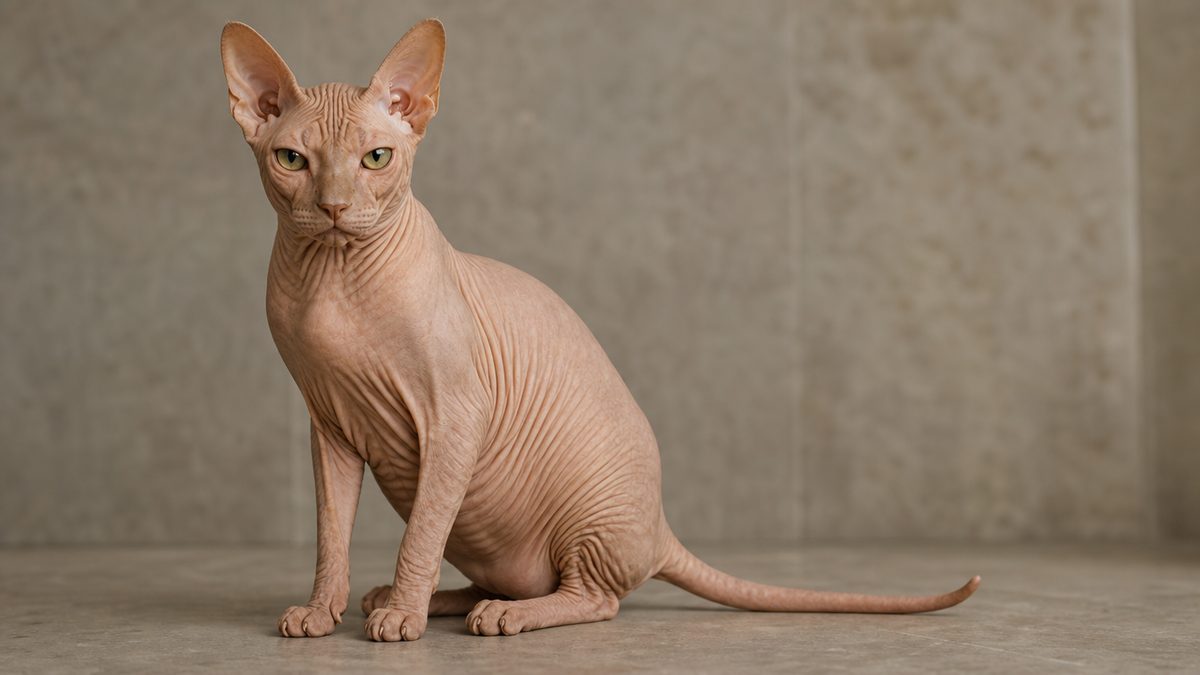
The Donskoy is a medium-sized hairless cat from Rostov-on-Don in southern Russia, registered by TICA as the Donskoy and by FIFe and the World Cat Federation as the Don Sphynx. It is not a Sphynx, it is not descended from one, and the two breeds are hairless for different genetic reasons.
TICA dates the breed to a single spontaneous mutation in Rostov-on-Don in 1987 and records the founding animal by name. Elena Kovaleva, a professor at the State Pedagogical Institute, took a kitten away from boys who were kicking it around in a bag and called her Varvara. Varvara lost her hair and was treated for it without success. Years later she produced a litter of both coated and bald kittens, the coated ones began losing hair the way their mother had, and a breeder named Irina Nemikina built the breed from a rescued kitten out of that line.
The physical breed is described in two standards that broadly agree and differ in useful detail. TICA scores the Donskoy out of 100 as head 40, body 40 and coat 20, and permits one outcross only, a Domestic Shorthair that is not a member of a recognised breed. FIFe scores head and eyes 35, body 35, coat and skin 20, ears 5 and condition 5, and files the breed in Category 4 with the EMS code DSP.
The look, in the standards' own words
Both standards build the breed around skin rather than shape. TICA calls the skin elastic and excessive, with pronounced wrinkles on the cheeks, jowls and under the chin, vertical wrinkles running down the forehead and horizontal lines above the eyes, and says outright that the more wrinkles the better. FIFe uses the same elastic wrinkled skin language and adds a limit that TICA also carries: the wrinkling must not be so pronounced that it affects the cat's normal functions. That sentence is the welfare brake inside an otherwise extreme description, and it is worth reading before you are shown a kitten whose folds are being sold to you as quality.
The feet are the detail nobody expects. Both standards describe long, slim toes separated by webs, with front thumbs that bend inward rather than downward, which TICA calls monkey fingers. A Donskoy manipulates objects in a way a Sphynx does not, and Indian owners describe cats that open cupboard latches.
Four coat types, and only three of them can be shown
The Donskoy is the only cat breed whose registry standard has to describe four different coats for one hairless animal. TICA names Born Bald, Flocked, Velour and Brush, and marks the first three as show coats while Brush is admissible for a breeding programme but not for show. FIFe describes three, Hairless, Flock at no more than 2 mm of residual hair, and Brush at more than 2 mm, states that complete hairlessness is preferred, and records that longhaired, shorthaired and brush varieties get no certificate and exist only for registration, with breeding permitted.
Because the hair loss allele is dominant rather than recessive, a litter can contain coated kittens that are genuinely, registrably Donskoy. Both registries let those cats be bred and neither lets them be shown. A breeder who tells you a coated kitten is a fault, or who is selling it at a discount as a cross, has the genetics backwards.
Two more things follow from that coat table. TICA notes the Donskoy can grow a fine winter coat and shed it when the weather warms, which is a temperate-climate behaviour that does very little in Chennai. And TICA disqualifies any evidence of depilating, plucking, shaving or clipping, which exists because a coated cat can be made to look bald. In India that clause matters more than in Moscow, because there is no local judging circuit to catch it.
The Donskoy also gave rise to another breed. Crossing it with the Oriental Shorthair produced the Peterbald, and the Ukrainian Levkoy came from the same Eastern European hairless pool. Both appear alongside the Donskoy in the one published clinical series on these cats. If you are comparing hairless breeds, read the Sphynx guide next, because that is the breed you will actually be offered in India.
The dominant gene, and why it changes what you ask a breeder
Donskoy hairlessness is inherited as an autosomal incompletely dominant trait, which means one copy from one parent is enough to show. The Sphynx needs two copies of a recessive variant. That single difference drives most of what a buyer should ask.
The primary source is a Russian study rather than a cat-fancy page. Zhigachev, Vladimirova and Katser reported in Genetika in 2000 that a novel hair-loss mutation had been found in Russian cats, and stated the contrast directly: in hairless cats known in other countries, including Canada, Great Britain, France and Germany, hair loss is inherited as a monogenic recessive trait, while in Russian hairless cats the trait is determined by a semidominant gene with the participation of other genes. Semidominant and incompletely dominant mean the same thing. The Online Mendelian Inheritance in Animals record for Don Sphynx hypotrichosis carries that finding forward and records the mode of inheritance as autosomal incomplete dominant.
The Sphynx side is settled and separate. Gandolfi and colleagues identified the Sphynx hairless allele as a variant of the KRT71 keratin gene, the same locus that gives the Devon Rex its curly coat, and the Sphynx allele is recessive. OMIA files that as a different phene record entirely.
The gene behind the Donskoy has never been found
This is the fact no ranking page carries, and it is the most useful thing on this page. In 2013 Dierks, Lehner, Philipp and Distl published a one-page brief note in Animal Genetics whose title is its result: elimination of keratin 71 as candidate for hairlessness in Don Sphynx cats. They sequenced the KRT71 coding sequence and exon flanking regions in Don Sphynx cats, examined the flanking haplotypes, and ruled the gene out. OMIA's record still reads key variant known: no Nicholas FW, Tammen I.
You cannot test for a variant nobody has identified. Any Indian seller offering a genetic certificate, a laboratory report or a 'DNA verified hairless' claim for a Donskoy is describing something that does not exist. Ask instead for the pedigree, the registry, and the coat type of both parents.
What dominance does to a litter
A dominant allele is visible in the parent, so the breeding is transparent in a way a recessive one is not. Three practical consequences follow.
- A hairless Donskoy parent carries at least one copy, so hairlessness is a choice the breeder made rather than a hidden carrier state that surfaced.
- A coated Brush parent can still be registered and bred under both TICA and FIFe rules, so a coated cat in the pedigree is normal and not a sign of crossbreeding.
- Two hairless parents can produce a homozygote, and nobody has published what a homozygous Donskoy looks like, because the gene has not been identified and so cannot be genotyped.
That last point deserves saying plainly rather than dressing up. In dogs, the closest comparable trait is canine ectodermal dysplasia, inherited as a monogenic autosomal semidominant trait and caused by a frameshift in FOXI3. In that system the homozygote is not seen among living dogs. Whether the Donskoy allele behaves the same way is unknown, and Zhigachev's own wording, a semidominant gene with the participation of other genes, argues against a clean single-locus model.
So the honest position is this. The dominant gene is established from pedigree data and is stated by TICA in its own general description, which says the gene occurring from this spontaneous mutation is dominant. What is not established is the gene itself, the homozygous phenotype, or whether the allele carries anything besides hair loss. A breeder who claims certainty on any of those three is ahead of the literature.
Donskoy cat price in India, and why there is not one
No verifiable Donskoy cat price in India exists in 2026. The breed has no Indian supply chain, and what an Indian buyer searching the term is actually shown is a Sphynx.
Start with the largest published Indian source. Supertails' 2026 cat price guide runs a 14-breed reference table, is reviewed by a named senior veterinarian, and prices the Sphynx at Rs 50,000 to Rs 1,50,000. It carries no Donskoy row and no Don Sphynx row at all. The other big Indian retailer to mention the breed, Heads Up For Tails, lists the Donskoy as entry 44 in a 50-breed article with an origin, a life expectancy of 12 to 15 years and a climate note, and gives no figure. Two Indian retail sources, neither willing to put a number on it.
What the Indian search result set actually contains
The SERP is the evidence, not an absence of one. On an India-localised search for the exact commercial query, nine of the ten organic results are about a different cat. Position one is a Sphynx price article, position three a Sphynx sales category, position six a Sphynx breed page, position seven a paperback about Sphynx breeding sold on Amazon, position eight a US Sphynx cattery, and the only on-breed result is a Czech cattery at position nine. A rare breed with no Indian listings looks exactly like this.
| Source type | What it is actually selling | Rupee figure attached |
|---|---|---|
| India's largest cat price guide | Fourteen other breeds, Sphynx at Rs 50,000 to Rs 1,50,000 | None for the Donskoy |
| Indian retailer breed list | An editorial description of the Donskoy | None |
| Indian marketplace category page | Sphynx kittens | Sphynx pricing |
| Amazon.in result | A paperback about Sphynx breeding | Book price |
| Overseas cattery pages | Live Donskoy and Sphynx kittens abroad | US dollars, not rupees |
Foreign catteries quote Donskoy kittens in US dollars. Running a dollar band through an exchange rate and printing the result as an Indian price is the single most common fabrication in Indian breed content, and this site does not do it. If someone quotes you a rupee figure, ask which cat, in which city, with which pedigree.
The substitution is the real risk, not the price
A hairless cat is expensive enough in India that the Sphynx substitution is worth money to a seller, and a buyer with no reference photograph cannot tell the two apart from a phone picture. Three checks separate them and none needs a vet. Look at the profile, because the Donskoy standard specifies a definite curve to a straight nose of medium length, close to a roman profile, while the Sphynx head is broader and rounder. Look at the toes, because the webbed monkey fingers with an inward-bending thumb are Donskoy and not Sphynx. And ask which registry issued the pedigree, because CFA registers the Sphynx and does not register the Donskoy at all.
If a hairless cat is what you want and you want to buy in India, buy the Sphynx knowingly rather than a Donskoy in name only. If what attracted you was rarity, an unusual coat and a manageable health picture, the Burmilla gets you further for less risk.
One last note on where a foreign figure would have come from. The highest-ranking dedicated Donskoy breed page on an India-localised search for the bare breed name is a US consumer site whose own FAQ heading asks how much a Donskoy cat costs, and it answers in US dollars. That is the page an Indian buyer lands on, and it is not describing the Indian market.
Monthly cost of a hairless cat in India
Budget roughly Rs 4,500 to Rs 9,000 a month for a Donskoy in an Indian city, and build the number from Indian rate cards rather than from a breed-specific figure, because none exists.
The monthly cost of a hairless cat differs from a coated one in three lines only. You spend nothing on brushing and de-shedding, you spend more on skin care consumables, and you spend more on electricity because the room the cat lives in has to stay in a narrow band. Everything else is what any Indian cat costs.
The rupee figures, read from Indian rate cards
| Line | Published Indian figure | Source |
|---|---|---|
| Kitten vaccination course, three visits at days 60, 90 and 120 | Starts at Rs 3,999 | Vetic, 11 Indian cities |
| Annual adult booster package, CRP plus anti-rabies | Starts at Rs 1,899 | Vetic |
| Pet licence, Chennai | Rs 50, with 9,115 issued in 2024 | Greater Chennai Corporation |
| Pet registration, Delhi | Rs 500 for dogs; no cat registration exists | MCD Delhi |
| Boarding, Bengaluru, up to 24 hours | Rs 899 | PawSpace |
| Daycare, Bengaluru, up to 10 hours | Rs 799 | PawSpace |
Those vaccination prices are one chain's promotional floors rather than a market average, and they move: Vetic prices differ by city page and the packages carry struck-through list prices of Rs 5,065 and Rs 1,908 respectively. Treat them as the bottom of the range in a metro, not as what you will pay in a smaller city.
The two lines a coated cat does not have
- Skin consumables. A mild shampoo, unscented wipes and ear cleaner are a recurring monthly cost rather than an occasional one, because you wipe the cat down and bathe it on a schedule instead of brushing it.
- Cooling and heating. A Donskoy needs a room held in the mid-20s Celsius, which in a Chennai May means running an air conditioner and in a Delhi January means not leaving the cat in an unheated room. Both cost money that a coated cat's owner does not spend.
The Greater Chennai Corporation runs six veterinary pet clinics that provide all treatment and anti-rabies vaccination free of cost for pet animals, and its pet licence is Rs 50. That is the cheapest routine veterinary care available to any Indian cat owner and almost no breed page mentions it.
Do not budget for grooming salon visits. An Indian salon priced for dogs will offer you a bath at dog rates, and a Donskoy's bath is a five-minute job you do at home in a basin. Money is better spent on a second annual health check, because a hairless cat's skin gives you an early warning system a coated cat does not, and a vet who sees the cat twice a year notices drift you will not.
For the full Indian care-cost picture across breeds, the Sphynx cost section works the same rate cards from the other direction.
Heat tolerance: Rostov-on-Don against six Indian cities
A Donskoy is heat-sensitive for the opposite reason to a Persian. It has no coat to trap heat, and no coat to block ultraviolet light either, so the Indian problem is sunburn and wet-bulb load rather than insulation.
Bonbeno queried NASA POWER by explicit latitude and longitude for the breed's home city and six Indian metros, using 2001 to 2020 monthly climatology, and echoed back the grid-cell elevation each time so a mountain cell cannot be mistaken for a town. Rostov-on-Don came back at 54.99 m against a real city elevation near 70 m, and every Indian point landed within about 80 m of its city, so all seven cells describe the places asked for rather than the hills next to them.
| Place | Cell elevation | Annual mean T2M | Annual mean RH2M | Coolest month | Warmest month |
|---|---|---|---|---|---|
| Rostov-on-Don, Russia | 54.99 m | 10.89 C | 70.61 percent | January, -3.3 C | July, 25.5 C |
| Bengaluru | 841.72 m | 23.74 C | 67.94 percent | December, 20.2 C | April, 28.4 C |
| Pune | 635.99 m | 23.86 C | 66.80 percent | December, 19.6 C | April, 28.9 C |
| Delhi | 206.37 m | 25.60 C | 45.56 percent | January, 13.6 C | June, 35.9 C |
| Kolkata | 7.35 m | 25.81 C | 73.93 percent | January, 17.3 C | May, 31.5 C |
| Mumbai | 97.15 m | 26.77 C | 67.39 percent | January, 23.2 C | May, 31.2 C |
| Chennai | 48.95 m | 27.95 C | 72.39 percent | January, 24.1 C | May, 31.5 C |
The one line that settles it
Chennai's coolest month, January at 24.1 C, sits 1.4 C below Rostov-on-Don's warmest month, July at 25.5 C. A Donskoy in Chennai lives its whole year at or above the hottest fortnight its home city ever gets. Bengaluru is the mildest metro on the list and its coolest month, December at 20.2 C, is still 9 C above Rostov's annual mean.
Humidity is not the shock, and saying it is would be wrong
Indian breed pages reach for humidity when a northern breed is involved, and on this breed the data says otherwise. Rostov-on-Don's annual mean relative humidity is 70.61 percent against Chennai's 72.39 and Kolkata's 73.93, so the home city is barely less humid than the two most humid metros on the list. What Rostov never does is combine the two. Its humid months are its cold ones, January at 90.0 percent and minus 3.3 C, and its warm months are its driest, August at 46.2 percent and 25.2 C. Chennai in August runs 29.0 C at 72.4 percent and Mumbai in August 26.1 C at 90.4 percent. The correct framing is wet-bulb load, not damp air.
Period extremes make the same point from the other end. NASA POWER's T2M_MAX is the highest value recorded over the climatology period rather than a mean daily maximum, and on that measure Delhi reaches 48.79 C, Kolkata 46.81 C and Mumbai 44.91 C, against Rostov's 42.13 C. Rostov does get hot. It does not get hot for eight months.
What Indian law actually says, and what it does not
India has no cat-breeding rule, and pretending otherwise would be inventing law. What exists is the Prevention of Cruelty to Animals (Pet Shop) Rules, 2018, which do cover cats. Rule 7(1) requires a pet shop owner to house animals for sale in accommodation and environment suitable to their species with respect to situation, size, temperature, lighting, ventilation and cleanliness, and rule 6(5) makes it incumbent on the owner to familiarise himself with the requirements of the breeds or species he intends to deal in and provide ambient and comfortable temperature for them. For a hairless breed in an Indian summer, that clause has teeth.
The provision Indian pages quote for heat is Second Schedule Part IV paragraph 21(1) of the Prevention of Cruelty to Animals (Dog Breeding and Marketing) Rules, 2017, which bars keeping in outdoor facilities, without the attending veterinary practitioner's written approval, dogs not accustomed to local temperatures and breeds that cannot tolerate them, such as long-haired breeds in high temperature locations. Those are the Dog Breeding and Marketing Rules. They govern dogs. The principle transfers to a bare-skinned cat on a Chennai balcony; the statute does not.
Apartment living, done properly
- Hold one shaded room in the mid-20s Celsius rather than chilling the whole flat to 18, because a bare cat loses heat as fast as it gains it.
- Keep the cat off west-facing sills between about 11am and 4pm, since glass passes the ultraviolet wavelengths that burn skin.
- Plan for a power cut, which in Bengaluru means checking whether your building's backup runs the air conditioning and not only the lights.
- Watch the cat, not the thermometer. Panting in a cat is not the mild sign it is in a dog and belongs at a veterinarian the same day.
One measurement note for anyone tempted to buy an infrared thermometer. A 2024 model built on cats with different baseline characteristics found that non-contact infrared readings need correction for the individual animal before they predict rectal temperature usefully, so treat a skin-surface reading on a hairless cat as a trend rather than a number.
Temperament and who should not buy one
The Donskoy is an intensely affectionate, people-focused cat that both recognising registries describe as needing company, and that is the trait most likely to make an Indian household regret the purchase.
TICA describes the breed as very social, extremely friendly, highly intelligent and loyal, says these cats assume anyone entering the home has come to see them, and states outright that they need company and should not be without a companion pet. FIFe's standard is a conformation document and says nothing about behaviour, which is worth noticing: only one of the two registries has published a temperament description, so the personality picture rests on a single source.
That single source matters because the failure mode is predictable. A cat that seeks warmth from bodies rather than from a coat will follow you, sleep under a blanket with you and object loudly to a closed door. In a two-income Indian household where the flat is empty from nine to seven, a single Donskoy is a badly matched animal, and the registry that recognises the breed says so in its own care advice.
Five households this breed genuinely suits
- Homes with a person at home most of the day, or a second cat already resident.
- Owners who want a cat that will tolerate handling, because you will bathe and wipe this animal weekly for its whole life.
- Strictly indoor households, since the breed cannot safely use a balcony in Indian daylight.
- Households with older children who can be taught not to grab wrinkled skin.
- People who already keep a coated cat and understand what a normal cat's skin looks like, so they can spot when this one's does not.
Three who should walk away
- First-time cat owners, because you will be managing skin, sun and warmth simultaneously with no DNA test to fall back on.
- Anyone who wants a low-contact cat, since the whole appeal of this breed is contact and it will not be negotiated down.
- Anyone buying because they were told a hairless cat is hypoallergenic, which is a claim about a coat that does not survive contact with the allergen literature.
The cat allergen most people react to is Fel d 1, a protein in saliva and skin secretions that a cat spreads while grooming itself. Removing the coat does not remove the protein and a hairless cat still deposits it on every surface it touches. Nothing in the TICA or FIFe descriptions of this breed claims otherwise, and a seller who does is selling you a coat, not an allergy result.
One further behavioural point that follows from the anatomy. The webbed, long-toed front paws with an inward-bending thumb described in the TICA standard give this cat unusual manipulation. Indian owners of hairless breeds report cupboard latches, taps and window catches. Childproof the kitchen before the cat arrives rather than after.
Training a Donskoy, and the one thing it resists
Train the Donskoy to be handled before you train it to do anything else, because weekly bathing is not optional for this breed and a cat that fights the basin at four years old is a problem you created at four months.
TICA records that the Donskoy is easily trained to follow voice commands and describes an intelligent, curious animal that invents games. That is the easy half. The hard half is that the breed's routine care is exactly the set of procedures cats object to most, and the window to make them normal is short.
The handling curriculum, in order
- Weeks 8 to 12: touch every part of the cat daily for thirty seconds, ears, toes, tail base, belly folds, and pair it with food. This is the single highest-value thing you will do.
- Weeks 10 to 14: introduce a dry basin. The cat sits in it, gets fed, and leaves. No water yet.
- Weeks 12 to 16: add two centimetres of lukewarm water. Bathe for sixty seconds and stop while the cat is still calm.
- Month 4 onward: settle into the real schedule, wipe down between baths and bathe on the interval your vet and your climate agree on.
- Month 5 onward: carrier training and harness work, because an indoor-only cat still needs to reach a clinic without a fight.
Litter training is unremarkable. The breed is no harder than any other cat, and the standard Indian problem, a litter tray placed next to the food bowl in a small flat, applies here as everywhere. Move the tray, not the cat.
What this breed genuinely resists
Two things. First, being left alone, which is a training problem you cannot solve by training. A cat that needs company needs company, and the honest fix is a second cat rather than a longer play session. Second, cold surfaces. A Donskoy will refuse a bed on marble or tile, which in most Indian homes is the whole floor, and will instead colonise whatever is warmest, including laps, laptops and the top of the refrigerator. Give it a raised, soft, draught-free place or it will choose one you did not intend.
Do not apply a human sunscreen to a cat that will lick it off. TICA's own advice is to consult your veterinarian about a suitable sunscreen, which is a real instruction rather than a hedge. Train the cat to accept the routine of being handled at the ears and nose bridge now, and let the vet decide the product.
Realistic timelines: a well-socialised Donskoy kitten accepts a bath without protest by about four months, tolerates ear cleaning by five, and will walk into a carrier on cue by six. A cat bought at eight months with none of this done takes roughly three times as long and may never be comfortable, which is a good reason to prefer a kitten from a breeder who has already started.
Daily exercise for an indoor-only cat
Give a Donskoy two structured play sessions of ten to fifteen minutes a day plus vertical space, and accept that outdoor time is off the table in Indian daylight rather than treating it as an option you are choosing not to take.
TICA describes an active, inquisitive cat that spends much of its waking time on the move and does best where it can explore and seek out new adventures, and recommends smart and interactive toys to keep it stimulated. That is a normal active-cat requirement. What is not normal is that the usual Indian release valve, a shaded balcony or a supervised terrace hour, is closed to this breed for most of the day.
What replaces outdoor time
- Vertical space. A tall cat tree in the coolest room converts floor area you do not have into territory the cat does.
- Two timed wand sessions, morning and evening, rather than a toy left on the floor. The breed responds to a person, not to an object.
- Food puzzles at the evening meal, which spread the intake and give a cat with nothing else to do a job.
- A second cat, which TICA effectively prescribes when it says these cats should not be without a companion pet.
Timing matters more than duration in an Indian summer. Play a bare-skinned cat hard at 2pm in a Delhi June and you are adding metabolic heat to an animal that cannot lose it by sweating; cats have no functional whole-body sweating and rely on evaporation, conduction and behaviour instead, which is precisely why a coat's role in heat exchange is not simply insulation. Move the hard session to early morning and after sunset.
Harness training is worth doing so the cat can be moved calmly, not so it can walk in a park. Between roughly 11am and 4pm, direct Indian sun on unpigmented bare skin is the exposure the Dutch government names when it lists skin vulnerable to sunlight and raised skin cancer risk among its reasons for restricting naked cats. Walk the cat at dusk or not at all.
Weight is the measure that tells you whether the exercise plan works. Cats that die younger in UK primary-care records are disproportionately those with a non-ideal body weight, alongside entire and purebred status. A hairless cat makes body condition unusually easy to assess, because you can see the ribs and the waist rather than having to feel for them through a coat. Use that.
Grooming, bathing and skin care in Indian humidity
You bathe a Donskoy rather than brush it, and the schedule that registries publish for a temperate climate needs adjusting downward in an Indian monsoon rather than copying verbatim.
TICA's published grooming advice is specific. Wipe the cat down daily to remove the oils the skin produces, and bathe it once a week or twice a month. That is written for North American and European homes. Two things change it here.
Why over-bathing backfires
Skin that produces sebum with no coat to wick it leaves a film that feels greasy within a day or two. The intuitive response is to bathe more. Histological work on hairless cat skin shows a structurally distinctive organ rather than simply a cat with the fur removed, and stripping it repeatedly with detergent drives sebum production up rather than down. In practice the useful Indian schedule is a daily wipe with a plain damp cloth or unscented wipe, and a full bathe at the longer end of TICA's range, closer to twice a month than weekly, adjusted by how the skin actually looks.
The monsoon adjustment
Never let a bare cat air dry in a humid month. Overseas care guidance written for a dry indoor winter assumes evaporation you will not get in a Mumbai August at 90.4 percent relative humidity. Towel the cat fully, dry inside the ear flap and between the skin folds at the neck, groin and armpits, and keep it out of a draught until it is genuinely dry. Damp folds in warm humid air are where yeast lives, and the Dutch government's own justification for restricting naked cats names yeast infections explicitly.
Ears, claws and the weekly check
- Ears. Hairless cats lack the ear furnishings that keep dirt out, which the Dutch release names as a route to inflammation. Clean weekly with a vet-approved solution and never with cotton buds pushed into the canal.
- Claw folds. Wax collects in the skin around the nail bed on hairless cats in a way it does not on coated ones. Wipe it out at the same time you do the ears.
- Skin folds. Run a finger through the neck, jowl and groin wrinkles weekly and look at what comes off. A change in colour or smell is your earliest warning.
- Whiskers. FIFe's own standard describes whiskers as curly, thick, of any length, and possibly broken off, so absent or stubby whiskers are a breed feature rather than damage, and the Dutch government treats that loss of tactile hair as a welfare cost.
A coated Brush Donskoy is a legitimate registered cat. Removing its hair to make it look bald is a show disqualification under the TICA standard, which names depilating, plucking, shaving and clipping, and selling an animal whose appearance has been altered runs into rule 7(14) of India's Pet Shop Rules, which bars a pet shop from selling animals with any form of mutilation other than necessary curative surgery.
Sun protection is part of grooming for this breed, not a seasonal extra. Apply nothing without veterinary advice, keep the cat off sunlit floors, and treat any pink patch on the nose bridge, ear tips or flanks as the first sign of a burn rather than a tan, whatever a registry page says about the skin tanning.
Health risks and life expectancy, separating Donskoy evidence from Sphynx evidence
Two conditions are documented in the Donskoy specifically, and almost everything else you will read about the breed's health is borrowed from the Sphynx. Knowing which is which is the whole point of this section.
Search PubMed for the breed name and one record comes back. Meriot and colleagues investigated the phenotype Donskoy breeders call pink-eye, with light-brown skin, yellow irises and a red-eye effect, mapped it by genome-wide association and homozygosity mapping, and identified a homozygous acceptor splice-site variant, c.2571-1G>A, in intron 16 of HPS5. Genealogical data indicated autosomal recessive inheritance, segregation was one hundred percent consistent, and genotyping 170 cats from 19 other breeds found not a single carrier outside the Donskoy. This is a breed-exclusive oculocutaneous albinism variant, and it is the only genetic condition published in the Donskoy.
Figurate erythema, the one dermatology series that includes this breed
The second documented condition is a skin disease first reported in these cats in 2024. Mendoza-Kuznetsova and colleagues described figurate erythema in eleven Eastern European hairless cats, of which seven were Donskoys, one a Peterbald, one a Ukrainian Levkoy and two presumed Canadian Sphynxes. Ten of the eleven were male, onset was under twelve months in eight, and lesions lasted between 1.2 and 56 months. Dermatophytosis was ruled out in eight cats by stains or fungal culture. No diet change or medical treatment achieved remission, though most cats improved spontaneously and partially.
Ring-shaped or serpentine red patches on a young hairless cat's trunk or legs, with scaling trailing the advancing edge, are a described pattern in this breed group rather than automatically a fungal infection. Ask your vet to rule out dermatophytosis properly with a stain or culture rather than treating empirically, because in that series the ringworm-shaped lesions were not ringworm.
The cardiomyopathy claim, tested
Answer engines and breeder pages routinely state that the Donskoy is highly prone to hypertrophic cardiomyopathy and needs an annual echocardiogram. That claim has no Donskoy evidence behind it. The published cardiac work sits on the Sphynx, and TICA's own health panel for the Donskoy says only that it is an overall healthy breed and that vaccinations, parasite treatment, skin checks and sunburn prevention are what matter. Screening the heart of any pedigree cat is defensible on general grounds. Telling an Indian buyer that this breed carries a documented cardiac risk is transferring another breed's data across a mutation that is not shared.
Life expectancy: three published numbers, none of them measured on this breed
| Figure | Source | What it actually measures |
|---|---|---|
| 12 to 15+ years | TICA breed page | The registry's own estimate for the Donskoy, with no study behind it |
| 12 to 15 years | Heads Up For Tails, India | An Indian retailer's breed list entry, unsourced |
| 11.74 years | UK VetCompass life tables, 7,936 deaths | All UK companion cats, not this breed |
| 6.68 years (95% CI 4.53 to 8.83) | Same study | The Sphynx, the shortest of the twelve breeds analysed |
The Donskoy does not appear in those life tables at all, and neither does any other hairless breed except the Sphynx. So the honest statement is that no measured life expectancy exists for the Donskoy, the registry estimate of 12 to 15+ years is an estimate, and the nearest breed for which a measurement exists came last out of twelve. Being purebred and carrying a non-ideal body weight were both independently associated with a shortened lifespan in the same study.
One structural risk is worth naming. TICA permits exactly one outcross, a Domestic Shorthair that is not a member of a recognised breed. That is a narrow gate for a breed founded on a single cat in 1987, and a small founder population with one permitted outcross is how inherited problems concentrate. Ask a breeder what the coefficient of inbreeding is on the pairing and watch whether the question is understood.
Ectodermal dysplasia, teeth and glands: what is published and what is borrowed
Ectodermal dysplasia is real, it is published in cats, and it has never been demonstrated in the Donskoy. The claim that a homozygous Donskoy has poor dentition and cannot sweat comes from dogs and from a single unrelated cat, not from this breed.
Hair, teeth and sweat glands all develop from the same embryonic tissue, so a mutation that disrupts one often disrupts the others. That is why the question gets asked about every hairless breed, and why the answer has to be sourced rather than assumed.
What is published in dogs
The dog evidence is strong and specific. Mexican and Peruvian hairless dogs and Chinese Crested dogs are characterised by missing hair and teeth, a phenotype named canine ectodermal dysplasia, inherited as a monogenic autosomal semidominant trait and caused by a frameshift in FOXI3, a forkhead box transcription factor expressed in developing hair and teeth. Kupczik and colleagues then measured the dentition and found hairless dogs lost the permanent canines, premolars and to an extent the incisors, while the deciduous fourth premolars and first and second molars consistently lacked their distal and lingual cusps.
The glands half of the claim does not survive the dog data either
Wiener and colleagues examined skin biopsies from 22 Chinese Crested dogs plus tissues from two more at post-mortem, and reported that the FOXI3 mutants carried only simple primary hair follicles against the compound follicles of the coated powderpuffs, and that apocrine glands in the skin and respiratory mucous glands of the mutant dogs were present and normal. They concluded there are distinct differences between canine ectodermal dysplasia in Chinese Cresteds and dogs with X-linked ectodermal dysplasia. So even in the best-studied dominant hairless animal, the glands were fine.
What is published in cats
Exactly one genetically confirmed feline case exists. Rietmann and colleagues investigated a male cat with diffuse truncal alopecia and a completely absent undercoat, which lacked several teeth while the remaining teeth had an abnormal conical shape, and whole-genome sequencing found a hemizygous missense variant in the X-chromosomal EDA gene. That is the first report of EDA-related hypohidrotic ectodermal dysplasia in cats.
The published feline case is X-linked and hemizygous in a male; the Donskoy's hairlessness is autosomal and incompletely dominant. Different chromosome, different gene, different transmission. Reading the EDA cat's missing conical teeth onto the Donskoy is the wrong-breed-health-advice error executed with a real citation attached.
So what can a buyer actually act on?
Three things, and no more than three. First, TICA's Donskoy standard disqualifies a malocclusion greater than 2 mm and disqualifies one or both eyelids turned inward, so the registry treats jaw alignment and entropion as worth a rule even though it has published no dental study. Second, no published work has examined Donskoy dentition, glands or homozygotes, so a breeder claiming either good or bad dental outcomes for the line is offering an opinion. Third, cats do not thermoregulate by whole-body sweating in the first place, so the popular claim that a hairless cat cannot sweat describes a capacity no cat has; the coat's real role in heat exchange is more complicated than insulation and works differently in glabrous-skinned animals.
TICA's own breed page states that the Donskoy's skin sweats when it is hot and gets sun-tanned. Treat that as the registry's description rather than as a physiological finding, and treat any pink patch as a burn.
Feeding a Donskoy in India
Feed a Donskoy the same complete, life-stage-appropriate cat food you would feed any cat, and treat the widely repeated claim that hairless cats need extra calories to stay warm as unverified rather than as a rule.
The registries are unusually plain about this. TICA states that Donskoy cats do not have any particular nutritional needs other than good, quality dry kibble and canned food, and spends more of its nutrition panel on water placement than on calories. No study has measured maintenance energy requirement in hairless cats against coated ones, and the higher-metabolism claim you will meet on breeder pages and in answer-engine summaries has no citation behind it.
What the climate argument actually implies here
In a cold house a bare-skinned cat would plausibly spend more energy on thermogenesis. In an Indian house at 26 C for most of the year, that argument runs the other way, and feeding a Donskoy extra because a North American page says hairless cats burn more is how an indoor cat in Chennai becomes overweight. Non-ideal body weight was independently associated with a shortened lifespan in the UK feline life tables, so the error is not cosmetic.
A practical Indian feeding plan
- Kitten to 12 months: a complete kitten diet, fed three to four times a day to 6 months, then twice.
- Adult 1 to 7 years: a complete adult diet split into two meals, with wet food carrying a meaningful share because Indian cats routinely underdrink.
- Senior 8 years and over: same total energy, reassessed every six months against body condition rather than against age.
- Every life stage: fresh water in a wide bowl placed at least three feet from the food, which is TICA's own advice and works because a cat's nose is sensitive enough that food smell suppresses drinking.
You can see the ribs, the waist and the abdominal tuck on a hairless cat without touching it. Photograph the cat from above and from the side on the first of each month in the same light. Nobody with a Persian can do this, and it is the one genuine health advantage of owning a bare-skinned animal.
Two Indian availability notes. Complete cat diets from the major brands are stocked in every metro and online across the country, so nothing about this breed requires an import. And a hairless cat's greasy skin is not fixed by a coat supplement, because there is no coat; if the skin is genuinely poor, that is a veterinary question rather than a food-aisle one.
Breed recognition: who registers the Donskoy and who refuses
Three of the five major cat registries recognise the Donskoy and two do not. TICA, FIFe and the World Cat Federation register it; the Cat Fanciers' Association and the Governing Council of the Cat Fancy do not.
The FCI does not enter into this. It registers dogs, not cats, so the dog-world shortcut of checking one international body has no equivalent here and each registry has to be read separately. Bonbeno checked all five against a control that had to pass on the same document, because an absence read off a list you cannot see the whole of is not an absence.
| Registry | Donskoy | Control on the same document | Verdict |
|---|---|---|---|
| TICA | Yes, as Donskoy, standard code DSK | Sphynx and Peterbald both present | Recognised, championship, own breed committee |
| FIFe | Yes, as Don Sphynx, code DSP, Category 4 | Sphynx and Peterbald present in the same index | Recognised 2011 |
| WCF | Yes, as Don Sphynx (Donskoy), Category 5 Hairless | Canadian Sphynx and Peterbald in the same category block | Recognised |
| CFA | Absent from every breed council | Sphynx council present, Burmilla council present | Not recognised in any class |
| GCCF | Absent from the 39-entry breed index | Sphynx present in the same index | Not recognised |
How each absence was proved
The CFA check used the association's own Breed Council Declared Candidates page, which lists a named secretary for every championship breed under Longhair Breeds and Shorthair Breeds, plus a separate block for Committee Chairs for Miscellaneous and Provisional Breeds. Sphynx appears in the shorthair list and Burmilla appears in it too. Donskoy, Don Sphynx, Peterbald and Ukrainian Levkoy appear nowhere, including in the miscellaneous and provisional block, which on that document holds only the Khao Manee. So the absence is not an artefact of an infinite-scroll listing that stopped loading; a hairless breed control passed on the same page.
The GCCF check used the council's own cat-breeds index, which links 39 breed pages. Sphynx is there and Donskoy is not. Again the control is a hairless breed, so GCCF is not excluding the Donskoy for being hairless.
The positive side was verified twice over. FIFe's breeds index lists DSP, Don Sphynx, with a breed profile and a breed standard, and the standard itself carries the line Rec. 2011 and files the breed in Category 4. TICA publishes a Donskoy breed page, a Donskoy breed standard and a three-member Donskoy Breed Committee.
FIFe's code for the breed is DSP. The World Cat Federation's EMS table gives the breed row as Don Sphynx (Donskoy), DSX, then further down the same table uses DSP in its coat-code rows, which are marked 'only DSP - PBD';. One registry document therefore prints two codes for one breed. If you are importing a cat, read the code on the pedigree against the issuing registry's own table rather than against another registry's.
One cross-registry claim is worth flagging rather than repeating. WCF's table lists the recognising bodies for each breed, giving the Don Sphynx as WCF, FIFe, TICA, SACC and LOOF. That is WCF's account of what other registries do, which is a filing rather than a grant. It happens to agree with the CFA and GCCF checks above, and it agrees because those checks were run separately, not because the table says so.
Two housekeeping notes on the instruments. CFA's public breed directory loads twelve breeds at a time behind an infinite scroll, so a raw fetch of it returns only Abyssinian through Burmilla and is not a document you can read an absence from; the breed-council roster is. FIFe's breeds index, by contrast, renders its whole list in one document, which is why the Don Sphynx entry and the Peterbald control could be read off the same page.
Kitten timeline: the first year, month by month
Plan a Donskoy kitten's first year around three things, which are socialisation to handling, the vaccination course, and watching the coat decide what it is going to be.
The last of those is unique to this breed group. A Velour-coated kitten is born with a bald spot or monk's cap on the top of the head and a wavy coat that disappears gradually within the first year, with residual hair possible on face, legs and tail, and most are hairless by two years of age. So the cat you buy at twelve weeks is not necessarily the cat you will have at two years, and an honest breeder will say which coat type each kitten appears to be rather than promising bald.
Month by month
- Weeks 0 to 8: with the breeder. India's Pet Shop Rules define kittens below eight weeks as un-weaned and rule 7(15) bars any pet shop from selling un-weaned or underage animals. Eight weeks is the legal floor, and twelve is better.
- Month 2: home. Set up one warm, shaded, draught-free room. Start thirty seconds of full-body handling a day.
- Month 2 to 3: first vaccinations. Vetic's Indian schedule runs CRP at day 60, anti-rabies plus CRP at day 90 and CRP plus anti-rabies at day 120, packaged from Rs 3,999.
- Month 3: dry-basin work begins. Ear cleaning becomes weekly. Introduce the second cat if you are getting one, while both are still young.
- Month 4: first real bath. Coat type starts becoming obvious as a Velour kitten's wool begins to go.
- Month 5 to 6: neutering conversation with your vet, and carrier plus harness training.
- Month 6 to 9: adult food transition. Body condition photographed monthly, which this breed makes easy.
- Month 9 to 12: full adult skin routine settled. Book the first annual health check and, in Chennai, the Rs 50 pet licence.
- Month 12 to 24: residual fur on muzzle, ears, legs and tail should fully disappear from adult cats by two years of age under the TICA standard, so the cat's final appearance is not settled until then.
Rule 7(16) of the Pet Shop Rules makes microchipping mandatory for puppies and requires a functional reader on the premises, and it says puppies. No equivalent obligation applies to kittens. Chip yours anyway. It is the only way an indoor cat that slips out of a Mumbai stairwell comes back, and the Netherlands has just made a demonstrable pre-2026 chip the difference between a legally kept naked cat and an illegal one.
One thing not to do in the first year is decide the cat is heat-hardy because it survived one summer indoors. The exposure that matters accumulates, and the reason to establish shade habits at four months is that you will not be able to retrain a two-year-old cat out of a favourite sunlit windowsill.
Donskoy against the cats Indian buyers cross-shop
Compare the Donskoy against the Sphynx on genetics, against the Peterbald on origin, and against the Persian and the Indian shorthair on what an Indian summer does to each of them.
Almost every Indian buyer who reaches this page arrived from a Sphynx search, so that is the comparison that matters most. The two breeds look similar and share almost nothing genetically.
| Donskoy | Sphynx | Peterbald | Persian | Indian shorthair | |
|---|---|---|---|---|---|
| Coat | Hairless to brush, four types | Hairless, fine down | Hairless to brush | Long double coat | Short single coat |
| Hairless gene | Unidentified, autosomal incomplete dominant | KRT71 variant, recessive | Donskoy allele, dominant | None | None |
| DNA test for the coat | None exists | Available | None exists | Not applicable | Not applicable |
| CFA recognition | No | Yes | No | Yes | Not a pedigree breed |
| GCCF recognition | No | Yes | No | Yes | Not a pedigree breed |
| Measured UK life expectancy | Not measured | 6.68 years | Not measured | Measured in the same study | Crossbred cats measured |
| Indian price published | None | Rs 50,000 to Rs 1,50,000 | None | Rs 12,000 to Rs 50,000 | Adoption, Rs 0 to Rs 2,000 |
| Sunburn risk in India | High | High | High | Low | Low |
| Grooming work | Bathe and wipe weekly | Bathe and wipe weekly | Bathe and wipe weekly | Daily brushing | Minimal |
Read the price row against the recognition row and the shape of the Indian market becomes obvious. The two hairless breeds with an Indian price are the two the biggest registries recognise, and the Donskoy is not one of them.
Donskoy against Sphynx, in one paragraph
The Sphynx is hairless because of a recessive KRT71 variant that needs two copies. The Donskoy is hairless because of an autosomal incompletely dominant allele that has never been identified, with KRT71 specifically excluded. Practically, the Sphynx has a commercial DNA test, published cardiac and lifespan data, CFA and GCCF recognition and an Indian price. The Donskoy has none of those five things. If what you want is a hairless cat in India with the most information behind it, that is the Sphynx, and this page saying so is not a criticism of the Donskoy.
Donskoy against Persian, the Indian heat trade
The Persian carries the opposite problem in the same climate. It has maximum coat and minimum skin exposure, so sunburn is a non-issue and heat retention and daily grooming are the burden, and it comes with a documented inherited kidney disease its ancestry passes on. The Persian guide works that trade in detail. The Donskoy has no coat to manage and no published inherited disease except a breed-exclusive albinism variant, and pays for it in ultraviolet exposure and temperature dependence.
An Indian domestic shorthair costs Rs 0 to Rs 2,000 to adopt, is adapted to the exact climate you live in, needs no bathing, and in UK primary-care records crossbred cats outlive purebred ones. That is not an argument against pedigree cats. It is the baseline every pedigree page should have to beat, and most do not print it.
What Indian owners get wrong with hairless cats
Six common mistakes account for most of what goes wrong with hairless cats in Indian homes, and five of those mistakes are about temperature, sun or water rather than about food or behaviour.
- Setting the air conditioner for a human. A room at 18 C is comfortable for you and cold for a cat with no coat. Hold the cat's room in the mid-20s and give it a raised, insulated bed off the tile.
- Letting the cat sunbathe. Cats seek sun and a cold-skinned cat seeks it harder. Unpigmented bare skin under Indian sun is a burn, not a tan, and the Dutch government lists skin vulnerable to sunlight and raised skin cancer risk among its stated reasons for restricting naked cats.
- Bathing on the overseas schedule without adjusting. Weekly bathing written for a dry northern winter strips skin that is already producing sebum hard, and in a Mumbai August at over 90 percent humidity the cat also does not dry properly afterwards.
- Buying a Sphynx believing it is a Donskoy. Nine of the ten Indian results for the Donskoy price query are about the Sphynx, and the two breeds are told apart by profile, toes and pedigree rather than by photograph.
- Believing a genetic certificate. No DNA test exists for Donskoy hairlessness because the variant has never been identified. A certificate that claims one is describing a test nobody can run.
- Buying a hairless cat for an allergy sufferer. The allergen is a protein in saliva and skin secretions, not in hair, and no registry description of this breed claims otherwise.
Two mistakes breeders make that buyers pay for
The first is discounting or hiding coated kittens. A Brush Donskoy is registrable and breedable under both TICA and FIFe rules and simply cannot be shown, so a breeder treating it as a defect either does not understand the dominant gene or is managing your expectations dishonestly. The second is shaving. TICA disqualifies depilating, plucking, shaving and clipping precisely because a coated cat can be made to look bald, and in India there is no show circuit to catch it, so the only person checking is you.
Shaved skin has an even stubble that regrows within days, follicle openings visible under a phone torch, and no wrinkling pattern where a genuine Donskoy has deep folds at the neck, jowls and groin. Ask for a video of the kitten at three weeks, when a Brush coat would have been obvious and nobody shaves a neonate.
The mistake that is not a mistake is worth naming too. Owners often panic at a warm cat, because a Donskoy genuinely feels hot to the touch, which both registry descriptions record as normal for the breed. Skin temperature on a hairless animal is not core temperature, and non-contact infrared readings need individual correction before they predict rectal temperature in cats. Judge by behaviour, appetite and breathing.
Adoption, responsible sourcing and Indian law
Adopt rather than import if you want a hairless cat in India, and if you buy, verify the registry, the coat type of both parents and the seller's registration under the Pet Shop Rules before you look at a photograph.
There is no Donskoy rescue network in India, because there is no Donskoy population. What does exist is a steady supply of surrendered pedigree cats through metro shelters and breed-specific groups, and an Indian domestic shorthair population that adoption costs Rs 0 to Rs 2,000 to join. If the appeal is an unusual-looking cat rather than this specific breed, that is the honest first stop.
What Indian law requires of the person selling you a cat
The Prevention of Cruelty to Animals (Pet Shop) Rules, 2018 apply to cats, and they are more specific than most Indian buyers realise.
- No pet shop may operate without a certificate of registration from the State Animal Welfare Board, valid five years and renewable on a fee of five thousand rupees.
- Rule 7(15) bars the sale of un-weaned or underage animals, and rule 2(1)(p) defines kittens below eight weeks as un-weaned.
- Rule 7(14) bars the sale of pet animals with any form of mutilation, with necessary curative surgery on a veterinarian's prescription exempted.
- The Second Schedule, paragraph 2, sets cat-specific housing requirements, including elevated resting surfaces, matting, soft clean toys, litter-box area excluded from the floor-space calculation, and cats housed in a room not shared with inimical species such as dogs.
- Rule 6(5) makes it incumbent on the pet shop owner to familiarise himself with the requirements of the breeds he deals in and to provide ambient and comfortable temperature for them.
That last clause is the one to quote at anyone keeping a hairless kitten in a glass display box in an Indian shopfront.
The verification checklist
- Ask which registry issued the pedigree and check the breed appears on that registry's own list. TICA, FIFe and WCF hold the Donskoy; CFA and GCCF do not.
- Ask the coat type of both parents and of the kitten, using the registry's own vocabulary of Born Bald, Flocked, Velour and Brush.
- Ask to see the mother, in the room the kittens live in, on video if not in person.
- Ask for the vaccination record against a real Indian schedule rather than a handwritten card.
- Ask the seller for their State Animal Welfare Board registration number and note the reaction.
- Decline any genetic certificate for hairlessness, and say why, because the variant has not been identified.
From 1 January 2026 the Netherlands added a keeping ban to its existing breeding ban for naked cats, with a transitional right only for cats born and demonstrably microchipped before that date, an administrative fine of 1,500 euros, and a bar on shows even for transitional cats. The veterinary profession's own summary of that decision is worth reading alongside it. India has no such rule and this page is not arguing for one. A buyer should know that a European government has looked at hairless cats and reached this conclusion, and should decide with that on the table.
The GCCF's welfare statement is the other document worth an hour of your time before buying, because it sets out a registry's reasoning on hair-deficient breeds rather than a campaigner's. Read that, read the FIFe standard's own limit that wrinkling must not affect the cat's normal functions, and then decide.
If you go ahead, register the cat where registration exists. Chennai issues a pet animal licence for Rs 50 and issued 9,115 of them in 2024, and runs six municipal clinics providing treatment and anti-rabies vaccination free of cost. Delhi's municipal portal covers pet dogs only, at Rs 500 for a new registration with a Rs 100 per month late fee on renewal, so a Delhi cat owner has nothing to register. If you board the cat while travelling, Bengaluru rates run to Rs 899 for up to 24 hours, and a hairless cat needs the kennel's air conditioning confirmed rather than assumed.
For the wider Indian picture on hairless breeds, the Bambino page covers what happens when a second mutation is stacked on the first, and the Devon Rex guide covers the same keratin locus in a cat that kept its coat. Bonbeno does not recommend breeders or link kitten listings.
Donskoy cat questions Indian buyers actually ask
How much does a Donskoy cat cost?
No verifiable Indian price for a Donskoy exists in 2026. India's largest published cat price table covers 14 breeds and prices none of them as a Donskoy, and the one large Indian retailer that lists the breed at all gives it a climate note and a lifespan but no figure. Any rupee number you are quoted is a seller's asking price, not a market rate, and it is worth asking to see the pedigree that names the breed.
What is the difference between a Sphynx and a Donskoy?
The gene is the difference. The Sphynx is hairless because of a recessive variant in the KRT71 keratin gene, so it needs two copies. The Donskoy's hair loss is autosomal and incompletely dominant, so a single copy shows, and a 2013 study specifically excluded KRT71 as the cause in Don Sphynx cats. They are separate breeds with separate origins, and they are not interbred in either registry standard.
Are Donskoy cats rare?
Rare in India and uncommon everywhere. The breed is held by TICA, FIFe, WCF, SACC and LOOF but not by the Cat Fanciers' Association or the Governing Council of the Cat Fancy, so a large part of the pedigree world does not register it at all. On an India-localised search for the breed name, nine of the top ten commercial results are about the Sphynx instead.
Do Donskoy cats have fur?
Some do, and the standards name the types. TICA recognises Born Bald, Flocked, Velour and Brush; FIFe's standard names Hairless, Flock and Brush and states that complete hairlessness is preferred. A Brush-coated Donskoy keeps real fur, and both registries let it be bred but not shown, which is why a coated kitten in a litter is normal rather than a fault of the breeder.
Is a Donskoy cat safe to keep in Indian heat?
Only indoors, and only with shade planned rather than assumed. A hairless cat has no coat to reflect ultraviolet light, and the Dutch government cites vulnerability of the skin to sunlight and raised skin cancer risk among its reasons for banning the keeping of naked cats from 1 January 2026. Chennai's coolest month is about as warm as the breed's home city's warmest.
Is there a DNA test for Donskoy hairlessness?
No. The Online Mendelian Inheritance in Animals record for Don Sphynx hypotrichosis lists the mode of inheritance as autosomal incomplete dominant and the key variant as not known, and the only published molecular work on the breed's coat ruled a gene out rather than finding one. A seller offering a genetic certificate for Donskoy hairlessness is describing a test that does not exist.
Do Donskoy cats have dental problems?
The honest answer is that nobody has published a study on Donskoy teeth. TICA's own breed standard disqualifies a malocclusion greater than 2 mm, so the registry treats jaw alignment as worth a rule. The tooth loss documented in dominantly inherited hairlessness comes from dogs carrying a FOXI3 variant, not from cats, and applying it to the Donskoy would be borrowing another species' finding.
What skin problems do Donskoys get?
One is documented in the breed specifically. A 2024 case series of figurate erythema in eleven Eastern European hairless cats included seven Donskoys, with lesion onset before twelve months in eight of the eleven and no remission achieved by diet change or medication, though most improved on their own. Sunburn, greasy skin and ear wax are the routine issues owners actually manage.
How often should you bathe a Donskoy?
TICA advises wiping the cat down daily to remove skin oils and bathing once a week or twice a month. In Indian humidity, err towards the lower end and towards plain lukewarm water, because over-bathing strips the skin and the sebum comes back heavier. Dry the ears and skin folds fully afterwards rather than letting a cat air dry in a monsoon month.
Can a Donskoy live in a flat in Mumbai or Delhi?
Yes, and a flat is the right place for it, provided the flat is planned. Keep the cat off west-facing windowsills in the afternoon, hold a shaded room in the mid-20s Celsius rather than an air-conditioned 18, and have a plan for a power cut. Delhi's registration portal covers pet dogs only, so no municipal cat registration applies there.
What should I ask a Donskoy breeder in India?
Ask four things. Ask to see the pedigree naming the registry and the breed, because TICA, FIFe and WCF register the Donskoy and CFA and GCCF do not. Ask which coat type each parent is. Ask whether both parents are hairless, because a dominant allele makes that a breeding choice rather than an accident. Ask what the kitten's skin looked like at six weeks.
Is the Donskoy banned anywhere?
The Netherlands bans it in practice. From 1 January 2026, on top of an existing breeding ban, a keeping ban applies to naked cats, with a transitional right only for cats born before that date and demonstrably microchipped before it, an administrative fine of 1,500 euros, and a bar on entering shows even for cats covered by the transition. India has no such rule.
Compare with similar breeds
Donskoy sits in 1 Bonbeno group. Each one compares it directly against the breeds it is genuinely an alternative to, on the same figures.