
Cat breed profile
Russian Blue Cat Price in India and the Full Breed Guide
What a Russian Blue actually costs in India, why published prices disagree by 20 times, the four free checks that separate the breed from a grey street cat, and the one health finding that exists for it and no Indian page prints.
Quick answer
The Russian Blue cat price in India runs Rs 30,000 to Rs 6,00,000 across published sources in 2026, a spread of roughly 20 times. Four free checks settle whether you are buying the breed at all, silver-tipped guard hairs that contrast when stroked against the grain, a plush coat that stands off the body, vivid green eyes by four months, and dilute paw pads that are never black. UK veterinary records put life expectancy at 9.65 years.
This guide is general information for Indian pet owners and is not a diagnosis. Always consult a registered veterinarian near you before acting on anything you read here, and treat any sudden change in your cat's condition as urgent.
Russian Blue at a glance
What a Russian Blue actually is
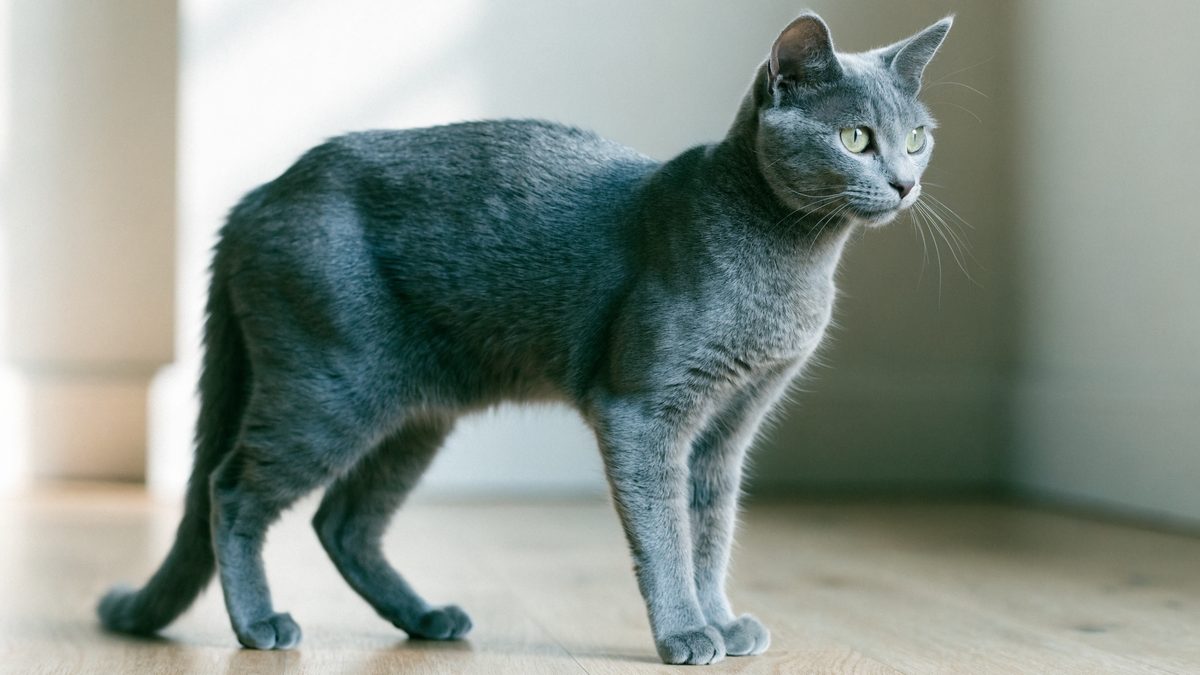
A Russian Blue is a short-haired pedigree cat with exactly one recognised coat colour, an even bright blue whose guard hairs carry distinct silver tips, and vivid green eyes in adulthood. Those two features are the whole breed, they are written into every registry standard, and they are the only free tools an Indian buyer has for telling a Rs 60,000 pedigree kitten from a grey street cat.
Six registries publish a Russian Blue standard and all six agree on the colour. The Cat Fanciers' Association calls for an even bright blue throughout, with lighter shades preferred, guard hairs distinctly silver-tipped, a definite contrast between ground colour and tipping, and a coat free from tabby markings. The International Cat Association says the same in different words, that the breed comes in one coat colour, blue, and one coat length, short. FIFe describes the colour as blue-grey, even and clear, medium to lighter shade, with a distinct and visible silver sheen. Any colour other than blue is a disqualification under the CFA standard.
The Governing Council of the Cat Fancy in Britain is the exception worth knowing about, because it recognises the Russian in three colours, blue, black and white, shown as Russian cats in different classes. GCCF's own history note records that CFA in the United States and FIFe in Europe do not recognise any colour other than blue in the breed. That single sentence answers two of the searches Google itself suggests alongside this query, 'White russian blue cat price in india' and 'Black russian blue cat price in india'. A white Russian and a black Russian exist as GCCF-registered Russian cats. A white or black Russian Blue does not exist anywhere, because blue is the colour.
The double coat is the breed, and it behaves unlike other short coats
The coat is what judges score highest and what a buyer can feel in thirty seconds. CFA describes it as short, dense, fine and plush, a double coat that stands out from the body due to its density, with a distinct soft and silky feel. TICA gives coat texture and colour a combined 40 of 100 points, the largest single block in its scale, and calls the double coat the breed's most outstanding characteristic, short, silky and upstanding. FIFe uses the phrase standing up like plush. The undercoat is soft and downy and equal in length to the guard hairs, which is the structural reason the coat stands away from the body instead of lying flat.
That equal-length undercoat matters more in Chennai than in Cambridge, and the climate section below deals with it properly. The short version is that a dense upstanding plush coat is a very different thing from the long coat of a Persian or a Maine Coon, and it is also a different thing from the thin single coat of a typical Indian domestic shorthair.
Silver tipping, and the free test that reveals it
TICA's standard hands you a physical test. Silver-tipped guard hairs should contrast against the solid blue ground colour when the hair is stroked against the grain. Stroke a hand from tail to shoulder, against the lie of the coat, and on a genuine Russian Blue the exposed hair shafts read visibly darker at the base than at the tip. On an ordinary grey cat the shaft is one tone all the way up. TICA also records that this silver-tipped effect is not produced by the Inhibitor gene that makes silver tabbies, so it is a structural feature of the breed rather than a colour modifier you can find on any grey cat.
Deeper tipping is preferred, because it makes the cat read lighter overall. The registries part company on how much patterning they will forgive. CFA requires the adult coat to be free from tabby markings. TICA permits ghost tabby markings on kittens. Faint, barely perceptible tabby striping may show on the tail while the body colour stays solid. Clear tabby striping across the flanks of an adult is not a Russian Blue.
Green eyes, and the four-month milestone
Adult Russian Blues have vivid green eyes and kittens do not. TICA states the sequence precisely, that eye colour is green in adults with kittens changing from yellow to green, that Russian Blue kitten eyes change rapidly through yellow to green, and that by 4 months a green ring should appear around the pupil. A cat whose eyes carry no green at all takes the full penalty in the ring. CFA, FIFe and GCCF all specify vivid green Federation Internationale Feline. Russian… Governing Council of the Cat Fancy. Russian…, and yellow eyes in an adult show cat are treated as a fault.
Two registries go further than a penalty. ACFA withholds awards for eyes any colour but green in adults, or lacking at least a green ring in kittens, and GCCF withholds certificates from adults, kittens and neuters for incorrect eye colour in adults while allowing for maturing eye colour in kittens. The Australian standard lists a yellowish tone to the eyes among its faults.
The practical consequence for an Indian buyer is a timing rule. A six-week-old kitten with yellow eyes tells you nothing, because every Russian Blue kitten has yellow eyes at that age. A four-month-old kitten with no green ring around the pupil is a real warning sign, and one registry treats exactly that absence as grounds to withhold. If you are buying young, the eye check has to wait, and the coat and paw pad checks carry the load.
Six registry standards side by side
Six bodies publish a Russian Blue or Russian standard that can be read in full, and where they disagree the disagreement is itself useful, so every version appears below rather than an average.
| Feature | CFA | TICA | FIFe | GCCF | ACFA | ACF Australia |
|---|---|---|---|---|---|---|
| Coat colour | Even bright blue, lighter shades preferred | Even bright blue throughout | Blue-grey, even and clear, medium to lighter | Clear even blue, medium blue preferred, blue to the roots | Even bright blue, lighter lavender preferred | Medium blue, no bars or dark shadings on an adult |
| Silver tipping | Guard hairs distinctly silver-tipped, definite contrast | Guard hairs tipped with silver, deeper tipping preferred | Distinct and visible silver sheen | Usually an absence of pigment at the tips of the hair shaft | Guard hairs silver tipped, lustrous appearance | Translucent tipping from absence of pigment at the tips |
| Eye colour | Vivid green | Green in adults, kittens change yellow to green | Vivid green | Vivid green, allowance for maturing colour in kittens | As vividly green as possible at maturity | Vivid green |
| Nose leather | Slate grey | Charcoal grey | Blue-grey | Blue | Charcoal grey | Blue-grey |
| Paw pads | Lavender pink or mauve | Rose flesh pink | Dark lavender | Blue, pinkish lavender also acceptable | Rosy flesh pink | Blue-grey to dark lavender |
| Tabby markings | Adult coat free from tabby markings | Ghost tabby permitted on kittens | Not specified in the standard text | Free from tabby markings in maturity, ghost markings may show in kittens | Penalise ghost tabby markings on adults | No bars or dark shadings permissible on an adult |
| Highest-scoring section | Head and neck 20, body 20, coat 20, colour 20 | Coat, colour and pattern 40 | Body 30, head 25 | Coat 30, head and ears 25 | Head 30, coat texture 25 | Body 30, head 25 |
| Withholds or disqualifies | Kinked tail, locket or button, wrong toe count, any colour but blue, long coat | Any white spots or lockets | Scale of points only | Flat coat showing lack of undercoat, cobby or British type, white anywhere in blues, incorrect eye colour in adults | Eyes any colour but green in adults or lacking at least a green ring in kittens, white locket or belly spots | Faults include cobby or thickset body and flat-lying coat |
Read the paw pad row carefully, because it is the row that most often settles an argument in India. CFA calls for lavender pink or mauve, TICA for rose flesh pink, FIFe for dark lavender, GCCF for blue with pinkish lavender also acceptable, ACFA for rosy flesh pink and the Australian Cat Federation for blue-grey to dark lavender. Six registries, six descriptions, and no way to reconcile them into one shade. What they do agree on is the underlying pigment. The blue coat is the dilute expression of the black gene, the dilute allele is recessive, and two non-carrier Russian Blues will always produce a blue cat. A dilute cat does not carry dense black pigment anywhere, pads included, which is why the Australian standard gives black pads to the Russian Black and pink pads to the Russian White while the blue cat gets blue-grey to lavender. Solid black paw pads on a blue cat are therefore inconsistent with all six standards at once.
The flat coat, which is a fault everywhere it is mentioned
Two of the six standards name a flat-lying coat explicitly and both treat it as a defect. GCCF withholds certificates from adults, kittens and neuters for a flat coat that shows lack of undercoat, and the Australian standard lists flat-lying coat among its faults alongside a cobby or thickset body and a round or square head. ACFA describes the correct alternative in the plainest language of any standard, that the coat lies out from the body due to the thick undercoat and may best be felt by stroking toward the head.
That last phrase is worth memorising because it is a second, independent registry telling you to run your hand the wrong way up the coat. TICA asks you to look for contrast when the hair is stroked against the grain, ACFA asks you to feel the coat by stroking toward the head. Same movement, two purposes, one free test that no Indian sales page teaches.
ACFA also supplies the best one-line description of what a correct coat feels like, that handling a Russian Blue feels like running a silk scarf through your hands. GCCF calls the coat the truest criterion of the Russian, very different from any other breed, and awards it the largest single block of 30 points in its 100-point scale. If the coat feels ordinary, it probably is.
Size, build and how slowly the breed matures
The Russian Blue is a medium cat that photographs larger than it weighs. GCCF gives an average weight of 8 to 15 lb fully grown, with males typically larger than females, which is 3.6 to 6.8 kg. TICA warns judges directly that the cat will appear chunkier due to the density of the coat and that fine bones do not mean a small cat. CFA describes a fine-boned, long, firm and muscular body, lithe and graceful, on long fine-boned legs. GCCF adds the negative, that a cobby or heavy build is undesirable.
The breed also matures slowly. Russian Blues retain many of their adolescent traits until they are three to four years old, and even much older cats are easily drawn into play. Budget for a kitten that behaves like a kitten well past its first birthday.
A short history that explains the Siamese in the family tree
The breed is old and its paperwork is not. GCCF records that the Russian has been known for at least 150 years, that it appeared at a show at Crystal Palace, London in 1875 shown as the Archangel Cat, and that it competed in a class with all other blue cats until 1912 when it was given its own class. It is generally accepted as a naturally occurring breed from the Archangel Isles in northern Russia that reached England and northern Europe on ships, and one early cat, called Kola, was documented as swapped for a leg of mutton at the London Docks in 1890.
The Second World War nearly ended it. A shortage of cats afterwards forced out-crossing, usually to Siamese, although the Siamese pattern has now mostly been bred out. That history left colour-point genes in some Russian Blue lines, so two carriers bred together can still throw blue-point kittens that look faintly Siamese, informally called Pika Blu cats, and most registries will not register, breed or show a colour-point Russian. If an Indian seller offers you a 'blue point Russian Blue', that is a cat most registries will not paper.
Dense upstanding double coat, silver-tipped guard hairs that show contrast when you stroke against the grain, vivid green eyes by adulthood, dilute paw pads that are never solid black. Everything else on this page follows from those four things.
Russian Blue cat price in India, and why sources differ by 20 times
The published Russian Blue cat price in India runs from Rs 30,000 to Rs 6,00,000 and above in 2026, a spread of roughly 20 times across the pages that rank for this query. That gap is not regional variation. It is the difference between editorial pages quoting a market and a lead-generation marketplace quoting a booking, and knowing which you are reading changes the number by a lakh or more.
Five Indian sources on page one publish a price in india figure and no two of them overlap cleanly. Wrapinfur puts a pet-quality kitten at Rs 30,000 to Rs 50,000, a show-quality cat at Rs 60,000 to Rs 90,000 and above, an imported cat at Rs 1,00,000 to Rs 1,80,000 and above, and an adoption at Rs 5,000 to Rs 20,000. Justdial gives Rs 30,000 to Rs 80,000 for a healthy, vaccinated kitten. Royal Kitten sets pet-quality at Rs 40,000 to Rs 70,000, show-quality or registered at Rs 75,000 to Rs 1,50,000, and imported or champion bloodline at Rs 1,20,000 to Rs 3,50,000 and above. Mr n Mrs Pet, the position-two result, opens at Rs 1,50,000 for its basic tier and runs to Rs 6,00,000 and above for champion bloodline.
| Source | Pet or basic quality | Show quality or registered | Imported or champion |
|---|---|---|---|
| Wrapinfur | Rs 30,000 - Rs 50,000 | Rs 60,000 - Rs 90,000+ | Rs 1,00,000 - Rs 1,80,000+ |
| Justdial | Rs 30,000 - Rs 80,000 | Not stated | Not stated |
| Royal Kitten | Rs 40,000 - Rs 70,000 | Rs 75,000 - Rs 1,50,000 | Rs 1,20,000 - Rs 3,50,000+ |
| Mr n Mrs Pet | Rs 1,50,000 - Rs 2,50,000 | Rs 2,50,000 - Rs 4,00,000 | Rs 4,00,000 - Rs 6,00,000+ |
| Nearby Pets India, New Delhi | Rs 43,500 (single figure) | Not stated | Not stated |
| The Times of India, global figure | Rs 41,859 - Rs 2,51,155 | Not stated | Not stated |
Two entries in that table need flagging rather than averaging. Nearby Pets India states that the price of a Russian Blue kitten in New Delhi typically ranges from Rs 43,500 to Rs 43,500, which is a single number formatted as a range, with a live listing on the same page priced Rs 55,650 to Rs 55,650. The Times of India figure of Rs 41,859 to Rs 2,51,155 is a straight currency conversion of a 500 to 3,000 US dollar range in a global listicle about the world's most expensive cats, so it describes the American market rather than the Indian one.
Russian Blue cat price across Indian cities
City tables exist on three ranking pages and they disagree with each other by more than they disagree internally. Across Indian cities, Wrapinfur's widest city band is Mumbai at Rs 40,000 to Rs 95,000 and its narrowest is Kolkata and Ahmedabad at Rs 30,000 to Rs 75,000. Royal Kitten's Mumbai band is Rs 50,000 to Rs 1,40,000 and its Chennai band is Rs 40,000 to Rs 95,000. Mr n Mrs Pet's Chennai band is Rs 1,70,000 to Rs 5,90,000.
| City | Wrapinfur | Royal Kitten | Mr n Mrs Pet |
|---|---|---|---|
| Delhi | Rs 35,000 - Rs 90,000 | Rs 45,000 - Rs 1,20,000 | Rs 1,50,000 - Rs 5,75,000 |
| Mumbai | Rs 40,000 - Rs 95,000 | Rs 50,000 - Rs 1,40,000 | Rs 1,60,000 - Rs 5,75,000 |
| Bangalore | Rs 35,000 - Rs 90,000 | Rs 42,000 - Rs 1,10,000 | Rs 1,60,000 - Rs 5,85,000 |
| Hyderabad | Rs 30,000 - Rs 80,000 | Rs 40,000 - Rs 1,00,000 | Rs 1,50,000 - Rs 5,50,000 |
| Chennai | Rs 30,000 - Rs 80,000 | Rs 40,000 - Rs 95,000 | Rs 1,70,000 - Rs 5,90,000 |
| Pune | Rs 30,000 - Rs 85,000 | Rs 42,000 - Rs 1,10,000 | Rs 1,60,000 - Rs 5,75,000 |
| Kolkata | Rs 30,000 - Rs 75,000 | Not published | Not published |
| Ahmedabad | Rs 30,000 - Rs 75,000 | Not published | Not published |
Notice what the city tables do not do. Chennai and Kolkata are not cheaper than Delhi in any consistent direction across the three sources, and the intercity spread inside any one source is under Rs 20,000 at the bottom end. City is close to noise. Source is the variable that moves the number, and it moves it by a factor of five.
What the top price tier is actually selling
The jump from roughly Rs 60,000 to roughly Rs 2,50,000 is sold as registration. Mr n Mrs Pet prices an 'FCI Registered' Russian Blue at Rs 2,50,000 to Rs 4,00,000 against Rs 1,50,000 to Rs 2,50,000 for basic quality, and describes the tier as coming with verified pedigree and breeder certification. On the same page it lists FCI as 'Feline Club of India', alongside CFA, WCF and TICA, and calls it India's largest and most trusted cat registry.
Set that against what this page has already established. The bodies that publish a Russian Blue breed standard you can read are CFA, TICA, FIFe, GCCF, ACFA and the Australian Cat Federation. If a seller charges you an extra Rs 1,00,000 for registration, the only question that matters is which of those issued the pedigree papers, and whether the registration number on the certificate resolves. Ask for the registry name, the registered cattery prefix, and the sire and dam registration numbers before any money moves. A registration you cannot verify against a named registry is a receipt, not a pedigree.
Two registries publish exactly what a genuine pedigree has to contain, which turns the question into something checkable. CFA's Russian Blue Rules of Registration allow no outcross breeds at all, require an eight-generation pedigree, and instruct the registry not to accept any colour other than blue or any coat length other than short, in the cat being registered or in its background. CFA registration for the breed has been effective since 1949.
GCCF runs a tiered system instead, and the tiers are the detail Indian sellers never mention. Its Full Register is for Russians with championship recognition carrying only Russian Blues, Whites or Blacks within five preceding generations, its Supplementary Register additionally allows Russian-type cats and approved Domestic Shorthair outcrosses and may still be shown and bred, and its Reference Register holds cats that cannot be shown as Russian although they may be bred from. A minimum of four generations must have been bred since an initial approved Domestic Shorthair cross before a cat may be registered as a Russian Blue.
So a genuine GCCF pedigree tells you which register the cat sits on, and that is a question worth asking out loud. GCCF also refuses registration outright to imported Russians with blue or odd eyes, and any colourpoint or longhaired offspring of Russian matings is registered separately and overstamped NOT FOR RUSSIAN BREEDING. A cat carrying the Siamese gene is overstamped as carrying it, and its progeny are overstamped as possibly carrying it until cleared by a DNA test.
Why Russian Blues are expensive in India, in one number
Scarcity explains the price better than lineage does. On the position-two marketplace, a search for Russian Blue kittens across all of India returned 11 results, and the breed does not appear at all in that site's own Most Popular Breeds sidebar, which lists Persian at 1,117 listings, Maine Coon at 96, Bengal at 78, Himalayan at 64, Ragdoll at 62, British Shorthair at 54, Siamese at 51, Calico at 46, Siberian at 37 and British Longhair at 23.
Eleven listings nationally, against 1,117 for the Persian, is the real pricing story. Wrapinfur says the same thing in prose, that the breed remains relatively uncommon compared with more widely available cats, which limits supply. A thin national supply of a breed with high search demand produces exactly the pattern the tables show, a wide asking range set by whoever happens to have a litter.
The scarcity is not only Indian. When CFA published its ten most popular breeds by registration, the list ran Ragdoll, Maine Coon, Exotic, Persian, Devon Rex, British Shorthair, Abyssinian, American Shorthair, Scottish Fold and Sphynx, and the Russian Blue did not appear on it while the British Shorthair placed sixth. A globally uncommon breed with a thin Indian supply is exactly the profile that produces both high prices and high substitution, which is the next problem.
Every figure above is reported from a published Indian page and is editorial content, not an offer. We do not sell cats, recommend breeders or link kitten listings. Read the adoption section before you pay anyone a booking amount.
A realistic way to read these numbers
Treat Rs 40,000 to Rs 90,000 as the band the three editorial pages converge on for a pet-quality kitten, and treat anything above Rs 1,50,000 as a claim that needs paperwork behind it. The convergence is real. Wrapinfur, Justdial and Royal Kitten were written independently and all three land inside Rs 30,000 to Rs 1,50,000 Justdial. Russian Blue Cat: traits, care Royal Kitten. Russian Blue cat price…. Google's own AI summary of this query, which reads the same page-one set, produces Rs 40,000 to Rs 2,50,000.
Then apply the reverse test. Anything below Rs 25,000 for a 'Russian Blue' in India is more likely a grey domestic shorthair than a bargain, because the supply data above says there is no volume at that price. Wrapinfur makes the same warning in its own words, that grey domestic cats are sometimes incorrectly marketed as Russian Blues and that extremely low prices can be a sign the kitten is not purebred. The identification checks in the overview cost nothing and settle it in under a minute.
Monthly maintenance cost of a Russian Blue in India
Published Indian monthly cost estimates for a Russian Blue cluster between Rs 2,900 and Rs 10,000, which is a narrow and broadly credible band. The published figures are wrong in one specific way, they all budget for grooming a cat that four registries describe as low maintenance, and they all omit the one recurring cost this breed genuinely carries a raised risk of.
Two ranking pages publish an itemised monthly cost table and they agree closely. Wrapinfur totals Rs 3,500 to Rs 10,000 a month, or Rs 42,000 to Rs 1,20,000 a year, and adds Rs 5,000 to Rs 18,000 of initial supplies such as a carrier, litter box, scratching post, bedding, food bowls and toys. Royal Kitten totals Rs 2,900 to Rs 9,300 and above. Mr n Mrs Pet quotes Rs 3,000 to Rs 8,000.
| Line item | Wrapinfur | Royal Kitten |
|---|---|---|
| Cat food | Rs 1,500 - Rs 4,000 | Rs 1,500 - Rs 4,000 |
| Litter and accessories | Rs 800 - Rs 2,000 | Rs 600 - Rs 1,800 |
| Routine veterinary care | Rs 500 - Rs 2,000 | Rs 300 - Rs 1,500 |
| Grooming and hygiene | Rs 200 - Rs 1,000 | Rs 300 - Rs 1,200 |
| Toys and extras | Rs 500 - Rs 1,000 | Rs 200 - Rs 800 |
| Monthly total | Rs 3,500 - Rs 10,000 | Rs 2,900 - Rs 9,300+ |
| Annual total | Rs 42,000 - Rs 1,20,000 | Not published |
The grooming line is mostly deletable
GCCF lists the Russian's maintenance as Low and states that, like most shorthair breeds, the Russian cat does not require much grooming to keep the coat healthy, although the cats enjoy being brushed with a soft brush. Wrapinfur's own care section agrees, saying weekly brushing is usually sufficient and that the breed rarely requires frequent bathing.
The position-two marketplace says something different and it is worth quoting precisely, because Indian buyers act on it. Its FAQ states that Russian Blue cats have dense, curly coats that need trimming every 4 to 6 weeks to prevent matting, and elsewhere that their long, silky coats require more maintenance than short-haired breeds. Neither sentence survives contact with a registry standard. CFA specifies a short coat and disqualifies a long coat outright, TICA lists coat length as short, and FIFe describes it as short, dense and very fine. A short-coated cat with no long guard hairs does not mat and does not need a trim cycle. If you budget on the basis of that FAQ you are paying a salon for work the breed does not need.
Delete the salon and the realistic recurring grooming spend on a Russian Blue in India is a soft slicker brush, a nail clipper and a toothbrush, bought once. Keep a small hygiene line for ear cleaner and litter deodoriser and the monthly total drops toward the bottom of both published bands.
The cost nobody prints, and the reason it matters for this breed
No Indian page on this query budgets for diabetes mellitus, and this is the one breed where that omission is indefensible. A Swedish insurance cohort of 504,688 cats contributing 1,229,699 cat-years at risk over 2009 to 2013 found the Russian Blue among four breeds at significantly raised risk, with an incidence of 44.1 cases per 10,000 cat-years at risk against 11.6 for the cohort overall. The health section below sets out the numbers and their limits properly.
The practical budgeting point is that feline diabetes mellitus is a chronic condition managed for the rest of the cat's life, not a one-off bill. The 2025 iCatCare consensus guidelines describe a management load that includes insulin or an SGLT2 inhibitor, a prescribed diet, repeat veterinary assessment, and continuous glucose monitoring using a sensor that records interstitial glucose every minute. No Indian source publishes a reliable rupee figure for that package and this page will not invent one. Treat it instead as a reason to hold an emergency fund rather than a line item you can predict.
What the published budgets get right
The food line is honest. Rs 1,500 to Rs 4,000 a month is a real range for a 4 to 6 kg cat on commercial food in an Indian metro, and the feeding section explains why the wet-versus-dry choice inside that range matters more for this breed than the brand does. The litter line is honest. The routine veterinary line is honest for a healthy adult but assumes nothing goes wrong, which is what a routine line should assume.
The initial-supplies figure of Rs 5,000 to Rs 18,000 is the one most first-time owners underspend. Feline environmental guidelines call for a minimum of two resting areas, two feeding areas and two toileting areas even for a single cat, each in its own separate location, with food and water separated from each other. Two litter box trays, two beds and separated bowls in a 2BHK costs more than one of each, and it is the difference between a settled indoor cat and a cat with a toileting problem.
| Item | Realistic range | Basis |
|---|---|---|
| Kitten purchase | Rs 40,000 - Rs 90,000 | Convergence of three editorial sources |
| Setup, two trays, two beds, separated bowls, carrier, scratcher | Rs 5,000 - Rs 18,000 | Wrapinfur initial supplies, sized to the two-of-everything rule |
| Food, 12 months | Rs 18,000 - Rs 48,000 | Rs 1,500 to Rs 4,000 a month |
| Litter, 12 months | Rs 7,200 - Rs 24,000 | Rs 600 to Rs 2,000 a month |
| Routine vet, vaccination, deworming, neuter | Rs 6,000 - Rs 24,000 | Published routine care line, annualised |
| Grooming consumables | Rs 1,000 - Rs 4,000 | Brush, clipper, toothbrush, ear cleaner, no salon cycle |
| Contingency for illness | Hold, do not spend | No Indian source publishes chronic-care costs |
Add the rows and a first year lands between roughly Rs 77,000 and Rs 2,08,000, with the kitten itself as the single largest item. From year two, the recurring cost is Rs 32,000 to Rs 1,00,000 a year on the published lines, which is the figure to test against your own household budget before you commit to a fifteen-year animal.
Can a Russian Blue survive in India, and how the coat handles heat
A Russian Blue copes with Indian heat better than most pedigree cats sold here, because it carries a short coat on a normal muzzle and has no structural cooling handicap. The real Indian problem with this breed is not the coat at all. It is what happens to a food-motivated cat that spends fifteen years inside a sealed air-conditioned flat, and that problem is measurable.
Start with what the heat actually is. During the April to May 2026 season, Banda in Uttar Pradesh recorded the season's highest observed temperature at 47.6 degrees Celsius on 27 April, roughly 8 degrees above the climatological norm, while Akola in Maharashtra recorded 46.9 degrees on the same day, and Delhi, Ahmedabad and Nagpur exceeded 42 degrees. Parts of Telangana ran 1.6 to 3.5 degrees above normal maximum temperatures with above-normal night temperatures alongside. Even the hill stations warmed, with Mussoorie and Nainital reaching 30 degrees and Shimla 27 degrees.
Two of those numbers matter more than the headline. Above-normal night temperatures are the ones that break a cat, because an animal that cannot dump accumulated heat overnight starts the next day already loaded. And the hill-station figures matter because 'move to Ooty' is no longer a plan.
Why the coat is not the problem people assume
The heat tolerance case for this breed rests on two structural facts. The coat is short on every registry standard, described by CFA as short, dense, fine and plush, by TICA as short with a dense plush double coat and by FIFe as short, dense and very fine. And the head is a moderate wedge with no nose break or stop, a blunt muzzle that is part of the total wedge and a medium-length nose. A cat with a normal muzzle has a normal airway, which is the single biggest advantage a pedigree cat can have in an Indian summer.
That combination puts the Russian Blue in a genuinely better position than the flat-faced and long-coated breeds Indian buyers cross-shop it against. Wrapinfur reaches the same conclusion honestly, noting that despite originating in colder regions the breed generally adapts well to Indian weather when kept indoors, and that the double coat provides insulation in both cold and warm conditions. GCCF frames it from the other end, saying the coat is ideally suited to cold weather while the Russian is a home-loving cat that should not suffer from being confined to the house, provided there is ample opportunity for adventure and play with its owner.
The double coat insulates in both directions and should not be shaved unless a veterinarian specifically recommends it, because it plays a role in regulating body temperature through the year. Shaving a double-coated cat removes the insulating undercoat and exposes skin that has never seen direct sun.
Recognising heat trouble in a cat, which is harder than in a dog
Cats cannot cool themselves by sweating the way people do, which leaves them less able to regulate body temperature, and the early signs of heatstroke are often more subtle in cats than in dogs. The Royal Veterinary College lists the early signs as panting that can progress to distressed or noisy breathing, restlessness or agitation, pacing, seeking shade or water, drooling, red gums or tongue, an increased heart rate, and vomiting or diarrhoea. Advanced signs are lethargy, confusion, weakness or collapse, and seizures.
Learn one of those by heart. Panting in a cat is never normal. A dog panting on a May afternoon in Nagpur is a dog. A cat panting on a May afternoon in Nagpur is an emergency in progress. The RVC's first-aid instruction is to act immediately because heatstroke can rapidly become life-threatening, to move the animal somewhere cool and well ventilated or use a fan, and it recommends cool first, transport second.
City by city, what changes
| Conditions | Cities | What to plan for |
|---|---|---|
| Dry extreme heat, 42 to 47 degrees | Delhi, Ahmedabad, Nagpur, Banda belt | One cooled room from 11am to 5pm, water in at least three separate places, no balcony access in the afternoon |
| Humid coastal heat | Mumbai, Chennai, Kochi, Kolkata | Cross-ventilation and a fan matter more than the thermometer, dry the coat fully after any bath, check ear canals weekly in monsoon |
| Moderate year round | Bengaluru, Pune, Hyderabad plateau | The easiest cities for this breed, and the ones where indoor confinement and free-feeding do the damage instead |
| Cool winters | Delhi NCR December to January, hill stations | The coat handles this without help, a warm resting box is enough |
| Above-normal night temperatures | Telangana and the central belt in a heat season | Keep the night-time room cooled too, because overnight recovery is what protects the next day |
Humidity deserves its own line because it is the coat's real weakness. A dense upstanding double coat holds moisture near the skin, so a Russian Blue that gets soaked in a Mumbai monsoon takes longer to dry than a thin-coated street cat. Towel-dry to the skin rather than the surface, and pay attention to skin condition through July and August. Overweight cats compound this, because they have difficulty grooming hard-to-reach areas and are up to 2.3 times more likely to develop unspecified dermatopathy and non-allergic skin disease than a healthy-weight cat.
The trap the climate answer creates
Every Indian page ends the weather question at 'keep it indoors with air conditioning' and stops. That advice is correct and it creates the breed's actual Indian health problem, so it needs the second half.
An indoor lifestyle increases the chances of obesity and a higher body condition score compared with a mixed or outdoor lifestyle, and cats with little to no access to the outdoors from a young age are twice as likely to become overweight or obese as a result of decreased physical activity, boredom and consequently greater food consumption. CFA's own breed page adds the breed-specific half, that Russians have large appetites and, if not provided with frequent interactive exercise, are at risk of becoming obese, which can lead to many other health issues in and of itself, and it tells owners to monitor food intake carefully.
So the Indian chain runs like this. Heat forces total indoor confinement. Indoor confinement doubles overweight risk. This particular breed has a documented large appetite and a documented raised diabetes risk. Nobody in India joins those three facts up, and joining them up is what the exercise, feeding and health sections of this page exist to do.
Yes, a Russian Blue can live comfortably in India, and its coat and muzzle make it a better hot-climate choice than a Persian, an Exotic Shorthair or a Maine Coon. Plan the cooled room, then spend the rest of your attention on food and activity, because that is where this breed actually gets hurt here.
Russian Blue temperament, and the households it does not suit
A Russian Blue is a reserved, quiet, highly intelligent cat that bonds hard with its own people and hides from everyone else. That description is consistent across all four registries, and it makes the breed an excellent fit for a small settled household and a poor fit for the busy Indian joint family that most buyers actually live in.
Take the registries in their own words. TICA's standard closes its general description with a single sentence about temperament, that Russian Blues are gentle and shy, with soft, sweet voices. GCCF describes a keen intellect, a cat that observes people to determine if they are worthy of its companionship, and notes that what people read as shy or aloof is really a reserved manner with strangers until the cat has fully assessed them. Once the Russian decides you are worthy, GCCF says, it is extremely affectionate and expects your loving attention to all its needs.
CFA is blunter about how that plays out at the front door. It is typical for a Russian to hide under the sofa when a guest enters the house, though its natural curiosity soon brings it out to investigate. The breed is best suited to quieter environments, although many Russians do thrive in noisier households and make friends with other animals. Wikipedia records the same pattern, that the breed is generally considered quiet with exceptions, and normally reserved around strangers unless brought up in an active household.
The intelligence is not a compliment, it is a specification
CFA's description of Russian Blue intelligence reads like a warning label and should be treated as one. Few other breeds can match the Russian Blue for sheer intelligence, and for mechanical aptitude they are at the top of the list, so every closed cabinet, every shut drawer, even sealed canisters or jars represent a tempting challenge, and owners should never be surprised to find an unexpectedly open door, drawer or jar. CFA's own remedy is to divert that attention with intellectually stimulating puzzle toys and interactive games.
In an Indian kitchen this is a practical problem before it is a charming anecdote. A cat that opens containers gets into rice tins, oil jars and the dustbin. Childproof latches on the two or three cabinets that matter cost a few hundred rupees and remove an entire category of veterinary emergency. Wikipedia adds that many Russian Blues have been trained to do tricks and that they can be fierce hunters, often catching rodents, birds, small mammals or reptiles, which is worth knowing if your flat has a balcony with lizards on it.
Who this cat suits, honestly
- Good fit. A one or two-person household with a predictable daily rhythm, where the cat gets the same people at the same times and can retreat when it wants to.
- Good fit. A working couple. GCCF calls the Russian a great choice for the modern family precisely because it is content with its own company while you are out and delighted to play or sit in your lap when you get home.
- Good fit. A home with older children who will let the cat approach them. CFA specifically calls them good pets for older children, who will let the cat take its time feeling comfortable.
- Poor fit. A house with constant visitors, frequent parties or a doorbell that rings all day. Wrapinfur puts it plainly, that the breed prefers predictable environments and may become stressed by excessive noise or constant disruption.
- Poor fit. A buyer who wants a cat that greets guests. This one will be under the bed.
- Poor fit. A household that will be empty for twelve hours a day with no enrichment. Independent is not the same as unaffected.
The one-person bond, and what it costs
Russian Blues often form an especially strong bond with one family member while staying affectionate with the rest of the household, and CFA notes they are very sensitive to their owners' moods, clowning around to cheer you up or offering gentle purrs and head butts to a crying child. That is the quality owners love and it has a cost. A cat wired to one person takes the disruption of that person's absence harder than a socially diffuse cat does, so long work trips, hostel moves and marriages are real events for this animal.
The mitigation is structural rather than emotional. Feline environmental guidelines are built on five pillars, one of which is providing positive, consistent and predictable human social interaction, and another of which is providing a safe place the cat can retreat to. Deliberately spreading handling across two or three adults in the household from kittenhood, and giving the cat a covered retreat it never gets pulled out of, buys resilience you will need later.
Diwali, doorbells and the Indian noise problem
The single most common temperament failure for this breed in India is noise, and the calendar makes it predictable. A cat that hides from a doorbell does not cope with a week of crackers. Plan Diwali in advance rather than during, using an interior room away from windows, a covered hiding box, familiar bedding, and the cat's food and water moved in there for the duration.
The same logic applies to construction, festivals, house moves and guests staying over. Common feline stressors include environmental changes, high cat population density, competition for resources, and conflicts between other cats, and a reserved breed sits at the sensitive end of all four. If you cannot control the noise, control the retreat.
With children, dogs and other cats
GCCF describes Russians as playful, loving companions that get along well with children and other pets, and CFA says many make friends with other animals. Both statements assume the introduction is done slowly and the cat is never cornered. For a multi-pet Indian flat the workable rule is resource separation rather than supervision, because guidelines call for each key resource to sit in its own location, with a minimum of two resting areas, two feeding areas and two toileting areas, and every cat in a household given its own separate feeding station.
For toddlers, be honest with yourself. This is a fine-boned cat that hides from strangers and matures slowly, retaining adolescent traits to three or four years. It will not retaliate readily, and that is exactly why an unsupervised toddler is a risk to the cat rather than the other way round.
Litter training, handling and enrichment for a Russian Blue
To train a Russian Blue, use the intelligence rather than fighting it. This is a breed that opens drawers for entertainment, learns tricks, and works readily for food, so the training job in an Indian flat is less about obedience and more about giving a very clever indoor cat legitimate work to do before it invents its own.
Wrapinfur summarises the trainable side accurately, that Russian Blues quickly learn routines, recognise feeding schedules and respond well to positive reinforcement, and that many enjoy puzzle feeders, interactive toys, clicker training and games that challenge them mentally. Wikipedia notes many Russian Blues have been trained to do tricks. CFA supplies the reason it matters, describing top-of-the-list mechanical aptitude and recommending intellectually stimulating puzzle toys and interactive games as the diversion.
Litter training, and the two-tray rule
Litter training a properly weaned Russian Blue kitten is usually the easiest thing you will do, and the failures almost always trace to tray setup rather than to the cat. Feline environmental guidelines call for a minimum of two toileting areas even for a single cat, each in its own separate location, with ample physical separation maintained between toileting areas and other environmental resources. Food and water should be separated from each other as well.
In a 2BHK that translates into a specific layout. One litter box in the bathroom, one in a quiet corner at the other end of the flat, food in the kitchen, water somewhere else entirely, and none of the four within sight of another. Owners who put a single tray next to the food bowl and then report a toileting problem have built the problem into the floor plan.
Scent is the other half. The fifth environmental pillar asks owners to provide an environment that respects the importance of the cat's sense of smell, and lists cleaners, detergents and scented litter among the disruptions to the cat's scent profile, with stress-related illness such as urinary tract disease among the consequences when a cat's sensory needs are not met. Strong-smelling floor cleaner used around a tray is a common Indian cause of a cat that stops using it.
Carrier training, which matters more for this breed than most
A cat that hides under the sofa when a guest arrives does not walk calmly into a carrier during a monsoon emergency at 11pm. Carrier training is therefore not optional for a reserved breed, and it is the single highest-value thing to train in the first six months.
- Leave the carrier out permanently with the door removed, in a room the cat already uses, so it becomes furniture rather than an event.
- Feed one meal a day inside it for two weeks, moving the bowl progressively deeper.
- Add a familiar blanket that already carries the cat's own scent rather than a freshly washed one.
- Close the door for ten seconds, open it, and feed. Build to two minutes across a fortnight.
- Carry the closed carrier five steps and back, then feed. Build to a lift down to the car and back with no destination.
- Book the first vet visit only after the cat enters voluntarily.
Clicker work and tricks, with realistic timelines
Clicker training works on this breed because it is food-motivated and pattern-quick. A realistic schedule for an Indian household running two five-minute sessions a day looks like sit on cue in one to two weeks, target-touch to a stick in one to two weeks, come on a name cue in two to four weeks, and voluntary entry into a carrier in four to eight weeks. Trick behaviours such as high-five or a jump between two stools take another few weeks each.
Use the cat's daily food allowance for training rather than adding treats on top. That single discipline is worth more to this breed than the tricks are, because CFA warns that Russians have large appetites and are at risk of becoming obese if not provided with frequent interactive exercise, and treats given on top of a full bowl are how an indoor cat crosses into overweight.
Enrichment that suits an Indian flat
The third environmental pillar is to provide opportunity for play and predatory behaviour, because the cat's natural behavioural sequence runs through locating, stalking, chasing, pouncing, capturing and then eating. Guidelines specifically recommend food puzzles and toys that require searching, locating and capturing, and they recommend rotating toys to prevent habituation and boredom.
- Feed part of the daily ration from a puzzle feeder rather than a bowl, so the cat works for food instead of grazing on it.
- Run two short wand-toy sessions a day that end with a catch and a small food reward, closing the hunting sequence rather than leaving it open.
- Rotate three or four toys weekly and keep the rest out of sight, because novelty is the active ingredient.
- Build vertical space with a tall cat tree or two wall shelves, which costs nothing in floor area, the scarce resource in an Indian flat.
- Place a perch at a screened window, which gives a confined indoor cat the closest thing to territory it will get.
One Indian caution on windows. High-rise balconies and unscreened windows are the commonest urban cat emergency, and a breed described as a fierce hunter of birds and lizards has every reason to go over the edge after one. Mesh the windows before the cat arrives, not after the first close call.
Russian Blues are gentle and shy, so nothing about training this breed responds to pressure. Force a shy cat into a social situation and you lose ground you spend months recovering. Every method above works by letting the cat choose to approach.
How much exercise a Russian Blue needs, and what happens without it
A Russian Blue needs deliberate daily interactive exercise, not because it is a high-energy breed but because it is a large-appetite breed living indoors. CFA states the risk in one sentence, and the epidemiology explains why an Indian flat makes it worse.
CFA's breed page is the closest thing to an official activity requirement this breed has. Russians have large appetites and, if not provided with frequent, interactive exercise, are at risk of becoming obese, which can lead to many other health issues in and of itself, so owners are told to monitor food intake carefully. Wrapinfur agrees from the other side, that while the breed is generally calm indoors it still benefits from daily play sessions, and that wand toys, climbing trees, scratching posts and food puzzles help prevent boredom.
Be clear about what no source says. No published study specifies a minutes-per-day activity requirement for the Russian Blue, and anyone quoting one is guessing. What the literature does give you is a mechanism and a target to steer by, which is more useful than a made-up number.
The mechanism, in three findings
- Indoor confinement roughly doubles the risk. An indoor lifestyle increases the chances of obesity and a higher body condition score compared with a mixed or outdoor lifestyle, and cats with little to no access to the outdoors from a young age are twice as likely to become overweight or obese, through decreased physical activity leading to boredom and consequently greater food consumption.
- Low activity feeds metabolic disease. Low levels of physical activity correlate with an increased likelihood of developing metabolic diseases associated with overweight and obesity, including type 2 diabetes.
- The base rate is not small. In a population of healthy urban cats, 19 percent were overweight and 7.8 percent were obese, with male sex, neutering and owners underestimating body condition among the risk factors.
Put those beside the Swedish diabetes finding for this breed and the picture is specific rather than generic. A Russian Blue in a Mumbai flat is an indoor cat by necessity, a neutered cat in most cases, and a member of a breed whose diabetes incidence in an insured Swedish cohort was 44.1 cases per 10,000 cat-years at risk against 11.6 for the cohort overall. Exercise is not enrichment for this animal. It is prevention.
A workable daily structure
Build the day around the predatory sequence rather than around a stopwatch. The behavioural sequence runs through locating, stalking, chasing, pouncing, capturing and eating, and guidelines recommend toys that require searching, locating and capturing, rotated to prevent habituation.
| Slot | Activity | Why it works |
|---|---|---|
| Early morning, before the heat | One wand-toy session ending in a catch, then breakfast | Completes the hunt-then-eat sequence the cat is wired for |
| Mid-morning | Part of the daily ration in a puzzle feeder | Turns grazing into work and slows intake |
| Afternoon, cooled room | Free choice, perch and window watching | Avoids forcing activity through the hottest hours |
| Evening | Second wand-toy or chase session, then dinner | The breed's most active window in most households |
| Night | Food puzzle or scattered kibble hunt before bed | Reduces the 3am zoomies that make owners free-feed to buy peace |
| Weekly | Rotate three or four toys, retire the rest out of sight | Novelty is the active ingredient, not toy count |
Two short sessions a day that both end in a catch beat one long session that ends in the cat losing interest. Vertical space does more in an Indian flat than floor space, because a tall cat tree or two wall shelves adds usable territory without adding square feet. Wikipedia notes that even much older Russian Blues can be easily enticed into play by their owners, so this is not a routine that expires when the cat turns five.
How to tell whether it is working
Do not judge by looks. Owner underestimation of body condition is itself a documented risk factor, and a dense upstanding double coat hides a waistline better than a flat coat does, which is a real and specific problem for this breed. TICA's standard warns judges of the same illusion in different words, that the cat will appear chunkier due to the density of the coat.
- Weigh the cat on the same kitchen scale on the first of every month and write the number down. A 4.5 kg cat that reaches 5.0 kg has gained 11 percent.
- Feel rather than look. Ribs should be findable under light pressure without pressing.
- Check the profile from above for a visible waist behind the ribs.
- Act on a 5 percent gain rather than waiting for a 15 percent one, because an overweight cat carries 10 to 19 percent over its ideal range and obesity begins at 20 to 30 percent over.
- Ask your vet to score body condition at every visit and record it, so the trend is documented rather than remembered.
Without daily interactive exercise you get the documented chain rather than a mystery. Boredom raises intake, intake raises weight, weight raises insulin resistance, and this breed already sits at a raised baseline. Obesity is described in the 2025 feline diabetes consensus guidelines as a risk factor and a reversible cause of insulin resistance, and reversible is the word to hold on to.
Grooming a Russian Blue in Indian humidity
To groom a Russian Blue, brush the coat once a week with a soft brush and stop there. GCCF rates the breed's maintenance as Low, no registry standard describes anything longer than a short coat, and the trimming schedule circulating on Indian marketplace pages belongs to a different animal entirely.
GCCF lists maintenance as Low and states that, like most short-haired breeds, the Russian cat does not require much grooming to keep the coat healthy, although the cats do love attention and will enjoy being brushed with a soft brush. Wrapinfur's care section agrees, saying weekly brushing is usually sufficient to remove loose hair, distribute natural skin oils and maintain the coat's soft texture, and that Russian Blues are naturally clean cats that rarely require frequent bathing.
The trimming claim, corrected
The position-two marketplace tells Indian buyers that Russian Blue cats have dense, curly coats that need trimming every 4 to 6 weeks to prevent matting, that regular grooming keeps them cool in Indian weather and reduces skin infections, and separately that their long, silky coats require more maintenance than short-haired breeds.
Check that against the standards. CFA specifies a short, dense, fine and plush coat and lists long coat among its disqualifications. TICA gives coat length as short. FIFe gives short, dense and very fine. GCCF describes a short, thick but fine coat standing up soft and silky. No registry uses the word curly and none describes a long coat. A cat whose guard hairs and undercoat are the same short length has nothing long enough to mat into a pelt, so there is nothing for a four-week trim cycle to prevent.
Refuse a scheduled body clip, because the double coat insulates in both directions and should not be shaved unless a vet specifically recommends it. Refuse a monthly bath, because a naturally clean short-coated cat does not need one and frequent bathing on any cat is effort spent against the grain.
Shedding, described honestly
Russian Blues shed. The coat is a genuine double coat with a soft downy undercoat equal in length to the guard hairs, and an undercoat is by definition a thing that comes out. Wrapinfur is straightforward about it, noting that during seasonal shedding periods additional brushing may help reduce loose fur around the home.
The marketing version is different. The position-two page's own feature block states that the dense double coat sheds less and produces lower levels of allergens. No registry standard makes a low-shedding claim for this breed, and the allergen half of that sentence is addressed properly in the health section below. What is true is comparative rather than absolute. A short coat sheds shorter hairs that vacuum out of an Indian floor more easily than the long fur of a Persian or a Maine Coon, which is a real quality-of-life difference and not the same thing as low shedding.
A weekly routine that fits Indian conditions
- Brush once a week with a soft brush, working with the lie of the coat, then once against the grain to lift the undercoat. Twice a week during a heavy shed.
- Trim nails every three to four weeks. An indoor cat with no rough outdoor surfaces does not wear them down.
- Check ears weekly through the monsoon. A dense coat around the ear base holds moisture, and Indian humidity does the rest.
- Brush teeth several times a week from kittenhood, because dental disease is one of the most common problems in domestic cats and prevention is the only cheap version.
- Dry the cat to the skin, not the surface, after any bath or a monsoon soaking. A plush upstanding coat traps water near the skin.
- Inspect the skin monthly, parting the coat along the spine and behind the ears, so a problem is found before it is a patch.
The against-the-grain stroke in step one has a second job. It is the same movement TICA's standard uses to judge the coat, where silver-tipped guard hairs should contrast against the solid blue ground colour when the hair is stroked against the grain. A weekly brush is also a weekly confirmation that you bought what you paid for.
Grooming is a weight check in disguise
Overweight cats groom themselves badly and it shows first in the coat. Obese cats have difficulty grooming hard-to-reach areas and are therefore at higher risk of developing dermatosis, and an overweight or obese cat is up to 2.3 times more likely to develop unspecified dermatopathy and non-allergic skin disease than a healthy-weight cat.
So a Russian Blue whose lower back and rump start looking scurfy or greasy, in a breed that keeps itself immaculate by default, is usually telling you about its waistline rather than its skin. Treat a deteriorating coat in this breed as a prompt to weigh the cat, not as a prompt to book a salon appointment.
Russian Blue health issues, life expectancy and the hypoallergenic question
Russian Blue health data is thin, and the honest summary is that one real breed-level finding exists and it is about diabetes. Both registries call the breed healthy with no known specific genetic problems, a UK life-table entry puts life expectancy lower than Indian pages claim, and a Swedish insurance cohort found a diabetes incidence roughly four times the average. This section reports all three and marks the limits of each.
Life expectancy, where the sources disagree most sharply
Indian pages publish a life expectancy of 12 to 20 years. Mr n Mrs Pet's specification table gives 12 to 20 years, Justdial gives 15 to 20 years with proper care, and Wrapinfur says the breed often enjoys lifespans of 15 to 20 years when properly cared for. GCCF, which registers the breed, gives 12 to 15 years, adding that Russians are quite long lived and often live well into their late teens.
One peer-reviewed figure exists and it is lower than all of them. The VetCompass life tables built from 7,936 confirmed deaths among UK cats under veterinary care report life expectancy at age 0 of 9.65 years, with a 95 percent confidence interval of 7.20 to 12.10, for the Russian group, defined in the paper's own footnote as Russian Blue and Russian unspecified. The comparison figures in the same table are 11.74 years for UK companion cats overall, 11.89 years for crossbred cats and 10.41 years for purebred cats.
| Source | Figure | What it is based on |
|---|---|---|
| Mr n Mrs Pet | 12 to 20 years | Marketplace specification table, no basis stated |
| Justdial | 15 to 20 years with proper care | Editorial guide, no basis stated |
| Wrapinfur | 15 to 20 years when properly cared for | Editorial guide, no basis stated |
| GCCF | 12 to 15 years | Registry breed profile |
| Teng et al, VetCompass life tables | 9.65 years at age 0 (95% CI 7.20 to 12.10) | 19 recorded deaths in the Russian group, within 7,936 confirmed UK cat deaths |
| Same study, UK cats overall | 11.74 years at age 0 (95% CI 11.61 to 11.87) | Whole-population comparator |
Now the limits, because this figure is easy to misuse. The 9.65-year estimate rests on 19 recorded deaths, its confidence interval runs from 7.20 to 12.10 years and therefore overlaps the GCCF range, and the Russian group in that table pools Russian Blue with Russian unspecified rather than isolating the breed. It is a UK primary-care population, not an Indian one. And life expectancy at age 0 is not the same statistic as how long a cat that reaches adulthood lives, because it includes kitten and juvenile deaths. The recorded lifespan range for the group ran from 0.32 to 19.39 years, which is where the late-teens cats GCCF describes actually sit.
A second VetCompass study gives the other half of the picture and is more optimistic. Among 4,009 cats with confirmed deaths across 90 primary-care practices in England, median longevity was 14.0 years with an interquartile range of 9.0 to 17.0 and a range of 0.0 to 26.7 years, and crossbred cats outlived purebred cats by 1.5 years at the median, 14.0 against 12.5. That median is the statistic most owners have in mind when they say a cat lives fourteen years, and it sits alongside the lower life-expectancy-at-age-0 figure rather than contradicting it, because a median age at death and a life expectancy from birth are different measures of the same population.
One finding in that study belongs in this page more than in any other. Among cats dying at or after five years, increasing bodyweight was associated with decreasing longevity, and cats weighing under 3 kg lived on average 1.7 years longer than cats weighing between 4 and 5 kg. Multivariable modelling also identified being crossbred, having a lower bodyweight and being neutered as associated with increased longevity. Weight is not a cosmetic issue in cats. It is a longevity variable with a number attached.
The defensible statement is the modest one. There is no evidence that Russian Blues are unusually long lived, the only peer-reviewed life-expectancy estimate places them below the population average rather than above it, and both VetCompass studies agree that purebred cats live shorter lives than crossbreds, by over 1.5 years with the odds of dying before three years of age 1.83 times higher in purebreds O'Neill DG, Church DB, McGreevy PD. Treat 12 to 15 years as a planning assumption and treat 20 years as an outlier rather than a promise.
Diabetes mellitus, the one finding that is specific to this breed
A cohort of 504,688 insured Swedish cats contributing 1,229,699 cat-years at risk between 2009 and 2013 found a significant association between breed and diabetes mellitus, with the Burmese, Russian Blue, Norwegian Forest cat and Abyssinian at higher risk than other cats. The Russian Blue contributed 3,174 cat-years at risk with 14 novel diabetes events, an incidence of 44.1 cases per 10,000 cat-years at risk with a 95 percent confidence interval of 21.0 to 67.2, against an overall cohort incidence of 11.6.
| Group | IRR vs all other cats (95% CI) | IRR vs other purebreds (95% CI) |
|---|---|---|
| Burmese | 4.3 (2.9 to 6.0) | 5.2 (3.6 to 7.6) |
| Russian Blue | 3.8 (2.1 to 6.4) | 4.5 (2.6 to 7.7) |
| Norwegian Forest cat | 1.9 (1.5 to 2.3) | 2.5 (1.9 to 3.2) |
| Abyssinian | 1.8 (1.0 to 3.2) | 2.1 (1.2 to 3.7) |
| Male cats, whole population | 2.0 (1.8 to 2.3) vs females | Not applicable |
The Russian Blue incidence rate ratio was 3.8 against all other cats and 4.5 against other purebred cats. For context in the same study, domestic cats had an incidence of 12.1 per 10,000 cat-years at risk and purebred cats 10.2, and male cats across the whole population had twice the incidence of females at 15.4 against 7.6.
State the caveats as plainly as the finding. Fourteen events is a small numerator, which is why the confidence interval around 44.1 runs from 21.0 to 67.2. The cohort is Swedish and insured, so it describes cats whose owners buy insurance in a cold country, and no equivalent Indian dataset exists. A raised relative risk on a low absolute base is still a low absolute risk. Even at 44.1 per 10,000 cat-years, most Russian Blues will never develop diabetes.
For a sense of the absolute base, an earlier study of an insured United Kingdom cat population put the prevalence of feline diabetes at 1 in 230 cats, and found Burmese cats 3.7 times more likely to develop it than non-pedigree cats. That UK study did not identify the Russian Blue, which is a reason to hold the Swedish finding loosely rather than to discard it, since only the Swedish cohort was large enough and breed-detailed enough to detect a signal in a breed this uncommon.
What makes it worth acting on is that the risk factor sitting alongside it is the one you control. The 2025 iCatCare consensus guidelines describe obesity as a risk factor for feline diabetes and a reversible cause of insulin resistance, and note that weight loss of at least 2 percent of body weight in obese cats during the first month of insulin treatment has been identified as a predictor of remission. CFA independently flags this breed's large appetite and obesity risk, and indoor confinement doubles overweight risk. An Indian Russian Blue sits at the intersection of all three.
Classic clinical signs of feline diabetes include increased thirst and urination, weight loss despite an increased appetite, and lethargy. A cat that is emptying the water bowl faster, filling the litter tray more, eating well and still losing weight needs a blood glucose check, not a wait-and-see. Note that comorbidities are common in the age group affected and may change how the signs present.
What the registries say, and what does not exist
GCCF states that the Russian is generally a very healthy breed and that no major genetic problems have been reported. CFA says the same with a qualifier worth keeping, that this healthy, natural breed is not known to have any specific genetic problems, but that some believe the relatively small gene pool may make the cats more susceptible to certain diseases.
Now the absence, stated plainly rather than papered over. No breed-specific prevalence study for inherited disease in the Russian Blue turned up in this research, and neither registry describes a disease the breed is known to carry.
The DNA panel that does exist, and where it comes from
One registry does name a screening panel, and it is the single most useful thing an Indian buyer can quote at a seller. GCCF's Registration Policy for Russian Cats requires that before an entire Russian Blue, Russian White or Russian Black imported from any other registering body may be registered, the cat must have DNA certificates showing it is not a carrier of colourpoint, longhair, chocolate, cinnamon, PKD, PK-Def and PRA-CEP290, and that it is blood type A and not carrying B. The same certificates are required where one parent is an approved Domestic Shorthair outcross.
Three of those are health tests rather than colour tests. PKD is polycystic kidney disease, PK-Def is pyruvate kinase deficiency, and PRA-CEP290 is a form of progressive retinal atrophy. Blood typing matters for breeding rather than for a pet, because a type B queen bred to a type A tom risks neonatal isoerythrolysis in the kittens. GCCF also requires that the swabs be taken and verified by a veterinary surgeon and that the verification be lodged along with the certificate, and that every cat be microchipped before it is DNA or BAER tested with the microchip number recorded on the certificate.
Read the scope honestly. That panel is a registration condition for imports and outcrosses, not a claim that the breed suffers from those diseases at raised prevalence, and GCCF still describes the Russian as generally very healthy with no major genetic problems reported. But it gives an Indian buyer something concrete to ask for from a seller charging a lakh for imported lineage, which is a great deal better than having nothing to ask for at all.
The one deafness requirement applies to colour rather than to the blue cat. Russian Whites on the active register and used for breeding must have a BAER test for deafness, and no progeny may be registered from a Russian White or White of Russian type sire or dam without a BAER or OAE certificate of freedom from unilateral or bilateral deafness lodged with GCCF.
Are Russian Blue cats hypoallergenic, answered from the allergy literature
No. The claim is the single most repeated selling point for this breed in India and it does not survive the evidence. The position-one search result's own page description sells the breed as hypoallergenic, soft-coated and affectionate. The position-two result runs a feature block headed Hypoallergenic Coat, claiming the dense double coat sheds less and produces lower levels of allergens, while its own specification table three screens further down answers HYPOALLERGENIC with the single word No.
The allergy literature is not ambiguous. All cats produce Fel d 1 regardless of breed, age, hair length, sex, housing or body weight, and there are no allergen-free or hypoallergenic cats. Fel d 1 is the major cat allergen, a secretoglobin rather than a lipocalin, and anti-Fel d 1 specific IgE is found in the serum of more than 80 to 95 percent of patients allergic to cats. The Purina Institute puts the breed question directly, that production may vary somewhat by breed but all cats produce Fel d 1, there is wide variation among individual cats regardless of breed, and there are no truly hypoallergenic or allergen-free cat breeds. Neither hair colour nor hair length influences Fel d 1 production.
The decisive numbers are about variation, and they are the reason breed is the wrong unit of analysis. Bastien and colleagues sampled saliva from 64 neutered domestic shorthair cats, twice daily every other day for a year, at two locations in Missouri and Ontario. Yearly averages ranged from 0.4 to 35.0 micrograms per millilitre, a difference between the lowest and highest cats of more than 80-fold, and the average within-cat coefficient of variation across the year was 57 percent in one group and 85 percent in the other. The same review reports up to a 76-fold difference between the lowest and highest levels recorded in a single individual cat. Read that twice. A single cat can vary across the year by almost as much as the entire spread between the lowest and highest producers in a group.
That study also tested the exact hypothesis Indian sales pages rely on, and it failed. There were no significant differences in salivary Fel d 1 between the various main coat colours, between dark-coloured and light-coloured cats, or between tabby and non-tabby coat patterns, and none by sex or by body weight. The only variable that reached significance was age, with older cats often producing lower levels. A Russian Blue is defined by a coat colour. Coat colour did not predict allergen output in the largest longitudinal study of the question.
| Claim | What the evidence says | Source |
|---|---|---|
| Some breeds are hypoallergenic | There are no allergen-free or hypoallergenic cats; all cats produce Fel d 1 regardless of breed | Satyaraj et al, Allergy 2019 |
| Breed predicts allergen level | Production may vary somewhat by breed, but variation among individuals regardless of breed is wide | Purina Institute |
| Short or dense coats produce less | Neither hair colour nor hair length influences Fel d 1 production | Purina Institute |
| A blue coat means lower allergen | No significant difference between main coat colours, between dark and light cats, or between tabby and non-tabby patterns | Bastien et al, JFMS 2019, 64 cats sampled over a year |
| Individual variation is small | Yearly averages of 0.4 to 35.0 micrograms per millilitre, over 80-fold between the lowest and highest cats | Bastien et al, JFMS 2019 |
| A given cat is consistent | Within-cat coefficient of variation averaged 57 and 85 percent across a year, and up to a 76-fold difference in one cat | Bastien et al, JFMS 2019, and Satyaraj et al |
| A low-allergen cat can be bought as a breed | The only reported low Fel d 1 cats were produced by CRISPR-Cas9 gene editing and cloning in 2024 | Lee et al, Scientific Reports 2024 |
| Bathing solves it | Bathing lowers allergen on the hair but levels return to baseline within 24 hours | Satyaraj et al, Allergy 2019 |
| Washing the cat is the answer | Fel d 1 is produced mainly in the sebaceous glands and is much greater on the head than the chest, so washing is of little benefit | Bonnet et al, AACI 2018 |
One study is cited whenever anyone defends the hypoallergenic breed idea, and it is worth naming precisely. A 2013 conference poster presented at the 5th International Symposium on Molecular Allergology sampled 6 normal cats and 8 so-called hypoallergenic cats by stroking absorbent cotton over the face and chest, found total Fel d 1 reduced in the samples from the hypoallergenic group, and concluded that hypoallergenic cat breeds pose an attractive alternative for cat-allergic patients. Fourteen cats, a poster abstract rather than a full peer-reviewed paper, and no mention of the Russian Blue anywhere in it. That is the entire evidentiary basis for the claim printed on Indian sales pages.
There is a further reason the breed framing fails in practice. Fel d 1 easily becomes and remains airborne, with up to 60 percent carried on particles under 5 microns across, and it transfers passively on clothing, so it has been documented in homes without cats, in private vehicles and in public buildings at levels above the threshold associated with sensitisation. Two large United States surveys detected Fel d 1 in 99.9 and 99.7 percent of American homes respectively, including homes without a cat.
One last piece of evidence settles the question of whether a genuinely low-allergen cat is a breed you can buy. In 2024 a research group reported generating Fel d 1 chain 2 genome-edited cats using CRISPR-Cas9, with ELISA showing the Fel d 1 level in the homozygous edited cat extremely low compared with wild-type domestic cats, and noted that to that date there had been no reports of the development of hypoallergenic cats. Producing a low-Fel d 1 cat required gene editing and cloning in a laboratory in 2024. It was not achieved by selecting for a blue coat in nineteenth-century Archangel.
Do not buy on the label. Spend several hours in a room with the specific adult cat you are considering, on more than one day, and be prepared to walk away. Individual cats vary by up to 80-fold, so testing the individual is the only method with any predictive value, and no amount of breed reputation substitutes for it.
The everyday health issues that will actually cost you money
Set the breed questions aside and the realistic health issues for a Russian Blue in an Indian flat are the ones common to all domestic cats. Wrapinfur lists them correctly, that although the breed is not strongly associated with inherited disorders it can still develop obesity, dental disease, urinary tract issues and age-related kidney problems, and that dental disease is one of the most common health issues affecting domestic cats.
Obesity is the one that connects to everything else on this page. An overweight cat carries 10 to 19 percent over its ideal range and obesity begins at 20 to 30 percent over, with male sex, neutering, middle age, dry food fed ad libitum, low physical activity and an indoor lifestyle among the documented risk factors. Every one of those applies to a typical Indian Russian Blue, which is why the feeding section that follows is not filler.
Feeding a Russian Blue in India, and the free-feeding trap
To feed a Russian Blue well in India, measure the daily ration, split it into meals, and move as much of it as your budget allows from dry kibble to wet food. The published research on feline overweight makes the moisture question the highest-leverage decision an owner of this particular breed makes, and it is a decision Indian buying habits push in the wrong direction.
Start with the breed-level warning. CFA states that Russians have large appetites and that owners should monitor their Russian's food intake carefully. Wrapinfur says the same in its care section, that because the breed can have a strong appetite, monitoring food intake helps reduce the risk of obesity, and that portion control matters alongside a balanced diet and daily interactive play.
Wet against dry, which is the decision that matters
The evidence on food moisture is unusually direct. Cats eating predominantly dry food, meaning at least 75 percent of their intake, are up to 2.4 times more likely to be overweight than cats on a predominantly wet diet, and cats fed from an early age on food comprising more than 50 percent dry food carry up to a 79 percent risk of being overweight or obese. Cats fed wet food ad libitum show better body condition than cats fed only dry food or fed wet food at fixed times, and dry feeding alone predisposes to overweight and obesity regardless of whether it is offered on a fixed schedule or free choice.
That last clause is the one Indian owners need. Portioning dry food does not neutralise dry food. The association persists across feeding styles, which means switching from a full bowl to a measured bowl of the same kibble is an improvement but not the improvement.
Now the honest Indian tension. Dry kibble is cheaper per calorie, keeps in Indian heat and humidity without refrigeration, and is what most Indian cat owners feed because of both facts. Wet food costs more per calorie and needs a fridge for the opened tin. Within the Rs 1,500 to Rs 4,000 a month that ranking pages budget for food, a full wet diet is out of reach for many households. The workable compromise is a mixed feeding plan that raises the wet fraction as far as the budget allows rather than an all-or-nothing switch.
| Approach | Evidence position | Practical note for India |
|---|---|---|
| Dry food, free choice in a full bowl | Worst option on the evidence, dry ad libitum is a named risk factor | The default in most Indian homes and the one to change first |
| Dry food, measured into two meals | Better, but dry feeding alone still predisposes to overweight | Costs nothing to adopt, do it today |
| Half wet, half dry by calories | Moves the cat out of the 75 percent dry category associated with 2.4 times the risk | One wet pouch or tin a day plus measured kibble, the realistic Indian middle |
| Predominantly wet, at least 75 percent | Best supported position for body condition | Needs fridge space and a higher food budget |
| Any of the above, delivered through puzzle feeders | Guidelines recommend food puzzles that require searching, locating and capturing | Free once bought, and it solves boredom eating at the same time |
Life stages, without inventing numbers
No published source gives a Russian Blue-specific calorie requirement, and this page will not manufacture one. Feed to body condition rather than to a chart, and change the plan at the points where the cat's biology changes. The 2021 AAHA and AAFP feline life stage guidelines set those points at kitten from birth to 1 year, young adult from 1 to 6 years, mature adult from 7 to 10 years and senior at 10 years and older, with an end-of-life stage at any age, and they ask for a life stage assessment at every examination visit.
- Kitten, to roughly twelve months. Growth food, several small meals a day, free access to water. This breed matures slowly, retaining adolescent traits to three or four years, so do not cut the ration the day the cat turns one.
- Neuter, whenever it happens. Neutering is a documented intrinsic risk factor for overweight and obesity, and the metabolic step down is immediate while the appetite is not. Reduce the ration at the operation, not three months later when the weight has already gone on.
- Adult, one to seven years. Measured meals, at least half the calories through a puzzle feeder, monthly weight recorded. This is the decade in which an Indian indoor cat quietly gains 20 percent.
- Mature and senior, seven years on. This is the age band in which diabetes shows up, since cats with the disease are usually mature to senior individuals with common comorbidities. Annual bloods, and take any change in thirst or urination seriously.
- Any age, if the cat is already overweight. Weight loss needs to be carefully managed rather than crash-imposed. Do this with a vet, not with a smaller bowl.
Where the bowls go
Bowl placement is part of feeding, not decoration. Feline environmental guidelines call for a minimum of two feeding areas even in a single-cat home, each key resource in its own location, with food and water resources separated from each other, and every cat in a multi-cat household given its own separate feeding station. Ample physical separation should also be maintained between toileting areas and other resources.
In an Indian flat that means the water bowl does not live beside the food bowl, and neither lives beside the litter box. Cats that drink poorly are a urinary problem waiting to happen, and separating water from food is the cheapest intervention available. Add a second water station in a different room and watch intake rise.
If your cat is ever diagnosed with diabetes
Diet becomes a treatment rather than a routine. Low-carbohydrate diets with medium to high amounts of protein and fat have been associated with an increased likelihood of remission and better glycaemic control, though remission can still be achieved in cats eating higher-carbohydrate diets, and each diabetic cat is an individual with their own food preferences and dietary history. Weight loss in an overweight or obese diabetic cat is essential to improve outcomes and the dietary regimen should be designed to achieve it, with effective early weight loss associated with a large increase in the odds of remission.
One rule is worth memorising in advance. The diets of cats with diabetes should not be altered during periods of reduced appetite. A diabetic cat that goes off its food needs a vet, not a new brand.
Replace the permanently full bowl with two measured meals. Move at least a third of the daily calories into a puzzle feeder. Put the water bowl in a different room from the food. None of the three costs more than a few hundred rupees, and together they attack the exact risk profile this breed carries.
Russian Blue kitten timeline, month by month through the first year
A Russian Blue kitten cannot lawfully be sold in India before eight weeks of age, its eyes will not tell you anything about the breed until roughly four months, and its coat will not finish setting until later still. That sequence should govern when you collect, when you check, and when you pay.
The legal anchor comes first because it is the one Indian buyers are most often talked past. The Prevention of Cruelty to Animals (Pet Shop) Rules, 2018 define an un-weaned animal to include kittens and pups below eight weeks, and rule 7(15) states that no pet shop shall sell un-weaned or underage animals or birds. A pet shop is also barred from displaying or housing pregnant animals or mothers caring for un-weaned young for sale.
Set that against the market. Listings for Russian Blue kittens on the position-two marketplace describe stock as 45 to 60 days old across Delhi, Mumbai and Bangalore, and 45 days is six and a half weeks. A separate page-one listing advertised a Russian Blue male kitten at 55 days. Neither figure clears eight weeks. If you are offered a kitten under eight weeks, the answer is no, and the reason is a named rule rather than a preference.
| Age | What is happening | What you do |
|---|---|---|
| 0 to 8 weeks | With the mother and littermates. Eyes are yellow. Ghost tabby markings may show and are permitted on kittens under the TICA standard | Nothing. This kitten cannot lawfully be sold to you under the Pet Shop Rules, 2018 |
| 8 to 9 weeks | Earliest lawful collection point | Collect. Inspect the mother, the litter and the premises. Take the written health certification and the records the rules require |
| 9 to 12 weeks | Settling into a new home, the most stressful fortnight of the cat's life | Two litter trays in separate locations, a covered retreat that is never disturbed, food and water in different rooms |
| 3 months | Confidence building, play drive climbing | Start carrier training. Begin clicker sessions. Mesh every window before this stage, not after |
| 4 months | The eye milestone. A green ring should appear around the pupil by four months under the TICA standard | Look at the eyes in daylight. No green at all at four months is a real warning sign |
| 5 to 6 months | Adolescence begins, appetite rises sharply | Discuss neutering timing with your vet, and plan the ration cut for the day of the operation |
| 6 to 9 months | Adult coat texture and silver tipping become assessable | Stroke against the grain weekly and check for contrast between tip and shaft |
| 9 to 12 months | Growth slows, transition to adult food | Record a baseline adult weight and repeat it monthly from now on |
| 12 months to 3 or 4 years | Still adolescent in behaviour | Keep the play routine. Do not assume the cat has calmed down and cut activity |
Collection day, what to take away with you
The Pet Shop Rules give a buyer more leverage than most buyers use. Rule 7 requires that only healthy pet animals, certified in writing by a veterinary practitioner as being so, are offered for sale at the pet shop. Every pet shop owner must make available to customers free of charge at the time of purchase pet care leaflets or other similar written instructions on the degree and manner of care and the traits and behavioural patterns of the animal being purchased. And the records the shop is required to maintain must be available at the pet shop for inspection by the State Board or by any intending purchaser.
Read that last clause again. An intending purchaser has a right to inspect the records. Not a favour, a right. Use it. Ask to see the register, and treat refusal as the answer to your question.
- Written veterinary health certification for the specific kitten, dated, on a letterhead with a registration number.
- The vaccination and deworming record, with dates and product names rather than ticks in boxes. The core vaccines for cats everywhere protect against feline parvovirus, feline calicivirus and feline herpesvirus-1, and rabies vaccination is core in any area where rabies is endemic, which includes India.
- Registration paperwork, naming CFA, TICA, FIFe or GCCF, with sire and dam numbers you can check.
- Written care instructions, which the rules require the shop to hand over free of charge.
- The shop's certificate of registration, which every pet shop owner must display prominently in the shop.
- Photographs or video of the mother and the litter in the premises where they were raised, taken by you rather than sent to you.
Vaccination timing, which the eight-week rule interacts with
The kitten vaccine series is not one injection, and the reason is maternal antibody. Maternally derived antibodies interfere substantially with the efficacy of most core vaccines given early in life, and because antibody levels vary between and within litters, the recommendation is multiple core vaccine doses every 2 to 4 weeks with the final dose delivered at 16 weeks of age or older, and revaccination at or after 26 weeks rather than waiting until 12 to 16 months. UC Davis puts the same schedule in practice terms, one dose of modified live FHV-1, FCV and FPV vaccine every 3 to 4 weeks from 6 to 8 weeks of age with the final dose no sooner than 16 weeks, and a single rabies vaccine at 12 to 16 weeks revaccinated one year later.
The practical consequence is that a kitten collected at eight weeks has months of vet visits ahead of it, and a seller who says the kitten is fully vaccinated at eight weeks is describing something the guidelines say is not possible. Ask which doses were given, on which dates, and when the final dose is due.
The first fortnight at home
A reserved breed handles a house move worse than a bold one does. TICA describes Russian Blues as gentle and shy and CFA notes the instinct to hide under the sofa when a stranger appears, so a new kitten in a new flat is a cat surrounded by strangers.
The first pillar of feline environmental care is to provide a safe place, and the guidelines are specific that a cardboard box on its side, or a perch on the roof of a box, works as one. Set that up before the kitten arrives, put it in a low-traffic room, and let the cat come out on its own schedule. Common feline stressors include environmental changes and competition for resources, and the first fortnight is nothing but environmental change.
Keep visitors away for two weeks. Every guest who wants to see the new kitten costs you socialisation ground with this breed rather than building it.
What sets in the first year and what does not
The coat and eyes finish on the timeline above. The habits do not, and this is the year the health trajectory gets set. Cats fed from an early age on food comprising more than 50 percent dry food carry up to a 79 percent risk of being overweight or obese, and cats with little to no access to the outdoor environment from a young age are twice as likely to become overweight or obese. Both of those describe a normal Indian indoor kitten fed kibble from a full bowl.
The counterweight is cheap and has to start now rather than at year three. Measured meals from month three. Puzzle feeders from month four. Two structured play sessions a day from the moment the kitten is confident enough to chase a wand. A monthly weight written down from month nine. None of that is optional for a breed CFA describes as having a large appetite and an obesity risk without frequent interactive exercise.
Two kittens play with each other and solve part of the enrichment problem, which is a real argument for a pair. The trade-off is that competition for resources between cats is a documented stressor, so a two-cat household needs separate feeding stations for each cat and physically separate resources for each social group. Budget for two of everything, not two cats sharing one setup.
Russian Blue compared with the breeds Indian buyers cross-shop
Against the breeds Indian buyers consider alongside it, the Russian Blue wins clearly on heat suitability and grooming load, sits mid-table on life expectancy, and is the scarcest of the group in the Indian market by a wide margin. Where a comparable number exists it is printed below, and where one does not that is said rather than filled in.
One dataset lets several of these breeds be compared on the same measure. The VetCompass life tables report life expectancy at age 0 for twelve breed groups drawn from 7,936 confirmed UK cat deaths, and six of the breeds Indian buyers shortlist appear in it. A second dataset, the Swedish insurance cohort, gives diabetes incidence rate ratios for four breeds. A third comparison, national availability, comes from the listing counts published on the position-two Indian marketplace.
| Breed | UK life expectancy at age 0 | Coat | Listings on one Indian marketplace | Where it beats or loses to the Russian Blue |
|---|---|---|---|---|
| Russian Blue | 9.65 years (Russian group) | Short, dense, plush double coat | 11 | Baseline |
| British cats (British Blue and British Longhair) | 9.58 years | Short and dense, cobby build | 54 British Shorthair, 23 British Longhair | Similar life expectancy and grooming load, far easier to find, and the breed most often confused with this one |
| Persian | 10.93 years | Long | 1,117 | Longer life expectancy in the data, but a far heavier grooming and heat burden in India |
| Maine Coon | 9.71 years | Semi-long | 96 | Similar life expectancy, much larger cat, much higher grooming load in humidity |
| Siamese | 11.69 years | Short | 51 | Beats the Russian Blue on life expectancy, loses badly on noise if you want a quiet flat |
| Ragdoll | 10.31 years | Semi-long | 62 | Longer in the data, more coat to manage in an Indian monsoon |
| Bengal | 8.51 years | Short | 78 | Shortest life expectancy of the group and the highest activity requirement |
| Indian domestic shorthair | 11.89 years (crossbred) | Short | Free to adopt | Longest life expectancy of any group in the table, adapted to the climate, costs nothing |
Read the bottom row before the others. Crossbred cats in that study had a life expectancy at age 0 of 11.89 years against 10.41 for purebred cats, purebred cats lived over 1.5 years less than crossbred cats, and the odds of a purebred cat dying before three years of age were 1.83 times higher. If longevity is your priority, the data does not point at any pedigree breed.
Russian Blue against the British Blue, the confusion that costs money
These two are the pair Indian sellers mix up most often, because both are solid blue-grey short-haired cats and photographs flatten the difference. The registry standards do not flatten it. CFA scores eye colour at 10 points and body type at 20 points out of a 100-point Russian Blue scale, and specifies vivid green eyes and a fine-boned, long, firm and muscular body, lithe and graceful. GCCF adds directly that a cobby or heavy build is undesirable in the Russian. FIFe calls for large almond-shaped eyes in vivid green on a long body with medium bone.
So a blue-grey cat with a round, heavy, cobby body and orange or copper eyes fails the Russian Blue standard on two of its highest-scoring components at once. That is a 30-point failure on the CFA scale before a judge looks at the coat. Bonbeno publishes a separate guide to the British Shorthair for buyers who find they want the cobby cat rather than the elegant one. Neither is better. They are different animals at similar prices, and knowing which one you are looking at is worth about a lakh.
Diabetes risk, where the comparison is uncomfortable
On the one health measure where breed-specific data exists, the Russian Blue does not compare well. Its diabetes incidence rate ratio was 3.8 against all other cats and 4.5 against other purebreds, second only to the Burmese at 4.3 and 5.2, and ahead of the Norwegian Forest cat at 1.9 and 2.5 and the Abyssinian at 1.8 and 2.1. No comparable figure exists for the Persian, the Maine Coon, the Bengal or the British Blue in that study, which means the honest reading is that the Russian Blue is one of only four breeds flagged, not that the others were cleared.
For Indian apartments specifically
Judged on fit for Indian apartments, the Russian Blue is near the top of the shortlist and the reasons are structural rather than temperamental. It carries a short coat that sheds short hairs, a normal muzzle with no airway compromise, a low grooming requirement that GCCF rates as Low, soft sweet voices per the TICA standard, and a temperament GCCF calls content with its own company while you are out. Against a Persian's coat, a Maine Coon's size or a Siamese's voice, that is a strong apartment package.
The two costs of that package are the two this page keeps returning to. A reserved cat in a house full of visitors is an unhappy cat, and an indoor cat with a large appetite is a metabolic problem waiting to happen. Do not buy this breed if your household is loud and busy, or if nobody will commit to twice-daily play for the next twelve years.
The alternatives worth a serious look
- Want the same look, easier to find. A British Shorthair in blue, five times more available on the Indian market and cobby rather than elegant.
- Want a quiet lap cat with less activity need. A Persian, at the cost of a serious grooming and heat burden in India.
- Want a talkative, people-facing cat. A Siamese, which posted the longest life expectancy of the shortlisted pedigree breeds at 11.69 years.
- Want maximum activity and interaction. A Bengal, understanding it recorded the shortest life expectancy in that table at 8.51 years.
- Want the longest odds on a long life, at zero purchase cost. An Indian domestic shorthair from a shelter, in the crossbred group that recorded 11.89 years.
Ten mistakes Indian Russian Blue owners actually make
Most Russian Blue problems in India trace to four decisions made in the first month, buying on an allergy claim, paying a registration premium nobody checks, feeding from a permanently full bowl, and booking grooming the coat does not need. Each one is listed below with the evidence that contradicts it.
- Buying on the word hypoallergenic. All cats produce Fel d 1 regardless of breed, age, hair length, sex, housing or body weight, and there are no allergen-free or hypoallergenic cats. Neither hair colour nor hair length influences Fel d 1 production. Test the specific cat against the specific allergic person over several hours, on more than one day.
- Paying the registration premium without naming the registry. An extra Rs 1,00,000 to Rs 1,50,000 buys registration on the position-two marketplace's own tier structure. Ask which of CFA, TICA, FIFe or GCCF issued it, and ask for sire and dam numbers you can check.
- Booking a kitten under eight weeks. The Pet Shop Rules, 2018 define kittens below eight weeks as un-weaned and prohibit their sale, yet listings advertise Russian Blue kittens at 45 to 60 days. Six and a half weeks is not eight weeks.
- Booking a salon trim cycle. Indian marketplace guidance recommends trimming this coat every 4 to 6 weeks, while CFA disqualifies a long coat and specifies a short one. You are paying for work a short-coated breed does not need.
- Shaving the coat in summer. The double coat insulates in both directions and should not be shaved unless a vet specifically recommends it. A shaved double-coated cat is worse off in an Indian May, not better.
- Free-feeding kibble in a cooled flat. Cats eating at least 75 percent dry food are up to 2.4 times more likely to be overweight, dry feeding alone predisposes regardless of feeding style, and indoor cats are twice as likely to become overweight. This breed already carries a large appetite.
- Judging weight by eye. Owner underestimation of body condition is a documented risk factor, and TICA warns that this cat appears chunkier because of coat density. Use a scale on the first of every month.
- Assuming twenty years. Indian pages publish 15 to 20 years Justdial. Russian Blue Cat: traits, care while the only peer-reviewed estimate for the Russian group is 9.65 years at age 0. Do not use the optimistic figure as a reason to skip mid-life bloodwork.
- Treating independent as low-need. GCCF describes a cat content with its own company while you are out and delighted to play when you get home. The second half of that sentence is the obligation.
- Leaving windows unmeshed. This breed hunts birds, rodents, small mammals and reptiles and has top-of-the-list mechanical aptitude for opening things. Mesh before the cat arrives.
The mistake behind the other mistakes
Almost every item above shares a root cause, which is trusting a page that is selling you a cat for information about the cat. The pages ranking for this query are marketplaces and classifieds, and the errors in them are not random. They point one way. The coat is described as longer and more demanding than it is, which sells grooming. The lifespan is described as longer than the data supports, which sells the purchase. The allergen claim is asserted on one page and denied in the specification table of another, which sells to allergy sufferers without carrying the liability.
The fix is not cynicism, it is a habit. For anything that costs money or affects the cat's health, ask which registry, which study or which rule says so. Four registry standards, two open-access veterinary datasets and one Government of India notification cover almost every question on this page, and all of them are free to read.
Paying pedigree money for a grey domestic shorthair. It is the most common outcome of a Russian Blue purchase in India and it is entirely preventable with the sixty-second check in the next section. A grey Indian shorthair is a wonderful cat and, on the UK life-table data, crossbred cats outlived purebred cats by over 1.5 years. The problem is not the cat you get. It is the Rs 60,000 you paid for a cat you could have adopted.
Adoption, verification and how to identify a genuine Russian Blue
Before you pay anyone, run four physical checks that cost nothing and take under a minute, then use the rights the Pet Shop Rules, 2018 already give you as an intending purchaser. If the checks fail or the paperwork does not exist, the right answer is to walk away and adopt instead.
How to identify a genuine Russian Blue in 60 seconds
Four checks, in this order, drawn straight from the six published standards.
- Stroke against the grain. Run a hand from tail to shoulder against the lie of the coat. Silver-tipped guard hairs should contrast against the solid blue ground colour when the hair is stroked against the grain, and ACFA describes the same movement as the way the coat may best be felt, by stroking toward the head. One flat tone from root to tip is a grey cat.
- Feel the coat stand up. The double coat stands out from the body due to its density, with a distinct soft and silky feel, described by FIFe as standing up like plush. GCCF withholds certificates for a flat coat that shows lack of undercoat and the Australian standard lists flat-lying coat as a fault. A coat that lies flat against the body is the wrong coat.
- Look at the eyes and the age together. Adults should have vivid green eyes Governing Council of the Cat Fancy. Russian…, and by 4 months a green ring should appear around the pupil. ACFA withholds awards for eyes any colour but green in adults, or lacking at least a green ring in kittens. Yellow eyes at eight weeks mean nothing. Yellow eyes at six months mean a great deal.
- Turn a paw over. Registries describe dilute paw pads, lavender pink or mauve under CFA, rose flesh pink under TICA, dark lavender under FIFe, blue with pinkish lavender acceptable under GCCF, rosy flesh pink under ACFA and blue-grey to dark lavender under the Australian standard. Solid black pads are inconsistent with all six, because the blue coat is the dilute expression of the black gene.
Several additional disqualifiers are worth knowing because they are easy to spot. CFA disqualifies a kinked or abnormal tail, a locket or button of white, an incorrect number of toes, any colour other than blue, and a long coat. TICA withholds all awards for any white spots or lockets. ACFA withholds for a white locket or belly spots. GCCF withholds certificates for white anywhere in blues or blacks, for cobby or British type, and for a weak chin or uneven bite. A white patch on the chest of a cat sold to you as a show-quality Russian Blue is a contradiction in terms.
One temperament check belongs on the list too, because a registry treats it as decisive. GCCF withholds all awards for an extreme aggressive temperament and asks judges to distinguish between a balanced cat that is temporarily upset or frightened and a cat with a genuinely extreme temperament. ACFA describes the correct disposition as gentle and shy, often playful, with a voice, if any, that is soft and sweet, and notes the breed prefers gentle but firm handling and is easily startled. A Russian Blue that hides from you at first meeting is behaving correctly. A Russian Blue that lunges at you is not.
These four checks separate a Russian Blue from an ordinary grey cat. They do not separate a Russian Blue from a Chartreux, a Korat or a well-bred blue British Shorthair, all of which are also blue cats with a specific look. For that, only registry paperwork with resolvable sire and dam numbers will do.
Buying checklist, and the rights the law already gives you
The Prevention of Cruelty to Animals (Pet Shop) Rules, 2018 make several things enforceable that Indian buyers usually treat as favours. No person may carry on the business of sale or trade in pet animals, whether retail or wholesale, or operate a pet shop, without a certificate of registration in Form II from the State Animal Welfare Board, and every pet shop owner must prominently display that certificate in the shop. Registration costs a non-refundable fee of five thousand rupees, is valid for five years and is non-transferable. No pet shop may sell any pet animal acquired from a breeder unless that breeder is registered as required by the relevant rules in force. And no pet shop may sell any pet animal to a person who has not attained the age of majority.
- Ask to see the Form II certificate of registration on the wall, which the rules require to be displayed prominently.
- Ask to inspect the records, which must be available at the pet shop for inspection by the State Board or any intending purchaser.
- Ask for the written veterinary certification of health that the rules require before an animal is offered for sale.
- Ask for the free written care instructions that every pet shop owner must supply at the time of purchase.
- Ask the kitten's date of birth and refuse anything under eight weeks, since kittens below eight weeks are defined as un-weaned and their sale is prohibited.
- Ask which registry issued the pedigree, and check that the answer is CFA, TICA, FIFe or GCCF rather than an acronym you cannot look up.
One honest gap belongs here. The 2018 rules require a pet shop to source only from a registered breeder, and India's central breeder-registration framework was written for dogs. The Prevention of Cruelty to Animals (Dog Breeding and Marketing) Rules, 2017 define a breeder as a person or group who own dogs of specific breeds, and require every establishment used for breeding or housing dogs for breeding to hold a certificate of registration from the State Animal Welfare Board before any local licence may be granted. There is no equivalent cat-breeder registration to point at. That is not a reason to skip the question. It is a reason to visit the premises and see the mother yourself.
Doorstep delivery, and why it defeats every check above
Pan-India doorstep delivery is the standard Indian model for pedigree kittens. The position-two marketplace advertises delivery anywhere in India by air, road or rail with a dedicated pet handler, real-time updates and travel videos, on a payment structure of 20 percent at booking, 30 percent after a quality check and before medical screening, and 50 percent at delivery.
Every check on this page requires the cat and the premises to be in front of you. You cannot stroke a coat against the grain over a video call, you cannot turn a paw over in a WhatsApp photograph, and you cannot inspect a shop's register from another state. A payment structure that takes half the money before delivery, on an animal you have not touched, transfers all the risk to you. If you are buying, buy locally and visit twice.
The adoption route in India
Adoption is a real option here and this page will not pretend otherwise to keep a purchase story tidy. Wrapinfur prices adoption at Rs 5,000 to Rs 20,000 against Rs 30,000 to Rs 90,000 for a purchase. The position-two marketplace concedes the point in its own FAQ, calling adoption a wonderful and compassionate choice, especially for buyers open to adult cats or mixed breeds. Adult cats are already vaccinated, litter-trained and socialised, which makes for a smoother transition than a kitten.
State the limitation clearly. No Indian source publishes shelter intake data broken down by breed, so nobody, including this page, can tell you how often a genuine Russian Blue turns up in an Indian rescue. Given eleven listings nationally on the largest marketplace, the realistic expectation is rarely. Breed-specific Russian Blue rescue is not an established thing in India the way it is in Britain or the United States.
What is abundant is the cat most Russian Blues get confused with. Grey Indian domestic shorthairs are in every shelter in every Indian city, they are free or near-free to adopt, they are already adapted to the climate you live in, and on the only life-table data available crossbred cats recorded a life expectancy at age 0 of 11.89 years against 10.41 years for purebred cats. If what you actually wanted was a self-possessed grey cat with green eyes and a short coat, the shelter has one.
If you are rehoming or buying an adult
An adult Russian Blue coming into a new home needs the same first fortnight a kitten does, and arguably more of it, because a reserved adult has established attachments to break. Set up the safe place before arrival, keep visitors away, and give the cat a full two weeks before you judge its personality. A Russian Blue under the bed on day three is a Russian Blue behaving exactly as four registries describe it.
If you want this specific breed, expect to pay Rs 40,000 to Rs 90,000, visit in person, run the four checks, demand the registry name, and refuse anything under eight weeks. If any of those five is impossible, adopt a grey Indian shorthair instead and put the difference into a veterinary fund. You will end up with a cat that, on the available data, is likely to live longer.
Russian Blue questions Indians actually search
Why are Russian blues so expensive?
Scarcity rather than lineage explains most of it. India's largest pet marketplace listed 11 Russian Blue kittens nationally against 1,117 Persians, and the breed does not appear in CFA's global top ten by registration either. A thin supply meeting steady search demand lets each seller set their own asking price, which is why published Indian ranges run from Rs 30,000 to Rs 6,00,000 for the same breed.
Can Russian Blue survive in India?
Yes, and it copes better than most pedigree cats sold here. The coat is short on every registry standard and the muzzle is a normal medium wedge with no nose break, so there is no structural cooling handicap of the kind a flat-faced breed carries. Keep the cat indoors with one cooled room through the afternoon, keep the night room cooled during a heat season, and never shave the double coat.
How much is 2 kittens?
Two pet-quality Russian Blue kittens cost roughly Rs 80,000 to Rs 1,80,000 on the band the three editorial Indian sources converge on, before setup. Budget for two of everything rather than two cats sharing one setup, because feline guidelines call for separate feeding stations per cat and physically separate resources for each social group. Two kittens do solve part of the enrichment problem by playing with each other.
Are Russian Blue cats hypoallergenic?
No. All cats produce Fel d 1 regardless of breed, age, hair length, sex, housing or body weight, and there are no allergen-free or hypoallergenic cats. A year-long study of 64 cats found no significant difference in salivary Fel d 1 between coat colours, between dark and light cats, or between tabby and non-tabby patterns, while the spread between the lowest and highest individual cats exceeded 80-fold. Test the specific cat, not the breed.
How can I identify a genuine Russian Blue cat?
Run four checks that cost nothing. Stroke the coat from tail to shoulder and look for silver-tipped guard hairs contrasting against a solid blue ground. Feel whether the coat stands off the body rather than lying flat, since a flat coat is a fault. Check for vivid green eyes, with at least a green ring around the pupil by four months. Turn a paw over, because dilute pads are never solid black.
Do Russian Blue cats shed a lot?
They shed, and no registry standard claims otherwise. The coat is a genuine double coat with a soft downy undercoat equal in length to the guard hairs, so there is undercoat to lose, and Indian pages themselves note that extra brushing helps during seasonal shedding. What is true is comparative. Short hairs vacuum out of an Indian floor far more easily than the long fur of a Persian or a Maine Coon.
Are Russian Blue cats rare in India?
Yes, on the only supply data that exists. India's largest pet marketplace returned 11 Russian Blue listings across the whole country, and the breed is absent from that site's own most-popular-breeds sidebar, which lists Persian at 1,117, Maine Coon at 96, Bengal at 78 and British Shorthair at 54. Expect a wait, and treat any seller with instant nationwide availability with caution.
How much does it cost to maintain a Russian Blue Cat in India monthly?
Published Indian estimates cluster between Rs 2,900 and Rs 10,000 a month, covering food at Rs 1,500 to Rs 4,000, litter, routine veterinary care, hygiene and toys. Delete most of the grooming line, because this is a short-coated breed a registry rates as low maintenance. Add nothing for chronic illness but hold a reserve, since no Indian source publishes what managing feline diabetes actually costs here.
Do Russian Blue Cats require professional grooming?
No. Weekly brushing with a soft brush is sufficient, and GCCF rates the breed's maintenance as Low. Indian marketplace guidance claiming this breed has dense curly coats needing trimming every 4 to 6 weeks contradicts all six published standards, every one of which specifies a short coat, and CFA disqualifies a long coat outright. Refuse a scheduled body clip and refuse a monthly bath.
Should I buy or adopt a Russian Blue Cat?
Buy only if you can visit in person, run the four physical checks, name the registry on the pedigree and refuse anything under eight weeks. If any of those is impossible, adopt instead. Grey Indian domestic shorthairs are in every shelter, cost nothing, are adapted to your climate, and crossbred cats recorded a life expectancy at age 0 of 11.89 years against 10.41 for purebreds.
What is the Russian Blue cat price in India in 2026?
Published figures run Rs 30,000 to Rs 6,00,000 and above, a spread of roughly 20 times. Three independently written editorial pages converge on Rs 30,000 to Rs 1,50,000, while one lead-generation marketplace starts at Rs 1,50,000 and runs to Rs 6,00,000. Treat Rs 40,000 to Rs 90,000 as the realistic pet-quality band and treat anything above Rs 1,50,000 as a claim requiring registry paperwork.
Is there a white or black Russian Blue cat?
No, because blue is the colour. GCCF recognises the Russian in three colours, blue, black and white, shown as Russian cats in different classes, but CFA and FIFe do not recognise any colour other than blue in the breed, and CFA lists any colour other than blue as a disqualification. A Russian White and a Russian Black exist. A white or black Russian Blue is a contradiction in terms.
How long do Russian Blue cats live?
Indian pages say 15 to 20 years and the evidence does not support it. GCCF, which registers the breed, gives 12 to 15 years. The only peer-reviewed estimate, from UK life tables built on 7,936 confirmed cat deaths, puts life expectancy at age 0 at 9.65 years for the Russian group, below the 11.74-year figure for UK cats overall. Plan on 12 to 15 years.
Are Russian Blue cats good for first-time owners?
Yes for a quiet household, no for a busy one. The breed is low grooming, quiet, clean and content alone during a working day, which makes it forgiving of a first-time owner's routine. It is also reserved with strangers, easily startled and slow to trust, so a home with constant visitors will get a cat that lives under the bed.
Compare with similar breeds
Russian Blue sits in 1 Bonbeno group. Each one compares it directly against the breeds it is genuinely an alternative to, on the same figures.