
Breed profile
Havana Brown Cat: The Rare Chocolate Breed, Checked Against Five Registries
What the Havana Brown actually is depends on which registry you ask, and the answer changes the rarity story. Here is the five-register map, the only live population figure anyone publishes, the two Indian prices that disagree by a factor of two, and what a chocolate cat needs in an Indian summer.
Quick answer
A Havana Brown cat is a rare, medium, short-coated chocolate cat with a square muzzle and vivid green eyes. It is genuinely rare: France's national studbook recorded 3 kittens born in the last 365 days against 574 Chartreux in the same register. CFA, TICA, WCF and LOOF hold it as a breed; FIFe and the GCCF do not, coding Havana as the chocolate Oriental Shorthair instead.
This guide is general information for Indian cat owners and is not a diagnosis. Breed-specific veterinary evidence for the Havana Brown is genuinely thin, running to two records in the whole of PubMed, so several figures here come from wider feline population studies and are labelled as such. Always consult a registered veterinarian near you before acting on anything you read. Treat straining to urinate, blood in the urine, a cat that stops passing urine, laboured breathing, heat collapse or any sudden change in appetite or thirst as an emergency and go immediately.
Havana Brown at a glance
What a Havana Brown is, and what the square muzzle is for
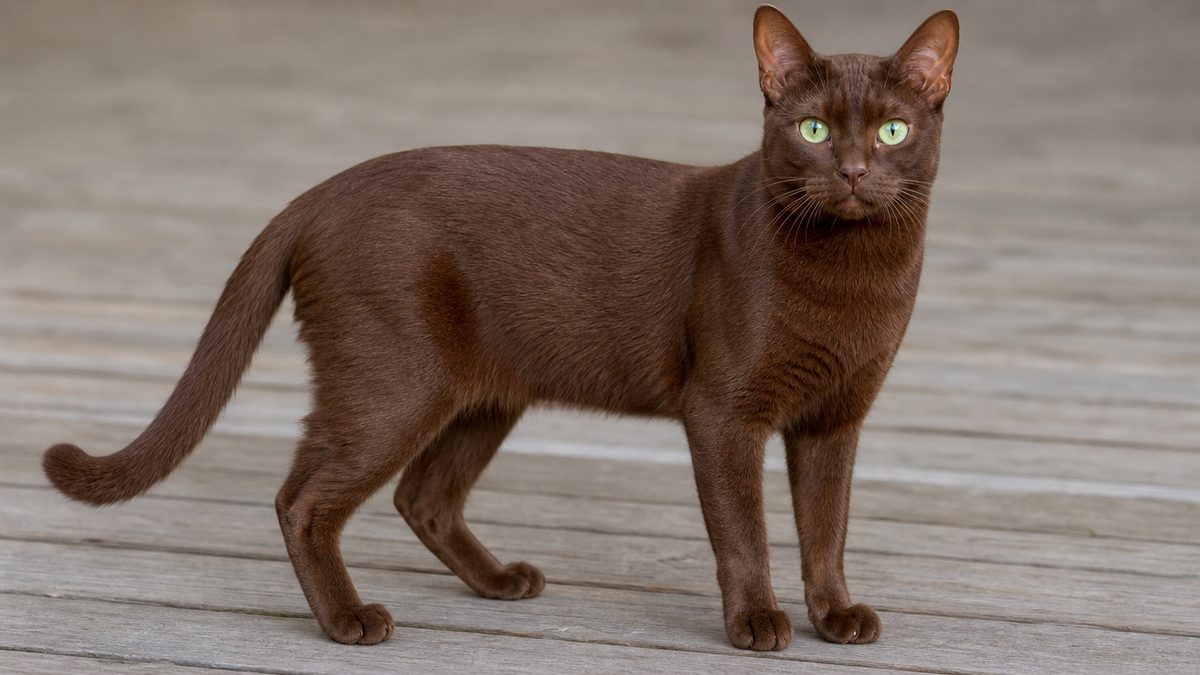
A Havana Brown is a medium, muscular, short-coated cat in an even warm chocolate brown with vivid green eyes and a muzzle so square that the breed standard treats it as the defining feature. That muzzle is what separates it from the chocolate Oriental Shorthair.
CFA's breed standard opens by saying the overall impression is a cat of medium size with a rich, solid colour coat and good muscle tone, and that due to its distinctive muzzle shape, coat colour, brilliant and expressive eyes and large forward tilted ears, it is comparable to no other breed. That last clause is doing real work, because the breed's whole identity rests on being distinguishable from a cat that shares its colour and much of its ancestry.
The muzzle, in the standard's own words
Viewed from above, the head is longer than it is wide, narrowing to a rounded muzzle with a pronounced break on both sides behind the whisker pads, and the standard says plainly that the somewhat narrow muzzle and the whisker break are distinctive characteristics of the breed and must be evident in the typical specimen. In profile there is a distinct stop at the eyes and the end of the muzzle appears almost square, an illusion heightened by a well-developed chin whose outline is more square than round.
WCF's standard describes the same feature from the other direction and says why it matters: the typical strong and square muzzle is a characteristic feature of the breed, distinguishing her from its oriental ancestors. Two registries, one anatomical point, and it is the point on which the entire separate-breed claim rests.
The rest of the cat
| Feature | What the standards require |
|---|---|
| Body | Medium in length, firm and muscular; general conformation mid-range between the cobby and svelte breeds; stands relatively high on the legs |
| Ears | Large, round-tipped, cupped at the base, wide-set but not flaring, tilted forward; little hair inside or outside |
| Eyes | Oval aperture, medium sized, set wide apart. Any vivid and level shade of green, the deeper the better |
| Coat | Short to medium, smooth and lustrous, and should not appear open or have an undercoat |
| Colour | Any even shade of rich warm brown, genotype chocolate-bb, the same sound shade throughout the hair shaft |
| Nose leather | Brown with a rosy flush. Paw pads rosy toned. Whiskers brown, complementing the coat |
| Tail | Medium, slender, tapering, neither whip-like nor blunt |
| Disqualifies | Kinked tail, locket or button, incorrect number of toes, any eye colour other than green, incorrect whisker, nose leather or paw pad colour |
Green eyes are not a preference, they are a rule
The standard permits any vivid and level shade of green and lists any eye colour other than green among the disqualifications, alongside a kinked tail and a locket or button. A green-eyed chocolate cat is what this breed is for. Kittens take months to develop full eye colour, so muddy eyes at ten weeks are not yet a fault, and a seller insisting an adult's yellow-green eyes are within standard is wrong.
One allowance is worth knowing because it worries new owners. The standard says to allow for ghost tabby markings in kittens and young adults, and WCF repeats it. Faint striping on a young chocolate cat usually clears. The GCCF's Suffolk standard, describing the same colour on a related breed, allows up to two years for it to clear fully.
Look at the profile and the eye shape, not the colour. A Havana Brown has a distinct stop at the eyes, an almost square muzzle end and OVAL eyes. A chocolate Oriental Shorthair has an unbroken straight line from skull to nose tip, a wedge with no whisker break, flared ears and ALMOND eyes. Same coat colour, different cat, and in Britain and across FIFe only one of the two exists as a breed.
Six registries, four answers: is Havana a breed or a colour?
Four of the six registers Bonbeno checked hold a Havana Brown as a breed and two do not, coding Havana instead as the chocolate colour of the Oriental Shorthair. That split is not a technicality. It is why the breed is rare.
The Havana Brown is one of the clearest cases on this site of a name meaning different things in different documents. Two registries hold it as a one-colour breed, two hold it as a two-colour breed under a shortened name, and two hold it as a colour code with no breed attached. Every one of those readings comes from a live primary document, and each was checked with an in-document control.
Registry recognition is the thing to establish before any price, because it decides whether the word on the advertisement corresponds to a document anywhere. Bonbeno checked all four TICA classes on 3 September 2026, finding Havana on the championship index, the Serengeti and Toybob in Advanced New Breeds, and no entries at all in the Preliminary class The International Cat Association.…. FIFe's own breed register was read the same day across all four categories.
CFA: a breed, brown only, lavender relegated to AOV
CFA has held the Havana Brown in championship since 1 July 1964. Its standard recognises one colour, any even shade of rich warm brown, and its registration rules place breed code 12 on standard cats with the lavender registered as AOV under codes 0498 and 0499. A lilac Havana Brown is therefore a registered Havana Brown in America that cannot compete for championship in its colour.
TICA: a breed, two colours, and a name change that records the disagreement
TICA holds the breed and calls it Havana, not Havana Brown, and its own page explains why. In 1983 TICA accepted the lilac Havana for championship competition and changed the breed name from Havana Brown to Havana. The name is shorter because the cat is no longer only brown. It appears on TICA's championship index as Havana, one row among 81 read on 3 September 2026, with Siamese, Balinese, Oriental Shorthair and Oriental Longhair present as controls.
Havana Brown returns nothing on TICA's index and Havana returns the breed. A researcher searching the American name and reporting the breed absent from TICA would be wrong, and the error would look exactly like a finding. This is why every absence on this page names the search string that produced it.
WCF: a breed under three names at once
WCF's Siamese and Oriental standards index lists the entry as Havana - Suffolk / Havana Brown, code HAV, with a standard dated 29 September 2019. The standard's opening sentence does the reconciliation itself, describing the ideal Havana as also called Havana Brown or Suffolk in other associations. WCF recognises two colour varieties, Brown and Lilac, agreeing with TICA and not with CFA.
LOOF: a breed, under the full American name
France's national studbook lists HAVANA BROWN as a recognised breed at record 26, with Siamese, Oriental, Balinese and Chartreux on the same index as controls. Its breed record describes two colours, mahogany brown or the rarer lilac, and states the history in one unusually frank sentence: the British breeders recreated solid brown cats in the 1950s, but their Havana, a word which then was defining the chocolate Oriental, then dissolved in the Orientals' family.
FIFe and the GCCF: Havana is a colour, not a breed
FIFe has no Havana in any category. Its Category 4 standard, edition 01.01.2026, instead carries a remarks table that defines the word outright: OLH/OSH n known as Ebony, OLH/OSH b known as Havana, all shades of warm chestnut brown, and OLH/OSH c known as Lavender. In FIFe, Havana is EMS colour code b on the Oriental Shorthair and Oriental Longhair. Nothing else.
The GCCF does the same thing in a different document and the arithmetic makes it airtight. In a 315-page Standard of Points running to 723,034 extracted characters, the word Havana appears exactly once, under the heading ORIENTAL SELFS, as HAVANA (OSH b), with the colour described as rich warm chestnut brown, not dark or cold toned. Controls read from the same extraction in the same session: British Shorthair 34, Siamese 47, Chartreux 8, Suffolk 10.
WCF's own basic-colour table agrees with both, coding chocolate as b with the note also: havanna, and lilac as c with the note also: lavender. Three separate international registries independently treat Havana as a synonym for chocolate.
History: made in England, kept alive in America
British cat fanciers created the Havana Brown in the 1950s by mating a chocolate-carrying seal point Siamese to a solid black shorthair, with Russian Blue in the early lines. The British version then dissolved back into the Oriental Shorthair, and only the American line stayed a separate breed.
TICA's account names the people. Fisher, of the Praha cattery, used chocolate point and seal point Siamese bred to solid black domestic shorthairs and a dash of Russian Blue to create the self-chocolate cats, and Praha Gypka was another early chestnut brown cat, a male from a chocolate point Siamese bred to a black shorthair. Elsie Quinn then contacted Baroness von Ullmann and imported the first Havana cats to the USA to form the foundation of the North American breed.
The name changed twice before anyone agreed on it
The Governing Council of the Cat Fancy recognised the new breed in 1958 as the Chestnut Foreign Shorthair, and the name was changed to Havana in 1970. That is the origin of the collision this page keeps returning to: by the time Britain settled on the word Havana, it was already using it for the chocolate Oriental, and the two meanings have never been separated since.
LOOF states the outcome without sentiment. The story of Havana Brown is a complicated one: coming from Siam, it was first selected in Great Britain before blossoming in the United States, which is why it is now considered an American cat; the British Havana then dissolved in the Orientals' family, and luckily the Havana Brown established itself in the United States, keeping its own characteristics and its medium type.
The divergence, stated as a table
| The British line | The American line | |
|---|---|---|
| What it became | A colour variety of the Oriental Shorthair | A separate breed |
| Type | Oriental: straight profile, flared ears, wedge head | Semi-foreign: distinct stop, square muzzle, medium type |
| Name today | Havana, meaning OSH b, or Suffolk as a separate GCCF breed | Havana Brown at CFA and LOOF, Havana at TICA |
| Recognised as a breed by | Not FIFe, not GCCF under this name | CFA, TICA, WCF, LOOF |
| Colours | Chocolate as one of dozens of Oriental colours | Brown only at CFA; brown and lilac at TICA, WCF and LOOF |
Britain's separate answer: the Suffolk
Britain did eventually create a breed for cats of the older, less extreme type, and it is not called Havana. The GCCF's Standard of Points carries SUFFOLK (SUF) in Section 5 Group B, updated by Council in June 2026, describing a shorthaired cat of Foreign type, graceful and elegant with a well-proportioned muscular body and long limbs, which should never look extreme, with a moderate head type and green eyes required with no flecks. It comes in four colours: chocolate SUF b, lilac SUF c, cinnamon SUF o and fawn SUF p.
That is a British breed occupying much of the same ground as the American Havana Brown, under a different name, with two extra colours. WCF's index acknowledges the relationship by filing all of it under one entry reading Havana - Suffolk / Havana Brown, and its EMS table records the HAV code as recognised by WCF, TICA, GCCF as SUF and LOOF as HAV.
That WCF recognition row lists WCF, TICA, GCCF and LOOF, and does not name CFA. CFA has held the Havana Brown in championship since 1 July 1964 and publishes a current standard and registration rules for it, so the omission is a gap in WCF's cross-registry column rather than evidence about CFA. We record the disagreement rather than quietly correcting either document.
Even Wikipedia splits the breed in two
The English Wikipedia article does not present one animal. Its section structure runs History, Characteristics and Health, with subheadings including Breed development, Appearance, Oriental-type, USA-type and Suffolk. When the encyclopedia's own outline needs separate headings for the Oriental type, the USA type and the Suffolk, the single-breed framing every commercial page uses is not describing the situation.
How rare is it, really? One register publishes a live number
LOOF recorded 3 Havana Brown kittens born in the last 365 days, against 574 Chartreux in the same register on the same day. That is the only hard population figure available for this breed anywhere, and it is the honest answer to the rarity question.
Rarity claims on cat breed pages are almost always unsourced, and the Havana Brown attracts more of them than most. One long-standing breeder-directory page states that Havana Browns are among the rarest breeds of pedigreed cats and that there may be fewer than 1,000 of these cats in existence today. Bonbeno could not reach that page to verify it and will not repeat the figure as a finding, because a number nobody can trace is not evidence.
What can be verified is better than an estimate, because it is a count. The Livre Officiel des Origines Félines, France's official feline studbook, publishes on every breed record the number of kittens born in the last 365 days. Read on 3 September 2026, that field is the closest thing to a live census any cat registry provides.
| Breed | Kittens, last 365 days | Ratio to Havana Brown |
|---|---|---|
| Chartreux | 574 | 191 to 1 |
| Oriental | 120 | 40 to 1 |
| Siamese | 83 | 28 to 1 |
| Havana Brown | 3 | 1 |
One comparison inside that table deserves its own sentence. The Oriental at 120 and the Siamese at 83 are the two populations this breed was made from, and both are registered in the same studbook on the same day. The chocolate Orientals inside that 120 are, in British and FIFe terms, Havanas. So the colour is roughly forty times commoner than the breed, which is the clearest possible statement of what the recognition split costs.
Three kittens in a year, in a country with an active pedigree cat fancy and a national studbook. The comparison that matters most is the Oriental at 120, because in France the chocolate Orientals in that number include cats a British registry would call Havana. The breed is not rare as a colour. It is rare as a breed.
LOOF says so in its own words
The register does not hedge. Its breed record ends the history with the observation that despite that rich history and its undeniable beauty, the Havana Brown is still extremely rare, including in its country of origin. A national studbook describing a breed it recognises as extremely rare in its homeland is a stronger statement than any breeder directory's estimate.
Why it is rare: a gene pool closed for 45 years
The rarity has a documented mechanism rather than being a mystery of fashion. CFA's registration rules record that the previous outcrosses were dropped on 1 January 1974, and names them: Burmese, Siamese, Russian Blue and Lilac Foreign Shorthair. From that date the breed bred only within itself. The outcrossing programme that reopened it took effect in February 2019. That is 45 years of a closed register on a founding population that was small to begin with.
Two registries hold no Havana Brown at all, coding the colour into the Oriental Shorthair instead Governing Council of the Cat Fancy.…. Every chocolate Oriental in Britain and across FIFe is a cat that in America would have been breeding stock for this breed and instead belongs to another one. The breed is rare partly because half the world files its cats somewhere else.
The gene pool, the 2019 outcross programme, and what a study measured
A microsatellite survey placed the Havana Brown among the four lowest-heterozygosity cat breeds it measured, and CFA opened a regulated outcrossing programme eleven years later. Those two facts belong in the same paragraph and are never printed together.
The study is the largest of its kind for cats: over 1,100 individuals across 17 random-bred populations from five continents and 22 breeds, genotyped on microsatellite markers. Its Table 1 gives per-breed genetic diversity, and the Havana Brown row is built on 11 cats.
| Population | N | HO | HE | Alleles per locus |
|---|---|---|---|---|
| Random-bred cats, average | - | 0.65 | - | - |
| Siberian | 19 | 0.69 | 0.73 | 6.65 |
| All purebred cats, average | - | 0.51 | - | - |
| Siamese | 32 | 0.47 | 0.52 | 4.06 |
| Havana Brown | 11 | 0.41 | 0.46 | 3.03 |
| Burmese | 25 | 0.40 | 0.51 | 4.44 |
| Singapura | 24 | 0.34 | 0.38 | 2.82 |
The paper's own summary of that table is direct: breeds such as the Burmese, Havana Brown, Singapura and Sokoke had the lowest heterozygosity values, while Siberians had the highest among the breeds, which was comparable to random bred cats. It also reports the two averages that give those numbers meaning, 0.65 for random-bred and 0.51 for purebred animals.
The Havana Brown row rests on 11 cats. That is a small sample even by the standards of a paper whose largest breed group is 40, and it is a consequence of exactly the rarity this page has documented. Treat 0.41 as a real measurement of a real bottleneck and not as a precise population parameter.
The same study could not separate the breed from the Siamese
Its Bayesian clustering placed the cats into twenty inferred clusters and reported that four pairs would not resolve: Singapura and Burmese, Havana Brown and Siamese, Korat and Birman, and Exotic Shorthair and Persian could not be distinguished as distinct breeds. Carry the qualifier that follows, because secondary write-ups drop it: these four breed pairs could be unequivocally differentiated when analysed independently of the other breeds, with the data not shown.
The discussion then says the thing that no ranking page repeats. The Siamese has been used to create numerous other breeds, including Colorpoints, Orientals, Havana Browns, and longhaired breed variants, and although listed as different, most of these derived breeds vary only by a single gene variant, such as hair length, colour patterns, and fur coloration; thus, these derived breeds will likely be inseparable as distinct breeds, as was shown with the Havana Brown and Siamese.
And then, in one sentence, the paper describes the registry split this page has spent two sections documenting: Havana Browns are considered a separate breed in the USA; however, European cat breed associations consider them only a color variant of Siamese. Peer-reviewed genetics reached the same conclusion Bonbeno reached from six registers, eighteen years earlier.
The 2019 outcross programme, in detail
CFA's response is a properly engineered programme rather than a gesture, and its rules are public. A Havana Brown may be mated with an unregistered black or blue domestic shorthair, known as F0; or with certain colours of Oriental shorthair, any colour except cinnamon, fawn, silver or bicolour; or with a Siamese, chocolate point or seal point only. The resulting kittens are F1.
- Mating an F1 back to a Havana Brown produces a litter registerable as Havana Brown, codes 0408 and 0409, provided the kitten meets the colour standard, or as Lavender AOV under 0498 and 0499.
- Kittens of any other colour or pattern stay registered as F1, codes 0416 and 0417, and may still be used for breeding as F1.
- One parent must always be a standard Havana Brown. The rules state that no breedings are permitted if at least one parent is not a Havana Brown.
- F0 to F0, F1 to F1, and F0 to Oriental or Siamese matings are all expressly not permitted.
- CFA's own breed page notes that with a programme like this, genetic testing of all breeding cats has become essential.
The timeline is the argument. The gene pool closed on 1 January 1974, a study measured the consequence in 2008, and the register reopened in February 2019 Lipinski MJ, Froenicke L, Baysac KC. Anyone quoting the 2008 heterozygosity figure today should say that it predates the outcross programme by eleven years, and anyone quoting the outcross programme should say what it was fixing.
Havana Brown price in India
Two Indian sources publish a Havana Brown price in india and they disagree by a factor of two at both ends, from Rs 20,000 to Rs 1,00,000 or more. Bonbeno found no verifiable Havana Brown actually offered for sale in India, so treat both as editorial.
Say the important thing first. There is no Havana Brown supply chain in India. A 40-breed Indian cat guide that prices this breed labels it very rare and describes it as one of the rarest cat breeds in India, and the world's most active national studbook recorded three kittens in a year. A country with no local breeding population and a global population that small does not have a market rate.
| Source | Price band | What else it says |
|---|---|---|
| Indian retailer's 40-breed guide | Rs 50,000 - Rs 1,00,000+ | Climate rating good, lifespan 10-15 years, availability very rare |
| Indian breed-page network | Rs 20,000 - Rs 50,000 | Origin England, ideal weather 20-28 C, monthly Rs 2,800 to Rs 4,199 |
The floor of one is the ceiling of the other. That is not a range, it is a disagreement, and publishing the midpoint would invent a number neither source supports. Bonbeno publishes both and recommends acting on neither.
Running the conversion tests
Indian breed pages routinely print a dollar figure run through an exchange rate and presented as a rupee price, so every figure here was tested. Rs 50,000 divided by 84.38 is 592.56 and Rs 1,00,000 divided by 84.38 is 1,185.11, neither clean. Divided by 74 they give 675.68 and 1,351.35, neither clean. Divided by a flat 80 they give exactly 625 and 1,250.
That flat-80 match proves less than it looks. Any rupee figure ending in three zeros divides cleanly by 80 by construction, because 1,000 divided by 80 is 12.5. What makes it worth reporting here is that the quotients are prices a seller would actually print, and that the US pages ranking for this breed quote 500 to 1,500 dollars and 600 to 1,500 dollars for a pet-quality kitten. A flat-80 conversion of a US band cannot be ruled out. It also cannot be demonstrated, so we report the arithmetic and draw no conclusion.
The Indian breed page quoting Rs 20,000 to Rs 50,000 also prints a monthly cost row of healthcare Rs 500 to Rs 700, grooming Rs 800 to Rs 1,499 and food Rs 1,500 to Rs 2,000. Bonbeno pulled the Oriental Shorthair page from the same network on the same day and the healthcare and food lines are identical to the rupee. Those are preset lines assigned per breed, not observations about a Havana Brown.
What an Indian buyer will actually be offered
Something else. A brown or chocolate-looking cat of no particular breeding, or an Oriental Shorthair, or a Siamese. Bonbeno's advice is specific: if a seller in India offers a Havana Brown, ask which registry issued the pedigree and ask to see it. The answer must be CFA, TICA, WCF or LOOF, because those are the only four registers on earth that issue the name. A pedigree from a British or FIFe club will say Oriental Shorthair, because that is what those registries call a chocolate cat of this ancestry.
Then ask about the outcross programme. A serious Havana Brown breeder anywhere in the world in 2026 will know whether their cats carry F1 ancestry and will be able to say so, because the registration codes make it explicit. A seller who has never heard of it is not breeding this breed.
Monthly cost of ownership in India
Budget Rs 2,000 to Rs 4,500 a month for one indoor Havana Brown in an Indian metro, plus a kitten vaccination course starting near Rs 4,000. Those figures come from named Indian providers, not from a breed table.
The purchase price is the number every page leads with and the least useful one, particularly for a breed with three kittens registered in France in a year. What an Indian owner spends is food, litter, parasite control, vaccination and the occasional consultation, and none of those depends on which registry recognises the cat.
Vaccination, the cost that surprises new owners
A national Indian clinic chain prices a kitten course of three visits at days 60, 90 and 120 from Rs 3,999 against a list price of Rs 5,065, with the adult annual booster from Rs 1,899, rabies at Rs 699 and the CRP vaccine at Rs 1,249. Read those as promotional floors from one chain, not as a market average, and note the same chain quotes different course prices on different city pages on the same day.
There is a cheaper route worth naming. Greater Chennai Corporation licenses pet animals generally, cats included, at Rs 50, and runs six pet clinics that provide treatment and anti-rabies vaccination free of cost. Delhi's municipal registration, by contrast, covers pet dogs only, so its fee is not a cat cost and no cat page should quote it as one.
| Item | Monthly range | Notes |
|---|---|---|
| Food | Rs 1,200 - Rs 2,500 | Top of range assumes a real wet-food share, which the health section argues for |
| Litter | Rs 400 - Rs 900 | Clumping bentonite at the low end, silica or pine at the high end |
| Parasite control | Rs 150 - Rs 400 | Monthly through the warm months |
| Vaccination, amortised | Rs 160 - Rs 300 | Adult booster from Rs 1,899 plus rabies Rs 699, spread over the year |
| Consultation, amortised | Rs 100 - Rs 250 | One or two routine visits a year |
| Grooming | Rs 0 - Rs 200 | A rubber mitt and nail clippers is the entire kit for this coat |
| Total | Rs 2,010 - Rs 4,550 | Excluding the first-year kitten course and any illness |
Compare that with the Rs 2,800 to Rs 4,199 the Indian template page quotes and the totals sit close together, which is worth conceding plainly. The difference is provenance: these lines trace to named Indian providers and can be re-checked, while the template row is assembled from preset lines shared to the rupee with unrelated breeds.
This breed genuinely does not need professional grooming, so the Rs 800 to Rs 1,499 monthly grooming line on the Indian template page is money you can redirect. Put it into canned food. The health section explains why urinary concentration is the risk that actually applies to this breed in an Indian climate, and wet food is the cheapest intervention against it.
Indian climate: the humidity warning everyone repeats is wrong
A Havana Brown handles Indian conditions better than most imported cats, because the standard specifies no undercoat. The homeland is also more humid than every Indian city measured here, so the load in India is heat rather than damp.
Start with the coat, because it is the one structural advantage. CFA's standard requires a coat short to medium in length, smooth and lustrous, that should not appear open or have an undercoat. WCF says the same, describing a coat that lies close to the body without undercoat. There is no dense insulating underlayer to trap heat against the skin or to hold monsoon moisture, and that removes most of the problems Persians and other double-coated breeds have in India.
The homeland is wetter than India, and that changes the advice
Indian breed pages routinely warn that an English cat will struggle in Indian humidity. Bonbeno queried NASA POWER by explicit latitude and longitude for a point in Kent, England and for six Indian cities, echoing the cell elevation each time to confirm the model was standing in the right place.
| Place | Cell elevation vs real | Annual mean temp | Annual relative humidity |
|---|---|---|---|
| Kent, England | 38.05 m vs about 60 m | 10.78 C | 84.64 % |
| Kolkata | 7.35 m vs about 9 m | 25.81 C | 73.93 % |
| Chennai | 48.95 m vs about 6 m | 27.95 C | 72.39 % |
| Bengaluru | 841.72 m vs about 920 m | 23.74 C | 67.94 % |
| Mumbai | 97.15 m vs about 14 m | 26.77 C | 67.39 % |
| Pune | 635.99 m vs about 560 m | 23.86 C | 66.80 % |
| Delhi | 206.37 m vs about 216 m | 25.60 C | 45.56 % |
The homeland runs 84.64 percent annual relative humidity, higher than every Indian city in that table, including Kolkata at 73.93 and Chennai at 72.39. Northern European air is damper than Indian air across the year. So the standard warning is simply the wrong warning, and repeating it distracts from the real one.
Kent's annual mean of 10.78 C against Chennai's 27.95 C is a gap of roughly 17 degrees C. That is the number to plan around. The risk is heat, or heat combined with humidity as a wet-bulb load, and not damp air by itself. Shade, airflow, cool floor surfaces and always-available water do more than any coat product.
City by city
- Bengaluru and Pune, at annual means of 23.74 and 23.86 C, are the easiest Indian cities for this cat. Both sit closest to the 20 to 28 C band an Indian breed page gives as ideal weather for it.
- Mumbai and Kolkata combine warmth with 67 to 74 percent humidity, so the wet-bulb load matters more than the thermometer suggests. Airflow is the lever, not air conditioning alone.
- Chennai is the hardest of the six, with the highest annual mean at 27.95 C. Keep the cat indoors through the middle of the day and give it a tiled or stone surface to lie on.
- Delhi is a two-season problem: 35.88 C in June and a January mean of 13.61 C. A short-coated cat with no undercoat needs a warm bed in the Delhi winter as much as it needs shade in June.
- Do not plan around a hill station without checking the elevation, for the reason below.
Why this page publishes no Shimla figure
NASA POWER returned a cell elevation of 897.65 m for the Shimla coordinates against a real ground level near 2,200 m, an error of about 1,302 m. The model is reporting a valley a kilometre and a third below the town, so its temperatures are far too warm to be Shimla's and Bonbeno will not print them under that name. A lapse-rate correction at about 6.5 C per 1,000 m suggests a real annual mean near 12.7 C, and that is an estimate, labelled as one.
The plains cells were accurate and that is the useful half of the check: Kolkata within 2 m, Delhi within 10 m, Chennai within 43 m, Pune within 76 m, Bengaluru within 78 m, Mumbai within 83 m. Where any page quotes a hill station's climate without saying which grid cell it used, distrust the figure.
Temperament and household fit
Expect a curious, affectionate, paw-using cat that is moderately active and genuinely variable between individuals, because CFA describes exactly that. It is a poor fit for a home nobody occupies and an excellent one for a flat with company.
CFA's description is more careful than most registry copy and worth quoting closely. High intelligence is to be expected from a Havana, along with curiosity and inquisitiveness, but not so much as to be intrusive: a Havana will be very interested in whatever might be hiding inside a cupboard, but is much more likely to wait and watch until you open it than to find a way in on its own.
The paw behaviour is the breed's signature and appears in three separate registry descriptions. CFA notes they often use their paws to communicate affection for their people, reaching out and touching you with a friendly paw, or investigating some new addition to their environment. TICA and other sources record the same habit. It is the single most-mentioned trait by people who live with them.
Variation between individuals is real and registry-acknowledged
CFA says plainly that while there are several common denominators to the Havana Brown personality, there is also a great deal of variation from one cat to the next, with some inclining toward shyness and devoting themselves primarily to one family member, while you may encounter one that is extremely outgoing and seeks to be everybody's best buddy. A registry conceding that its own temperament description does not always hold is unusual, and it is useful: meet the individual kitten.
Take two, and CFA says which one if you take one
Moderately active, playful and compatible with other family pets, and CFA notes that curling up to sleep in a tangled pile with another cat, or even a dog, is this breed's idea of heaven, which is one reason it may make sense to acquire two Havana Browns rather than one; if you do decide to get only one, breeders typically recommend a female rather than a male. That is a specific, actionable recommendation from the breed's own registry, and almost no consumer page carries it.
LOOF adds the domestic detail. At home the Havana Brown likes quietness and comfort, a true stay-at-home cat, but an active and talkative one whose voice sounds like the Siamese's but a bit lower; even at night it does not like to sleep alone and sneaks into the bed, and it can be a bit exclusive with its owner.
Who should not get one
- Households empty twelve hours a day with no second animal. This is a cat that dislikes sleeping alone; solitude is the wrong environment for it.
- Anyone wanting a silent cat. It is quieter and lower-pitched than a Siamese and it is not quiet.
- Buyers shopping on colour alone. A chocolate coat is available far more cheaply and far more easily in a domestic shorthair, and it is the same colour.
- Anyone who cannot verify a pedigree. With three kittens registered in France in a year, an unverifiable Havana Brown in India is almost certainly not one.
- Households wanting an ornamental cat that stays off the furniture. This one investigates cupboards and joins you in bed.
Somebody home much of the day, a second cat or a tolerant dog, an apartment with vertical routes, and an owner who wants an affectionate cat that participates rather than observes. Retired owners and work-from-home households suit this breed particularly well, and it is a better apartment cat than its Oriental relatives because it is calmer and less vocal.
Training, and what a Havana Brown resists
Train this cat with food, short sessions and its own paws, because the breed investigates with its forefeet and that habit is the easiest lever you have. It resists being rushed and it resists being ignored.
The training targets that matter in India are the same three as for any cat, and this breed takes to all of them. Carrier tolerance comes first, because an Indian cat travels to a clinic through traffic and heat and a cat that fights the carrier arrives already compromised. Leave the carrier open permanently with a familiar blanket in it, feed part of every meal inside it for a fortnight, and never use it exclusively for vet trips.
Use the paw habit
Because Havana Browns investigate with a paw rather than a nose, target training works unusually well. Hold a small object out, reward the moment a paw touches it, and within a week most cats will touch on request. That single behaviour then becomes the basis for voluntary carrier entry, scale training for monthly weighing, and cooperative handling for claw trims. It is the most breed-appropriate training approach available and it is free.
Harness work, with an Indian caveat
The breed's curiosity makes harness acceptance straightforward. Fit it indoors, five minutes at a time with food, and build gradually before attaching a lead. The caveat is climatic rather than behavioural: do not walk a cat on an Indian terrace or pavement in the middle of the day. Surface temperatures on paving in a Delhi June, where the monthly mean already reaches 35.88 C, will burn paw pads, and a short coat with no undercoat offers no protection in direct sun.
What it resists
- Being hurried. CFA describes a cat that waits and watches rather than forcing its way in, and that temperament does not respond to pressure. Slow down and it complies.
- Punishment. A spray bottle produces a cat that avoids you and continues the behaviour out of sight, which is worse than the original problem.
- Isolation. No training substitutes for company in a breed that dislikes sleeping alone.
- Rough grooming. Keep sessions short and gentle and handling stays easy for life; force one session and you will pay for months.
- Boredom. An under-occupied intelligent cat invents work, and it will not choose your shelves wisely.
A kitten forms its idea of normal roughly between two and nine weeks, and that window closes before an Indian buyer collects a kitten at eight weeks or later. Ask the breeder what the kitten has already met: pressure cookers, doorbells, vacuum cleaners, children, a car journey, another animal. A kitten raised in a quiet back room has missed the window, and later work never fully replaces it.
Daily exercise requirement
Give a Havana Brown two play sessions of ten to fifteen minutes a day plus climbing routes, because it is moderately active rather than frantic. Without that, the intelligence goes into your cupboards.
This is a moderately active cat and the requirement is honest about that. CFA calls the breed moderately active and playful, which places it well below an Oriental Shorthair and above a Persian. Two wand-toy sessions of ten to fifteen minutes, one before the household leaves and one in the evening, covers most of what an indoor Havana Brown needs.
Give it problems, not just movement
The intelligence needs more attention than the muscles. This is the breed that waits at a cupboard door rather than forcing it, which means it is watching and learning rather than acting on impulse. Puzzle feeders, foraging toys and hidden food work better here than a laser pointer, which produces motion without resolution and frustrates a cat that likes to solve things. Rotate three or four toys weekly rather than leaving everything out.
Vertical space in an Indian flat
An Indian apartment cannot usually offer more floor, and it does not need to. A tall scratching post, two or three staggered wall shelves and a clear route onto a wardrobe multiply the usable territory for a cat that stands relatively high on its legs and jumps well. This costs a few hundred rupees in brackets and shelf board and does more for behaviour than any toy.
| Time | What to do | Why |
|---|---|---|
| Early morning | 10 to 15 minutes wand play, then breakfast | Follows the natural hunt-eat-groom-sleep sequence and settles the cat before you leave |
| Midday | Nothing active. Shade, airflow, a cool floor, fresh water | The hottest part of the Indian day and the wrong time to raise core temperature |
| Late afternoon | Puzzle feeder or hidden food | Mental work without heat load, which suits this breed's temperament better than sprinting |
| Evening | 10 to 15 minutes wand play, then the main meal | The session that decides whether the cat wakes you at four |
| Night | Free access to climbing routes and a clean tray | A cat that can patrol settles; a confined one does not |
What under-exercise looks like, and why it matters more here
It shows up as a cat waking the household before dawn, over-grooming a patch of belly or flank, ambushing ankles, and putting on weight. The weight is the one that matters most on this page. A heavier, less active indoor cat drinks less relative to its needs and moves less, and this breed carries a documented increased risk of calcium oxalate urinary stones. Exercise here is urinary tract management as much as behaviour management.
Weigh yourself holding the cat and subtract, once a month, and keep the numbers. A trend line over six months tells you more than any body condition score guessed once a year. Pair it with wet food: a cat that is gaining weight on a fixed ration is moving less, and a cat on dry food alone in an Indian summer is running concentrated urine whatever the scale says.
Grooming a solid chocolate coat in Indian humidity
Groom a Havana Brown once a week with a rubber mitt and stop. The standard specifies no undercoat, which removes nearly every grooming problem Indian owners meet, and the one thing to be careful about is the coat colour itself.
CFA requires a coat short to medium in length, smooth and lustrous, that should not appear open or have an undercoat, and WCF describes the same coat lying close to the body without undercoat. No undercoat means nothing packs against the skin in monsoon humidity, nothing mats behind the ears, and there is no seasonal blow-out to manage. This is among the lowest-maintenance coats of any pedigree cat.
The weekly routine in full
- Rubber curry mitt or soft-bristled brush, once a week, five minutes, with the lie of the coat. That lifts dead hair and spreads coat oil, which is what produces the lustre the standard asks for.
- Claws every two to three weeks, taking the sharp tip only and staying clear of the pink quick.
- Ears checked weekly and cleaned only when visibly waxy, with a vet-supplied cleaner rather than a cotton bud pushed into the canal.
- Teeth brushed with a feline enzymatic paste as often as you can manage, because dental disease is the most consistently listed problem on Indian pages for this breed.
- Eyes wiped with a clean damp cloth if there is discharge, a fresh corner of the cloth per eye.
Why not to brush hard, on this colour specifically
A solid chocolate coat shows everything. On a tabby, a scratch or a patch of broken hair disappears into the pattern; on an even single colour it reads as a dull track across the flank. The standard demands the same sound shade throughout the hair shaft and an even colour with no lighter or darker preference, and a wire slicker dragged across a solid coat works against exactly that. Rubber or soft bristle only, and no pressure.
Ghost tabby markings are normal in a young cat
CFA's colour clause ends with an instruction in capitals: allow for ghost tabby markings in kittens and young adults. WCF repeats it, permitting ghost tabby markings in kittens, and the GCCF's Suffolk standard, covering the same chocolate colour on a related British breed, allows that ghost markings can take up to two years to clear fully. A young chocolate cat with faint striping is not mismarked and does not need a different diet.
The standard requires brown whiskers complementing the coat colour, and lists incorrect colour of whiskers, nose leather or paw pads among the disqualifications. TICA notes the same trait, that Havana cats have whiskers matching their coat colour. White whiskers on a chocolate cat are the cheapest single check that the animal in front of you is not what the seller says.
Humidity and one thing not to do
The Indian cities measured here run 45.56 to 73.93 percent annual relative humidity, all of them below the 84.64 percent of the breed's English homeland, and there is no undercoat to hold moisture regardless. Keep the weekly ear check honest through the monsoon and dry the cat properly if it ever gets soaked rather than letting it air dry in a humid room. And do not declaw: rule 7(14) of the Pet Shop Rules, 2018 bars the sale of a pet animal with any form of mutilation, curative surgery excepted on veterinary prescription.
Health, lifespan, and a literature of two papers
PubMed holds exactly two records naming the Havana Brown, and both are usable. One establishes an increased risk of calcium oxalate urinary stones, which is the risk that matters most in an Indian climate. No breed lifespan study exists.
Searched on 3 September 2026, a title and abstract search for the exact phrase returns two records, with a clean query translation and a control query returning 61 in the same session. That is a genuine absence rather than a broken search, and it means every general claim about this breed's health has to be built from two papers and wider feline evidence.
The word Havana on its own returns 6,345 PubMed records, and they are about the capital of Cuba: mosquito insecticide resistance in Panama, paediatric palliative care in Cuba, an Ecuadorian depression study. A researcher taking that count as a literature would be reading a city. Quote the breed name in full, read the query translation the database actually ran, and run a control in the same session.
Calcium oxalate stones: the one solid breed-specific finding
A case-control study at the Minnesota Urolith Center examined 7,895 cats with calcium oxalate uroliths and 7,334 with magnesium ammonium phosphate uroliths against 150,482 control cats without urinary tract disease, admitted to North American veterinary teaching hospitals between 1981 and 1997. Its results name British Shorthair, Exotic Shorthair, Foreign Shorthair, Havana Brown, Himalayan, Persian, Ragdoll and Scottish Fold as breeds at increased risk of developing calcium oxalate uroliths, along with male cats and neutered cats.
That finding transfers to India badly, in the sense that it gets worse here. Calcium oxalate stones form in concentrated urine, cats drink poorly by design, and Indian ambient temperatures raise water loss. A Havana Brown on dry food in Chennai, at an annual mean of 27.95 C, is the exact combination the study's risk factors describe. This is the most actionable health fact on the page and the answer is wet food, not a supplement.
Ocular dermoids: two cats, and what that does and does not mean
The second paper is a French multicentre retrospective of 13 cats treated for ocular surface dermoids, with a mean age at diagnosis of 5 months. The breeds were domestic shorthair 7, Birman 4 and Havana Brown 2, and the authors note that the two Havana Browns were related, sharing a sire, as were two of the four Birmans, concluding that genetic transmission is likely.
Be careful with that. Two cats in a 13-cat case series is not a prevalence, and the paper does not claim one; it says the condition is rare in cats and treatable by surgical excision, with ten of the thirteen excised and no recurrences. What it does establish is that dermoids have been recorded in this breed in related individuals, which is worth one question to a breeder and nothing more.
| Item | Evidence | What to do |
|---|---|---|
| Calcium oxalate uroliths | Breed named in a 7,895-case study against 150,482 controls | Feed wet food, multiple water bowls, and know the blocked-cat emergency |
| Ocular dermoid | 2 of 13 cats in one French series, the two related | Ask a breeder whether it has appeared in the line. Any mass on the eye surface needs a vet |
| Low genetic diversity | HO 0.41 on 11 cats, among the four lowest of 22 breeds measured | Ask whether the cats carry F1 ancestry under the 2019 outcross programme |
| Dental disease | Listed on Indian breed pages, no breed-specific study | Brush what you can and budget for scaling under anaesthesia |
| Lifespan | No study exists. Indian pages give 10 to 15 years as a trade estimate | Judge the individual on weight and screening, not on a breed number |
The blocked cat: learn this before you need it
A male cat straining in the tray and producing nothing, crying, or going back to the tray repeatedly is a blocked urethra until proven otherwise, and an untreated blockage kills within roughly forty-eight hours. Do not wait until morning, do not wait to see whether it settles, and do not accept a diagnosis over the phone. Given this breed's documented calcium oxalate risk, every owner of a male Havana Brown in India should know this paragraph.
What Bonbeno will not tell you
No lifespan figure, because no cohort has ever been followed for this breed. Two Indian sources give 10 to 15 years Supertails. Cat Breeds in India and LOOF publishes none at all. Averaging trade estimates would produce a number that describes nothing, so this page carries none, and any page giving you a confident breed lifespan for a cat with a two-paper literature is not reading the literature.
Feeding and nutrition, with the urinary tract in mind
Feed a Havana Brown wet food as a real share of the diet, because this breed carries a documented increased risk of calcium oxalate urinary stones and India makes that risk worse. Water intake is the single lever that matters most.
Most cat feeding advice is generic. This page's is not, and the reason is one study: a case-control analysis of 7,895 calcium oxalate urolith cases against 150,482 controls names the Havana Brown among the breeds at increased risk. Stones form in concentrated urine. Cats evolved to take most of their water from prey and drink poorly when fed dry food. Indian heat raises water loss. Those three facts point in the same direction.
Hydrate through food, not through hope
- Feed at least one wet meal a day, more if the budget allows, and treat it as preventive medicine rather than a treat.
- Provide water in wide shallow bowls, several around the flat, because a cat dislikes its whiskers touching the sides.
- Keep water away from the food bowl and well away from the litter tray. Cats reliably drink less from a bowl beside their food.
- Try a fountain if the cat ignores still water. Many cats of Siamese descent will drink from moving water and not from a bowl.
- Refresh water twice a day through Indian summer. A bowl that has stood all day in a warm room stops being appealing before it stops being clean.
Portions and life stages
| Stage | Approach | Watch for |
|---|---|---|
| 8 to 16 weeks | Kitten formulation, four small meals, wet food from the first day so it is never a novelty later | Loose stools on a diet change. Transition over a week, never overnight |
| 4 to 12 months | Kitten formulation, three meals, measured portions from the start | The growth spurt hiding overfeeding. Weigh monthly from the day it arrives |
| 1 to 7 years | Adult formulation, two meals, at least one wet, fixed portions | Slow gain after neutering. Cut the ration rather than waiting for the vet to mention it |
| 7 to 11 years | Adult or mature, two meals, more wet food | Weight loss with increased thirst and urination. That combination is a blood test, not a diet change |
| 11 years and over | Senior formulation on veterinary advice, smaller more frequent meals | Dental pain changing what the cat will eat, which reads as fussiness |
Do not add urinary supplements on your own
Over-the-counter urinary supplements sold in India target struvite and oxalate stones by opposite mechanisms, acidifying or alkalinising the urine. Giving the wrong one is worse than giving none, and this breed's documented risk is specifically calcium oxalate rather than struvite. Stone type is established by analysis after an episode, not by guessing beforehand. If your cat has had an episode, ask which stone was found and let that decide the diet.
Availability and cost in India
Every major feline life-stage diet is available through Indian online pet retailers in the metros, so availability is not the constraint and cost is. A medium cat's food line is genuinely modest, and the Rs 1,200 to Rs 2,500 monthly range in the cost section already assumes a meaningful wet-food share. Buy the best wet food you can sustain rather than the best dry food you can afford, and fund it from the grooming budget this coat does not need.
The Indian breed-page network prints calories per day for this breed as kittens 300 kcal and adults 250 kcal. Its Colorpoint Shorthair page prints 250 for kittens and 300 for adults, which is inverted, and its Oriental Shorthair page prints 200 and 250. Three pages, three different pairs, one of them backwards. Feed to body condition and the pack's own guidance instead.
Kitten timeline, month by month through the first year
Take a Havana Brown kitten home at no earlier than eight weeks, because Indian law defines a kitten below eight weeks as un-weaned and bars its sale. Here is what to expect month by month after that.
State the legal floor first, because Indian sellers routinely breach it. The Prevention of Cruelty to Animals (Pet Shop) Rules, 2018 define an un-weaned animal in rule 2(1)(p)(ii) to include kittens and pups below eight weeks, and rule 7(15) provides that no pet shop shall sell un-weaned or underage animals or birds. A seller offering a six-week kitten is breaking the law and telling you what kind of operation you are dealing with.
| Age | What is happening | What you do |
|---|---|---|
| Birth to 3 weeks | Eyes opening, entirely dependent. Coat colour still developing | Nothing. A kitten sold at this age is being sold illegally |
| 3 to 8 weeks | Weaning, litter training, and the core socialisation window all run here | Visit if you can. Ask what the kitten has met: noise, handling, children, other animals |
| 8 to 9 weeks | The earliest lawful age to go home | Collect. Set up one quiet room with litter, water, food and a hiding box; do not give the run of the flat on day one |
| 9 to 12 weeks | Settling in, first vaccinations, fast growth. Ghost tabby markings often visible | Start the vaccination course, from about Rs 3,999 for three visits. Begin carrier training immediately |
| 3 to 4 months | Teething. Chewing increases and everything gets tested | Safe chew items. Start weekly claw trims and short grooming sessions to normalise handling early |
| 4 to 6 months | Eye colour deepening toward the required green. Coat colour evening out | Discuss neutering timing with your vet. Keep weighing monthly and keep the numbers |
| 6 to 9 months | Adolescence. Boundaries tested, activity peaks | Hold the routine. Most rehoming decisions are made in this window and most are avoidable |
| 9 to 12 months | Filling into adult muscle. Males noticeably larger than females | Switch to adult food. Book the first annual check and set the booster date |
What to expect from the colour and the eyes
Two things worry new owners and neither should. Ghost tabby markings are expressly permitted in kittens and young adults by CFA's standard and by WCF's World Cat Federation. Breed Standard Havana…, and the GCCF's standard for the same colour on the Suffolk allows up to two years for them to clear. And eye colour deepens over months: the standard requires any vivid and level shade of green, the deeper the better, and a ten-week kitten will not be there yet.
Ask for the kitten's own vaccination record with dates and vaccine names, and for the registration paperwork naming the registry. Only four registers on earth issue a Havana Brown or Havana pedigree: CFA, TICA, WCF and LOOF. A British or FIFe pedigree for a chocolate cat of this ancestry will say Oriental Shorthair, and that is not a forgery. It is a different registry answering the same question differently.
Head to head against the cats you will actually be offered
An Indian buyer looking for a Havana Brown ends up comparing an Oriental Shorthair, a Bombay, a Burmese and a domestic chocolate cat, because those are what exist here. On coat colour alone, three of the four are cheaper and easier.
The honest framing is that you are unlikely to be choosing between a Havana Brown and anything else in India, because you are unlikely to find one. What you will be choosing between is the cats that look similar, and the differences that matter are head type, eye colour and price.
| Havana Brown | Oriental Shorthair | Bombay | Burmese | Domestic chocolate cat | |
|---|---|---|---|---|---|
| Indian price published | Rs 20,000 - 1,00,000+, two sources disagreeing | Rs 20,000 - 60,000 | Rs 15,000 - 35,000 | Commonly quoted above Rs 25,000 | Adoption fee only |
| Findable in India | Effectively no | Rarely | Select breeders | Select breeders | Yes, in any shelter |
| Head type | Semi-foreign, distinct stop, square muzzle | Extreme wedge, straight profile | Rounded, medium | Rounded wedge, medium | Varies |
| Eyes | Green only, oval | Green, almond, blue in whites | Gold to copper | Yellow to golden | Varies |
| Coat | Short, no undercoat, even chocolate | Short, no undercoat, any colour | Short, close, black only | Short, satin, sable to lilac | Usually short |
| Recognised as its own breed by | CFA, TICA, WCF, LOOF | Every registry | Most registries | Every registry | Not a breed |
| Noise | Moderate, lower than Siamese | Very high | Moderate | High | Varies |
Against the Oriental Shorthair, which is the real comparison
In Britain and across FIFe this is not a comparison at all, because a chocolate Oriental Shorthair is what those registries mean by Havana Governing Council of the Cat Fancy.…. Where the two do differ is type: an Oriental is an extreme wedge with a straight profile and flared ears, while the Havana Brown keeps a distinct stop, a square muzzle and a medium body. If you want the colour and cannot find the breed, the Oriental is the same colour in a more extreme cat, and it is slightly easier to source in India.
Against the Bombay
The Bombay is the closest thing India has to an accessible solid-coloured designer shorthair, and it is black rather than chocolate. Both are single-colour short-coated cats of medium size with a similar apartment temperament, and the Bombay is materially cheaper and materially easier to find. For a buyer whose real want is a sleek solid-coloured cat rather than this specific breed, it is the better recommendation and nobody makes it.
Against the Burmese, and a shared genetic problem
The Burmese was a permitted Havana Brown outcross until 1 January 1974, so the relationship is real rather than superficial. It is also the other breed the microsatellite survey named alongside the Havana Brown, Singapura and Sokoke as having the lowest heterozygosity values it measured. If you are cross-shopping these two on the basis of rarity, know that both carry a documented diversity problem.
Against a chocolate cat from a shelter
Brown and chocolate-coated domestic cats exist in Indian shelters, they cost an adoption fee, they are already adapted to the climate, and they carry none of a closed pedigree's inherited risk. What they will not have is the square muzzle, the oval green eyes or the even chocolate the standard describes. That is the whole difference, and it is worth knowing that it is the whole difference before paying a five-figure premium for it.
If what appeals is a rare, elegant, short-coated cat with a documented history and a genuine registry story, the Chartreux is the comparison worth making. LOOF registered 574 Chartreux kittens in the last 365 days against 3 Havana Browns Livre Officiel des Origines Felines. Havana…, so one of the two is a rare breed you can actually obtain.
Mistakes Indian owners and buyers make with this breed
The recurring Indian errors are buying an unverified chocolate cat as a Havana Brown, feeding dry food to a breed with a documented stone risk, and quoting a rarity claim nobody can trace. All three are avoidable.
1. Buying a chocolate cat and being told it is a Havana Brown
This is the expensive one, and the arithmetic makes the risk obvious: three kittens registered in France in a year, and an Indian guide listing the breed as very rare. Ask which registry issued the pedigree. Only CFA, TICA, WCF and LOOF issue this breed name. Then check the whiskers, which the standard requires to be brown and lists among the disqualifications if wrong. A chocolate cat with white whiskers is not this breed.
2. Feeding dry food only
The breed is named in a 7,895-case study as being at increased risk of calcium oxalate uroliths, stones form in concentrated urine, and Indian heat raises water loss. A kibble-only diet is the wrong choice for this specific breed in this specific country, and the fix is one wet meal a day plus water bowls kept away from the food.
3. Repeating the fewer-than-1,000 figure
A breeder directory states there may be fewer than 1,000 Havana Browns in existence, and the number circulates everywhere. Bonbeno could not reach that page to verify it and does not repeat it as a finding. There is a better number available, published by a national studbook and re-checkable by anyone: 3 kittens in the last 365 days at LOOF, against 574 Chartreux in the same register on the same day. Use the count, not the estimate.
4. Assuming Indian humidity is the problem
It is not. The English homeland runs 84.64 percent annual relative humidity, higher than Kolkata, Chennai, Bengaluru, Mumbai, Pune or Delhi. The gap that matters is temperature, about 17 degrees C between Kent and Chennai. Owners who buy dehumidifiers and ignore shade and airflow are solving the wrong problem.
5. Treating ghost tabby markings as a defect
Both CFA and WCF expressly allow ghost tabby markings in kittens and young adults World Cat Federation. Breed Standard Havana…, and the GCCF's standard for the same colour allows up to two years for them to clear. Buyers reject kittens over this, and sellers exploit it by discounting a perfectly correct cat. Neither is necessary.
6. Believing a cost table without checking a second breed
The Indian breed page for this cat prints healthcare at Rs 500 to Rs 700 and food at Rs 1,500 to Rs 2,000, and the Oriental Shorthair page on the same site prints both lines identically to the rupee. The test takes thirty seconds: open another breed on the same site and compare. If the lines match, you are reading a template rather than a costing.
7. Expecting a lavender kitten to be showable everywhere
It depends entirely on the registry, and buyers are rarely told. CFA registers a lavender Havana Brown as AOV, codes 0498 and 0499, so it cannot take championship in that colour. TICA accepted the lilac in 1983 and renamed the breed accordingly, and WCF recognises Brown and Lilac as its two colour varieties. Same cat, three answers, and only one of them is a restriction.
Both are unlawful to sell in India. Rule 7(14) of the Pet Shop Rules, 2018 bars the sale of a pet animal with any form of mutilation, curative surgery excepted on veterinary prescription, and rule 7(15) read with rule 2(1)(p)(ii) bars the sale of a kitten under eight weeks. A seller offering either is telling you how they operate.
Adoption and responsible sourcing in India
Adopt, because there is no Havana Brown supply chain in India and a chocolate shorthair from a shelter gives you the colour without the closed gene pool. If you do buy, verify the registry and the outcross ancestry.
The adoption argument is unusually strong for this breed. There is no Indian breeding population to support, no Indian line to preserve, and the world population is small enough that a national studbook recorded three kittens in a year. Meanwhile Indian shelters hold brown and chocolate-coated cats continuously, already adapted to the climate and carrying none of a 45-year closed register's inherited risk.
What to do first
- Start with municipal and NGO shelters in your own city rather than national listing sites, because moving a cat across Indian states in summer is hard on the animal and usually unnecessary.
- Ask specifically for adult cats. Kittens go quickly everywhere and adults wait, and an adult arrives with a known temperament instead of a prediction.
- Ask for a cat that has lived with another cat if you want a pair, because this breed does best with company and pairing two unfamiliar adults is a project.
- Expect a nominal fee covering sterilisation and vaccination. That is cost recovery, not a sale.
- Get the vaccination and deworming history in writing, exactly as you would from a breeder.
Chennai's municipal route is genuinely good
Greater Chennai Corporation licenses pet animals generally at Rs 50, issued 9,115 licences in 2024, and runs six pet clinics providing treatment and anti-rabies vaccination free of cost. A Rs 50 licence and free rabies vaccination changes a first-year budget more than any decision about breed. Note the scope trap that catches most Indian pet pages: Delhi's municipal registration covers pet dogs only, so its fee is not a cat cost and should never be quoted as one.
If you buy, verify these six things
| Ask for | Why it matters here | Legal position in India |
|---|---|---|
| The registry that issued the pedigree | Only CFA, TICA, WCF and LOOF issue this breed name | No Indian requirement. It is the question that establishes what you are buying |
| Whether the line carries F1 outcross ancestry | CFA's programme codes it explicitly as 0416 and 0417 | No Indian requirement. A real breeder will answer without hesitation |
| The kitten's age in weeks | Under eight weeks is unlawful and harmful | Rule 2(1)(p)(ii) treats kittens below eight weeks as un-weaned; rule 7(15) bars their sale |
| To see the mother with the litter | The best available signal of how the kitten was raised | Rule 7(3) bars a pet shop displaying mothers caring for un-weaned young for sale |
| The kitten's own vaccination record | Dates and vaccine names, not an assurance | No Indian requirement, so insist on it in writing |
| Confirmation the cat is not declawed | Declawing removes the last bone of each toe | Rule 7(14) bars sale of a pet animal with any form of mutilation |
Rule 7(16) of the Pet Shop Rules, 2018 requires every puppy to be micro-chipped by a veterinary practitioner and permits only micro-chipped puppies to be sold. The word puppy appears exactly once in the entire gazette and that is the sentence, so kittens fall outside the requirement completely. Do it anyway. A chip at roughly Rs 1,250 from a Chennai clinic is the only thing that reliably returns an indoor cat that got out of a flat.
The housing standard a pet shop must meet for cats
Second Schedule paragraph 2 of the Pet Shop Rules, 2018, headed FOR CATS, gives you a checklist to use on sight. It requires a solid floor in an enclosure large enough for all occupants to exercise free movement and play, elevated resting surfaces, matting, soft and clean play toys within the enclosure, the litter box area excluded from the calculation of total area, and cats or kittens kept in a room not shared by other inimical animal species such as dogs.
That last clause is the one to watch for in Indian pet shops, where cats and dogs are routinely housed in the same room. A shop keeping kittens in a wire cage beside a dog run is failing the Second Schedule, and the appropriate response is to leave rather than to negotiate.
Havana Brown questions Indians actually search
Are Havana Brown cats good pets?
Yes, for a household that is usually occupied. CFA describes high intelligence, curiosity and a habit of reaching out with a paw to communicate, and notes real variation, with some cats devoted to one person and others outgoing with everybody. LOOF calls it a true stay-at-home cat that dislikes sleeping alone. CFA's own breeders suggest taking two rather than one, and recommend a female if you take only one. It is a poor fit for a home empty twelve hours a day.
What cat costs $100,000?
No Havana Brown does, and this question reaches this page because Google's People also ask box attaches it to rare-cat queries rather than because anyone sells one. The figures usually behind it are hybrid Savannah kittens of early filial generations, and they are asking prices rather than transacted ones. The Havana Brown's own published Indian range runs from Rs 20,000 to about Rs 1,00,000, and even that spans a factor of five across two sources.
Where do Havana Brown cats come from?
England, in the 1950s, from a deliberate cross of a chocolate-carrying seal point Siamese with a solid black shorthair, with some Russian Blue in the early lines. British cat fanciers made it, the GCCF recognised it in 1958 as the Chestnut Foreign Shorthair and renamed it Havana in 1970, and the British line then dissolved into the Oriental Shorthair family. The breed survived as a separate animal only in the United States, which is why it is now usually described as American.
Is the Havana Brown a rare cat?
Yes, and unusually for a rare-breed claim there is a live number behind it. LOOF publishes a per-breed count of kittens born in the last 365 days, and on 3 September 2026 it read 3 for the Havana Brown. The same register on the same day recorded 574 Chartreux, 120 Orientals and 83 Siamese. LOOF's own breed record says the Havana Brown remains extremely rare including in its country of origin.
What is the difference between a Havana Brown and a chocolate Oriental Shorthair?
Head type, eye shape and which registry you are standing in. The Havana Brown has a semi-foreign body and a muzzle so square that CFA describes a pronounced break on both sides behind the whisker pads, with oval eyes. A chocolate Oriental is an extreme wedge with a straight profile, flared ears and almond eyes. In Britain and across FIFe the distinction does not exist as a breed at all: Havana is simply the name for the chocolate Oriental Shorthair, EMS code OSH b.
Do Havana Brown cats have green eyes?
Always, and nothing else is permitted. The CFA breed standard requires any vivid and level shade of green, the deeper the better, and lists any eye colour other than green among the disqualifications alongside a kinked tail, a locket or button, and an incorrect number of toes. Kittens can take months to develop full colour, so a young kitten with muddy eyes is not necessarily a fault yet.
Can a Havana Brown be lilac?
It depends entirely on the registry, and this is the clearest example of the split. CFA registers a lavender Havana Brown as an AOV, codes 0498 and 0499, which means it cannot compete for championship in the colour. TICA accepted the lilac in 1983 and renamed the breed from Havana Brown to Havana precisely because it was no longer brown-only. WCF's standard recognises Brown and Lilac as the two colour varieties. Same cat, three answers.
What is the Havana Brown price in India?
Two Indian sources publish a figure and they disagree by a factor of two. A 40-breed Indian cat guide gives Rs 50,000 to Rs 1,00,000 or more and labels the breed very rare. An Indian breed-page network gives Rs 20,000 to Rs 50,000. Bonbeno found no verifiable Havana Brown actually offered for sale in India, so treat both as editorial rather than as a market rate, and read the arithmetic in the price section before trusting either.
Are Havana Brown cats healthy?
Reasonably, with one specific and well-evidenced risk and one large unknown. A case-control study of 7,895 calcium oxalate cases against 150,482 controls names the Havana Brown among breeds at increased risk of calcium oxalate urinary stones, which matters more in India than in England because heat and low water intake concentrate urine. The unknown is genetic: a microsatellite survey measuring 11 cats found the breed among the four lowest-heterozygosity breeds it examined.
Is a Havana Brown suitable for Indian weather?
Better than most imported cats, and worse than a desi cat. The coat is short with no undercoat, which is the one real advantage. But the homeland is about 17 degrees C cooler than Chennai in annual mean. The counterintuitive part is humidity: a point in Kent, England runs 84.64 percent annual relative humidity, higher than any Indian city measured here, so the Indian problem is heat rather than damp, and the answer is shade, airflow, water and an indoor cat.
How long do Havana Brown cats live?
No breed-specific lifespan study exists, and the honest answer is that the published figures are trade estimates rather than measurements. Two Indian sources give 10 to 15 years and LOOF publishes no figure at all. Bonbeno will not average those or present one as a finding, because no cohort has ever been followed. Expect a normal indoor-cat lifespan and judge an individual on its screening and its weight, not on a breed number.
Does Indian law require a kitten to be microchipped before sale?
No, and the absence is worth knowing. The Prevention of Cruelty to Animals (Pet Shop) Rules, 2018 make microchipping mandatory in rule 7(16), but that rule is written for puppies only: the word puppy appears exactly once in the entire gazette and it is in that rule. Kittens fall outside it. What does apply is rule 2(1)(p)(ii), which treats kittens below eight weeks as un-weaned, and rule 7(15), which bars any pet shop from selling an un-weaned or underage animal.
Compare with similar breeds
Havana Brown sits in 1 Bonbeno group. Each one compares it directly against the breeds it is genuinely an alternative to, on the same figures.