
Breed profile
Suphalak Cat in India: One Registry, One Colour
A solid copper-brown Thai cat with a single recognised colour, held by one registry of six, and the subject of exactly one peer-reviewed study.
Quick answer
No Suphalak cat price in India exists. Six Indian commerce pages were opened on 9 September 2026 and none carries the breed, while Persian, Bengal and Maine Coon controls appear on all six. One registry of the six this site checks holds the Suphalak, and its standard recognises a single colour and permits no outcrosses.
This page reports what one registry standard and one genetic study say about the Suphalak, and records that no clinical veterinary literature about the breed exists. Nothing here is a diagnosis and nothing here is a treatment plan, and no health figure has been borrowed from a related breed and relabelled. Consult your nearby vet, a registered veterinarian, about any animal in your care before acting on anything on this page.
Suphalak at a glance
What a Suphalak cat is
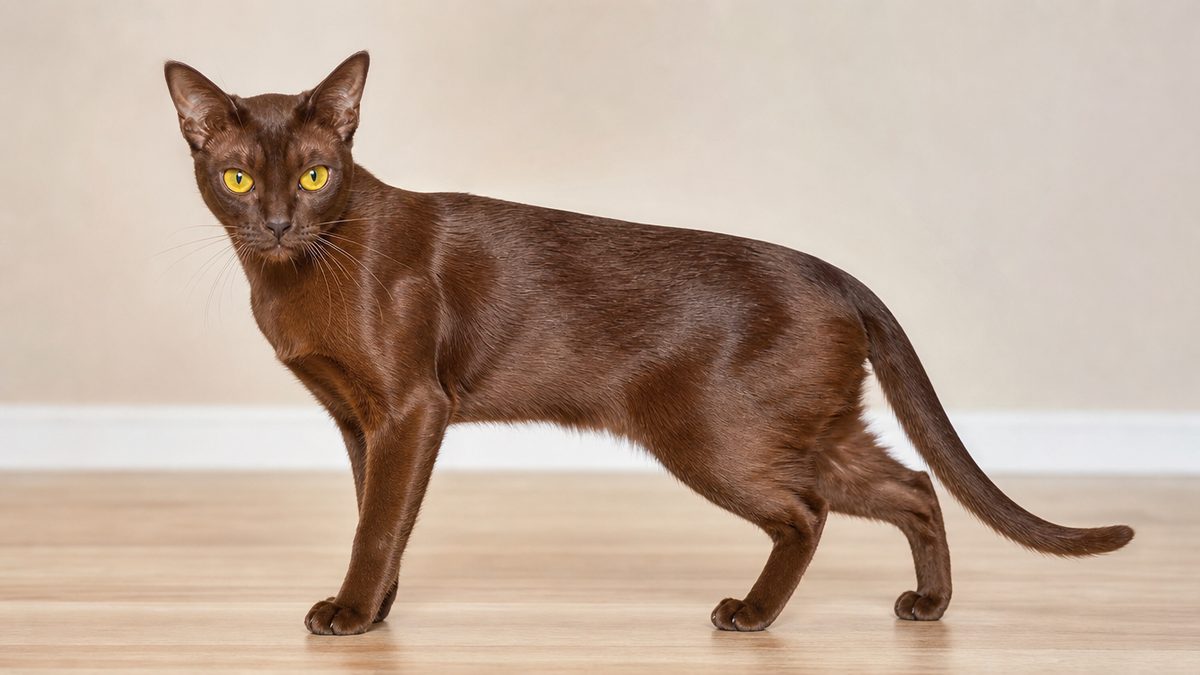
The Suphalak is a semi-foreign Thai cat with a very short glossy coat in one recognised colour, a warm reddish chocolate, and a distinctive brow that its only standard describes as looking almost bald.
Exactly one registry publishes a standard for this cat, so that standard is the whole of the written description available, and it is worth reading rather than paraphrasing. The World Cat Federation's Suphalak standard, dated 1 November 2024, opens with a medium-sized, well balanced, muscular and graceful cat of semi-foreign type, moderate and well proportioned, with long slender muscular legs and oval paws.
The breed standard is the only document of record here, and its history is the shortest on this site: it was actualised on 1 November 2024, which makes it newer than most of the cats it sits beside in the same registry's catalogue. There is no registry account of the breed's development, no named founder and no dated import, which is itself the history a buyer needs, because it means the paperwork trail is short.
The head, which is the breed's signature
The head is of medium width and moderate length, wedge-shaped with gently rounded contours and a slightly heart-shaped form. High rounded cheekbones curve gently inwards to the muzzle, and the forehead is slightly arched. Then comes the detail no photograph explains and no other standard on this site contains: *the supraorbital (brow) ridges are pronounced with sparse hairs above the eyes that give the face a peculiar astonished expression*, and in the coat section, *above the eyes, the fur gives the impression of baldness*.
The profile is slightly curved with a dip below eye level, the nose straight and slightly curved just before the tip, the chin narrow and well developed, the muzzle fine and neither too round nor pointed. A slight break in the muzzle is permitted.
Coat and colour, which are one thing here
The coat is very short, fine, close-lying, with an intense lustre and no undercoat, and a silky feel. The colour is a glossy warm chocolate, rich and intense, and the standard is unusually explicit about which version of it is wanted: an intense reddish-copper coat colour should be preferred to a dull, matt chocolate. Slight ghost markings are acceptable, especially in younger cats and with seasonal coat condition.
The supporting detail is where the breed becomes checkable. Nose leather is chocolate brown; paw pads are a warm cinnamon that in older cats takes on an orange to coffee-latte hue; the whiskers are brown; and the colouring can become darker with age. Eye colour runs from light yellow to rich golden, with a slight green shade permitted and an intense rich golden-yellow preferred.
A kinked tail, a locket or medallion of white, and any eye colour except yellow to green. A coat that is not shiny excludes the certificate outright, and a too dark or cloudy coat colour is a fault. Those five lines are more useful to a buyer than any amount of breed folklore, because each of them can be verified in a minute by looking.
One colour, and a closed book
The standard recognises exactly one colour, Chocolate, EMS code SUP b, and its outcross field reads Permitted outcrosses: None. A single-colour breed with no approved outcross, held by one registry, is a narrow definition by any standard, and it is the fact that shapes everything else on this page.
A last point of vocabulary. This is a solid chocolate cat rather than a shaded or pointed one: one colour over the whole animal, with the darkening confined to age rather than to pattern. That is what makes it a rare thing to find and an easy thing to counterfeit.
Registry recognition: one body of six
The World Cat Federation is the only one of the six registries this site checks that holds the Suphalak, and its own cross-registry table names no other body.
| Registry | Status | Evidence |
|---|---|---|
| WCF | Recognised, code SUP, Category 4 Oriental Group | Published standard dated 1 November 2024; EMS row 287 names WCF alone |
| CFA | Absent | No breed council and no Miscellaneous or Provisional entry |
| TICA | Absent | Not among the 83 breed entries in the Browse All Breeds index, which does carry the Khao Manee and the Thai |
| FIFe | Absent | Not among the 52 EMS rows nor the 54 rows of the 2024 statistics, which do carry THA Thai |
| GCCF | Absent | Not on the recognised list, not on the green, amber or red unrecognised lists, and zero occurrences in the 315-page Standard of Points |
| LOOF | Absent | Not among the 55 breeds in the complete French studbook index, which does carry the Thai |
Why the GCCF absence is the most informative one
The GCCF publishes an unrecognised-breeds page that grades breeds green, amber and red with the recognising body named, and then adds a further sentence naming seven more breeds it knows of but which are not present in the UK: Anatoli, Arabian Mau, Brazilian Shorthair, Chinese Li Hau, Kanaani, Tasman and Ural Rex. The Suphalak is on none of those lists and is not among the seven. That is a stronger absence than a simple omission from a recognised-breeds index, because this registry maintains a list specifically of breeds it has considered and not recognised, and the Suphalak has not reached even that.
The Standard of Points confirms it independently: 315 pages and 723,034 extracted characters, and the string Suphalak appears zero times, against Thai, Korat, Siamese and Sokoke as in-document controls.
The company it keeps at the WCF
The WCF files the Suphalak in Category 4, the Oriental Group, alongside the Havana, the Khao Manee, the Mekong Bobtail, the Oriental Shorthair, the Siamese, the Thai, the Tonkinese and the Toy Bob World Cat Federation. That filing is a claim about body type rather than about geography, and it is the right one: a semi-foreign body with long slender legs belongs there rather than with the cobby breeds.
The comparison that puts this in proportion
Thailand's other breeds are recognised far more widely. The Thai, which is the Wichien Maat under its Western registry name, is held by the WCF, FIFe, TICA, the GCCF and LOOF, and FIFe registered 234 Thai kittens in 2024 at rank 24 of 54 Federation Internationale Feline. The Korat is held by nine bodies in the WCF's own map. The Khao Manee is held by the WCF, CFA and TICA. Against that, one registry for the Suphalak is a genuinely unusual position for a Thai breed, and it is the single most important thing a buyer should know before paying for one.
Three checks close the absences rather than assuming them. CFA's index of declared breed council candidates lists every Longhair and Shorthair council plus the Miscellaneous and Provisional chairs, and carries no Suphalak entry. TICA's Browse All Breeds index, captured on 28 August 2026, carries 83 breed entries including the Khao Manee and the Thai but not this breed. And the French studbook's complete 55-breed list carries the Thai and not the Suphalak. Each index returned its control breeds in the same pass, so none of these is a parsing artefact.
What the one study that names this breed actually found
A 2024 Thai population-genetics study of 184 cats across five Thai breeds found high diversity in all of them, mitochondrial haplogroups shared worldwide, and a distinct genetic structure in only one breed, which was not the Suphalak.
This is the only peer-reviewed paper that names the Suphalak, so it deserves to be reported carefully rather than mined for a headline.
The design
Genetic variability and structure were examined in five Thai domestic cat breeds using 15 microsatellite markers and mitochondrial DNA D-loop sequencing. In total 184 samples were analysed, representing the Wichien Maat, Suphalak, Khao-Manee, Korat and Konja breeds.
The findings, in the authors' own terms
- High genetic diversity was observed in all five breeds, with observed and expected heterozygosity both above 0.5.
- Mitochondrial analysis revealed two primary haplogroups, A and B, shared among all domestic cat breeds in Thailand and globally.
- Clustering analyses showed only minor differences between the Thai breeds, with a distinct genetic structure observed in the Wichien Maat specifically.
- The authors interpret this as allele fixation for distinctive morphological traits in breeds that emerged in isolated regions with shared racial origins.
- Individual identification within these breeds was highly efficient, with a sibling probability of identity below ten to the minus four, and nine loci were sufficient.
It says the Suphalak sits inside a Thai domestic cat population that is genetically diverse and largely shared, and that of the five breeds studied only the Wichien Maat stood out structurally. It does not say the Suphalak is not a breed, and this page does not say so either. A breed is a registry construct built on a standard and a studbook, and the WCF has both. What the study does establish is that the difference is carried by fixed morphological traits rather than by deep population separation, which is exactly what a single-colour standard with no permitted outcross would predict.
The practical consequence for a buyer
Two things follow. First, a solid brown Thai-type cat is not self-identifying: with Thai breeds sharing alleles and haplogroups, the pedigree does the work that appearance cannot. Second, the high diversity reported is genuinely good news for a breed with a closed studbook, because it means the founding population was not narrow to begin with, even though the WCF standard permits no outcross today.
One more caution belongs here. Solid brown cats carry names that collide across registries: the Havana is a WCF breed, a GCCF breed under the name Suffolk and an Oriental colour code in FIFe's own remarks. Before treating any brown cat's breed name as meaningful, ask which registry issued the paper.
Suphalak cat price in India, and why this page publishes none
No Suphalak cat price in India exists, because no Indian seller checked on 9 September 2026 carries the breed and only one registry in the world holds it.
Six Indian commerce pages were opened directly, chosen because they are the pages Bing India returns for the unqualified query cat price in india, which is a query the engine reads properly. Each was searched for the Suphalak alongside three control breeds.
| Indian page | Suphalak | Persian | Bengal | Maine Coon |
|---|---|---|---|---|
| Supertails, position 1 for cat price in india | No | Yes | Yes | Yes |
| Wrapinfur cat price guide | No | Yes | Yes | Yes |
| World Blaze cat breeds price list | No | Yes | Yes | Yes |
| MyKitten, verified breeders | No | Yes | Yes | Yes |
| Puppiezo, live listings | No | Yes | Yes | Yes |
| Nearby Pets India, live listings | No | Yes | No | Yes |
Three controls on every page and the target on none is composition evidence rather than volume evidence MyKitten, Cats for Sale in India Wrapinfur, Cat Price in India 2026 World Blaze, List of Cat Breeds Price… Nearby Pets India. Puppiezo's index in particular runs to well over a hundred breed names and contains no Suphalak.
The search engine could not read the query at all
The result set for the commercial query is reported here as a documented failure rather than as a finding. Bing India returned seven results about the word ball: Britannica on balls, Wiktionary, Wikipedia, basketball, the Cambridge Dictionary, a list of sports balls and the Ball Corporation. A second query, suphalak thai cat breed, returned ten song-lyric pages on a single lyrics site under About 50 results. The instrument was healthy: the control query cat price in india, run in the same session, returned ten genuine Indian cat-commerce pages under About 6,850 results. So no conclusion about the Indian market is drawn from those rows, and none needs to be, because the commerce pages were opened directly.
Ask for the registry first, because there is only one possible answer: a World Cat Federation pedigree. No CFA, TICA, FIFe, GCCF or LOOF document for this breed can exist, since none of those five registries holds it. Then check the three disqualifications yourself: a kinked tail, any white locket or medallion, and any eye colour outside yellow to green. A solid brown domestic cat is very easy to present as a Suphalak and impossible to distinguish without papers.
Import is the only theoretical route. The DGFT's own FAQ states that import of cats into India is restricted and permitted only with an authorisation, that animals for commercial or breeding purposes are not allowed, and that entry is confined to the airports and seaports of Delhi, Mumbai, Chennai, Hyderabad, Bangalore and Kolkata under ITC(HS) code 01061900. DAHD added a seventh port, Cochin International Airport at Kochi, for pets arriving under the baggage rules in October 2024. The full route, which covers cats too, is set out in how to import a dog to India.
Heat tolerance: a tropical cat measured against tropical cities
A Suphalak would suit Indian heat about as well as any cat can, because the standard specifies a very short coat with no undercoat and Bangkok's climate sits within a tenth of a degree of Chennai's annual mean.
The coat is a written specification rather than an impression: very short, fine, close-lying, with an intense lustre and no undercoat. A coat with no undercoat cannot trap the still layer of warm air that makes a northern breed suffer in an Indian summer, and it dries within minutes after rain.
| Place | Annual mean (C) | Hottest month | Mean daily max, hottest month (C) | Annual mean RH (%) | Peak wet bulb (C) |
|---|---|---|---|---|---|
| Bangkok | 27.86 | April, 30.73 | 37.36 | 74.38 | 25.99 |
| Chennai | 27.94 | May, 31.51 | 36.02 | 72.39 | 26.11 |
| Mumbai | 26.77 | May, 31.19 | 38.17 | 67.28 | 25.77 |
| Kolkata | 25.80 | May, 31.53 | 37.43 | 73.84 | 27.09 |
| Bengaluru | 23.74 | April, 28.37 | 36.31 | 67.84 | 21.86 |
| Pune | 23.86 | April, 28.93 | 38.56 | 66.68 | 22.97 |
| Delhi | 25.57 | June, 35.88 | 41.66 | 45.51 | 26.50 |
Read the first two rows against each other
Bangkok's annual mean is 27.86 degrees against Chennai's 27.94, a difference of 0.08 degrees. Annual mean relative humidity is 74.38 percent against 72.39, with Bangkok the slightly wetter. Peak wet bulb is 25.99 degrees against 26.11, a difference of 0.12. On every measure that governs whether a cat can shed heat, the two cities are effectively the same place. Every POWER cell used here landed within 83 m of the real elevation, so these are the towns rather than neighbouring hills.
Indian pages routinely warn that Indian humidity will trouble an imported cat. Bangkok runs 74.38 percent annual mean relative humidity, higher than Chennai, Mumbai, Bengaluru, Pune and Delhi and only just below Kolkata's 73.84. This breed comes from air at least as wet as India's. What it has never met is a Delhi winter: Bangkok's coolest month averages 24.95 degrees while Delhi's January averages 13.61.
Parasite pressure is the Indian risk that heat is not. A Kerala study of 120 animals tested at veterinary clinics found Babesia in 80 of them, 66.7 percent, with a pre-monsoon peak from March to May. That is a clinic caseload rather than a population prevalence and it concerns dogs, so read it as a reason to keep any cat on a vet-prescribed parasite protocol. A coat with no undercoat is an advantage here, because ticks are visible.
What a Suphalak would cost to keep in India
The cost of ownership for a Suphalak in India would be as low as any pedigree cat gets, because a coat with no undercoat generates no grooming bill and a tropical cat needs less cooling than a northern one.
There is no Indian purchase price to report and no realistic supply, so this section shows what the recurring monthly cost of a short-coated cat in India actually is. Every figure is a published Indian rate re-checked on 9 September 2026.
| Item | Published figure | Source |
|---|---|---|
| Kitten vaccination course, three visits | From Rs 3,999, list price Rs 5,065 | Vetic |
| Adult annual booster | From Rs 1,899 | Vetic |
| Anti-rabies, single dose | Rs 699 | Vetic |
| CRP (Tricat or Feligen) | Rs 1,249 | Vetic |
| Pet licence, Chennai | Rs 50 for pet animals generally | Greater Chennai Corporation |
| Boarding, 24 hours, Bengaluru | Rs 899 | PawSpace |
| Daycare to 10 hours, Bengaluru | Rs 799 | PawSpace |
The Vetic figures are promotional floors from one clinic chain rather than a market average, and the same chain quotes different course prices on different city pages on the same day, so record which city page a figure came from. Chennai's Rs 50 licence covers pet animals generally, and the corporation's six pet clinics give treatment and anti-rabies vaccination free of charge, which for a tropical short-coated cat in a coastal city is the most useful municipal fact in this section.
Boarding at Rs 899 a night comes to Rs 6,293 for a week away. A realistic Indian metro annual total would be roughly Rs 38,000 to Rs 60,000, with no grooming line and no cooling premium. The unusual cost would be veterinary uncertainty rather than veterinary expense, because a vet in India will never have seen this breed and has no breed literature to consult.
One more line belongs in any honest budget. An imported cat of a rare breed is expensive before it lands, and the humid Indian summer that suits the coat is also the season that drives parasite costs, so put the parasite protocol in the annual figure rather than treating it as an occasional purchase.
Temperament and household fit: an honest blank
No registry publishes a temperament description for the Suphalak, so this page describes what the standard implies about the body and refuses to invent a personality.
This section is short because the evidence is. The World Cat Federation standard is a conformation document: body, tail, head, ears, eyes, coat, colour, faults, disqualifications, outcrosses, scale of points. It contains no temperament clause at all, unlike the TICA standards for other breeds on this site, which frequently do. And the WCF is the only registry that holds the breed, so there is no second description to consult.
Almost every English-language page about this breed asserts a personality: affectionate, intelligent, playful, devoted. None of those claims traces to a registry document, a study or a survey, because none exists. A breed profile that gives you a confident temperament paragraph for a cat with one published standard and no temperament clause has written the paragraph rather than found it. Treat any such description as a breeder's impression, which may be perfectly accurate and is not evidence.
What the standard does support
The body it describes is semi-foreign: medium sized, well balanced, muscular and graceful, with long slender muscular legs. That is an active build rather than a cobby one, and the WCF files the breed in its Oriental Group beside the Siamese, the Oriental Shorthair and the Thai. Cats of that build and that grouping are generally more active and more vocal than cobby breeds, which is why this page rates activity 4 and flags the vocal rating as inferred rather than measured.
If you want a documented Southeast Asian temperament, the Burmese and the Korat both have registry temperament descriptions and far wider recognition. That is a better basis for a fifteen-year decision than an undocumented one.
Training a Suphalak, and what it resists
Train a Suphalak as an oriental-type cat, because that is what its only standard's body description and its registry filing both point to, and say plainly that nothing breed-specific is published.
No registry publishes training guidance for this breed and no study exists, so the honest approach is general feline practice applied to a semi-foreign body filed in an Oriental Group World Cat Federation, WCF EMS code table.
- Clicker-train a hand target early, which converts into recall, carrier loading and vet handling.
- Feed at least one meal a day from a puzzle feeder rather than a bowl.
- Handle the face and brow daily from the start, because the sparse-haired brow ridges are the area a vet will want to examine and an owner will want to check.
- Build carrier tolerance before the first vet visit, since an Indian vet meeting this breed will need time to examine it properly.
- Reward quiet deliberately, on the assumption that an Oriental-Group cat is a talkative one.
What it would resist is unknown, and that is the honest answer. This page will not list resistances for a breed with no published behavioural description, because doing so would be inventing the very content this page exists to correct.
Daily exercise for a semi-foreign body
Give a Suphalak two structured play sessions a day and climbing height, because the standard describes long slender muscular legs and a graceful muscular body rather than a sedentary one.
- Two wand or chase sessions of fifteen minutes, at the cool ends of the Indian day.
- One climbing route from floor to above head height that does not use your furniture.
- One elevated resting place per cat, which is also what the Pet Shop Rules require of shops.
- Puzzle feeding for at least one meal daily.
- Weekly tick and ear checks, which are quick on a coat with no undercoat.
Weigh monthly and record it. The largest recent UK life-table study associates body weight deviance from the breed and sex mean with shortened lifespan at an estimate of minus 0.02 years per 100 g in cats that died after nine months of age. On a glossy close-lying coat the trend is visible early, which is one of the few practical advantages of a breed nobody has studied.
Grooming, which is almost nothing, and one thing to watch
Comb a Suphalak once a week and inspect the sparse-haired brow, because a coat with no undercoat needs no work but the standard's own head description points at skin that is barely covered.
The standard describes a coat that is very short, fine, close-lying, with an intense lustre, no undercoat and a silky feel. There is nothing to mat and nothing to strip. A weekly pass with a rubber curry removes the loose hair and, more usefully, lets you feel the skin.
| When | What | Why |
|---|---|---|
| Weekly | Rubber curry or fine comb over the whole coat | Removes loose hair and lets you check the skin |
| Weekly | Look at the brow above the eyes | The standard describes sparse hair there, so skin is more exposed than on most cats |
| Weekly in tick season | Check ears, neck, armpits and between toes | No undercoat means ticks are visible, which is the real advantage |
| Fortnightly | Nails and teeth | Standard, and easy on a cat trained young |
| Rarely | Bath | Only if soiled. A coat with no undercoat dries in minutes |
The standard states that the supraorbital ridges carry sparse hairs and that above the eyes the fur gives the impression of baldness. Thinly haired skin above the eyes in a country with high ultraviolet exposure is a plausible reason to keep this cat out of direct midday sun, and to mention the area to your vet at a routine visit. No study supports that, so this page states it as reasoning from the standard rather than as an established risk.
Health: one paper, and it is not a clinical one
No clinical veterinary literature about the Suphalak exists, so this page reports the absence rather than borrowing figures from the Burmese or the Havana Brown and relabelling them.
Consult your nearby vet before acting on anything in this section. The honest content of this section is what is missing, and the method for establishing that matters as much as the conclusion.
The absence, tested rather than assumed
A PubMed search for the exact phrase Suphalak in title or abstract returns exactly one record, and it is the Thai population-genetics study described above rather than a clinical paper. An unquoted all-fields search returns three, the other two being radiotherapy papers by an author named Suphaphong, which is the classic personal-name collision this site tests for. A search for the Thai name Thong Daeng returns zero. The control query returned 126 records in the same session.
The obvious move is to say that the Suphalak is a Thai brown cat and therefore shares the Burmese's health profile. That is exactly the reasoning this site treats as fabrication wearing a citation. The Burmese has its own literature and its own lifespan row in the largest UK life-table study, at 14.42 years on 45 deaths, the longest in that table. None of that describes a Suphalak, no study has tested whether the two brown coats even arise from the same allele, and this page will not transfer a figure across a boundary nobody has measured.
What the genetic study does support
One thing, and it is mildly reassuring. All five Thai breeds studied, including the Suphalak, showed high genetic diversity with observed and expected heterozygosity above 0.5. A breed founded on a narrow base would not look like that. The counterweight is that the WCF standard permits no outcrosses at all, so whatever diversity exists in the source population is not being renewed inside the register.
Lifespan
No breed figure exists. The largest recent UK life-table study covered 7,936 confirmed deaths and reported only 12 breeds, because breeds with fewer than 15 deaths were grouped into other; the Suphalak is not among the 12 breeds that reached that threshold. Two figures from that paper do apply to any cat: entire cats had 4.29 times the odds of dying before three years compared with neutered cats, and purebreds 1.83 times the odds compared with crossbreds.
There is also nothing specific to screen for, which sounds like good news and is not. With no clinical literature there is no candidate condition, so a buyer cannot ask a breeder to screen the parents against anything, and an Indian vet has no breed baseline to compare a result against.
Feeding a tropical short-coated cat in India
Feed a Suphalak a complete diet split across the day, because no breed-specific nutrition guidance exists and general practice is all anyone has.
The only registry that holds this breed publishes a conformation standard with no nutrition section, and no study addresses the question PubMed searches run through NCBI eutils…. What follows is general feline practice applied to an active short-coated cat in a hot climate.
- Split the ration into three or four meals rather than free-feeding.
- Deliver one meal through a puzzle feeder, which paces an active cat.
- Keep water away from food and in more than one place, which is the standard feline recommendation.
- Store dry food airtight and out of the heat, because Indian summer storage is what spoils kibble.
- Feed wet food within twenty minutes in a hot kitchen and discard the rest rather than leaving it down.
One breed-specific note is worth making because the standard supports it. The coat colour darkens with age and the paw pads shift from cinnamon towards an orange or coffee-latte hue in older cats. That is a normal ageing change written into the standard, not a nutritional signal, and it is worth knowing so an owner does not go looking for a dietary explanation for it.
Kitten timeline: month by month through the first year
A Suphalak kitten's first year would be ordinary veterinary work plus one unusual task, which is documenting a cat that no Indian vet will have seen and no second registry can verify.
| Age | What is happening | What you do |
|---|---|---|
| Before 8 weeks | Legally un-weaned under the Pet Shop Rules 2018 | Do not collect. Get the date of birth in writing |
| At purchase | The WCF pedigree is the only proof of breed | Get the registration number and both parents' numbers, and check the three disqualifications yourself |
| 8 to 9 weeks | Collection window opens; first vaccinations | Vaccinate on your vet's schedule. Kitten course from Rs 3,999 at one national chain |
| 9 to 12 weeks | Socialisation window still open | Handle face, ears and paws daily. The brow is thinly haired and needs to be a routine touch point |
| 3 to 4 months | Second and third vaccinations, deworming | Start a weekly parasite check, since pre-monsoon is the Indian peak |
| 4 to 8 months | Ghost markings often still visible | Do not treat faint ghost markings as a defect. The standard accepts them, especially in young cats |
| 5 to 6 months | Neutering conversation | Discuss timing with your vet. Entire cats carry 4.29 times the odds of early death |
| Year 2 onward | Coat colour deepens with age | Expect the colour to darken and the paw pads to shift towards orange. This is written into the standard |
The eight-week floor is legal rather than advisory. Rule 2(1)(p)(ii) of the Pet Shop Rules 2018 defines an un-weaned animal to include kittens below eight weeks, and rule 7(15) provides that no pet shop shall sell un-weaned or underage animals. Eight weeks is 56 days.
Rule 7(16) makes microchipping mandatory for puppies sold through Indian pet shops and requires a functional reader on the premises; the rule says puppy, so kittens fall outside it. For a solid brown cat whose breed identity rests on a single registry's pedigree and cannot be confirmed by appearance, a chip is the only durable link between the animal and its document.
Suphalak against the Thai and Southeast Asian breeds you can actually verify
Every other Thai and Southeast Asian breed in this comparison is held by more registries, appears in more studies and, in one case, has the longest lifespan in the largest UK life-table.
| Breed | Registries of six | FIFe 2024 kittens | Teng 2024 lifespan row | On Indian seller pages |
|---|---|---|---|---|
| Suphalak | One, WCF | Not registered | Below the 15-death threshold | 0 of 6 |
| Thai (Wichien Maat) | Five | 234 | Below the threshold | 0 of 6 |
| Korat | Five or more | 97 | Below the threshold | 0 of 6 |
| Burmese | Six | 1,515 | 14.42 years on 45 deaths, longest in the table | 0 of 6 |
| Siamese | Six | 929 | 11.69 years on 88 deaths | Yes, on most |
| Havana Brown | Three or four, under three names | Not registered | Below the threshold | 0 of 6 |
Against the Thai
The Thai is the Wichien Maat under its Western registry name and it is the fair comparison, because it is the same country's cat with the same body type. It is held by the WCF, FIFe, TICA, the GCCF and LOOF, registered 234 FIFe kittens in 2024, and is the one Thai breed the genetic study found structurally distinct. On every documentary measure it is a stronger proposition.
Against the Burmese
The Burmese is the other brown Southeast Asian cat, it is held by all six registries, it registered 1,515 FIFe kittens in 2024, and it heads Teng's lifespan table at 14.42 years on 45 deaths, the longest life expectancy of the twelve breeds reported. If what appeals about the Suphalak is a warm brown Southeast Asian cat, the Burmese delivers it with a literature, a lifespan figure and six registries behind it.
Against the Havana Brown
The solid-chocolate comparison is the trickiest, because the name itself is unstable across registries: the WCF's own EMS table files the breed as *Havana (Suffolk / Havana Brown)* and notes that the GCCF holds it under the name Suffolk while LOOF holds it as Havana. A buyer looking at a solid brown cat has to establish which registry issued the paper before the breed name carries any meaning at all, and that applies to the Havana Brown as much as to the Suphalak.
Against an Indian domestic cat
Purebred cats in the UK life-table study had 1.83 times the odds of dying before three years compared with crossbreds, and crossbreds lived 11.89 years against 10.41 for purebreds. India has a large population of short-coated brown cats adapted to precisely the climate this breed evolved in, costing between nothing and Rs 2,000. For a breed with one registry, one standard, one paper and no clinical literature, that comparison is not a consolation prize.
What people get wrong about this breed
Five mistakes recur, and three of them come from treating a single-registry breed as though it were widely recognised.
- Assuming wide recognition. One registry of six holds the Suphalak. No CFA, TICA, FIFe, GCCF or LOOF pedigree for this breed can exist, so a document claiming to be one is wrong on its face.
- Accepting a confident temperament description. The only published standard has no temperament clause. Every personality paragraph you will read about this cat is somebody's impression rather than a registry's finding.
- Borrowing the Burmese health profile. No study has established that the two brown coats even arise from the same allele, and the Burmese's 14.42-year lifespan row belongs to the Burmese.
- Treating faint ghost markings as a fault. The standard accepts slight ghost markings, especially in younger cats and with seasonal coat condition. What it faults is a too dark or cloudy colour, and what excludes the certificate is a coat that is not shiny.
- Buying an unpapered solid brown cat. With Thai breeds sharing alleles and haplogroups, and with a single-colour standard, appearance cannot identify this breed. The pedigree does all the work.
Three disqualifications are visible without any equipment: a kinked tail, a white locket or medallion anywhere on the coat, and any eye colour outside yellow to green. Any one of them means the cat in front of you would not pass under the only standard that exists for the breed, whatever the seller says.
Adoption, verification and the honest recommendation
Adopt an Indian brown domestic cat, because there is no Indian population of this breed and the climate argument that favours it favours the street cat equally.
No Suphalak appeared on any of the six Indian commerce pages checked, and no Indian rescue route this site tracks lists the breed. Supertails names CUPA in Bengaluru and Friendicoes in Delhi as starting points for adopting a cat in India, and its own advice is that an Indian domestic cat is the most low-maintenance and resilient choice.
If you somehow find one, verify these four things
- The registry, which can only be the World Cat Federation, with the registration number.
- Both parents' registration numbers, given that the standard permits no outcross.
- The three disqualifications, checked on the cat in front of you rather than in a photograph.
- The DGFT authorisation, since import of cats is restricted, breeding and commercial imports are refused, and entry is limited to seven ports.
What the Pet Shop Rules give you as a buyer
Rule 6(5) of the Pet Shop Rules 2018 makes temperature the shop's responsibility and states that comfortable temperature varies from animal to animal and from breed to breed, with the onus on the shop owner to familiarise himself with the requirements of the breeds he deals in. The Second Schedule paragraph 2, headed FOR CATS, requires a solid floor, elevated resting surfaces, matting, soft clean play toys, the litter-box area excluded from the space calculation, and cats or kittens kept in a room not shared with inimical species such as dogs.
The honest recommendation
The Suphalak is the least documented cat in this cluster and one of the best suited to Indian weather, and those two facts do not cancel out. A single registry, a single standard dated 2024, a single colour, no permitted outcross, one peer-reviewed paper that is about population genetics rather than health, and no clinical literature at all is a thin basis for a fifteen-year commitment made from India, where no vet will have seen the breed and no second registry can confirm the paperwork. If the appeal is a warm brown Southeast Asian cat, the Burmese has six registries and the longest lifespan in the largest study. If the appeal is a tropical short-coated cat for an Indian summer, the cat outside already is one.
Five things, named rather than papered over. No People Also Ask box could be captured on the day this page was built. A rendered Google India result on 18 September 2026 did carry one, 4 questions, and the FAQ below answers 1 of them verbatim. Both commercial SERPs for this breed were substituted, into dictionary entries for the word ball and into song lyrics, while the control passed in the same session, so no conclusion was drawn from them. No registry publishes a temperament description, so none is given. No clinical veterinary literature exists, so no health figure is reported and none has been borrowed from the Burmese or the Havana Brown. And no Indian price exists to publish, which is the finding rather than a gap.
Suphalak cat questions people actually ask
What is the Suphalak cat price in India?
No Indian price exists. Six Indian commerce pages were opened on 9 September 2026, including the page ranking first for cat price in india and two live-listing marketplaces, and none carries the Suphalak, while Persian, Bengal and Maine Coon appear on all six. Bonbeno will not convert a foreign figure into rupees.
Which registries recognise the Suphalak?
One of the six this site checks. The World Cat Federation holds it as SUP in its Category 4 Oriental Group and publishes a standard dated 1 November 2024. It is absent from CFA, from TICA's 83-entry breed index, from FIFe's 52 EMS rows, from the GCCF's recognised and unrecognised lists alike, and from the French studbook's 55 breeds.
What colour is a Suphalak?
One colour only. The standard recognises Chocolate, EMS code SUP b, described as a glossy warm chocolate that is rich and intense, with an intense reddish-copper preferred over a dull matt chocolate. Slight ghost markings are acceptable, especially in younger cats, and the colour can darken with age.
Is the Suphalak the same as a Burmese or a Havana Brown?
No, and the distinction is registry-level rather than visual. The Suphalak is held only by the WCF, which files the Burmese and the Havana as separate breeds in separate rows of the same table. What no source establishes is whether the brown arises from the same allele, because no published genetic work on this breed's coat colour exists.
What does the only study of Thai cat breeds actually say?
It analysed 184 cats across five Thai breeds including the Suphalak, using 15 microsatellite markers and mitochondrial D-loop sequencing. All five showed high genetic diversity with heterozygosity above 0.5, two mitochondrial haplogroups were shared among Thai and global domestic cats, and only the Wichien Maat showed a distinct genetic structure.
Would a Suphalak suit the Indian climate?
Very well on coat and origin. The standard specifies a very short, fine, close-lying coat with no undercoat, and Bangkok's annual mean of 27.86 degrees at 74.38 percent relative humidity sits within a tenth of a degree of Chennai's 27.94 at 72.39. This is a tropical cat measured against tropical cities rather than assumed to suit them.
What health problems does the Suphalak have?
Nobody knows. PubMed returns exactly one record for the exact phrase Suphalak and it is a population-genetics paper, not a clinical one. No case report, survey or disease study names this breed anywhere, against a control that returned 126 records in the same session.
Can a Suphalak be crossed with another breed?
Not under the only standard that exists. The World Cat Federation standard's outcross field reads Permitted outcrosses: None. For a breed with one registry and no published registration figures, a closed studbook is a real constraint on its genetic future rather than an administrative detail.
What disqualifies a Suphalak at a show?
Three things, and they are worth knowing because they are checkable on any cat you are shown. A kinked tail, a locket or medallion of white, and any eye colour except yellow to green. A coat that is not shiny excludes the certificate, and a too dark or cloudy coat colour is a fault.
Can I import a Suphalak into India?
Only under a DGFT authorisation, and not for breeding or resale. Import of cats into India is restricted, the DGFT's own FAQ says animals for commercial purposes such as breeding are not allowed, and entry is limited to the airports and seaports of Delhi, Mumbai, Chennai, Hyderabad, Bangalore and Kolkata under ITC(HS) code 01061900. DAHD added a seventh port, Cochin International Airport at Kochi, for pets arriving under the baggage rules in October 2024.
What is the most popular cat in Thailand?
No popularity survey exists on this page, so the honest measure is registry reach, and on that measure the Thai, which is the Wichien Maat under its Western registry name, leads Thailand's breeds by a wide margin. It is held by the WCF, FIFe, TICA, the GCCF and LOOF, and FIFe registered 234 Thai kittens in 2024 at rank 24 of 54. The Korat is held by nine bodies in the WCF's own map, the Khao Manee by the WCF, CFA and TICA, and the Suphalak by the WCF alone. The one population-genetics study of Thai breeds, covering 184 cats of the Wichien Maat, Suphalak, Khao-Manee, Korat and Konja, found the Wichien Maat the only one with a distinct genetic structure.
Compare with similar breeds
Suphalak sits in 2 Bonbeno groups. Each one compares it directly against the breeds it is genuinely an alternative to, on the same figures.