
Cat breed profile
Arabian Mau in India: The Desert Street Cat That Became a Breed
One registry recognises this Gulf street cat, no study has ever measured its famous desert adaptation, and no Indian seller could be found. Here is what the primary sources support and what it would take to keep one in India.
Quick answer
The Arabian Mau cat is the free-ranging street cat of the Arabian peninsula, formalised as a breed by one registry, the World Cat Federation, in 2008. Bonbeno read the breed lists of TICA, CFA, FIFe and GCCF and found it in none of them. No Indian retailer or price guide carries it, so the rupee figures online describe a market that does not exist.
This guide is general information for Indian pet owners and is not a diagnosis. No breed-specific veterinary evidence exists for the Arabian Mau, so the health content here is drawn from general feline population data and is clearly labelled as such throughout. Always consult a registered veterinarian near you before acting on anything you read here, and treat heat stress, laboured breathing, straining in the litter tray, or any sudden change in appetite, drinking or litter habits as a same-day veterinary emergency.
Arabian Mau at a glance
What the Arabian Mau actually is
The Arabian Mau is the free-ranging street cat of the Arabian peninsula, formalised into a breed by one registry in 2008. It is a genuine landrace with a real written breed standard, which puts it in a different category from most street-cat populations, and it is also the same animal you can see foraging outside a Dubai supermarket. Both of those things are true at once, and holding them together is the whole point of this page.
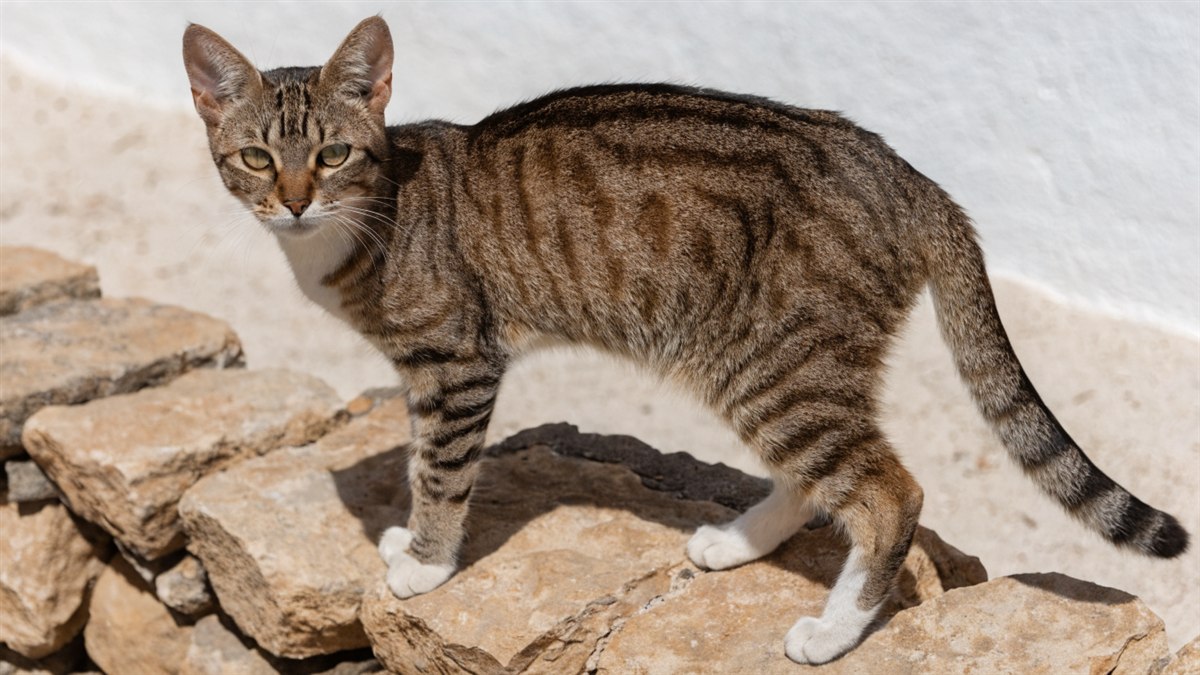
Start with the document, because almost nobody writing about this cat in English has opened it. The World Cat Federation publishes a one-page breed standard for the Arabian Mau under the code ARM, last updated on 6 July 2012. It describes a medium-sized cat with a strong body structure, very muscular and high on the legs, with long legs and oval paws and a medium-long tail tapering to the tip. The head appears round but is slightly longer than broad, with well defined whisker pads, a slightly curved profile and a prominent chin. The ears are large and set slightly to the sides, the eyes are oval, and the eye colour simply corresponds with the coat colour rather than being fixed.
The single most useful line in that standard is the one about the coat, and it is the line this whole page returns to. The coat is without undercoat and close lying to the body, and in adult cats the texture should not be too silky but firm to the touch. A silky texture in young cats is allowed. That is not decoration. A single-layered coat with no insulating underlayer is the one physical feature of this cat that plausibly matters in an Indian summer, and it is the one feature you can verify against a primary document rather than against a story.
What the standard does not say, which is most of what you have read
The WCF standard specifies no weight, no height and no measurement of any kind. Read it against what the ranking pages publish and the gap is immediate. CatBreedsList prints 'Male: 9 - 16 pounds, Female: 8 - 14 pounds' in a table headed Breed Information, as though those numbers came from somewhere official. They are not in the standard. Nor is a life expectancy figure, nor a temperament description, nor a health profile. The standard allocates 100 points across Body 25, Tail 10, Head 25, Eyes 10, Coat 25 and Condition 5, and stops.
The colour section is where the standard is most interesting and where the internet is most wrong. WCF defines five colour varieties, namely White, Black, Black and White, Brown tabby in mackerel or spotted pattern, and Grey and White in mackerel or spotted pattern, with 'Any amount of white' permitted throughout. So a plain white cat and a plain black cat both fit the standard, and the tabby pattern can be striped rather than spotted. CatBreedsList nonetheless calls the Arabian Mau 'the only naturally spotted breed of the domestic feline';. That claim fails twice over. It fails against the Arabian Mau standard, which permits mackerel and permits solids, and it fails against the WCF Egyptian Mau standard on the same website, which defines a pattern that is 'highly contrasted, clearly spotted';.
How a street cat became a breed, in eight documented steps
The recognition story is unusually well recorded, because a newspaper covered it while it was happening. The National reported on 27 October 2008 that Petra Mueller, head of the Middle East Cat Society, had studied the cats of Saudi Arabia, Kuwait, the UAE, Bahrain and Qatar, coined the name Arabian Mau, and first alerted WCF to the population in 2005. She was then asked to conduct a two-year study of four generations covering their history, character, originality and breeding habits, and her proposal went to the WCF board in August 2008. Wikipedia records the approval as having come at the WCF Annual General Meeting of 2 to 3 August 2008 in Germany, with show eligibility from 1 January 2009.
WCF's president at the time, Anneliese Hackmann, was quoted directly, and her words are worth reading closely. 'It is a very big thing when we recognise a new breed,' she said. 'The last time this happened was more than 10 years ago when we formally accepted the Brazilian shorthair, which is also a special cat that lives in a particular part of the world'. She then added the sentence that every Indian breed page has since paraphrased without attribution. 'The climate in the Middle East is very hot so the cat has evolved to adapt to its natural surroundings';. That is a registry president speaking to a reporter in 2008. It is not a measurement, and the climate section below treats it as what it is.
| When | What happened | Source |
|---|---|---|
| Before 2005 | Free-ranging cats across Saudi Arabia, Kuwait, the UAE, Bahrain, Qatar and Oman, present on the peninsula for more than a thousand years | The National, Wikipedia Wikipedia, Arabian Mau |
| 2005 | Petra Mueller of the Middle East Cat Society alerts WCF to the population and coins the name | The National |
| 2005 to 2008 | Two-year study of four generations, covering history, character, originality and breeding habits | The National |
| 2 to 3 August 2008 | WCF Annual General Meeting in Germany approves the breed | Wikipedia |
| 14 to 15 November 2008 | Formal announcement at the International Cat Show in Dubai, with a provisional competition licence | The National |
| 1 January 2009 | Eligible for international shows | Wikipedia |
| 6 July 2012 | Current version of the WCF standard, expanded to five colour varieties from the three first recognised | WCF standard, The National Au J. UAE's 'desert cats' recognised… |
| 2026 | Still recognised by WCF alone among the five major registries, and still absent from Indian breed lists | Bonbeno registry audit Heads Up For Tails |
One detail in that timeline is worth pausing on. WCF originally recognised three variants, described in 2008 as pure white, mackerel tabby and patched black and white. The 2012 standard carries five, adding solid black and a grey and white tabby. A standard that grows to accommodate more of what the population actually looks like is behaving like a description of a landrace, not like a specification for a manufactured breed. That is a compliment to the standard and a warning against reading it as a guarantee of type.
The comparison this site has already made, in feline form
Bonbeno has argued the same case before about a dog. The Indian Pariah Dog is a landrace shaped by a place rather than by a breeder, healthier on the available evidence than most imported pedigrees, and systematically undervalued in India precisely because it is free. The Arabian Mau is the closest feline parallel we have covered, with one important difference. Somebody in Dubai did the paperwork. The Greek Aegean cat is the control case in the other direction, a Mediterranean island landrace that no registry recognises at all, with no written standard anywhere in the world.
Line the three up and the pattern is clear. A landrace does not become better or worse when a registry writes it down. It becomes legible. The Arabian Mau has a standard because one person spent three years assembling one, not because the cats of Sharjah are biologically different from the cats of Chennai. Everything this page says about buying, keeping and feeding one follows from that.
Petra Mueller explained the name herself. 'These cats are not only the national cats of the UAE but they can also be found all over the Gulf. I decided to call it the Arabian Mau because "Mau" means cat';. The Egyptian Mau shares the word and nothing else. It is a separate WCF breed with a separate standard, three fixed colours, a fixed gooseberry-green eye colour and a required spotted pattern. Six of the top ten India results for 'arabian mau cat price in india' are actually about the Egyptian Mau, so if a seller shows you a silver spotted cat and calls it an Arabian Mau, the name is doing work the animal is not.
Which registries recognise the Arabian Mau, checked one by one
One major cat registry recognises the Arabian Mau. The World Cat Federation admitted it in August 2008 and publishes the only breed standard that exists for it anywhere in the world Wikipedia, Arabian Mau. TICA, CFA, FIFe and GCCF do not list it at any level, and Bonbeno confirmed that by reading each body's own published breed list rather than by repeating the claim. The second registry every article names has stopped existing.
Recognition is the first thing a buyer should check and the last thing any ranking page verifies. An Arabian Mau entry would sort alphabetically between American Wirehair and Australian Mist in most English-language breed lists, which makes this audit unusually easy to repeat for yourself in about ten minutes.
| Registry | Arabian Mau listed? | What the list actually shows |
|---|---|---|
| WCF (World Cat Federation) | Yes, as ARM | Listed in the shorthair index between Aphrodite's Giant SH and Australian Mist, with a downloadable one-page standard World Cat Federation |
| TICA | No | The A-to-Z runs Abyssinian, American Bobtail, American Bobtail Shorthair, American Curl, American Curl Longhair, American Shorthair, American Wirehair, then Australian Mist. Nothing sits in the gap |
| CFA | No | The recognised-breeds grid places American Wirehair and Balinese adjacent with nothing between them |
| FIFe | No | All four fully recognised categories, both preliminary recognised breeds and both House Cat standards read in full. No Arabian Mau at any level. FIFe does carry the Egyptian Mau as a category 3 breed |
| GCCF | No | Absent from the green, amber and red candidate lists. Appears only in a closing note as a breed GCCF knows of, 'not present in the UK'; |
| Emirates Feline Federation | Cannot be checked | The domain felinefederation.org does not resolve. The last Internet Archive capture is 2 January 2024 and the snapshot Wikipedia cites renders no content |
The registry that every article names and nobody can open
Wikipedia's opening sentence describes the Arabian Mau as recognised 'by a number of prominent cat registries, such as the World Cat Federation (WCF) and the Emirates Feline Federation (EFF)';. Bonbeno tried to open the EFF. The domain felinefederation.org does not resolve in DNS at all, and the Internet Archive's 63 captures stop on 2 January 2024. The specific 18 July 2018 snapshot Wikipedia cites is a Wix page whose body content never rendered into the archive, so all that survives is the page title, 'Emirates Feline Federation - Pedigree Regestry in UAE', with the misspelling intact, and a one-line description calling itself the largest registry of pedigree cats in the Middle East.
That single unverifiable sentence has propagated everywhere. The identical phrasing about WCF and EFF turns up on Animalia, on Scribd, and on multiple Facebook cat pages, all repeating an older Wikipedia revision word for word. None of them links to a working EFF page, because there is not one. So when you read that the Arabian Mau is recognised by multiple registries, the honest count is one that you can verify and one that you cannot.
What GCCF's silence actually says
The Governing Council of the Cat Fancy publishes something unusually useful, a graded register of breeds it does not recognise. Green means not yet applied for but probable acceptance, amber means a physical anomaly needs evidence, and red means known health problems make acceptance unlikely. Ten breeds sit in green, including the Aphrodite, the American Shorthair and the Serengeti. The Arabian Mau is on none of the three lists.
It appears exactly once, in a closing sentence. 'Other recognised breeds known of include Anatoli, Arabian Mau, Brazilian Shorthair, Chinese Li Hau, Kanaani, Tasman, Ural Rex,' followed immediately by 'All of these are minority breeds which are experimental or rare and not present in the UK';. GCCF is not rejecting the cat. It is saying nobody in Britain keeps one. Note three of the same page adds the practical consequence, that cats of breeds without GCCF recognition 'are NOT eligible to be present at GCCF-licensed cat shows, including being shown in exhibition classes or entered as pedigree/non-pedigree pets'.
How WCF decides your cat is one, which is not what you think
A cat is an Arabian Mau because of its paperwork, not because of its appearance. WCF's Breeding and Registration Rules state that cats on the Full Register, the Livre d'Origine, 'should be of a breed, pattern and colour officially listed in the WCF Standard of points and must have at least 3 generations of the same or related breeds', counting the kitten as generation zero, its parents as the first, grandparents as the second and great-grandparents as the third. Everything else goes on the Supplementary Register, described verbatim as being 'used for all other cats (for example outcrossed, novice and unrecognised breeds)';.
Follow that through and the consequence is stark. A street cat picked up in Sharjah that matches the ARM standard in every particular cannot go on the Full Register, because it has no grandparents on paper. Its kittens cannot either, and neither can its grandkittens. Three documented generations of registered breeding is the entry price. The rules add that the breeder must be a member of a WCF club with a registered cattery name, and must be the legal owner of the dam and able to prove it.
WCF's current procedure for recognising a new breed makes the same point from the other end. A pre-recognition show of six to ten cats requires a report on the origin, history, genetics and breeding rules of the breed plus a proposed standard, and the recognition show that follows demands at least 15 cats presented to two judges, where 'The cats presented must have complete pedigrees of 4 generations and at least 7 of these pedigrees must show 3 generations of pure breed'. That is the 2026 procedure and Bonbeno cannot confirm it is the one applied in 2008, so treat it as the shape of the process rather than as the record of this particular decision.
- Check WCF first. It is the only registry with a published Arabian Mau standard, and the PDF is two clicks from the shorthair index.
- Check the register, not just the pedigree. A WCF pedigree can sit on the Supplementary Register (RIEX) rather than the Full Register (LO), and the registration number should carry a code telling you which.
- Discount any TICA, CFA, FIFe or GCCF claim outright. None of those four recognises the breed, so no document from them can name it Fédération Internationale Féline (FIFe) Governing Council of the Cat Fancy (GCCF).
- Treat an EFF certificate as unverifiable. The issuing body has no working website and no reachable standard.
The class your unregistered cat can actually be shown in
An unregistered cat is not homeless in the cat fancy, and this is the cheerful finding in an otherwise sceptical section. WCF publishes a Household Pet Shorthair standard, code HPS, sitting in the same shorthair index as the Arabian Mau itself. It asks for a balanced solid body in excellent condition that 'appears well fed', a head in good proportion with soft contours, vivid expressive eyes and a coat that is short, dense and glossy, and it states that 'All colours are permitted' and that 'Adult cats shall be neutered';.
Read its scale of points and you can see what the class is really judging. Balance 20, Temperament 10, Eyes, coat texture and colour 20, Maintenance 20 and Condition 30. Maintenance and condition carry half the marks between them, which means the household pet class scores how well the cat has been kept rather than how closely it matches an ancestral template. For a cat with no pedigree, which describes every Arabian Mau type animal in India, that is the honest place to compete.
The South Asian landrace nobody has written down
WCF has published a standard for Sri Lanka's street cat and none for India's, which is the single most pointed fact in this audit for an Indian reader. The Ceylon standard, code CEY, describes a small to medium cat with broad shoulders and hips, slender medium-length legs, a short solid tail and a coat that is 'very short, fine and of silky texture', close lying, 'and has little undercoat';. It specifies a ticked back and flanks with clear striping on legs and tail, two rows of spots on the belly, six ticking colours, and it makes white extending beyond the chin and neck a severe fault.
That is what a South Asian landrace looks like once somebody does the work. Sri Lanka has one. The Arabian peninsula has one. India, with the largest free-ranging cat population of the three, has none, and India's largest pet retailer can only call its own national cat the 'Spotted Cat (Indian Billi)' with no standard behind the name. The Arabian Mau's real lesson for India is not that you should import one. It is that somebody could do for the Indian street cat exactly what Petra Mueller did for the Gulf one.
A WCF breed standard is a show-judging document. It tells a judge how to allocate 100 points across body, tail, head, eyes, coat and condition. It is not a health scheme, not a studbook health record, and not a guarantee about lifespan or temperament, and WCF publishes none of those things for this breed. Registry recognition answers the question 'can this cat be shown and registered'. It does not answer 'is this cat healthy', and treating the two as the same thing is the commonest reasoning error on every breed page we audited.
Is the Arabian Mau genuinely different from the street cats it came from?
Nobody has published a genetic study of the Arabian Mau as a breed, so the honest answer is that the distinctness has never been tested. What has been tested is the wider question, and the answer there is unflattering to every regional street-cat breed. The largest survey of free-breeding cats ever run sampled cats in Dubai and in India, and found that worldwide random-bred cats form very nearly one population.
The 2022 Heredity study by Nilson and colleagues genotyped 1,987 random-bred cats, four African wildcats and ten putative wildcat hybrids, from over 40 countries and over 85 sampling sites. UAE cats are in that dataset. The author list includes Rolf K Schuster of the Central Veterinary Research Laboratory in Dubai, and the contributions statement records plainly that 'RKS collected samples in Dubai';. Indian cats are in it too, collected by a separate contributor. So the two populations an Indian reader would want to compare were genotyped side by side, by the same laboratory, with the same markers.
The result is the important part. Verbatim from the paper, 'For the SNP data, a K of 1 explains 99.99% of the variation in the dataset ... suggesting the worldwide random-bred feline populations do not form genetically distinct clusters, even though the cats have been geographically separated';. Population differentiation across the whole world was low, at an STR FST of 0.078 and an SNP FST of 0.088. The discussion describes the global structure as 'nearly a panmictic population with evidence of isolation by distance at the peripheries of their migration';.
The UAE cats were analysed there as a geographic random-bred population, grouped with Bahrain, Iran, Iraq, Kuwait, Oman and Pakistan under the heading Middle East. They were not analysed as a breed, because to the study they were not one. That is not a criticism of the Arabian Mau. It is a precise statement of what the best available evidence covers and what it does not.
The one claim that would settle it, and why it is not evidence
The 2008 newspaper report contains a striking assertion. 'They are also distinctive because they breed only among themselves, and do not mate with other stray cats';. If that were demonstrated it would be the strongest possible argument for the breed's distinctness, because reproductive isolation is what turns a population into a lineage. No source Bonbeno could open supports it. It is not in the WCF standard, not in Wikipedia's article, and not in any published study. It appears once, in a newspaper, unattributed to any method.
It is also hard to square with what the genetics shows. Free-ranging domestic cats are the textbook case of a species that does not maintain reproductive barriers, which is precisely why worldwide random-bred populations resolve to a single genetic cluster. A claim that one peninsula's cats have spontaneously stopped interbreeding with the cats around them is an extraordinary claim, and it currently rests on one sentence in one 2008 article.
What the breed does have going for it genetically
The argument that actually works is a different one, and it favours the cat. Lipinski and colleagues, publishing in the same year the Arabian Mau was recognised, compared over 1,100 cats from 17 random-bred populations against 22 recognised breeds and found average heterozygosity of 0.65 for random-bred cats against 0.51 for purebreds. Their explanation is worth quoting. Random-bred cats 'have the largest within population variance, consistent with their larger population sizes, freedom to migrate, and no artificial selection';. Within-population variance was 86 percent for random-bred cats and 61 percent for purebreds.
So a cat drawn straight out of a large free-breeding population carries more genetic variation than a cat from a closed studbook. That is a real and measurable advantage, and it is the same advantage Bonbeno describes on the Indian Pariah Dog page. The catch is that the advantage belongs to the population, not to the breed label. It attaches to a hardy unselected street cat, and it starts to erode the moment three generations of closed registered breeding are stacked on top of it, which is exactly what the Full Register requires.
| Question | Status | Evidence |
|---|---|---|
| Does a written breed standard exist? | Established | WCF publishes one, updated 6 July 2012 |
| Do UAE street cats differ genetically from other random-bred cats? | Tested and largely negative | K of 1 explains 99.99 percent of worldwide variation across 1,987 cats |
| Has an Arabian Mau ever been genotyped as a breed? | Never tested | No such study found in the research literature Lipinski MJ, Froenicke L, Baysac KC |
| Do these cats breed only among themselves? | Claimed, unevidenced | One sentence in a 2008 newspaper report, no method given |
| Are random-bred cats more genetically diverse than purebreds? | Established | Heterozygosity 0.65 versus 0.51 |
| Is there a documented desert physiological adaptation? | Never tested | No published measurement in this population, see the climate section |
Read that table honestly and the Arabian Mau sits in an unusual position. It has more documentation than the Aegean cat, which has no standard at all, and far less than a Bengal or a Siamese, which have studbooks running back decades. What it does not have, and what no page will tell you it lacks, is a single peer-reviewed measurement of anything. Its entire footprint in the veterinary literature is one behavioural case report about one cat, and that cat 'was rescued as a stray at the age of 6 weeks';.
Wikipedia gets one thing exactly right. It describes the Arabian Mau as 'a landrace and formally recognized breed';. Both halves matter. The landrace is ancient, large, free-breeding and genetically ordinary for its region. The formally recognised breed is a small, documented subset of it, created in 2008, defined by a one-page standard and by three generations of pedigree World Cat Federation. Anybody selling you the ancient half using the paperwork of the recognised half is selling you a story.
Arabian Mau cat price in India, and why no honest number exists
There is no verifiable Arabian Mau cat price in india, because there is no Indian market for the cat. Bonbeno checked the 50-breed list published by India's largest pet retailer, a vet-reviewed 14-breed price table from India's largest online pet pharmacy, and a Justdial category built specifically around the breed name, and found no Indian supply, no Indian transaction and no rupee figure with a method behind it. The one rupee range on the Indian SERP is undercut by its own page.
Start with the single Indian number, because it is the one Google shows. Happy Pet ranks first in India for this query and prints 'Cost of buying ₹ 30,000 - ₹ 80,000' in its data box. Scroll to the section headed Buying or Adopting an Arabian Mau Cat in India and the same page says 'Since Arabian Maus are a natural breed and not commonly bred in India, sourcing one requires patience and caution';. A page that tells you the cat is not bred here has no transactions to average, so the rupee band above it is not a market observation. It is a number in a box.
The same page cannot hold its own lifespan figure steady either. The data box says 12 to 14 years, twice. Four hundred words later the body text says 'The Arabian Mau is a hardy natural breed with a lifespan of 12–16 years';. Neither figure is sourced to anything.
Three Indian price guides that do not list the breed at all
Every Indian breed list Bonbeno opened omits the Arabian Mau, including the ones that go deep into rarities. Heads Up For Tails publishes 50 cat breeds kept in India, annotated one by one with life expectancy, country of origin and climate suitability, and it reaches the Sokoke from Kenya, the Serengeti, the Chausie, the Donskoy, the Peterbald, the Khao Manee, the Nebelung and the Burmilla Longhair. It does not reach the Arabian Mau. It does list the Egyptian Mau at number 19, marked suitable for the Indian climate.
Supertails publishes the most accountable Indian cat price table we found, dated 25 March 2026 and reviewed by a named senior veterinarian with a BVSc and AH. It prices 14 breeds, from Indian Domestic (Desi) at Rs 0 to Rs 2,000 up to Sphynx at Rs 50,000 to Rs 1,50,000. Neither Mau appears. When a pharmacy that sells to Indian cat owners for a living, and pays a vet to review its price guide, does not carry a line for your breed, that absence is a market signal and it is more informative than any range.
| Source | Figure | What it really represents |
|---|---|---|
| Happy Pet (India), data box | Rs 30,000 to Rs 80,000 | A boxed price on a page whose own body text says the breed is not commonly bred in India |
| CatBreedsList (US) | $500 to $800 | A US figure with no stated method, on a page that contradicts itself twice and cites one television episode |
| Pets4Homes (UK), Beautiful Bruno | 150 pounds | An 11-month-old black cat that 'came to my garden at 6 weeks old searching for food' |
| Pets4Homes (UK), stray from Dubai | 300 pounds | A rescued Dubai street cat rehomed in Wales, listed by someone whose friend has since moved to India |
| Pets4Homes (UK), Antar | 200 pounds | Tagged Rescue/Charity, a three-year-old indoor-only cat |
| Pets4Homes (UK), litter of three | 50 pounds each | Three all-black 12-week-old kittens, no pedigree mentioned |
| Heads Up For Tails, Supertails | No entry Hiregange S, reviewed by Ibrahim | The breed does not appear in Indian breed lists or Indian price guides at all |
Look at the four UK listings together, because they make the point better than any argument could. On the UK's largest pet classifieds site, all four cats advertised as Arabian Maus are rescues or strays, priced between 50 and 300 pounds, and not one is described as coming from a breeder or carrying a pedigree. The site's own FAQ list even includes the question 'Is the Arabian Mau a stray cat?';. Meanwhile GCCF states the breed is 'not present in the UK';. Four self-declared Arabian Maus in a country where the breed does not officially exist is a description of how this name travels.
The Justdial listings that promise a cat nobody has
Justdial has generated a local-commerce category for the breed and multiplied it across every Indian town, and the result is worth seeing in full. The page titled 'Popular Pet Shops For Arabian Mau Cat in Satana' carries category identifier nct-12099124, and Satana is a small town in Nashik district, Maharashtra. The businesses it returns are in Nashik, Virar East, Nalasopara East, Ghansoli, Hoshangabad twice over, Vijayapura, Jhansi, Khammam and Bikaner. Not one is in Satana. They span six states. None says it has an Arabian Mau.
The identical category number is reused for Vadodara, Ambala Cantt, Kolkata and Bhubaneshwar. That is not a listing, it is a template. If you searched 'Arabian Mau near me' from a town in Nashik district and rang the top result, you would reach a kennel 150 kilometres away that has never heard of the cat.
What it would actually take to bring one to India
The lawful routes for a cat to enter India are three, and none of them is a purchase. India's Standard Operating Procedure for Import of Pet Cat(s), issued under the Livestock Importation Act, 1898 as amended in 2001, covers Transfer of Residence, re-import under Customs Circular No. 25/2013, and import under a DGFT licence. The import rules for the first route are explicit. Before filing, the applicant must confirm eligibility for Transfer of Residence with 'Proof of two years overseas stay and visa cancellation/relocation proof'.
The mechanics are tight and worth budgeting for. An application goes in a minimum of seven working days before embarkation, the Advance No Objection Certificate is issued within one working day, and airlines will not lift the pet until it is obtained. A duplicate of the NOC must be fixed to the crate during the flight. Cats arriving as accompanied or unaccompanied baggage are quarantined for 15 days, the short-visit exemption applies to two pets only, and no feed or bedding may travel with the animal. Thirty days after arrival a local veterinarian's certificate must be produced before a permanent health certificate is issued. AQCS operates from six stations, at Delhi, Mumbai, Kolkata, Chennai, Bangalore and Hyderabad, and since October 2024 a pet arriving under the baggage rules can also land at Kochi airport, which the Chennai station covers. The full route, which covers cats too, is set out in how to import a dog to India.
Two clauses matter more than the rest. The DGFT licence route uses form ANF-2M and takes about a month to process, so it is not a route anyone completes casually. And AQCS states plainly on its own authorisation form that 'no charges are levied by AQCS for the purpose of NOC issuance with respect to Import and Export of Pets', which means any agent quoting you a government NOC fee is quoting you their own margin.
The figures above are reported from published sources as editorial context, not offered as prices. We link no listings and endorse no seller. If anyone in India quotes you a rupee price for an Arabian Mau kitten, the first question is not how much, it is where the cat came from, because the lawful routes into the country are narrow, documented and closed to casual purchase. If a seller cannot show you a WCF pedigree naming the register the cat sits on, you are being sold a short-haired cat with a story attached.
Monthly cost of keeping an Arabian Mau type cat in India
Budget roughly Rs 2,300 to Rs 9,000 a month to keep a medium short-coated cat in an Indian city, and note that none of that is breed-specific to the Arabian Mau. The two Indian sources that publish a running figure here disagree by a factor of more than two at the top end, and the reason is that one of them is costing a cat nobody in India owns.
Two Indian pages publish a monthly cost for this and they are measuring different things. Happy Pet gives average monthly expenses of Rs 2,800 on a basic lifestyle and Rs 4,200 on a premium one, itemised as food Rs 1,500 to Rs 2,000, veterinary Rs 500 to Rs 700 and grooming Rs 800 to Rs 1,500. Supertails, costing cats in India generally rather than this breed, gives Rs 2,000 to Rs 8,000 in its headline and a line-item table totalling Rs 2,300 to Rs 4,600 on a budget footing, Rs 4,600 to Rs 9,000 mid-range and Rs 9,000 to Rs 21,700 premium.
| Line item | Happy Pet, quoted for the Arabian Mau | Supertails, quoted for cats in India |
|---|---|---|
| Food | Rs 1,500 to Rs 2,000 | Rs 800 to Rs 6,000 depending on tier |
| Veterinary, routine | Rs 500 to Rs 700 | Rs 300 to Rs 2,000, about one visit every two to three months |
| Grooming | Rs 800 to Rs 1,500 | Rs 500 to Rs 4,000, professional |
| Litter and litter box | Not itemised | Rs 300 to Rs 2,500 |
| Flea and tick prevention | Not itemised | Rs 150 to Rs 1,200 |
| Toys and enrichment | Not itemised | Rs 100 to Rs 1,500 |
| Stated monthly total | Rs 2,800 to Rs 4,200 | Rs 2,300 to Rs 21,700 across three tiers |
The gap between those two columns is not a disagreement about this cat. It is a disagreement about how many line items you admit exist. Happy Pet costs three things and Supertails costs eight, which is why one lands at Rs 4,200 and the other at Rs 9,000 for a comparable animal Hiregange S, reviewed by Ibrahim. If you are planning a budget, start from the eight-item version, because litter, parasite control and enrichment are not optional in an Indian flat.
Where a single-coated cat is genuinely cheaper
Grooming is the one line where the breed standard predicts a real saving. A coat with no undercoat sheds less bulk than a double coat and does not mat, so professional grooming becomes optional rather than structural. Compare that with a Persian, which Heads Up For Tails marks as not ideal for the Indian climate and describes as needing daily grooming and pampering. At Supertails' mid-range grooming figure of Rs 1,000 to Rs 2,000 a month, dropping the salon entirely takes Rs 12,000 to Rs 24,000 a year off the bill.
Set against that, three costs go up rather than down for an active hunting-type cat in India. Parasite prevention runs year-round rather than seasonally in most Indian cities, at Rs 150 to Rs 1,200 a month. Enrichment is not decorative for a cat rated high-energy with a 30 to 60 minute daily exercise requirement. And balcony netting is a one-time cost most first-time Indian cat owners skip and then pay for twice.
- Set aside Rs 4,600 to Rs 9,000 a month as a realistic mid-range figure for a medium short-coated Indian house cat.
- Add a one-time sterilisation and vaccination block in the first year, which Supertails costs separately from the monthly running figure.
- Subtract professional grooming, which a single-coated cat with no undercoat does not structurally need.
- Keep year-round parasite prevention in the budget, because Indian flea and tick pressure does not have an off season.
- Reserve an emergency fund, because the 15-day quarantine and testing costs on any imported cat fall entirely on the owner.
One cost nobody publishes deserves naming. If you acquire a cat that somebody has described as an Arabian Mau and you later want it registered or shown, there is no route in India, because no Indian club is a WCF member with a registered cattery name that could enter it. Budget zero for showing, and treat the cat as a pet, which is what every single one of the four UK listings is.
Heat tolerance in Indian conditions, rated from evidence rather than origin
Bonbeno rates the Arabian Mau 4 out of 5 for heat tolerance in India, which is the highest score we have given any cat, and it stops short of 5 for one reason. No published study has ever measured thermoregulation, water turnover or heat tolerance in this population. What can be verified is the coat construction, the actual climate of the cat's home range, and general feline heat physiology, and those three together do support a genuinely high rating. Origin alone does not, and the difference matters.
Every page about this cat leans on one sentence spoken by a registry president to a newspaper in 2008. 'The climate in the Middle East is very hot so the cat has evolved to adapt to its natural surroundings';. That is a plausible statement and it is also the entire evidential base for the desert claim as it circulates in English. There is no measurement behind it. Bonbeno searched the veterinary and biological literature and found no study of desert adaptation, water conservation, renal concentrating ability, panting threshold or skin temperature in Arabian Mau cats. The breed's complete peer-reviewed footprint is one behavioural case report about one animal.
The one heat-relevant fact that is actually documented
The coat is the evidence, and it comes straight from the founding registry. The WCF standard states that 'The coat is without undercoat and close lying to the body' and that in adults the texture should be firm rather than silky. That is a single-layer coat. A double-coated cat carries an insulating woolly underlayer that traps still air against the skin, which is exactly what you want in Oslo and exactly what you do not want in Chennai. Compare the WCF Egyptian Mau standard, which specifies a coat that is 'medium short, dense, supple and close lying';. Dense is doing work in that sentence that the Arabian Mau standard deliberately does not do.
That single feature is worth more than the whole origin story, because it is checkable on the animal in front of you. Part the fur over the shoulder blade of any cat you are offered. If a paler, softer, crimped layer sits underneath the guard hairs, that cat has an undercoat and does not match the standard, whatever the seller calls it.
The correction nobody makes: every domestic cat descends from an arid wildcat
Descent from the African wildcat is not a differentiator for this breed, and treating it as one is the single most repeated error on the topic. Wikipedia describes the Arabian Mau as having 'distant ancestry from the early African wildcat';, and Indian pages read that as a special claim. It is not. The 2022 Heredity study states that the four African wildcats it genotyped, Felis silvestris lybica, 'are considered the progenitor subspecies for the domestic cat';. Every domestic cat on earth, including the desi cat asleep on a Chennai compound wall, descends from the same arid-adapted ancestor.
So the honest version of the argument is narrower and more useful. The Arabian Mau is not more descended from a desert wildcat than your neighbour's Indian Billi. What it plausibly has is a coat that has not been selected away from the ancestral single layer, in contrast to breeds like the Persian or the Norwegian Forest Cat where selection has added bulk. Heads Up For Tails marks both the Persian and the British Shorthair as not ideal for the Indian climate, and it marks the Indian Billi as suitable. That is the correct company for this cat.
Gulf heat is not the dry heat you think it is
The Persian Gulf coastline is the most extreme humid-heat region measured anywhere on earth, which reframes the entire adaptation question. Raymond and colleagues, working from 39 years of quality-assured weather station data, report that 'Of the stations along the Persian Gulf coastline with at least 50% data availability over 1979 to 2017, all have a historical 99.9th percentile of TW (the value exceeded roughly 14 times in 39 years) above 31°C';. Wet-bulb temperature is the measure that matters for any animal cooling itself by evaporation, and a TW of 35 degrees C is described in the same paper as marking the upper physiological limit for humans.
Now put India in the same frame. The paper's list of other stations above 31 degrees C wet-bulb runs 'eastern coastal India, Pakistan and northwestern India, and the shores of the Red Sea, Gulf of California, and southern Gulf of Mexico';. The two stations that have recorded TW above 35 degrees C are described as concentrated in 'South Asia, the coastal Middle East, and coastal southwest North America';. Dubai in August and Chennai in May are in the same tier of humid heat, not different ones.
One genuine difference does exist and it favours caution in India. Western South Asia is called out as 'the main exception to this coastline rule, likely due to the efficient inland transport of humid air by the summer monsoon together with large-scale irrigation';. In the Gulf, extreme humid heat is a coastal phenomenon and the interior stays dry. In India, the monsoon carries that load hundreds of kilometres inland, so Nagpur and Lucknow get a humid-heat exposure that Riyadh and Al Ain do not. The frequency of these extremes has 'more than a doubling of occurrences of the corresponding threshold between 1979 and 2017';.
| Condition | Arabian peninsula | India | Does the origin story transfer? |
|---|---|---|---|
| Extreme dry daytime heat | Yes, interior deserts | Yes, Ahmedabad reached 46.8 degrees C in May 2010 | Yes, this is the closest match |
| Extreme coastal humid heat | Yes, Gulf coast 99.9th percentile TW above 31 degrees C at every station | Yes, eastern coastal India named as a hotspot | Yes, and this surprises most readers |
| Inland monsoon humid heat | No, the interior stays arid | Yes, monsoon carries humid air far inland | No, this is a load the home range does not produce |
| Warm humid nights that block recovery | Coastal only | Widespread, and rising night-time humidity 'impedes relief from high temperatures'; | Partly |
| Sustained monsoon wet | No | Yes, months of it | No, and it drives the skin and ear problems in the grooming section |
| Official heatwave threshold | Not applicable | IMD declares one in the plains at 40 degrees C or above | Context, not a transfer |
The physiology that applies to every cat, including this one
Cats cool themselves badly compared with dogs, and dehydration makes it dramatically worse. Doris and Baker measured evaporative water loss, metabolic rate, core temperature and respiratory rate in nine cats at high ambient temperatures, hydrated and progressively dehydrated. Verbatim, 'At 38 and 35 degrees C, EWL in animals dehydrated for 4 days was reduced to about 50% of hydrated levels', and 'Significant elevations in Tc occurred in dehydrated animals at 43, 40, and 38 degrees C';. Reductions in respiratory rate correlated closely with the reduced evaporation, so a dehydrated cat is not just short of water, it has switched off half its cooling system to conserve what is left.
Translate that into a flat in Pune in April and the instruction is simple. Water access is a heat intervention, not a housekeeping detail. Two or three water stations away from the food bowl, refilled twice daily, do more for a cat at 38 degrees C than any amount of ancestry. This is general feline physiology and Bonbeno is not claiming the Arabian Mau escapes it, because nobody has shown that it does.
City by city, for someone actually deciding
- Delhi, Jaipur, Ahmedabad. Dry pre-monsoon heat is the closest match to the interior of the home range, and a single-coated cat handles it better than most. IMD's plains heatwave threshold of 40 degrees C is crossed routinely here, and Ahmedabad's May 2010 event at 46.8 degrees C produced an estimated 43 percent excess in all-cause mortality. Shade, tiles and water, and no balcony access between 11am and 4pm.
- Mumbai, Chennai, Kochi, Kolkata. Coastal humid heat, in the same wet-bulb tier as the Gulf coast the cat came from. This is survivable rather than comfortable, and it is where a fan matters more than an air conditioner, because moving air restores some evaporative capacity.
- Nagpur, Lucknow, Raipur. Inland monsoon humidity on top of high dry-bulb temperatures, which is the one load the Arabian peninsula does not generate. Do not assume the origin story covers this.
- Bengaluru, Pune, Shillong. Genuinely easy for this cat, and the least interesting case. A heat-tolerant short-coated animal in a mild city needs no special provision.
- Anywhere, in the monsoon. The heat problem becomes a skin problem. See the grooming section.
Happy Pet, ranking first in India for this breed, prints 'Ideal Weather 15º-30ºC' in its data box. That upper bound is ten degrees below the temperature at which IMD declares a heatwave in the Indian plains, and comfortably below a normal August afternoon in the cat's own home range. It is a default value from a template, applied to the most heat-adapted cat in the catalogue. If a data box tells you a Gulf street cat wants a European spring, the data box is not about this animal.
Open-mouth breathing, drooling, staggering, bright red gums, vomiting or collapse in a hot room are veterinary emergencies regardless of breed. Move the cat somewhere cool, wet the ears, paws and belly with room-temperature water rather than ice, offer water without forcing it, and get to your nearby vet immediately. Core temperature rises significantly in dehydrated cats from 38 degrees C ambient upward, and a cat that has stopped drinking has already lost about half its evaporative cooling.
Temperament and household fit, separating what is measured from what is repeated
Expect an active, vocal, territorial, human-bonded cat that is not a lap cat, and hold every part of that description loosely, because none of it comes from a survey. The temperament literature for the Arabian Mau consists of one clinical case report about a single animal and a set of star ratings on aggregator pages that cite a television episode.
Take the aggregator description first, because it is what most readers have seen. CatBreedsList rates the breed 5 stars for adaptability, 5 for affection level, 5 for dog friendliness, 4 for child friendliness, 4 for energy level and 3 for intelligence. It also states 'Lap Cat: No';. Its narrative adds that these cats are territorial, that males guard their territory from other males, that they are good hunters, quick and agile, that they jump high, and that they are not picky about food, which the page attributes to a history of hunting for themselves.
Then read the vocalisation entry twice. The rating table says 'Low Vocalization: It is known to be quiet' while the body text on the same page says 'they do tend to have a high vocal range and their vocalizations can sometimes come across as loud and demanding';. Those cannot both be true. The page's only listed reference is a YouTube episode of Cats 101. Happy Pet's top five traits for the breed are affectionate, playful, friendly, independent and energetic, with no source at all.
The one documented case, and what it is actually good for
A single peer-reviewed case report exists and it is more useful than every star rating combined, precisely because it is specific. A 14-month-old spayed female Arabian Mau in the UAE was presented to a behaviour service before an international relocation. She showed daily episodes of jumping at her owners' hands and legs, scratching and biting, locking on with teeth and claws and kicking with the back feet, with episodes lasting up to 20 minutes and drawing blood. She was also eating wool and fabric. The diagnoses were misplaced play or predatory behaviour, fear-based aggression towards visitors, and pica.
Two details make this case instructive rather than alarming. The cat 'was rescued as a stray at the age of 6 weeks. It was in poor health, with no sign of siblings or mother';. A kitten taken at six weeks with no littermates has missed the window in which cats learn bite inhibition from siblings, which is a far better explanation for misplaced predatory play than anything about the breed. And the behaviour worsened after the international move, then resolved on fluoxetine with significant improvement in all signs after six weeks.
So the single documented Arabian Mau in the literature is a cat that was hand-reared too early and then relocated across borders, and both of those are things an Indian buyer of this cat is statistically likely to be doing. That is a genuinely transferable lesson, and it is the opposite of a breed-temperament claim.
Who this cat suits, and who it does not
| Household | Verdict | How confident, and why |
|---|---|---|
| Working couple, two-bedroom flat, willing to play twice daily | Good fit | Moderate. Rests on a 30 to 60 minute daily exercise requirement that is asserted rather than measured |
| Family wanting a lap cat that sleeps on the sofa | Poor fit | Low. Based on one aggregator's 'Lap Cat: No' entry |
| Home with an existing adult male cat | Introduce slowly | Low. Rests on an unsourced territoriality claim, though it is consistent with free-ranging cat behaviour generally |
| Home with a resident dog | Usually fine | Low. A 5-star dog-friendliness rating with no method behind it |
| First-time owner taking a kitten under eight weeks | Avoid | High. Under Indian law a kitten below eight weeks is un-weaned and may not lawfully be sold, and the one documented case shows what early separation costs |
| Household that cannot mesh a balcony | Avoid | High. A high-jumping hunting-type cat in an Indian high-rise is a fall risk, and this is a design decision not a training one |
Apartment living is the question most Indian buyers actually have, and the answer is yes with conditions. A short-coated affectionate active cat living in a flat needs vertical space more than floor area, so a tall cat tree, a cleared shelf run and a window perch matter more than square footage. Happy Pet lists the ideal space for this breed as Apartment and rates the energy level high, with 30 to 60 minutes of exercise. Those two things are only compatible if somebody in the household actually does the 30 to 60 minutes.
Bonbeno's own read, stated as a judgement rather than a finding, is that temperament is the weakest section on any page about this cat and should be the least load-bearing part of your decision. An unselected landrace varies far more between individuals than a breed selected for temperament over decades. Meet the specific animal, twice, and ignore the star ratings.
Training an Arabian Mau, and the one thing it genuinely resists
Train this cat by redirecting predatory sequences rather than by suppressing them, because the behaviour Indian owners complain about most is misplaced hunting aimed at human hands and ankles. That is the exact problem documented in the only published clinical case involving the breed, and it responded to management plus medication rather than to correction.
Cats are trainable and this one is described as intelligent and curious by every page that describes it at all Happy Pet (India). Take those descriptions as weak evidence and work from the documented case instead, because it is specific enough to act on. The 14-month-old Arabian Mau in the case report showed dilated pupils, staring and fixation, ears turned sideways or backwards, piloerection and tail flicking while lying on her side, then a run and a jump at the owner. That is a complete predatory sequence with a human as the target, and it is readable in advance.
The four-step redirect, built on the documented sequence
- Read the pre-attack posture. Lying on the side, tail flicking, pupils wide and eyes locked on your feet is the last quiet moment before the run.
- Throw a wand toy or a ball past the cat at that moment, so the predatory sequence completes on an object. Never on a hand.
- Finish the sequence properly with a catch and a small food reward, because an interrupted hunt raises arousal rather than lowering it.
- Repeat the whole cycle twice daily at fixed times, so the cat stops having to invent its own opportunities.
Two rules bracket that routine. Never use hands as toys with a kitten of this type, at any age, because the one documented case escalated to an animal that drew blood from hands, arms and legs in episodes lasting up to 20 minutes. And never punish a predatory outburst physically, because the same cat also showed fear-based aggression towards visitors, and fear and predation respond to opposite handling.
What this cat resists
Confinement without stimulation is the thing it will not accept quietly. A high-energy cat rated for 30 to 60 minutes of daily activity, kept in a small flat with no vertical space and no play, will invent work. CatBreedsList describes the breed as a good hunter, quick and agile, that jumps high and patrols territory. An Indian flat gives it nothing to patrol, so it patrols you.
Litter training is usually straightforward and this is where a street-descended cat is genuinely easy. Free-ranging cats bury reliably by instinct, and the pica case in the literature was about wool and fabric, not about litter avoidance. Use a large uncovered tray, unscented clumping litter, one tray per cat plus one, and keep them away from the food.
The Indian variable no overseas guide mentions
Overseas advice assumes a cat that can go outdoors under supervision, and in most Indian cities that assumption fails. Free roaming exposes a cat to traffic, to dog packs, to rabies risk and to unvaccinated community cats, so the realistic Indian setup is indoor with a meshed balcony. That changes training from optional to structural. A cat kept fully indoors needs the full 30 to 60 minutes of directed play delivered by a person, because it cannot self-supply it.
Harness training is worth doing for exactly this reason, and it is easier on a cat socialised from eight weeks than on one taken earlier. Start indoors with the harness on for two minutes at feeding time, build to fifteen, then move to a quiet balcony or terrace before ever attempting a street. Expect four to eight weeks of short daily sessions rather than a weekend.
Daily exercise, and what happens in an Indian flat without it
Plan on 30 to 60 minutes of directed play a day, split into two or three sessions, and treat the figure as an asserted requirement rather than a measured one. The one Indian page that publishes an exercise number for this breed gives 30 to 60 minutes and rates the energy level high, and everything else about the cat's described behaviour is consistent with that.
Two sessions beat one long one, and the timing in India is set by heat rather than by preference. Play in the early morning and after sunset in April to June, because a cat run hard at 2pm in Delhi is a cat generating metabolic heat it cannot shed. Doris and Baker found core temperature rising significantly in dehydrated cats at ambient temperatures of 38, 40 and 43 degrees C, and a plains heatwave is declared at 40 degrees C. Move the session, not the cat.
What the play should actually be
Wand toys that move away from the cat work, and toys that move towards it do not, because prey flees. Aim for a sequence the cat can complete, meaning stalk, chase, pounce, catch and a small food reward, then stop. Happy Pet lists interactive feeders, exploring, climbing, play with toys, hiding places and sunbathing as this breed's activities, and the first of those is the most underused in Indian homes. A puzzle feeder converts a two-minute meal into a fifteen-minute activity at no recurring cost.
Vertical space carries more of the load than floor space in an Indian flat, and this is the practical answer to whether apartment living works for an active cat. A cat described as jumping high and patrolling territory needs somewhere to go up. Two shelves, a cat tree and a window perch turn a 600 square foot flat into a usable range. A bare flat of twice the area does not.
- Schedule two sessions of 15 to 20 minutes, morning and evening, before the heat and after it.
- Build height with a cat tree and two cleared shelf runs, because vertical range substitutes for floor area.
- Convert one meal a day to a puzzle feeder, which Happy Pet lists among this breed's activities.
- Mesh the balcony before the cat arrives, not after the first scare.
- Stop play immediately if the cat starts open-mouth breathing, and offer water.
What under-exercise looks like
Under-exercise in this type of cat shows up as aggression aimed at people, not as lethargy. The documented case is the template. Daily episodes, sometimes multiple times a day, of a cat jumping at hands and legs and locking on with teeth and claws, diagnosed as misplaced play or predatory behaviour. Owners read that as a temperament problem and it is usually an unspent-energy problem, and it costs a behaviour consultation to find out.
Weight gain is the second signal and it is the one that actually shortens life. The UK life-table study found that 'Being entire, purebred and with a non-ideal body weight were significantly linked to a decreased lifespan';. Non-ideal body weight is the item on that list that an Indian owner controls entirely, and a bored indoor cat on free-fed dry food is the standard route to it.
Coat care for a single-coated cat in Indian humidity
Brush once a week and spend the saved time on skin checks instead, because a coat with no undercoat is the easiest coat in the cat world to maintain and the Indian monsoon attacks skin rather than fur. The WCF standard defines the coat as being 'without undercoat and close lying to the body', which is the whole grooming brief in one clause.
Coat care here is genuinely minimal and every source agrees for once. Wikipedia notes that Arabian Maus 'have short fur without an undercoat and as such, are not high shedders' and that they keep themselves neatly groomed, with brushing serving to remove dead hairs and add gloss rather than to prevent matting. Happy Pet rates shedding low and recommends a weekly session with a soft bristle brush. CatBreedsList rates grooming 1 star out of 5.
That is one of the few areas where the aggregators and the primary document point the same way, so take the saving. A single-coated cat does not mat, does not need a de-shedding tool, and does not need a salon appointment. At Supertails' mid-range professional grooming figure of Rs 1,000 to Rs 2,000 a month, that is Rs 12,000 to Rs 24,000 a year you do not spend.
Never shave a short-coated cat for the heat
Shaving is the commonest well-meant mistake Indian owners make with short-coated cats in April, and it makes heat management worse rather than better. A close-lying single coat is already the minimum insulation the animal has, and removing it exposes skin to direct solar gain and to sunburn on light-coloured cats. Remember also that the WCF standard permits solid White as one of the five recognised colour varieties, and a white cat on a sunlit Indian balcony is at real risk of solar dermatitis on the ear tips and nose.
The evidence-based intervention for heat is water and airflow, not hair removal. A dehydrated cat loses about half its evaporative cooling at 35 to 38 degrees C ambient, and no haircut compensates for that.
The monsoon changes the job from coat to skin
Overseas breed-club grooming advice is written for dry climates and it does not transfer to an Indian monsoon. A guide that says to towel a wet cat and let it air dry is correct in Bavaria and wrong in Kerala in July, where a damp coat against skin in saturated air stays damp for hours. Indian night-time humidity is high enough that the Heliyon review specifically notes 'Rising night-time humidity impedes relief from high temperatures' as a distinguishing feature of Indian heat. The same trapped moisture that blocks a cat's cooling also creates the conditions for skin problems.
So the monsoon routine is a skin routine rather than a coat routine. Run a flea comb through the coat weekly and look at what comes out. Check between the toes, under the chin, inside the ear flaps and at the base of the tail. Dry the cat properly with a towel and then let it sit somewhere with moving air rather than in still humid air. Happy Pet's own generic health list for this breed includes fleas and ticks and skin allergies, which are the two categories a monsoon check is looking for.
| Step | How often | What you are looking for |
|---|---|---|
| Soft bristle brush, whole body | Weekly | Dead hair and coat gloss, not matting, because a single coat does not mat |
| Flea comb, base of tail and neck | Weekly, twice weekly in monsoon | Flea dirt, which looks like black specks that turn rust red on a damp tissue |
| Ear flaps and canal opening | Weekly | Dark waxy discharge, smell, head shaking. Never poke a cotton bud inside |
| Between the toes and pads | Weekly | Damp interdigital skin, cracks, embedded grit from balcony tiles |
| Chin and lip margins | Weekly | Feline acne, which plastic bowls in humid weather make worse. Switch to steel or ceramic |
| Nail trim | Every three to four weeks | Overgrown tips on an indoor cat with no outdoor abrasion |
| Full skin check under a light | Fortnightly, weekly in monsoon | Round hairless patches, scabs along the spine, redness. Any of these needs a vet, not a shampoo |
One thing to verify at the point of purchase rather than later. Part the fur over the shoulder and look for an undercoat, because a cat sold to you as an Arabian Mau that has a woolly underlayer is not matching the standard the seller is invoking. That single check takes five seconds and tells you more about a seller's honesty than any certificate.
Health and lifespan, and the three things that do not exist for this breed
No lifespan study, no health survey and no screening scheme exists for the Arabian Mau, and Bonbeno will say that three times rather than borrow a figure once. The lifespan numbers circulating online, 12 to 14 years and 12 to 16 years, are unsourced and appear on the same page contradicting each other. What follows is what the general feline evidence supports, clearly labelled as such.
Three absences define this section and each one is a finding rather than a gap. There is no breed health survey, because the breed has no parent club publishing one and no registry collecting one, WCF's role being to publish a show standard rather than health data. There is no breed-specific lifespan study, because the Arabian Mau does not appear among the 12 breeds analysed in the largest cat life-table study published. And there is no genetic screening panel marketed for it, because no disease-causing variant has been identified in the population.
We will not transfer the hypertrophic cardiomyopathy mutations identified in Maine Coons and Ragdolls onto this breed. Those are specific named variants found in specific closed populations, and there is no evidence any of them segregates in Arabian peninsula cats. We will not borrow the lifespan of the Egyptian Mau, which Heads Up For Tails gives as 13 to 16 years, because a shared syllable in a name is not a shared genome. And we will not repeat the claim that the breed is 'Generally Healthy' with 1 star for health issues, because a page that cannot keep its own hypoallergenicity claim straight has not measured anything.
The defensible lifespan proxy, and what it is a proxy for
Use the crossbred figure from UK veterinary life tables as the honest anchor, and label it as a proxy. Teng and colleagues built life tables from 7,936 confirmed deaths among cats under primary veterinary care, drawn from an available population of 1,254,484 cats, covering deaths between 1 January 2019 and 31 March 2021. Life expectancy at age 0 for UK companion cats overall was 11.74 years, with a 95 percent confidence interval of 11.61 to 11.87.
The breakdown is the part that matters for a landrace. Verbatim, 'The life expectancy of crossbred cats at age 0 was 11.89 years (95% CI 11.76-12.03), more than 1.5 years longer than purebred cats (10.41 years; 95% CI 9.99-10.83)';. Read off the life tables directly, the probability of dying in the first year was 0.034 for crossbred cats, from 238 deaths among 6,998, and 0.071 for purebred cats, from 58 among 819. Purebred kittens died in their first year at roughly twice the crossbred rate.
That comparison supports the instinct behind the natural-cat argument without validating any specific claim about this breed. A cat drawn from a large free-breeding population, with the heterozygosity that comes with it, starts from a better position than one from a closed studbook. It does not follow that any individual cat is healthy, and it certainly does not follow that a cat somebody in India has labelled an Arabian Mau carries that advantage.
| Figure | Source | Weight |
|---|---|---|
| 11.89 years, crossbred cats at age 0 | UK VetCompass life tables, 7,936 deaths | Highest available. Not an Arabian Mau figure, and it is UK data applied to India |
| 11.74 years, all UK companion cats at age 0 | Same study | High, same caveats |
| 12 to 14 years | Happy Pet data box and CatBreedsList table CatBreedsList, Arabian Mau: Price | Low. Unsourced, and one of the two pages contradicts itself |
| 12 to 16 years | Happy Pet body text | Low. Contradicts the same page's own data box |
| Any Arabian Mau specific study | None found | Does not exist |
What to actually screen for, in India
Screen for what is common in Indian cats rather than for a breed profile that does not exist. The realistic risk list for a cat descended from free-ranging stock, kept in an Indian city, is dominated by infectious and parasitic disease and by the consequences of an outdoor start, not by inherited conditions.
- Vaccinate on the core schedule. Happy Pet's own table gives feline distemper, calicivirus and herpesvirus at 6 to 8 weeks, boosters at 12 and 16 weeks, and rabies at 12 to 16 weeks. Confirm the exact protocol with your nearby vet, because Indian practice varies by city and by product availability.
- Test any cat with an outdoor history for FIV and FeLV before it meets a resident cat. Neither is a breed issue, both are street-exposure issues.
- Treat for internal and external parasites on a year-round schedule, budgeted at Rs 150 to Rs 1,200 a month.
- Weigh the cat monthly and record it, because non-ideal body weight is one of only three factors the UK life tables found significantly linked to a shortened lifespan.
- Neuter, because the same study found being entire significantly linked to a decreased lifespan.
- Watch for the generic issues Indian breed pages list without evidence, namely urinary tract problems, dental disease, hairballs, skin allergies, obesity and gastrointestinal upset, and treat each as a symptom to investigate rather than a breed trait to accept.
The one clinical finding on record, and it is behavioural
The only Arabian Mau in the veterinary literature was presented for behaviour, not for disease. Human-directed aggression and pica involving wool and fabric, in a cat rescued as a stray at six weeks, worsening after an international relocation and resolving on fluoxetine after six weeks. Pica in cats warrants a workup rather than a shrug, because it can indicate anaemia, gastrointestinal disease or dietary deficiency before anyone reaches a behavioural diagnosis.
If your cat eats fabric, book an appointment rather than hiding the laundry. That is one documented case and not a breed pattern, and Bonbeno is presenting it as a single case precisely because that is all it is.
This section is general information for Indian cat owners and it is not a diagnosis. No breed-specific veterinary evidence exists for the Arabian Mau, so everything here is drawn from feline population data and labelled as such. Always consult a registered veterinarian near you before acting on anything you read here, and treat heat stress, laboured breathing, straining in the litter tray, or any sudden change in appetite, drinking or litter habits as a same-day veterinary emergency.
Feeding, hydration and body condition in Indian conditions
Feed a measured, protein-led diet in two or three meals and make water access the priority, because hydration is the single dietary variable with a documented link to heat performance in cats. A cat dehydrated for four days lost about half its evaporative cooling capacity at 35 and 38 degrees C ambient, which makes the water bowl a thermoregulatory device in an Indian summer.
Start with quantity, and treat the only published figure with appropriate caution. Happy Pet gives 200 kcal a day for kittens and 300 kcal a day for adults of this breed, with a macronutrient split of 45 percent protein, 30 percent fats and 10 percent carbohydrates. Those numbers are unsourced and no weight range accompanies them, and the WCF standard specifies no weight at all, so there is no defensible way to convert them into a per-kilogram figure. Use them as an order of magnitude and set the actual amount from body condition, weighed monthly.
Wet food is a hydration decision in India, not a luxury
Cats evolved from an arid-zone ancestor with a weak thirst drive, which is precisely why they under-drink when fed only dry food. Every domestic cat descends from Felis silvestris lybica, and this is the one place where that ancestry has a genuine practical consequence, though again it applies to every cat and not specially to this one. In a climate where IMD declares a plains heatwave at 40 degrees C and dehydration halves evaporative cooling, a wet component in the diet is functional.
Supertails costs cat food at Rs 800 to Rs 1,500 a month on a budget footing and Rs 1,500 to Rs 3,000 mid-range, with a separate higher band for kittens under one year at Rs 1,000 to Rs 3,500. Happy Pet's breed-specific food figure of Rs 1,500 to Rs 2,000 sits inside that range. A part-wet diet lands at the upper end of the budget tier and is worth the difference.
- Serve two or three measured meals rather than free-feeding, because a bored indoor cat grazes and gains.
- Offer water in two or three locations away from the food bowl, refilled twice daily in summer.
- Include a wet component daily, which raises total water intake more reliably than any fountain.
- Convert one meal to a puzzle feeder, which Happy Pet lists among this breed's activities.
- Weigh monthly, because non-ideal body weight is a documented lifespan risk factor.
- Avoid onions, garlic, chocolate, caffeine, alcohol, grapes, raisins, xylitol, cooked bones and raw eggs, all of which Happy Pet lists as unsafe.
The 'not picky about food' claim, and why it is a warning
CatBreedsList states that these cats 'were adapted to a desert life style and had to hunt for food themselves; possibly because of this they are not picky about food and they seem to love eating';. Read as a compliment, that sentence is a convenience. Read correctly, it is a warning about obesity in a cat that will eat whatever is in front of it, in a home where it burns a fraction of the calories a street cat burns.
The lifespan evidence backs the warning. Non-ideal body weight was one of only three factors significantly linked to a decreased lifespan in the UK life tables, alongside being entire and being purebred. Of those three, weight is the one entirely under your control. An independent hunting-type cat with a good appetite and 30 to 60 minutes of daily activity in an Indian flat is a straightforward candidate for creeping weight gain.
One Indian practicality worth naming. Milk and rice, still the default offering for cats in many Indian households, is not cat food. Adult cats are commonly lactose intolerant, and a carbohydrate-led diet undermines the 45 percent protein target the same Indian page publishes. If you have taken in a community cat that has been eating household scraps, transition over seven to ten days rather than overnight.
Kitten timeline, month by month through the first year
Take a kitten at eight weeks at the earliest, because Indian law defines a kitten below eight weeks as un-weaned and bars its sale, and because the only Arabian Mau in the veterinary literature was taken at six and developed exactly the problems early separation predicts. The Prevention of Cruelty to Animals (Pet Shop) Rules, 2018 define an un-weaned animal to include 'kittens and pups below eight weeks', and rule 7(15) states 'No pet shop shall sell un-weaned or underage animals or birds';.
That legal floor is the single most actionable fact in this section, so start there. It is not guidance, it is a gazette notification of 6 September 2018, and it applies to cats because rule 2(1)(j) includes the cat in the definition of a pet animal. It also applies to online sellers, because rule 2(1)(k) defines a pet shop to include 'online platforms over which the sale and purchase of pet animals is carried out wherever the context permits';.
| Age | What is happening | What you do |
|---|---|---|
| 0 to 8 weeks | With the mother and littermates. Bite inhibition and social behaviour are learned here | Do not take the kitten. Under Indian law it is un-weaned and may not lawfully be sold |
| 6 to 8 weeks | First core vaccines fall due | Feline distemper, calicivirus and herpesvirus, per the schedule Happy Pet publishes and your vet confirms |
| 8 to 10 weeks | Earliest lawful homing. Settling and litter training | One quiet room, one large uncovered tray, no hands as toys, ever |
| 10 to 12 weeks | Socialisation window still open | Introduce carrier, harness, nail clippers and visitors in short positive sessions |
| 12 weeks | First booster | Distemper, calicivirus, herpesvirus booster |
| 12 to 16 weeks | Rabies vaccination window | Rabies, which matters more in India than in most countries the overseas guides are written for |
| 16 weeks | Second booster, and the predatory play problem starts | Establish the twice-daily wand-toy routine now rather than at eight months |
| 4 to 6 months | Rapid growth, first full Indian summer for a spring kitten | Two or three water stations, shade, no midday play |
| 5 to 8 months | Sexual maturity approaches | Discuss neutering timing with your nearby vet. Being entire is linked to a shortened lifespan |
| 6 to 9 months | First monsoon for most Indian kittens | Switch the weekly brush to a weekly skin and ear check |
| 9 to 12 months | Adult coat texture settles. A silky kitten coat is permitted by the standard and should firm up | Part the fur and confirm there is still no undercoat |
| 12 months | Switch from kitten to adult food | Weigh, record, and set the adult ration from body condition rather than from a packet |
The six-week kitten problem, documented
Early separation is not a theoretical risk in this breed, it is the one thing the published record actually shows. The Arabian Mau in the case report 'was rescued as a stray at the age of 6 weeks. It was in poor health, with no sign of siblings or mother';. By 14 months she was showing daily human-directed aggression and pica, and the aggression was diagnosed as misplaced play or predatory behaviour.
That is one cat and Bonbeno is not generalising it into a breed trait. It is generalisable as a rearing lesson, because a kitten with no littermates has nobody to teach it that teeth hurt. If you are rescuing an underage kitten in India, which is a common and admirable thing to do, plan the bite-inhibition work deliberately from the start rather than discovering the gap at a year old.
If you are buying rather than adopting, rule 8(5) of the Pet Shop Rules gives you a right most Indian buyers do not know they have. The shop's Form V record of breeders and suppliers 'shall be available at the pet shop for inspection by the State Board or any intending purchaser';. You are an intending purchaser. Ask to see it. Rule 7(25) adds that no pet shop may sell an animal acquired from a breeder unless that breeder is registered, and rule 7(12) requires species, numbers and prices to be prominently displayed. A shop that refuses all three has told you what you need to know.
Arabian Mau against the cats Indian buyers actually cross-shop
Compare the Arabian Mau against the Egyptian Mau and the Indian Billi rather than against a pedigree breed, because those are the two animals an Indian buyer will genuinely be offered instead. Six of the top ten India results for this breed's price query are about the Egyptian Mau, and the Indian Billi is the cat that is actually available, actually suited to the climate and actually free.
The Egyptian Mau confusion is not incidental, it is the shape of the whole SERP. Position 2 is a Quora thread about getting an Egyptian Mau in India, position 4 is an Egyptian Mau price guide, position 5 is a Justdial category for Egyptian Mau pet shops in Delhi, position 7 is a paperback book about the Egyptian Mau on Amazon India, position 10 is a US cattery's Egyptian Mau pricing page and position 12 is another Egyptian Mau cost guide. If a seller in India tells you they have a Mau, establish which one before anything else.
| Arabian Mau | Egyptian Mau | Indian Billi (spotted desi cat) | Aegean | |
|---|---|---|---|---|
| Registry recognition | WCF only, since 2008 Wikipedia, Arabian Mau | WCF, FIFe, TICA and CFA Fédération Internationale Féline (FIFe) The International Cat Association (TICA) | None, and none sought | None at all |
| Written breed standard | One page, WCF, updated 2012 | One page, WCF, plus FIFe and TICA versions Fédération Internationale Féline (FIFe) | None | None published anywhere |
| Coat | No undercoat, close lying, firm to touch | Medium short, dense, close lying | Short, single, variable | Described four incompatible ways by one source |
| Pattern rules | Mackerel or spotted tabby, plus solid white and solid black, any amount of white | Spotted only, three colours only, bronze, silver, black smoke | Anything | Bicolour or tricolour |
| Eye colour | Corresponds with coat colour, not fixed | Light gooseberry-green, fixed | Anything | Green, blue or yellow |
| Available in India | No Indian listing verified Hiregange S, reviewed by Ibrahim | Listed by Indian retailers as suitable for the climate | Everywhere, free | No Indian market |
| Indian price | No verifiable figure | Not in the main Indian price tables either | Rs 0 to Rs 2,000 | No verifiable figure |
| Published lifespan for the breed | None | 13 to 16 years per Indian retailer, unsourced | 10 to 18 years per Indian retailer, unsourced | None |
| Climate suitability, Indian retailer view | Not assessed, breed absent from the list | Suitable | Suitable | Not assessed, breed absent |
The comparison that actually decides it
Set the Arabian Mau against the Indian Billi and the case for importing collapses. Heads Up For Tails puts the Spotted Cat, the Indian Billi, at number one on its list of the 50 cat breeds kept in India, gives a life expectancy of 10 to 18 years, marks it suitable for the Indian climate, and describes it as having 'over years of living as community street cats, evolved to be independent, active and inquisitive'. Read that sentence next to the Arabian Mau's own description and they are the same animal, separated by a peninsula and a registry decision.
The price difference makes the point sharper. Supertails puts the Indian Domestic cat at Rs 0 to Rs 2,000. The Arabian Mau has no verifiable Indian price, and the only lawful route to acquire one is a Transfer of Residence import requiring two years of documented residence abroad. You would be spending a relocation to acquire a rare version of a cat sleeping on your building's stairwell.
Where the Arabian Mau does win
One genuine advantage exists and it is documentary rather than biological. The Arabian Mau has a written standard, and the Indian Billi does not. If you want an active short-coated heat-adapted cat and you also want a document describing what it should look like, WCF publishes one and nobody publishes one for the Indian street cat. That is worth something to a show exhibitor and close to nothing to a pet owner in Pune.
The second advantage is comparative rather than absolute. Against a Persian or a British Shorthair, both marked not ideal for the Indian climate by India's largest pet retailer, a single-coated unexaggerated cat is straightforwardly the better choice for an Indian home. That argument holds. It just holds equally for the desi cat, and it holds for the Egyptian Mau and the Abyssinian too.
Read against the Aegean cat, which Bonbeno covered on the same evidentiary basis, the Arabian Mau comes out ahead on exactly one axis. It has a registry and a standard. It matches the Aegean on everything else, meaning no health survey, no lifespan study, no Indian supply and no defensible Indian price.
Six mistakes Indian owners make with this cat
The commonest Indian mistake with an Arabian Mau is paying a pedigree price for an unverifiable label, and the second is assuming a desert origin makes the cat immune to Indian heat. Both come from the same root, which is treating a registry name as a guarantee about an animal. Here are the six in the order they cost money.
1. Paying a rupee price for a breed with no Indian supply chain
Nobody in India can show you a Full Register WCF pedigree for an Arabian Mau, because the Full Register requires three documented generations bred by a WCF club member with a registered cattery name, and no such cattery exists here. Yet the top India result prints Rs 30,000 to Rs 80,000 as a cost of buying. If a seller quotes that band, ask which register the parents sit on. The unrecognised answer, or no answer, is the answer.
2. Buying a cat that is actually an Egyptian Mau, or neither
The two breeds share a syllable and nothing else, and the Indian SERP conflates them relentlessly. The distinguishing checks are simple and take a minute. An Egyptian Mau must be spotted, must be bronze, silver or black smoke, and must have light gooseberry-green eyes. An Arabian Mau may be mackerel striped, may be solid white or solid black, and its eye colour merely corresponds with its coat. A silver spotted green-eyed cat sold as an Arabian Mau is either mislabelled or is neither.
3. Believing the desert origin makes the cat heat-proof
Desert adaptation in this population has never been measured, and the phrase does most of its work as marketing. What is documented is that any cat dehydrated for four days loses about half its evaporative cooling at 35 to 38 degrees C, and that its core temperature rises significantly from 38 degrees C ambient upward. Ancestry does not suspend that. Water, shade and airflow do the work.
4. Shaving the cat in April
A single-coated cat has the minimum insulation it is going to have, and shaving it removes protection against solar gain without adding cooling. On a solid white cat, which the standard explicitly permits, it also exposes thin ear and nose skin to Indian sun. This is a common Indian summer instinct and it is the wrong one.
5. Taking a kitten at six weeks
Indian law defines a kitten below eight weeks as un-weaned and bars a pet shop from selling one. The only Arabian Mau in the veterinary literature was taken as a stray at exactly six weeks with no siblings or mother, and by 14 months was drawing blood from her owners in daily 20-minute predatory episodes. One case is not proof, but the mechanism is well understood and the law already agrees with it.
6. Ringing the Justdial listing
Justdial's Arabian Mau category is auto-generated for every Indian town from one template, category number nct-12099124, and the businesses it returns for a Nashik-district town are in Nashik, Palghar, Navi Mumbai, Hoshangabad, Vijayapura, Jhansi, Khammam and Bikaner. Not one is local and not one states that it has the cat. A shop that answers yes to 'do you have an Arabian Mau' after that call has just agreed to find you something.
| Mistake | Likely cost | Fix |
|---|---|---|
| Paying a pedigree price for an unverifiable label | Rs 30,000 to Rs 80,000 | Ask which WCF register the parents are on |
| Buying the wrong Mau | The whole purchase | Check pattern, colour and eye colour against both standards World Cat Federation |
| Trusting the origin story in a heatwave | An emergency vet visit | Two or three water stations, shade, no midday play |
| Shaving for summer | Sunburn and no cooling benefit | Leave the coat, move the air |
| Taking an underage kitten | A behaviour consultation and possibly medication | Eight weeks minimum, which is also the legal floor |
| Chasing directory listings | Time, and exposure to an unregistered seller | Ask to see the Form V supplier record, which you have a right to inspect |
One mistake sits underneath all six. Indian buyers treat an unfamiliar foreign breed name as evidence of quality, and sellers know it. The Arabian Mau is a good cat and a real breed with a real standard. It is also, biologically, the street cat of a hot country, and there is a street cat of a hot country available for nothing in every Indian city.
Adoption, responsible sourcing and what to verify in India
Adopt an Indian community cat instead, and understand that you are getting the same animal the Arabian Mau standard describes, from a population that has never left. If you are set on the breed specifically, the only lawful route into India is a Transfer of Residence import requiring two years of documented residence abroad, and every UK listing for the breed is itself a rescue Pets4Homes, Arabian Mau Kittens for sale….
Start with the strongest evidence for adoption, which is what the breed's own market looks like. On the UK's largest pet classifieds site, all four cats listed as Arabian Maus are strays or rescues. One 'came to my garden at 6 weeks old searching for food';. One is a Dubai street cat rescued and rehomed to Wales, listed by someone whose friend has since moved to India. One carries a Rescue/Charity tag. The site even publishes the FAQ 'Is the Arabian Mau a stray cat?';.
The one Arabian Mau in the veterinary literature was also a rescue, 'rescued as a stray at the age of 6 weeks' by an owner in the UAE. So the documented population of this breed outside the Gulf consists almost entirely of rescued street cats. Adoption is not the ethical alternative to acquiring an Arabian Mau. Adoption is how essentially everyone who has one got one.
Why the Indian community cat is the right answer
A community cat in an Indian city is a member of a free-breeding population that the largest genetic survey of cats treats as belonging to the same worldwide cluster as the cats of Dubai. Indian samples and Dubai samples were in the same dataset, analysed with the same markers, and the study found that a K of 1 explains 99.99 percent of the variation. Whatever the Arabian Mau is, the Indian street cat is not a lesser version of it.
The health argument runs the same way. Crossbred cats outlived purebred cats by more than 1.5 years in UK life tables, and purebred kittens died in their first year at roughly twice the crossbred rate. Random-bred cats carry measurably higher heterozygosity, 0.65 against 0.51. And India's largest pet retailer rates the Indian Billi as suitable for the Indian climate with a life expectancy of 10 to 18 years, which is the widest range on its whole 50-breed list.
How to adopt well in India
- Contact a local animal welfare organisation or SPCA rather than a shop. Shelters run by or on behalf of a local authority, and welfare organisations registered with the Board, are exempt from pet shop registration precisely because they are not selling.
- Ask for the cat's vaccination and deworming record, and for a written note of when it was sterilised.
- Test for FIV and FeLV before introducing the cat to a resident cat, because an outdoor history is an exposure history.
- Take the cat at eight weeks or older, which is both the welfare answer and the legal floor for a sale.
- Budget Rs 4,600 to Rs 9,000 a month before you commit, using the eight-item Indian cost table rather than a three-item one.
- Mesh the balcony before the cat comes home.
If you are buying anyway, verify these six things
Indian law gives a buyer more leverage than most buyers use, and none of it costs anything. The checks below all come from the Prevention of Cruelty to Animals (Pet Shop) Rules, 2018, which apply to physical shops and to online platforms alike.
- Certificate of registration in Form II, displayed prominently. Trading in pet animals without one is prohibited, and an unregistered shop can be sealed and its animals confiscated.
- The Form V supplier record. Rule 8(5) makes it inspectable by 'any intending purchaser', and rule 7(25) bars a shop from selling an animal from an unregistered breeder.
- A written veterinary fitness certificate. Only animals 'certified in writing by a veterinary practitioner' as healthy may be offered for sale, and a vet must check every animal monthly.
- Displayed species, numbers and prices, and a Form IV receipt. Both are required, and a shop that will not issue a receipt is not complying.
- Age. Below eight weeks a kitten is un-weaned and cannot lawfully be sold.
- The WCF paperwork, if the breed name is being charged for. A pedigree should name the register, and only the Full Register requires three generations of the same or related breeds.
One thing the rules do not require is worth knowing about. Rule 7(16) mandates micro-chipping for every puppy sold and a functional chip reader on the premises, and it says nothing at all about kittens. So there is no legal identity chain for a cat sold in India, which is precisely why the supplier record and the receipt matter more than they would for a dog.
Bonbeno's view, stated plainly, is that an Indian household wanting a hardy short-coated heat-tolerant active cat should adopt a local community cat and stop looking. You get the same coat construction, the same unexaggerated build, the same genetic diversity advantage, a life expectancy Indian retailers put at 10 to 18 years, and a cat that has already survived the exact climate it will live in. What you give up is a one-page show document from a German registry. That is the entire trade.
Arabian Mau questions Indian buyers actually ask
What is the Arabian Mau cat price in India?
No verifiable Arabian Mau cat price in India exists, because there is no Indian supply. The one rupee band on the Indian SERP, Rs 30,000 to Rs 80,000, sits on a page whose own text says the breed is not commonly bred in India, and neither of the two main Indian cat price guides lists the breed at all.
How can I tell if my cat is an Arabian Mau?
Check the coat against the only written standard that exists. The World Cat Federation specifies a coat without undercoat, close lying to the body and firm rather than silky in adults, on a muscular medium cat high on the legs with large ears and oval eyes whose colour corresponds with the coat. Part the fur over the shoulder. If there is a soft woolly underlayer, the cat does not match.
Are Arabian Mau cats rare?
Rare outside the Arabian peninsula and ordinary inside it. Free-ranging cats of this type number in the tens of thousands across the Gulf, and experts told a UAE newspaper that a good percentage of street cats foraging in UAE cities are Maus. Only one of five major registries recognises the breed, and GCCF records it as not present in the UK at all.
Is the Arabian Mau a stray cat?
Essentially yes, in origin and often in practice. The breed was formalised in 2008 from the free-ranging cats of the Gulf, all four Arabian Maus listed on the UK's largest classifieds site are strays or rescues, and the only Arabian Mau in the veterinary literature was rescued as a stray at six weeks old.
Are Arabian Mau cats friendly?
Probably, on weak evidence. Aggregator pages rate the breed five stars for affection and four for child friendliness, but none of them surveyed anything and the only clinical case on record involved human-directed aggression in a hand-reared cat. Temperament in an unselected landrace varies far more between individuals than in a breed selected for it, so meet the animal rather than trusting the rating.
Are Arabian Maus prone to any specific health issues?
No breed-specific health data exists, so nobody can answer this honestly with a list. There is no health survey, no lifespan study and no screening panel for the Arabian Mau. The closest defensible figure is the UK life table for crossbred cats, 11.89 years at birth, and that is a proxy rather than a breed number. Consult your nearby vet about the risks that matter locally.
Are Arabian Maus good with children and other pets?
Aggregator pages say yes, rating the breed four stars with children over six and five stars with dogs, but neither rating rests on a survey. The one documented case showed fear-based aggression towards visitors in a cat separated from its mother at six weeks, which is an argument for taking a kitten at eight weeks or later rather than an argument about the breed.
How do I choose a reputable breeder for an Arabian Mau?
You cannot, in India, because no Indian cattery can produce one. A World Cat Federation Full Register pedigree requires three documented generations bred by a club member with a registered cattery name, and no such cattery exists here. Anyone offering an Arabian Mau kitten in India should be asked which register the parents sit on, and the honest answer is usually silence.
Is the Arabian Mau suitable for the Indian climate?
Yes, better than most cats, and Bonbeno rates heat tolerance 4 out of 5. The breed standard specifies a coat with no undercoat, and the cat's home range on the Gulf coast is the world's most extreme humid-heat region, in the same wet-bulb tier as eastern coastal India. It stops short of 5 because no study has ever measured heat tolerance in this population.
Can I import an Arabian Mau into India?
Only through one of three narrow routes, and none of them is a purchase. India's cat import procedure allows Transfer of Residence with proof of two years overseas stay, re-import of a cat previously exported from India, or import under a DGFT licence that takes about a month to process. Cats arriving as baggage are quarantined for 15 days at the owner's cost.
What is the difference between an Arabian Mau and an Egyptian Mau?
They share a syllable and nothing else. The Egyptian Mau must be clearly spotted, comes in bronze, silver or black smoke only, and has fixed light gooseberry-green eyes. The Arabian Mau may be mackerel striped, may be solid white or solid black, and its eye colour merely corresponds with its coat. The Egyptian Mau is recognised by four registries, the Arabian Mau by one.
How long do Arabian Mau cats live?
Nobody knows, and the figures online are unsourced. The same Indian page prints 12 to 14 years in its data box and 12 to 16 years in its body text. No lifespan study covers this breed. The best available proxy is the UK crossbred figure of 11.89 years at birth, from 7,936 confirmed deaths, and it is not an Arabian Mau number.
Should I adopt an Indian street cat instead?
Yes, on the evidence. The Indian Billi has the same single coat, the same unexaggerated build, the genetic diversity advantage of a free-breeding population, a life expectancy Indian retailers put at 10 to 18 years, and it is available for between nothing and Rs 2,000. What you give up is a one-page show document published in Germany.
Compare with similar breeds
Arabian Mau sits in 1 Bonbeno group. Each one compares it directly against the breeds it is genuinely an alternative to, on the same figures.