
Breed profile
Egyptian Mau: Price in India, Care and Health
A naturally spotted breed with three founders, an Indian bloodline, and one health risk that changes how you keep it here.
Quick answer
The Egyptian Mau price in India is advertised at roughly Rs 40,000 to Rs 80,000, but that band comes from a single template page and no verified Indian cattery publishes a rate. Budget Rs 2,500 to Rs 5,000 a month once the kitten course is done. The breed's defining risk here is urate bladder stones, where one series put it at an odds ratio of 118, so water intake matters more than coat care.
This guide is general information for Indian cat owners and is not a diagnosis. The Egyptian Mau carries a documented predisposition to urate urolithiasis and an inherited pyruvate kinase deficiency variant, and neither can be assessed from a web page. Always consult a registered veterinarian near you before acting on anything you read here, and treat straining in the litter tray, blood in urine, any failure to pass urine, sudden lethargy, pale gums or jaundice as a same-day veterinary emergency.
Egyptian Mau at a glance
What the Egyptian Mau actually is
The Egyptian Mau is the only naturally spotted breed of domestic cat, meaning its spotted tabby pattern arose in the population rather than being engineered by crossing in a wild species.
That single sentence is the whole reason the breed matters, and it is the sentence Indian listings get wrong most often. CFA's own show standard opens with it: "the Egyptian Mau is the only natural domesticated breed of spotted cat";. Every other spotted cat a buyer meets in India got its spots from somewhere else. The Bengal took them from the Asian leopard cat, the Ocicat built them out of Abyssinian, Siamese and American Shorthair crosses, and the Savannah took them from the serval. The Mau simply had them.
The physical markers that settle an identification
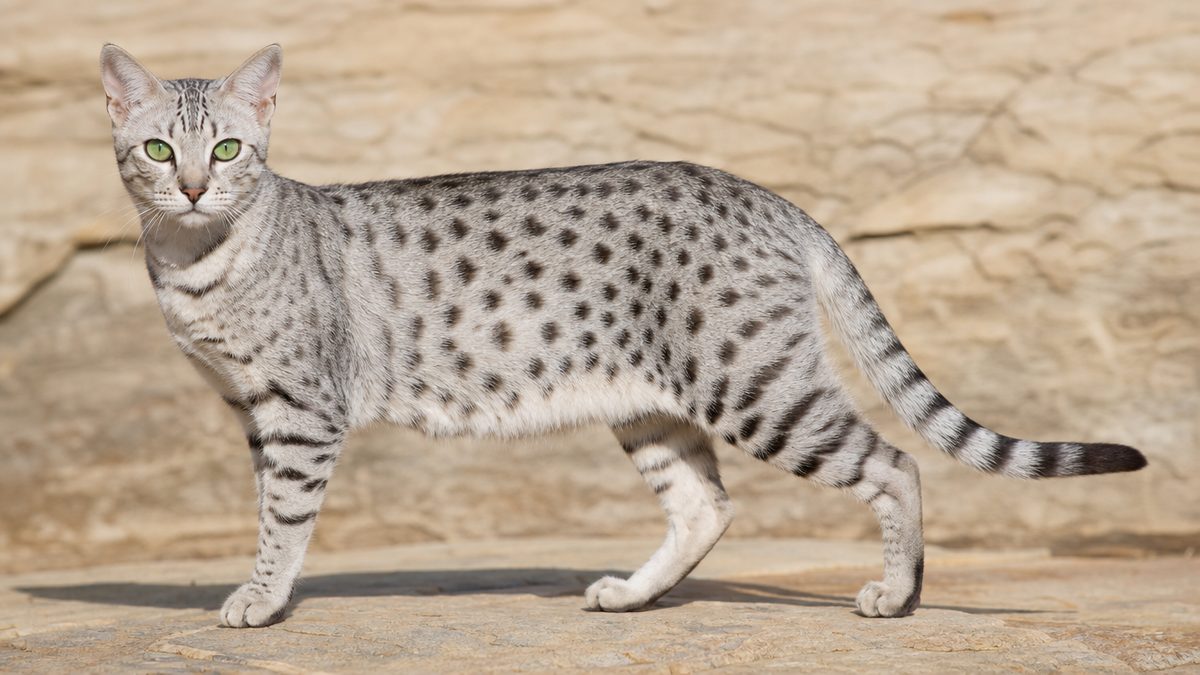
Five features identify the breed, and four of them are visible in a photograph. The coat carries random distinct spots on the torso, varying in size and shape, against a contrasting pale ground. The forehead is barred with a characteristic M and frown marks. The cheeks carry mascara lines. The upper chest carries one or more broken necklaces, and the word broken is doing real work there, because an unbroken collar is a fault. The fifth marker is tactile: a loose skin flap extending from the flank to the hind leg knee, which the WCF standard describes in the same terms. That primordial pouch is not fat and is not a fault. It lets the cat extend its stride.
The hind legs are proportionately longer than the front, so a standing Mau looks as though it is up on tip-toe. The eyes are large, almond shaped and slanted slightly towards the ears, and their colour is specified precisely as light gooseberry green. A cat over one year and six months with no green in the eye is disqualified outright under the CFA standard, which tells you how load-bearing eye colour is to this breed's identity.
How the registries weight it
Coat is half the cat on paper. Under the CFA point score, pattern carries 25 points and colour another 25, of which eye colour alone is 10, so half the available marks sit on colour and markings before body type is considered at all. The WCF breed standard reaches the same place by a different route, awarding 30 of 100 points to coat colour and pattern, its single heaviest item. A breeder selecting a Mau is selecting a coat first.
| Breed | Where the pattern came from | Wild ancestor | Recognised by CFA |
|---|---|---|---|
| Egyptian Mau | Arose naturally in the population | None claimed | Yes |
| Bengal | Bred in from a wild species | Asian leopard cat | Yes |
| Ocicat | Built from Abyssinian, Siamese and American Shorthair | None | Yes |
| Savannah | Bred in from a wild species | Serval | No |
| Chausie | Bred in from a wild species | Jungle cat, Felis chaus | No |
| Arabian Mau | Arose naturally, but mackerel striped not spotted | None | No |
The comparison table above is the most useful thing on this page for a reader who arrived by searching for a spotted cat rather than for this breed specifically. Three of those six are wild hybrids, and one of them, the Chausie, has a wild parent species that is legally protected in India.
Two further sources are worth naming for a reader checking this page against others. The breed's Wikipedia entry describes it in the same terms used here, as a small to medium-sized, short to medium-haired standardised breed bearing a solid or spotted tabby coat and one of the few naturally spotted domesticated cats. Purina's Indian breed library is one of the very few India-facing brand pages that carries the breed at all, which is itself a measure of how thin the Indian coverage is.
Registry recognition, checked on all five bodies
Registry recognition for the Egyptian Mau is unanimous: CFA, TICA, FIFe, GCCF and WCF all hold the breed, all publish a written breed standard, and all maintain a studbook.
Bonbeno applies a two-condition test to every breed. A written standard has to exist somewhere, and a studbook recording generations has to exist somewhere. The Egyptian Mau clears both on all five bodies, which is rarer than it sounds and puts it in a different category from most cats with an exotic-sounding name.
Note first what does not apply to cats. The FCI does not register cats at all, so the question that settles dog recognition in India is simply unavailable here, and there is no Indian national cat registry equivalent to the Kennel Club of India. Any claim that a cat is KCI registered should be treated as an error.
| Body | Holds the breed | Evidence read | In-document control |
|---|---|---|---|
| CFA | Yes | Listed in CFA Recognized Breeds with full show standard and point score | Abyssinian, Bengal, Birman present |
| TICA | Yes | Listed among the 73 breeds in Browse All Breeds | Persian, Siamese, Bengal present |
| FIFe | Yes | EMS code MAU, breed standard last modified 2026 | Persian, Siamese, Abyssinian, Ocicat present |
| GCCF | Yes | Full breed details, three colours bronze, silver and smoke | Persian, Siamese, Bengal present |
| WCF | Yes | Code MAU, standard dated 01.01.2010 | Abyssinian, Chartreux, Korat present |
Two of those five were read directly as breed indexes rather than as breed pages, which is the stricter test. The CFA Recognized Breeds index carries the Egyptian Mau with its coat length, characteristics and personality summary in the same list that carries the Abyssinian, Bengal and Birman, and TICA's own breed page for the Mau sits inside the set of 73 breeds it recognises.
Why the controls are recorded
A register's index can fail to load, serve a stale page, or return a shell without its list. An absence read off a broken page looks exactly like a real absence, so Bonbeno records which known breeds were visible on the same document at the same moment. On the FIFe index the retrieval parsed to 52 EMS-coded entries with Persian, Siamese, Bengal, Abyssinian and Ocicat all present, so MAU appearing there is a real presence rather than an artefact. On the GCCF index the alphabetical run and the controls both held.
One nuance worth stating, because it cuts against the breed's own marketing. CFA records allowable outcross breeds as none, and describes the Mau as a natural breed. A 2012 genetic survey, however, describes the Egyptian Mau and the Bengal as "two breeds that have used Abyssinians in their breed development" when explaining why both carry the same inherited variant. Bonbeno does not adjudicate that. Both statements come from credible bodies, they point in different directions on the breed's ancestry, and a reader is better served knowing the question is open than being handed one side of it.
Three cats, one bottleneck, and an Indian bloodline
The modern Egyptian Mau descends from a founding population of three cats, and the infusion that rescued it came out of New Delhi.
This is the part of the breed's story that no page ranking in India tells, and it is the part an Indian reader should find most interesting.
The bottleneck
The Second World War came close to ending the breed. By 1945 the Egyptian Mau was in serious danger of extinction, and a handful of Italian breeders held what remained. In Rome in the early 1950s the exiled Russian princess Natalie Troubetsky found them, and despite her efforts she was able to secure only two whole Maus from the Italian stock: Gregorio, an eleven-year-old black male, and Lulu, a silver female. She later located a third, a smoke male named Geppa, and imported him to Italy from Syria.
Three animals. The first post-war litter arrived in Italy in 1953 and a second in 1954. In December 1956 Troubetsky emigrated to the United States with three cats of her own breeding, Jojo, Liza and Baba, and founded the Fatima cattery, registering the cattery name and ten cats with CFF in 1958.
Read the pedigrees of those three and the bottleneck becomes concrete rather than abstract. Baba was out of Lulu by Geppa. Jojo was out of Baba by Gregorio, which is a father-to-daughter mating. Liza was out of Baba by Jojo, which is a son-to-mother mating. An entire breed was rebuilt from three founders through matings of that closeness, and the consequences showed up exactly where a geneticist would predict.
What a narrow gene pool did to the cats
CFA's own breed history is unusually candid about it. The severely limited gene pool of the traditional Mau "was starting to impact on litter size and viability and the health of the cats themselves", and problems including cardiomyopathy, asthma, luxating patella and dystocia had begun to appear in the traditional lines. That is a breed club describing inbreeding depression in its own stock, in print, which is worth more than any outside assessment.
In 1980 Jean Mill imported two cats, a male named Toby and his sister Tasha. They had been born in Egypt and adopted by a zoo keeper in New Delhi. Registered with ACA in 1982 and accepted by TICA shortly after, their descendants became known as the Indian lines, and CFA records that the new blood "effectively doubled the gene pool". Litter sizes rose, kitten viability improved significantly, and the genetic problems receded.
So the breed a buyer in Chennai or Delhi is looking at today exists in its present form partly because of two cats that passed through New Delhi. Every ranking page for this breed in India omits that, and it is the single most India-relevant fact the breed has.
Scale is worth stating alongside it. CFA registered 299 Maus in 1998, and fewer than 3,500 in total across the twenty-one years from 1977. This is a genuinely rare breed by registration volume, not a marketing claim.
One historical footnote connects this breed to another page on this site. The same 1999 CFA history records a long-standing but, in its own words, not widely accepted theory that the jungle cat Felis chaus may have contributed to the Mau or the Abyssinian, on the grounds that the jungle cat and the African wildcat were held in captivity simultaneously in ancient Egypt. Felis chaus is a real and separate wild species, listed on CITES Appendix II and native across almost all of India. That speculation is not evidence of wild ancestry in the modern Mau, and the breed is not a hybrid.
Egyptian Mau price in India, and why one number is doing all the work
One Indian page publishes an Egyptian Mau price in India, quoting Rs 40,000 to Rs 80,000, and no verified Indian cattery publishes a rate to check it against.
That is the honest position, and it should be the first thing a buyer reads rather than the last. Bonbeno reports published ranges as editorial content and does not broker sales or link listings.
What the ranking page actually says, and what it shares with other breeds
The page holding position one on Google India for this query gives the buying cost as Rs 40,000 to Rs 80,000 and monthly expenses of Rs 2,800 basic to Rs 4,199 premium. To find out whether those monthly figures describe this breed, Bonbeno pulled an unrelated breed from the same site and compared the rows to the rupee. The result is unambiguous.
| Line | Egyptian Mau | Abyssinian | Same? |
|---|---|---|---|
| Cost of buying | Rs 40,000 to 80,000 | Rs 15,000 to 50,000 | Differs |
| Monthly food | Rs 1,500 to 2,000 | Rs 1,500 to 2,000 | Identical |
| Monthly grooming | Rs 800 to 1,500 | Rs 800 to 1,500 | Identical |
| Monthly basic total | Rs 2,800 | Rs 2,800 | Identical |
| Monthly premium total | Rs 4,199 | Rs 4,200 | Differs by Rs 1 |
| Veterinary line | Rs 500 to 699 | Rs 500 to 700 | Differs by Rs 1 |
| Ideal weather | 15 to 30 C | 18 to 30 C | Differs |
| Life expectancy | 12 to 15 years | 12 to 15 years | Identical |
The food line and the grooming line match to the rupee. The basic monthly total matches exactly. The premium total and the veterinary ceiling differ by a single rupee, which is the signature of a charm price set once and nudged, not of two independent observations. A Mau and an Abyssinian have different coats, different sizes and different health profiles, and no honest costing of the two produces identical grooming and food lines. These are template constants shared across breeds, and Bonbeno has now confirmed on the cat side of this site what it had previously only documented on the dog side.
Running the division tests on the buying price
Indian pages routinely publish a dollar price run through one exchange rate and presented as rupees, so every rupee figure gets divided before it is used. Rs 40,000 and Rs 80,000 do not divide cleanly at 84.38, giving 474.0 and 948.1, and do not divide cleanly at 74, giving 540.5 and 1,081.1. At a flat 80 they give exactly USD 500 and USD 1,000.
A match at 80 proves very little on its own, because any figure ending in three zeros divides cleanly by 80 by construction. What makes this one worth reporting is the quotient. USD 500 and USD 1,000 are prices a seller would actually print, and Cats.com gives the Egyptian Mau a US band whose floor is exactly USD 500. So the Indian band is consistent with a converted American figure without being proved to be one. Bonbeno reports the division and the quotient together rather than declaring a verdict.
The US sources themselves disagree, which is worth showing rather than averaging. Petful gives pet-quality kittens at USD 800 to 2,500 and show or breeding cats at USD 2,800 to 3,000 and above, while Cats.com gives a wider USD 500 to 3,500. Neither is an Indian price and neither should be converted into one.
What an Indian search actually offers you
Search for pet shops selling this breed in Delhi and the ranking directory listing returns a page whose first result is a Persian seller. That is not a price problem, it is a supply problem wearing a price. Before you compare any figure, verify that what is being offered is the breed you searched for, and read the spotted pattern rather than the advertisement.
Monthly cost of ownership in rupees
Budget Rs 2,500 to Rs 5,000 a month to keep an Egyptian Mau in an Indian metro once the kitten vaccination course is complete, with first-year costs running considerably higher.
Those figures are assembled from published Indian clinic and retailer prices rather than copied from a breed page, and each line names its source. Cost of ownership for this breed is close to that of any other short-coated cat of similar size, with one exception that is covered in the health section.
| Item | Published price | Source |
|---|---|---|
| Anti-rabies, single dose | Rs 699 | Vetic clinic list price |
| Feline core vaccine equivalent, single | from Rs 849 to Rs 899 | Vetic clinic list price |
| Bath, professional | from Rs 934 | Vetic Delhi grooming list |
| Complete bath and styling | from Rs 1,869 | Vetic Delhi grooming list |
| Boarding, 24 hours | Rs 899 | PawSpace Bengaluru |
| Daycare to 10 hours | Rs 799 | PawSpace Bengaluru |
| Microchipping | Rs 1,250 | Named Chennai clinic's own transacted price |
| Delhi pet registration | Rs 500 | Municipal Corporation of Delhi |
| Chennai pet licence | Rs 50 | Greater Chennai Corporation |
Where the municipal numbers actually help
The registration figures are the most durable numbers on this page, because municipal fees move far more slowly than retail prices. Delhi charges Rs 500 to register a pet with a Rs 100 per month late fee, while the Greater Chennai Corporation charges Rs 50 for a pet licence. Chennai goes further than that: its six corporation pet clinics provide treatment and anti-rabies vaccination free of cost, which is a materially better fact for a Chennai reader than any private rate card.
What this breed does not cost you
Grooming is the saving. A close-lying medium-short coat needs a comb once a week and no professional cut, so the Rs 1,869 styling line simply does not apply. Anyone quoting a Mau a monthly grooming budget of Rs 800 to 1,500 is quoting a template, as the previous section demonstrated.
What it costs you that other cats do not
Water and diet management, and the veterinary follow-up that goes with a stone-forming breed. A urinary diet costs more than ordinary maintenance food, and a cat that blocks needs emergency care rather than an appointment. Budget for a contingency rather than a flat monthly line, and read the health section before setting a number.
One retail caution. Prices on Indian pet e-commerce move within days, so re-price anything load-bearing before you rely on it. Bonbeno re-checks these rows on each build and states the date they were read rather than presenting them as stable.
Boarding deserves a separate line for anyone who travels. A Bengaluru operator publishes hourly care to four hours at Rs 599, daycare to ten hours at Rs 799 and overnight care to twenty-four hours at Rs 899. For a cat that bonds tightly to one household, in-home care usually beats boarding, but the published rates give you a benchmark to judge a quote against.
Heat tolerance and the Indian climate
The Egyptian Mau tolerates dry heat well and humid heat considerably less well, and the difference is measurable rather than a matter of opinion.
Bonbeno rates heat tolerance from climate data at explicit coordinates rather than from breed-club prose written for another country. NASA POWER returns a grid cell rather than a point, so the elevation it reports is echoed and checked against each place's real elevation before any figure is used. All the Indian cities below sit on plains where the cell and the town agree closely.
| Place | Cell elevation | Real elevation | Annual mean T | Annual mean RH | May mean T |
|---|---|---|---|---|---|
| Cairo, breed homeland | 135 m | 23 m | 21.82 C | 50.54% | 25.34 C |
| Delhi | 206 m | 216 m | 25.60 C | 45.56% | 35.05 C |
| Pune | 636 m | 560 m | 23.86 C | 66.80% | 28.80 C |
| Bengaluru | 842 m | 920 m | 23.74 C | 67.94% | 26.97 C |
| Mumbai | 97 m | 14 m | 26.77 C | 67.39% | 31.19 C |
| Kolkata | 7 m | 9 m | 25.81 C | 73.93% | 31.53 C |
| Chennai | 49 m | 6 m | 27.95 C | 72.39% | 31.51 C |
What the numbers say
Chennai runs about six degrees warmer and twenty-two humidity points wetter than the breed's homeland. That is the gap that matters, and it is a humidity gap more than a temperature one. A cat sheds heat by evaporation from the respiratory tract, and evaporation slows as ambient humidity rises, so the same air temperature is a heavier load in Chennai or Kolkata than in Cairo.
Delhi inverts the problem. Its annual humidity of 45.56 percent is actually drier than Cairo's 50.54, so a Mau in Delhi is closer to its ancestral air than a Mau in Mumbai. What Delhi adds instead is raw May heat at 35.05 C against Cairo's 25.34, nearly ten degrees hotter in the hardest month. Neither city is disqualifying and neither is comfortable without management.
The monsoon humidity months are the ones to plan for, and the plan is airflow rather than cold. A fan moving air across a cat does more for evaporative cooling than a closed air-conditioned room the cat cannot leave. Give it a choice of a tiled floor, a shaded high perch and a ventilated low spot, and let it self-select.
Practical measures that work in an Indian flat
- Place two or more water sources away from food, because cats drink less when water smells of food.
- Run a fan rather than sealing a room, so evaporative cooling still works.
- Offer a tiled or stone surface in shade, which this breed will use by choice.
- Mesh every balcony, because an athletic cat that climbs will test the opening.
- Shift active play to early morning and after dark in April and May.
- Watch for open-mouth breathing, which in a cat is an emergency rather than a quirk.
This breed is not heat-tolerant in the way a street-adapted shorthair is, and it is not fragile either. Rated 3 of 5, it sits in the middle honestly: a dry-heat cat asked to live in wet heat.
Temperament and who should not buy one
The Egyptian Mau suits a household that wants an interactive, athletic and vocal cat, and it suits a busy household full of strangers considerably less well.
CFA's own description is unusually direct about the trade-off. Maus are "exceptionally intelligent and intensely devoted to their owners", expect to be treated as members of the household, and are "shoulder riders, refrigerator vultures, and furry alarm clocks";. The same description then says they are "known to be strong-willed, they have definite ideas about who can handle them and when and may be cautious or reserved with strangers".
Read those two paragraphs together and a clear picture emerges. This is a cat that bonds hard with a small number of people and does not distribute that warmth freely. It is not aloof and it is not nervous. It is selective.
Who this breed fits
- Households with one to three consistent people the cat can attach to.
- Owners who want to train a cat and will actually do it, since this breed retrieves and walks on a harness.
- Homes with vertical space, because an athletic cat needs height more than floor area.
- Owners who want conversation, since the voice is quiet but frequent.
- People who will socialise a kitten deliberately rather than hoping it settles.
Who should choose something else
- Households with heavy visitor traffic, where a reserved cat stays stressed.
- Owners away for long days, because an independent-looking cat is not an unattached one.
- Anyone wanting a lap cat that tolerates handling by anyone.
- First-time owners unwilling to manage a stone-forming breed's water intake for life.
- Buyers who want the look alone, for whom an Ocicat delivers it without the health tail.
The vocal quality is worth expanding, because it surprises people. CFA describes quiet cats with low melodious voices that chirp or chatter in greeting. That is not the carrying yowl of an Oriental breed. It is closer to a running commentary, and in a small flat with thin walls that difference matters.
One temperament note specific to the show ring is revealing about the breed generally. The 1999 breed history records that selective breeding for temperament, alongside appearance, substantially improved disposition and show presence, and that handling kittens from birth and exposing them to varied experiences is the key to a settled adult. A Mau is made calm rather than born calm, which puts the work on the breeder and then on you.
Training: what works and what this breed resists
To train an Egyptian Mau, work in short sessions with food rewards and start before sixteen weeks, because this is a trainable breed that will not be compelled into anything.
Maus retrieve, learn to walk on a harness and lead, and take readily to clicker work, and CFA records owners being trained to play fetch rather than the other way round. That describes a cat that offers behaviour and expects a response, which is exactly the raw material positive reinforcement needs.
A realistic timeline
- Weeks 8 to 12: handling, carrier familiarity, name response. Three sessions a day of two minutes each.
- Weeks 12 to 16: harness worn indoors without a lead, litter habits fixed, nail trims paired with food.
- Weeks 16 to 24: recall to a sound cue, fetch shaped from a natural retrieve, first lead work indoors.
- Months 6 to 12: outdoor harness work only in a secure space, plus station training for veterinary handling.
- Year 1 onward: maintenance, since a bored Mau invents its own curriculum.
The resistance is predictable and specific. This breed does not respond to repetition for its own sake, and it disengages rather than fighting. A session that runs past the cat's interest teaches it that training is boring, which is harder to undo than teaching nothing. Stop while it still wants more.
The one thing worth training above all others
Teach voluntary carrier entry and calm handling of the belly and hindquarters. A breed with this urinary risk profile will need veterinary examination under stress at some point, and a cat that loads into a carrier without a chase is a cat that reaches the clinic sooner. That is a training goal with a clinical payoff, and it is the one Bonbeno would prioritise over any trick.
Socialise deliberately during the window before sixteen weeks. The 1999 breed history is explicit that handling kittens from birth and exposing them to varied experience is what produces a settled adult in this breed. A Mau left unsocialised does not become merely shy; it becomes a cat that is hard to medicate.
Daily exercise requirement
An adult Egyptian Mau needs roughly 30 to 45 minutes of active play a day, split into several short bursts rather than one long session.
This is a muscular, athletic cat built on longer hind legs, and the CFA standard describes a body showing well developed muscular strength. Muscle that is not used becomes weight, and weight on a stone-forming breed is a compounding problem rather than a cosmetic one.
What the sessions should look like
Cats hunt in short high-intensity bursts and then rest, so play should mirror that. Four sessions of eight to ten minutes beat one session of forty. End each on a caught toy and a small meal, because an uncompleted hunt sequence leaves a cat wound up rather than satisfied.
Indoor enrichment for an Indian flat
Indoor enrichment matters more here than in most countries, because a Mau in an Indian city is an indoor cat for the great majority of its life. Street risk, traffic, dog packs and heat all argue for it, and the breed's value makes theft a real consideration.
- Build upward: shelves, a tall tree and a window perch beat any amount of floor space.
- Rotate toys weekly rather than leaving them all out, since novelty is the active ingredient.
- Use puzzle feeders for part of the daily ration, which slows eating and adds work.
- Give a meshed balcony or a window with a secure grille, because scent and air matter.
- Provide one high refuge the cat can reach and people cannot, especially in a visitor-heavy home.
In April and May, move the two biggest sessions to before 8 am and after 8 pm. A cat pushed into hard play at 3 pm in Chennai is being asked to shed heat into air that is already near saturation, which is precisely the load its homeland never imposed.
Under-exercised Maus present in a recognisable way. They wake their owners at four in the morning, they redirect play onto ankles, and they patrol and vocalise. None of that is a temperament fault. It is an unmet exercise requirement wearing one.
Grooming and coat care in Indian humidity
Groom an Egyptian Mau once a week with a fine comb and bathe it almost never, because the coat is medium-short, close-lying and self-maintaining.
The CFA standard describes hair medium in length with a lustrous sheen, dense and resilient in silver and bronze and silky and fine in smoke. The WCF standard reaches the same place, calling the coat medium short, dense, supple and close lying to the body. Nothing in either description implies a coat that mats, and nothing implies a coat that needs cutting.
A weekly routine that takes four minutes
- Comb once weekly with a fine-toothed comb, working with the lie of the coat.
- Increase to twice weekly during the two shedding peaks, which in Indian cities track the temperature swings rather than daylight.
- Check ears monthly, and check them weekly through the monsoon.
- Trim nails every three to four weeks, paired with food from kittenhood.
- Brush teeth several times a week with a veterinary paste, never a human one.
What Indian humidity actually changes
Overseas breed guidance on cat grooming rarely mentions humidity, because it is written for drier places. Two adjustments are worth making here. First, dry the ears properly after any bath, since a warm humid ear canal is the one place an Indian climate genuinely raises risk. Second, resist the urge to bathe more often in summer. Bathing strips the coat oils that keep the guard hairs lying flat, and a Mau's whole visual identity depends on a flat close coat displaying the spotted pattern.
A short coat is not a hot coat. It sits flat, traps a thin insulating layer and reflects sun off the guard hairs, and shaving removes all three functions while exposing skin to sun. Shaving also destroys the pattern for months, since the spots live in the coat rather than in the skin.
Grooming cost, honestly
Professional grooming is close to optional for this breed. Indian rate cards list a bath from Rs 934 and a complete bath and styling from Rs 1,869, and a Mau needs neither on a schedule. Any Indian page quoting this breed a monthly grooming budget of Rs 800 to Rs 1,500 is reproducing a template constant, as the price section demonstrated line by line. That makes the Mau an affordable cat to maintain in coat terms, whatever it costs to buy.
One cosmetic point that owners misread as a health problem. The loose skin flap running from flank to hind knee, the primordial pouch, swings visibly when the cat moves. It is in both breed standards and is not obesity.
Health risks, screening and lifespan
Two inherited problems define Egyptian Mau health, and the larger of the two is urate urolithiasis, for which one Canadian series put the breed at an odds ratio of 118 against other cats.
That figure is not a typo and it is worth sitting with. It is, by a wide margin, the largest breed effect in the study that reported it, and it changes how this cat should be kept in a hot country.
Urate bladder stones
A retrospective case control study of feline uroliths submitted to the Canadian Veterinary Urolith Centre between 1998 and 2007 examined 10,083 stones, of which 385 were ammonium urate, 13 uric acid and 21 mixed struvite and urate. The Egyptian Mau, Birman and Siamese were all significantly predisposed to urate urolithiasis, with odds ratios of 118 (95% CI 38.2 to 510), 9.1 and 3.9 respectively. The authors wrote that the association between Egyptian Maus and urate urolithiasis was remarkable, which is strong language for a veterinary paper.
The finding is not a one-off. The same centre reported over 50,000 submissions from 1998 to 2008 and recorded that urate uroliths were over-represented in Egyptian Maus, and a later evaluation of 21,426 feline bladder urolith submissions covering 1998 to 2014 again found Egyptian Mau, Birman, Ocicat and Siamese over-represented among urate submissions. Three reports, overlapping datasets from one centre, consistent direction.
Urate stones form in concentrated urine. A cat drinks less when it is hot and lethargic, and eats dry food when the household is out for long days, and both push urine concentration up. The Canadian data were collected in a cold country. The same breed kept in Chennai or Delhi faces the same genetics under worse hydration conditions, and no published Indian series exists to quantify that. Treat the risk as at least as high here, not lower.
- Feed wet food as a meaningful share of the diet rather than dry alone.
- Hydrate actively: multiple water stations, a fountain if the cat prefers moving water, water bowls placed well away from food.
- Watch the litter tray daily, because the first sign is usually straining or frequent small volumes.
- Treat any male cat unable to pass urine as an immediate emergency rather than an appointment.
- Ask a veterinarian about urine pH monitoring if a stone has already been found.
Pyruvate kinase deficiency
A survey of 14,179 American and European cats representing 38 breeds identified the PKLR c.693+304G>A variant behind feline erythrocyte pyruvate kinase deficiency, an autosomal recessive cause of anaemia. The Egyptian Mau carries it. In that study's Egyptian Mau sample of 36 cats, 27 were clear, 9 were carriers and none were affected. The paper names the Egyptian Mau explicitly among the breeds for which PK testing is recommended.
The same 36 cats and the same 27, 9 and 0 genotype counts are given an allele frequency of 0.10 in the paper's Table 2 and 0.13 in its Table 3. Computed from the counts, 9 carrier alleles in 72 gives 0.125, which rounds to the 0.13 of Table 3. So Table 2's figure does not reproduce from its own numbers. Bonbeno quotes the counts, which both tables agree on, rather than either percentage. Note also the denominator: 36 cats is a small sample, and a study finding no affected homozygotes in 36 animals has not shown that none exist.
What the breed club says, and what the old lines carried
CFA's breed council records that breeders have been diligent about genetic testing for pyruvate kinase deficiency and notes urolithiasis as a further concern, while stating plainly that genetic testing is not available for all heritable conditions in the breed. The 1999 breed history adds the historical picture: cardiomyopathy, asthma, luxating patella and dystocia had begun to appear in the narrow traditional lines and receded after the gene pool widened.
Lifespan
CFA's 1999 history gives an average life expectancy of approximately 12 years, while the GCCF breed data gives 12 to 15 years. Bonbeno publishes both rather than averaging them. No Indian lifespan data for this breed exists, and none should be invented.
One India-specific caution belongs here even though it is not a breed problem. Tick-borne disease pressure in India is substantial, and a Kerala series found Babesia in 80 of 120 animals tested at veterinary clinics. That series sampled clinically suspected dogs at clinics rather than a random population, and it is not a cat study, so it cannot be read as a prevalence figure for cats. It is cited only to make the point that parasite control is not optional here, and that an indoor cat in a household with a dog still needs a plan agreed with a veterinarian.
Screen before you buy. Ask any breeder for the PK deficiency DNA result on both parents, ask what the line's urinary history is, and treat an unwillingness to answer as the answer. A genuinely healthy Mau line will have the paperwork.
Feeding and nutrition, life stage by life stage
Feed an Egyptian Mau a moisture-rich diet from kittenhood, because water intake is the single dietary lever that acts on this breed's largest health risk.
Everything else about feeding a Mau is ordinary feline nutrition. The moisture point is not ordinary, and it follows directly from the urate stone finding rather than from any general preference for wet food.
| Stage | Approach | What to watch |
|---|---|---|
| 8 to 16 weeks | Four small meals a day of a complete kitten diet, wet included from the start | Steady weight gain, formed stools, willingness to drink |
| 4 to 12 months | Three meals a day, transitioning toward adult portions after nine months | Growth plateau, body condition rather than the scale alone |
| 1 to 7 years | Two meals plus part of the ration in puzzle feeders | Rib cover, waist behind the ribs, urine volume |
| 7 years and over | Two meals, senior formulation on veterinary advice | Weight loss, drinking changes, litter tray frequency |
Why moisture is the point
A cat evolved to take most of its water from prey and has a weak thirst drive relative to a dog. Feed a stone-forming breed exclusively on dry food in a hot country and urine concentration rises for most of the day. Wet food shifts that materially, and it is the cheapest intervention available. Where a household cannot feed wet food throughout, adding water to dry food and running multiple water stations is the fallback.
Availability in India
Complete wet cat food is now widely stocked in Indian metros, and the constraint is usually cost rather than supply. That argues for a mixed regime, with wet food anchoring the largest meal and a good dry food filling the rest, rather than an all-or-nothing choice a household cannot sustain. A diet the owner abandons in month three helps nobody.
Prescription urinary diets are formulated for specific stone types, and the diet that dissolves one type can promote another. Urate is not struvite. A veterinarian needs to identify what is actually forming before a therapeutic diet is chosen, so ask rather than buying the bag with the urinary label.
Kitten birth weight, and why it is worth asking about
A study of 5,596 kittens from 15 breeds supplied by 194 French breeders identified low birth weight, being male, and being born in a large litter as significant risk factors for mortality in the first two months, and defined breed-specific thresholds. The Egyptian Mau is one of the named breeds, and the paper notes that critical thresholds can differ between breeds with similar birth weight distributions. Overall, 19.7 percent of kittens in that population were classified low birth weight and 1.9 percent very low.
The practical use of that is a question to a breeder. A cattery that records birth weights is a cattery paying attention, and one that cannot tell you a kitten's birth weight is telling you something too.
Kitten timeline, month by month through the first year
An Egyptian Mau kitten's first year runs on a predictable timeline, and the two dates that matter most are the close of the socialisation window at about sixteen weeks and the arrival of full eye colour at about eighteen months.
The timeline below is assembled from the breed standards and the veterinary literature cited on this page rather than from a generic kitten calendar, and the breed-specific rows are marked.
| Age | What happens | What you do |
|---|---|---|
| 8 to 9 weeks | Earliest reasonable point to leave the litter | Collect PK deficiency test paperwork on both parents |
| 9 to 12 weeks | Core vaccination course under way | Establish wet feeding and multiple water stations now |
| 12 to 16 weeks | Socialisation window closing | Handling, carrier work, visitors, nail trims, harness indoors |
| 4 to 6 months | Rapid growth, adult play style emerging | Fix litter tray habits and start recall |
| 6 to 8 months | Some green appears in the eye | Neutering discussion with a veterinarian |
| 8 to 12 months | Coat pattern sharpens as faint kitten markings resolve | Confirm spotting and contrast against the standard |
| 12 to 18 months | Body fills out; muscle replaces gangliness | Reassess portions, since growth demand has ended |
| 18 months | Full gooseberry green eyes expected | A cat still lacking green here would be disqualified in the ring |
The eye-colour clock is a real breed marker
CFA allows for changing eye colour, expecting some discernible green by eight months and full green by one and a half years, with preference given at all ages to greener eyes. A cat over one year six months with no green in the eye is disqualified, and an amber cast after that age is penalised. For a buyer, that clock is a useful authenticity check on a kitten sold as a Mau: nobody can promise you the adult eye colour at ten weeks, and a seller who does is guessing or worse.
What to watch for in an Indian first year
- Litter tray output, daily, from the first week home. Establish what normal looks like while the cat is healthy.
- Water intake through the first hot season, which for a kitten arriving in December means the following April.
- Weight monthly rather than weekly, since single readings mislead.
- Balcony and grille security before the cat starts climbing, not after.
- Municipal registration where your city requires it, which in Delhi costs Rs 500.
Register the cat and microchip it early. A Chennai clinic's own transacted microchipping price is Rs 1,250, and for a rare breed in a country with an active market in stolen pets, a chip is cheap insurance rather than bureaucracy.
Egyptian Mau against the cats you are actually choosing between
Most people searching for an Egyptian Mau in India are choosing between four spotted or ticked cats, and only two of the four are lawfully and realistically available here.
Compare them on availability and health tail rather than on looks, because looks are what brought you here and are the thing least likely to go wrong.
Bonbeno publishes this breed comparison because the choice in front of an Indian buyer is rarely the choice the search term implies. Somebody typing the name of one spotted cat is usually deciding between four, and availability in India separates them far more sharply than appearance does.
| Egyptian Mau | Bengal | Ocicat | Chausie | |
|---|---|---|---|---|
| Pattern | Natural spots | Spots or marbling | Spots | Ticked or grizzled |
| Wild ancestor | None claimed | Asian leopard cat | None | Jungle cat, Felis chaus |
| CFA recognition | Yes | Yes | Yes | No |
| Registries of five holding it | 5 | 5 | 4 | 2 |
| Realistic Indian availability | Very low | Good | Very low | None lawful |
| Signature health watch | Urate stones, PK deficiency | PK deficiency, HCM | Generally robust | No published literature |
| Legal complication in India | None | None | None | Wild parent is Schedule I |
| Typical grooming load | Low | Low | Low | Low |
Against the Bengal
The Bengal is the honest default for an Indian buyer who wants a spotted cat, purely because it exists here in numbers. It shares the pyruvate kinase deficiency variant, appearing at a comparable frequency in the same survey, so the DNA test question applies to both. What the Bengal does not carry is the urate stone predisposition, and what the Mau does not carry is a wild ancestor.
Against the Ocicat
The Ocicat is the closest thing to a Mau with no health tail attached, and it is worth naming because almost nobody considers it. It is a wholly domestic breed that looks wild, and it appears in the same Canadian urolith series among breeds over-represented for urate submissions, so it is not free of that risk either. Availability in India is as thin as the Mau's.
Against the Chausie
This one is not a close call. The Chausie descends from the jungle cat, a species listed in Schedule I of the Wild Life (Protection) Act 1972, and no lawful supply route into India exists. Anyone weighing a Mau against a Chausie on looks alone should read that page before going further.
And against the Arabian Mau
The name collision is a real problem in Indian listings. The Arabian Mau is a mackerel tabby, striped rather than spotted, and shares nothing with this breed except a word that simply means cat. If a listing shows a striped cat and calls it an Egyptian Mau, the seller either does not know the difference or is relying on you not knowing it.
Common mistakes Indian owners actually make with this breed
The most common and most expensive mistake with an Egyptian Mau in India is treating it as a low-maintenance shorthair, because its coat is low maintenance and its urinary tract is not.
Each mistake below has a specific correction, and several of them are cheap to fix before they cost anything.
1. Feeding dry food only
This is the big one, and it is the mistake that connects directly to the breed's largest documented risk. A stone-forming breed on an all-dry diet in a hot country produces concentrated urine for most of the day. Wet food as a meaningful share of the ration is the correction, and it costs less than one emergency for a blocked cat.
2. Reading the price band as a market rate
One Indian page publishes Rs 40,000 to Rs 80,000, and its monthly cost rows are template constants it shares with an unrelated breed to the rupee. Treating a single template figure as the market is how buyers end up anchoring on a number nobody actually charges.
3. Buying a striped cat sold as a spotted one
The Mau is defined by random distinct spots, an M on the forehead and broken necklaces. Continuous vertical stripes mean a mackerel tabby, which may be a lovely cat and is not this breed. Ticking with no pattern at all means an Abyssinian.
4. Ignoring the litter tray until something is obviously wrong
By the time a cat is visibly distressed, a urinary obstruction is already an emergency. Learn what your cat's normal output looks like in its first fortnight at home, and check daily thereafter. Straining, frequent small volumes and any vocalising in the tray are all reasons to call a veterinarian the same day.
5. Not asking for the DNA result
Pyruvate kinase deficiency has a published test and the breed carries the variant. A breeder who has tested will produce the paperwork immediately. Do not accept an assurance in place of a result.
6. Shaving the cat in summer
A close-lying coat is part of the thermoregulation, not an obstacle to it. Shaving removes the insulating layer and exposes skin to sun, and this is a mistake Indian owners make with short-coated cats every April.
7. Leaving balconies open
An athletic cat that climbs will test every opening. Mesh before the kitten is mobile rather than after the first escape.
Across this page the serious health issues are hydration, weight and dentition, not anything exotic. A Mau that drinks enough, stays lean and gets its teeth brushed will most likely spend its twelve to fifteen years being unremarkable, which is the goal.
Adoption and responsible sourcing in India
Adopt rather than buy is the honest recommendation for this breed in India, because no verified Indian supply chain exists to buy from.
That is not a moral position bolted onto the end of a page. It follows from what the earlier sections established: one template price, a Justdial listing whose first result sells Persians, and no Indian cattery publishing a rate.
What adoption realistically looks like
A purebred Egyptian Mau will not appear in an Indian shelter in any predictable way, and a reader waiting for one will wait indefinitely. What is available in every Indian city is a large population of spotted and tabby domestic shorthairs, many of which carry exactly the mackerel or spotted patterning people find attractive in this breed, and all of which are adapted to the local climate in a way an imported pedigree is not.
- Contact metro rescue networks directly rather than waiting for a listing to appear.
- Ask breed-specific rescue groups overseas whether any Indian placement route exists, and expect the answer to be no.
- Consider an Indian domestic shorthair with the pattern you actually wanted, which costs a fraction and arrives climate-adapted.
- Register and microchip whatever cat you take on, since a Chennai clinic charges Rs 1,250 to microchip.
If you are determined to buy, verify these five things
- Registration papers from CFA, TICA, FIFe, GCCF or WCF naming both parents, since all five recognise the breed.
- A pyruvate kinase deficiency DNA result for both parents, in writing.
- The line's urinary history, asked as a direct question about stones.
- Recorded birth weight for the kitten, which indicates a cattery that measures things.
- Sight of the mother with the litter, which no photograph substitutes for.
Bringing a cat into India is a restricted import under ITC(HS) 01061900, and the route that exists is a personal pet accompanying a transferee of residence rather than a purchase. DGFT states that applications for trading or breeding purposes shall be duly rejected, and entry is confined to Delhi, Mumbai, Chennai, Hyderabad, Bangalore and Kolkata. DAHD added a seventh port, Cochin International Airport at Kochi, for pets arriving under the baggage rules in October 2024. This is a genuine route for somebody moving home with their cat, and it is not a shopping channel. DGFT's own published FAQ confirms that ITC(HS) 01061900 is the code covering cats as well as dogs and that the policy for pet cats is Restricted. The full route, which covers cats too, is set out in how to import a dog to India.
What Bonbeno will not do
Bonbeno does not recommend breeders, link kitten listings, or quote a live price as an offer. Every figure on this page is reported from a published source as editorial context, and where the only available figure is a template constant, this page says so rather than repeating it as a market rate.
The most useful sentence on this page may be the least commercial one. If what you want is an intelligent, athletic, spotted, talkative cat that will follow you around an Indian flat, the odds are much better that you will find one in a rescue than in a listing for this breed.
Common questions
How much does an Egyptian Mau cat cost?
Outside India the published range runs from about USD 800 to USD 2,500 for a pet-quality kitten and USD 2,800 to USD 3,000 and above for a show or breeding cat. Inside India only one page publishes a figure at all, and it is a band rather than a cattery's rate.
Are Egyptian Mau cats good pets?
They suit a household that wants an interactive, athletic, talkative cat and can give it vertical space. CFA describes them as strong-willed, intensely devoted to their own people and often cautious or reserved with strangers, so a quiet home with consistent handling fits better than a busy one.
How much does an Egyptian Mau cat cost in rupees?
One Indian page advertises Rs 40,000 to Rs 80,000, and no verified Indian cattery publishes a rate to compare it against. That band divides by a flat 80 to exactly USD 500 and USD 1,000, so treat it as an unconfirmed figure rather than a market price.
How to tell if your cat is an Egyptian Mau?
Look for random distinct spots rather than stripes, a barred M on the forehead, broken necklaces on the chest, a loose skin flap running from flank to hind knee, and large almond-shaped gooseberry-green eyes. A ticked coat means an Abyssinian and continuous vertical striping means an Arabian Mau.
Is the Egyptian Mau recognised by Indian or international cat registries?
All five major bodies recognise it. CFA, TICA, FIFe, GCCF and WCF each publish a written breed standard and each keeps a studbook, so the breed clears both limbs of the recognition test comfortably. India has no national cat registry equivalent to the Kennel Club of India for dogs.
What is the biggest health risk for an Egyptian Mau in India?
Urate bladder stones. A Canadian series of 10,083 feline uroliths found the Egyptian Mau significantly predisposed at an odds ratio of 118, the largest breed effect in that study, and the authors called the association remarkable. Stone risk rises when a cat drinks too little, which is exactly what heat and dry food produce.
Does the Egyptian Mau need a DNA test before breeding?
Yes. A survey of 14,179 cats across 38 breeds found the PKLR pyruvate kinase deficiency variant in the Egyptian Mau and named the breed explicitly among those for which testing is recommended. The condition is autosomal recessive, so two carriers can produce an affected kitten.
Can an Egyptian Mau handle Indian heat?
It handles dry heat better than humid heat. Its homeland runs about six degrees cooler and twenty-two humidity points drier than Chennai, so the risk here is wet-bulb load rather than temperature alone. Shade, airflow and constant water matter more than air conditioning.
How much does an Egyptian Mau cost per month in India?
Budget roughly Rs 2,500 to Rs 5,000 a month for food, litter and routine care once the kitten course is done. Published Indian clinic prices put core vaccines at several hundred rupees each and a Delhi grooming bath from Rs 934, though this breed needs little professional grooming.
Is the Egyptian Mau related to India in any way?
Yes, and it is the most surprising fact about the breed. In 1980 Jean Mill imported two cats, Toby and his sister Tasha, that were born in Egypt and adopted by a zoo keeper in New Delhi. Their descendants became the Indian lines and, in CFA's own words, effectively doubled the breed's gene pool.
Should I adopt instead of buying an Egyptian Mau in India?
Adoption is the honest recommendation here, because there is no verified Indian supply to buy from. Indian searches for this breed surface pet shops whose first listing sells Persians, so a buyer is unlikely to be shown the breed they searched for.
What is the difference between an Egyptian Mau and an Arabian Mau?
Pattern is the whole difference. The Egyptian Mau is spotted, carries gooseberry-green eyes and comes in bronze, silver and smoke. The Arabian Mau is a mackerel tabby with continuous vertical striping and no spotting requirement, and the two share nothing but the word Mau.
Compare with similar breeds
Egyptian Mau sits in 1 Bonbeno group. Each one compares it directly against the breeds it is genuinely an alternative to, on the same figures.