
Breed profile
California Spangled Cat: Price in India, and What Happened to the Breed
A designed spotted cat from 1980s Los Angeles that a department store sold through its Christmas catalogue, and that no registry checked on 10 September 2026 still holds.
Quick answer
There is no California Spangled cat price in India, because there is no California Spangled cat to buy anywhere. Six registries were read on 10 September 2026 and none holds the breed. It is a designed spotted cat from 1980s Los Angeles, sold through the Neiman Marcus Christmas catalogue at $1,400, and effectively gone.
This page is reference information and not veterinary advice. No peer-reviewed clinical literature exists for this breed at all, so every health statement here is either about domestic cats in general or is attributed to the specific document that carries it, and none of it is a substitute for an examination. For anything concerning your own cat, consult your nearby vet.
California Spangled traits, rated for India
What the California Spangled was, and which registry still holds it
The California Spangled is a spotted domestic cat designed in Los Angeles in the 1970s and 1980s by the screenwriter Paul Casey, and no registry checked on 10 September 2026 still holds it.
Start with the registry recognition question, because every ranking page states an answer and none of them opens a document. We read six registers on one day and the answer differs by body, so we give it per registry rather than as one global claim.
| Registry | Document read | Result | In-document controls that passed |
|---|---|---|---|
| TICA | Browse All Breeds, plus all three non-championship class indexes | Absent from all four classes | Bengal, Egyptian Mau, Ocicat, Savannah, Toyger |
| CFA | Declared Candidates for Breed Council Secretary, modified 31 July 2026 | No breed council; not in the Miscellaneous or Provisional block | Bengal, Ocicat, Lykoi, Toybob |
| WCF | The complete 198-row EMS code table, pulled by ajax | No row | Bengal, Ocicat, Toyger, Egyptian Mau |
| FIFe | Breeds index, 198,115 bytes | Zero occurrences | Abyssinian, Bengal, Ocicat, Egyptian Mau |
| GCCF | Cat Breeds index, 267,153 bytes | Zero occurrences | Ocicat, Bengal, Toyger, Abyssinian, Egyptian Mau |
| ACFA | Breed standards index, breed synopsis and Registration Rules 2022 | Zero occurrences in all three | Bengal, Manx, Abyssinian, Ocicat, Egyptian Mau |
Three of those deserve a note. TICA's own page says it recognises 73 cat breeds and lists 79 entries once coat-length divisions are counted, and the California Spangled is in none of them. Its Advanced New Breed class holds exactly two entries, the Serengeti and the Toybob, and its Preliminary New Breed class returns *No matches found* and is empty. So this is not a breed sitting quietly in a lower class. It is absent from every class TICA operates.
The WCF row is the one to read most carefully. This site's own playbook records four confirmed errors in the WCF EMS map, all of them omissions of a recogniser, so a WCF absence is unverified rather than probably false. Here it is corroboration rather than evidence: five other registers were read directly and all five agree.
Pulling all 198 rows of the WCF EMS map returns exactly one row containing the string California, and it is not this breed. Row 18 is Cornish Rex Longhair (Californian Rex), code CLX, recognised by LOOF. That is a coat variety, not a spotted cat, and it is worth knowing because a reader searching for a California cat breed will meet it.
The breed standard, and where a real one once existed
No registry publishes a breed standard for the California Spangled today, so the working description comes from two contemporaneous documents rather than from a register. Both were read in full for this page.
The Los Angeles Times of 13 October 1986 gives the physical picture. Females weighed 8 to 10 pounds and males 10 to 12, which makes this a medium cat rather than the large one modern pages imply. Colours were silver, bronze, black, charcoal, gold, red, blue and brown, plus a snow leopard variety born white that developed its markings as it aged. Dominant-colour cats usually had brown eyes and the snow leopards had blue ones, and no cat reached its full colour and final coat texture until about 12 to 18 months. *Cat Fancy* in May 1987 gives the same colour list and puts the maturity point at one to two years.
The eight bloodlines, named in print, none of them wild
The most misunderstood fact about this cat is its ancestry, and the 1986 record settles it. Casey built the breed from eight domestic bloodlines from four continents, and the Los Angeles Times printed the list: Siamese, spotted silver, Manx, Abyssinian, cat of the Nile, brown tabby, Malayan tropical house cat and a spotted silver longhair. Every one is a domestic cat. There is no serval, no leopard cat and no wild ancestor of any kind.
Casey described the method himself in 1987. It took four standard bloodlines and four generations to produce his first truly spotted breeder; an African line crossed with Abyssinian entered at the fifth generation and a Malayan line at the eighth; and, in his words, *just as predicted on paper a decade earlier, the eleventh generation produced my first full-blooded Spangled Cats*. He named the breed spangled rather than spotted because the spotted tabby and the Ocicat already held that word.
This matters for an Indian reader more than it looks. A spotted coat built entirely from domestic stock raises none of the wild-hybrid questions that hang over the Savannah and the Bengal, and none of the wildlife-law questions an Indian owner of a wild-derived cat has to think about. Whatever else is wrong with this breed's story, its genetics were never the problem.
The origin story, and the one date the sources agree on
Casey met the anthropologist Louis Leakey and travelled to Olduvai Gorge in Tanzania, where a poacher had killed one of the few remaining leopards of the territory. The Los Angeles Times dates the Africa trip to 1971 and notes that Leakey died in 1972. Casey's stated design brief was a cat that would *sit on your lap and purr, eat ordinary cat food, use a litter box and satisfy the public's fascination with spotted cats*. His reasoning about fur was blunt and is quoted in the archives: if people have their own spotted cats, they may not want to wear coats that look like their beloved pets.
The Los Angeles Times describes Casey in October 1986 as 51 years old, which puts his birth around 1935. A cat-history archive records his death on 23 April 2007 in Los Angeles aged 60, which puts it around 1946. Those cannot both be right and they are eleven years apart. We have found no document that settles it, so we publish both rather than picking the convenient one, and no age or birth year on this page is load-bearing.
California Spangled cat price in India, and the import rules that apply anyway
There is no California Spangled cat price in India, because a controlled search returned no Indian listing, no Indian breeder and no rupee figure, and because no registry anywhere holds the breed to verify one against.
We ran the search rather than assuming the answer. A Google India pull on 10 September 2026, with gl=IN and hl=en and a Labrador Retriever control passing in the same session, returned an organic set led by American breed-profile sites and a cat-history archive. No Indian listing, no Indian breeder and no rupee figure appeared anywhere in it.
The one price a ranking page prints is the position-one result at cats.com, which gives $800.00 to $1,500.00, in United States dollars, with no rupee conversion and no named seller. We do not convert it. Converting a foreign asking price into rupees and publishing the result is how a fabricated Indian price gets made, and there is nothing on the other end of this one to buy.
The only genuine price in the record is from 1986
Neiman Marcus listed the California Spangled Cat at $1,400 each as its His and Hers gift for 1986, and the retailer still publishes that line in its own Christmas Book history. That is the source. Not a blog, not an aggregator, but the company's own gift list, where it sits between the 1985 pair of diamonds at $2,000,000 and the 1987 Day at the Circus at $7,500.
| Year | Gift | Price |
|---|---|---|
| 1982 | Lasertour, each | $20,000 |
| 1983 | Chinese Shar-Pei Puppies, each | $2,000 |
| 1984 | Custom Wooden Steer or Horse Desk, each | $65,000 |
| 1985 | Diamonds, pair | $2,000,000 |
| 1986 | California Spangled Cat, each | $1,400 |
| 1987 | Day at the Circus, per couple | $7,500 |
| 1988 | Cloudhopper, each | $18,000 |
Three numbers describe the demand and they do not quite agree, which is itself worth reporting. *Cat Fancy* says 40 of the spotted cats were designated for the promotion. The Los Angeles Times, two and a half weeks after the christmas catalogue appeared, reported 53 orders taken and a waiting list for unborn litters, with Neiman-Marcus Dallas fielding 300 to 400 calls. A cat-history archive puts the total at around 350 orders and enquiries. The catalogue oversold its own supply within three weeks.
India's import rules for a cat, which apply whatever the animal is
India's import rules for a pet cat are restricted, and the Directorate General of Foreign Trade publishes them in a nine-page guidance document that names cats explicitly forty-seven times. We retrieved that file as bytes and extracted it with pypdf rather than reading a summary of it: HTTP 200, 195,481 bytes, 13,596 characters, a real text layer.
The import rules split into two routes and conflating them is the commonest error a reader makes. Under the baggage route a person transferring residence to India after two years of continuous stay abroad may bring up to two pets with no DGFT authorisation, and the guidance states flatly that only cats and dogs can be imported under baggage rules. Under the authorisation route falls everything else: a stay abroad shorter than two years, an animal not carried as passenger baggage, more than two animals, and every temporary import.
- Authorisation is applied for under ITC(HS) code 01061900.
- The application goes to the Department of Animal Husbandry, Dairying and Fisheries for a no-objection certificate, then to a monthly Exim Facilitation Committee, and the licence is issued by DGFT headquarters.
- Entry is only through the airports and seaports of Delhi, Mumbai, Chennai, Hyderabad, Bengaluru and Kolkata and, since October 2024, Kochi airport, with quarantine at the port where required. The full route, which covers cats too, is set out in how to import a dog to India.
- An advance no-objection certificate must be obtained from the port's Regional or Quarantine Officer seven days before travel, relaxable to three.
- Owners are advised to start the application at least two months before travel.
Page one of the DGFT guidance says New born puppies are not allowed. Its own FAQ, later in the same file, says New born puppies of less than 7 months are not to be allowed. A seven-month-old animal is not a newborn by any ordinary reading, so those two sentences describe very different rules inside one document, and we publish the disagreement rather than quoting whichever is convenient. Note also that both clauses say puppies, so what either of them does to a kitten is genuinely unsettled on the face of the text. Plan against the stricter reading and confirm with the Regional Authority before booking anything.
None of this opens a route to a California Spangled, because import for commercial purposes such as breeding, import as a gift and import for other purposes are each barred by name, and short-duration import as a tourist is described as generally not permitted. But the rules are the same rules for any cat, so they are worth having whichever breed you end up with.
The real cost of ownership for a cat in India, priced from named providers
The cost of ownership for a cat in India is the useful half of the money question here, because the purchase price of this breed does not exist and the running costs of any cat do.
We price components from named Indian providers rather than assembling a monthly total, and every figure below was divided by 84.38, 80 and 74 to test whether it is a converted United States dollar price. None resolves to a round dollar amount.
| Line | Indian figure | Source |
|---|---|---|
| Kitten vaccination course, three visits | Starts at Rs 3,999, list Rs 5,065 | Vetic, national page |
| Adult annual booster, CRP plus anti-rabies | Starts at Rs 1,899, list Rs 1,908 | Vetic |
| Anti-rabies, single dose | Starts at Rs 699 | Vetic |
| CRP (Tricat or Feligen), single dose | Starts at Rs 1,249 | Vetic |
| Municipal pet licence, Chennai | Rs 50, covering pet animals generally | Greater Chennai Corporation |
| Municipal registration, Delhi | Not available for cats | MCD Delhi registers pet dogs only |
Delhi's municipal scheme registers pet dogs only, at Rs 500 new and Rs 500 to renew. Several Indian pages quote that Rs 500 as a generic pet registration fee. For a cat in Delhi it is not a cost, because there is nothing to register. Greater Chennai Corporation is the contrast: its licence covers pet animals generally at Rs 50, it issued 9,115 licences in 2024, and its six municipal pet clinics provide treatment and anti-rabies vaccination free of cost. Two metros, two completely different answers, and the difference is the instrument rather than the cat.
Why the vaccination figure is a floor and not an average
Vetic's numbers are promotional floors from one chain, and the chain quotes different course prices on different city pages on the same day, so record which page a figure came from. What is genuinely stable is the per-vaccine price rather than the bundle. The struck-through list prices sit close to the sum of their own components, which tells you the components are the durable layer.
The wider point for an Indian cat owner is that delivery route moves the bill more than anything about the animal. The same core vaccination costs a few hundred rupees at a municipal clinic in Chennai, where it is free, and several thousand through a vet-at-home service, for identical drugs Vetic Pet Clinic cat vaccination page.
The cost line this breed would have added, and cannot
For most rare imported breeds this section would end with a screening cost. Here it cannot, because there is no screening scheme to buy. No registry holds the breed, so no registry mandates a test, no breed club publishes health guidance, and no DNA panel exists for any condition specific to it. An Indian buyer offered a California Spangled therefore has no way to verify anything about the animal's health background at any price, which is a cost in the only sense that matters.
No monthly food total. A monthly kibble figure is arithmetic rather than a quoted price, and this site has watched Indian retail cat-food listings change within days. Re-price the bag you actually intend to buy, and treat any monthly figure you read elsewhere, including one carrying a rupee sign, as a calculation somebody did once rather than a price anyone charges.
Heat tolerance and the Indian climate, measured against Los Angeles
The California Spangled comes from the Los Angeles basin, and the gap between that climate and India's is the widest this site has measured for any American cat, which makes heat tolerance the decisive practical fact even for a breed nobody can buy.
We measured it with NASA POWER by explicit latitude and longitude, echoing the cell elevation on every point and comparing it against the real one, because a cell at the wrong altitude gives the right answer for the wrong place. Wet bulb is computed by the Stull method from mean temperature and mean relative humidity, never from the period maximum.
North Hollywood, where Casey kept his colony, and downtown Los Angeles are 18 km apart and return a byte-identical series from a single cell at 395.00 m. That is 215 m above North Hollywood and 306 m above downtown, so POWER has flattened the basin into the hills behind it and cannot tell the two apart. The figures below are therefore a hill cell rather than a basin one, and a real Los Angeles basin summer is warmer than they show. We use them anyway because the direction of the error makes our conclusion harder rather than easier.
| Place | Cell elevation | Elevation error | Annual mean T2M | Annual mean RH2M | Peak Stull wet bulb |
|---|---|---|---|---|---|
| Los Angeles cell | 395.00 m | +215 m over North Hollywood | 17.36 C | 56.7 percent | 16.86 C (Jul) |
| Bengaluru | 841.72 m | -78.28 m | 23.74 C | 67.9 percent | 21.86 C (May) |
| Pune | 635.99 m | +75.99 m | 23.86 C | 66.8 percent | 22.97 C (Jun) |
| Hyderabad | 494.59 m | -47.41 m | 26.10 C | 60.3 percent | 23.35 C (Jun) |
| Mumbai | 97.15 m | +83.15 m | 26.77 C | 67.4 percent | 25.77 C (Jun) |
| Chennai | 48.95 m | +42.95 m | 27.95 C | 72.4 percent | 26.11 C (May) |
| Delhi | 206.37 m | -9.63 m | 25.60 C | 45.6 percent | 26.50 C (Jul) |
| Kolkata | 7.35 m | -1.65 m | 25.81 C | 73.9 percent | 27.09 C (Jun) |
What that table actually says
Read the wet-bulb column, because it is the one that describes how hard an animal has to work to lose heat. The Los Angeles peak of 16.86 C sits 9.25 degrees below Chennai's 26.11 C, 10.23 degrees below Kolkata's 27.09 C and 9.64 degrees below Delhi's 26.50 C NASA POWER climatology 2001 to 2020…. Even Bengaluru, the mildest large Indian city on this site, is 5.00 degrees above it.
The humidity column runs the same way and that is unusual. This site has repeatedly found that a European or coastal breed's homeland is *more* humid than most of India, which makes the standard humidity-shock argument wrong. Not here. Los Angeles runs 56.7 percent annual relative humidity against Kolkata's 73.9, Chennai's 72.4, Mumbai's 67.4 and Bengaluru's 67.9 NASA POWER climatology 2001 to 2020…. Only Delhi, at 45.6 percent, is drier. So this is a genuinely dry-climate cat meeting a genuinely humid one, on top of a large temperature gap.
A short-coated cat with no double coat handles Indian heat better than a Persian or a Maine Coon does, and this breed's coat is its one climatic advantage. But the gap it starts from is very large. On the plateau, at Bengaluru and Pune, the wet-bulb difference is five to six degrees and manageable indoors. On the coastal plain at Chennai, Mumbai and Kolkata, and on the northern plain at Delhi, it is nine to ten degrees and this would be a heat-sensitive cat needing genuinely cool keeping conditions through the hot season. No page that gives one country-wide verdict is telling an Indian reader enough.
Keeping conditions that follow from the numbers
- Keep the cat indoors through the hot hours, which for a spotted cat with a strong hunting drive means the indoor space has to be interesting rather than merely cool.
- Give water in more than one place and refresh it twice daily, because cats under-drink and a hot dry indoor room makes that worse.
- Watch the ears, nose and any pale-pigmented skin for sunburn, since a thin close coat gives little protection at an Indian window.
- Plan for power cuts. Indian boarding operators in Bengaluru warn specifically about generator backup for air conditioning during load shedding from March to May.
- Treat tick pressure as a year-round Indian cost rather than a seasonal one, and read the seasonality studies for what they are.
On ticks the Indian veterinary literature is real but has to be framed correctly. Published Indian series report heavy burdens, including 56 of 178 animals positive for *Ehrlichia canis* in Odisha, *Babesia* in 80 of 120 in Kerala with a pre-monsoon peak from March to May, 51 of 442 positive by PCR in Andhra Pradesh, and, in West Bengal, 72.9 percent of the 584 animals screened carrying two or more pathogens. Those studies sampled clinically suspected animals or clinic caseloads rather than random populations, so read them as the burden among animals tested at veterinary clinics. A short coat makes ticks easy to find, which genuinely helps, but finding is not preventing.
Temperament and household fit, from the only two sources that observed the cat
The California Spangled was described consistently as confident, affectionate and physically athletic, and every modern page repeating that is repeating two 1980s documents rather than anything measured since.
We are unusually strict in this section because the evidence base is unusually thin. There is no breed club, no registry standard in force, no behavioural study and no population to observe. What exists is contemporaneous journalism and one magazine breed profile, and we say which is which.
Casey's own stated design brief, quoted in 1987, was that the cat *had to be something recognizable as distinctly different from all other breeds, both domestic and wild. It needed to be beautiful, and above all, affectionate*. That is a designer's intention, not an observation of the finished animal, and it should be read as one.
What the physical description implies for a household
The animal underneath the marketing was a long, low, muscular cat with powerful legs and a hunting build. Two things follow that a buyer would care about.
- A real prey drive. A cat selected on a spotted, wild-looking phenotype from spotted domestic hunting stock is not a sedentary animal, and birds, fish and small pets are a management question rather than a training project.
- Vertical space matters more than floor space. An athletic cat in an Indian flat needs height, and a bare room is the fastest route to a destructive one.
- Not a large cat. Females were 8 to 10 pounds and males 10 to 12 in 1986, which is an ordinary domestic size. Modern pages that describe a large cat are describing something else.
- Sociable rather than aloof. Both 1980s sources describe a people-oriented animal that sought company, and Neiman Marcus's screening process assumed buyers would live with the cat rather than display it.
Google asks What is the #1 smartest cat? alongside this breed, which is a fair signal of how the 1980s coverage landed. No registry and no study ranks cat breeds by intelligence, so there is no number one. The intelligent and trainable framing around this cat traces to marketing copy and a magazine profile, not to a measurement, and we answer that question verbatim in the FAQ below rather than tidying it away.
The one Indian household question worth settling first
If someone in India offers you a California Spangled, the temperament question is the wrong one to ask first. The animal in front of you is not a California Spangled, because no registry holds the breed and no verifiable line exists The Cat Fanciers' Association. It is most likely a spotted domestic shorthair, which is a perfectly good cat and is available free from any Indian shelter. Ask what the animal actually is before asking what it is like.
Spotting is a common pattern in Indian free-ranging cats, and a Reddit thread ranking in the same search asks whether a photographed cat is a California Spangle; the answer given there is that it is a black-spotted tabby domestic shorthair. That exchange is the whole Indian market for this breed in one screenshot: people meeting an ordinary spotted cat and reaching for an extinct name to describe it.
Training, and what can honestly be said about a breed with no living population
To train a cat of this type you work with the hunting sequence rather than against it, and everything below is general feline training applied to an athletic short-coated cat, because no breed-specific training evidence exists.
We will not invent a breed training profile. There is no breed club publishing guidance, no registry running a standard and no behavioural literature under any name form for this cat. What follows applies to any confident, high-drive domestic shorthair in an Indian home, and we label it that way rather than dressing it up as breed knowledge.
- Start litter and carrier training in the first weeks, because a carrier a cat enters willingly is what makes Indian summer vet visits survivable.
- Build a daily hunting outlet with wand toys in short bursts, ending each session with a catch, since an unresolved chase leaves an aroused cat.
- Redirect predation on hands early, because an athletic kitten that learns hands are prey becomes an adult that hurts visitors.
- Teach a recall to a specific sound, which is the single most useful cue for a cat that will be indoors during Indian afternoons.
- Give vertical routes rather than more floor toys, and place at least one high perch away from a west-facing window.
Indian law, and the clause an Indian buyer should know exists
For cats the relevant Indian instrument is the Prevention of Cruelty to Animals (Pet Shop) Rules, 2018, notified as G.S.R. 844(E) on 6 September 2018, not the Dog Breeding and Marketing Rules that most Indian pages reach for. Anyone quoting the Rules should be able to say which copy they read, and this is where we hit a genuine limit.
We fetched the Department of Animal Husbandry and Dairying copy at HTTP 200 and 4,729,949 bytes and extracted it with pypdf. It returned 15 pages and 14 extractable characters. It is an image scan with no text layer, which means no clause number quoted from that file has been read by whoever quoted it. The Karnataka state mirror returned HTTP 500 on three consecutive attempts in the same session, so we could not reach a machine-readable copy on 10 September 2026 and we quote no clause from it rather than repeating one we could not open. That is a limit of our retrieval on one day, not a claim that the document is unavailable.
What we can say with a document in hand is the import position, set out in the price section above and read out of the DGFT guidance itself. And what an Indian buyer can act on immediately is simpler than any clause: a seller who cannot name a registry, a registration number and a register that will confirm it has not given you anything to check.
The socialisation window, and the Indian vaccination schedule around it
Kittens do their heaviest social learning early, and in India that window collides with the vaccination course. Vetic's national cat page sets a three-visit kitten course starting at Rs 3,999 and warns against socialising a kitten before all three vaccines and boosters are complete. That advice is about disease exposure rather than about handling, so handle the kitten at home throughout and hold off on other cats and outdoor surfaces until your own vet clears it. Ask your nearby vet where the line sits for your city and season.
Daily exercise for an athletic indoor cat in India
An athletic spotted cat needs two genuine play sessions a day and vertical space to use, and in India both have to be scheduled around the heat rather than around your evening.
The 1980s descriptions are consistent about the build: a long, low, muscular animal with powerful legs, selected from spotted domestic hunting stock over eleven generations. That is an exercise requirement, not a decorative fact.
- Play twice daily, in the cool hours, and end each session with a catch and a small meal so the sequence completes.
- Give at least two climbing routes to different heights, because an athletic cat that cannot go up will go through things instead.
- Use food puzzles in the hot middle of the day, when active play is a bad idea on the coastal plain.
- Keep the cat indoors in India, which is a welfare and a safety point rather than a breed point.
- Watch for open-mouth breathing after play and stop immediately if you see it, because a panting cat is already in trouble.
Reading the wet bulb rather than the thermometer
Chennai peaks at a Stull wet bulb of 26.11 C in May and Kolkata at 27.09 C in June, and those are monthly means, so individual afternoons run above them. Against a Los Angeles homeland peak of 16.86 C, a cat of this type has around nine to ten degrees less margin than the climate it was designed in, and no way to tell you it has spent it.
At Bengaluru the peak wet bulb is 21.86 C in May and at Pune 22.97 C in June. Those are five to six degrees above the Los Angeles cell rather than nine to ten, and note also that Bengaluru and Pune are hottest in April, not May, which catches out anyone planning a summer routine from a national average. On the plateau an indoor cat with a fan and shade has a workable day. On the coast in May it does not.
Grooming, coat and colour in Indian humidity
Grooming a short close-coated spotted cat takes about five minutes a week, and the whole job in India is tick checking rather than coat management.
The coat and colour description below comes from two 1980s documents rather than from a registry standard, because no registry publishes one today. Both were read in full.
| Feature | As recorded | Source |
|---|---|---|
| Coat length | Short and close-lying | Los Angeles Times, October 1986 |
| Colours | Silver, bronze, black, charcoal, gold, red, blue and brown | Both sources agree on the list |
| Extra variety | Snow leopard, born white and developing its markings with age | Los Angeles Times and Cat Fancy |
| Eye colour | Brown or amber in the dominant colours, blue in the snow leopard | Los Angeles Times, October 1986 |
| Maturity | Full colour and final coat texture at about 12 to 18 months | Los Angeles Times; Cat Fancy says one to two years |
| Weight | Females 8 to 10 pounds, males 10 to 12 | Los Angeles Times, October 1986 |
Of everything in the 1980s record, the snow leopard is the part that best shows this was a real breeding programme rather than a marketing exercise. Those cats were born white and developed their spots later, and they carried blue eyes where the other colours carried brown. Casey said in 1987 that he was working towards brown eye colour in every colour except the snow leopards, because brown eyes are hard to get in domestic cats and they give the cat more of the look of a wild one. That is a breeder describing a selection target, and it is the kind of detail nobody invents.
What a short close coat means in an Indian monsoon
- A rubber mitt once a week handles the whole coat, and cats of this type shed moderately rather than heavily.
- Run the mitt as a tick check rather than as grooming, working the neck, ears, armpits and between the toes.
- Dry a wet cat to the skin after any monsoon soaking, since a thin coat over a lean frame chafes at the elbows.
- Watch pale-pigmented nose and ear edges for sunburn, which is a real risk on a close-coated cat sitting at an Indian window.
- Trim nails regularly, because an indoor cat on tile does not wear them down the way an outdoor cat does.
The Indian tick literature is the reason the mitt matters. Published Indian series report *Babesia* in 80 of 120 animals tested in Kerala with a pre-monsoon peak from March to May, and 72.9 percent of the 584 animals screened in West Bengal carrying two or more pathogens. Those figures describe animals tested at veterinary clinics rather than a random population, which is the honest framing, and they still tell you what season to be vigilant in.
Health issues, screening and life expectancy, where the evidence simply stops
There are no published health issues for the California Spangled, no screening scheme and no life expectancy figure, and the useful thing this page can do is show exactly how that absence was established rather than fill it.
Three separate instruments were run and all three came back empty with their controls passing. We set out each one, because an unproven absence is not evidence.
One: the peer-reviewed literature is zero, under four name forms
PubMed returns zero records for `"California Spangled"[tiab]`, `"California Spangleds"[tiab]`, `"California Spangled cat"[tiab]` and `"Spangled cat"[tiab]`, each with PubMed's own quotedphrasesnotfound warning. Because that warning can hide real records, we ran the unquoted retry as well. Unquoted `california spangled` returns exactly one record, and we opened it: PMID 19842574 is *Pili torti: clinical findings, associated disorders, and new insights into mechanisms of hair twisting*, in *Cutis*, 2009. It is a human hair-shaft disorder in which hair takes on a coarse or spangled appearance.
Run in the same session: `Ocicat[tiab]` returned 4, `"Egyptian Mau"[tiab]` 7, `"Maine Coon"[tiab]` 202, and `Felis catus hip dysplasia` 61 with a sane query translation. Two of those are spotted breeds of comparable obscurity and both have literature. So the instrument works, the search was not silently rewritten, and the zero is a finding about the breed rather than about the query.
Two: the largest feline life-table study did not reach it
Teng 2024 is the definitive UK feline life expectancy study and the correct place to look for a lifespan figure. Its Table 6 is the entire breed list and it holds exactly 12 rows, because the Methods state verbatim that breeds with fewer than 15 deaths were grouped into other. The California Spangled is not among the 12 breeds that reached that threshold, which is a different and weaker statement than being absent from the study.
| Breed | Life expectancy at age 0 (95 percent CI) | Observed lifespan range | Deaths |
|---|---|---|---|
| Burmese | 14.42 (12.91-15.93) | 0.74-21.29 | 45 |
| Birman | 14.39 (12.87-15.91) | 0.94-22.25 | 38 |
| Crossbred | 11.89 (11.75-12.03) | 0.00-26.69 | 7,117 |
| Siamese | 11.69 (10.56-12.82) | 0.66-21.48 | 88 |
| Persian | 10.93 (9.63-12.23) | 0.01-21.68 | 80 |
| Ragdoll | 10.31 (8.86-11.76) | 0.36-21.34 | 69 |
| Norwegian Forest Cat | 9.95 (7.55-12.35) | 1.71-19.05 | 15 |
| Maine Coon | 9.71 (8.42-11.00) | 0.03-21.61 | 69 |
| Russian cats | 9.65 (7.20-12.10) | 0.32-19.39 | 19 |
| British cats | 9.58 (8.73-10.43) | 0.01-22.32 | 194 |
| Bengal | 8.51 (7.12-9.90) | 0.14-21.22 | 73 |
| Sphynx | 6.68 (4.53-8.83) | 0.13-14.67 | 18 |
The twelve death counts sum to 7,825 against the study's 7,936 confirmed deaths, leaving 111 in the other group, which is exactly what a fewer-than-fifteen-deaths rule predicts. Two of the twelve rows are footnoted aggregates rather than single breeds: Russian cats is Russian Blue plus Russian unspecified, and British cats is British Blue plus British Longhair. Do not hand either merged figure to one constituent breed. And note that the PMC record carries zero supplementary-material elements, so unlike the equivalent dog study there is no supplement to hunt for and a Table 6 absence is decisive on its own.
Three: nobody can screen for anything, because nobody holds the breed
There is no health scheme to screen against. No registry holds the breed, so no registry mandates a test. No breed council exists at CFA, no standard exists at TICA, and no DNA panel is sold for any condition specific to this cat. That is the practical health finding, and it is worse than a list of inherited diseases would be: a disease list at least tells a buyer what to ask for.
What does apply is ordinary feline preventive care, which is the same for any cat in India. Core vaccination against panleukopenia, calicivirus and rhinotracheitis, plus anti-rabies, is the baseline, and Vetic's national page prices the kitten course from Rs 3,999 and the adult annual booster from Rs 1,899. In Chennai the municipal clinics provide anti-rabies free of cost.
Several ranking pages carry a health section for the California Spangled. Ask where it came from. With no registry, no breed club, no screening scheme, no cohort study and zero papers under four name forms, there is no body of evidence for such a list to summarise Teng KT, Brodbelt DC, Church DB. A confident list of conditions for a breed with no literature is generic cat health with a breed name attached to it, and this page prefers to say so. For anything about your own cat, consult your nearby vet.
Feeding a lean short-coated cat in India
Feed to a visibly lean body condition and split the day into small meals, because the build described in 1986 is a light, muscular one that carries weight badly.
The 1986 record gives the target: females of 8 to 10 pounds and males of 10 to 12. That is 3.6 to 4.5 kg and 4.5 to 5.4 kg, an ordinary domestic range, and it is the number to hold in mind against modern pages that describe a large cat.
- Weigh the ration rather than scooping it, and re-weigh the cat monthly on a kitchen scale.
- Feed three or four small meals rather than two large ones, which suits a hunting-shaped cat better and reduces vomiting.
- Keep water in more than one place away from the food, and refresh it twice a day through the Indian summer.
- Assess condition by hand rather than by eye, feeling for ribs under a close coat with a light touch.
- Introduce any diet change over seven to ten days, because an abrupt switch in a hot month is how a cat stops eating.
A monthly rupee total for cat food is arithmetic rather than a quoted price, and this site has watched Indian retail listings for a named product change within days. Any monthly figure you read on a breed page was computed once by someone who did not re-check it. Price the bag you actually intend to buy, work out grams per day from the pack rather than from a blog, and do the multiplication yourself.
One breed-specific point does survive. There is no evidence of any dietary sensitivity in this cat, because there is no evidence of anything in this cat. Where a page tells you a California Spangled needs a particular diet, ask which study or which breed club said so; the answer will be neither.
Kitten timeline, month by month through the first year
The first year of any spotted shorthair kitten in India runs on the vaccination schedule and the socialisation window, and for this breed there is one extra milestone that no other breed page carries.
We anchor this timeline to Indian veterinary practice and to the 1980s record of how this cat developed, rather than to a growth curve, because no growth data exists for the breed.
| Age | What should be happening | Anchor |
|---|---|---|
| Under 8 weeks | The kitten stays with its mother and littermates | Standard weaning practice |
| From about 8 weeks | Kitten vaccination course begins, three visits, from Rs 3,999 | Vetic national cat page |
| 8 to 16 weeks | Heaviest social learning at home: handling, carrier, nail trims, sounds | Behavioural |
| Course complete | Vetic warns against socialising with other cats until all three vaccines and boosters are done | Vetic national cat page |
| 4 to 6 months | Neutering discussion with your own vet; recall and play routine established | Veterinary |
| From 6 months | Tick prevention becomes a year-round Indian cost, not a seasonal one | Indian tick literature |
| 12 to 18 months | Adult colour and final coat texture arrive, according to the 1986 record | Los Angeles Times |
| Annually | CRP plus anti-rabies booster, from Rs 1,899, or free at a Chennai municipal clinic | Vetic; Greater Chennai Corporation |
Do this in week one, not month twelve. Ask the seller which registry issued the pedigree and what the registration number is, then verify it with that registry directly. For this breed the check has a known answer: no registry holds it, so no registry can confirm anything World Cat Federation EMS code table. A seller who produces a certificate from an organisation you cannot find, or who says the papers are coming later, has answered the question.
One historical note belongs here rather than in the overview, because it is about timing. Casey told *Cat Fancy* in early 1987 that by the end of that year he might have as many as 16 breeding females and 9 breeding males. Set that beside the figure a cat-history archive gives for the whole life of the breed, 58 ever registered, and the arithmetic of the founder population explains the ending better than any of the usual stories about rival breeds do.
The spotted cats compared, and which ones a registry will actually confirm
If you want a spotted cat, the comparison that matters is not coat pattern but whether a register will confirm the animal, and on that test the California Spangled is the only one of six that fails everywhere.
We built this table from the same six registry documents used above, read on one day, rather than from breed-profile pages. Where a cell says a registry holds a breed, that registry's own index was the source.
| Breed | TICA | CFA breed council | WCF EMS row | FIFe | GCCF | Wild ancestry |
|---|---|---|---|---|---|---|
| California Spangled | No, in any class | No | No | No | No | None, eight domestic lines |
| Ocicat | Yes | Yes | Yes | Yes | Yes | None |
| Bengal | Yes | Yes | Yes | Yes | Yes | Asian leopard cat |
| Egyptian Mau | Yes | Yes | Yes | Yes | Yes | None, naturally spotted |
| Toyger | Yes | No council listed | Yes | No | Yes | None |
| Serengeti | Advanced New Breed | No council listed | Yes | No | No | None |
| Savannah | Yes | No council listed | Yes | No | No | Serval |
Every other cat in the table can be checked. You can take a registration number to TICA or the WCF and get an answer. For the California Spangled there is no body to ask, which means there is no way to tell a genuine animal from a spotted domestic shorthair with a story attached The Cat Fanciers' Association World Cat Federation EMS code table. That is not a criticism of the cat Casey bred. It is a statement about what you can and cannot verify in 2026.
The Ocicat comparison Casey made himself
Casey named his cat spangled rather than spotted precisely because the spotted tabby and the Ocicat already held the word. That was in 1986, when the Ocicat was already established and his cat was not. Forty years later the Ocicat holds a breed council at CFA and a full listing at TICA, the WCF, FIFe and the GCCF, and the California Spangled holds none of them Governing Council of the Cat Fancy.
The usual explanation, repeated on every ranking page, is that the Ocicat and the Bengal overshadowed it. That is probably part of the story, but the founder-population arithmetic is a better one: a projected 16 breeding females and 9 breeding males at the end of 1987 against 58 cats ever registered in total is not a breed that lost a competition. It is a breed that never reached the size a registry requires.
The other designed cats, and what they did differently
Three living breeds were built the same way, from wholly domestic stock selected for a wild appearance, and comparing them is the fairest way to judge what happened here.
- Ocicat, an accidental Abyssinian and Siamese cross taken up by a community of breeders rather than one person, now held by every register in the table.
- Toyger, a deliberate tiger-look project begun in the 1980s, now held at TICA, the WCF and the GCCF World Cat Federation EMS code table.
- Serengeti, a designed serval-look cat that reached TICA's Advanced New Breed class and is one of only two entries in it today.
- California Spangled, run largely by one breeder from one colony, and now in no register at all.
Every one of those four has zero wild ancestry, so genetics does not separate them. What separates them is how many independent breeders the programme reached. Casey held the colony, wrote the newsletter, screened the buyers and hand-delivered the kittens himself Hartwell S. Lost Breeds. That is admirable custodianship and it is also a single point of failure, which is the durable lesson for anyone judging a new breed today: ask how many separate breeders hold it, not how striking it looks.
Mistakes readers make with the California Spangled
The commonest mistake is believing the breed still exists to buy, and the second is assuming its spotted coat means wild ancestry, which it never did.
Six errors, and the check that settles each
- Assuming it is still a recognised breed. Six registers were read on 10 September 2026 and none holds it, with spotted-breed controls passing in every document World Cat Federation EMS code table Federation Internationale Feline Governing Council of the Cat Fancy American Cat Fanciers Association.
- Assuming wild ancestry. The eight foundation lines were printed in 1986 and every one is a domestic cat.
- Printing a TICA status with no date. TICA acceptance is datable to between October 1986 and May 1987, and TICA's position in 2026 is a different fact from its position in 1987 Beane C. The California Spangled. Cat…. The Kiddle encyclopedia entry ranking for this term runs three headings, on how the breed began, what the cats look like and what their personality is like, and dates nothing.
- Quoting a lifespan. No cohort study covers the breed; Teng 2024's Table 6 holds twelve breeds and this is not one of them.
- Calling it a large cat. Females were 8 to 10 pounds and males 10 to 12 in the contemporaneous record.
- Converting the $1,400 into rupees. The figure is a 1986 catalogue price for an animal nobody can supply, and a conversion of it would be a number describing nothing.
The registration document mistake, and what those papers actually were
Every 1986 buyer received a registration document, and reading what that document was is the most useful hour anyone can spend on this breed. *Cat Fancy* records that the $1,400 purchase included the cat's registration document, in the California Spangled Cat Association, plus a pedigree, a breed history, a description of the breed and the cat's medical records. The Los Angeles Times adds that new owners became members of that association and received its newsletters.
So the register was the breeder's own association, not an independent body. That is not by itself improper, and many breeds start exactly that way. But it is a different thing from a TICA or CFA registration, and the Associated Press caught the distinction at the time. Its wire copy of 24 September 1986 quotes Pat Morgan, Neiman's vice president of mail order merchandising, saying the cats are not a registered breed, but do come with official papers denoting them as Spangled cats.
The catalogue called the animal a completely new breed of American Domestic feline and promised that all the genetic magic that produces the lush spotted coats of the world's big cats had been duplicated for these leopards for your living room. Its own vice president told a wire service, in the same autumn, that the cat was not a recognized breed. Both statements are on the record and they point in opposite directions. That gap, not the price, is the part of this story worth remembering.
A trademark is a different instrument from a registry, and one cat breed used it
Because breeder-run associations are easy to set up, it is worth knowing what a stronger form of name control looks like. RAGDOLL was registered as a United States trademark for goods reading, verbatim, For: LIVE CATS, in International Class 031. Serial number 73030420, filed 26 August 1974, registration 1026916, registered 9 December 1975 on the Principal Register, owner the International Ragdoll Cat Assoc. Inc. Its status today reads DEAD/REGISTRATION/Expired, with the note that the registration was not renewed, status date 16 September 2006.
We found no United States trademark for this breed name, and we are careful about what that is worth. The register itself, USPTO's Trademark Status and Document Retrieval, works and was proven with the RAGDOLL record above, but it resolves by serial number and does not search. Of the search instruments tested, the USPTO's own Trademark Search front end returned 0 results for the RAGDOLL control, which makes it a broken instrument here and not a source of any absence; and Justia's index reproduces the RAGDOLL record exactly but its search ignores quotation marks, returning a byte-identical 500-result set for the phrase quoted and unquoted, so no phrase absence can be read from it either. So: no mark found, no absence claimed. What is established is the contrast in kind, between a name protected in a national register and a name issued by its own breeder's association.
Adoption, and the far better answer for an Indian household
You cannot adopt a California Spangled anywhere, and the spotted cat you actually want is already in an Indian shelter waiting for you.
There is no Indian population of this breed, no Indian breeder, no rescue network and no register that could confirm one if there were The International Cat Association. The breed's own creator died in 2007 and the association that issued its papers has left no live register behind it.
What to adopt instead, and why it is a genuine substitute
- An Indian spotted domestic shorthair. Spotting is common in Indian cats, it is the same pattern gene at work, and shelters and street rescues carry it constantly at no cost.
- An adult rather than a kitten. With a high-drive cat, a known temperament matters more than any breed description, and an adult shows you who it is on day one.
- A cat already acclimatised to your city. A cat born in Chennai has spent its life in a 26.11 C peak wet bulb, which is nine degrees beyond anything the California Spangled's homeland climate asked of it NASA POWER climatology 2001 to 2020.
- Two cats rather than one, if you work long hours, because the athletic, sociable profile every source describes for this type is exactly the profile that suffers alone.
Greater Chennai Corporation licenses pet animals generally at Rs 50, issued 9,115 licences in 2024, and runs six municipal pet clinics providing treatment and anti-rabies vaccination free of cost. That is a better fact for an Indian cat owner than any breed price on this page. Delhi, by contrast, registers pet dogs only, so a Delhi cat owner has no equivalent scheme at all.
If someone offers you one anyway
Ask three questions, in this order, and stop at the first one that has no answer.
- Which registry issued the pedigree, and what is the number? Then contact that registry yourself. For this breed the answer is already known: none of the six holds it.
- Where was the cat born, and can you see the mother? An imported cat would need a DGFT authorisation and an advance quarantine no-objection certificate, and there is no lawful commercial route in.
- What was the cat tested for? No breed-specific test exists, so the honest answer is a general feline panel, and a seller who names a breed-specific screen is describing something that does not exist.
This is a page about a breed that no longer exists in any register, written because the pages that rank for its name state a recognition status without ever opening a document. Paul Casey's project was serious, the eight bloodlines are on the record, and the snow leopard variety was a real piece of breeding. What killed it was arithmetic rather than scandal. The useful thing an Indian reader can take from it is a habit: before believing that any cat is a rare and valuable breed, ask which register holds it, and then go and look.
California Spangled questions, answered from the registers
Are California Spangled cats rare?
Rarer than rare. On 10 September 2026 the breed appears in no breed list at TICA, CFA, the WCF EMS map, FIFe, the GCCF or the ACFA Registration Rules, with spotted-breed controls passing in every one of those documents. A cat-history archive puts the total ever registered at 58 and the worldwide peak population under 200. So the honest answer is not rare but effectively gone.
How much does a California Spangled cat cost?
Nothing, because there is nothing to buy. The only genuine price in the record is historic: Neiman Marcus listed the cat at $1,400 each in its 1986 Christmas Book, confirmed in the retailer's own published gift history. The one band a ranking page prints today, $800 to $1,500, is in United States dollars and attaches to no verifiable breeder. No Indian rupee figure exists anywhere.
What is the #1 smartest cat?
No registry or study ranks cat breeds by intelligence, so there is no number one. Google asks this alongside the California Spangled because 1980s coverage described the breed as intelligent and trainable, but that was marketing copy and a magazine profile, not a measurement. Cat cognition research works on individual cats rather than breed rankings.
What cat cost $100,000?
Not this one. The California Spangled's own headline price was $1,400 in 1986, and the figures in six digits that circulate online attach to Ashera and Savannah cats sold by dealers rather than to registry-recorded transactions. A cat-history archive does record a $24,000 California Spangled sale, which is the highest figure the breed's own record carries.
What is the California Spangled cat price in India?
There is none. A controlled Google India pull on 10 September 2026 returned no Indian listing, no Indian breeder and no rupee figure for the breed, with a Labrador Retriever control passing in the same session. India's pet import policy separately bars import for commercial purposes, as a gift or for other purposes, so no lawful supply chain could form even if cats existed to sell.
Is the California Spangled cat extinct?
Probably, and here is the careful version. No registry checked on 10 September 2026 holds a standard for it, no breeder can be verified and no registry publishes a population count, so nobody can prove a living population exists. Nobody can prove one does not either, since unregistered pets leave no record. The defensible statement is that the breed exists in no register.
Does the California Spangled have wild cat ancestry?
No, and this is the most consistently misunderstood thing about it. The Los Angeles Times named the eight domestic bloodlines in 1986: Siamese, spotted silver, Manx, Abyssinian, cat of the Nile, brown tabby, Malayan tropical house cat and a spotted silver longhair. Every one is a domestic cat. The wild look was assembled from domestic spotting, which was the entire point of the project.
Was the California Spangled really sold in a department store catalogue?
Yes, and the retailer still publishes the record. Neiman Marcus lists the California Spangled Cat at $1,400 each as its 1986 His and Hers gift in its own Christmas Book history, between the 1985 pair of diamonds at $2,000,000 and the 1987 Day at the Circus at $7,500. It was not the store's first live animal: camels in 1967, ostriches in 1980 and Shar-Pei puppies in 1983 came first.
Did TICA ever recognise the California Spangled?
Yes, and the date matters more than the fact. In October 1986 Paul Casey told the Los Angeles Times he was going to start showing the cats in order to meet the requirements of a formal registry with TICA, so it was not registered then. By May 1987 Cat Fancy reported the breed accepted by TICA as a new breed, exhibitable but not yet eligible for championship. On 10 September 2026 it is in none of TICA's four classes.
Can I import a California Spangled cat into India?
No, on two separate grounds. There is no verifiable source animal anywhere to import. And India's import rules for a cat are restricted in any case: import authorisation is needed for anything outside the baggage route, and that route is open only to a person transferring residence after two years of continuous stay abroad, for up to two pets, with import for commercial purposes or as a gift barred by name.
How long do California Spangled cats live?
Nobody knows, and any page giving you a range is guessing. There is no cohort study covering this breed. Teng 2024, the largest UK feline life-table study, lists exactly twelve breeds in its Table 6 because breeds with fewer than fifteen deaths were grouped into other, and the California Spangled is not among the twelve that reached that threshold. UK cats overall reach 11.74 years.
What did a California Spangled cat look like?
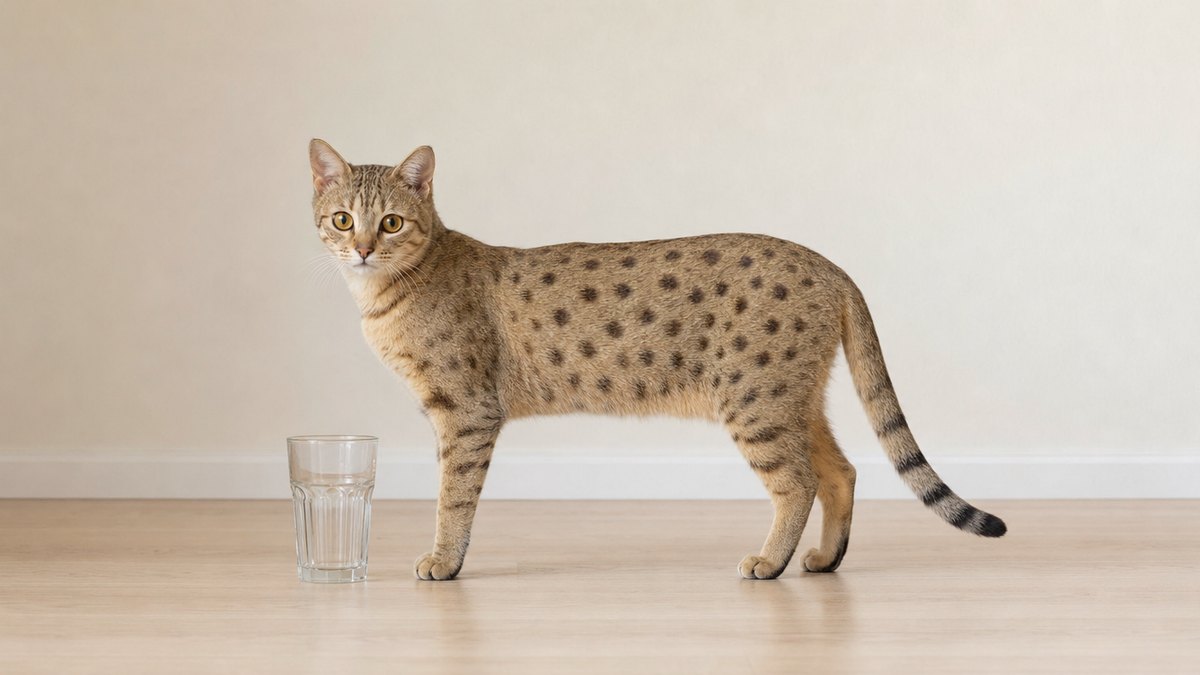
A long, low, muscular short-coated cat with dark separated spots over a warm ground, small rounded ears and, in most cats, brown eyes. Colours recorded in 1986 were silver, bronze, black, charcoal, gold, red, blue and brown, plus a snow leopard variety born white that developed its markings later and carried blue eyes. Females weighed 8 to 10 pounds and males 10 to 12.
Compare with similar breeds
California Spangled sits in 2 Bonbeno groups. Each one compares it directly against the breeds it is genuinely an alternative to, on the same figures.