
Breed profile
Toyger in India: A Kashmir Street Cat Is in the Foundation
A designed breed whose own standard calls it a designer cat, whose foundation includes a street cat imported from Kashmir in 1993, and whose one peer-reviewed paper describes a brain malformation in a line bred for the ear the standard prefers.
Quick answer
No Toyger cat price in India can be verified, because no Toyger is available in India. Google's AI answer quotes Rs 1,50,000 to Rs 30,00,000 while giving 1,500 to 3,500 US dollars as the same figure, which implies two exchange rates 8.6 times apart, and it cites a page whose only Indian rupee figure is a children's book. India's leading cat-price guide lists 14 breeds and the Toyger is not one of them.
This page summarises published veterinary research on the Toyger, including a peer-reviewed description of an autosomal recessive brain malformation syndrome in cats bred for a short ear, and the general feline literature on hypertrophic cardiomyopathy. It is reference material, not a diagnosis and not a treatment plan. Consult your nearby vet, a registered veterinarian who can examine the animal in front of them, before acting on anything here, and take any seizure, circling, head pressing, breathlessness, sudden hind-limb weakness or collapse in a cat to a clinic immediately.
Toyger at a glance
What a Toyger is, and what it is not
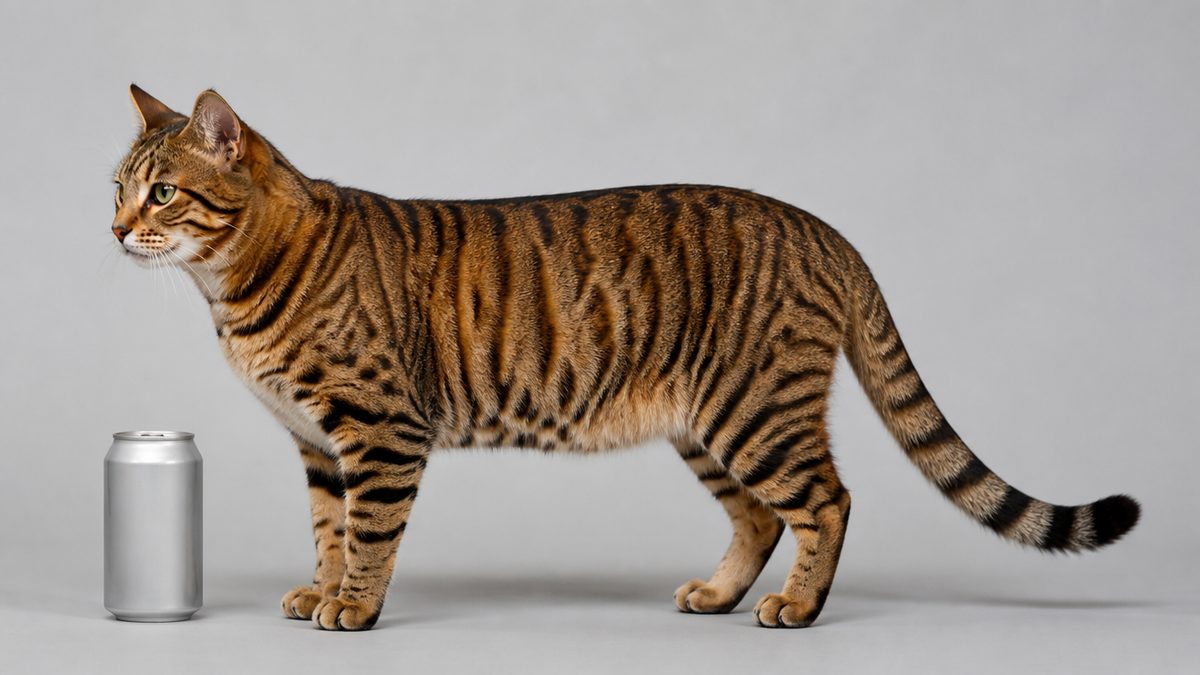
A Toyger is a medium-sized wholly domestic shorthair selected to carry a tiger's coat pattern, in brown mackerel tabby and nothing else. No wild cat appears anywhere in its ancestry, and its own standard calls it a designer cat.
The TICA standard opens with an unusually candid sentence for a breed document. It reads that the Toyger is a designer cat: a loving, glittered, medium sized domestic shorthair companion cat reminiscent of the big cats in pattern, type, confidence and movement, designed with the experience of active cat ownership in the modern urban setting foremost in mind. A registry saying the animal was designed for flats is a useful thing for an Indian reader to have in writing.
The pattern carries 40 points out of 100
Coat, colour and pattern take 40 of the standard's 100 points, split as pattern 20, colour 15 and length or texture 5. That weighting is the breed. The markings are a modified mackerel tabby, bold, braided and non-uniform, generally vertically aligned, with encircling markings on neck, legs and tail, and the belly and inside of the legs must be marked. Facial markings must run circularly around the face rather than radially away from it, which is the reverse of an ordinary tabby.
The GCCF standard reaches the same place by a different route, giving pattern and contrast 15 points, coat colour 10 and coat texture 10, and stating that at present brown black mackerel tabby is the only recognised variety. Anyone offered a silver, snow or blue Toyger is being offered a cat that neither registry can register under that name.
The ear is small, and that matters later on this page
Both standards prefer a small ear. TICA's ears clause reads, in full: Rounded. Small preferred. Set as much on the side as on the top. Thickly furred temples and ears preferred. Lynx tipping undesirable. The GCCF says the ears should be rounded and a small size is preferred, set as much on the side as on the top of the head. Hold that clause. The health section returns to it.
| Point | TICA, 05/01/2008 | GCCF, June 2026 |
|---|---|---|
| Colour accepted | Brown Mackerel Tabby ONLY | Brown black mackerel tabby only at present |
| Outcrosses | PERMISSIBLE OUTCROSSES: None | Not stated in the standard |
| Ears | Rounded, small preferred, set as much on the side as on the top | Rounded, a small size preferred, set as much on the side as on the top |
| Eye colour | Rich deep colour preferred; blue eyes withhold all awards | GREEN preferred, gold or hazel acceptable, deep shades preferred |
| Eye shape | Small to medium, circular, gently hooded | Small to medium, gently hooded, slanted toward the base of the ear |
| Weight limit | Not stated | Males not exceeding 6.8 kg, females 5 kg at maturity |
| Entropion | Not mentioned | Withhold all awards where the lower eyelid margins are not visible |
| Tail tip | Must be black | Must be black |
The British standard directs judges to withhold all awards for entropion where the margins of the lower eyelids are not visible. TICA's standard does not mention entropion at all. Entropion is an inturning eyelid that abrades the cornea, and a registry writing a withhold for it is a registry deciding that a cosmetic eye set must not be allowed to produce a painful one. It is worth asking any breeder whether the parents' eyelid margins are visible, wherever the pedigree comes from.
How the Toyger was made, and the Indian cat in the foundation
Judy Sugden built the Toyger in the United States from the 1980s using three named cats, and one of them was a street cat imported from Kashmir in 1993. That cat contributed the head pattern that distinguishes the breed.
TICA's breed page tells the story with names and dates, which is unusual and useful. In the late 1980s Judy Sugden was working to improve the clarity of the mackerel markings in tabby cats, and noticed that her cat Millwood Sharp Shooter had two spots of tabby marking on the temple, realising this could be the key to a cat with the true circular pattern of a tiger's head, since the temples of domestic tabbies do not usually carry such markings.
Two cats formed the cornerstone of the programme: a striped domestic shorthair named Scrapmetal, and a big-boned Bengal named Millwood Rumpled Spotskin. The Bengal is why the Toyger is sometimes assumed to carry wild ancestry, and it is also why the breed's closest documented relative in the lifespan literature is the Bengal.
Jammu Blu, imported 1993
The third named cat is the one no Indian page mentions. TICA records that in 1993 Judy also imported Jammu Blu, a street cat from Kashmir, India, who had all spots between his ears rather than the regular tabby lines. One commercial breed profile independently carries the same phrase, a street cat from Kashmir, India.
Read that against the Sharp Shooter observation and the sequence is clear. The trait Sugden was chasing was spotting on the temples in place of tabby lines, because that is what allows a circular tiger-style head pattern. A cat from Kashmir carried the whole thing rather than a hint of it. The circular head marking that separates a Toyger from every ordinary mackerel tabby is, in part, an Indian street cat's.
| Cat | What it was | What it contributed |
|---|---|---|
| Millwood Sharp Shooter | Judy Sugden's own tabby | Two spots of tabby marking on the temples, the observation that started the programme |
| Scrapmetal | A striped domestic shorthair | A cornerstone of the early breeding |
| Millwood Rumpled Spotskin | A big-boned Bengal | Size, boning and the rosette-derived pattern vocabulary |
| Jammu Blu | A street cat imported from Kashmir, India, in 1993 | All spots between the ears in place of regular tabby lines |
Why the breed was made, in the founder's words
Wikipedia records that Judy Sugden has stated the breed was developed in order to inspire people to care about the conservation of tigers in the wild. That article carries a maintenance banner dated March 2008 saying it needs more citations, so treat the surrounding detail with care while noting that the conservation framing is repeated by TICA, whose page says many Toyger breeders are also very concerned about conserving the beautiful wild species that cats are created to resemble.
TICA states plainly that this is an all domestic cat with no tiger blood in the Toyger, and its standard permits no outcrosses of any kind. That matters in India because the questions a wild-hybrid cat raises under wildlife law do not arise here at all. India's own pet-import FAQ contains zero occurrences of CITES, wild, hybrid or exotic, and for this breed none of them would be relevant anyway.
Registry recognition, and a fourth error in the cross-registry map
Four registries hold a Toyger standard and two do not. The World Cat Federation's cross-registry map names three recognisers and misses a fourth, which is the fourth such omission this site has verified.
State registry recognition per body rather than as one global claim. On this breed the picture is unusually clean, with one complication in the index most people would consult first.
| Registry | Status | The document that settles it |
|---|---|---|
| TICA | CHAMPIONSHIP since February 2007, code TG | The breed standard dated 05/01/2008 and the Browse All Breeds index of 73 breeds |
| GCCF | RECOGNISED, code TOY, Section 4 Group C | Standard of Points, June 2026, printed page 221 |
| WCF | RECOGNISED, code TOY | The EMS code table actualised 6 June 2026 |
| LOOF | RECOGNISED, code TGR, championnat | Liste des Races, version au 1 January 2026 |
| CFA | NOT HELD. No standard and no breed council | The 2024-25 show standards book, where Toyger returns zero across 826,048 characters |
| FIFe | NOT HELD. No EMS code | The breeds index, 49 codes, where Toyger and TOY both return zero |
Both absences are earned rather than assumed. The CFA book's contents page lists 46 standards and the string Toyger appears nowhere in it, against in-document controls of Bengal 23, Balinese 22, Siamese 20 and Ocicat 14. FIFe's index returns 49 breed codes with BEN present as a control and no Toyger row. Neither body has quietly dropped the breed; neither ever took it. The CFA's 2026 breed-council ballot confirms it from the other side, listing 12 longhair and 32 shorthair councils plus one Miscellaneous and Provisional entry, with no Toyger council anywhere on the page. TICA's position is equally visible: the Toyger sits in the Browse All Breeds index of 73 recognised breeds and in none of the three sub-class indexes, which on that site is what championship status looks like.
The map error, and why it is the fourth
The World Cat Federation publishes a cross-registry table naming, for each breed, the bodies that recognise it. Its Toyger row gives code TOY and lists WCF, TICA, GCCF and NZCF. The French studbook is not on that list, and the French studbook's own Liste des Races of 1 January 2026 carries TOYGER with code TGR and a championnat tick.
That is an omission of a recogniser rather than a false positive, which is the same shape as the three errors this site has already verified in the same map: a Japanese Bobtail Longhair row missing the CFA, a Savannah row missing LOOF, and a Korat row missing the GCCF. Four confirmed errors, all omissions, all in the same direction. Use the map to know where to look, then read the registry's own document.
One breed, two codes
The World Cat Federation codes this breed TOY and the French studbook codes it TGR Livre Officiel des Origines Felines. That joins the cross-registry code collisions this site tracks, and it matters practically: a pedigree reading TGR and a pedigree reading TOY describe the same cat, and a buyer checking one code against the other registry's tables will find nothing.
The CFA not holding the Toyger tells you nothing about the cat's quality. What it tells an Indian buyer is practical: an American pedigree for this breed will come from TICA rather than the CFA, so asking which registry issued it is a real question rather than a formality. It also means the CFA's registration rules, which several Indian sellers cite loosely, have nothing to say about this breed at all.
Is Toyger a trademark rather than a breed? Checking the register
No. In the United States register, filtered to Nice class 31 for live animals, the term toyger returns zero trade marks. The word is registered elsewhere for clothing, phones and games, and one of those registrations is Indian.
A recurring claim about designed cat breeds is that the name is owned rather than earned. This site has already tested that claim on another breed and found the story half wrong, so the method here is the same: search the register rather than repeat the story.
Filtered to the United States office and Nice class 31, live animals, the term toyger returns ZERO marks. Across all classes the United States register holds exactly one TOYGER mark, application 87359422, filed 6 March 2017 by an individual, in Nice class 35 for advertising and business services, with no registration date and a status of Ended. The instrument was proved in the same session against a control term that returns four live-animal marks, so the zero is a reading rather than a broken query.
| Office | Application | Class and goods | Status |
|---|---|---|---|
| United States | 87359422, filed 6 March 2017 | 35, advertising and business services | Ended, never registered |
| India | 2910840, filed and registered 25 February 2015 | 25, clothing | Registered |
| South Korea | 4020090019127, registered 1 June 2010 | 31, live animals | Registered |
| China | 56013056, registered 7 February 2022 | 31, live animals | Registered |
| Germany | 3020110596832, registered 11 September 2012 | 31, 35 and 44, as ToygerArt | Expired |
| Finland | T201850407, registered 2 May 2018 | 28, games and toys | Registered |
| Brazil | 921048769 and 921048912, registered 24 August 2021 | 25 and 35, as TOYGER JEANS | Registered |
The Indian mark is real and it is for clothes
An Indian reader searching for Toyger and India together will eventually reach a registered Indian trade mark for the word, and it has nothing to do with cats. Application 2910840 was filed and registered on 25 February 2015 in Nice class 25, clothing. That is the only TOYGER registration India holds. Nobody in India has registered the word for animals, and nobody has needed to.
What the answer is, stated plainly
The Toyger is a breed, not a brand. Four registries publish a standard for it, TICA granted championship status in February 2007, and the word is unowned in the class that would matter for a cat in the country where the breed was made. Where the name is registered, it is registered for jeans, phones and toys by people with no connection to the breed, which is what happens to any short, memorable coined word.
The useful question is not whether the name is owned but whether the cat is verifiable. With about 30 active breeders worldwide and 469 cats on the Pawpeds database in 2020, a Toyger offered for sale in India is far more likely to be a well-marked domestic tabby than a registered animal. Ask for the registry, the registration number and the parents' numbers, and check them with the issuing body before any money moves.
Toyger cat price in India, and a band off by a factor of ten
No Toyger price exists in India because no Toyger supply exists in India. The AI answer that fills the gap quotes a rupee band whose two ends imply exchange rates 8.6 times apart, and cites a children's book as evidence about Indian breeders.
Google India's AI Mode for the Indian commercial query says Toyger cats are extremely rare and not commonly available in India, then that if imported, a kitten typically costs anywhere from Rs 1,50,000 to Rs 3,000,000 or more, giving 1,500 to 3,500 US dollars internationally as the same figure, and cites a United States breed profile.
Do the arithmetic on both ends, which is the test this site applies to every rupee band an answer engine prints.
| End of the band | Rupees quoted | Dollars quoted | Implied rate |
|---|---|---|---|
| Floor | Rs 1,50,000 | 1,500 US dollars | 100.0 rupees per dollar |
| Ceiling | Rs 30,00,000 | 3,500 US dollars | 857.1 rupees per dollar |
| What 3,500 dollars actually is at the floor's own rate | Rs 3,50,000 | 3,500 US dollars | 100.0 |
| Spread between the two implied rates | 8.6 times |
The ceiling is out by roughly a factor of ten. Written the way the answer's own floor rate implies, 3,500 dollars is about Rs 3,50,000, not Rs 30,00,000. This site has documented answer engines converting a foreign asking price into rupees immediately after saying no local price exists, and has documented them using two slightly different rates at the two ends of one band. A band whose ends differ by 8.6 times is the same failure, an order of magnitude worse.
The source cited carries no Indian figure at all
The page the answer names is a United States breed profile whose own numbers are in dollars. It publishes no rupee figure, no Indian city band and no Indian breeder. So the rupee numbers were not read off that page; they were produced from it. The same answer separately cites Amazon.in as a source for the claim that there are very few, if any, ethical or registered Toyger breeders in India.
The only Indian rupee figure attached to this breed is a book
Searching this term in India returns one listing with a rupee price and it is Toyger Cats, a children's book by Jill C. Wheeler in a series called Designer Cats, at Rs 8,808 against a stated maximum retail price of Rs 19,026. This site has documented merchandise listings presenting themselves as breed prices before, usually a poster or a mug. Here an answer engine cited the bookshop as evidence about breeders.
| Figure | Where it appears | What it actually is |
|---|---|---|
| Rs 1,50,000 to Rs 30,00,000 | Google India AI Mode | A conversion of a US dollar band, with the ceiling out by about ten times |
| Rs 8,808 | Amazon.in | A children's book, and the only Indian rupee listing for the word |
| Rs 50,000 to Rs 1,65,000 | The same AI answer, offered as an alternative | A Bengal price, for a different and available breed |
| Rs 20,000 to Rs 70,000 | An Indian kittens index | Generic bands on the site's own landing page, not attached to this breed |
| No row at all | India's leading cat-price guide, 14 breeds | The honest position for the Indian market |
A generated local directory page exists for this breed, titled Top Pet Shops For Toyger Cat in India Gate, Delhi, produced by crossing a breed name with a locality. This site has documented that class of page filling itself with businesses that do not carry the named breed, several of them in other cities. Read each listing's own categories rather than the page title. Two independent sources put the world's active breeder count at about 30, the Toyger Cat Society database via Wikipedia and a major breed profile reaching the same figure, so any Indian listing for this breed deserves that scrutiny before a deposit.
What a Toyger would cost to keep in India
The cost of ownership of a designer breed is the cost of ownership of any medium shorthaired cat. Budget a monthly cost of roughly Rs 2,500 to Rs 4,500 in an Indian metro, plus about Rs 5,000 to Rs 9,000 in the first year once the kitten course and neutering are paid for. The purchase price is the unanswerable part, not the running cost.
No Indian breed guide prices this cat, so there is no template row to correct here. What exists is a set of published Indian rate cards that apply to any medium shorthaired cat, and those are worth more to a reader than an imported dollar figure.
| Item | Published figure | Source and scope |
|---|---|---|
| Kitten vaccination course | From Rs 3,999 for three visits at days 60, 90 and 120 | One national clinic chain's own listing, against a struck-through Rs 5,065 |
| Adult annual booster | From Rs 1,899 | Same chain, national page |
| Anti-rabies, single dose | Rs 699 | Same chain |
| Feline CRP test | Rs 1,249 | Same chain |
| Annual vaccination, second source | Rs 1,500 to Rs 3,000 | India's leading cat-price guide, a wider band from a different publisher |
| Pet licence, Chennai | Rs 50 | Greater Chennai Corporation, which issued 9,115 licences in 2024 |
| Municipal treatment and anti-rabies, Chennai | Free of cost | Greater Chennai Corporation's six pet clinics |
| Echocardiogram on breeding parents | No published Indian rate found | Ask a referral hospital or veterinary college for a quote |
The line this breed genuinely adds
One screening cost applies here and it is cardiac. TICA reports that heart murmurs, possibly indicative of hypertrophic cardiomyopathy, have occurred in the breed, and no gene test exists for this breed's HCM, so an echocardiogram on both parents is the only screen that means anything. No published Indian price for a feline echocardiogram was found on 9 September 2026, and that absence is stated rather than filled with a guess.
Where the coat saves money
Grooming is close to free. TICA describes grooming the Toyger as relatively simple and much safer than grooming a tiger, asking for an occasional brush or comb for most of the year and once daily during the short shedding seasons to keep fur on the brush rather than the furniture. No undercoat blow, no mat clipping, no salon package. Against the imported purchase price that saving is trivial, but for an Indian household comparing this cat against a semi-longhair it is real.
Add the vaccination course, one neutering, one carrier, one litter tray and three months of food, and you have the running cost of a Bengal, a domestic tabby or a Toyger, because none of those differs materially. What differs is the purchase price, which for this breed cannot be sourced in India at all. Budget the care, then decide whether the cat is findable.
Heat tolerance in India, and two climate points this page will not publish
A Toyger handles Indian warmth well, because it is a short-coated muscular domestic cat with no wild-species requirements. Neither of the two places in its own story can be measured with this site's climate instrument, and that is stated rather than worked around.
Start with the honest limits, because this breed has two geographic anchors and the grid model fails on both. The breed was developed in southern California, and the Los Angeles cell returns 395.00 m against a real elevation near 93 m, an error of about 302 m, which puts the cell on high ground behind the city rather than in it. The breed's Indian foundation cat came from Kashmir, and the Srinagar cell returns 2,630.66 m against a real 1,585 m, an error of about 1,046 m.
Neither figure is published here. A homeland baseline from a cell a kilometre above the town is worse than no baseline, and this site has recorded the same failure across Indian hill stations and mountainous terrain worldwide. What can be measured is where the cat would actually live, which is an Indian city.
| City | Annual mean, C | Hottest month | Peak Stull wet bulb, C |
|---|---|---|---|
| Chennai | 27.95 | May, 31.51 | 26.11 (May) |
| Kolkata | 25.81 | May, 31.53 | 27.09 (June) |
| Mumbai | 26.77 | May, 31.19 | 25.77 (June) |
| Delhi | 25.60 | June, 35.88 | 26.50 (July) |
| Hyderabad | 26.10 | May, 33.30 | 23.35 (June) |
| Pune | 23.86 | April, 28.93 | 22.97 (June) |
| Bengaluru | 23.74 | April, 28.37 | 21.86 (May) |
Read the last column rather than the second. Kolkata is the hardest city on this table for any cat, at a June wet bulb of 27.09, despite a lower annual mean than Chennai. Delhi is the hottest by air temperature and peaks in June rather than the May most people assume. Bengaluru and Pune both peak in April and are coolest in December, not January.
Why this coat copes
The standard asks for fur that is short, thick, luxurious and unusually soft, plush but resilient, with the markings possibly slightly longer than the ground colour for a sculpted effect. That is a single short coat on a muscular frame. There is no downy undercoat to trap warm air against the skin, which is the structure that makes northern double-coated breeds suffer in Indian summers. Nothing about this breed's morphology fights an Indian climate.
What still needs managing
- Shade and airflow rather than air conditioning, which is enough for a short-coated cat below about a 26 degree wet bulb.
- Play scheduled early and late, since this is an athletic breed that will overheat itself if encouraged at midday in May.
- Water in more than one room, placed at least three feet from the food, which raises total intake in a hot month.
- Weekly ear checks between June and September, when humidity favours ear problems in any cat.
- No parked vehicles and no closed balconies, which kill cats in Indian summers regardless of coat length.
Two of the three places this breed's story touches, southern California and Kashmir, return grid cells hundreds or thousands of metres above the real ground. Publishing those numbers would have produced a confident, wrong homeland comparison. The useful climate statement for an Indian reader is simply that a short-coated domestic cat has no structural problem in an Indian city, and the table above says what that city actually asks of it.
Health, and a brain malformation in cats bred for a small ear
The Toyger has exactly one paper in the clinical literature, and it describes an autosomal recessive brain malformation syndrome in twenty related Toygers selectively bred for a short ear phenotype. Both current standards prefer a small ear.
A PubMed audit run on 9 September 2026, reading the query translation on every query, returned exactly one record for Toyger[tiab], with a clean unrewritten translation, against a control returning 126 with a sane translation in the same session. That single record is the paper below. For a breed with championship status since 2007 and about 30 breeders worldwide, one paper is the whole literature.
What the paper found
Twenty related Oriental-derived crossbred Toyger cats were evaluated by pedigree analysis, genetic evaluation, physical and neurological examination and magnetic resonance imaging: seven clinically healthy carriers and thirteen clinically affected. The hypothesis under test was stated in the paper's own words, that congenital brain defects underlie the neurologic signs observed in Toyger cats selectively bred for a short ear phenotype.
In all cats displaying neurologic signs, the imaging found ventriculomegaly with frequent concomitant supratentorial interhemispheric communicating ventricular type-1b cysts, together with multiple midline and callosal malformations. Post-mortem and histopathological examination was carried out in eight affected and five healthy cats. Genetic analysis confirmed an autosomal recessive mode of inheritance with no chromosomal abnormalities.
Why the ear clause matters
Ear shape is where the two facts meet. Both current standards prefer a small ear, and TICA writes Rounded. Small preferred. The GCCF writes that the ears should be rounded and a small size is preferred. The paper describes a syndrome in a line selected for a short ear. Those two facts sit next to each other and nobody has put them next to each other before.
Say precisely what that does and does not establish. It does not establish that the standards cause the syndrome, that every small-eared Toyger is affected, or that the trait and the defect are the same gene. The paper studied one related group of twenty cats, and it describes the ear phenotype as the selection context rather than as a proven cause. What it does establish is that selection for a small ear in this breed has already produced, in at least one line, a recessive brain malformation severe enough to be visible on MRI in thirteen animals.
The practical consequence for a buyer
- Ask the breeder directly whether any cat in the line has shown seizures, circling, head pressing, tremor or delayed development.
- Ask whether both parents are related, since an autosomal recessive syndrome needs two carriers and carriers are clinically healthy.
- Ask for the pedigree back three generations and look for repeated names, because seven of the twenty cats in the study were healthy carriers.
- Ask for an echocardiogram on both parents, which is a separate question and the only screen for the cardiac risk.
- Take any neurological sign in a kitten to your nearby vet immediately rather than waiting to see whether it settles.
| Concern | Evidence | Is there a test |
|---|---|---|
| Forebrain commissural malformation syndrome | 13 affected and 7 carriers among 20 related cats, autosomal recessive, MRI-confirmed | No DNA test. Pedigree questions and MRI in a symptomatic animal |
| Hypertrophic cardiomyopathy | Heart murmurs possibly indicative of HCM reported by the registry; up to about 15 percent of all cats affected | Echocardiography on the parents, not a swab |
| Cow hocking | Reported by the registry as having occurred in the breed | Visual assessment of the hind limb by a vet |
| Entropion | The GCCF withholds all awards where the lower eyelid margins are not visible | Visual inspection; look at the kitten's lower lids in daylight |
| Breed-specific lifespan | Not among the 12 breeds reaching the 15-death threshold in the UK life tables | No breed figure exists; do not accept one |
Lifespan, honestly
TICA gives 13 or more years without citing a study. The largest UK feline life-table analysis reached its inclusion threshold of 15 or more deaths for exactly 12 breeds, and the Toyger is not among the 12 that reached that threshold, with the name returning zero across the whole paper. The nearest documented relative in that table is the Bengal, a foundation breed of the Toyger, at 8.51 years with a 95 percent interval of 7.12 to 9.90 on 73 deaths. That Bengal figure is not the Toyger's, and it is the closest sourced number that exists.
Everything above is published research summarised for a reader, not a diagnosis. Seizures, circling, head pressing, sudden hind-limb weakness, breathlessness or collapse in a cat are emergencies. Take them to a clinic immediately rather than researching them, and tell the vet the breed and what this page says about the line, because a general practice will not have met a Toyger before.
Temperament and household fit, written into the standard
A Toyger is a quiet, laid-back, easily handled cat, and that is not a marketing claim but a scored requirement. The TICA standard lists companionability traits as an integral part of the breed profile, breeding program and genetic makeup.
Most breed standards describe a body. This one describes a personality and says it must be bred for. The general description asks for companionability traits such as, but not limited to, dependable, quiet temperament, laid-back personality, intelligent and easily trained and handled, good athletic ability, stately movement, excellent health and longevity, and states that all of these must be considered an integral part of the breed profile, breeding program and genetic makeup.
The GCCF's version is shorter and says the same thing: the Toyger should be alert, friendly and affectionate and in excellent physical condition with a dependable temperament, and should exhibit other companionability traits such as a laid back personality, high intelligence, and be easy to handle and train. Two registries, one instruction.
Who this cat suits in India
- Flat-dwelling households, which is the environment the standard names as the design target.
- Families with children and other pets, since TICA describes a cat active enough to entertain children and adults without running you ragged.
- Owners who want a quiet cat, because the standard scores quietness rather than merely tolerating it.
- People who will interact daily, since TICA warns that if ignored the Toyger will by necessity become independent and aloof.
- Anyone who wants a wild look with none of the wild-hybrid legal and welfare questions attached.
Who should not buy one
- Anyone in India who has not first confirmed a registered cat is actually obtainable, which for this breed is the binding constraint.
- Anyone expecting a big-cat temperament to match the coat, since the whole design brief was the opposite.
- Anyone who cannot answer breeder questions about neurological signs in the line before committing.
- Anyone buying purely on appearance, since a well-marked Indian domestic tabby will satisfy that at a fraction of the cost.
- Anyone away from home for long days with no second animal, because interaction is the stated condition of the temperament holding.
TICA's Toyger standard makes temperament a breeding obligation rather than a bonus, and adds that any sign of definite challenge shall disqualify. If a breeder's adult cats cannot be handled calmly in front of you, they are failing a clause of the standard they are selling against. That is a fair and specific thing to raise.
Training approach, and what this breed resists
Train a Toyger with short reward-based sessions and expect fast progress, because both standards select for intelligence and easy handling. It resists boredom and being ignored, and almost nothing else.
TICA says Toygers are highly intelligent and easy to train to walk on a leash, play fetch or run an agility course, and recommends challenging the brain with interaction, tricks and puzzle toys that reward with treats. Both standards name easy to handle and train as a selected trait rather than an observation The Governing Council of the Cat Fancy.
Five things worth teaching first, in India specifically
- Carrier entry on cue, because a monsoon vet trip is much harder with a cat that fights the box.
- Harness and lead walking, which TICA says the breed learns easily and which is the safe version of outdoor time in an Indian city.
- Recall to a specific sound, which matters in buildings with open stairwells and shared terraces.
- Station on a mat during doorbell traffic, so the cat has a job rather than bolting past a delivery rider.
- Handling of ears, eyes and mouth for ten seconds a day, which makes weekly checks and a vet visit uneventful.
What it resists
Boredom is the whole answer. TICA's own caution is unusually direct: one of the most important aspects of caring for a Toyger is a desire on the part of family members to interact with this willing companion animal in a consistent, dependable and caring manner, and as with many cats, if ignored the Toyger will by necessity become independent and aloof. That is a registry telling you the temperament you are paying for is conditional.
The other thing it resists is repetition. An intelligent cat drilled on one trick disengages. Rotate, and stop while it still wants more.
TICA recommends a cat exercise wheel and says most Toygers teach themselves to run on one. In a small Indian flat that is genuinely useful, because it converts vertical energy into a stationary activity that does not need a person present. If a wheel is not practical, TICA's alternative is plenty of toys or children.
Daily exercise requirement in an Indian flat
A Toyger needs about 30 to 45 minutes of active play a day, scheduled at the cool ends of an Indian day. It is athletic by standard rather than by accident, and the standard scores musculature at 6 points.
The TICA standard asks for a cat that is very muscular and athletic looking, especially in young males, with very large, dense, robust boning that is never delicate, and scores boning at 7 points and musculature at 6. That is 13 of 100 points on physical condition, which is an unusual amount for a cat standard and tells you what the animal needs.
TICA describes the practical level well: active enough to entertain children and adults alike, but not so energetic that he will run you ragged. This is not a Bengal's energy budget, and that is deliberate.
How to split it
- Two wand sessions of ten to fifteen minutes, early morning and after dark, avoiding the middle of an Indian day.
- One food-puzzle meal daily, which converts feeding into working time at no extra cost.
- A cat exercise wheel where space allows, which the registry specifically recommends for this breed.
- Vertical furniture in at least two rooms, since a large-boned athletic cat uses height rather than floor area.
- Harness walks in shade at the cool ends of the day, which the breed learns readily.
The Indian timing rule
Play early and late. In Chennai in May, with a mean of 31.51 degrees C and a peak wet bulb of 26.11, midday play is a heat risk rather than exercise. In Delhi the same logic applies a month later, at a June mean of 35.88. In Bengaluru and Pune, which peak in April at 28.37 and 28.93, the usable window is wider through most of the year.
Counter-surfing, night activity, door-opening and destructive play are the standard signs, and in this breed they arrive alongside the aloofness TICA warns about. Add twenty structured minutes a day for two weeks before concluding anything about temperament, and take genuine overgrooming to your nearby vet, because skin disease and boredom look identical in a photograph.
Grooming a short plush coat in Indian humidity
Brush a Toyger occasionally through most of the year and daily during its short shedding seasons. Humidity changes the ear routine rather than the coat routine, and glitter is a coat property rather than a product.
TICA's advice is short because the job is short: brush or comb them occasionally for most of the year, and once a day during their short shedding seasons to keep fur on the brush rather than the furniture. The standard describes fur that is thick, luxurious and unusually soft, plush but resilient, short except that markings may be slightly but uniformly longer than the ground-coloured fur for a sculpted effect.
The weekly routine, in full
- Brush weekly with a soft rubber curry, and daily for the two or three weeks of a seasonal moult.
- Check ears weekly between June and September and fortnightly otherwise, using a dry cotton pad and no liquid.
- Look at the lower eyelid margins in daylight each week, since the GCCF withholds awards where they are not visible.
- Trim nail tips every two weeks, taking only the white tip.
- Brush teeth twice a week with a veterinary paste, because dental disease is the cost owners most under-budget.
Glitter is not a grooming product
The standard requires some glitter and says the more the better without undue loss of contrast or whited ground. Glitter in a cat coat is a light-scattering property of the hair shaft, not a coating, and nothing you buy adds it. A seller offering a spray or a supplement to improve glitter is selling something the standard does not recognise.
What Indian humidity actually changes
Humidity does not mat this coat, because there is no undercoat to felt. It favours ear and skin problems, and the routine that prevents them is weekly inspection rather than more brushing. Bathe only when the cat is genuinely dirty, plug the ears first, and dry properly with a towel and a fan on low rather than leaving the cat to air-dry, since coastal Indian humidity runs above 85 percent for weeks in the monsoon.
A short plush coat leaves less visible hair on an Indian sofa, which is a real convenience. It is not an allergy claim. A 2024 review states flatly that there is no scientific evidence for a hypoallergenic cat breed, and neither Toyger standard mentions shedding or allergens at all. An allergic buyer should spend an hour with an adult cat of the breed before committing.
Feeding a Toyger in India, by life stage
Feed a kitten three to four small meals a day to about six months, then twice a day as an adult, with wet food doing real work in an Indian summer. Watch condition rather than weight, because the standard asks for a large-boned cat that is never bulky.
TICA's guidance is that Toygers do not have any particular nutritional needs beyond fresh water always available and a good quality diet of both wet food and dry kibble, and it repeats the standard behaviourist advice to place the water bowl at least three feet away from any food, because a strong food smell can reduce drinking.
- Kittens to six months, three to four small meals a day, weighed rather than eyeballed.
- Six to twelve months, three meals tapering to two, with a large-boned breed still filling out at a year.
- Adults, two meals a day, with wet food forming a real share rather than a garnish.
- Seniors from about ten years, the same frequency, with an annual blood and urine panel added.
- All ages, water changed daily and placed away from food, in more than one room.
The weight ceiling that decides portions
The GCCF puts a hard number on it: at maturity males should not exceed 6.8 kg and females 5 kg. TICA gives 10 to 15 pounds for males and 7 to 10 for females on its breed page, which is roughly 4.5 to 6.8 kg and 3.2 to 4.5 kg. Those two overlap at the top and the British ceiling is the stricter statement. Use it.
The standard also penalises excessive size or unmuscled bulk explicitly. A large-boned cat carrying fat looks correct to an inexperienced eye and is not, which is exactly the failure mode this breed invites.
Body condition beats a chart
Feel the ribs easily under a thin covering, see a waist from above and a tuck from the side, and expect to feel dense heavy boning underneath that has nothing to do with condition. If you cannot find the ribs on a Toyger, the cat is overweight regardless of what the scale says relative to the 6.8 kg ceiling.
Onions and garlic, chocolate, alcohol, cooked bones, raw eggs, grapes and raisins, xylitol and caffeine appear on every credible avoid-list. Onion and garlic matter more in an Indian kitchen than a Western one, because both are in almost every dish and a cat that scavenges is exposed daily rather than occasionally.
Month by month through a Toyger kitten's first year
Expect a longer, less rufused, less coordinated kitten than the adult photograph suggests, because the standard says so. The pattern and the colour both intensify with maturity.
The TICA standard's allowances clause is the honest guide to a Toyger kitten: kittens may be somewhat longer coated, be less rufused and be rather uncoordinated, and colour may vary somewhat in intensity seasonally. The GCCF adds that allowances should be made for a slightly longer coat in kittens. Judge a kitten's pattern against its parents rather than against an adult show photograph.
| Age | What is happening | What to do in India |
|---|---|---|
| 0 to 8 weeks | With the queen. Coat is longer and colour paler than it will be | Do not take the kitten. Indian pet shop rules treat kittens below eight weeks as un-weaned |
| 8 to 10 weeks | Home transition, litter training, first fears | First vaccination visit; a three-visit course from Rs 3,999 at one national chain |
| 8 to 12 weeks | Neurological development is complete enough to assess | Watch for circling, tremor, head pressing or delayed milestones and report any to your vet at once |
| 10 to 14 weeks | Socialisation window closing; handling habits set for life | Second visit; start harness introduction and ten seconds a day of ear and eye handling |
| 14 to 16 weeks | Rabies dose due; climbing begins in earnest | Third visit; mesh the windows and balcony before this stage, not after |
| 4 to 6 months | Rapid growth, teething, coordination arrives | Discuss neutering timing with your vet; add vertical furniture or a wheel |
| 6 to 12 months | Ground colour rufuses, pattern contrast sharpens | Annual booster planning; switch to adult feeding at two meals |
| 12 to 24 months | Boning and musculature fill in, especially in males | Monthly condition check against the 6.8 kg ceiling for males and 5 kg for females |
The eight-week line is law in India, not etiquette
The Prevention of Cruelty to Animals (Pet Shop) Rules, 2018 treat kittens below eight weeks as un-weaned, and the Second Schedule's paragraph 2, headed FOR CATS, sets out six housing requirements including that cats or kittens shall be kept in a room which is not shared by other, inimical animal species such as dogs. A seller offering a six-week kitten is telling you about the whole operation.
A citable absence in the same instrument: its microchipping requirement is written as micro-chipped and is scoped to puppies, so kittens fall outside it. Microchip the cat anyway.
A registry name and registration numbers for the kitten and both parents, an echocardiogram report for both parents with a date, a direct written answer about neurological signs anywhere in the line, a vaccination card with batch numbers, and a visit with the mother present. For a breed with about 30 breeders worldwide, a seller who cannot supply the first item is not selling this breed.
Toyger against the cats an Indian buyer can actually get
Compare the Toyger against the Bengal, the Ocicat, the Egyptian Mau and a well-marked Indian domestic tabby. Only one of those is genuinely available in India, and it is the last one.
The honest comparison is not between wild-looking breeds. It is between a cat you can find and a cat you cannot. Google's own AI answer reaches the same conclusion by a different route, offering the Bengal as the locally available alternative at Rs 50,000 to Rs 1,65,000 through breeders in Bangalore, Mumbai and Delhi.
| Cat | Pattern | Registry position | Indian availability |
|---|---|---|---|
| Toyger | Modified mackerel tabby, bold vertical braided stripes, circular face markings | TICA, GCCF, WCF and LOOF; not CFA, not FIFe | None found. About 30 breeders worldwide |
| Bengal | Rosetted or marbled spots, a foundation breed of the Toyger | Held by every major registry | Rs 30,000 to Rs 80,000 in India's leading guide |
| Ocicat | Spotted, wholly domestic, no wild ancestry | Held by CFA, TICA, FIFe, WCF, GCCF and LOOF | No Indian price sourceable |
| Egyptian Mau | Naturally spotted, the only natural spotted breed | Held by every major registry | No Indian price sourceable |
| Indian domestic mackerel tabby | Vertical stripes, sometimes strikingly bold | None, and none needed | Free to Rs 2,000 through shelters and municipal routes |
The comparison that decides most Indian purchases
A well-marked Indian domestic mackerel tabby already carries vertical stripes on a warm ground. What it lacks is the circular face pattern, the whited belly and the extreme contrast the standard scores. Those three things are what forty years of selection bought, and they are what you are paying for. That is a real thing to want, and it is worth knowing precisely what it is.
Against the Bengal the argument is different. The Bengal is available in India, is in the same lineage, and is one of the 12 breeds with a published median lifespan, at 8.51 years on 73 deaths. The Toyger's temperament is the quieter of the two by design, which is the case for preferring it if you could get one.
Buyers often group the Toyger with the Savannah and the Bengal as wild-derived cats. The Toyger is not one. TICA states there is no tiger blood in it and its standard permits no outcrosses at all. That removes an entire category of Indian regulatory uncertainty that attaches to genuine wild hybrids, and it is one of the few respects in which this breed is simpler than its alternatives.
Mistakes Indian buyers make with this breed
Five mistakes account for most bad Toyger decisions in India, and the first is believing a rupee figure that was produced rather than observed.
1. Taking the AI answer's rupee band at face value
The band quoted is Rs 1,50,000 to Rs 30,00,000 alongside 1,500 to 3,500 US dollars for the same cat, which implies 100 rupees to the dollar at one end and 857 at the other. Test both ends of any rupee band you are shown against whatever foreign figure sits beside it. If the two ends imply different rates, the number was calculated rather than observed, and if they differ by a factor of eight it was calculated badly.
2. Reading a bookshop listing as market evidence
The only Indian listing with a rupee figure attached to this word is a children's book at Rs 8,808, and an answer engine cited that retailer as a source for a claim about Indian breeders. Before quoting any rupee figure for any breed, confirm the listing is for a live animal.
3. Trusting a generated local directory
A page exists titled Top Pet Shops For Toyger Cat in India Gate, Delhi, and an Indian kittens index ranks for the term while its quoted rupee bands of Rs 20,000 to Rs 35,000 and Rs 25,000 to Rs 70,000 sit on its own landing page and are attached to no breed at all. Pages of that shape are produced by crossing a breed name with a locality, and this site has documented them filling with businesses that do not carry the named breed and are sometimes in other cities entirely. Read each listing's own categories rather than the page title.
4. Buying a colour the standard does not accept
Both registries accept brown mackerel tabby only, and TICA writes it in capitals The Governing Council of the Cat Fancy. Silver, snow, charcoal and blue Toygers are advertised. Whatever those cats are, no registry will show them under this breed name, so a premium paid for a rare Toyger colour is a premium paid for something that does not exist in the standard.
5. Not asking about the neurological line
The breed's only paper describes an autosomal recessive brain malformation syndrome, and seven of the twenty cats studied were clinically healthy carriers. Healthy carriers are invisible. The only tool a buyer has is the pedigree and a direct question, so ask it, in writing, and ask whether the parents are related.
- Verify the registry and the registration numbers for kitten and both parents before discussing price.
- Verify an echocardiogram exists for both parents, with a date.
- Verify the colour is brown mackerel tabby, which is the only one either standard accepts.
- Verify the kitten is at least eight weeks old and housed away from dogs, both of which Indian rules require.
- Verify any rupee figure against the raw markup of the page that produced it.
With about 30 breeders in the world and 469 cats on a pedigree database in 2020, the arithmetic makes an Indian Toyger listing improbable before you look at it. The likeliest thing offered under the name is a boldly marked domestic mackerel tabby, which may be a fine cat and is not this breed. Ask for the registration number first, not last.
Adoption, and the realistic route for an Indian household
Adopt a bold-striped Indian domestic tabby, or buy a Bengal from a verifiable Indian breeder. Importing a Toyger is legal and possible, and it is the hardest and least sensible of the three routes for almost every household.
Start with what exists. There is no Indian Toyger breeder, no Indian registry entry and no rescue pipeline for the breed. What exists is a very large population of Indian domestic mackerel tabbies, many of them strikingly marked, and a municipal system that will vaccinate them free in at least one metro.
Three routes, in the order worth trying
- Local shelter or foster network first, where a boldly striped tabby turns up constantly and where an adult's temperament is already visible.
- A verifiable Indian Bengal breeder second, since the Bengal is a foundation breed of the Toyger, is genuinely available and has a published median lifespan.
- Import last, as a personal pet, after confirming a registered breeder abroad will actually sell and export to India.
If you do import, what the rules actually say
India's foreign trade FAQ for pet import names cats explicitly, gives ITC(HS) 01061900, limits entry to a named list of ports and sends anything outside the personal pet allowance to the Exim Facilitation Committee. Because the Toyger is wholly domestic, none of the wild-hybrid questions that complicate other wild-looking cats apply. The obstacle is supply rather than law: with about 30 breeders worldwide, most of them will have a waiting list before they have an export policy.
What adoption gets you that importing cannot
An adult cat's temperament is already visible, and for this breed temperament is the point. TICA's own warning is that an ignored Toyger becomes independent and aloof, which means the temperament in the standard is a product of handling as well as breeding. An adult shelter cat shows you what it is. A kitten flown across the world does not, and neither does a photograph.
Greater Chennai Corporation charges Rs 50 for a pet licence and its six pet clinics provide all treatment and anti-rabies vaccination free of cost, having issued 9,115 licences in 2024. Against an import quoted anywhere between Rs 1,50,000 and a figure that turns out to be a mistyped conversion, a striped Indian shelter cat with a municipal licence is a serious proposition rather than a consolation prize. The stripes are already vertical.
Toyger questions people actually ask
How much does a Toyger cat cost?
Western breeders quote 1,200 to 5,000 US dollars depending on the source, and no Indian price exists because no Indian breeder does. Converting that dollar band into rupees would be fabrication, and the AI answer that tried produced Rs 1,50,000 to Rs 30,00,000 from the same dollar figures, a band whose two ends imply exchange rates 8.6 times apart.
What is the cat price in India?
India's leading cat-price guide puts pedigree cats between Rs 10,000 and Rs 1,20,000 and the Indian domestic or desi cat at Rs 0 to Rs 2,000, across a table of 14 breeds. The Toyger appears in none of those rows. The Bengal, its own foundation breed, is priced at Rs 30,000 to Rs 80,000 and is genuinely available.
What is the most expensive cat breed in India?
By the 14-row table India's leading guide publishes, the Sphynx at Rs 50,000 to Rs 1,50,000 and the Himalayan at Rs 30,000 to Rs 1,20,000 are the top rows. Higher figures circulate for the Savannah, but those rest on import quotes rather than on Indian transactions, and no Toyger figure of any kind is sourceable in India.
What is the top 1 expensive cat?
No registry or market body ranks cat breeds by price, so any single answer is a magazine list rather than a fact. What is checkable is that the most expensive Indian row in the leading guide is the Sphynx at up to Rs 1,50,000, and that Western Toyger quotes reach 5,000 US dollars, which is a different market with different costs.
Is the Toyger a real breed or a trademark?
A real breed, and the register settles it. Filtered to the United States office and Nice class 31, live animals, the term toyger returns zero trade marks. The only United States TOYGER mark is a 2017 application in the advertising class that never registered and is now Ended. Four registries hold a Toyger breed standard, so the breed exists in exactly the way the name does not.
Does a Toyger have tiger in it?
No. There is no tiger, no wild cat and no hybrid anywhere in the Toyger. TICA states plainly that this is an all-domestic cat with no tiger blood, and its standard allows no outcrosses at all. The breed was made from domestic mackerel tabbies, a Bengal and an Indian street cat, selected over four decades for a pattern.
Is there an Indian cat in the Toyger's ancestry?
Yes. In 1993 Judy Sugden imported Jammu Blu, a street cat from Kashmir, chosen because he carried all spots between his ears rather than the regular tabby lines. The circular head pattern that distinguishes a Toyger from any other tabby traces in part to that cat, which makes India a source of the breed rather than merely a market for it.
Are Toygers healthy?
The breed has one paper and it is a serious one. Twenty related Toygers were studied, 13 of them clinically affected by ventriculomegaly with interhemispheric cysts and midline brain malformations, in cats selectively bred for a short ear phenotype, and the inheritance was autosomal recessive. TICA separately reports heart murmurs possibly indicating hypertrophic cardiomyopathy, and cow hocking. Ask the breeder about both.
How long do Toygers live?
No breed-specific figure exists. The largest UK feline life-table study reached its 15-death inclusion threshold for exactly 12 breeds and the Toyger is not among them, with the name returning zero across the whole paper. TICA gives 13 or more years without citing a study. The nearest documented relative in that table is the Bengal at 8.51 years on 73 deaths.
What colours do Toygers come in?
One. Both current standards accept brown mackerel tabby only, and the TICA standard writes COLOR: Brown Mackerel Tabby ONLY in capitals. Silver, snow, charcoal and blue Toygers are advertised, and none of them can be shown or registered as a Toyger in the colour classes either registry publishes.
Can you keep a Toyger in an Indian flat?
Yes, and the flat is what the breed was designed for. The TICA standard says the cat was designed with the experience of active cat ownership in the modern urban setting foremost in mind, and asks for a dependable, quiet temperament and a laid-back personality as part of the breed profile. A short plush coat also handles Indian warmth better than any semi-longhair.
Are Toyger cats hypoallergenic?
No. No cat breed is. A 2024 review states flatly that there is no scientific evidence for a hypoallergenic cat breed, and nothing in either Toyger standard mentions shedding or allergens. The coat is short and low-maintenance, which reduces visible hair in a humid Indian flat and says nothing about allergen load.
What should I ask a Toyger breeder?
Five things. Which registry issued the pedigree and the parents' registration numbers; whether both parents have had an echocardiogram and when; whether any cat in the line has shown seizures, circling or head pressing; whether the kitten is at least eight weeks old; and whether the cats are housed away from dogs, which Indian pet shop rules require.
Compare with similar breeds
Toyger sits in 2 Bonbeno groups. Each one compares it directly against the breeds it is genuinely an alternative to, on the same figures.