
Breed profile
Pixie-bob in India: The Bobtail Is a Manx Mutation
A large woolly-coated American cat whose defining bobbed tail has been sequenced, and whose one shared allele with the Manx was looked for in eight bobcats and not found.
Quick answer
No pixie bob cat price in India can be sourced, and the only Indian rupee listing for the name is a children's book at Rs 2,569. The breed's bobcat origin story has been tested: 8 of 14 short-tailed Pixie-bobs sequenced carried c.998delT, the same Brachyury deletion that shortens a Manx tail, and that allele was not found in eight American bobcats. That is evidence about the tail, not a whole-genome ancestry test.
This page summarises published genetic and veterinary research on short-tailed and polydactyl cats, including the T gene mutations behind the bobbed tail and the clinical literature on feline polydactyly and hypertrophic cardiomyopathy. It is reference material, not a diagnosis and not a treatment plan. Consult your nearby vet, a registered veterinarian who can examine the animal in front of them, before acting on anything here, and take any difficulty passing faeces, hind-limb weakness, loss of tail sensation, breathlessness or collapse in a cat to a clinic immediately.
Pixie-bob at a glance
What a Pixie-bob is
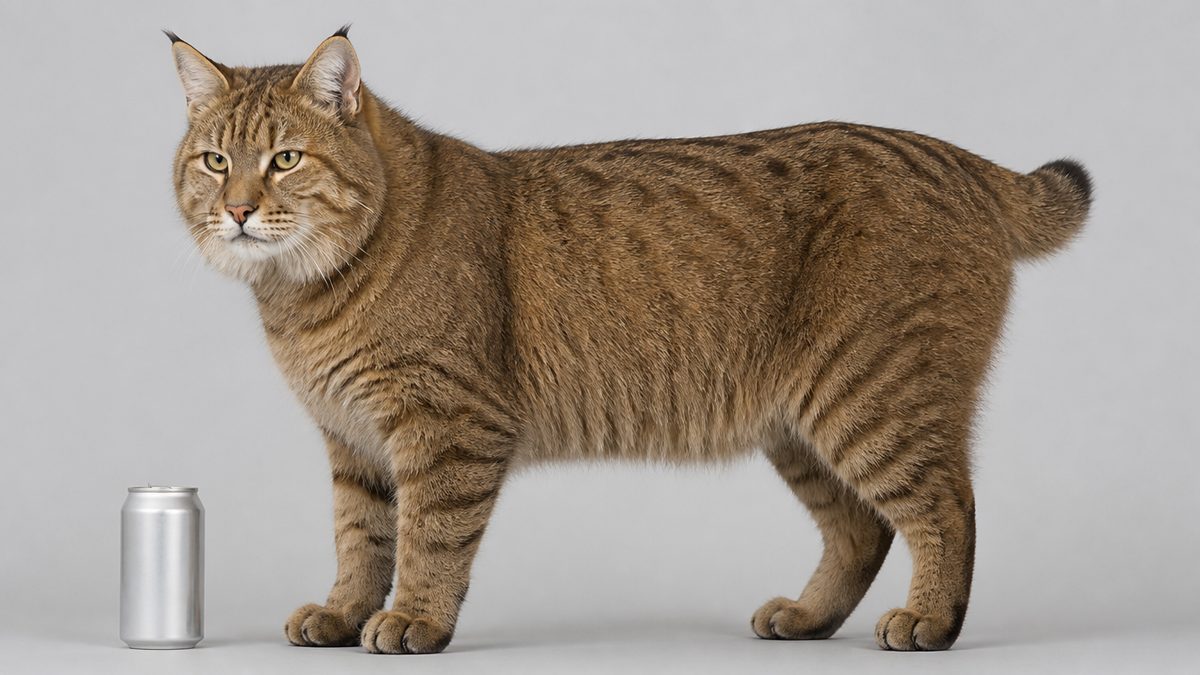
A Pixie-bob is a medium to large, heavily boned domestic cat with a woolly double coat, a bobbed tail and, uniquely among two breeds, permission to have extra toes. It was bred to look like a North American bobcat, and its own registry says so in exactly those terms.
TICA states the breeding programme's purpose without decoration: the goal of the Pixiebob breeding program is to create a domestic cat with a visual similarity to the North American Bobcat. Visual similarity. That single phrase is the most useful sentence any source produces about this breed, and the section below on the bobcat question is essentially an examination of how far it has been stretched.
The coat is a double coat, and that decides the India question
TICA describes a thick double coat with a woolly texture that stands off from the body, giving it a padded feel when petted, with longhairs carrying a medium coat up to two inches in a softer, silkier texture. The pattern is a brown spotted tabby from tawny to reddish brown, with small spots muted by heavy ticking, the ticking heavier and more silvery in winter. Facial hair grows downward into what the registry calls muttonchop sideburns, and some cats carry lynx tips on the ears.
The head and the eye
The most notable characteristics, in the registry's own summary, are the deep-set, heavily hooded eyes, a well-developed fleshy chin and the short tail. The face is an inverted pear with a thick fleshy chin and puffy nose leather, and a heavy brow sits over a medium, soft, triangular eye. Eye colour is golden brown or gooseberry green.
The tail, with the clause that matters clinically
The minimum tail length is two inches and it can reach the hock, though some cats fall outside both ends. Then comes the clause a buyer should read twice: the tail is frequently kinked or knotted but should be completely flexible and move naturally. A kink is within the breed. A rigid, fused or painful tail is not, and it is a reason to involve a vet rather than a reason to accept a discount.
| Feature | What TICA describes | What a buyer should check |
|---|---|---|
| Size | Males 12 to 17 pounds, females 8 to 12; substantial boning, rangy body, rolling gait | That the weight is muscle, since the registry warns against mistaking obesity for size |
| Coat | Thick double coat, woolly, standing off the body; longhair up to two inches | How much cooling your home can provide in an Indian summer |
| Pattern | Brown spotted tabby, tawny to reddish brown, small spots muted by heavy ticking | That the spotting is muted rather than Bengal-crisp |
| Tail | Minimum two inches, up to hock length, frequently kinked or knotted | That it is COMPLETELY FLEXIBLE and moves naturally |
| Feet | Polydactyly permitted, maximum seven toes | That extra toes are well formed and the cat walks soundly |
| Eyes | Deep-set, heavily hooded, medium soft triangular; golden brown or gooseberry green | That hooding does not obstruct the eye or roll the lid inward |
| Voice | Chirps, chitters and the occasional growl | Nothing. This is a quiet cat by ordinary standards |
TICA's own breed page says in its opening summary that this is one of only two breeds that accept polydactyls, and four paragraphs later that it is the only breed that accepts polydactyls. Both sentences are on the page today. The World Cat Federation's cross-registry table settles it: exactly two rows in the whole table carry the polydactyl marker, the Pixiebob and the Maine Coon Polydactyl, and the second is recognised by TICA. So one of only two is right, and a widely-read commercial profile repeating that the Pixie-Bob is the only cat breed where polydactyly is permitted is repeating the wrong half.
How the breed was made, from the registry's own account
Carol Ann Brewer built the Pixie-bob in Washington State from two short-tailed males bought and rescued in 1985 and 1986. TICA's history names the cats and the dates, and it never once says a bobcat sired any of them.
In the spring of 1985 Carol Ann Brewer purchased a polydactyl spotted male kitten with a short tail from a couple in the foothills of the Cascade Range in Washington State. In January 1986 she rescued a classic-patterned male with a short tail who stood as tall as her knees, and named him Keba. Keba bred a neighbour's domestic female named Maggie, who delivered a litter in April 1986, and Brewer kept one female kitten with muted spotting on a reddish-fawn coat, naming her Pixie.
By 1987 Brewer had decided these bobtailed cats had a distinctive appearance and began looking for more, partly out of concern about what would happen if she lost Pixie. In 1989 she documented a standard describing the traits being consistently reproduced, and named the breed Pixiebob after her original cats. She approached TICA in 1993; TICA accepted the breed for Exhibition Status in 1994, advanced it to New Breed and Colour effective 1 May 1996, and granted championship status in 1997 beginning with the 1998 show season.
What the registry leaves out, and what Wikipedia adds
TICA's history describes Keba as a classic patterned male with a short tail who stood as tall as her knees. It does not say he was sired by a bobcat. Wikipedia does, recording that Keba was reported to have been sired by a bobcat and that he weighed 7.7 kg while starving, and adding that Brewer went on to introduce 23 cats from around the Cascade Range that she believed to be the progeny of naturally occurring hybrid matings between bobcats and domestic cats.
Read those two accounts together and the shape of the story is clear. The claim of bobcat parentage was always a report and a belief, held by the founder about cats she acquired, and the registry's own history states the programme's goal as visual similarity rather than descent. Nobody is being accused of anything. The distinction between what was believed and what was demonstrated is simply the whole subject of the next section.
| Year | What happened | Source |
|---|---|---|
| Spring 1985 | A polydactyl spotted male kitten with a short tail bought in the Cascade foothills | TICA breed page |
| January 1986 | Keba rescued, short-tailed, standing as tall as Brewer's knees | TICA breed page |
| April 1986 | A litter from Keba and a neighbour's female, Maggie; Brewer keeps Pixie | TICA breed page |
| 1989 | Brewer documents a standard and names the breed Pixiebob | TICA breed page |
| 1993 to 1994 | Brewer approaches TICA; Exhibition Status granted | TICA breed page |
| 1996 | Advanced to New Breed and Colour effective 1 May | TICA breed page |
| 1997 to 1998 | Championship status granted, beginning with the 1998 show season | TICA breed page |
| 1999 | Frank Ditto's attempt to patent the Pixie-bob is rejected by the USPTO, upheld on appeal | Wikipedia |
Wikipedia records that Frank Ditto attempted to patent the Pixie-bob in 1999, that his application was rejected by the United States Patent and Trademark Office, and that successive litigation upheld the rejection. Whatever else this breed is, it is one of very few cats whose existence has been argued over in a patent office. It is also a useful reminder that the register is a checkable public record, which the next section uses.
Does the Pixie-bob have bobcat in it? What the genetics actually show
The breed's defining trait has been sequenced and it is domestic. In 8 of 14 short-tailed Pixie-bobs, the short tail is caused by c.998delT, the same Brachyury deletion that shortens a Manx tail, and that allele was looked for in eight American bobcats and not found.
One peer-reviewed paper bears directly on this question and almost nobody quotes it. A 2013 study collected buccal swabs and phenotypic data from 196 domestic cats, comprising 136 Manx, 21 American Bobtail, 14 Japanese Bobtail, 15 Pixie-Bob and 10 Kurilian Bobtail, along with DNA from eight American bobcats. It sequenced the T gene, which encodes the Brachyury protein, in all of them.
The result, in the paper's own words
Under a heading reading Mutant T alleles cause short-tailed phenotypes in the American Bobtail and Pixie-Bob, the paper reports: sequencing of exon 8 of T in 15 Pixie-Bobs, including 14 short-tailed cats and one cat with a full tail, identified the c.998delT allele in 8 of 14 short-tailed cats. A Pixie-Bob with a full tail and the six remaining short-tailed Pixie-Bobs did not carry the mutation.
It then addresses the origin story directly: the origin of the Pixie-Bob is controversial and purportedly resulted from hybridization between a domestic cat and an American Bobcat, however, the c.998delT allele was not found in samples from eight American Bobcats.
| Group | Cats sequenced | Result |
|---|---|---|
| Pixie-bob | 15, of which 14 short-tailed | c.998delT in 8 of 14 short-tailed cats; 6 short-tailed cats carried no T mutation in any exon |
| Manx | 136 | Four mutant T alleles; 95 percent of short-tailed Manx heterozygous |
| American Bobtail | 21 | c.998delT in 12 of 20 short-tailed cats, one carrying c.1199delC |
| Japanese Bobtail | 14 | No causal T variant found |
| Kurilian Bobtail | 10 | No causal T variant found |
| American bobcat | 8 | c.998delT NOT present |
What that establishes, precisely
It establishes that the trait the breed is named for is a domestic mutation. c.998delT is one of the Manx alleles, it is shared with the American Bobtail, and the paper notes that both breeds developed more recently in the United States. A bobbed tail on a Pixie-bob is, in most tested cats, a Manx tail arriving by a different route. It is not evidence of a wild ancestor, and the bobcats tested did not carry it.
What it does not establish, and this page will not overstate it
- It is one gene, not a genome. Testing a tail locus says nothing about ancestry at any other locus.
- Six of the fourteen short-tailed Pixie-bobs carried no T mutation anywhere in the gene, so a second and unidentified cause of the short tail exists in this breed.
- Eight bobcats is a small comparison group, and absence of one allele in eight animals is a narrower statement than absence of bobcat ancestry.
- The breed's own long-standing claim rests on testing reportedly conducted in 1996 whose methodology and primary data do not appear to be publicly available, so there is nothing to check on that side either.
- As late as 2020, a forensic paper stated that commercial microsatellite arrays and DNA barcoding had not been developed for identifying bobcat and domestic cat hybrids at all.
That last point deserves its own sentence, because it is the one that keeps the question open. When Colorado Parks and Wildlife needed to determine whether a seized animal was a bobcat or a bobcat and domestic cat hybrid in 2018, the investigators wrote that no such commercial test existed and that limited time and resources prevented them developing one, so they instead targeted endogenous feline leukemia virus to show the absence of domestic cat DNA. A purpose-built hybrid test is a workaround someone builds for a single case, not something a cattery can order.
Google India's answer for this breed states, under a heading reading No Wild DNA, that despite looking wild and having early myths of bobcat parentage, genetic tests show they are fully domestic cats. That is firmer than the evidence. What the published genetics show is that the tail allele is domestic and absent from eight bobcats. What has never been published is a genome-wide ancestry test on this breed. The marketing overclaims the bobcat and the answer engine overclaims its refutation, and the accurate position sits between them.
The trade mark that says it out loud
The most direct comment on this question was filed by the breed's own people at the United States trade mark office. In Nice class 31, the class for live animals, the register carries PIXIE-BOB: THE BOBCAT WANNABE, filed 27 April 1999 and registered 3 July 2001 to Twilight Hunter Cattery, now Ended; and FOREST HUNTER PIXIE BOBS - THE BOBCAT WANNABE, filed 11 December 2018 and registered 16 July 2019, still live. The holder of the live mark is Kornelia Surmann, who chairs TICA's own Pixiebob breed committee.
Two catteries, twenty years apart, chose to register the word wannabe in the class for live animals. Whatever the founding claims were, the people breeding the cat today have put the joke on the register.
Registry recognition, and what a pedigree will actually say
Four registries of six hold the Pixie-bob and three do not. Two of the four give the two coat lengths different codes from each other, so one cat can carry four different code strings depending on where its pedigree was issued.
State registry recognition per body rather than as one global claim. On this breed the division is clean and the codes are not.
| Registry | Status | Codes | The document that settles it |
|---|---|---|---|
| TICA | CHAMPIONSHIP from the 1998 show season, both coat lengths | Pixiebob and Pixiebob Longhair | The breed page and the Browse All Breeds index of 73 breeds |
| WCF | RECOGNISED, both coat lengths, marked as a polydactyl breed | PXS and PXL | The EMS code table actualised 6 June 2026 |
| ACF | RECOGNISED | Not published in the cross-registry table | Named as a recogniser in the WCF table |
| LOOF | RECOGNISED, championnat, both coat lengths | PBS and PBL | Liste des Races, version au 1 January 2026 |
| CFA | NOT HELD | None | The 2024-25 show standards book, zero occurrences across 826,048 characters |
| FIFe | NOT HELD | None | The breeds index, 49 codes, where Pixie returns zero |
| GCCF | NOT HELD | None | Standard of Points June 2026, zero occurrences across 723,034 characters |
All three absences are earned rather than assumed, and each was checked with in-document controls. The GCCF's Standard of Points returns zero for Pixiebob, Pixie-Bob and Pixie Bob against Toyger 12, Balinese 18, Bengal 15 and Devon Rex 7, and the single occurrence of the string pixie anywhere in those 315 pages is inside the Devon Rex standard, describing that breed's pixie face. The CFA book returns zero against Bengal 23, Balinese 22, Siamese 20 and Ocicat 14. FIFe's index returns zero while carrying CYM, MAN, KBL, KBS and JBS as short-tailed controls.
Four codes for one cat
The World Cat Federation codes the two coat lengths PXS and PXL; the French studbook codes them PBS and PBL Livre Officiel des Origines Felines. A buyer holding a French pedigree reading PBL and checking it against a German table will find nothing, and vice versa. That joins the cross-registry code collisions this site tracks, and here it is doubled because the breed has two coat lengths.
The French studbook's long-tailed clause
The French studbook carries one further row worth knowing. Its final page lists the variants that do not access championship, and among them is PIXIE BOB PBS, PBL, chats a queue longue, meaning long-tailed cats. So a full-tailed Pixie-bob is registrable in France and cannot be shown. That matters because the 2013 study included exactly one full-tailed Pixie-bob among its fifteen, and it carried no T mutation. Full-tailed cats exist in this breed and the registries have already decided what to do about them.
The World Cat Federation's own front matter states that all WCF recognised breeds and colours get full pedigrees, all others get RIEX pedigrees, and all breeds which cannot be found in the WCF EMS CODE are NON RECOGNIZED BREEDS. The Pixie-bob is in the table, so a WCF pedigree for one is a full pedigree rather than a RIEX. That is a genuinely useful thing to be able to check before buying anything described as recognised.
Pixie-bob cat price in India, and the only rupee figure that exists
No Pixie-bob price can be sourced in India. The only Indian listing carrying a rupee figure for the name is a children's book at Rs 2,569, and the same publisher's series supplies the only Indian rupee listing for the Toyger as well.
Searching the Indian commercial query on 9 September 2026 returns United States cost guides, one cattery, one generated directory page, a bookshop, and a single Indian-facing brand page, Purina India's cat breed library entry for the Pixiebob, which carries information, personality, history, nutrition and care and no price at all. The bookshop is the only place a rupee figure attaches to the breed name: Pixiebob Cats, a children's book in a series called Designer Cats, at Rs 2,569, whose own description reads that the book examines the pixiebob cat, believed by some to be a mix of a North American bobcat and a barn cat.
This site has documented merchandise presenting itself as breed price data before. What is new here is the pattern across a batch: two of the four breeds researched today have their only Indian rupee listing supplied by the same children's book series, and on the other one an answer engine cited the bookshop as evidence about breeders.
The AI answer's conversion, which is arithmetically sound this time
Google India's AI Mode says a Pixie-bob is extremely rare in India and generally costs between Rs 1,50,000 and Rs 3,00,000 or more if imported, gives the international price as 1,000 to 3,500 US dollars, and converts that as approximately Rs 85,000 to Rs 3,00,000. Test both ends: 85,000 divided by 1,000 is 85.0, and 3,00,000 divided by 3,500 is 85.7. One rate, applied consistently, close to a real one.
That is worth saying plainly because the same engine, on the same day, produced a band for another breed whose two ends implied rates 8.6 times apart. A conversion being arithmetically consistent does not make it an Indian price. It makes it a correctly converted foreign price, which is a different thing and must never be published as a local market figure.
| Figure | Where it appears | What it actually is |
|---|---|---|
| Rs 2,569 | Amazon.in | A children's book, and the only Indian rupee listing for the breed name |
| Rs 1,50,000 to Rs 3,00,000 | Google India AI Mode | A converted US dollar band plus an estimated import cost, not an observation |
| Rs 85,000 to Rs 3,00,000 | The same answer's own conversion line | 1,000 to 3,500 US dollars at about 85 rupees, stated as such |
| Rs 40,000 to Rs 90,000 | A template Indian breed guide | A spec-card band on a page whose cost rows are shared with unrelated breeds |
| No row at all | India's leading cat-price guide, 14 breeds | The honest position for the Indian market |
The template page, and its own internal contradiction
One Indian breed guide does print a band, Rs 40,000 to Rs 90,000 on its specification card. Its cost rows are the same three preset lines this site has documented across that site: food Rs 1,500 to Rs 2,000, healthcare Rs 500 to Rs 700 and grooming Rs 800 to Rs 1,500, summing exactly to the Rs 2,800 and Rs 4,200 monthly totals it prints. The identical three lines, the identical totals and the identical ideal-weather band appear on the same site's Javanese page, for a medium American semi-longhair rather than a large woolly-coated one.
The same page also contradicts itself on lifespan, printing 13 to 15 years on the card and 12 to 16 years in its own prose a scroll below. Neither figure is sourced to a study.
Google's answer for this query contains a sentence worth keeping: you will rarely find ethical or dedicated Pixie-bob breeders within India, and general listings on local classifieds or pet portals should be approached with extreme caution, as rare designer breeds advertised locally are often misidentified mixed-breed domestic cats. That is correct, it is specific, and it applies to every breed on this site with no Indian supply chain. A generated local directory page for this breed already exists in Delhi.
What a Pixie-bob would cost to keep in India
The cost of ownership for a large double-coated cat in an Indian metro runs roughly Rs 3,500 to Rs 6,500 a month, and the line that separates it from a shorthair is cooling rather than food. Budget about Rs 5,000 to Rs 9,000 in the first year for the kitten course and neutering.
The published Indian rate cards below apply to any cat. What this breed adds is a bigger animal eating more, a double coat that needs real brushing, and a cooling requirement no shorthaired breed in this batch carries.
| Item | Published figure | Source and scope |
|---|---|---|
| Kitten vaccination course | From Rs 3,999 for three visits at days 60, 90 and 120 | One national clinic chain's own listing, against a struck-through Rs 5,065 |
| Adult annual booster | From Rs 1,899 | Same chain, national page |
| Anti-rabies, single dose | Rs 699 | Same chain |
| Feline CRP test | Rs 1,249 | Same chain |
| Annual vaccination, second source | Rs 1,500 to Rs 3,000 | India's leading cat-price guide, a wider band from a different publisher |
| Pet licence, Chennai | Rs 50 | Greater Chennai Corporation, which issued 9,115 licences in 2024 |
| Municipal treatment and anti-rabies, Chennai | Free of cost | Greater Chennai Corporation's six pet clinics |
| Summer cooling | No published Indian figure for a cat | The real recurring cost for a double-coated breed, and it is your electricity bill |
Why the template row understates this breed specifically
The Indian guide that prices this cat gives it the identical monthly cost row it gives a medium semi-longhair from a different continent happypet.care, Javanese breed page. A cat that reaches 17 pounds does not eat what a 12-pound cat eats, and a woolly double coat does not groom for what a single silky coat grooms for. A template row cannot distinguish them because it was never measuring either animal.
Price the food you actually intend to buy, at the shop you intend to buy it from, in the week you buy it. Retail food figures on this site have gone stale within days before now, so no monthly kibble number is published here.
The screening line
There is no DNA test specific to this breed. What is worth paying for is a veterinary examination of the tail and the feet before purchase, and an echocardiogram on both breeding parents, since hypertrophic cardiomyopathy affects up to about 15 percent of all domestic cats and its cause is unknown in most of them. No published Indian rate for a feline echocardiogram was found on 9 September 2026, and that absence is stated rather than guessed at.
Add the vaccination course, one neutering, one carrier, three months of food and a realistic summer cooling estimate for your own home. For a double-coated cat in Chennai or Kolkata the cooling line is the one that surprises people, and it recurs every year. Work it out before you work out whether the cat is findable, because for this breed in India the answer to the second question is almost certainly no.
Heat tolerance in India, and the coat that argues against it
The Pixie-bob is the least heat-suited cat in this batch, and the reason is a thick woolly double coat from a homeland 17 degrees cooler than Chennai. It can live in India with real cooling, and it should not live in India without it.
Start with the homeland. Seattle, the nearest usable point to the Cascade foothills where the breed began, returns a NASA POWER cell at 110.01 m against a real 53 m, an error of about 57 m, so the cell is the city. Its annual mean is 10.51 degrees C at 83.23 percent relative humidity, hottest month August at 18.27 and coolest December at 3.83. Mount Vernon in the Skagit Valley returns a cell 127 m above the real ground and is reported here as the less reliable of the two, so the Seattle figure is the one used.
| Place | Annual mean, C | Hottest month | Peak Stull wet bulb, C |
|---|---|---|---|
| Seattle, homeland | 10.51 | August, 18.27 | 15.45 (July) |
| Chennai | 27.95 | May, 31.51 | 26.11 (May) |
| Kolkata | 25.81 | May, 31.53 | 27.09 (June) |
| Mumbai | 26.77 | May, 31.19 | 25.77 (June) |
| Delhi | 25.60 | June, 35.88 | 26.50 (July) |
| Hyderabad | 26.10 | May, 33.30 | 23.35 (June) |
| Pune | 23.86 | April, 28.93 | 22.97 (June) |
| Bengaluru | 23.74 | April, 28.37 | 21.86 (May) |
Chennai's annual mean is 17.44 degrees above Seattle's, and Chennai in May is 13 degrees hotter than Seattle's hottest month. That is the gap the coat has to bridge. Note also that the homeland is genuinely humid, at 83.23 percent annual relative humidity against Chennai's 72.39, so humidity by itself is not the problem here. Heat is, and heat combined with humidity is worse.
What the coat actually does
TICA describes a thick double coat with a woolly texture that stands off from the body, giving a padded feel when petted. A coat that stands off traps a layer of warm air against the skin, which is exactly what an animal wants at 10 degrees and exactly what it does not want at 31. This is the structural difference between this breed and the three shorthaired cats built alongside it in this batch, and it is not a matter of degree.
Which Indian cities are workable
- Bengaluru and Pune are the two most workable, peaking in April at 28.37 and 28.93 with the lowest wet bulbs on the table.
- Delhi is survivable with cooling but has the highest air temperature, a June mean of 35.88, and the widest annual swing.
- Chennai, Mumbai and Kolkata are the hardest, and Kolkata's June wet bulb of 27.09 is the single worst figure here.
- Hyderabad sits between the two groups, hot and dry in May at 33.30 with a moderate June wet bulb of 23.35.
- Hill stations look attractive and are not measurable with this instrument, since its cells for Indian hill towns are wrong by 700 to 1,900 metres.
For a double-coated cat in coastal India, air conditioning during the pre-monsoon months is the difference between a comfortable animal and a heat-stressed one. Watch for open-mouth breathing, which is an emergency in a cat rather than the panting it resembles in a dog, and never leave any cat in a parked vehicle or on a closed balcony. If your household cannot commit to cooling from March to June, choose a shorthaired breed and consult your nearby vet about heat management for whatever cat you do keep.
Health, and the two structures worth a vet's hands on them
The Pixie-bob has no breed-specific clinical literature of its own, so the health questions are conformational: a shortened tail and, in some cats, extra toes. Both are checkable by examination, and neither has a DNA test.
A PubMed audit run on 9 September 2026, reading the query translation on every query, returned exactly one record for Pixie-Bob[tiab] and the same single record for Pixiebob[tiab], both with clean unrewritten translations. That record is the 2013 Manx T-gene paper, not a Pixie-bob clinical study. The control returned 126 with a sane translation in the same session. So there is no Pixie-bob disease literature, and this section reasons from structure and from the neighbouring breeds instead.
The tail, and why the Manx allele matters clinically
In most tested short-tailed Pixie-bobs the tail is shortened by c.998delT, one of the mutant T alleles that shorten a Manx tail, and the paper's own conclusion is that haploinsufficiency of Brachyury is one mechanism underlying variable tail length in domesticated cats. Brachyury is a developmental gene acting on the whole posterior axis, which is why tail shortening in cats is worth examining rather than admiring.
TICA's own standard gives you the test to apply: the tail is frequently kinked or knotted but should be completely flexible and move naturally. Ask a vet to handle the tail and confirm three things: that it is flexible along its length, that handling causes no pain reaction, and that the cat has normal control of defaecation and normal hind-limb function. Any of those failing is a reason to walk away from a kitten, not to negotiate.
The feet, and the one study that exists
Polydactyly is permitted in this breed to a maximum of seven toes, and the only clinical characterisation of feline polydactyly examined a different breed. It radiographed 70 Maine Coons including 48 polydactyl cats from four breeding lines across Europe, Canada and the USA, found great variability not only in digit number and conformation but in the structure of the carpus and tarsus, found no difference in radius size between polydactyl and non-polydactyl cats, and concluded that polydactyly in Maine Coon cats is characterised by broad phenotypic diversity with no apparent deleterious consequence on feline welfare.
That is a reassuring finding and it is about Maine Coons. It should not be transferred wholesale to a different breed with a different founding population. What it does justify is a proportionate response: have a vet look at the feet, check the nails on extra digits can be trimmed and are not growing into a pad, and watch the cat walk.
| Concern | Evidence | How it is checked |
|---|---|---|
| Shortened tail | c.998delT, a Manx Brachyury allele, in 8 of 14 short-tailed cats sequenced | Veterinary examination for flexibility, pain and normal hind-end function |
| A second unidentified tail cause | 6 short-tailed cats in the same study carried no T mutation in any exon | Not checkable. State it as unknown rather than assuming it is the same allele |
| Polydactyly | Studied clinically only in the Maine Coon, where no welfare harm was apparent | Examination of digit conformation, nail growth and gait |
| Hypertrophic cardiomyopathy | Affects up to about 15 percent of all domestic cats, cause unknown in most | Echocardiography on the parents, not a swab |
| Breed-specific lifespan | Not among the 12 breeds reaching the 15-death threshold in the UK life tables | No breed figure exists; do not accept one |
What the registry says about health, and what it leaves out
TICA's health note is brief and slightly unusual: the Pixiebob is generally a healthy breed, however be sure to watch their weight and not mistake it for them being a large cat. That is a registry warning owners about obesity being mistaken for breed type, which is a real and specific hazard in a heavy-boned breed and is worth more than a list of conditions nobody has documented.
Lifespan, honestly
TICA gives 13 to 15 or more years without citing a study. The Indian template guide gives 13 to 15 on its card and 12 to 16 in its own prose, contradicting itself. The largest UK feline life-table analysis reached its inclusion threshold of 15 or more deaths for exactly 12 breeds, and this cat is not among the 12 that reached that threshold, with the name returning zero across the whole paper. Crossbred cats in that table sit at 11.89 years with a 95 percent interval of 11.75 to 12.03 on 7,117 deaths, and that is the nearest sourced number that exists.
Everything above is published research summarised for a reader, not a diagnosis. Difficulty passing faeces, loss of sensation or control at the hind end, a tail that is rigid or painful to handle, breathlessness, sudden hind-limb weakness or collapse are all reasons to go to a clinic immediately rather than to research further. Tell the vet the cat is a bobtailed breed, because the tail conformation changes what a normal examination looks like.
Temperament and household fit
A Pixie-bob is a doglike, loyal, quietly communicative cat that bonds hard to one family and wants to be involved in everything. TICA's own phrase is doglike in its loyal devotion, and it is not marketing.
TICA describes an active, social cat that is doglike in its loyal devotion to its family, makes a great companion for children while embracing the company of other pets, bonds strongly with families, and easily learns to fetch and to walk on a harness and leash. It adds a balancing note that is easy to miss: while the Pixiebob is an active cat wanting to take part in all your activities, it is also a very laid-back relaxed cat participating calmly in the family.
The voice is the distinctive part. This cat communicates in chirps, chitters and the occasional growl rather than meowing. In a shared-wall Indian flat that is a real advantage over a Siamese-group cat, and it is one of the few respects in which this breed is easier than the others in this batch.
Who this cat suits in India
- Households with somebody home most of the day, because a doglike cat left alone all day behaves like a dog left alone all day.
- Homes that can commit to summer cooling from March to June, which is the binding constraint for a double-coated breed.
- Families with children and other pets, which the registry specifically names as a good fit.
- Owners who want a cat they can walk on a harness, since the breed learns it readily.
- Larger flats or houses, since this is a rangy cat that males take to 17 pounds.
Who should not buy one
- Anyone in India who has not first established that a registered cat is actually obtainable, which for this breed is the real question.
- Anyone without reliable cooling in a coastal Indian city.
- Anyone expecting a wild temperament to match the look, since the animal is entirely domestic and behaves like it.
- Anyone unwilling to have a vet examine the tail and feet before purchase.
- Anyone in a small flat who wants a low-activity cat, because this one wants to join in.
The fetch, the harness walking and the following-around are all real and all reported by the registry. What follows from them is that this cat needs the interaction a dog needs, and an Indian household choosing it for the look rather than the relationship will end up with a bored 7 kg cat. That is the commonest way a good breed becomes a bad match.
Training approach, and what this breed resists
Train a Pixie-bob like a small dog, with short reward-based sessions, because the registry says it learns fetch and leash work easily. It resists very little, and what it resists is being excluded.
TICA reports that Pixiebobs bond strongly with their families and easily learn to fetch and to walk on a harness and leash. That combination, a heavy-boned cat that will walk on a lead and retrieve, makes it one of the more trainable cats on this site and gives an Indian owner a real option for safe outdoor time.
Five things worth teaching first, in India specifically
- Harness and lead work, which the breed picks up readily and which replaces unsupervised outdoor access in an Indian city.
- Carrier entry on cue, because a monsoon vet trip is harder with a large cat that fights the box.
- Tail and foot handling for ten seconds a day, which is not optional in a bobtailed and possibly polydactyl breed.
- Recall to a sound, useful in buildings with open stairwells and shared terraces.
- Settle on a cool tiled spot, which is the behaviour that keeps a double-coated cat comfortable in April and May.
Why the handling training matters more here
In most cats, foot and tail handling is a convenience. In this breed it is diagnostic. A cat that accepts its tail being flexed calmly lets a vet establish that the tail is flexible and pain-free, which is the check TICA's own description implies. A cat that accepts its feet being held lets you and your vet keep the nails on extra toes trimmed, which is the one practical maintenance job polydactyly adds.
What it resists
Exclusion, and nothing much else. A cat described as wanting to take part in all your activities objects to being shut out of a room rather than to being asked to do something. Punishment is useless and counterproductive, as with any cat. Redirect and reward.
A large cat introduced to a harness as an adult is a harder proposition than a kitten introduced at twelve weeks. If supervised outdoor time in shade is part of your plan for an Indian summer, and it should be for a double-coated breed, start the harness before the socialisation window closes rather than after.
Daily exercise requirement in an Indian home
A Pixie-bob needs about 30 to 45 minutes of active play a day, scheduled at the cool ends of the day. It is a rangy, heavily muscled cat and the registry's own health warning is about weight.
TICA describes a medium to large cat with substantial boning and a muscular, rangy body that gives it a rolling gait like a wild cat. It also gives the one health instruction the registry chose to print: watch their weight and do not mistake it for them being a large cat. Exercise is how you act on that.
How to split it
- Two wand or fetch sessions of fifteen minutes, early morning and after dark, avoiding the middle of an Indian day.
- One food-puzzle meal daily, which slows a large cat's eating and converts feeding into work.
- Harness walks in shade at the cool ends of the day, which this breed takes to more readily than most.
- Sturdy vertical furniture rated for a 7 kg cat, since a shelf that holds a Siamese will not hold this animal.
- A monthly weight check, because a heavy-boned cat hides gain better than a slender one.
The Indian timing rule is stricter for this coat
In Chennai in May, at a mean of 31.51 degrees C and a peak wet bulb of 26.11, a double-coated cat should not be encouraged to run. In Delhi the constraint arrives a month later at a June mean of 35.88. In Bengaluru and Pune, peaking in April at 28.37 and 28.93 with the lowest wet bulbs in the table, the usable window is much wider and this breed is a far more reasonable proposition.
An under-exercised cat of this build gains weight that its owner reads as breed type, which is exactly the confusion the registry warns about. If you cannot feel the ribs under a thin covering, the cat is overweight regardless of how large the breed is meant to be. Ask your nearby vet for a body condition score at every visit rather than relying on the scale.
Grooming a woolly double coat in Indian humidity
Brush a Pixie-bob at least twice a week and more during a moult, because TICA says the thick double coat needs regular brushing to avoid matting and excessive shedding. This is the highest grooming load in this batch by a clear margin.
TICA is direct about it: Pixiebobs have a thick double coat which needs to be brushed regularly to avoid matting and excessive shedding, and the texture is woolly, like a bobcat, in either coat length. A woolly undercoat is the coat type that felts, and Indian humidity plus an undercoat is the combination that produces mats behind the elbows and under the ruff.
The weekly routine, in full
- Brush twice a week minimum with a slicker and an undercoat rake, working down to the skin rather than over the top of the coat.
- Brush daily through a seasonal moult, when the woolly undercoat comes away in quantity.
- Check the armpits, the britches and behind the ears weekly, which are where mats start in a double coat.
- Check ears weekly between June and September and fortnightly otherwise, using a dry cotton pad and no liquid.
- Trim nails every two weeks including any extra digits, whose nails can be missed and can grow into the pad.
What Indian humidity actually changes
It changes the mat risk, which is the opposite of the three shorthaired breeds this site built alongside this one. A woolly undercoat holds moisture, and a coat that stays damp under a dense topcoat is where skin problems begin. Do not bathe on a schedule. Bathe when the cat is genuinely dirty, plug the ears first, and dry the undercoat properly with a towel and a fan on low, because in a coastal Indian monsoon with humidity above 85 percent for weeks, air drying a double coat is slow enough to matter.
The one thing not to do
Do not shave a double-coated cat for the Indian summer. A shaved double coat regrows unevenly, removes the insulation that also works against heat gain, and exposes skin that has never seen sun. If the coat is matted beyond combing, a vet or a professional groomer should deal with the mats specifically rather than clipping the whole animal.
A heavy-shedding double coat leaves more hair on an Indian sofa than any other cat in this batch, and that is a housekeeping fact rather than an allergy one. A 2024 review states flatly that there is no scientific evidence for a hypoallergenic cat breed, and nothing in this breed's description addresses allergens at all. An allergic buyer should spend an hour with an adult cat of the type before committing.
Feeding a Pixie-bob in India, by life stage
Feed a kitten three to four small meals a day to about six months, then twice a day as an adult, and watch condition rather than the scale. The registry's only health warning is about mistaking fat for breed size.
TICA's guidance is minimal by design: Pixiebob breeds do not have any particular nutritional needs, but as with all cats it is important to give fresh, clean water daily, and the bowl should sit at least three feet away from any food because a strong food smell can reduce drinking.
- Kittens to six months, three to four small meals a day, weighed rather than eyeballed.
- Six to twelve months, three meals tapering to two, with a heavy-boned breed still filling out well past a year.
- Adults, two meals a day, with wet food forming a real share rather than a garnish.
- Seniors from about ten years, the same frequency, with an annual blood and urine panel added.
- All ages, water changed daily and placed away from food, in more than one room.
The weight warning, restated because it is the registry's own
TICA writes that the Pixiebob is generally a healthy breed, however be sure to watch their weight and not mistake it for them being a large cat. Males run 12 to 17 pounds and females 8 to 12, which is a wide band, and a heavy-boned cat carrying an extra kilo looks correct to an inexperienced eye. Feel for ribs under a thin covering, look for a waist from above and a tuck from the side, and expect dense boning underneath that has nothing to do with condition.
Why wet food earns its place in India
In Chennai, with an annual mean of 27.95 degrees C and a peak wet bulb of 26.11 in May, total fluid intake is the easiest thing an owner can influence. Canned food carries water into the cat without asking it to drink, which supports kidney and bladder health. For a large cat in a hot climate that argument is stronger than for a small one, simply because the absolute volumes involved are larger.
Ignore the template calorie figures
The Indian breed guide that prices this cat prints per-day calorie figures, and the identical pairs appear across unrelated breeds on the same site happypet.care, Javanese breed page. Those are template values rather than a calculation for a 7 kg cat. Ask your vet for a figure based on the animal's actual weight and body condition score, which for a breed with this much size variation is the only way to get it right.
Onions and garlic, chocolate, alcohol, cooked bones, raw eggs, grapes and raisins, xylitol and caffeine appear on every credible avoid-list. Onion and garlic matter more in an Indian kitchen than a Western one, because both are in almost every dish and a large confident cat that counter-surfs is exposed daily rather than occasionally.
Month by month through a Pixie-bob kitten's first year
Expect slow physical maturity in a heavy-boned breed and two structural checks nobody else on this site needs. Get a vet's hands on the tail and the feet before the kitten comes home, not after.
| Age | What is happening | What to do in India |
|---|---|---|
| 0 to 8 weeks | With the queen. Tail length and any extra toes are already visible | Do not take the kitten. Indian pet shop rules treat kittens below eight weeks as un-weaned |
| 8 to 10 weeks | Home transition, litter training, first fears | First vaccination visit; a three-visit course from Rs 3,999 at one national chain |
| 8 to 12 weeks | Structural assessment is possible | Have a vet flex the tail and examine the feet and gait BEFORE money changes hands |
| 10 to 14 weeks | Socialisation window closing; handling habits set for life | Second visit; start the harness and ten seconds a day of tail and foot handling |
| 14 to 16 weeks | Rabies dose due; climbing and jumping begin in earnest | Third visit; check that shelves and cat furniture are rated for an eventual 7 kg cat |
| 4 to 6 months | Rapid growth; the woolly undercoat thickens | Discuss neutering timing with your vet; establish the twice-weekly brushing habit now |
| 6 to 12 months | Adolescent testing; first full seasonal moult | Annual booster planning; daily brushing through the moult; switch to two meals |
| 12 to 24 months | Boning and musculature fill in, especially in males | Monthly body condition check, since this is when fat starts being read as breed type |
The two checks specific to this breed
First, the tail. TICA accepts kinks and knots and requires that the tail be completely flexible and move naturally. A vet should confirm flexibility along its length, no pain on handling, and normal hind-end function. Second, the feet. If the kitten is polydactyl, the extra digits should be well formed with nails that can be trimmed, and the cat should walk soundly. Neither check needs equipment and neither can be done from a photograph.
The eight-week line is law in India, not etiquette
The Prevention of Cruelty to Animals (Pet Shop) Rules, 2018 treat kittens below eight weeks as un-weaned, and the Second Schedule's paragraph 2, headed FOR CATS, sets out six housing requirements including that cats or kittens shall be kept in a room which is not shared by other, inimical animal species such as dogs. Its microchipping requirement is written as micro-chipped and scoped to puppies, so kittens fall outside it. Microchip a large valuable cat anyway.
A registry name and registration numbers for the kitten and both parents, a veterinary note confirming the tail is flexible and pain-free, a note on the feet if the kitten is polydactyl, an echocardiogram report for both parents with a date, a vaccination card with batch numbers, and a visit with the mother present. The tail note is the one nobody thinks to ask for and the one this breed most needs.
Pixie-bob against the cats it is cross-shopped with
Compare the Pixie-bob against the three other bobtailed breeds and against the Maine Coon, because those are the real alternatives. Only one of the five is genuinely available in India.
The useful comparison is genetic rather than visual, because the four bobtailed breeds look similar and arrived at short tails by at least three different routes. The 2013 study tested all four in one experiment, which makes this the rare case where a direct comparison exists.
| Breed | What causes the short tail | Registry position | Indian availability |
|---|---|---|---|
| Pixie-bob | c.998delT, a Manx T allele, in 8 of 14 tested; unexplained in the other 6 | TICA, WCF, ACF, LOOF | None found |
| Manx | Four mutant T alleles; 95 percent of short-tailed cats heterozygous | Held by every major registry | No Indian price sourceable |
| American Bobtail | c.998delT in 12 of 20 short-tailed cats, plus one c.1199delC | TICA, WCF, CFA, LOOF | No Indian price sourceable |
| Japanese Bobtail | No causal T variant; a different gene entirely | Held by every major registry | No Indian price sourceable |
| Kurilian Bobtail | No causal T variant found across all exons of T | TICA, WCF, FIFe, LOOF | No Indian price sourceable |
| Maine Coon | Not a bobtail. The other breed where polydactyly is recognised | Held by every major registry | Rs 40,000 to Rs 1,00,000 in India's leading guide |
What that table is actually telling you
The Pixie-bob and the American Bobtail share an allele with the Manx and the Japanese and Kurilian Bobtails do not. So three of these four breeds are not variations on one theme; they are separate events that produced a similar silhouette. Anyone choosing between them on the basis that a bobtail is a bobtail is choosing between genuinely different genetics.
The comparison that decides most Indian purchases
For an Indian buyer, the practical comparison is against the Maine Coon, which is the only large heavy-boned cat on the table with a published Indian price, at Rs 40,000 to Rs 1,00,000. It is also the other breed in which polydactyly is recognised, and the only breed in which polydactyly has actually been studied clinically. If size, boning and the possibility of extra toes are what attracted you, that is a cat you can actually buy in India with paperwork you can check.
Buyers sometimes group the Pixie-bob with the Savannah and the Bengal as wild-derived cats. The genetics say the tail is domestic and the registry says the goal is visual similarity. India's pet-import FAQ contains zero occurrences of CITES, wild, hybrid or exotic anyway, so it settles nothing about cats claimed to carry wild ancestry, and for this breed the question does not need settling.
Mistakes Indian buyers make with this breed
Five mistakes account for most bad Pixie-bob decisions in India, and the first two are about believing a story in either direction.
1. Paying a premium for bobcat ancestry
The trait the premium attaches to has been sequenced. In 8 of 14 short-tailed Pixie-bobs the short tail is c.998delT, a Manx Brachyury deletion, and that allele was not found in eight American bobcats. Whatever a seller tells you about wild ancestry, the tail is domestic and it is the same mutation an Isle of Man cat carries. Paying extra for it is paying extra for a Manx allele.
2. Believing the story has been fully refuted either
One gene is not a genome. Six of the fourteen short-tailed cats in that study had no T mutation anywhere in the gene, and as late as 2020 no commercial test for bobcat and domestic cat hybridisation existed at all. An answer engine stating that genetic tests show they are fully domestic cats is overreaching in the other direction. The accurate position is narrower and more interesting than either claim.
3. Underestimating the coat in an Indian summer
This is the only breed in this batch with a thick woolly double coat, from a homeland whose annual mean is 17.4 degrees below Chennai's The International Cat Association. The recurring cost is cooling and the recurring chore is brushing, and neither appears on the template Indian page that prices the cat with the same monthly row it gives a medium semi-longhair.
4. Accepting a tail without a vet examining it
TICA accepts kinks and knots and requires the tail to be completely flexible and to move naturally. Those two clauses do different jobs. A kinked tail is within the breed; a rigid or painful one is a reason to walk away. The examination takes a minute and almost no Indian buyer asks for it.
5. Buying from a generated listing
A directory page for this breed already exists in Delhi, produced by crossing a breed name with a locality, and Google's own answer warns that rare designer breeds advertised locally in India are often misidentified mixed-breed domestic cats. A short-tailed, heavily built Indian domestic cat is not a rare animal, and nothing about its appearance will contradict a seller.
- Verify the registry and the registration numbers for the kitten and both parents before discussing price.
- Verify a vet has flexed the tail and examined the feet, in writing.
- Verify the kitten is at least eight weeks old and housed away from dogs, both of which Indian rules require.
- Verify your household can cool a double-coated cat from March to June.
- Verify any rupee figure against the page that produced it, and check whether it is attached to an animal at all.
Short tails occur naturally in domestic cat populations worldwide, and so does heavy boning and a brown spotted tabby coat. Unlike a pointed cat or a pure white one, nothing about a Pixie-bob's phenotype is hard to find by accident. The registration certificate is the only check that separates the breed from a coincidence, and for this breed in India, nobody has produced one.
Adoption, and the realistic route for an Indian household
Adopt a short-tailed Indian domestic cat, or buy a Maine Coon from a verifiable Indian breeder. Importing a Pixie-bob is legal and possible, and it is the worst of the three options for almost every Indian household because of the coat.
There is no Indian Pixie-bob breeder network, no Indian registry entry and no rescue pipeline for the breed. What exists is a large population of Indian domestic cats, some of them naturally short-tailed and heavily built, and a municipal system that will vaccinate them free in at least one metro.
Three routes, in the order worth trying
- Local shelter or foster network first, where short-tailed and heavy-boned cats appear regularly and where an adult's temperament and tail are both already assessable.
- A verifiable Indian Maine Coon breeder second, since that breed is genuinely available at Rs 40,000 to Rs 1,00,000, is the other polydactyl-recognised breed, and delivers the size without the bobtail question.
- Import last, as a personal pet, and only after you have decided how you will cool a woolly double-coated cat through an Indian April.
If you do import, what the rules actually say
India's foreign trade FAQ for pet import names cats explicitly, gives ITC(HS) 01061900, limits entry to a named list of ports and sends anything outside the personal pet allowance to the Exim Facilitation Committee. The document contains zero occurrences of CITES, wild, hybrid or exotic, so it neither helps nor hinders a cat with a contested origin story; the breed is treated as an ordinary domestic cat, which is what the genetics support anyway.
What adoption gets you that importing cannot
A tail you can have examined before you commit, a temperament already visible, and a cat already acclimatised to the Indian climate it will live in. For this breed that last point is not a minor advantage. A cat bred in the Pacific Northwest and flown to Chennai meets a 17-degree annual jump and a coat designed for the wrong end of it.
Greater Chennai Corporation charges Rs 50 for a pet licence and its six pet clinics provide all treatment and anti-rabies vaccination free of cost, having issued 9,115 licences in 2024. Against an import quoted at Rs 1,50,000 to Rs 3,00,000 for a cat whose defining trait turns out to be a Manx mutation, a short-tailed Indian shelter cat with a municipal licence and a vet-checked tail is a genuinely good animal rather than a compromise.
Pixie-bob questions people actually ask
Is a Pixiebob cat rare?
Rare outside the United States and absent from India. India's leading cat-price guide prices 14 breeds and this is not one of them, and the only Indian rupee listing carrying the name is a children's book. Google's own answer for the Indian query warns that rare designer breeds advertised locally are often misidentified mixed-breed domestic cats, which is the most useful sentence in it.
How big are Pixiebob cats?
Medium to large. TICA gives males 12 to 17 pounds and females 8 to 12, on substantial boning with a muscular rangy body, long heavy legs with the hind legs slightly longer than the front, and big paws with long thick toes. The registry adds a warning worth repeating: watch the cat's weight and do not mistake obesity for the breed simply being large.
Which cat is under 2000?
The Indian domestic or desi cat is the only entry under Rs 2,000 in India's leading cat-price guide, at Rs 0 to Rs 2,000. Municipal routes cost less again: Greater Chennai Corporation charges Rs 50 for a pet licence and runs six clinics giving treatment and anti-rabies vaccination free of cost.
What is the top 1 expensive cat?
No registry or market body ranks breeds by price, so any single answer is a magazine list. What is checkable is that India's leading guide's most expensive row is the Sphynx at Rs 50,000 to Rs 1,50,000, and that Pixie-bob quotes abroad run 1,000 to 3,500 US dollars with show cats passing 5,000. Converting those into rupees would be inventing an Indian price.
Do Pixie-bobs really have bobcat in them?
The evidence says the tail does not. A 2013 study sequenced the T gene in 15 Pixie-bobs and found c.998delT, the same Brachyury deletion that shortens a Manx tail, in 8 of 14 short-tailed cats, and states that the allele was not found in samples from eight American bobcats. That settles the defining trait as a domestic mutation. It is not a whole-genome ancestry test, so it does not settle the question of ancestry anywhere else in the cat.
Has a DNA test proved Pixie-bobs are fully domestic?
Not in any published form. The breed's own literature rests on testing reportedly conducted in 1996 whose methodology and primary data do not appear to be publicly available, and as late as 2020 a forensic paper stated that commercial microsatellite arrays and DNA barcoding had not been developed for identifying bobcat and domestic cat hybrids at all. The honest position is that the tail is domestic and the rest is untested rather than cleared.
How many toes can a Pixie-bob have?
Up to seven. TICA states that the Pixie-bob is a breed allowed to have polydactyly and that the maximum number of toes allowed is seven, against the normal five in front and four behind. The same page contradicts itself on whether it is the only such breed or one of two; the World Cat Federation's table settles it, marking both the Pixiebob and the Maine Coon Polydactyl as polydactyl breeds recognised by TICA.
Is polydactyly harmful to a cat?
The only clinical study of feline polydactyly examined 70 Maine Coons including 48 polydactyl cats from four breeding lines, found great variability in digit number and in carpus and tarsus structure, found no difference in radius size between polydactyl and non-polydactyl cats, and concluded there was no apparent deleterious consequence on feline welfare. That is a different breed, so ask your vet to examine the individual feet rather than assuming the finding transfers.
How short is a Pixie-bob's tail?
A minimum of two inches and up to hock length, with TICA noting that some cats will have tails shorter or longer than those proportions. The registry adds a clause worth acting on: the tail is frequently kinked or knotted but should be completely flexible and move naturally. A rigid or painful tail is not the breed standard, it is a reason to see a vet.
Which registries recognise the Pixie-bob?
Four of the six this site checks. TICA granted championship status in 1997 effective from the 1998 show season, holds both coat lengths as separate entries in its Browse All Breeds index of 73 recognised breeds and lists neither in any of its three sub-class indexes, the World Cat Federation codes them PXS and PXL, the ACF holds the breed and the French studbook codes them PBS and PBL. The CFA, FIFe and the GCCF hold nothing, and the GCCF's 723,034-character Standard of Points returns zero occurrences of the name.
Can a Pixie-bob cope with Indian heat?
Less well than any other cat in this batch, because of the coat rather than the cat. TICA describes a thick double coat of woolly texture that stands off from the body, and the breed's homeland runs an annual mean of 10.51 degrees C against Chennai's 27.95. Expect to provide real cooling in an Indian summer and to brush through a heavier moult than a shorthaired breed produces.
How long do Pixie-bobs live?
No breed-specific figure exists. TICA gives 13 to 15 or more years without citing a study. The largest UK feline life-table analysis reached its 15-death inclusion threshold for exactly 12 breeds and this is not among them, with the name returning zero across the whole paper. The nearest sourced comparator is crossbred cats at 11.89 years on 7,117 deaths.
Is Pixie-bob a trademark?
The breed name is not, and something more interesting is. A search of the United States register in the class for live animals returns zero marks for pixiebob as a bare term, but two containing the phrase THE BOBCAT WANNABE: one registered in 2001 to a cattery and now ended, and one registered on 16 July 2019 and still live. Carol Ann Brewer separately held a LEGEND CAT mark from 2008 which the register now shows as Ended.
Compare with similar breeds
Pixie-bob sits in 3 Bonbeno groups. Each one compares it directly against the breeds it is genuinely an alternative to, on the same figures.