
Breed profile
Chausie in India: Price, Legality and the Law
A domestic cat crossed with a protected Indian wild animal. Read the legal position before you read the price.
Quick answer
The Chausie cat price in India is the wrong first question. Its wild parent species, the jungle cat Felis chaus, is entry 42 under CATS in Schedule I of the Wild Life (Protection) Act 1972, the same schedule as the tiger. Section 40(2) bars acquiring or keeping a Schedule I animal without the Chief Wild Life Warden's written permission, and DGFT Policy Condition 6 prohibits importing wild animals as defined by that Act. No lawful Indian supply exists.
This guide is general information for Indian readers and is not a diagnosis, and it is not legal advice. Whether a particular animal offered to you is lawful to keep depends on facts Bonbeno cannot see, and it is a question for your State Chief Wild Life Warden and a qualified lawyer rather than for a website. On health, always consult a registered veterinarian near you before acting on anything you read here, and treat laboured breathing, collapse, refusal to eat for more than a day, or any straining to pass urine as a same-day veterinary emergency.
Chausie at a glance
What a Chausie is, in one paragraph
The Chausie is a hybrid breed produced by crossing the jungle cat, Felis chaus, with domestic cats, and every serious statement about it in India follows from that fact rather than from its appearance.
The World Cat Federation's own breed standard says it without hedging. The Chausie "is a 'hybrid' cat (Felis chaus x domestic cat) and should resemble the Felis chaus in appearance";. TICA's standard opens the same way, requiring that the Chausie "should resemble its non-domestic ancestor, Felis chaus";. This is not a breed with a distant or disputed wild connection. Resembling a wild animal is the written purpose of the breed.
What the animal looks like
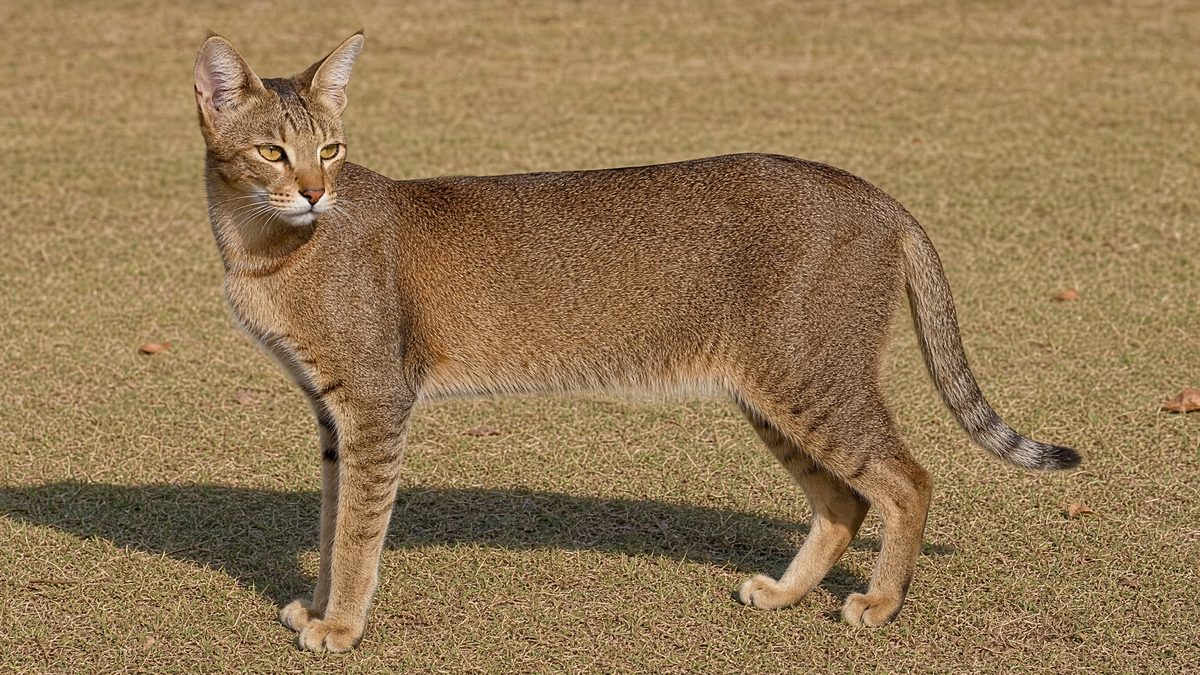
A Chausie is tall, long-legged, lean and deep-chested, with flat sides and a long rectangular torso. TICA describes it as ectomorphic and compares it to a basketball player or an Olympic long jumper, built for a long stride and a lightning pounce. The ears are tall and large, set at a slight outward angle about two fingers apart, with lynx tufts preferred. The tail is deliberately short, reaching roughly the hock and no more than a third of body length under the WCF standard.
Three coat patterns are recognised: brown ticked tabby, solid black, and black grizzled ticked tabby. The grizzled pattern is the interesting one, because both standards attribute it directly to the wild parent. TICA calls it "a pattern acquired from the breed's Jungle Cat (Felis chaus) ancestors", possibly caused by a mutation at the agouti or extension locus. A Chausie is ticked or grizzled, never spotted, which is the quickest way to tell it apart from a Bengal or a Savannah.
Size, and the gap between claims
TICA gives a medium-to-large adult male at about 15 lb, roughly 6.8 kg, with females about 15 percent smaller, and a kitten around 3 lb at 12 weeks. An Indian retailer page gives males 5 to 10 kg and females 4 to 7 kg. Those are not the same claim, and the wider Indian figure has no stated source. Bonbeno reports both rather than picking the more impressive one.
The detail in the standard that tells you the most
TICA's Chausie standard carries this line: "Temperament must be unchallenging; any sign of definite challenge shall disqualify. The cat may exhibit fear, seek to flee, or generally complain aloud but may not threaten to harm." Standards for wholly domestic breeds rarely need an express temperament disqualification. Its presence here is a quiet acknowledgement of what sits a few generations back in the pedigree, and it is worth more than any amount of marketing copy about how domestic the breed has become.
Wikipedia's summary agrees on the essentials, describing a hybrid breed developed by hybridising wild jungle cats with domestic cats, with a lean athletic build and a black-based ticked, grizzled or solid coat. Nothing about the breed's identity is in dispute. What is in dispute, and what no ranking page in India addresses, is whether an Indian reader can lawfully keep one.
Legal status in India: what the Act actually says
The jungle cat, Felis chaus, is a Schedule I animal under the Wild Life (Protection) Act 1972, which is the highest level of protection Indian wildlife law provides, and that single fact governs everything else on this page.
Bonbeno read the Act itself rather than a summary of it. The source is the India Code consolidated text of Act No. 53 of 1972 as on 5 June 2025, a 222-page document, extracted directly and searched.
Where Felis chaus sits, precisely
In Part A, Mammals, of Schedule I, under the sub-heading CATS, the entries run: 34 Asiatic Golden Cat, 35 Asiatic Lion, 36 Caracal, 37 Cheetah, 38 Clouded Leopard, 39 Desert Cat, 40 Eurasian Lynx, 41 Fishing Cat, 42 Jungle Cat Felis chaus, 43 Leopard, 44 Leopard Cat, 45 Marbled Cat, 46 Pallas's Cat, 47 Rusty Spotted Cat, 48 Snow Leopard, 49 Tiger. The jungle cat is entry 42 in that list, seven places from the tiger, in the same schedule and under the same heading.
The schedule numbering matters, because it changed recently and older sources are out of date. The Act formerly had six schedules. The Wild Life (Protection) Amendment Act, 2022, Act No. 18 of 2022, section 41, substituted them with the present four, with effect from 1 April 2023. That substitution footnote is printed on the Schedule I mammal pages themselves, two pages above the jungle cat entry, and reads: "Subs. by Act 18 of 2022, s. 41, for 'Schedules I, II, III, IV, V and VI' (w.e.f. 1-4-2023)". So the correct citation today is Schedule I of the Act as amended by Act 18 of 2022, not any of the pre-2023 six-schedule references still circulating online.
What Schedule I actually prohibits
Three provisions do the work, and they are worth quoting rather than paraphrasing.
- Section 2(36) defines a wild animal as any animal specified in Schedule I or Schedule II and found wild in nature.
- Section 9 provides that no person shall hunt any wild animal specified in Schedules I and II, and section 2(16)(b) brings capturing, coursing, snaring, trapping, driving or baiting any wild or captive animal inside the meaning of hunting.
- Section 40(2) provides that no person shall acquire, receive, keep in his control, custody or possession, sell, offer for sale or otherwise transfer or transport any animal specified in Schedule I, except with the previous permission in writing of the Chief Wild Life Warden or the authorised officer.
Section 40(2) is the provision an Indian buyer needs to read twice, because it is not about hunting. It is about keeping. It covers acquiring, receiving, possessing, selling and transporting, and the only lawful route through it is the written permission of the Chief Wild Life Warden. Section 40(2A) narrows it further, providing that no person other than one holding a certificate of ownership may acquire, receive or keep a captive Schedule I animal, except by way of inheritance.
The penalty
The first proviso to section 51(1) provides that where an offence is in relation to any animal specified in Schedule I, it is punishable with imprisonment of not less than three years, which may extend to seven years, together with a fine of not less than twenty-five thousand rupees. A second or subsequent offence carries the same imprisonment range and a minimum fine of one lakh rupees. That is a mandatory minimum custodial sentence, not a fine-only offence.
The honest gap: the Act says nothing about hybrids
Here Bonbeno has to report an absence rather than a rule, and it is the most important paragraph on this page.
Searching the full 222-page consolidated Act for the word hybrid returns twelve occurrences, and reading the context of every one of them shows that not a single occurrence concerns animal hybrids. Two are species whose own names contain the word, the Hybrid Sapphire butterfly Heliophorus hybrida and the Whiskered Tern Chlidonias hybrida. The other ten are Schedule IV notes reproducing CITES text about artificially propagated PLANT hybrids: orchids, cacti, Cyclamen and Taxus. The word progeny appears zero times. So the Act contains no provision on animal hybrids at all, and no provision on filial generation.
That absence cuts both ways, and an honest page has to say so. It means nobody can point you to a clause stating that an F3 Chausie is lawful, and equally nobody can point you to a clause stating that it is not. Whether a particular captive-bred hybrid is "an animal specified in Schedule I" for the purposes of section 40(2) is a question the statute does not answer on its face. Anyone who tells you the answer is settled, in either direction, is going beyond the text.
What is not unclear
Two things are clear even though the hybrid question is not. First, producing an F1 Chausie requires a Felis chaus parent, and holding that animal is squarely inside section 40(2), so the first generation cannot lawfully be produced in India without the Chief Wild Life Warden's written permission. Second, section 2(36)'s phrase "found wild in nature" is the qualifier a captive-bred animal argument would have to run through, and running it is a matter for a court and a lawyer rather than for a seller's assurance or a website.
If you need an answer for a specific animal, the Act itself names the person to ask. Take the question to your State Chief Wild Life Warden, in writing, before money changes hands. Bonbeno does not offer legal advice and will not suggest any route around these provisions.
Import restriction: why no lawful supply chain can form
Importing a Chausie into India is barred by the trade notice governing live mammals, because the relevant policy condition prohibits importing wild animals as defined in the Wild Life (Protection) Act 1972.
Bonbeno read the notice itself, a five-page PDF, rather than a summary of it. This matters because several Indian pages describe the import rules for pets entirely in terms of dogs and miss the condition that actually applies here.
The relevant row and the relevant condition
DGFT Trade Notice No. 22/2022-23 of 19 December 2022 sets out the import policy for other mammals including pet animals in a single table row: ITC(HS) 01061900, "Mammals: Other", Import Policy Restricted, "Subject to Policy Condition 6 of this Chapter";.
"Policy Condition (6): Import of Wild Animals (including their parts and products) as defined in the Wild Life (Protection) Act, 1972 (as amended from time to time) is prohibited and those species which are listed in CITES are subject to the provisions of CITES."
Read the structure of that notice carefully, because it is routinely misdescribed. Policy Condition 6 sits above Conditions 7 and 8 and is the condition the ITC(HS) row actually points to. Condition 7 permits import of dogs for three specific purposes, and Condition 8 bars commercial dog imports for breeding. Both of those are about dogs. Condition 6 is the general prohibition, it is the one attached to the code, and it is the one that catches a wild-animal question about a cat.
Both limbs of Condition 6 bite here
- The first limb prohibits importing wild animals as defined in the Wild Life (Protection) Act 1972. Felis chaus is specified in Schedule I of that Act.
- The second limb subjects CITES-listed species to CITES. The jungle cat is listed on CITES Appendix II, which the IUCN assessment states directly, and Schedule IV of the Act reproduces the CITES appendices with a generic entry reading 'Felidae spp.' annotated 'Except the species included in Appendix I. Excludes specimens of the domesticated form, which are not subject to the provisions of the Convention.'
That annotation is where a Chausie sits, precisely and uncomfortably. The exclusion from CITES control is for "specimens of the domesticated form", and a hybrid a few generations from a wild parent is exactly the case the phrase does not obviously resolve. Again, Bonbeno reports the text rather than deciding it.
The rest of the notice, for completeness
The notice's other provisions are worth knowing even though they do not rescue the position. Import may be as passenger baggage or as cargo, and permanent import without a DGFT authorisation is available only to a person transferring residence to India after two years of continuous stay abroad, for up to two pets, with only cats and dogs importable under baggage rules. Paragraph 6 of the notice states that any applications for trading or breeding purposes, or applications made on behalf of another person or entity, shall be duly rejected. Paragraph 7 confines entry to the airports and seaports of Delhi, Mumbai, Chennai, Hyderabad, Bangalore and Kolkata, with quarantine where required. DAHD added a seventh port, Cochin International Airport at Kochi, for pets arriving under the baggage rules in October 2024. DGFT's own published FAQ confirms that ITC(HS) 01061900 is the code covering cats as well as dogs and that the policy is Restricted. The full route, which covers cats too, is set out in how to import a dog to India.
Put the two instruments together and the conclusion is structural rather than rhetorical. Import of the wild parent is prohibited, import for breeding is refused by rule, no Indian registry recognises the breed, and the domestic bodies that do recognise it are overseas. No lawful supply chain can form. Any Chausie offered for sale in India therefore needs an explanation of where it came from, and that explanation is the buyer's problem to resolve before purchase rather than after.
Registry recognition, checked on all five bodies
Two of the five major cat registries hold the Chausie, TICA and the World Cat Federation, while CFA, FIFe and the GCCF do not.
Bonbeno applies a two-condition test: does a written standard exist anywhere, and does a studbook exist anywhere. The Chausie clears both, which makes it a real standardised breed rather than a marketing label. It clears them on two bodies out of five, which is a materially weaker position than a breed like the Egyptian Mau that all five recognise. Note that the FCI does not register cats at all, so it plays no part in a feline recognition question.
| Body | Holds the breed | Evidence read | In-document control |
|---|---|---|---|
| TICA | Yes, Championship | Listed among the 73 breeds; standard CU effective 1 May 2013 | Persian, Siamese, Bengal, Abyssinian present |
| WCF | Yes | Listed as Chausie (CHS) with standard dated 22 September 2019 | Abyssinian, Chartreux, Korat, Russian Blue present |
| CFA | No | Index runs Burmilla, Chartreux, Colorpoint Shorthair, Cornish Rex with no Chausie | Abyssinian, Bengal, Birman, Egyptian Mau present |
| FIFe | No | 52 EMS-coded entries parsed; the string Chausie occurs zero times | Persian, Siamese, Bengal, Abyssinian, Ocicat present |
| GCCF | No | Index runs Burmese, Chartreux, Cornish Rex with no Chausie | Persian, Siamese, Bengal, Egyptian Mau present |
Why the controls matter more than usual here
An absence is a claim about the world, and a claim read off a page that failed to load is worthless. On each of the three registers that do not hold the breed, Bonbeno recorded which known breeds were visible on the same document at the same moment, and checked the alphabetical position where a Chausie entry would sit. On the CFA index the run passes from Chartreux straight to Colorpoint Shorthair. On the GCCF index it passes from Chartreux to Cornish Rex. On the FIFe index the breed name appears zero times across 52 entries.
TICA's timeline
TICA records that breeders first documented a jungle cat by domestic cat breeding in 1990, that TICA awarded the Chausie foundation registration status in 1995, and that Championship status followed from 1 May 2013. Foundation registration is the mechanism a registry uses for a breed still being built out of an outcross programme, and a twenty-three-year gap between foundation status and championship is a long development period by any measure.
The two standards disagree on outcrosses, and it matters
This is a genuine conflict between two recognising bodies, and it is worth publishing rather than smoothing over. TICA's standard states "PERMISSIBLE OUTCROSSES: None";. The WCF standard states "Permitted outcrosses: Abyssinian, Domestic Shorthair";. Both are current and both are official. A cat that is a legitimate Chausie under one register's breeding rules may not be under the other's, which means a pedigree needs reading rather than trusting.
The WCF's permitted Abyssinian outcross carries a specific implication. A survey of 14,179 cats across 38 breeds found the PKLR pyruvate kinase deficiency variant concentrated in Abyssinian-derived lines and recommended testing for breeds developed using Abyssinian crosses. A Chausie bred under WCF rules using an Abyssinian outcross therefore inherits that testing obligation, while one bred under TICA rules with no outcross at all does not, at least not by that route.
Neither register is Indian, and neither confers any right to keep the animal in India. Registry recognition is a question about pedigree and shows. The legal question is separate and is answered by the Wild Life (Protection) Act.
Chausie cat price in India, and why this page publishes none
No Chausie cat price in India can be verified, and Bonbeno will not convert a foreign figure into rupees, because doing so would imply a market that cannot lawfully form here.
That is a deliberate editorial decision rather than a research failure, and the reasoning is worth setting out so a reader can judge it.
What the Indian search results actually contain
Searching the commercial query for this breed on Google India returns a top ten in which eight results are not about the Chausie at all. Position one is a general Indian cat price guide covering Persians and Bengals. Positions two, seven, nine and ten are seller videos and reels for Persian and Bengal kittens. Positions four and five are Persian price pages. Position eight is a Bengaluru cattery selling Persians, Himalayans, Exotic Shorthairs, British Shorthairs, Scottish Folds and Maine Coons. Only position three, a United States guide, is about the Chausie, and it quotes dollars.
A commercial SERP that returns a generic Indian cat-price cluster instead of the breed you searched for is telling you something precise: there is no Indian market for this breed to rank. This is composition evidence, not volume evidence. Bonbeno does not treat a printed result count as a measure of market size, because an exact-phrase query returns few results even for the thickest commercial terms.
The foreign figures, reported and not converted
Overseas guides give roughly USD 500 to USD 2,500 for later-generation cats, with early generations quoted far higher. Bonbeno reports those in dollars and stops there. Running them through an exchange rate would manufacture an Indian price that no Indian seller charges, and this site has documented that exact mechanism repeatedly: rupee figures on Indian breed pages that resolve to round dollar amounts at 84.38, 80 or 74, presented as local market rates. A rare and expensive breed with no lawful Indian route is precisely where that fabrication would be hardest for a reader to detect.
What an Indian page does publish
One Indian retailer carries a full Chausie breed guide with history, appearance, training, health, living conditions, exercise, grooming, advantages and disadvantages. It presents the breed as suited to "large apartments with extensive climbing areas" and to "active households" and "families with older children". It quotes no price. It also makes no mention anywhere of the Wild Life (Protection) Act, of the protected status of Felis chaus in India, or of any import restriction.
Bonbeno cites that page as the object of an audit rather than as a source of fact. Its care content is unremarkable and mostly sensible. The problem is the omission, and the omission is the whole reason this page exists: an Indian reader can arrive at a domestic retailer's site, read a complete, confident, well-organised guide to keeping this animal, and leave without ever learning that its wild parent is a Schedule I species.
If you are quoted a price
Treat a quoted Indian price as information about the seller rather than about the breed. Ask where the animal came from, what its filial generation is, what registration papers exist and in whose name, and whether any permission under section 40 has been obtained. A seller who cannot answer those four questions in writing is not a seller you can safely buy from, whatever the number is.
Cost of ownership, if the legal question were resolved
Running costs for a Chausie in India would be roughly Rs 3,000 to Rs 6,000 a month on published Indian prices, and that figure is offered as context rather than as an invitation.
This section exists because a reader deciding against a purchase still deserves to know what the ongoing commitment would have been, and because the same figures apply to any large, active, short-coated cat kept in an Indian metro.
| Item | Published price | Source |
|---|---|---|
| Anti-rabies, single dose | Rs 699 | Vetic clinic list price |
| Other single vaccines | Rs 849 to Rs 1,349 | Vetic clinic list price |
| Bath, professional | from Rs 934 | Vetic Delhi grooming list |
| Boarding, 24 hours | Rs 899 | PawSpace Bengaluru |
| Daycare to 10 hours | Rs 799 | PawSpace Bengaluru |
| Microchipping | Rs 1,250 | Named Chennai clinic's transacted price |
| Delhi pet registration | Rs 500 | Municipal Corporation of Delhi |
| Chennai pet licence | Rs 50 | Greater Chennai Corporation |
Where a Chausie would cost more than an ordinary cat
Food is the main line. This is a large, extremely active animal, and overseas guidance leans toward high-protein diets. An Indian retailer's own guidance flags that some early-generation hybrids may have more complex nutritional requirements than typical domestic cats and notes digestive sensitivity and food intolerance among the health concerns. A cat that needs a specific diet in a country where that diet may not be reliably stocked is an expensive cat, and the risk is supply as much as price.
Enrichment is the second line. A cat that jumps six feet vertically and opens cabinets needs built infrastructure rather than a scratching post, and secure meshing on every opening is not optional.
Where the veterinary cost is unquantifiable
There is no published veterinary literature on this breed. A PubMed search for the exact phrase Chausie returns zero records, with the quotedphrasesnotfound warning, against in-session controls that returned 126 records for Labrador retriever hip dysplasia and 30 for cat breed genetic diversity. So the zero is a real absence rather than a broken query. An Indian veterinarian treating a Chausie would be working without breed-specific evidence, without an established anaesthetic or dosing literature for the type, and without local peers who have seen one.
The municipal costs are the same as for any cat and are the most durable figures here. Delhi charges Rs 500 to register a pet with a Rs 100 per month late fee, and the Greater Chennai Corporation charges Rs 50 for a licence while providing free anti-rabies vaccination at its six corporation clinics. Boarding runs about Rs 899 for twenty-four hours in Bengaluru, though finding a boarding facility willing to take this animal is a separate problem from affording one.
Retail prices in India move within days, so re-price any of these before relying on them. Municipal fees rarely move.
Heat tolerance: the one thing India is right for
A Chausie would handle Indian heat well, because the wild half of its ancestry is native to India, and this is the only page on Bonbeno where the usual imported-breed climate warning runs backwards.
Most breed pages on this site have to explain that an animal selected in Yorkshire or Wisconsin is being asked to live somewhere far hotter. Here the opposite is true, and saying so honestly matters as much as stating the legal position, because a page that stacked every possible objection would be advocacy rather than reporting.
The wild parent is an Indian animal
The IUCN records that the jungle cat "remains probably the most common cat species in South Asia (India, Nepal, Bangladesh), where the majority of the global population occurs", ranging from western Pakistan through almost all of India and up to about 2,400 metres in the Himalayan foothills. It is not a marginal Indian species. It is an abundant one, and its habitat includes exactly the irrigated agricultural landscapes and scrub that surround Indian cities. The IUCN notes it has adapted well to irrigated cultivation, including sugar cane plantations in India.
| Place | Cell elevation | Real elevation | Annual mean T | Annual mean RH | May mean T |
|---|---|---|---|---|---|
| Bharatpur, inside jungle cat range | 197 m | 174 m | 26.48 C | 43.00% | 35.99 C |
| Delhi | 206 m | 216 m | 25.60 C | 45.56% | 35.05 C |
| Chennai | 49 m | 6 m | 27.95 C | 72.39% | 31.51 C |
| Mumbai | 97 m | 14 m | 26.77 C | 67.39% | 31.19 C |
| Bengaluru | 842 m | 920 m | 23.74 C | 67.94% | 26.97 C |
| Kolkata | 7 m | 9 m | 25.81 C | 73.93% | 31.53 C |
Bharatpur in Rajasthan, a documented jungle cat locality, runs an annual mean of 26.48 C at 43.00 percent humidity with a May mean of 35.99 C, which is hotter than any of the six metros in that table. A cat descended in part from an animal thriving in those conditions is not going to be defeated by a Chennai summer.
Half this animal is a domestic cat, and the domestic half was not selected for anything in particular. A Chausie is also short-coated with no undercoat problem, which helps. What stops the rating reaching 5 is that nobody has measured thermoregulation in the breed, because there is no literature on it at all, so the argument here is inference from the wild parent's range rather than an observation of the hybrid.
The honest conclusion
Climate is not the reason to say no to this breed in India. The reason is legal, and dressing a legal objection up as a welfare or climate objection would be dishonest. It is worth stating plainly that on the narrow question of whether the Indian climate suits the animal, the answer is that it suits it better than it suits most pedigree cats sold here.
Temperament and household fit
TICA describes the Chausie as good-natured, loyal, highly intelligent and trainable, with a temperament that is predominantly domestic, and the qualifier in that last phrase is doing real work.
Both recognising standards use almost identical language. TICA states that "Temperament is predominantly domestic" and that Chausies "are active, curious, playful cats that require stimulation and company";. Predominantly is not wholly, and the standard's express disqualification for any sign of definite challenge is the clearest indication of what the word is guarding against.
What owners actually report
TICA's own breed page describes a cat that is affectionate, people-oriented and very talkative, that plays fetch and walks on a lead, and whose playful demeanour persists into adulthood. It also says something more pointed: on an energy scale, Chausies are "an eleven", people should be prepared for a cat that gets into everything all the time, and many owners install child-proof latches on cabinets. The same page recommends the breed for adults and families without young children, and warns it does not tolerate being left alone.
Who this animal would suit, in the abstract
- Experienced cat owners with time, not first-time owners.
- Households with another compatible cat, since TICA advises a companion.
- Homes with built vertical space and a secure outdoor run.
- Adults or families with older children rather than toddlers.
- Owners who will socialise a kitten intensively and continue training for life.
Who it would not suit
- Anyone out of the house for long working days.
- Small flats with no vertical build-out and open balconies.
- Households with small pets, given strong hunting instincts.
- Quiet or sedentary homes, where a bored Chausie becomes destructive.
- Anyone in India who has not resolved the legal question first.
The hunting instinct deserves a specific note in an Indian context. The IUCN records that jungle cats feed mainly on prey under one kilogram, principally rodents, with birds ranking second, and that a study in Sariska estimated three to five rodents caught per day. A descendant of that animal in an Indian home with balcony access to pigeons, squirrels and garden birds is not a neutral presence in the local ecology, which is one more argument for secure meshing.
One last temperament point that is easy to miss. A cat bred to look wild attracts attention, and an animal that attracts attention in a country where its parent species is protected creates a risk for its owner that has nothing to do with the cat's behaviour.
Training a highly trainable cat
To train a Chausie, use short positive-reinforcement sessions from kittenhood and give it a job, because this is among the most trainable of all cat breeds and among the least tolerant of boredom.
TICA describes a highly intelligent and highly trainable cat that learns to play fetch and walk on a leash. Indian retailer guidance for the breed recommends early socialisation, positive reinforcement, basic obedience, harness training, recall training, interactive games and mental enrichment, and warns that the breed becomes bored easily so training must stay varied and challenging. That advice is sound and is not the part of that page Bonbeno takes issue with.
A realistic training programme
- Weeks 8 to 16: handle daily, socialise to people, sounds and surfaces, and build carrier and harness tolerance before the window closes.
- Months 4 to 6: name response, recall to a sound cue, and station training for veterinary handling.
- Months 6 to 12: fetch, targeting, puzzle feeders, and structured play twice a day.
- Year 1 onward: rotate the curriculum, because a Chausie that has solved everything will invent new problems.
What this breed resists
Repetition without novelty, and any attempt at compulsion. A cat with this much drive does not sulk; it redirects. The failure mode is not a cat that ignores you but a cat that dismantles your kitchen, which is why the child-proof latches TICA mentions are a training story rather than a hardware story.
If a Chausie in India ever needs veterinary care, it will be seen by a veterinarian who has never treated one. A cat that loads calmly into a carrier, tolerates restraint and accepts examination of its abdomen and hindquarters makes that appointment safe for everyone in the room. That is the single most valuable thing to train, and it is worth more than fetch.
Exercise requirement, which is the highest of any cat on this site
An adult Chausie needs roughly 60 to 90 minutes of active exercise a day, split across several sessions, which is more than double what a typical pedigree cat requires.
That figure comes from Indian retailer guidance for the breed, which recommends around 60 to 90 minutes or more of active exercise and play per day for an adult depending on individual energy level, and notes that multiple sessions throughout the day work better than one long one. TICA's description supports the scale of it: a cat active for long periods, jumping six feet straight up, requiring a great deal of interaction and playtime.
What the exercise requirement means in an Indian flat
It means built infrastructure, not toys. A tall cat tree, wall shelving, tunnels, climbing walls and puzzle feeders are the baseline, and a secure outdoor run or catio is the meaningful upgrade. TICA lists large apartments with extensive climbing areas, houses, and homes with secure outdoor enclosures as the appropriate environments.
- Four to six short sessions daily rather than one long block.
- Vertical routes at three heights, so the cat can move around a room without touching the floor.
- Part of the daily ration delivered through puzzle feeders.
- Harness walks only in a genuinely secure space, never on an Indian street with free-roaming dogs.
- Meshing on every window and balcony, checked rather than assumed.
A Chausie loose outdoors in India is a serious problem in both directions. The animal faces traffic, dog packs and heat, and it looks unmistakably like a wild cat, which invites exactly the wrong kind of response from neighbours and authorities. Given that its parent species is protected, an escaped Chausie is a situation nobody involved will handle well. Secure containment is a legal precaution here, not just a welfare one.
Timing matters in the hot months, as it does for any cat. Move the main sessions to early morning and after dark from April through June, even though this breed's ancestry copes with heat better than most.
Grooming needs, which are the least of the considerations
Groom a Chausie once or twice a week with a brush and nothing else, because the grooming needs of a short dense close-lying coat are minimal.
The WCF standard describes a dense soft undercoat with a somewhat resilient, slightly coarser outer coat, short to medium in length with enough length to carry at least two bands of ticking. TICA's standard uses the same description. Nothing in either implies matting, and neither implies a coat needing professional attention.
- Brush once or twice weekly, more often during shedding periods.
- Bathe only when genuinely necessary, since the coat sheds dirt well.
- Trim nails regularly, which matters more here than usual given the climbing.
- Clean ears routinely and dry them properly through the monsoon months.
- Brush teeth several times a week with a veterinary paste.
Indian grooming rate cards start at Rs 934 for a bath and Rs 1,869 for a complete bath and styling, and a Chausie needs neither on any schedule. Anyone budgeting monthly professional grooming for this coat is budgeting for a service the animal does not require.
The grizzled and ticked patterns live in banded individual hairs rather than in the skin, so shaving destroys the pattern for months and removes the flat insulating layer that helps the cat manage heat. This applies to every short-coated cat in India and applies with particular force to a breed whose whole appearance is its coat.
Health issues, and an evidence base that does not exist
No breed-specific veterinary literature exists for the Chausie, so every health claim about it, including the ones on this page, rests on general feline medicine or on unverified breeder report.
That absence is the most honest and most useful health statement Bonbeno can make about this breed, and it is one no ranking page makes.
The absence, proved rather than assumed
A PubMed search for the exact phrase Chausie returns zero records, with the quotedphrasesnotfound warning indicating the phrase is simply not indexed. Two controls were run in the same session on the same instrument: Labrador retriever hip dysplasia returned 126 records and cat breed genetic diversity returned 30. The instrument was working, so the zero is a real absence rather than a broken query. Bonbeno reports absences only when a control has passed alongside them.
What is claimed, and by whom
TICA states that most consider the Chausie an overall healthy breed and recommends keeping vaccinations and parasite treatments up to date. An Indian retailer page lists digestive sensitivity, food intolerance, obesity, dental disease, hip or joint problems and nutritional deficiencies in poorly managed diets, and notes that some early-generation hybrids may have more complex nutritional requirements than typical domestic cats. None of those claims carries a citation to a study, because no study exists to cite.
There is no published prevalence data, no breed-specific anaesthetic guidance, no reference intervals for haematology or biochemistry in the type, and no Indian clinical experience to draw on. A cat with an unusual physiology that presents unwell in an Indian clinic will be treated as a domestic shorthair, because that is the only evidence base available. That is a real and unquantifiable risk, and it is a direct consequence of the breed's rarity rather than a criticism of any veterinarian.
One inherited risk that can be reasoned about
The WCF permits Abyssinian outcrosses, and Abyssinian-derived lines carry the PKLR variant behind feline erythrocyte pyruvate kinase deficiency, an autosomal recessive anaemia. The survey identifying that variant across 14,179 cats and 38 breeds explicitly recommends testing for new breeds using the affected breeds in outcrossing or development programmes. So any Chausie bred under WCF rules using an Abyssinian should be screened for it. A Chausie bred under TICA rules, which permit no outcrosses at all, does not inherit that obligation by the same route.
Lifespan
TICA gives 12 to 18 plus years, and an Indian retailer gives 12 to 15. Neither figure rests on a published dataset, and Bonbeno publishes both rather than averaging them or presenting either as established.
Parasite pressure in India is a general point worth making. A Kerala series found Babesia in 80 of 120 animals tested at veterinary clinics. That series sampled clinically suspected dogs at clinics rather than a random population and is not a cat study, so it cannot be read as a feline prevalence figure. It is cited only to show that parasite control in India is not optional, and any cat with outdoor access needs a plan agreed with a veterinarian.
Feeding a high-drive cat
Feed a Chausie a high-protein diet split across two or more meals, with wet food forming a meaningful share, and expect the diet question to be harder in India than the amount.
TICA advises feeding twice a day, notes that the breed does best on high-quality canned food, and observes that Chausies are so active they do not gain weight easily. That is straightforward for any obligate carnivore, and the ordinary rules apply: fresh water daily, and the water bowl placed at least three feet from food, because a cat's nose is sensitive enough that food smell suppresses drinking.
| Stage | Approach | What to watch |
|---|---|---|
| 8 to 16 weeks | Four small meals daily, complete kitten diet, wet food from the start | Weight gain, stool quality, digestive tolerance |
| 4 to 12 months | Three meals daily, high protein | Growth rate, energy, any food intolerance |
| 1 to 7 years | Two meals plus part of the ration in puzzle feeders | Body condition, muscle rather than fat |
| 7 years and over | Two meals, senior formulation on veterinary advice | Weight change, appetite, drinking habits |
The digestive sensitivity claim, handled carefully
Indian retailer guidance and overseas breeder sources both report digestive sensitivity and food intolerance in the breed, particularly in early generations, and some breeders recommend grain-free or raw diets on that basis. Bonbeno cannot verify that claim, because no study exists. What can be said is that it is widely and consistently reported, that it would be biologically unsurprising in a hybrid whose wild parent eats small whole prey, and that acting on it should mean a conversation with a veterinarian rather than a switch to a raw diet on the strength of a forum post.
Raw diets carry bacterial risk that rises with ambient temperature and with any break in the cold chain, and Indian summer conditions are unforgiving of both. Anyone considering a raw diet for any cat in India should discuss handling, sourcing and storage with a veterinarian first, and should assume the margin for error is smaller here than in the countries where most raw-feeding guidance is written.
The supply problem is worth stating plainly. A diet that is easy to maintain in Europe or North America may not be reliably stocked in an Indian city, and a specialised diet that becomes unavailable mid-year is worse than a good ordinary diet fed consistently.
Kitten timeline through the first year
A Chausie kitten's first year runs on the same developmental clock as any cat, with the socialisation window closing around sixteen weeks and adult body type arriving late because of the breed's length.
This section is offered for completeness of the breed record rather than as a plan a reader should expect to execute in India.
| Age | What happens | What matters |
|---|---|---|
| 12 weeks | TICA gives a kitten at about 3 lb | Birth weight and growth records from the breeder |
| 12 to 16 weeks | Socialisation window closing | Handling, carrier, harness, sounds, surfaces |
| 4 to 6 months | Climbing and jumping ability develops fast | Secure meshing installed before, not after |
| 6 to 9 months | Faint kitten tabby markings resolve | Grizzling in a grizzled cat is minimal at this age by standard |
| 9 to 12 months | Leg length and body length dominate | Do not mistake leanness for underfeeding |
| 12 to 18 months | Fills out; males reach about 15 lb | Females settle about 15 percent smaller |
The TICA standard makes an allowance for faint tabby markings on the body of kittens up to one year old, and for minimal grizzling in kittens. So a young Chausie does not look like the adult, and a seller presenting a kitten as showing full adult pattern is either mistaken or describing a different animal.
A study of 5,596 kittens across 15 breeds from 194 French breeders found low birth weight, being male and being born in a large litter to be significant risk factors for mortality in the first two months, and and 19.7 percent of that population was classified low birth weight. The Chausie was not among the 15 breeds studied, so no breed-specific threshold exists for it, and applying another breed's threshold would be wrong. The general finding still argues for asking any breeder whether birth weights were recorded at all.
Breed comparison: the Chausie against what you can lawfully keep
Anyone drawn to the Chausie is choosing a wild look, and three other cats deliver a version of it without a protected parent species.
This breed comparison is the most practically useful table on the page, because the honest recommendation is not to buy this breed in India and a reader deserves to know what the alternatives actually are.
| Chausie | Bengal | Ocicat | Egyptian Mau | |
|---|---|---|---|---|
| Wild ancestor | Jungle cat, Felis chaus | Asian leopard cat | None | None |
| Wild parent protected in India | Yes, Schedule I | Yes, Schedule I | Not applicable | Not applicable |
| Coat | Ticked or grizzled | Spotted or marbled | Spotted | Naturally spotted |
| Registries of five holding it | 2 | 5 | 4 | 5 |
| Lawful to keep in India | Unresolved at best | Yes, long established | Yes | Yes |
| Realistic Indian availability | None | Good | Very low | Very low |
| Published veterinary literature | None | Substantial | Some | Substantial |
| Daily exercise | 60 to 90 minutes | 45 to 60 minutes | 30 to 45 minutes | 30 to 45 minutes |
The Bengal is the answer for most people
The Bengal is also descended from a wild species whose Indian population is protected, the Asian leopard cat, which appears at entry 44 in the same Schedule I list as the jungle cat. The difference is generational distance and settled practice. The Bengal has been bred as a domestic breed for decades, is recognised by all five registries, has an established Indian population and an established veterinary literature, and is treated in practice as a domestic cat. Anyone who wants the wild aesthetic and can lawfully act on it should be looking at a Bengal.
The Ocicat is the answer for purists
The Ocicat is the cat for someone who wants wild looks with no wild ancestry whatsoever. It was built entirely from Abyssinian, Siamese and American Shorthair lines. Availability in India is thin, but the legal and ethical questions simply do not arise.
The Egyptian Mau is the answer for people who wanted the spots
The Egyptian Mau is the only naturally spotted domestic breed, recognised by all five bodies, with a well-documented history and, unusually, a founding bloodline that came through New Delhi. It carries its own health tail, notably a very high urate stone risk, but it carries no legal complication.
One point of connection worth noting between these two pages. The CFA's own 1999 breed history records a long-standing but, in its words, not widely accepted theory that Felis chaus may have contributed to the Egyptian Mau or the Abyssinian in antiquity. That is speculation about ancient Egypt, not a claim of modern hybrid ancestry, and the Egyptian Mau is not a hybrid breed.
Common mistakes Indian buyers make with this breed
The most common and most serious mistake with a Chausie in India is treating it as an ordinary exotic pedigree, because the legal question comes before every other question.
1. Reading a retailer breed guide as clearance to buy
A complete, confident, well-organised Indian breed guide that never mentions the Wild Life (Protection) Act reads like an implicit all-clear, and it is not one. Absence of a warning is not a legal opinion, and a retailer's care page carries no authority on whether the animal is lawful to keep.
2. Assuming a later filial generation settles the question
Many jurisdictions treat F1, F2 and F3 animals differently. India's Wild Life (Protection) Act does not, because it contains no provision on hybrids or filial generations at all, as Bonbeno's own search of the full consolidated text confirmed. A seller who tells you an F4 is automatically fine is stating a rule that does not appear in the statute.
3. Trusting paperwork that proves the wrong thing
A TICA or WCF registration certificate proves pedigree. It does not prove lawful acquisition, lawful import, or lawful possession in India, and it is not a certificate of ownership under section 40. Verify what a document actually certifies before treating it as protection.
4. Buying an animal that is not the breed
Where a breed is rare and unavailable, mislabelling follows. A large ticked domestic cat, a Bengal cross, or a genuinely wild-caught kitten can all be offered under this name, and the last of those would be unlawful on its face. Check the coat: a Chausie is ticked or grizzled, never spotted or rosetted.
5. Under-building the enclosure
A cat that jumps six feet vertically and is active for long periods will find any gap. In India an escape is worse than elsewhere, because the animal looks like a protected wild species and the consequences fall on the owner.
6. Not asking the only authority that can answer
The Act names the Chief Wild Life Warden as the officer whose written permission section 40(2) requires. That is the person to ask about a specific animal, before any money moves, and the answer should be obtained in writing. Bonbeno does not offer legal advice, does not suggest any route around these provisions, and will not help anyone construct an argument that a particular animal falls outside them.
Adoption, responsible sourcing and the honest recommendation
Do not buy a Chausie in India, and adopt one of the thousands of cats already here instead, because no lawful supply chain exists and the legal exposure falls entirely on you.
Bonbeno reaches that recommendation from the documents rather than from sentiment, and the reasoning has been set out section by section above.
Why no lawful route exists
- Import of the wild parent species is prohibited under DGFT Policy Condition 6, which bars importing wild animals as defined in the Wild Life (Protection) Act 1972.
- Import for trading or breeding is refused by rule, since the trade notice states such applications shall be duly rejected.
- Producing an F1 domestically requires holding a Felis chaus, which section 40(2) bars without the Chief Wild Life Warden's written permission.
- No Indian registry recognises the breed, and the two overseas registries that do confer no right to keep it here.
- A Schedule I offence carries imprisonment of not less than three years and a minimum fine of twenty-five thousand rupees.
Those five points do not depend on resolving the hybrid question. Even on the most favourable reading of the law for a captive-bred later-generation cat, there is no lawful way for one to have reached India.
The conservation argument, stated once
The IUCN assessment for Felis chaus names hybridisation with domestic cats as a potential though unproven threat to the wild species, alongside habitat loss and continuing poaching, and records the population trend as decreasing. It also records that when India banned the export of jungle cat skins in 1979, traders declared holdings of over 300,000 skins. A market for jungle cat hybrids in the country that holds most of the world's jungle cats is not a neutral thing, and a reader is entitled to weigh that alongside the legal position.
What to do instead
- Adopt from a metro rescue network, where large athletic ticked and tabby cats are always available.
- Consider a Bengal if the wild aesthetic is the point, since it is lawfully and widely kept in India.
- Consider an Ocicat or an Egyptian Mau if the spotted look is what you wanted.
- Register and microchip whatever cat you take on, at Rs 500 in Delhi and Rs 1,250 for a microchip in Chennai.
- Screen any pedigree kitten's parents for the inherited conditions its breed actually carries.
If you already have one
This page is written for someone deciding, not to alarm someone who has already acquired an animal in good faith. If you are in that position, the constructive step is the same one: take the facts to your State Chief Wild Life Warden and to a lawyer, in writing, and act on what they tell you. Do not rehome the animal informally, and do not release it under any circumstances. An abandoned hybrid is the worst outcome for the cat, for the owner and for the wild population the law exists to protect.
Bonbeno does not recommend breeders, link listings, quote a live price as an offer, or broker sales. On this breed it goes one step further and publishes no Indian price at all, because there is none to publish and inventing one would be the most damaging thing this page could do.
Common questions
How much does a Chausie cat cost?
Published overseas figures run from about USD 500 to USD 2,500 for later-generation cats, rising steeply for early generations. No Indian price exists, and Bonbeno will not convert a foreign figure into rupees, because doing so would imply a market that cannot lawfully form here.
Are Chausie cats friendly?
TICA describes them as good-natured, loyal and highly trainable, and its standard goes further than most by disqualifying any cat that shows definite challenge. That a breed standard needs an explicit temperament disqualification at all is itself worth noticing, because standards for wholly domestic breeds rarely carry one.
How big do Chausie cats get?
TICA gives a medium-to-large adult male at about 15 lb, roughly 6.8 kg, with females about 15 percent smaller, and a kitten around 3 lb at 12 weeks. Height comes more from leg length than bulk, and the breed can jump about six feet straight up.
Are Chausie cats rare?
Very. Only two of the five major registries hold the breed at all, and a PubMed search for the exact phrase Chausie returns zero records against controls that returned 126 and 30 in the same session. In India the breed is effectively absent, and no lawful route exists to import one.
Is it legal to keep a Chausie in India?
The honest answer is that it is unresolved for the hybrid and clear for the wild parent. Felis chaus is a Schedule I animal, and section 40(2) bars acquiring, keeping, transferring or transporting a Schedule I animal without the Chief Wild Life Warden's written permission. The Act says nothing anywhere about hybrids, so nobody can tell you from the statute alone which side of the line a particular cat falls.
What does F1, F2 or F3 mean for a Chausie in India?
Filial generation counts how many generations separate a cat from its wild ancestor, with F1 being the direct offspring of a jungle cat. Many countries treat early generations differently, but India does not, because the Wild Life (Protection) Act contains no provision on hybrids or filial generations at all. What is certain is that producing an F1 requires holding a Felis chaus, which is unambiguously restricted.
Can I import a Chausie into India?
No route is available. DGFT Trade Notice 22/2022-23 places live mammals under ITC(HS) 01061900 in the Restricted category subject to Policy Condition 6, which prohibits importing wild animals as defined in the Wild Life (Protection) Act 1972 and subjects CITES-listed species to CITES. The notice also states that applications for trading or breeding purposes shall be duly rejected.
Which registries recognise the Chausie?
TICA and the World Cat Federation do. CFA, FIFe and the GCCF do not, checked on each body's own index with control breeds present on the same page. So the breed clears the written-standard and studbook test, but on two bodies out of five rather than universally.
What is the difference between a Chausie and a Bengal or Savannah?
Different wild ancestors and a different coat. The Chausie descends from the jungle cat Felis chaus and is ticked or grizzled rather than spotted, the Bengal from the Asian leopard cat and is spotted or marbled, and the Savannah from the serval. Only the Bengal is widely available in India.
Is the jungle cat found in India?
Yes, and abundantly. The IUCN records that the jungle cat remains probably the most common cat species in South Asia, with the majority of the global population in India, Nepal and Bangladesh, ranging through almost all of India up to about 2,400 metres in the Himalayan foothills. Its population trend is nonetheless recorded as decreasing.
Does owning a Chausie harm wild jungle cats?
The IUCN assessment names hybridisation with domestic cats as a potential though unproven threat to the wild species, alongside habitat loss and poaching. India banned the export of jungle cat skins in 1979, when traders declared holdings of over 300,000 skins, which gives some sense of the historical pressure on the species.
What should I do if someone offers me a Chausie in India?
Do not complete the purchase, and do not attempt to work around the position. A Schedule I offence carries imprisonment of not less than three years extending to seven and a fine of not less than twenty-five thousand rupees. If you want to know where a specific animal stands, the question goes to your State Chief Wild Life Warden, who is the authority the Act itself names.
Compare with similar breeds
Chausie sits in 2 Bonbeno groups. Each one compares it directly against the breeds it is genuinely an alternative to, on the same figures.