
Breed profile
Korat Cat in India: One Colour, No Local Market
A Thai natural breed with a heart-shaped head, one permitted colour, two fatal recessive diseases with DNA tests, and 97 registrations worldwide in a single year.
Quick answer
No Korat cat price in India could be sourced from any page opened on 9 September 2026. India's leading cat-price guide lists 16 breeds and the Korat is not among them, while FIFe registered just 97 Korats worldwide in 2024, ranking the breed 33rd of 54. Indian care costs are real and quotable, so this page publishes those instead.
This page summarises published veterinary research on the Korat, including two fatal recessive storage diseases and a recently described cholesterol disorder. It is reference material, not a diagnosis and not a treatment plan. Consult your nearby vet, a registered veterinarian who can examine the animal in front of them, before acting on anything here, and take any suspected neurological sign in a kitten to a clinic the same day.
Korat at a glance
What a Korat cat is
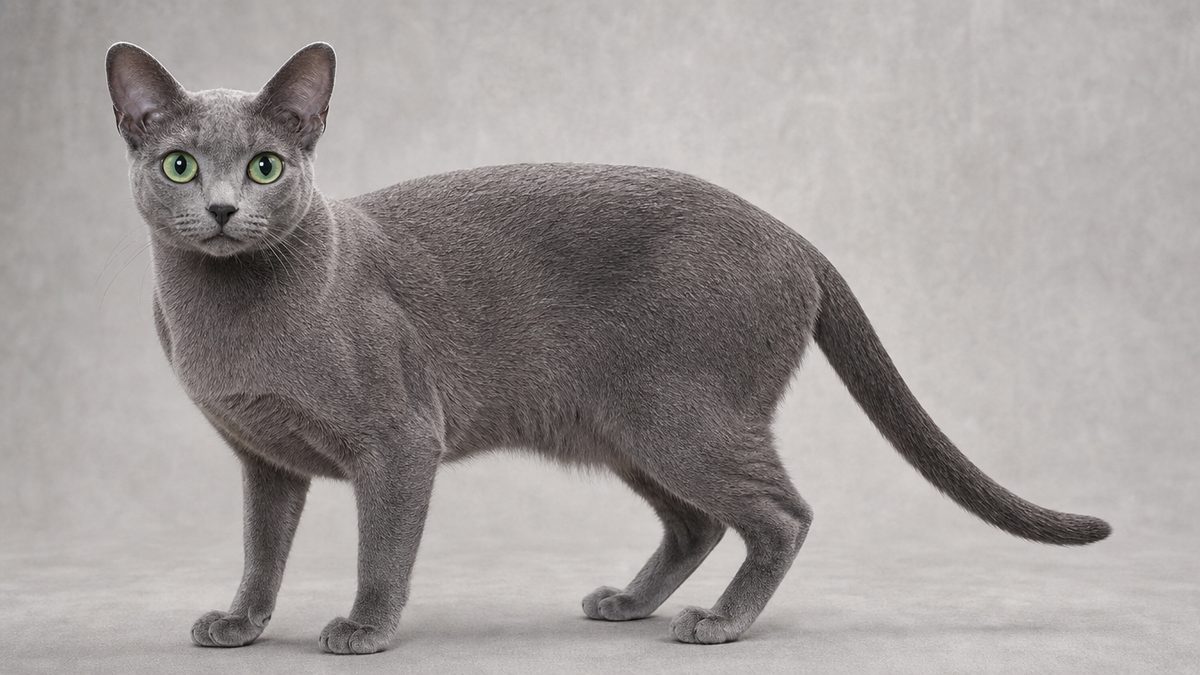
The Korat is a short-coated Thai natural breed with a heart-shaped head, oversized luminous green eyes and exactly one permitted colour, silver-tipped blue, bred only to other Korats.
Two things separate this cat from every other blue shorthair, and both are written into the standards rather than into marketing. The first is that the colour is not a variety, it is the breed: CFA disqualifies any colour but silver-tipped blue and disqualifies a white spot or locket outright, and TICA puts it as bluntly as a registry ever does, saying the Korat is silver blue from birth to death and can exist in no other colour as a Korat. The second is that the register is closed. LOOF prints the permitted mating as Korat x Korat, CFA lists allowable outcross breeds as none, and TICA states that outcross with any other breed is not accepted.
That combination is unusual. Most breeds this rare keep an outcross door open to manage genetic diversity. The Korat does not, and the consequence runs straight into the health section below.
The head, which is the second identifier after colour
The head is heart-shaped seen from the front, and the standards describe how the shape is built rather than merely naming it. CFA's clause reads that the eyebrow ridges form the upper curves of the heart and the sides of the face gently curve down to the chin to complete the heart shape, with any pinch or narrowness across the eyes marked undesirable. The GCCF adds that the forehead is large and flat, and that the muzzle is well developed, neither strongly pointed nor square. Ears are large with a rounded tip and a large flare at the base, set high on the head, which is what closes the top of the heart.
The eyes are the other half of the identification. Both standards call them oversized for the face, wide open and well-rounded when fully open, with an Asian slant when closed or partially closed Cat Fanciers' Association. CFA describes the adult colour as a rich shade of peridot green. Kittens and adolescents carry yellow or amber to amber-green eyes, and the GCCF says the adult colour is not usually reached until about two years.
Coat and colour, in the words of the documents
The coat is single, short to medium in length, glossy and fine, lying close to the body, and the GCCF adds a detail that reads like a field mark: the coat over the spine is inclined to break as the cat moves. The colour is any shade of blue all over, tipped with silver, and the more silver tipping the better; where the coat is short the silver sheen is intensified. CFA describes the same thing as a silver halo effect, with hair lighter at the roots, deepening to blue along the shaft, and silver at the tips.
Soundness to the roots is explicitly irrelevant in the GCCF text, and ghost tabby markings, while undesirable, should not unduly penalise an otherwise good exhibit. Silver tipping develops through kittenhood and reaches full intensity at about two years, which is the same clock as the eye colour.
Whiskas India publishes a Korat page whose specification block prints Colour: White and Pattern: Calico, Tabby. Both are disqualifications under the CFA standard, which throws out any colour but silver-tipped blue and any white spot or locket. The same Whiskas page then says in its own prose, a few lines below, that the animal sports a beautiful blue coat. The page contradicts itself, and a reader trusting the spec card would be looking for the wrong cat.
Body, size and the history, with the dates the sources actually give
The body is semi-cobby, neither compact nor svelte, broad chested with good space between the forelegs, muscular and supple, with the back carried in a curve The Governing Council of the Cat Fancy. TICA gives females 6 to 8 pounds and males 10 pounds or more, and notes the breed does not reach full maturity until two to four years. LOOF puts full maturity nearer three years.
The history is where the sources begin to disagree, and the disagreement is worth printing rather than smoothing. Wikipedia records the Tamra Maew, the Cat-Book Poems, as the probable first allusion to the breed, authored between 1350 and 1767 CE and now in the National Library of Thailand, and adds the caveat that the illustration is not detailed enough to be definitive as to the breed portrayed. CFA dates the same manuscript to the Ayudhya period, 1350 to 1767, and says it illustrates 17 good-luck cats of Thailand. LOOF places the manuscript in the thirteenth century instead, which is a century before Ayutthaya was founded.
On the modern history the sources agree more closely. CFA records that Jean Johnson imported the first two Korats into the United States in 1959, and that Daphne Negus returned from Thailand ten years later with nine more to widen the bloodlines. LOOF says the breed reached America in the 1950s, Europe in 1972 and France in 1979, and credits King Rama V with ordering a copy of the Book of Cats, finding the blue cat in it, and naming it after the Korat province. The Thai name, Si-Sawat, is what the cat is called at home.
The modern genetic picture is thinner than the legend, and a Thai team published it in 2024. Across 184 samples from five Thai breeds including the Korat, using 15 microsatellite markers plus mitochondrial D-loop sequencing, observed and expected heterozygosity came back above 0.5 in every breed, and the mitochondrial analysis found two primary haplogroups shared among all the Thai breeds and with domestic cats globally. Clustering separated the breeds only slightly, with the Wichien Maat showing the most distinct structure, which the authors read as allele fixation for distinctive traits in populations that emerged in isolated regions from shared origins. In plain terms, the Korat is a Thai domestic cat selected for one colour, not a separate lineage.
Registry recognition, checked one body at a time
Six registries hold the Korat and they agree on almost everything, which is rare enough on this site to be worth stating first. The only defect found is in a cross-registry map rather than in a registry's own documents.
State recognition per registry, never as one global claim, because registries genuinely differ. On this breed they happen not to, and the reason is that the Korat has been a settled natural breed in the Western fancy since the 1960s rather than a recent creation still climbing a ladder.
Two positive instruments carry most of the weight below. The CFA runs one breed council per recognised breed, and its 2026 candidate list names a Korat breed council secretary among 32 shorthair councils. FIFe's breeds index carries KOR among its 52 EMS code rows, of which two are the house-cat categories rather than breeds. Each body's breed standard is then a separate document again, and the GCCF's is the most detailed of the six.
| Registry | Status | The document that settles it |
|---|---|---|
| CFA | Championship, with its own breed council | The 2026 breed council candidate list names a Korat breed council secretary among 32 shorthair councils, and CFA publishes a full Korat standard with a 100-point score and a disqualification list |
| TICA | Held, with a breed page and a full standard | The breed page states the Korat is an imported, natural breed and that outcross with any other breed is not accepted |
| GCCF | Section 4 Group A, standard updated Council June 2026 | Standard of Points, June 2026, page 171, with the Thai following as a separate breed at page 173 |
| FIFe | Recognised, EMS code KOR, Category 3 | The breeds index lists KOR, and the 2024 breeding statistics carry a KOR row |
| LOOF | Championnat oui, mating Korat x Korat | The French studbook breed record, which also prints gabarit semi-cobby and toilettage modere |
| WCF | Recognised, code KOR | Row 70 of the WCF EMS code table |
The WCF cross-registry map omits a recogniser, and the GCCF contradicts it
The World Cat Federation publishes a cross-registry map that names, for each breed, the bodies that recognise it. Its Korat row reads WCF, CFA, FIFE, TICA, ACF, CCCA, SACC and LOOF. The GCCF is not on that list. The GCCF publishes a complete Korat standard at page 171 of its June 2026 Standard of Points, marked Updated Council June 2026, with a scale of points, a general type standard, colour clauses and two withhold lists. The map is wrong, and it is wrong in the direction this site has recorded twice before, by omitting a recogniser rather than by inventing one.
The internal evidence makes the omission stranger still. The same WCF table lists the GCCF among the recognisers of the Thai, and the GCCF's own Thai standard opens by saying that the Thai Group is the name used for cats of Korat type but non-Korat colour or pattern, and that Thais should not vary from the Korat in any respect. A map that credits the GCCF with the derivative breed and not the parent is not a reliable instrument for an absence.
Use it to know where to look, then confirm in the registry's own documents. Its presences have held up on this breed; its absence did not. Reading the WCF row alone would have produced a page saying the Korat is not a GCCF breed, which the GCCF's own 723,034-character Standard of Points disproves in three pages of detail World Cat Federation, EMS code table.
What the Kennel Club of India equivalent tells you, which is nothing
There is no Indian feline studbook that publishes a breed list, so no Indian registry position on the Korat can be quoted in either direction. That is an instrument limit rather than a finding, and this page states it as one. The practical consequence for a buyer is simple: any Indian pedigree offered for a Korat traces to a foreign register or to nothing, and asking which one is the first question to put to a seller.
The closed register matters more here than the paperwork. Because every recogniser bars outcrossing, the entire world population descends from a small founder group, and the Korat carries two fatal recessive diseases that are described further down this page. A closed register concentrates recessives. That is not an argument against the breed, it is the reason the DNA tests exist.
How rare the Korat actually is, with the only global count that exists
FIFe registered 97 Korats worldwide in 2024, ranking the breed 33rd of 54 codes at 0.1 percent of all kittens registered that year.
One registry publishes a per-breed registration count for a whole continent's worth of catteries, and that makes its table the only defensible rarity instrument for a cat. FIFe's 2024 breeding statistics rank 54 codes. KOR sits at rank 33 with 97 registrations, printed at 0.1 percent.
The table closes on its own arithmetic, which is worth checking before trusting any transcription of it including this one. Its 54 rows are numbered 1 to 54 with no gaps, and those 54 registration counts sum to exactly the printed total of 96,075.
| Breed | EMS code | Rank | Registrations 2024 |
|---|---|---|---|
| Maine Coon | MCO | 1 | 23,775 |
| British Shorthair | BSH | 2 | 16,278 |
| Ragdoll | RAG | 3 | 15,052 |
| Siamese | SIA | 17 | 929 |
| Thai | THA | 24 | 234 |
| Peterbald | PEB | 30 | 118 |
| Korat | KOR | 33 | 97 |
| Turkish Angora | TUA | 34 | 94 |
| Oriental Longhair | OLH | 38 | 51 |
| Turkish Van | TUV | 40 | 49 |
| Sokoke | SOK | 54 | 0 |
Read that table the right way round. The Korat is not on the edge of extinction; 97 kittens in a year is a functioning breed. It is simply four orders of magnitude smaller than the Maine Coon, and a registration count of 97 across all of FIFe's member countries tells you why no Indian supply chain has formed and why none is likely to.
The registries call it rare in their own words
TICA's breed page says the Korat is rare even in its native Thailand. CFA's own advice is that although the breed is rarer, Korats are seen more often at CFA shows, and that with a relatively small number of breeders a buyer may have to wait for a kitten. Neither statement is a number, and both are consistent with the number FIFe publishes.
For an Indian reader the practical translation is that a Korat is not a cat you find, it is a cat you plan for. The rarity is also why the health section below matters more than usual: in a small closed population, the two recessive diseases are not curiosities.
Korat cat price in India, and why this page publishes none
No Korat cat price in India could be sourced on 9 September 2026, and the strongest evidence for that is not an empty search result but a full one.
Start with the page that ought to carry it. Supertails publishes India's most visible cat-price guide, dated 25 March 2026, written by a named author and reviewed by a named veterinarian, and it runs a quick-reference table of 16 breeds from the Indian domestic cat through the Turkish Angora. Across its 50,834 extracted characters the word Korat appears zero times, while Persian appears 22 times and Bengal 16. That is an absence with a working control attached: the same document proves it names breeds when it has them.
| Breed | Price band the guide prints | Occurrences on the page |
|---|---|---|
| Persian | Rs 12,000 to Rs 50,000 | 22 |
| Bengal | Rs 30,000 to Rs 80,000 | 16 |
| Ragdoll | Rs 25,000 to Rs 60,000 | 11 |
| Maine Coon | Rs 40,000 to Rs 1,00,000 | 10 |
| Siamese | Rs 15,000 to Rs 40,000 | 9 |
| Turkish Angora | Rs 20,000 to Rs 1,50,000 | 1 |
| Korat | no band printed | 0 |
One Indian breed-content site does print a figure. happypet.care gives a cost of buying of Rs 25,000 to Rs 60,000 for the Korat, updated 11 June 2025. Before quoting that anywhere, run the same-site control this site always runs on that publisher. Its Bengal page prints average monthly expenses of Rs 2,800 basic and Rs 4,200 premium. Its Korat page prints exactly the same two numbers. The monthly row is a template shared across unrelated breeds, not an observation about a Korat.
The two pages differ on buying price, size label and ideal weather band, so the buying figure is at least breed-keyed rather than copied happypet.care, Bengal Cat breed page. But a page whose running-cost row is a preset is a page whose other figures deserve a second look, and this one also assigns the Korat an ideal weather band of 20 to 25 degrees C for a cat whose homeland averages 26.31 NASA POWER climatology API, 2001 to 2020. Treat Rs 25,000 to Rs 60,000 as one publisher's estimate, not as a market rate, and do not budget from it.
The division tests, run and reported
Every rupee figure on this page was divided by 84.38, 80 and 74 to test for a disguised dollar price. Rs 25,000 divides to 296.28, 312.50 and 337.84; Rs 60,000 divides to 711.07, 750.00 and 810.81. None of those is a price a seller would print, and the 80 result is the arithmetic artefact this site has documented, because any figure ending in three zeros divides cleanly at 80 by construction. So the happypet band is rupee-native rather than a converted dollar list. It is still one publisher's number.
What is actually being offered when you search the commercial term
The commercial query returns adoption directories, a US kitten marketplace, an Etsy market page for Korat-themed merchandise, a UK classifieds question page and the Supertails guide that does not mention the breed. None of those is an Indian Korat for sale. A print, a mug or a poster will present itself as a breed's Indian price if a scraper is not looking, and naming what the results actually contain is more useful to a reader than any number would be.
The pages that currently outrank this one do not publish an Indian price either, which is worth knowing before a reader keeps looking. PetMD's Korat guide runs an FAQ block that asks how much a Korat cat costs and answers it without a rupee figure anywhere. Purina's guide covers need-to-know, personality, history, nutrition, grooming and family suitability with no price of any kind and no Indian content at all. A rare cat is expensive to acquire in every market that actually has one, and the honest answer for India is that this market does not.
So this page publishes no Korat price in India. That is the honest answer, and inventing one by converting a foreign figure would be the only way to produce a different one.
What a Korat costs to keep in India, month by month
The monthly cost of ownership for a Korat in India is the ordinary cost of keeping a healthy short-coated cat, and every figure below comes from an Indian price page opened on 9 September 2026.
There is no Korat premium on running costs. A single short coat means no professional grooming line at all, and the breed carries no chronic condition that needs lifelong medication. What follows is therefore the cost of a cat, not the cost of this cat, which is exactly what an Indian reader planning a budget needs.
| Item | Price | Source and scope |
|---|---|---|
| Kitten course, three visits | From Rs 3,999, listed against a struck-through Rs 5,065 | One national clinic chain's national page, covering 11 cities |
| Adult annual booster, CRP plus anti-rabies | From Rs 1,899, listed against Rs 1,908 | Same chain, same page |
| Anti-rabies alone | From Rs 699 | Same chain |
| CRP alone (Tricat or Feligen) | From Rs 1,249 | Same chain |
| Anti-rabies, Chennai municipal clinics | Free | Greater Chennai Corporation, six named pet clinics |
| Pet licence, Chennai | Rs 50 | Greater Chennai Corporation, 9,115 issued in 2024 |
| Grooming | Rs 0 for most months | A single coat needs a comb, not a salon |
The vaccination figures are promotional floors from one chain rather than a market average, and this site has recorded that the same chain quotes different course prices on different city pages on the same day. Quote them as a starting point and re-check the page for your own city before you budget from them.
The spread that actually matters is the delivery model
The single most useful cost fact for an Indian cat owner is not any one figure but the gap between routes. Greater Chennai Corporation runs six veterinary pet clinics that provide all treatment and anti-rabies vaccination free of cost, and issues a pet licence for Rs 50, of which it issued 9,115 during 2024. A private chain charges from Rs 699 for the same anti-rabies dose. The drug is the same; the delivery model is the price.
The Greater Chennai Corporation page heads the section Licensing of Pet Dogs, and then says in its own body text that pet animal owners should obtain a pet licence for keeping their pet animals at their house, and that 9,115 pet animal licences were issued during 2024. The heading says dogs and the body says pet animals. Where a municipality's own wording is broader than its heading, take the body text and ask the zonal office rather than assuming a cat is out of scope.
- Budget Rs 4,000 for the first-year kitten course, then about Rs 1,900 a year for boosters, from one national chain's published floors.
- Budget nothing for professional grooming, because a single short coat is a weekly comb.
- Budget for a covered litter tray and litter, which is the recurring line most Indian first-time owners underestimate.
- Budget for neutering once, which is the single largest one-off welfare spend and the one with the clearest evidence behind it.
- Budget for a carrier and an annual health check, because a cat that hides illness well is a cat that needs to be looked at on a schedule.
One evidence-backed line belongs in any Indian cat budget, and it is not a price. Entire cats carried 4.29 times the odds of death before three years compared with neutered cats in the largest UK feline life-table study, with a confidence interval of 3.72 to 4.95. Neutering is the cheapest life-extending intervention available to an Indian cat owner, and it costs less than one year of the private vaccination route.
Heat tolerance: the Korat's homeland is a near match for coastal India
The Korat handles Indian heat better than almost any imported breed, and the reason is that the province it is named after has a tropical climate within 1.64 degrees C of Chennai's annual mean.
Every breed page on this site rates heat tolerance, and almost every imported breed comes off badly. This one does not, and the argument is geographic rather than anecdotal. Nakhon Ratchasima, the province known as Korat and the one King Rama V named the cat after, was queried by explicit latitude and longitude, 14.98 N and 102.098 E NASA POWER climatology API, 2001 to 2020.
The model cell for that point sits at 226.26 m against a real city elevation near 187 m, a difference of about 39 m, so this is a plains cell describing the place it claims to describe rather than a mountain cell flattening the terrain. That check matters, and it is the check that makes the comparison below usable.
| Place | Cell elevation | Annual mean T2M | Annual mean RH2M | Hottest month | Coolest month |
|---|---|---|---|---|---|
| Nakhon Ratchasima (Korat), Thailand | 226.26 m | 26.31 C | 73.19 percent | April, 29.86 C | December, 22.62 C |
| Bangkok, Thailand | 4.48 m | 27.85 C | 74.45 percent | April, 30.73 C | December, 24.95 C |
| Chennai | 48.95 m | 27.95 C | 72.39 percent | May, 31.51 C | January, 24.09 C |
| Mumbai | 97.15 m | 26.77 C | 67.39 percent | May, 31.19 C | January, 23.19 C |
| Kolkata | 7.35 m | 25.81 C | 73.93 percent | May, 31.53 C | January, 17.31 C |
| Bengaluru | 841.72 m | 23.74 C | 67.94 percent | April, 28.37 C | December, 20.22 C |
| Pune | 635.99 m | 23.86 C | 66.80 percent | April, 28.93 C | December, 19.62 C |
| Delhi | 206.37 m | 25.60 C | 45.56 percent | June, 35.88 C | January, 13.61 C |
Chennai reproduces the Korat's homeland more closely than any other Indian city on that list, at 1.64 degrees warmer and 0.8 humidity points drier on the annual mean. Kolkata is 0.5 degrees cooler than Nakhon Ratchasima and slightly more humid. Bengaluru and Pune are both about 2.5 degrees cooler, which for this cat is a comfort rather than a problem.
Where the homeland comparison stops working
Delhi is the exception and the reason is not the heat. Nakhon Ratchasima never sees a monthly mean below 22.62 degrees C; Delhi's January mean is 13.61. A tropical short-coated cat with a single coat and no undercoat has no insulation to fall back on, and a Delhi winter is a genuinely different problem from a Chennai one. That is a heating question rather than a cooling question, and it is the opposite of the advice most imported-breed pages give.
Nakhon Ratchasima runs 86.53 percent relative humidity in September and 82.08 in August, which is wetter than Chennai in the same months. A reader who assumes an imported cat will struggle with Indian damp has the argument backwards for this breed. What hurts a short-coated tropical cat in India is a heat spike without water and shade, not humid air it evolved in.
- Provide shaded floor space at ground level, because a cat that has an option will find the coolest tile in the house.
- Provide more water points than you think are needed, in wide shallow bowls away from the food.
- Provide airflow rather than cold air, since a fan and a cross-draught do more for a cat than an air conditioner it cannot reach.
- Provide a warm covered bed for a north Indian winter, which is the season this particular breed is least equipped for.
- Provide a fixed indoor routine, because the Korat is a homebound cat and free roaming in Indian traffic is a separate risk entirely.
Temperament and household fit
The Korat is a demanding companion cat rather than an ornamental one, and the registries are unusually direct about the cost of getting that wrong.
TICA describes a social breed that requires the companionship of its family, does not like being left alone for long periods or going unnoticed, and becomes withdrawn if ignored. That is not a marketing sentence. It is a statement about what happens in a household that leaves the cat alone from nine to seven, and it should decide the purchase for a lot of readers.
LOOF says the same thing from a different angle, calling the Korat a cat that has lived in close proximity to people for centuries, describing its fusional attachment as the origin of its nickname of chat-chien, the dog-cat, and noting that it is homebound rather than adventurous, dislikes crowds and commotion, and can be delicate to handle at a show.
The noise, which nobody warns buyers about clearly enough
The GCCF writes the vocal habit directly into the breed's general type standard, saying the Korat can be a very vocal cat and adding that this does not usually indicate aggression. TICA agrees, describing a cat that makes a wide range of noises and is not afraid to speak up for attention. In an Indian flat with shared walls that is a real consideration, and it is better decided before purchase than after.
- Choose a Korat if somebody is home most of the day, because the registries treat loneliness as the breed's main welfare risk.
- Choose a Korat if you want a cat that follows you between rooms rather than one that tolerates you.
- Choose a different breed if the household is empty from morning to night, whatever else is convenient about a short coat.
- Choose a different breed if a quiet cat is a requirement, because two registries describe this one as very vocal.
- Choose carefully in a household with an existing pet, since TICA warns of jealousy when attention shifts to a newcomer.
With children and other animals
TICA reports that Korats generally get along with other animals but have a tendency to become jealous when other pets receive too much love from their owner, and that they suit families because of their loyalty. CFA adds a specific piece of household advice worth following: if a new pet enters the home, keep a significant focus on the Korat so its head-of-the-family role stays unchallenged, which helps prevent jealousy developing.
Neither registry describes a cat that is fragile with children, and neither describes one that will tolerate being ignored. That is a consistent picture, and it is the picture to buy on.
Training a Korat, and what it will refuse
To train a Korat, work with a cat that is easy to motivate and hard to compel, because both registries describe an animal that cooperates on its own terms.
CFA puts it precisely: the Korat is extremely intelligent and can be taught to do tricks, but only with its consent, and its high intelligence means it craves stimulation, so it is easy to motivate by providing that stimulation. Whiskas India adds that the breed is easily trained to fetch a toy or to walk on a lead, while being strong-willed enough to make its preferences known.
TICA's version is the most practical for a first-time owner. It describes a cat that enjoys interactive play and will fetch toys until the human tires of throwing, and recommends puzzle toys that reward with kibble or treats.
- Start with food-motivated recall, using the same word every time and a reward the cat actually wants.
- Add fetch second, because two registries independently describe it as a behaviour this breed offers without being taught.
- Add puzzle feeders third, which meet the stimulation need CFA names and slow down eating at the same time.
- Add carrier training fourth, done in short sessions with the door open and food inside, months before any vet visit needs it.
- Add harness work last, and only if the household genuinely intends to use it, since an Indian street is not a safe destination.
What this breed resists
Coercion, and being ignored. CFA notes the cat considers itself the head of its family, forms a strong bond with its people, seeks out contact and takes a keen interest in every activity. A training method built on withholding attention works badly on an animal whose registries warn that being unnoticed makes it withdraw.
There is one practical Indian consequence. Carrier training is not optional for a cat this attached to routine, because the alternative is a stressed animal at the exact moment a vet needs to examine it. Do it early, do it in short sessions, and do it before the first vaccination visit rather than after.
Daily exercise for an energetic indoor cat
A Korat needs two or three short bouts of interactive play a day rather than a set distance, and the registries describe an energetic but not hyperactive animal.
CFA describes the Korat as energetic but not hyperactive, generally interacting well with other household pets. TICA is more specific about what that energy looks like in a home, describing a cat that is gentle enough to curl up on a lap and also playful and highly intelligent, that enjoys interactive play, and that jumps high to find the best perch on top of a refrigerator or cupboard to survey its domain.
That last detail is the one that translates into furniture. A cat that seeks height will find height, and an Indian flat that provides none will have its kitchen counters used instead.
- Provide two interactive sessions a day of ten to fifteen minutes each, wand toys rather than laser pointers.
- Provide one high resting place per room the cat uses, at a height it can reach in two hops.
- Provide puzzle feeders on the days nobody is home to play, because stimulation is the need CFA names.
- Provide a scratching post tall enough for a full stretch, which for a semi-cobby adult means at least 70 cm.
- Provide a window with a safe grille, since a homebound cat still wants to watch the street.
There is no evidence base for a Korat-specific exercise requirement, and this page does not invent one. What is evidenced is the direction of travel on body weight: in the largest UK feline life-table study, lifespan fell by 0.02 years for every 100 g of deviation from the median adult body weight within a cat's breed and sex group. Play is how an indoor cat stays near that median.
Move interactive sessions to early morning and after sunset from March to June in the plains. A short-coated tropical cat is well equipped for ambient heat but not for exertion at 35 degrees C, and the same rule applies whether the cat is in Chennai at a May mean of 31.51 or Delhi at a June mean of 35.88.
Grooming a single coat in Indian humidity
Grooming a Korat is a weekly comb and nothing else, because the coat is single, short, glossy and close-lying with no undercoat to manage.
The GCCF describes the coat as single, short to medium in length, glossy and fine, lying close to the body. CFA says the same and adds the practical consequence: shiny single coats shed only lightly, so brushing weekly should keep the coat in good condition and help the bond with the caregiver. LOOF rates toilettage as modere and notes the cat sheds little and its short lustrous fur needs almost no upkeep.
For an Indian household that single coat is the whole argument. There is no dense undercoat to hold damp against the skin through a monsoon, nothing to blow out in April, and no reason to visit a grooming salon at all in an ordinary year.
| Task | Frequency | Indian cost |
|---|---|---|
| Comb through with a fine metal comb | Weekly | One comb, once |
| Nail trim | Every three to four weeks | Free at home, or included in a clinic visit |
| Ear check | Weekly during the monsoon | Free |
| Tooth brushing | Two or three times a week | One brush and feline paste |
| Professional grooming | Not required | Rs 0 in a normal year |
Never shave this cat, and never let a salon talk you into it
A single close-lying coat is sun protection and evaporative regulation, not insulation to be removed. Nothing in any Korat standard contemplates a clipped coat, and the colour that defines the breed is a property of the hair shaft, with lighter roots deepening to blue and silver tips Cat Fanciers' Association. Cutting it removes the silver tipping that makes the cat what it is, and grows back unevenly.
Indian salons routinely bathe cats and let them air dry, which is care advice written for a drier climate. If a Korat is bathed at all, and there is rarely a reason, dry the ears properly and check them weekly through the monsoon. The coat itself dries in minutes because there is no undercoat to hold water.
One grooming note has an evidence base worth respecting. CFA says the hair of a Korat does not float off when the cat is stroked or petted, so airborne allergen levels in the home should stay relatively tolerable for an occasional allergic visitor, and then states plainly that this does not mean Korats are a low-allergen breed. That is a registry declining to make the claim its own marketing would benefit from, and it deserves to be quoted rather than paraphrased away.
Health: two fatal recessives, and a cholesterol story nobody has picked up
The Korat carries two named autosomal recessive storage diseases with commercial DNA tests, and a recently described LDL receptor mutation that no lipid panel can detect.
Most breed pages on this site have to report an absent evidence base. This one has the opposite problem, because the Korat has been a laboratory model since 1985 and the literature is both specific and current.
GM2 gangliosidosis, the Sandhoff model, described in 1985 and mapped in 1994
The first disorder was characterised in Korat cats imported from Thailand and described as analogous to human Sandhoff's disease, with pedigree analysis indicating an autosomal recessive disorder in the American Korat. Nine years later the molecular defect was published: in the affected Korat, the deletion of a cytosine at position +39 of the HEXB coding region produces a frameshift and a stop codon at base +191.
That mutation is the Korat's own, and it is worth saying so because a neighbouring paper is easy to misattribute. Martin 2004 reports a 25-base-pair inversion causing feline GM2 gangliosidosis variant 0, and states in its own abstract that distinct feline models have been described in both domestic shorthair and Korat cats, with the inversion belonging to the domestic shorthair. Two different mutations, two different populations, one disease name.
Clinically, the diagnostic laboratory that sells the test describes onset as early as four weeks with fine head tremors, followed rapidly by ataxia and progressing to death by eight months, and lists the Korat as the only breed at risk.
GM1 gangliosidosis, described in a Korat in 1998
The second disorder was described in a 7-month-old Korat referred for slowly progressive neurological disease and euthanased at 21 months. Brain beta-galactosidase activity was 18.9 percent of normal and liver 33.25 percent, total beta-hexosaminidase was markedly increased, and on densitometry the GM1 ganglioside band accounted for 98.52 percent of all stained bands. The authors describe it as comparable to the human juvenile type II form while noting that clinical progression, survival and enzyme levels do not completely fit, and that it differs from other reported feline GM1 forms.
The test laboratory gives the practical version: the mutation sits in the feline beta-galactosidase gene GLB1, affected kittens develop tremors around three months progressing to blindness, seizures and death by nine to ten months, inheritance is autosomal recessive, and the breeds at risk are the Korat and the Siamese, both at low prevalence.
Ask for GM1 and GM2 DNA certificates on both parents. Both diseases are autosomal recessive, so two clear parents cannot produce an affected kitten, and carrier testing is what makes that guarantee possible Langford Vets Diagnostic Laboratories. The breed's own testing programme was set up on exactly this basis, and its instruction sheet records that both mutations are firmly established in the Korat and that the laboratory offered tests for both to any Korat breeder or owner. A seller who cannot produce two certificates is not screening for the only two conditions this breed is known for.
The new finding: familial hypercholesterolaemia in a cat
In 2021 two genetically related Korats were reported with severe spontaneous atherosclerosis, presenting with heart failure in adulthood and progressing to death. At necropsy, large and medium arteries carried lesions with a fibrous cap and a lipid core containing abundant cholesterol clefts, closely resembling advanced human atherosclerosis. The authors note that cats are considered atheroresistant and that spontaneous atherosclerosis had not, to their knowledge, previously been reported in cats, and suspected a genetic predisposition in the local Korat population.
The 2025 follow-up identified the mechanism and, more usefully for an owner, established its limits. Across 76 adult cats with confirmed LDL receptor genotypes, heterozygous Korats showed no clinical signs of cardiovascular disease or lipid disorder, and only a minor rise in total and LDL cholesterol that the authors judged not clinically relevant. Unlike humans, in whom heterozygous familial hypercholesterolaemia is itself a disease, the feline condition behaves as a recessive.
The 2025 paper states it directly: heterozygous cats cannot be screened and identified with conventional clinical lipidology markers and require LDLR genotyping. So a normal cholesterol panel on a breeding Korat proves nothing about carrier status. This is new enough that no ranking page carries it, and it is the single most useful thing an Indian buyer could take to a breeder.
Infectious risk, measured by breed
One study has measured Toxoplasma gondii seroprevalence across named cat breeds, and the Korat is in it. Of 114 Korats tested, 33 were seropositive, 28.95 percent with a 95 percent confidence interval of 21.39 to 37.88, which is the second lowest of the eight breeds studied and above only the Burmese. In the multivariable model, the Korat's odds ratio against the Burmese reference was 2.03 with a confidence interval of 0.94 to 4.42 and a p value of 0.073, which is not statistically significant.
Read that carefully rather than as a breed ranking. The same model found older age and receiving raw meat to be risk factors, and seroprevalence in adult cats was 45.20 percent against 18.79 percent in kittens. For an Indian household the actionable part is the raw meat, not the breed.
Lifespan, and what cannot be said
No breed-specific life table exists for the Korat. The largest UK feline lifespan study reports 12 breed rows, and the Korat is not among the 12 breeds that reached the threshold of 15 or more deaths, so it carries no median, no confidence interval and no observed range from that work. What the same study does supply is two figures that apply to any cat in an Indian home: purebred cats had 1.83 times the odds of dying before three years compared with crossbreds, and entire cats 4.29 times the odds compared with neutered cats.
TICA states that Korats are a healthy breed that can be expected to live 15 years or more, and that finding a 20-year-old Korat is not unusual. That is a registry statement rather than a measured figure, and this page reports it as one rather than converting it into a number it has not earned.
Feeding a Korat in India
Feed a Korat as an ordinary obligate carnivore on a measured ration, because no breed-specific nutritional requirement has been published and body weight is the variable with real evidence behind it.
There is no Korat diet. What exists is one hard number that applies to every cat: in the largest UK feline life-table study, lifespan decreased by 0.02 years for each 100 g of increase or decrease in adult body weight away from the median for the cat's breed and sex group. Deviation in either direction shortens life, which is an argument for weighing the cat rather than for any particular brand.
- Weigh the cat monthly on a kitchen scale in the carrier, subtracting the carrier weight, and write the number down.
- Measure every meal rather than free-feeding, because a semi-cobby cat carries weight invisibly under a close coat.
- Include wet food daily, which raises water intake in a hot climate and is the cheapest urinary-health intervention available.
- Keep water separated from food bowls and use wide shallow dishes, which most cats prefer to deep narrow ones.
- Adjust the ration by body condition rather than by the label, since Indian ambient temperature and indoor life both change requirements.
What the Indian pages claim, and how to read it
The Indian breed-content page for this cat prints a calorie figure of 300 kcal a day for kittens and 250 kcal for adults, alongside a monthly food line of Rs 1,500 to Rs 2,000. Treat both with the caution the same page's template rows earn: its monthly expense row is identical to the one it prints for the Bengal, a cat of a different size class. A daily calorie figure that does not vary with the individual cat's weight is a starting estimate, not a prescription.
Cats eat less in heat and drink more, and both changes are normal. Watch water intake rather than appetite between March and June, and split the daily ration into a larger evening meal and a smaller morning one when the plains are at their hottest, which is May in Chennai, Mumbai and Kolkata and June in Delhi.
One further point belongs here rather than in the health section. Must 2017 identified receiving raw meat as a risk factor for Toxoplasma gondii seropositivity, alongside older age. Raw feeding is fashionable and the evidence against it in this specific respect is measured rather than theoretical. Cook the meat.
Kitten timeline: month by month through the first year
The first year of a Korat has three fixed checkpoints, the vaccination course, the neutering decision and the slow arrival of the adult coat and eye colour, and the standards say the last of those is not finished for two years.
| Age | What is happening | What to do |
|---|---|---|
| 0 to 8 weeks | With the mother and litter; eyes still amber or yellow | Nothing. A kitten should not leave its mother in this window |
| 2 months | Homecoming at the earliest; first vaccination visit | Start the kitten course, which one national chain lists from Rs 3,999 for three visits |
| 3 months | The window in which GM1 signs would appear if present | Take any tremor to a vet the same day; ask the breeder for both DNA certificates |
| 4 months | Third vaccine visit including anti-rabies | Complete the course; begin carrier training in short sessions |
| 5 to 6 months | Rapid growth; play drive at its peak | Two interactive sessions daily; introduce puzzle feeders |
| 6 to 9 months | Sexual maturity approaches | Discuss neutering, the single largest evidenced survival intervention |
| 9 to 12 months | Frame fills out; coat begins to settle | Switch to adult feeding on veterinary advice; start monthly weighing |
| 12 to 24 months | Silver tipping intensifies; eyes move to green | Nothing to do but wait, since both are documented to complete at about two years |
| 24 to 48 months | Full physical maturity | Annual health check; keep weight near the adult median |
Two of those rows come straight from the standards rather than from custom. The GCCF states that silver tipping develops throughout kittenhood and adolescence to full intensity at about two years old, and that kittens and adolescents up to two years have yellow or amber to amber-green eyes. TICA and CFA both put full maturity at two to four years Cat Fanciers' Association.
GM1 gangliosidosis presents with tremors at around three months, and GM2 can begin with fine head tremors as early as four weeks Langford Vets Diagnostic Laboratories. Both are fatal and neither is treatable. A tremor in a Korat kitten is not something to watch for a week. Take it to a clinic the same day, and tell the vet the breed, because the differential is specific and the literature is specific to it.
Neutering deserves its own line in the timeline rather than a footnote. Entire cats carried 4.29 times the odds of death before three years compared with neutered cats, with a confidence interval of 3.72 to 4.95, in a study of the whole UK cat population under primary veterinary care. Discuss timing with your vet, and treat the conversation as a health decision rather than an administrative one.
Korat against the blue cats buyers cross-shop
The Korat, the Russian Blue and the Chartreux are three unrelated breeds that share one colour, and the coat structure separates them faster than the head does.
The question the search engines surface is the Korat against the Russian Blue, and it has a clean answer. A Korat carries a single coat that lies close to the body and breaks over the spine as the cat moves. A Russian Blue carries a double plush coat that stands out from the body. Run a hand along the back and the difference is immediate, and it does not require a pedigree.
| Breed | Coat structure | Colours permitted | Outcross allowed | Available in India |
|---|---|---|---|---|
| Korat | Single, short, close-lying, breaks over the spine | One, silver-tipped blue | None, Korat x Korat only | No verified listing found |
| Russian Blue | Double, plush, stands out from the body | Blue | Registry dependent | Occasionally listed |
| Chartreux | Dense, slightly woolly, water-repellent | Blue-grey | Registry dependent | Rarely listed |
| Thai | As the Korat in every respect but colour | Korat type in non-Korat colours, including blue point and lilac | Related to the Korat by standard | No verified listing found |
| British Shorthair | Dense, crisp, stands away from the body | Many, including blue | Registry dependent | Widely listed, priced Rs 20,000 to Rs 60,000 |
The Thai is the comparison nobody makes and the one that matters
The GCCF holds the Thai as a separate breed at page 173 of the same Standard of Points, and defines it in terms of the Korat: the Thai Group is the name used for cats of Korat type but non-Korat colour or pattern, and Thais should not vary from the Korat in any respect. The colours are blue point, lilac point and lilac, and the standard asks for the same silver tipping and sheen.
That matters commercially. A blue-point cat of Korat type is a Thai, not a Korat, and under the CFA standard a Korat of any colour but silver-tipped blue is disqualified. FIFe registered 234 Thais in 2024 against 97 Korats, so the Thai is the more numerous of the pair.
The honest recommendation on availability
Of those five cats, only the British Shorthair is reliably available in India at a published price, at Rs 20,000 to Rs 60,000 in the leading guide. A reader who wants a blue cat in India, rather than this specific blue cat, has a real option there and no import problem to solve. A reader who specifically wants a Korat is looking at a relocation rather than a purchase, which the adoption section below sets out.
What Indian owners and Indian pages get wrong about this breed
Five errors recur, and four of them are on pages a reader will meet before they meet this one.
- Trusting a spec card over a standard. The one Indian page ranking for this breed prints Colour: White and Pattern: Calico, Tabby, and contradicts itself in its own prose two lines later by calling the coat blue.
- Budgeting from a template row. The Indian breed-content page's monthly figure is the same number it prints for the Bengal, so it is a preset rather than an observation about a Korat.
- Buying a blue cat as a Korat. Colour alone identifies nothing, since the Russian Blue, the Chartreux and the blue British Shorthair are all blue and all commoner.
- Skipping the DNA certificates. Two fatal recessive diseases have commercial tests, and a seller who has not run them cannot tell you what the kitten carries.
- Leaving the cat alone all day. Every registry that describes this breed's temperament warns that isolation is its main welfare risk.
The mistake with the highest cost
The DNA certificates are the one that cannot be fixed later. GM2 can begin at four weeks and kills by about eight months; GM1 begins around three months and kills by nine to ten Langford Vets Diagnostic Laboratories. Both are autosomal recessive, which is the good news, because two tested-clear parents cannot produce an affected kitten. A buyer who asks for the certificates before paying converts an untreatable disease into a solved problem, and a buyer who does not has no way to know.
Do not accept a normal cholesterol result as evidence that a breeding Korat is clear of the LDL receptor variant. The 2025 study of 76 genotyped cats states that heterozygous cats cannot be screened and identified with conventional clinical lipidology markers and require LDLR genotyping. This is recent enough that no page currently ranking for the breed mentions it at all.
One thing Indian owners get right and should keep doing
Indian buyers ask about heat more than buyers anywhere else, and on this breed the answer is genuinely reassuring rather than a hedge. The province the cat is named after runs an annual mean of 26.31 degrees C at 73.19 percent humidity, which is a tropical climate close to Chennai's. The instinct to check is right; on this occasion the answer is good news.
Adoption, import and the honest recommendation
There is no verified route to buy a Korat in India, so the two real options are to adopt a cat that needs a home or to import one lawfully as a personal pet, and the second is a relocation rather than a purchase.
This page will not send a reader to a breeder, in India or anywhere else. What it can do is set out what the lawful routes actually are, so that nobody pays a deposit to a listing that cannot deliver.
The import route, in the government's own words
Import of live animals including cats is restricted in India and permitted only with an authorisation from the DGFT, using ITC(HS) code 01061900 for the import authorisation application for pet animals. Applications are considered by an Exim Facilitation Committee that meets once a month, and import of pet animals is allowed only through the airports and seaports of Delhi, Mumbai, Chennai, Hyderabad, Bengaluru and Kolkata and, since October 2024, Kochi airport Department of Animal Husbandry…. Import without authorisation is allowed for people shifting residence permanently to India under the customs baggage rules. The full route, which covers cats too, is set out in how to import a dog to India.
Read that carefully before treating it as a shopping route. It is a mechanism for bringing your own cat with you, not a mechanism for ordering one, and the FAQ says explicitly that animals may be quarantined at the port for a stipulated period.
- Adopt an Indian shorthair from a local shelter, which is the route that costs least and helps most.
- Adopt an adult cat rather than a kitten if the household is out during the day, since an adult's temperament is already known.
- Verify any pedigree offered for a Korat against the issuing register, because no Indian feline studbook publishes a breed list to check it against.
- Verify GM1 and GM2 DNA certificates on both parents before any money changes hands, if a genuine import is in prospect.
- Verify that a seller can name the register, the cattery prefix and the sire and dam, since a seller who cannot has nothing to sell.
What an Indian shelter cat gives you that a Korat cannot
The cost side is not close. A pet licence in Chennai costs Rs 50, the Corporation issued 9,115 of them in 2024, and its six municipal pet clinics provide all treatment and anti-rabies vaccination free of cost. Against that, a private kitten course starts at Rs 3,999 and an annual booster at Rs 1,899. An adopted Indian cat can be fully vaccinated and licensed for less than the price of one private vaccine package.
The evidence side is not close either. Crossbred cats lived 1.27 years longer than purebred cats on average in the largest UK feline study, and purebred cats had 1.83 times the odds of dying before three years. Those are population figures rather than a verdict on any individual animal, but they are the only figures anyone has, and they point one way.
If what you want is a quiet, affectionate, short-coated cat that suits the Indian climate and costs little to keep, adopt. If what you specifically want is a Korat, plan a lawful personal import through one of the seven named ports, ask for GM1 and GM2 certificates on both parents in writing, and expect to wait, because FIFe registered 97 of these cats worldwide in a year Directorate General of Foreign Trade Langford Vets Diagnostic Laboratories Department of Animal Husbandry….
One last comparison is worth making explicit. Readers who reach this page through the Russian Blue or the Chartreux are usually after the colour rather than the breed, and readers who reach it through the Siamese or the Suphalak are usually after Thailand. Both are easier wishes to satisfy in India than this one, and the British Shorthair satisfies the first at a published Indian price.
Korat cat questions people actually ask
How much does a Korat cat cost?
No Indian price could be sourced on 9 September 2026. India's leading cat-price guide runs a 16-breed reference table and the Korat is absent from it, while Persian, Ragdoll, Bengal, Siamese, Maine Coon and Turkish Angora all appear with bands. One Indian breed-content site prints Rs 25,000 to Rs 60,000, but its monthly cost row is a template it also prints for the Bengal, so treat the buying figure with the same caution. Bonbeno will not convert a foreign price into rupees.
Do Korat cats like to be held?
Yes, and the registries say so in unusually strong terms. TICA describes a social breed that requires the companionship of its family, dislikes being left alone or unnoticed, and will climb on your lap or arms to show affection. It also warns that an ignored Korat becomes withdrawn, so the question of whether the cat likes being held matters less than whether the household is home enough to hold it.
How do I know if my cat is a Korat?
Check the colour first, because it is the fastest disqualifier. A Korat is silver-tipped blue and nothing else; CFA disqualifies any other colour and disqualifies a white spot or locket outright. Then check the head, which is heart-shaped from the front with the eyebrow ridges forming the upper curves, and the eyes, which are oversized for the face and luminous green in an adult. Without a pedigree from a registry, a blue cat with green eyes is a blue cat with green eyes.
Is the Korat a rare cat?
Yes, by the only global count that exists. FIFe registered 97 Korats in 2024, ranking the breed 33rd of the 54 codes in its own statistics, against 23,775 Maine Coons and 16,278 British Shorthairs. Those 54 counts sum exactly to the printed total of 96,075, so the table closes on its own arithmetic. TICA's own breed page calls the cat rare even in its native Thailand.
What is the difference between a Korat and a Russian Blue?
Colour is shared and almost nothing else is. The Korat carries a single short coat that lies close to the body and breaks over the spine as the cat moves, on a semi-cobby body with a heart-shaped head. The Russian Blue is a foreign-type cat with a double plush coat that stands out from the body. The Korat also permits exactly one colour and one outcross rule, Korat to Korat, which the Russian Blue does not.
Can you buy a Korat in India?
Not through any route that could be verified. No Indian listing was found, no Indian price appears in the leading guide, and there is no registered Indian breeder trail to follow. The lawful route into the country is a personal pet import under a DGFT authorisation using ITC(HS) code 01061900, permitted only through the airports and seaports of Delhi, Mumbai, Chennai, Hyderabad, Bengaluru and Kolkata and, since October 2024, Kochi airport, and that is a relocation, not a purchase.
Are Korats hypoallergenic?
No, and the CFA says so on its own breed page. It notes that Korat hair does not float off when the cat is stroked, so airborne allergen may stay tolerable for an occasional visitor, then states plainly that this does not mean Korats are a low-allergen breed. The 2024 review of the whole field puts it more bluntly still: to date there is no scientific evidence for a hypoallergenic cat breed, and even hairless Sphynx cats produce Fel d 1.
What health tests should a Korat breeder show me?
Ask for GM1 and GM2 gangliosidosis DNA results on both parents, in writing. Both are autosomal recessive and both are fatal, GM2 killing by about eight months and GM1 by nine to ten, and commercial tests for each exist at university laboratories. Two clear parents cannot produce an affected kitten. A breeder who cannot produce those two certificates is not screening for the only two conditions this breed is actually known for.
How long do Korat cats live?
No breed-specific life table exists. Teng 2024, the largest UK feline lifespan study, reports 12 breed rows and the Korat is not among the 12 breeds that reached the threshold of 15 or more deaths, so it carries no median from that work. TICA's breed page says Korats can be expected to live 15 years or more and that 20 is not unusual, which is a registry statement rather than a measured figure, and this page reports it as one.
Is a Korat a good cat for Indian weather?
Better than almost any imported breed, and the reason is geographic rather than anecdotal. The province the cat is named after runs an annual mean of 26.31 degrees C at 73.19 percent relative humidity, against 27.95 and 72.39 for Chennai, so an Indian coastal city reproduces the homeland closely. The coat is single, short and close-lying with no woolly undercoat to trap heat.
Which registries recognise the Korat?
Six, and they agree for once. The CFA runs a Korat breed council and publishes a full standard, TICA holds the breed, the GCCF gives it Section 4 Group A with a standard updated in June 2026, FIFe holds it under EMS code KOR, LOOF holds it at championship level, and the WCF lists it as KOR. The one wrinkle is that the WCF's own cross-registry map omits the GCCF from the Korat's recognisers, which the GCCF's Standard of Points contradicts on page 171.
Do Korat cats shed?
Lightly, and less noticeably than most shorthairs. The coat is single with no undercoat, short, glossy and fine, and it lies close to the body. CFA describes the shed as light enough that weekly brushing keeps the coat in condition, and notes that the hair does not float off when the cat is stroked. In Indian humidity that single coat is an advantage, because there is no dense underlayer to hold damp against the skin.
Compare with similar breeds
Korat sits in 2 Bonbeno groups. Each one compares it directly against the breeds it is genuinely an alternative to, on the same figures.