
Breed profile
Ragamuffin in India: The Trademark Was on the Other Name
A large, sweet-tempered longhaired cat split from the Ragdoll in 1994, recognised by three registries under that name, and carrying almost no published veterinary record.
Quick answer
One Indian page publishes a Ragamuffin cat price in India of Rs 35,000 to Rs 1,20,000 with a city-by-city table, and that table does not contain its own headline band: its lowest city floor is Rs 28,000 and its highest ceiling Rs 1,15,000. India's leading cat-price guide does not list the breed, and the two Indian sites that price other cats return a 404 and a soft 404.
This page reports that the Ragamuffin has almost no veterinary literature of its own, and explains why the Ragdoll's published heart-disease genetics must not be assumed to apply to it without evidence. It is reference material, not a diagnosis and not a treatment plan. Consult your nearby vet, a registered veterinarian who can examine your own animal, before acting on anything here, and ask about heart screening rather than assuming a related breed's test result covers this one.
Ragamuffin at a glance
What a Ragamuffin is
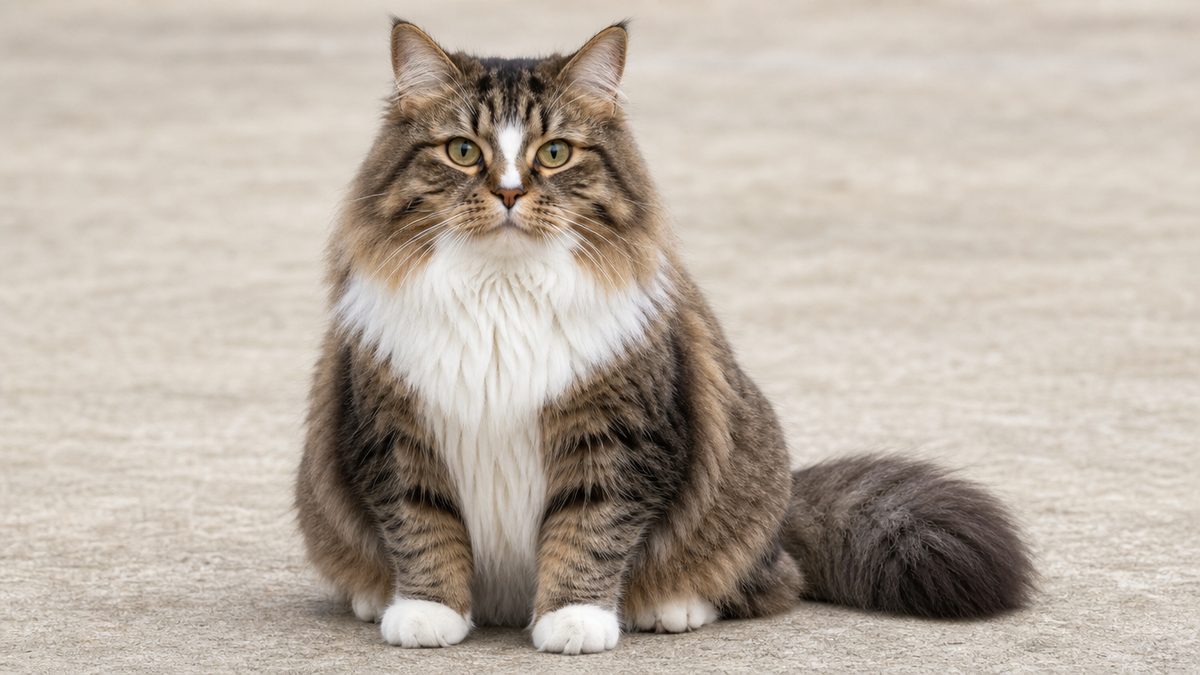
The Ragamuffin is a large, heavily boned, plush-coated companion cat established in the United States in 1994, permitted in every colour and pattern except the pointed one that defines the Ragdoll.
The GCCF's opening paragraph is the clearest short description available. It calls the RagaMuffin a large breed, well balanced in both personality and physical characteristics, whose characteristic sweet and gentle expression results from the size, shape and setting of its expressive eyes combined with puffy whisker pads, and notes that no physical characteristic is extreme. Both sexes should be muscular and heavy with a fleshy pad on the lower abdomen, and full maturity arrives at approximately four years.
That fleshy pad is not a euphemism for a fat cat. It is scored in the standard, inside the ten points allotted to Body and Neck, and the same clause says these cats are fully fleshed and the backbone and ribs should not be visible. A Ragamuffin in correct condition looks softer than most pedigree cats by design.
The body itself is described in one word before anything else. The breed standard opens its body clause as rectangular, with a broad chest and broad shoulders, moderately heavy muscling in the hindquarters and the hindquarters equally as broad as the shoulders, and asks for legs that are heavily boned and medium to medium-long with the back legs slightly longer than the front, and large round paws able to support the weight of the cat without splaying. Rectangular rather than cobby is the shape to look for, and it is what separates this cat from a Persian at a glance.
Head, eyes and the coat pattern rule
The head is very broad, of moderate length, with rounded contours and a moderately rounded rather than domed forehead, and the muzzle and cheeks are rounded to emphasise that breadth. The walnut eyes are large and spaced well apart, and the standard says a sweet gentle expression is essential and that the more intense the eye colour the better. CFA describes the same head as a broad modified wedge with a pleasingly rounded appearance.
The coat is medium to medium-long with a plush texture, soft and dense and with an undercoat, longer around the neck and outer face to give a ruff, increasing in length from the top of the head through the shoulder blades and back, with knickerbockers on the hind legs and a tail like a plume or soft bottlebrush. CFA compares the coat to a rabbit's fur.
The colour clause is the rule that defines the breed against its parent. All colours and patterns are allowed, with the exception of the Siamese colourpointed pattern, with or without white, and any amount of white is allowed, from spots on the paws to a blaze, a locket or a white tip on the tail, with symmetry of no importance. CFA states that pointed cats and pointed and white cats exist but are designated for breeding only and cannot currently be shown.
The GCCF gives Temperament 15 points, the joint highest single line in the scale alongside Head Shape, and defines it as Amenable, adding that RagaMuffins should be amenable at ALL times, with allowances made for different surroundings. A registry scoring temperament as heavily as head shape is telling a buyer what the breed was actually selected for.
Size arrives slowly. CFA calls this a slow-maturing breed that can take up to four years to reach full growth, with a mature male's weight reaching up to 20 pounds and females peaking closer to 15. The GCCF agrees on four years and adds that females are substantially smaller than males.
The 1994 split, and what the trademark actually covered
The Ragamuffin exists because a group of breeders left Ann Baker's registry in 1994, and the trademark everyone cites was registered on a different name, which the public register confirms.
The story is told the same way everywhere and almost nobody checks the register. Wikipedia's account is that in 1975, after a group of breeders left, Ann Baker trademarked the names Ragdoll and Cherubim and set up her own registry, the International Ragdoll Cat Association; and that in 1994 a group of IRCA breeders left and, owing to Baker's trademark on the names Ragdoll and Cherubim, renamed its stock of IRCA Cherubim Cats Ragamuffins. It adds that the originally proposed name was Liebling and that Ragamuffin was put forward by founder Curt Gehm.
That account carries its own health warning. The article's Breed divergence section, which contains the trademark claim, sits under a maintenance banner dated October 2022 stating that the section does not cite any sources.
What the register shows
The United States trade mark database can be searched by Nice class, and class 31 is live animals. Searched against the United States office and filtered to that class, the results are unambiguous.
| Search term | Marks returned | The relevant records |
|---|---|---|
| ragdoll | 4 | RAGDOLL, application 73030420, filed 26 August 1974, registered 9 December 1975, INTERNATIONAL RAGDOLL CAT ASSOC. INC., status Ended |
| ragdoll | RAGDOLL, application 74045198, filed 2 April 1990, The International Ragdoll Cat Association Inc, no registration date, status Ended | |
| ragdoll | Two modern cattery names, RAGDOLL PUPPIES and FUR-REAL RAGDOLLS | |
| ragamuffin | 0 | None |
| cherubim | 0 | None |
Three things follow, and they are all checkable in the same database.
- The Ragdoll trademark is real and the date matches the story. It was registered to the International Ragdoll Cat Association on 9 December 1975, the year Wikipedia gives.
- The Ragamuffin name has never been a trademark for cats. Across all classes there are 29 United States marks containing the word, covering clothing, toys, bags, recordings, publications, a bicycle and flour, the oldest a 1935 footwear registration, and not one is in the live-animals class.
- The Cherubim mark does not appear in the live-animals class either. Twelve United States marks contain the word and they are locks, music publications, clothing and church organisations.
A zero in one class of one country's register is not proof that no mark ever existed. A Cherubim mark could have been filed in another class, under another spelling, allowed to lapse before electronic records, or asserted as an unregistered common-law mark, and this page reports what the register shows rather than asserting a negative beyond it TMview, United States office. What can be said flatly is the part that matters commercially: nobody has ever held a United States trade mark on the name Ragamuffin for cats, so no seller can claim one, and the mark that shaped this breed's name belonged to the Ragdoll.
The registry's own version, which does not mention a trademark at all
CFA tells the story differently. It records that in the early 1990s a group of breeders formerly associated with Ann Baker chose to break away from her registry, that they worked with carefully chosen domestic longhairs to continue development and add fresh genes for health and vitality, and that they retained some Ragdoll characteristics but with a somewhat different type and a dramatically different colour scheme. On the name it says only that RagaMuffin was chosen because it linked the new breed back to its ancestral street cats and added a certain roguish charm.
No trademark appears anywhere in CFA's account. Two documented versions of one naming decision, one register that confirms half of one of them, and this page publishes all of it rather than picking the version that reads better. What both accounts agree on is the year, 1994, and the direction, away from Baker's registry.
The founding stock is worth recording because it explains the colour rule. Wikipedia states that the IRCA Cherubim cats developed from 1971 to 1994 were used as the foundation cats and included the IRCA Miracle Ragdolls, Ragdolls, Honey Bears and Maxamillion lines, while the Ragdoll breed was founded on only the IRCA Ragdoll lines developed from 1971 to 1975. A wider founding pool produces a wider colour range, and the standard then wrote that width into the breed.
Registry recognition, and the Cherubim question
Three registries hold a breed called Ragamuffin, three do not, and two of those three hold something called a Cherubim instead.
State registry recognition per body rather than as one global claim. On this breed the split is not just about recognition, it is about the name, which is unusual enough to be worth a table of its own.
| Registry | Holds a breed called Ragamuffin | What it holds instead or in addition |
|---|---|---|
| CFA | Yes, registration 2003 and championship 2011 | A RagaMuffin breed council with two 2026 candidates, separate from the Ragdoll council |
| GCCF | Yes, Section 2 Group A from page 57 | A full standard beside the Ragdoll at page 47 and the Birman at page 60 |
| WCF | Yes, code RGM, recognised by WCF, CFA and GCCF | Ragdoll listed separately at code RAG, recognised by all |
| TICA | No | A Cherubim, described as part of the Ragdoll Breed Group and accepted in mink, sepia and traditional categories |
| LOOF | No | One record titled Ragdoll and Cherubim, permitting Ragdoll to Ragdoll, Ragdoll to Cherubim and Cherubim to Cherubim |
| FIFe | No | Ragdoll only, at code RAG, rank 3 of 54 with 15,052 registrations in 2024 |
The TICA absence was tested rather than assumed. Because tica.org returns HTTP 403 behind a Cloudflare JavaScript challenge to every direct fetch, its breed pages were enumerated from the Internet Archive index instead, which returns 85 distinct breed pages including household-pet categories and coat-length variants. There is no ragamuffin page among them and none under any raga spelling, while a cherubim page exists.
Whether the Cherubim is the same cat
This page will not assert that it is, because no document opened here settles it. What can be set out is what each registry describes. TICA's Cherubim is a large affectionate semi-longhaired cat, part of the Ragdoll Breed Group, sharing the same body and head type as the Ragdoll, distinguished from it by a wide variety of colours, and accepted in the mink, sepia and traditional categories. LOOF files Ragdoll and Cherubim as one record and permits crosses between them.
The CFA and GCCF RagaMuffin is a separate breed with its own standard, its own breed council and its own colour rule excluding the pointed pattern, sharing a section with the Ragdoll rather than a breed group Cat Fanciers' Association. The two arrangements describe overlapping cats and organise them differently, and a buyer's practical question is simply which register the pedigree in front of them comes from.
The World Cat Federation's EMS table lists the Ragamuffin as recognised by WCF, CFA and GCCF, with TICA, FIFe and LOOF absent. Every one of those three absences held up against the registries' own documents Federation Internationale Feline Livre Officiel des Origines Felines. This site has recorded the same map omitting a genuine recogniser elsewhere, so it is worth saying plainly when its absences check out.
There is no registration count for this breed anywhere, because the one registry that publishes per-breed registration figures does not hold it. FIFe's 2024 statistics carry 54 numbered rows summing exactly to the printed total of 96,075 and there is no Ragamuffin row, while the Ragdoll sits third at 15,052 registrations, 70.3 percent of the whole of Category 1. So the honest comparison is that the parent breed is one of the three most-registered cats in Europe and the offshoot is not counted at all.
Ragamuffin cat price in India, and a table that fails its own arithmetic
One Indian page prices the Ragamuffin cat in India city by city, and its headline band is neither the minimum nor the maximum of its own table.
Unusually for this cluster, an Indian page exists and it is detailed. It gives a headline range of Rs 35,000 to Rs 1,20,000, a separate show-quality band of Rs 75,000 to Rs 1,20,000 plus, monthly maintenance of Rs 4,000 to Rs 10,000, and a city-wise breakdown. The city table is where it comes apart.
| City | Minimum printed | Maximum printed | Spread |
|---|---|---|---|
| Delhi and NCR | Rs 38,000 | Rs 1,05,000 | Rs 67,000 |
| Mumbai | Rs 40,000 | Rs 1,15,000 | Rs 75,000 |
| Bangalore | Rs 35,000 | Rs 95,000 | Rs 60,000 |
| Hyderabad | Rs 32,000 | Rs 90,000 | Rs 58,000 |
| Chennai or Kolkata | Rs 28,000 | Rs 85,000 | Rs 57,000 |
| Table minimum and maximum | Rs 28,000 | Rs 1,15,000 | Rs 87,000 |
| Page headline band | Rs 35,000 | Rs 1,20,000 | Rs 85,000 |
Read the last two rows together. The headline floor of Rs 35,000 sits Rs 7,000 above the lowest city figure the same page prints, and the headline ceiling of Rs 1,20,000 sits Rs 5,000 above the highest. A summary band that does not contain its own data was typed rather than derived, which does not make the numbers false but does mean nobody checked them.
That page prices a TICA or CFA show quality Ragamuffin at Rs 75,000 to Rs 1,20,000 plus. CFA does show the breed, at championship level since 2011. TICA does not hold a breed called Ragamuffin at all, as its own 85-page breed index shows. A show-quality premium quoted against a registry that does not show the breed is a premium quoted against nothing.
The division tests, run and reported
Every figure on that page was divided by 84.38, 80 and 74 to test for a disguised foreign price. Rs 35,000 gives 414.79, 437.50 and 472.97; Rs 1,20,000 gives 1,422.14, 1,500.00 and 1,621.62; Rs 75,000 gives 888.84, 937.50 and 1,013.51. Several land on round numbers at flat 80, and that proves nothing, because every figure on the page ends in three zeros and any such figure divides cleanly at 80 by construction. The quotients it produces, 437.50 and 1,312.50 and 1,187.50, are not prices any seller would print.
The international comparison confirms it. The page ranking first for the bare breed query prices the Ragamuffin at 1,200 to 2,000 US dollars, which at 84.38 is Rs 1,01,256 to Rs 1,68,760. The Indian band of Rs 35,000 to Rs 1,20,000 is not a conversion of that. So the Indian figures are rupee-native rather than a converted dollar list, and they are still one publisher's numbers.
What the rest of the Indian market says, which is nothing
India's leading cat-price guide, dated 25 March 2026 and reviewed by a named veterinarian, runs a 16-breed quick-reference table and the string Ragamuffin appears zero times across its 50,834 extracted characters, while Ragdoll appears 11 times at Rs 25,000 to Rs 60,000. happypet.care returns HTTP 404 for the breed and poodles.in returns HTTP 200 with the title Cat Breed Not Found, exactly as both do for the Peterbald.
The international pages that rank alongside it price the cat in dollars and say nothing about India. Cats.com prints 1,200 to 2,000 US dollars in its specification block and repeats the figure in its own FAQ, with no rupee anywhere. A large slow-maturing pedigree cat is expensive in every market that genuinely has one, and the useful Indian question is not what it costs but whether a verifiable seller exists, which on 9 September 2026 none did.
So one Indian publisher has a price and the rest of the Indian market does not have the cat. Treat Rs 35,000 to Rs 1,20,000 as a single page's estimate, note that the page cannot reconcile its own table, and do not pay a deposit against it.
The monthly cost of ownership in India
A Ragamuffin costs what a large longhaired indoor cat costs in India, and the one Indian figure available for it is roughly double the template rows other breeds get.
The Indian page that prices this breed puts monthly maintenance at Rs 4,000 to Rs 10,000. That is worth noting because the two template publishers that cover other cat breeds both print Rs 2,800 to Rs 4,200 for almost every cat regardless of size, so a figure that scales with a 20-pound animal is at least being thought about, even on a page whose price table does not reconcile.
| Item | Price | Source and scope |
|---|---|---|
| Kitten course, three visits | From Rs 3,999, against a struck-through Rs 5,065 | One national clinic chain's national page, 11 cities |
| Adult annual booster, CRP plus anti-rabies | From Rs 1,899, against Rs 1,908 | Same chain, same page |
| Anti-rabies alone | From Rs 699 | Same chain |
| CRP alone (Tricat or Feligen) | From Rs 1,249 | Same chain |
| Anti-rabies, Chennai municipal clinics | Free | Greater Chennai Corporation, six named pet clinics |
| Pet licence, Chennai | Rs 50 | Greater Chennai Corporation, 9,115 issued in 2024 |
| Monthly maintenance claim for this breed | Rs 4,000 to Rs 10,000 | One Indian publisher, on the page whose price table does not reconcile |
The vaccination figures are promotional floors from one chain rather than a market average, and that chain has been observed quoting different course prices on different city pages on the same day. Re-check the page for your own city before budgeting from it.
The spread that matters more than any single figure
Greater Chennai Corporation runs six veterinary pet clinics that provide all treatment and anti-rabies vaccination free of cost, and issues a pet licence for Rs 50, of which it issued 9,115 during 2024. A private chain charges from Rs 699 for the same anti-rabies dose. The vaccine is identical; the delivery model is the price.
- Budget Rs 4,000 for the first-year kitten course, then about Rs 1,900 a year for boosters at private-chain floors.
- Budget for a long-toothed comb rather than a salon, because CFA says the coat resists tangles and needs combing once or twice a week.
- Budget for more food than a medium cat needs, since a mature male can reach 20 pounds.
- Budget for cooling in the plains summer, which is the real recurring cost for a plush double-coated cat in India.
- Budget for neutering once, which is the single largest evidenced survival intervention for any cat.
One population figure belongs in every Indian cat budget. Entire cats carried 4.29 times the odds of death before three years compared with neutered cats, with a confidence interval of 3.72 to 4.95, across the whole UK cat population under primary veterinary care. Neutering costs less than one year of the private vaccination route.
Heat tolerance: a plush double coat on a twenty-pound cat
The Ragamuffin is the least heat-suited cat in this cluster of six, because it combines the largest body with the densest coat and has no seasonal thinning to fall back on.
This breed has no homeland climate to compare against, because it was developed in the United States from cats that were themselves developed there. What it has instead is a coat description that can be read directly against Indian temperatures. The GCCF calls the coat medium to medium-long with a plush texture, soft and dense and with an undercoat, longer around the neck and outer face and increasing in length from the top of the head through the shoulder blades and back.
Compare that with the Turkish Van in the same cluster, whose standard specifies no woolly undercoat and whose summer coat is much lighter than its winter one. The Ragamuffin has no equivalent clause. A dense undercoat is the single worst coat structure for a hot humid climate, because it traps a layer of still air against the skin exactly where the animal needs to shed heat.
| City | Cell elevation | Annual mean T2M | Annual mean RH2M | Hottest month | Coolest month |
|---|---|---|---|---|---|
| Chennai | 48.95 m | 27.95 C | 72.39 percent | May, 31.51 C | January, 24.09 C |
| Mumbai | 97.15 m | 26.77 C | 67.39 percent | May, 31.19 C | January, 23.19 C |
| Kolkata | 7.35 m | 25.81 C | 73.93 percent | May, 31.53 C | January, 17.31 C |
| Delhi | 206.37 m | 25.60 C | 45.56 percent | June, 35.88 C | January, 13.61 C |
| Bengaluru | 841.72 m | 23.74 C | 67.94 percent | April, 28.37 C | December, 20.22 C |
| Pune | 635.99 m | 23.86 C | 66.80 percent | April, 28.93 C | December, 19.62 C |
Two Indian cities in that table are genuinely workable for this breed and four are not, and the split is altitude. Bengaluru and Pune sit at 841.72 m and 635.99 m and run annual means of 23.74 and 23.86 degrees C, peaking below 29. Chennai, Mumbai and Kolkata all peak above 31 with humidity above 67 percent, and Delhi reaches 35.88 in June.
This is a cat for an air-conditioned home, and in the plains that is not optional between March and June. A 20-pound animal in a dense double coat has a poor surface-area-to-mass ratio for shedding heat, and unlike a shorthaired breed it cannot lose the problem by moulting. If the household cannot guarantee cooling through the hot season, the honest answer is that this is the wrong breed rather than that it needs management.
- Provide air conditioning or a genuinely cool room through the plains summer, not a fan alone.
- Provide cool tile or stone floor space, which a large longhaired cat will lie flat on given the option.
- Provide more water points than seem necessary, in wide shallow bowls away from the food.
- Provide serious combing through the moult, because a shed undercoat left in place is an insulating layer.
- Provide indoor life, which suits a breed CFA describes as trusting and rarely aggressive and therefore poorly equipped for Indian streets.
The humidity point deserves care rather than alarm. Kolkata runs 73.93 percent annual relative humidity and Chennai 72.39, which is genuinely humid air. What hurts this cat is not damp by itself, it is heat combined with damp against a dense undercoat, and the fix is temperature control rather than dehumidifying.
Temperament and household fit
The Ragamuffin is a lap cat by design, scored on amenability in its own standard, and CFA describes a cat unlikely to mind being dressed up in doll clothes.
The GCCF writes the breed's purpose into its general type standard, saying RagaMuffins are bred to be sociable, intelligent, extremely affectionate, cuddly teddy bear companion cats that are playful and entertaining throughout their lives. Its temperament clause reads Amenable, and requires that RagaMuffins should be amenable at all times, with allowance made for different surroundings.
CFA describes what that looks like in a home. RagaMuffins are known for sweetness rather than high intelligence, though they are eager to please and quite responsive; many will learn to wear a harness and walk on a lead, and some learn to fetch; and while they can be playful, most are happiest living up to their lap cat role and will snuggle with a favourite person for hours.
With children, and the warning that goes with it
CFA says these cats make wonderful pets for families with small children and are unlikely to mind participating in a tea party or being dressed up in doll clothes, and that they also do well with people who live alone, providing devotion and emotional support. Then it adds the caution that matters: RagaMuffins are very trusting and enjoy the company of dogs and other cats, but since they are rarely aggressive, care should be taken to introduce them properly so they will not be dominated by other family pets.
That is a specific, actionable warning. A cat that does not defend itself in a multi-pet household needs a managed introduction and a retreat it can reach, not an open door and optimism.
- Choose a Ragamuffin if you want a genuine lap cat and can keep the house cool.
- Choose a Ragamuffin if there are children old enough to be gentle, because the breed will tolerate more than it should.
- Choose carefully in a household with a confident existing cat or dog, since this breed will not stand its ground.
- Choose a different breed if the flat has no cooling, because the coat and the size are a bad combination in an Indian summer.
- Choose deliberately on noise, since CFA describes friendly conversation rather than a vocal cat.
One trait rating on this page is unusually low and it is deliberate. CFA says RagaMuffins engage in friendly conversation but are not unduly vocal, which makes this the quietest of the six breeds in this cluster and a genuine point of difference against the Tonkinese and the Peterbald.
Training a Ragamuffin, and what it resists
To train a Ragamuffin, use its willingness rather than its intelligence, because CFA describes a cat that is eager to please rather than a problem-solver.
The registry is refreshingly direct about this. CFA says RagaMuffins are known for sweetness rather than high intelligence, but that this does not mean they are not smart, and that because they are very eager to please they are also quite responsive to their owners' wishes. Many are willing to learn to wear harnesses and walk on a lead, and some have also learned to fetch.
Eager to please is a different training lever from clever. A Korat has to be persuaded that a trick is its own idea; a Ragamuffin will cooperate because cooperating is pleasant. That makes short, frequent, food-paired sessions more effective than puzzle-based work.
- Start with handling tolerance, because a slow-maturing cat that will reach 20 pounds needs to accept being lifted correctly.
- Add carrier training second, in short sessions with the door open, months before a vet visit needs it.
- Add comb tolerance third, working up to the moult with brief daily sessions rather than one long fight.
- Add harness work fourth if the household genuinely intends to use it, which CFA reports many of these cats accept.
- Add a monthly weigh-in last, which on a cat this size is the only reliable way to notice a slow gain.
What this breed resists
Very little, and that is the risk rather than the benefit. A cat that will tolerate being dressed in doll clothes will also tolerate being handled badly, carried by a child who cannot support 20 pounds, or crowded by a dominant dog. The training that matters most in this breed is training the humans.
Support the hindquarters. A mature male reaching up to 20 pounds cannot be lifted under the forelegs without strain on the spine and shoulders. Teach every member of the household the two-handed lift before the kitten grows into the problem, and teach the cat to walk into a carrier rather than be posted into one.
Daily exercise for a large, mellow cat
A Ragamuffin needs deliberate daily play rather than self-directed activity, because the breed was selected for calm and calm cats gain weight.
CFA describes a cat that can be quite playful but is happiest snuggling for hours. That is a pleasant temperament and a weight-management problem, and the two facts belong together.
The evidence on why it matters is not breed-specific but it is direct. In the largest UK feline life-table study, lifespan fell by 0.02 years for every 100 g of deviation from the median adult bodyweight within a cat's breed and sex group. On a cat whose correct adult weight may be 20 pounds, judging condition by eye through a plush coat is unreliable, so the scale matters more here than on a shorthair.
- Provide two short interactive sessions a day, initiated by you rather than by the cat.
- Provide a wand toy and a throwable toy, since CFA reports some RagaMuffins learn to fetch.
- Provide low, broad climbing furniture rather than tall narrow towers, because a 20-pound cat lands hard.
- Provide puzzle feeders to slow eating, which is the practical lever on a cat that would rather lie down.
- Provide a monthly weigh-in, recorded, because a plush coat hides a gain that a hand on the ribs would not.
Move sessions to early morning and after sunset from March to June. This is the breed in this cluster with the least heat headroom, so exertion at a Chennai May mean of 31.51 degrees C or a Delhi June mean of 35.88 is a genuine risk rather than a caution. In Bengaluru or Pune, peaking below 29, ordinary timing is fine.
There is no published Ragamuffin exercise requirement and this page does not invent one, for the same reason there is no published anything else: the breed has four PubMed records and three of them are not about cats. What is published applies to all cats, and it points at the food bowl and the scale.
Grooming a plush coat that resists matting
Grooming a Ragamuffin is a comb once or twice a week, because the fur tends to resist tangles and mats despite its length.
CFA is specific and it is good news. Despite their long coats, RagaMuffins do not need daily grooming because their fur tends to resist tangles and mats, and combing with a long-toothed comb once or twice a week is suggested to remove anything that might have got stuck in the coat. Most RagaMuffins do not require regular bathing, though an occasional bath will add to the breed's natural beauty.
The GCCF's coat clause explains why the routine is manageable. The fur is medium to medium-long with a plush texture, soft and dense with an undercoat, longest around the neck and outer face and through the shoulder blades and back, with the fur on the front legs thick and short to medium, and a tendency for the coat to be slightly curled on the underbody. It is a coat with structure rather than a fine silky one that knits itself into mats.
| Task | Frequency | Indian cost |
|---|---|---|
| Long-toothed comb through the coat | Once or twice a week | One comb, once |
| Extra combing through a moult | Daily for a fortnight | Time rather than money |
| Check the ruff, breeches and underbody | Weekly | Free |
| Nail trim | Every three to four weeks | Free at home |
| Tooth brushing | Two or three times a week | One brush and feline paste |
| Professional grooming | Not required | Rs 0 in a normal year |
A dense undercoat is genuinely a heat problem, and clipping it is still the wrong answer. A shaved double coat regrows unevenly, removes the sun barrier over the skin, and does nothing about the underlying issue, which is a large body producing heat in a hot room. Comb the dead undercoat out and cool the room. If a salon offers a lion clip for the weather, decline it and buy an air conditioner instead.
The allergy claim, closed off
A long plush coat attracts the opposite claim to a hairless breed's, but the answer is the same and it is not breed-specific. The 2024 review of the field states that to date there is no scientific evidence for a hypoallergenic cat breed, that even hairless Sphynx cats produce Fel d 1, and concludes that molecular analyses of dander from different breeds show high individual variation in allergen levels but provide no scientific evidence for the concept. Coat length changes how visible the shedding is and nothing else.
Health: an evidence base that barely exists, and one figure not to borrow
Four peer-reviewed records contain the word Ragamuffin and three of them are not about cats, which makes the Ragdoll's heart-disease literature the most tempting and most dangerous thing on this page.
Start with what the search actually returns, because it is a textbook case of a breed name colliding with an ordinary English word. Ragamuffin[tiab] returns four PubMed records, with a clean unrewritten query translation and passing controls in the same session.
| Record | Year | What it actually is |
|---|---|---|
| Ecology: ragamuffin Earth, Nature | 2009 | An ecology commentary. Not about cats |
| The ragamuffin oil, Clinica Odontoiatrica | 1949 | An Italian dentistry note. Not about cats |
| The London Ragamuffin, Hall's Journal of Health | 1885 | A Victorian health-journal piece. Not about cats |
| Ocular Abnormalities in 127 Cats, Veterinary Ophthalmology | 2025 | A feline eye-registry review in which one of 127 cats was a Ragamuffin |
The phrase Ragamuffin cat in title or abstract returns zero records. Controls in the same session returned 126 for Labrador retriever hip dysplasia, 116 for Ragdoll and 43 for Ragdoll cat, so the instrument was working and the absence is real.
The one paper that does count the breed
A 2025 review examined every complete feline examination form in the American eye registry's database from 2013 to 2023, 127 cats in total. The population was 113 Bengals, six British Shorthairs, two each Maine Coon and Norwegian Forest, and one each Domestic Shorthair, Ragamuffin, Siberian and Sphynx. One Ragamuffin, in eleven years, across the United States and Canada.
That is not a health finding about the breed. It is a measurement of how absent the breed is from the veterinary record, and it is more useful than a borrowed statistic would be.
The Ragdoll has a substantial heart-disease literature, with 16 PubMed records on hypertrophic cardiomyopathy naming the breed and 20 on the MYBPC3 gene in cats. The Ragamuffin descends from Ann Baker's IRCA lines and shares ancestry with the Ragdoll, so it is tempting to read that literature across. Nobody has published a Ragamuffin genotype or a Ragamuffin prevalence, so this page states the question rather than answering it: ask a breeder what heart screening the parents have had and what result it gave, and treat any claim that the breed is free of the condition as unevidenced in both directions.
What the registry says, read carefully
CFA writes that because of their diverse background RagaMuffins tend to be sturdy healthy cats with no breed-specific genetic issues, and then immediately names two conditions that may occur in all cats, hypertrophic cardiomyopathy and polycystic kidney disease, adding that genetic testing of breeding animals usually enables breeders to manage health concerns.
Read those two sentences together rather than separately. The first is a statement that nothing has been shown to be breed-specific, which is true and is also what you would expect for a breed with no literature. The second is the registry recommending genetic testing anyway. Both are sensible; neither is a health guarantee.
Lifespan, and the comparison that is available
No breed-specific life table exists. Teng 2024 reports 12 breed rows and the Ragamuffin is not among the 12 breeds that reached the threshold of 15 or more deaths, so it carries no median, no confidence interval and no observed range from that work.
The Ragdoll does have a row, and quoting it as the Ragdoll's rather than as this breed's is the honest handling. It sits at a life expectancy at age zero of 10.31 years, with a 95 percent confidence interval of 8.86 to 11.76, on 69 deaths, and an observed lifespan range of 0.36 to 21.34 years. That places the Ragdoll below the all-cat figure and below the crossbred figure in the same table.
Two figures from that study do apply to any cat in an Indian home. Entire cats carried 4.29 times the odds of death before three years compared with neutered cats, and purebred cats 1.83 times the odds compared with crossbreds. Those are the numbers to act on while the breed-specific ones do not exist.
Feeding a Ragamuffin in India
Feed a Ragamuffin on a measured ration and weigh it monthly, because a plush coat over a 20-pound frame hides weight change better than almost any other cat.
There is no Ragamuffin diet and no published nutritional requirement for the breed, which follows from having no published anything. What exists is the general finding that lifespan fell by 0.02 years for every 100 g of deviation from the median adult bodyweight within a cat's breed and sex group, and the specific complication that this breed's standard asks for a fleshy pad on the lower abdomen.
That last point is the practical difficulty. A correct Ragamuffin has a soft lower belly by design, so the visual cue owners normally use to spot a fat cat is already present in a fit one. The GCCF resolves it in the same clause: these cats are fully fleshed, and the backbone and ribs should not be visible. Not visible is not the same as not palpable, and the ribs should still be findable under the coat.
- Weigh the cat monthly on a bathroom scale, weighing yourself holding the cat and subtracting your own weight.
- Feel for the ribs weekly, because on this breed the eye is a poor guide and the hand is a good one.
- Measure every meal rather than free-feeding, since a slow, mellow cat eats out of availability.
- Feed for the life stage rather than the size, because this breed is not fully grown until about four years.
- Ask your vet to body-condition-score the cat at every visit and write the score down.
Cats eat less and drink more in heat, and both are normal. Between March and June watch water intake rather than appetite, and move the larger meal to the evening. For this breed there is a second reason to watch intake in summer: a cat that is uncomfortably hot moves less, and a large cat that moves less through a four-month season arrives at the monsoon heavier than it started.
The one Indian figure available puts monthly maintenance at Rs 4,000 to Rs 10,000, which includes food alongside everything else. Treat it as an order of magnitude from a page that could not reconcile its own price table, and set the actual ration from your vet's body-condition score rather than from any published band.
Kitten timeline: the first year, and the three years after it
A Ragamuffin kitten's first year follows the ordinary schedule, and then the breed keeps growing for three more years, which is the part buyers get wrong.
| Age | What is happening | What to do |
|---|---|---|
| 0 to 8 weeks | With the mother and litter; colour and pattern already visible | Nothing. A kitten should not leave its mother in this window |
| 2 months | Homecoming at the earliest; first vaccination visit | Start the kitten course, from Rs 3,999 for three visits at one national chain |
| 3 to 4 months | Third vaccine visit including anti-rabies | Complete the course; begin comb training and carrier training in short sessions |
| 4 to 6 months | Rapid growth; the coat begins to fill | Teach the two-handed lift to everyone in the household now, before the weight arrives |
| 6 to 9 months | Sexual maturity approaches | Discuss neutering, the largest evidenced survival intervention for any cat |
| 9 to 12 months | Frame lengthens; still nowhere near adult weight | Switch to adult feeding on veterinary advice; start the monthly weigh-in |
| 1 to 2 years | Body broadens; ruff and breeches develop | Judge condition by hand rather than by eye, because the coat now hides the outline |
| 2 to 4 years | Full maturity arrives at about four years | Annual health check; ask for a body condition score each time |
| Beyond 4 years | Adult weight up to 20 pounds in males | Hold weight steady and keep the room cool through the hot season |
The four-year maturity is stated by both registries that hold the breed. The GCCF says full maturity is reached at four years of age, at which time the RagaMuffin should be heavy boned, strong and muscular, and CFA calls it a slow-maturing breed that can take up to four years to reach full growth.
A seller presenting an eighteen-month-old Ragamuffin as a finished adult is describing an adolescent. Judge the parents rather than the kitten, ask to see the sire and dam or photographs of them at four years or older, and treat any claim about final size made about a yearling as an estimate Cat Fanciers' Association.
Neutering deserves its own line rather than a footnote. Entire cats carried 4.29 times the odds of death before three years compared with neutered cats, with a confidence interval of 3.72 to 4.95, across the whole UK cat population under primary veterinary care. Discuss timing with your vet and treat it as a health decision rather than an administrative one.
Ragamuffin against the Ragdoll and the other big longhairs
The Ragamuffin and the Ragdoll differ on one rule of colour and on almost nothing else a buyer can see, and in India only one of the two is actually available.
The comparison is unusually clean because the two breeds share ancestry, share a GCCF section and differ by a single written rule. Everything else in the table below follows from that rule or from how the registries organise the two names.
| Breed | Pointed pattern | FIFe registrations 2024 | Registries holding the name | Indian price published |
|---|---|---|---|---|
| Ragamuffin | Excluded from the show ring | Not held by FIFe | CFA, GCCF, WCF | Rs 35,000 to Rs 1,20,000, one publisher |
| Ragdoll | Required; it defines the breed | 15,052, rank 3 | All | Rs 25,000 to Rs 60,000, leading guide |
| Birman | Required, with white gloves | 3,147, rank 8 | All | Not in the leading guide |
| Maine Coon | Not applicable | 23,775, rank 1 | All | Rs 40,000 to Rs 1,00,000, leading guide |
| Persian | A separate division | 1,981, rank 11 | All | Rs 12,000 to Rs 50,000, leading guide |
How to tell the two apart in a photograph
Look at the mask. A Ragdoll is pointed, meaning a pale body with darker face, ears, legs and tail, and blue eyes. A Ragamuffin may be any colour and pattern except that one, with or without white, and its eyes may be any colour including odd eyes. So a tabby, a solid black, a tortie or a bicolour with a blaze is a Ragamuffin question rather than a Ragdoll question, and a seal-point with blue eyes is the reverse.
The physical differences are subtler and less reliable for a buyer. The Ragamuffin standard asks for a very broad head with puffy whisker pads and walnut eyes, and CFA notes a somewhat different type from the Ragdoll Cat Fanciers' Association. Type is a judge's call. Colour is a rule anyone can apply.
The honest availability answer
Three of the five breeds in that table carry a published Indian price in a source covering sixteen breeds: the Ragdoll at Rs 25,000 to Rs 60,000, the Maine Coon at Rs 40,000 to Rs 1,00,000 and the Persian at Rs 12,000 to Rs 50,000. The Ragamuffin has a price from one publisher whose table does not reconcile.
So a reader who wants a big mellow longhaired lap cat in India is realistically choosing the Ragdoll, the Maine Coon or the Persian, and should know that all three have Indian prices, Indian availability and, in the Ragdoll's case, an actual published life expectancy.
What gets written wrong about this breed
Five errors recur, and two of them sit on the single Indian page that ranks first for the breed.
- Saying the Ragamuffin name was trademarked, when no United States mark for live animals contains the word.
- Quoting a TICA show-quality premium, when TICA does not hold a breed called Ragamuffin at all.
- Treating a headline price band as a summary of a city table it does not contain.
- Applying the Ragdoll's heart-disease literature to a breed with no published genotype of its own.
- Assuming an eighteen-month-old cat is finished growing, when both registries put full maturity at four years.
The trademark mistake, stated precisely
The claim everyone repeats is that Baker's trademark on the names Ragdoll and Cherubim forced the 1994 group to invent a new name. Half of it checks out and half does not. Searching the United States register filtered to Nice class 31, live animals, returns four ragdoll marks including one registered to the International Ragdoll Cat Association on 9 December 1975, and zero marks containing either cherubim or ragamuffin. And CFA's own history of the breed does not mention a trademark at any point, attributing the name instead to the breed's ancestral street cats and a certain roguish charm.
poodles.in returns HTTP 200 with the title Cat Breed Not Found for this breed, and happypet.care returns a plain 404 happypet.care, which publishes Indian breed…. A summariser that reads status codes rather than page titles could treat the first as an Indian Ragamuffin price page and generate a plausible band from it. There is one Indian price page for this breed and it is the one named on this page; anything else presented as an Indian price should be traced to its source before it is believed.
One thing worth getting right about the name itself
The GCCF and CFA both write the breed name with an internal capital, RagaMuffin, while Wikipedia, the WCF code list and every Indian page use Ragamuffin Cat Fanciers' Association World Cat Federation, EMS code table. Neither is wrong and both refer to the same breed. It is worth knowing only because a buyer searching one spelling on a registry site may not find the other.
Adoption, import and the honest recommendation
No Indian Ragamuffin breeder or listing could be verified, so the two real routes are adoption or a lawful personal import, and the parent breed is genuinely available instead.
This page will not send a reader to a breeder. It can set out the routes and it can point at the cat that is actually obtainable in India, which on this occasion is a close relative.
The import route, in the government's own words
Import of live animals including cats is restricted in India and permitted only with an authorisation from the DGFT, using ITC(HS) code 01061900 for pet animals. Applications go to an Exim Facilitation Committee that meets once a month, and import is allowed only through the airports and seaports of Delhi, Mumbai, Chennai, Hyderabad, Bengaluru and Kolkata and, since October 2024, Kochi airport, with quarantine at the port where required Department of Animal Husbandry…. Import without authorisation is allowed for people shifting residence permanently to India under the customs baggage rules. The full route, which covers cats too, is set out in how to import a dog to India.
- Adopt an Indian shorthair from a local shelter, which costs least, helps most and is already adapted to the climate.
- Verify which registry issued any pedigree offered, because only three bodies hold a breed of this name.
- Verify that a seller claiming TICA papers understands that TICA holds no breed called Ragamuffin.
- Verify what heart screening the parents have had, since the breed has no published literature to fall back on.
- Verify cooling before anything else, because a plush double coat in an unconditioned plains flat is a welfare question.
What an Indian shelter cat gives you instead
A pet licence in Chennai costs Rs 50, the Corporation issued 9,115 of them in 2024, and its six municipal pet clinics provide all treatment and anti-rabies vaccination free of cost. A private kitten course starts at Rs 3,999 and an annual booster at Rs 1,899. An adopted Indian cat can be fully vaccinated and licensed for less than one private vaccine package.
The evidence points the same way. Crossbred cats lived 1.27 years longer than purebred cats on average, and purebred cats had 1.83 times the odds of dying before three years, across the whole UK cat population under primary veterinary care. Those are population figures rather than a verdict on any individual animal, and they are the only figures anyone has.
If what you want is a very large, very gentle, plush-coated lap cat and you have a cool home, the Ragdoll is the same idea with an Indian price, an Indian supply and a published life expectancy Teng KT, Brodbelt DC, Church DB. If you specifically want a Ragamuffin, plan a lawful personal import through one of the seven named ports, ask which of the three registries holding the name issued the pedigree, and ask about heart screening on both parents rather than accepting that the breed has no issues Cat Fanciers' Association Department of Animal Husbandry….
Readers who arrive here from the Birman are usually comparing the three breeds that share the GCCF's Section 2 Group A, and readers who arrive from the British Longhair or the Turkish Van are usually weighing plush coats against Indian heat NASA POWER climatology API, 2001 to 2020.
Ragamuffin questions people actually ask
What is the Ragamuffin cat price in India?
One Indian page prints Rs 35,000 to Rs 1,20,000 and its own table contradicts it. That page gives a city-wise breakdown whose lowest floor is Rs 28,000 for Chennai or Kolkata and whose highest ceiling is Rs 1,15,000 for Mumbai, so the headline band is neither the minimum nor the maximum of its own data. India's leading cat-price guide lists 16 breeds and the Ragamuffin is not among them, while the Ragdoll appears at Rs 25,000 to Rs 60,000.
How much does a ragdoll cat cost in India?
India's leading cat-price guide prices the Ragdoll at Rs 25,000 to Rs 60,000 in its 2026 quick-reference table, describing the breed as gentle and laid-back and suited to families with children. That is a real Indian figure for a breed India genuinely sells, which is why this question appears in a question box about a different cat. If you are searching for the Ragamuffin and being shown Ragdoll prices, the search engine is telling you something true about the Indian market.
How much does a Persian cat cost in India?
The same guide prices the Persian at Rs 12,000 to Rs 50,000, and the Persian is the most-mentioned breed on that page at 22 occurrences. For a reader who wants a large, calm, longhaired cat that is actually obtainable in India, the Persian and the Ragdoll are the two breeds with published Indian bands from a source that covers sixteen breeds, and the Ragamuffin is not.
How much does a cat cost in India?
The purchase price is the smaller half. India's leading guide puts 2026 cat prices from Rs 500 to Rs 5,000 for adoption or an Indian domestic cat, up to Rs 10,000 to Rs 1,20,000 plus for pedigree breeds, and adds Rs 2,000 to Rs 8,000 a month for food, vet care, grooming and litter. Against that, a pet licence in Chennai costs Rs 50 and the Corporation's six pet clinics provide all treatment and anti-rabies vaccination free of cost.
How much does cat parenting cost in India?
Vaccination is the line most first-time owners underestimate, and it varies by delivery model rather than by drug. One national clinic chain lists a three-visit kitten course from Rs 3,999 against a struck-through Rs 5,065, an adult annual booster from Rs 1,899, anti-rabies alone from Rs 699 and the CRP vaccine from Rs 1,249. Greater Chennai Corporation provides the same anti-rabies vaccination free at six municipal clinics. Budget for neutering once, which is the single largest evidenced survival intervention.
Is the Ragamuffin name a trademark?
No, and the register is checkable. Searching the United States trade mark database restricted to Nice class 31, live animals, returns zero marks containing the word ragamuffin. Across all classes there are 29 US marks containing it, covering clothing, toys, bags, recordings, publications, a bicycle and flour, the oldest a 1935 footwear registration, and not one applicant is a cat registry or cattery. The trademark in this story was on the other name.
What is the difference between a Ragamuffin and a Ragdoll?
Colour is the rule that separates them, and it is written into the standard. The GCCF allows the Ragamuffin in all colours and patterns with the exception of the Siamese colourpointed pattern, with or without white and any amount of white, while the pointed pattern is exactly what defines the Ragdoll. CFA adds that pointed RagaMuffins exist but are designated for breeding only and cannot currently be shown. Eye colour follows: a Ragamuffin's eyes may be any colour, including odd eyes.
Which registries recognise the Ragamuffin?
Three under that name, and the map is exact. The CFA granted registration in 2003 and championship in 2011 and runs a RagaMuffin breed council today, the GCCF gives it Section 2 Group A from page 57 of its Standard of Points, and the World Cat Federation lists it as RGM recognised by WCF, CFA and GCCF. FIFe holds no Ragamuffin at all, and neither TICA nor LOOF has a breed of that name, though both hold a Cherubim connected to the Ragdoll.
How rare is the Ragamuffin?
Rare enough that it barely appears in veterinary records. One of 127 cats presented for feline eye-registry examination in the United States and Canada across the eleven years from 2013 to 2023 was a Ragamuffin. In the peer-reviewed literature, four records contain the word and three of them are not about cats at all. CFA describes the breed as relatively new and still small in number, though growing every year.
What health problems do Ragamuffin cats have?
Almost nothing has been published, which is the honest answer. CFA says that because of their diverse background RagaMuffins tend to be sturdy healthy cats with no breed-specific genetic issues, while naming hypertrophic cardiomyopathy and polycystic kidney disease as conditions that may occur in all cats. The Ragdoll has a substantial heart-disease literature, 16 records on hypertrophic cardiomyopathy alone, and none of it has been extended to this breed, so ask about heart screening on the parents rather than assuming.
How long do Ragamuffin cats live?
No breed-specific life table exists. Teng 2024 reports 12 breed rows and the Ragamuffin is not among the 12 breeds that reached the threshold of 15 or more deaths, so it carries no median from that work. The Ragdoll does have a row, at 10.31 years with a 95 percent confidence interval of 8.86 to 11.76 on 69 deaths and an observed range of 0.36 to 21.34 years, and this page reports that as the Ragdoll's figure rather than borrowing it.
Are Ragamuffin cats hypoallergenic?
No. A plush coat with a dense undercoat is the opposite of the shape the claim usually takes, and the claim is unsupported for any breed anyway. The 2024 review of the field states that to date there is no scientific evidence for a hypoallergenic cat breed, that even hairless Sphynx cats produce Fel d 1, and concludes that molecular analyses of dander across breeds show high individual variation in allergen levels but provide no scientific evidence for the concept.
Can a Ragamuffin live in India?
In an air-conditioned home in the south or west, yes, and in an unconditioned plains flat it is the wrong cat. This is a large animal, up to 20 pounds for a male, in a plush medium to medium-long coat with a dense undercoat. Chennai runs an annual mean of 27.95 degrees C and Delhi peaks at 35.88 in June. Unlike the Turkish Van, which has no undercoat at all, this coat does not thin out for summer.
Can you buy a Ragamuffin in India?
No Indian breeder or listing could be verified on 9 September 2026. One Indian page publishes a city-wise price table, two Indian sites that price other cat breeds return a 404 and a page titled Cat Breed Not Found, and the marketplace listings that rank sit behind a human-verification wall. The lawful route into the country is a personal pet import under a DGFT authorisation using ITC(HS) code 01061900 through one of seven named ports, which is a relocation rather than a purchase.
Compare with similar breeds
Ragamuffin sits in 1 Bonbeno group. Each one compares it directly against the breeds it is genuinely an alternative to, on the same figures.