
Cat breed guide
Raas Cat (Busok): Price in India, Registry Status and Care
One island, four colours, a mandatory kinked tail, and about 500 cats left. Almost nothing written in English about this cat is filed under the name Indonesians actually use.
Quick answer
No Raas cat price in India could be sourced on 10 September 2026, and no Indian seller, registry or price guide names the breed at all. India's leading cat-price guide runs a 40-breed list in which the strings Raas and Busok each appear zero times. In Indonesia the reported figure is Rp 5 million per cat, which is rupiah and not rupees.
This page reports what published research and breed standards do and do not say about a landrace cat with no health literature of its own. Where no study exists, the page says so instead of borrowing another breed's numbers. It is reference material, not a diagnosis and not a treatment plan. Consult your nearby vet, a registered veterinarian who can examine your own animal, before acting on anything here.
Raas at a glance
What the Raas cat is, and what to call it
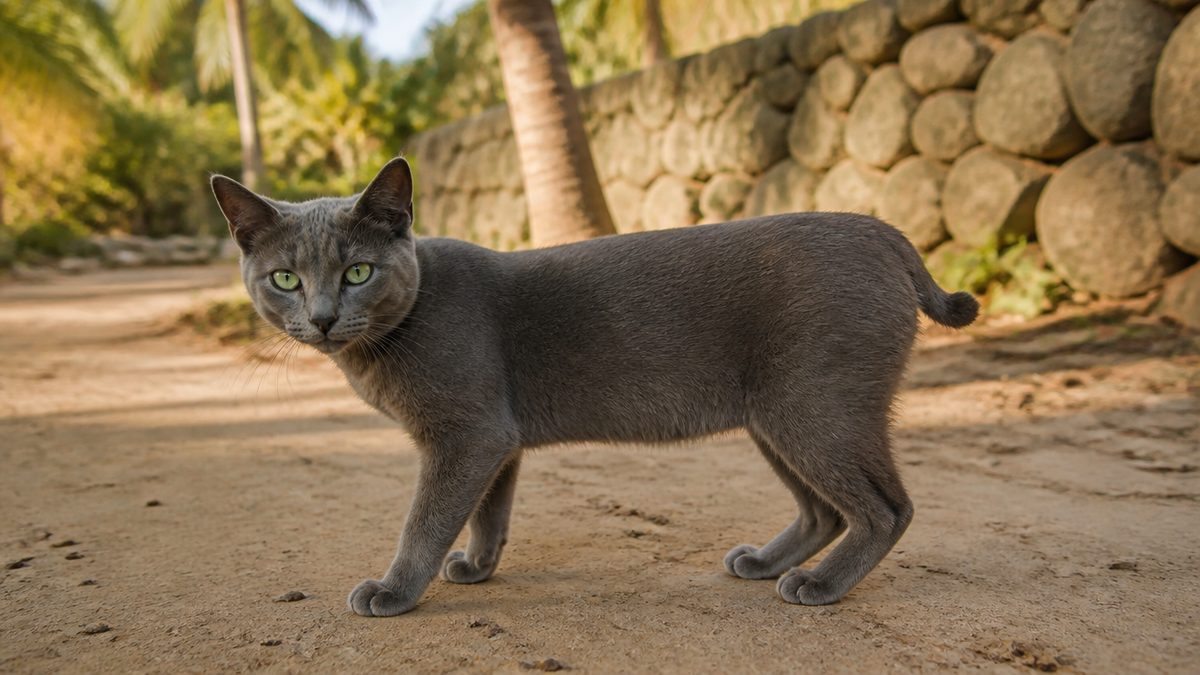
The Raas is a short-coated landrace cat from one Indonesian island, defined by a naturally short and kinked tail, four solid colours and eyes that must not be blue.
The cat is native to Raas Island, which sits east of Madura and forms part of the Raas District of Sumenep Regency in East Java. The island covers about 38.9 square kilometres and is the administrative centre of its district. That is the whole of the breed's natural range, and the long isolation of the island's cat population is what turned an ordinary village cat into a recognisable local type.
Start with the name, because almost every English page gets this backwards. In Indonesia the animal is the kucing busok. Busok is the everyday name, Raas is the island, and Busok-Raas is the compound the breed clubs use. Other forms in circulation include Buso, the Madura cat, and Amethyst cat for the chocolate colour. English-language content files all of it under Raas, which is the least useful key of the lot: on Google India the English query returned about 109 results and no question box at all, while the Indonesian name returned a live four-question box on the identical recipe in the same session.
The physical description, from the standard rather than from a blog
The Feline Fanciers' Federation, a Hong Kong register, publishes the only formal breed standard for this cat that a reader can open and check. It describes a medium-sized cat with a firm, well-muscled body, an equilateral-triangle head with rounded cheekbones, a medium-length nose with a smooth break below the eye line tolerated to about 3 mm, and ears set to point roughly toward 11 and 1 o'clock with their outer edges continuing the lines of the head. The coat is short to medium, close-lying, naturally smooth and shiny.
Two clauses in that document do more work than everything else written about the breed. The first is the tail. It may be rumpy at 0 cm, rumpy riser at 0 to 3 cm, stumpy at 3 to 4 cm, or longy at 4 to 10 cm, and it is kinked or bent at the end. The second is the eye. Colour runs from yellow to green, tosca and orange, and blue eye colour is not accepted. Both appear again in the disqualification list, which reads: a tail that is not kinked, a tail that is not rumpy or stumpy, an incorrect number of toes, and blue eye colour.
Read that beside the CFA's Russian Blue standard, whose disqualification list opens with kinked or abnormal tail, and beside the GCCF's Oriental Bicolour standard, which withholds all placings for a visible kink. The same anatomical feature is a fault in the European and American show world and a requirement in this one. That is not a curiosity. It is the clearest single statement of how far outside the mainstream cat fancy this breed sits, and it is checkable in three documents.
On coat colour the standard is equally short. The four accepted colours are blue, black, chocolate and lilac, with a white belly acceptable. Blue is the busok proper; chocolate is the amethyst. There are no tabby markings, no pointed pattern and no silver in the standard, which is why an Indian buyer shown a grey tabby and told it is a Raas is being shown something else. Tail length is graded rather than merely described, which is unusual, and the four grades below are the ones a buyer should learn.
Allowable outcross breeds: none. That single line tells you the register is closed and the whole future of the breed sits inside an island population one government official puts at not more than 500 animals. A closed register on a small island population is the hardest conservation problem in the cat fancy, and it is the reason people are arguing about how to conserve this animal rather than how to sell it.
Registry recognition, checked in every register that matters
Five major cat registries do not hold the Raas, one Hong Kong registry does, and an Indonesian broadcast claim of World Cat Federation recognition is not supported by the WCF's own current documents.
Recognition is a per-registry question and this page answers it per registry, with the control that proves each search worked. Absence is a strong claim, so it has to be earned rather than assumed.
| Registry | Holds the breed | Document checked | In-document control |
|---|---|---|---|
| Feline Fanciers' Federation (Hong Kong) | Yes, as Busok, Provisional Class | Its own three-page breed standard PDF | Standard opens and extracts cleanly |
| World Cat Federation | No row in the EMS table, no shorthair standard | All 198 EMS rows via the nonce POST, plus the shorthair standards index | Kanaani, Korat, Russian Blue, Oriental Shorthair, Thai all present |
| The International Cat Association | No | The 90-breed index at tica.org | Khao Manee, Korat, Thai, Siamese, Russian Blue all present |
| Cat Fanciers' Association | No | Breed Council Declared Candidates, which includes the miscellaneous and provisional blocks | Korat, Russian Blue, Oriental, Siamese all present |
| Governing Council of the Cat Fancy | No | Standard of Points, June 2026, 723,034 characters | British Shorthair appears 32 times |
| Fédération Internationale Féline | No | The live recognised-breeds list by EMS code | OSH, OLH, RUS, SIA, THA all present |
The Hong Kong register is real and its document is specific. Wikipedia records the breed as holding Provisional Class status with the Feline Fanciers' Federation under the name Busok, with pedigree registration, and the standard itself carries the registration-code table for pedigreed and Supernova classes.
The World Cat Federation claim, tested rather than repeated
An Indonesian broadcast item states that the Busok was recognised by the World Cat Federation on 10 November 2022. That claim circulates widely in Indonesian media and is the basis for the phrase, which several English pages copy, that the breed is the only Indonesian cat recognised internationally.
Two of the WCF's own current documents disagree with it. The EMS code table is a server-side table that serves only 10 of its 198 rows to an ordinary page read, so this page pulled all 198 by reading the nonce out of the page and POSTing for the full set; the server reported recordsTotal 198 and returned 198. Neither Busok nor Raas appears in any row, while Kanaani, Korat, Russian Blue, Oriental Shorthair and Thai all do. The WCF's shorthair breed-standards index likewise carries zero occurrences of Busok or Raas, while carrying Kanaani, Korat and Russian.
There is a reading that reconciles both facts, and it is worth stating because it is probably the truth. The WCF's own table includes a code for non-recognised shorthairs, XSH. A cat can be entered, judged and titled at a WCF show in that class without the breed being recognised, and Wikipedia carries a photograph captioned as a solid blue champion at a WCF show in Jakarta in 2023. Winning at a WCF show and being in the WCF's breed table are different things, and Indonesian coverage appears to have collapsed them.
This site's standing rule is that a WCF absence is unverified rather than disproved, because the EMS map has known omissions. Here the absence is stronger than usual, because it holds across two independent WCF documents with five passing controls in each, and because no WCF Busok standard exists to point at. The honest verdict is that the WCF does not currently publish this breed, that Indonesian sources date a recognition to 10 November 2022, and that a reader who is told the cat is internationally recognised should ask which register and ask to see the standard.
The domestic picture is the more interesting one anyway. The breed standard is issued by the Indonesia Busok Raas Association, and IBRA states in plain words that it was created from the observation and evaluation of 23 busok cats on 24 March 2024 at BSD City. Twenty-three animals, assessed in a satellite town near Jakarta rather than on the island, is the entire evidential base of the written breed. That is not a criticism; it is what an early standard looks like, and saying so is more useful than repeating the word endemic.
History: a gift cat from one island
The Raas was a prestige gift rather than a market animal for most of its history, which is why the population stayed on the island and stayed small.
Historically the cat was associated with myth and legend on Raas Island and was regarded as a prestigious gift, given by local elders, the kyai, to honoured guests or visiting officials. Ownership was therefore limited and never widespread. A cat you give rather than sell does not build a breeding population elsewhere, and the island's isolation did the rest.
That system broke down within living memory. Zainul Mujib, a conservation activist in Desa Alas Malang in the Raas sub-district, told Kompas that open buying and selling had already become common around 2015 and had run freely for close to a decade by mid-2025. He also reported that the breeders working with the cat are now mostly from outside Madura entirely, scattered across places such as Kudus and Sidoarjo.
The regency government has taken the opposite tack in public, treating the cat as a regional asset and using shows to encourage conservation. Mujib's argument in the same Kompas piece is that encouragement is not enough and that a perda or at minimum a perbup, a regional or regent's regulation, is needed to stop free trade, with police, military and transport authorities involved in preventing cats leaving the island.
Two facts sit awkwardly together here, and both belong on the page. A breed becomes internationally visible by being exported, registered and shown. This breed's own conservationists are asking their government to make export harder. An Indian reader who wants one is, in effect, asking to be the problem those people are describing.
Raas cat price in India
No Raas cat price in India exists, from any seller, guide or listing, and the only reported figure anywhere is Indonesian and denominated in rupiah.
The absence is not an artefact of a thin search. India's most visible cat-price guide runs a 2026 all-breeds list, and read as raw text across 45,016 characters, the strings Raas and Busok each appear zero times, while Persian appears 22 times, Bengal 16 and Siamese 9. The same publisher's 40-breed guide to cats for the Indian climate returns zero for both names across 51,780 characters, while Siamese appears 17 times. Two long Indian documents, both built to enumerate what is available here, and neither has heard of this cat.
That matches the supply side exactly. No major registry holds the breed, so no Indian buyer can be sold a pedigree that any Indian body would honour, and there is no Feline Club of India route either.
The only reported figure, and why it is not a rupee price
In Indonesia, Kompas quotes a conservation activist saying prices for cats sold off the island can reach Rp 5 juta, five million rupiah, per animal. Read that abbreviation carefully. Rp is the Indonesian rupiah and Rs is the Indian rupee, one character apart, and Indonesian reporting writes large sums in juta, millions. A reader who skims Rp 5 juta as five lakh rupees has misread the number by a wide margin in the wrong direction.
This page publishes no conversion. No live rupiah-to-rupee rate was established in this research, and a converted band would be exactly the fabricated Indian price this site exists to catch. What can be said is that Rp 5 million is a high figure in its own market, quoted by someone arguing that the trade is a threat rather than by a seller advertising stock.
| Source | What it is | Raas or Busok mentioned | Usable as a price |
|---|---|---|---|
| India's 2026 all-breed cat price guide | 45,016 characters, 16-plus breeds priced | Zero times | No |
| India's 40-breed cat climate guide | 51,780 characters | Zero times | No |
| Kompas, Indonesia | News report quoting a conservation activist | Yes, Rp 5 juta | No, wrong currency and wrong market |
| Stock photo libraries | Image licensing at about USD 25 per file | Yes, repeatedly | No, that is the price of a photograph |
| Indian classified sites | Nothing found for either name | No | No |
The stock-library row deserves a sentence, because it is the trap that catches scrapers. Search either name and image licensing pages surface immediately, each carrying a tidy price of about USD 25. That is the cost of a photograph of the cat. Before quoting any figure attached to a rare breed, confirm the listing is for a live animal.
Could you import one legally
In practice, no. India's import rules put live dogs and cats under ITC(HS) 01061900 as a Restricted item, and the commercial route bars import for trading or breeding purposes outright; the personal pet route runs on the Livestock Importation Act, 1898, and needs a valid pet book in the importer's own name after a qualifying stay abroad. Neither route is a way to buy a cat that is currently sitting on an Indonesian island, and the export side has its own problem: the people closest to the population are lobbying their own government to stop cats leaving. An unrecognised breed also has no pedigree any Indian body would honour, which removes the one document that makes an import worth attempting.
So the honest answer to the price question is that the breed has no Indian price because it has no Indian supply, no Indian registry route and no lawful import route, and that anyone quoting you a rupee figure for a Raas kitten in India is quoting you something else.
Monthly cost of ownership in India, if you had one
Running costs for a Raas would be an ordinary Indian shorthair cat's costs, because nothing in the standard adds a grooming, feeding or veterinary burden.
Nobody in India owns one, so this section prices the animal the standard describes rather than pretending to quote a market. A medium, short-coated, muscular cat with no described undercoat, no brachycephaly, no coat-length problem and no known inherited disease costs what a healthy Indian shorthair costs.
| Line | Figure | Note |
|---|---|---|
| Kitten vaccination course | From Rs 3,999, three visits at days 60, 90 and 120 | List price Rs 5,065 at the same chain |
| Annual booster thereafter | From Rs 1,899 | Anti-rabies alone Rs 699 |
| Consultation | Rs 500 to Rs 1,000 | Treat as one data point, not two; two publishers print it identically |
| Professional grooming | Rs 0 | A close-lying short coat needs none |
| Boarding, per 24 hours | Rs 899 in Bengaluru | Daycare to ten hours Rs 799 |
| Municipal licence | Rs 50 in Chennai | Delhi's Rs 500 registration is for dogs only and does not apply |
The vaccination figures come from a chain with clinics across seven metros and are promotional floors rather than a market average, so budget above them. Neither headline divides cleanly at 84.38, 80 or 74, so neither is a disguised dollar price.
Two Indian facts are worth more to a reader than any of these numbers. Greater Chennai Corporation licenses pet animals generally at Rs 50 and issued 9,115 licences in 2024, and its six municipal pet clinics provide all treatment and anti-rabies vaccination free of cost. If you are budgeting for a cat in Chennai, that single line changes the arithmetic more than the choice of breed does.
Neutering belongs in the budget as a one-off. It is the single best-evidenced survival intervention available for any cat: entire cats carried 4.29 times the odds of death before three years compared with neutered cats in the UK life-table study. Nothing about this breed changes that.
- Budget Rs 4,000 to vaccinate a kitten through its first-year course, then about Rs 1,900 a year to maintain it.
- Budget nothing for professional grooming, because the standard describes a coat that does not need it.
- Budget Rs 899 for a night of boarding in Bengaluru if you travel, or find a sitter, because this is a vocal cat in a kennel row.
- Budget one neutering, which buys more life expectancy than any other line here.
- Budget Rs 50 for a Chennai licence if you live there, and check your own corporation rather than assuming Delhi's dog fee applies.
Suitability for the Indian climate
The Raas is one of the very few breeds on this site whose homeland is hotter and more humid than most of India, so heat is not the risk here and a north Indian winter is.
Most imported breeds on this site come from somewhere cooler, and the climate section is an argument about how badly they will cope. This one runs the other way, and the numbers are unusually clean because the grid cell actually describes the island.
NASA POWER returns a cell elevation of 2.86 m for Raas Island against a real island elevation near 5 m, an error of only 2.14 m, so the model is standing where the cats live rather than on a flattened mountain. That check matters: the same API puts Jerusalem 473 m below its true elevation, and a page that quotes a cell without echoing its elevation is quoting a number it has not verified.
| Place | Annual mean C | Annual RH % | Warmest month | Coolest month | Peak Stull wet bulb |
|---|---|---|---|---|---|
| Raas Island | 27.99 | 78.49 | Nov, 28.83 | Aug, 27.09 | Apr, 25.51 |
| Chennai | 27.95 | 72.39 | May, 31.51 | Jan, 24.09 | May, 26.11 |
| Kolkata | 25.81 | 73.93 | May, 31.53 | Jan, 17.31 | Jun, 27.09 |
| Mumbai | 26.77 | 67.39 | May, 31.19 | Jan, 23.19 | Jun, 25.77 |
| Bengaluru | 23.74 | 67.94 | Apr, 28.37 | Dec, 20.22 | May, 21.86 |
| Delhi | 25.60 | 45.56 | Jun, 35.88 | Jan, 13.61 | Jul, 26.50 |
Read the first two rows together. Raas Island and Chennai have essentially the same annual mean, 27.99 against 27.95, and the island is six points more humid. The reflex that Indian humidity will finish a foreign cat is simply wrong here, and the wet-bulb column proves it from the other side: the island's peak wet bulb is 25.51 C in April, which is below Chennai's 26.11 C in May and well below Kolkata's 27.09 C in June.
The real finding is the range, not the mean
The island's warmest and coolest monthly means are 28.83 C and 27.09 C. That is an annual spread of 1.74 C. Chennai's spread is 7.42 C and Delhi's is 22.27 C NASA POWER climatology API, 2001-2020. This cat evolved in a place that is the same temperature all year, which is a much rarer thing than being hot.
Now put that beside the one climate sentence the breed's own standard contains: they are very sensitive to the cold weather. A registry rarely bothers to write that down. Taken together, the honest Indian reading is the opposite of the usual one for an imported breed.
Chennai, Kochi, Mumbai and Kolkata are climatically the closest analogues India has to this cat's homeland, and none of them would be a shock. Delhi is the problem, and the problem is winter: a January mean of 13.61 C is roughly fourteen degrees below anything on the island's calendar. A short close-lying coat with no undercoat has nothing to offer against that. In Delhi, Chandigarh or Lucknow this is a strictly indoor cat from November to February, with a warm resting place off the floor, and that is a management instruction rather than a reason not to keep one.
One more thing the wet-bulb numbers do not capture. Kolkata's June peak of 27.09 C is the highest in this table and it is the same month as the monsoon. Warm, wet air is what turns a routine ear into a problem in any cat, and the practical rule is the same for a Raas as for a street cat: dry the ears properly after any bath, and do not let a wet cat air-dry in a humid room.
Temperament and household fit
The breed standard describes an active, athletic, owner-loyal cat with an unusually loud and deep voice, and that voice is the trait most likely to decide whether it suits your household.
The Feline Fanciers' Federation general description is short and unusually behavioural for a breed standard. It calls the Busok-Raas very active and athletic, loyal to its owner, and a very vocal cat with a distinctive loud and deep voice compared to other cats. Standards normally confine themselves to anatomy, so a registry writing down a voice is worth taking seriously.
Wikipedia adds the cultural half: for most of its history this was a cat given by village elders to honoured guests, which selected for animals that lived closely with people rather than for anything else.
Everything beyond that, on every ranking page, is invention. The pages currently holding positions one to ten describe the cat as classy, nervous around new people, independent, energetic and affectionate, and none of them cites a source for any of it. Bonbeno will not add a ninth version. What can be stated is what a standard says and what a landrace implies: a working village cat from a small island, selected mostly by survival, will be a competent hunter with a strong bond to one household and little patience for handling by strangers.
For an Indian household the practical read is this. The voice is a genuine consideration in a flat with shared walls. The activity level suits a house with vertical space and shutters that let a cat watch a street. And the loyalty-to-one-person pattern the standard describes makes this a poor match for a home where the cat would be handled by a rotating cast of visitors.
Training a landrace cat
To train a Raas, work with the hunting and food drive a village cat brings rather than against it, because no breed-specific training literature exists.
There is no published training research on this breed, and there is no published behavioural research either: seven name forms returned zero papers in PubMed. Anyone writing a Raas training guide is writing a general cat training guide with a breed name pasted on, and the top Indian result for this breed is exactly that.
What the standard does supply is a starting point. A very active, athletic cat that is loyal to its owner and highly vocal is a cat that will learn a routine quickly, will ask for things loudly, and will get destructive if the day contains nothing to do.
- Train the carrier first, weeks before the first vet visit, by feeding in it with the door open.
- Train a recall to a specific sound, because a semi-outdoor village cat with a strong hunting drive needs one.
- Train tolerance of handling early, especially ears and paws, because the ear-drying routine below depends on it.
- Train an alternative to shouting, by answering a quiet request and ignoring a loud one, or a loud deep voice becomes the default.
- Train harness walking only if your street is safe, and never as a substitute for indoor climbing space.
Two Indian specifics. Litter training is rarely an issue with a cat from a village background, but the litter itself often is: clumping clay dries out fast in a Chennai or Ahmedabad summer and cats reject a dusty tray. And in a monsoon city, a cat that has learned to come indoors on a sound is a cat you can get out of the rain before its ears are soaked.
Daily exercise requirement
A Raas needs two structured play sessions a day plus climbing height, because the standard describes an athletic cat and Indian flats supply neither by default.
The breed standard calls the cat very active and athletic and gives it well-muscled slim legs with hind legs slightly longer than the front, which is the build of an animal that jumps. On the island that need is met by the island. In a flat it is met by you or it is not met at all.
Two sessions of ten to fifteen minutes with a wand toy, ending in a catch and a meal, covers the hunting sequence properly. Add vertical space, which in an Indian flat usually means a shelf run or a tall cat tree rather than furniture, because tiled floors and glass-fronted cabinets make a bored athletic cat expensive.
Time it around the heat. In Chennai in May the outdoor mean is 31.51 C, and hard play in the afternoon is a bad idea for any cat regardless of how heat-adapted the breed is. Early morning and after dark are the sessions that work, which happens to match a cat's own crepuscular preference.
One caution specific to a short-tailed cat. Balance in cats is not tail-dependent to the degree folklore suggests, but a rumpy cat lands differently from a long-tailed one, and high narrow perches are a worse idea for this breed than for a Siamese. Give it height in broad steps rather than in single long jumps.
Grooming and coat care in Indian humidity
Grooming a Raas takes a weekly brush and nothing else, because the standard describes a short, close-lying coat with no undercoat to manage.
The coat clause is brief and that brevity is the point: close-lying to the body, naturally smooth to touch, shiny in appearance, short to medium in length. There is no undercoat described, no ruff, no plume and no texture that a groomer could improve. A rubber brush once a week during a coat change and a damp cloth is the whole routine.
That makes the breed cheap to keep in a country where professional grooming is a real line item. For comparison, a single haircut at a chain in Delhi starts at Rs 1,359 and a complete bath and styling from Rs 1,869, which is money a Persian owner spends and a Raas owner does not.
The one routine that matters in an Indian monsoon
Bathing advice written for a temperate country tells you to towel the cat and let it air-dry. In a Kolkata or Kochi monsoon that is how you get an ear problem: Kochi runs 78.83 percent annual relative humidity and Kolkata's June wet bulb peaks at 27.09 C. If you bathe this cat at all, and mostly you should not, dry the ears properly afterwards and do not leave a damp cat in a closed humid room.
Claws need attention for a different reason. The standard disqualifies an incorrect number of toes, which tells you polydactyly turns up in the source population often enough for a registry to legislate against it. If you ever meet a cat sold as a Raas with extra toes, that is a specific, checkable reason to doubt the paperwork, and it is also a practical grooming note, because extra digits carry claws that do not wear down.
Health risks and lifespan, with the gaps stated
No health study of the Raas exists in any language this research could search, so this section reports what is genuinely unknown and what can be inferred from the standard's own rules.
The literature is empty and the emptiness was tested rather than assumed. Seven name forms were run through PubMed on 10 September 2026 with the query translation read on every one: "Raas cat"[tiab], "Raas cats"[tiab], "Kucing Raas"[tiab], Busok[tiab], "Indonesian cat"[tiab], "Indonesian cats"[tiab] and Madura[tiab] AND cat[tiab] all returned zero, against a session control of 167 for "Siamese cat"[tiab].
Unquoted, Raas[tiab] returns 4,821 records and every one of the first five resolved is about the renin-angiotensin-aldosterone system, the blood-pressure pathway universally abbreviated RAAS. A four-figure count on an obscure breed is evidence of a collision, never of a literature. Madura[tiab] behaves the same way at 348 records, dominated by agriculture and microbiology from Madura Island. Anybody who tells you this cat is well studied has read a result count rather than a record.
The tail, which is the only genuinely interesting genetic question
This is a bobtail breed whose tail locus has never been tested. That matters, because the three bobtail breeds that have been tested gave three different answers. Short tails in the Manx are caused by multiple mutant T alleles producing haploinsufficiency of Brachyury. The Japanese Bobtail's short tail sits in a different gene entirely, with whole-genome sequencing in cats identifying a somite-segmentation model in HES7. Those are two separate mechanisms with two separate risk profiles.
No study has genotyped a Raas for either. No registry requires a DNA test for the breed, and the Feline Fanciers' Federation standard names none. So the responsible position is that the mechanism behind this cat's short kinked tail is unknown, that it must not be assumed to be the Manx mechanism, and that a buyer cannot currently be given a test to ask for. Stating that plainly is more useful than borrowing another breed's genetics, and the difference is not academic: the Manx allele set carries an embryonic-lethal homozygote and an associated rate of congenital anomaly that the Japanese Bobtail's does not.
White, deafness, and why this standard's eye rule reduces the risk
The one health-relevant thing the standard does settle is the white question. In cats, the Dominant White locus is KIT on chromosome B1, and a feline endogenous retrovirus insertion produces two distinct phenotypes: a full-length 7,125 bp FERV1 element associated with white spotting, and an LTR only associated with Dominant White, with deafness genetically linked to that marker.
The Raas standard permits a white belly, which is white spotting, and disqualifies blue eye colour outright. A breed that excludes the all-white, blue-eyed phenotype excludes the combination that carries the congenital deafness risk. That is a real, sourced, breed-specific health statement, and it is the only one this page can honestly make.
Lifespan
No lifespan figure exists for this breed and none should be invented. The best cat life-table study available covers UK cats under primary veterinary care and reports life expectancy at age 0 of 11.74 years across all cats and 11.89 years (11.75-12.03) for crossbreds on 7,117 deaths. Its breed-specific table carries 12 rows and the Methods state that breeds with fewer than 15 deaths were grouped into 'other'. The Raas is not among the 12 breeds that reached that threshold, which is exactly what you would expect of a breed with no UK population at all, and is not a statement about its health.
Two figures from that study do transfer, because they are not breed-specific. Entire cats carried 4.29 times (3.72-4.95) the odds of death before three years compared with neutered cats, and purebred cats 1.83 times (1.50-2.23) the odds compared with crossbreds. The first is the strongest argument for neutering that exists in the cat literature.
If you are ever offered this breed and the seller quotes a lifespan, ask where the number came from. There is no source for one.
Feeding and nutrition
Feed a Raas as a medium, muscular, active shorthair on a complete diet, because no breed-specific nutritional requirement has ever been established for it.
There is no Raas feeding literature and no registry nutritional guidance. The standard describes a medium-sized cat, solid and muscular with medium bone, well-muscled slim legs and a moderate body length, which is a body type that carries condition well and hides weight gain badly under a close-lying coat.
The practical Indian points are the same ones that apply to any active shorthair here. Split the daily ration into three or four meals rather than free-feeding, because an athletic cat that gorges once a day puts on weight. Weigh the food rather than measuring by cup. And check body condition by feel, over the ribs and the base of the spine, monthly.
Water, which matters more in India than the choice of kibble
In a Chennai May at 31.51 C or an Ahmedabad May at 35.06 C, intake is the thing to watch. Wet food raises total water intake more reliably than any fountain does. If a cat eats only dry food in an Indian summer, put a second and third water source in rooms it actually uses, and keep them out of the kitchen, because cats routinely refuse water placed beside their food.
One thing not to do is buy a diet on the strength of a breed claim. There is no Raas-specific formulation, there is no research that could support one, and any product sold as such is sold on a name.
Kitten timeline, month by month through the first year
A Raas kitten's first year follows the ordinary feline schedule, with two breed-specific checkpoints at the tail and the ears.
There is no breed-specific developmental data, so this timeline is the standard feline one with the two points where this breed differs marked.
| Age | What happens | What you do |
|---|---|---|
| 0 to 8 weeks | With the queen. Weaning completes around eight weeks | Nothing. Indian law treats kittens below eight weeks as un-weaned and bars their sale |
| 8 to 9 weeks | Home. Socialisation window still open | Handle ears and paws daily. Introduce the carrier |
| Day 60 | First vaccination visit | Kitten course starts, from Rs 3,999 for three visits |
| Day 90 | Second visit | Confirm the schedule your own clinic uses; chains differ by city page |
| Day 120 | Third visit, plus anti-rabies | Anti-rabies Rs 699 privately, free at Chennai's six municipal clinics |
| 4 to 6 months | Adult coat comes through. Tail conformation settles | Breed checkpoint one: the tail is what it is by now |
| 5 to 8 months | Sexual maturity in a tropical climate can be early | Neuter. This is the single largest survival intervention available |
| 9 to 12 months | Adult muscle and body length fill out | Breed checkpoint two: eye colour finalises, and it should not be blue |
Checkpoint one is the tail. The standard's four grades run rumpy at 0 cm, rumpy riser at 0 to 3 cm, stumpy at 3 to 4 cm and longy at 4 to 10 cm, with a kink or bend at the end required and its absence a disqualification. A kitten sold at eight weeks with a long straight tail will not grow a kink.
Checkpoint two is the eye. Adult colour runs yellow to green, tosca or orange, and blue disqualifies. Kitten eye colour is unreliable and settles over the first year, so a seller certain of adult eye colour at ten weeks is guessing.
The neutering line is not a formality. Entire cats carried 4.29 times the odds of death before three years in the UK life tables, and in a tropical climate with a long breeding season the exposure starts earlier than a temperate schedule assumes.
Raas against the grey cats it gets confused with
Indonesian conservationists name four grey breeds the Busok is mistaken for, and three of them are far easier to obtain in India than the real thing.
This comparison is not Bonbeno's idea. Zainul Mujib, quoted in Kompas, warns the public specifically that four other grey-coated breeds get confused with the busok, naming the British Shorthair, the Russian Blue and the Korat, and adds that a shared colour is no guarantee at all.
The same quote calls the British Shorthair a breed "from America";. It is British, and the GCCF's own Standard of Points carries its standard in Section 3. The rest of the warning is sound and the error is worth flagging rather than repeating, because it is the kind of detail that gets copied.
| Breed | Tail | Eyes | Coat | Registries holding it | Indian price published |
|---|---|---|---|---|---|
| Raas (Busok) | Rumpy to 10 cm, kink required | Yellow to green, orange; blue disqualifies | Short to medium, close-lying, four solid colours | One, in Hong Kong | None |
| Russian Blue | Long; a kink disqualifies | Vivid green | Short, dense, plush double coat with silver tipping | All major registers, blue only | Yes, widely quoted |
| Korat | Long | Green, amber in young cats | Short, single, silver-blue | WCF, CFA, FIFe, TICA and others | Not in India's leading guide |
| British Shorthair | Long and thick | Copper, gold and others | Short, dense, crisp; cobby body | All major registers | Yes, widely quoted |
The tail column separates them instantly and is the check to make in person. A Russian Blue with a kinked tail is a disqualified Russian Blue under the CFA standard; a Raas without one is a disqualified Raas under the Feline Fanciers' Federation standard. No other pair of breeds on this site is defined by opposite rulings on the same feature.
The eye column is the second check. A blue-eyed grey kitten is not a Raas under any reading of the standard.
For an Indian buyer the practical conclusion is short. If what appeals is a solid blue-grey short-coated cat with green eyes, the Russian Blue delivers exactly that, is held by every major register, and has a published Indian price band. If what appeals is specifically the island origin and the short kinked tail, that is not a purchase decision available in India, and the people who keep the cat are asking for fewer of them to leave, not more. The Korat sits in between: a genuine ancient landrace with full registry standing, and absent from India's leading cat-price guide just as this one is.
Mistakes Indian readers make with this breed
Five errors account for almost everything wrong that is written about the Raas in English, and four of them are checkable in under a minute.
1. Reading Rp as Rs
The only reported price for this cat is Rp 5 juta, five million Indonesian rupiah. Rp and Rs are one character apart and the Indonesian convention of writing large sums in juta compounds it. This site has already recorded Rs colliding with Pakistani rupees and with the Brazilian real; the rupiah is the fourth. Never carry a figure across a border without carrying its currency with it, and never publish a conversion without a rate you can name.
2. Searching the English name
Every English page files this cat under Raas. In Indonesia it is the busok. The consequences are measurable in both directions: PubMed's unquoted Raas[tiab] returns 4,821 renin-angiotensin-aldosterone system papers, while on Google India the native name surfaced a question box the English name did not. If you are researching this breed, search busok first.
3. Treating a show win as registry recognition
An Indonesian broadcast claim dates World Cat Federation recognition to 10 November 2022, and a champion photograph exists from a WCF show in Jakarta in 2023. Neither survives contact with the WCF's own documents, which carry the breed in neither the 198-row EMS table nor the shorthair standards index, with five controls passing in each World Cat Federation. The WCF's own table has a class for non-recognised shorthairs, and being judged in it is not the same as being in the breed table.
4. Quoting a stock-photo price
Search either name and image libraries appear immediately with a clean price of about USD 25 attached. That is the licence fee for a photograph. This is the same failure that has produced fake Indian dog prices from downloadable posters, and it is harder to spot here because the number is plausible.
5. Believing the care advice on the ranking pages
The pages currently ranking for this breed give heights, weights, temperaments and health advice with no cited source, and one of them is an Indian site publishing a training guide for a cat that does not exist in India. There is no health literature to draw on and no lifespan figure anywhere. When a page about a 500-animal island landrace reads as confidently as a page about the Persian, that confidence is the tell.
Adoption, and the honest recommendation
Adopt an Indian shorthair instead, because there is no ethical route to a Raas in India and the cat you would actually be buying is a local one.
This is the rare breed page where the adoption section is not a coda. It is the answer.
The situation on the ground is that a sub-district head puts the surviving population at not more than 500 animals, says there is no dedicated breeding facility, and reports that a single village is down to ten or fifteen households still keeping the cat, mostly letting them run loose. The written breed standard rests on the evaluation of 23 cats. Wikipedia records an estimate of fewer than 100 animals with pure genes as of 2016, and six official catteries as of 2026. Whatever the precise number, this is a population that cannot support an export market, and its own conservationists are asking their government to restrict trade rather than expand it.
There is also no route. No major registry holds the breed The International Cat Association The Cat Fanciers' Association The Governing Council of the Cat Fancy Fédération Internationale Féline, no Indian guide lists it, and India's import regime makes a commercial import of a cat impossible in any case.
What to do instead
The cat that suits an Indian home for the reasons people like the look of this one, a short-coated, muscular, heat-adapted animal that lives closely with one household, is the Indian shorthair sitting in a local shelter. It is free or close to it, it is already adapted to the climate you live in, and every rupee you would have spent on a rare breed goes into the vaccination course, the neutering and the food instead.
- Contact a registered municipal or NGO shelter in your own city rather than a breeder in another country.
- Confirm the kitten is at least eight weeks old, which Indian law requires and which the pet-shop rules define as the weaning threshold.
- Confirm the vaccination record and start the course if it has not begun, from Rs 3,999 for three visits.
- Confirm the licence position with your own corporation, which in Chennai is Rs 50 and covers cats.
- Confirm neutering is booked, because it buys more than any other single decision on this page.
If you specifically want the solid blue-grey look with green eyes, buy the breed that legitimately supplies it. The Russian Blue is held by every major register, has a real Indian market and a published price band, and comes with a registry standard you can hold a seller to. That is the whole practical difference between a breed and a landrace, and it is worth understanding before you spend anything.
Support for the Raas itself, if you want to give it, belongs on the island. The Sumenep regency government treats the cat as a regional asset and runs public conservation efforts around it, and the argument being made locally is for regulation and for a proper breeding programme, not for more cats going overseas. The most useful thing an Indian reader can do to conserve this breed is to want it slightly less.
Raas cat questions people actually ask
What is the Raas cat price in India?
No Raas cat price in India could be sourced on 10 September 2026. India's leading 2026 cat-price guide runs to 45,016 characters and the strings Raas and Busok each appear zero times in it, while Persian appears 22 times. The same publisher's 40-breed Indian climate guide returns zero for both names. There is no Indian seller, no Indian registry route and no lawful commercial import route for this breed.
Are all Khao Manee deaf?
No. The deafness risk in cats attaches to the Dominant White phenotype rather than to any breed, and it is not absolute. In cats the locus is KIT on chromosome B1, where a full-length retroviral element produces white spotting and an LTR alone produces Dominant White, with deafness genetically linked to that marker. A white cat with blue eyes carries a raised risk; a BAER test settles it for an individual animal. This question reached a Raas search because Google filled the box with other cats entirely.
What cat is worth $13 million dollars?
No cat breed is worth that. The figure comes from a 2011 inheritance story about an Italian stray named Tommaso, not from a sale price, and it circulates in Google's question box attached to searches for rare breeds including this one. Bonbeno records the question because it was genuinely returned for this breed, and answers it plainly: an inheritance is not a market price, and no breed on this site has one anywhere near it.
How expensive is a Sokoke cat?
Bonbeno has no verified Indian figure for the Sokoke and will not repeat an unsourced one. The question is recorded here because Google returned it in the Raas question box, which is itself a finding: the two breeds are linked in Google's related-search rail alongside the Javanese and the Sam Sawet, and that cluster of rare landrace cats is where the entity confusion around this breed begins.
What is the most aggressive wild cat in the world?
This question is not about the Raas and no wild cat is involved in the breed at all. The Raas is Felis catus, a domestic landrace from one Indonesian island, with no documented wildcat ancestry and no hybrid status in any registry document. The question appeared in the Raas question box on Google India and is answered here verbatim rather than tidied away, because the composition of that box says something real about how thin the indexed information on this breed is.
Is the Raas cat recognised by any registry?
Yes, by one. The Hong Kong-based Feline Fanciers' Federation holds it under the name Busok with a published three-page standard and pedigree registration. Five major registries do not: the World Cat Federation carries no row in its full 198-row EMS table and no shorthair standard, TICA's 90-breed index does not list it, the CFA breed-council list does not, the GCCF's 723,034-character Standard of Points returns zero, and FIFe's recognised-breeds list has no entry. Each of those searches had a passing control.
Why does the Raas cat have a short tail?
Nobody knows, and that is the honest answer. The Feline Fanciers' Federation standard requires a tail between rumpy and about 10 cm with a kink or bend at the end, and disqualifies a tail that is not kinked. No study has genotyped this breed. The Manx short tail comes from mutant T alleles causing haploinsufficiency of Brachyury; the Japanese Bobtail's comes from HES7, a different gene entirely. Neither has been shown to apply here, and no registry requires a DNA test for the breed.
How many Raas cats are left?
Not more than about 500, according to Subiyakto, the sub-district head of Pulau Raas, speaking to Kompas in July 2025. He also said there is no dedicated breeding facility and that a single village is down to ten or fifteen households still keeping the cat. A separate estimate on Wikipedia puts the number of animals with pure genes at fewer than 100 as of 2016, with six official catteries operating as of 2026.
Can a Raas cat handle Indian heat?
Yes, better than almost any breed on this site, and the evidence is direct. Raas Island runs an annual mean of 27.99 C at 78.49 percent relative humidity, which is marginally warmer and six points more humid than Chennai, and its peak wet bulb of 25.51 C is below Chennai's 26.11 C. The risk runs the other way: the breed's own standard says the cat is very sensitive to cold weather, and Delhi's January mean of 13.61 C is about fourteen degrees below anything in the homeland's calendar.
How long do Raas cats live?
No lifespan figure exists for this breed and any number quoted to you is invented. The best available cat life-table study gives 11.74 years for all cats and 11.89 years for crossbreds on 7,117 deaths, and its breed-specific table carries only 12 rows because breeds with fewer than 15 deaths were grouped into other. The Raas is not among the 12 breeds that reached that threshold, which reflects the absence of a UK population rather than anything about its health.
Is the Raas cat the same as the Sam Sawet?
No. The Raas is an Indonesian landrace from Raas Island in Sumenep Regency; the Sam Sawet is a Thai cat named in the Ayutthaya-era cat-book poems. They are separated by about 3,000 kilometres and by completely different documentary traditions. The two are nonetheless linked in Google's related-search rail, and at least one stock-photo library has published a caption reading Sam Sawet or Raas Cat breed, also known as Busok Cat, which is how the conflation spreads.
Is there any peer-reviewed research on the Raas cat?
None. Seven name forms were run through PubMed with the query translation read on each: Raas cat, Raas cats, Kucing Raas, Busok, Indonesian cat, Indonesian cats and Madura combined with cat all returned zero, against a session control of 167 for Siamese cat. Searched unquoted, Raas returns 4,821 records and they are the renin-angiotensin-aldosterone system, a blood-pressure pathway with the same acronym.
Compare with similar breeds
Raas sits in 2 Bonbeno groups. Each one compares it directly against the breeds it is genuinely an alternative to, on the same figures.