
Cat breed guide
Sam Sawet Cat: Price in India, and the Thai Cat Nobody Counts
One of the seventeen auspicious cats of the Ayutthaya cat-book poems, and absent from Thailand's own list of the five that survive. The gap between those two facts is the whole story.
Quick answer
No Sam Sawet cat price in India could be sourced on 10 September 2026, and India's two largest cat guides never name the breed. The deeper problem is upstream: Thailand's Fine Arts Department, a Cabinet resolution announced in November 2025 and a peer-reviewed 2024 genetics study each name five surviving Thai cat breeds, and the Sam Sawet is in none of the three lists.
This page reports what Thai state sources, peer-reviewed genetics and the registries do and do not say about a cat named in a seventeenth-century manuscript and absent from every modern list of survivors. Where no evidence exists, it says so rather than borrowing another breed's figures. It is reference material, not a diagnosis and not a treatment plan. Consult your nearby vet, a registered veterinarian who can examine your own animal, before acting on anything here.
Sam Sawet at a glance
What the Sam Sawet is, in the words of the Thai sources
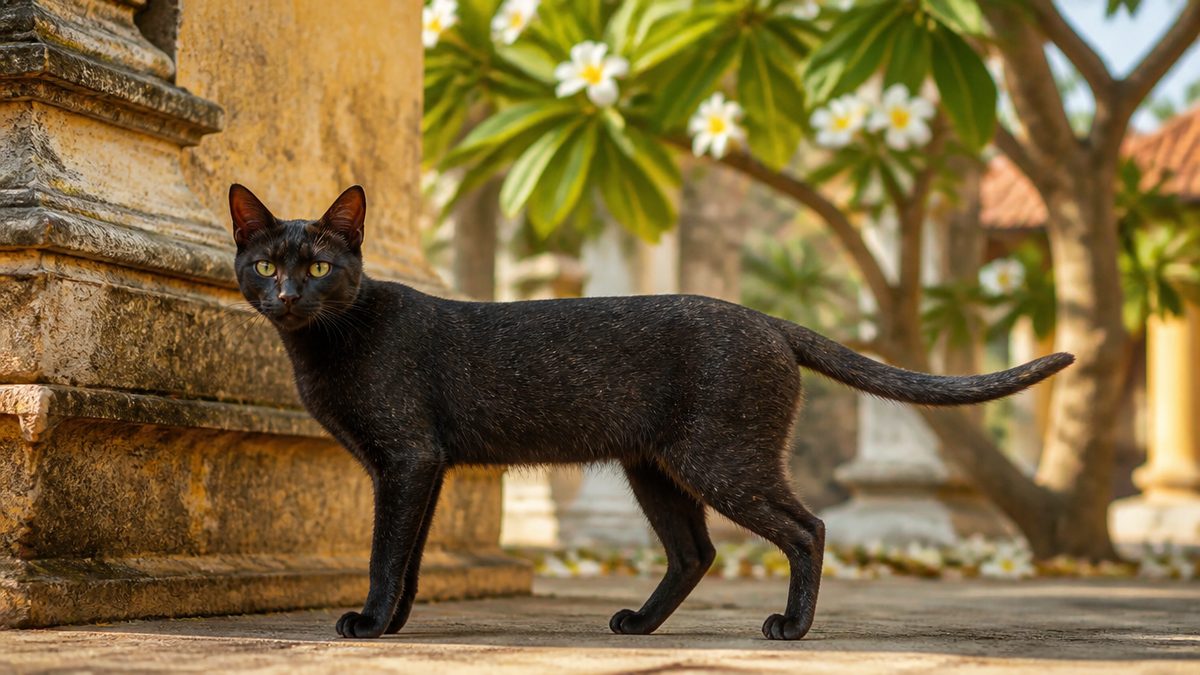
The Sam Sawet is a black Thai cat flecked throughout with white hairs, named as one of the seventeen auspicious cats of the Tamra Maew, and its name simply means interspersed with white.
Start with the name, because it is also the description. แซมเสวตร แปลว่า แซมสีขาว, Sam Sawet means interspersed with white. There is no further mystery in the breed's identity: it is a black cat with white hairs scattered through the coat.
The most compact Thai description comes from the Office of Knowledge Management and Development, a Thai public organisation, whose entry reads in full: ลักษณะเดียวกับโกนจา ตาสีเขียว แต่มีขนสีขาวแซม, the same characteristics as the Konja, green eyes, but with white hairs interspersed. That single sentence defines the breed by reference to another one, and it is the reason this page and the Korn Ja page have to be read together.
The fuller description, and one internal disagreement
Ramkhamhaeng University's central library gives more. Its entry describes a coat black with white flecking throughout, thin and rather short; a head neither round nor too pointed; large erect ears; eyes greenish-yellow, a colour it likens to the light of a firefly; a long tail with a straight pointed tip; and long slender legs in proportion to the body.
The two Thai sources do not quite agree on the eye. OKMD says green; Ramkhamhaeng says greenish-yellow like firefly light Ramkhamhaeng University Central Library. That difference matters less than it looks, because both are describing the same range and both distinguish the cat from the blue-eyed Wichien Maat. It is recorded here rather than smoothed over.
The Thai state and university sources write the name แซมเสวตร Office of Knowledge Management…. A widely-cited breed-identification app writes it แซม เศวต, with a space and a different final cluster. Both romanise to Sam Sawet. If you search Thai sources, search both, because the two strings do not match each other and neither matches the English name. Nor can you translate your way out of the problem with a search engine, since a machine that will translate the words will not reconcile the two spellings for you.
There is no breed standard. No registry anywhere publishes one, so the descriptions above are the entirety of what the breed's identity rests on, and they come from a manuscript tradition rather than from a show ring. That leaves coat colour doing all the work: an unrecognised cat with no studbook is identifiable only by the pattern its name describes, and there is no body anywhere that could confirm or refuse the label. Where a Western registry does hold a Thai cat, the difference is obvious, and the GCCF's current Thai standard, complete with Thai Blue Point (TAI 33 a) and Thai Lilac Point (TAI 33 c), shows what a written standard looks like.
Registry recognition, and the more important Thai question
No cat registry in the world holds the Sam Sawet, and Thailand's own state bodies do not count it among the Thai breeds that still exist.
The registry answer is short and was tested rather than assumed.
| Registry | Holds the breed | Document checked | In-document control |
|---|---|---|---|
| World Cat Federation | No, in any spelling | All 198 EMS rows via the nonce POST | Korat, Thai, Siamese, Oriental Shorthair, Russian Blue present |
| The International Cat Association | No | The 90-breed index at tica.org | Khao Manee, Korat, Thai, Siamese present |
| Cat Fanciers' Association | No | Breed Council Declared Candidates, including miscellaneous and provisional | Korat, Siamese, Oriental, Russian Blue present |
| Governing Council of the Cat Fancy | No | Standard of Points, June 2026, 723,034 characters | Korat and Thai standards both present in Section 4 Group A |
| Fédération Internationale Féline | No | The live recognised-breeds list by EMS code | THA and SIA fully recognised; only Bombay and Lykoi preliminary |
That absence is unsurprising for a landrace and would normally be the end of the section. It is not, because the interesting question about this cat is not what the Western registries think. It is what Thailand thinks.
Thailand names five surviving cats, and this is not one of them
Three separate Thai authorities have published a list of the Thai cat breeds that survive today, and all three give the same five.
| Source | What it is | Number of surviving Thai breeds | Sam Sawet included |
|---|---|---|---|
| Fine Arts Department, Chanthaburi National Library | Thai state cultural authority | Five | No, zero mentions |
| Cabinet of Thailand, announced 19 November 2025 | Cabinet resolution on national identity | Five | No, zero mentions |
| Jaito et al. 2024, Genomics & Informatics | Peer-reviewed genetics, 184 cats sampled | Five | No, zero mentions |
| Ramkhamhaeng University Central Library | University library information page | Six | Yes |
| A Thai cat enthusiast site | Hobbyist | Four | No |
The Fine Arts Department's national library in Chanthaburi introduces five Thai cat breeds accepted domestically and internationally as carrying a distinctly Thai identity: Wichienmaat, Suphalak, Korat, Konja and Khao Manee. The string แซมเสวตร appears zero times in that article.
On 19 November 2025 the Prime Minister's Office announced that the Cabinet had resolved to designate Thai cats as a national identity in the pet-animal category, and named the surviving purebred Thai breeds as Suphalak, Korat, Wichienmaat, Konja and Khao Manee. Again five, again the same five, again no Sam Sawet.
And a peer-reviewed genetics study published in 2024, which sampled 184 Thai cats across the country and genotyped them at 15 microsatellite loci plus mitochondrial D-loop, states in its introduction that the ancient texts identified 23 cat breeds and that today only five remain, naming Wichien Maat, Suphalak, Korat, Khao-Manee and Konja. The string 'Sam Sawet' appears zero times in the paper.
Against that, one Thai university library page lists six surviving types and includes the Sam Sawet, describing it as believed extinct but beginning to be found again in recent years. That page is the origin of almost every English claim that the breed survives. Its own bibliography cites Thai Wikipedia for the Sam Sawet entry specifically, which is worth knowing before treating it as an independent authority.
The Sam Sawet is real as a historical type. It is named in the manuscript tradition, described consistently in Thai sources, and defined by a specific coat pattern. Whether it survives as a living population is a question three Thai authorities have answered in the negative by omission and one university page has answered in the affirmative without independent evidence. Any English page telling you the Sam Sawet is a rare living Thai breed is choosing one side of that without mentioning that a side exists.
History: the seventeen auspicious cats and the six that bring harm
The Sam Sawet is one of seventeen auspicious cats in a Thai manuscript tradition of twenty-three, and the whole scheme is a system of household omens rather than a breed register.
The source is the Thai cat manual, the ตำราดูลักษณะแมว, which forms part of the Tamra Phrommachat and was copied by hand through the generations. Ramkhamhaeng University attributes the surviving text to the ancient samut khoi of Wat Anongkharam, believed handed down from the Ayutthaya period, with a manual of auspicious characteristics compiled in the early Rattanakosin period.
The system has a fixed shape. Twenty-three varieties in total: seventeen that bring benefit and six that bring harm Office of Knowledge Management…. The 2024 genetics paper independently reports the same total, dating the Cat-Book Poems to 1350-1767 and the SMUD Khoi of Cats to 1868-1910.
The seventeen, in the order Ramkhamhaeng gives them, are Wichienmaat, Suphalak (also Thongdaeng), Maled (also Korat or Si-sawat), Konja, Ninrat (also Dam Plod), Wilat, Kao Taem, Rattanakamphon, Ninchak, Malila, Krop Waen (also An Ma), Pat Sawet (also Pat Talot), Krachok, Singhasep, Karawek, Chatubot and Sam Sawet. The six that bring harm are Thupphalaphet, Phanphayak (the tiger-striped one), Pisat, Hinathot, Kop Phloeng and Nep Saniat.
What the tradition is actually doing
It is worth being clear about the genre, because English cat writing treats these as a breed register and they are not one. This is a system of household omens organised by coat pattern. A cat is auspicious or inauspicious according to how its markings read, and the verses attached to the seventeen describe what keeping one is believed to bring the owner.
That has two consequences for anyone researching this cat. First, several of the seventeen are distinguished from one another by very small differences. The Konja is solid black; the Ninrat is the same cat with black claws, black tongue, black teeth and black eyes; the Sam Sawet is the same cat again with white hairs interspersed. These are not seventeen distinct populations, they are seventeen readings of a cat.
Second, the tradition itself disagrees internally. Ramkhamhaeng groups ดำปลอด with Ninrat, while OKMD lists it as an alternative name for the Konja alongside รองมด Office of Knowledge Management…. Two Thai sources, one manuscript tradition, and the same name filed against two different cats. That is what a copied manuscript lineage looks like after four centuries, and it is a better explanation of the confusion around this breed than anything in the English literature.
The Khao Manee comparison, which cuts the other way
One control makes the whole scheme legible. The Khao Manee is not in the seventeen at all. Both the Fine Arts Department and Ramkhamhaeng University state plainly that it does not appear in the Ayutthaya-period manual and was recorded additionally in the early Rattanakosin period, its older name in the Wat Arun samut khoi being แมวขาวปลอด, described there as a priceless jewel cat with none of the dedicated verses the seventeen carry.
So the two cats are exact opposites. The Khao Manee is absent from the manuscript and present on every modern list, including the Cabinet's. The Sam Sawet is present in the manuscript and absent from every modern list but one. Being in the Tamra Maew and being a living Thai breed turn out to be independent facts, and no English page about either cat says so.
Sam Sawet cat price in India
No Sam Sawet cat price in India exists, and no price exists in Thailand either, because Thailand's own authorities do not list the cat among the breeds that still exist.
The Indian absence was tested. India's 2026 all-breed cat price guide runs to 45,016 characters of extracted text and the strings Sam Sawet and Sawet each appear zero times, while Persian appears 22 times, Bengal 16 and Siamese 9. The same publisher's 40-breed guide to cats for the Indian climate returns zero across 51,780 characters.
That is expected. What is not expected, and what no other page reports, is that there is no Thai market either. A breed that Thailand's Fine Arts Department, its Cabinet and a 184-cat genetics study all omit from the list of surviving Thai breeds does not have a breeder network to price Public Relations Department Jaito W, Singchat W, Patta C, Thatukan C.
| Source | What it is | Sam Sawet named | Usable as a price |
|---|---|---|---|
| India's 2026 all-breed cat price guide | 45,016 characters | Zero times | No |
| India's 40-breed cat climate guide | 51,780 characters | Zero times | No |
| Amazon listings | A print-on-demand care guide book | Yes | No, that is the price of a paperback |
| Stock photo libraries | Image licensing at about USD 25 | Yes, and merged with the Raas | No, that is a licence fee |
| Any registry or Thai breeder body | Nothing found | No | No |
The Amazon row is worth a sentence because it is the cleanest example of the genre. A print-on-demand book titled as a Sam Sawet care guide ranks on page one of Google India for this breed. It is a book about a cat whose existence as a living population is contested, sold to people searching for one. The price attached to it is the price of the book, and it is not expensive, which is precisely why it is easy to buy by mistake.
A Shutterstock caption in the same result set reads: 'The image shows cats of the Sam Sawet or Raas Cat breed, also known as Busok Cat';. That merges a Thai cat with an Indonesian one about 3,000 kilometres away, and Google's related-search rail on the Raas query links back to the Sam Sawet in the other direction. A scraper following that thread would happily attach the Indonesian Raas cat's reported Rp 5 million figure to this breed, and it would be wrong in the breed, the country and the currency simultaneously.
The honest answer to the price question is that this cat cannot be bought anywhere, and that a seller offering one in India is offering a black cat with some white hairs, which is a description that fits a very large number of Indian street cats.
Monthly cost of ownership in India
A Sam Sawet would be among the cheapest cats in India to keep, because the Thai description gives it a thin, short coat that needs no professional grooming at all.
Nobody in India or Thailand can obtain one, so this prices the animal the Thai sources describe rather than pretending to quote a market. A medium, short-coated cat with a thin coat, no undercoat mentioned, no brachycephaly and no described inherited condition costs what a healthy Indian shorthair costs.
| Line | Figure | Note |
|---|---|---|
| Kitten vaccination course | From Rs 3,999, three visits at days 60, 90 and 120 | List price Rs 5,065 at the same chain |
| Annual booster | From Rs 1,899 | Anti-rabies alone Rs 699 |
| Consultation | Rs 500 to Rs 1,000 | One data point, not two; two publishers print it identically |
| Professional grooming | Rs 0 | A Delhi haircut starts at Rs 1,359 and a full bath and styling at Rs 1,869 |
| Boarding, per 24 hours | Rs 899 in Bengaluru | Daycare to ten hours Rs 799 |
| Municipal licence | Rs 50 in Chennai | Delhi's Rs 500 registration covers dogs only |
The grooming line is the breed-driven saving and it is real. A Delhi grooming list starts at Rs 1,359 for a haircut, Rs 934 for a bath and Rs 1,869 for a complete bath and styling. A thin, rather short coat needs none of it.
Two Indian facts change the arithmetic more than the breed does. Greater Chennai Corporation licenses pet animals generally at Rs 50, issued 9,115 licences in 2024, and its six municipal pet clinics provide all treatment and anti-rabies vaccination free of cost. And neutering, at whatever your clinic charges, buys more life expectancy than anything else on this list: entire cats carried 4.29 times (3.72-4.95) the odds of death before three years in the UK life tables.
- Budget Rs 4,000 to vaccinate a kitten through its first-year course, then about Rs 1,900 a year.
- Budget nothing for professional grooming, because a thin short coat does not need it.
- Budget Rs 899 for a night of boarding in Bengaluru if you travel.
- Budget one neutering, which is the single largest survival intervention available.
- Budget Rs 50 for a Chennai licence, and check your own corporation rather than assuming Delhi's dog fee applies.
Suitability for the Indian climate
Thailand and coastal India are the same climate to within a tenth of a degree, so a Sam Sawet would find Chennai unremarkable and a north Indian winter genuinely new.
This is one of the cleanest climate comparisons on the site, and both cells check out against their real elevations before any figure is used.
NASA POWER returns a Bangkok cell at 4.48 m against a real elevation near 2 m, an error of only +2.48 m, and a Nakhon Ratchasima cell at 226.26 m against a real 187 m, an error of +39.26 m. Both describe the places they are supposed to. That check is not decorative: the same API puts Jerusalem 473 m below its true elevation, and a page quoting a cell without echoing its elevation is quoting a number it has not verified.
| Place | Annual mean C | Annual RH % | Warmest month | Coolest month | Peak Stull wet bulb |
|---|---|---|---|---|---|
| Bangkok | 27.85 | 74.45 | Apr, 30.73 | Dec, 24.95 | May, 25.99 |
| Nakhon Ratchasima (Korat) | 26.31 | 73.19 | Apr, 29.86 | Dec, 22.62 | May, 24.73 |
| Chennai | 27.95 | 72.39 | May, 31.51 | Jan, 24.09 | May, 26.11 |
| Kolkata | 25.81 | 73.93 | May, 31.53 | Jan, 17.31 | Jun, 27.09 |
| Kochi | 27.31 | 78.83 | Mar, 29.42 | Aug, 25.91 | May, 25.79 |
| Bengaluru | 23.74 | 67.94 | Apr, 28.37 | Dec, 20.22 | May, 21.86 |
| Delhi | 25.60 | 45.56 | Jun, 35.88 | Jan, 13.61 | Jul, 26.50 |
Read the first and third rows together. Bangkok runs 27.85 C at 74.45 percent relative humidity; Chennai runs 27.95 C at 72.39 percent NASA POWER climatology API, 2001-2020. The annual means are a tenth of a degree apart and the humidity is two points apart. For this breed, Chennai is not a foreign climate.
The wet-bulb column carries the same message. Bangkok peaks at 25.99 C in May and Chennai at 26.11 C, a difference of 0.12 C NASA POWER climatology API, 2001-2020. Kolkata is the outlier at 27.09 C in June, about a degree above anything in the Thai calendar, and Kochi is the most humid Indian city in the table at 78.83 percent while being cooler than Bangkok at its peak.
The real risk is the north Indian winter
Bangkok's coolest month averages 24.95 C. Delhi's coolest averages 13.61 C. That is an eleven-degree gap, and the Thai description gives this cat a coat that is thin and rather short, which is the least insulating coat description in this batch.
So the practical instructions are simple and they are the opposite of the usual ones for an imported breed. In Chennai, Kochi, Mumbai and Kolkata, no special provision is needed beyond shade, water and sense about afternoon play. In Delhi, Chandigarh, Lucknow and Jaipur, this is an indoor cat from November to February with a warm raised bed off a tiled floor.
The Deccan cities sit in between and deserve their own line. Pune peaks in April at 28.93 C and falls to 19.62 C in December, Hyderabad peaks in May at 33.30 C, and Ahmedabad is the driest and hottest of the three at 35.06 C in May against only 48.32 percent annual humidity. Pune is the mildest fit in that group, Ahmedabad the harshest, and none of the three needs the winter arrangement Delhi does. For a reader in Tamil Nadu the answer is the simplest of all, because Chennai and Bangkok are effectively the same climate.
One monsoon note that applies everywhere. Kochi's 78.83 percent annual humidity and Kolkata's June wet bulb of 27.09 C mean a wet cat should not be left to air-dry in a closed room. Dry the ears properly after any soaking. That is not breed advice, it is Indian cat advice, and it is more useful than any breed claim on the ranking pages.
Temperament and household fit
No Thai source describes the Sam Sawet's temperament at all, so this section reports that gap rather than filling it.
The Thai sources describe coat, eyes, ears, head, tail and legs Office of Knowledge Management…. They do not describe behaviour. The manuscript tradition is a system of omens organised by appearance, and what a cat is believed to bring its owner is not the same as how the cat behaves.
The English pages fill the gap confidently. They describe the breed as incredibly intelligent and friendly, highly active, social, loving heights and toys, a great hunter that has survived hundreds of years through its intelligence. None of it is sourced, and none of it could be, because there is no population to observe.
Bonbeno will not add another version. What can be said is this: the Sam Sawet is described in Thai sources as the same cat as the Korn Ja with white flecking, so whatever is true of Thai village black cats is the closest available guide, and the Thai landrace cats that do survive are generally described as active, closely bonded and vocal to varying degrees.
For an Indian household the honest read is that you cannot use temperament to choose this breed, because nobody has measured it. If you want a specific temperament in a Thai cat, choose one of the five that exist and have registry descriptions: the Siamese at the vocal, demanding end, the Korat at the quieter, more reserved end.
Training a cat with no training literature
To train a Sam Sawet you would train an ordinary Thai shorthair, because no breed-specific behavioural evidence exists in any language.
There is no training research and there is no behavioural research. PubMed returns zero for both English name forms, and the Thai-script query does not run at all. Every Sam Sawet training guide on the web is a general cat training guide with a name pasted on.
The general principles that work for any short-coated Asian landrace cat are worth stating properly, since they are what a reader can actually use.
- Train the carrier weeks before the first vet visit, by feeding in it with the door open.
- Train a recall to a distinct sound and pay it every single time, without exception.
- Train handling of ears and paws early, because the monsoon ear routine depends on it.
- Train the full hunting sequence twice a day, ending in a catch and a meal, rather than leaving toys out.
- Train an alternative to counter-surfing by supplying a higher legal perch, because height competition cannot be won.
One Indian specific worth more than any breed claim. Litter refusal in Indian summers is usually a substrate problem rather than a behaviour problem: clumping clay dries and dusts in Chennai and Ahmedabad heat, and cats reject a dusty tray. Change the litter type before treating it as disobedience.
Daily exercise requirement
Two structured play sessions a day plus vertical space is the right plan for any Thai shorthair, and no breed-specific figure exists for this one.
The Thai description gives long slender legs in proportion to the body and a long tail, which is the outline of an ordinary agile landrace cat rather than of an unusually athletic one. There is no published exercise requirement for the breed because there is no breed population.
Two sessions of ten to fifteen minutes with a wand toy, each ending in a catch and a meal, meets the behavioural need better than an hour of undirected play. Add vertical space, which in an Indian flat means a shelf run or a tall tree rather than furniture.
Time it around the Indian day. Chennai in May averages 31.51 C and Delhi in June averages 35.88 C. Hard play in the afternoon during those months is a bad idea for any cat. Early morning and after dark are the sessions that work, which matches a cat's own preference anyway.
Do not substitute outdoor roaming. India's free-roaming cat population carries infectious, road and fight risk, and the one thing every Thai source agrees on about this cat is that there are very few of them.
Grooming and coat care in Indian humidity
Grooming a Sam Sawet would take a weekly brush and nothing else, and the coat description also disproves the hypoallergenic claim Google attaches to the breed.
The Thai source is specific: the coat is black flecked with white throughout, thin and rather short. There is no undercoat described, no ruff, no plume. A rubber brush once a week during a coat change is the whole routine, and no professional appointment is needed at any point.
The hypoallergenic claim, and why the premise fails first
Google's AI summary for this breed asserts that the Sam Sawet's dense coats resist shedding and produce less dander, making them a better match for some people with mild pet allergies.
That claim fails twice over. It fails on its premise, because the only description of this coat in a Thai source calls it thin rather than dense. And it fails on its conclusion, because the coat is not where cat allergy comes from. The major cat allergen is Fel d 1, a salivary and sebaceous protein spread onto the fur by grooming, so coat density is not the mechanism a hypoallergenic claim would need.
The literature is thinner than the marketing suggests in both directions. A PubMed search combining hypoallergenic, cat and breed returns exactly one record, a 2024 review asking whether hypoallergenic animals are a promise of hope for allergic patients, and the exact phrase "hypoallergenic cat" returns zero records. No breed-level allergen measurement of any Thai cat has ever been published.
So the honest position is not that the Sam Sawet is proven ordinary. It is that no breed-level hypoallergenic claim about any cat is supported, and that this particular claim was generated about a coat the source describes as the opposite of dense. If you are allergic to cats, spend time with the individual animal, because individual variation in Fel d 1 is large and breed is not a useful predictor.
The one routine that matters in an Indian monsoon
Grooming advice written for temperate countries says to towel a cat and let it air-dry. In Kochi at 78.83 percent annual humidity or Kolkata with a June wet bulb of 27.09 C, that is how ear problems start. Dry the ears properly after any soaking, and do not leave a damp cat in a closed humid room.
Health risks and lifespan, with the gaps stated
No health study of the Sam Sawet exists, the Thai-script search that would have found one does not run at all, and the 2024 study of Thai cats sampled five breeds without including this one.
There is no breed health literature and the absence was tested carefully, because this is the breed in the batch where the testing method mattered most.
"Sam Sawet"[tiab] returns zero with the quotedphrasesnotfound warning, and Samsawet[tiab] returns zero. The session controls passed: "Thai cat"[tiab] returns 5 and "Thai cats"[tiab] returns 7, so the Thai feline literature is reachable in English.
The obvious next step is to search the Thai name. Querying แซมเสวตร returns zero records, and the query translation line PubMed actually ran consists only of whitespace. The query was emptied before it executed. It did not error and it did not warn. A zero from a voided query measures nothing at all, and this site already knows the same trap for Cyrillic, Chinese and Korean script. Thai belongs on that list.
So the correct statement is that no English-language literature exists for this breed and that the Thai-language literature could not be searched, rather than that it was searched and found empty. Those are different claims and only the first is earned.
What the 2024 Thai genetics study does and does not cover
The most relevant study in existence sampled 184 Thai domestic cats, 69 males and 115 females, across five breeds, using 15 microsatellite markers and mitochondrial D-loop sequencing. It reported high genetic diversity in all five, with observed and expected heterozygosity above 0.5, and found two primary mitochondrial haplogroups shared among all Thai domestic cats and globally.
The five breeds were Wichien Maat, Suphalak, Khao-Manee, Korat and Konja. The Sam Sawet was not sampled, because the study's own premise is that only five Thai breeds remain. That is the single most useful health-adjacent fact available: the best genetic characterisation of Thai cats ever published did not include this one, and its authors did not consider it a surviving breed.
Lifespan
No lifespan figure exists for this breed and any number quoted to you is invented. The best cat life-table study available gives life expectancy at age 0 of 11.74 years across all cats and 11.89 years (11.75-12.03) for crossbreds on 7,117 deaths. Its breed-specific table carries 12 rows, and the Methods state that breeds with fewer than 15 deaths were grouped into 'other'. The Sam Sawet is not among the 12 breeds that reached that threshold.
The only Thai cat in that table is the Siamese at 11.69 years (10.56-12.82) on 88 deaths, which is essentially the all-cat average. That is a mildly reassuring fact about Thai cats in general and is not a figure for this breed.
Two figures from the same study do transfer because neither is breed-specific: entire cats carried 4.29 times (3.72-4.95) the odds of death before three years compared with neutered cats, and purebred cats 1.83 times (1.50-2.23) the odds compared with crossbreds.
Feeding and nutrition
Feed a Sam Sawet as an ordinary medium shorthair on a complete diet, because no breed-specific nutritional requirement has ever been established for it.
There is no Sam Sawet feeding literature, no registry guidance and no breed body. The Thai description gives a medium cat with long slender legs in proportion to the body, which implies nothing unusual about energy requirements.
The practical Indian points are the ones that apply to any active shorthair here. Split the daily ration into three or four meals rather than free-feeding. Weigh the food rather than measuring by cup. Check body condition by feel over the ribs and the base of the spine monthly, because a thin short coat shows loss earlier than gain.
Water, which matters more than the brand in an Indian summer
In a Chennai May at a 31.51 C mean or a Delhi June at 35.88 C, intake is the variable to watch. Wet food raises total water intake more reliably than a fountain does. If the cat eats dry food only, place a second and third water source in rooms it actually uses and keep them away from the food bowl, because cats routinely refuse water sited beside a meal.
Do not buy a diet on a breed claim. There is no Sam Sawet formulation, no research that could support one, and no breed population to formulate for.
Kitten timeline, month by month through the first year
A Sam Sawet kitten would follow the ordinary feline schedule, with one breed-specific checkpoint at the white flecking, which does not appear at birth.
No breed-specific developmental data exists, so this is the standard feline timeline with the one point where the Thai description gives you something to look for.
| Age | What happens | What you do |
|---|---|---|
| 0 to 8 weeks | With the queen. Weaning completes around eight weeks | Nothing. Indian law treats kittens below eight weeks as un-weaned |
| 8 to 9 weeks | Home. Socialisation window still open | Handle ears and paws daily. Introduce the carrier |
| Day 60 | First vaccination visit | Kitten course starts, from Rs 3,999 for three visits |
| Day 90 | Second visit | Confirm the schedule your own clinic uses |
| Day 120 | Third visit plus anti-rabies | Anti-rabies Rs 699 privately, free at Chennai's six municipal clinics |
| 4 to 8 months | Adult coat replaces kitten coat | The breed checkpoint: white flecking through a black coat is an adult-coat feature |
| 5 to 8 months | Sexual maturity, early in a tropical climate | Neuter. The single largest survival intervention available |
| 9 to 12 months | Adult eye colour settles | Greenish-yellow, per the Thai description; blue would rule the cat out |
The checkpoint matters because it is where a seller can most easily mislead. White flecking scattered through a black coat is not reliably visible in a young kitten and settles with the adult coat. A black kitten sold at nine weeks as a Sam Sawet is being sold on a prediction, and there is no registry, no standard and no pedigree anywhere in the world that could confirm it later.
The neutering line is not a formality. Entire cats carried 4.29 times the odds of death before three years in the UK life tables, and in a tropical climate the exposure starts earlier than a temperate schedule assumes.
Sam Sawet against the Thai cats that do exist
Thailand recognises five surviving cat breeds and an Indian buyer can realistically obtain one of them, so the comparison that matters is between this cat and its neighbours in the same manuscript.
Every cat in this table is named in the same Thai tradition. Four of them are on Thailand's Cabinet list of national-identity breeds, one is not, and only one has a life-expectancy figure anywhere in the veterinary literature.
| Cat | In the 17 auspicious cats | On Thailand's 2025 Cabinet list | In the 2024 genetics study | Registry standard | Life expectancy in the cat life tables |
|---|---|---|---|---|---|
| Sam Sawet | Yes | No | No | None anywhere | Not among the 12 breeds that reached the threshold |
| Korn Ja (Konja) | Yes | Yes | Yes, 18 cats sampled | None | Not among the 12 breeds that reached the threshold |
| Wichien Maat (Siamese) | Yes | Yes | Yes, 59 cats sampled | CFA, TICA, GCCF, FIFe, WCF | 11.69 years (10.56-12.82), 88 deaths |
| Korat (Si-sawat) | Yes | Yes | Yes, 41 cats sampled | CFA, TICA, GCCF, FIFe, WCF | Not among the 12 breeds that reached the threshold |
| Suphalak | Yes | Yes | Yes, 29 cats sampled | None in the major registers | Not among the 12 breeds that reached the threshold |
| Khao Manee | No | Yes | Yes, 37 cats sampled | TICA, CFA (provisional) | Not among the 12 breeds that reached the threshold |
Two rows in that table are worth dwelling on. The Khao Manee is the only cat here that is absent from the seventeen and present everywhere else Jaito W, Singchat W, Patta C, Thatukan C. The Sam Sawet is the only one that is present in the seventeen and absent everywhere else. Those two facts together demolish the idea that appearing in the Tamra Maew is what makes a Thai cat real.
The sample sizes in the genetics column are worth reading too. The study genotyped 59 Wichien Maat, 41 Korat, 37 Khao-Manee, 29 Suphalak and 18 Konja, summing exactly to its stated total of 184. The Konja is the rarest of the five that survive, at eighteen sampled animals. The Sam Sawet is one step further out than that.
For an Indian buyer the practical conclusion is clear. Only one Thai cat in this table can be obtained in India with a pedigree an Indian body would read, and that is the Siamese, which is also the only one with a published life expectancy. The Korat has full registry standing but is absent from India's leading price guide. Everything below that line is a research subject rather than a purchase.
Mistakes Indian readers make with this breed
Five errors account for essentially everything written about the Sam Sawet in English, and each of them is checkable against a document that takes minutes to open.
1. Assuming that being in the Tamra Maew means the cat still exists
The Sam Sawet is genuinely one of the seventeen auspicious cats. It is also absent from Thailand's Fine Arts Department list of five surviving breeds, from the Cabinet's list of five, and from a 2024 genetics study that sampled 184 Thai cats across the same five Jaito W, Singchat W, Patta C, Thatukan C. The Khao Manee proves the two things are independent, because it is the exact reverse: absent from the manuscript, present on every modern list.
2. Treating a university library page as a Thai state source
The claim that six Thai cats survive, including this one, traces to a single Ramkhamhaeng University library information page. It is a useful and detailed page, and its own bibliography cites Thai Wikipedia for the Sam Sawet entry specifically. Follow the citation before treating the source as independent. The Fine Arts Department, which is the state cultural authority, says five.
3. Believing a hypoallergenic claim about a coat nobody has measured
Google's AI summary calls the coat dense and infers reduced dander from it. The Thai source calls the coat thin. A PubMed search for hypoallergenic, cat and breed returns exactly one record, and the phrase "hypoallergenic cat" returns zero PubMed search audit run 10 September 2026…. No breed-level allergen measurement of any Thai cat exists.
4. Reading a Thai-script PubMed zero as an absence
Searching แซมเสวตร in PubMed returns zero, and the translation line the database actually ran is blank whitespace. The query was voided before it executed. This is the same silent failure this site has recorded for Cyrillic, Chinese and Korean, and Thai script belongs on that list. Always read the translation line: a zero from an emptied query is not evidence of anything.
5. Letting a stock library merge two breeds
A Shutterstock caption reads 'cats of the Sam Sawet or Raas Cat breed, also known as Busok Cat';, merging this Thai cat with an Indonesian island landrace, and Google's related-search rail on the Raas cat query links back here. Two breeds, two countries, two currencies. A price scraped along that thread would be wrong in all three.
Adoption, and the honest recommendation
Adopt a black Indian shorthair, because that is what a Sam Sawet is once the manuscript is set aside, and it is available in every Indian city for nothing.
This page ends where the evidence ends. There is no Sam Sawet to buy, in India or in Thailand.
No registry anywhere holds the breed The International Cat Association The Cat Fanciers' Association The Governing Council of the Cat Fancy Fédération Internationale Féline. Thailand's own cultural authority, its Cabinet and its most recent genetics study all name five surviving Thai breeds and this is not one of them Public Relations Department Jaito W, Singchat W, Patta C, Thatukan C. India's two largest cat guides never mention it Supertails, 'Cat Breeds in India.
What the description actually describes
Strip away the manuscript and the Thai sources are describing a medium, short-coated black cat with white hairs scattered through its coat and greenish-yellow eyes Office of Knowledge Management…. That description fits an enormous number of cats currently sitting in Indian shelters, and there is no test, no registry and no pedigree anywhere in the world that could tell one of them apart from a Sam Sawet.
This is not a cynical point. It is the most useful thing this page can tell an Indian reader who came here because they liked the look of a black cat flecked with white. That cat exists near you, it is free, it is already adapted to your climate, and the money you would have spent chasing a name goes into the vaccination course and the neutering instead.
- Contact a registered municipal or NGO shelter in your own city and ask specifically for a black cat, which shelters everywhere struggle to rehome.
- Confirm the kitten is at least eight weeks old, which Indian law requires and which the pet-shop rules define as the weaning threshold.
- Confirm the vaccination record and start the course if it has not begun, from Rs 3,999 for three visits.
- Confirm the licence position with your own corporation, which in Chennai is Rs 50 and covers cats.
- Confirm neutering is booked, because it buys more life expectancy than any other decision here.
Black cats are the hardest colour to rehome in almost every shelter system that publishes figures, and the Thai tradition this page has spent its length examining regarded exactly that cat as auspicious rather than unlucky. The Fine Arts Department makes the same point about the Korn Ja, noting that Thai belief treats the solid black cat as bringing good fortune and driving away evil rather than the reverse.
If the Sam Sawet ever does turn out to survive, it will be found by Thai researchers working on the island of a manuscript tradition, not by an Indian buyer. Reading about it is the right relationship to have with this cat, and it is the only one currently available.
Sam Sawet cat questions people actually ask
What is the Sam Sawet cat price in India?
No Sam Sawet cat price in India could be sourced on 10 September 2026. India's 2026 all-breed cat price guide runs to 45,016 characters and the strings Sam Sawet and Sawet each appear zero times, while Persian appears 22 times. There is no price in Thailand either, because Thailand's Fine Arts Department, its Cabinet and a 2024 genetics study of 184 cats all name five surviving Thai breeds and this is not one of them.
What cat is worth $13 million dollars?
No cat breed is worth that. The figure comes from a 2011 inheritance story about an Italian stray named Tommaso, not from a sale, and it circulates in Google's question box attached to searches for rare breeds including this one. Bonbeno records the question because Google genuinely returned it here, and answers it plainly: an inheritance is not a market price, and this breed has no price at all in any country.
What is the 3-3-3 rule of cats?
The 3-3-3 rule is a rehoming rule of thumb, not a breed fact: roughly three days for a new cat to decompress and hide, three weeks to settle into a routine, and three months to feel at home. It has no research base and no breed specificity, and it appeared in this breed's question box because Google had no Sam Sawet question to fill the slot with. For an Indian adopter it is still a useful expectation to set before bringing a shelter cat home.
Are all Khao Manee deaf?
No. Deafness risk in cats attaches to the Dominant White phenotype rather than to any breed, and it is a raised probability rather than a certainty, with blue-eyed white cats at the highest risk. A BAER test settles it for an individual animal. The question is relevant here because the Khao Manee is the other Thai cat this page keeps returning to: it is absent from the seventeen auspicious cats of the manuscript and present on every modern Thai list, which is the exact inverse of the Sam Sawet.
What cat cost $100,000?
The figure usually attached to that question is the Ashera, a marketing name rather than a registry breed, and Bonbeno does not repeat six-figure cat prices as though they were market observations. The relevant fact for this breed runs the other way: the Sam Sawet has no price anywhere at any level, because no registry holds it and Thailand's own authorities do not count it among the surviving Thai breeds.
Is the Sam Sawet a real cat breed?
It is a real historical type and a contested living one. The Sam Sawet is named as one of the seventeen auspicious cats in the Thai manuscript tradition, and Thai sources describe it consistently as a Korn Ja with white hairs interspersed. But Thailand's Fine Arts Department, a Cabinet resolution announced on 19 November 2025 and a peer-reviewed 2024 genetics study each name five surviving Thai breeds without including it. No registry anywhere in the world holds a standard for it.
What does Sam Sawet mean in Thai?
Interspersed with white. The Thai source states it directly: แซมเสวตร แปลว่า แซมสีขาว. The name is a description of the coat rather than a place or a person, which is why the cat is defined against the Korn Ja, the solid black cat of the same tradition. Thai sources write the name แซมเสวตร, while a widely-used breed-identification app writes แซม เศวต, so search both if you are reading Thai material.
How many Thai cat breeds are there?
Twenty-three in the manuscript tradition and five surviving today, on the Thai state's own count. The ancient manual describes 23 varieties, split into 17 that bring benefit and 6 that bring harm. Thailand's Cabinet named five purebred Thai breeds as national identity animals on 19 November 2025: Suphalak, Korat, Wichienmaat, Konja and Khao Manee. A 2024 genetics study of 184 cats sampled exactly those five and says the same thing.
Are Sam Sawet cats hypoallergenic?
No, and the claim circulating about this breed fails on its premise before it fails on its conclusion. Google's AI summary calls the coat dense and infers reduced dander; the only Thai description of the coat calls it thin and rather short. Cat allergy is driven by Fel d 1, a salivary and sebaceous protein spread onto the fur during grooming, so coat density is not the mechanism. A PubMed search for hypoallergenic, cat and breed returns exactly one record, and no breed-level allergen measurement of any Thai cat exists.
How long do Sam Sawet cats live?
No lifespan figure exists and any number quoted to you is invented. The best available cat life-table study gives 11.74 years for all cats and 11.89 for crossbreds on 7,117 deaths, and its breed-specific table carries only 12 rows because breeds with fewer than 15 deaths were grouped into other. The Sam Sawet is not among the 12 breeds that reached that threshold. The only Thai cat in that table is the Siamese at 11.69 years on 88 deaths.
Is there any research on the Sam Sawet cat?
None in English, and the Thai-language question could not be tested. Sam Sawet and Samsawet both return zero in PubMed against a working session control. The Thai-script query แซมเสวตร also returns zero, but the query translation line PubMed actually ran is blank whitespace, meaning the query was voided before it executed and the zero measures nothing. The most relevant study in existence sampled 184 Thai cats across five breeds and did not include this one.
Can a Sam Sawet cat live in the Indian climate?
Coastal India would be indistinguishable from its homeland. Bangkok runs an annual mean of 27.85 C at 74.45 percent relative humidity against Chennai's 27.95 C at 72.39 percent, and their peak wet bulbs are 0.12 C apart at 25.99 and 26.11 C. The problem is the north Indian winter: Bangkok's coolest month averages 24.95 C while Delhi's averages 13.61 C, and the Thai source describes this cat's coat as thin and rather short.
Compare with similar breeds
Sam Sawet sits in 2 Bonbeno groups. Each one compares it directly against the breeds it is genuinely an alternative to, on the same figures.