
Breed profile
Asian Cat in India: The Breed Group, Not the Adjective
A British breed group of five varieties with an adjective for a name, one registry in the world, 121 registrations last year, and no Indian market at all. Here is what the primary documents say.
Quick answer
The asian cat breed is a British group of five varieties rather than a single breed, recognised by one registry in the world. GCCF files it as Section 5 Burmese Group 2 and names the varieties Self (including the Bombay as Black Self), Smoke, Shaded (the Burmilla), Tabby and the semi-longhaired Tiffanie. It registered 121 in 2025. CFA, TICA, FIFe and WCF recognise the Burmilla instead.
This guide is general information for Indian pet owners and is not a diagnosis. The two inherited conditions described here are confirmed by DNA test on a laboratory certificate, not by how a cat looks, and kidney disease is confirmed by ultrasound or DNA test rather than by breed. Always consult a registered veterinarian near you before acting on anything you read here, and treat collapse, laboured breathing, an inability to lift the head, or a cat panting at rest as an emergency rather than a question for the internet.
Asian at a glance
What the Asian cat breed actually is
The asian cat breed is a British breed group of five varieties, registered by one cat registry in the world, and it has no connection to the continent its name suggests. The Governing Council of the Cat Fancy files it as Section 5, BURMESE, Group 2, and defines it as elegant cats of medium size and foreign type in various coat colours and patterns and two coat lengths, with the same overall type as the Burmese and no extremes.
It began with an accident in 1981. A Chinchilla Persian male named Jemari Sanquist reached a Lilac Burmese female named Bambino Lilac Faberge, both belonging to Baroness Miranda von Kirchberg, and Faberge produced four female kittens: Galatea, Gemma, Gabriela and Gisella Governing Council of the Cat Fancy.…. Those four founded the Burmilla. Therese Clarke, who took Gemma, formed the Burmilla Cat Club in 1984, GCCF gave the Burmilla preliminary Championship Status in 1990, and by 2003 all five varieties of what had become the Asian group held full Championship Status.
The group's own breeding policy adds a detail the breed pages leave out. Burmese to domestic non-pedigree matings also fed the foundation stock during the 1980s and 1990s, and the descendants of those matings form part of the group as recognised today. This was never one closed line from one litter.
The name describes the type, not an origin
The word Asian in this breed name refers to the Burmese body type the founders chose to keep, not to a country of origin. The Asian is a United Kingdom breed, developed in Britain, recognised in Britain, and shown in Britain. India's largest pet retailer records the group's shorthair variety with the origin United Kingdom on its own breed list, which is correct even though the same list never uses the word Asian for it.
Wikipedia adds one further trap worth clearing early. The Asian is sometimes called the Malayan, and that is wrong: Malayan was CFA's name between 1974 and 1984 for the blue, chocolate and lilac Burmese, a different thing entirely. A video sitting in the same search results under the title Asian Cat TOP 10 FACTS (Malayan) is about the Asian golden cat, a wild species.
What the cat looks like, from the Standard of Points
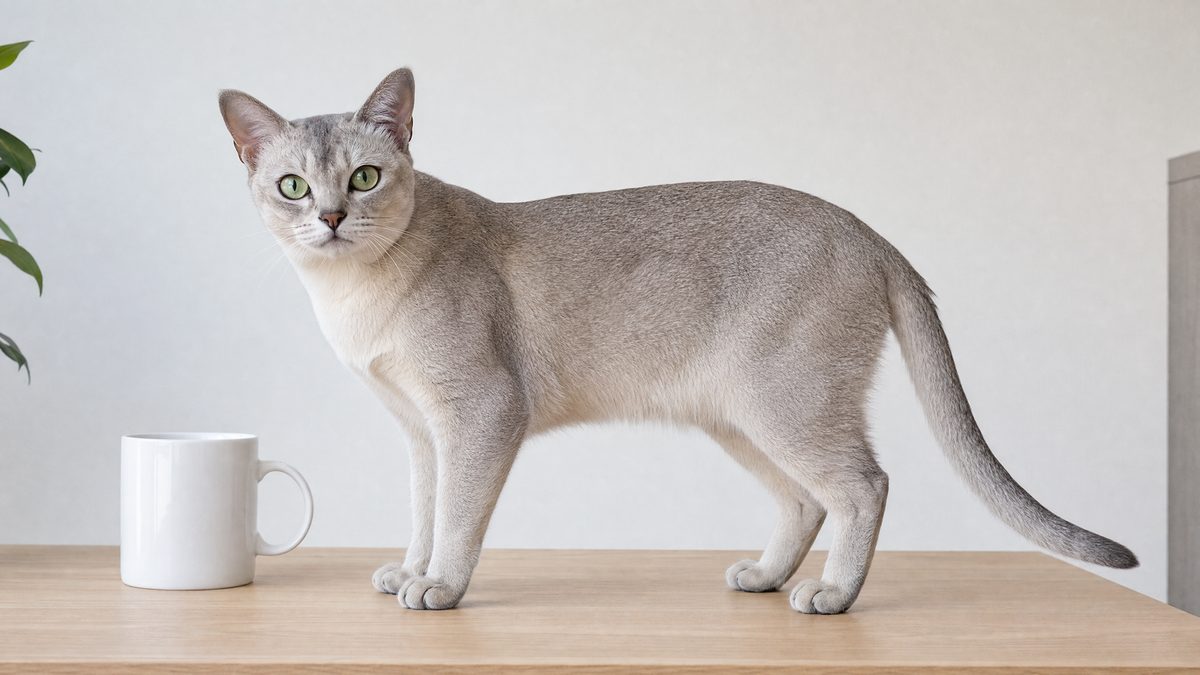
The Standard of Points describes a slender, muscular cat of medium size that feels heavier than it looks. The head forms a short balanced wedge with width at the cheekbones, tapering to a blunt muzzle, with a distinct nose break and a firm chin of good depth. Ears are medium to large, broad at the base, rounded at the tips and set well apart with a slight forward tilt. Eyes are large, lustrous and set wide apart. The shorthair coat is short, fine and close lying, smooth and satin-like with a glossy appearance, while the semi-longhaired Tiffanie carries a fine silky coat, medium long except over the shoulders, without a woolly undercoat.
| Source | Male weight | Female weight | Life expectancy |
|---|---|---|---|
| GCCF characteristics box | 12 to 15 lbs (whole breed) | 12 to 15 lbs (whole breed) | 16 years |
| GCCF care text | 5 to 7 kg (11 to 15 lbs) | 3.5 to 5.5 kg (8 to 12 lbs) | 16 to 18 years |
| Asian Group Cat Society | 5 to 7 kg | 3.5 to 5.5 kg | 16 to 18 years |
| Purina UK | 3.5 to 5.5 kg (no male figure) | 3.5 to 5.5 kg | 15 years |
| Your Cat magazine | around 4 kg | around 3 kg | around 15 years |
Read that table before you trust any single number. GCCF's own breed page contradicts itself inside one screen, giving a size of 12 to 15 lbs in the characteristics box and then a female range of 8 to 12 lbs in the care text below it. Purina publishes only the female range and no male figure at all. Your Cat gives around 3 kg for females, which is below every other published figure.
One registry recognises this group. It has five varieties, 17 colours and two coat lengths. It is a Burmese in different clothes, it is British, and outside Britain it is usually sold to you under one of its variety names instead.
Asian the adjective against Asian the breed, and how to tell them apart
Search for the asian cat breed and most of what comes back is not this cat. Bonbeno ran the India-localised query on 23 August 2026 and found that of the top eleven organic results, five were about cats from Asia generally, about the Oriental Shorthair, or about the wild Asian leopard cat and the Asian golden cat. That is the single largest obstacle between an Indian buyer and a correct answer, and no ranking page mentions it.
The pattern repeats in every tool. Bing's own answer panel for the query renders it as Cat breeds from Asia, illustrates it with a Siamese and sources it to Wikipedia and two hobby blogs. Every one of the seven related searches Bing offers for the query is about the adjective: asian cat breeds list, types of asian cats, asian cat breeds pictures, cute asian cat, pictures of oriental cats, asian cats pictures, popular korean cat breeds. Not one is about the group.
The same trap wrecks a literature search, with numbers
PubMed rewrites the phrase without telling you. Searching "Asian Shorthair" through the E-utilities endpoint, where the query translation is printed, returns 6 records and reveals that PubMed silently expanded the query to ("asian"[MeSH Terms] OR "asian"[All Fields] OR "asian people"[MeSH Terms] OR ("asian"[All Fields] AND "people"[All Fields]) OR "asian people"[All Fields] OR "asians"[All Fields]) AND ("shorthair"[All Fields] OR "shorthaired"[All Fields] OR "shorthairs"[All Fields]).
Bonbeno opened all six. They are a case of cryptococcal granulomas of the basal ganglia in a cat, a terbinafine-resistant Microsporum canis isolate, feline cutaneous histoplasmosis from Thailand, a dermoid cyst in a domestic shorthair cat published in the Asian Pacific Journal of Tropical Biomedicine, blood type frequencies in non-pedigree cats in Beijing, and a 1992 review of feline dental resorptive lesions. None of the six is about this breed. A count of six is not six pieces of evidence.
The controls that make that a finding rather than a broken search
| Query | Records | Genuine hits on opening |
|---|---|---|
| Ragdoll cat (control) | 112 | Plausible volume, tool working |
| Burmese cat hypokalaemia (control) | 4 | 4 of 4 genuine |
| "Asian Shorthair" | 6 | 0 of 6 |
| "Asian" in title AND cat in title | 2 | 0 of 2, both Asian leopard cat papers |
| Tiffanie in title or abstract | 1 | 1 of 1, the hypokalaemia review |
| Burmilla, all fields | 2 | 2 of 2, both breed-table mentions only |
Two controls run in the same session cleared the tool. Ragdoll cat returned 112 records, a plausible volume for a popular breed, and Burmese cat hypokalaemia returned four, every one of them the correct paper. So the search worked, and the honest conclusion stands: there is no peer-reviewed literature about the Asian cat group as a breed. The only records that genuinely concern it reach it through a variety name.
How to search for this cat and get the right thing
- Search the variety, not the group. Burmilla, Tiffanie or Asian Smoke each return the cat; asian cat breed does not.
- Add the registry. Adding GCCF to any query removes almost all of the adjective noise in one step.
- Read the document's own heading before taking a figure off it. A page can be titled Asian and be about the Asian leopard cat.
- Treat a non-zero result count as nothing at all until you have opened the records. Six hits and zero relevant records is the normal outcome here.
- Avoid the word Malayan, which is a retired CFA name for three Burmese colours and also a name for a wild cat.
An Indian seller advertising an Asian cat is not necessarily lying and is not necessarily selling this breed either. The word does duty for at least four different things in Indian listings: this GCCF group, any cat from Asia, the Asian leopard cat behind the Bengal, and simply a black kitten. Ask which of the five varieties it is, and ask for the registration paper that names it.
The five varieties, the 17 coat colours, and the 816 permutations
Five varieties make up the Asian group, and GCCF names them in one sentence: Self (which includes the Bombay as the Black Self plus the 16 other recognised self and tortie colours), Asian Smoke, Asian Shaded (called Burmilla), Asian Tabby (Ticked, Mackerel, Spotted and Classic), and the semi-longhaired Tiffanie. Every Asian is one of those five, and a Tiffanie is additionally one of the other four, so a cat can correctly be a Red Silver Ticked Tabby Tiffanie.
| Variety | What it is | Also called |
|---|---|---|
| Asian SH Self / Tortie | Solid colour from tip to root, no pattern | The Black Self is the UK Bombay |
| Asian SH Smoke | Non-agouti with a silver undercoat showing when the cat moves | Once called the Burmoire |
| Asian SH Shaded | Agouti, colour at the tips over a paler base | Burmilla |
| Asian SH Tabby | Ticked, Spotted, Mackerel or Classic pattern | No separate name |
| Asian Semi-Longhair | Any of the above in a fine silky medium-long coat | Tiffanie |
The 17 recognised colours are set out at the top of the Registration Policy: Black, Blue, Chocolate, Lilac, Cinnamon, Fawn, Caramel, Red, Cream, Apricot, and the tortie versions of Black, Blue, Chocolate, Lilac, Cinnamon, Fawn and Caramel. Two colour-expression genes sit on top of that. Full Expression gives strong deep colour; Burmese Colour Restriction reduces melanin in the hair shaft near the skin, so colour in a BCR cat cannot be sound to the roots The Asian Group Cat Society. The Breed.
Where the over 400 figure comes from, and why it is only half the answer
GCCF's breed page advertises over 400 colour combinations in its characteristics box, and the group's Breeding Policy gives a different and larger number: a total of 816 permutations that we recognise in the Asian Standard Governing Council of the Cat Fancy.…. Both are right, and the gap between them is the coat length.
Bonbeno reconstructed the arithmetic from the Registration Policy's own definitions, for shorthairs only. Selfs and Torties come in 17 colours in Full Expression and in Burmese Colour Restriction, which is 34. Smokes are silver by definition, in 17 colours and both expressions, which is another 34. Shadeds come in 17 colours, both expressions and both silver and standard undercoats, which is 68. Tabbies come in four patterns, 17 colours, both expressions and both silver and standard, which is 272. Add them and you get 408, which is the over 400 in the box. Double it for the Tiffanie's separate coat length and you get 816, which is the Breeding Policy's figure exactly.
That is a satisfying result and it carries a warning. GCCF does not publish this derivation anywhere, so treat it as Bonbeno's reconstruction rather than as the registry's own statement, and note that the Registration Policy restricts Burmese Colour Restriction Selfs to seven colours rather than all 17, which would give 398 instead of 408 on a stricter reading.
The two GCCF documents do not agree on how many colours there are
The Registration Policy of 2018 counts Caramel as one colour and Caramel Tortie as one colour, giving 17 in total. The Standard of Points updated in May 2024 splits both into three, listing Blue-Based, Lilac-Based and Fawn-Based Caramel and the same three Caramel Torties, each with its own EMS string. So the show standard describes 21 colours where the registration document describes 17. Neither is wrong. They were written six years apart and nobody reconciled them.
The breed numbers, which is how a pedigree actually reads
A GCCF pedigree gives you a number, not a name. The basic breed number for the Asian Shorthair is 72 ASH and for the Tiffanie 68 ASL, with colour and pattern codes appended. An Asian Chocolate Self reads 72b, or ASH b. An Asian Blue Silver Classic Tabby with Burmese Colour Restriction reads 72 41asq, or ASH as 22 31. A Chocolate Smoke Tiffanie reads 68 42b, or ASL bs. Your Cat magazine prints breed number 72 on its Asian profile, which matches.
If a document offered to you as an Asian pedigree does not carry a 72 or 68 breed number and a GCCF colour code, it is not a GCCF Asian registration. It may still be a real pedigree from another registry, but then the cat is registered as something else, most likely a Burmilla.
Breed recognition: one registry says yes, and the rest say something different
One registry in the world recognises the Asian group, and that is the GCCF. The World Cat Congress publishes the comparison across its nine member bodies in a single table, and it reads: ACF not recognised, CCCofA not recognised, CFA not recognised, FIFe not recognised, GCCF full with breed code ASH, NZCF not recognised, SACC see Asian Shorthair, TICA see Asian Shorthair, WCF not recognised. Bonbeno then checked each registry's own list rather than resting on the summary.
| Registry | The Asian group | What it recognises instead |
|---|---|---|
| GCCF (United Kingdom) | Full recognition, breed code ASH, Section 5 Burmese Group 2 | All five varieties, at Championship since 2003 |
| CFA (United States) | Not recognised, and absent from the A sequence of its breed index | Burmilla, Longhair and Shorthair. Bombay separately |
| TICA (international) | Not on the championship breed index. Recorded as registration only, code NL | Burmilla and Burmilla Longhair. Bombay separately |
| FIFe (Europe) | Not in any of the four categories or the preliminary list | BML Burmilla, fully recognised in category 3. BOM Bombay, preliminary |
| WCF (worldwide) | Absent from both the shorthair and semi-longhair standard indexes | Burmilla Shorthair (BMS). Bombay (BOM). No longhair equivalent |
| SACC (Southern Africa) | Recognises Asian Shorthair at full status, breed code ASN | Outcross to Burmese only, no breeding restrictions |
Each absence was checked with a control on the same page
An absence is only evidence if the list actually loaded, so Bonbeno confirmed the neighbours in every case. FIFe's breeds page rendered all four categories plus the preliminary list, including BML Burmilla, BUR Burmese, KOR Korat, MAU Egyptian Mau, OCI Ocicat, SIN Singapura and BOM Bombay, and carried no Asian entry anywhere. TICA's index rendered from Abyssinian to Turkish Van and runs American Wirehair, then Australian Mist, with nothing between them where Asian would sort, and no Tiffanie in a T sequence that includes Tennessee Rex, Thai, Tonkinese, Toybob, Toyger, Turkish Angora and Turkish Van. CFA's index runs American Wirehair straight into Balinese. WCF's shorthair index rendered 44 standards and runs Arabian Mau straight into Australian Mist, and its semi-longhair index rendered 23 and runs Somali straight into Turkish Angora World Cat Federation. Breed Standards SEMI….
TICA will register the cat without recognising it, which nobody explains
TICA's position is not a simple no. The World Cat Congress records TICA's status for the Asian Shorthair and the Asian Longhair as registration only, with breed code NL in each case. That is why the breed is missing from TICA's public index, which lists championship breeds, while a TICA pedigree can still name it. For an owner outside Britain this is the practically useful fact on this page: TICA will put the cat on paper and will not let it into a show ring under that name.
SACC, the Southern Africa Cat Council, goes further than anyone except GCCF. It recognises the Asian Shorthair at full status with breed code ASN, permits Burmese as the only outcross, and imposes no breeding restrictions at all, which means no mandatory hypokalaemia test. That is a materially weaker health regime than the British one on the same cat.
The disagreement is about grouping, not about the animal
Bonbeno reports the disagreement rather than resolving it, because the registries are not describing different cats. They are drawing the boundary in different places. GCCF treats the silver shaded cat as one variety inside a group and gives the group a name. CFA, TICA, FIFe and WCF treat the silver shaded cat as the whole breed, call it the Burmilla, and have no home for the Smoke, the Tabby or the non-black Self The International Cat Association. Find… Federation Internationale Feline. Breeds… World Cat Federation. Breed Standards…. FIFe's Burmilla standard was last modified in 2019 and sits in category 3 as a full breed.
Outside the United Kingdom there is no registry that will issue you a pedigree reading Asian Tabby or Asian Smoke at championship level. If a seller anywhere shows you such a document, either it is a GCCF paper, or it is a TICA registration-only record, or it is not what it claims to be. Bonbeno has read all five registries' own lists and there is no fourth option.
How many Asians exist, and the number Wikipedia got wrong
GCCF registered 121 Asian group cats in 2025, made up of 101 Asian Shorthairs and 20 Asian Longhairs (Tiffanies), against a whole-register total of 17,464 cats. That is 0.69 percent of every pedigree cat GCCF registered that year, and it is the only hard population figure that exists for this group anywhere in the world.
| Year | Asian Shorthair | Asian Longhair (Tiffanie) | Group total | GCCF whole register |
|---|---|---|---|---|
| 2022 | Combined line | Combined line | 266 | 24,867 |
| 2023 | Combined line | Combined line | 223 | 22,071 |
| 2024 | 138 | 30 | 168 | 19,283 |
| 2025 | 101 | 20 | 121 | 17,464 |
Every percentage in that table divides out. 101 against 138 is a fall of 37, which GCCF prints as 27 percent, and 37 divided by 138 is 26.8 percent. 20 against 30 is a fall of 10, printed as 33 percent, and 10 divided by 30 is 33.3 percent. The whole register fell 1,819 from 19,283, printed as 9 percent, and 1,819 divided by 19,283 is 9.4 percent. The 2023 line fell 43 from 266, printed as 16 percent, and 43 divided by 266 is 16.2 percent. Bonbeno checked each one because a table that does not divide out is a table that was not read.
The Asian is falling faster than the register around it
GCCF's whole register shrank 9 percent between 2024 and 2025. The Asian Shorthair shrank 27 percent and the Tiffanie 33 percent over the same period. So this is not simply a shrinking cat fancy carrying the group down with it. The group is losing ground three times faster than the register it sits in, and at 20 cats a year the Tiffanie is close to the point where a single breeder retiring moves the national figure.
Wikipedia's registration figure is wrong, and the correct one is one row away
Wikipedia states that in 2023, only 160 kittens of the entire Asian group were pedigreed with the GCCF, and cites GCCF's Analysis of breeds registered page for it. Bonbeno opened the 2023 table it points to. The Asian SH and LH line sits at rank 15 with 223 registrations, and the row directly beneath it, at rank 16, is the Bengal with 160.
So the figure in circulation is the Bengal's, read one row low. It is not a small error either: 223 against 160 understates the group by 39 percent, because 223 minus 160 is 63 and 63 divided by 160 is 39.4 percent. Any page repeating 160 has copied Wikipedia rather than opened the table. The correct 2023 figure is 223.
Context, so 121 means something
The same 2025 table gives British Shorthair 5,873, Ragdoll 3,111, Maine Coon 2,324, Siamese 860 and Burmese 805. The Asian group's parent breed therefore outnumbers it roughly six and a half to one, since 805 divided by 121 is 6.7. Against the register's own scarce breeds the Asian sits mid-table: more numerous than the Australian Mist at 5 or the Singapura at 8, far behind the Abyssinian at 186 or the Tonkinese at 149.
A hundred and twenty-one registrations across the whole United Kingdom is roughly two a week, spread over five varieties and 17 colours. There is no scenario in which a steady export supply reaches India from a population that size, and Bonbeno found no evidence of any Indian import at all.
The seven permitted outcross entries, and the four-generation road back
GCCF permits seven outcross entries into the Asian pedigree, and every one carries a named genetic clearance. Read from the Registration Policy itself, they are Korat or Thai Lilac, Abyssinian, Tonkinese with Burmese Colour Restriction, Egyptian Mau, Ocicat and Ocicat Classic (Aztec), Australian Mist, and Somali in either coat length. Burmese is handled separately and is not counted among the seven, because a Burmese on the Full Register goes straight into an Asian pedigree with no generational penalty.
| Permitted outcross | Required to be tested clear of |
|---|---|
| Korat or Thai Lilac | Himalayan gene, GM1 and GM2 Gangliosidosis |
| Abyssinian | PKdef, PRA rdAC, PRA Rdy |
| Tonkinese with Burmese Colour Restriction | No clearance named |
| Egyptian Mau | PKdef |
| Ocicat and Ocicat Classic (Aztec) | PKdef, PRA rdAC, PRA Rdy |
| Australian Mist | PKdef, PRA rdAC, PRA Rdy |
| Somali, longhair or shorthair | PKdef, PRA rdAC, PRA Rdy |
| Burmese on the Full Register | Burmese Head Defect, if imported |
That last line matters more than its length. GCCF requires any imported Burmese used in Asian breeding to be DNA tested clear of the Burmese Head Defect, which is the registry closing the one door through which the lethal ALX1 deletion could walk into the group. It is a targeted rule, not a blanket one, and it exists because the defect is concentrated in Contemporary Burmese lines from the United States.
Our Bombay page said seven outcrosses. It holds
Bonbeno's Bombay guide states that GCCF permits seven outcrosses to the Asian group, including Korat, Abyssinian and Somali, and that it does not permit the American Shorthair. Reading the Registration Policy directly confirms all of that: seven entries, those three among them, and no American Shorthair anywhere in the document. See Bombay Cat in India for the CFA and FIFe side of that comparison, which this page does not repeat.
One correction is due. That page describes a four-generation route from an outcross back to full Asian registration. The policy is a step stricter. The fourth generation is registered as an Asian on the Supplementary Register, and the Full Register requires three generations of pedigree in which every cat is already a Full or Supplementary Register Asian, Burmese or Asian Variant. So four generations buys the name, and full status comes later.
The route, step by step
- Cross a permitted outcross breed to an Asian or Burmese. Every kitten is registered as a Cat of Asian Type on the Reference Register.
- Mate that first generation to an Asian, a Burmese or another Cat of Asian Type. The second generation is again a Cat of Asian Type.
- Mate the second generation to an Asian or Burmese only. The third generation is again a Cat of Asian Type.
- Mate the third generation to an Asian or Burmese only. The fourth generation is finally registered as an Asian, on the Supplementary Register.
- Register subsequent generations on the Full Register once three clean generations sit behind the cat.
The Chinchilla Persian door, and why it is only open to imports
Chinchilla Persians were one of the two founding breeds, so GCCF permits one at or beyond the second generation in the pedigree of an imported cat, provided it is tested clear of the PKD gene, and treats the descendants as Cats of Asian Type until the Chinchilla falls off the back of a three-generation pedigree. A British breeder cannot make that cross afresh. The founding mating is history, not a permitted method.
A group registering 121 cats a year cannot afford a closed studbook, and the seven-entry list is how GCCF keeps the gene pool open without losing the Burmese type. The Breeding Policy is blunt about it, telling breeders that continuing to outcross to Burmese should be considered in order to maintain and expand the diversity of the Asian gene pool.
Asian cat price in India: there is no Indian price, and here is the proof
No Indian source publishes an asian cat breed price in india, for any of the five varieties, and Bonbeno could not find one after searching with controls. That is the finding, not a gap. The only published breeder price for the group anywhere in the world is British: GBP 400 to GBP 500 for a pet-quality kitten, with many breeders including neutering and microchipping before the kitten leaves.
The controls, run in the same session, so the absence is earned
A zero can be a blocked search wearing a result page, so Bonbeno checked the tool first. The control query persian cat price in india returned eight substantive Indian pricing pages carrying live rupee bands, including Rs 10,000 to Rs 80,000, Rs 8,000 to Rs 30,000 and Rs 10,000 to Rs 40,000. The tool works and Indian price content is indexed. The equivalent query naming Asian Shorthair, Burmilla and Tiffanie returned a coin dealer selling an Isle of Man crown depicting a Burmilla, a university mathematics department's word list, and a Facebook thread about a person named Tiffanie. Not one Indian price page.
What India's own price guides actually contain
Supertails publishes the largest Indian cat pricing guide, a 2026 all-breeds article reviewed by a named senior veterinarian, with a fourteen-row price table. The words Asian, Burmilla, Tiffanie and Burmese do not occur anywhere in it. That is an in-document control as well as a finding: the same page names fourteen breeds including the Bombay, so the search worked.
Heads Up For Tails, India's largest pet retailer, does list the group, but under TICA's names rather than GCCF's. Its 50 Popular Cat Breeds In India carries Burmilla at number 39 and Burmilla Longhair at number 49, both with the origin United Kingdom, and neither carries a rupee figure. Tiffanie does not appear. The single occurrence of the word Asian on that page is the Wild Asian Leopard Cat in the Bengal entry. Vetic, an Indian veterinary chain with more than 50 clinics, runs a 20-breed guide that sorts breeds by Indian climate suitability and contains no Burmilla, no Tiffanie and no Asian group at all.
The Justdial listings are an empty template, not a market
Search Justdial for Pet Shops For Burmilla Cat in Bangalore and you get a real page with ten real businesses on it, category number nct-12049740. Not one of them mentions a Burmilla. Their catalogue images are filed under pet-shops-for-dog, pet-shops-for-japnese-spitz, pet-shops-for-chow-chow-dog, kennel-service and aquarium-fish-dealers, and their service tags read We Buy Pets-Dogs and Pet Grooming. The page's own meta description offers Pet Shops For Dog, Dog Kennel Dealers and Pet Clinics.
The tell is that the identical template exists for breeds nobody is selling. Justdial runs Pet Shops For Ashera Cat, quoting Rs 1,50,000 to Rs 2,50,000, and Pet Shops For Diamond Dove, from the same generator. A shell page is not a price signal, and a category is not a supply chain.
Every rupee figure in reach, run through the 84.38 test
| Figure and where it appears | Divided by 84.38 | Verdict |
|---|---|---|
| No Asian, Burmilla or Tiffanie price published anywhere in India | Not applicable | Nothing to test. This is the finding |
| Rs 10,000, Bombay floor, Supertails all-breeds table | USD 118.51 | Not a round dollar amount |
| Rs 30,000, Bombay ceiling, Supertails all-breeds table | USD 355.53 | Not a round dollar amount |
| Rs 1,50,000, Justdial Ashera floor | USD 1,777.67 | Not a round dollar amount, and not a real offer either |
| Rs 2,50,000, Justdial Ashera ceiling | USD 2,962.79 | Not a round dollar amount, and not a real offer either |
None of those resolves to a figure anybody would set in dollars, so none was manufactured by running an American price through an exchange rate. That is a genuine pass and Bonbeno says so. It changes nothing about the Asian group, because the only rupee band in the family belongs to the Bombay, which GCCF classes as the Black Self of this group and which India buys as a black kitten rather than as a registered Asian. See Bombay Cat in India for that band in full.
The British figure is left unconverted deliberately. Bonbeno tests rupee figures against 84.38 rupees per US dollar and has no verified pound rate for this page, so GBP 400 to GBP 500 is reported as published. The comparison that matters does not need a conversion: a British buyer can name a price for this cat and an Indian buyer cannot, because in India the cat is not sold.
A listings site, petzlover.com, indexes a page titled Asian Cats for Sale in West Delhi. Three attempts, including two through a stealth proxy, returned HTTP 403 behind a Verify You Are Human CAPTCHA. Bonbeno therefore makes no claim about what that page offers, in either direction, and records it as unreachable rather than guessing.
Monthly cost of keeping an Asian in India, and a total that does not add up
Budget Rs 2,300 to Rs 4,600 a month at the low end and Rs 4,600 to Rs 9,000 in the mid range for a short-haired cat of this size in India, using the only Indian cost table published with a named veterinary review. A Tiffanie sits higher because of grooming. Bonbeno checked the arithmetic of that table row by row, and one of its totals is wrong.
| Category | Budget | Mid | Premium | What this breed changes |
|---|---|---|---|---|
| Cat food, dry and wet | Rs 800 to 1,500 | Rs 1,500 to 3,000 | Rs 3,000 to 6,000 | Nothing. A 4 kg cat eats like a 4 kg cat |
| Kitten food, under 1 year | Rs 1,000 to 2,000 | Rs 2,000 to 3,500 | Rs 3,500 to 5,000 | Replaces the row above, it does not add to it |
| Litter and litter box | Rs 300 to 600 | Rs 600 to 1,200 | Rs 1,200 to 2,500 | Higher. This is an indoor cat with no outdoor option |
| Routine vet visits | Rs 300 to 600 | Rs 600 to 1,000 | Rs 1,000 to 2,000 | Nothing routine, but see the screening row below |
| Professional grooming | Rs 500 to 1,000 | Rs 1,000 to 2,000 | Rs 2,000 to 4,000 | Skip it for a shorthair. Budget it for a Tiffanie |
| Treats | Rs 150 to 300 | Rs 300 to 600 | Rs 600 to 1,500 | Nothing |
| Toys and enrichment | Rs 100 to 300 | Rs 300 to 600 | Rs 600 to 1,500 | Higher. Boredom is this breed's real cost |
| Flea and tick prevention | Rs 150 to 300 | Rs 300 to 600 | Rs 600 to 1,200 | Nothing |
| Published monthly total | Rs 2,300 to 4,600 | Rs 4,600 to 9,000 | Rs 9,000 to 21,700 | Check the last cell |
The premium ceiling does not add up, and the headline contradicts the table
Add the premium column's upper figures, excluding kitten food because it replaces adult food rather than joining it: 6,000 plus 2,500 plus 2,000 plus 4,000 plus 1,500 plus 1,500 plus 1,200 comes to Rs 18,700, not the Rs 21,700 printed. Add kitten food in and you get Rs 23,700, which is not it either. Every other total in the table does reconcile, including the premium floor of Rs 9,000 and both mid-range figures, so this is one bad cell rather than a broken table.
The article's headline sentence is looser still. It says the monthly cost of owning a cat in India typically ranges from Rs 2,000 to Rs 8,000, while its own detailed table spans Rs 2,300 to Rs 21,700. The floor in the headline sits below the floor in the table. The first-year table then multiplies the headline range rather than the detailed one, carrying Rs 24,000 to Rs 96,000 as twelve months of running costs.
The one-off costs, which the monthly figure hides
The same guide prices a first year at Rs 35,000 to Rs 2,40,000 and above, including an initial vet check at Rs 500 to Rs 1,500, a full year-one vaccination schedule at Rs 1,500 to Rs 3,000, deworming courses at Rs 300 to Rs 600, spay or neuter surgery at Rs 3,000 to Rs 8,000, a carrier at Rs 800 to Rs 3,000 and a scratching post or cat tree at Rs 800 to Rs 4,000.
Two of those are non-negotiable for this breed rather than optional. The scratching post is mandatory because the Asian Group Cat Society states plainly that Asians are not outdoor cats, so every claw needs an indoor target and trimming every couple of weeks. Early neutering is mandatory because GCCF warns that the breed matures sexually at a young age and tells owners to consult their vet about neutering at the earliest opportunity.
The screening line no Indian cost guide includes
A cat of this ancestry should carry two DNA results, and neither appears on any Indian budget. UC Davis charges USD 47 for a single test, USD 71 for two, USD 95 for three and USD 119 for all four in the Burmese panel. At 84.38 rupees to the dollar that is Rs 3,966 for one test, Rs 5,991 for two and Rs 10,041 for the full panel, before courier and before the vet's fee for taking the swab under microchip verification.
Rs 4,000 to Rs 6,000 a month covers a short-haired cat of this size well in most Indian cities, with grooming stripped out and enrichment moved up. Add Rs 1,000 to Rs 2,000 a month for a Tiffanie's coat. Then add the one-off Rs 6,000 to Rs 10,000 screening panel once, at the start, rather than discovering you needed it at eighteen months.
Heat tolerance in India, measured against the climate this breed was made in
Chennai runs 17.56 degrees Celsius warmer than London on annual mean temperature, and London is where this breed was made. NASA POWER, queried by explicit latitude and longitude for 2001 to 2020 and checked against the coordinates it returned, gives London an annual mean air temperature of 10.39 C and Chennai 27.95 C. That single gap is the whole climate argument, and no page ranking for this breed makes it.
| Place | Annual mean C | Warmer than London by | Annual max C | Annual mean humidity |
|---|---|---|---|---|
| London (51.5072, -0.1276) | 10.39 | origin | 33.96 in July | 84.59 percent |
| Bengaluru (12.9716, 77.5946) | 23.74 | 13.35 C | 40.38 in April | 67.94 percent |
| Delhi (28.6139, 77.2090) | 25.60 | 15.21 C | 48.79 in June | 45.56 percent |
| Kolkata (22.5726, 88.3639) | 25.81 | 15.42 C | 46.81 in May | 73.93 percent |
| Mumbai (19.0760, 72.8777) | 26.77 | 16.38 C | 44.91 in April | 67.39 percent |
| Chennai (13.0827, 80.2707) | 27.95 | 17.56 C | 42.70 in May | 72.39 percent |
The humidity result is the opposite of what everyone assumes
London is more humid on an annual mean than any of these five Indian cities, at 84.59 percent against Chennai's 72.39 and Delhi's 45.56. Bonbeno publishes that because it is what the data says, not because it is convenient. The Indian problem is not humidity by itself. It is heat, and then heat and humidity arriving together: Mumbai reaches 90.36 percent mean relative humidity in August and Kolkata 89.34 percent in September, and both of those months sit inside a year whose maximum air temperature has already touched 44.91 C and 46.81 C respectively.
London never combines the two. Its wettest months are December at 94.39 percent and January at 93.25 percent, when the mean temperature is near its floor. A British cat is bred against cold damp. An Indian cat lives against warm damp, which is a different problem for a coat, for skin and for a cat's ability to shed heat.
The care advice on the ranking pages was written for the wrong country
Purina UK warns that the Asian's fine coat is not particularly weather proof to wet, cold or windy situations, and recommends a secure sheltered cat run with free access to the house. That is sound guidance in Britain and close to useless in Chennai, where the risk is not a cold wind but an enclosed run in 42 C sun. Read every British care instruction for this breed with that substitution in mind.
Indian sources are not much better. Vetic's breed guide sorts cats explicitly by Indian climate suitability, says the Burmese can struggle in India's hot, humid climate without a cool, well-ventilated environment, and then contradicts itself in its own FAQ by grouping long-haired breeds like Burmese and Birman as the ones needing air-conditioning. Its own entry for the Burmese, four screens above, describes a short, silky coat needing minimal grooming. The Burmese is a short-haired breed and so is the Asian.
Heads Up For Tails takes the other position, marking the Burmilla Suitable for the Indian climate and the Burmilla Longhair Suitable for the Indian climate with grooming. Bonbeno agrees with the direction and not with the confidence. No study measures heat tolerance in this group, and marking a breed suitable on a retail list is a judgement, not a measurement.
What a heat-tolerant short coat does and does not buy you
- Keep the cat indoors between 11am and 4pm from March to June in Delhi, Mumbai, Kolkata and Chennai, because those are the months the annual maximum falls in.
- Provide shade and moving air rather than a closed room. Ventilation, not just a lower thermostat, is what Indian veterinary advice on this ancestry actually calls for.
- Watch the Tiffanie harder than the shorthair. A medium-long coat without a woolly undercoat still traps more heat than a close-lying one.
- Never shave a Tiffanie to cool it. The coat lies flat along the spine and forms fringes, and it is the cat's own shading layer.
- Treat panting at rest as an emergency in any cat, in any city, in any month.
Three out of five. A close-lying single coat of medium size is genuinely heat-tolerant compared with a Persian or a Maine Coon, and that is the honest upside. It is a rating built from the standard's coat description and the origin-climate gap above, not from any measurement of this breed in heat, because none exists.
Temperament, and the one claim on the ranking pages that is flatly contradicted
The Asian is a demanding companion cat, not a low-maintenance one, and its own registry says so in plain words: these cats need an owner who will pay attention and who will interact with him or her. Lively, outgoing, affectionate, intelligent, inquisitive and determined, they want to be part of every part of the household's life, and they are talkative without being noisy The Asian Group Cat Society. The Breed.
Purina says this cat can be left alone all day. Three sources say it cannot
Purina UK's need-to-know list for the Asian includes the line Can be left alone all day. GCCF says the opposite: the Asian is extremely sociable and needs an owner who will pay attention and interact. The Asian Group Cat Society says what Asians need most is love and attention, and that they need to play, interact and get fuss in the same way a dog does. Naomi Johnson of that society goes further, telling Your Cat that if someone wants a kitten but will be out at work all day, they should have two, ideally from the same litter.
Bonbeno reports the disagreement rather than averaging it, and notes which side is which. The pet-food manufacturer says the cat is easy. The registry, the breed society and a named breeder inside that society all say it is not. For an Indian buyer in a two-income household this is the most consequential sentence on the page, and Purina's version is the one that will be quoted back at you by a seller.
| Trait | Rating |
|---|---|
| Family-friendly | 5 / 5 |
| Playfulness | 4 / 5 |
| Intelligence | 4 / 5 |
| Tendency to vocalise | 4 / 5 |
| Likes other pets | 4 / 5 |
| Grooming needs | 3 / 5 |
| Shedding | 1 / 5 |
Who this cat suits, and who it does not
- Suits a household with somebody home for most of the day, which in India often means a joint family or a work-from-home flat.
- Suits children old enough to respect a cat's space, and dogs, provided introductions are done properly.
- Suits an older owner wanting a devoted companion, which GCCF names explicitly.
- Does not suit a single person out twelve hours a day with one cat and no company.
- Does not suit a tense, crowded or unpredictable household. Purina warns the breed picks up on stress easily, and that in multi-cat homes this can produce fighting, marking and inappropriate toileting.
- Does not suit an existing shy or retiring cat. GCCF says Asians co-exist most successfully with breeds of a similar disposition, confident, lively and outgoing, and can be wilful about the pecking order.
Two practical warnings the breed clubs give and the retail pages drop
GCCF tells prospective owners that Asians mature sexually at a young age, and to consult a vet about neutering or spaying at the earliest opportunity. That is a specific instruction, not a general one, and it matters in India where a first heat in an unspayed young queen in a flat is a common route to an unplanned litter.
Purina adds that the Asian is quite a high theft risk and should not be given unsupervised access to the outdoors. In a British suburb that is a caution. In an Indian city where a visibly pedigree cat in a lane is unusual, it is a reason to keep the cat indoors, which the Asian Group Cat Society already recommends outright.
The Standard of Points closes the temperament question from the show bench end. Extreme aggressive temperament is the single fault for which all awards are withheld, and the standard instructs that any extreme or aggressive temperament should not be encouraged by breeding. A nervous or snappy Asian is not a variant of the breed. It is a cat outside the standard.
This is a cat that will follow you into the bathroom and complain when the door shuts. If that sentence sounds charming, the breed fits. If it sounds exhausting, buy a different cat rather than expecting this one to settle down.
Training an Asian, and the one thing it will not accept
Train an Asian by giving it a job, because this is an intelligent, inquisitive cat that is described by its own registry as curious and determined with a love of investigating new things. Purina's vet panel rates the breed 4 out of 5 for intelligence and 4 out of 5 for playfulness. What it will not accept is being managed by exclusion. Shut an Asian out of a room and it will work on the door.
Four things that work, in the order to teach them
- Start claw handling in week one. The Asian Group Cat Society says these are not outdoor cats, so claws need trimming every couple of weeks for life, and a cat that learned it at nine weeks does not need restraining at nine months.
- Move part of the daily ration into food-dispensing toys. Purina recommends this specifically for the breed, to recreate hunting and prey-capture behaviours, and it converts an idle afternoon into work.
- Teach a fetch and a recall early. Purina notes the breed enjoys things on strings, balls and toys that can be fetched and carried, which is the raw material for both.
- Introduce the carrier as furniture, not as transport. This is an indoor cat that will meet a vet, a courier crate and possibly a monsoon power cut, and the carrier should be a bed before it is ever a journey.
What it resists
It resists silence. GCCF describes the Asian as talkative and chatty, readily answering its owner when spoken to, and the training consequence is that ignoring the cat is not a neutral act. Withholding attention as a correction reads to this breed as a puzzle to solve harder, not as a signal to stop.
It resists a rigid hierarchy. GCCF warns that Asians can be wilful, and that issues sometimes occur if the cat wants to be top-cat in the pecking order. In a multi-cat Indian flat this shows up as resource guarding at the litter tray and the feeding bowl rather than as open fighting. Duplicate every resource and place them apart.
It resists a stressed household. Purina records that the breed picks up on stress easily, and that in multi-cat households this can cause behaviour problems including fighting, marking and inappropriate toileting. A cat that starts spraying in a busy Indian home is usually reporting the household, not failing training.
One health-shaped training rule
Teach this cat to be handled around the mouth and neck, and do it before you need to. Burmese hypokalaemia, the one inherited disease confirmed in the group, presents as episodic weakness that is most obvious in the neck muscles, and the classic sign is ventroflexion of the head and neck Malik R, Musca FJ, Gunew MN, Menrath VH. An owner who can lift and support a cat's head calmly will notice the first episode weeks earlier than one who cannot.
Litter training is usually done before the kitten reaches you. Claw handling takes two to three weeks of daily thirty-second sessions. A reliable recall takes six to eight weeks of paid practice. Carrier acceptance takes a month if the carrier simply lives in the room with the door off.
Daily exercise, apartment living, and what happens without it
Give an Asian two structured play sessions a day, fifteen to twenty minutes each, plus food-dispensing toys and vertical space. This is a lively, energetic breed that loves to play and wants to be part of everything, and the exercise requirement is really a boredom requirement The Asian Group Cat Society. The Breed.
Apartment living suits this cat better than most, and that is not a consolation. The Asian Group Cat Society states outright that Asians are not outdoor cats, and notes only that they like enclosed outdoor space if you can provide it, adding that it is not essential. Purina agrees from the other direction, warning that the breed should not be given unsupervised outdoor access because it is curious and bold enough to get into trouble, and is a high theft risk.
For an Indian buyer that resolves a question other breeds leave open. A third-floor flat in Pune with no balcony access is an appropriate home for this cat, provided the indoor environment does the work the outdoors would have done.
What the indoor environment has to supply
- Climb. Purina names cat-trees explicitly for this breed, and a cat that supervises human activity needs somewhere above head height to do it from.
- Hunt. Split the daily ration across two or three puzzle feeders. This is the single highest-value change in an Indian flat, because it turns eating into twenty minutes of activity instead of two.
- Chase. Things on strings, twice a day, ending with a catch rather than with the toy vanishing.
- Scratch. A full-height post, not a mat, because the claws are never wearing down outdoors.
- Watch. A secured window position with a view. A mesh screen makes this safe on an Indian high-rise and costs less than one month's food.
Two cats is an exercise decision, not a sentimental one
Naomi Johnson of the Asian Group Cat Society tells Your Cat that anyone who wants a kitten but will be out at work all day should take two, ideally from the same litter. Two cats exercise each other in the eight hours you are not there, which no toy does. GCCF adds the caveat that matters: Asians co-exist most successfully with confident, lively, outgoing breeds, so a second cat of a retiring type is not an equivalent solution.
What happens without it
An under-exercised Asian does not become a quiet cat. It becomes a loud one. The behaviours Purina lists for a stressed cat of this breed, fighting, marking and inappropriate toileting, are the same behaviours an Indian owner will describe to a vet as the cat suddenly turning difficult. Weight is the second consequence, and it is measurable: in the largest primary-care study of cats in England, lower bodyweight in cats dying at or after five years was associated with increased longevity.
Timing exercise around Indian heat
Move both play sessions to early morning and after sunset from March to June. Delhi's climatological maximum air temperature peaks at 48.79 C in June and Kolkata's at 46.81 C in May, and a cat encouraged to sprint at 2pm in either month is being asked to shed heat it cannot shed. In Bengaluru, where the annual maximum is 40.38 C, the same rule applies with a wider midday window.
Put the cat's dinner in a puzzle feeder instead of a bowl. If it is emptied in under a minute and the cat then follows you around demanding something, the exercise budget is too low. If it takes ten minutes and the cat sleeps afterwards, it is about right.
Grooming a glossy coat, and a silver one, in Indian humidity
Brush a short-haired Asian once a week and a Tiffanie two or three times, and that is the whole routine. GCCF recommends weekly brushing for the short-haired varieties and notes the Tiffanie needs a little more attention than its group mates. Purina rates the breed 3 out of 5 for grooming needs and 1 out of 5 for shedding, the lowest score on its scale.
The coat is built to be easy. The Standard of Points asks for a short, fine, close-lying coat, smooth and satin-like with a glossy appearance in the shorthairs, and for the Tiffanie a fine silky coat, medium long, without a woolly undercoat. That last clause is the reason a Tiffanie is not a Persian to look after. No woolly undercoat means far less felting at the armpits and behind the ears, which is where an Indian monsoon does its worst work on a long coat.
| Variety | Brushing | Extra in monsoon | Watch for |
|---|---|---|---|
| Asian Self, Smoke, Tabby | Once a week, or a hand groom | Dry the coat fully after any wetting | A greasy coat, which signals the cat has stopped self-grooming |
| Burmilla (Shaded) | Once a week | Same, plus check the silver ground | Tarnishing of the silver ground colour |
| Tiffanie | Two or three times a week with a rotating-tooth comb | Fringes, breeches and the plume tail | Matting behind the ears and at the ruff |
Tarnishing is the Indian-specific grooming problem nobody names
The Standard of Points marks tarnishing on Silvers, meaning discolouration of the silver ground colour, as an explicit fault in both the Burmilla and the Silver Tabbies. In Britain that is a show-bench concern. In India it is a household one, because a silver undercoat is exactly the surface that shows sebum, dust and the yellowish cast that heat and humidity produce on a pale ground.
There is no study of this and Bonbeno will not invent one. What the standard does tell you is that the silver base colour takes time to develop in kittens, and that allowance is made for a minimum amount of silver in kittens and adolescent cats. So a young Burmilla whose ground looks dull may be immature rather than dirty, and a mature one that has gone yellow is a grooming and diet question for your vet, not a defect.
Colour takes two years, so do not judge a kitten's coat
Your Cat magazine warns buyers plainly that colours can take up to two years to develop, and the Standard of Points agrees for specific colours, noting that Red, Cream and Apricot may appear pale and uneven in Silvers and Smokes and can take in excess of two years to fully mature. Burmese Colour Restriction cats develop slower still, because the BCR gene reduces melanin in the hair shaft near the skin.
Four things to do in an Indian monsoon
- Dry the cat completely after any wetting, ears included, rather than letting it air dry. British breed advice assumes a British drying rate.
- Check the ears weekly during July, August and September, when Mumbai runs at 90.36 percent and Kolkata at 89.34 percent mean relative humidity.
- Groom rather than bathe. A greasy coat is a health signal, not a dirt problem, and Purina notes it may indicate the cat is not self-grooming at all.
- Trim claws every couple of weeks all year, because an indoor cat wears none of them down.
Nowhere, for a shorthair. Skip the Rs 500 to Rs 4,000 a month professional grooming line in the Indian cost tables entirely and buy one good comb. For a Tiffanie, budget the low end of that range and use it in the monsoon rather than year-round.
Hypokalaemia: the one inherited disease confirmed in the Asian group
Burmese hypokalaemia is the only inherited condition GCCF says has actually arisen in the Asian, and it is the only one the registry has made compulsory to test for. While PKD and PRA have been identified in the Asian's ancestral breeds, so far only evidence of Hypokalaemia has arisen in the Asian, and mandatory testing came into force on 1 January 2018 for every Asian registered with active status and intended for breeding.
The disease is a recessive muscle disorder. Affected cats usually present in the first year of life with episodic skeletal muscle weakness and muscle pain, most characteristically a ventroflexion of the head and neck, although some cats never show that sign. Weakness is usually periodic and occasionally incessant, and it waxes and wanes, possibly in response to dietary factors and stress, to the point that some cats appear to grow out of it.
The cause is a nonsense mutation in WNK4 producing a premature stop codon and a truncated protein lacking the C-terminal coiled-coil domain, found by a genome-wide study of 35 cases and 25 controls in the Burmese. All cases were homozygous. The likely mechanism is a potassium-losing nephropathy. The condition has been recorded in Australasia, Europe and South Africa.
The good news, which Indian breed pages never print
This disease is manageable. Both the laboratory that runs the test and the review that defines the condition say the same thing: the disease is not typically fatal, and affected cats can usually be managed effectively by adding potassium supplements to the diet Langford Vets Diagnostic Laboratories. Langford adds that in some affected cats the signs seem to disappear at one to two years of age without further treatment. A carrier has one copy, will never develop the disease, and passes the variant to half its offspring.
A three-base discrepancy in the published coordinate
The paper and the laboratory record the same variant at different positions. The PLoS ONE abstract gives the WNK4 nonsense mutation as c.2899C>T. UC Davis's own test page gives it as c.2902C>T. Bonbeno reports the difference rather than picking the tidier one. It does not change the test you order, which is requested by name, and it is the kind of detail that shows whether a page opened its sources.
The GCCF scheme, which is stricter than it first appears
- Register an Asian on the Active Register only if it has tested normal itself, or both parents have, or it can be deemed normal from testing across every pedigree line in previous generations.
- Place a genetically tested carrier on the Genetic Register, and mate it only to cats proven clear.
- Test the offspring of a Genetic Register cat individually, because they stay on the Genetic Register unless they themselves test normal.
- Never breed from a cat with two copies. The policy states that any Asian cat which has inherited two copies of the HK recessive gene must not be bred from.
- Supply the certificate with the registration application, or an imported cat goes on the non-active register.
The Asian Cat Association was directly involved in the research that produced the test, and holds a laboratory account giving its members a 20 percent discount at Langford. That is a breed club funding its own screening, which is the strongest signal available that the risk is taken seriously inside the group.
No carrier frequency has ever been published for the Asian
Bonbeno searched for one and found none. No study reports a hypokalaemia carrier rate in the Asian group, in any variety, in any country, and Bonbeno prints no number rather than borrowing the Burmese figure and relabelling it. What transfers is the mechanism, not a rate: this is a single recessive allele in a shared founder population, and UC Davis lists Bombay, Burmilla and Tiffanie among the breeds appropriate for the genetic test precisely because their Burmese half is the population the allele was found in.
Ask for the hypokalaemia result on both parents, on a laboratory certificate carrying the cat's microchip number. Langford will only place a cat on a GCCF or ICC negative register if a vet took the sample and confirmed the identity from the microchip, with that number written on both the form and the sample. A result on a breeder's letterhead with no microchip number is not that.
Burmese head defect: the Asian group's own figure exists, and it is two cats
An Asian-group figure for the burmese head defect does exist, in the paper that identified the mutation, and it is 2 cats tested, 0 carriers, 2 wildtype. Bonbeno reports it because it is real and because reporting it is the only way to show how little it means. Two animals is not a prevalence estimate. It is a note that somebody sent two swabs.
| Group | Tested | Carriers | Wildtype | Carrier rate |
|---|---|---|---|---|
| Asian | 2 | 0 | 2 | 0 percent |
| Australian Mist | 1 | 0 | 1 | 0 percent |
| Burmilla | 5 | 0 | 5 | 0 percent |
| Tonkinese | 6 | 0 | 6 | 0 percent |
| Bombay | 133 | 43 | 90 | 32.3 percent |
| Burmese | 3,250 | 151 | 3,099 | 4.6 percent |
| Burmese Breeds (pooled) | 3,264 | 194 | 3,070 | 5.9 percent |
| Other Breeds | 2,456 | 0 | 2,456 | 0 percent |
Four of the six Burmese-derived rows carry a sample of six cats or fewer. Between them the Asian, Australian Mist, Burmilla and Tonkinese account for 14 tested animals, and not one carried the variant. A zero out of fourteen is compatible with a true carrier rate anywhere from nothing to well above the Burmese's 4.6 percent, so nobody knows.
The pooled row does not add up, and Bonbeno can show exactly where
Our Bombay Cat in India guide found an arithmetic problem in the widely quoted 5.9 percent pooled rate. Bonbeno re-opened Table 3 for this page and the finding holds, with one extra piece.
Add the tested counts of the five non-Bombay Burmese-derived rows: 2 plus 1 plus 3,250 plus 5 plus 6 is 3,264, which is exactly the pooled row's Tested figure, with the 133 Bombays excluded. Now add the carriers of those same five rows: 0 plus 0 plus 151 plus 0 plus 0 is 151, not the 194 printed. The difference is 43, which is precisely the Bombay carrier count. The wildtype column shifts by the same amount: those five rows sum to 3,113 wildtype against the 3,070 printed, and 3,113 minus 3,070 is 43 again.
So the pooled row is internally consistent, because 194 plus 3,070 does equal 3,264, but it draws its numerator from six breeds and its denominator from five. UC Davis publishes the resulting figure as its headline: 5.9 percent of Burmese and related breeds carry the mutation, and 194 divided by 3,264 is 5.94 percent. Recomputed honestly across all six rows, 194 of 3,397 is 5.71 percent. The difference is small. The habit of checking is not.
What the disease is, and why one copy is the dangerous one
The variant is a 12 base-pair deletion, c.496delCTCTCAGGACTG, in the aristaless-like homeobox protein 1 gene, and inheritance is autosomal co-dominant. One copy causes no defect but may shorten the face into brachycephaly. Two copies produce a craniofacial malformation incompatible with life, so kittens are stillborn or require euthanasia Lyons LA, Erdman CA, Grahn RA, Hamilton MJ. Two carriers mated together are expected to produce 25 percent affected kittens.
The paper's Discussion names this group directly, stating that the Bombay, Singapura, Asian and Burmilla cat breeds are derived from the Burmese and need to be screened for the craniofacial defect, as well as hypokalemia. That sentence is the closest thing to an Asian-specific health recommendation in the peer-reviewed literature.
The registry acted on it. The test laboratory has not caught up
GCCF requires any imported Burmese used in Asian breeding to be DNA tested clear of the Burmese Head Defect, which closes the route the allele would use. Purina's UK breed page lists Burmese head defect among the conditions the Asian may be prone to, with DNA testing available.
Yet UC Davis's own Burmese Head Defect page lists the breeds appropriate for testing as Australian Mist, Bombay, Burmese, Burmilla, European Burmese and Tonkinese, and the word Asian appears nowhere on it. The hypokalaemia page adds Tiffanie to its list but still never says Asian. An owner of an Asian Smoke or an Asian Tabby looking for the right test finds no breed that matches their cat.
Both tests are the same assay whatever the breed field says. Order Burmese Head Defect and Burmese Hypokalemia by name at USD 47 each, or the pair at USD 71, and enter the variety your paperwork uses. Do not conclude from a missing breed name that your cat cannot be tested.
Polycystic kidney disease: GCCF says no, three other sources say check anyway
GCCF states that only hypokalaemia has arisen in the Asian, and three independent sources disagree enough to be worth acting on. The registry's exact words are that while PKD and PRA have been identified in the Asian's ancestral breeds, so far only evidence of Hypokalaemia has arisen in the Asian. Bonbeno publishes the disagreement rather than picking a side, because a buyer can act on both readings at once for about Rs 4,000.
The disagreeing evidence, in order of weight
| Source | Position | Evidence behind it |
|---|---|---|
| GCCF breed page | Only hypokalaemia has arisen in the Asian | No figure given |
| Barrs et al. 2001, Australian Veterinary Journal | 2 of 14 Burmillas positive on ultrasound, 14 percent | Renal ultrasonography of 320 cats in Sydney and Brisbane |
| UC Davis Veterinary Genetics Laboratory | PKD1 test recommended for the Burmilla breed | Printed on both Burmese-panel test pages |
| Purina UK breed page | The Asian may be prone to PKD, at lower risk than prone breeds | No figure given |
| GCCF Asian Breeding Policy | PKD came in from the Chinchilla. A test is available | Names the Chinchilla as the route |
| GCCF Asian Registration Policy | Imported Chinchilla Persian ancestors must be tested clear of PKD | A binding registration condition |
The strongest of those is the oldest. Barrs and colleagues ultrasound-screened 320 cats older than ten months across Sydney and Brisbane, comprising 230 Persians, 48 Himalayans, 17 Exotics, 14 Burmillas, 6 Ragdolls and 5 Chinchillas. Overall prevalence was 45 percent in Sydney and 42 percent in Brisbane. Two of the 14 Burmillas were positive, which the authors report as 14 percent, and 2 divided by 14 is 14.3 percent, so the figure divides out.
The authors draw a specific conclusion from that Burmilla result: it demonstrates that long hair coat and brachycephalic features do not segregate with the polycystic kidney disease trait. In other words, a short-haired, moderate-faced Burmilla can carry the Persian's kidney disease without looking anything like a Persian.
Three caveats that keep this honest
- Fourteen cats is a tiny sample, and a two-case result carries very wide uncertainty. Bonbeno reports 2 of 14, never 14 percent on its own.
- 2001 is old. The study used renal ultrasonography, before the PKD1 DNA test became routine, and Australian breeding has had a quarter of a century to respond.
- Australia is not Britain. Australian Burmillas are registered as a standalone breed rather than inside a GCCF Asian group, so the population is related but not identical.
None of those caveats explains away UC Davis, which is current and unambiguous. Its Burmese Head Defect and Burmese Hypokalemia pages both offer Polycystic Kidney Disease (PKD1) in the discounted panel and annotate it recommended for Burmilla breed University of California Davis Veterinary…. A laboratory does not print a breed recommendation without submissions behind it.
GCCF's own documents already hedge the claim
Read the registry's paperwork against its breed page and the gap closes. The Asian Breeding Policy names Polycystic Kidney Disease first in its Genetic Defects section, traces it to the Chinchilla and notes that a test is available. The Registration Policy makes a PKD clearance a condition of registration for any imported cat with a Chinchilla Persian grandparent or great-grandparent. A registry that writes a mandatory PKD clearance into its own registration rules is not treating the risk as theoretical.
Two more conditions the breeding policy names and the breed page does not
The Asian Breeding Policy lists flat-chest syndrome, a compressed flattened rib cage that causes breathing difficulty and can be fatal in severe cases, with a sampling study underway at Langford and no DNA test available. It also lists orofacial pain syndrome (FOPS), characterised by exaggerated licking and chewing and pawing at the mouth, resolving in kittens when teething does but capable of recurring in adults, and identified by recent research as a genetic disorder with a test in development. Steve Crow, chairman of the GCCF Genetics Committee, confirms both to Your Cat as very occasional instances in the Asian inherited from the foundation breeds.
One further signal sits in the literature. An Australian study of 1,705 feline lymphoma cases against a reference population of 85,741 cats names the Burmilla among the breeds showing significant variation in the proportions of anatomical presentations. That is a pattern observation and not a risk figure, and Bonbeno reports it as such.
You do not have to decide who is right. Order the PKD1 test alongside the two Burmese-panel tests. UC Davis prices three tests at USD 95 against USD 47 for one, so the whole question costs about USD 48 extra, or roughly Rs 4,050 at 84.38 to the dollar. That is less than one month of the Indian mid-range food budget.
Life expectancy: a published range of 10 to 18 years, and no study behind any of it
Published life expectancy for this group runs from 10 years to 18 years, an eight-year spread, and not one of those figures comes from a study of Asian cats. Bonbeno lists every published claim it found, names who made it, and then gives the only large dataset that has anything relevant in it.
| Source | Figure | What it is based on |
|---|---|---|
| GCCF characteristics box | 16 years | Not stated |
| GCCF care text, same page | 16 to 18 years | Not stated |
| Asian Group Cat Society | About 16 to 18 years | Breeders' own cats |
| Purina UK | 15 years | Not stated |
| Your Cat magazine | Around 15 years | Not stated |
| Heads Up For Tails, Burmilla | 10 to 15 years | Not stated |
| Heads Up For Tails, Burmilla Longhair | 10 to 15 years | Not stated |
| Vetic, for the parent Burmese | 14 to 16 years | Cites a cat-longevity paper |
GCCF contradicts itself on one page, printing 16 years in the characteristics box and 16 to 18 years in the care text below it. India's largest retailer sits five to eight years lower for the same cat under a different name. Purina and Your Cat land in the middle Your Cat magazine. Asian Cat breed…. None of them cites anything.
The one dataset with a real denominator
The VetCompass study of primary-care practices in England is the largest relevant evidence there is. It covered 118,016 cats at 90 practices, analysed 4,009 confirmed deaths, and found an overall median longevity of 14.0 years, with an interquartile range of 9.0 to 17.0 and a full range of 0.0 to 26.7.
Its breed finding cuts against the optimistic end of the table. Crossbred cats reached a median 14.0 years against 12.5 years for purebred cats, a difference significant at p under 0.001, though the authors note that individual purebred breeds varied substantially. Of the 4,009 deaths analysed, 3,660 or 91.7 percent were crossbred, so the purebred figure rests on 349 cats across all breeds combined.
That study contains no Asian-specific figure. Bonbeno labels the 12.5-year purebred median borrowed, and says why the transfer is only partly reasonable: it is drawn from the same country, the same era and the same kind of practice, which is unusually good for a borrowed figure, but it pools every pedigree breed from the Persian to the Siamese and tells you nothing about this one.
What actually killed the cats in that dataset
The leading attributed causes of death across all ages were trauma 12.2 percent, renal disorder 12.1 percent, non-specific illness 11.2 percent, neoplasia 10.8 percent and mass lesion disorders 10.2 percent. Two of those five are worth an Asian owner's attention. Trauma is the argument for the indoor life the breed clubs already recommend. Renal disorder is the reason the polycystic kidney disease question above is worth Rs 4,000 to settle rather than argue about.
One further finding from the same study is directly actionable. In cats dying at or after five years, lower bodyweight, being neutered and being non-insured were associated with increased longevity. Keep the cat lean.
Bonbeno publishes no single life expectancy for the Asian, because none has been measured. Plan for a cat that should reach its mid teens with good care, treat 16 to 18 years as the breed's own optimistic estimate rather than a finding, and treat 10 years as a retail floor nobody has justified.
Feeding an Asian in India, by life stage and by body condition
Feed to a target weight, not to a bowl size, and the targets are published: males 5 to 7 kg and females 3.5 to 5.5 kg for an adult Asian The Asian Group Cat Society. The Breed. That is a medium cat that GCCF describes as slender and muscular and heavier than its appearance indicates, which is exactly the body type an owner underestimates and then overfeeds.
| Stage | What changes | Indian monthly food cost |
|---|---|---|
| 8 to 16 weeks | Four small meals a day, kitten formulation, free water always | Rs 1,000 to 2,000 budget, Rs 2,000 to 3,500 mid |
| 4 to 12 months | Three meals, then two. Growth is still running | Rs 1,000 to 2,000 budget, Rs 2,000 to 3,500 mid |
| 1 to 7 years | Two meals, adult formulation, weigh monthly | Rs 800 to 1,500 budget, Rs 1,500 to 3,000 mid |
| 7 years and over | Two meals, senior formulation, weigh monthly and watch for loss | Rs 800 to 1,500 budget, Rs 1,500 to 3,000 mid |
Note what that table does not do: it does not add the kitten row to the adult row. The Indian cost guide lists both as separate lines and then excludes kitten food from its own totals, which is correct because one replaces the other, and is easy to misread as an extra Rs 2,000 a month.
Wet food matters more in India than the breed pages suggest
Combining wet and dry is standard veterinary advice for hydration, and the Indian guide repeats it. The Indian argument for it is stronger than the British one. Chennai runs an annual mean of 27.95 C and Delhi peaks at 48.79 C, so a cat in either city is losing water at a rate a British cat never approaches, and dry food alone leaves less margin. Kidney disorder was also the second commonest attributed cause of death in the largest primary-care cat dataset available, at 12.1 percent.
The potassium question, and what not to do about it
Do not supplement potassium on your own initiative. Affected hypokalaemic cats are managed with dietary potassium supplements, and that is a treatment prescribed after a diagnosis, not a preventive measure for a healthy cat Langford Vets Diagnostic Laboratories. A cat that has tested clear, or whose parents have, needs an ordinary complete diet and nothing added.
What an owner should do instead is know the sign. Episodic muscle weakness, most obvious in the neck, sometimes only in the limbs, with a cat that struggles to hold its head correctly, is the presentation, and it typically appears in the first year of life University of California Davis Veterinary…. Weakness that waxes and wanes, possibly with dietary factors and stress, is the pattern, so a single good day proves nothing.
Body condition, checked with your hands
- Feel the ribs through a thin layer of fat with light pressure. If you have to press, the cat is heavy.
- Look down from above for a visible waist behind the ribs. A straight-sided outline in a breed described as slender is a warning.
- Weigh monthly on a kitchen scale and write it down. A 4 kg cat that reaches 4.6 kg has gained 15 percent, and 0.6 divided by 4 is 15 percent, which is invisible by eye.
- Compare each reading against the published adult targets rather than against last month alone.
- Act on loss as fast as on gain. Weight loss in a cat over seven is a veterinary appointment, not a diet success.
Availability in India
Nothing about this breed's diet is hard to source. It needs an ordinary complete cat food, and the Indian market carries every major brand at the price points in the table above. The only breed-specific purchase is a set of puzzle feeders, which Purina recommends for the Asian by name and which cost less than one month of treats Supertails. Cat Price in India 2026.
An Asian will ask for food as a way of asking for attention, because it is a people cat that wants to be involved in everything. Answering with food instead of with ten minutes of play is how a lean breed becomes an overweight one, and lower bodyweight is the variable the VetCompass study associated with living longer.
Kitten timeline: month by month through the first year, and the four-year coat
Two things in an Asian's first year are breed-specific rather than general kitten care: the window in which hypokalaemia would appear, and the fact that almost nothing about the coat is finished. Colour can take more than two years to mature and a Tiffanie's full coat can take four Your Cat magazine. Asian Cat breed…. Judge the cat, not the colour.
| Age | What is happening | What you do |
|---|---|---|
| 8 to 12 weeks | Settling, litter habits already formed, vaccination course begins | Start daily claw handling. Get both parents' DNA certificates in hand |
| 3 to 4 months | Fast growth on four then three meals. Ears look too big for the head | Ignore the ears. The standard allows for correctly shaped but over-large ears in kittens |
| 4 to 6 months | Play drive peaks. Silver ground colour still developing in Burmillas | Fix the two-session play routine now. Book the neutering conversation |
| 6 to 9 months | Sexual maturity can arrive. GCCF warns this breed matures young | Neuter or spay at the earliest opportunity your vet advises |
| 9 to 12 months | The hypokalaemia window closes. Adult food from twelve months | Watch the neck. Weigh monthly against the adult target |
| 1 to 2 years | Colour deepens. Reds, Creams and Apricots still uneven | Do not conclude the cat is a poor colour yet |
| 2 to 4 years | A Tiffanie's ruff, breeches and plume tail complete | Add the second and third weekly grooming session |
The health window that only exists in the first year
Affected hypokalaemic cats usually present with muscle weakness and muscle pain in the first year of life. That makes the first twelve months the period in which an untested kitten declares itself, and it makes an owner's ability to spot cervical ventroflexion the most useful skill of that year. Weakness is usually periodic and can wax and wane, so a good week means nothing.
The other inherited risk resolves before you ever see the kitten. Cats homozygous for the ALX1 deletion are stillborn or require euthanasia, so a live, normal-looking kitten is not carrying two copies Lyons LA, Erdman CA, Grahn RA, Hamilton MJ. What a live kitten can be is a carrier, which is invisible and is why the parents' certificates matter more than the kitten's appearance.
What a healthy kitten of this breed looks like, from a breeder inside the club
Naomi Johnson of the Asian Group Cat Society gives Your Cat a specific checklist: bright eyes with no sign of discharge, lively, friendly and outgoing behaviour, no sign of diarrhoea, not thin or lethargic, and a good appetite. Note the second item. In a breed whose standard withholds all awards for extreme aggressive temperament and whose registry describes it as confident and outgoing, a kitten hiding at the back is a question, not shyness Governing Council of the Cat Fancy. Asian….
Coat markings that look wrong and are not
- Faint tabby markings on a Self or Smoke kitten are allowed for, and are a fault only in adults.
- A skull cap on a Ticked Tabby kitten may clear to the standard's forehead M as the cat matures.
- Very little silver on a young Burmilla is expected, because the silver base colour takes time to develop.
- Surface tabby pattern on a young Burmilla should become less distinct as the lighter base extends up the hair shaft with maturity.
- A pale, uneven Red, Cream or Apricot can take in excess of two years to reach full colour.
Buy the parents' test certificates and the kitten's temperament. Everything about the coat is still arriving, and in a Tiffanie it will still be arriving when the cat is three.
Compare the Asian against the cats an Indian buyer is actually offered
No Indian buyer is choosing between an Asian and a Burmilla, because no Indian seller offers either. The real comparison is between this group and the five breeds an Indian buyer will be shown instead, and the honest headline is that the Asian loses on availability to every one of them and wins on very little else that a first-time buyer would notice.
| Breed | Indian price band | Coat work | Indian availability | Registry position |
|---|---|---|---|---|
| Asian group (all five varieties) | No Indian price published | Weekly brush, or 2 to 3 for a Tiffanie | None found | GCCF only. Not CFA, TICA, FIFe or WCF |
| Bombay (the group's Black Self) | Rs 10,000 to 30,000 | Weekly brush | Widely listed | CFA and TICA championship, FIFe preliminary |
| Burmese (the parent breed) | Not in the Indian price table | Weekly brush | Rare in Indian listings | Recognised by every major registry |
| British Shorthair | Rs 20,000 to 60,000 | Weekly, dense coat | Very widely listed | Recognised by every major registry |
| Bengal | Rs 30,000 to 80,000 | Low | Very widely listed | Recognised by every major registry |
| Persian | Rs 12,000 to 50,000 | Daily, very high | The default Indian pedigree cat | Recognised by every major registry |
Every rupee band above comes from one Indian source, the 2026 Supertails all-breeds table reviewed by a named senior veterinarian, so they are at least internally consistent with each other. The Asian row is blank because nothing fills it, and the Burmese row is blank because that table does not carry the Burmese either, which is itself remarkable for the parent breed of the group.
Asian against Bombay: the same cat, two different documents
In the United Kingdom these are not two breeds. GCCF files the Bombay as the Black Self of the Asian group, which means a British Bombay is an Asian and carries breed number 72 Governing Council of the Cat Fancy.…. In the United States and internationally they are entirely separate: CFA and TICA recognise the Bombay at championship level and neither recognises the Asian at all The International Cat Association. Find….
So an Indian buyer comparing the two is comparing paperwork, not animals. Our Bombay Cat in India guide covers the American side of that split, including the CFA and TICA outcross rules, and this page does not repeat it. What matters here is the practical consequence: a black cat sold in India as a Bombay is being sold under the name with an Indian market, and a black cat sold as an Asian Black Self is being sold under the name with a British registry.
Asian against Burmese: what the extra colours cost you
The Asian is a Burmese in different clothes, and its own breed society says so, calling the group Burmese in fancy pyjamas. The Standard of Points requires the overall type to be the same as the Burmese, without extremes. Temperament, size and coat care are effectively the same cat.
The Burmese wins on everything else an Indian buyer would weigh. It is recognised by every major registry rather than one. GCCF registered 805 Burmese in 2025 against 121 for the whole Asian group, which is 6.7 times as many. And it carries the same two inherited risks, so choosing the Burmese does not avoid the screening bill University of California Davis Veterinary….
What the Asian genuinely offers
- Colour, on a scale no other Burmese-type breed matches, with 17 registered colours across four patterns and two expressions.
- Type without extremes, since the standard explicitly forbids any tendency to Siamese, Persian or British type and withholds certificates for small or fine-boned adults.
- A mandatory health scheme, which the Bombay's registries in America do not impose and which SACC does not impose on its own Asian Shorthair.
- A short-haired, low-shedding coat rated 1 out of 5 for shedding, which is a real advantage in an Indian flat.
- A documented outcross programme, which for a rare breed matters more than any show result.
If you want this cat in India you are choosing an import you almost certainly cannot lawfully arrange, against five breeds available in your own city this week. Read the import section before you pay a deposit on anything described as an Asian.
Import rules for a cat into India: what the trade notice actually says
You can bring an Asian into India as your own pet on transfer of residence, and you cannot import one to breed from. DGFT Trade Notice No. 22/2022-23, dated 19 December 2022 and signed by Deputy Director General Md. Moin Afaque, is the governing document, and Bonbeno extracted its text directly rather than reading a summary of it.
The classification comes first. ITC(HS) 01061900, Mammals: Other, carries an import policy of Restricted, subject to Policy Condition 6 of that chapter. Policy Condition 6 itself is about wild animals: it prohibits import of wild animals as defined in the Wild Life (Protection) Act 1972 and subjects CITES-listed species to CITES. So the condition the code points at is not a pet condition at all.
Which clauses name dogs, and which reach a cat
| Provision | What it says | Reaches a cat? |
|---|---|---|
| ITC(HS) 01061900 | Mammals: Other. Restricted, subject to Policy Condition 6 | Yes. The notice is headed Import of Pet Animals (cats/dogs) |
| Policy Condition 6 | Wild animals under the Wild Life (Protection) Act 1972 prohibited, CITES species subject to CITES | Not a pet clause at all |
| Policy Condition 7 | Import of dogs allowed only for a pet dog with a valid pet book, R&D with CPCSEA recommendation, or Defence and Police internal security | Written for dogs. Never mentions cats |
| Policy Condition 8 | Import of commercial dogs for breeding or other commercial activities not permitted | Written for dogs. Never mentions cats |
| Baggage table | Up to two pets without DGFT authorisation, only on transfer of residence after two years continuous stay abroad. Only cats and dogs can be imported under baggage rules | Yes, and it names cats explicitly |
| Paragraph 6 | Any applications for trading or breeding purposes, or made on behalf of another person or entity, shall be duly rejected | Yes. It restricts applications, not species |
| Paragraph 7 | Import allowed only through the airports and seaports of Delhi, Mumbai, Chennai, Hyderabad, Bangalore and Kolkata; DAHD added Kochi for pets arriving under the baggage rules in October 2024 | Yes. It says pet animals |
Our Bombay page's reading of this document holds
Bonbeno's Bombay Cat in India guide states that Policy Conditions 7 and 8 say dogs and never mention cats, and that the baggage rule together with paragraphs 6 and 7 are what bind a cat importer. Reading the extracted text directly confirms every part of that. Policy Condition 7 opens Import of dogs is allowed only for the following specific purposes and its three limbs are all about dogs. Policy Condition 8 begins Import of commercial dogs for breeding. The baggage row is the only place cats are named, and it names them: Only cats and dogs can be imported under baggage rules.
The quotable sentence for anyone hoping to found an Indian Asian line does not depend on the dog clauses at all. Paragraph 6 reads: It may be noted that any applications for trading/breeding purposes, or applications made on behalf of some another person/entity shall be duly rejected. That governs applications, and a cat import application is an application.
Three things the trade notice adds that our Bombay page did not carry
- More than two pets requires a DGFT authorisation in every case, permanent or temporary, and the application goes to DAH&D for examination against justifications and supporting documents before any authorisation is granted.
- Temporary imports always require a DGFT authorisation, with no baggage exemption at all, plus a copy of the return ticket and an undertaking from a local host who becomes liable under the Foreign Trade (Development and Regulation) Act 1992 if the pet is not taken back.
- The mandatory document list for a permanent import is a Vaccination Book, Pet Passport or Pet Book, a Certificate for Emotional Support, and a Passport of the Pet.
What a private buyer actually has to do
- Import up to two pets as passenger baggage without a DGFT authorisation only if you are transferring residence to India after two years of continuous stay abroad.
- Apply on form ANF-2M in every other case, against your own Importer Exporter Code or the permanent personal-use IEC IIHIE0153E.
- Start at least two months before travel, which is DGFT's own written advice.
- Obtain an advance No Objection Certificate from the AQCS Regional or Quarantine Officer seven days before travel, relaxable to three, after submitting the DGFT licence and the exporting country's veterinary health certificate.
- Arrive at Delhi, Mumbai, Chennai, Hyderabad, Bengaluru, Kolkata or, since October 2024, Kochi, and expect quarantine at the government station where required Department of Animal Husbandry…. The full route, which covers cats too, is set out in how to import a dog to India.
Two facts close the door together. GCCF registered 121 Asian group cats in the whole of 2025, so there is barely an export surplus to draw on. And paragraph 6 rejects breeding applications on its face. A person moving home to India can bring their Asian. Nobody can lawfully import one to found a line.
Seven mistakes Indian buyers make with this breed
Six of these seven mistakes start before the cat arrives, which is unusual and is a direct consequence of the naming problem. Bonbeno lists them in the order they are made.
1. Buying the adjective instead of the breed
The commonest error is assuming an Asian cat is a cat from Asia. It is a British breed group, and the confusion is manufactured by the search results themselves. Bonbeno's own India-localised pull on 23 August 2026 found that of the top twelve organic results for asian cat breed, five are about cats from Asia, the Oriental Shorthair or wild cats, and those five are recorded position by position in this page's SERP block. Wikipedia adds the other half of the confusion, noting that the Asian is sometimes incorrectly called the Malayan, which was CFA's name between 1974 and 1984 for three Burmese colours. Ask which of the five varieties the cat is. A seller who cannot answer is not selling this breed.
2. Expecting a GCCF pedigree from a non-British registry
GCCF is the only registry in the world that recognises the group, and CFA, TICA, FIFe and WCF all recognise the Burmilla instead The Cat Fanciers' Association. CFA… Federation Internationale Feline. Breeds… World Cat Federation. Breed Standards…. A pedigree headed Asian Tabby from an American or European body is either a TICA registration-only record or is not what it says.
3. Repeating Wikipedia's registration figure
Wikipedia states that only 160 kittens of the entire Asian group were pedigreed with GCCF in 2023, and the GCCF table it cites puts the Asian SH and LH line at 223, with 160 belonging to the Bengal one row below Governing Council of the Cat Fancy.…. Any Indian page quoting 160 has copied Wikipedia rather than opened the source, which tells you what else it has not opened.
4. Treating a Justdial or directory category as a market
Justdial's Pet Shops For Burmilla Cat in Bangalore lists ten businesses and not one mentions a Burmilla, with catalogue images filed under dog, Japanese Spitz, Chow Chow and aquarium fish. The same generator produces a page for the Ashera with a Rs 1,50,000 to Rs 2,50,000 band attached. A category page is not evidence that anything is for sale.
5. Skipping the DNA certificates because the breed page says the cat is healthy
GCCF made hypokalaemia testing mandatory from 1 January 2018 for every Asian on the active register intended for breeding, and requires imported Burmese to be tested clear of the Burmese head defect. SACC, which also recognises the Asian Shorthair, imposes no breeding restrictions at all. So the paperwork standard depends entirely on which registry the cat came through, and a buyer who does not ask inherits whichever one is weaker.
6. Believing the cat can be left alone all day
Purina's UK breed page says the Asian can be left alone all day. GCCF says the breed needs an owner who will pay attention and interact, and a breeder inside the breed society tells Your Cat that anyone out at work all day should take two kittens Your Cat magazine. Asian Cat breed…. In a two-income Indian household this single decision determines whether the cat is content or destructive.
7. Judging the kitten by its colour
Colour can take more than two years to mature, silver takes time to develop in a young Burmilla, and a Tiffanie may not carry a full coat until four Your Cat magazine. Asian Cat breed…. Buyers reject good kittens for faint tabby ghosting that the standard itself allows for in kittens, and accept poor ones because a two-month-old looked dramatic.
Paying a deposit before asking to see the registration document and the two laboratory certificates with the microchip numbers on them. Everything above is downstream of that one question.
Adoption, and how to verify anything sold in India as an Asian
Adopt an Indian cat if what you want is this cat's temperament, and import your own animal if you want the pedigree. Those are the only two honest routes, because no Indian breeder of the Asian group could be found and no Indian price for any of its five varieties is published anywhere Heads Up For Tails. 50 Popular Cat Breeds… Vetic. 20 Popular Cat Breeds in India.
The adoption route, and why it is not a consolation prize
Indian shelters and rescues charge Rs 0 to Rs 2,000 for a domestic cat and Rs 500 to Rs 5,000 for adoption generally, against Rs 12,000 to Rs 1,50,000 for the pedigree breeds in the same table. What you cannot adopt is a registration certificate. What you can adopt is a short-haired, medium-sized, lively, affectionate indoor cat, which is a fair description of most of what the Asian standard actually delivers to a pet home.
Look specifically for a young, confident, outgoing cat rather than for a coat. The one temperament trait the Standard of Points enforces absolutely is the absence of extreme aggression, and the one temperament trait the breed clubs promise is sociability The Asian Group Cat Society. The Breed. Both are things you can assess in a shelter in twenty minutes and neither requires a pedigree.
If somebody in India offers you an Asian, verify it in this order
- Ask which of the five varieties it is: Self or Tortie, Smoke, Shaded (Burmilla), Tabby, or Tiffanie. A seller who answers just Asian has not seen a registration document.
- Ask for the breed number. A GCCF Asian Shorthair reads 72 ASH and a Tiffanie 68 ASL, followed by colour and pattern codes. No 72 or 68 means no GCCF registration.
- Ask which registry issued the paper. Only GCCF recognises the group. A TICA record is possible but will be registration only, not championship.
- Ask for both parents' hypokalaemia certificates, with the microchip number printed on them, because Langford only issues a negative-register result where a vet confirmed the identity from the chip.
- Ask for the Burmese head defect result on any imported Burmese in the pedigree, which GCCF requires as a condition of registration.
- Ask how the cat entered India, and expect a transfer-of-residence answer, because a breeding import application is rejected on its face.
Every item on that list is verifiable by you, from a document, without expertise. That is deliberate. A claim about a rare breed that cannot be checked from paperwork is not a claim, and in a market where the breed's own name is also an ordinary adjective, the paperwork is the only thing separating this cat from a black kitten.
What is most likely being offered instead
Three substitutions are predictable. A black cat described as an Asian, which in GCCF terms would be the Black Self and in Indian listings is usually just a black kitten. A Burmilla or Burmilla Longhair, which is the name Indian retail lists actually use, both marked United Kingdom in origin and neither priced. Or a silver tabby of no particular breeding, because a silver shaded coat is what buyers picture when they see the word Burmilla.
None of those is necessarily a scam and all three are cats worth having. The problem is only the price attached to the word, and since no Indian price for the word exists, any figure quoted to you was invented for the transaction.
The screening bill applies whatever you adopt
One argument survives the adoption route intact. If the cat you take home has any Burmese ancestry, tested or claimed, the two DNA tests are worth ordering. UC Davis charges USD 47 for one and USD 71 for two, which is roughly Rs 3,966 and Rs 5,991 at 84.38 rupees to the dollar University of California Davis Veterinary…. A clear result ends the question permanently, and a carrier result changes nothing about the cat's life and everything about whether it should ever be bred from.
This page found no Indian Asian breeder, no Indian Asian price and no evidence of an Indian import. That is not a reason to be disappointed. It is a reason to adopt a cat that already exists in your city, screen it if it has Burmese lines, and spend the difference on the puzzle feeders and the cat tree this temperament actually needs.
Asian cat breed questions Indian buyers actually ask
Is the Asian cat breed from Asia?
No. The Asian is a United Kingdom breed group, developed in Britain from a 1981 mating between a Chinchilla Persian and a Lilac Burmese, and recognised only by the British registry. The word Asian in the name describes the Burmese body type the founders kept, not a country of origin.
How many types of Asian cats are there?
Five. GCCF recognises Asian Self and Tortie, which includes the Bombay as the Black Self, plus Asian Smoke, Asian Shaded (the Burmilla), Asian Tabby in four patterns, and the semi-longhaired Tiffanie. A Tiffanie is additionally one of the other four, so a cat can be a Red Silver Ticked Tabby Tiffanie.
What is the Asian cat price in India?
No Indian source publishes one, for any of the five varieties. India's largest cat price guide names fourteen breeds and does not contain the words Asian, Burmilla, Tiffanie or Burmese anywhere. The only published breeder price for the group worldwide is British, at GBP 400 to GBP 500 for a pet-quality kitten.
Is the Bombay cat an Asian cat?
In Britain yes, and elsewhere no. GCCF files the Bombay as the Black Self of the Asian group under breed number 72. CFA and TICA recognise the Bombay as a separate breed at championship level and recognise no Asian group at all, so the answer depends entirely on which registry issued the paperwork.
Do CFA or TICA recognise the Asian cat?
Neither recognises it for championship. CFA's breed index runs American Wirehair straight into Balinese with no Asian entry, and TICA's index skips from American Wirehair to Australian Mist. TICA will however register an Asian Shorthair or Asian Longhair on a registration-only basis, under breed code NL.
Is the Asian cat the same as a Burmilla?
The Burmilla is one of the five Asian varieties, the Shaded one, and outside Britain it is the only part of the group most registries recognise. CFA, TICA, FIFe and WCF all list the Burmilla as a standalone breed and none of them has any category for the Smoke, the Tabby or the non-black Self.
What health problems do Asian cats have?
Hypokalaemia is the only inherited disease GCCF says has actually arisen in the group, and testing has been mandatory for breeding cats since 1 January 2018. Burmese head defect, polycystic kidney disease, flat-chest syndrome and orofacial pain syndrome are all named in the breed's own documents as risks inherited from its foundation breeds.
How long do Asian cats live?
Nobody has measured it. Published figures run from 10 years on an Indian retail list to 18 years on the registry's own care page, an eight-year spread with no study behind any of it. The largest primary-care dataset available, from 118,016 cats in England, put purebred cats at a median 12.5 years.
Are Asian cats good for the Indian climate?
Reasonably, with limits. A short close-lying single coat sheds heat far better than a Persian's, and India's largest retailer marks the Burmilla suitable for the Indian climate. Chennai still runs 17.56 degrees warmer than London on annual mean, so keep the cat indoors through the hottest hours from March to June.
Can you import an Asian cat into India?
Only as your own pet. DGFT Trade Notice 22/2022-23 lets you bring up to two pets as baggage on transfer of residence after two years abroad, and its paragraph 6 states that any application for trading or breeding purposes shall be duly rejected. Entry is limited to seven ports.
Are Asian cats rare?
GCCF registered 121 in 2025, made up of 101 Asian Shorthairs and 20 Tiffanies, out of 17,464 cats on the whole register. That is 0.69 percent. The group fell 27 percent and 33 percent respectively in one year, against a 9 percent fall across the register as a whole.
Do Asian cats need a lot of attention?
Yes, and one major page says otherwise. Purina's UK entry lists the breed as able to be left alone all day. GCCF says these cats need an owner who will pay attention and interact, and a breeder inside the breed society advises anyone out at work all day to take two kittens instead of one.
What is a Tiffanie cat?
The Tiffanie is the semi-longhaired variety of the Asian group, carrying a fine silky coat of medium length without a woolly undercoat, with fringes along the lower body and a plume tail. GCCF registered 20 in 2025. TICA calls the same cat a Burmilla Longhair and registers it without recognising it.
Are Asian cats hypoallergenic?
No cat breed is, and this one is not marketed that way by its registry either. Purina rates the Asian 1 out of 5 for shedding, which is the lowest score on its scale and is a genuine practical advantage in an Indian flat, but low shedding is not the same thing as low allergen.
What are Asian cats called?
The registry name is the Asian group, and GCCF files five varieties under it: Asian Self and Tortie, which includes the Bombay as the Black Self, Asian Smoke, Asian Shaded, which is the Burmilla, Asian Tabby, and the Tiffanie, the semi-longhaired variety. The name Malayan is wrong for this cat; it was CFA's name between 1974 and 1984 for the blue, chocolate and lilac Burmese, and it is also used for a wild cat. Most of what a search for asian cat returns is the adjective, cats from Asia such as the Siamese, or the wild Asian leopard cat and Asian golden cat, rather than this British breed group.
Compare with similar breeds
Asian sits in 1 Bonbeno group. Each one compares it directly against the breeds it is genuinely an alternative to, on the same figures.