
Cat breed profile
Burmese Cat Price in India, the Two Types and Full Breed Guide
What a Burmese actually costs in India, why the country's largest cat marketplace lists none at all, the two head types that registries openly contradict each other about, and the three DNA tests that no Indian seller page mentions.
Quick answer
The burmese cat price in india is quoted at Rs 15,000 to Rs 25,000 by the one Indian source that names the breed, and no Indian marketplace stocks it at all. Two facts decide the purchase and no ranking page carries either. UK veterinary records give the Burmese the longest life expectancy of any breed studied at 14.42 years, and three inherited conditions have DNA tests with carrier rates from 4.6 to 14.5 percent.
This guide is general information for Indian pet owners and is not a diagnosis. Always consult your nearby vet, a registered veterinarian, before acting on anything you read here, and treat sudden weakness, a head held low, or a collapse as an emergency.
Burmese cat at a glance
What a Burmese cat actually is
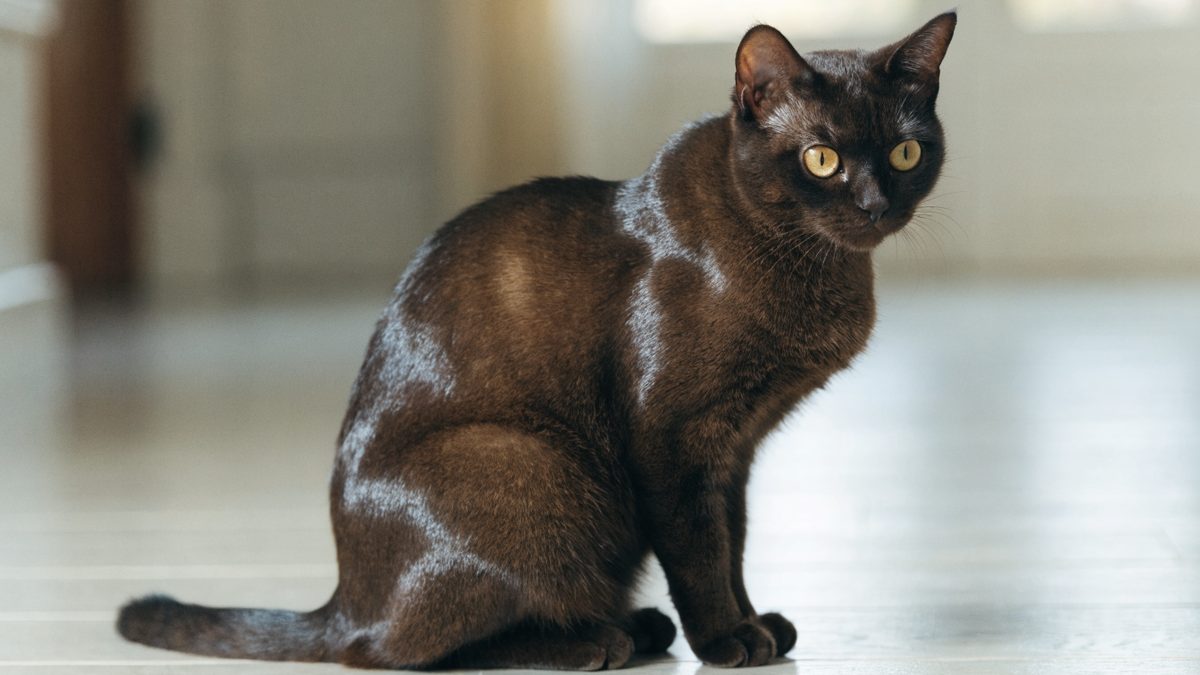
A Burmese is a medium-sized, muscular, short-coated cat with a solid sepia coat and gold eyes, and it exists in two distinct types that the world's cat registries do not describe the same way. The Cat Fanciers' Association asks for a head that is pleasingly rounded without flat planes and penalises a wedge-shaped head. The Governing Council of the Cat Fancy asks for a short wedge and withholds certificates from cats with a round head. Both are describing a Burmese.
Start with the breed standard, because it is free, public, and it settles arguments that Indian sellers otherwise settle with adjectives. CFA describes the ideal Burmese as a cat of medium size with substantial bone structure, good muscular development and a surprising weight for its size, with a rounded head, expressive eyes and a sweet expression. The coat is fine, glossy, satin-like in texture, short and very close lying. Eyes are large, set far apart, with a rounded aperture, and eye colour runs from yellow to gold. Blue eyes, crossed eyes and a kinked tail all disqualify.
That is the American, or contemporary, Burmese. Now read the British one. The GCCF Standard of Points asks for a head that, viewed from the front, forms a short wedge, wide at the cheek bones and tapering to a blunt finish at the muzzle, with a distinct nose break followed by a straight nose. Its withhold list is the part that matters, because GCCF judges are instructed to withhold certificates for British type, described in the standard's own words as a square cobby body, round head, small ears. Faults include flat or dished brows. Federation Internationale Feline takes the same line and lists oriental or British type among the faults precluding the certificate.
The two types, tabulated from the registries' own standards
Bonbeno compared five published standards line by line rather than repeating the usual sentence about the breed having two looks. The table below is what those documents actually say.
| Registry | What the standard asks of the head | Colours recognised |
|---|---|---|
| CFA, Burmese | Pleasingly rounded without flat planes from front or side, full face, broad short muzzle, visible nose break. Penalises an elongated muzzle producing a wedge-shaped head | Four only: sable, champagne, blue, platinum |
| CFA, European Burmese | Top slightly rounded, wide cheekbones tapering to a short blunt wedge, visible nose stop. Penalises pronounced muzzle pinch | Ten: brown, blue, chocolate, lilac, red, cream and four torties |
| TICA, Burmese | Rounded with no flat planes, face full, muzzle rounded short broad, visible break. Penalises a flat plane to the forehead | All sepia solid and tortoiseshell colours |
| GCCF, Burmese | Short wedge, wide at the cheek bones, tapering to a blunt finish, distinct nose break. Withholds certificates for a round head; faults flat or dished brows | Ten: brown, blue, chocolate, lilac, red, cream and four torties |
| FIFe, Burmese | Short wedge, wide at the cheekbones, distinct nose break at the base, no nose bump. Oriental or British type precludes the certificate | Ten: brown, blue, chocolate, lilac, red, cream and four torties |
Read the middle column downward and the disagreement is unmistakable. CFA and TICA want roundness and penalise a wedge. GCCF and FIFe want a wedge and penalise roundness. CFA resolves the contradiction by registering the two as separate breeds, Burmese and European Burmese, each with its own standard, point score and colour class numbers. Most other registries do not split them, and Wikipedia's summary of the position is accurate: most modern cat registries do not formally recognise the two as separate breeds, and those that do refer to the British type as the European Burmese.
Registries also disagree about whether the two types may be bred together
The World Cat Congress maintains a registry-by-registry comparison table for this breed, and it records restrictions no seller page mentions. The Australian Cat Federation states that its Burmese are not to be mated with USA contemporary style Burmese. The Co-ordinating Cat Council of Australia records that progeny of matings with American Burmese cannot be registered or exhibited. The Southern Africa Cat Council goes furthest, recording that no Burmese will be registered that was imported from Northern America or has cats in its pedigree imported from Northern America up to the eighth generation. The New Zealand Cat Fancy notes that, due to current controversy over the difference in type being seen in New Zealand, its standard is under review.
The head shape argument is usually presented as aesthetics. Two published findings turn it into medicine. The craniofacial defect variant that produces the rounded contemporary head is described by UC Davis as common in the Contemporary lines of Burmese from the United States. And the review of hypokalaemia in this breed states plainly that Burmese cats with hypokalaemia have never been reported from the USA, because the breed in North America is generally distinct from the breed in Europe, South Africa and Australasia. The health problems section below sets out both, with the numbers.
Where the breed came from, and why one cat matters
Almost every Burmese alive descends from a single female cat. Wong Mau was imported into San Francisco in 1930 by Dr Joseph Cheesman Thompson, who judged her build sufficiently different from the Siamese to be worth developing as a separate breed. TICA records her original description as a rather small cat, fine-boned, but with a more compact body than that of a Siamese, with a shorter tail, a rounded, short-muzzled head, with greater width between rounded eyes. She was bred to Tai Mau, a seal point Siamese, then back to her son, and the dark brown offspring founded the breed. Wong Mau herself was later understood to be a Siamese and Burmese hybrid, and that hybrid type was subsequently developed as the Tonkinese.
The dates explain the split. CFA granted formal recognition in 1936, suspended it a decade later because outcrossing to Siamese had overwhelmed the original type, and lifted the suspension permanently in 1954. The United Burmese Cat Fanciers compiled a US judging standard in 1958 that has remained essentially unchanged since. Britain went its own way, recognised the breed through GCCF by 1952, and Commonwealth and European countries then based their standards on the British model. TICA recognised the Burmese as one of its original breeds in June 1979. Then in the late 1970s a single male in the USA with a more brachycephalic head became a highly popular sire, and his lineage became the Contemporary Burmese.
The sepia coat, and why it is not a Siamese coat
The Burmese carries a different allele at the same pigment gene that makes a Siamese pointed, which is why the two look related but never identical. FIFe states the genetics directly in its standard, describing the Burmese as distinguishing itself as an independent breed by its unique genetics of colour, written as cbcb. The practical result is a sepia coat, a solid body colour with only slight darkening on the face, ears and extremities, rather than the hard mask-and-points contrast of a Siamese cat. FIFe requires that in all colour varieties the underparts are paler than back and legs but the shading should be gradual, with face and ears showing only a little contrast.
Two consequences follow for an Indian buyer. First, kittens look wrong. TICA records that in young cats the points will be darker, and that as the cat matures the body colour becomes deeper and richer until there is only a very slight difference between the body and the colour on the legs, head and tail. Both GCCF and FIFe formally instruct judges to allow for a lighter coat in kittens and adolescents Federation Internationale Feline. Burmese. A four-month-old sable Burmese in Pune that looks like a washed-out Siamese is very likely a normal Burmese. Second, a pointed kitten with blue eyes is not a Burmese at all, because blue eyes are a CFA disqualification for this breed and more blue than yellow pigmentation precludes the certificate under FIFe.
Six checks to run before you pay for a Burmese in India
Run these in daylight on the actual kitten, not on a photograph sent over WhatsApp. Each one costs nothing and each one is anchored to a published breed standard rather than to an opinion.
- Check the eye colour. Eye colour must run from yellow to gold under CFA, and blue eyes are an outright disqualification. Green eyes are penalised. A blue-eyed pointed kitten sold as a Burmese is something else.
- Check the coat against the sepia description. The coat should be short, fine, satin-like and very close lying, with a solid body colour shading only gradually. Distinct barring on the torso disqualifies under CFA.
- Ask which type the cat is, in full words. Ask whether the kitten is registered as Burmese or as European Burmese, because CFA runs them as two breeds with two standards and two sets of colour classes. A seller who cannot answer has not read either document.
- Ask which registry issued the pedigree and see the certificate. CFA allows Tonkinese, imported Southeast Asian cats and sable Bombay as outcrosses to the Burmese through 31 December 2031, while European Burmese has no allowable outcross breeds at all. Those are different animals on paper.
- Ask for the three DNA test certificates by name. Hypokalaemic polymyopathy, Burmese head defect and Burmese GM2 gangliosidosis all have commercial tests, and GCCF requires all three to be clear before a Burmese imported from another registry goes on its register Veterinary Genetics Laboratory.
- Weigh the kitten and check the age. Under Indian law a kitten below eight weeks is un-weaned and may not be sold, and the rules apply to online platforms as well as shops.
One honest limit frames everything below. Bonbeno found no published count of registered Burmese cats in India, no Indian breed club for the Burmese, and no Indian registry data on the breed. Nobody can say what share of Indian cats sold as Burmese are pedigreed and what share are dark domestic shorthairs. The price in india section quantifies how thin the market actually is, using live listing counts rather than adjectives.
Burmese cat price in India
One published Indian source gives a Burmese cat price in India, and it quotes Rs 15,000 to Rs 25,000 with availability marked Rare. Every other page ranking for this query on 16 August 2026 either quotes United States dollars or quotes no Burmese figure at all. That is the finding. There is no Indian price consensus for this breed because there is barely an Indian market for it.
Bonbeno checked the actual supply rather than repeating a range. India's largest pedigree cat marketplace, Mr n Mrs Pet, listed 1,674 cats for sale on 16 August 2026 across a breed filter of eighteen options: American Shorthair, Bengal, British Longhair, British Shorthair, Calico, Exotic Shorthair, Himalayan, Indian Breed, Indian Standard, Leopard, Maine Coon, Munchkin, Persian, Ragdoll, Russian Blue, Scottish Fold, Siamese and Siberian. Burmese is not on that list. Its most popular breeds page counts 1,117 Persians, 96 Maine Coons, 78 Bengals, 64 Himalayans, 62 Ragdolls, 54 British Shorthairs, 51 Siamese, 46 Calicos, 37 Siberians and 23 British Longhairs. Zero Burmese.
The number one organic result for this query tells the same story in a different way. Puppiezo ranks first in India for burmese cat price in india and its Burmese page carries a full specification block, a tier comparison chart and a replacement guarantee, but no Burmese kitten and no Burmese price. The rupee figures visible on that page belong to the Other Available Pets carousel, which on 16 August 2026 was showing Maltipoos, Poodles, a Cane Corso, a Rottweiler and a Goldendoodle. Anyone quoting Rs 98,999 as the Indian Burmese price has read a Maltipoo listing.
| Source | Quoted price | What the quote covers |
|---|---|---|
| Supertails, India climate guide | Rs 15,000 to Rs 25,000 | The only published Indian rupee band for the breed. Climate fit Excellent, lifespan 15 to 18 years, availability Rare |
| Puppiezo, position 1 in India | No Burmese price published | Specification block and tier chart only. No Burmese kitten listed |
| Mr n Mrs Pet, India marketplace | Breed not offered | 1,674 cats listed, 18 breeds in the filter, Burmese absent |
| Vetscan, 20 Best Cat Breeds in India | Breed not listed | Twenty Indian breed profiles with prices. Burmese does not appear |
| Petful, position 2 | 600 to 1,500 US dollars, up to 3,000 show quality, 50 to 350 to adopt | United States market, not India |
| Catster, position 3 | 600 to 2,500 US dollars | United States market, not India |
| PDSA, United Kingdom | Average purchase cost 450 pounds | UK average, with lifetime cost estimated at 14,700 to 18,000 pounds |
| Mr n Mrs Pet, all-breed average | Rs 18,000 to Rs 35,000, premium breeds Rs 60,000 or more | Average across all kittens sold in India, not Burmese specific |
| PatMyPets, India | Rs 5,000 to Rs 15,000 to buy a cat in India | Generic cat, not breed specific |
Bonbeno does not average those numbers into a single tidy figure, because averaging a United States dollar price, a United Kingdom pound price and a generic Indian cat price produces a number that describes nothing. What the table supports is narrower and more useful. The one Indian source that names the breed puts it at Rs 15,000 to Rs 25,000, which sits below Bengal, Maine Coon, British Shorthair, Russian Blue and Tonkinese on the same published Indian ladder and level with Bombay and the low end of Siamese.
Where the Burmese sits on the Indian pedigree cat price ladder
The same Supertails table prices forty breeds for the Indian market on one page, which makes it the only like-for-like comparison available. Read this as relative position, not as a quotation you should accept from a seller.
| Breed | Published Indian band | Availability noted |
|---|---|---|
| Indian cat, desi | Free to Rs 3,000, adoption | Widely available |
| Bombay | Rs 15,000 to Rs 35,000 | Select breeders |
| Burmese | Rs 15,000 to Rs 25,000 | Rare |
| Siamese | Rs 15,000 to Rs 50,000 | Widely available |
| Abyssinian | Rs 15,000 to Rs 50,000 | Rare |
| Russian Blue | Rs 15,000 to Rs 40,000 | Select breeders |
| Bengal, SBT or F4 and above | Rs 25,000 to Rs 1,50,000 | Select breeders |
| Tonkinese | Rs 30,000 to Rs 60,000 | Very rare |
| British Shorthair | Rs 35,000 to Rs 60,000 | Widely available |
| Singapura | Rs 40,000 to Rs 90,000 | Very rare |
Two of those rows deserve a second look. The Tonkinese at Rs 30,000 to Rs 60,000 is the Siamese and Burmese cross that descends from the same Wong Mau line, and it is quoted at roughly double the Burmese despite being described on the same page as very rare rather than rare. The Bombay at Rs 15,000 to Rs 35,000 is the breed CFA permits as a Burmese outcross in its sable form through 2031. In a market this thin, those two breeds are the realistic substitutes, and both are easier to find in India than a Burmese.
What actually drives the number a seller quotes you
Four factors move the figure, and only two of them are about the cat. Mr n Mrs Pet lists its own price drivers as breed, size and gender, breeder reputation and location, registration and lineage, kitten age and colour, and grooming and vaccination. To that Bonbeno adds the two that matter most for this specific breed in India.
- Import cost dominates. With no listings on India's largest marketplace and no Indian breed club, a genuine registered Burmese in India is either imported or bred from imported stock, and the airfare, health certification and quarantine sit inside whatever price you are quoted.
- Type changes the paperwork, not usually the price. CFA registers Burmese and European Burmese as separate breeds with separate colour classes, so a red, cream or tortoiseshell cat is a European Burmese question and cannot be a CFA Burmese at all.
- Colour changes availability. CFA Burmese recognises four colours and nothing else, while GCCF and FIFe recognise ten Federation Internationale Feline. Burmese. A seller offering a chocolate or red Burmese is working from a British or European standard, which is a legitimate cat and a different registry.
- Genetic testing is a real cost the seller may have absorbed. Three DNA tests exist for this breed at 47 US dollars each, or 119 US dollars for all three plus polycystic kidney disease, and a breeder who has run them has spent that money.
We report published ranges as editorial content and do not broker sales. For this breed the honest answer to what is the burmese cat price in india is that one source says Rs 15,000 to Rs 25,000, no marketplace stocks the breed, and any quote you receive should be treated as a single seller's asking price rather than a market rate. Ask for the registry, the registration number and the three test certificates before you discuss money at all.
Monthly cost of keeping a Burmese in India
Budget Rs 2,000 to Rs 6,000 a month for a Burmese in India, which is the band Mr n Mrs Pet publishes for a low to medium coat cat given a moderate lifestyle. The monthly cost of this breed sits at the cheaper end of pedigree cats for one specific reason. A short close-lying coat means the professional grooming line, which can dominate a Persian budget, is simply zero.
Bonbeno separates one-time costs from recurring costs, because Indian sellers routinely blend them and produce a first-year number that looks like a monthly number. Work through the two tables below in order.
| Item | Published Indian figure | Source and note |
|---|---|---|
| Kitten, the only published Indian band for the breed | Rs 15,000 to Rs 25,000 | Supertails, availability Rare |
| Kitten, all-breed Indian average | Rs 18,000 to Rs 35,000, premium Rs 60,000 plus | Mr n Mrs Pet |
| Full kitten vaccination course, three core shots | Rabies Rs 300 to Rs 500, FVRCP Rs 500 to Rs 1,000, panleukopenia Rs 400 to Rs 800 per shot | Supertails |
| Vaccination and early check-ups, bundled | Rs 2,000 to Rs 4,000 | PatMyPets |
| Burmese head defect DNA test | 47 US dollars | UC Davis Veterinary Genetics Laboratory |
| GM2 gangliosidosis DNA test | 47 US dollars | UC Davis |
| All three Burmese tests plus polycystic kidney disease | 119 US dollars | UC Davis package price |
The DNA tests are a seller cost rather than a buyer cost in most cases, because they are run on the breeding cats, not on your kitten. Ask whether they were run and ask to see the certificates. If the answer is that the parents were not tested, you are being asked to pay a pedigree price for an untested animal, and the health problems section explains exactly what that risks.
| Line item | Published Indian figure | Bonbeno note for this breed |
|---|---|---|
| Food | Rs 1,000 to Rs 2,000 | Rises with a wet-food-led diet, which this breed benefits from given its diabetes risk |
| Litter | Rs 500 to Rs 1,000 | Budget for a second litter box if you keep two cats, which this breed genuinely suits |
| Professional grooming | Zero | The coat needs a weekly rubber brush and nothing else |
| Toys and enrichment | Not separately published for India | Treat this as a real line, not an extra. TICA describes a breed that needs puzzle or interactive toys |
| All-in monthly, low to medium coat cat | Rs 2,000 to Rs 6,000 | The most reliable Indian figure available, and it matches the zero-grooming structure of this breed |
Two costs that Indian pages omit belong in a Burmese budget specifically. The first is diabetes monitoring in later life. Burmese cats carry roughly three times the odds of a diabetes mellitus diagnosis of a crossbred cat in UK primary care, and a diabetic cat needs glucose monitoring, prescription diet and often daily insulin, which PDSA describes plainly for the breed. The second is that PDSA estimates a Burmese lifetime cost of 14,700 to 18,000 pounds in the United Kingdom, excluding purchase price. Indian costs are far lower, but the shape of the spend is the same: the kitten is the small number.
Delete the professional grooming line entirely. TICA's own care guidance for the breed is a weekly grooming with a rubber brush to remove loose hairs, the oils from your hand helping maintain the coat, and a quick wipe with a chamois to finish. PDSA says the same, a weekly brushing followed by a good stroke. Any Indian quote that includes a four to six week trimming schedule for this breed has pasted a long-coat template onto a short-coated cat. Put that money into toys instead.
A longer life also changes the arithmetic in a way no ranking page mentions. UK veterinary records give the Burmese a life expectancy at age 0 of 14.42 years, the longest of the twelve breeds analysed. At Rs 4,000 a month that is roughly Rs 6.9 lakh of care across a full life, which dwarfs any plausible purchase price. Budget for the fifteen years, not for the kitten.
Suitability for the Indian climate
The Burmese is one of the better pedigree cats for Indian conditions and Bonbeno rates its heat tolerance 4 out of 5. It carries a short, fine, close-lying coat with almost no undercoat, it has a normal muzzle with a visible nose break rather than a flattened face, and its foundation stock came from the Thai and Burmese border. Supertails rates its climate fit Excellent and calls it one of the most underrated heat-tolerant breeds in India.
Understand what the coat actually is before you rely on it. FIFe describes the structure as fine, glossy, silky, lying close to the body, almost without undercoat, very short. That is the single most important sentence on this page for an Indian owner, because undercoat is what traps heat. A Persian or a Maine Coon in a Chennai summer is carrying insulation it cannot remove. A Burmese is not.
Then check the face, because that is where imported cats fail in India. CFA requires a visible nose break and a broad, well-developed short muzzle, but it also disqualifies a malocclusion of the jaw that visually prohibits the described profile. This is a moderately foreshortened face, not a flat one. It is worth being precise here: the carrier state of the Burmese craniofacial variant produces a brachycephalic appearance, so a very extreme contemporary head is worth a second look on a hot-country cat, and the health problems section explains why that is a genetic question rather than a cosmetic one.
What an Indian summer actually looks like in numbers
India's April 2026 peak is a real number rather than a feeling. The India Meteorological Department recorded the highest maximum temperature of the week ending 29 April 2026 as 47.6 degrees Celsius at Banda in East Uttar Pradesh on 27 April 2026, with severe heat wave conditions in isolated pockets of Himachal Pradesh and East Uttar Pradesh and heat wave conditions across Gangetic West Bengal, Bihar, Haryana, Chandigarh, Delhi, Punjab and Rajasthan during the same week. A cat with no undercoat handles that better than a cat with one. No cat handles a closed flat in that heat with no water.
| Indian condition | Risk to this breed | What to do |
|---|---|---|
| Dry heat, plains, April and May | Lower than most pedigree cats. No undercoat and a normal muzzle The Cat Fanciers' Association. Burmese… | One cool room, a fan, shaded floor space and water in more than one bowl |
| Coastal humidity, Mumbai, Chennai, Kochi | Fungal skin infection, which Indian veterinary writing lists as a summer condition in cats | Keep bedding dry, brush weekly, check between the toes and under the chin |
| Monsoon, fleas and ticks | Indian sources list flea and tick load as a common summer and monsoon problem | Preventive treatment on your vet's schedule, and never a human shampoo |
| Heatstroke in a closed flat | Real for any cat. Poor ventilation and dehydration are the listed causes | Keep the cat indoors during peak hours, provide airflow, provide cool water |
| Delhi and north Indian winter | A single close-lying coat with almost no undercoat gives little insulation | Provide a warm bed off the floor. This breed seeks out warm laps by nature |
The winter row is the one Indian buyers underestimate. TICA and CFA both describe a cat that seeks warmth and body contact by preference, following you room to room and sleeping on or in your bed. A coat built for a tropical border region is not a Himachal coat. In a Delhi January, give a Burmese a raised warm bed rather than a tiled floor.
The Burmese sepia pattern comes from a variant of the same pigment gene family that makes a Siamese pointed, which FIFe records as the cbcb genetics unique to this breed. Registries formally allow for a lighter coat in kittens and adolescents and a deeper body colour in mature cats Federation Internationale Feline. Burmese The International Cat Association. Burmese…. Bonbeno found no published study measuring how much an Indian ambient temperature shifts a Burmese coat, so we do not put a number on it. Expect an Indian-raised Burmese to look somewhat lighter than a European show photograph, and do not treat that as proof of poor breeding.
Temperament and household fit
The Burmese is an affectionate, people-following, sociable cat that does badly alone, and that single fact should decide whether you buy one. CFA describes a breed that is extremely people oriented, following you from room to room, seeking out warm laps. TICA is blunter about the cost of that: they are very social cats that thrive on the company of others, thus they tend to become lonely if left by themselves for long periods of time.
Read the two registry descriptions together, because they are unusually specific about behaviour. CFA calls the Burmese curious, clever and friendly, known for being good with children, and notes that they typically like or at least tolerate the family dog. They readily learn fetch and other games. Crucially, CFA adds that they do not focus on one special person and bestow affection on everyone within reach. That distinguishes them from breeds that bond to a single household member and sulk at the rest.
On volume, the record is consistent and it contradicts the usual assumption that a Siamese relative must be loud. CFA states that Burmese are generally soft-spoken, but if something is amiss they have no trouble making you aware of it. TICA describes a soft voice and a cat that enjoys talking with its family about the events of their day. CFA's European Burmese page goes further, noting that the cat is more likely to look up at you and purr for your attention than it is to meow. So the vocal behaviour here is conversational rather than piercing, and a Burmese is a realistic choice for a household that found a Siamese too loud.
Who should buy this breed in India
- Choose it if someone is home most of the day, or if you are willing to keep two cats. TICA's own guidance is that if a busy household means the cat will be alone for long periods, consider two so they will be company for each other.
- Choose it if you have children. CFA describes the breed as known for being good with children and TICA calls it an ideal pet for the whole family, including younger children.
- Choose it if you already have a dog. CFA notes that Burmese typically like or at least tolerate the family dog.
- Choose it if you live in an apartment. This is a medium-sized, compact cat that PDSA rates as a lap cat with a high tendency to climb and jump, so vertical space matters more than floor area.
- Skip it if the flat is empty ten hours a day and you will not keep a second cat. That is the single situation in which this breed is the wrong choice, and both registries say so in their own words.
How the personality changes with age
CFA gives a useful three-stage description that Indian sellers never quote. Burmese are spirited as kittens, mellow out in adulthood, but remain playful and active well into old age. Combine that with a life expectancy at age 0 of 14.42 years in UK primary care records and you are committing to well over a decade of a cat that still wants to play at twelve. That is a feature if you want it and a burden if you do not.
There is one honest caveat about temperament and the show ring. TICA's Burmese and Bombay standard notes that both breeds are talkative, vocal and very happy to express their opinions, and instructs judges to expect a mouthy cat that is completely relaxed and unthreatening. Temperament carries five points in the GCCF scale of points, and extremely aggressive behaviour is on the withhold list. A Burmese that is genuinely aggressive is atypical for the breed, and in India that is more likely to signal poor early socialisation or an animal that is not a Burmese at all.
Training a Burmese, and what it resists
Train a Burmese with short reward-based sessions, because this is an intelligent breed that learns fetch readily and thrives on interactive work. CFA records that Burmese readily learn fetch and other games, and TICA recommends families who are willing to teach them tricks, play games and provide plenty of puzzle or interactive toys. What it resists is being ignored, not being taught.
Set the expectation correctly first. You are not training obedience into a cat. You are giving a highly social animal a job so that it stops inventing one. TICA states that Burmese do best with families who give them plenty of attention, and CFA notes that most are convinced it is their job to run the house and you may have a challenge on your hands trying to convince them otherwise. That is the resistance, and it is charming rather than difficult.
A realistic Indian training sequence
- Litter training, week 8 to 10. Most kittens arrive already trained by the queen. Place one litter box per cat plus one spare, away from food, and do not move them for the first fortnight.
- Carrier training, week 10 to 16. Leave the carrier open in the room with bedding inside and feed the kitten in it. A cat that walks into its carrier turns every Indian vet visit and every summer power cut into a calm event.
- Name and recall, month 3 to 5. Use a single syllable and reward every response. This breed is people-oriented enough that recall is genuinely achievable.
- Fetch, month 4 onward. CFA lists fetch as something the breed picks up on its own. Start with a crumpled paper ball and reward the return, not the chase.
- Handling and grooming tolerance, month 3 onward. Brush weekly from the start, handle the paws, and open the mouth briefly each week. This pays for itself when a vet needs to look at teeth, which matters in a breed with a documented orofacial pain syndrome.
- Scratching post redirection, ongoing. TICA's care guidance is to keep nails trimmed and provide a nice tall scratching pole to serve the natural scratching instinct.
Indian law defines mutilating an animal as subjecting it to a surgery or procedure such as ear cropping, tail docking or branding, or otherwise performing a procedure to camouflage or hide any defect, and bars pet shops from selling animals with any form of mutilation. Trim the nails and provide a post. A cat that has learned to use a scratching pole does not need surgery.
One training detail is specific to this breed's health profile. Because Burmese carry raised odds of diabetes mellitus Ohlund M, Fall T, Strom Holst B, teaching a kitten to accept restraint and a paw hold early makes later glucose monitoring far easier. If a Burmese does become diabetic in later life, PDSA notes it may need daily insulin injections to control the disease. A cat trained at four months to sit still for ten seconds is a cat that can be treated at ten years.
Daily exercise and enrichment requirement
Give a Burmese two structured interactive play sessions a day plus puzzle feeding, and treat that as the minimum rather than the ideal. TICA describes a highly intelligent breed that thrives with families willing to teach them tricks, play games and provide plenty of puzzle or interactive toys, and PDSA rates the Burmese as an energetic cat who loves to play and is good at climbing and jumping.
Two things make this specific rather than generic advice. First, exercise is not optional for a breed whose registry demands visible muscle. CFA's standard states that perfect physical condition with excellent muscular tone is expected and that there should be no evidence of obesity, paunchiness, weakness or apathy. That is a judging instruction, but it is also a health target you can see at home. Second, a cat carrying elevated diabetes odds benefits directly from staying lean, since UK primary-care data shows diabetes odds increasing as bodyweight categories increase above 4 kg.
| When | What | Why it matters for this breed |
|---|---|---|
| Morning, 10 to 15 minutes | Wand toy, chase and pounce, ending in a catch | Burns energy before the household leaves. A frustrated hunt sequence is worse than none |
| Daytime, unattended | Puzzle feeder holding part of the daily ration | TICA specifically recommends puzzle or interactive toys for this breed |
| Evening, 10 to 15 minutes | Second wand session or fetch | CFA notes the breed readily learns fetch |
| Always available | Cat tree or tall shelf run | PDSA recommends a cat tree so a climbing, jumping breed can do it safely |
| Weekly | Rotate three toys in and three out | Novelty does more for a clever cat than volume of toys |
| Monthly | Weigh the cat and score body condition | PDSA gives an average Burmese weight of 5 kg, and diabetes odds rise above 4 kg |
The Indian constraint is heat, not space. Between about 11 am and 4 pm in April and May, when the plains can reach 47.6 degrees Celsius, move play to early morning and after sunset. A short-coated cat sheds heat better than a Persian, but a hard chase in a closed afternoon flat is still avoidable strain.
The top-ranking Indian page for this query lists the exercise routine for a Burmese cat as a daily walk and light indoor play, and elsewhere on the same page refers to Burmese Dogs being known for their quiet demeanor. That is a dog template applied to a cat. You do not need to walk a Burmese. If you want to harness-train one for a balcony or a garden, that is a legitimate enrichment choice for an intelligent breed, not a requirement.
Grooming and coat care in Indian humidity
Brush a Burmese once a week with a rubber brush and do nothing else. TICA's care guidance is exact: a weekly grooming with a rubber brush to remove loose hairs will polish the coat to a high gloss, the oils from your hand petting and stroking the coat help maintain its balance, and a quick wipe with a chamois gives the final finishing touch. PDSA gives the same instruction, a weekly brushing followed by a good stroke.
The reason grooming is this simple is structural. FIFe describes the coat as fine, glossy, silky, lying close to the body, almost without undercoat, very short. CFA calls it fine, glossy, with a satin-like texture, short and very close lying. GCCF adds a line worth remembering, that the glossy coat is a distinctive feature of Burmese and is indicative of good health. A Burmese coat that has gone dull is a reason to see a vet, not a reason to buy a conditioner.
| Task | Frequency | Note |
|---|---|---|
| Rubber brush or grooming mitt | Weekly | Removes loose hair and polishes the coat |
| Chamois wipe | Weekly, after brushing | The finishing step TICA names |
| Nail trim | Every 3 to 4 weeks | TICA lists keeping nails trimmed as routine care |
| Ear check and clean | Fortnightly | TICA lists ears cleaned as routine care |
| Tooth brushing | Two or three times a week | TICA specifies a vet-approved pet toothpaste |
| Skin and coat check | Weekly in monsoon | Indian summer and monsoon bring fungal skin infection and flea and tick load |
| Full bath | Rarely, only when genuinely dirty | Indian advice for hot dusty weather is a cat-safe shampoo, never a human one |
| Professional grooming | Never | A short close-lying single coat needs no trimming at any point |
Two Indian conditions deserve a specific check during that weekly brush. Fungal skin infection presents in hot humid weather as itching and circular patches, and Indian veterinary writing lists cleaning the living area and avoiding fragrances as the practical prevention. Fleas and ticks peak in the same season and show as itching and rashes. Run your hand against the lie of the coat once a week along the spine, under the chin, behind the ears and between the toes. On a close-lying coat you will feel a problem before you see it.
Shedding is the question Indian buyers ask most often about this breed, and the honest answer is that a Burmese does shed. PDSA rates the breed low on both overall grooming needs and shedding and the top Indian seller page marks shedding as No, which is wrong. All cats with hair shed. What a single close-lying coat with almost no undercoat does is shed less visibly and produce no mats, which is a different and more useful claim. Nobody should treat this breed as hypoallergenic, because coat length does not change the Fel d 1 protein that drives most cat allergy.
Health problems, screening and life expectancy
The Burmese is long-lived and carries four documented breed-linked conditions, three of which have a commercial genetic test available. UK veterinary records give the breed the longest life expectancy of any breed studied, 14.42 years at age 0. Against that, published carrier rates for hypokalaemic polymyopathy, the Burmese head defect and GM2 gangliosidosis run from 4.6 percent to 14.5 percent in tested populations Lyons LA, Erdman CA, Grahn RA, Hamilton MJ Veterinary Genetics Laboratory. Discuss all of this with your nearby vet before and after you buy.
Take the good news first, because it is genuinely unusual. Among the twelve cat breeds with fifteen or more recorded deaths in the UK VetCompass life tables, built from 7,936 cats that died between 1 January 2019 and 31 March 2021, Burmese and Birman had the longest life expectancy at age 0, at 14.42 years with a 95 percent confidence interval of 12.91 to 15.93 and 14.39 years respectively. The overall figure for UK companion cats was 11.74 years, crossbred cats 11.89 years and purebred cats 10.41 years. The Burmese figure rests on 45 recorded deaths with a lifespan range of 0.74 to 21.29 years. The shortest-lived breed in the same study was the Sphynx at 6.68 years.
So a Burmese outlives the average crossbred cat by about two and a half years on population data, which is the opposite of the usual pedigree pattern. Indian seller pages that quote 14 to 16 years for this breed are, unusually, close to the veterinary record, and Supertails' 15 to 18 years is on the optimistic side of it.
| Group | Life expectancy at age 0 | Recorded deaths |
|---|---|---|
| Burmese | 14.42 years (95% CI 12.91 to 15.93) | 45 |
| Birman | 14.39 years (95% CI 12.87 to 15.91) | 38 |
| Crossbred cats | 11.89 years (95% CI 11.76 to 12.03) | Not stated in the extract |
| All UK companion cats | 11.74 years (95% CI 11.61 to 11.87) | 7,936 cats in the study |
| Purebred cats, all breeds | 10.41 years (95% CI 9.99 to 10.83) | Not stated in the extract |
| Sphynx, shortest in the study | 6.68 years (95% CI 4.53 to 8.83) | 18 |
Hypokalaemic polymyopathy, the WNK4 potassium disease
Burmese hypokalaemia is an inherited episodic muscle weakness caused by a nonsense mutation in the WNK4 gene, and it has real prevalence numbers behind it. In 2012 it became the first feline disease phenotype characterised using a genome-wide association study, and it is inherited as a highly penetrant autosomal recessive trait. Genotyping at Langford Veterinary Services and UC Davis from 2012 to September 2014 tested 2,099 Burmese, of whom 411, or 20 percent, were carriers and 34, or 1.6 percent, were homozygous affected, with a WNK4 allele frequency of 0.1141. Most of those cats were domiciled in the UK, Europe or Australasia.
The clinical picture is specific enough to recognise at home. Affected cats usually present with muscle weakness and muscle pain in the first year of life, and most first develop signs between 2 and 10 months of age, the majority by 4 to 6 months. The most characteristic sign is passive ventroflexion of the head and neck, and in extreme cases cats adopt a swan-like cervical posture with the chin tucked into the sternum. Affected cats may have hindlimb weakness misread as ataxia, with a gait described as swaying or crouching, and prominent head bobbing because they cannot fixate the head during movement. The Burmese Cat Club describes the same posture as a meerkat posture with difficulty walking and jumping.
Diagnosis rested until recently on a serum potassium concentration below a threshold of 3.0 mmol per litre, or 2.5 mmol per litre according to some authorities, with a blood test showing low serum potassium and raised creatine kinase indicating muscle damage. Treatment is oral potassium replacement, typically enteric-coated sustained-release potassium chloride, with spironolactone as an adjunct in difficult cases. CFA's European Burmese page notes plainly that the condition is recessive, detectable by genetic testing, and treatable with potassium supplements.
The review states that Burmese cats with hypokalaemia have never been reported from the USA, because the breed in North America is generally distinct from the breed in Europe, South Africa and Australasia. The disease has been reported from Australasia, Europe and South Africa, and specifically from New Zealand, Germany and the Netherlands. If an Indian seller's cat traces to British, European or Australasian lines, this is the test to insist on. If it traces to American lines, the craniofacial defect below is the one that matters more. Ask which, and get the answer in writing.
The variant is also present in breeds derived from the Burmese, which matters if you are cross-shopping. In the same dataset 26 of 124 Bombays, or 21 percent, 17 of 133 Burmillas, or 13 percent, and 7 of 21 Tiffanies, or 33 percent, were carriers, while 9 of 124 Bombays, or 7 percent, and 1 of 19 Tonkinese, or 5 percent, were homozygous affected. Asian cats showed 6 of 26, or 23 percent, carriers. No affected or carrier Australian Mist cats were detected.
The Burmese head defect, and why it is the contemporary head
The Burmese head defect is a lethal congenital craniofacial defect caused by the same variant that produces the rounded contemporary head shape, which is why it cannot be bred away by eye. UC Davis describes Burmese head defect, or congenital frontonasal dysplasia, as improper development and subsequent malformation of the skull and facial features, with affected kittens either stillborn or born live but unable to survive long. The cause is a 12 base pair in-frame deletion, c.496delCTCTCAGGACTG, in the aristaless-like homeobox protein 1 gene, identified by the Lyons laboratory at UC Davis.
The inheritance is the part that changes how you should read a show photograph. The variant is autosomal co-dominant. Cats with one copy do not have the defect but may have a shortened facial structure, that is brachycephalic conformation, and matings between two carriers are predicted to produce 25 percent affected kittens. The paper states it directly: the brachycephaly of the Contemporary Burmese is a simple co-dominant trait, however the homozygous cats have a severe craniofacial defect that is incompatible with life. Heterozygous cats became the hallmark phenotype of the Contemporary Burmese and the predominant winners at cat shows.
| Group tested | Cats tested | Carriers | Wildtype |
|---|---|---|---|
| Burmese | 3,250 | 151 | 3,099 |
| Bombay | 133 | 43 | 90 |
| Burmilla | 5 | 0 | 5 |
| Tonkinese | 6 | 0 | 6 |
| Asian | 2 | 0 | 2 |
| Australian Mist | 1 | 0 | 1 |
| All Burmese-type breeds combined | 3,264 | 194 | 3,070 |
| Other breeds, including Persian, Exotic Shorthair, Scottish Fold, Selkirk Rex and British Shorthair | 2,456 | 0 | 2,456 |
Two conclusions follow from that table and they matter to an Indian buyer. First, the defect is Burmese-specific. Around 2,400 cats from other brachycephalic breeds were genotyped and none carried the deletion. Do not let anyone transfer a Persian or Scottish Fold screening claim onto this breed, and do not accept a heart-mutation certificate from another breed as if it covered a Burmese. Second, you cannot judge it by looking. The paper states that Traditional Burmese have also become more brachycephalic over the past three decades and their phenotype cannot be clearly distinguished from Burmese heterozygous for the ALX1 variant, so all Burmese need to be genotyped to confirm presence or absence of the variant. UC Davis summarises the population figure as 5.9 percent of Burmese and related breeds carrying the mutation, and notes the mutation is common in the Contemporary lines of Burmese from the United States.
UC Davis adds a caveat that no Indian page carries. Burmese head defect is not related to midline defect, a genetic disease which can present head malformation among other abnormalities, and midline defect appears more common in European lines of Burmese cats and is currently under investigation, with no genetic test available at this time. So the American type has a testable craniofacial problem and the European type has an untestable one under study. Neither type is clean, and any seller who tells you their line has no head issues at all is telling you they have not read the literature.
Diabetes mellitus, the risk that shows up in middle age
The Burmese carries the clearest breed predisposition to diabetes mellitus of any cat, and four independent datasets agree. PDSA states it flatly for owners: Burmese are the most common cat breed to develop this condition.
| Study and population | Burmese finding | Comparison |
|---|---|---|
| O'Neill et al, 193,435 cats in English primary-care practice | Within-breed prevalence 2.27 percent (95% CI 1.63 to 3.06), odds ratio 3.0 (95% CI 2.0 to 4.4) | Overall period prevalence 0.58 percent (95% CI 0.54 to 0.61) |
| Ohlund et al, insured Swedish cats | Incidence rate 48.8 per 10,000 cat-years at risk (95% CI 31.9 to 65.7), incidence rate ratio 5.2 (95% CI 3.6 to 7.6) versus other purebreds | Overall incidence 11.6 per 10,000 cat-years (95% CI 11.0 to 12.2) |
| McCann et al, insured UK cat population | Burmese cats were 3.7 times more likely to develop diabetes than non-pedigree cats | Overall prevalence 1 in 230 cats |
| PDSA breed guidance | Named as the most common cat breed to develop the condition | Listed alongside hypokalaemic polymyopathy as the breed's two main problems |
Two details from those papers change what you do about it. In the English primary-care data, diabetes odds increased as bodyweight categories increased above 4 kg and as cats aged beyond 6 years. In the Swedish data, male cats overall had roughly twice the risk of females, but no sex predisposition was found among Burmese cats, with similar rates for males at 52.1 and females at 45.2 per 10,000 cat-years. So a female Burmese gets no protection from her sex, and weight is the lever you control. PDSA describes the presentation as high blood sugar causing weakness, blindness, excessive appetite and thirst, potentially needing daily insulin injections. CFA's own breed pages advise asking about any incidence of diabetes in your breeder's lines and monitoring carbohydrate consumption as the cat ages The Cat Fanciers' Association. European….
GM2 gangliosidosis and feline orofacial pain syndrome
GM2 gangliosidosis is a fatal neurological disease of Burmese kittens with a test available and a high carrier rate. It is caused by a 15 base pair deletion in the HEXB gene, inherited as an autosomal recessive, and it first shows at 6 to 8 weeks of age with mild tremors that progress to difficulty eating and loss of coordination. UC Davis reports that at the time of publishing, researchers found the carrier frequency for GM2 gangliosidosis to be 14.5 percent among tested Burmese cats, and the mutation has been detected in European Burmese cats in at least five countries including the United States. That is the highest carrier frequency of the three testable Burmese conditions and the one least often mentioned by sellers.
Feline orofacial pain syndrome is the fourth condition and it has no genetic test. In a retrospective series of 113 cats, 100 were Burmese, an overwhelming predilection of 88 percent of cases. It was first recognised in the early 1990s and the predominance within the breed suggests an inherited disorder. Sixty-three percent of cases had a history of oral lesions, including dental disease, oral ulceration and eruption of permanent teeth, events could be directly linked to a situation causing anxiety in 20 percent of cats, and 12 of the 113 cats were euthanased with the syndrome cited as the main or only reason. The mean age at first episode was 7.1 years. Practically, that means mouth pawing, tongue mutilation or sudden face rubbing in a Burmese is a veterinary emergency and not a behavioural quirk.
The screening panel to ask for, by name
Three of the four conditions have commercial tests, and GCCF makes all three mandatory for imports. All Burmese imported onto the GCCF register from other registries must be microchipped and DNA tested clear of hypokalaemic polymyopathy, Burmese head defect and Burmese GM2 gangliosidosis, with a veterinary certificate of the results required, and must also be tested to show they do not carry the cinnamon colour gene or the long-hair gene. GCCF further requires that a Burmese may go on the Active Register only if the cat itself has tested normal for hypokalaemia or both parents have, and states that any Burmese which has inherited two copies of the recessive gene must not be bred from.
- Burmese hypokalaemia, WNK4. Autosomal recessive, offered by Langford Veterinary Services and UC Davis, with results reported as Normal, Carrier or Affected.
- Burmese head defect, ALX1. Autosomal co-dominant, 47 US dollars at UC Davis, results reported as N/N, N/BHD or BHD/BHD.
- Burmese GM2 gangliosidosis, HEXB. Autosomal recessive, 47 US dollars at UC Davis, appropriate for Burmese and European Burmese.
- No test exists for feline orofacial pain syndrome or for the European midline defect. Ask the breeder about family history instead, and accept that the answer cannot be certified.
- Insist the swab was taken by a vet who verified the microchip. For a certificate to count towards a GCCF or International Cat Care register, the sample must be taken by a veterinarian who confirms the cat's identity using its microchip number.
One point of proportion so this section is not read as alarmism. The published carrier rates mean roughly one in five tested Burmese carried the hypokalaemia variant and roughly one in twenty carried the head defect variant Lyons LA, Erdman CA, Grahn RA, Hamilton MJ, and a carrier is a healthy cat. The Burmese Cat Club makes the breeding argument explicitly, noting that for every 1 percent of the breed classed as affected there will be an estimated 18 percent carrier status, and that removing so many individuals from the gene pool would not be wise. Carriers can be used but only mated to cats tested free. As a pet buyer, what you need is a cat that is not affected, not a cat with no carrier ancestors.
A Burmese holding its head low with the chin tucked toward the chest, walking with a swaying or crouching gait, or bobbing its head while moving may be showing hypokalaemic weakness. A Burmese that is suddenly drinking and urinating far more than usual, eating ravenously and losing weight may be diabetic. A Burmese pawing at its mouth or mutilating its tongue may have orofacial pain syndrome. None of these is a wait-and-see problem. Consult your nearby vet the same day, and take this page's condition names with you so the right blood tests get run.
Feeding and nutrition for an Indian Burmese
Feed a Burmese a complete meat-based diet portioned to a lean body condition, and treat weight control as the breed's main nutritional job. Diabetes odds in cats rise as bodyweight categories increase above 4 kg, PDSA gives an average Burmese weight of 5 kg, and CFA's standard states there should be no evidence of obesity or paunchiness. Those three facts point the same way.
Start with the non-negotiable. Cats are obligate carnivores and must receive essential nutrients mainly from animal sources, a point Indian marketplaces state explicitly for vegetarian households. There is no vegetarian version of this. If your household does not cook meat, buy a complete commercial cat food and let the manufacturer solve the amino acid problem.
Then take the breed-specific point. CFA's guidance on its Burmese pages is to provide regular checkups and monitor carbohydrate consumption as the cat ages The Cat Fanciers' Association. European…. That is a diabetes-driven instruction, and it is unusual for a registry to put dietary advice in a breed profile at all. Take it seriously in a breed with an odds ratio of 3.0 for diabetes mellitus against crossbred cats and an incidence rate ratio of 5.2 against other purebreds.
| Life stage | What to feed | What to watch |
|---|---|---|
| 8 to 16 weeks | Complete kitten food, four meals a day, same brand the breeder used for the first fortnight | Any tremor or wobble at 6 to 8 weeks is a GM2 gangliosidosis red flag, not fussiness |
| 4 to 9 months | Complete kitten food, three meals a day, introduce a puzzle feeder | This is the window in which hypokalaemia usually appears, most cases by 4 to 6 months |
| 9 to 12 months | Transition to adult food over 7 to 10 days, two meals a day | Weigh monthly. Growth slowing is normal, weight climbing past target is not |
| 1 to 6 years | Complete adult food, measured portions, wet food as a meaningful share | Hold the cat under 5 kg unless your vet sets a different target |
| 7 years and older | Senior or weight-control formulation on veterinary advice, carbohydrate content reviewed | Diabetes odds rise past 6 years of age. Annual bloodwork from seven |
| Any age, any stage | Fresh clean water daily, bowl at least three feet from the food | TICA gives this exact placement advice because food smell suppresses drinking |
Water intake deserves that last row rather than a footnote. TICA's nutrition guidance for the breed is to give fresh clean water daily and to place the water bowl at least three feet away from any food, because cats' noses are sensitive and an overwhelming smell of food may cause them to drink less, with filtered drinking fountains as an alternative. In an Indian summer that matters twice over, because dehydration is one of the listed causes of feline heatstroke.
What not to put in the bowl
The top-ranking Indian page for this query publishes a never-feed list for the breed that is worth repeating, since it is one of the few things on that page that is correct. It names almonds, avocados, cherries, grapes, lemon, onions, salt and sugar. Add the Indian kitchen reality to that: no milk after weaning, no leftover masala, no chicken bones from the biryani, and no sweets. A Burmese that begs at the table is doing what CFA describes as running the house, and it is very good at it.
Run your palms flat along the cat's ribcage without pressing. You should feel each rib under a thin layer of tissue, the way the back of your hand feels over the knuckles. Look down from above for a visible waist behind the ribs. Look from the side for a tucked-up belly line. GCCF's standard asks for a cat that is well muscled with good weight for size, lively and alert, and CFA describes a body that is muscular in development with an ample rounded chest and a back level from shoulder to tail. Heavier than it looks is correct for this breed. Soft and round is not.
One phrase in the standards causes real confusion in India and is worth clearing up. FIFe, GCCF and CFA all describe the Burmese as heavier than its appearance indicates or of surprising weight for its size Governing Council of the Cat Fancy. Burmese… The Cat Fanciers' Association. Burmese…. That refers to dense bone and muscle in a compact frame, not to fat. Published Indian sources put the breed at 3.6 to 5.4 kg for males and 2.7 to 4.5 kg for females, with a Puppiezo listing quoting 5 to 7 kg and PDSA an average of 5 kg. Those disagree, so use a body condition score rather than a number on the scale, and let your vet set the target.
Burmese kitten timeline, month by month through year one
Plan the first year around three windows: the eight-week legal floor for bringing a kitten home, the four to six month window in which hypokalaemia usually declares itself, and the nine to twelve month transition to adult food and adult weight. Under Indian law a kitten below eight weeks is un-weaned and may not be sold, and the rules apply to online platforms as well as physical shops.
Nothing in this section is padding. Each row carries either a legal requirement, a published clinical window or a registry instruction, and the ones that are Bonbeno's own practical judgement are labelled as such.
| Age | What is happening | What you do |
|---|---|---|
| Birth to 6 weeks | With the breeder. Kittens are lighter in colour than they will be as adults, which every registry formally allows for Federation Internationale Feline. Burmese | Visit if you can. Meet the mother. Ask for the three DNA certificates on the parents |
| 6 to 8 weeks | GM2 gangliosidosis, where present, first shows here as mild tremors | Do not accept a kitten below 8 weeks. It is illegal to sell one |
| 8 to 10 weeks | Homecoming. First core vaccinations under way | Rabies costs Rs 300 to Rs 500 a shot and FVRCP Rs 500 to Rs 1,000 in India. Set up one litter box per cat plus a spare |
| 10 to 12 weeks | Socialisation peak. The kitten is learning what normal looks like | Socialise deliberately. Visitors, the vacuum, the pressure cooker, the doorbell, the carrier. This breed is built to be sociable, so use the window |
| 3 to 4 months | Booster vaccinations. Play drive climbing sharply | Start fetch and wand routines. CFA notes the breed readily learns fetch |
| 4 to 6 months | The hypokalaemia window. The majority of affected cats show signs here | Watch for a head held low, a swaying gait or head bobbing. If you see it, see a vet the same day and ask for a serum potassium and creatine kinase Burmese Cat Club. Hypokalaemia |
| 5 to 7 months | Neutering window in most Indian practices, on veterinary advice | Discuss timing with your nearby vet. Body weight and behaviour both shift afterwards, so re-measure portions |
| 6 to 9 months | Adult coat colour deepening. Kitten ghost markings fading | Faint tabby ghost markings at 4 to 8 months are explicitly tolerated by FIFe. Do not panic and do not accept a discount for them |
| 9 to 12 months | Growth slowing. Transition to adult food | Change food over 7 to 10 days. Start the monthly weigh-in habit that will run for fifteen years |
| 12 months | First adult health check and annual booster | Record the adult weight. It is the baseline every later diabetes conversation will reference |
The four things Indian buyers get wrong in the first fortnight
- Changing the food immediately. Keep the breeder's food for at least two weeks, then transition over a week. A gut upset in week one is almost always a diet change, not an illness.
- Leaving the kitten alone on day two. This breed becomes lonely if left by itself for long periods. Bring a Burmese home when someone can be present for the first few days.
- Buying a single litter box for two cats. The rule is one litter box per cat plus one spare, placed away from food and away from noise.
- Skipping the eight-week rule because the kitten looks ready. Kittens below eight weeks are defined as un-weaned under Indian law and cannot legally be sold. Early separation is a welfare problem regardless of how the kitten looks.
One Indian-specific note about the vaccination schedule. Indian published prices for the three core vaccines run Rs 300 to Rs 500 for rabies, Rs 500 to Rs 1,000 for FVRCP and Rs 400 to Rs 800 for the panleukopenia component, while a broader Indian estimate for vaccination plus early check-ups is Rs 2,000 to Rs 4,000. Your vet sets the schedule, not a blog. What matters is that the course is finished, because an unfinished course is money spent for no protection.
Burmese versus the breeds Indian buyers cross-shop
Indian buyers who search for a Burmese almost always end up comparing it with the Siamese, the Bombay and the Tonkinese, because all four are short-coated, people-oriented and descend from overlapping stock. Bonbeno compares them on the five things that decide an Indian purchase: availability, published price, heat fit, noise and life expectancy.
The relationship between these breeds is not marketing. Wong Mau, the founding Burmese, was bred to a seal point Siamese, and the resulting hybrid type was later developed into the Tonkinese. The Bombay originated as a hybrid between the Burmese and the American Shorthair, and CFA still permits sable Bombay as a Burmese outcross through 31 December 2031. TICA lists Tonkinese and Bombay as the breeds most similar to the Burmese. So this is one family, and Indian sellers genuinely confuse its members.
| Factor | Burmese | Siamese | Bombay | Tonkinese |
|---|---|---|---|---|
| Published Indian price band | Rs 15,000 to Rs 25,000 | Rs 15,000 to Rs 50,000 | Rs 15,000 to Rs 35,000 | Rs 30,000 to Rs 60,000 |
| Availability in India | Rare. Absent from the largest marketplace's 1,674 listings | Widely available. 51 live listings on the same marketplace | Select breeders | Very rare |
| Climate fit for India | Excellent | Excellent | Excellent | Excellent |
| Coat | Short, satin-like, almost no undercoat | Short, close-lying, pointed pattern | Short, jet black, patent leather sheen | Shorter coat than a Burmese |
| Voice | Generally soft-spoken | Loud and persistent | Talkative and vocal, like the Burmese | Less intense than a Siamese |
| UK life expectancy at age 0 | 14.42 years, longest of 12 breeds studied | 11.69 years (10.56 to 12.82), from 88 deaths | Not separately reported | Not separately reported |
| Main breed-linked health risk | Diabetes, hypokalaemia, head defect, orofacial pain Rusbridge C, Heath S, Gunn-Moore DA | Different profile entirely. Do not transfer Burmese tests to it | Carries the WNK4 variant at 21 percent carrier and 7 percent affected | Raised diabetes odds, OR 4.1 in English primary care |
| Best for | A busy affectionate household that will be home, or will keep two | The same household that also wants a talkative cat | Someone who wants the Burmese build in black | Someone who found the Siamese too loud |
Three conclusions come out of that table. First, on availability the Siamese wins outright in India, with 51 live listings against zero for the Burmese on the same platform on the same day. If you want a short-coated, people-oriented cat this month rather than this year, the Siamese cat is the realistic answer and the Burmese is a waiting list.
Second, on health the Bombay is not a safe substitute for a Burmese, which is the exact opposite of what most buyers assume. In the WNK4 genotyping dataset, 26 of 124 Bombays were carriers and 9 of 124 were homozygous affected, a 7 percent affected rate that is more than four times the 1.6 percent seen in Burmese. A single Bombay cattery in New Zealand had a high prevalence of carriers and affected cats. Bombays also carried the ALX1 head defect variant at 43 of 133 tested. Ask for the same three certificates on a Bombay that you would ask for on a Burmese.
Third, on longevity the Burmese is the strongest choice in the group on the only population data that exists. Its 14.42 years at age 0 beat both crossbred cats at 11.89 years and the purebred average of 10.41 years, in a study of 7,936 cats. Very few pedigree breeds can say that, and it is the single best argument for putting up with the wait.
Both breeds trace to the Thai and Burmese border region, both are short-coated, and Wong Mau was bred to a Siamese to found the Burmese line. The separation is simple and takes ten seconds. A Siamese has blue eyes and hard dark points against a pale body. A Burmese has yellow to gold eyes and a solid sepia coat with only slight shading, and blue eyes are an outright CFA disqualification for the breed. If the cat you are being shown has blue eyes and a pale body, you are looking at a pointed cat, not a Burmese, whatever the listing says.
Common mistakes Indian owners actually make with this breed
Six common mistakes recur with the Burmese in India, and five of them come from applying advice written for another breed. The most expensive is buying an untested kitten from a line the seller cannot place as American, British or European, because the three testable conditions in this breed do not distribute evenly across those lines Veterinary Genetics Laboratory.
1. Accepting a price with no registry behind it
There is no Indian marketplace listing for this breed, no Indian breed club, and one published Indian price band Supertails. Cat Breeds In India. In that vacuum, any number a seller gives you is unanchored. Ask which registry issued the pedigree, in full words, and ask whether the cat is registered as Burmese or as European Burmese, because CFA runs those as two breeds with two standards. A three-letter acronym on a certificate is not a pedigree.
2. Paying a grooming budget the coat does not need
The coat is short, fine, satin-like and very close lying, with almost no undercoat Federation Internationale Feline. Burmese. A weekly rubber brush covers it. Any Indian quote containing a professional trimming schedule for a Burmese has been copied off a long-coat template. Redirect that money to puzzle toys, which this breed genuinely needs.
3. Reading the seller page instead of the standard
The number one Indian result for this query describes the animal as a Burmese Dog with a quiet demeanor and gives its exercise routine as a daily walk. A second Indian page lists the breed's colours as sable, champagne, blue and platinum in one table and as sable, blue, lilac, chocolate and red in another table on the same page. Both of those contradictions are resolvable in ninety seconds by opening a free registry standard. CFA Burmese recognises four colours. GCCF and FIFe recognise ten Federation Internationale Feline. Burmese.
4. Leaving the cat alone all day
TICA states that Burmese are very social cats that thrive on the company of others and tend to become lonely if left by themselves for long periods, and its own recommendation is to consider two cats if the household is out for long stretches. In an Indian metro where both adults commute, a single Burmese in an empty flat is the wrong animal in the right home. Two Burmese, or a Burmese and a friendly resident cat, fixes it.
5. Letting the cat get heavy because the standard says heavy
Three registries describe the Burmese as heavier than it looks or of surprising weight for its size Governing Council of the Cat Fancy. Burmese… Federation Internationale Feline. Burmese. That is dense muscle and bone, and CFA in the same paragraph says there should be no evidence of obesity, paunchiness, weakness or apathy. Indian owners read the first phrase and ignore the second. In a breed where diabetes odds rise with every bodyweight category above 4 kg, that misreading has a clinical cost.
6. Treating a Burmese like a Persian in summer, or like a desi cat in winter
The heat advice for this breed is genuinely lighter than for a long-coated one, because there is almost no undercoat to trap heat. The winter advice is heavier, for the same reason. A single close-lying coat gives little insulation, and this is a cat that seeks warm laps and warm beds by nature. In a Delhi January, a raised warm bed matters more for a Burmese than for a street-adapted Indian cat.
Buying a kitten below eight weeks. Indian law defines kittens below eight weeks as un-weaned and prohibits their sale, and it applies that definition to online platforms as well as physical shops. Beyond the law, early separation costs the kitten the socialisation the mother provides, and this is a breed whose whole value proposition is that it is sociable. Wait the extra fortnight.
Adoption, breeder verification and responsible sourcing in India
Adopt first, and if you buy, run breeder verification against the Prevention of Cruelty to Animals (Pet Shop) Rules, 2018 before you verify anything about the cat. Those rules define a pet shop to include online platforms over which the sale and purchase of pet animals is carried out, require a certificate of registration from the State Animal Welfare Board, and require that the species, numbers and prices of pet animals be prominently displayed.
Start with the honest position on adopting this specific breed. A Burmese in an Indian shelter is close to a statistical accident, because the breed is absent from India's largest pedigree marketplace and rare enough that Supertails marks its availability as Rare Supertails. Cat Breeds In India. What is available in every Indian city is an Indian domestic shorthair, quoted at free to Rs 3,000 as an adoption fee with a 14 to 18 year lifespan and a climate rating of Excellent. Vetscan describes the desi cat as arguably the best-suited cat for Indian conditions, incredibly adaptable, intelligent and hardy, with robust health meaning lower vet bills.
That is not a consolation prize argument. It is the same argument the life-table data makes about pedigree cats generally: crossbred cats in UK primary care live 11.89 years at age 0 against 10.41 years for purebreds. The Burmese happens to be the exception that beats both, at 14.42 years, which is precisely why it is worth waiting for a well-bred one rather than settling for an untested cat sold under the name.
Verify the seller against Indian law, in this order
- Ask for the certificate of registration and its number. No person may carry on the business of sale or trade in pet animals without a certificate of registration, and every pet shop owner must prominently display it. Registration is issued by the State Animal Welfare Board, costs a non-refundable five thousand rupees to apply for, and is valid for five years.
- Check that prices are displayed, not negotiated in a chat. The rules require that the species and numbers of pet animals, and the prices for which they are offered for sale, be prominently displayed at the pet shop.
- Ask for a receipt. Receipts must be issued for every pet animal sold in Form IV, with a copy retained at the shop.
- Confirm the kitten's age. Kittens below eight weeks are un-weaned under the rules and no pet shop may sell un-weaned or underage animals.
- Ask to see the mother and the housing. The rules require that only healthy animals certified in writing by a veterinary practitioner are offered for sale, and that pregnant animals and mothers caring for un-weaned young are not displayed or offered for sale.
- Ask for the three DNA test certificates by name. Hypokalaemic polymyopathy, Burmese head defect and Burmese GM2 gangliosidosis. GCCF requires all three, plus cinnamon and long-hair gene tests, for a Burmese imported from another registry, with a veterinary certificate of results.
- Check that the swab was taken by a vet who verified the microchip. A certificate only counts towards a recognised register if a veterinarian confirmed the cat's identity by microchip when taking the sample.
Where to look, and what to expect
Realistically there are four routes to a Burmese in India, and they differ in cost and in risk. Bonbeno does not recommend individual breeders or link to listings, so treat this as a map rather than a referral.
| Route | What it looks like | The catch |
|---|---|---|
| Shelter or rescue adoption | Free to Rs 3,000 for an Indian domestic shorthair | A genuine Burmese almost never appears. What you get is a healthy adaptable cat, not this breed |
| Breed-specific rescue abroad | US adoption quoted at 50 to 350 dollars | Import costs, health certification and a long flight for a cat that dislikes being alone |
| Indian seller or online platform | Rs 15,000 to Rs 25,000 is the only published Indian band | No marketplace listings exist, so verify registration, age and the three certificates before money moves Ministry of Environment |
| Registered breeder abroad, imported | 450 pounds average purchase in the UK, 600 to 1,500 dollars from a US breeder | The most verifiable route and the most expensive. Ask which registry, and which type |
One thing improves your odds regardless of route. Both CFA and TICA publish breeder directories tied to a code of ethics, and TICA states that its website is the only place to find TICA member breeders who have signed the TICA Code of Ethics. Starting from a registry directory rather than from a marketplace listing changes what questions you are able to ask, because the breeder on the other end will recognise the words hypokalaemia and ALX1.
A Siamese cat is widely available in India with 51 live listings on the largest marketplace, short-coated, and rated Excellent for the Indian climate Supertails. Cat Breeds In India. A Bombay cat carries the Burmese build in solid black and is quoted at Rs 15,000 to Rs 35,000, though it needs the same three DNA certificates. An Indian domestic shorthair costs nothing, lives 14 to 18 years on Indian estimates, and is already adapted to your weather. None of those is a compromise on affection. All three are available this month.
Finally, keep the paperwork after the sale. Keep the receipt, the registration number, the vaccination record and the DNA certificates in one folder. If a problem appears at four months, which is exactly when hypokalaemia usually declares itself, that folder is what lets your vet act fast and what lets you hold the seller to account. Consult your nearby vet at the first sign of anything on the health checklist above rather than waiting for the next scheduled visit.
Burmese cat questions Indian buyers actually ask
What is the burmese cat price in india?
One published Indian source quotes Rs 15,000 to Rs 25,000 and marks availability as Rare. No other Indian page names a rupee figure for the breed, India's largest pedigree cat marketplace lists 1,674 cats across eighteen breeds with Burmese absent, and the top-ranking Indian result publishes no Burmese price at all. Treat any quote you receive as one seller's asking price, not a market rate.
Are Burmese cats expensive?
Not by Indian pedigree standards. On the one Indian table that prices forty breeds, the Burmese at Rs 15,000 to Rs 25,000 sits below Bengal, British Shorthair, Tonkinese, Russian Blue and Singapura, and level with Bombay. What makes it hard to buy in India is scarcity rather than price, because no marketplace stocks the breed and a genuine registered cat is usually imported.
are burmese cats rare
In India, yes. Supertails marks availability as Rare, Mr n Mrs Pet does not carry the breed at all among 1,674 listed cats, and Vetscan's twenty best cat breeds in India guide does not include it. Internationally the breed is well established, with published standards from CFA, TICA, GCCF, FIFe, ACF, NZCF, SACC and WCF.
how long do burmese cats live
UK veterinary records give the Burmese a life expectancy at age 0 of 14.42 years, with a 95 percent confidence interval of 12.91 to 15.93 and a recorded lifespan range of 0.74 to 21.29 years. That was the longest of the twelve breeds analysed, above crossbred cats at 11.89 years and well above the purebred average of 10.41 years.
do burmese cats have health problems
Four are documented. Hypokalaemic polymyopathy from a WNK4 mutation, the Burmese head defect from an ALX1 deletion, GM2 gangliosidosis from a HEXB deletion, and feline orofacial pain syndrome. The first three have commercial DNA tests, the fourth does not. The breed also carries the clearest diabetes predisposition of any cat. Consult your nearby vet about screening before you buy.
why are burmese cats so expensive
In India the driver is import cost rather than breed premium. With no listings on the largest marketplace and no Indian breed club, a registered Burmese is imported or bred from imported stock, so airfare, health certification and quarantine sit inside the price. Responsible breeders have also paid for three DNA tests at 47 US dollars each, or 119 dollars as a package.
are burmese cats vocal
Less than most people expect from a Siamese relative. CFA describes Burmese as generally soft-spoken, though they will make you aware when something is amiss, and TICA describes a soft voice. CFA's European Burmese page adds that the cat is more likely to purr for your attention than to meow. It is the realistic choice if you found a Siamese too loud.
do burmese cats shed
Yes. Every cat with hair sheds, and the Indian seller page marking shedding as No for this breed is wrong. What a single short close-lying coat with almost no undercoat does is shed less visibly and never mat, so a weekly rubber brush is genuinely all the coat care needed. Short hair does not make the breed hypoallergenic.
are burmese cats hypoallergenic
No. Coat length does not change the Fel d 1 protein that drives most cat allergy, and no cat breed is genuinely hypoallergenic. A short close-lying coat reduces visible shedding and loose hair around the flat, which is a comfort benefit rather than an allergy benefit. Anyone allergic should spend time with an adult Burmese before committing.
What is the difference between an American and a European Burmese?
Head shape, colours and registry treatment. CFA asks its Burmese for a head pleasingly rounded without flat planes and penalises a wedge, recognising four colours. GCCF and FIFe ask for a short wedge, withhold certificates for a round head, and recognise ten colours. CFA registers the two as separate breeds, Burmese and European Burmese, each with its own standard.
Can Burmese cats live in India's climate?
Yes, and better than most pedigree cats. The coat is short, fine and close-lying with almost no undercoat, the muzzle is moderately short rather than flat, and the foundation stock came from the tropical Thai and Burmese border. Supertails rates its climate fit Excellent. Provide a cool room and multiple water bowls through April and May, when the plains reached 47.6 degrees Celsius in 2026.
Should I buy or adopt a Burmese cat in India?
Adopt first if you can, but be realistic. A genuine Burmese almost never appears in an Indian shelter, while an Indian domestic shorthair costs free to Rs 3,000 and lives 14 to 18 years on Indian estimates. If you buy, ask for the seller's State Animal Welfare Board registration, a Form IV receipt, proof the kitten is at least eight weeks old, and the three DNA certificates.
Do Burmese cats require professional grooming?
No, none at any point. TICA's own care guidance is a weekly grooming with a rubber brush to remove loose hairs, the oils from your hand maintaining the coat, and a quick wipe with a chamois to finish. PDSA gives the same instruction. The breed standard describes a short, fine, satin-like coat lying close to the body with almost no undercoat.
What is the monthly cost of a Burmese cat in India?
Budget Rs 2,000 to Rs 6,000 a month, which is the published Indian band for a low to medium coat cat given a moderate lifestyle. Food runs Rs 1,000 to Rs 2,000 and litter Rs 500 to Rs 1,000. Delete the professional grooming line entirely and put that money into puzzle toys, which this breed genuinely needs.
Why do Burmese cats get diabetes?
The predisposition is inherited and consistent across countries. In 193,435 cats in English primary-care practice the within-breed prevalence was 2.27 percent with an odds ratio of 3.0 against crossbred cats. In insured Swedish cats the incidence rate ratio was 5.2 against other purebreds, and unusually there was no sex predisposition among Burmese. Odds also rise with bodyweight above 4 kg and with age past 6 years.
Do Burmese cats make good pets?
Yes, for a household where someone is usually home. CFA describes an extremely people-oriented cat that follows you from room to room and seeks out warm laps, and TICA warns that such social cats become lonely if left by themselves for long periods. It is excellent for Indian flats, being medium-sized, quiet on its feet and happiest indoors with its people, and UK veterinary records give it the longest life expectancy of twelve cat breeds at 14.42 years. The limiting factor is never square footage, it is how many hours the flat is empty.
Is my cat Bombay or Burmese?
Colour is the first check and paperwork is the only proof. The Bombay originated as a hybrid between the Burmese and the American Shorthair and carries the Burmese build in solid black, while CFA accepts the Burmese in four colours only: sable, champagne, blue and platinum. CFA still permits sable Bombay as a Burmese outcross through 31 December 2031, so the two are genuinely related and Indian sellers confuse them. Ask which registry issued the pedigree and see the certificate, and ask for the same three DNA certificates on a Bombay as on a Burmese, because Bombays carried the WNK4 and ALX1 variants at higher rates.
Can Burmese cats go outside?
Bonbeno's guidance on this page is indoors with its people, with supervised outdoor time as an option rather than a need. The breed is happiest indoors and does not need walking, though harness-training a Burmese for a balcony or a garden is a legitimate enrichment choice for an intelligent breed. Keep the cat indoors during peak heat hours with airflow and cool water, because heatstroke in a closed flat is real for any cat and poor ventilation and dehydration are the listed causes.
Compare with similar breeds
Burmese sits in 1 Bonbeno group. Each one compares it directly against the breeds it is genuinely an alternative to, on the same figures.