
Breed profile
Tonkinese Cat in India: The Price Is a Template
A Siamese and Burmese cross with three coat patterns, three eye colours, no FIFe recognition, and the highest breed odds of diabetes in the largest study of the question.
Quick answer
The Tonkinese cat price in India is printed as Rs 25,000 to Rs 45,000 by two Indian sites, and those two sites publish the identical band, the identical monthly figure and the identical food line, so they are one data point rather than two. One of the two contradicts its own arithmetic by Rs 400. No Indian breeder or listing could be verified on 9 September 2026.
This page reports published veterinary research in which the Tonkinese carries the highest breed odds ratio for diabetes mellitus in a 193,435-cat study and the second highest for dystocia in a 118,168-queen study. It is reference material, not a diagnosis and not a treatment plan. Consult your nearby vet, a registered veterinarian who can examine your own animal, before acting on anything here, and treat increased thirst, increased urination or unexplained weight loss in a Tonkinese as a same-week appointment rather than a wait-and-see.
Tonkinese at a glance
What a Tonkinese cat is
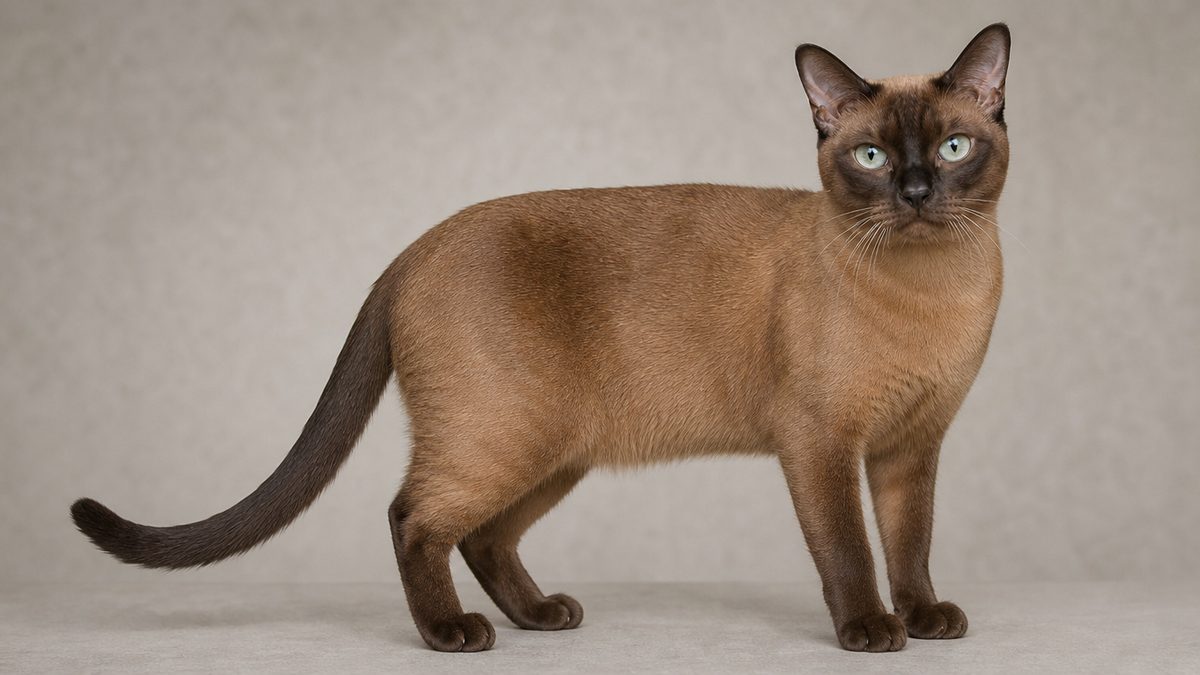
The Tonkinese is a medium-sized short-coated cat created by crossing the Siamese and the Burmese, built to sit exactly between them in body, head and coat contrast.
Start with the design brief, because this breed is one of the few whose whole point is a compromise. CFA describes the ideal Tonkinese as intermediate in type, neither cobby nor svelte, giving the overall impression of an alert active cat with good muscular development that should feel surprisingly heavy when lifted. The GCCF says the same in its own words, calling for medium build and foreign type with head, body, legs, feet and tail in proportion.
The head is a modified, slightly rounded wedge somewhat longer than it is wide, with high gently planed cheekbones, a blunt muzzle as long as it is wide, a slight whisker break and a slight stop at eye level, and in profile the chin tip lines up with the nose tip in the same vertical plane. Ears are alert and medium, oval-tipped, broad at the base and set as much on the sides of the head as on the top, with hair so short that the leather may show through.
The history, and the cat both registries agree about
Most Tonkinese descend from one animal. CFA records that Wong Mau, a small compact walnut-brown female with darker areas on head, legs and tail, was brought to America in 1930 and was eventually determined to be a natural mink Tonkinese. Bred to Siamese she produced three distinct kitten types, and the solid brown ones founded the Burmese breed while those resembling her were used to produce more Tonkinese. TICA tells the same story more bluntly, saying Wong Mau is often considered the first Burmese but is now recognised as the first Tonkinese, although the breed had yet to be defined.
The modern breed was built twice, in two countries, at about the same time. TICA credits Jane Barletta in the United States, who wanted a cat between the two extremes, and Margaret Conroy in Canada, who bred a shy English Burmese female to a Siamese on a judge's suggestion and was fascinated by the resulting tan coats and aqua eyes, and records that the two then worked together.
TICA states that the breed appears in The Cat-Book Poems of Siam from the Ayudha Period, which it dates 1358 to 1767. CFA dates the same manuscript to 1350 to 1767 on its Korat page, and so does the general reference literature. Eight years is not important in itself, but it is a reminder that a registry's history section is prose rather than a register, and that this manuscript is invoked by several Thai-linked breeds with slightly different dates each time.
Recognition dates, which are unusually precise for this breed
CFA prints a clean chronology. The breed first achieved recognition in Canada in 1960; a concerted effort by breeders on both sides of the border led to acceptance for CFA registration in 1982; mink-patterned cats were accepted for championship competition in 1984; and the pointed and solid colours were not able to join them until 2002.
That last date matters more than it looks. For eighteen years the CFA show ring held only one of the three patterns the breed produces, which is why so much writing about the Tonkinese treats mink as the breed and the other two as variants. They are not variants. They are the two homozygous outcomes of the same cross.
Origin is the one field the Indian pages get wrong. poodles.in lists the Tonkinese origin as United States, while both major registries record first recognition in Canada in 1960 and a development effort that ran on both sides of the border The International Cat Association.
Registry recognition, checked one body at a time
Five registries hold the Tonkinese and FIFe does not, which is the single most consequential fact about this breed that no ranking page states.
State registry recognition per body rather than as one global claim, because on this breed they genuinely differ. The split is clean and it is checkable in both directions.
The CFA instrument is the cleanest positive one. That body runs one breed council per recognised breed, and its 2026 candidate list names two declared Tonkinese breed council secretary candidates among 32 shorthair councils. Each body's breed standard is then a separate document again, and the three that publish a full one, the CFA, TICA and the GCCF, agree on body type and disagree on eye colour, which the next section sets out.
| Registry | Status | The document that settles it |
|---|---|---|
| CFA | Championship since 1984 for mink, 2002 for pointed and solid | The 2026 breed council candidate list names two declared Tonkinese candidates, and CFA publishes a full standard with a 100-point score |
| TICA | Held, with a breed page and full standard | The breed page, read through a 27 July 2026 Internet Archive capture |
| GCCF | Section 5 Group B, standard updated Council June 2025 | Standard of Points, June 2026, pages 248 to 250 |
| LOOF | Championnat oui, shorthair and semi-longhair varieties | The French studbook record for Tonkinois PC et PL |
| WCF | Recognised, code TON | Row 289 of the WCF EMS code table |
| FIFe | Not held | Absent from the 52-code breeds index and from the 54-row 2024 breeding statistics, while both parent breeds appear in each |
The FIFe absence is a real absence rather than an instrument failure, and it was tested from two directions. The FIFe breeds index parses to 52 three-letter EMS codes, two of which are house-cat categories, and there is no Tonkinese row. FIFe's 2024 breeding statistics carry 54 numbered rows whose registration counts sum to exactly the printed total of 96,075, and again there is no Tonkinese row, while Burmese sits at rank 14 with 1,515 registrations and Siamese at rank 17 with 929. Two independent FIFe documents, both with passing in-document controls, both silent on this breed.
The World Cat Federation's EMS map lists the Tonkinese as recognised by WCF, CFA, TICA, ACF, CCCA, GCCF, NZCF, SACC and LOOF, with FIFe absent from that list. On this breed the map's absence is correct, which is worth saying because this site has recorded the same map omitting a genuine recogniser elsewhere. Use the map to know where to look, then confirm in the registry's own documents, and report the result either way.
The longhair variety only one registry holds
LOOF files the breed as Tonkinois PC et PL, poil court et poil mi-long, which is a shorthair and a semi-longhair variety under one breed record. The WCF map carries this separately as row 290, Tonkinese Longhair (Tibetan), code TOL, recognised by LOOF alone. So a semi-longhaired Tonkinese has exactly one register in the world, and a buyer offered one outside France should ask what paperwork is actually on offer.
The outcross permissions that carry an expiry date
LOOF prints three permitted matings for this breed. Tonkinois to Tonkinois is unconditional. Tonkinois to Burmese anglais and Tonkinois to Asian longhair, sepia only and not tipped, are both marked provisional until 1 January 2026. That date has passed, and the record still displayed both lines when it was read on 9 September 2026. Either the permissions lapsed and the page is stale, or they were renewed without the label changing. A buyer relying on an outcross pedigree should ask the studbook rather than the seller.
One caution about the words themselves closes this section. The World Cat Federation's tables carry the string Tonkinese three times: once as a breed at row 289, once at row 358 where colour code 32, mink, is defined as Tonkinese pointed, and once at row 366 where eye colour code 66, aquamarine or turquoise, is defined as Tonkinese eye colour. Two of those three are colour terms, not breed records. Before treating any Tonkinese reference in an EMS document as a breed, check which table it sits in.
The three coat patterns, and why the registries disagree about eye colour
A Tonkinese comes in three coat patterns, pointed, mink and solid, and each one carries a different eye colour, which is the fastest way to tell what you are looking at.
The three patterns are not colours. They are the three possible outcomes of carrying two copies of the Siamese allele, one of each, or two copies of the Burmese allele, and the registries describe them in exactly that order of contrast.
| Pattern | GCCF name | Contrast | Eye colour, GCCF | Eye colour, CFA | Eye colour, LOOF |
|---|---|---|---|---|---|
| Pointed | Colourpointed Pattern (CPP) | Clearly defined contrast between body and points | Clear blue | Blue | Bleus |
| Mink | Tonkinese Colour Restriction (TCR) | A subtle merging, not sharply defined | Greenish-blue or bluish-green | Aqua | Aigue-marine |
| Solid or sepia | Burmese Colour Restriction (BCR) | An even tone lightening gradually to the underparts | Yellow to bluish-green | Green | Ambre |
Read the last row across and the disagreement is plain. For the same solid or sepia pattern, the GCCF asks for yellow to bluish-green, CFA says green, and LOOF says amber Cat Fanciers' Association Livre Officiel des Origines Felines. Three registries, three answers, on a point of the standard that a judge scores. This page publishes the disagreement rather than picking one, because a cat exported between those registries is judged against different eye colour requirements.
The mink pattern, described precisely
The GCCF's Tonkinese Colour Restriction clause is the most careful description available. The colour is expressed as a subtle merging of toning colour from the darker ears, mask, legs, feet and tail to the lighter body colour, and it is quite different from a Burmese Colour Restriction or a Colourpointed pattern. It is important that the difference between the points and body colour is not sharply defined, with the exception of chocolate where there is a notable contrast. Legs and feet may be paler than the other points but should match in tone.
CFA describes what that looks like in a show cat, saying that in mink-patterned cats the eyes will be a beautiful shade of aqua, while solid cats have green eyes and pointed cats have blue eyes. TICA lists the colours the patterns come in, naming seal, chocolate, cinnamon, red, blue, lilac, fawn, cream and their tortoiseshell counterparts.
In the World Cat Federation's own colour tables, code 32 is mink and it is defined as Tonkinese pointed, while code 66 is aquamarine or turquoise and is defined as Tonkinese eye colour. So the word mink names a coat restriction on the GCCF standard, a colour code in the EMS system, and a fur in a wardrobe. If you meet the term in an EMS string, it is describing a pattern, not naming a breed.
What disqualifies a Tonkinese
- Withhold all awards for a coat restriction or colour that does not conform to the standard.
- Withhold all awards for a domed or exaggerated curvature of the forehead.
- Withhold all awards for miniaturisation.
- Withhold all awards for white patches anywhere.
- Withhold certificates for tabby or ghost tabby markings in non-agouti adults, incorrect eye colour for the coat restriction, round eyes, a long narrow or very short wedge, or a straight profile.
Those are the GCCF's own two lists, and the second one is the practical buyer's checklist. A round-eyed Tonkinese with a straight profile is a cat, not a fault to argue about, but it is not a show cat and it should not carry a show price.
Tonkinese cat price in India, and the arithmetic that gives it away
The Tonkinese cat price in India is printed as Rs 25,000 to Rs 45,000 by two Indian sites, and those two sites are one source, because they agree to the rupee on five separate quantities.
This is the rare case where a breed does have an Indian number attached to it, and the number turns out to be more interesting than a blank would have been. Two Indian breed-content sites carry Tonkinese pages, and both print the same figures.
| Figure | poodles.in | happypet.care |
|---|---|---|
| Buying price | Rs 25,000 to Rs 45,000 | Rs 25,000 to Rs 45,000 |
| Average monthly | Rs 2,800 to Rs 4,200 | Rs 2,800 to Rs 4,200 |
| Monthly food | Rs 1,500 to Rs 2,000 | Rs 1,500 to Rs 2,000 |
| Ideal weather | 20 to 30 degrees C | 20 to 30 degrees C |
| Life expectancy | 12 to 16 years | 12 to 16 years |
Two unrelated publishers agreeing exactly on five separate quantities is not two confirmations. It is one number that has been copied, or two sites drawing on one upstream table happypet.care, Tonkinese Cat breed page. Genuinely independent sources disagree at the edges. These do not disagree anywhere.
The arithmetic test, which one of them fails
poodles.in prints a monthly expense summary in components as well as a total, which makes it checkable. For the Tonkinese it gives monthly care Rs 2,800 to Rs 4,200, food Rs 1,500 to Rs 2,000, grooming Rs 1,200 to Rs 1,500 and health Rs 500 to Rs 700. Add the three components at the low end and you get Rs 3,200, against a printed floor of Rs 2,800. The total is Rs 400 lower than its own parts.
Run the same test on the same site's Persian page and it closes exactly. Food Rs 1,500 to Rs 2,000, grooming Rs 800 to Rs 1,500, health Rs 500 to Rs 700, giving Rs 2,800 at the floor and Rs 4,200 at the ceiling, matching the printed band at both ends.
The Rs 2,800 to Rs 4,200 total is a fixed preset that does not recalculate when a component line changes. On the Persian the components happen to sum to it; on the Tonkinese the grooming floor was moved from Rs 800 to Rs 1,200 and the total stayed put, leaving the page contradicting itself by exactly the difference. Do not budget from a monthly figure that its own page cannot reconstruct.
The division tests, run and reported
Rs 25,000 divided by 84.38 is 296.28, by 80 is 312.50 and by 74 is 337.84. Rs 45,000 divided by the same three rates gives 533.30, 562.50 and 608.11. None of those is a figure a seller would print, so this band is rupee-native rather than a converted dollar list. The 80 result proves nothing on its own, because any figure ending in three zeros divides cleanly at 80 by construction.
What the commercial query actually returns
India's leading cat-price guide, dated 25 March 2026 and reviewed by a named veterinarian, carries a 16-breed quick-reference table and the word Tonkinese appears zero times across its 50,834 extracted characters, while Persian appears 22 times and Bengal 16. The one marketplace ranking for the Indian query is thepedigreepaws.com, which carries a +44 United Kingdom telephone number, a registration gate, and zero rupee figures in 23,363 characters of page text, and which serves a comparable page for the Korat and the Peterbald as well, so it generates one page per breed.
The international pages that rank alongside them publish no Indian figure at all, which is worth knowing before a reader keeps looking. Cats.com runs an FAQ asking how much a Tonkinese cat costs with no rupee anywhere, Life and Cats devotes an H3 to how much Tonkinese cats cost and answers it in another currency, and Purina's guide covers history, nutrition and grooming with no price of any kind and no Indian content. A pedigreed cat is expensive in every market that genuinely has one, and India's leading guide simply does not list this breed.
So the honest position is this. A number exists, it is Rs 25,000 to Rs 45,000, it comes from one source wearing two names, and no Indian listing sits behind it. Treat it as a published claim rather than a market rate, and do not pay a deposit against it.
The monthly cost of ownership in India, with one line that is not ordinary
A Tonkinese costs the same to keep as any short-coated cat in India, with one exception that belongs in the budget from day one, which is the diabetes risk.
Grooming costs nothing, feeding is ordinary, and vaccination is the same schedule as any other cat. The line that separates this breed from the rest of the cluster is the possibility of a lifelong endocrine condition, and it is worth planning for rather than discovering.
| Item | Price | Source and scope |
|---|---|---|
| Kitten course, three visits | From Rs 3,999, listed against a struck-through Rs 5,065 | One national clinic chain's national page, 11 cities |
| Adult annual booster, CRP plus anti-rabies | From Rs 1,899, listed against Rs 1,908 | Same chain, same page |
| Anti-rabies alone | From Rs 699 | Same chain |
| CRP alone (Tricat or Feligen) | From Rs 1,249 | Same chain |
| Anti-rabies, Chennai municipal clinics | Free | Greater Chennai Corporation, six named pet clinics |
| Pet licence, Chennai | Rs 50 | Greater Chennai Corporation, 9,115 issued in 2024 |
| Professional grooming | Not required | A short close-lying coat needs a rubber brush, not a salon |
Those vaccination figures are promotional floors from one chain rather than a market average, and the same chain has been observed quoting different course prices on different city pages on the same day. Re-check your own city's page before you budget from them.
The line most Indian buyers do not budget for
Diabetes mellitus is not a rare disease in cats. Its period prevalence across 193,435 cats attending English primary-care practices was 0.58 percent, which the authors describe as one cat in 200, and the Tonkinese carried 4.1 times the odds of crossbred cats, the highest breed figure in that study. In India, insulin, needles, a glucometer and repeat curves are out-of-pocket costs with no insurance backstop for most owners.
The same study found that diabetes odds increased as bodyweight categories increased above 4 kg and as cats aged beyond six years. Bodyweight is the only one of those an owner controls. A measured ration, a food-puzzle feeder and a monthly weigh-in cost almost nothing and are the cheapest insurance available for a breed with this odds ratio.
- Budget Rs 4,000 for the first-year kitten course, then about Rs 1,900 a year for boosters at private-chain floors.
- Budget nothing for professional grooming, since a rubber brush two or three times a month is the whole routine.
- Budget for a kitchen scale and a monthly weigh-in, which is the only diabetes control an owner has.
- Budget for wet food daily, which raises water intake and matters for a breed associated with calcium oxalate stones.
- Budget for neutering once, which is the single largest evidenced survival intervention for any cat.
One population figure belongs in every Indian cat budget. Entire cats carried 4.29 times the odds of death before three years compared with neutered cats, with a confidence interval of 3.72 to 4.95, across the whole UK cat population under primary veterinary care. Neutering costs less than one year of the private vaccination route and buys more.
Heat tolerance: two tropical parent breeds and one thin coat
The Tonkinese handles Indian heat well, and the reason is that both of its parent breeds come from tropical Southeast Asia while the coat itself is short, fine and close-lying with no undercoat.
This breed has no homeland of its own, since it was created in North America. What it has is two ancestral climates, and both of them are hotter and at least as humid as most of urban India. Both points were queried from NASA POWER by explicit latitude and longitude with the model cell elevation echoed back, and both cells are lowland cells describing the places they claim to describe: Bangkok at 4.48 m and Yangon at 10.91 m.
| Place | Cell elevation | Annual mean T2M | Annual mean RH2M | Hottest month | Coolest month |
|---|---|---|---|---|---|
| Bangkok, Thailand (Siamese homeland) | 4.48 m | 27.85 C | 74.45 percent | April, 30.73 C | December, 24.95 C |
| Yangon, Myanmar (Burmese homeland) | 10.91 m | 28.07 C | 68.43 percent | April, 32.58 C | December, 25.26 C |
| Chennai | 48.95 m | 27.95 C | 72.39 percent | May, 31.51 C | January, 24.09 C |
| Mumbai | 97.15 m | 26.77 C | 67.39 percent | May, 31.19 C | January, 23.19 C |
| Kolkata | 7.35 m | 25.81 C | 73.93 percent | May, 31.53 C | January, 17.31 C |
| Hyderabad | 494.59 m | 26.10 C | 60.30 percent | May, 33.30 C | December, 20.76 C |
| Bengaluru | 841.72 m | 23.74 C | 67.94 percent | April, 28.37 C | December, 20.22 C |
| Delhi | 206.37 m | 25.60 C | 45.56 percent | June, 35.88 C | January, 13.61 C |
Chennai sits within 0.1 degrees of Bangkok's annual mean and within 0.12 of Yangon's, at almost the same humidity as Bangkok. An Indian coastal city is, on the annual figures, the ancestral climate of both parent breeds. That is the strongest heat argument available for any imported cat, and it is why the heat tolerance rating on this page is the highest one on the scale.
Where the two Indian pages get the weather band wrong
Both Indian template sites print an ideal weather band of 20 to 30 degrees C for this breed happypet.care, Tonkinese Cat breed page. Bangkok's coolest month averages 24.95 and its hottest 30.73, and Yangon's hottest averages 32.58. The ancestral climate spends part of the year above the top of the band those pages recommend. Take the band as a comfort guideline for an air-conditioned flat, not as a limit on where the cat can live.
Neither ancestral city has a month averaging below 24.95 degrees C. Delhi's January mean is 13.61 and Kolkata's is 17.31. A short fine single coat has no reserve for that, so a north Indian winter is the season this breed actually needs help with. Provide a warm covered bed and keep the cat off cold floors between December and February.
- Provide shaded floor space and airflow rather than cold air, because a cat will find its own temperature if given options.
- Provide multiple wide water bowls away from the food, which matters doubly for a breed linked to calcium oxalate stones.
- Provide a warm bed from December to February in the north, which is the genuine climate gap for this coat.
- Provide indoor life, since a homebound cat avoids both Indian traffic and the parasite load of outdoor roaming.
- Provide early morning and post-sunset play in the hot months, keeping exertion out of the afternoon.
Temperament and household fit
The Tonkinese is an outgoing, people-driven cat that suits a busy family household and does badly in an empty one, and one registry recommends buying two.
CFA describes Tonkinese as intelligent, gregarious and generally quite outgoing, operating on the principle that humans were put on this earth to love them, and quite naturally taking possession of a lap or shoulder to supervise every activity. It adds that they have excellent memories and quickly learn what you do not want them to do, then notes drily that in Tonk-think the word no means okay to do when Mom is at work.
Enthusiastic owners, in CFA's own phrasing, describe the breed as part puppy, part monkey and part elephant, the last referring to a tendency to run through the house at a noisy gallop. They get along well with dogs, other pets, children and guests, and will greet visitors at the door.
The registry that tells you to buy a second cat
TICA describes a smart, active cat that likes to jump to high places and master puzzle toys, that loves people and laps, and that fits well in homes with other pets and children. Then it adds the sentence a buyer should act on: they do not like to be left alone, so consider a second cat to keep them company when their human is away.
That is unusual. A registry advising a prospective owner to acquire two animals rather than one is a strong statement about the breed's tolerance of solitude, and in an Indian household where both adults commute it is the decisive consideration.
- Choose a Tonkinese if the household is busy and sociable, because this cat wants to be in the middle of it.
- Choose a Tonkinese if there are already cats or a cat-friendly dog, since both registries describe easy integration.
- Choose two, or choose a different breed, if the flat is empty from morning to evening.
- Choose carefully if a quiet home is a requirement, because CFA describes vocalisation in complete sentences.
- Choose deliberately on the diabetes risk, because this is a cat whose weight an owner has to actively manage.
How vocal, exactly
The two registries disagree slightly and the difference is useful. CFA says Tonkinese vocalise not just with meows and purrs but in complete sentences that require a prompt response, adding that it is usually very clear what they are trying to communicate. TICA is more moderate, saying they are known to be a talkative social breed that speaks when spoken to but does not vocalise every move, and that they are not as vocal as a Siamese. Expect conversation, not a Siamese.
Training a Tonkinese, and what it resists
To train a Tonkinese, use its own game, because this is one of the few cat breeds with a measured tendency to fetch.
Fetching is not a party trick in this breed, it is a documented breed effect. A survey of 8,224 cat owners found fetching reported in 40.9 percent of cats, and breed effects were observed with fetching more prominent in cat breeds originating in the Far East, the authors naming the Burmese, the Siamese and the Tonkinese together. In cats, fetching correlated with play and activity rather than with trainability, which is the practical point: this is a game the cat starts.
TICA describes the same behaviour from the other side, saying Tonkinese love to invent and play games from fetch with a favourite toy to tag with other cats, and that they are intelligent cats with a long memory and a strong will, so persistence pays off when training them.
- Start with fetch, because a breed-level tendency means you are joining a game rather than teaching one.
- Add recall second, using one word and a reward the cat genuinely wants, since memory is the registries' repeated observation.
- Add puzzle feeders third, which meet the stimulation need and slow eating for a breed at raised diabetes risk.
- Add carrier training fourth, in short sessions with the door open, months before the first vaccination visit.
- Add a scale routine last, weighing monthly, which turns weight management into a habit rather than a crisis.
What this breed resists
Being contradicted, and being left out. CFA's observation that a Tonkinese learns what you do not want it to do and then does it when you are out is a description of a cat that is training you back. Management works better than correction here. Put the counter food away, close the door, and give the cat something better to do.
One training goal has a medical payoff. A cat that accepts handling of its paws, mouth and scruff without a fight is a cat a vet can take a blood glucose reading from, and for a breed carrying 4.1 times the crossbred odds of diabetes that is not a cosmetic skill. Start it in kittenhood.
Daily exercise for a cat that will start the game itself
A Tonkinese needs two or three interactive sessions a day, and unusually for a cat, it will initiate most of them.
TICA describes a smart, active cat that is intelligent and active but does not bounce off the walls or engage in much mischief, that likes to jump up to high places and master puzzle toys, and that suits an assortment of interactive toys to keep mind and body exercised. CFA's noisy gallop description says the same thing less politely.
The exercise argument here is not about fitness for its own sake. It is about weight, and weight is the one diabetes risk factor an owner controls, since the odds rose with every bodyweight category above 4 kg in the 193,435-cat study.
- Provide two interactive sessions a day of ten to fifteen minutes, using wand toys rather than laser pointers.
- Provide a throwable toy the cat can retrieve, because fetching is a documented breed effect rather than a novelty.
- Provide vertical space in every room the cat uses, since jumping to high places is what both registries describe.
- Provide puzzle feeders on working days, which convert the daily ration into activity.
- Provide a second cat if the household is out all day, which is TICA's own recommendation for this breed.
Move interactive sessions to early morning and after sunset from March to June across the plains. The ancestral climate is hot, but exertion at a Delhi June mean of 35.88 degrees C or a Hyderabad May mean of 33.30 is a different matter from resting in it. A cat that is well adapted to ambient heat is not thereby adapted to sprinting in it.
There is no published Tonkinese-specific exercise requirement and this page does not invent one. What is published is the direction of travel on weight: lifespan fell by 0.02 years for every 100 g of deviation from the median adult bodyweight within a cat's breed and sex group. Play is how an indoor cat stays near that median.
Grooming a short silky coat in Indian humidity
Grooming a Tonkinese takes a rubber brush two or three times a month, because the coat is short, fine, soft and close-lying with a healthy sheen and no undercoat to manage.
The GCCF describes the coat in five words that settle the question: close lying and short, fine, soft, silky with a healthy sheen. CFA adds the useful detail that these cats tend to be seasonal rather than year-round shedders, and recommends grooming with a rubber brush two or three times a month to keep shedding to a minimum and condition the coat. TICA suggests a weekly once-over with a rubber brush and an occasional bath.
For an Indian household that is a genuinely low-maintenance coat. There is no dense underlayer to hold damp through a monsoon, nothing to blow out in April, and no reason to book a salon.
| Task | Frequency | Indian cost |
|---|---|---|
| Rubber brush over the coat | Two or three times a month | One brush, once |
| Nail trim | Every three to four weeks | Free at home, or with a clinic visit |
| Ear check | Weekly during the monsoon | Free |
| Tooth brushing | Two or three times a week | One brush and feline paste |
| Professional grooming | Not required | Rs 0 in a normal year |
The one grooming task that is really a health task
Tooth brushing belongs on the list because CFA names dental disease as this breed's only breed-specific health concern, describing a tendency towards gingivitis in older cats and adding that it may be possible to prevent this by getting a Tonkinese accustomed to having its teeth brushed while young. PetMD's Tonkinese page also opens its health block with dental disease. A cat that accepts a toothbrush at four months is a cat that will still accept one at ten years.
No Tonkinese standard contemplates a clipped coat, and the coat is sun protection rather than insulation. The GCCF withholds all awards for white patches anywhere and withholds certificates for tabby or ghost tabby markings in non-agouti adults, and a clipped coat regrows unevenly in both pattern and tone. If a salon offers a summer clip for a short-coated cat, decline it.
One grooming claim to leave alone is the allergy one. A short close-lying coat sheds less visibly, which makes a home easier to keep clean, and that is all it does. The 2024 review states plainly that to date there is no scientific evidence for a hypoallergenic cat breed, and that even hairless Sphynx cats produce Fel d 1.
Health: three raised risks, one lowered risk, and a test worth running
The Tonkinese carries the highest breed odds of diabetes mellitus in the largest study of the question, the second highest odds of dystocia in any cat breed, and a raised risk of calcium oxalate stones, against one clearly reduced risk.
This is a well-studied breed, and the picture is specific enough to act on rather than a list of generic conditions. Everything below names the study, the population and the confidence interval.
| Finding | Effect size | Population | Study |
|---|---|---|---|
| Diabetes mellitus | OR 4.1 (1.8 to 9.6), highest breed OR in the study | 193,435 cats in English primary-care practices | O'Neill 2016 |
| Dystocia | OR 8.27 (2.92 to 23.43), second highest of any breed | 118,168 queens under UK emergency care | Leicester 2026 |
| Upper urinary tract uroliths | OR between 1.92 and 3.31 vs non-purebred | 11,431 referred cats over 10 years | Geddes 2023 |
| Calcium oxalate bladder stones | Significantly associated vs domestic shorthairs | 21,426 urolith submissions, 1998 to 2014 | Houston 2016 |
| Hyperthyroidism | OR 0.05 (0.00 to 0.95), a decreased risk | 4,705 cats aged 10 or over at one UK hospital | Crossley 2017 |
Diabetes, which is the finding that should change an owner's behaviour
In a cohort of cats attending English primary-care practices, multivariable modelling gave the Tonkinese an odds ratio of 4.1 with a 95 percent confidence interval of 1.8 to 9.6 and a P value of .001, ahead of the Norwegian Forest at 3.5 and the Burmese at 3.0, all against crossbred cats. Period prevalence across the whole cohort was 0.58 percent, which the authors describe as one cat in 200, and the odds rose with bodyweight above 4 kg and with age beyond six years.
One caution about that paper, offered because this site checks arithmetic rather than assuming it. Its abstract prints three different denominators for its own cohort: 193,435 in the title, 193,563 in the methods and 194,563 in the results. The odds ratio is unaffected by which one is right, and this page quotes the title figure while naming the inconsistency rather than hiding it.
Increased thirst, increased urination, a bigger appetite with weight loss, or a change in gait to a flat-footed hocks-down walk are the signs that need a same-week appointment rather than observation. Consult your nearby vet rather than a search engine, and mention the breed, because a 4.1 odds ratio changes what a clinician looks for first.
Dystocia, the 2026 finding nobody has picked up
Anyone thinking about breeding a Tonkinese in India should read one paper first. Among 118,168 queens under UK primary emergency veterinary care, 1,102 dystocia cases were identified, an incidence risk of 0.93 percent, and purebred queens carried 2.53 times the odds of crossbred queens. The individual breeds with the highest odds were the Devon Rex at 10.38 and the Tonkinese at 8.27, with a confidence interval of 2.92 to 23.43.
The outcomes are the part that matters. Caesarean section was performed in 394 of 1,102 queens, 38 of 1,102 dystocic queens died, and the neonatal mortality rate was 1,072 of 2,784 kittens born across all dystocia cases, 38.51 percent. In a country where a 24-hour surgical facility is not available in every city, that risk profile is an argument against casual breeding rather than a footnote to it.
The Burmese inheritance, and the one cheap test
Hypokalaemic polymyopathy is a genetic disease of Burmese cats, caused by a single nonsense mutation in WNK4 coding for lysine-deficient 4 protein kinase, an enzyme present primarily in the distal nephron, so the underlying mechanism is a potassium-wasting nephropathy. Affected cats usually present with muscle weakness and pain in the first year of life, and ventroflexion of the head and neck is especially characteristic although not universal.
The review names this breed explicitly rather than by inference. Diagnosis is now straightforward because an inexpensive PCR test identifies affected homozygous individuals as well as carriers, and the authors write that eliminating the condition from the Burmese breed and also from pedigree cats infused with Burmese lines, such as the Bombay, Tonkinese and Tiffanie breeds, should therefore be possible. Carrier testing on both parents is the ask.
Stones, seizures and lifespan
Two independent urolith studies place this breed at raised risk. In 21,426 feline bladder urolith submissions to the Canadian Veterinary Urolith Centre between 1998 and 2014, Tonkinese, Burmese, Devon Rex, Himalayan, Persian and Siamese cats were significantly associated with calcium oxalate urolith submission compared with domestic short-haired cats. In a referral population of 11,431 cats over ten years, of which 521 had upper urinary tract uroliths, British Shorthair, Burmese, Persian, Ragdoll and Tonkinese carried odds ratios between 1.92 and 3.31 against non-purebred cats. Wet food and plentiful water are the practical response.
A single 2025 case report describes generalised motor tonic seizures with paroxysmal fast activity on EEG in a Tonkinese cat, classified as idiopathic epilepsy and meeting the criteria for drug-resistant epilepsy. One case is not a breed risk, and this page does not present it as one; the useful context from that paper is that epilepsy affects 1 to 2 percent of the feline population generally.
On lifespan, no breed-specific life table exists. Teng 2024 reports 12 breed rows and the Tonkinese is not among the 12 breeds that reached the threshold of 15 or more deaths, so it carries no median from that work. TICA states 12 to 16 plus years with proper care, and the two Indian template pages print 12 to 16, which is the same figure repeated rather than corroborated happypet.care, Tonkinese Cat breed page.
Feeding a Tonkinese in India
Feed a Tonkinese on a measured ration with wet food every day, because the two conditions this breed is measurably prone to are both influenced by weight and water intake.
There is no Tonkinese diet, and the ranking pages that imply one are guessing. What exists is two evidence trails that both point at the food bowl. Diabetes odds rose with every bodyweight category above 4 kg, and two urolith studies place the breed at raised risk of calcium oxalate stones Geddes RF, Davison LJ, Elliott J, Syme HM. Portion control answers the first and water intake helps the second.
- Weigh the cat monthly in its carrier, subtract the carrier, and write the number down where you will see it.
- Measure every meal rather than free-feeding, because a muscular medium-sized cat hides weight under a close coat.
- Include wet food daily, which is the cheapest urinary intervention available to an Indian owner.
- Split the ration into two or three measured meals, which suits a cat that eats when it is bored.
- Discuss any prescription urinary or weight-control diet with your vet rather than buying one on a search result.
What the Indian pages claim about calories
Both Indian template sites print 300 kcal a day for kittens and 250 for adults, alongside a food line of Rs 1,500 to Rs 2,000 a month happypet.care, Tonkinese Cat breed page. The same two numbers appear on the same sites' Persian pages, so this is a site-wide default rather than a breed calculation. Use it as an order of magnitude and set the actual ration by body condition and by your vet's advice.
Cats eat less and drink more in heat, and both are normal. Between March and June, watch water intake rather than appetite, and move the larger meal to the evening. A cat with a raised stone risk that stops drinking in a heatwave is a genuine problem, so put out more bowls than seem necessary and refresh them twice a day.
One further point belongs here. Obesity appears on PetMD's own list of Tonkinese health issues alongside dental disease and kidney disease, and it is the only item on that list with a measured breed-level consequence behind it in the peer-reviewed literature. Take it seriously in a way the ranking pages do not.
Kitten timeline: month by month through the first year
A Tonkinese kitten's first year has four checkpoints, the vaccination course, the WNK4 carrier question, the neutering decision and the start of a weight routine that will matter for the rest of its life.
| Age | What is happening | What to do |
|---|---|---|
| 0 to 8 weeks | With the mother and litter; pattern and eye colour still developing | Nothing. A kitten should not leave its mother in this window |
| 2 months | Homecoming at the earliest; first vaccination visit | Start the kitten course, listed from Rs 3,999 for three visits at one national chain |
| 3 months | Play drive climbing; tooth brushing should start now | Introduce a toothbrush, because dental disease is the breed's named concern |
| 4 months | Third vaccine visit including anti-rabies | Complete the course; begin carrier training in short sessions |
| 5 to 6 months | Rapid growth; the fetch instinct usually appears | Two interactive sessions daily; start the monthly weigh-in habit |
| 6 to 9 months | Sexual maturity approaches | Discuss neutering, the largest evidenced survival intervention for any cat |
| 9 to 12 months | Frame fills out; adult coat contrast settles | Switch to adult feeding on veterinary advice; keep weighing monthly |
| 12 months | First adult health check | Ask for a baseline body condition score and a note of adult weight |
| Beyond 12 months | Adult maintenance | Hold weight near the adult median, since diabetes odds rise with every category above 4 kg |
Two of those rows are breed-specific rather than generic. Tooth brushing starts early because CFA identifies gingivitis in older cats as the only breed-specific health concern and says it may be preventable by starting young. The weigh-in habit starts early because the diabetes odds ratio is the highest of any breed in the study that measured it, and bodyweight is the modifiable term in that equation.
Ask for the WNK4 hypokalaemia PCR result on both parents in writing. The condition is autosomal recessive, so two clear parents cannot produce an affected kitten, and the review that mapped it names the Tonkinese among the breeds infused with Burmese lines from which it could be eliminated. Signs usually appear in the first year of life, with muscle weakness and pain and often ventroflexion of the head and neck.
Neutering deserves its own line rather than a footnote. Entire cats carried 4.29 times the odds of death before three years compared with neutered cats, with a confidence interval of 3.72 to 4.95, across the whole UK cat population under primary veterinary care. For a queen there is a second argument, because the dystocia odds for this breed are the second highest of any.
Tonkinese against the two breeds it was made from
The Tonkinese sits between the Siamese and the Burmese by design, and the comparison that matters for an Indian buyer is which of the three is actually obtainable.
PetMD answers the Siamese question by name in its own FAQ, which is a fair signal of what buyers ask. The answer is contrast and eye colour, then body type.
| Breed | Body type | Contrast | Eye colour | FIFe registrations 2024 | Indian price published |
|---|---|---|---|---|---|
| Siamese | Svelte, foreign | Sharply defined points | Deep blue | 929, rank 17 | Rs 15,000 to Rs 40,000 |
| Tonkinese (mink) | Intermediate, neither cobby nor svelte | Gradual merging, not sharply defined | Aqua | Not held by FIFe | Rs 25,000 to Rs 45,000, from one source |
| Burmese | Cobby, compact | Even tone, lightening to the underparts | Yellow to gold | 1,515, rank 14 | Not in the leading Indian guide |
| Thai | Korat type in non-Korat colours | Pointed or solid depending on colour | Blue or green | 234, rank 24 | None found |
| British Shorthair | Cobby, dense crisp coat | Not applicable | Copper to gold | 16,278, rank 2 | Rs 20,000 to Rs 60,000 |
The health comparison, which cuts the other way
The Tonkinese does not simply inherit the average of its parents' risks. It carries a higher diabetes odds ratio than the Burmese in the same study, 4.1 against 3.0, and it appears alongside the Burmese and the Siamese in both urolith studies Geddes RF, Davison LJ, Elliott J, Syme HM. On hyperthyroidism it does better than the domestic shorthair baseline, and so do all three of the family.
The one thing that clearly transfers from the Burmese side is the WNK4 mutation, and it transfers as a testable carrier state rather than as a certainty. That is the difference between an inherited risk and an inherited disease, and it is why the test matters.
The honest availability answer
Of the five cats in that table, three have a published Indian price in a source that carries more than one breed: the Siamese at Rs 15,000 to Rs 40,000 and the British Shorthair at Rs 20,000 to Rs 60,000, both from India's leading guide. The Tonkinese has a price only from two sites printing the same template row happypet.care, Tonkinese Cat breed page. A reader who wants this look and this temperament in India has a genuinely easier route through the Siamese or the Burmese.
What Indian owners and Indian pages get wrong about this breed
Five errors recur, and three of them are on the two pages an Indian reader is most likely to meet first.
- Treating two Indian sites as two sources. They print identical price, monthly, food, weather and lifespan figures, so they are one number.
- Budgeting from a monthly total the page itself cannot reconstruct, which on the Tonkinese row is out by Rs 400.
- Accepting Polycystic Kidney Disease as a Tonkinese condition because an Indian page lists it, when the same page lists it for the Persian too.
- Assuming FIFe recognition because five other registries hold the breed, when FIFe does not hold it at all.
- Ignoring weight, which is the one diabetes risk factor an owner actually controls.
The health list that travelled from another breed
poodles.in lists Polycystic Kidney Disease as a common health issue for the Tonkinese and recommends a DNA test for screening. Its Persian page lists the same condition in the same words. PKD has a genuine, long-established association with the Persian and its derivatives; a template that assigns it to a Siamese and Burmese cross without a source is repeating a heading, not reporting a risk. The conditions with actual breed-level evidence in the Tonkinese are diabetes, dystocia and calcium oxalate stones, and none of the three appears on either Indian page Leicester L, O'Neill DG. Dystocia in cats… Houston DM, Vanstone NP, Moore AE.
PetMD's Tonkinese article carries an H3 heading reading Burmese Cat Behavior inside its behaviour section. That is a leftover from another breed's page, and it is the same class of defect as the Indian PKD row: content assembled from a template rather than written for the breed. Read the heading structure of any breed page before trusting its health list.
One thing Indian buyers get right
Indian readers ask about heat before anything else, and on this breed the answer is genuinely reassuring. Both parent breeds come from cities whose annual means are within 0.12 degrees of Chennai's, and the coat is short, fine and single. The instinct to check is correct, and the answer this time is good news.
Adoption, import and the honest recommendation
No verified Indian Tonkinese breeder or listing exists, so the two real routes are to adopt a cat that needs a home or to import one lawfully as a personal pet.
This page will not send a reader to a breeder. It can set out what the lawful routes are, so that nobody pays a deposit against a template row.
The import route, in the government's own words
Import of live animals including cats is restricted in India and permitted only with an authorisation from the DGFT, using ITC(HS) code 01061900 for pet animals. Applications are considered by an Exim Facilitation Committee that meets once a month, and import of pet animals is allowed only through the airports and seaports of Delhi, Mumbai, Chennai, Hyderabad, Bengaluru and Kolkata and, since October 2024, Kochi airport, with quarantine at the port where required Department of Animal Husbandry…. Import without authorisation is allowed for people shifting residence permanently to India under the customs baggage rules. The full route, which covers cats too, is set out in how to import a dog to India.
That is a mechanism for bringing your own cat with you. It is not a mechanism for ordering one, and any Indian seller who offers to arrange it should be asked to name the authorisation.
- Adopt an Indian shorthair from a local shelter, which is the cheapest route and the one that helps most.
- Adopt an adult rather than a kitten if the household is out during the day, since an adult's temperament is already known.
- Verify the register, the cattery prefix and the sire and dam before any money changes hands.
- Verify a WNK4 hypokalaemia PCR result on both parents if the pedigree carries Burmese lines.
- Verify that any longhaired Tonkinese offered has paperwork from the one studbook that actually holds that variety.
What an Indian shelter cat gives you instead
The cost comparison is not close. A pet licence in Chennai costs Rs 50, the Corporation issued 9,115 of them in 2024, and its six municipal pet clinics provide all treatment and anti-rabies vaccination free of cost. A private kitten course starts at Rs 3,999 and an annual booster at Rs 1,899. An adopted Indian cat can be fully vaccinated and licensed for less than one private vaccine package.
The evidence comparison points the same way. Crossbred cats lived 1.27 years longer than purebred cats on average, and purebred cats had 1.83 times the odds of dying before three years, in the largest study of the UK cat population. Those are population figures rather than a verdict on any individual animal, and they are the only figures anyone has.
If what you want is an outgoing, talkative, short-coated cat that suits Indian heat and a busy family, adopt, and adopt two if the house is empty by day. If you specifically want a Tonkinese, plan a lawful personal import, ask for a WNK4 carrier result on both parents, budget for lifelong weight management, and do not breed from a queen without reading the dystocia figures first Malik R, Musca FJ, Gunew MN, Menrath VH Leicester L, O'Neill DG. Dystocia in cats….
Readers who arrive here from the Korat are usually comparing Thai-linked cats, and readers who arrive from the Burmilla or the Bombay are usually tracing the Burmese line. Both of those roads lead to the same practical question, which is whether the cat you can actually obtain in India is a better answer than the cat you cannot.
Tonkinese cat questions people actually ask
What is the Tonkinese cat price in India?
Two Indian sites print Rs 25,000 to Rs 45,000, and they are not two sources. poodles.in and happypet.care publish the identical buying band, the identical Rs 2,800 to Rs 4,200 monthly figure, the identical Rs 1,500 to Rs 2,000 food line, the identical 20 to 30 degree weather band and the identical 12 to 16 year lifespan. Two unrelated publishers agreeing to the rupee on five separate quantities is one number copied, not two observations. India's leading cat-price guide does not carry the breed at all.
Are Tonkinese cats expensive?
There is no verifiable Indian market value. The only Indian figures come from two content sites printing the same template row, and the United Kingdom marketplace that ranks for the Indian query carries a +44 telephone number and no rupee figure anywhere in 23,363 characters of page text. Bonbeno will not convert a foreign price into rupees, so this page publishes the template and names it as one.
Are Tonkinese cats rare?
Rarer than the search results suggest, and completely absent from one major register. FIFe holds 52 EMS breed codes and the Tonkinese is not among them, while both its parent breeds are, the Burmese at rank 14 with 1,515 registrations in 2024 and the Siamese at rank 17 with 929. The CFA, TICA, the GCCF, LOOF and the WCF all hold the breed, so this is a registry split rather than an absolute rarity.
What is the difference between a Siamese and a Tonkinese cat?
Contrast is the difference you can see, and the eyes tell you which cat you are looking at. A Siamese carries a sharply defined mask with deep blue eyes. A mink Tonkinese carries points that merge gradually into the body colour with aqua eyes, and the GCCF standard states that the difference between points and body must not be sharply defined. The Tonkinese body is also intermediate, neither svelte like the Siamese nor cobby like the Burmese.
Are Tonkinese cats friendly?
Yes, to an extent that is written into the registries' own descriptions. CFA says Tonkinese get along well with dogs, other pets, children and guests and will greet visitors at the door. TICA calls them friendly and open enough to suit families with children, other cats or cat-friendly dogs. Both add the same warning, which is that they do not tolerate being left alone, and TICA suggests a second cat for company.
Do Tonkinese cats like to cuddle?
Yes, and both registries describe it in the same terms. TICA says they love the attention of their family and adore sitting in a human lap, while also being stubborn in their quest to get their own way. CFA describes a cat that takes possession of your lap or shoulder to supervise your activity and is sensitive enough to your moods to appear with a comforting purr after a bad day.
What health problems do Tonkinese cats have?
Three raised risks are measured rather than anecdotal. In 193,435 cats attending English primary-care practices, Tonkinese carried 4.1 times the odds of diabetes mellitus against crossbred cats, the highest breed figure in that study. In 118,168 queens, Tonkinese carried 8.27 times the odds of dystocia, second only to the Devon Rex. Tonkinese were also significantly associated with calcium oxalate bladder stones and with upper urinary tract uroliths. The one genuinely good finding is a decreased risk of hyperthyroidism.
How long do Tonkinese cats live?
No breed-specific life table exists. Teng 2024 reports 12 breed rows and the Tonkinese is not among the 12 breeds that reached the threshold of 15 or more deaths, so it carries no median from that work. TICA states 12 to 16 plus years with proper care and the two Indian template pages both print 12 to 16 years, which is the same claim repeated rather than three independent estimates.
Are Tonkinese cats hypoallergenic?
No. The 2024 review of the whole field states that to date there is no scientific evidence for a hypoallergenic cat breed, and that even hairless Sphynx cats produce Fel d 1. Its conclusion adds that molecular analyses of dander across breeds show high individual variation in allergen levels but provide no scientific evidence for the concept of a hypoallergenic cat. A short close-lying coat is easier to live with; it is not an allergy solution.
Do Tonkinese cats play fetch?
More often than most cats, and there is a number behind it. A survey of 8,224 cat owners found fetching reported in 40.9 percent of cats overall, with breed effects showing fetching more prominent in cat breeds originating in the Far East, and the authors name the Burmese, the Siamese and the Tonkinese together. TICA's own page independently says Tonkinese love to invent games including fetch with a favourite toy.
Can you buy a Tonkinese in India?
No verified Indian breeder or listing could be found on 9 September 2026. The lawful route into the country is a personal pet import under a DGFT authorisation using ITC(HS) code 01061900, permitted only through the airports and seaports of Delhi, Mumbai, Chennai, Hyderabad, Bengaluru and Kolkata and, since October 2024, Kochi airport, and considered by a committee that meets once a month. That is a relocation route rather than a purchase route.
Which registries recognise the Tonkinese?
Five hold the breed and one does not. The CFA runs a Tonkinese breed council and accepted the mink pattern for championship in 1984, TICA holds it, the GCCF gives it Section 5 Group B with a standard updated in June 2025, LOOF holds both a shorthair and a longhair variety, and the WCF lists it as TON. FIFe does not hold the Tonkinese at all, and the WCF's cross-registry map correctly records that absence.
Are Tonkinese cats good pets?
Yes, for a household that is home most of the day. CFA says Tonkinese get along well with dogs, other pets, children and guests and will greet visitors at the door, and TICA calls them friendly and open enough to suit families with children, other cats or cat-friendly dogs. Both registries add the same warning, which is that they do not tolerate being left alone, and TICA suggests a second cat for company.
Compare with similar breeds
Tonkinese sits in 1 Bonbeno group. Each one compares it directly against the breeds it is genuinely an alternative to, on the same figures.